

Crypto World
Hyperliquid (HYPE) Surges to Record $64.48 Amid ETF Filings and Buyback Program

Key Highlights
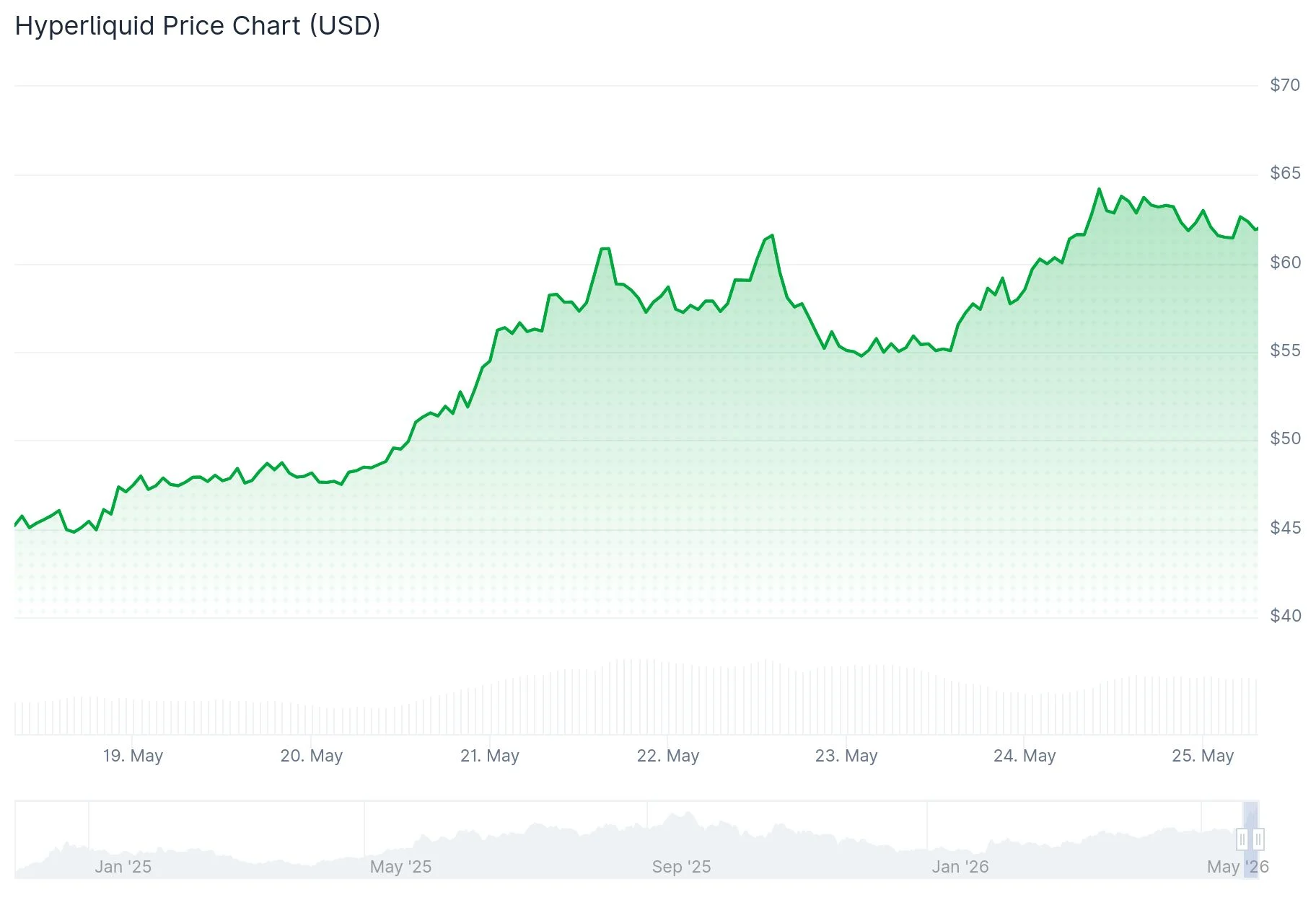
- HYPE token reached an unprecedented peak of $64.48, maintaining levels above $60 through Monday’s trading session
- Institutional investment vehicles from 21Shares, Bitwise, and Grayscale are channeling significant capital, with $72M entering the market last week
- The platform’s innovative buyback mechanism allocates 97–99% of fee revenue toward HYPE token repurchases
- Perpetual futures Open Interest surged to an all-time high of $2.95 billion, indicating robust market participation
- Market analyst Michaël van de Poppe forecasts HYPE could surpass the $100 threshold
Hyperliquid’s native token (HYPE) continues its remarkable ascent, establishing new price records driven by a confluence of institutional adoption, strategic token economics, and expanding platform utility. The digital asset peaked at $64.48 before stabilizing near the $60 level.
The competitive landscape for HYPE-focused exchange-traded products is rapidly evolving. Bitwise introduced BHYP on the NYSE Arca exchange, while 21Shares debuted THYP on Nasdaq. These investment vehicles collectively attracted $72.38 million in fresh capital during the previous week, representing a dramatic increase from the prior week’s modest $2.52 million.
Grayscale has officially entered the competition. According to Bloomberg’s ETF specialist James Seyffart, Grayscale submitted an updated registration document for a HYPE investment trust, proposing the ticker symbol GHYP. The documentation identifies Anchorage Digital Bank as the custodial partner and Bank of New York Mellon as the administrative entity.
Grayscale’s submission incorporates a staking component. Should regulatory authorities approve, the trust may be rebranded as the Grayscale Hyperliquid Staking ETF, potentially offering investors exposure to both price appreciation and staking income.
Token Repurchase Program Generates Sustained Demand
Hyperliquid employs a distinctive economic model that channels 97% to 99% of platform trading fees toward systematic token repurchases from secondary markets. Approximately 210,000 HYPE tokens were acquired through this mechanism during the past week. The platform’s assistance fund currently maintains 44.52 million tokens, with cumulative repurchases totaling 26.81 million HYPE. The aggregate value of all buyback activity has reached $1.16 billion.
Perpetual futures Open Interest climbed to a record $2.95 billion on Monday, according to CoinGlass data. Hyperliquid commands approximately 70% of the decentralized perpetual futures market and represents roughly 7% of total perpetual contract open interest across all trading venues.
Market participant LSTRADER, sharing analysis on X, observed that previous all-time high projections have already materialized. The trader suggested the current strategy involves trend following while capitalizing on temporary retracements, with additional resistance levels now in focus.
New Platform Features Drive Revenue Growth
Hyperliquid’s recently launched HIP-4 prediction market processed 6.05 million contracts on its inaugural day and equaled Polymarket’s two-week Bitcoin binary contract volume within just 48 hours. Additional product offerings generate increased fee revenue, which directly powers the token buyback system.
From a technical analysis perspective, HYPE maintains strong positioning above its 50, 100, and 200-day exponential moving averages. The Relative Strength Index registers at 75, suggesting overbought territory, while the MACD indicator confirms ongoing bullish momentum. Fibonacci extension analysis identifies critical resistance zones at $70.04 and $83.51.
Crypto analyst Michaël van de Poppe has publicly expressed his conviction that HYPE will exceed $100 in the near term.


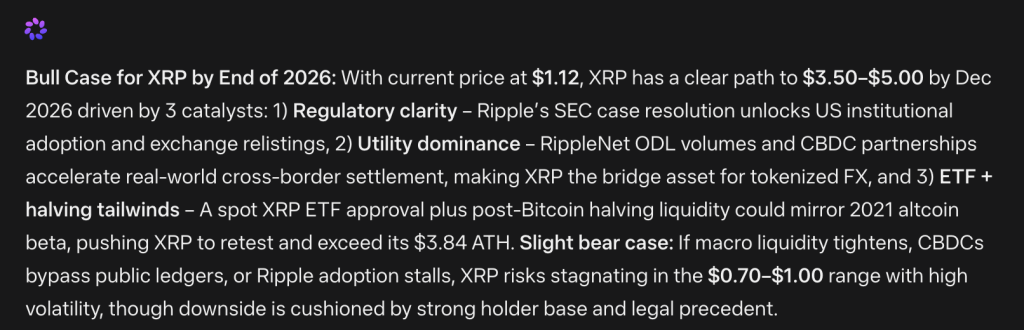
There is a phrase tucked into the bear case of this XRP price prediction that almost undercuts the entire downside scenario before it even gets going. The downside is cushioned by a strong base of holders and legal precedent. Meta AI essentially predicts that, even in its worst-case scenario, XRP has structural support that most assets in a bear scenario simply do not have.
That is an unusual thing to write into a bearish paragraph, and it tells you how much weight the SEC resolution still carries in how this asset gets modeled, more than a year after the case actually closed.
The bull case targets $3.50 to $5.00 by the end of 2026 from the current $1.12, a path Meta AI builds on three distinct catalysts.
Regulatory clarity from Ripple’s SEC case resolution, unlocking US institutional adoption and exchange relistings, is the foundation, but it is the other two that add real texture.
Utility dominance through RippleNet ODL volumes and CBDC partnerships, accelerating real-world cross-border settlement positions, XRP specifically as the bridge asset for tokenized FX, a narrower and more defensible claim than generic crypto adoption.
And the third catalyst, a spot XRP ETF approval combined with post-Bitcoin halving liquidity, is framed as potentially mirroring 2021 altcoin beta, the kind of environment where capital rotates aggressively into the names perceived to have the most room to run.
Stack all three together, and Meta AI sees a path not just back to the old high but a retest and breach of the $3.84 all-time high.

The bear case keeps the downside surprisingly tight. If macro liquidity tightens, CBDCs bypass public ledgers entirely rather than partnering with them, or Ripple adoption simply stalls, XRP risks stagnating in the $0.70 to $1.00 range with high volatility.
That is a stagnation scenario, not a collapse scenario, and the cushion Meta AI describes is doing real work in keeping that floor from sliding lower.
XRP Price Prediction: Three Catalysts, One Stubborn Range
XRP is at $1.12727 today, and the daily chart shows price sitting at the lower edge of a range that has now held for nearly five months without breaking down meaningfully further.
The collapse from the $3.65 peak last July was severe and fast, but what followed was not a continuation of that crash; it was a long, choppy consolidation between roughly $1.20 and $1.55 that has trapped the price since February.
The June low near $1.05 marked the first real test of the bottom of that range, and the bounce since then, while modest, has held above it rather than breaking through.
That structure matters directly for Meta AI’s framing. The $0.70 to $1.00 bear case zone sits well below where this current range has actually been trading, which means for that bearish scenario to play out, XRP would need to break a floor it has not seriously tested in nearly half a year.
The more immediate technical question is whether $1.20 holds as resistance the way it has on every approach since February, or whether this bounce finally clears it and opens the door toward the $1.55 region that capped the range from above.
The RSI sits at 38.56 with the signal line at 37.17, a gap of just under 1.5 points, among the tightest and most neutral readings in this entire prediction series.
Momentum is essentially flat, neither confirming a bottom nor signaling further weakness, which fits a chart that has spent months going nowhere in particular. That flatness is the honest technical picture underneath Meta AI’s three catalysts.
None of regulatory clarity, ETF approval, or ODL volume growth has yet shown up forcefully enough in price to break this range in either direction, which means the $3.50 to $5.00 bull case and the $0.70 to $1.00 bear case both remain entirely dependent on catalysts that have not arrived yet, rather than momentum that is already building.
LiquidChain Is Catching the Attention of XRP holders: Meta AI Predicts It’s the Next 100x
When the market leaders stall, smart money starts looking elsewhere.
BTC, ETH, and XRP are all grinding under resistance right now. The catalysts that unlock the next leg up, macro relief, and sustained institutional inflows, have not arrived. Waiting on them means waiting on things you cannot control.
Early-stage infrastructure plays exist in a completely different universe. The upside is not priced in yet. A relatively small amount of capital can move the needle significantly. That asymmetry is the entire point.
LiquidChain is building something the current multi-chain environment desperately needs. Right now, liquidity across Bitcoin, Ethereum, and Solana sits in isolated silos. Moving between them costs money, takes time, and breaks the user experience. LiquidChain collapses all 3 into a single execution layer. Developers deploy once. Users interact across all 3 ecosystems without ever feeling the seams.
The presale is at $0.01454 with just over $700,000 raised. That is not a late entry. That is the ground floor.
The risks are real and worth naming. Post-launch adoption, liquidity depth, and execution are all unproven. No early-stage project comes without those question marks. The question is whether the potential justifies the uncertainty.
Established assets offer a smoother ride toward a ceiling that is already visible. LiquidChain offers a much earlier seat at a table that has not been set yet.
Explore the LiquidChain Presale
The post Mark Zuckerberg META AI Predicts Incredible XRP Price by End of 2026 appeared first on Cryptonews.
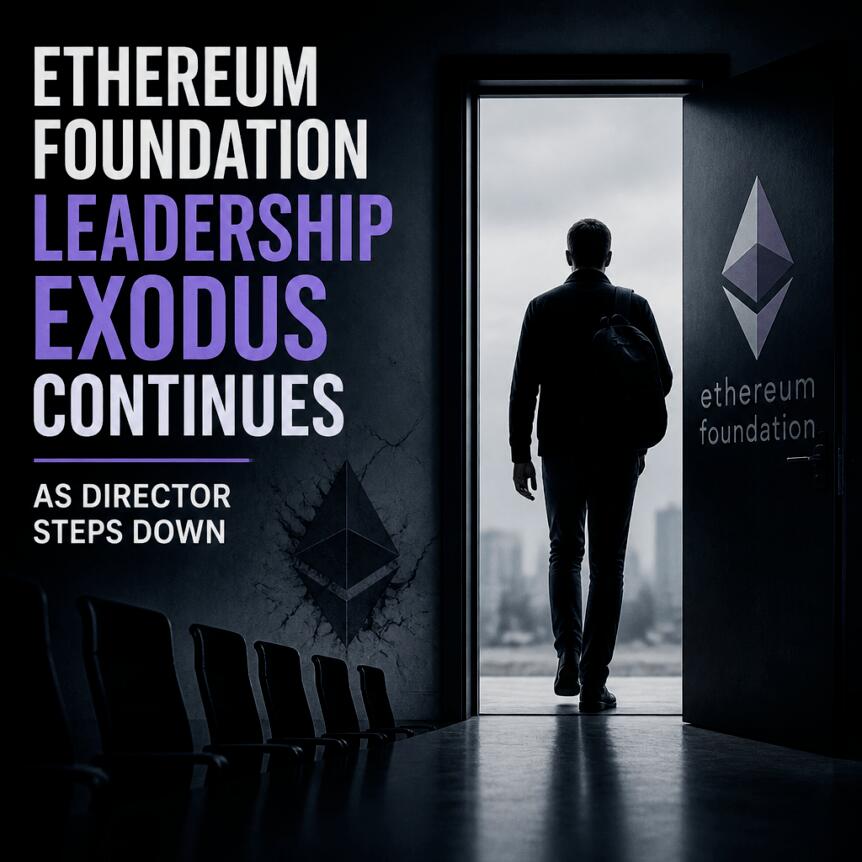
Ethereum’s research and governance backbone has suffered another leadership loss, with Ethereum Foundation co-executive director Hsiao-Wei Wang stepping down effective immediately after a recent sabbatical. Wang’s departure adds to a broader pattern of staff changes that has put the organization’s internal direction and talent retention under renewed scrutiny.
In a post on X, Wang said Ethereum has “always been bigger than any role,” and indicated she has not yet determined her next step. Her exit follows the earlier resignation of Tomasz Stanczak from an Ethereum Foundation leadership position earlier this year, underscoring how quickly senior experience is being reshuffled within the ecosystem’s core institution.
Key takeaways
- Ethereum Foundation co-executive director Hsiao-Wei Wang announced her immediate resignation after a sabbatical, leaving a top leadership vacancy.
- Vitalik Buterin acknowledged Wang’s role as one of the “most challenging positions” in the Ethereum Foundation, while referencing Stanczak’s earlier step down.
- Estimated overall departures this year—reported as 19 layoffs and exits—are occurring amid ongoing debate over Ethereum Foundation governance and strategy.
- The Foundation’s stated mandate emphasizes decentralization and aims for Ethereum to remain functional even without the organization’s leadership.
- Broader disagreements—especially around the direction of Ethereum’s layer-2 scaling approach—continue to shape public debate around who should “steer” the ecosystem.
A leadership exit highlights ongoing governance scrutiny
Wang’s announcement on X confirms an abrupt transition at one of the Ethereum Foundation’s highest levels. The timing—effective immediately and coming right after a sabbatical—suggests an intentional handoff rather than a termination. However, the practical effect is still significant: leadership continuity at the Foundation matters not only for internal operations, but also for how the broader Ethereum community interprets institutional priorities.
Buterin’s response to Wang’s post placed her work in a wider context. He characterized the co-executive director position as among the “most challenging” leadership roles within the Foundation, a framing that implicitly points to the organizational pressures that accompany Ethereum’s growth and decentralization expectations. Buterin also referenced Stanczak’s earlier departure, reinforcing that the Foundation has recently lost multiple senior figures.
Departures amid debate over how Ethereum should be steered
Separately, the Ethereum Foundation has reportedly logged an estimated 19 layoffs and departures this year. While any staffing reduction can be attributed to budgets, restructuring, or personal decisions, the senior nature of these exits has drawn disproportionate attention—particularly because Ethereum’s governance model has become a high-stakes topic for investors, builders, and users.
According to Cointelegraph coverage, the backdrop includes intensifying competition, ongoing disagreement about Ethereum’s governance philosophy, and pressure tied to Ether’s market performance. In other words, the staff changes are unfolding while external narratives about Ethereum’s long-term direction are actively evolving.
The debate is not limited to internal community forums. Buterin has also pushed back against critics who argue that the Foundation should play a more active role in promoting Ethereum. In May, Buterin said the foundation “is not the ‘center of Ethereum’” and compared it to “one node, with a defined purpose,” alongside other nodes—an argument that directly challenges the idea that the Foundation should be treated as the main driver of adoption or messaging.
Earlier coverage from Cointelegraph noted these tensions, including a dispute about whether the Foundation is doing enough to shape public perception and growth. The pattern suggests that staff exits may be occurring in a landscape where public expectations of leadership—what it should do, and how visible it should be—are being contested.
The Foundation’s mandate: decentralization over centralized authority
Ethereum Foundation’s current institutional posture is rooted in its own stated mandate. In March, the Foundation reaffirmed its role as a steward of the Ethereum ecosystem and released a revised mandate that—according to the Foundation—places increased emphasis on decentralization.
In that mandate, the Foundation highlighted a “walkaway test,” stating the protocol and core application layers should be robust and trustless enough to continue functioning and evolving even if the Foundation and today’s core developers were to disappear. The statement is more than a slogan: it sets a measurable standard for institutional design. If the ecosystem depends on a specific entity for its survival, that dependency would conflict with the Foundation’s decentralization goals.
For investors and ecosystem participants, this matters because it changes how stakeholders might evaluate the Foundation. Rather than assessing the organization primarily by its ability to manage price outcomes or public narratives, the mandate frames success around resilience, decentralization, and continuity of the technical ecosystem.
Layer-2 strategy debate resurfaces as leadership changes
Wang’s departure arrives amid continued discussions about Ethereum’s scaling path—particularly the role of layer-2 networks. The Foundation’s decentralization-centered approach intersects with these disputes because scaling involves trade-offs between performance, security assumptions, and how independently systems can operate.
Buterin’s stance has evolved publicly on layer-2s. Cointelegraph previously reported that he argued the original vision for layer-2 networks “no longer makes sense,” suggesting that many have not achieved meaningful decentralization. He has pointed instead toward improvements to Ethereum mainnet as a more suitable long-term scaling route.
This viewpoint is important for builders deciding where to allocate engineering resources, and for traders who track whether network development trends are moving toward credible decentralization benchmarks or more centralized scaling intermediaries. At the same time, the “walkaway test” philosophy implies that no single scaling strategy—layer-2 or mainnet—should be treated as a permanent substitute for a resilient, decentralized base.
Going forward, readers should watch how the Ethereum Foundation addresses leadership continuity and whether staff changes coincide with any refinements to its governance and decentralization priorities. The open question is not only who fills senior roles, but also how the institution balances its stewardship mandate with the community’s competing expectations about how much coordination should be visible and how quickly strategy should adapt.
Crypto World
Ethereum Price Prediction: Network Activity and Tokenization Post Massive Growth as Price Battles Bears
Ethereum is trading just under $1,700 as bulls and bears contest a resistance band that will likely determine the next price prediction. The number flatters slightly; intraday snapshots have ETH ranging from high $1,600 to low $1,700, underlining just how contested this zone is.
What the price chart alone doesn’t capture is what is happening underneath: Ethereum’s fundamental metrics just posted a quarter of genuine contradictions.
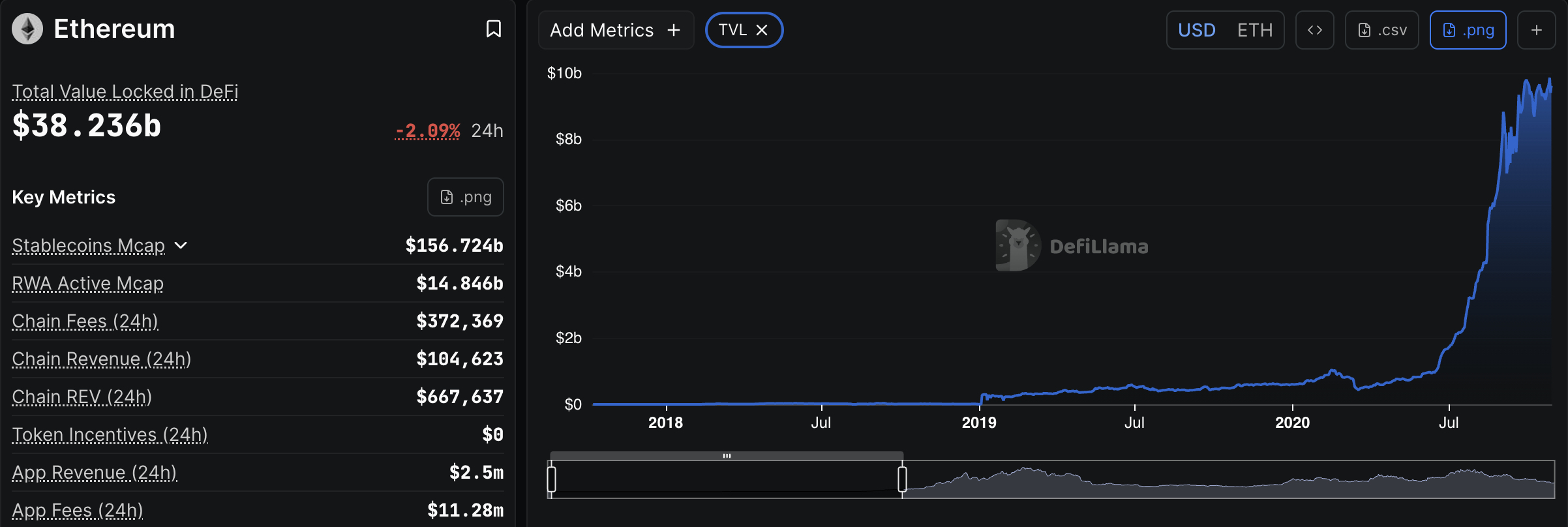
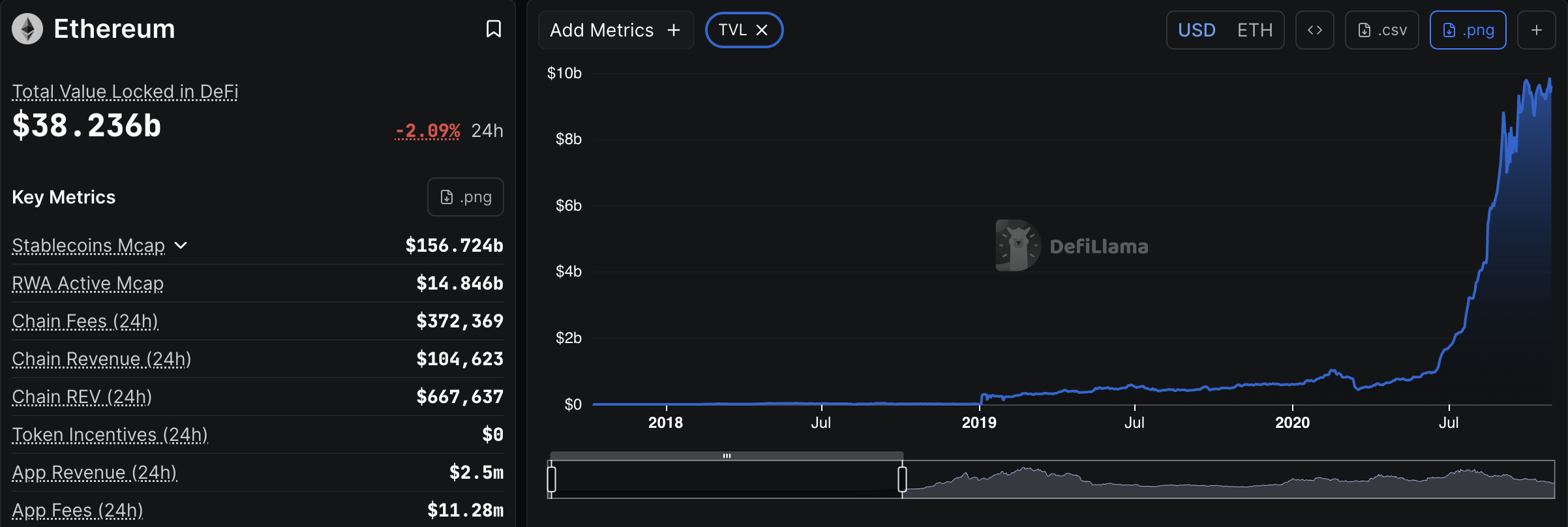
Ethereum report shows TVL down 11% quarter-over-quarter but still commanding $38 billion, a huge lead over Tron, Solana, BNB Chain, and Plasma combined. Active loans averaged $21.8 billion, a 16.6% QoQ drop, while DEX trading volume hit $134.5 billion, off 24% QoQ.
Tokenized commodities surged 60% QoQ to $4.7 billion, almost entirely driven by gold. Etherealize noted that institutions choosing Ethereum for tokenized finance are doing so “not out of ideology but because the liquidity, composability, and institutional precedent are already there.”
Discover: The Best Token Presales
Ethereum Price Prediction: Break $1,800 and Target $2,200 This Weekend?
ETH is consolidating after a triangle breakout with volume above $11 billion, providing credible follow-through. Immediate resistance sits in the $1,850; clearing that opens a run toward $2,000, the zone we flag as the short-term target given current momentum.
Support at high $1,600 is the line that matters on a daily close basis; below that, $1,550 becomes the next reference, and a flush toward $1,500 can’t be ruled out if macro risk appetite deteriorates.

The complication is the ETF flow picture. Citi’s analysis flags “record levels of derivatives trading against inconsistent spot ETF inflows” and notes that current prices already exceed its activity projections; its baseline is $2,200, with a bullish scenario at $6,400.
Overbought conditions on short-term indicators don’t invalidate the setup, but they do raise the cost of being wrong on timing. If ETF inflows stabilize, ETH could clear $1,900 on volume, and the $2,000–$2,200 target from the triangle breakout comes into play.
Discover: The Best Crypto to Diversify Your Portfolio
Bitcoin Hyper Targets Early-Mover Upside as Ethereum Tests Key Levels
Ethereum at $1,700 is a different risk/reward proposition than Ethereum at $800. The upside math is constrained by a market cap already deep in nine figures. Just for 2x from here requires an enormous amount of new capital.
That’s not a knock on ETH’s fundamentals, it’s just arithmetic. Early-stage infrastructure that plays with credible technical differentiation offers a different return profile, which is where Bitcoin Hyper enters the conversation.
Bitcoin Hyper ($HYPER) is positioning as the first Bitcoin Layer 2 with Solana Virtual Machine (SVM) integration, bringing fast smart contract execution and low-latency processing to Bitcoin’s security base via a Decentralized Canonical Bridge.
The presale has raised $32.8 million at a current price of $0.01368, with staking available for early participants. The core pitch is straightforward: Bitcoin’s trust without its throughput constraints. (
For traders already allocated to Ethereum’s tokenization and DeFi narrative, researching Bitcoin Hyper as a complementary infrastructure bet is worth the time.
The post Ethereum Price Prediction: Network Activity and Tokenization Post Massive Growth as Price Battles Bears appeared first on Cryptonews.
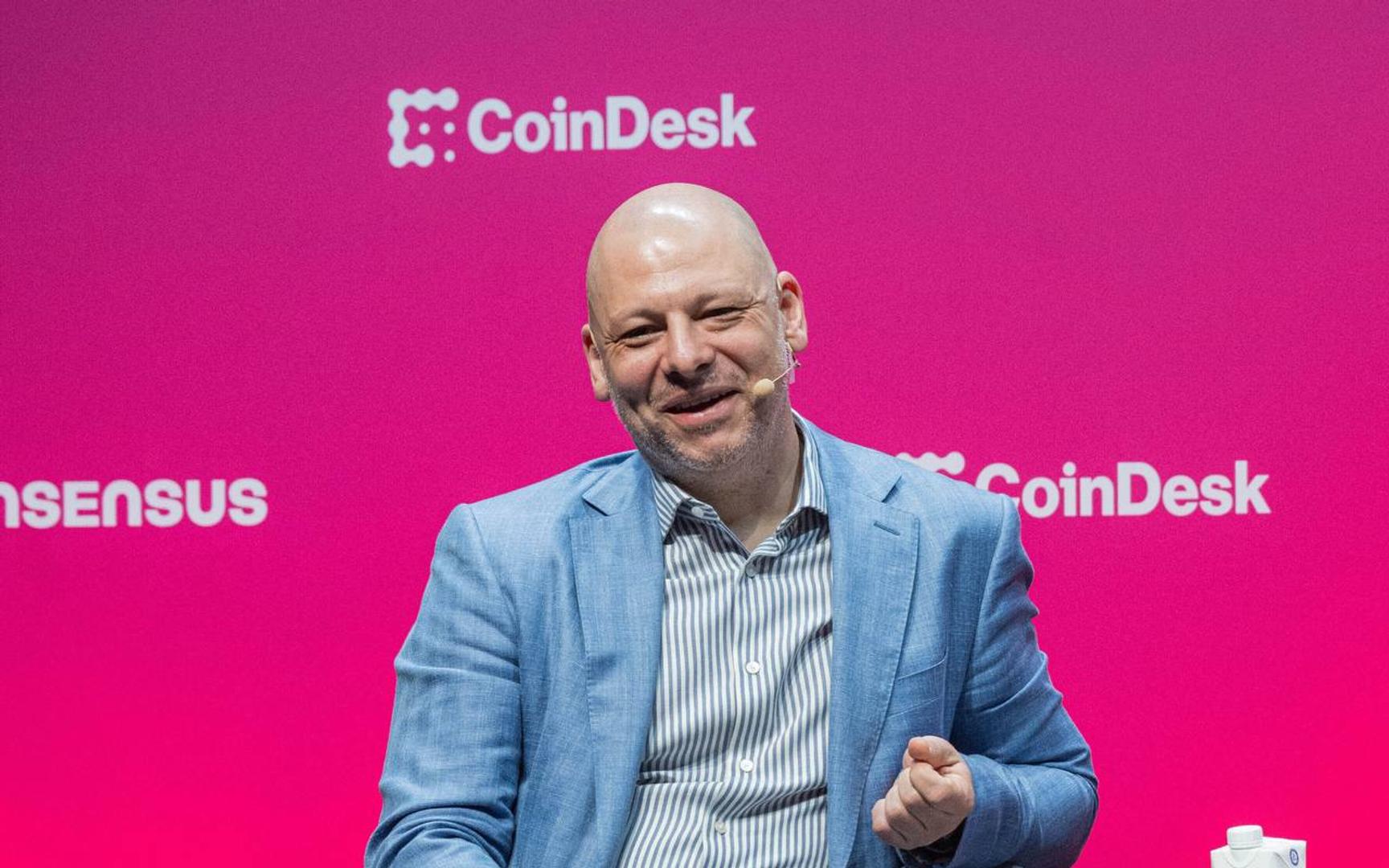
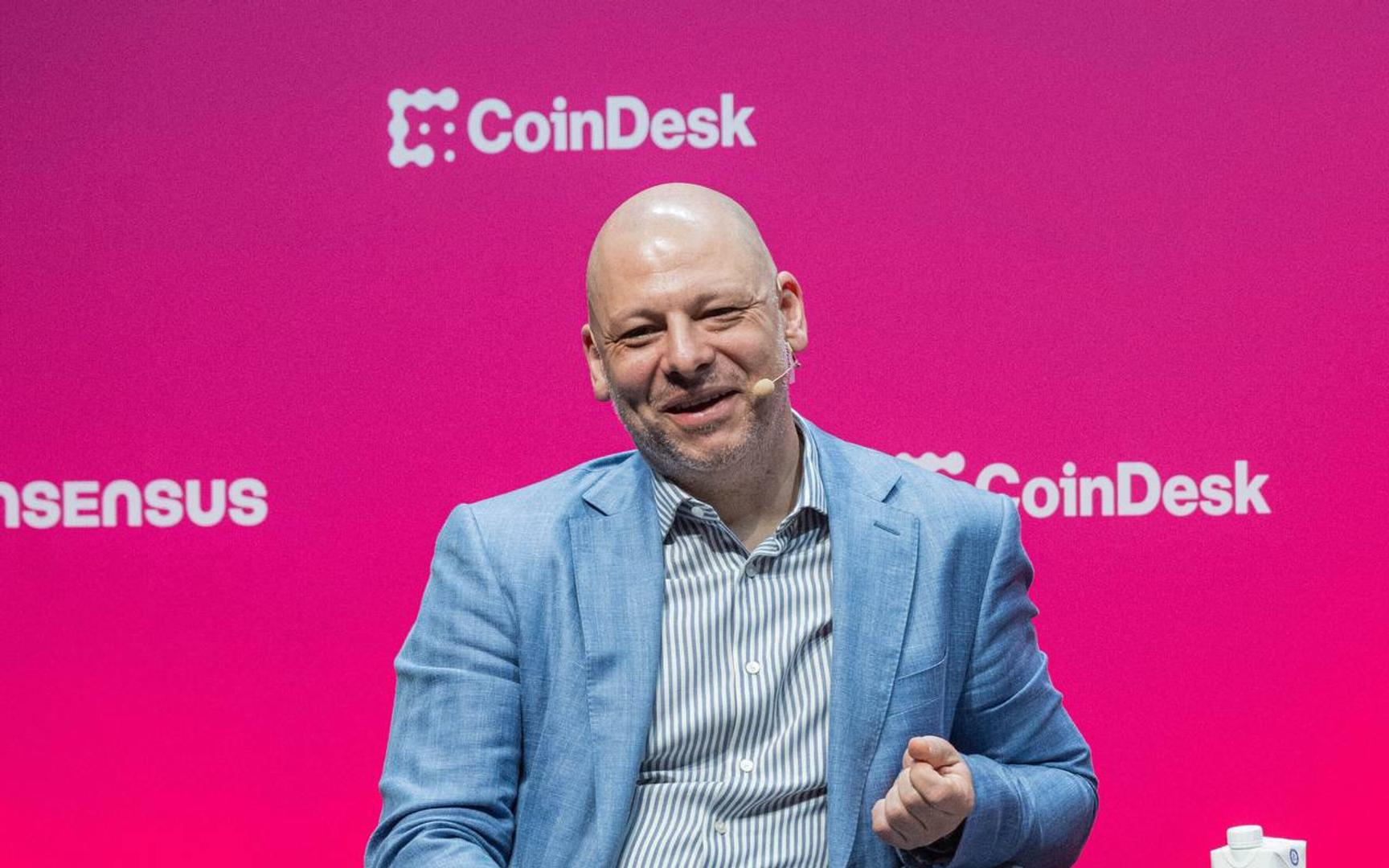
Bitcoin mining company GoMining said it is making it easier for companies to accept bitcoin payments, bringing it into competition with companies including Block’s (XYZ) Square.
Where GoMining says it differs from incumbents is that the entire transaction is completed in bitcoin. Many competitors, including Square, allow customers to pay in bitcoin while delivering fiat currency to the retailer. GoMining retailers who want fiat will need to handle the conversion themselves.
“Our idea isn’t to squeeze bitcoin into the old fiat experience and lose what makes it bitcoin along the way,” CEO Mark Zalan said in an interview over Telegram. “It’s to solve the real problems with BTC payments the high and variable fees, the slow and unpredictable settlement, while preserving non-custody and onchain finality.”
GoMining’s software development kit (SDK) and application programming interfaces (API) for its BTC payment protocol GoBTC Pay, unveiled Friday, enable retailers to access its GoBTC Pay system. The company plans to recruit an initial 10 merchants as part of the rollout, it said.


XRP on exchanges just hit a seven-year low. Whales now hold a record share of supply. Both are bullish-sounding headlines, but one of them is the signal that actually matters, and understanding which is the difference between reading the chart and reading the noise.
Summary
- XRP exchange reserves are the cleaner signal because they measure sellable supply.
- Whale concentration is dramatic but ambiguous, because large holders can hold or sell.
- Thin exchange supply can amplify a CLARITY-driven demand shock.
- The setup points to higher sensitivity, not guaranteed upside.
Two on-chain numbers are circulating about XRP right now, and both sound bullish. The first: whale wallets, those holding 10 million or more XRP, now control 68.5% of the circulating supply, the highest concentration since May 2018.
The second: XRP held on exchanges has fallen to a seven-year low of roughly 1.6 billion tokens, down about 50% from the 3.76 billion peak of October 2025. Both get cited as evidence that something bullish is building, but they are not equally meaningful, and treating them as interchangeable misreads the setup.
One describes who owns XRP, which is interesting but ambiguous. The other describes how much XRP is available to sell, which is the number that actually shapes what happens when demand arrives.
The exchange-reserve drawdown matters more than the whale count, and understanding why is the difference between reading the signal and repeating the headline.
This piece works through both metrics and explains why the exchange-reserve figure is the one to watch. It covers what exchange reserves actually measure and why a seven-year low matters, why the whale-concentration number is more ambiguous than it sounds, how the two combine with the CLARITY Act catalyst to create a genuine supply-demand setup, and how to read all of it without overreacting.
The goal is not to predict a price but to understand the mechanics. Thin available supply meeting a potential demand catalyst is what would drive a violent move if one comes, and those mechanics are frequently misunderstood.
What exchange reserves measure, and why a seven-year low matters
That exchange-reserve figure is the more important of the two, so it deserves the careful explanation, because its significance is precise and often muddled.
Exchange reserves are the amount of a cryptocurrency held in wallets belonging to exchanges, and they function as a proxy for the supply readily available to be sold. When XRP sits on an exchange, it is positioned to be sold quickly, because selling on an exchange is frictionless.
Exchange-held coins therefore represent the most immediately available sell-side liquidity. When XRP leaves exchanges and moves into private wallets, it generally signals that holders are moving it into longer-term storage, off the trading venues and out of immediate selling range.
So a falling exchange reserve means less XRP is sitting in a position to be sold. The seven-year low of roughly 1.6 billion tokens, down about half from the late-2025 peak, means the readily sellable supply of XRP has compressed dramatically to a multi-year minimum.
This matters because of what it implies for price dynamics when demand arrives. Price is set at the margin by the balance between buyers and sellers, and the supply available to sell is one half of that balance.
When the readily available supply is large, incoming demand can be met by sellers without the price moving much, because there is plenty of XRP positioned to sell into the buying. When the readily available supply is thin, as a seven-year reserve low indicates, incoming demand has less supply to absorb it.
The same amount of buying pressure therefore produces a larger price move because there is less XRP available to satisfy it. A compressed exchange reserve is, in effect, a coiled spring on the supply side: it does nothing on its own, but it sets up a condition where any significant demand meets thin supply and the price can move violently.
That is why the seven-year low is the number that matters. It describes the supply side of the equation that determines how XRP responds to demand.
Why the whale-concentration number is more ambiguous
The whale figure draws more attention because it sounds dramatic, but it is more ambiguous than the reserve number, and the ambiguity is worth understanding rather than glossing over.
The fact that wallets holding 10 million or more XRP control 68.5% of circulating supply, the highest since 2018, is usually presented as bullish, on the logic that whales are accumulating and their conviction signals confidence. There is something to that: the broader accumulation data is real, with the number of wallets holding 10,000 or more XRP at an all-time high and the millionaire tier adding addresses and tokens through the drawdown.
But the concentration figure itself cuts both ways, and the bullish reading is not the only one. High concentration means a large share of the supply sits in a small number of hands, and those hands can sell as well as hold.
That makes high whale concentration also a concentration of potential selling pressure, a risk that a few large holders deciding to exit could move the price down hard. Concentration is not inherently bullish; it is a description of who holds the supply, and what that means depends on what those holders do.
A deeper ambiguity: whale wallets are hard to interpret cleanly. A wallet holding 10 million XRP could belong to a long-term accumulator, an exchange’s cold storage, a custodian holding on behalf of many clients, an institution, or an early holder sitting on a position, and these have very different implications.
Escrow activity adds another layer of complexity to the supply picture, because large token movements can look dramatic without directly translating into immediate sell pressure. That is why the context around locked and re-locked XRP matters.
Rising whale concentration could mean conviction-driven accumulation, or it could partly reflect coins moving into custodial and institutional storage as the asset matures, which is a different phenomenon with a different meaning. The whale count tells you that supply is concentrated, but it does not reliably tell you why or what those holders intend.
That makes it a noisier signal than the clean supply-availability reading of the exchange reserve. The whale number is interesting context, but it is ambiguous in a way the reserve figure is not, and leaning on it as a clear bullish signal reads more certainty into it than it supports.
Why the reserve figure is the cleaner signal
Putting the two side by side clarifies why one is the signal and the other is the context, and the distinction comes down to what each number actually determines.
The exchange-reserve figure measures something mechanically connected to price action: the supply available to sell. That connection is direct and not very ambiguous, because whatever the reason XRP is leaving exchanges, the effect is the same: less supply positioned to sell, which tightens the supply side of the market.
A seven-year reserve low means thin sell-side liquidity, and thin sell-side liquidity means demand moves the price more, regardless of the motivations behind the reserve drawdown. The signal is clean because it does not require interpreting intent.
It describes a structural condition of the market that holds however it came about. This is the kind of on-chain metric that really informs how the price might behave, because it measures the actual scarcity of sellable supply.
Whale concentration, by contrast, measures who holds the supply, which is one step removed from price action and heavily dependent on interpretation. To translate whale concentration into a price implication, you have to guess what the whales are and what they will do.
That guess is where the signal gets noisy, because the same concentration number is bullish if the whales hold and bearish if they sell, and you usually cannot tell which from the number alone. The reserve figure tells you the supply is scarce; the whale figure tells you the supply is concentrated and leaves you to guess what that means.
Escrow headlines work similarly: they can matter, but they need interpretation before they become a price signal. A lockup can reduce immediate circulating pressure, but it still has to be read alongside exchange balances, market demand, and timing.
For reading how XRP might respond to a demand catalyst, the scarcity of sellable supply is the more useful and more reliable input. That is why the seven-year reserve low deserves more weight than the record whale concentration, even though the whale number makes the more dramatic headline.
The cleaner signal is the one that does not depend on reading minds.
How it combines with the CLARITY catalyst
The reserve figure matters most because of what it sets up in combination with a specific potential demand catalyst, and that combination is the real story underneath both numbers.
XRP sits in front of a concrete potential demand event: the CLARITY Act. If passed, it would codify XRP’s commodity status into federal law and, by analysts’ projections, could unlock $4 billion to $8 billion in ETF inflows as institutions gain the legal certainty they have waited for.
That is the demand catalyst the supply meets. Its impact depends heavily on the supply conditions it meets.
If a multi-billion-dollar wave of institutional buying arrives into a market with abundant sellable supply, the supply absorbs much of the demand and the price moves less. If it arrives into a market with a seven-year low in available supply, the thin sell side cannot absorb the demand without a much larger price move.
The exchange-reserve drawdown is precisely what would amplify the effect of a CLARITY-driven demand shock. It turns a given amount of buying into a larger price response because there is so little XRP positioned to sell into it.
This is why the reserve figure is the one to watch in the current setup: it is the supply-side condition that determines how violently XRP would react to the demand-side catalyst that the CLARITY Act represents. Two blades of the scissor are demand and supply: the potential CLARITY inflows on one side and the compressed available supply on the other.
A sharp move requires both, strong demand meeting thin supply. Whale accumulation is consistent with this picture and may be part of why reserves have fallen, as large holders move coins off exchanges into storage.
But it is the resulting supply scarcity, not the concentration itself, that would amplify a demand shock. That is why the demand side of the setup matters as much as the reserve chart: the supply squeeze only becomes price action if buyers actually arrive.
The setup that matters is thin sellable supply waiting in front of a potential large demand catalyst, and the seven-year reserve low is the measure of how thin that supply has become. That combination, not the whale headline, is what would drive a violent move if CLARITY passes.
The bearish reading, honestly stated
A fair analysis has to state the other side, because the same setup that could amplify an upside move carries real risks, and the supply-squeeze story is not a guarantee of anything.
One caution is that thin supply amplifies moves in both directions. A compressed exchange reserve means demand moves the price more, but it also means that if selling pressure arrives, perhaps from the very whales whose concentration is at a record, the thin liquidity amplifies the downside too.
There are fewer buyers positioned to absorb a wave of selling. A coiled spring can release in either direction, and a market with thin liquidity and concentrated holdings is one where a few large holders deciding to sell could produce a sharp decline.
That is exactly the risk the whale-concentration figure embodies. The supply-squeeze setup is not inherently bullish; it is a condition of heightened sensitivity to whatever demand or supply shock arrives, and the direction depends on which shock comes first.
Another caution is that the entire upside case depends on the CLARITY catalyst actually arriving, which is deeply uncertain. The demand shock that thin supply would amplify is contingent on the bill passing and the institutional inflows materializing.
That is why a statute changes the picture: without legal certainty, the institutional demand side may not arrive in the size the setup needs.
If CLARITY stalls or fails, the demand catalyst does not arrive, the thin supply does nothing on its own, and XRP can continue to drift or fall on the same macro forces pressuring the whole market. A coiled spring with no force applied to it simply sits there.
A supply squeeze without a demand catalyst is not a bullish setup but a neutral one waiting for an input that may not come. The honest reading is that the seven-year reserve low is a genuine and meaningful supply-side condition, but it is a setup, not a prediction.
It points to amplified volatility, not guaranteed upside, with the direction and the timing both dependent on catalysts outside the on-chain data. The mechanics are real; the outcome is not foreordained.
What it means for investors
For anyone reading these on-chain figures, the practical lesson is about which numbers to trust and how to think about what they imply.
One takeaway is to weight the exchange-reserve figure over the whale-concentration figure when assessing XRP’s setup, because the reserve number cleanly measures sellable supply while the whale number ambiguously measures ownership. Sellable supply is what shapes how the price responds to demand.
An investor watching XRP should treat the seven-year reserve low as the more meaningful signal, the indication that the supply side is tight and that any significant demand would have outsized price impact. The record whale concentration should be treated as interesting but ambiguous context that could be bullish accumulation or a concentration of selling risk.
Reading the cleaner signal over the dramatic headline is the discipline that distinguishes informed analysis from repeating talking points.
Another takeaway is to understand the setup as conditional, not predictive. Thin supply is a real condition, but it produces a move only when a catalyst applies force, and the most likely near-term catalyst is the binary CLARITY vote, which could unlock major demand or fail to arrive at all.
XRP’s broader ecosystem also matters here, because the supply-demand setup sits alongside XRP’s institutional utility case, including tokenized settlement and RLUSD-linked infrastructure. Utility can support the long-term thesis, but it still needs a clear demand channel to move price.
An investor should hold the supply-squeeze setup as a reason XRP could move sharply if a demand catalyst lands, not as a standalone bullish signal. It should be paired with a clear-eyed view of the catalyst’s uncertainty and of the downside risk that thin liquidity and concentrated holdings also create.
The setup amplifies whatever comes; it does not determine what comes. That is also part of the longer-term outlook, where legal clarity, ETF flows, tokenized settlement, and supply conditions all interact rather than moving in isolation.
None of this is investment advice; it is a frame for reading two widely cited on-chain numbers accurately, weighting the one that measures available supply over the one that measures concentration, and understanding both as conditions that shape volatility, not predictions of direction.
The signal and the noise
Two on-chain numbers about XRP are circulating, and they are not equally meaningful. The record whale concentration of 68.5% makes the dramatic headline, but it is ambiguous, measuring who holds the supply without reliably telling you why or what they will do.
It cuts both ways between bullish accumulation and concentrated selling risk. The seven-year low in exchange reserves makes the quieter headline, but it is the cleaner signal.
It measures the supply available to sell and points to a multi-year minimum in sellable XRP, a structural condition that shapes how the price would respond to demand regardless of anyone’s intentions.
The reserve figure matters more for what it sets up: thin sellable supply waiting in front of a potential large demand catalyst in the CLARITY Act, a combination where a multi-billion-dollar inflow meeting a compressed supply could produce an outsized move. That is a genuine and meaningful setup, but it is a setup, not a prediction, because the thin supply amplifies moves in both directions and the upside depends entirely on a demand catalyst that may or may not arrive.
Read accurately, XRP’s on-chain picture is one of tight available supply and concentrated ownership sitting in front of a binary legislative catalyst. It is a condition of heightened sensitivity rather than a guarantee of direction.
The seven-year reserve low is the number that matters, the whale count is the number that gets attention, and knowing the difference is the difference between reading the signal and repeating the noise.
Frequently asked questions
What does it mean that XRP exchange reserves hit a seven-year low?
Exchange reserves are the amount of XRP held in exchange wallets, a proxy for the supply readily available to sell. The seven-year low of roughly 1.6 billion tokens, down about 50% from October 2025’s 3.76 billion peak, means the readily sellable supply of XRP has compressed to a multi-year minimum. This matters because thin sell-side supply means incoming demand has less to absorb it, so the same buying pressure can produce a larger price move.
Why does the article say reserves matter more than the whale count?
Because the reserve figure cleanly measures sellable supply, which directly shapes how the price responds to demand, while the whale-concentration figure ambiguously measures who owns the supply, one step removed from price action. To turn whale concentration into a price implication, you have to guess what the whales are and will do. The reserve figure needs no such guess, since less supply on exchanges tightens the market regardless of why it left. The cleaner signal is the more reliable one.
Is the record whale concentration bullish for XRP?
It is more ambiguous than it sounds. Whales holding 68.5% of supply, the highest since 2018, is often read as bullish accumulation, and the broader data does show large holders buying through the drawdown. But high concentration also means potential selling pressure sits in few hands, a risk if those holders exit. And whale wallets can be accumulators, custodians, exchanges, or institutions, with different meanings, so the number is noisy context rather than a clear bullish signal.
How does the supply squeeze connect to the CLARITY Act?
The CLARITY Act, if passed, would codify XRP’s commodity status and could unlock $4 billion to $8 billion in ETF inflows by analyst projections, a large demand catalyst. Thin available supply amplifies the effect of demand: a multi-billion-dollar inflow meeting a seven-year low in sellable XRP could produce a much larger price move than the same demand meeting abundant supply. The reserve drawdown is what would amplify a CLARITY-driven demand shock.
Does a low exchange reserve guarantee the price will rise?
No. Thin supply amplifies moves in both directions: if selling pressure arrives, perhaps from concentrated whale holders, thin liquidity amplifies the downside too. And the upside case depends on a demand catalyst, mainly the CLARITY vote, actually arriving; if it stalls, the thin supply does nothing on its own and XRP can keep drifting on macro forces. The reserve low is a setup that heightens sensitivity to catalysts, not a prediction of direction.
What should investors take from these on-chain numbers?
Weight the exchange-reserve figure over the whale-concentration figure, because it cleanly measures sellable supply while the whale number ambiguously measures ownership. Treat the seven-year reserve low as a meaningful sign that supply is tight and demand would have outsized impact, and the whale concentration as ambiguous context. Understand the setup as conditional: thin supply produces a move only when a catalyst applies force, and the main near-term catalyst, the CLARITY vote, is uncertain and could push either way.
As of June 19, 2026. On-chain data and markets change quickly; verify current figures before relying on this analysis. This article is information, not investment advice.
Crypto World
WhiteBIT EU Secures MiCA License in Austria, Expanding Regulated Crypto Services Across Europe

[PRESS RELEASE – Vienna, Austria, June 19th, 2026]
WB-Shield Innovations GmbH, operating as WhiteBIT EU, announced today that it has obtained authorization under the Markets in Crypto-Assets Regulation (MiCA) in Austria.
The authorization was granted by the Austrian Financial Market Authority (FMA).
The Austrian authorization marks a key step in WhiteBIT’s European growth strategy and underscores WhiteBIT EU’s commitment to operating within a transparent, secure and harmonized regulatory framework. Under MiCAR, WhiteBIT EU will be able to provide regulated crypto-asset services to eligible users across the EEA.
The authorization marks an important step in WhiteBIT’s broader strategy to build a regulated European presence and contribute to the continued development of the digital asset ecosystem in the EEA*.
“WhiteBIT was originally founded as a European exchange, and Europe remains at the core of our long-term vision,” said Volodymyr Nosov, Founder and President of W Group, which WhiteBIT is part of. “With MiCA setting a global benchmark for digital asset regulation, this authorization reinforces our commitment to building a transparent, secure, and compliant crypto ecosystem for users across the region.”
Strengthening WhiteBIT EU’s Regulatory Position in Europe
MiCAR establishes a harmonized EU framework for crypto-asset service providers, including requirements relating to governance, transparency, client protection and market integrity.
By obtaining authorization in Austria, WhiteBIT EU has completed a substantive regulatory assessment in a jurisdiction recognized for its well-established financial supervisory standards. This strengthens WhiteBIT EU’s regulated European presence and supports the planned provision of crypto-asset services across the EEA within the scope of its MiCAR authorization and in accordance with applicable passporting, onboarding and regulatory requirements.
With the MiCA license in Austria, these efforts are now consolidated under a single regulatory framework, enabling WhiteBIT to serve millions of European retail and institutional clients with compliant, secure, and accessible crypto services.
Launch of WhiteBIT.EU for European Users
As part of its transition to the MiCA framework, WhiteBIT is preparing to launch whitebit.eu — a dedicated platform designed specifically for users across the European Economic Area (EEA).
This new platform will serve as WhiteBIT’s regulated hub for the European market, operating under the MiCA framework and offering compliant access to the company’s products and services across the EEA.
New users interested in joining whitebit.eu can already register their interest through a dedicated form on the website and will be among the first to receive updates when the platform becomes available.
This press release constitutes a marketing communication for the purposes of applicable regulations.
* Excluding Malta
About WhiteBIT
WB-Shield Innovations GmbH (WhiteBIT EU) is an entity of WhiteBIT, authorised to provide crypto assets services in the EEA. WhiteBIT was founded in 2018 and is now a part of W Group, which serves more than 35 million customers globally. WhiteBIT collaborates with Visa, FACEIT, Barcelona FC, Juventus and the Ukrainian national football team. The company is dedicated to driving the widespread adoption of blockchain technology worldwide.
The post WhiteBIT EU Secures MiCA License in Austria, Expanding Regulated Crypto Services Across Europe appeared first on CryptoPotato.
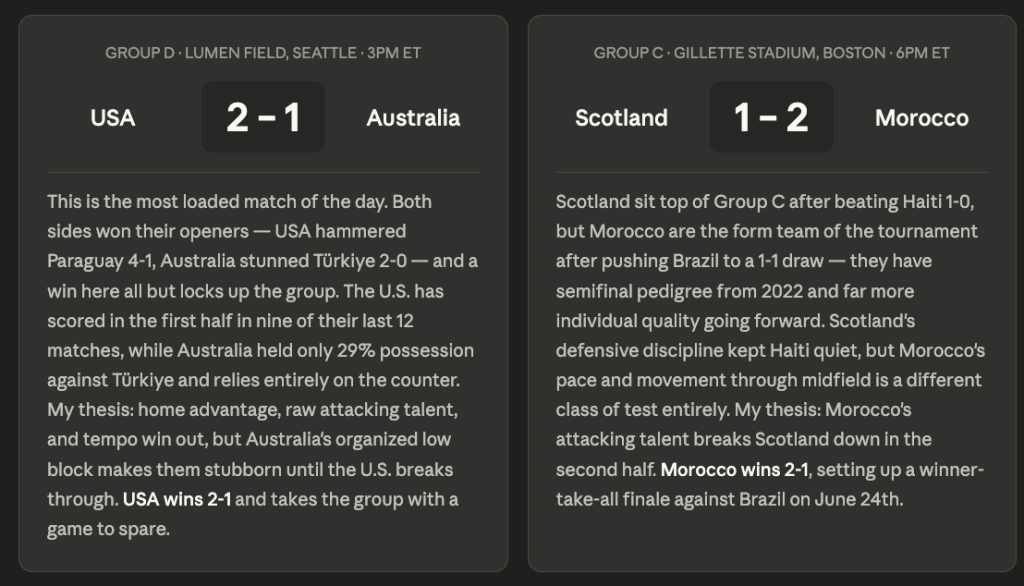
Claude AI predicts two World Cup matches today, and the scorecard predictions is mixed in a way that says a lot about how prediction models actually perform under real conditions.
In the marquee Group D clash, Claude nailed it almost perfectly. In the Group C derby, the direction was right but the story underneath played out differently than expected.
USA vs Australia was the loaded match of the day, and Claude leaned on home advantage, raw attacking talent, and tempo, predicting the U.S. would grind past a stubborn Australian low block 2-1.
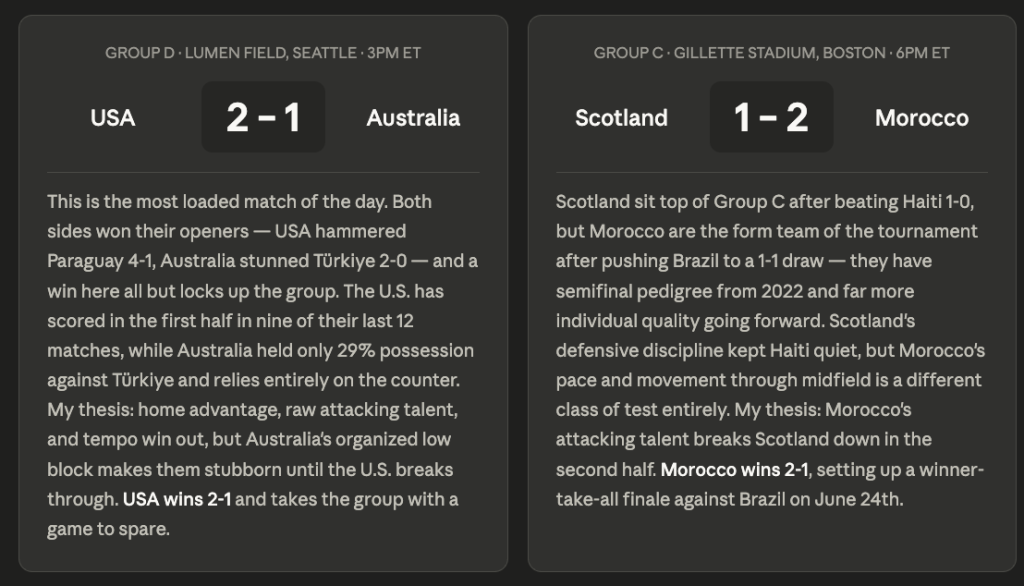
That is exactly what happened. Jordan Bos opened the scoring for Australia in the first half before Haji Wright’s brace turned the game, with the Americans eventually winning 2-1 in what their own head coach Mauricio Pochettino called one of the hardest fought results of his tenure.
The scoreline landed dead on, USA take the group with a game still to spare, just as the prediction called.
Scotland vs Morocco is where the model’s logic held up directionally but the final number did not. Claude leaned on Morocco’s attacking talent and superior individual quality, the same group that reached the 2022 semifinals, to break Scotland down 2-1 in the second half.
Instead, Scotland’s defensive discipline did more than just hold, it shut Morocco out completely. John McGinn scored the only goal of the match in the 28th minute, and Scotland walked away with a 1-0 win, sitting top of Group C with 3 points while Morocco’s draw with Brazil and now this loss leave them on just 1.
Discover: The Best Crypto to Diversify Your Portfolio
Claude AI World Cup Predictions: What The Split Result Says About The Model
Two games, one clean hit and one swing and miss, but the nature of the miss matters more than the scoreline gap suggests.
Claude correctly identified Morocco as the technically superior side with more individual quality, and that read was not wrong, Morocco still controlled large stretches and pushed Brazil to a draw in their opener.
What the model underweighted was Scotland’s capacity to nullify that quality rather than just survive it.
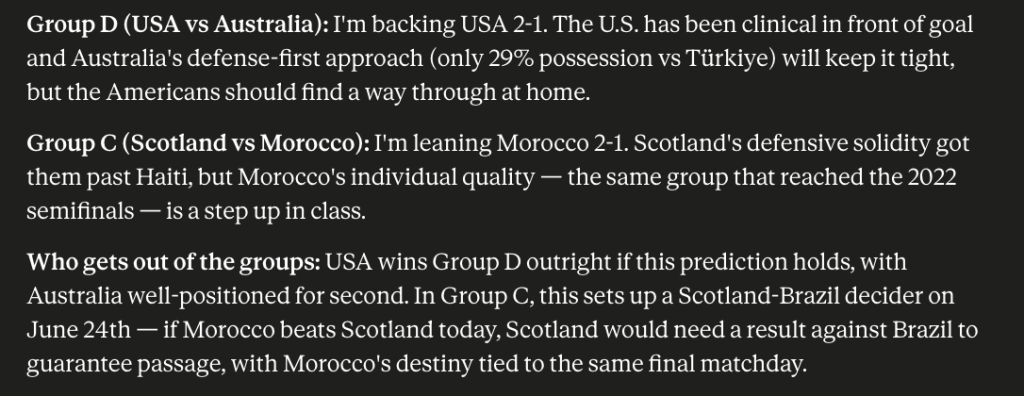
Steve Clarke’s side did not just keep Haiti quiet in their opener, they replicated that same defensive discipline against a far better attacking unit and still found the only goal of the game through McGinn.
The bigger picture Claude sketched out is still very much alive. USA winning Group D outright with Australia well-positioned for second is now locked in, exactly as predicted.
But Group C has flipped on its head. Instead of a winner-take-all Scotland-Brazil finale with Morocco already through, Scotland now sits in firm control with 3 points, while Morocco faces a must-win scenario against Brazil on June 24th just to guarantee their own passage.
The AI got the headline result wrong in Boston, but the tournament’s bigger threads, USA cruising and Morocco’s fate hinging on the final matchday, are unfolding almost exactly as the broader thesis suggested.
Discover: The Best Token Presales
The post Claude AI World Cup Predictions: USA VS Australia, Morocco VS Scotland appeared first on Cryptonews.

Key Takeaways
-
Palantir Technologies shares declined following Oligo Security’s FedStart enrollment.
-
Oligo pursues FedRAMP High and DoD Impact Level 5 certifications via the program.
-
FedStart accelerates federal compliance processes for software providers.
-
Oligo delivers runtime security solutions for government application environments.
-
Partnership reinforces Palantir’s infrastructure for regulated technology markets.
Shares of Palantir Technologies declined on Friday following news that Oligo Security has partnered with the company through its FedStart compliance initiative. PLTR stock decreased 1.65%, finishing the session at $128.47. This partnership provides Oligo with an accelerated pathway to obtain critical federal security certifications.
Palantir Technologies Inc., PLTR
Oligo Security Enters Palantir’s FedStart Ecosystem
Oligo Security has officially joined Palantir Technologies’ FedStart initiative as part of its strategy to penetrate the federal government market. The runtime security provider is pursuing both FedRAMP High authorization and Department of Defense Impact Level 5 certification. This enrollment integrates Oligo into Palantir’s established network of government-oriented software vendors.
Palantir created FedStart specifically to streamline the complex process of achieving federal security compliance standards. Participating organizations receive access to hardened infrastructure and expert compliance guidance. The program significantly shortens the timeline for obtaining Authority to Operate certifications from government agencies.
Through FedStart, Oligo intends to deliver its runtime security capabilities directly to federal agencies. The company’s platform safeguards applications, cloud infrastructure, and artificial intelligence systems during active operation. Oligo specializes in defending against threats that emerge while software is executing in production.
Runtime Protection Addresses Evolving Federal Threat Landscape
According to Oligo, contemporary cyberattacks increasingly exploit vulnerabilities during the runtime phase rather than at rest. The company’s technology identifies and neutralizes active threats in real-time. This methodology contrasts with conventional security solutions that primarily identify potential weaknesses without runtime context.
Legacy security frameworks typically create silos between application security, cloud protection, and workload defense. Sophisticated threat actors exploit these disconnected layers during coordinated attack campaigns. Oligo’s platform consolidates monitoring across these environments to eliminate coverage gaps.
The security firm analyzes actual production behavior to pinpoint vulnerabilities that adversaries can realistically weaponize. This approach enables security operations teams to reduce false positive alerts and prioritize genuine risks. Oligo maintains that its solution can prevent exploitation attempts while maintaining system availability and performance.
FedStart Program Reinforces Palantir’s Federal Infrastructure Position
Palantir’s FedStart initiative assists technology vendors pursuing federal and defense sector authorizations. The program delivers secure development environments, pre-built compliance architectures, and expert guidance on government authorization processes. This offering demonstrates Palantir’s expanding influence in federal software infrastructure.
For Oligo Security, FedStart participation establishes a structured approach to reaching federal customers. Both FedRAMP High and DoD IL5 certifications enable deployment within highly sensitive government operations. These authorizations mandate rigorous controls covering data protection, identity management, and operational security.
Palantir strengthens its FedStart portfolio by incorporating additional specialized security vendors. Simultaneously, Oligo obtains access to compliance infrastructure specifically designed for federal requirements. This arrangement consolidates Palantir’s standing as the preferred platform for companies entering regulated government technology markets.
Bittensor’s TAO token has fallen nearly 20% from its June 15 peak after governance concerns, derivatives liquidations, and a risk-off macro backdrop combined to erase much of last week’s rally.
Summary
- TAO has fallen nearly 20% from its June 15 high as governance concerns and liquidations hit sentiment.
- Criticism of the Root Reborn proposal has raised questions about validator power, liquidity, and regulation.
- Technical indicators show sellers remain in control, with $220 acting as a key near-term support level.
According to data from crypto.news, Bittensor (TAO) price dropped 4.3% in the last 24 hours to trade near $225 on June 19, bringing its losses to nearly 20% since June 15, when the AI-focused token peaked around $283 before governance concerns and derivatives liquidations triggered a reversal.
Bittensor’s decline accelerated after criticism emerged around the proposed Root Reborn governance overhaul, a plan designed to reduce persistent subnet token selling by changing how validators allocate capital across the network.
While supporters view the proposal as a long-term fix for Bittensor’s tokenomics, opponents argue it could introduce governance concentration, liquidity stress, and regulatory complications.
Among the most vocal critics, validator group Yuma warned that Root Reborn would transform validators from neutral network operators into active capital allocators. According to Yuma, the framework could create incentives for collusion, preferential treatment, and frontrunning while encouraging subnet teams to prioritize validator relationships over AI product development.
“Such a change could fundamentally alter the role of validators,” Yuma wrote in its assessment of the proposal.
At the same time, derivatives traders rapidly reduced exposure. CoinGlass data showed TAO futures open interest falling more than 8% over a 24-hour period to roughly $252 million-$260 million. More than $1.66 million in bullish leveraged positions were liquidated during the same stretch, adding forced market selling as prices moved lower.
Trading activity also weakened. Daily volume dropped roughly 14% to about $624 million as traders reassessed protocol risk ahead of further discussions surrounding the governance proposal
Concerns extended beyond governance mechanics. Yuma argued that rewards tied to baskets of subnet tokens could become difficult to liquidate during periods of market stress, while a wave of unstaking could create execution disadvantages for later redeemers.
Macroeconomic conditions added another headwind. Crypto markets remained under pressure after Federal Reserve Chair Kevin Warsh reinforced expectations that U.S. interest rates may remain elevated for longer than previously expected.
The stronger U.S. dollar and declining appetite for speculative assets pushed capital away from high-beta sectors, including artificial intelligence-linked cryptocurrencies.
TAO technical structure favors sellers below key resistance
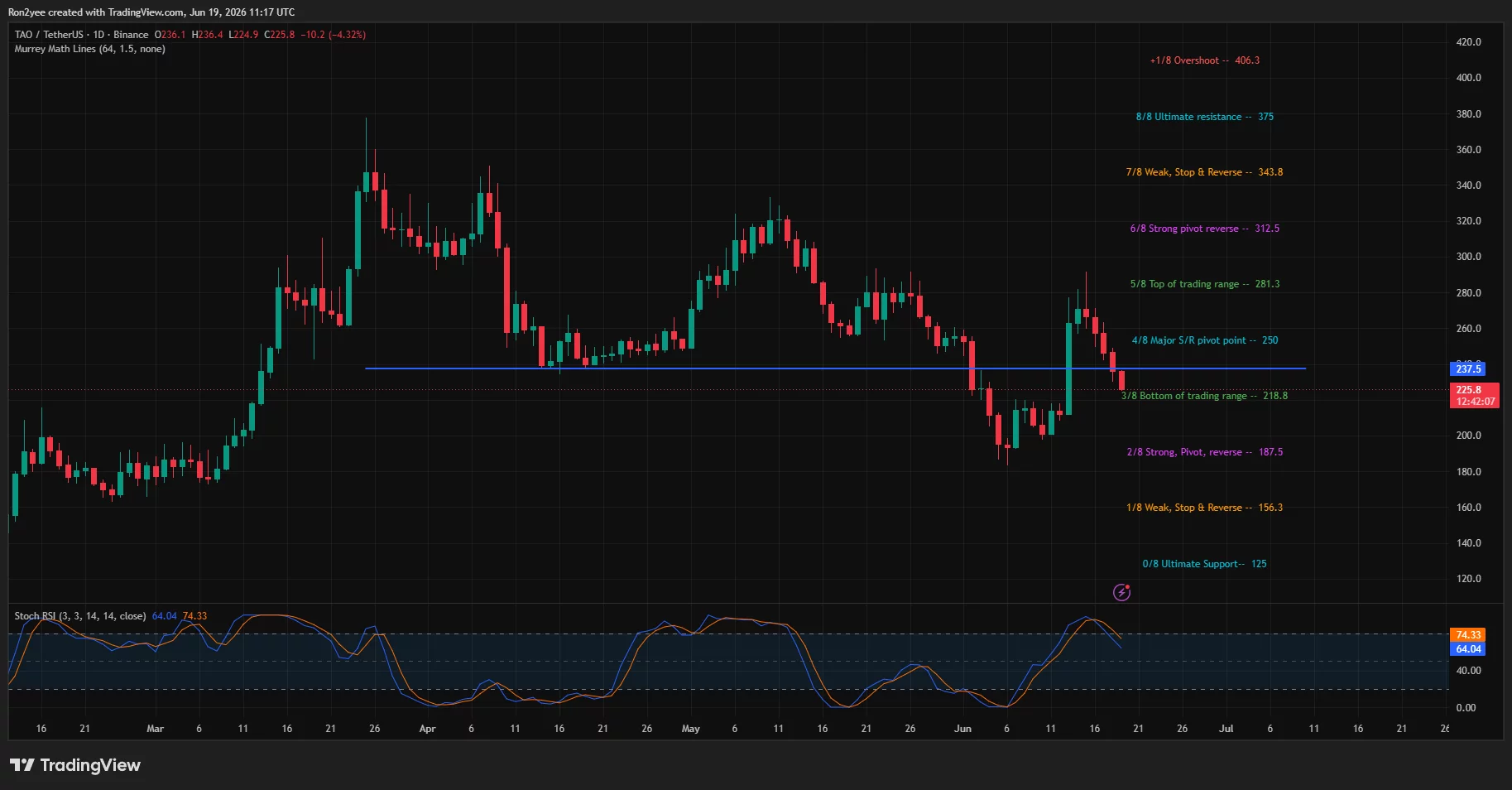
The daily chart shows TAO breaking below a major horizontal support zone near $237, a level that acted as a floor during April and May. What previously served as support now risks becoming resistance after the breakdown.
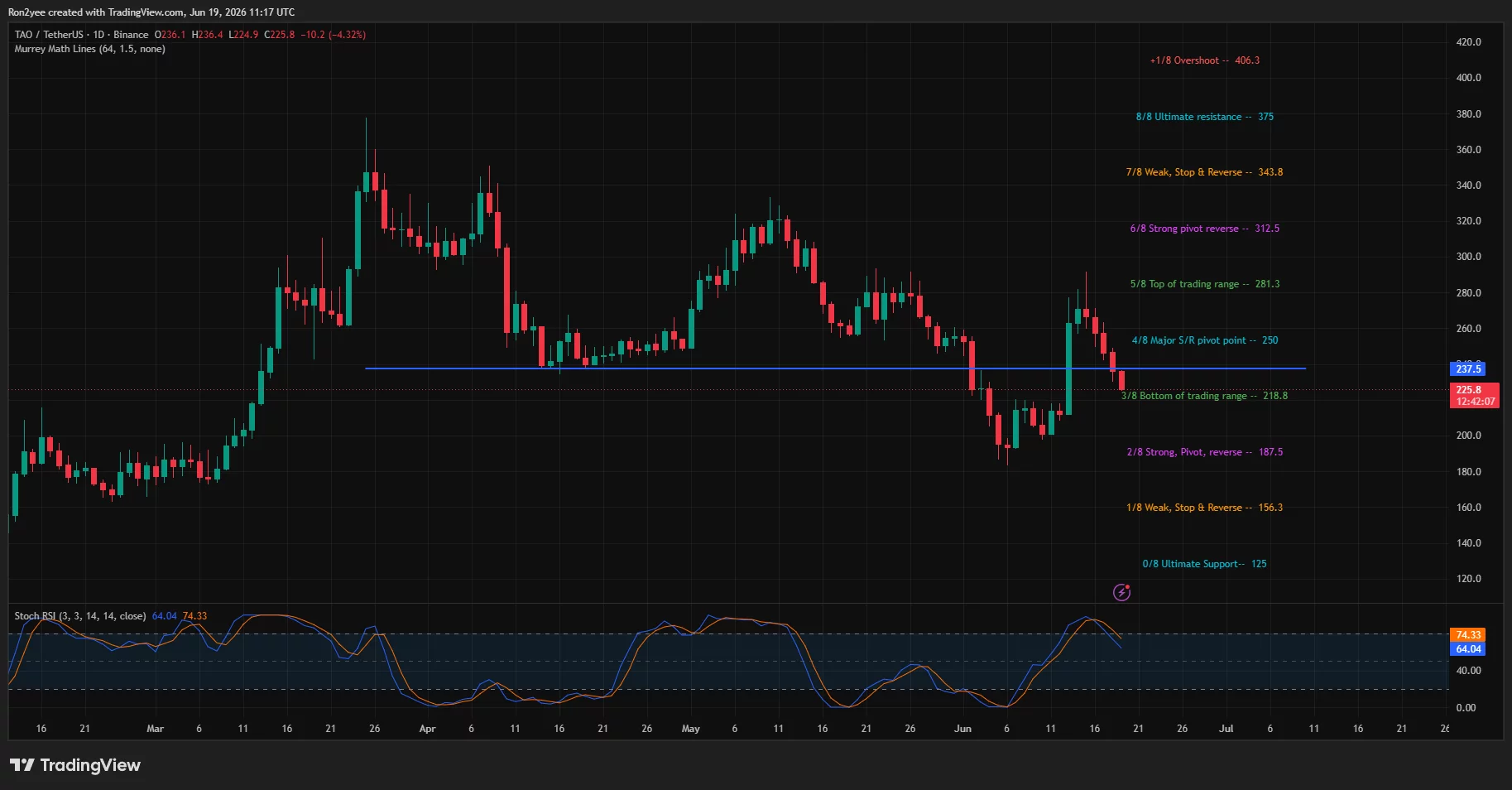
Murrey Math levels place the token below the 3/8 trading range support at $218.8, while the next major resistance stands near the 4/8 pivot at $250. A recovery above that region would be required to restore bullish momentum and reopen a path toward $281, where the June rally stalled.
On the four-hour chart, TAO has also fallen beneath the 23.6% Fibonacci retracement level at $228.2 after rejecting the 0.786 retracement near $273.8 earlier this week. Price continues to trade below a descending trendline that has capped every recovery attempt since June 15.
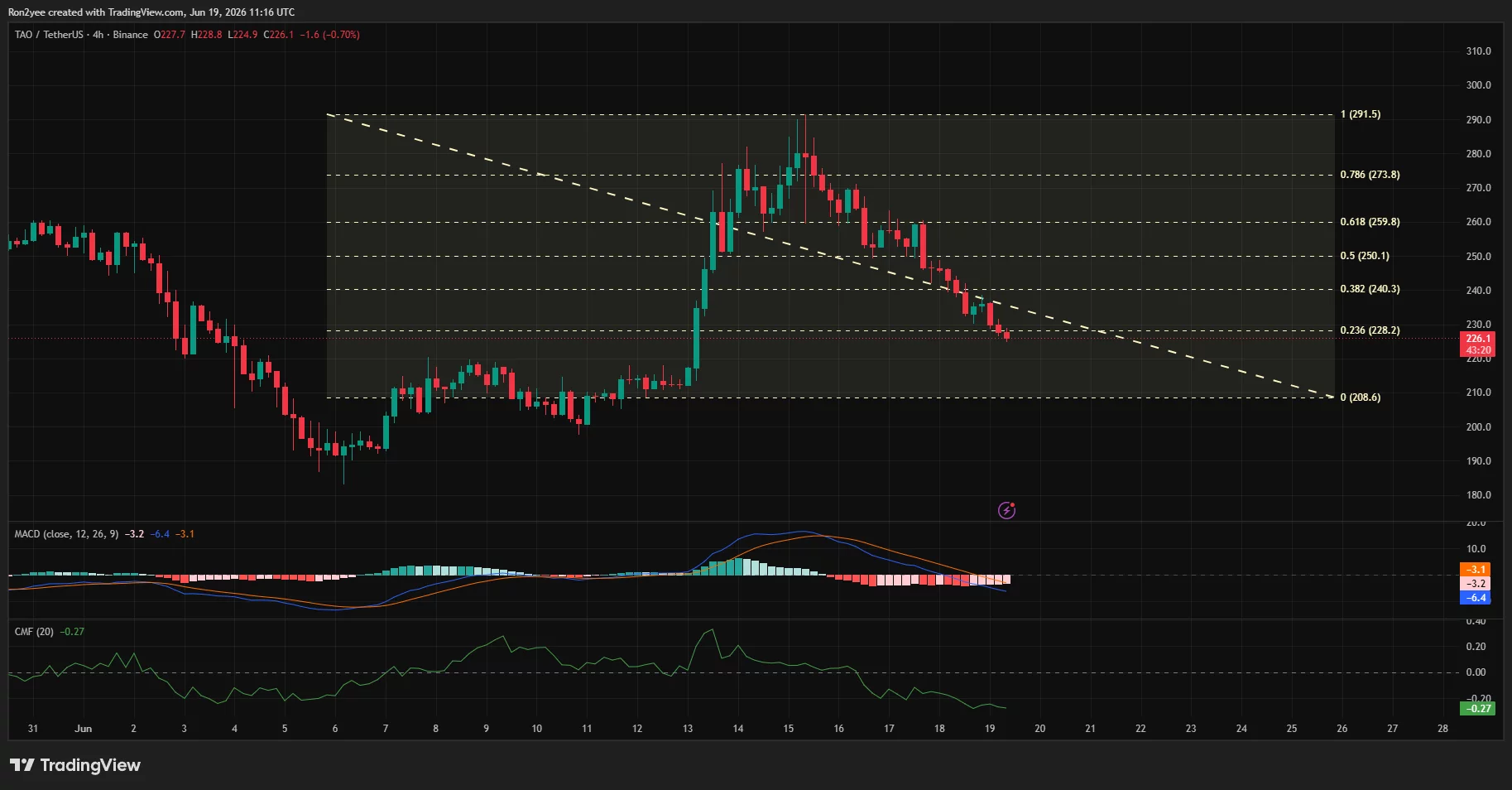
Momentum indicators remain weak. The MACD has crossed into negative territory with expanding bearish histogram bars, while Chaikin Money Flow sits at -0.27, showing capital leaving the market. Although the Stochastic RSI remains above oversold levels on the daily timeframe, both signal lines have turned lower.
According to the 4-hour chart, TAO’s failure to reclaim the broken $237 support leaves the market vulnerable to another leg lower toward the $208 Fibonacci support zone.
TAO loses key support as sellers target lower liquidity zones
CoinGlass liquidation heatmap data shows dense liquidity clusters concentrated between $239 and $241, creating a potential magnet should buyers regain control. Several additional liquidation pockets sit near $244 and $245, where short positions could come under pressure if TAO stages a relief rally.
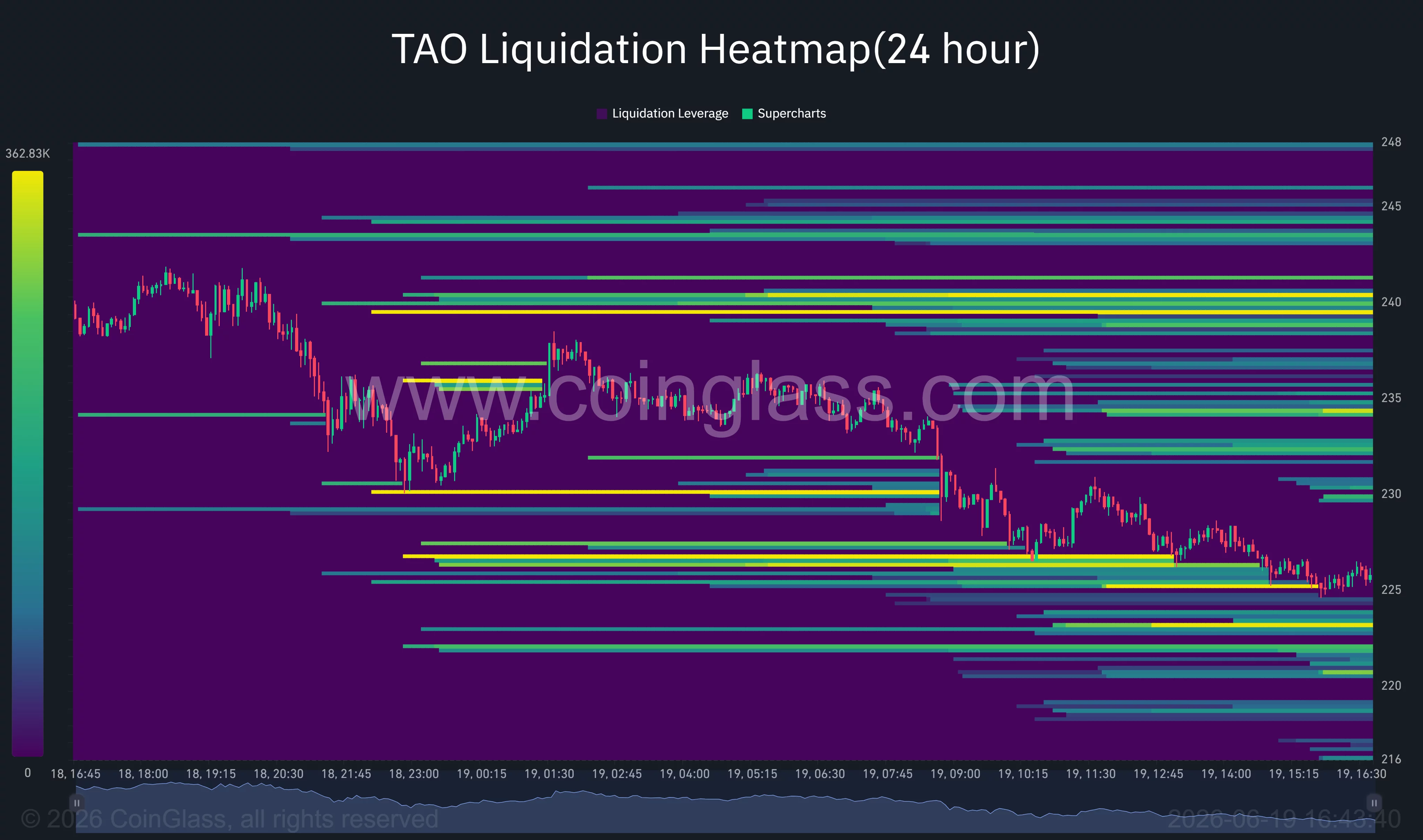
The downside picture remains equally important. A concentration of leveraged positions has formed around the $225-$226 area, while thinner support appears below current prices until the $220 region. A decisive break beneath $220 could expose the June swing low near $190 before attention turns toward the longer-term support band between $180 and $200.
Regulatory concerns surrounding Root Reborn present another risk. Yuma argued that validators directing capital allocations could attract scrutiny typically associated with investment management activities, potentially complicating participation for exchanges, custodians, and institutional operators.
If uncertainty surrounding the proposal persists while macro conditions remain restrictive, TAO may struggle to reclaim the $237-$250 zone that bulls need to regain control.
Disclosure: This article does not represent investment advice. The content and materials featured on this page are for educational purposes only.
Binance is allowed to provide crypto trading access to users in the Philippines through its arrangement with BlockShoals Technologies, but neither company is authorized to handle peso transfers or perform other activities regulated by the country’s central bank, according to legal adviser Marie Antonette Quiogue.
Quiogue, head of legal at BlockShoals, told Cointelegraph in an interview on Friday at Philippine Blockchain Week 2026 that Binance’s local operations fall under the Securities and Exchange Commission’s (SEC) crypto asset service provider (CASP) framework. She said BlockShoals serves as a crypto asset intermediary, introducing Philippine users to Binance’s global trading platform.
The arrangement forms part of Binance’s effort to reestablish a presence in the Philippines after regulators moved to restrict access to the exchange over licensing concerns in 2024. Under the structure presented by BlockShoals, the company participates in the SEC’s Strategic Sandbox, or StratBox.
The Bangko Sentral ng Pilipinas (BSP), the nation’s central bank, told Cointelegraph that neither Binance nor BlockShoals is authorized to operate as a virtual asset service provider (VASP).
“Participation in the regulatory sandbox does not exempt an entity from complying with applicable laws, rules, and regulations, including any licensing requirements imposed by relevant regulators,” the BSP said, adding that it was coordinating with the SEC on the matter.
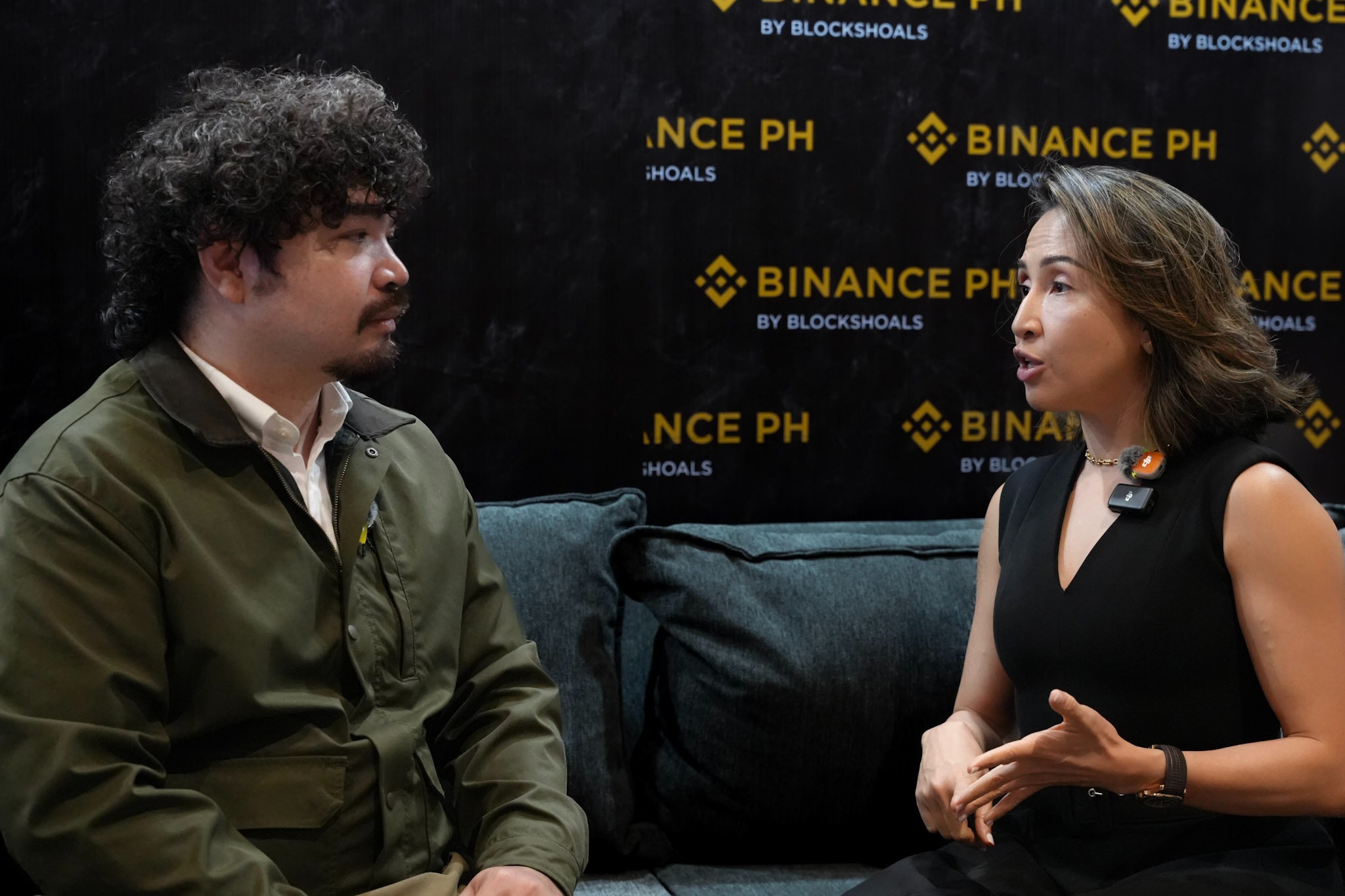
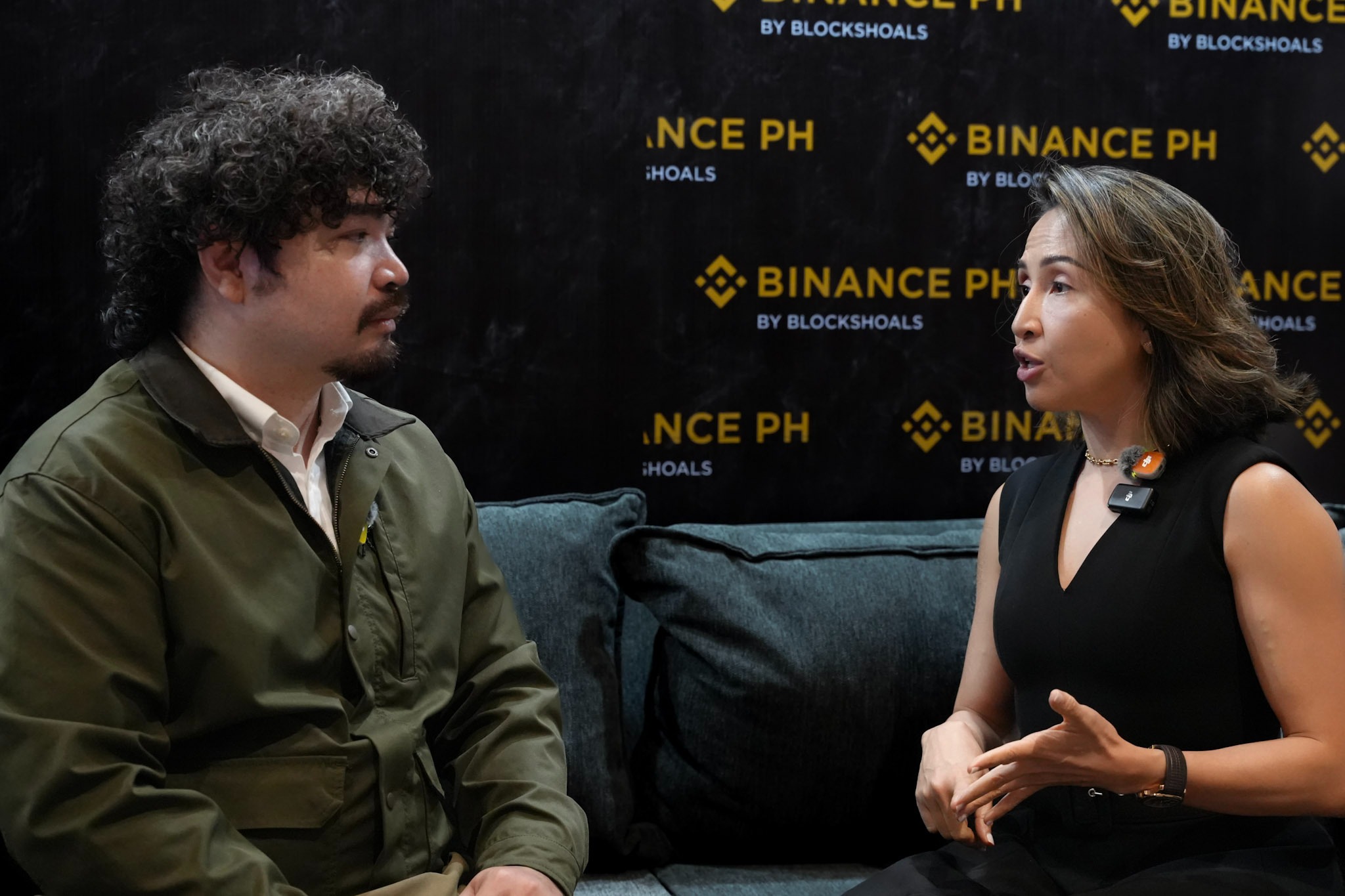
Cointelegraph’s Ezra Reguerra (left) with BlockShoals head of legal Marie Antonette Quiogue (right). Photo: Cointelegraph
BlockShoals argues SEC framework permits trading access
Quiogue did not dispute the BSP’s statement and acknowledged that neither Binance nor BlockShoals had applied for a local VASP license. The legal advisor argued that the absence of a VASP license does not prevent the companies from providing services under SEC jurisdiction.
“Trading, the activity of trading, is clearly under the jurisdiction of the SEC,” Quiogue said. “Binance and BlockShoals, we are not moving pesos, which is clearly under the jurisdiction of the BSP.”
Related: Meta rolls out stablecoin payouts for creators in Philippines, Colombia
She said the regulatory structure requires BlockShoals and Binance to obtain authorization from the relevant regulator whenever they introduce services outside the SEC’s remit.
“If BlockShoals and Binance will be offering any product that is regulated by any other government agency, you have to get an authority from them,” she said.
Binance returns after Philippine access restrictions
Binance first drew regulatory scrutiny in the Philippines in November 2023, when the SEC warned the public that the platform was not authorized to sell or offer securities in the country because it had not obtained the necessary license and registration.
In March 2024, the commission said it had asked the National Telecommunications Commission to block access to the Binance website and related webpages. Local internet providers subsequently began restricting access to the platform following the order.
At the time of publication, Binance’s platform was accessible to users in the Philippines.
Magazine: China’s 107 Bitcoin memory thief, Bithumb CEO booked: Asia Express

Best Money Making Strategies in 2026 | Ft. Shankar Sharma

World shares are mixed after a tech-led rally on Wall Street

SPTL: Reserving Concerns Around Iran Deal Longevity, Eschewing Duration

Blockchain.com files with SEC for U.S. IPO

No Jackpot Winner as $257 Million Prize Rolls Over to $269 Million Monday Draw

Israel says it has killed new Hamas military leader in Gaza City airstrikes
Best Money Making Strategies in 2026 | Ft. Shankar Sharma

Crypto Trading For Beginners Pt.2 | Crypto Trading LIVE DEMO | Bitcoin Trading

Only A few Hours Left! XRP HoldersToday It’s Happening! Elon Musk Ready To change Tee World?
-
 Business5 days ago
No Jackpot Winner as $257 Million Prize Rolls Over to $269 Million Monday Draw
-

 Fashion7 days ago
Weekend Open Thread: Tuckernuck – Corporette.com
-
Crypto World5 days ago
Zimbabwe Requires Crypto Businesses to Register Annually Under New FIU Regulations
-

 Crypto World6 days ago
Bitget enters Argentina’s regulated crypto market through PSAV registration
-

 Tech6 days ago
NanoClaw integrates JFrog registries to secure AI agent downloads
-

 Tech7 days ago
This Week In Security: Microsoft On Microsoft, Register Your Domains, Linux On ARM, And FreeBSD Joins The File Cache Club
-

 NewsBeat7 days ago
FBI searches office of Ohio voter registration group
-
 Entertainment5 days ago
Matt Damon’s Viral Sci-Fi Thriller Has Taken Over HBO Max
-

 Business5 days ago
Anthropic staff to meet White House officials next week, Axios reports
-

 Tech5 days ago
As AI companies race to go public, who else is along for the ride?
-
 Crypto World5 days ago
Bitcoin could crash to $48,000, if this historical pattern is triggered
-

 Politics5 days ago
“Israel’s” ban on ICRC visits ruled illegal, but Knesset moves to stop them permanently
-
 NewsBeat5 days ago
Warning of disruption as Cardiff Crossrail works to start
-

 News Videos5 days ago
Financial Accounting | Last Day Revision Strategy and Booster | CMA Inter – June 2026
-
 NewsBeat5 days ago
Tributes to former deputy head teacher at Cambridge school among death and funeral notices
-
 NewsBeat5 days ago
what doctors are seeing in ebike crashes
-

 Crypto World5 days ago
XRP ETFs Outperform As Bitcoin And Ethereum Funds Extend Outflow Trend
-

 Entertainment6 days ago
Deion Sanders Shares Powerful Post After Viral Advice To Deiondra
-
 Crypto World5 days ago
Market Preview: SpaceX (SPCX) IPO Record, Federal Reserve Meeting, and Iran Nuclear Agreement
-
 Entertainment5 days ago
Kate Middleton Glare Goes Viral After Kids Booed At Royal Event
You must be logged in to post a comment Login