
Crypto World
Hyperliquid rolls out new testnet for prediction markets



Hyperliquid has launched Outcome Trading testnet, introducing fully funded contracts for prediction markets and event-based trading.
Summary
- Hyperliquid launched Outcome Trading under HIP-4.
- Contracts are fully collateralized with no leverage.
- Mainnet launch may follow after testing.
Hyperliquid announced on Feb. 2 that it has launched “Outcome Trading” on its testnet under Hyperliquid Improvement Proposal 4.
The new feature allows users to trade fully collateralized outcome contracts that settle within a fixed price range.
What is Outcome Trading and how it works
Prediction markets and actual events, such as elections, sports, or economic data, are the main focus of these contracts. They are solely dependent on the outcome of the event and do not require leverage, unlike conventional crypto derivatives.
Traders must fund their positions in full, which removes the risk of forced liquidations. This structure is meant to provide a more stable and transparent way to trade uncertain events.
Hyperliquid (HYPE) said the system introduces non-linear payouts and time-based settlement, giving traders more ways to express market views. It also responds to strong demand from users looking for lower-risk alternatives to perpetual futures.
Outcome Trading is built to work alongside existing tools such as portfolio margin and HyperEVM. This allows developers to combine outcome contracts with other decentralized applications on the platform.
At this stage, the feature is only available on testnet and remains under active development. Hyperliquid plans to launch curated “canonical” markets once testing is complete. These markets will be settled in USDH, the platform’s stablecoin, and will rely on objective data sources to reduce disputes.
If user feedback is positive, the company may later allow permissionless market creation, enabling anyone to launch outcome-based contracts.
Why this matters for Hyperliquid and the market
The launch comes as Hyperliquid keeps pushing beyond its roots in perpetual futures. Earlier updates, including HIP-3, opened the door to permissionless markets for tokenized stocks, commodities, and other real-world assets.
Those changes have driven trading volumes and open interest to new highs, with several ecosystem projects reporting solid growth after the upgrades. With the introduction of outcome trading, Hyperliquid is now entering the quickly expanding prediction market, which is already dominated by companies like Polymarket and Kalshi.
The feature might be released on the mainnet later in 2026 if it becomes popular on the testnet. A smooth rollout would further cement Hyperliquid’s evolution into a multi-product, on-chain derivatives platform.


Key Takeaways
- Dynamix Corporation and The Ether Machine have abandoned their $1.6 billion SPAC merger arrangement
- Adverse market conditions were cited by both parties as the primary factor behind the cancellation
- A $50 million breakup fee will be paid to Dynamix within a two-week period
- The transaction was designed to bring The Ether Machine to Nasdaq with the ETHM ticker symbol
- Dynamix must secure an alternative merger partner by November 22, 2026 or face liquidation
A cryptocurrency treasury company holding more than $1 billion worth of ether has terminated its planned public market debut. The Ether Machine and special purpose acquisition company Dynamix Corporation officially ended their $1.6 billion merger arrangement on April 8, 2026.
According to joint statements from both entities, the Business Combination Agreement was terminated by “mutual agreement.” Both parties attributed the decision to challenging market dynamics.
Originally unveiled in July 2025, the transaction would have enabled The Ether Machine to secure a Nasdaq listing through a reverse merger with Dynamix, trading under the ETHM ticker.
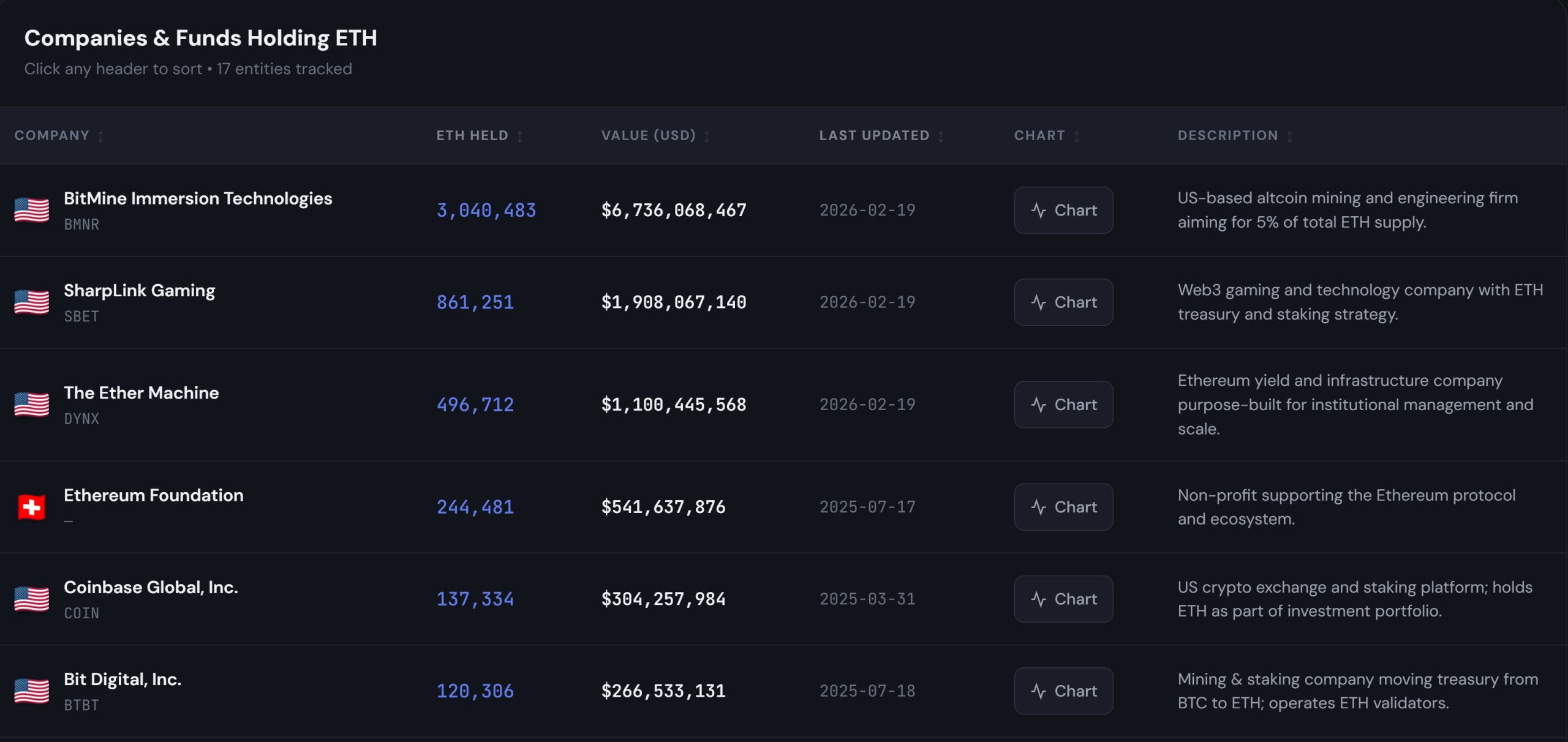
The Ether Machine operates as an Ethereum treasury and yield generation platform. Its holdings include 496,712 ETH valued at over $1.1 billion, with revenue generated through staking operations and DeFi strategies.
The proposed deal stood out for its substantial scale. It featured a $1.5 billion fully committed PIPE financing arrangement, marking the largest all-common-stock capital raise in this category since 2021.
Upon completion, the merged entity would have controlled in excess of 400,000 ETH. A significant portion of these digital assets came from co-founder Andrew Keys, who previously held a key position at Consensys.
$50 Million Breakup Fee Headed to Dynamix
Under the termination terms, an entity associated with The Ether Machine is obligated to transfer $50 million to Dynamix within 15 days. This payment structure is documented in an SEC 8-K filing.
The $50 million sum represents a substantial amount when compared to Dynamix’s approximate $232 million market capitalization. The filing does not explicitly identify which specific party will make the payment.
The cancellation also voids associated agreements, including Sponsor Support and Subscription Agreements. Both organizations executed mutual release provisions and non-disparagement clauses addressing potential shareholder legal actions.
Dynamix’s Next Steps and Timeline
Dynamix’s SPAC journey continues. The company retains until November 22, 2026 to identify and execute an alternative business combination.
Should Dynamix prove unable to finalize a new transaction before this deadline, the company faces mandatory dissolution, public share redemption, and liquidation procedures.
The deal’s failure arrives during a period of weak performance for ether prices. Appetite for cryptocurrency-related SPAC transactions has diminished considerably.
Nonetheless, the Ethereum treasury sector continues to show vitality. Currently, 10 Ethereum treasury firms collectively control more than 6 million ETH, representing a combined value approaching $14 billion.
The sector leader is Tom Lee’s Bitmine, which recently achieved uplisting to the New York Stock Exchange. The company’s board simultaneously expanded its share buyback program from $1 billion to $4 billion.
Neither The Ether Machine nor Dynamix provided statements when contacted for this report.

Key Takeaways
- Iranian and U.S. representatives convened in Pakistan’s capital on April 11–12 for direct diplomatic discussions following weeks of military tensions
- No agreement was secured after approximately 21 hours of intensive negotiations, Vice President JD Vance announced
- Tehran’s unwillingness to abandon nuclear weapons development emerged as the primary obstacle to a settlement
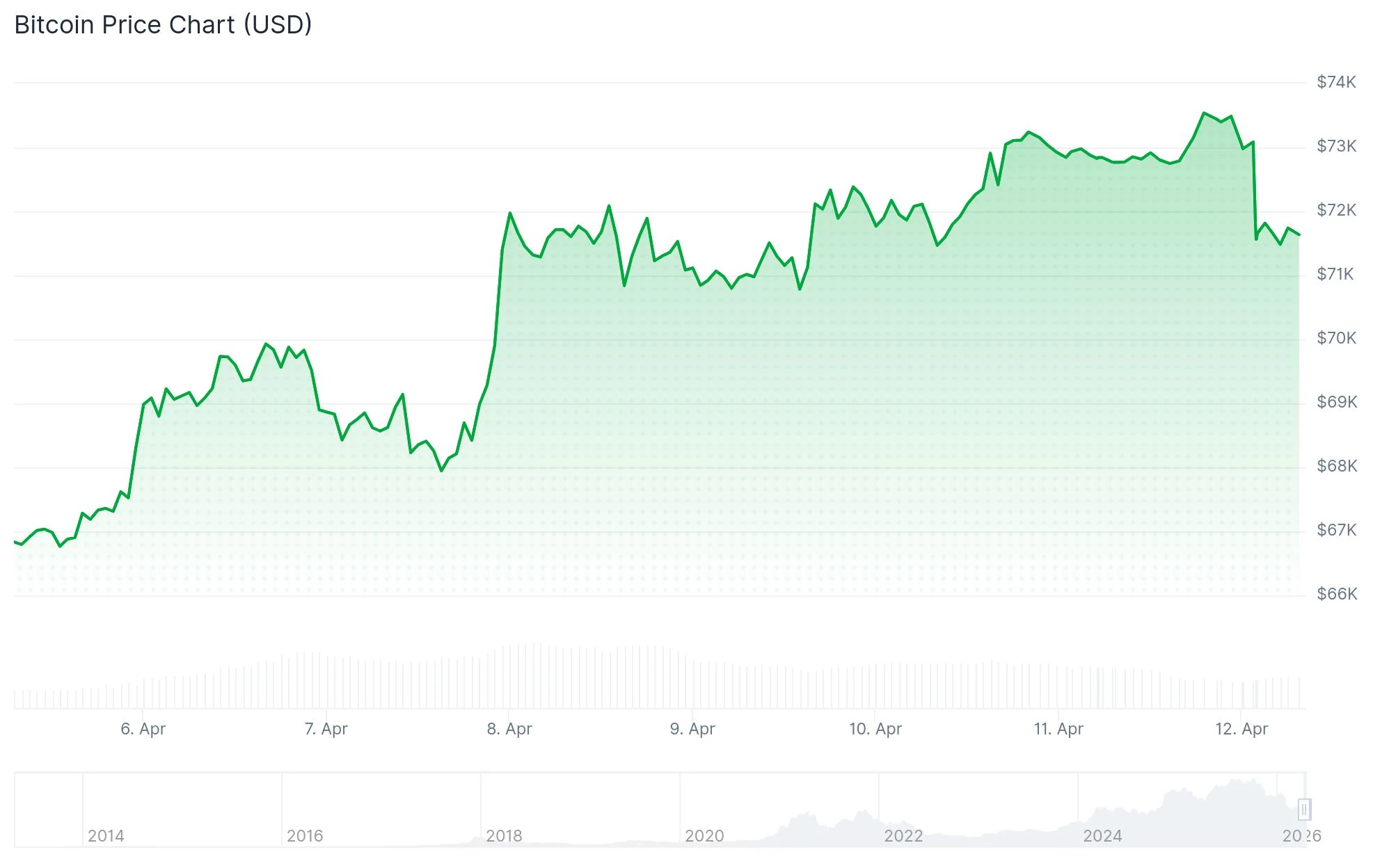
- Bitcoin experienced a 2% decline to approximately $71,500 in the aftermath of the failed negotiations
- XRP decreased 1.69% to $1.33, while Ethereum slipped 1.26% to $2,216, with cryptocurrency markets broadly declining 1–3%
High-ranking officials from Washington and Tehran convened in Pakistan’s capital on April 11 for their first direct, senior-level diplomatic engagement in decades. These discussions came after weeks of military confrontation that erupted on February 27, when the United States and Israel executed joint military operations dubbed “Operation Epic Fury,” striking Iranian military installations and nuclear facilities. The operations resulted in the death of Supreme Leader Ali Khamenei.
The military escalation sent shockwaves through global energy markets and international financial systems. Critical maritime passages near the Strait of Hormuz, responsible for significant portions of worldwide petroleum transport, experienced disruptions due to the intensifying conflict.
Pakistan assumed a crucial intermediary position, providing neutral ground for both parties. While previous ceasefire initiatives had temporarily de-escalated tensions, no permanent resolution had materialized prior to these diplomatic sessions.
Before negotiations commenced, Tehran reportedly pursued sanctions removal, unfreezing of financial assets, and security assurances. Washington maintained firm positions regarding restrictions on Iran’s nuclear capabilities and maintaining freedom of navigation through strategic waterways.
Esmaeil Baqaei, Iran’s Foreign Ministry spokesperson, characterized the 24-hour discussion period as addressing the Strait of Hormuz situation, nuclear program concerns, compensation for war damages, sanctions removal, and complete conflict resolution. He indicated that results would hinge on “the seriousness and good faith of the opposing side.”
Baqaei further urged Washington to refrain from “excessive demands and unlawful requests” while honoring Iran’s “legitimate rights and interests.”
Diplomatic Efforts Conclude Without Agreement
Following approximately 21 hours of intensive discussions, Vice President JD Vance announced at a media briefing that negotiators failed to reach a settlement.
“The bad news is that we have not reached an agreement,” Vance stated. He noted that the U.S. had presented its position comprehensively throughout the talks.
According to Vance, the fundamental obstacle centered on Iran’s refusal to pledge abandonment of nuclear weapons ambitions. “The simple fact is that we need to see an affirmative commitment that they will not seek a nuclear weapon,” he explained.
The American delegation departed Pakistan without securing any agreement. The trajectory of the conflict remains uncertain moving forward.
Cryptocurrency Markets Decline Following Failed Talks
Digital asset markets responded swiftly after Vance’s public statement. Bitcoin declined to approximately $71,500, representing a roughly 2% daily loss.
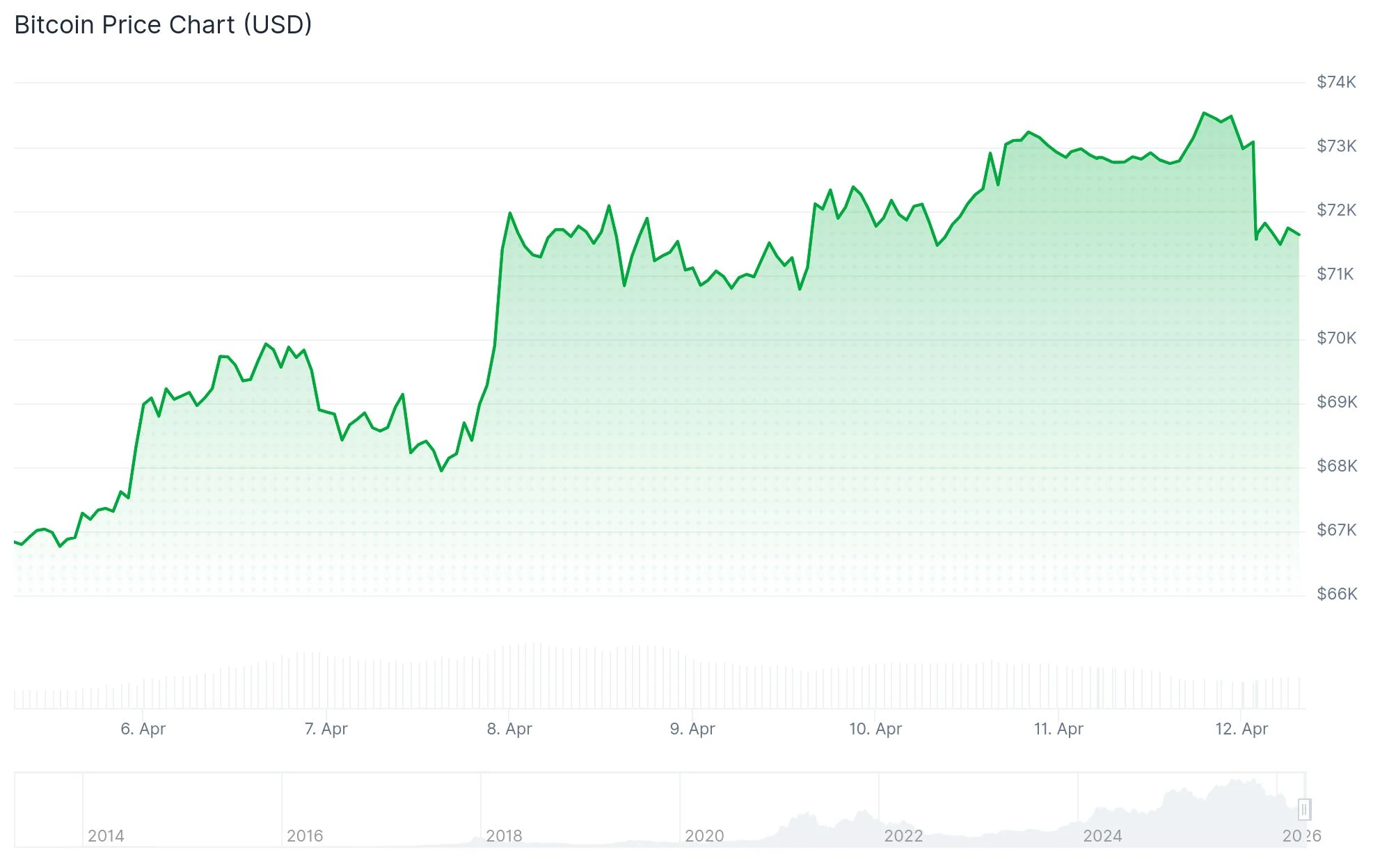
Short-term trading charts revealed a pronounced selloff directly correlated with news reports about the diplomatic impasse.
XRP retreated 1.69% to $1.33. Ethereum declined approximately 1.26% to $2,216. Comprehensive losses throughout cryptocurrency markets spanned from 1% to 3%.
As of April 12, the standoff between Washington and Tehran persists without resolution.
Ether Machine has called off its planned public debut after the Ethereum treasury-focused firm and Dynamix Corporation agreed to terminate their merger, citing deteriorating market conditions.
In a Saturday post on X, Ether Machine said the decision to end the deal was mutual and effective immediately. The transaction had aimed to take the firm public through a merger with the Nasdaq-listed special purpose acquisition company (SPAC), alongside involvement from The Ether Reserve LLC.
“The Ether Reserve LLC, together with certain other parties thereto, announced today that they have mutually agreed to terminate their previously announced Business Combination Agreement, effective immediately, as a result of unfavorable market conditions,” the firm wrote.
According to a filing with the US Securities and Exchange Commission, an unnamed “Payor,” identified in Annex A of the agreement but not disclosed publicly, must pay $50 million to Dynamix within 15 days of the termination taking effect.
Related: Bitmine uplists to NYSE as share buyback is increased to $4B
Ether Machine’s $1.5 billion Ethereum treasury plan collapses
Ether Machine first announced plans to launch what it described as the largest yield-bearing Ether (ETH) fund aimed at institutional investors in July last year. At the time, the company, co-founded by former Consensys executives Andrew Keys and David Merin, said it would list on Nasdaq under the ticker “ETHM,” launching with more than 400,000 ETH, worth over $1.5 billion at the time, under management.
In September, Ether Machine secured $654 million in a private financing round, including 150,000 ETH from Ethereum advocate Jeffrey Berns, who also joined the company’s board. The raise was part of its broader plan to build a large Ether treasury ahead of the planned Nasdaq debut, which has now been canceled.

Meanwhile, Dynamix retains a limited window to secure a new deal. The company has until November 22, 2026, to complete another business combination. If it fails to do so, it will be required to liquidate and return funds held in trust to shareholders, in line with its corporate charter.
Related: Peter Thiel’s Founders Fund dumps ETHZilla stake as ETH treasuries face pressure
Ethereum treasury exits deepen
Ether funds exit amid mounting pressure on Ethereum treasury strategies. Trend Research has fully unwound its Ethereum position, selling 651,757 ETH worth about $1.34 billion while locking in an estimated $747 million loss.
Separately, ETHZilla, formerly a biotech firm that pivoted into an Ethereum treasury strategy during the 2025 hype, has also moved away from Ether accumulation, updating its corporate name and brand to Forum Markets.
Magazine: Bitcoin’s ‘biggest bull catalyst’ would be Saylor’s liquidation — Santiment founder

Bitcoin and Ether are hovering near levels that could signal a trend shift for the year, even as a broad bear-case narrative persists across markets. Macro strategist Jordi Visser argued on the Anthony Pompliano podcast that a durable move would hinge on price anchors: BTC above $76,000 and ETH above $2,400. “If we trade above $76,000 and at the same time we see Ethereum above $2,400, I believe that is the beginning of a move that will be sustainable this year because I don’t think we’re going to have a recession,” Visser said on Friday’s episode.
From a price perspective, crossing $76,000 would imply roughly a 6% gain from Bitcoin’s around $71,646 level at the time of publication, according to CoinMarketCap data. An ETH revival to $2,400 would imply roughly an 8% lift, depending on the prevailing price trajectory. The thresholds are less about a single day move and more about signaling a potential shift in momentum if macro conditions remain supportive.
Key takeaways
- A durable rally would hinge on Bitcoin clearing the $76,000 level and Ethereum reaching $2,400, potentially marking the start of a more sustained move in 2026 if the economy avoids a recession.
- Inflation remains a central factor for market sentiment. Visser and other observers argue that elevated price pressures could push investors to seek non-equity hedges as traditional markets stagnate.
- Market-implied recession risk for 2026 sits around 24%, according to Kalshi’s pricing, down about 10 percentage points over the past month, illustrating shifting macro bets as traders reassess downside scenarios.
- Not all voices are aligned with an imminent upswing: veteran trader Peter Brandt has warned that BTC could retest or dip below recent lows later in 2026, underscoring ongoing uncertainty in timing and magnitude.
Inflation, the recession bet and crypto flows
The macro backdrop remains a central question for crypto traders. The U.S. Bureau of Labor Statistics reported that the April Consumer Price Index rose 3.3% year over year, a figure that signals the persistence of inflationary pressures even as headline prints moderate. In this environment, a segment of market participants argues that the crypto market could benefit from a rotation away from equities if the macro landscape fails to deliver broad-based growth. Kalshi’s market pricing, which points to a 24% chance of a recession in 2026, has moderated in recent weeks but continues to color risk assessments across digital assets and traditional markets.
Visser’s framing suggests that, in his view, a symmetrical rebound would depend on both BTC and ETH breaking key thresholds, paired with the absence of a macro shock. The implication for traders is clear: price action around major psychological and technical levels could catalyze a broader re-pricing of risk assets, including altcoins that have lagged during a protracted bear cycle.
Contrasting voices and potential paths for 2026
In late March, Peter Brandt—a well-known veteran trader—signaled that Bitcoin could move to new territory beyond the February low near $60,000. He described the possibility of a test of the downside later in the year, calling it a potential bear-cycle low rather than a forecast set in stone. Brandt’s stance underscores a fundamental tension in the market: even if some analysts outline scenarios for a structural bottom, timing remains highly uncertain and dependent on a convergence of macro data, policy expectations, and on-chain dynamics.
Visser has long maintained a more nuanced stance on market regimes, cautioning against rigid bull/bear labeling. He noted that even during periods of price ascent, the buildup of speculative appetite can wane, suggesting that a clean, textbook breakout may not be instantaneous. “At some point in there, it just seems like okay, they go up and then the normal course is at some point people don’t invest as much as they have,” he remarked, highlighting how sentiment can shift before traditional trend signals fully align.
What this could mean for traders and builders
For traders, the narrative hinges on whether BTC can sustain momentum through the next leg of price discovery and whether ETH can regain relevance as a macro-divergence asset in a high-inflation regime. A confirmed breakout above the $76,000/$2,400 threshold would not only mark a milestone for this cycle but could also influence funding rates, liquidity flows, and risk-off/reward dynamics across decentralized finance and broader crypto markets.
From a broader market perspective, the combination of sticky inflation and evolving recession expectations keeps macro risk at the forefront. If inflation trends were to cool more decisively or if the economy demonstrates resilience despite soft indicators, the case for a renewed crypto-upleg strengthens. Conversely, a renewed macro shock or a longer-than-expected slowdown could keep upside constrained, even if price testing around key levels continues.
For developers and infrastructure builders, the potential shift in momentum could affect funding appetites, user onboarding, and the pace of Layer-2 and cross-chain proliferation. In a scenario where risk assets regain traction, attention may move toward scaling, security, and user experience as the sector seeks to convert renewed interest into sustainable network activity.
Key references: Visser’s remarks on the Pompliano podcast, the 24% recession probability priced into Kalshi markets (down about 10 points in a month), and the latest CPI release from the U.S. Bureau of Labor Statistics. For context on price levels, Bitcoin hovered around the $71,646 mark, with Bitcoin price data corroborated by CoinMarketCap, while the ETH threshold cited sits at $2,400.
Looking ahead, market participants will be watching how inflation evolves, how central banks signal policy pivots, and whether crypto markets can translate macro resilience into durable price action. The next few weeks could help clarify whether the 2026 path favors a renewed crypto rally or a renewed test of downside support.
Watch next: as inflation data and policy cues unfold, traders will scrutinize whether the BTC-ETH cross-threshold thesis holds and which macro scenario—soft landing or renewed slowdown—ultimately shapes the year’s trajectory.
Crypto World
New Crypto Pepeto Final Exchange Testing Update While Markets Ask If Dogecoin Price Prediction Can Reach $1
The new crypto Pepeto moved into final exchange testing, and the presale pushed past $8,920,321 at the fastest pace this project has ever seen. On-chain activity inside this presale makes traders remember what showed up around Dogecoin in its earliest days, before small bags turned into serious wealth and the rest of the market wished they had moved faster.
This article breaks down the Dogecoin price prediction numbers and why the new crypto Pepeto keeps showing up as the biggest opportunity of 2026.
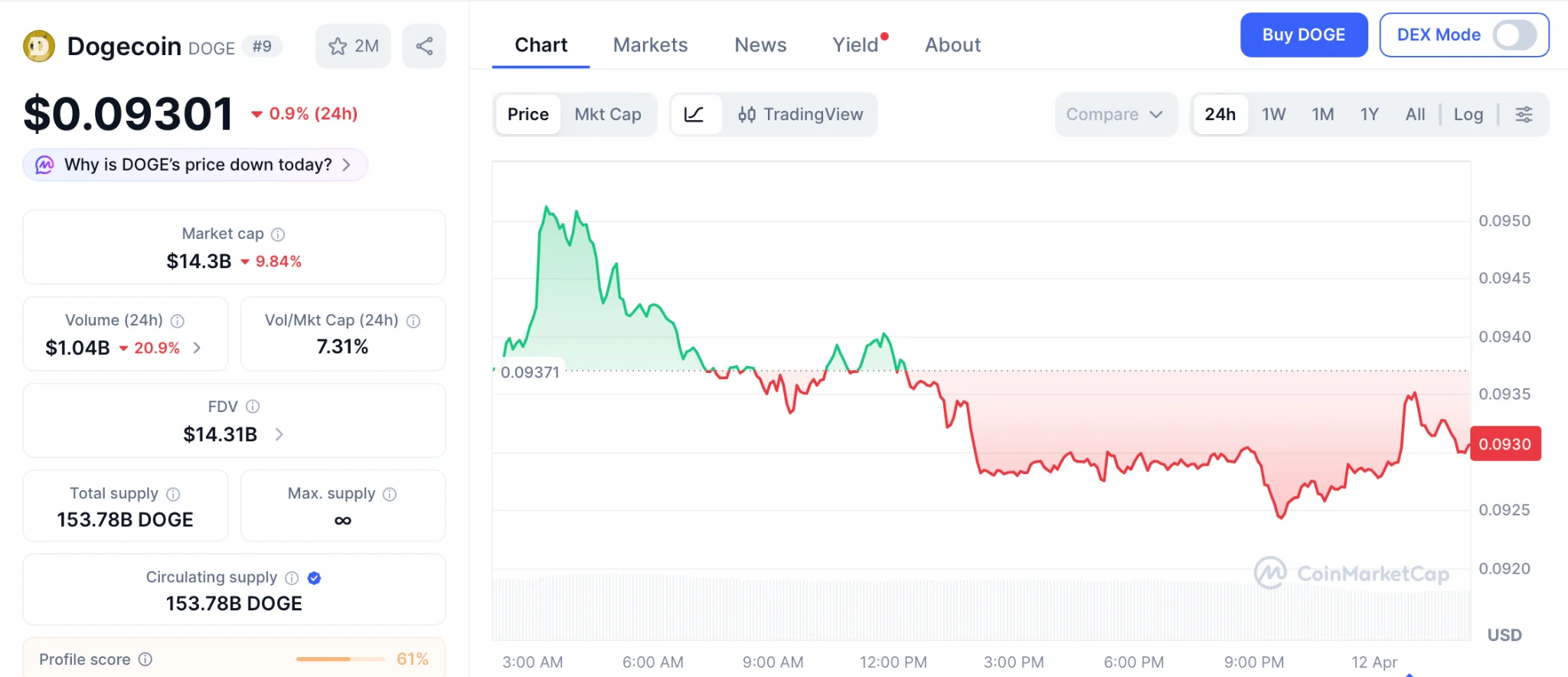
Before getting into the Pepeto project in detail, a quick look at DOGE outlook. The Dogecoin price prediction for $1 faces a long road from $0.093 but the catalysts stacking underneath make it harder to dismiss. DOGE needs to clear $0.095 first, a level that sellers have capped for six straight weeks, then break $0.10 where the Fibonacci ceiling sits according to CoinMarketCap.
After that, the 200-day EMA waits at $0.126, and the real fight starts at $0.25 where the 2026 high failed. A $1 Dogecoin price needs $148 billion in market cap, roughly ten times where it trades today.
Three spot ETFs are already live, the SEC classified DOGE as a digital commodity in March, developer activity jumped 300% year over year, and a GitHub proposal to cut annual issuance by 90% could flip the supply math entirely according to Benzinga. X Money is live with 600 million users but launched fiat-only with no DOGE integration confirmed, and every bull case above $0.25 depends on Musk making that call according to Changelly. The pieces are there. The trigger is not.
The main reason behind the Dogecoin price prediction is clear. A meme coin with no real tools behind it loses value the moment attention moves somewhere else. So where do you make real money on meme coins in 2026? Not on tokens sitting at $14 billion with nothing underneath. You find the early one, the new crypto with DOGE level energy in its first days, real Musk ties spreading across every platform, and a community growing the way DOGE grew before it blew up. That new crypto is Pepeto.
Pepeto Project In Focus
The data points anyone looking for real returns straight to Pepeto, and the case gets even stronger once you see what the team actually built behind those presale numbers.
“What would Dogecoin look like today if it launched with a real exchange behind the name instead of nothing? That question is the whole reason Pepeto was built. The exchange handles every swap at zero fees across Ethereum, BNB Chain, and Solana, the bridge sends tokens between all three chains instantly, and the AI scanner catches scam contracts before they touch any wallet. Every one of those actions runs on Pepeto, so the community pushing viral growth is the same user base generating real volume every day,” said the senior developer on the Pepeto team.
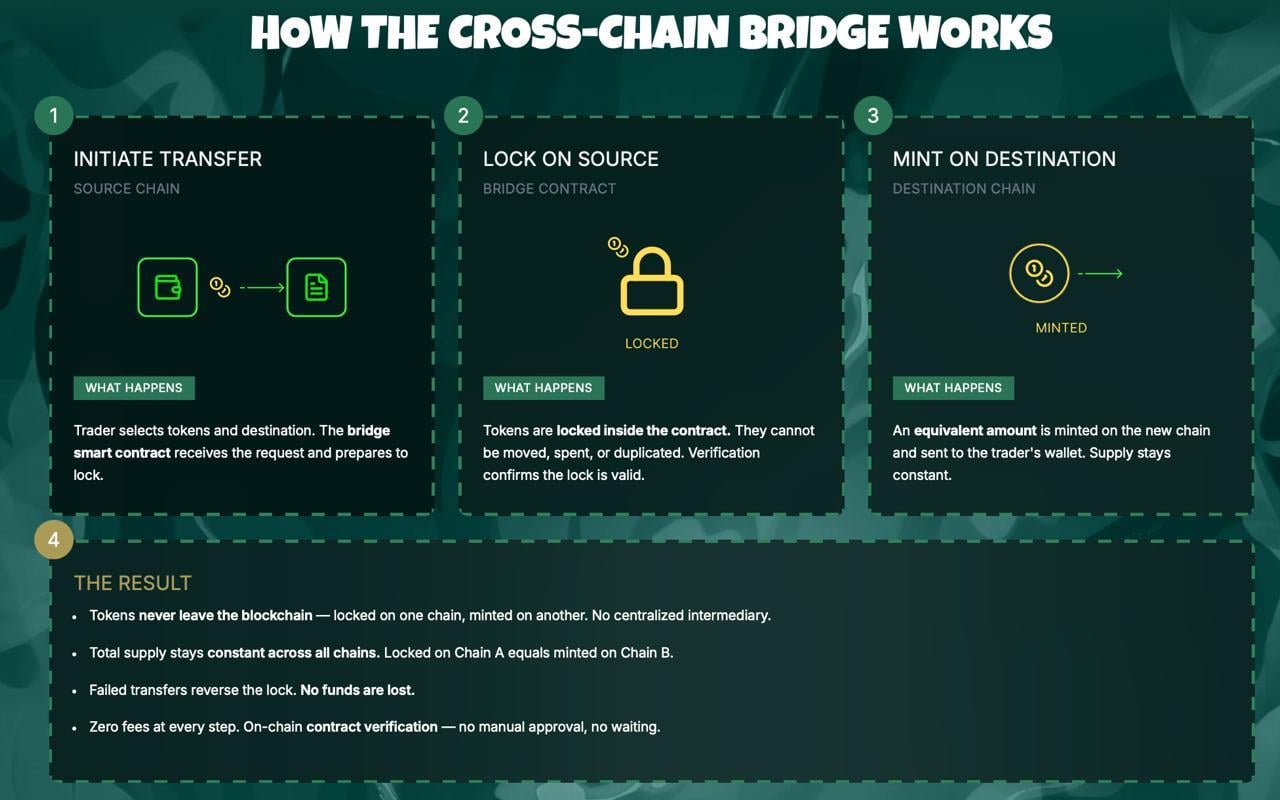
Picture being inside Dogecoin before Musk ever tweeted about it. That is where Pepeto sits right now. The wallets that rode a few thousand into millions on DOGE got one thing right: they entered before the world knew the name, and by the time Musk tweeted those positions were already worth fortunes.
Pepeto is moving on that same path. Musk’s ties to Pepeto keep growing across X and Telegram, and the only question left is when he posts about it, because the same signals that came before his Dogecoin run are showing up around Pepeto now. The whale wallets filling this presale are moving the same way early DOGE whales moved. Maybe they know something nobody else does. They always do.
Conclusion
The Dogecoin price data makes one thing clear: a $14 billion meme token cannot turn a small position into the kind of money that changes how someone lives. But early DOGE buyers know exactly what that feels like. A few hundred dollars at $0.004 became a house, a paid off car, a life with no alarm clock.
Those people did not do anything complicated. They made one right decision at the right time, and that single choice separated them from everyone who spent the next five years saying they almost bought.
Pepeto is sitting at that same moment right now, priced at presale, weeks from a Binance listing, with the same energy DOGE had before the world knew the name, and for anyone looking for the one decision that could deliver the same outcome, Pepeto is it.
Click To Visit Pepeto Website To Enter The Presale

FAQs
What is the dogecoin price prediction for 2026?
Benzinga targets the Dogecoin price between $0.145 and $0.249 for 2026. DOGE sits at $0.093 with three spot ETFs live.
Why is Pepeto considered a leader in the presales space?
Pepeto leads the presales race because it pairs meme coin virality with a working zero fee exchange at presale pricing. The Pepe cofounder leads the project with $8.9 million raised and a confirmed Binance listing ahead.
Disclaimer: This is a Press Release provided by a third party who is responsible for the content. Please conduct your own research before taking any action based on the content.


Pavel Durov said push notifications can create a privacy risk even after users delete messages and apps.
Summary
- Pavel Durov said push notifications may preserve data even after users delete chats and apps.
- Reports said FBI retrieved deleted Signal messages from iPhone notification logs in a criminal investigation.
- Interest in decentralized messaging apps rose as bans, unrest and internet restrictions disrupted communication access.
His remarks followed reports that investigators retrieved deleted Signal messages from iPhone notification logs, renewing debate about metadata, device storage and private messaging tools.
Durov said push notifications can leave message data on a device outside the encrypted chat itself. He said that risk remains even when users turn off preview text, because people they contact may still use default settings.
“Turning off notification previews won’t make you safe if you use those applications, because you never know whether the people you message have done the same,” he wrote.
He linked that point to privacy settings that depend on choices made by both sides of a conversation.
Durov referred to a report first published by 404 Media. The report said the FBI accessed deleted Signal messages from notification logs stored on an Apple iPhone used in a criminal case.
The case drew attention to how investigators can access data created around messages, even when message content remains protected by end-to-end encryption.
Moreover, the reports renewed focus on metadata, notification storage and other records created by messaging apps and operating systems. Encrypted content may stay protected, but surrounding device data can still reveal communication details.
That debate also increased interest in messaging tools that try to reduce centralized data collection. Developers of decentralized platforms say local storage, routing methods and network design affect how much information remains after users send or delete messages.
Decentralized apps gain users during bans
Interest in decentralized messaging and social platforms has risen since 2025 during blackouts, unrest and internet restrictions. Exploding Topics data cited in the report showed online search interest in decentralized social media platforms rose 145% over five years.
The report also pointed to Bitchat, a Bluetooth mesh messaging app that works without the internet. It said more than 48,000 users in Nepal downloaded the app during a social media ban in September 2025, while Durov said Telegram bans in Iran drove users toward VPNs instead of state-backed services.

Bitcoin and Ether aren’t far from levels that could signal a trend reversal this year, despite a growing consensus across the industry calling for a bear market, according to macro analyst Jordi Visser.
“If we trade above $76,000 and at the same time we see Ethereum above $2,400, I believe that is the beginning of a move that will be sustainable this year because I don’t think we’re going to have a recession,” Visser said on the Anthony Pompliano podcast published on YouTube on Friday.
A move to $76,000 would represent an increase of 6.1% from Bitcoin’s (BTC) price of $71,646 at the time of publication, according to CoinMarketCap data. Ether’s (ETH) move to $2,400 would represent an increase of around 8%.
Inflation is going to remain high, says Visser
Traders on the prediction market Kalshi are leaning toward a similar macro outlook to Visser, pricing a 24% chance of a recession in 2026, down 10% over the past 30 days.
“I think inflation is going to stay elevated, and I think people are going to need to find something that is making money in a world where the S&P is not moving anywhere,” Visser said.

The United States Bureau of Labor Statistics (BLS) revealed in a report published on Friday that the Consumer Price Index (CPI) in April rose 3.3% year-over-year.
Visser’s recent comments challenge the growing view across the crypto industry that 2026 still has more downside ahead, with some even calling for a move below the Feb. 6 yearly low of $60,000.
Bitcoin may fall below $60,000 yearly low
On March 31, veteran trader Peter Brandt said that this may not be the lowest level for 2026, forecasting that Bitcoin could retest or even move “slightly lower” than the price level in September or October this year.
“That would then be the bear cycle low,” Brandt said.
Related: Bitcoin charts point to $80K in April: Here’s how it may happen
Visser explained that he has never been a “big fan” of labeling Bitcoin price trends as bull or bear markets.
“Especially when we’re at all-time highs. Like, at some point in there, it just seems like okay, they go up and then the normal course is at some point people don’t invest as much as they have,” he said.
Magazine: Should users be allowed to bet on war and death in prediction markets
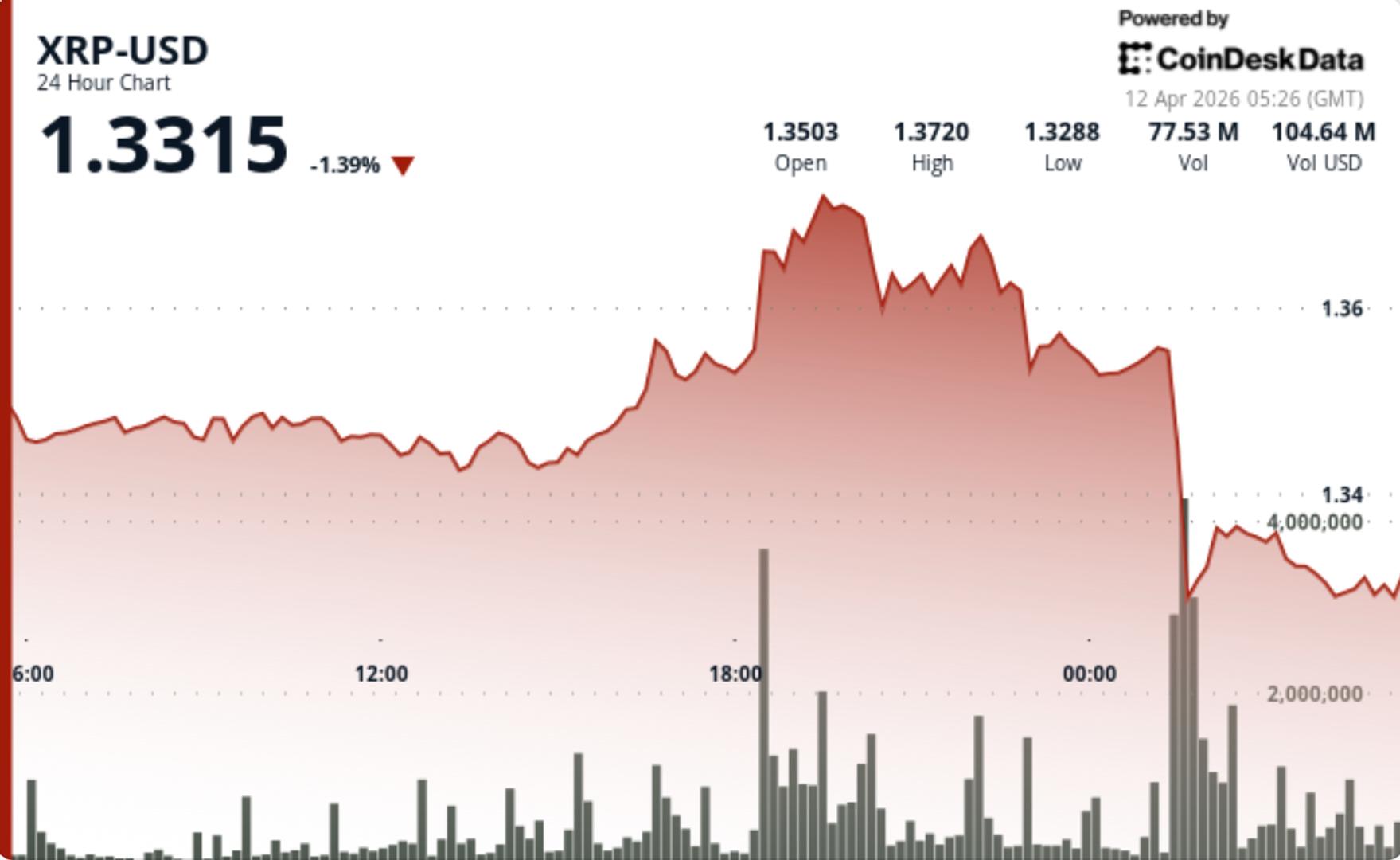
XRP saw a sharp breakdown in late trading, with a sudden wave of selling pushing price below key support. The speed of the move and lack of strong recovery suggest sellers are still in control, even as volatility compression points to a larger move ahead.
News Summary
• XRP fell from $1.36 to $1.33 in minutes, with a rapid spike in volume triggering a cascade of selling.
• The breakdown pushed price below $1.35, flipping it into resistance while upside remains capped near $1.41.
• Analysts remain split, with some calling for deeper downside while others still see a larger cycle recovery.
Market Overview
XRP declined 1.7% over the 24-hour period, but the headline move hides the real story, which is the intraday breakdown. Price was relatively stable before a sudden burst of selling hit, driving a quick drop through $1.35 and down toward $1.33.
The move came on extremely elevated volume, confirming it was not a thin liquidity move but a real flush. Once support gave way, price moved quickly, which is typical in current conditions where order books remain relatively shallow.
The bounce that followed was weak. XRP recovered slightly but failed to reclaim lost levels, forming a lower high and reinforcing the idea that the move was not just a temporary spike but a structural rejection.
Technical Analysis
The key signal is how quickly support failed and how weak the recovery has been. High volume on the way down, followed by fading volume on the bounce, typically points to distribution rather than accumulation.
XRP remains below key resistance levels and continues to trade within a broader downtrend. Indicators are mixed, with volatility compressing even as momentum weakens, creating the conditions for a larger move but without a clear direction yet.
This leaves the market in a familiar position where price is stuck between breakdown risk and the potential for a sharp reversal if resistance is reclaimed.
What traders should watch
• $1.35 is now the immediate pivot after breaking down, and price needs to reclaim it to stabilize.
• $1.40-$1.41 remains the key resistance zone that has capped multiple recovery attempts.
• On the downside, failure to hold $1.33 opens a move toward $1.32-$1.31, where the next demand zone sits.
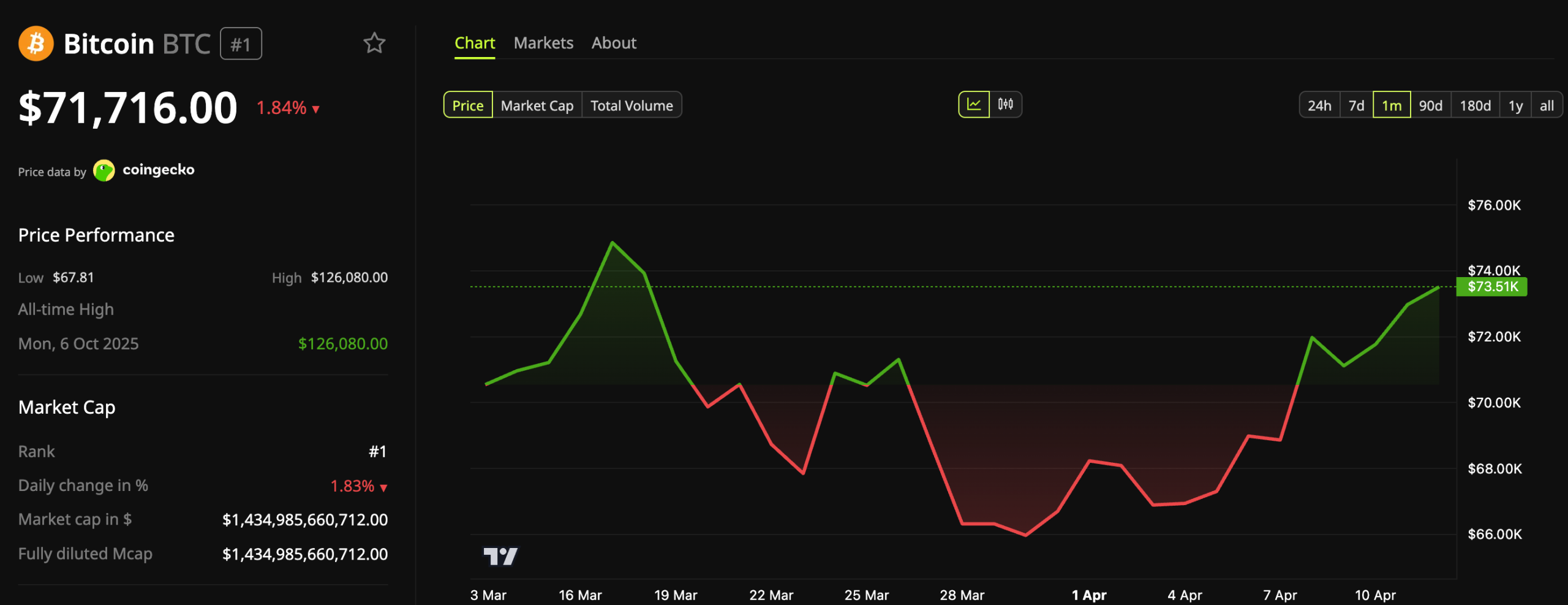
Bitcoin (BTC) reversed its Saturday rally and fell below $72,000 after the United States and Iran failed to reach an agreement following peace talks in Islamabad, Pakistan.
The largest cryptocurrency had climbed near $74,000 on Saturday before dropping to an intraday low of $71,168 during early Asian trading hours.
Bitcoin Drops as US-Iran Talks Fail After 21-Hour Islamabad Session
At press time, BTC traded at $71,716, down 1.84% over the past 24 hours.
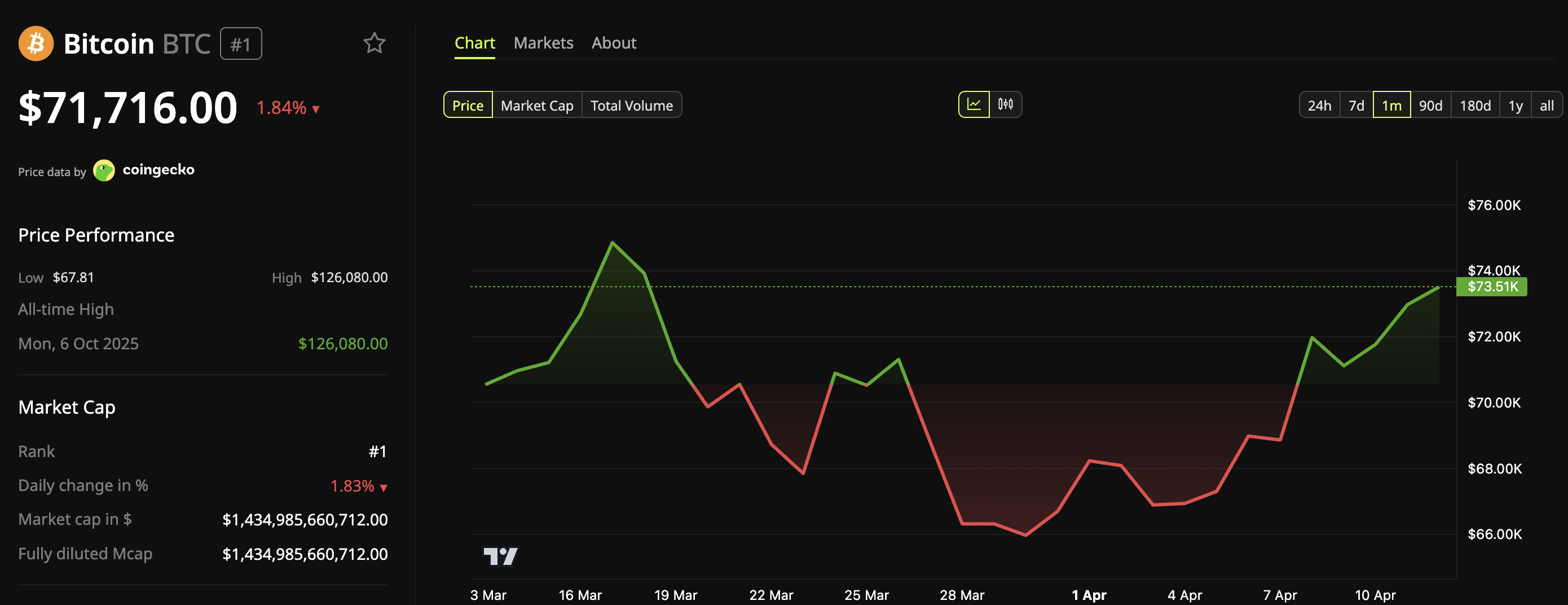
BeInCrypto Markets data showed that the broader crypto market cap also declined by 1.7%, with most major large-cap assets in the red. Ethereum (ETH) slipped to roughly $2,220, while XRP fell to $1.33, each shedding close to 2%.
BTC had gained ground earlier in the week after a two-week ceasefire was announced. However, the ceasefire remained fragile.
Israel continued airstrikes in Lebanon, and Iran announced crypto tolls on ships passing through the Strait of Hormuz. BeInCrypto also reported that, according to US officials, Tehran was unable to locate all the mines across the strait.
Two US Navy destroyers reportedly transited the Strait of Hormuz to begin mine-clearing operations, according to US Central Command. However, Iran rejected that claim outright.
Follow us on X to get the latest news as it happens
What Happened Between the US and Iran in Islamabad
The high-level negotiations between Washington and Tehran ended without producing a peace deal. Both sides offered competing explanations for the breakdown.
According to Fars news agency, any path to an agreement depends on Washington scaling back what Iran considers “unreasonable demands”. The control of the Strait of Hormuz and the nuclear program remain among several unresolved points of contention between the two sides.
“Despite various initiatives from the Iranian delegation, the unreasonable demands of the American side prevented the progress of the negotiations. Thus, the negotiations ended,” Iranian state broadcaster IRIB said in a post.
A source close to Iran’s negotiating team told Fars news agency that Washington sought concessions through diplomacy that it had been unable to secure from the war.
“The Americans needed the negotiation for their lost face in the international arena and were unwilling to lower their expectations despite the defeat and stalemate in the war with Iran,” the source said. “Iran has no plans for the next round of talks,” they mentioned.
On the US side, VP JD Vance held a brief press conference. He maintained that the American delegation was “quite accommodating and flexible.”
“The president told us, ‘You need to come here in good faith and make your best effort to get a deal.’ We did that, and unfortunately, we weren’t able to make any headway,” he said.
Vance emphasized that preventing Iran from developing nuclear weapons, both now and in the future, remains President Trump’s “core goal.” He left Pakistan after the briefing.
“So, look, we were constantly in communication with the team, because we were negotiating in good faith. And we leave here with a very simple proposal, a method of understanding that is our final and best offer. We’ll see if the Iranians accept it.”
The deadlock raises concerns about the fragile two-week ceasefire. However, Pakistan’s foreign minister has released a statement, urging both sides that it is “imperative that the parties continue to uphold their commitment to ceasefire”.
Subscribe to our YouTube channel to watch leaders and journalists provide expert insights
The post US-Iran Talks Breakdown, Bitcoin looses Weekend Gains appeared first on BeInCrypto.
TLDR:
- US intelligence confirms China is preparing MANPAD air defense shipments to Iran within weeks.
- Beijing is routing weapons through third countries to conceal origin and maintain plausible deniability.
- The transfer escalates beyond dual-use tech sales to direct government-to-government weapons delivery.
- Trump is set to meet Xi in Beijing next month as US-China tensions quietly build behind ceasefire talks.
Beijing has publicly taken credit for brokering the fragile US-Iran ceasefire, according to three sources familiar with US intelligence assessments.
The systems in question are MANPADS—shoulder-fired air defense missiles that threatened US aircraft throughout the five-week war. Shipments are reportedly being routed through third countries to conceal their Chinese origin.
China Prepares MANPAD Transfer To Iran While Ceasefire Holds
Three U.S intelligence sources familiar with recent assessments have confirmed to CNN that Beijing is preparing to deliver man-portable air defense systems, known as MANPADs, within the next few weeks.
The timing raises immediate questions. China claimed credit for helping broker the ceasefire that paused fighting between Iran and the US earlier this week.
Moving weapons to one side of that conflict during an active pause directly contradicts that public position. MANPADs presented a real threat to low-flying US military aircraft throughout the five-week war.
President Trump confirmed at a Monday press conference that an F-15 downed over Iran last week was struck by a shoulder-fired heat-seeking missile. Iran credited a new air defense system for that strike without identifying it further.
Two sources told CNN that Beijing is routing the shipments through third countries to conceal their origin. That approach preserves China’s ability to deny direct involvement and has been used in previous sanctions evasion cases.
A Chinese embassy spokesperson flatly denied the reporting, stating Beijing has never provided weapons to any party in the conflict.
Beijing’s Calculated Support For Iran Behind A Neutral Facade
Chinese companies have already been supplying Iran with sanctioned dual-use technology. That technology has helped Iran continue building weapons and improving navigation systems.
A direct government-to-government weapons transfer, however, would mark a clear escalation beyond those commercial arrangements.
One source described Beijing’s strategy as deliberate. China sees no value in openly entering the conflict against the US and Israel.
That path would be unwinnable and damaging to China’s broader standing. Instead, Beijing is quietly supporting Iran while maintaining the appearance of neutrality.
Iran supplies China with the bulk of its sanctioned oil, giving Beijing a firm economic reason to keep Tehran stable. Sources noted China could argue that air defense systems are defensive rather than offensive, distancing its support from Russia’s intelligence sharing that helped Iran target US forces.
Trump is set to meet President Xi in Beijing next month. High-level US-China talks took place during ceasefire negotiations this week.
Whether the reported shipment affects those diplomatic plans remains an open question as both governments continue engaging publicly.

Why Markets Are News-Driven, Not Financial!

Bolton News Best Gastropub and Restaurant: Bob’s Smithy Inn

Faisal Islam: Why the government is relaxed about Chinese car imports


-

 Business6 days ago
Three Gulf funds agree to back Paramount’s $81 billion takeover of Warner, WSJ reports
-

 Politics2 days ago
US brings back mandatory military draft registration
-

 Fashion2 days ago
Weekend Open Thread: Veronica Beard
-

 Tech4 days ago
How Long Can You Drive With Expired Registration? What Florida Law Says
-

 Business7 days ago
No Jackpot Winner, Prize to Climb to $231 Million
-

 Fashion6 days ago
Massimo Dutti Offers Inspiration for Your Summer Mood Board
-
 Sports2 days ago
Man United discover Nico Schlotterbeck transfer fee as defender reaches Dortmund agreement
-

 Crypto World3 days ago
Canary Capital Files SEC Registration for PEPE ETF
-

 Fashion5 days ago
Let’s Discuss: DEI in 2026
-

 Business1 day ago
Tesla Model Y Tops China Auto Sales in March 2026 With 39,827 Registrations, Beating Cheaper EVs and Gas Cars
-

 Crypto World4 days ago
Bitcoin recovers as US and Iran Agree a Ceasefire Deal
-

 Politics2 days ago
Malcolm In The Middle OG Turned Down ‘Buckets Of Money’ To Appear In Reboot
-

 Business2 days ago
OpenAI Halts Stargate UK Data Centre Project Over Energy Costs and Copyright Row
-

 Business16 hours ago
Ireland Fuel Protests Enter Day 5 as Blockades Spark Shortages and Government Prepares Support Package
-

 Tech6 days ago
Gamer Restores the Original PlayStation Portal From Two Decades Ago
-

 Tech6 days ago
Italian court says Netflix must refund customers up to $576 over price hikes
-

 Tech6 days ago
Samsung just gave up on its own Messages app
-

 Tech6 days ago
Haier is betting big that your next TV purchase will be one of these
-

 Tech6 days ago
The Xiaomi 17 Ultra has some impressive add-ons that make snapping photos really fun
-

 Politics2 days ago
LBC Presenter Mocks Trump Over Iran War Failures
You must be logged in to post a comment Login