

Crypto World
“I’m Pretty Confident That Was the Bottom at $60K,” Says Pompliano as Bitcoin Surges


TLDR:
- Pompliano declared confidence that Bitcoin’s cycle bottom was established at the $60K price level.
- Institutional accumulation by buyers like MicroStrategy created consistent demand against Bitcoin’s fixed supply.
- Pomp argues volatility compression has broken Bitcoin out of its traditional four-year market cycle.
- Bitcoin, stablecoins, and tokenization are the assets Pompliano sees surviving and leading crypto’s next phase.
Bitcoin’s recent price action has renewed debate over whether the market has already seen its cycle low. Anthony Pompliano, widely known as “Pomp,” made a bold claim, stating, “I’m pretty confident that was the bottom at $60K.”
His comments came during a broader discussion on Bitcoin’s fundamentals, institutional adoption, and long-term outlook. The statement has since drawn significant attention from investors watching Bitcoin’s next move closely.
Pompliano Points to $60K as the Cycle Bottom
Pompliano’s confidence in the $60K bottom is rooted in Bitcoin’s core fundamentals. He described Bitcoin as offering “certainty” that traditional assets simply cannot provide.
Unlike gold or U.S. Treasuries, Bitcoin’s fixed supply and transparent monetary policy give investors a clear picture of what they own. That clarity, he argues, is what separates Bitcoin from every other asset class available today.
He also noted that the shift from fear to confidence among investors played a major role in establishing that floor. When prices hovered around $60K, many retail and institutional participants were still hesitant.
Pompliano described this period as one where the market needed to move from “fear to confidence” before a sustained recovery could take hold. That transition, in his view, defined the bottom.
Institutional activity also supported the case for $60K as a turning point. Buyers like Michael Saylor and MicroStrategy were accumulating during that period, adding consistent demand against a fixed supply.
However, Pompliano was careful not to overstate any single buyer’s role, calling the recovery a “confluence of events” rather than the result of one catalyst. Each factor reinforced the other, creating a durable floor.
Pompliano also challenged the traditional four-year Bitcoin cycle, arguing that “volatility compression” has changed how the market behaves entirely. Price movements now happen faster and with less dramatic drawdowns than in previous cycles.
If that pattern holds, the $60K level may represent the deepest pullback of this cycle. Investors waiting for lower prices, he suggested, may have already missed their entry point.
Bitcoin’s Fundamentals Back the Bullish Case
Beyond the price call, Pompliano laid out the structural reasons Bitcoin is well-positioned from here. He described Bitcoin as “the only asset” offering digital scarcity, decentralization, and a predictable monetary policy at the same time.
In periods of geopolitical tension and economic volatility, those qualities attract serious capital. Investors seeking certainty are finding fewer alternatives outside of Bitcoin.
He also addressed the growing intersection of artificial intelligence and crypto. Pompliano argued that AI systems will increasingly require assets like Bitcoin and stablecoins to operate, framing both industries under the broader theme of “automation.”
Crypto infrastructure, therefore, becomes a foundational layer for the emerging automation economy. Venture firm a16z has already raised a dedicated fund targeting exactly this convergence.
On surviving assets within crypto, Pompliano was direct and unambiguous. He expressed strong conviction in Bitcoin, stablecoins, equity infrastructure, and tokenization as the areas that will endure.
Most altcoins and meme coins, he argued, are unlikely to recover meaningfully. The smarter approach, in his words, is to “provide the venue” for speculation rather than being the one speculating.
While acknowledging that Bitcoin’s days of delivering 100x returns are behind it, Pompliano remains firmly bullish on its long-term performance. He expects Bitcoin to outperform equities over a sustained period.
For investors who missed the $60K entry, his message is straightforward — “the bottom,” by his assessment, is already in.


TLDR:
- Jensen Huang says AI will make intelligence a commodity accessible to billions worldwide for the first time.
- NVIDIA chips power data centers at Amazon, Microsoft, Google, and Meta, driving the global AI buildout.
- Huang argues AI automates tasks but elevates human purpose, pushing back against job displacement fears.
- The NVIDIA CEO urges scientists, engineers, and policymakers to advance AI capabilities and safety together.
NVIDIA chief executive Jensen Huang addressed graduates at Carnegie Mellon University on Sunday, May 10. He received an honorary doctorate at the commencement ceremony.
Huang said artificial intelligence will make intelligence a commodity for everyone. He argued the technology will reach billions who have never accessed computing power before. His remarks touched on jobs, safety, and America’s industrial future.
AI as a Tool for Closing the Technology Divide
Huang told graduates that AI represents a historic opportunity to reach underserved populations. He stated, “We have the opportunity to close the technology divide—and bring the power of computing and intelligence to billions of people for the very first time.”
He named carpenters and shopkeepers as people who would benefit from this shift. These are groups that have traditionally been left outside the technology economy.
He framed the current AI buildout as America’s reindustrialization moment. According to Huang, building chip factories and data centers requires plumbers and ironworkers, not just engineers.
NVIDIA’s chips currently power data centers run by Amazon, Microsoft, Google, and Meta. This positions the company at the center of the global AI supply chain.
Huang pushed back against the view that AI will displace human workers. He drew a clear line between tasks and purpose in his argument.
A radiologist, he explained, does more than read scans — they care for patients. AI handles the repetitive task, while the human focus shifts to higher-level care.
He closed this section with a broader historical point. “Every major technological revolution in history created fear alongside opportunity,” he told the graduating class.
When society engages technology openly and responsibly, human potential expands, he added. He urged graduates to approach AI with optimism rather than resistance.
Safety and Innovation Must Advance Together
Huang called on scientists, engineers, and policymakers to develop AI capabilities and safety in parallel. He warned that guardrails must keep pace with the technology’s rapid growth.
Addressing this directly, he said society must engage technology “openly, responsibly, and optimistically” to expand human potential. His remarks added a measured voice to the ongoing global debate on AI regulation.
He honored Carnegie Mellon’s long history in AI research during the address. The university’s Logic Theorist program from the 1950s was among the examples he cited.
He also referenced its Robotics Institute, founded in 1979, calling both pillars of American technological leadership. Huang described these contributions as a foundation the current generation must build upon.
He challenged graduates to treat AI as an inclusive tool, not one reserved for the elite. The moment, he said, is a mandate to build.
That charge was directed at everyone in the room — scientists, engineers, and policymakers alike. The message was clear: progress requires active participation, not observation.
TLDR:
- Strategy’s software revenue grew 12% in Q1 2026, marking its strongest financial quarter in ten years.
- Cloud revenue surged 59% year-over-year, with controllable margin expanding 27% to fund Bitcoin operations.
- Strategy launched Mosaic, an AI data foundation integrating LLMs, hyperscalers, and data warehouses in one platform.
- CEO Phong Le says Bitcoin and software create unique synergies, energizing staff and winning over skeptical customers.
Strategy’s software division recorded its best financial quarter in ten years during Q1 2026, according to CEO Phong Le. Revenue grew 12% year-over-year, driven by 59% growth in cloud revenue.
Controllable margin expanded 27%, helping offset Bitcoin operating expenses. Le outlined how the enterprise software business and Bitcoin treasury strategy create mutual benefits for the company. The update offers a rare inside look at Strategy’s dual business model.
Software Business Drives Financial Growth for Strategy
Strategy has been operating since 1989 and went public in 1998. Today, it employs 1,500 people across nearly every major city worldwide.
The company operates in over 25 countries and maintains partnerships with Amazon, Google, Microsoft, Snowflake, and HCL.
Le took to X to share the milestone, writing, “Q1 2026 was the strongest financial quarter in the last decade for our software business.”
He added that revenue growth was fueled by a 59% rise in cloud revenue. The company serves over 3,000 customers and more than 500,000 active users globally.
Strategy holds SOC 2 Type 2, ISO 27001, and FedRAMP certifications. It also complies with PCI DSS, HIPAA, DPF, and GDPR standards. These credentials directly strengthen the company’s credibility as a Bitcoin treasury operator.
Over 100,000 employees, partners, and customers have built careers around Strategy Software. Many have gone on to found startups and lead public companies near its Tysons Corner headquarters. Le noted, “No company in the digital asset ecosystem has this depth of institutional experience.”
AI Investment and Bitcoin Synergies Shape Strategy’s Future
Le addressed a common question about Strategy’s dual business model on X. He wrote, “I’m sometimes asked why a Bitcoin Treasury Company should also operate a software business.” His answer was direct: “The two create powerful and unique synergies.”
Strategy recently launched an AI data foundation called “Mosaic.” It integrates large language models, hyperscalers, and data warehouses into one trusted platform. The system uses AI agents to serve enterprise data needs through a simple semantic layer.
The company is also rebuilding many internal workflows using multiple AI models. Le stated, “Over the next year, I expect we will automate many core workflows and replace much of our internal enterprise software.” He added that systems will become “increasingly autonomous, adaptive, self-healing, and self-improving.”
On the human side, Le noted that Bitcoin has energized the workforce and attracted strong talent. He wrote, “Our customers have evolved from skeptical to curious to supportive.” The software business and Bitcoin treasury continue to reinforce each other’s growth, according to Le.
TLDR:
- XRP’s Taker Buy/Sell Ratio is nearing 1.0, showing a gradual shift from seller control to market balance.
- XRP has held the $1.35–$1.45 range despite weak momentum, signaling that buyers are absorbing sell orders.
- Taker buy and sell volumes have dropped sharply from January highs, pointing to a possible accumulation phase.
- A sustained ratio above 1.0 with rising buy volume could push XRP toward the $1.50–$1.60 resistance zone.
XRP price action has remained range-bound in recent weeks, but underlying market data tells a different story. The Taker Buy/Sell Ratio is now hovering near the 1.0 level, showing a gradual shift from seller dominance to a more balanced market.
Meanwhile, overall trading volume has dropped sharply from earlier highs. These combined signals are pointing toward a possible upside move rather than a continued decline.
Buyer and Seller Activity Points to Market Balance
The Taker Buy/Sell Ratio is one of the more reliable indicators for reading short-term market sentiment. When the ratio sits below 1.0 consistently, prices tend to fall under sustained pressure.
However, XRP has managed to hold the $1.35–$1.45 range despite the ratio staying close to neutral for an extended period.
This holding pattern shows that buyers are still absorbing available sell orders in the market. The price has not broken down sharply, which would be expected if sellers were clearly in control. That alone suggests some degree of underlying demand at current levels.
CryptoQuant analyst PelinayPA noted that the recovery in the ratio while price stays stable is worth watching.
The analyst pointed out that fading sell pressure and stable price action often appear during accumulation phases before a larger market move.
As things stand, the current structure does not point toward panic. Neither aggressive selling nor strong buying momentum is present right now. That balance is consistent with a market that is pausing before its next directional move.
Lower Volume and Stable Price Raise Breakout Probability
Both taker buy volume and taker sell volume have dropped significantly compared to January and February levels. The large sell spikes seen in those months are no longer present in current data. This shift shows that seller strength has weakened, even if buyer conviction has not fully returned.
Lower volume during a sideways price trend is a pattern often associated with accumulation. It suggests that large market participants may be quietly building positions without triggering major price swings. The absence of a breakdown despite weaker volume adds to this reading.
PelinayPA stated that whales appear to be stabilizing the market while energy builds ahead of a larger move. The analyst added that if the ratio stays above 1.0 for several consecutive days, a move toward the $1.50–$1.60 range becomes more likely.
Still, no strong buying momentum has entered the market yet. A confirmed upside move would require rising buy volume alongside a sustained ratio above 1.0.
Until those conditions are met, XRP remains in a sideways-to-slightly-bullish posture rather than a confirmed breakout phase.
TLDR:
- HBAR is trading between $0.094 and $0.0955, posting weekly gains of around 8% in May 2026.
- The Canary HBAR ETF recorded roughly $2.5M in fresh inflows as of May 8, ending weeks of stagnation.
- FedEx joined Hedera’s Governing Council post-HederaCon 2026, alongside McLaren and insurance sector partners.
- Analysts are targeting $0.12 and above for HBAR if price sustains a breakout beyond the $0.10 resistance level.
Hedera’s HBAR token is showing renewed strength in May 2026. The asset is trading between $0.094 and $0.0955, posting gains of roughly 2.9% to 3.1% over the past 24 hours.
Weekly performance also stands at approximately 8%, placing it among the better-performing assets in the current cycle. The $0.10 psychological resistance level remains the key price point traders are watching closely.
ETF Inflows and Institutional Positioning Signal Returning Confidence
Institutional interest in HBAR appears to be making a quiet comeback. The Canary HBAR ETF recorded approximately $2.5 million in fresh inflows as of May 8. This came after several weeks of stagnant activity, making it a notable shift in sentiment.
Grayscale has also maintained its position in the asset. The firm continues to hold a 7.41% HBAR allocation within its Smart Contract Platform Fund. That allocation has remained stable, showing consistent institutional conviction in the network’s long-term role.
Crypto analyst account Cryptofic noted on X that “fundamentals (enterprise council, real usage, ETF flows) are bullish and decoupling from broader market noise, but price action lags.” The observation points to a growing gap between on-chain activity and market price movement.
Price is currently testing a resistance zone that has not been sustained since earlier this year. A confirmed break above $0.10 could open the door toward analyst targets near $0.12 and beyond.
HederaCon 2026 Momentum Continues With Major Enterprise Additions
HederaCon 2026 took place in Miami in early May and left a noticeable trail of announcements. FedEx has since joined the Hedera Governing Council, expanding the network’s enterprise footprint further. The event also drew White House crypto policy representation, reflecting growing regulatory attention.
Beyond logistics, the insurance sector has begun integrating Hedera for property data management. McLaren’s involvement was also confirmed, adding another high-profile name to the council’s growing roster. These partnerships point to a network increasingly embedded in real-world industries.
On the financial infrastructure side, organizations such as DTCC and Euroclear have been linked to Hedera’s stablecoin, RWA, and tokenization efforts.
HashSphere, the network’s private ledger offering, also reached general availability. Cross-ledger protocol development adds another layer to the ecosystem’s growing infrastructure.
Hedera’s transaction volumes and fee metrics continue to trend positively. Combined with commodity classification discussions at the regulatory level, the network is positioning itself for longer-term institutional adoption.
The convergence of enterprise use, ETF activity, and regulatory clarity makes HBAR one of the more closely watched assets in the current market environment.

The US Department of Justice announced that 20-year-old Marlon Ferro of Santa Ana has been sentenced to 78 months in prison for his role in a large-scale cryptocurrency theft and social engineering conspiracy that stole more than $250 million from victims across the country.
Ferro, who also used the alias “GothFerrari,” pleaded guilty in October 2025 to conspiracy to participate in a racketeering enterprise.
Crypto Burglary Operation
In addition to the prison sentence, the court ordered him to serve three years of supervised release and pay $2.5 million in restitution. According to court filings, federal investigators uncovered a multi-year operation active between late 2023 and early 2025 that involved members across several US states and abroad.
The group allegedly carried out database hacks, fraudulent phone calls, money laundering, and residential burglaries that targeted people believed to hold large amounts of cryptocurrency. Prosecutors said Ferro was brought in when victims stored their assets in hardware wallets that could not be accessed remotely.
In one incident in February 2024, Ferro allegedly traveled to Winnsboro and broke into a victim’s home, stealing a hardware wallet that contained about 100 BTC worth more than $5 million at the time. Authorities said he later laundered the funds through crypto exchanges. In another case in July 2024, Ferro allegedly flew to New Mexico and monitored a target residence for several days before smashing a window with a brick and entering the home in search of a hardware wallet.
Investigators said the burglary was captured on the victim’s surveillance cameras. Court documents also stated that Ferro helped launder stolen crypto by using fraudulent identification documents to open accounts on geo-blocked payment platforms, which allowed members of the group to spend stolen funds at retail stores and nightclubs. Authorities alleged he purchased more than $255,000 worth of designer clothing for co-conspirators and assisted an arrested conspiracy leader by converting crypto into cash to pay legal fees.
Prosecutors also said Ferro arranged the purchase and shipment of Hermès Birkin bags for the associate’s girlfriend. When Ferro was arrested in May 2025, law enforcement recovered two firearms and a fake identification document.
Growing Real-World Threats
The case comes as the industry faces growing concerns over so-called “wrench attacks,” where victims are threatened into handing over access to their digital assets. Earlier this year, blockchain security firm CertiK reported a 75% increase in crypto thefts involving physical threats in 2025.
Amid those concerns, Binance this week introduced a feature allowing users to lock withdrawals for up to seven days, which is designed to help reduce risks tied to physical coercion.
The post Crypto Burglar ‘GothFerrari’ Sentenced After $250M Theft Ring Targeted US Victims appeared first on CryptoPotato.


Sui (SUI) jumped roughly 31% over 24 hours on Sunday, lifting it onto CoinGecko’s trending coins list alongside Sweat Economy (SWEAT) and Zano (ZANO) and reviving talk of a fresh altcoin narrative.
The high-throughput Layer 1 reclaimed ground above $1.40, according to analytics tracker CoinsLytic, while the simultaneous appearance of a fitness token and a privacy-by-default chain in the same bracket caught traders’ attention.
A 31% Rally Puts SUI Back in Focus
Several accounts logged the move within hours. Trader Ivan Liljeqvist captured the mood for short-term participants in a Sunday post.
“SUI up almost 30% since flipping bull on the hourly time frame Last 7-10 days is a paradise for short-term day traders grinding lower timeframes in altcoins,” he wrote.
The rally extends an advance that lifted SUI more than 38% earlier in 2026. Analysts flag a clean break above the $1 zone, naming $3 and $10 as longer-term targets.
SWEAT and ZANO Point to a Different Kind of Demand
The mix of names alongside SUI is what has drawn wider attention. CoinGecko noted the trio entering its top five “for the first time in a while” and asked whether a new narrative could form.
SWEAT ties token rewards to physical activity through the Sweatcoin app, while ZANO operates as a privacy-by-default chain.
Their joint appearance points to rotating interest beyond meme coins and AI agents, toward privacy names and other utility plays.
Whether this grouping marks the start of a sustained shift or simply a weekend in the algorithm will depend on whether volumes hold through the week.
The post SUI Climbs 31% as Utility Plays Take Over CoinGecko This Week appeared first on BeInCrypto.

Strategy, the Bitcoin treasury company co-founded by Michael Saylor, signaled it will resume BTC purchases this week after an earnings call, while leaving open the possibility of selling portions of its holdings to fund dividends on its credit instruments. Saylor took to X to declare “Back to work, BTC,” a message that has historically coincided with new BTC acquisitions. The firm last purchased BTC on April 27, buying 3,273 coins for about $255 million, lifting total holdings to 818,334 BTC. At the time, Strategy valued its stash at roughly $61.8 billion on its website.
The buy pause that preceded the quarterly update was brief. Strategy paused its BTC buying streak for one week ahead of its Q1 2026 earnings call, during which the leadership discussed the possibility of selling portions of its Bitcoin to help fund dividend payments to holders of its credit instruments. This marks a potential shift from the company’s long-standing stance of avoiding sales, and it has already prompted debate about the impact on Bitcoin prices as well as the treasury’s flexibility in turbulent markets.
Key takeaways
- Strategy plans to resume BTC purchases this week after a one-week pause ahead of its Q1 2026 earnings release.
- The company indicated it may periodically sell portions of its BTC holdings to fund dividends on its corporate credit products, a move that would diversify its treasury management.
- As of the April 27 purchase, Strategy owns 818,334 BTC, a stake valued at roughly $61.8 billion at the time, following a 3,273-BTC buy for about $255 million.
- CEO Phong Le stressed that sales would be selective, including for dividend yields and tax-deferral reasons, and that neither sales nor purchases should materially move Bitcoin’s market price given its large daily trading volume.
- The move sparked mixed reactions—from investors who see periodic sales as capital-efficient financing to critics who warn of potential downward pressure on the spot market and a “doom loop.”
Resuming purchases and the timing signal
Following the earnings call, Strategy signaled a return to its routine BTC accumulation, a pattern that has helped push Bitcoin higher during favorable market conditions in the past. Saylor’s public cadence—often accompanied by a tweet preceding a fresh purchase—has become a barometer for market participants watching for a signal of renewed corporate demand. The late-April buy, which raised Strategy’s BTC holdings to 818,334 coins, underscored the scale at which the treasury operates. With Bitcoin’s price volatility and macro uncertainty, the timing of additional buys could still hinge on the company’s liquidity needs and the broader risk tolerance of the market.
The background to this development includes Strategy’s earlier pause in purchases ahead of the Q1 earnings release. The company reported its quarterly results in early May, and the accompanying discussion underscored a potential shift in treasury policy: while Strategy does not intend to abandon its BTC holdings, it may monetize a portion of its reserve to support dividend distributions on its credit instruments. This approach would align the treasury’s capital allocation with shareholder-oriented goals while preserving a long-term BTC stake—a nuance that investors will be watching as the narrative unfolds.
Dividend funding, optionality, and what changes
During Strategy’s Q1 earnings call, Saylor indicated that the company could sell a slice of its Bitcoin to fund a dividend and to defer taxes in certain scenarios. CEO Phong Le later clarified that any BTC sales would occur in specific, limited contexts and should not be viewed as a routine counterweight to purchases. He argued that selling would provide optionality and help the company manage cash flows without destabilizing Strategy’s overall strategy or the Bitcoin market at large. Le noted that the firm owns about 4% of the total BTC supply, a figure that underscores the potential market impact of any large coordinated sales, even if they are strategic and occasional.
From a market dynamics perspective, the plan raises questions about how a meaningful BTC treasury might influence price discovery and liquidity. Proponents argue that selective selling could inoculate the market by providing predictable, time-bound cash flows that support ongoing BTC accumulation and the servicing of debt instruments. Critics, however, worry about signaling effects and the potential for selling episodes to introduce new selling pressure, particularly if the timing factors into broader negative sentiment or macro shocks.
Even as debates rage, Strategy’s broader operational context remains clear: the company’s daily activity sits within a highly liquid, multi-trillion-dollar market. Bitcoin’s average daily trading volume widely exceeds $60 billion, a fact that Le cited when explaining that even a few hundred million dollars in annual dividend payments—about $1.5 billion per year—could be absorbed by the market without undue price disruption. This framing suggests that, in practice, well-structured, selective sales could be managed in a way that minimizes price impact while meeting dividend obligations for creditors.
Market reactions and strategic implications
Industry observers offered a spectrum of interpretations. Some investors, including Strategy investor Adam Livingston, argued that periodic BTC sales could be accretive for the treasury by enabling larger future purchases and maintaining liquidity to meet dividend commitments. Samson Mow, a long-standing Bitcoin advocate, framed Strategy’s new flexibility as increasing the treasury’s optionality and capacity to maneuver in financial markets, potentially enabling more strategic responses to shifting incentives and market conditions.
Conversely, social commentary reflected concerns about possible downward pressure on BTC’s spot price and the emergence of a so-called “doom loop” if similar corporate actions become widespread or poorly sequenced. While the market’s reaction remains nuanced, the central takeaway is that Strategy’s moves are not isolated: they sit at the intersection of corporate treasury management, investor yields, and Bitcoin’s price dynamics in a macro environment shaped by rate expectations, liquidity, and regulatory considerations.
What this means for Strategy and the broader market
Viewed through the lens of treasury strategy, Strategy’s latest stance introduces a more nuanced balance between hodling and monetization. The firm’s assertion that sales will be targeted, with clear purposes—dividends and tax planning—offers a framework for addressing investor needs without abandoning the premise of BTC ownership as a central, long-term ledger asset. The company’s sizable stake, representing roughly 4% of the total Bitcoin supply, implies that even selective sales could be meaningful in aggregate, given the liquidity profile of Bitcoin’s market.
Investors will want to monitor how Strategy calibrates its buy/sell cadence going forward, especially in the context of quarterly earnings cadence, dividend schedules, and potential tax considerations. The interplay between Strategy’s treasury actions and Bitcoin price action could become a more visible feature of Bitcoin’s price discovery, particularly if other large holders adopt similar treasury flexibilities. As always, macro factors, such as institutional risk appetite and regulatory clarity across major markets, will shape how these announced policies translate into real-world market outcomes.
Looking ahead, readers should watch for updates on Strategy’s dividend policy and any further disclosures about its planned sell events. The coming weeks could reveal whether the company maintains a steady pattern of modest, periodic sales or adjusts the pace in response to market liquidity and headline risks. The implications reach beyond Strategy: they test the viability of BTC as a corporate treasury instrument capable of financing shareholder returns while maintaining a disciplined, long-horizon hodl strategy.
In the near term, observers should pay attention to how Bitcoin’s price reacts to any new prints of Strategy’s buying or selling activity, how the market absorbs dividend-related flows, and whether other corporate treasuries contemplate similar approaches. The evolving dynamic between treasury management and price stability will help define whether Bitcoin can sustain large, fiduciary-backed positions without compromising market integrity.
For ongoing coverage and deeper context, keep an eye on Strategy’s earnings commentary and subsequent market reactions as the narrative unfolds—particularly how the implied trade-offs between liquidity, yield, and price stability play out in a market that remains among the most liquid, but also most scrutinized, in crypto.
TLDR:
- XRPL Foundation has expanded its leadership roles to improve coordination across developers and validators.
- XRP continues acting as liquidity bridge across settlement flows and tokenized asset markets.
- Compliance tools like credentials and permissioned domains support regulated XRPL participation.
- Lending, escrow, and payment channels advance XRPL’s programmable settlement infrastructure layer.
XRP Ledger Foundation advances ecosystem coordination as XRPL development intensifies across liquidity, compliance, and settlement design.
The latest structural updates place XRP at the center of network activity, while new leadership roles expand collaboration across developers, validators, and institutions globally.
XRPL Foundation Reshapes Governance and Ecosystem Coordination
The XRP Ledger Foundation new leadership roles now span engineering, operations, and community engagement to streamline protocol development cycles.
This structure will strengthen alignment between validators, developers, and infrastructure operators participating in network upgrades.
The organisation’s coordination model aims to reduce fragmentation across technical proposals and amendment processes.
Public collaboration has become central, with structured communication channels connecting core contributors globally. Regular updates and documentation efforts are now supporting clearer alignment between ecosystem participants.
Leadership changes also reflect a shift toward transparent ecosystem development and broader stakeholder participation.
The foundation continues engaging validators and developers through structured forums and technical working groups.
This approach positions XRPL governance for more consistent delivery of upgrades and protocol enhancements. Stakeholder engagement has increased through public events, livestreams, and community-led technical discussions.
These efforts aim to strengthen feedback loops between infrastructure operators and protocol engineers. The expanded structure reflects a growing emphasis on coordinated development across the XRPL ecosystem layers.
It also supports clearer decision-making processes for amendments and validator consensus upgrades. Overall coordination improvements are expected to enhance XRPL’s long-term technical stability.
The foundation continues positioning itself as a central facilitator across ecosystem governance. This transition supports broader institutional alignment globally across markets.
XRP Expands Role in Liquidity, Compliance, and Settlement Design
This is as XRP continues to function as a liquidity bridge asset across XRPL-based settlement flows. It is increasingly used for transactions requiring cross-currency routing without direct trading pairs.
This structure enhances settlement efficiency across institutional and retail payment environments globally. On-chain orderbook systems and automated market makers continue supporting decentralized trading activity.
Token standards across the ledger include IOUs, NFTs, and semi-fungible asset representations. These mechanisms improve liquidity distribution while maintaining native settlement characteristics of the network.
Compliance-oriented tools such as credentials and permissioned domains are gaining attention within XRPL development. These features aim to support regulated participation without compromising core ledger efficiency or performance.
Permissioned DEX concepts are being evaluated to enable controlled trading environments for institutions. Lending infrastructure under development targets both institutional credit markets and retail participation models.
XRP will remain central to settlement flows, particularly in bridging liquidity across asset classes. Its role extends across both retail payments and institutional-grade financial infrastructure use cases.
The asset continues to support ecosystem expansion across global payment corridors and tokenized markets. Market participants continue monitoring XRPL upgrades as adoption of compliant infrastructure grows steadily.
The ecosystem developments aim to support broader interoperability across global blockchain-based financial systems over time frameworks.
TLDR:
- MSTR targets doubling Bitcoin exposure per share every 7 years through strategic leverage and management execution.
- A 14-year projection shows MSTR potentially delivering a 75x return compared to Bitcoin’s estimated 13x gain.
- Buying MSTR alongside spot Bitcoin lets investors compound exposure without selling or replacing their core holdings.
- The core trade-off is clear: MSTR carries more risk but offers greater purchasing power protection than spot Bitcoin alone.
Investors seeking Bitcoin exposure increasingly look beyond spot holdings toward MicroStrategy (MSTR) as an alternative vehicle.
The question of why someone would buy MSTR instead of Bitcoin comes down to one core objective: maximizing purchasing power through amplified exposure.
While both assets track Bitcoin’s growth, their mechanics differ significantly, and those differences matter greatly depending on an investor’s goals.
MSTR Offers a Different Path to Bitcoin Exposure
MicroStrategy operates as a leveraged Bitcoin holding company. Every share represents indirect but amplified exposure to Bitcoin’s price movements. This structure appeals to investors who want more Bitcoin per dollar invested over time.
Adam Livingston, a Bitcoin advocate, framed this clearly. He explained, “If I take $180 and buy 1 MSTR share, the management is acting to increase my Bitcoin exposure per share, currently with a stated goal of doubling my Bitcoin per share over 7 years.”
Compare that to buying spot Bitcoin directly. A $180 investment in Bitcoin locks in a fixed amount of the asset. That exposure never grows unless the investor adds more capital. MSTR, by contrast, works to compound Bitcoin holdings per share through strategic leverage.
Management execution remains the key variable here. If MicroStrategy delivers on its stated goals, shareholders benefit from growing Bitcoin exposure without actively adding capital. That compounding effect is what separates MSTR from simply holding spot Bitcoin in a wallet.
The Math Behind Choosing MSTR Over Bitcoin
Numbers help clarify why risk-tolerant investors favor MSTR. Livingston outlined a 14-year projection using realistic assumptions. With Bitcoin growing at 20% annually and MSTR maintaining a 33% amplification ratio, the results diverge sharply over time.
Under those conditions, Bitcoin delivers roughly a 13x return over 14 years. MSTR, factoring in leverage and a mNAV re-rating to 1.5x, projects closer to a 75x return over the same period. That gap represents a meaningful difference in preserved and grown purchasing power.
Livingston acknowledged the trade-off directly. He noted, “Am I accepting more risk? Absolutely, 100%. But when you actually run the math it is very easy to see why people take the risk.” The risk is real, but so is the potential reward for investors who understand what they are buying.
MSTR also fits within a Bitcoin-standard framework. Investors can price their returns in Bitcoin terms rather than fiat, making MSTR a rational allocation of risk capital alongside spot holdings.
Buying MSTR does not replace Bitcoin — it works alongside it for those seeking greater exposure. For investors focused on protecting and growing purchasing power, MSTR presents a mathematically sound, though higher-risk, alternative to holding Bitcoin alone.
.
TLDR:
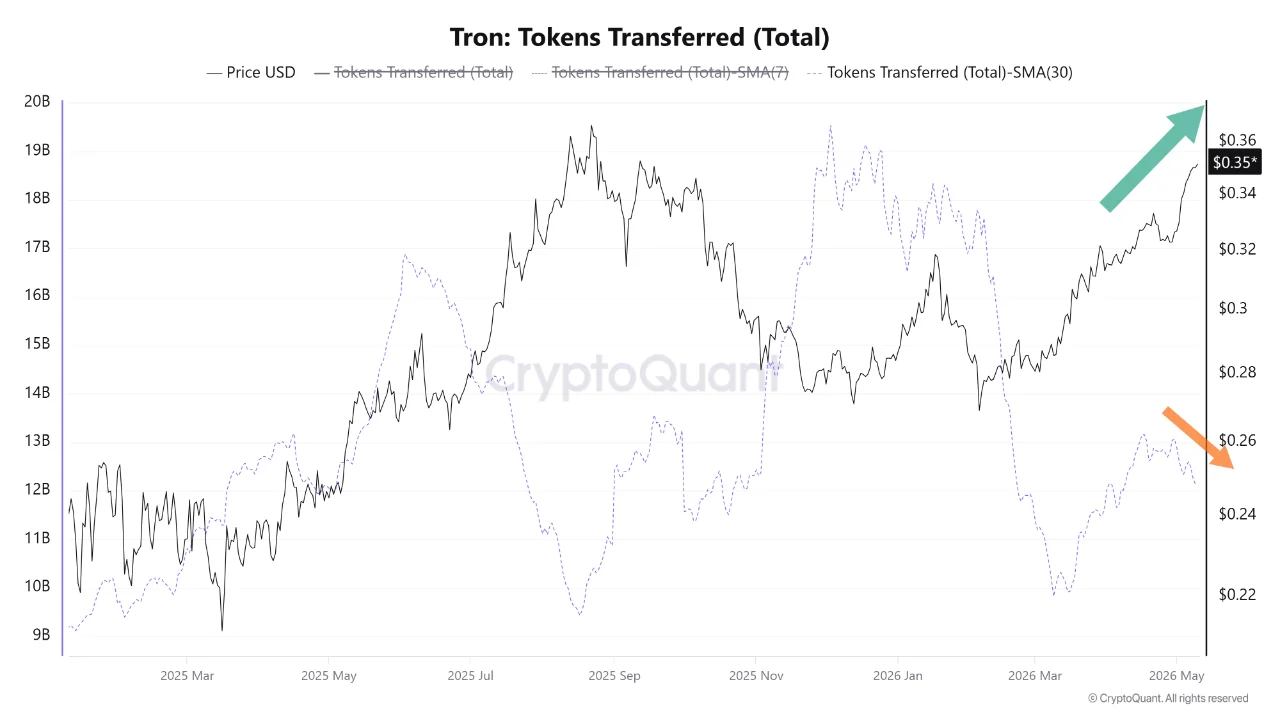
- TRX price climbed to $0.35 while total token transfers fell sharply from 17.3 billion to 12.2 billion.
- The drop in network activity during a price rally points to speculation rather than organic on-chain demand.
- Tron Inc. acquired 142,957 TRX at $0.3498, pushing total treasury holdings past 695.2 million tokens.
- Analysts warn the $0.35 price level remains fragile without a recovery in on-chain transfer volume.
Tron (TRX) has climbed back to $0.35, matching its recent price high. However, on-chain data tells a different story beneath the surface.
Network token transfers have dropped sharply, falling from 17.3 billion to 12.2 billion. This gap between price and activity has raised red flags among analysts. The divergence points to a rally that may lack the organic support needed for sustained momentum.
On-Chain Data Reveals a Growing Gap Between Price and Network Activity
Tron’s price recovery to $0.35 looks strong on charts at first glance. Yet the underlying network data does not confirm the move.
Token transfer volume on the Tron blockchain has declined steeply over the past month. That kind of drop during a price rally is a classic bearish divergence signal.
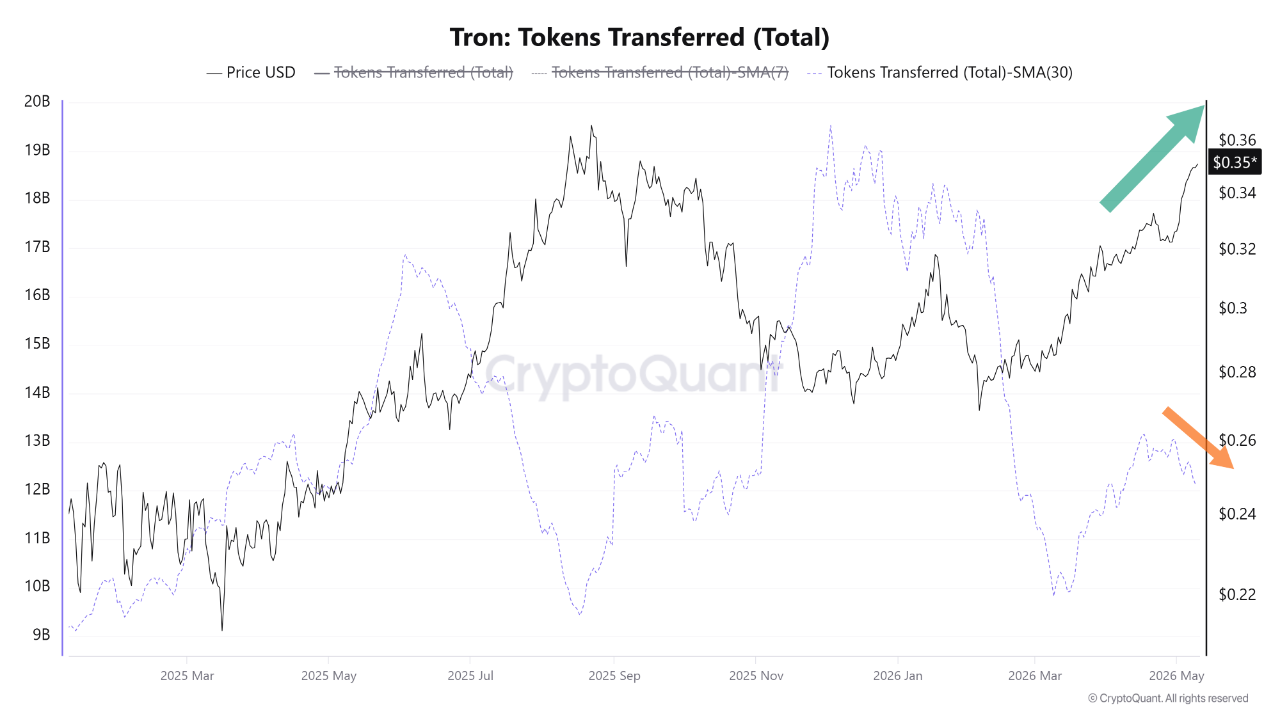
Source: Cryptoquant
A healthy price rally is typically backed by rising network usage and real utility. When prices rise while transfers fall, it suggests fewer users are actively moving tokens.
This pattern often points to speculative buying rather than organic demand. Traders watching on-chain metrics would treat this as a cautionary sign.
The gap between price performance and transfer volume has widened considerably. Moving from 17.3 billion to 12.2 billion in total transfers is not a minor dip.
It reflects a measurable decline in actual network participation. That level of drop during a price surge is worth taking seriously.
If buying pressure fades without network activity to support the price, a correction becomes more likely. The $0.35 level may struggle to hold under those conditions.
Analysts tracking these signals tend to wait for transfer volume to recover before calling a rally sustainable. Until then, caution remains the appropriate stance.
Tron Inc. Continues Accumulating TRX Despite Market Warning Signs
While market analysts flag the divergence, corporate activity around TRX continues. Tron Inc., listed on NASDAQ under the ticker TRON, recently disclosed a fresh purchase. According to an update shared on X, the company acquired 142,957 TRX tokens at an average price of $0.3498.
That purchase brought Tron Inc.’s total TRX treasury holdings to over 695.2 million tokens. The company stated that it aims to grow its Tron DAT holdings further.
The goal, as outlined in the announcement, is to enhance long-term shareholder value. A designated on-chain wallet tracks these treasury movements in real time.
Corporate accumulation at the $0.35 level adds an interesting layer to the current picture. Large buyers stepping in at these prices can sometimes slow or delay a correction.
However, institutional buying alone does not resolve the underlying network activity concern. Transfer volume would still need to recover to confirm a healthier rally.
The contrast between institutional accumulation and declining on-chain usage reflects the tension in TRX’s current market position.
Traders are watching both sets of data closely. The next move in price may depend on which force proves stronger. Network activity picking back up would be the cleaner bullish signal to watch for.

Insider Shares Emotional Update On Dolly Parton’s Health Battle

Passengers of hantavirus-hit cruise ship arrive at Manchester Airport

Thailand Gears Up for WorldPride 2030 Bid

Manchester United reach agreement with Casemiro over contract clause amid transfer speculation

US brings back mandatory military draft registration

Steven Gerrard disagrees with Gary Neville over ‘shock’ Chelsea and Arsenal claim | Football


-
 Crypto World3 days ago
HarrisX Poll Found 52% of Registered Voters Support the CLARITY Act
-

 Crypto World4 days ago
Upbit adds B3 Korean won pair as Base token gains Korea access
-

 Fashion2 days ago
Weekend Open Thread: Marianne Dress
-

 Tech6 days ago
Image AI models now drive app growth, beating chatbot upgrades
-
 NewsBeat4 days ago
NCP car park operator enters administration putting 340 UK sites at risk of closure
-
 Business1 day ago
Ignore market noise, India’s long-term story intact, say D-Street bulls Ramesh Damani and Sunil Singhania
-

 Politics2 days ago
Politics Home Article | Starmer Enters The Danger Zone
-

 Entertainment7 days ago
Olivia Wilde Reacts To Viral ‘Corpse’ Comparison
-

 Sports7 days ago
Inter Milan Win Serie A Title After Victory Over Parma
-

 Sports7 days ago
La Liga: Vinicius Jr scores twice as Real Madrid win to keep Barcelona waiting for title
-

 Crypto World5 days ago
UAE Free Zone Deploys Blockchain IDs to Verify Registered Firms
-
 Sports7 days ago
Every word of Arne Slot’s heated rant after Manchester United win vs Liverpool
-
 Sports6 days ago
2026 NHL playoff picks: Second-round predictions, series odds, Stanley Cup bracket
-

 Entertainment7 days ago
Moroccan Reacts To Nick Cannon’s Dating Rules For His Sister
-

 Entertainment7 days ago
Kylie Jenner and Timothee Chalamet Hold Hands in NYC Outing
-

 Crypto World4 days ago
BlackRock CEO Larry Fink Discusses a New Asset Class
-

 Crypto World4 days ago
Robinhood says Wall Street is building onchain
-

 Entertainment7 days ago
Post Malone Delays Tour With Jelly Roll Amid Ongoing Backlash
-
Entertainment6 days ago
Serena Williams hits Met Gala in metallic dress after GLP-1 reveal
-

 Fashion4 days ago
The Best Work Pants for Women in 2026
You must be logged in to post a comment Login