
Crypto World
IMF confirms El Salvador’s bitcoin growth was funded by private donations, not public money



The IMF confirmed that all bitcoin added to official holdings since June 2025 was sourced from private donations, with no public funds used for accumulation.


The hardware wallet manufacturer revealed in a new update from September 4 that another 67,000 customers in the United States had their personal information exposed in the breach at its shipping provider, ShipMonk.
These clients placed orders between November 2019 and August 2021, meaning some of the compromised records were almost seven years old.
CryptoPotato reported last month that Trezor had initially said the ShipMonk breach affected approximately 13,689 customers. The timing was quite peculiar as it came amid the Coldcard saga, and investors’ confidence was already shaken.
12,742 of the entire amount had their names, emails, phone numbers, and shipping addresses exposed, while another 1,947 had more limited information compromised.
The latest discovery, though, shed some more worrisome light on the incident, as much older customer information remained in ShipMonk’s systems. Trezor said it had repeatedly requested – and received, written assurances from the logistics provider confirming that the data had been deleted in accordance with its contract and data policy.
“We are very disappointed that, despite receiving this confirmation, the data was not deleted in their systems,” reads the update on X.
Adding the newly identified 67,000 customers brings the known number of affected users to more than 80,000. The hardware wallet provider noted that all newly affected customers have been contacted directly by email and explained that users who have not received a notification are not believed to be impacted.
Trezor’s team emphasized that its own systems were not compromised and that its wallets remain secure. Private keys and wallet backups were not exposed in the ShipMonk incident.
However, the danger comes from criminals possessing detailed information identifying people are hardware wallet customers. The company warned affected users to be particularly cautious of fake emails, fraudulent phone calls, and physical letters.
The update also highlighted potential physical security risks, which have become a considerably more serious issue lately.
The post Trezor Breach Is Much Bigger Than Initially Thought: Another 67,000 Customers Exposed appeared first on CryptoPotato.

The wild nature of the cryptocurrency markets has returned for some major altcoins, such as the privacy coin leader, Zcash (ZEC). The token skyrocketed to a new multi-year peak of just over $1,000 earlier today.
The move caught many traders, including Garrett Jin, unprepared. Data from Lookonchain outlined his massive loss due to a short squeeze.
The analysts provided a screenshot from a wallet linked to Jin, showing that he had entered a massive short for 32,760 ZEC (currently worth over $33 million) at prices well below the current level of $444.
Given the asset’s substantial rally in the past several days, Jin had to add to his short position over time before ultimately realizing a loss of over $18.5 million.
As $ZEC broke above $1,000, Garrett Jin (@GarrettBullish) has lost over $18.5M on his 32,760 $ZEC ($33.11M) short.https://t.co/bLk5NAoS2r pic.twitter.com/YiAA6oySEo
— Lookonchain (@lookonchain) September 4, 2026
The privacy coin is among the top performers in the past 24 hours. Its daily gains stand at over 21% as of now, as its price jumped to $1,020 for the first time in eight years. Moreover, ZEC’s value has doubled since the market broke out on August 19, when it traded at around $500.
Data from CoinGlass indicated that the total value of wrecked ZEC positions is up to $36 million, meaning Jin’s wipeout accounted for half of it.
The post Garrett Jin’s ZEC Short Bleeds Over $18M as Zcash Explodes Past $1,000 appeared first on CryptoPotato.

Another thing we can combat individually is the urge to check our messages every time we have a spare minute. Pulling out our phones is often a convenient way to avoid negative emotions or awkward encounters. Yet all this task switching leaves us distracted and depleted, and I can’t realistically handle any of the issues in the emails I read in the 30 seconds it takes to walk from my yoga class to my car.
It stands to reason that our brains would be less foggy if we used those small slices of our lives to take a deep breath, notice our surroundings, and have short, pleasant interactions with the people around us. When we returned to our desks, we’d think more clearly, work more efficiently, and send better responses.
This Labor Day, there’s a way for workers to be healthier, happier, more productive, and solve a lot of our public policy problems, too. We need to stop working when we’re not working.
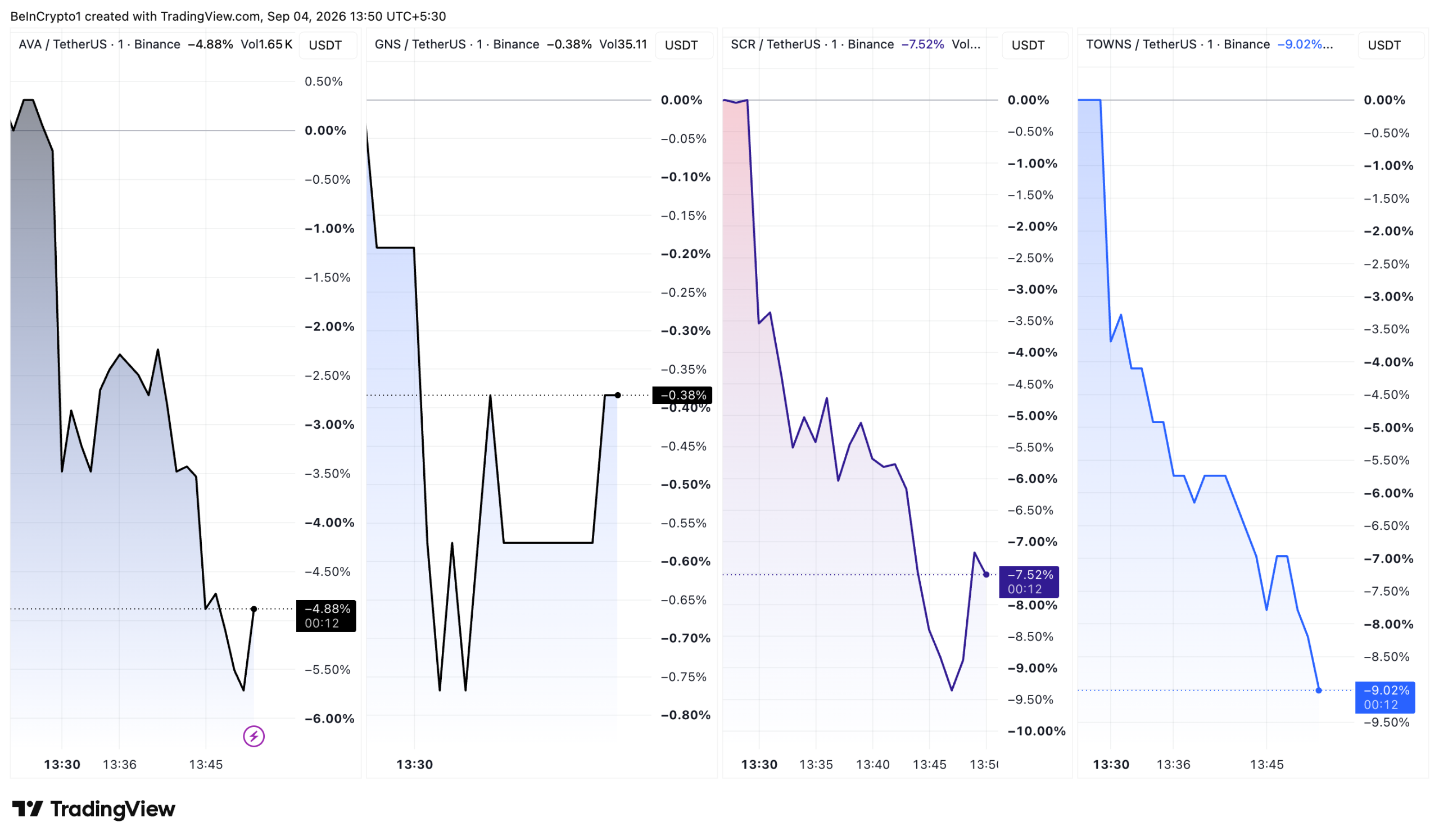
Binance applied its Monitoring Tag to AVA (AVA), Gains Network (GNS), Scroll (SCR), and Towns Protocol (TOWNS) on September 4. The label places all four tokens under closer review.
Traders reacted quickly. All four tokens dropped following the announcement.
What Does the Binance Monitoring Tag Mean?
Binance uses the tag to flag assets that are more volatile and riskier than the rest of its listings. Tagged tokens face repeat reviews and can lose their listing entirely.
“Keep in mind that tokens with the Monitoring Tag are at risk of no longer meeting our listing criteria and being delisted from the platform,” the team said.
Binance weighs team commitment, development activity, trading volume, liquidity, network stability, and tokenomics changes during each review.
The recent record gives the label weight. Binance delisted Across Protocol (ACX), Hashflow (HFT), PIVX, Vulcan Forged PYR (PYR), Vanar (VANRY), and Viction (VIC) last month, and all had been tagged earlier.
The pattern repeated weeks later. Binance removed ICON (ICX), Secret (SCRT), and Storj (STORJ) from spot trading on September 3. All three had received the tag first, ICX as recently as August 11.
Follow us on X to get the latest news as it happens
Scroll and Towns Protocol Lead the Selloff
The market priced that history in almost immediately. TOWNS slid 9.02% in the minutes after the announcement. SCR traded near $0.0214 after the notice, down 7.5%, with about $1.6 million in trading volume on Binance.

AVA dropped 4.88%. GNS managed to recover some of its losses and was down 0.38% at press time. Binance said other services tied to the four tokens remain unaffected.
The tag does not commit Binance to a delisting. However, the last few removal rounds drew from the tagged list, raising risks.
Subscribe to our YouTube channel to watch leaders and journalists provide expert insights
The post Binance Adds Monitoring Tag to 4 Tokens, Signaling Delisting Risk appeared first on BeInCrypto.


U.S. spot Bitcoin ETFs have recorded $730.9 million in net inflows in their strongest single trading session since mid-January, led by more than $450 million entering BlackRock’s iShares Bitcoin Trust.
Summary
- U.S. spot Bitcoin ETFs recorded $731 million in net inflows on Sept. 3, their strongest single trading day since January.
- BlackRock’s IBIT led the session with $454 million, followed by $138 million for ARKB and roughly $74 million for Fidelity’s FBTC.
- Combined Bitcoin ETF net assets reached $103.34 billion, equal to just over 6% of Bitcoin’s market capitalization.
- The inflows followed a $236 million withdrawal on Sept. 1, when IBIT alone recorded roughly $201 million in redemptions.
According to SoSoValue data for Sept. 3, the group posted its largest daily inflow since Jan. 14, when the funds attracted $843.6 million, pushing cumulative net inflows since their January 2024 launch to $55.44 billion.
Bitcoin ETF inflows reach $731 million
BlackRock’s IBIT accounted for $454 million of Thursday’s inflows, representing more than 60% of the total. The latest allocation brought the fund’s cumulative net inflows to $63.94 billion.
ARK Invest and 21Shares’ ARKB ranked second with $138 million, while Fidelity’s FBTC received roughly $74 million. Grayscale’s two Bitcoin products drew a combined $57 million during the session.
VanEck’s HODL and WisdomTree’s BTCW were the only products to record withdrawals. HODL lost close to $20 million, while approximately $5 million left BTCW.
The inflows arrived as Bitcoin rebounded sharply, with the U.S.-listed funds gaining between 5.7% and 5.9% during Thursday’s trading session. Their combined net assets climbed to $103.34 billion, equivalent to 6.32% of Bitcoin’s market capitalization.
Thursday’s result was more than three times the size of any single daily inflow recorded during an 11-session run of positive flows in late August.
The latest buying followed an active August for the products. U.S. Bitcoin ETFs collected $1.92 billion during the five trading sessions ending Aug. 21, when Bitcoin and Ether ETFs together attracted $2.61 billion in their strongest combined week since October 2025.
Bitcoin funds accounted for roughly 73% of those flows, while spot Ether ETFs received $697.47 million during the same five-day period.
BlackRock’s IBIT remains the main source of ETF demand
IBIT has repeatedly accounted for a large share of the money entering U.S. spot Bitcoin ETFs during recent periods of buying.
Crypto.news previously reported that the funds attracted $853.5 million over five days from Aug. 3 through Aug. 7. BlackRock’s fund brought in an estimated $693 million during the run, equivalent to roughly 81% of the group’s total inflows.
The pattern continued later in August. QCP Capital said Bitcoin’s advance from approximately $63,500 to above $80,000 was supported by spot buying while futures positioning declined. During part of the rally, spot Bitcoin ETFs drew $2.8 billion across eight consecutive sessions.
Futures open interest fell from 646,000 BTC to 588,000 BTC as Bitcoin advanced, according to QCP, separating the price move from rallies driven primarily by an increase in leveraged positions.
IBIT has remained the largest U.S. spot Bitcoin ETF by assets through the changes in daily flows. BlackRock had reported $60.52 billion in net assets for the fund as of Aug. 26, before Bitcoin’s latest advance and Thursday’s increase in ETF asset values.
Institutional filings have shown large positions in the fund as well. Jane Street reported more than $1 billion in U.S. spot Bitcoin ETF shares as of June 30, including approximately $828 million in IBIT. The quarterly filing represented positions at the end of June and did not disclose the trading firm’s current exposure.
ETF flows have remained volatile between large buying sessions
Large inflows have not produced a continuous run of buying across every trading day.
The U.S. products recorded $201.9 million in net outflows on Aug. 28, ending nine consecutive sessions of inflows. ARK 21Shares’ ARKB led the withdrawals with $114.9 million, while IBIT lost $33.4 million.
Despite the final negative session, the funds still attracted a combined $924.5 million during the Aug. 24 to Aug. 28 trading week.
Flows reversed again as September began. Investors withdrew $236 million from the funds on Sept. 1, with IBIT accounting for roughly $201 million of the redemptions.
SoSoValue data showed the group returned to net buying the following session, taking in approximately $101 million on Sept. 2. IBIT received roughly $115 million, offsetting withdrawals elsewhere in the group before Thursday’s much larger allocation.
The $454 million that entered IBIT on Sept. 3 therefore came two sessions after the fund recorded a $201 million withdrawal, putting BlackRock’s product on both sides of the largest daily moves during the opening days of September.
The recent swings follow a period when Bitcoin ETF demand had already recovered from sustained withdrawals earlier in the year. The products entered July after eight consecutive negative weeks, including $527 million in withdrawals during the four trading days ending July 2.
A $221.7 million inflow on July 2 ended a 10-day daily withdrawal run, while BlackRock returned to larger allocations days later. IBIT received $209.4 million on July 7 as total daily inflows across the U.S. Bitcoin ETFs reached $265.7 million.
By July 30, another $233.1 million entered the products, with BlackRock taking $183.4 million. The fund accounted for 78.7% of that session’s inflows.
Thursday’s $730.9 million allocation has now exceeded each of those daily totals, while the combined net asset value of the U.S. spot Bitcoin ETF market has moved above $103 billion.
Today, 4 September, the market’s main focus is the August US employment report. According to CNBC, the consensus forecast calls for just 53,000 nonfarm jobs to be added following July’s decline, highlighting the continued weakness of the labour market. At the same time, the Federal Reserve’s focus is shifting towards inflation risks. In the eurozone, a Reuters poll showed that all 65 economists surveyed expect the ECB to raise its deposit rate by 25 basis points to 2.50% at its 10 September meeting, while around 91% expect the rate to remain at that level through the end of the year.
Technical Analysis of EUR/USD
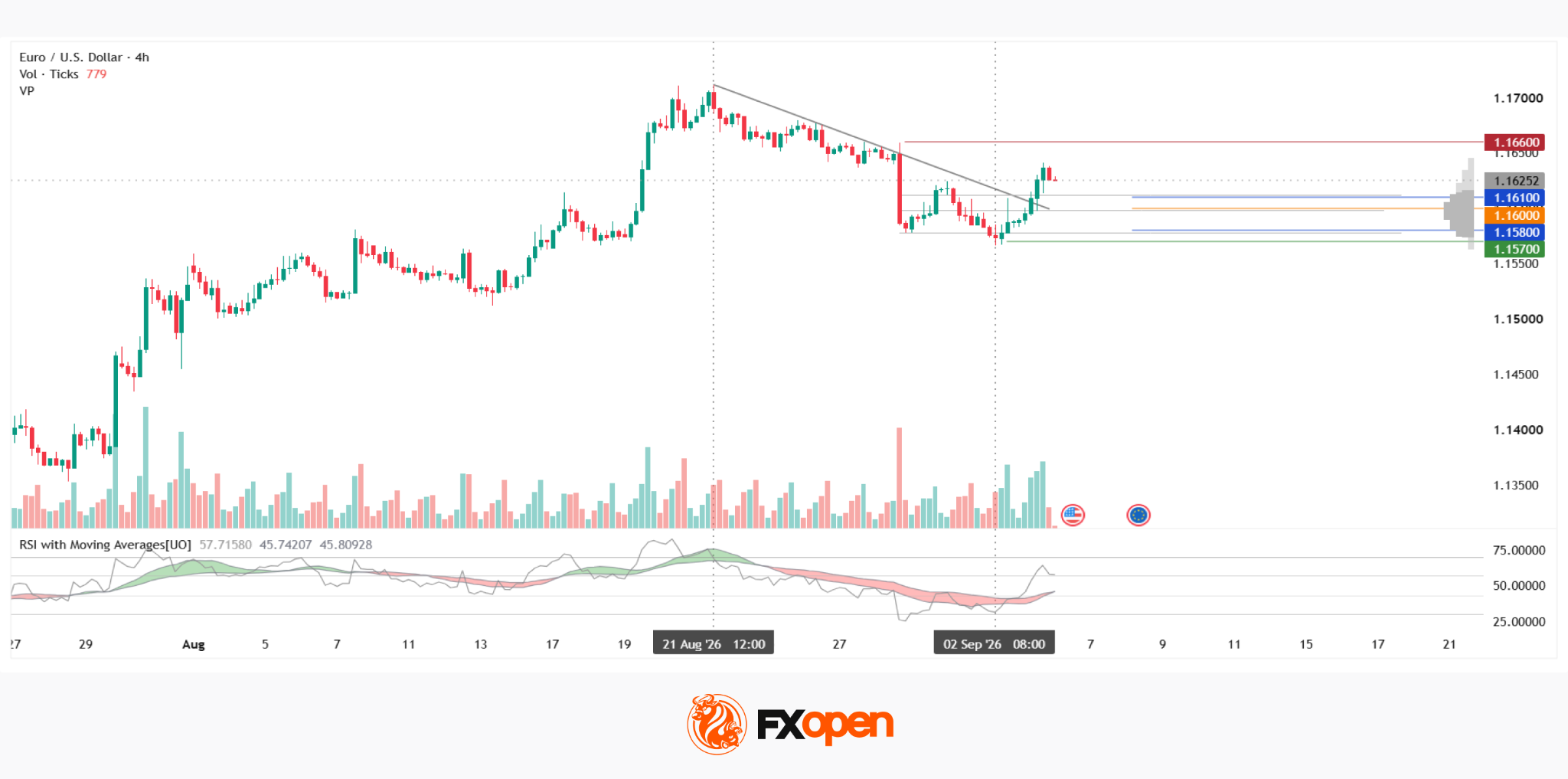
On 21 August, a peak formed around 1.1700 on the four-hour chart, from which a trend and a descending trendline developed. The price repeatedly rejected this trendline to the downside, eventually reaching a low of 1.1570 on 2 September. The following day, the trendline was broken to the upside on increased volume, and the price is now attempting to establish itself above it, as well as above the upper boundary of the current market profile at 1.1610.
A red resistance area is located around 1.1660 above the established market density. In the event of a false breakout followed by a further decline, the asset could trade within the market density or continue lower. However, for this to happen, the price would need not only to test the upper boundary but also break through the Point of Control (POC) at 1.1600 and the lower boundary of the profile at 1.1580. Just below the lower boundary of the profile, there is also a green support area around 1.1570.
The RSI + MAs indicator is showing readings of 58, 45 and 45. The oscillator has moved above the neutral zone, while both moving averages remain red and close to its lower boundary, so they are not yet confirming the breakout.
Key Takeaways
The divergence between the RSI and its moving averages leaves the sustainability of the recovery uncertain, and the market may need more time for the other components of the breakout to develop. The August US employment report could provide an additional catalyst for the pair over the coming hours, with its significance for the Fed’s September decision having increased further against the backdrop of an expected ECB rate hike.
Trade over 50 forex markets 24 hours a day with FXOpen. Take advantage of low commissions, deep liquidity, and spreads from 0.0 pips (additional fees may apply). Open your FXOpen account now or learn more about trading forex with FXOpen.
This article represents the opinion of the Companies operating under the FXOpen brand only. It is not to be construed as an offer, solicitation, or recommendation with respect to products and services provided by the Companies operating under the FXOpen brand, nor is it to be considered financial advice.

El Salvador’s Bitcoin reserve increases after the IMF began reviewing its financing program do not involve new purchases funded by public resources, according to the International Monetary Fund. In documents shared with the lender, Salvadoran authorities attributed the growth to private donations after the IMF’s first review of the program concluded in June 2025.
In a Thursday statement, the IMF said it verified the explanation through materials provided by local authorities, concluding that the additions therefore should not be treated as additional government-funded Bitcoin buying within the terms of the program. The IMF also said control of the Chivo wallet—El Salvador’s state-linked Bitcoin wallet—has been shifted to a private operator, while the government retains a minority stake and certain custodial responsibilities.
Key takeaways
- The IMF says post–June 2025 Bitcoin reserve increases were supported by documents showing they came from private donations, not government financing.
- The lender expects no further Bitcoin accumulation beyond the donation activity it says is documented.
- IMF said majority ownership and operational control of the Chivo wallet moved to a private operator, with the state keeping minority and custody roles.
- El Salvador’s public announcements about ongoing accumulation have previously renewed scrutiny over compliance with IMF conditions.
IMF verification after the June 2025 review
The IMF’s latest explanation is aimed at clarifying the source of Bitcoin increases during the period following its first review of El Salvador’s IMF-supported financing arrangement. In its statement, the IMF said the documents submitted by Salvadoran authorities verified that the accumulation did not rely on “public resources.”
The distinction matters because El Salvador’s IMF deal includes restrictions on how the public sector can engage with Bitcoin. When Bitcoin-related activity appears to expand after key compliance checkpoints, investors and stakeholders typically look for whether the activity aligns with the program’s conditions—particularly around public funding and state-led accumulation.
The IMF also framed expectations going forward: it said it does not anticipate additional accumulation beyond what can be tied to documented donations. That message effectively sets a compliance ceiling for future reserve growth, at least as the IMF continues to monitor the arrangement.
Chivo wallet control reshuffle
Beyond the donation-source question, the IMF’s statement addressed governance of the Chivo wallet. According to the lender, majority ownership and operational control have been transferred to a private operator. At the same time, the government retains a minority stake and custodial responsibilities.
This matters because earlier IMF commitments emphasized reducing the government’s role in Bitcoin-related activity. A shift in operational control can be seen as consistent with a broader effort to move away from state-driven Bitcoin operations—though the exact implications for users and custody arrangements depend on how the private operator manages day-to-day functions.
How previous rules set the stage for scrutiny
El Salvador’s IMF controversy around Bitcoin centers on the line between government involvement and private-sector activity. In December 2024, the IMF agreement required changes that included limiting public-sector involvement in Bitcoin under the IMF package. The arrangement also made private-sector Bitcoin acceptance voluntary and required that taxes be paid in US dollars, while calling for government involvement in Chivo to be unwound.
Then, in March 2025, the IMF issued new documents that barred “voluntary accumulation” of Bitcoin by the public sector. President Nayib Bukele responded publicly, saying purchases were “not stopping” and that El Salvador would continue adding at least one BTC daily.
The tension between El Salvador’s statements about ongoing accumulation and the IMF’s restrictions has repeatedly reemerged in subsequent months. After the March 2025 update, the country’s Bitcoin Office often posted that El Salvador continued to accumulate Bitcoin, which prompted renewed questions about whether the additions were consistent with the program’s constraints.
From a private-donation explanation to a reserve tracker snapshot
The IMF previously addressed the issue after El Salvador’s December 2024 commitments. In July 2025, the IMF offered an initial explanation, stating that it had found no new Bitcoin purchased since the December agreement. At that time, it attributed increases to consolidation among government wallets.
However, El Salvador’s November 2025 announcement that it had acquired 1,090 BTC worth $100 million—after the first review timeline—brought the question back to the forefront. Coverage at the time highlighted compliance concerns tied to the $1.4 billion IMF program, and an IMF representative reportedly indicated the lender would not provide “running commentary” on announcements, assessing compliance in due course.
Now, the IMF says those due diligence efforts produced a clearer result: it verified that accumulation after the June 2025 review came from private donations rather than additional Bitcoin purchases financed with government resources.
For readers tracking the scale of El Salvador’s holdings, the National Bitcoin Office’s reserve tracker reports that El Salvador holds about 7,764 BTC. Using CoinGecko’s cited BTC price of $80,900, the stockpile is valued at roughly $628 million. The IMF’s framing suggests that the higher balance relative to earlier points should be interpreted, at least for IMF monitoring purposes, as donation-linked additions rather than new public-sector purchases.
What to watch next for investors and market participants
While the IMF’s latest statement provides a compliance-oriented explanation and sets expectations for future accumulation, uncertainty remains around how independently verifiable the donation documentation is over time and whether future reserve changes match the “documented donations only” boundary the IMF described. Market participants should continue to monitor subsequent IMF reviews, alongside updates from El Salvador’s Bitcoin Office and any further disclosures tied to the Chivo wallet’s private operator arrangements.

El Salvador’s Bitcoin holdings grew after the International Monetary Fund (IMF) reviewed part of its $1.4 billion program in June 2025, but the IMF says the country did not use public money for the additional accumulation. In a Thursday statement, the lender said documents provided by Salvadoran authorities confirmed that the increase came from private donations rather than government-financed purchases.
The IMF also said operational control of El Salvador’s Chivo wallet has been transferred to a private operator, with the government keeping a minority stake and custodial responsibilities. The IMF added that it does not expect any further Bitcoin accumulation beyond donations that can be documented.
Key takeaways
- The IMF verified that post–June 2025 Bitcoin increases were funded by private donations, not public resources.
- The Chivo wallet’s majority ownership and day-to-day control moved to a private operator, while the government retained a minority stake and custody role.
- The explanation is aimed at addressing renewed compliance concerns after El Salvador publicly reported large Bitcoin purchases in late 2025.
- El Salvador is still holding a sizable Bitcoin reserve—about 7,764 BTC—valued at roughly $628 million at the price level cited by CoinGecko.
IMF: June 2025 accumulation did not involve government funds
According to the IMF, the key point from its June 2025 review was whether El Salvador’s Bitcoin accumulation reflected spending from public resources. In Thursday’s release, the IMF said it checked supplied documentation and found that the additional holdings were linked to private donations.
That matters because El Salvador’s IMF-supported financing arrangement is tied to economic and policy conditions, including boundaries around how public institutions engage with Bitcoin. The IMF’s statement effectively separates “donation-driven” increases from purchases that would otherwise imply further public financing.
Thursday’s release also states that the government does not intend to accumulate additional Bitcoin beyond what is documented as coming from donations—another signal that the IMF is drawing a line around what it considers compliant behavior under the program.
Chivo wallet control shifts, but custodial duties remain
In addition to the funding source question, the IMF’s statement addressed the structure around El Salvador’s Chivo Bitcoin wallet. The lender said majority ownership and operational control of the wallet have been transferred to a private operator, while the government retains a minority stake and custodial responsibilities.
For observers, this distinction goes beyond corporate housekeeping. Earlier IMF discussions around Bitcoin policy placed emphasis on reducing public-sector involvement. By describing a change in operational control and retaining only a narrower government role, the IMF is clarifying how it views the current setup relative to those earlier conditions.
Why the explanation became necessary again
While IMF scrutiny around El Salvador’s Bitcoin purchases has been ongoing, the latest clarification followed renewed controversy after El Salvador said in November 2025 that it had acquired 1,090 BTC valued at $100 million.
That November claim resurfaced questions about whether El Salvador was complying with its IMF program. Earlier coverage noted that the IMF arrangement includes restrictions intended to limit certain kinds of public-sector participation in Bitcoin.
The IMF’s June 2025 verification therefore appears aimed at reconciling the country’s reported reserve increases with the conditions the lender has set—particularly when El Salvador’s Bitcoin office posted that accumulation continued after earlier understandings were reached.
From “unwind Chivo involvement” to “no voluntary accumulation”
The current dispute has roots in the IMF’s original conditions under the financing arrangement. In December 2024, El Salvador agreed to limit public-sector involvement in Bitcoin. The deal outlined several elements: private-sector acceptance of Bitcoin was to be voluntary, taxes were to be paid in US dollars, and government involvement in Chivo was to be unwound.
In March 2025, the IMF issued additional documents barring what it described as “voluntary accumulation” of Bitcoin by the public sector. President Nayib Bukele publicly pushed back, saying purchases were “not stopping” and that El Salvador would continue adding at least one BTC daily.
Subsequently, the Bitcoin Office frequently posted that it was accumulating Bitcoin. In July 2025, the IMF offered an initial explanation for earlier reserve changes, saying no new Bitcoin had been purchased since the December agreement and attributing increases to consolidation among government wallets.
However, the November 2025 announcement about a much larger acquisition renewed doubts. An IMF representative previously told Cointelegraph that the lender would not provide “running commentary” on announcements and would assess compliance in due course. Thursday’s statement can be read as that due-course assessment for the period after the first review.
How big is El Salvador’s Bitcoin reserve now?
Based on the National Bitcoin Office’s official reserve tracker, El Salvador currently holds about 7,764 Bitcoin. Using a price level of $80,900 cited via CoinGecko, the reserve is valued at approximately $628 million.
Importantly, the IMF’s position suggests that at least part of the post-agreement reserve growth is not explained by government purchases, but rather by donation flows that Salvadoran authorities say can be documented. Readers should note that the IMF’s verification focuses on the source of accumulation, not on whether the reserve increased in absolute terms.
Going forward, market participants will likely watch two things closely: whether El Salvador continues to produce documentation supporting donation-linked increases, and how the operational role of the Chivo wallet evolves under the private operator structure. As the IMF turns compliance checks into formal findings, the durability of El Salvador’s Bitcoin narrative under the program may hinge on the clarity—and consistency—of that evidence.


A Bitcoin address named in a New York lawsuit involving 39,069 allegedly abandoned addresses transferred 40 BTC on Sept. 3 after remaining inactive since Nov. 5, 2011.
Summary
- A Bitcoin address dormant since 2011 transferred 40 BTC worth approximately $3.1 million on Thursday.
- Galaxy linked the address to litigation seeking title over 39,069 allegedly abandoned Bitcoin wallets collectively.
- The transaction demonstrates control of private keys but does not identify the wallet’s legal owner.
- Plaintiffs rely on New York lost-property law, but opponents dispute its application to self-custodied Bitcoin.
- The court has not awarded the disputed coins, and the ownership case remains unresolved.
The transaction was confirmed in Bitcoin block 965,330. Galaxy Research valued the transfer at approximately $3.1 million and identified the sending address as “Noah Doe #38097,” linking it to the pending ownership lawsuit.
The transfer proves that someone controls the private key associated with the address. However, public blockchain data does not reveal that person’s identity or establish whether the Bitcoin was sold.
Bitcoin address moved funds after nearly 15 years
Bitcoin traded near $3 when the wallet received its coins in November 2011. Galaxy calculated that their market value had increased by approximately 2,571,899% by the time of the latest transfer.
That figure represents price appreciation rather than a confirmed realized gain. Moving Bitcoin between addresses does not prove a sale, and the receiving address has not been publicly linked to an exchange.
Bitcoin was trading near $81,100 on Sept. 4, up about 4.3% over 24 hours. No evidence linked the broader market increase directly to the 40 BTC transaction or the New York case.
The latest movement follows several transfers from older addresses during 2026. In related coverage, six long-dormant wallets moved more than 553 BTC during a ten-day period in August. Two carried labels connecting them to the same lawsuit.
New York lawsuit targets 39,069 Bitcoin addresses
The case, ABC Company, XYZ Company and Noah Doe v. John Does 1–39,069, was filed in New York County Supreme Court under Index No. 153119/2026. The plaintiffs seek a declaration giving them legal title to Bitcoin associated with 39,069 addresses.
Those addresses held an estimated 3.7 million to 3.8 million BTC when researchers examined the complaint. Their combined dollar value has varied with Bitcoin’s price and was estimated at approximately $293 billion during earlier reporting.
The list reportedly includes addresses attributed to Bitcoin creator Satoshi Nakamoto, an address associated with the Mt. Gox theft and an unspendable burn address. Such labels are based on blockchain analysis and do not necessarily establish legal ownership.
The plaintiffs claim the addresses qualify as abandoned property under Article 7-B of New York’s Personal Property Law. They say the wallets were identified through an algorithm, reported to police and notified through small Bitcoin transactions containing on-chain messages.
Wallet movement challenges but does not end the claim
Activity from a listed address conflicts with the assertion that nobody controls its private key. The plaintiffs have previously removed addresses from their claim after those addresses moved funds.
In July, Galaxy Research’s Alex Thorn said the plaintiffs had dropped 44 addresses that became active after the case began. Those removals show that on-chain activity can narrow the addresses covered by the complaint.
However, the latest transaction does not automatically “thwart” or end the entire case. It directly concerns one listed address. Any legal effect will depend on the plaintiffs’ response and subsequent court filings.
The transfer also does not prove that the person moving the Bitcoin is its lawful owner. It demonstrates technical control, while ownership remains a separate legal question involving evidence and applicable property law.
Opponents say inactivity does not prove abandonment
Attorney Ian Cohen, the Digital Chamber and the Bitcoin Policy Institute have challenged the plaintiffs’ theory. Their arguments maintain that an address is not property that somebody can “find” merely by viewing it on a public blockchain.
The Digital Chamber warned that treating inactivity as abandonment could create uncertainty for people who deliberately hold Bitcoin in self-custody for extended periods. As crypto.news reported, the organization urged the court to reject the dormant-wallet ownership claim.
A New York judge previously paused the proceedings, preventing the plaintiffs from immediately obtaining a default judgment. The court has not ruled that the addresses are abandoned or awarded their Bitcoin to Noah Doe and the two companies.
What happens next in the Bitcoin ownership case
The plaintiffs may remove address No. 38097 from their requested relief, as they reportedly did with previously activated addresses. Any change should appear through an amended filing or another submission on the case docket.
The broader case will still require the court to consider jurisdiction, ownership and whether New York’s lost-property statute can apply to Bitcoin addresses. Even a favorable judgment would not provide the plaintiffs with private keys or enable an on-chain transfer without them.
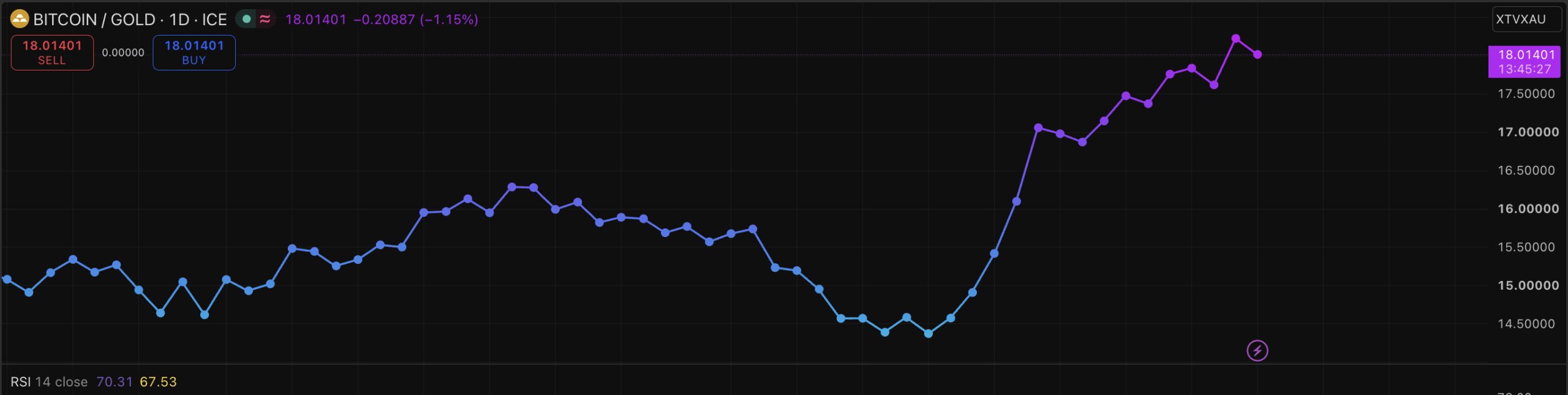
Bitcoin now buys 18 ounces of gold, the highest reading on that ratio since January, and it’s climbing while both assets rally together after the Fed’s job data news. The number forces a specific question onto the table: is Bitcoin capturing a durable share of the safe-haven trade from gold, or is it simply moving faster through a door gold already opened?
The bitcoin-to-gold ratio is a straightforward comparison: bitcoin’s dollar price per coin divided by gold’s dollar price per ounce. At 18.17, one bitcoin now covers a little over 18 ounces of the metal, and TradingView data pegs that as the strongest relative showing for bitcoin since January.

In dollar terms, Bitcoin is trading around $80,800 to $81,000. That places BTC firmly in a zone traders have watched all week closely, with the asset also grinding back above $81,000 on shifting rate-hike expectations.
Discover: The Best Token Presales
Debt Fears News Are Driving Bitcoin
Both bitcoin and gold spent months lagging the AI-driven equity boom running through U.S. and Asian markets. Now both are rallying at the same time. The move specifically to fears that heavily indebted governments will lean on currency debasement to inflate away their obligations, rather than to shifts in bond yields.
The fiscal backdrop supports that reading. Every major advanced economy except Switzerland now carries a debt-to-GDP ratio above 100%, and the U.S. leads that group on primary deficit, the shortfall that remains once interest payments are stripped out. Policymakers, for their part, are betting on growth rather than austerity to close the gap.
— Crypto Banter (@crypto_banter) August 20, 2026
 BESSENT: TREASURY WILL ROUTINELY RUN BUYBACKS ABOVE $4B!
Treasury Secretary Scott Bessent said the U.S. will conduct buybacks on a routine basis and increase their size, with operations set to exceed $4 billion.
The comments follow this week’s move to at least double… pic.twitter.com/yJF9YIGr7e
U.S. Treasury Secretary Scott Bessent captured that stance at the G20 finance ministers’ meeting in Asheville, North Carolina, saying the world is awash in debt and that growth is the only realistic way out, rather than shrinking the debt pile through spending cuts.
SkyBridge Capital founder Anthony Scaramucci read that line as an unintentional case for bitcoin, arguing on X that Bessent had just handed the market bitcoin’s entire pitch without meaning to.
Traders weighing how far that logic extends into rate policy should also watch shifting September rate-cut odds, since Fed positioning feeds directly into how aggressively the debasement trade gets pressed.
Visit Coinbase Now For Stock and Crypto Trading
What The Ratio Proves?

The 18 reading confirms one thing cleanly: Bitcoin has gained relative strength against gold since January, inside a broader hard-asset rally that’s lifting both. Bitcoin advocates frame that outperformance as validation of the asset’s core pitch.
It has just a fixed supply of 21 million coins, and a structure that sits outside the traditional financial system, immune to the kind of policy decision that can devalue a fiat currency overnight.
That argument is real, and it’s the same one that’s driven every prior bitcoin-as-digital-gold cycle. What the ratio does not establish is that this particular move will persist, or that it marks a permanent reallocation of store-of-value demand away from the metal. A rising ratio can reflect exactly what advocates claim, or it can reflect bitcoin’s higher volatility, simply amplifying the same debasement narrative faster than gold can move.
Discover: The Best Crypto to Diversify Your Portfolio
The post Bitcoin News: BTC to Gold Ratio Hits 18 as Both Assets Rally appeared first on Cryptonews.

OpenAI Astra released as Brockman hails ‘AGI era’
Trezor Breach Is Much Bigger Than Initially Thought: Another 67,000 Customers Exposed

Symptom Borrowing Meaning: Why Social Media Health Videos Trigger Health Anxiety





-

 Fashion7 days ago
Weekend Open Thread: Maeve – Corporette.com
-

 Crypto World1 day ago
CLARITY Act could advance within weeks, Atkins says
-

 Business6 days ago
Onto Innovation Stock: AI’s Next Bottleneck Is Yield (NYSE:ONTO)
-

 Crypto World2 days ago
Elon Musk Says Grok 4.7 Lands in 10 Days and Will Beat Every Model
-

 Crypto World6 days ago
Bitcoin price tests $82K resistance as Brandt stays long
-
 Tech6 days ago
Hugging Face built a $4.5 billion empire on free AI models. Now Nvidia is buying it for $12.9 billion
-

 Business7 days ago
iPhone 18 Pro Pre-Orders Could Shift to Saturday as Apple Reportedly Avoids September 11 Anniversary
-

 Sports5 hours ago
Devon Dampier throws for 3 TDs as No. 21 Utah demolishes Idaho
-
Crypto World4 hours ago
XRP Trading Activity Hits Highest Level Since February as Price Jumps 8%
-
 Entertainment7 days ago
‘Adults’ Creators Break Down Season 2’s Most Shocking Moments and Tease a Potential Season 3
-

 Tech6 days ago
PaperCut releases second emergency patch for exploited flaws
-

 News Videos5 days ago
Charlie Munger on Robinhood: No one should believe that Robinhood’s trades are free
-

 Crypto World1 day ago
Kalshi seeks CFTC approval for WTI perpetual
-

 Tech5 days ago
As the influencer economy drives retail sales, Seattle startup raises $22M to play matchmaker
-
 Crypto World2 days ago
Bitcoin slips below $77.5K as macro pressure offsets ETF inflows
-

 Tech5 days ago
Tamagotchi Ring Takes the 30-Year Digital Pet and Places it on Your Finger
-
 Business2 days ago
Oil Price Today (September 2): Crude oil nears $97 as war tensions escalate. Will it hit $100 again?
-
 Entertainment4 days ago
Taylor Swift Reportedly ‘Frustrated’ With Travis Kelce After ‘Short’ Honeymoon
-

 Business7 days ago
Apple Confirms September 9 iPhone Launch Event as Tim Cook Prepares to Hand CEO Reins to John Ternus
-

 News Videos5 days ago
News kii Crypto ugu danbeeyey & Suuqa oo dhaqaaqey
You must be logged in to post a comment Login