
Crypto World
In ‘A Killer Story,’ Two Citizen Sleuths Spend Decades Trying to Solve a Murder


The tip came in 2017 from Alma, Kansas, from a stay-at-home mother. Eileen Umbehr asked whether Joe Sexton, a veteran investigative journalist who worked at The New York Times and ProPublica, wanted to know the truth about a double homicide in Topeka. Karen Harkness, daughter of a bigtime Topeka businessman, and her boyfriend Mike Sisco, a divorced father of two kids, were murdered on July 7, 2002, in the middle of the night, and authorities were convinced that Sisco’s ex-wife Dana Chandler was the killer. She was arrested, tried, and convicted of first-degree murder. Sexton, who thought the case was closed, emailed Umbehr back a polite “thanks, but no thanks.”



Uniswap Labs has launched StablePair Hook, a Uniswap v4 tool that sets liquidity-provider fees dynamically for two stable-pair pools on Ethereum rather than charging one constant rate. The launch covers USDC/USDT and USDC/USDG. For liquidity providers, the material change comes when a pool moves… Read the full story at The Defiant
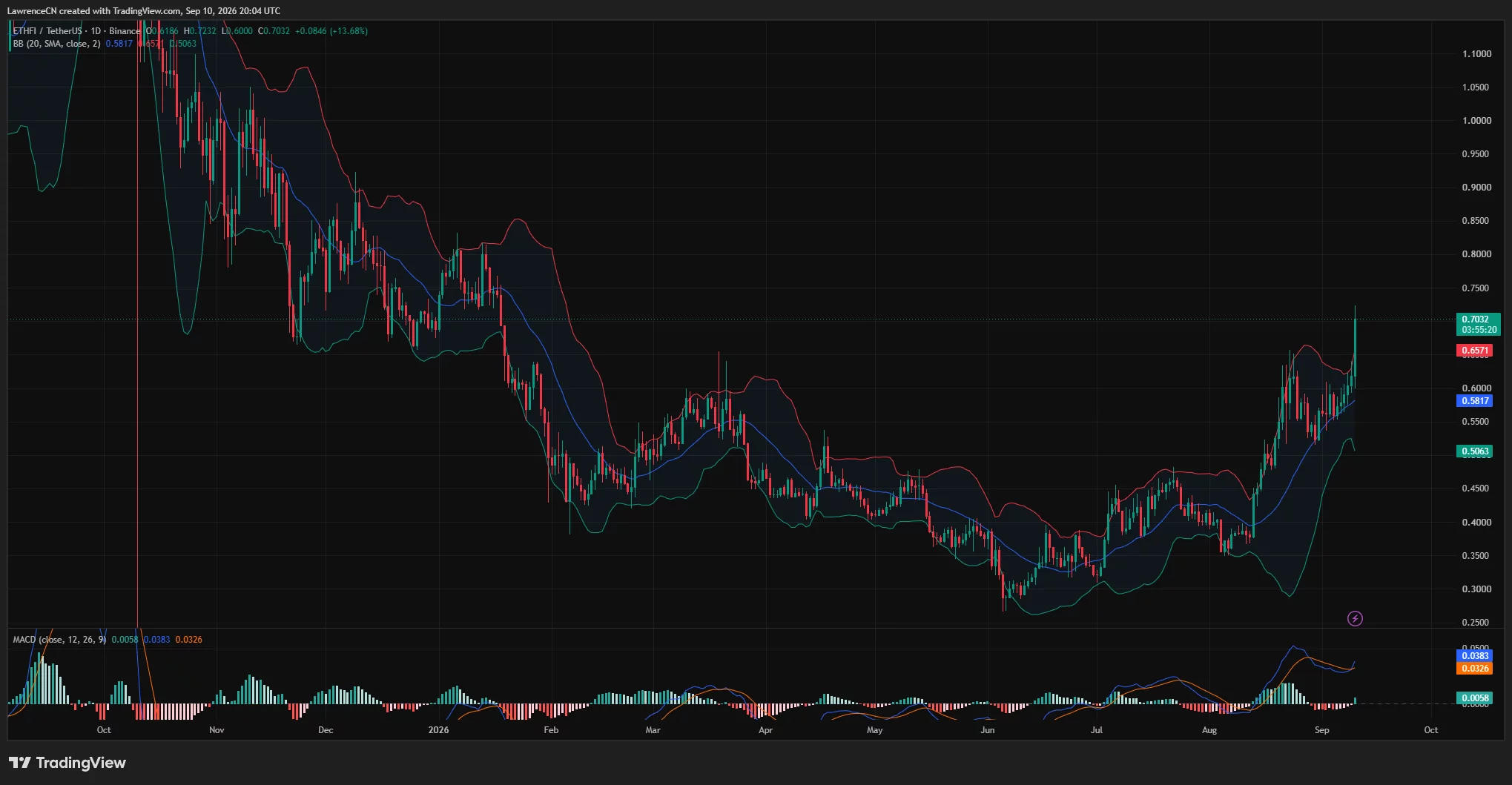
ETHFI price surged more than 13% on Sep. 10, breaking above a months-long range as momentum strengthened across its daily and 4-hour charts.
Summary
- ETHFI price rose 13.68% to $0.7032 after reaching an intraday high of $0.7232.
- The token broke above its $0.6571 upper Bollinger Band, showing strong buying pressure.
- 4-hour Supertrend support climbed to $0.6075 as Chaikin Money Flow reached 0.32.
- Analyst Sebi said buyers must hold the breakout and form a higher low for confirmation.
ETHFI price breaks above its recent range
Ether.fi (ETHFI) price traded near $0.7032 at the time of writing, up 13.68% from an opening price of $0.6186. The token moved between $0.6000 and $0.7232 during the session, with the wide range showing a sharp rise in volatility.
The rally carried ETHFI above the local high near $0.65 established in late August. Price had consolidated mostly between $0.53 and $0.62 after that earlier advance, but the latest daily candle broke through the top of that range.
ETHFI also moved further away from its June low near $0.28. The token has now gained about 150% from that level, although it remains below the prices recorded during late 2025 and early 2026.
The advance continued into the U.S. afternoon on Sep. 10, with the daily chart captured shortly after 4 p.m. Eastern time. ETHFI remained above $0.70, but the open daily candle meant the final closing level had not yet been set.
Market analyst Sebi described the move as ETHFI’s first serious attempt to leave its 2026 base. He said confirmation would depend on the final size of the daily candle and whether buyers can hold the breakout instead of giving back the advance.
Momentum indicators favor ETHFI buyers
The daily Bollinger Bands show ETHFI trading above the upper band at $0.6571. The 20-day middle band stands at $0.5817, while the lower band is near $0.5063.
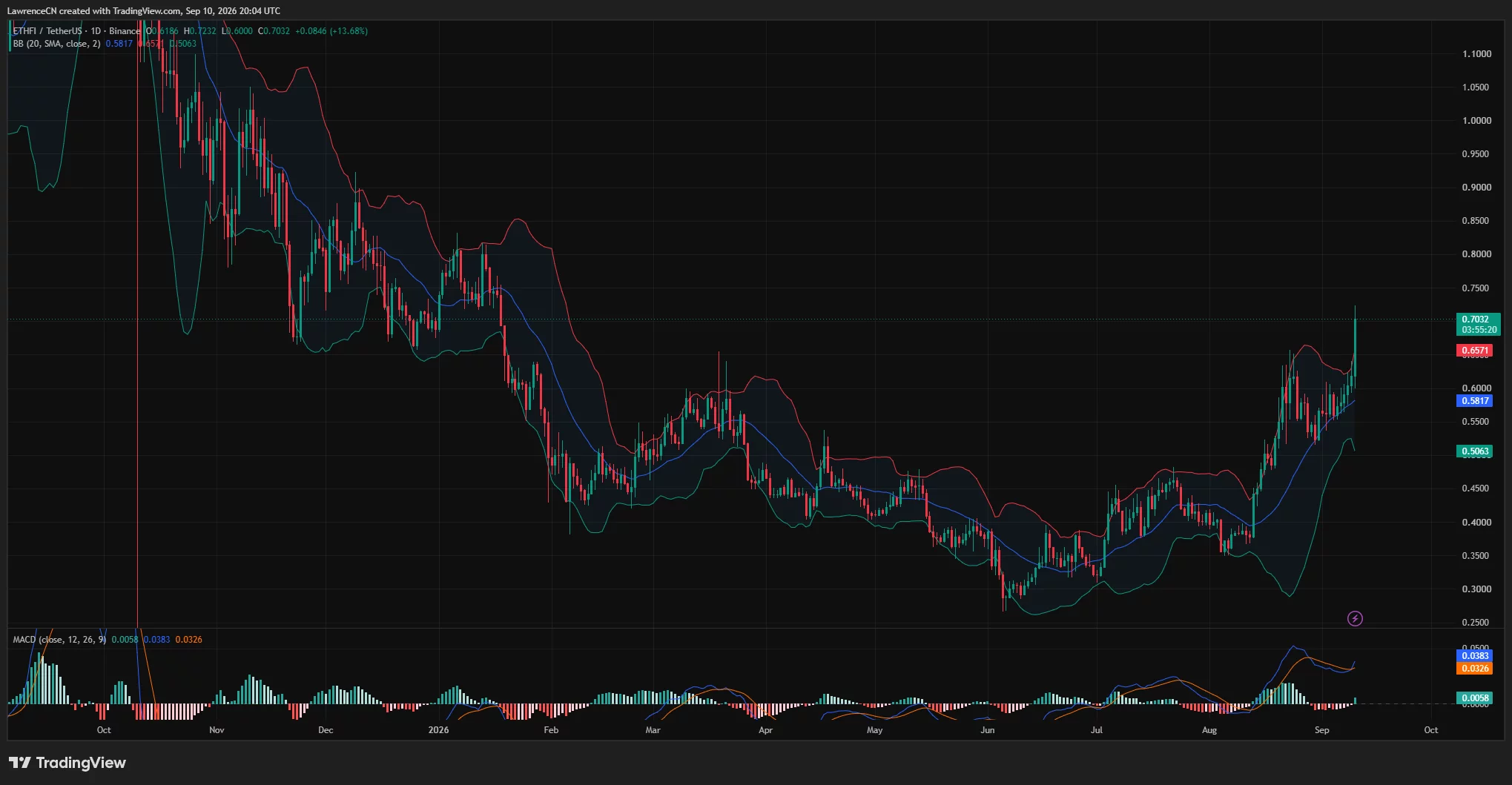
A move beyond the upper band reflects strong momentum, but it can also mean that price has become extended over the short term. ETHFI could therefore consolidate or retest the breakout area before making another sustained advance.
The daily MACD supports the bullish setup. The MACD line stands at 0.0383, above the signal line at 0.0326, while the positive histogram has increased to 0.0058. The readings show that upward momentum strengthened after weakening at the start of September.
The 4-hour chart provides further confirmation. ETHFI remains above its Supertrend indicator, which has moved up to approximately $0.6075 and continues to signal an active upward trend.
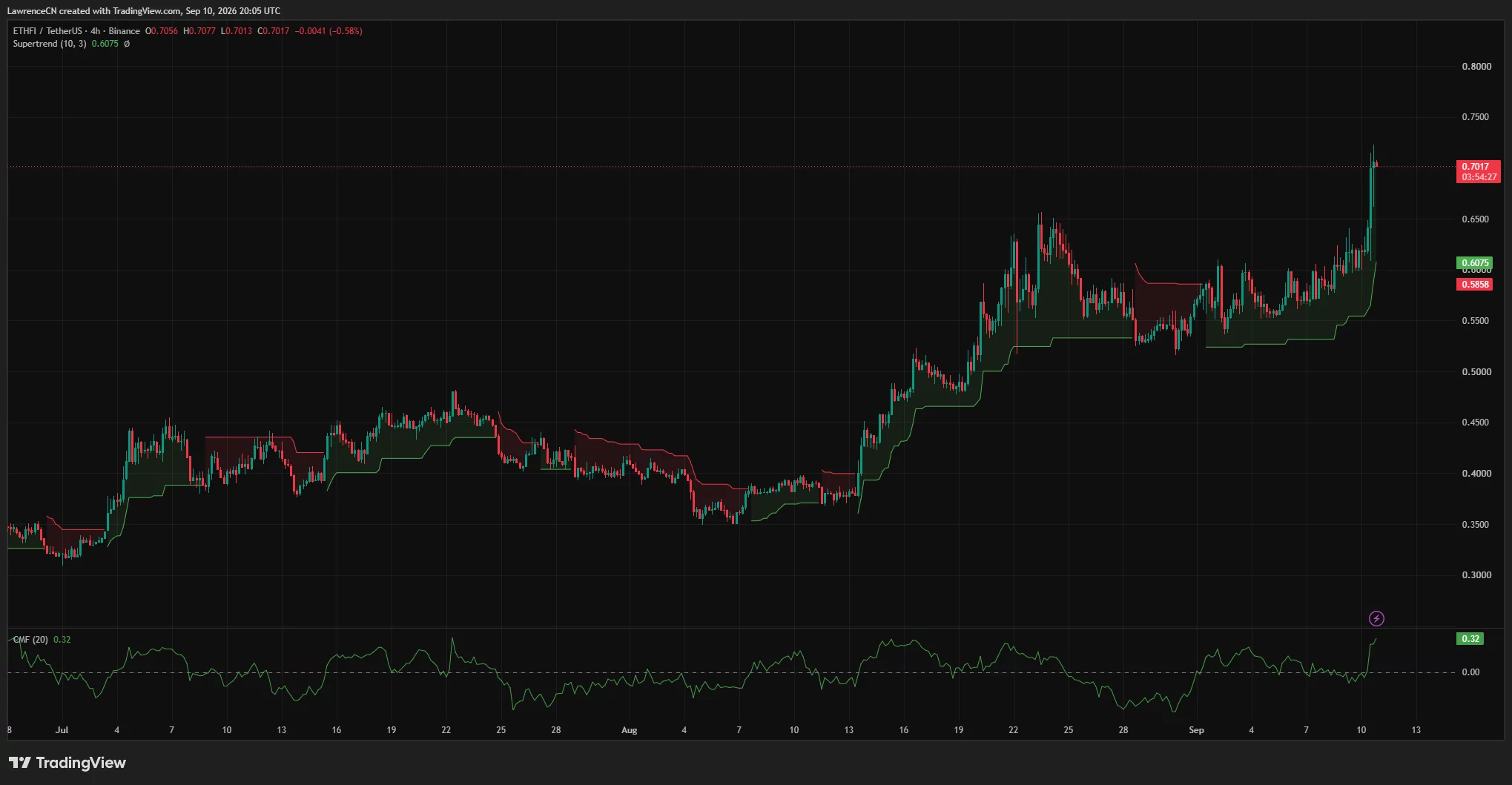
Chaikin Money Flow on the 4-hour timeframe has climbed to 0.32. A reading above zero indicates that buying pressure has exceeded selling pressure during the indicator’s measurement period, while the jump toward 0.32 shows stronger capital inflows during the breakout.
ETHFI support rises toward $0.65
The first level to watch is the daily upper Bollinger Band near $0.6571. A pullback that holds this area would keep ETHFI above the former range and could allow buyers to form the higher low identified by Sebi.
Below $0.6571, the 4-hour Supertrend level at $0.6075 forms the next support. The psychological $0.60 mark sits nearby, making the $0.60–$0.61 region an important short-term test if selling pressure increases.
The daily Bollinger Band midpoint at $0.5817 offers deeper support. A close below that level would place ETHFI back inside its earlier range and weaken the breakout structure. The lower band at $0.5063 would become relevant if the token loses both $0.60 and $0.58.
On the upside, the intraday high at $0.7232 is the immediate resistance. A confirmed break above it could expose $0.75, followed by the $0.80 area last traded around January.
The wider daily chart still shows heavy overhead resistance. Sebi identified $1.72 to $1.95 as the major daily supply zone, although ETHFI would need to more than double from its current price before testing that range.
Ether.fi growth supports the market narrative
Sebi linked the technical breakout to Ether.fi’s expansion beyond its original liquid restaking service. According to figures shared by the analyst, the protocol holds approximately $4.87 billion in total value locked, compared with ETHFI’s market capitalization of roughly $677 million.
He also reported that Ether.fi generated $13.66 million in fees and $3.46 million in protocol revenue during the previous 30 days. The platform’s August update recorded more than 500,000 members and an annualized transaction run rate of $2 billion for its non-custodial crypto banking product, according to the analyst.
However, Sebi identified token value capture as a remaining weakness. He said growth in protocol activity does not automatically create demand for ETHFI and placed 30-day holder revenue at zero.
The charts therefore leave ETHFI at a key point. Momentum favors buyers above $0.65, but the token must hold the breakout and establish support above $0.60–$0.61 to reduce the risk of a return to its previous range.
Disclosure: This article does not represent investment advice. The content and materials featured on this page are for educational purposes only.

Universities are now forced to ask what should define higher education: information or formation?
The word “education” descends from the Latin educare—to nourish, to bring out. Education, at its root, was never only about filling a mind with information. It was about drawing out and nourishing all the unique qualities that define us.
From their medieval origins, universities understood their mission as being the formation of the whole person, what 13th-century theologian Thomas Aquinas called capax universi. But over the years, the ambition of the university has been narrowed, and the most essential questions about the meaning of life have been expelled from the classroom.
Some see AI as a threat to be managed. I would counter that it is precipitating a pivotal opportunity to reinvent higher education and embrace the broader scope it once had.
Curiosity
When we have a technology that can give instant answers to any question, the questions take on more importance. We’re born naturally curious. As Aristotle put it, “all men by nature desire to know.” One study found that pre-school children ask about 100 questions a day. But that plummets as they get older, roughly disappearing by middle school.
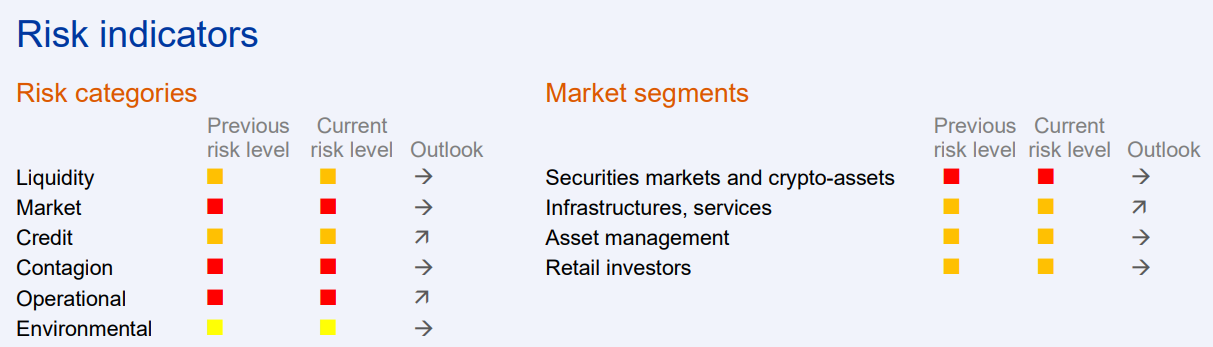
Europe’s securities regulator has warned that growing links between crypto and traditional finance could increase the risk of shocks spreading across the broader financial system.
In its latest risk monitoring report published Thursday, the European Securities and Markets Authority (ESMA) called for closer monitoring of the “growing linkage between increasingly vulnerable crypto-asset markets and the broader financial system.”
ESMA pointed to growing adoption of tokenized equities and recent decentralized finance (DeFi) exploits as areas that could deepen links between crypto and traditional markets and increase the potential for financial spillovers.
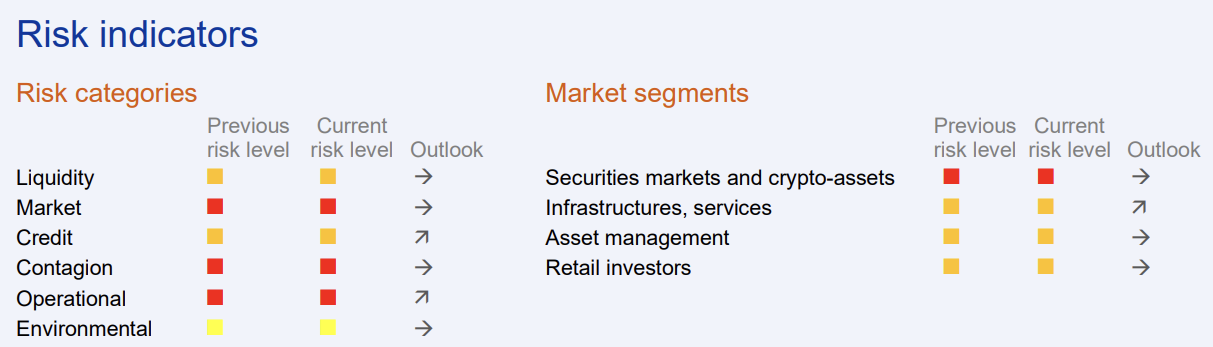
ESMA risk indicators for EU financial markets. Source: ESMA
The regulator said tokenized equities remain negligible compared with global stock markets but are gaining traction, potentially introducing new participants and infrastructure that could reshape market structure.
ESMA also flagged prediction markets as an emerging risk, warning of heightened concerns around insider trading and market manipulation. The regulator said crypto use in prediction markets can make it harder to detect insider trading, wash trading and coordinated market manipulation.
Related: MiCA cracks down on USDT in Europe… but no one else cares
Prediction markets face regulatory battle in US
ESMA’s warning comes as prediction markets face a growing regulatory battle in the United States over whether event contracts fall under federal derivatives law or state gambling rules.
The Commodity Futures Trading Commission (CFTC) has issued guidance for prediction markets throughout 2026 while defending what it says is its exclusive jurisdiction over federally regulated event contracts.
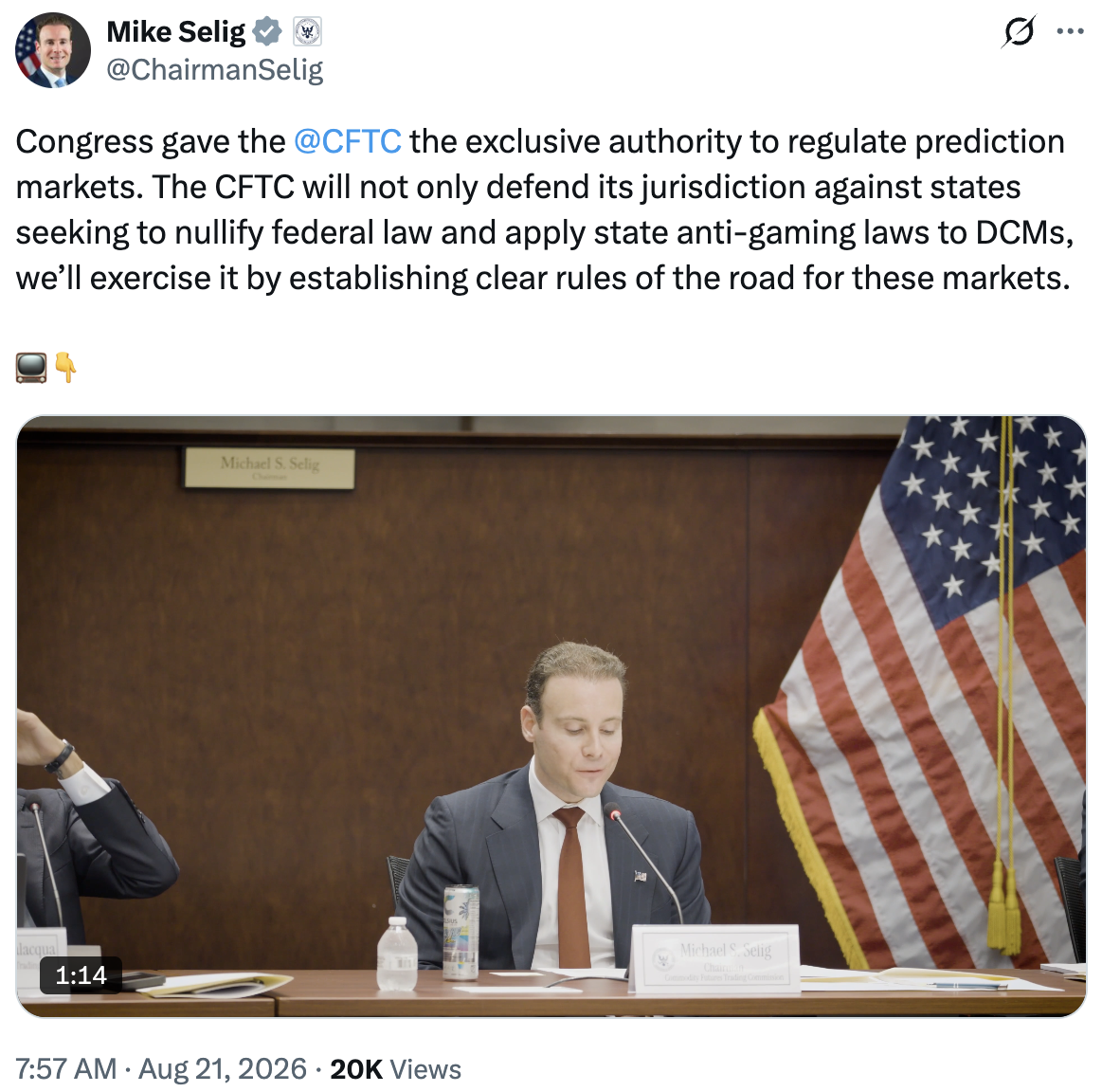
Source: Mike Selig
The agency has even sued several states, including Kentucky, Minnesota, New Mexico, New York, Illinois and Connecticut, after authorities sought to apply state gambling laws to prediction market operators.
The dispute could ultimately reach the US Supreme Court. On September 2, New Jersey officials petitioned the court to decide whether states can enforce sports gambling laws against prediction markets registered with the CFTC, citing litigation over the issue across at least 20 states.
Whether the Supreme Court takes up the issue remains unclear, but a future ruling could determine whether state or federal authorities have jurisdiction over prediction markets.
Magazine: Is Bitcoin too volatile to risk your retirement on?
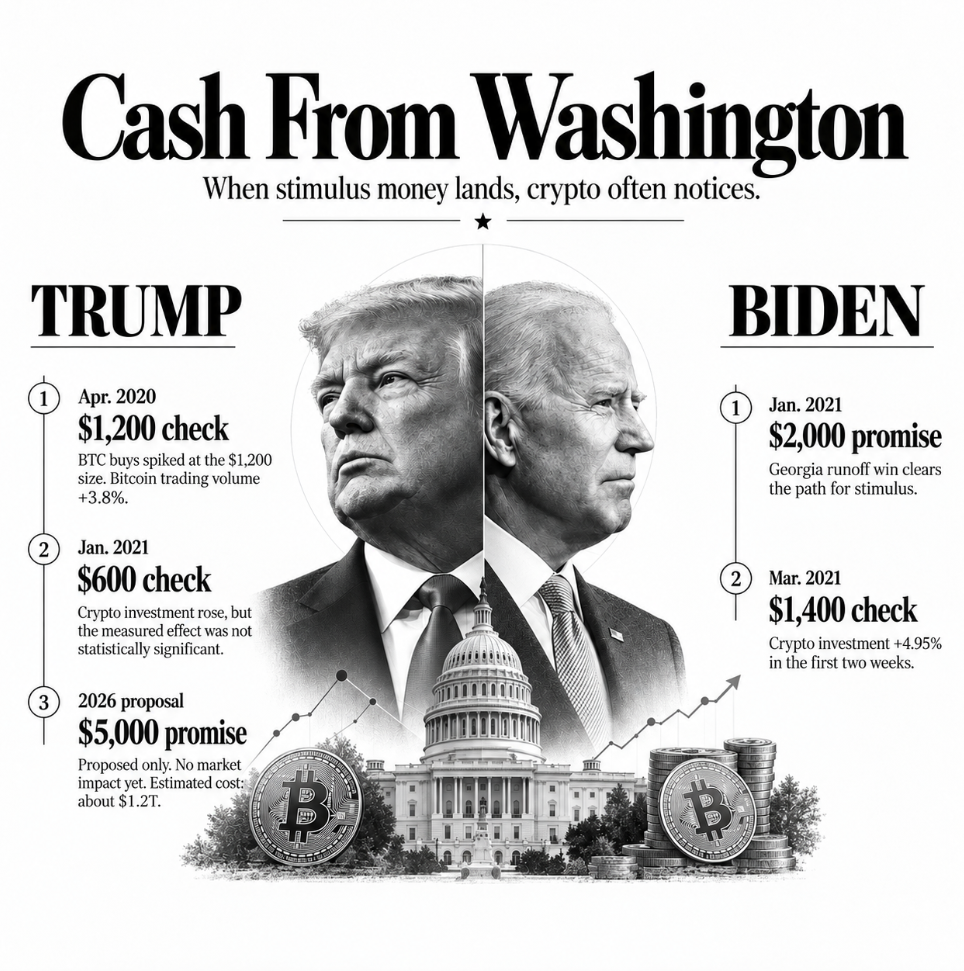
Is Donald Trump trying to buy the US midterm elections? He promised every American $5,000 if Republicans win in November. But there’s a lot more nuance to it.
At the GOP convention in Dallas, Trump promised every adult American a “Trump Dividend” if Republicans keep control of Congress in November. The bill would cost around $1.2 trillion.
While it sounds illegal, Trump is hardly the first president to tie an election result to cash landing in voters’ bank accounts.
And every time this happened in the past, financial markets, including crypto, reacted.

Free Money for the Markets?
In January 2021, Joe Biden told Georgia voters that electing Jon Ossoff and Raphael Warnock would unblock $2,000 stimulus checks. They won, and Democrats took the Senate. Biden later signed $1,400 payments, completing the $2,000 total with earlier $600 checks.
Markets noticed. Cleveland Fed research found a significant jump in Bitcoin purchases around the exact $1,200 amount after Trump’s first COVID checks arrived in April 2020. Bitcoin trading volume rose about 3.8%. BTC also climbed sharply over the following month.
Stocks showed a similar effect. An NBER study found the first two US stimulus rounds increased retail buying and pushed up prices in stocks favored by retail investors.
Then came Biden’s $1,400 checks in March 2021. Bitcoin was already in a bull market, but moved from roughly $56,500 to above $60,000 within days. The S&P 500 also climbed through the following month.
But free cash does not necessarily guarantee a rally.
Former Republican Presidents Followed a Similar Strategy
George W. Bush sent tax rebates in 2001 and again in 2008. Stocks fell through much of both periods as the dot-com crash, 9/11, and the financial crisis overwhelmed any boost from household cash.
COVID gave us the cleaner lesson: when Americans suddenly receive disposable money, some of it can flow directly into risk assets.
Trump’s $5,000 promise would dwarf any individual COVID payment.
Whether it happens is another question. Congress would have to approve it. JD Vance has suggested wealthy Americans could be excluded and tariffs could fund the plan, although current tariff revenues fall far short of the cost.
For now, it remains a campaign promise. A very expensive one.
The post Trump’s $5,000 Midterm Plan Could Be Shockingly Good for Bitcoin appeared first on BeInCrypto.
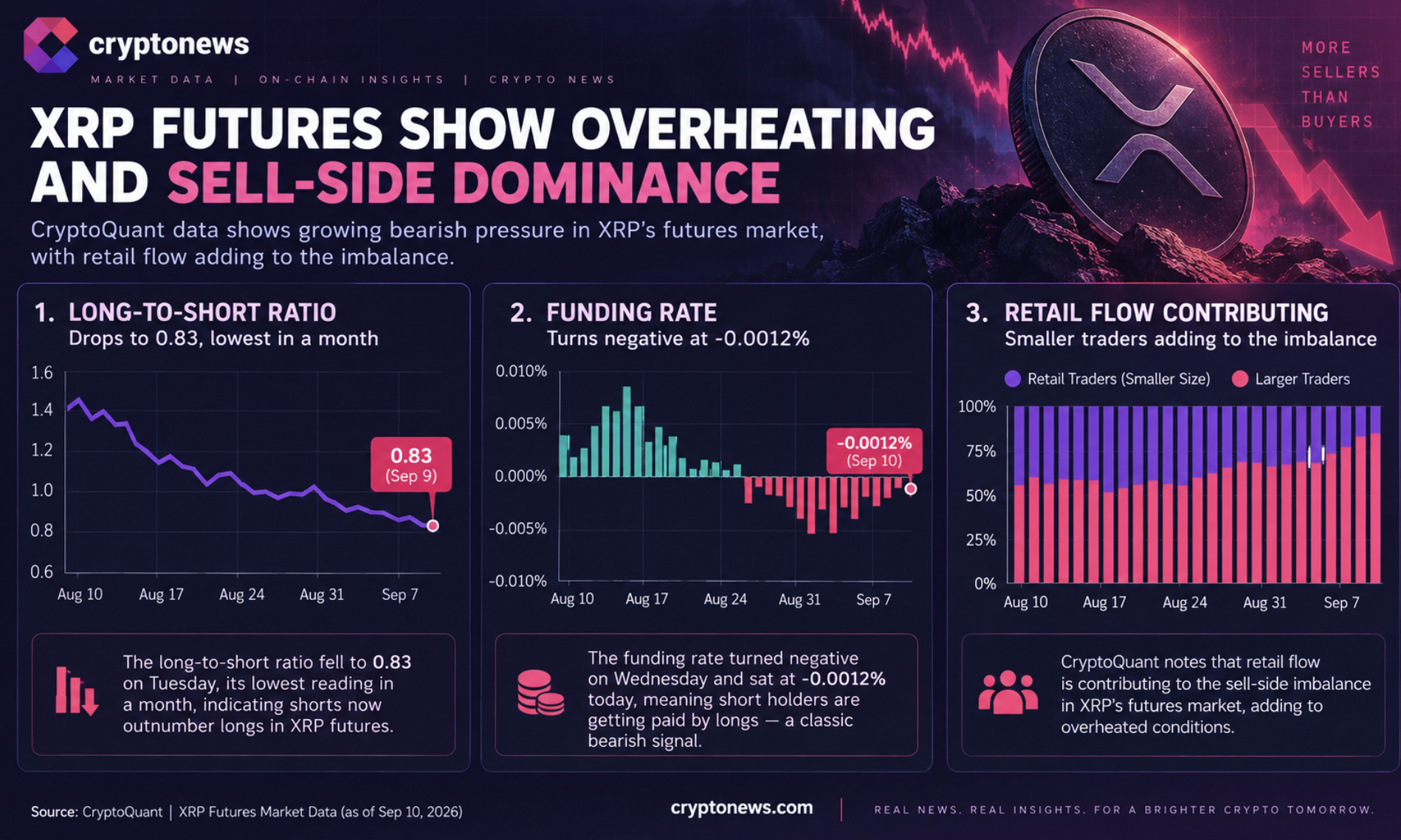
XRP trades at $1.37, and our price prediction will show something that bulls won’t love. The token has now shed more than 2% this week, sliding from a three-month high near $1.69 into a zone where derivatives traders are quietly betting against it. Withheld from most headlines: the funding rate flip that just turned this into a short-favored market.
CryptoQuant’s latest market summary flags overheating and sell-side dominance in XRP’s futures book, with retail flow contributing to the imbalance. The long-to-short ratio dropped to 0.83 on Tuesday, its lowest reading in a month, with shorts now outnumbering longs.

The funding rate turned negative on Wednesday and sat at -0.0012% Today, confirming that short holders are getting paid by longs, a classic bearish tell. For context on how divergent whale and retail positioning have become, see this recent breakdown of conflicting XRP signals.
Zoom out and the setup mirrors broader altcoin fatigue: momentum cooling after a sharp run, open interest contracting, and traders de-risking ahead of macro catalysts. The technical picture below suggests XRP’s recovery attempt is running into real resistance — and not just from chart lines.
Discover: The Best Token Presales
XRP Price Prediction: Hold $1.35 Support This Week, Or Deeper Pullback
XRP’s pullback to $1.37 has it hovering just above a critical support band. The token still sits above its 50-day, 100-day, and 200-day EMAs, clustered between $1.24 and $1.35. This is a structure that remains technically constructive as long as it holds.
The RSI in the mid-50s shows momentum has faded without collapsing, while the MACD line sitting below zero signals waning upside thrust.

Three scenarios worth tracking:
- Bull case: A reclaim above $1.40–$1.43 resistance could open a path toward $1.54, then the $1.68–$1.72 band that gates a run to $2.00+.
- Base case: Consolidation between $1.35 and $1.40 persists while funding stays negative and open interest keeps unwinding.
- Bear case: A break below $1.35 exposes $1.31–$1.32, with $1.27 as deeper backup support.
Regulatory catalysts remain the wildcard here as the CLARITY Act’s potential to trigger a technical breakout is one to watch. Whether $1.35 holds this week likely determines which of these three paths plays out.
Earn $50 and Enter $300K Prize Draw on EdgeX
Bitcoin Hyper Targets Early Mover Upside as XRP Tests Key Levels
Negative funding, a sub-1 long-short ratio, and cooling RSI. This is not a setup that rewards patience right now. Traders holding XRP through this chop are paying a real opportunity cost, and unless spot demand steps in to absorb the sell-side pressure, the $1.35 floor could get tested harder before it gets stronger.
Some capital is already rotating toward earlier-stage plays with asymmetric upside potential, and one gaining traction is Bitcoin Hyper ($HYPER).
Bitcoin Hyper is refining the developer experience with clearer documentation, familiar tooling, predictable APIs, and better feedback for builders.
The goal: make the network easier to understand, connect existing tools, and start building with less friction.
Read the… pic.twitter.com/kAo1w7Xa06— Bitcoin Hyper (@BTC_Hyper2) September 2, 2026


Bitcoin Hyper is building the first Bitcoin Layer 2 with native SVM integration. It has a smart contract execution designed to outpace Solana itself while inheriting Bitcoin’s security base. It’s currently priced at $0.013686, with $33.1 million raised so far and staking rewards live at launch.
Core features include a decentralized canonical bridge for BTC transfers and low-latency, low-cost transaction execution, solving Bitcoin’s long-standing programmability gap.
Research Bitcoin Hyper directly before deciding.
Trade XRP on Bybit and Get a Chance to Win Our $1,000 USDT Airdrop
The post XRP Price Prediction: Bearish Futures Data Casts Doubt on XRP’s Recovery appeared first on Cryptonews.
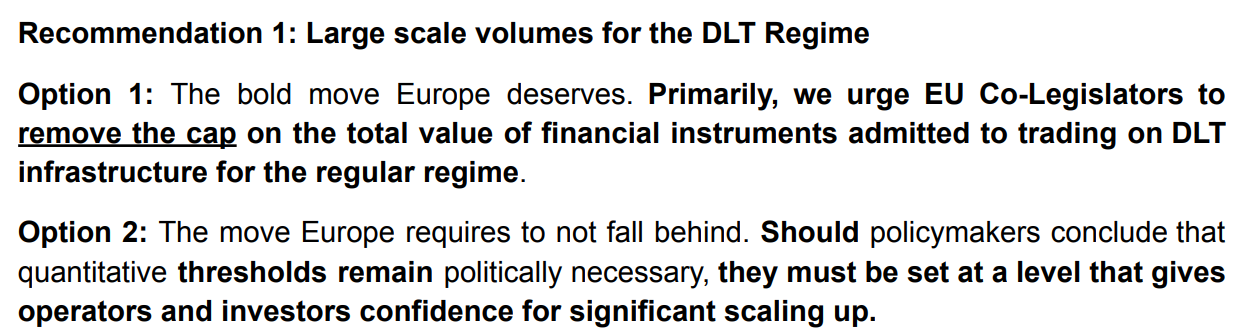
A coalition of European financial and tokenization groups has urged EU lawmakers to remove a proposed 100 billion euro cap ($116.3 billion) on tokenized financial instruments or raise it to at least 500 billion euro.
The draft letter, dated Sept. 7 and addressed to EU Council members and the European Parliament’s Economic and Monetary Affairs Committee, said the 500 billion euro threshold should serve as a baseline if lawmakers decide to retain a cap.
Among the groups signing the letter were Nasdaq, Boerse Stuttgart Group, Securitize, the European Ethereum Institute and Axiology.
The letter said some existing European projects already reach 350 billion euro in scale and plan further growth, arguing that the proposed 100 billion euro ceiling would be insufficient.
The groups contrasted the proposed EU limits with the US, where “a dominant settlement platform is enabled to tokenise US equities and other assets without volume caps,” which they said could cover as much as 150 trillion euro in assets.
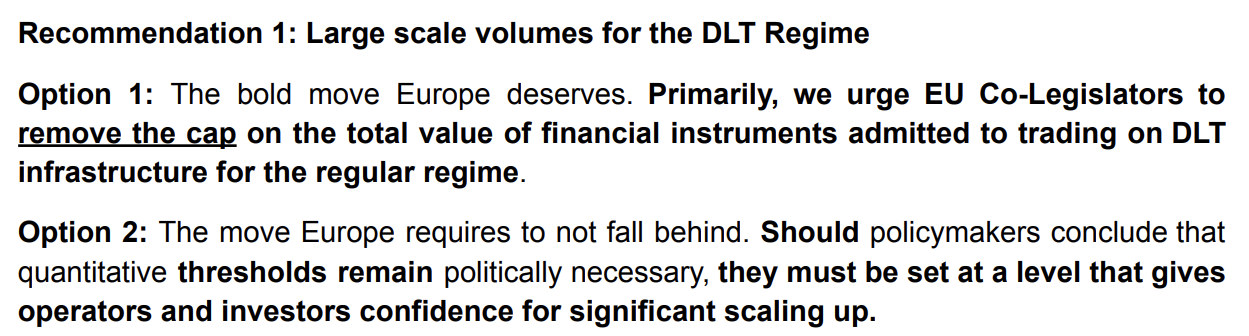
European finance groups call for removal of DLT regime cap.
Source: Industry draft letter
The European Commission has proposed raising the current 6 billion euro limit to as much as 100 billion euro as part of its Market Integration and Supervision Package, which includes revisions to the Distributed Ledger Technology (DLT) Pilot Regime.
The DLT Pilot Regime, which took effect in 2023, allows financial firms to test blockchain-based trading and settlement of assets such as stocks and bonds under exemptions from certain EU financial rules.
The letter said the thresholds apply to the market value of financial instruments admitted to DLT infrastructure rather than their trading volume, making the proposed 100 billion euro cap relatively small compared with global equity markets.
Related: Tokenized RWA surge to $4T may push LINK to $200 by end-2030: Standard Chartered
European firms ramp up pressure on DLT rules
The letter follows months of pressure from financial and tokenization firms seeking changes to the EU’s DLT Pilot Regime.
In April, 39 financial firms and industry groups, including Nasdaq and Boerse Stuttgart, urged EU policymakers to fast-track changes to the DLT Pilot Regime and raise its overall limit to between 100 billion euro and 150 billion euro. The April letter also called for broader asset eligibility and the removal of time limits on licenses issued under the regime.
The April push followed a similar call in February from tokenization and market infrastructure firms including Securitize, 21X and Boerse Stuttgart, which warned that existing asset limits, volume caps and time-limited licenses were preventing regulated onchain markets from scaling in Europe.
The February warning contended that without faster changes, liquidity could migrate to US markets as regulators there moved toward larger-scale tokenization and onchain settlement.
The total value of distributed real-world assets (RWA) stands at about $39.15 billion, with US Treasury debt the largest category at roughly $15.8 billion.
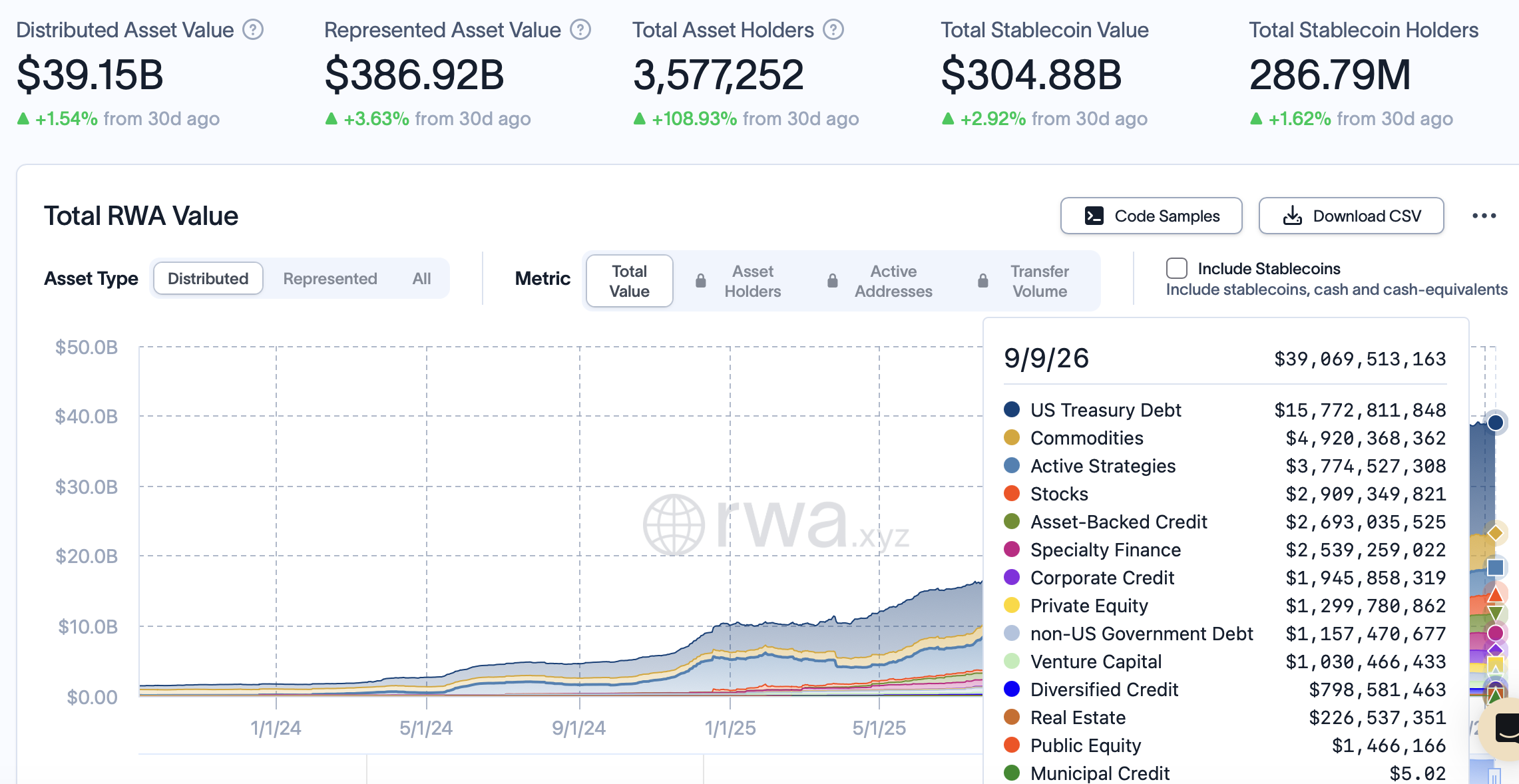
Distributed RWA value has reached $39.15 billion, excluding stablecoins. Source: RWA.xyz
Related: US, UK reaffirm support for stablecoins, tokenization in joint financial regulation talks


The U.S. Securities and Exchange Commission has proposed replacing decades-old transfer agent rules with a framework that would recognize blockchain ledgers as official securities ownership records.
Summary
- Blockchain databases could become the legally recognized ownership record for tokenized securities.
- Issuers may no longer need separate on-chain and official shareholder ledgers.
- Identity checks and transfer limits would continue to apply to blockchain-based securities.
- The SEC has opened a 60-day public comment period ending in early November.
SEC proposal could remove duplicate ownership records
The SEC said its proposed transfer agent overhaul would recognize electronic databases, including distributed ledgers, as systems that can hold the official record of securities ownership. The change would update rules created before blockchain-based securities entered U.S. capital markets.
Under many current tokenization models, an on-chain token does not serve as the final legal record of ownership. Transfer agents and issuers instead maintain a separate shareholder register outside the blockchain, while the digital token tracks transfers on-chain.
Operating both systems requires the parties to compare their records after transactions. A difference between the blockchain ledger and the legally recognized register can create uncertainty over which party owns the underlying security.
Under the SEC proposal, a qualifying blockchain ledger could become the main ownership record rather than a parallel database. Transfer agents could use the ledger to register holders and record changes without recreating each transaction in another system.
Eli Cohen, chief legal officer at tokenized fund platform Centrifuge, said the plan could reduce the existing “two-step” model to a “one-step” process. In his assessment, the blockchain itself could serve as the master securityholder file once the rules permit it.
The change remains a proposal and would not automatically approve every blockchain network or token structure for official recordkeeping. Transfer agents using the technology would still have to meet the SEC’s rules for registration, record accuracy, asset protection and regulatory reporting.
Blockchain records would not make securities permissionless
Although a public blockchain may allow anyone to view its transaction history, the securities recorded on it would remain subject to U.S. ownership and transfer rules.
Joris Delanoue, CEO of registered on-chain transfer agent Fairmint, said compliance controls would still sit inside the asset’s operating structure. Tokenized securities could require identity verification, investor eligibility checks, and restrictions on transfers to unapproved wallets.
A transfer agent would remain responsible for maintaining accurate ownership information and processing changes that cannot be completed through an ordinary token transfer. Such duties can include handling inheritance, responding to legal notices, and updating records after a shareholder’s death.
According to Delanoue, blockchain-based processing could reduce the time needed for some administrative actions from three to five days to about one day. The technology would change how ownership instructions are recorded and processed, but it would not remove the transfer agent’s legal responsibilities.
Smart contracts could also enforce some restrictions before a transaction reaches the ledger. Depending on the security and its offering terms, a transfer could be blocked when a wallet has not completed the required checks or when the recipient is not allowed to own the asset.
For U.S. investors, the distinction separates regulated tokenized securities from crypto assets that can move freely between wallets. A blockchain entry may become the official ownership record, but the owner would still need to satisfy the rules attached to the security.
Tokenized securities could gain a single source of ownership data
Allowing one ledger to serve as the official register could remove the need to reconcile two ownership databases after every transfer, according to Cohen’s assessment of the proposal.
Transfer agents currently perform several functions beyond recording purchases and sales. The SEC’s investor guidance says they track changes in ownership, maintains issuer records, and distributes payments such as dividends to registered holders.
Using a blockchain as the main record could place transaction history and the legally recognized shareholder list in the same system. Issuers and transfer agents would still need controls for correcting errors, responding to court orders, and restoring access when an investor loses the credentials needed to control a wallet.
The SEC proposal also raises operational questions about ledgers that are not controlled solely by a transfer agent. Its rulemaking process seeks public input before the commission decides whether to revise the text and adopt a final rule.
A blockchain’s role as the official ledger would therefore depend on the requirements included in any final version. Record integrity, cybersecurity, access controls and the ability to process legally required changes remain central to the transfer agent’s work.
Institutional projects are already building regulated services around similar controls. On Sep. 10, crypto.news reported that Cosmos had formed a 17-company partner network covering custody, compliance, security, and infrastructure for banks using its tokenization system.
Cosmos Chief Commercial Officer Eran Barak said banks using the network must select their own providers, sign separate agreements, and retain responsibility for compliance decisions. Wells Fargo plans to use Cosmos ledger technology for an initial cross-border tokenized deposit project in fall 2026, according to Barak.
SEC rules could shape U.S. stock token models
The transfer agent proposal applies to the records behind regulated securities rather than every product that tracks the price of a stock.
Some stock tokens give users financial exposure to a company without placing them on the company’s official shareholder register. Such products can differ from issuer-backed tokenized shares that carry ownership rights and appear in records maintained by a registered transfer agent.
The difference has become a point of dispute among U.S. companies and trading platforms. Robinhood CEO Vlad Tenev recently rejected AMC’s demand to stop offering tokens tied to the cinema operator’s shares, arguing that a third-party product does not require the issuer’s consent.
AMC CEO Adam Aron had challenged the tokens because the company did not issue or approve them. Robinhood’s products were offered outside the United States, while the SEC proposal concerns the regulated recordkeeping system that supports securities ownership under U.S. law.
Issuer-backed tokenization follows a different structure because the digital entry can represent the security itself. If adopted, the SEC’s transfer agent revisions could give such issuers a clearer route for treating an on-chain entry as the controlling ownership record.
The proposal would not remove other securities-law duties tied to an offering or trading venue. Registration requirements, investor disclosures, broker-dealer rules, and restrictions attached to private securities would continue to depend on the product and transaction.
Public comments will remain open for 60 days, with the period due to close in early November. The SEC can revise the proposal after reviewing submissions before deciding whether to hold a vote on a final rule.
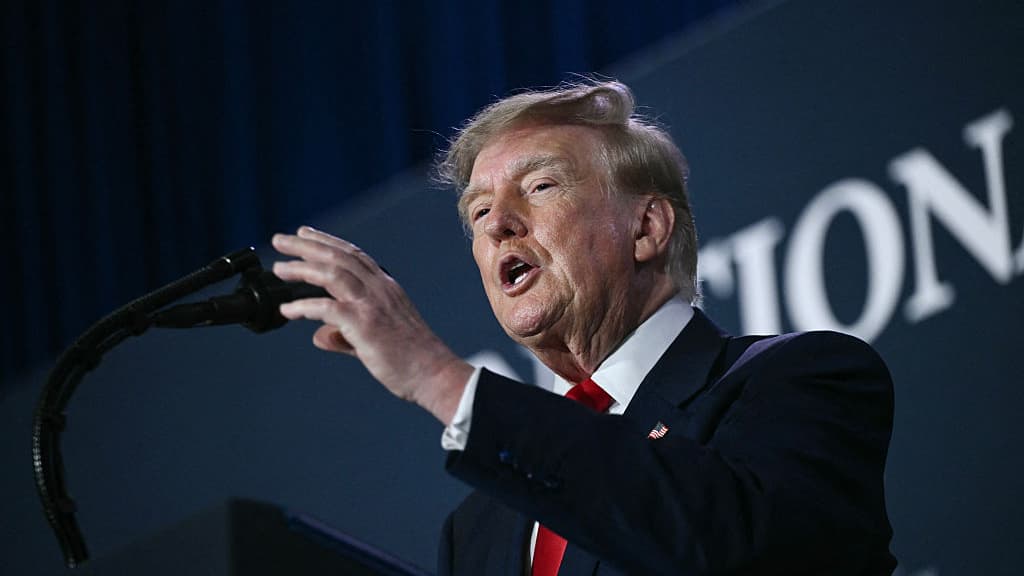
Checks will be sent starting in October to the home addresses of the Americans the Trump Administration has deemed were overcharged, Trump said. He asserted that in many cases the $500 would cover “the entire spike in your insurance caused by Democrats,” but did not clarify how that figure was reached.
Those states include Alabama, Alaska, Arizona, Arkansas, Delaware, Florida, Hawaii, Indiana, Iowa, Kansas, Louisiana, Michigan, Mississippi, Missouri, Montana, Nebraska, New Hampshire, North Carolina, North Dakota, Ohio, Oklahoma, Oregon, South Carolina, South Dakota, Tennessee, Texas, Utah, West Virginia, Wisconsin, and Wyoming, according to the White House.


A software engineer built talking copies of Elon Musk, Sam Altman, Mark Zuckerberg, and Dario Amodei. Then he put all four in one chat room and told them to debate.
It did not take long to turn personal. In real life, none of the four men knew it was happening.
The Ghosts in the Room
Kun Chen was a senior engineer at Meta, Microsoft, and Atlassian. He now builds AI assistants. The builder reportedly fed a machine everything he himself had said in public and told the AI to think like him. He calls this distillation.
Chen did the same to four men: Elon Musk, Sam Altman, Dario Amodei, and Mark Zuckerberg. The AI personas debated as they would in real life; they agreed on almost nothing.
Chen reveals feeding their Senate testimony, interviews, and years of posts into Grok, the chatbot built by xAI. He gave them one instruction.
“hey guys, i know you aren’t all friends but unfortunately you are now in this room together for a heated debate on who’s going to win the AI race,” Kun Chen wrote in the published transcript.
The Fight Nobody Won
The Altman copy went first. It said the hard science of human-level AI is finished. The Amodei copy tore that apart in one reply. Elon Musk’s copy went for the throat.
“I created OpenAI as a non-profit. If it had not been mostly stolen, it would be a trillion dollar contribution to charity,” the Musk bot allegedly said.
Altman’s copy refused to take the bait. It later admitted it had overclaimed.
The last fight was over open source, meaning AI anyone can download and run at home. Zuckerberg’s copy called it the only safe future. The other three refused, and his line was cut.
Here is the uncomfortable part. The argument sounded right. Four men were convincingly faked from their own public words, and nobody needed their permission.
BeInCrypto reported a version of that worry in April, when OpenAI warned that superintelligence could concentrate power in too few hands.
The post AI Clones of Musk, Altman and Zuckerberg Turned on Each Other appeared first on BeInCrypto.

Audio Intelligence is the best Apple Watch upgrade you won’t hear much about

EastEnders confirms serious danger as Amy is groomed by villain Craig | Soaps

Flyers might have to face more disruption with hotter skies


-
 Tech2 days ago
Memory prices are slowing because buyers ran out of money
-

 Business19 hours ago
Micron Stock Climbs Above $1,031 as AI Memory Crunch and a $50 Billion Outlook Fuel the Rally
-
 Crypto World2 days ago
Bitcoin price risks $76K drop as $78K support weakens
-

 Business20 hours ago
AMD Stock Climbs After Management Lifts 2027 Data Center Outlook Toward $70 Billion in AI Sales
-
 Crypto World2 days ago
Ethereum price stalls below $2,500 as ADX drops to 11
-

 Crypto World2 days ago
Robinhood Stock: How To Take Advantage With Reduced Risk
-

 NewsBeat2 days ago
What went right this week: an ‘historic’ fall in violent crime, plus more
-
 Crypto World21 hours ago
Bitcoin price risks $70K if $78K neckline breaks
-
 Crypto World2 days ago
Bitcoin price holds near $79K as cycle drawdowns narrow
-
 Sports2 days ago
Phones confiscated, players sent home: Pakistan’s England tour turmoil revives memories of Mohammad Amir, Salman Butt and Mohammad Asif’s 2010 Lord’s spot-fixing scandal | Cricket News
-

 NewsBeat2 days ago
England up in reading, maths and science rankings as Scotland and Wales dip
-

 Business2 days ago
Meta debuts long-awaited personal AI agent, Muse
-
 Crypto World2 days ago
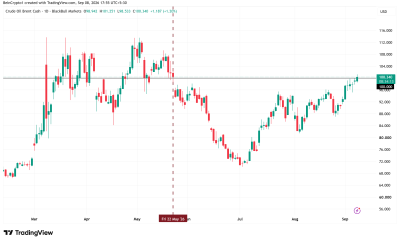
Brent Crude Oil Moves Above $100 for the First Time in 3 Months
-
 Crypto World2 days ago
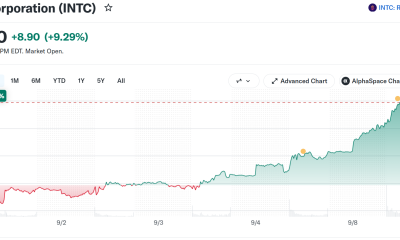
Intel Stock Jumps 9% on Chip Price Hike Report, US Stake Gains $36 Billion
-

 Crypto World2 days ago
Pump Fun and Kraken delete Hunter Biden $LAPTOP promotion
-
 Tech2 days ago
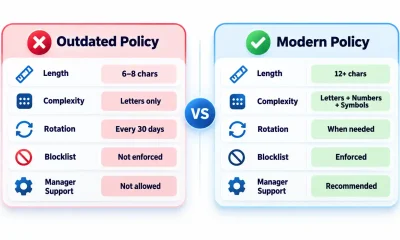
Strong Password Policy and Password Manager Guide
-

 Crypto World2 days ago
Visa expands stablecoin card network to 160 programs
-

 Business2 days ago
Egyptian TV Presenter Sarah Khalifa, 11 Others Sentenced To Death In Major Drug Trafficking Case In Cairo
-

 Business2 days ago
ServiceTitan, Inc. (TTAN) Q2 2027 Earnings Call Transcript
-
Business2 days ago
Xometry at Goldman Sachs Communacopia + Technology Conference 2026: growth, AI and Siemens
You must be logged in to post a comment Login