
Crypto World
Irish police unlock Bitcoin wallet years after keys vanished


Irish authorities have recovered a portion of a long-dormant Bitcoin stash tied to a convicted drug dealer, signaling a rare success in unlocking a decades-old cryptographic puzzle. The Criminal Assets Bureau (CAB) announced on Tuesday that it had gained access to and seized a cryptocurrency wallet containing 500 BTC, valued at more than $35 million, with crucial assistance from Europol’s European Cybercrime Centre.
Cabinet-level cooperation appears to have been pivotal. Europol reportedly hosted operational briefings at its headquarters in The Hague and supplied specialized technical expertise and decryption resources that supported CAB investigators and analysts in bringing the operation to fruition.
The wallet is part of a cluster of 12 addresses holding a total of about 6,000 BTC once linked to Clifton Collins, a drug dealer who received a five-year prison sentence for cannabis cultivation and distribution. The keys to these wallets were believed to be irretrievable after the paper containing them vanished from a fishing-rod case at Collins’ rental home.
“CAB gained access to and seized a cryptocurrency wallet” containing 500 BTC, the agency said, with support from Europol’s European Cybercrime Centre.
The disclosure underscores the evolving landscape of crypto asset recovery, where authorities increasingly combine off-chain investigations with on-chain tracing to locate and recover illicit funds long after their acquisition.
Key takeaways
- A 500 BTC wallet, one of 12 tied to Clifton Collins, has been seized by Irish authorities with Europol’s help, valued at over $35 million.
- The broader stash comprises about 6,000 BTC spread across 12 wallets, deposited by Collins in 2011–2012 and guarded by a paper key hidden in a fishing-rod case.
- Blockchain analytics firm Arkham has linked a wallet labeled “Clifton Collins: Lost Keys” to recent movement in the wallet cluster, including a transfer to Coinbase Prime.
- Arkham’s data indicate Collins controls 14 addresses with a total of roughly 5,500 BTC, valued at more than $391 million, highlighting the persistence and scale of his holdings despite prior legal actions.
- The case illustrates how cross-border law enforcement collaboration and decryptive capabilities can unlock “lost” crypto memories that were once deemed inaccessible.
Tracing a decade-old stash and its implications
The seizure traces back to a long-running narrative of how crime proceeds were converted into Bitcoin more than a decade ago. The 6,000 BTC in question reportedly flowed to multiple wallets in late 2011 and early 2012. Police describe the storage as an audacious yet ultimately fragile arrangement: private keys scattered across 12 wallets, and crucially, paper-based credentials hidden inside an aluminum cap within a fishing-rod case. When Collins was arrested in 2017, authorities say the landlord cleared out the rental home and discarded many belongings, complicating any effort to recover the keys.
While this story has a long tail in public reporting, the latest development shows that some of those “lost keys” can still unlock real value under the right circumstances. The Guardian’s coverage of Collins’ case provides the background on the criminal operation and the 2017 arrest, underscoring how a single possession—an apparently ordinary fishing-rod case—could become a cryptographic Achilles’ heel decades later.
Fresh on-chain activity and what it signals
Beyond the 500 BTC seizure, on-chain observers have noted movements linked to the Clifton Collins wallet cluster. Arkham, a blockchain analytics platform, traces a transfer of 500 BTC to Coinbase Prime from a wallet labeled “Clifton Collins: Lost Keys” on a recent Tuesday. Arkham’s explorer shows Collins as the controller of 14 addresses holding a combined 5,500 BTC, currently valued at more than $391 million.
The development has several practical implications. For investors and fund managers, it highlights that even “cold” assets tied to past criminal activity can re-enter the market or be moved to regulated custodians, potentially affecting liquidity and spot availability in sensitive coins. For traders and risk managers, it underscores the ongoing risk of asset provenance concerns—an issue that can influence compliance checks, KYC/AML workflows, and the perception of who ultimately controls large, long-dormant holdings.
Context and what to watch next
The case sits at the intersection of criminal finance, digital asset forensics, and international enforcement. It underscores the growing role of institutional-grade assistance in crypto asset recovery, including decryption resources and cross-border coordination. While only a portion of Collins’ original stash has been recovered to date, authorities have signaled that the collaboration with Europol will continue to pursue the remaining wallets where possible.
Readers should monitor further updates from the CAB and Europol as the investigation unfolds. The Arkham disclosures also warrant attention, as additional wallets in the cluster could surface new movements that shed light on the ultimate disposition of the roughly 6,000 BTC tied to Collins’ operations. The broader takeaway is clear: the line between traditional crime and digital assets is continually being redrawn as investigators apply both on-chain analytics and cooperative legal channels to recover illicit proceeds.
In the coming weeks, observers should watch for any additional wallet recoveries, updates on the status of the 12-wallet cluster, and whether more of Collins’ holdings surface in public or institutional custody. The episode serves as a reminder that even long-standing crypto hoards can be traced, unlocked, and, in some cases, repurposed for asset recovery and restitution.

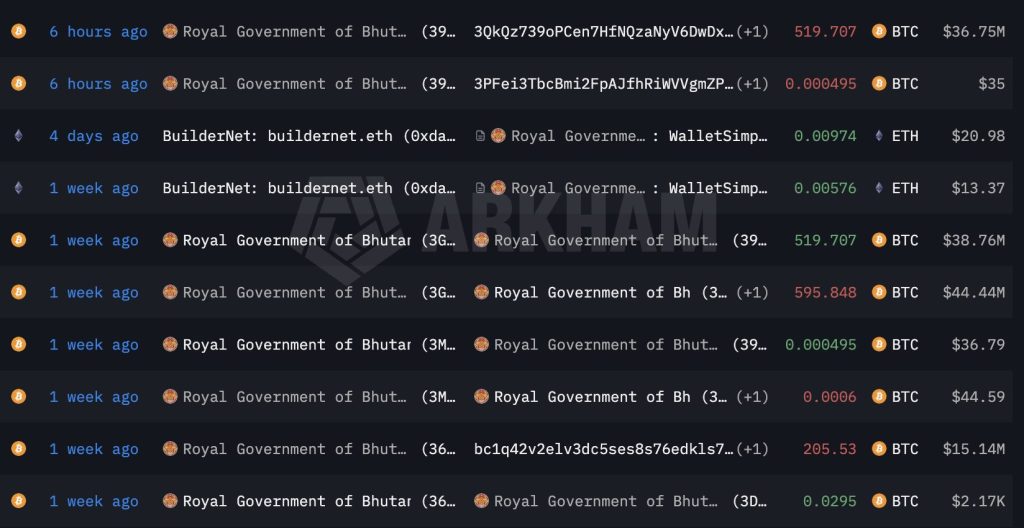
Bhutan is selling Bitcoin again. The Royal Government transferred 519.7 BTC worth roughly $36.75 million to a Binance deposit address Wednesday. The move comes from Druk Holding and Investments, the nation’s sovereign wealth fund, and follows a consistent pattern of outflows that has been running for months.
The remaining stack now sits at 4,453 BTC. That is a sharp drop from a peak of over 13,000 BTC. More than two thirds of the position is gone.
- The Transaction: Druk Holding moved 519.7 BTC to exchange-linked wallets, including Binance and QCP Capital.
- The Trend: Sovereign holdings have dropped over 60% from the October 2024 peak to roughly 4,450 BTC.
- The Signal: Sovereign inventory is converting to liquid supply in steady $30M-$70M tranches.
The Transfer: On-Chain Confirmation
Data from Arkham Intelligence identifies the movement as a split transaction.
The funds were routed to two distinct wallets: one associated with the trading firm QCP Capital and another directly feeding Binance Inflows.

Direct transfers to exchange deposit addresses typically signal immediate intent to sell or collateralize assets rather than mere custody rotation.
This is a liquidity event. The market has seen this repeatedly in recent weeks, including a $72 million exit last week and a $12 million tranche earlier in the month. Druk Holding is averaging down its exposure while prices hover near $71,100. While some analysts debate the exact motive, the destination of these funds suggests active profit-taking rather than long-term repositioning.
The Strategy: From Mining to Monetization
Bhutan Bitcoin holdings were not purchased on the open market like typical institutional assets. They were generated through industrial-scale Bitcoin Mining operations utilizing the country’s renewable hydropower resources.
This gives Druk Holding a cost basis of effectively zero (excluding infrastructure CAPEX), making these Sovereign BTC Sales pure profit realization for the state treasury.

The strategy has shifted. From 2022 through late 2024, Bhutan was a net accumulator. Now, the state acts as a disciplined seller.
Unlike El Salvador, which continues to buy, Bhutan is monetizing its digital surplus to fund domestic initiatives. Analysts view this as a capital rotation likely funding the Gelephu Mindfulness City infrastructure project.
While Bitcoin and gold reverse roles in the broader macro conversation, Bhutan treats its BTC stack strictly as a working capital account.
Markets are absorbing the supply. Despite persistent sell pressure from Bhutan, Bitcoin remains resilient, trading with volatility signals that suggest strong demand absorption. The Druk Holding wallet is now a known sell-side vector. This is an organized unwind. The treasury is liquidating into strength.
Discover: The best new crypto in the world
The post Bhutan Continues Bitcoin Sell-Off with $37M Transfer to Binance appeared first on Cryptonews.


South Korean crypto exchanges recorded large capital outflows in the second half of 2025, even as user activity and deposits continued to grow.
Summary
- South Korean exchanges recorded $60 billion in crypto outflows as funds moved offshore in 2025.
- Exchange accounts rose to 11.1 million and customer deposits climbed despite weaker market conditions nationwide.
- Profits, trading volumes, and market capitalization fell as crypto prices softened late in 2025 overall.
New data from the Financial Services Commission showed that more funds moved to overseas platforms and private wallets during the period. The report also showed weaker profits and lower trading activity across the local market.
The Financial Services Commission said crypto outflows from South Korean exchanges reached 90 trillion won, or about $60 billion, in the second half of 2025. That marked a 14% rise from 78.9 trillion won, or $52.5 billion, in the first half of the year.
The regulator linked part of that movement to cross-border trading activity. In its report, the FSC said,
”It is presumed that virtual assets are being transferred abroad for arbitrage and other similar activities.”
The statement pointed to overseas platforms and private wallets as major destinations for those transfers.
The report showed that more people continued to use local crypto exchanges despite the rise in outflows. By the end of 2025, the number of exchange accounts reached 11.1 million, up 3% from June 2025.
Customer deposits rose at a faster pace. The FSC said deposits climbed 31% to 8.1 trillion won, or about $5.4 billion, during the second half of the year. The figures showed that users kept adding funds to exchanges even as market conditions turned weaker.
In addition, the growth in accounts and deposits did not lift earnings for exchange operators. The country’s 18 active exchanges posted 380.7 billion won, or $253.4 million, in operating profit in the second half. That figure was down 38% from 617.8 billion won, or $411.2 million, in the first half.
Trading activity also moved lower during the period. The FSC estimated average daily trading volume at 5.4 trillion won, or $3.6 billion, which was 15% lower than in the first half. The regulator said lower crypto prices near the end of 2025 likely weighed on exchange revenue and market activity.
Market value also moved lower
The report estimated South Korea’s total crypto market capitalization at 87.2 trillion won, or about $58 billion, at the end of 2025. That was down 8% from the first half of the year and reflected softer market conditions across major digital assets.
The broader market remained below its October 2025 peak, when bitcoin reached an all-time high of about $126,080. The FSC data showed that while local participation stayed firm, weaker prices and lower volumes put pressure on exchange performance in the second half.

Cardano price is grinding through a critical consolidation phase, trading in a tight band between $0.25 and $0.27 as on-chain prediction flashes a potential reversal.
Analysis from market intelligence platform Santiment suggests the asset has entered a historic “opportunity zone,” with average wallet returns signaling capitulation typically seen before market resets.
— Santiment (@santimentfeed) March 24, 2026
 Average wallets that have been active on the Cardano network over the past year are netting a return of -43% on their investments. Memes aside about the altcoin's major -71% price decline since September, this extreme negative MVRV value is generally an indicator of $ADA being… pic.twitter.com/LzQRKhobQe
The 13th-largest cryptocurrency by market cap has printed six consecutive red candles on the daily chart, leaving active wallets from the past 12 months sitting on unrealized losses of approximately -43%. The price action reflects a 63.5% correction from year-ago levels.
Imminent catalysts, including the Midnight privacy sidechain launch and the Plutus V11 hard fork, are keeping smart money attentive. As broader markets hesitate, volume data suggests whales are positioning for volatility.
Discover: The best pre-launch token sales
Cardano Price Prediction: Can ADA Defend Support Amid Record Shorting?
Technical indicators for Cardano reveal a battleground at the $0.25 support level, a zone that has historically triggered significant liquidity inflows. Recent price action shows $ADA hovering near $0.268, down over 71% from its September high of $0.954.
This steep discount has pushed the MVRV (Market Value to Realized Value) metric significantly below zero. Historically, when MVRV drops this low, selling pressure begins to fade as holders refuse to sell at deep losses.
Despite the bearish sentiment, significant accumulation is occurring behind the scenes. Previous analysis highlighted that periods of low social dominance combined with high negative returns often precede short squeezes.

Data indicates that derivatives markets are seeing record shorting interest. If $ADA can reclaim the $0.2717 pivot, a rapid move toward the first resistance level at $0.3230 becomes the primary scenario.
Conversely, a failure to hold $0.25 could expose the asset to price discovery to the downside. However, with the SEC and CFTC recently classifying ADA as a digital commodity, institutional regulatory fears have subsided.
Discover: The best crypto to diversify your portfolio with
Maxi Doge Flows Surge as Traders Rotate into High-Beta Assets
While Cardano works through its slow-moving accumulation phase, aggressive traders are increasingly rotating capital into high-leverage meme protocols to capture immediate upside. The market’s appetite for volatility has found a new outlet in Maxi Doge ($MAXI), a project that blends “gym-bro” meme culture with actual trading utility.
Maxi Doge is positioning itself as the “Review Mirror” for traders who missed the original DOGE runs, but with a distinct cultural twist focused on the “1000x leverage mentality.” The presale has already secured more than $4.7 million in early funding, signaling robust demand for assets that offer higher beta than legacy L1s.
Currently priced at $0.000281, the token incentivizes holding through huge 66% APY staking and holder-only trading competitions.
Unlike standard meme coins that rely solely on hype, Maxi Doge utilizes a “Maxi Fund” treasury to support liquidity and partnerships, aiming to create a sustainable ecosystem for its community. (
Disclaimer: Crypto is a high-risk asset class. This article is provided for informational purposes and does not constitute investment advice.
The post Cardano Price Prediction: Record Shorting and Line to Defend appeared first on Cryptonews.
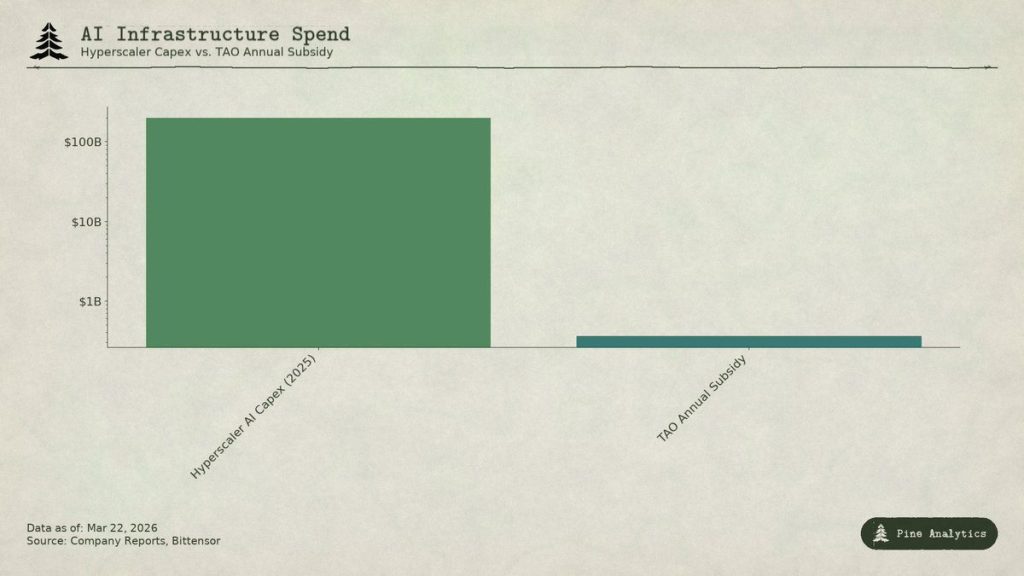
Bittensor (TAO crypto) is currently priced on an annual subsidy of $52 million, not organic revenue.
The decentralized AI protocol incentivizes its subnet to emit 518 TAO daily to top performers like Chutes, masking a near-term liquidity crisis.
With a $1.37 billion subnet market cap and near-zero organic validator yield, the network faces a structural “Income Desert.”
The TAO halving effectively starts a timer on this valuation model. While the TAO price has recovered from its Q1 2026 lows to trade above $330, the disconnect between token incentives and actual utility is widening. If external revenue does not replace inflationary rewards before the miners bleed out, the math stops working.
- Emission Dependency: Top subnets like Chutes receive $52 million in annualized subsidies while generating negligible external revenue.
- Cost Inversion: Unsubsidized decentralized compute costs are roughly 1.6-3.5x higher than centralized competitors like Deepseek.
- Valuation Gap: The network supports a $1.37 billion subnet market cap despite the bulk of validator yield coming from inflation rather than customers.
Tao Crypto Data Deep Dive: The Emission Problem
Subnets are currently paid to exist, not to serve. Chutes (SN64), a top-performing subnet, captures approximately 14.4% of total network emissions. That equals roughly 518 TAO per day. At current market prices, this serves as a $52 million annual operational subsidy shared among miners and validators.
Without this subsidy, the economics invert immediately. Pine Analytics data indicates that unsubsidized inference on Chutes would cost 1.6x to 3.5x as much as centralized competitors like Deepseek or TogetherAI.
The protocol acts as a heavy subsidizer of compute, creating a cost advantage that is artificial rather than structural. When the emissions stop covering the spread, the user value proposition evaporates. This mirrors the structural inefficiencies seen in legacy market infrastructure, where capital gets trapped in systems that do not generate velocity.
The Halving Catalyst: Why the Clock is Ticking
The TAO halving in December 2025 slashed daily emissions from 7,200 to 3,600 TAO. The buffer is gone. Miners previously relying on fat block rewards now fight for a shrinking pie, making the “Income Desert” a solvency issue rather than just a theoretical concern.

This scarcity mechanism is designed to support the price, but it stress-tests the business model. If organic revenue does not scale to replace the lost 3,600 TAO per day, miners operate at a loss. Much like the sustainability challenges that forced Balancer Labs to restructure, Bittensor’s subnets cannot run indefinitely on a deficit. The halving exposes which subnets are businesses and which are zombie chains feeding on inflation.
The Valuation Gap: What the $1.37B Subnet Market Cap Actually Reflects
The market currently values Bittensor’s subnets at roughly $1.37 billion. This figure implies a massive growth multiple based on future Crypto AI adoption, as current organic cash flows are near zero. The discrepancy is stark.
Investors are paying a premium for infrastructure that is currently less efficient than centralized alternatives. In a Proof-of-Work style system like Bittensor, the valuation must eventually be backed by miner revenue.
If the price of TAO drops or the cost-to-serve remains high, the security budget collapses. The current price of $332 assumes a seamless transition from subsidized growth to organic profitability. The data does not yet support that assumption.
The post Bittensor Income Desert: Why $52M in Subsidies Mask a TAO Crypto Valuation Risk appeared first on Cryptonews.


Cipher Digital (CIFR) shares jumped 9% in pre-market trading after the company, formerly a bitcoin miner, announced a new long-term data center lease and said it secured a $200 million revolving credit facility.
The company revealed a 15-year lease agreement with an investment-grade hyperscale tenant for its third data center campus. Cipher will develop and deliver a high-performance computing facility at an existing site, strengthening its position as a partner to large technology firms building AI infrastructure.
Cipher also announced a revolving credit facility of up to $200 million, with an additional $50 million accordion option. Backed by a syndicate of leading global banks, the facility provides non-dilutive capital to support expansion, boost liquidity, and fund future growth initiatives.
Cipher Digital, formerly known as Cipher Mining, has rebranded to reflect a strategic pivot away from bitcoin production toward the development of industrial-scale data centers for AI and cloud workloads. The move aligns the company with the rapidly growing demand for high-performance computing capacity.

Key Takeaways
- Shares of Circle Internet Group (CRCL) plunged approximately 20% on Tuesday following reports of draft legislation that would prohibit yield payments on stablecoin holdings
- Coinbase (COIN), which partners with Circle on USDC distribution, declined 9.1% amid the same regulatory concerns
- The draft provision within the Clarity Act aims to restrict yield payments offered “directly or indirectly” on stablecoins that function like interest-bearing deposits
- Company insider Nikhil Chandhok offloaded 10,000 shares on March 23 at $123.08 per share, totaling $1.23 million, just before the stock tumbled
- Circle’s fourth-quarter financial performance exceeded expectations with earnings per share of $0.43 versus the anticipated $0.25, while revenues surged 76.9% compared to the previous year
Shares of Circle Internet Group (CRCL) experienced a dramatic decline on Tuesday following revelations that proposed legislative language in the Clarity Act could eliminate the ability for platforms to provide yield on stablecoin deposits. The stock tumbled roughly 20% during trading, with Wednesday’s opening price settling at $101.90.
According to correspondence from the Blockchain Association distributed to its membership and subsequently examined by Barron’s, the proposed provision would prevent platforms from compensating investors—whether through direct or indirect means—simply for maintaining stablecoin balances in arrangements that mirror traditional interest-bearing bank accounts.
Circle serves as the creator of USDC, which ranks as the second-most widely circulated stablecoin globally. Income generated from USDC reserve assets, predominantly invested in U.S. Treasury securities and reverse repo agreements, is distributed between Circle and its distribution ally, Coinbase.
[[LINK_START_2]]Coinbase (COIN)[[LINK_END_2]] experienced a 9.1% decline on the identical trading day. The exchange presently provides users with a 3.5% annual percentage yield on USDC balances—an offering that would face elimination under the contemplated regulatory framework.
The negotiated provision, developed with contributions from White House officials and Senators Angela Alsobrooks (D-MD) and Thom Tillis (R-NC), underwent review by banking institutions and cryptocurrency companies throughout Monday and Tuesday. While activity-driven rewards and customer loyalty initiatives would remain permissible under the draft text, the Blockchain Association indicated it was pursuing additional clarification regarding acceptable programs.
The legislation has been under development for multiple years. Its primary objective involves establishing regulatory clarity for digital assets within the United States and providing exemptions from securities regulations for most cryptocurrency transactions. The stablecoin yield controversy has emerged as among several contentious elements.
Traditional banking industry representatives have consistently opposed stablecoin yield offerings, contending that such products divert customer deposits from conventional financial institutions, which generally provide lower interest rates.
Coinbase Leadership Previously Withdrew Endorsement
Brian Armstrong, CEO of Coinbase, had previously retracted his backing for the Clarity Act when an earlier iteration of the yield prohibition came to light. The current compromise represents an effort to bridge the divide between banking sector advocacy and cryptocurrency industry interests.
Beyond the yield question, the legislation confronts additional obstacles. Democratic lawmakers have advocated for provisions preventing President Trump and his relatives from generating profits through cryptocurrency holdings. Republican members have predominantly resisted such additions. These negotiations remain suspended pending resolution of the yield controversy.
The legislative calendar presents another challenge. Congressional members express concern that the measure may not secure passage through both legislative chambers before midterm election campaigns intensify.
Executive Stock Transaction and Market Analyst Perspectives
The stock decline occurred mere days following an insider transaction. Nikhil Chandhok disposed of 10,000 CRCL shares on March 23 at an average price of $123.08, generating proceeds of $1.23 million. This marked his second divestiture in recent months—he had previously sold 20,000 shares in late February at $90.00 per share.
Notwithstanding the market turbulence, Circle’s recent financial metrics demonstrated strength. The organization disclosed fourth-quarter earnings per share of $0.43, substantially exceeding the consensus forecast of $0.25, accompanied by revenue of $770.23 million—representing a 76.9% year-over-year increase.
Wall Street analyst projections vary considerably. Wells Fargo reduced its price objective from $128 to $111 while maintaining an “overweight” recommendation. Robert W. Baird maintains an “outperform” rating with a $138 price target. MarketBeat’s aggregated consensus reflects a “Hold” rating with an average target price of $126.29.
CRCL has traded within a 52-week range spanning from $49.90 to $298.99.

Crypto World
STS Digital unveils structured crypto platform, brings in Kraken as distribution partner


STS Digital, a trading firm specializing in crypto options, unveiled a structured-products platform aimed at sophisticated investors as digital assets gain growing acceptance among traditional financial institutions.
One month after raising $30 million, the Bermuda-based company said the platform, which covers 400 tokens, is aimed at banks, family offices, and high-net-worth individuals seeking returns on top of their spot-market holdings. Kraken, the crypto exchange whose parent, Payward, took part in the fundraising, will offer the platform to its partners, STS Digital said in a statement shared with CoinDesk.
Crypto structured products are seeing rising demand as venture funds, portfolio managers and large mandate holders look for more tailored hedging solutions. Standard leveraged products like futures and perpetuals, with their one-size-fits-all design, often fall short, especially due to path dependency.
Structured products typically embed options that help navigate volatility and generate additional income on top of spot market holdings. Open interest is currently around $47 billion, according to TheTie, with the lion’s share on Deribit.
For Kraken, the partnership is also about deepening its bench of products. According to the release, the exchange is leveraging STS’ derivatives expertise to power its Dual Investment product, introduced earlier this month, to allow eligible clients to earn fixed returns on bitcoin and ether (ETH).
The agreement brings “structured strategies like covered calls to our platform, strengthens our growing suite of derivatives solutions and gives clients a new way to generate return that’s distinct from traditional crypto approaches like staking or lending,” Alexia Theodorou, director of derivatives at Kraken, said in the statement.


The Reserve Bank of Australia said tokenization could bring AU$24 billion in yearly efficiency gains to the national economy.
Summary
- RBA said tokenization could add AU$24 billion yearly and is now moving toward practical rollout.
- Project Acacia tested bonds, repos, funds, and four settlement options across Australia’s wholesale finance markets.
- Stablecoins may suit smaller markets while deposit tokens could support larger regulated activity across Australia.
Meanwhile, the central bank used findings from Project Acacia to show that tokenized assets and tokenized money are moving closer to practical use in wholesale finance. It said the next stage will focus on implementation, industry coordination, and market testing.
Reserve Bank of Australia Assistant Governor Brad Jones said the central bank now sees tokenization as a question of “how” rather than “if.” He made the remarks while presenting findings from Project Acacia, which reviewed how tokenized assets and money could work in Australia’s wholesale financial system.
Jones said research from the Digital Finance Cooperative Research Centre estimated that tokenization could deliver AU$24 billion in annual efficiency gains. He also said the benefits could grow further if the technology supports the creation of new markets and services.
Project Acacia reviewed 20 use cases tied to tokenized assets, including government bonds, corporate bonds, repos, and investment funds. The project also tested settlement using four types of money, namely wholesale central bank digital currency, exchange settlement account balances, stablecoins, and bank deposit tokens.
The results showed that different forms of tokenized money may serve different roles. Jones said stablecoins could support smaller and newer tokenized markets, while bank deposit tokens may suit larger markets because banks already operate under prudential rules and have access to central bank liquidity facilities.
Moreover, Jones said stablecoins and bank deposit tokens could work in complementary ways rather than compete directly. This approach reflects the RBA’s current view that different tokenized payment tools may fit different parts of the wholesale market.
He also said market participants viewed a wholesale CBDC as “potentially helpful, but far from essential” for tokenized markets to develop. He pointed to the United States, where tokenized repo markets are already recording daily activity close to $400 billion without depending on a wholesale CBDC.
Sandbox and advisory groups set next steps
The RBA said it will work with the Council of Financial Regulators, the DFCRC, and industry participants on a set of new initiatives. A digital financial market infrastructure sandbox will provide a stage-gated setting for testing tokenized assets, money, and settlement systems.
The central bank will also review exchange settlement account access rules after payment service provider licensing reforms pass parliament. In addition, regulators and industry members will form a joint tokenisation advisory group, while an expanded Deposit Token Working Group will focus on interoperability between deposit tokens issued by different banks.
Monument Bank said it plans to tokenise up to 250 million pounds ($335 million) of retail customer deposits on the Midnight network in what it described as the first such move by a U.K.-regulated bank on a public blockchain.
The London-based challenger bank said the deposits will remain interest-bearing, fully backed by Monument and redeemable one-for-one in pounds sterling. They will also remain covered by the U.K.’s Financial Services Compensation Scheme.
The move marks is a step in the push to bring tokenized financial products into regulated banking. While banks in the U.K. and elsewhere have explored tokenized deposits, most work to date has focused on institutional use or closed networks.
Monument is pitching this effort at retail customers, starting with clients with investable assets between 50,000 pounds and 5 million pounds, the so-called mass-affluent, according to asset manager St. James’s Place.
Monument, which says it has more than 100,000 customers and about 7 billion pounds in deposits, said the first phase will mirror savings balances on Midnight’s privacy-focused blockchain.
Later phases are meant to add tokenized investment products such as private market and commodity funds, followed by lending against those holdings inside the Monument app.
Midnight Foundation, which was developed by Shielded Technologies, a company linked to Cardano creator Input Output, is providing the blockchain infrastructure.
Monument said the system is designed so transaction data remains visible only to the bank and its customers, while operating within existing U.K. banking protections and compliance rules.
The announcement also points to a wider play. Monument said affiliate Monument Technology plans to offer tokenized deposit functionality through its Banking-as-a-Service platform. That could allow other institutions to adopt the same model.
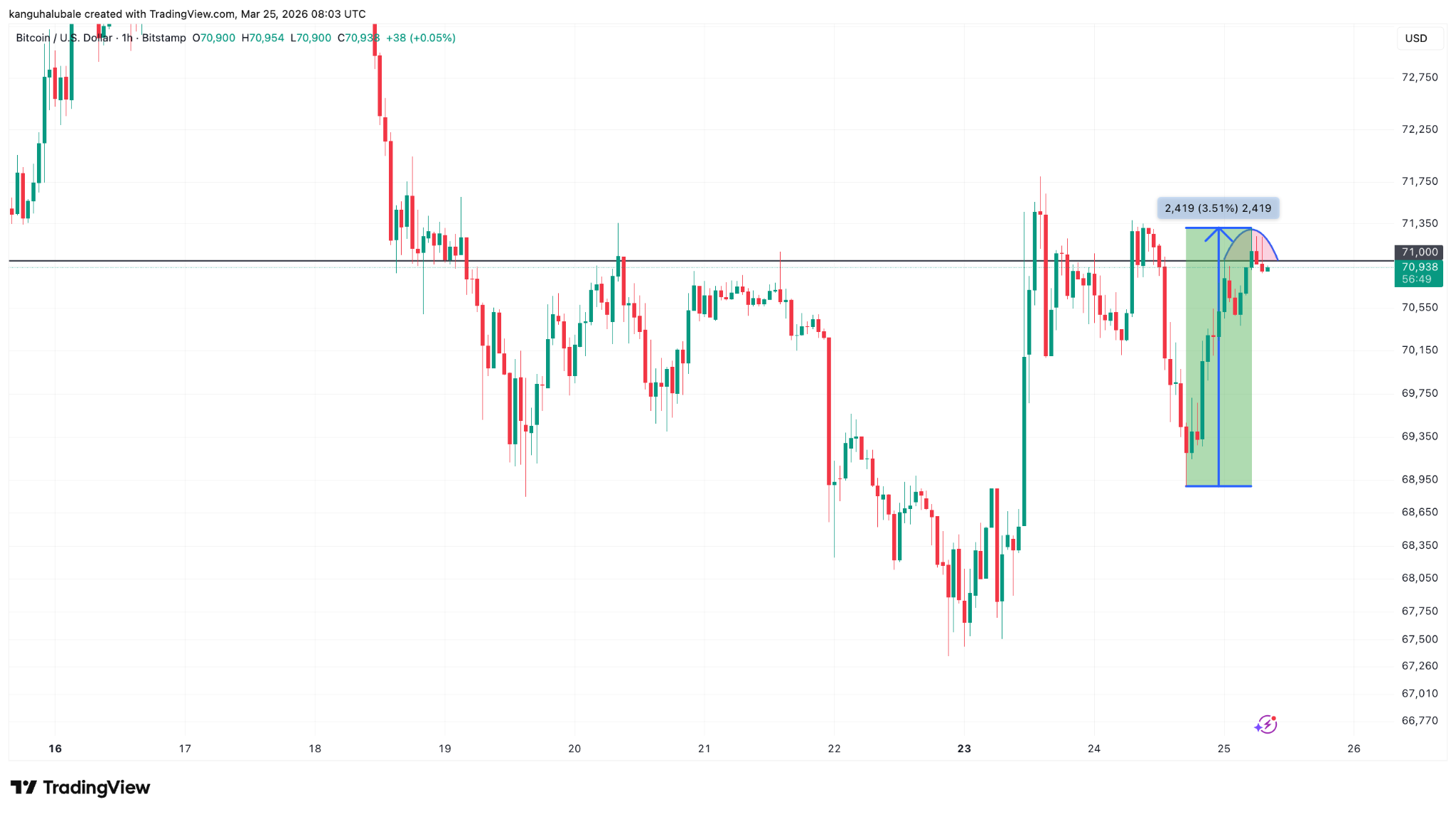
Bitcoin (BTC) rose back above $71,000 during the early Asian trading hours on Wednesday after Trump’s administration offered a 15-point plan to Iran to end the war, sparking short-term optimism across risk assets.
Key takeaways:
-
Bitcoin bounces 4% to $71,500 after President Trump sent Iran a 15-point proposal aimed at ending the war.
-
Bitcoin faces stiff resistance above $72,000.
Bitcoin jumps 4% on ceasefire hopes
Data from TradingView showed BTC price rose as much as 4% to an intraday high of $71,300 from Tuesday’s low of $68,890, recouping all the losses incurred the day prior.

The price reacted to news that the US, through the primary intermediary Field Marshal Syed Asim Munir (Pakistan’s Chief of Army Staff), has sent Iran a 15-point plan aimed at ending the war.
The key elements of the plan include: a temporary ceasefire with calls on Iran to dismantle or severely limit its nuclear program, suspend its ballistic-missile work, and the full reopening of the Strait of Hormuz for safe maritime traffic.

Meanwhile, Iran continues to deny any ongoing talks as Trump delayed his self-imposed deadline for Tehran to reopen the Strait of Hormuz.
Following the news, WTI crude oil dropped 5.75% to $87 per barrel, while Brent crude shed 6% to trade at $98.

Gold extended yesterday’s gains, now up 2.53% on the day to trade at $4,561 at the time of writing.
This move eases inflation fears tied to disrupted shipping through the Strait of Hormuz, positively impacting risk assets, including Bitcoin.
Analysts noted the swift repricing, with Coinlore saying that Bitcoin is now acting as a “real-time sentiment instrument for global risk.”
CryptoQuant analyst Axel Adler Jr said that BTC will “likely remain headline-driven” until the US and Iran send a “public de-escalation signal.”
Bitcoin price faces “rough times ahead”
Despite the rebound, BTC’s upside appears to be capped at $72,000, where the 50-day exponential moving average (EMA) and the upper trend line of a symmetrical triangle converge.
A break above $72,000 would confirm a bullish breakout from the triangle, toward the measured target at $92,400, 30% above the current price.

Glassnode’s cost-basis distribution heatmap reveals concentrated supply and resistance between $72,000 and $74,000, where investors acquired roughly 380,000 BTC over the last 30 days. This indicates that sellers could aggressively defend this zone.

On the downside, a dense accumulation cluster sits around $65,000, where investors previously acquired 160,000 BTC.
This level coincides with the lower trend line of the symmetrical triangle, which, if lost, could trigger the next leg lower toward the bearish target of the triangle at $52,500.
Meanwhile, Capriole Investment’s Bitcoin Macro index has dropped to -1.37, levels seen at the depth of previous bear cycles.
The chart below shows that the metric historically spends a year at or below these valuations before recovering.
“Bitcoin Macro index is in the value zone,” Capriole Investments founder Charles Edwards said in an X post on Wednesday, adding:
“In all prior instances, price went lower into deeper value first before recovering, suggesting we may have more rough times ahead first.”

As Cointelegraph reported, traders warn of a second bear flag breakdown that could clear the path for another sell-off below $50,000.
This article does not contain investment advice or recommendations. Every investment and trading move involves risk, and readers should conduct their own research when making a decision. While we strive to provide accurate and timely information, Cointelegraph does not guarantee the accuracy, completeness, or reliability of any information in this article. This article may contain forward-looking statements that are subject to risks and uncertainties. Cointelegraph will not be liable for any loss or damage arising from your reliance on this information.

Riding the GLP-1 wave

Bhutan Continues Bitcoin Sell-Off with $37M Transfer to Binance

Phaedra Parks Says Wendy Osefo Should Take A Plea Deal In Fraud Case


-
 Crypto World5 days ago
NIO (NIO) Stock Plunges 6.5% as Shelf Registration Sparks Dilution Worries
-

 Fashion5 days ago
Weekend Open Thread: Adidas – Corporette.com
-

 Politics5 days ago
Jenni Murray, Long-Serving Woman’s Hour Presenter, Dies Aged 75
-

 Crypto World4 days ago
Best Crypto to Buy Now: Strategy Just Spent $1.57 Billion on Bitcoin During Fear While Early Investors Quietly Enter Pepeto for 150x Potential
-

 News Videos7 days ago
RBA board divided on rate cut, unusually buoyant share market | Finance Report | ABC NEWS
-

 Crypto World4 days ago
Bitcoin Price News: Bhutan Sells $72 Million in BTC Under Fiscal Pressure, but the Smart Money Entering Pepeto Sees What the Market Does Not
-
 NewsBeat4 hours ago
Manchester United reach agreement with Casemiro over contract clause amid transfer speculation
-

 Tech5 days ago
inKONBINI Lets You Spend Summer Days Behind the Register
-

 Crypto World7 days ago
Canada’s FINTRAC revokes registrations of 23 crypto MSBs in AML crackdown
-

 Sports2 days ago
Remo Stars and Kano Pillars Strengthen Survival Hopes in NPFL
-
 NewsBeat7 days ago
Residents in North Lanarkshire reminded to register to vote in Scottish Parliament Election
-

 News Videos7 days ago
PARLIAMENT OF MALAWI – PAC MEETING WITH REGISTRAR OF FINANCIAL ON AMARYLLIS HOTEL – INQUIRY LIVE
-

 Politics6 days ago
Gender equality discussions at UN face pushbacks and US resistance
-

 Business3 days ago
No Winner in March 21 Drawing as Prize Rolls to $133 Million for Next
-

 Business7 days ago
Who Was Alex Pretti? 5 Key Facts About the ICU Nurse Killed by Federal Agents in Minneapolis
-

 Sports2 days ago
Gary Kirsten Accuses Pakistan Cricket Board Of ‘Interference’, Mohsin Naqvi Responds
-

 Tech3 days ago
Give Your Phone a Huge (and Free) Upgrade by Switching to Another Keyboard
-

 Tech7 days ago
Inventec’s bizarre VeilBook laptop hides its touchpad under a sliding keyboard just to give cooling fans a little breathing room
-

 Sports5 days ago
2026 Kentucky Derby horses, odds, futures, preview, date: Expert who nailed 12 Derby-Oaks Doubles enters picks
-
Sports6 days ago
Vikings Free Agency Enters Phase 2 with Key Questions
You must be logged in to post a comment Login