
Crypto World
Is a Bullish Bounce on the Way?

TLDR
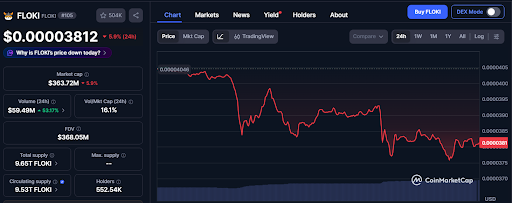
- FLOKI price has decreased by 5.9% in the last 24 hours, now at $0.00003812.
- The price fluctuated, briefly rising to $0.00004046 before declining steadily.
- Despite the price dip, FLOKI’s trading volume surged by 53.17%, reaching $59.49 million.
- Market analysts suggest a potential change, with FLOKI nearing a key support zone in its descending channel.
- Key target levels to watch for are $0.000052, $0.000078, $0.000117, and $0.000160.
For a month now, the FLOKI price has been trending lower, with a 4% dip. During today’s Asian trading session, the meme coin opened at $0.00003899 and then traded in an up-and-down manner. However, market analysts have hinted at a potential change following the formation of a historical downtrend channel that followed a pullback.
FLOKI Price Dips 5.9% in 24 Hours
At the time of writing this article, CoinMarketCap data reveals that the price of FLOKI has decreased by 5.9% in the last 24 hours, now standing at $0.00003812. Throughout the observation period, the price fluctuated.

The FLOKI price briefly rose to about $0.00004046 before declining steadily. This dip followed an earlier surge, reflecting a moderate price movement. FLOKI’s market cap has decreased by 5.9% to $363.72 million.
Despite the price drop, FLOKI’s trading volume has increased by 53.17% over the past 24 hours, reaching $59.49 million. The volume-to-market cap ratio stands at 16.1%, suggesting relatively high trading activity relative to market value. The price chart displays a period of decline, with the value steadily decreasing throughout the timeframe.
FLOKI Nears Key Support: Bullish Reversal Expected Soon
While current market data indicates negative price performance, market analysts have identified a potential change. According to Jonathan Carter’s observation, the FLOKI price chart shows the price moving within a descending channel. The FLOKI price has consistently bounced between the top resistance zone and the bottom support zone.
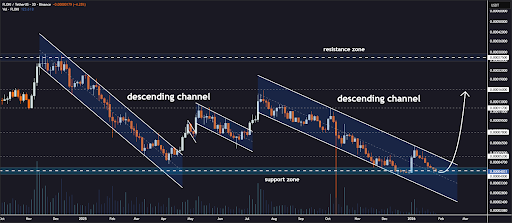
Currently, the price is approaching the support zone, where it has previously found buying interest. FLOKI price action shows that the market is defending this key support zone, indicating a potential shift in momentum towards the bulls. As the price nears the midline of the descending channel, a bounce is becoming more likely. This shift could lead to an upward move.
The key target levels to watch for are $0.000052, $0.000078, $0.000117, and $0.000160. These levels represent potential areas of resistance where the price could face challenges. The FLOKI token is currently at a critical point in the descending channel. If the support holds, the price could rise toward these targets, reflecting a possible trend reversal.




Strategy (formerly MicroStrategy) managed to turn an unrealized bitcoin (BTC) profit of $32.6 billion into a $2.2 billion loss thanks to founder Michael Saylor’s reluctance to sell.
To be specific, four months ago on October 6, the company owned 640,031 BTC acquired for $73,983 apiece but worth $125,000 apiece at prevailing market prices.
As of yesterday’s Nasdaq close, however, Strategy now owns 713,502 BTC acquired for $76,052 and worth just $72,925.
In other words, Strategy had an unrealized BTC profit of $32.6 billion on October 6 that has turned into a $2.2 billion loss.
Even excluding the last four months of purchases to restrict yesterday’s figure to the original 640,031 BTC, that still recalculates to an equally embarrassing swing from a $32.6 billion profit to a $670 million loss on only the BTC the company owned four months ago.
Read more: Michael Saylor is running out of ways to boost Strategy’s BTC per share
New lows across multiple metrics
Management’s choice to not sell means Strategy’s balance sheet has $33 billion less in assets than it could have, less capital gains tax.
This figure also ignores the effects on BTC’s price of Strategy selling such large sums.
As of yesterday’s close, the company’s common stock MSTR had a market capitalization of just 0.82x the value of the company’s BTC holdings — down 75% from its November 2024 high of 3.4x.
In addition to a 76% loss since its November 2024 high, including its latest 52-week decline of 61%, Strategy leadership has also failed to capture those tens of billions of dollars of investment income along the way.
It might seem tempting, given these losses, to point to a reminder of Saylor’s previously devout and confident proclamations that he never intended to sell Strategy’s BTC.
Unfortunately, he did say those things in the distant past, but even that promise has been deteriorating along with most other metrics at Strategy.
Indeed, Saylor now discusses the possibility of selling Strategy’s BTC, including official statements from the company and its CEO, albeit in euphemisms such as raising capital or covering dividend obligations.
Moreover, the company recently diluted equity holders for $1.44 billion with $0 in associated BTC purchases in order to shore up USD, not BTC, for a rainy day. That day might be arriving soon.
Got a tip? Send us an email securely via Protos Leaks. For more informed news, follow us on X, Bluesky, and Google News, or subscribe to our YouTube channel.


- Playnance unveils Web2-to-Web3 gaming infrastructure after years operating privately at scale.
- The platform processes 1.5 million daily on-chain transactions with over 10,000 active users.
- Playnance focuses on simplifying blockchain access through Web2-style onboarding systems.
Playnance has made its first public announcement, revealing itself as a Web3 infrastructure and consumer platform company that has been operating a live ecosystem aimed at onboarding mainstream Web2 users into blockchain-based environments.
The announcement was made on February 5, 2026, from Tel Aviv, marking the company’s first formal introduction after several years of developing and running its technology and platforms privately.
Founded in 2020, Playnance has positioned itself as a Web2-to-Web3 gaming infrastructure layer.
The company integrates with more than 30 game studios and enables the conversion of thousands of games into fully on-chain experiences, where all gameplay actions are executed and recorded directly on blockchain networks.
Infrastructure built to simplify blockchain adoption
Playnance’s core offering focuses on removing technical barriers commonly associated with blockchain usage.
The company’s products are designed to allow users to interact with on-chain systems without needing direct knowledge of blockchain mechanics.
Instead, users access platforms through familiar Web2-style interfaces, including standard account creation and login processes, while blockchain functionality operates in the background.
The company stated that its live platforms currently process approximately 1.5 million on-chain transactions daily and support more than 10,000 daily active users.
According to Playnance, a significant portion of its user base originates from traditional Web2 environments.
These users are reportedly able to onboard and interact with blockchain-based systems without using external wallets or managing private keys, suggesting continued on-chain engagement from audiences outside the traditional crypto sector.
The company’s ecosystem also includes the G Coin initiative, which is currently operating in pre-sale mode and is accessible through the Playnance official website.
Consumer platforms showcase operational ecosystem
Playnance operates several consumer-facing platforms designed to demonstrate its infrastructure capabilities.
Among these are PlayW3, Up vs Down, and other products that run on shared on-chain infrastructure and wallet systems.
The integrated structure allows users to move between platforms without repeating onboarding procedures.
All user interactions across these platforms are executed and recorded on-chain while remaining non-custodial, aligning with the company’s focus on user control and blockchain transparency.
The shared wallet and infrastructure framework also supports cross-platform engagement within the broader Playnance ecosystem.
“Our focus was on building systems that people could use without needing to understand blockchain mechanics,” said Pini Peter, CEO of Playnance. “We prioritized live operation and user behavior over public announcements, and this is the first time we are formally introducing the company after reaching scale.”
Expansion strategy centred on user behaviour
Playnance stated that its infrastructure is designed to support high-volume consumer activity and continuous on-chain execution.
The company’s approach reflects a broader industry shift toward practical blockchain applications targeting mainstream audiences.
Looking ahead, Playnance indicated that its ecosystem expansion will be guided by observed user behaviour and platform performance.
The company emphasised that its development roadmap will focus on real usage data rather than speculative adoption models.
Playnance describes itself as a company focused on reducing friction between user behaviour and blockchain execution by operating consumer platforms at scale.

Institutional custodian Hex Trust has expanded its long-standing partnership with Flare through a new collaboration aimed at delivering institutional access to native FLR staking and FXRP minting.
Under the agreement, Hex Trust said it will provide custody, governance, and compliance infrastructure, while Flare supplies the underlying protocol layer.
— Hex Trust (@Hex_Trust) February 5, 2026
 With @FlareNetworks, we’re launching secure institutional access to FXRP minting and FLR staking. No more choosing between security and utility.
 https://t.co/5RXaYDKUYY
Key Benefits: Direct DeFi Access: Mint $FXRP and stake $FLR natively.  All actions are governed by… pic.twitter.com/wBeYqRNirB
The update is now live for Hex Trust’s institutional clients and positions Hex as a primary gateway into the Flare ecosystem, offering a standardized and secure interface for interacting with Flare-native assets.
Gateway Into the Flare Ecosystem
The partnership allows institutions to mint and redeem FXRP — a non-custodial 1:1 representation of XRP on Flare — and to participate in native FLR staking directly through Hex Trust’s platform.
These activities underpin economic activity on Flare, supporting network security, liquidity and decentralized finance use cases. By firm combines Flare’s protocol infrastructure with Hex Trust’s regulated custody and operational controls.
In December, Hex Trust announced the launch of Wrapped XRP (wXRP) on Thursday, deploying the token across Ethereum, Solana, Optimism, and HyperEVM with $100 million in initial liquidity.
The move aims to anchor Ripple’s RLUSD stablecoin pairs on EVM chains. XRP remained flat on the news, while RLUSD supply held steady at 1.3 billion.
Solving Institutional Risk and Custody Constraints
The firm claims many institutions, direct engagement with staking or bridging has been constrained by the need for hot wallet connections and limited governance controls. As a result, assets such as XRP and FLR have often remained sidelined, despite growing onchain demand.
Hex Trust said it addresses this by maintaining a strict chain of custody while allowing participation in Flare’s DeFi ecosystem via WalletConnect. This structure allows institutions to access native FLR staking and XRP-based DeFi strategies through FXRP minting without compromising internal risk frameworks.
Turning Idle Assets Into Productive Collateral
“The expansion of token wrapping to assets like XRP marks a significant shift in market structure,” said Giorgia Pellizzari, CPO and head of custody at Hex Trust.
She notes that the integration allows traditionally static assets to become productive, liquid collateral while remaining within an enterprise-grade governance framework.
Hugo Philion, co-founder and CEO of Flare, said the partnership is designed to unlock smart contract utility for assets that lack native programmability. “Working with Hex Trust empowers institutions to put their assets to work without compromising on security or compliance,” he said.
Institutional-Grade DeFi Infrastructure
Flare’s FAssets system enables non-smart contract assets to be represented on-chain in a trust-minimized manner, supporting use cases such as staking and lending.
The system has been built with institutional requirements in mind, incorporating external audits, continuous monitoring and safeguards to protect solvency and system integrity.
Minting and redemption actions under the collaboration are governed by Hex Trust’s transaction policy engine, which supports customizable, multi-approval workflows.
As Flare expands support for other assets such as BTC, Hex Trust said it will continue to provide the secure infrastructure enabling institutions to participate at scale.
The post Hex Trust Adds Custodial FXRP Minting and FLR Staking for Institutions appeared first on Cryptonews.
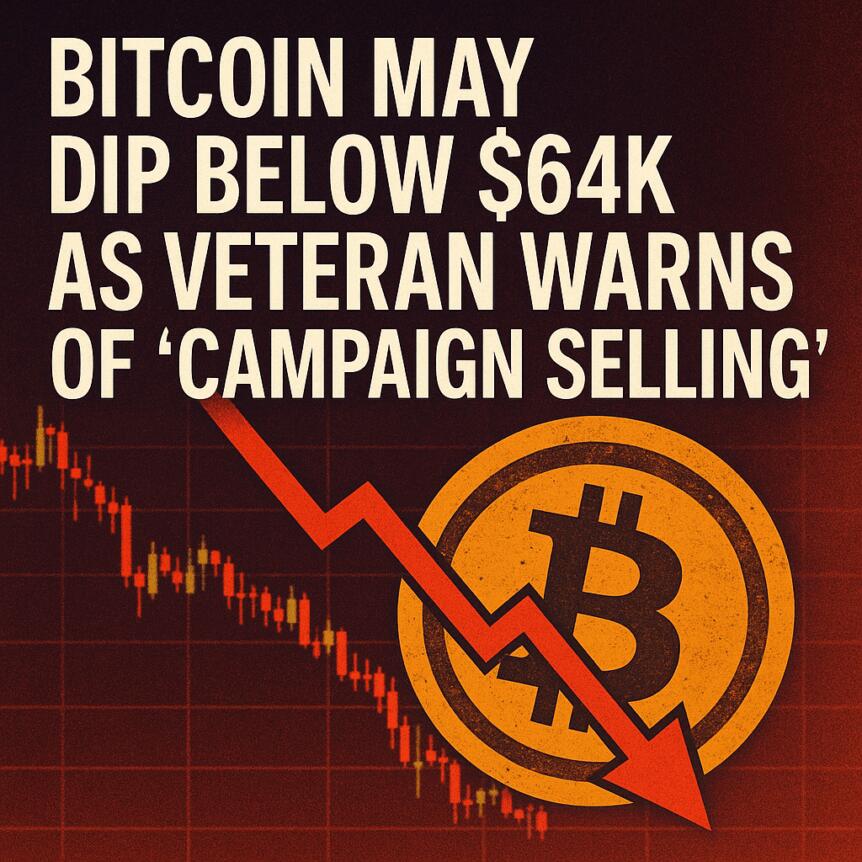
Bitcoin (CRYPTO: BTC) extended its pullback, slipping more than 22.5% over the past week to hover around $69,000 as traders weigh supply and demand dynamics. The retreat follows a period in which miners and US spot BTC ETFs trimmed exposure, adding modest selling pressure to an already fragile downtrend. The market has shown little appetite for a rebound, underscoring how thin liquidity and cautious sentiment can magnify losses in a risk-off environment. On-chain data and fund flows paint a nuanced picture: distribution signals from large holders sit alongside episodes of fading demand, complicating bets on a swift recovery.
Key takeaways
- Campaign selling by institutions, particularly miner-related activity and ETF exposure reductions, is pressing BTC lower rather than providing a floor.
- A potential bottom zone remains visible in the $54,600–$55,000 area, but confirmation requires sustained demand and stabilizing on-chain metrics.
- On-chain data shows miners shifting toward net distribution, signaling that fresh supply is hitting the market as January closes.
- Bitcoin spot ETF balances have declined to about 1.27 million BTC, echoing cooled institutional exposure and a potential headwind for price recovery.
- Market indicators, including the Coinbase premium, have retreated to yearly lows, suggesting waning institutional interest in this phase of the cycle.
Tickers mentioned: $BTC
Sentiment: Bearish
Price impact: Negative. The combination of ongoing distribution by miners and reduced ETF exposure signals further near-term downside risk.
Trading idea (Not Financial Advice): Hold. The current setup implies caution until there are clearer signs of demand and a firmer base forming around key support zones.
Market context: The BTC move unfolds amid a broader risk-off environment and evolving ETF flows that continue to influence spot prices. With liquidity patterns tightening and macro uncertainty lingering, price action remains highly data-dependent, with on-chain signals and fund flows providing mixed signals about when a durable bottom might form.
Why it matters
The ongoing pressure on Bitcoin highlights how interlinked the crypto market has become with macro liquidity and institutional participation. As miners and spot ETFs pull back, the supply-demand balance tilts toward hodlers and short-term traders, potentially elevating the risk of sharper moves if selling accelerates. The situation underscores the importance of on-chain dynamics—especially miner behavior and exchange balances—in gauging how much selling pressure the market can absorb before a meaningful rebound takes hold. For participants watching risk, the dynamics around BTC’s supply chain—miner distributions and ETF outflows—remain a critical lens for assessing whether the market is merely digesting a correction or entering a more extended phase of weakness.
From a technical perspective, several indicators point to a challenging landscape ahead. Veteran analyst Peter L. Brandt has highlighted what he describes as “campaign selling”—a deliberate, sustained distribution by large institutions rather than a reflexive, retail-led decline. The observation aligns with an impairment of bid strength as price trends lower highs and lower lows. While this framing does not guarantee further downside, it does suggest that the near term could remain precarious absent a meaningful change in buying interest or a reinterpretation of macro catalysts. The price path toward potential targets, such as the bear-flag scenario around the $63,800 level and the broader zone near mid-$50,000s, remains a focal point for traders watching for a possible inflection.
On-chain temperature checks reinforce the sense of a market in flux. Data indicate that miners have shifted from a net accumulation posture to distribution in January, sending BTC toward exchanges. Such movements can amplify selling pressure if capitulation accelerates or if external demand does not step in to absorb the newly minted supply. This dynamic dovetails with the retreat in the Coinbase premium, a gauge closely watched for institutional appetite; the premium slipping to yearly lows implies that institutions may be pulling back from aggressive entry points that previously provided steadying support. The mix of on-chain distribution and weakened exchange inflows contributes to a narrative in which BTC could spend additional time testing support levels rather than staging a rapid rebound.
Two additional threads bear watching. First, the official balance of Bitcoin held by spot ETFs has continued to drift lower, with total BTC under management dipping to about 1.27 million as of the latest reads. Second, some analysts point to a possible longer-horizon accumulation window that could materialize later in the cycle—potentially around mid-2026—driven by timing dynamics in credit spreads and historical lag effects between price bottoms and accumulation phases. These lines of inquiry do not imply an imminent rally, but they offer a framework for understanding where and when demand might re-enter with more conviction. For context, historical analysis has surfaced instances where price convergences toward accumulation bands signaled times of capitulation followed by assertive recoveries, albeit on longer horizons than immediate, intraday moves.
Looking back, the market has shown that the path from capitulation to accumulation can be gradual. In 2022, for instance, BTC dipped into a zone near $20,000 before a bottom formed and a subsequent rally pushed prices higher in the following year. The current cadence—sliding into a zone around $54.6K as an accumulation signal emerges—has prompted some to suggest that the asset is nearing a decisive juncture: the point at which sellers exhaust and buyers begin to re-enter, setting the stage for a more sustained recovery if macro conditions improve and institutional participation returns.
As one analyst put it, the convergence toward a band signaling the start of the accumulation phase around $54.6K could indicate we are transitioning from capitulation to accumulation. Such a reading does not guarantee a reversal on the immediate horizon, but it frames a potential pause in the downtrend and a setup for a more deliberate, value-oriented accumulation once conditions improve. The broader framework also includes a comparative timing signal that some researchers say could push a renewed cycle of accumulation toward mid-2026, a view anchored in widening credit spreads and other macro timing data. Taken together, the signals suggest that investors should monitor rather than chase, awaiting more robust evidence of demand and a firmer foundation beneath prices.
Ultimately, the market’s sensitivity to institutional flows and on-chain movements means BTC’s fate remains tethered to the behavior of large players and the health of the broader liquidity environment. While there is recognition of potential relief points—whether from a stabilization around the $55k zone or a delayed uptick in ETFs’ appetite—the current configuration favors caution. For traders, the narrative remains one of careful risk management, waiting for clearer catalysts that could flip the narrative from bear to bull—or at least reduce the downside risk to a more manageable level.
What to watch next
- Watch BTC price behavior around the $54,600–$55,000 support zone for signs of accumulation or further breakdown.
- Monitor miner activity and distribution trends as January closes, weighing any shift back toward net accumulation against ongoing selling pressure.
- Track US spot BTC ETF balances for continued outflows or stabilization that could influence price direction.
- Observe the Coinbase premium and other institutional indicators for renewed appetite from large buyers.
- Follow commentary and data on the potential mid-2026 accumulation window linked to credit-spread timing and macro liquidity cycles.
Sources & verification
- Peter L. Brandt’s commentary on “campaign selling” and its implications for price structure (as discussed on X).
- On-chain signals showing miner net position change shifting toward distribution in January (Glassnode data).
- Bitcoin ETF balances and trends indicating reduced exposure among spot ETFs.
- Coinbase premium readings signaling shifts in institutional demand.
- Analyses projecting a potential accumulation window around mid-2026 based on credit-stress timing data.
Market reaction and near-term risks for BTC
Bitcoin (CRYPTO: BTC) faced a renewed test of support as miners and spot ETFs reduced their BTC exposure, intensifying near-term supply pressure in a market already sensitive to liquidity and macro cues. The price moving through the mid-to-lower $60k range would not be surprising if current distribution persists, particularly given a backdrop of subdued buying interest from institutions and cautious sentiment among traders. The bear-case scenario identified by technical observers centers on a continuation toward the bear-flag target around $63,800, a level that could become a catalyst for new momentum if sellers accumulate pressure without a compelling counterparty bid. Conversely, a stabilization near $55,000 could pave the way for a measured recovery if institutional demand returns and miners slow their distribution cycles.
In this context, the on-chain picture remains a critical barometer. Miners’ net position changes have shifted to a net outflow pattern in January, suggesting that fresh BTC supply is entering the market at a pace that could sustain pressure on prices near key supports. This dynamic aligns with a decline in spot ETF balances and a cooling of the Coinbase premium, both of which imply that institutional demand has yet to reassert itself with vigor. For traders, the combination of persistent distribution signals and softening buy-side signals means the price could hinge on the next wave of macro and liquidity catalysts—the kind of inputs that often determine whether a market tests lower supports or finds a foothold for a multi-week bounce.
At the same time, several analysts point to potential longer-term inflection opportunities. A subset of commentary highlights the possibility of an accumulation window emerging after mid-2026, tied to timing patterns around widening credit spreads and the historical cadence of BTC market bottoms. While such forecasts are inherently probabilistic, they offer a framework for considering how a cycle may pivot from capitulation to accumulation, even if the timing remains uncertain. For now, the dominant narrative remains one of vigilance: a phase in which buyers must demonstrate conviction and where the absence of a clear catalyst keeps risk balanced on the knife-edge between a renewed rally and a deeper drawdown.
https://platform.twitter.com/widgets.js
Bitcoin risks a deeper slide as miners and US spot ETFs cut BTC exposure, adding supply pressure during a fragile downtrend.
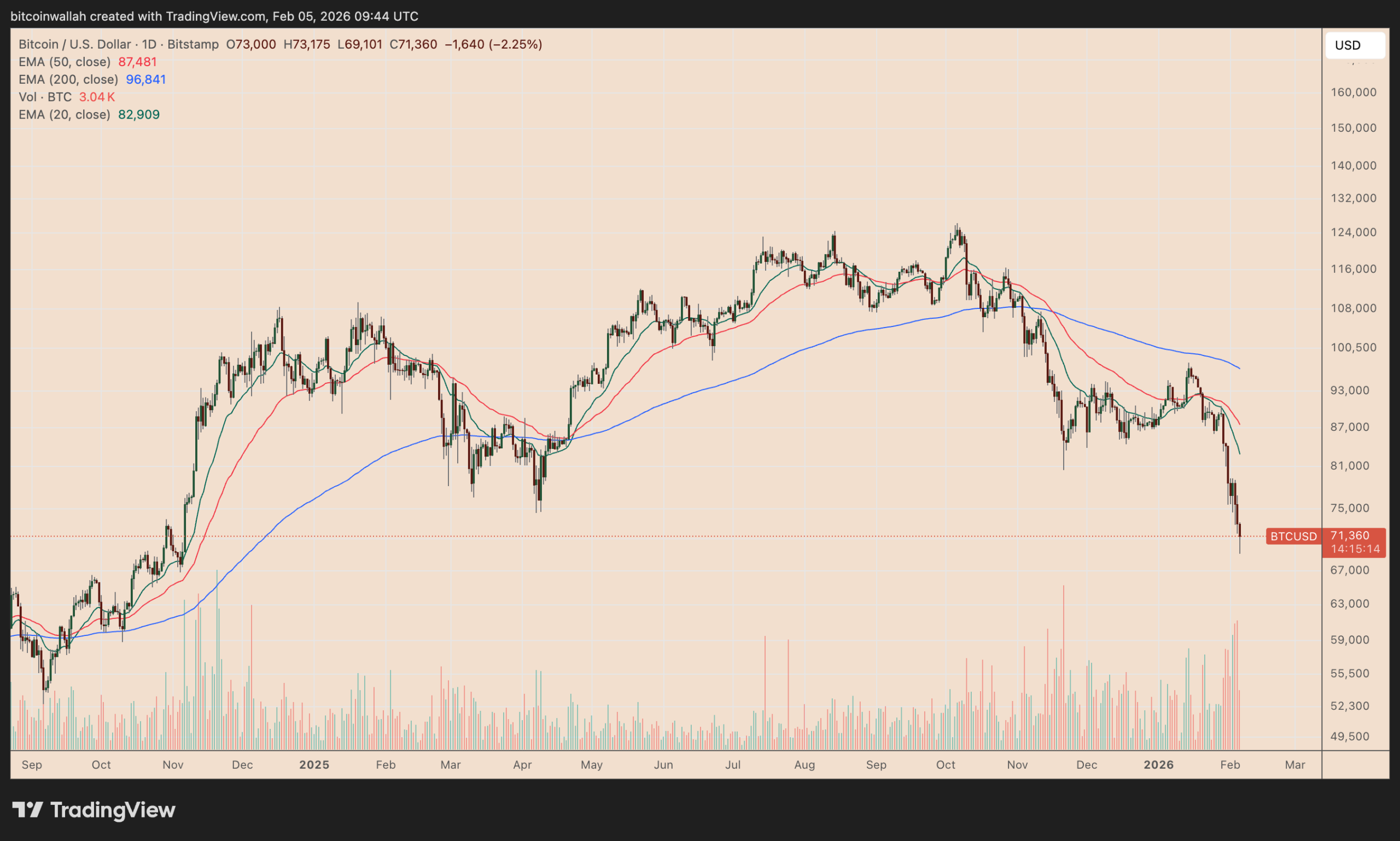
Bitcoin (BTC) price dropped by more than 22.5% in the past week to $69,000 on Thursday, wiping out 15 months of gains entirely. However, the downtrend may not be over, according to veteran trader Peter Brandt.
Key takeaways:
-
Brandt says “campaign selling” is pressuring BTC, with miners and ETFs also cutting exposure.
-
A potential bottom zone is near $54,600–$55,000.

Bitcoin may drop another 10% as miners, ETFs cut BTC exposure
BTC’s decline left behind a sequence of daily lower highs and lower lows. Simply put, the lack of even modest rebounds suggests few traders are stepping in to buy the dip, at least for now.
This structure, according to Brandt, had “fingerprints of campaign selling,” a deliberate, sustained distribution by large institutions, not retail liquidation.

Onchain data supports Brandt’s outlook. For instance, as of Thursday, the BTC miner net position change metric was showing a clear shift into net distribution throughout January, with miners consistently sending more BTC to the market.

US spot Bitcoin ETFs also reduced their exposure, with net BTC balances falling to 1.27 million BTC as of Wednesday from 1.29 million at the beginning of the year.
Related: Bhutan makes second Bitcoin transfer in a week, worth $22M
The Coinbase premium, a barometer linked to institutional interest, also fell to yearly lows.

This distribution boosted Bitcoin’s chances of reaching its bear flag target of around $63,800, down 10% from current levels, as shown below, based on Brandt’s technical setup.

Bitcoin may bottom below $55,000
Bitcoin risks a deeper drop toward $54,600 amid continued institutional selling, according to onchain analyst GugaOnChain.
The downside target is aligned with the lower zone (red) highlighted in the BTC DCA Signal Cycle metric below. This zone reflects Bitcoin’s one-week to one-month realized price and helps identify periods when BTC is structurally undervalued.

In 2022, the signal turned bullish as BTC fell below the same red zone near $20,000, forming a bottom around the level, before rallying to over $30,000 a year later.
GugaOnChain said:
“The current price convergence toward the band signaling the start of the accumulation phase, situated around $54.6K, suggests we are in the critical transition between Capitulation and Accumulation.”
Meanwhile, another analysis highlights a potential accumulation window emerging after July 2026, based on historical lag effects between widening credit spreads and Bitcoin market bottoms.
This article does not contain investment advice or recommendations. Every investment and trading move involves risk, and readers should conduct their own research when making a decision. While we strive to provide accurate and timely information, Cointelegraph does not guarantee the accuracy, completeness, or reliability of any information in this article. This article may contain forward-looking statements that are subject to risks and uncertainties. Cointelegraph will not be liable for any loss or damage arising from your reliance on this information.

“Speed and compliance beat ambition alone.” Investors who act on that truth win. Picture a crypto neo bank that plugs into Poland’s payment fabric, issues virtual IBANs and cards, settles cross-border payroll in stablecoins, and provides custody-grade controls investors can audit in real time. This is practical, not hypothetical. It is a repeatable deployment that converts frequent payment flows into predictable revenue and institutional margin.
For serious investors, the criteria are tight: prove custody safety, guarantee instant liquidity, and demonstrate regulator-ready compliance. If those boxes are checked, scaling follows; if not, growth stalls. White label Banking-as-a-service (BaaS) model combines hardened BaaS infrastructure, threshold key custody, and automated KYT so you capture speed without regulatory compromise. Opportunity windows close fast. Expect measurable KPIs and audit-ready evidence from day one.
Let’s scroll through the blog to know in detail.
Why is Poland Strategically Attractive Right Now?
Poland’s payments infrastructure is exceptionally modern. Instant rails and local schemes drive very high transaction frequency, creating a fertile environment for an integrated crypto-fiat product that sits beside existing behavior and improves margins for merchants and corporates. Recent regulatory clarity across Europe introduces a harmonized rulebook for crypto assets, reducing regulatory uncertainty for licensed providers. At the same time, demand for seamless fiat-on and off-ramps, corporate treasury efficiency, and lower cross-border friction creates a commercial runway for crypto-friendly neo banking solutions. These structural elements combined deliver both an attractive top line and predictable regulatory paths for institutional-grade services.
What Pain Points Does a Crypto Neo Bank Solve in Poland?
- Costly cross-border business payments and remittances, especially for SMEs with EU and non-EU suppliers. Stablecoin rails reduce time and FX slippage and open new settlement patterns.
- Fragmented on/off ramps. Consumers and merchants juggle centralized exchanges, separate wallets, and traditional bank accounts. An integrated account that tokenizes settlement and offers instant conversion removes friction.
- Inefficient corporate treasury for companies paying international contractors. Crypto-native treasury offers options for FX hedging and programmable payroll.
- Poor merchant acceptance paths for crypto receipts. Many merchants want exposure to crypto settlement but need instant conversion to PLN. A neo bank with native conversion fixes this.
- Trust and custody concerns among institutional counterparties. A regulated custody and compliance stack is table stakes for enterprise adoption. These are solvable with best-practice custody and a compliant CASP model.
Top-Notch Reasons to Launch a White Label Neo Bank App in Poland Now
- Digitally mature payments ecosystem- Poland’s widespread adoption of instant payments and digital banking reduces adoption friction and accelerates transaction volumes from day one.
- Regulatory clarity at the EU level- A defined compliance framework provides predictability for investors, lowers regulatory uncertainty, and supports structured market entry.
- High-value, enterprise-driven demand- SMEs, cross-border businesses, and merchants actively seek faster settlement, efficient treasury management, and seamless fiat-crypto interoperability.
- Attractive and diversified revenue model- Multiple monetization layers, including interchange, conversion fees, custody services, treasury subscriptions, and enterprise APIs improve margin resilience.
- Strong unit economics potential- High transaction frequency, lower customer education costs, and enterprise-led onboarding shorten CAC payback periods.
- Rapid go-to-market feasibility- Mature fintech infrastructure and availability of BaaS, BIN, and PSP partnerships significantly compress launch timelines.
- Scalability beyond Poland- A Poland-first strategy enables structured expansion across the EU using a single compliance and product framework.
- Growing institutional interest in Web3 infrastructure- Increasing demand for regulated crypto banking solutions positions early movers for long-term strategic advantage.
- Clear strategic exit pathways- Regulated neo-banking and crypto infrastructure assets remain attractive acquisition targets for banks, fintechs, and payment platforms.
Make sure that you hire the best white label neo bank development company globally that holds years of experience and expertise in designing business-tailored solutions along with legal and regulatory assistance.
How to Deploy Your Crypto Neo Bank With White-Label BaaS in 1 Week?
This must not sound so realistic to you, but launching an impactful white-label crypto neo banking platform is a realistic task for an experienced company, but a conditioned one too. One week is feasible as a minimum viable commercial deployment if three prerequisites are met in advance. First, a preapproved suite of partners must be in place. Second, compliance artifacts must be ready for the target customer profile. Third, the white-label BaaS must be truly modular with production-grade connectors. If those conditions exist, you can go live with a limited product set in seven days. Here is a practical day-by-day playbook.
Day 1: Provision core accounts and sandbox APIs
• Provision the tenant in the BaaS platform.
• Configure product catalog: e-wallet, virtual card, fiat wallet, crypto wallet.
• Route test BINs and IBAN ranges, and create webhooks for events.
Day 2: Integrate identity and compliance flows
• Wire KYC/KYB flows into onboarding.
• Configure AML/KYT thresholds and alerting.
• Set KYT rules for on-chain and fiat monitoring.
Day 3: Custody and liquidity setup
• Connect to custodial key management or MPC node.
• Wire liquidity provider for instant conversion between crypto and PLN.
• Sanity test settlement loops.
Day 4: Card issuance and payment rails
• Configure BIN sponsor for virtual cards and enable BLIK/SEPA rails.
• Run end-to-end card lifecycle tests.
Day 5: UX polish, risk rules, and enterprise onboarding
• Finalize frontend flows and onboarding.
• Implement throttles and risk rules for high-value transactions.
Day 6: Compliance signoff and sandbox transactions
• Execute a full test cycle for compliance reporting and audit trails.
• Load test critical flows.
Day 7: Soft launch with invited customers
• Onboard pilot SMEs and retail cohort.
• Monitor metrics and iterate immediately.
Architecture & Tech Stack Investors Must Demand
- Modular customized BaaS software core with multi-tenant isolation and secure multi-cloud deployment.
- Custody layer with MPC and institutional-grade key management, BLS or threshold signatures, and auditable signer logs.
- A compliance layer that merges on-chain KYT and fiat AML telemetry into a single risk engine.
- Payments layer with BIN orchestration, card lifecycle management, IBAN issuance, and local scheme adapters like BLIK.
- Liquidity and settlement layer with automated market making or liquidity pools for instant fiat conversion.
- Observability and audit trail stack with immutable logging, transaction reconstruction, and regulatory reporting exports.
- Upgradeable smart contract modules and off-chain reconciliations respecting MiCA reporting expectations.
Rolling Out Crypto Neo-Banking in Poland with White-Label BaaS
How Can a Blockchain Company Deliver a Customized BaaS App in a Short Time?
A credible white label BaaS service provider will present prebuilt connectors to KYC, BIN, IBAN, custody, and liquidity partners; a template-driven UI kit; a compliance module with configurable rules; and hardened APIs for enterprise integration. Critical differentiators include white box compliance for investor due diligence, turnkey custody certificates and SOC reports, and documented latency SLAs for settlement. For enterprise adoption, the provider must supply SDKs, sandbox keys, and a preconfigured regulatory evidence pack ready for KNF and other supervisors. Investors should insist on runbooks, incident response, and a roadmap for issuing CASP/CASP filings where required.
Legal & Compliance Support To Expect From a White-Label BaaS Partner
- Regulatory clarity from day one- Clear mapping of your crypto neo-banking model against EU and Polish regulatory requirements, avoiding ambiguity or rework later.
- Licensing and registration guidance- End-to-end support for CASP or VASP readiness, including scope definition, documentation, and regulator-ready submissions.
- Built-in AML and transaction monitoring- Configured AML and KYT frameworks covering both fiat and on-chain transactions with real-time alerts and audit trails.
- Enterprise-grade KYC and KYB workflows- Seamless onboarding flows with configurable risk scoring aligned with Polish and EU expectations.
- Custody and asset protection compliance- A documented custody model with institutional controls, segregation of assets, and audit-ready evidence.
- Regulatory reporting and audit readiness- Automated compliance reports, immutable logs, and support during regulator or banking partner reviews.
- Data protection and privacy alignment- GDPR-compliant data handling, storage, and access controls embedded into the platform.
- Ongoing compliance support- Continuous updates for regulatory changes, policy refinement, and compliance health monitoring post-launch.
The Bottom Line
Poland is a market where modern payment rails, technical literacy, and regulatory convergence create a window to deploy a crypto neo bank that is both profitable and compliant. For investors, the opportunity is to own a differentiated payments and treasury platform that captures recurring, high-frequency flows and monetizes custody and enterprise services.
We bring the technical architecture, custody know-how, and regulatory playbooks necessary to execute. Our team has deep experience delivering production BaaS and crypto custody integrations, and we work closely with legal partners to map MiCA obligations and local procedural requirements so your deployment is defensible and auditable from day one. We will deliver a white label crypto neo bank app with a full compliance pack, a hardened custody solution, and commercial integrations so your capital can be deployed with confidence.
Frequently Asked Questions
01. What advantages does Poland’s payment infrastructure offer for crypto neo banks?
Poland’s modern payment infrastructure, characterized by instant rails and high transaction frequency, creates a favorable environment for integrated crypto-fiat products, enhancing margins for merchants and corporates while benefiting from recent regulatory clarity.
02. What key pain points does a crypto neo bank address for businesses in Poland?
A crypto neo bank solves issues such as costly cross-border payments, fragmented on/off ramps for consumers and merchants, inefficient corporate treasury management, and poor merchant acceptance paths for crypto receipts.
03. What are the essential criteria for investors in the crypto banking sector?
Investors require proof of custody safety, guaranteed instant liquidity, and demonstrated regulator-ready compliance to ensure scalability and avoid growth stalls in the crypto banking sector.


Brazil advances a bill to ban algorithmic stablecoins and force all domestic issuers to fully collateralize tokens, tightening rules in a market where stablecoins drive 90% of crypto flows.
Summary
- Bill 4.308/2024 would prohibit issuance or trading of uncollateralized, code-based stablecoins and introduce prison terms of up to eight years for minting unbacked tokens.
- Foreign issuers like USDT and USDC would need Brazilian authorization, while local exchanges must verify comparable compliance standards or assume direct risk responsibility.
- The proposal, still subject to further committee and Senate approvals, could force algorithmic projects to redesign or exit a market processing $6b–$8b in monthly crypto volume.
Brazil’s Congress has fired a clear warning shot at uncollateralized stablecoins, advancing a bill that would effectively outlaw algorithmic designs such as Ethena’s USDe and Frax in one of crypto’s busiest markets.
Brazil inches closer towards stablecoin outlawing
Bill 4.308/2024, approved this week by the Science, Technology, and Innovation Committee, “prohibits the issuance or trading of stablecoins … which aim to maintain their value through code rather than collateral,” tightening the definition of what can legally pass as a fiat‑pegged asset in Brazil. Under the proposal, all stablecoins issued domestically must be “fully backed by segregated reserve assets,” with lawmakers creating a new criminal offense for minting unbacked tokens that carries penalties of up to eight years in prison and reframes such issuance as financial fraud.
The move comes after global scrutiny of unbacked models following Terra’s 2022 collapse and amid explosive local demand for dollar‑linked tokens. Data from Brazil’s tax authority show that stablecoins already drive roughly 90% of the country’s reported crypto transaction volumes, cementing their role as the main on‑ramp for digital assets and cross‑border flows. That dominance has made Brazil a test case for regulators worldwide: earlier analysis from Chainalysis and local officials similarly highlighted that “over 90% of Brazilian crypto flows are now stablecoin‑related,” underscoring the systemic stakes.
Foreign issuers are firmly in the crosshairs. Under the bill, offshore stablecoins such as Tether’s USDT and Circle’s USDC could only be offered by entities authorized to operate in Brazil, while local exchanges would be required to verify that issuers comply with standards “similar to Brazil’s,” or else assume direct responsibility for risk management. That aligns with a broader policy push to tax and formalize crypto flows, including plans to subject stablecoin transactions to Brazil’s IOF financial operations tax and stricter reporting regimes.
The proposal still needs sign‑off from the Finance and Taxation and Constitution, Justice, and Citizenship committees before heading to the Senate, but the direction of travel is clear: Brazil is moving toward a fully collateralized, tightly supervised stablecoin stack. If passed, the law would force algorithmic projects to either abandon their core design or exit a market that processes between $6 billion and $8 billion in crypto volume every month, much of it now intermediated through stablecoins.
This regulatory pivot lands against a volatile market backdrop. Bitcoin (BTC) trades near $71,392, with a 24‑hour range between roughly $70,120 and $76,181 on about $94.1B in volume. Ethereum (ETH) changes hands around $2,114, after swinging between $2,080 and $2,294 over the past day on roughly $46.3B in turnover. Solana (SOL) sits close to $91.48, having traded between about $90.56 and $100.52 on more than $7.5B of volume as traders reassess risk across the complex.
Brazil’s tax authority and central bank have repeatedly flagged the dominance of stablecoins in local flows, with recent analyses and consultations detailing how new rules could reshape cross‑border payments, self‑custody, and foreign‑issued tokens.

TLDR
- Strategy stock dropped 5.7% to $125.66 Wednesday, tracking toward its lowest close since September 2024
- Canaccord Genuity maintained a Buy rating while cutting its price target from $474 to $185, a 60% reduction
- The company’s 713,502 Bitcoin holdings are valued at $53.6 billion as Bitcoin trades around $73,000
- Strategy’s premium to Bitcoin assets compressed to 1.06x from previous multiples exceeding 2x
- Analyst expects Bitcoin to rally 20% in 2026 and Strategy to reach a 1.25x valuation multiple
Strategy stock extended its losing streak Wednesday with a 5.7% decline to $125.66. The drop followed Canaccord Genuity’s decision to cut its price target by 60%.
The firm lowered its target from $474 to $185. Canaccord maintained its Buy rating despite the substantial reduction.
Strategy shares are down 72% since July. Wednesday’s decline put the stock on pace for its lowest close since September 9, 2024.
The price target cut reflects Bitcoin’s sharp decline. The cryptocurrency dropped to around $73,000 after hitting record highs above $126,000 in October.
Strategy holds 713,502 Bitcoins worth approximately $53.6 billion. The company’s average purchase price is $76,052 per coin.
Bitcoin Premium Evaporates
Strategy’s valuation premium has collapsed. The stock’s market-to-net-asset-value ratio now stands at 1.06. Investors previously paid more than 2x the value of Strategy’s Bitcoin holdings.
Bitcoin recently traded below Strategy’s average cost. This sparked worries about the company’s debt and dividend payments.
Canaccord analyst Joseph Vani dismissed those concerns. Strategy carries $8 billion in convertible debt against $53.6 billion in Bitcoin assets.
Vani said dividend payments on preferred stock can be funded through modest share sales. He described Strategy’s structure as built to survive a prolonged crypto downturn.
Bitcoin Rebound Expected
The analyst believes Bitcoin has been incorrectly treated as a risk asset. Vani argues it should trade as a store of value based on scarcity and verifiability.
“MSTR shares remain a bit of a lightning rod for media attention when BTC is weak,” Vani wrote. He suggested the business model was designed for market volatility.
Canaccord projects Bitcoin will rebound approximately 20% in 2026. The firm acknowledged uncertainty around timing the recovery.
Strategy won’t recapture its previous premium anytime soon. Canaccord expects shares to reach a 1.25x multiple relative to Bitcoin assets.
Strategy reports fourth-quarter earnings Thursday. The company will likely post an unrealized loss due to Bitcoin’s quarterly decline.
Vani emphasized Bitcoin’s outlook matters more than quarterly results. Strategy’s performance remains directly tied to cryptocurrency prices.
The company pioneered the digital-asset treasury strategy. Strategy issues equity and debt to accumulate Bitcoin holdings.
Bitcoin hit its lowest point in over a year Tuesday. The cryptocurrency’s weakness has pressured Strategy stock throughout the downturn.
Canaccord believes Bitcoin’s sell-off may be nearing an end. The firm sees the cryptocurrency as undervalued at current levels.
Strategy’s convertible debt remains manageable relative to its Bitcoin position. The company’s holdings provide substantial coverage for its obligations.
Is BTC headed for a crash to $25,000?
Bitcoin (BTC) has experienced a steep decline over the past weeks, mirroring the broader crypto market crash.
According to some analysts and experts, the situation could worsen for bulls in the short term, with the price at risk of falling below $60,000.
Fasten Your Belts
Just recently, the leading cryptocurrency tumbled below $70,000 for the first time since November 2024. As of press time, it trades at around $69,300, down 21% over the past week alone.
The renowned analyst Ali Martinez suggested that the bears might be just stepping in. He reminded that since 2015, every time BTC has lost the 100-week simple moving average (SMA), it has failed to reclaim it in time and continued toward the 200-week SMA. According to his chart, the price could drop to as low as $57,600. Prior to that, Martinez claimed that the next key support levels for BTC after the drop under $77,086 are $60,176 and $47,824.
The trader, using the X handle Hardy, also recently made a pessimistic prediction. They envisioned a massive decline in the coming months, with the bottom set at roughly $30,000.
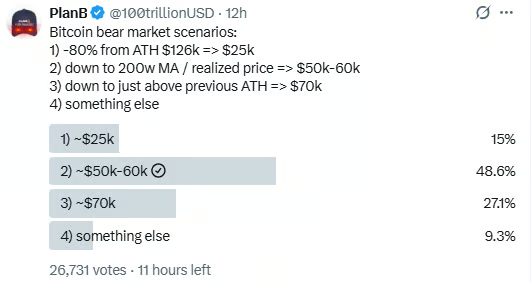
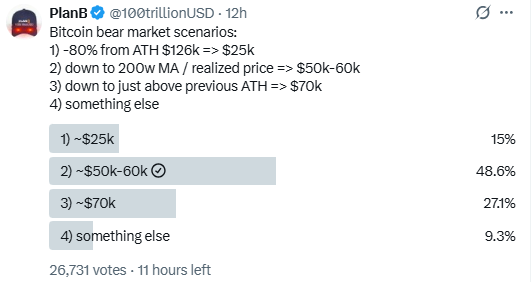
Meanwhile, PlanB (the anonymous creator of the Stock-to-Flow (S2F) model) believes several scenarios are possible, including a collapse to $25,000 and a retreat to $50,000- $60,000. The analyst took it to X to ask the followers for their take on the matter. Nearly half of the participants think a plunge to $50K-$60K is the most plausible option, while only 15% see the valuation nosediving to $25K.
Recent investor behavior supports the bearish thesis. According to data from CryptoQuant, the amount of BTC held on exchanges has been rising over the past few weeks. This suggests that many market participants have moved their holdings from self-custody to centralized platforms, typically interpreted as a pre-sale step.
You may also like:

Is It Really Over?
While BTC’s current condition may appear weak, several indicators suggest a potential rebound ahead. The Relative Strength Index (RSI) measures the speed and magnitude of recent price changes.
It ranges from 0 to 100, and anything below 30 means that the asset is oversold and due for a potential resurgence. On the contrary, ratios above 70 are considered bearish territory. As of this writing, the RSI stands at roughly 19.

SECRET PARTNERSHIP BONUS for CryptoPotato readers: Use this link to register and unlock $1,500 in exclusive BingX Exchange rewards (limited time offer).


- Tron (TRX) outperforms Bitcoin (BTC) despite recent market volatility.
- Tron Inc. keeps accumulating TRX, boosting token support.
- Key resistance for Tron sits at $0.2846 while the immediate support is at $0.2758.
Of late, Tron (TRX) has demonstrated remarkable resilience in the volatile cryptocurrency market.
Despite overall market weakness, TRX has outperformed Bitcoin over the past few weeks.
The token has only seen a modest decline of around 2.3% in the past 24 hours, compared to Bitcoin’s sharper drop of 7.3%.
At press time, TRX traded at approximately $0.2797, maintaining a stable position within its 24-hour range of $0.2799 to $0.2868.
This strong performance is closely linked to the continued accumulation strategy by Tron Inc., the company behind the TRX ecosystem.
Tron Inc.’s strategic TRX purchases
Tron Inc., a Nasdaq-listed firm focused on crypto treasury strategies, has been actively increasing its TRX holdings in recent months.
The company’s treasury currently holds nearly 680 million TRX tokens after recent purchases amounting to around 175,000 TRX (worth approximately $49,000).
Notably, Justin Sun, the founder of Tron, has publicly endorsed the company’s buy-the-dip strategy, encouraging continued accumulation.
Tron Inc.’s approach mirrors strategies seen in other corporate crypto treasuries, such as MicroStrategy’s Bitcoin holdings.
By holding TRX as a core asset, Tron Inc. signals long-term confidence in the token and the broader Tron ecosystem.
The accumulation also serves as a stabilizing factor, providing underlying support to TRX during periods of market volatility.
TRX technical outlook and the key levels to watch
From a technical perspective, TRX faces important resistance and support levels.
The first major resistance, according to analysts, is at $0.2846, which, if broken, could push the token toward $0.2944.
The third resistance level lies at $0.3012, offering a potential upside target for bullish traders.
On the downside, TRX must maintain support at $0.2758 to avoid further decline.
Technical indicators, however, signal a possible continuation of the current bearish trend with TRX currently below its 50-day and 200-day EMAs, reflecting short-term bearish momentum.
The MACD also remains on the negative side, and the RSI is hovering near 35, indicating persistent selling pressure.
A drop below this level could see the token fall to the next support near $0.2635.
However, the strong accumulation by Tron Inc. provides a stabilizing force, which could help the token recover and surpass resistance levels.
Market sentiment
Market sentiment for TRX remains cautiously optimistic.
Even though the token has slipped for several consecutive days, the accumulation trend suggests institutional confidence.
Derivatives data show negative funding rates, implying that traders are willing to pay to hold short positions.

Futures open interest has slightly declined, signaling reduced speculative activity.
This environment may allow TRX to consolidate before attempting another upward move.
Analysts suggest that maintaining above $0.2758 is critical for short-term momentum.
Breaking above $0.2846 could reignite bullish sentiment, while failure to hold support may trigger deeper corrections.
Overall, TRX’s relative outperformance against Bitcoin, combined with Tron Inc.’s treasury strategy, points to a token with strong institutional backing.

Manchester United give injury update on two players with one due back soon
Earnings call transcript: BNP Paribas Q4 2025 earnings beat expectations

Michael Saylor missed out on a $33 billion profit at Strategy


-

 Crypto World6 days ago
Smart energy pays enters the US market, targeting scalable financial infrastructure
-
 Crypto World7 days ago
Software stocks enter bear market on AI disruption fear with ServiceNow plunging 10%
-

 Politics6 days ago
Why is the NHS registering babies as ‘theybies’?
-
 Crypto World6 days ago
Adam Back says Liquid BTC is collateralized after dashboard problem
-

 Video3 days ago
When Money Enters #motivation #mindset #selfimprovement
-

 Fashion6 days ago
Weekend Open Thread – Corporette.com
-

 Tech1 day ago
Wikipedia volunteers spent years cataloging AI tells. Now there’s a plugin to avoid them.
-

 NewsBeat6 days ago
Donald Trump Criticises Keir Starmer Over China Discussions
-

 Politics3 days ago
Sky News Presenter Criticises Lord Mandelson As Greedy And Duplicitous
-

 Crypto World5 days ago
U.S. government enters partial shutdown, here’s how it impacts bitcoin and ether
-

 Sports5 days ago
Sinner battles Australian Open heat to enter last 16, injured Osaka pulls out
-
 Crypto World5 days ago
Bitcoin Drops Below $80K, But New Buyers are Entering the Market
-
 Crypto World3 days ago
Market Analysis: GBP/USD Retreats From Highs As EUR/GBP Enters Holding Pattern
-

 Crypto World6 days ago
KuCoin CEO on MiCA, Europe entering new era of compliance
-
Business6 days ago
Entergy declares quarterly dividend of $0.64 per share
-

 Sports3 days ago
Shannon Birchard enters Canadian curling history with sixth Scotties title
-

 NewsBeat3 hours ago
Still time to enter Bolton News’ Best Hairdresser 2026 competition
-

 NewsBeat2 days ago
US-brokered Russia-Ukraine talks are resuming this week
-

 NewsBeat3 days ago
GAME to close all standalone stores in the UK after it enters administration
-

 Crypto World2 days ago
Russia’s Largest Bitcoin Miner BitRiver Enters Bankruptcy Proceedings: Report