

Crypto World
is Patos token Solana’s Shiba Inu?


Disclosure: This article does not represent investment advice. The content and materials featured on this page are for educational purposes only.
A new Solana-based meme coin, Patos, is preparing for launch as traders increasingly shift attention from Ethereum to faster, lower-cost networks. The project aims to attract meme-coin liquidity by leveraging Solana’s speed, low fees, and native SPL integration.
This report analyzes the impending launch of Patos Meme Coin, a novel project set to disrupt the dominant paradigm within the cryptocurrency meme market. Built on the high-performance Solana blockchain, this initiative aims to attract capital moving away from the crowded Ethereum ecosystem, specifically targeting investors currently engaged with tokens like Pepe, Shiba Inu, and Dogecoin. By analyzing data on current ERC-20 meme coin performance, recent Solana-based successes like Bonk and Wen, and emerging market data on Solana whale movements, this analysis paints a bullish case for Patos.
The article explores how the project’s strategic deployment on Solana addresses the primary pain points for retail and institutional investors alike, namely Ethereum’s prohibitive gas fees. By leveraging Solana’s superior transaction speeds and minimal costs, Patos offers a frictionless alternative for a high-frequency trading strategy often associated with the speculative nature of meme coins. This analysis is crucial for any market participant monitoring capital flows between rival layer-one blockchains and seeking to capitalize on the next wave of meme coin volatility. Investors are advised to conduct thorough due diligence, as this report highlights both the potential rewards and the inherent risks associated with early-stage crypto assets.

New Kid on the Block: Patos Meme Coin Prepares to Shake Up the Meme Economy
Meme coins are a persistent fixture in the volatile world of crypto. Everyone is always looking for the next breakout star. Ethereum’s dominant ERC-20 tokens are facing new competition from Solana. A fresh contender, Patos Meme Coin, aims to be that next viral sensation. Here is what we know about this intriguing new project.
Leaving Ethereum Behind: The Solana Advantage for Meme Coins
For a long time, the Ethereum network was the undisputed home of meme coins. Iconic tokens like Dogecoin (DOGE) and Shiba Inu (SHIB) were originally ERC-20 assets before launching their own chains or Layer 2s. This created a strong network effect, making Ethereum the initial landing spot for almost all speculative liquidity.
However, a serious problem began to emerge during bull markets: exorbitant transaction fees. This issue became an insurmountable barrier for small-scale, high-frequency meme coin traders. Trading a $20 asset when gas fees cost $100 made no economic sense. This limitation hindered these coins’ ability to achieve truly rapid and widespread retail adoption.
This inefficiency provided a perfect entry point for Solana. This rival layer-one blockchain, built for speed and affordability, became an enticing alternative for developers and investors alike. Transactions that might take minutes and cost substantial sums on Ethereum are completed in milliseconds for a fraction of a cent on Solana.
The launch of successful meme coins like Bonk (BONK) and Wen (WEN) served as strong proof of concept for this new ecosystem. Traders, weary of high costs, flocked to these projects, generating massive daily volume. Patos Meme Coin has strategic plans to capitalize on this migration, establishing its entire ecosystem and future utility directly on the Solana network. This conscious choice allows the new token to side-step the cost and congestion issues that continue to plague its Ethereum counterparts.
Whale Watching: Institutional Interest and Strategic Investments
The cryptocurrency market is often heavily influenced by “whales.” These are investors holding massive quantities of a particular digital asset, capable of shifting prices with a single trade. Recently, blockchain data has revealed a significant and telling trend among these major crypto players.
Market intelligence consistently shows a pattern of capital rotation. High-net-worth individuals and investment funds are actively reallocating their assets, moving significant amounts of Ethereum from old ERC-20 giants to the more efficient Solana ecosystem. This shift suggests a professional interest in Solana’s superior scalability.
A noteworthy rumor is now circulating within deep crypto circles. A major investor, often identified as a “Solana Whale” due to their immense holdings of SOL, is purportedly conducting research into the Patos Meme Coin project.
While unconfirmed, the potential investment from such a significant player could validate the project’s ambition. It suggests that major capital allocators see genuine long-term value in this new venture. This potential interest from large-scale traders may create a significant advantage for the token at its launch, positioning it far ahead of its competitors.
The Mechanics of Momentum: How Token Presales Build Buzz
In the high-stakes world of meme coins, building and sustaining momentum is critical for long-term survival. The most successful projects don’t launch directly into an open market, risking instant volatility. Instead, they strategically utilize a structured token presale to establish a dedicated, community-driven foundation.
This approach offers several significant advantages for both the new project and its earliest participants. By selling tokens directly to the public before the official exchange listing, the team behind Patos Meme Coin can secure critical funding to support ongoing development, widespread marketing, and crucial liquidity on decentralized exchanges (DEXs).
For investors, participation in a presale often means securing tokens at the lowest possible entry price. This structure is strategically designed to attract early adopters who believe in the project’s potential. These early holders, often highly vocal advocates, become a key pillar of the project’s long-term success.
The Patos team has designed a tiered presale structure that progressively increases the token price across stages. This method is carefully crafted to reward the project’s earliest and most dedicated supporters. This strategic approach is crucial for generating the early interest and widespread hype that are essential for a new asset to capture significant mindshare and market share in the highly competitive meme coin landscape.
A New SPL Standard: Patos Aims for Superior Trading
One technical detail is paramount to Patos Meme Coin’s long-term strategy. The project has committed to launching its token as an SPL token, the native token standard of the Solana blockchain. This choice has profound implications for its future.
The integration with the Solana Program Library ensures native compatibility. Patos can be easily supported by the entire ecosystem of Solana wallets, explorers, and decentralized applications (dApps). This makes it far simpler to integrate into liquidity pools, yield farms, or new utility-driven products than cross-chain solutions.
This native integration simplifies trading dramatically. On Solana, investors can execute trades through highly efficient, liquid decentralized exchanges (DEXs). This streamlined experience contrasts sharply with the often-cumbersome process of swapping Ethereum tokens, which can involve complex approvals and high slippage on top of transaction fees.
By adhering to this standard, the Patos team is prioritizing future utility and accessibility. The goal is to build a coin that is not just speculative, but also fundamentally integrated into the burgeoning Solana economy. The project intends to offer superior trading capability, unmatched liquidity, and future use cases that go far beyond what many simple meme coins achieve.
Diversification Play: Why Meme Coin Traders are Looking Beyond Ethereum
Meme coin traders are rarely known for their long-term, passive-holding strategies. They are active, opportunistic, and constantly searching for the highest potential returns. This means they are highly attuned to emerging market cycles and new opportunities.
A strategic realization is now spreading among veteran market participants. Concentrating exclusively on a single network, such as Ethereum, can be incredibly risky during periods of high congestion. To maximize their returns, investors are actively diversifying their portfolios.
This new mindset naturally benefits projects like Patos. Experienced traders are moving capital into other ecosystems with strong fundamentals and booming activity. Solana, with its high-speed performance and dynamic community, is the primary beneficiary of this asset rotation.
The Patos project is carefully designed to attract this exact type of market player. The project offers these traders a fresh opportunity to participate in a viral asset class with significantly reduced technical friction. This makes it an appealing and pragmatic addition for any well-rounded crypto portfolio exploring the high-reward potential of meme coins.
Analyzing the Contenders: How Patos Stacks Up Against Pepe and Shiba Inu
When analyzing a new meme coin, it’s necessary to examine the existing competitive landscape. The ERC-20 tokens Pepe (PEPE) and Shiba Inu (SHIB) currently sit at the pinnacle of the meme economy, boasting massive followings. They are, essentially, the benchmarks against which all new projects are measured.
Pepe, for example, achieved its massive valuation through rapid, viral internet culture. This success was achieved despite the high transaction fees that frequently occurred during its peaks. This phenomenon demonstrated the pure, irrational power of community sentiment.
Similarly, Shiba Inu built an extremely loyal community of proponents known as the “ShibArmy.” This group championed the coin’s development of a native decentralized exchange and other ecosystem components.
The strategy behind Patos Meme Coin appears to be to leverage the strengths of both models while avoiding their primary weakness. By launching on Solana, Patos intends to cultivate the same fervent, organic community engagement while also offering a practical, cost-effective trading platform. The aim is to prove that high-speed, minimal-cost transactions can accelerate community growth more effectively than any ERC-20 network.

From Hype to Utility: The Long-Term Plan for Patos
The initial success of any meme coin is almost always fueled by speculation, community engagement, and a good narrative. However, sustaining that interest over months or years is an entirely different challenge. Longevity in the crypto space requires practical utility.
A persistent criticism of tokens like Dogecoin has been their lack of tangible real-world application. The Patos team is aiming to proactively address this critical point by outlining a long-term roadmap that goes beyond the initial launch phase.
The whitepaper for Patos outlines planned expansions and partnerships that are intended to give the token a genuine purpose. These proposed use cases include potential integrations into future gaming initiatives, NFT staking systems, and even exclusive access to unique physical merchandise.
The plan is to leverage the unique advantages of the Solana network—such as its low costs—to make microtransactions, rewards, and in-game items economically feasible. By integrating the token into functional applications early in its life cycle, Patos aspires to transition from a purely speculative meme coin into a resilient utility asset within the Solana ecosystem.
Risks and Rewards: A Balanced View of the Meme Coin Market
It is absolutely essential for every investor, from absolute beginners to professional funds, to understand that the meme coin market is an inherently high-risk, speculative environment. These assets are incredibly volatile, with prices that can fluctuate dramatically in very short periods.
Investing in a new project, especially one still in its presale phase, like Patos Meme Coin, carries unique risks. The success of any new cryptocurrency depends on countless factors, from achieving widespread adoption to the simple execution of a technological roadmap. Any participant must approach these investments with extreme caution.
The primary lure of this sector is, of course, the potential for staggering returns. Meme coins, when successful, have demonstrated the ability to generate unparalleled profits for their early backers, often yielding returns that are simply impossible in traditional equity or commodity markets.
A prudent approach is paramount. This requires thorough research, a deep understanding of the project’s fundamentals, and a clear comprehension of the potential pitfalls. Investors are strongly advised to commit only capital they can afford to lose and to carefully manage their risk exposure in highly speculative markets like cryptocurrency.
Community and Culture: The Essential Recipe for Viral Success
In the decentralized world of cryptocurrency, the strength and dedication of a project’s community are arguably more important than its underlying code or technological breakthroughs. Without a passionate group of advocates, a new asset is simply code on a ledger.
The entire team behind Patos Meme Coin is acutely aware of this fundamental principle. This realization has shaped their entire strategy, placing a paramount focus on building a robust, engaged, and authentic community from day one. This effort is already visible in their organic growth across various social media platforms.
The project is actively encouraging user participation. This strategy extends beyond simple token ownership and involves fostering a creative culture of meme sharing, community-driven content, and active participation in decentralized governance decisions.
By emphasizing transparency and authentic engagement, the project aims to build an inclusive ecosystem where every holder feels a deep sense of shared ownership and purpose. This focus on building a sustainable culture may prove crucial for maintaining momentum and ensuring the project’s resilience in an incredibly crowded market.
Cross-chain to Solana for a generational SPL token
The impending launch of Patos Meme Coin marks another potential milestone for the rapidly maturing Solana ecosystem. By prioritizing efficiency, affordability, and community above all else, the new project represents a direct and potent challenge to the established order of the Ethereum-based meme coin market. This unique value proposition may prove highly effective.
Whether this new initiative can truly capture the viral imagination and replicate the staggering success of its predecessors remains to be seen. However, its arrival is yet another undeniable signal that the meme coin economy is rapidly evolving, with capital and attention continuing to flow toward high-performance, cost-effective networks. Market participants would be wise to continue to monitor these developments closely.
Disclosure: This content is provided by a third party. Neither crypto.news nor the author of this article endorses any product mentioned on this page. Users should conduct their own research before taking any action related to the company.


TLDR
- AVAX One Technology completed a repurchase of 2,423,383 shares as part of its $40 million buyback initiative
- Stock currently valued at $0.76 per share, representing a 95% decline from its 52-week peak of $22.50; buyback program approved November 2025
- Company CEO Jolie Kahn believes current share price significantly undervalues the firm’s net asset holdings
- AVAX One functions as a publicly accessible Avalanche blockchain treasury vehicle, concentrating on AVAX token acquisition and yield generation
- Firm simultaneously deployed its inaugural public validator node within the Avalanche ecosystem
AVAX One Technology Ltd. has completed a significant share repurchase transaction, acquiring more than 2.4 million of its outstanding shares based on management’s conviction that the market is significantly undervaluing the company.
The Florida-based firm, headquartered in West Palm Beach, executed the transaction under a $40 million share repurchase authorization initially greenlit in November 2025.
Shares are presently trading at $0.76, marking a dramatic 95% plunge from the 52-week peak of $22.50.
According to CEO Jolie Kahn, the company strategically acquired shares when market pricing fell beneath the firm’s calculated net asset value. “We believe our shares remain materially undervalued relative to the strength of our operating platform and the long-term opportunity ahead for the Avalanche blockchain,” she stated.
Kahn characterized the share acquisitions as “opportunistic,” indicating management capitalized on perceived pricing inefficiencies between market valuation and intrinsic worth.
AVAX One operates as a publicly accessible investment vehicle centered on the Avalanche blockchain ecosystem. The company positions itself as the inaugural publicly traded treasury dedicated to Avalanche.
Its core business model involves accumulating and maintaining positions in the Avalanche native token, AVAX, while simultaneously generating returns through various yield strategies. Management’s primary objective centers on expanding AVAX holdings on a per-share basis.
How the Buyback Works
The entire repurchase was executed via open market purchases. The company maintains flexibility regarding purchase volumes and retains the ability to modify or terminate the initiative based on evolving circumstances.
Additional share acquisitions remain contingent upon prevailing market dynamics, capital allocation priorities, and applicable regulatory frameworks.
Financial analysis from InvestingPro highlights concerns that the firm is “quickly burning through cash.” The company’s current ratio stands at 0.69, indicating that near-term liabilities exceed readily available liquid resources.
Validator Node and Broader Strategy
Concurrent with the buyback announcement, AVAX One unveiled its inaugural public validator node on the Avalanche network. This infrastructure component contributes to Avalanche’s consensus protocol and enables delegators to participate in staking at minimal thresholds, while the company generates income through delegation fee arrangements.
The firm also submitted a Form 8-K filing accompanied by a prospectus supplement related to its active registration statement on Form S-3.
AVAX One’s leadership team comprises veterans from institutional finance and capital markets sectors. The organization seeks to provide conventional investors with a regulated avenue for gaining exposure to Avalanche blockchain opportunities through strategic treasury operations and potential acquisitions.
Kahn emphasized that leadership remains “focused on investing in AVAX accumulation and yield opportunities to maximize AVAX per share and create durable shareholder value.”
Both the validator infrastructure deployment and the share repurchase program align with the company’s broader strategic roadmap to diversify revenue channels and strengthen its financial foundation.

TLDR
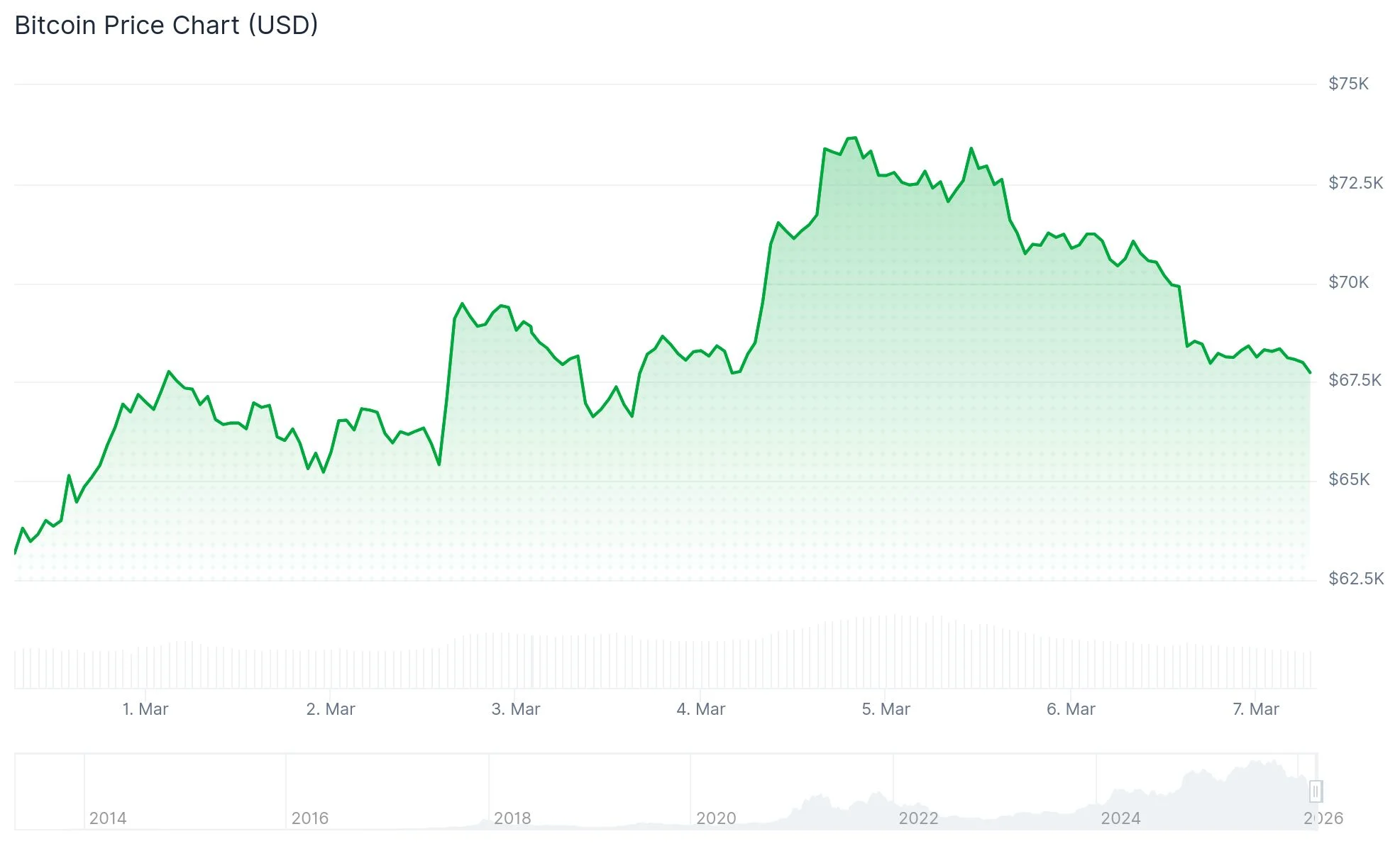
- BTC experienced a 3.4% decline to approximately $68,000 on Saturday following a mid-week peak at $74,000
- February employment data revealed a loss of 92,000 jobs, with unemployment climbing to 4.4%
- The greenback recorded its most significant weekly rally in twelve months, weighing on digital assets
- Large holders liquidated approximately 66% of their recent Bitcoin accumulation as retail continued buying
- Bitcoin ETFs experienced $348.9 million in redemptions — the highest single-day exodus in three weeks
Bitcoin’s weekly trajectory began on an optimistic note but concluded with significant headwinds. After reaching $74,000 on Thursday, BTC reversed course dramatically, sliding back to approximately $68,000 by Saturday morning — representing a 3.4% decline over 24 hours.
The downturn followed disappointing employment figures from the Bureau of Labor Statistics, which revealed the U.S. economy shed 92,000 jobs in February. This stark contrast to economists’ projections of a 50,000 job increase caught markets off guard. Meanwhile, the unemployment rate ticked upward from 4.3% to 4.4%.
Equity markets absorbed the shock as well. The Dow Jones Industrial Average plummeted over 900 points in early Friday trading. The Nasdaq Composite declined 1.7%.
The broader cryptocurrency market mirrored Bitcoin’s weakness. Ethereum declined 4.4% to $1,974. Solana shed 4% to reach $84.31. Dogecoin retreated 2.9% to $0.09. XRP decreased 2.2% to $1.37.
Despite Friday’s selloff, most leading digital assets maintained weekly gains. Bitcoin advanced 3.6% over the seven-day period. Ethereum posted a 2.6% increase. BNB climbed 2.1%.
Whale Selling and ETF Outflows
Analytics from Santiment revealed that large holders — addresses containing between 10 and 10,000 BTC — accumulated positions from February 23 through March 3 while Bitcoin traded in the $62,900 to $69,600 range. As BTC surged beyond $70,000 and reached $74,000, these same addresses offloaded approximately 66% of their recent accumulation.
Meanwhile, smaller investors — wallets holding less than 0.01 BTC — continued accumulating. Santiment indicated this divergence typically signals additional downside ahead.
Spot Bitcoin ETFs registered $348.9 million in net redemptions on Friday, marking the most substantial single-day withdrawal since February 12.
Crypto analyst Michael van de Poppe warned: “If Bitcoin doesn’t find support in this $67–68K region, then we’re likely going to retest the lows.”
Macro Headwinds
The U.S. dollar experienced its strongest weekly advance in a year. Climbing oil prices — with Brent crude reaching $90 per barrel, a surge exceeding 20% over the week — combined with persistent Middle East tensions amplified inflation concerns, diminishing expectations for imminent Federal Reserve interest rate reductions.
Glassnode analytics indicated that 43% of Bitcoin’s circulating supply currently sits underwater. This underwater supply generates selling pressure during price rallies as holders attempt to achieve breakeven.
A potential silver lining emerged: net stablecoin inflows surged 415% to $1.7 billion throughout the week, indicating substantial capital waiting on the sidelines.
Economist Timothy Peterson observed that Bitcoin’s present price range has historically represented a floor, citing a 99.5% statistical probability that BTC maintains levels above $60,000.
The Crypto Fear & Greed Index dropped to a reading of 12 on Saturday, firmly entrenched in “Extreme Fear” territory.
Crypto World
Coinbase Prime Unveils Cross-Margin Trading and CFTC-Regulated Futures for Institutions
Key Highlights
- Coinbase Prime introduces unified cross-margin capability spanning spot and derivatives markets for institutional traders
- Institutions gain round-the-clock access to over 20 futures and perpetual products through the company’s CFTC-regulated division
- Cross-margin functionality enables traders to utilize one collateral pool for multiple positions rather than maintaining isolated accounts
- This development advances Coinbase’s objective to establish itself as a comprehensive prime brokerage provider for institutional crypto participants
- The exchange recently completed its acquisition of Deribit to incorporate options trading into its institutional product lineup
Coinbase Prime, serving as the institutional division of America’s premier crypto exchange, has introduced unified cross-margin capabilities alongside regulated futures products spanning its spot and derivatives offerings. The announcement came on Friday, March 6, 2026.
The enhanced features operate through Coinbase Financial Markets, the organization’s Futures Commission Merchant that maintains regulatory oversight from the Commodity Futures Trading Commission. Institutional participants now enjoy continuous market access to over 20 futures instruments.
The deployment encompasses perpetual-style futures instruments delivered via Coinbase Derivatives. The platform broadened its perpetuals portfolio in the latter part of last year amid intensifying competition among crypto venues for derivatives trading volume.
Derivatives trading represents approximately 70% to 75% of aggregate crypto market volume, based on data from Kraken’s Head of Derivatives.
The cross-margin functionality stands as the centerpiece of this product launch. Previously, institutional participants needed to maintain distinct collateral reserves for spot versus futures activity, coupled with separate risk management frameworks.
The newly implemented unified architecture permits traders to deploy their complete account equity as pooled collateral spanning all trading positions. Spot holdings and futures exposure now receive combined evaluation within an integrated portfolio structure.
This proves particularly valuable for basis trading strategies, where market participants simultaneously maintain long spot exposure paired with short futures positions. The previous infrastructure demanded independent collateral for each component.
Understanding the Risk Framework
Coinbase indicates its infrastructure employs a deterministic risk framework. This approach allows institutions to project margin obligations prior to trade execution, eliminating post-trade surprises.
This represents a departure from what Coinbase describes as “opaque margin engines,” which only disclose margin costs following order submission. The modification provides trading operations enhanced oversight regarding position construction and capital allocation.
Client holdings reside with Coinbase’s NYDFS-regulated qualified custodian. Futures operations execute through the CFTC-regulated division, maintaining all transactions within compliant frameworks.
Coinbase reports custodying approximately 12% of total cryptocurrency market capitalization. Rival institutional prime brokerage providers include FalconX, BitGo, and Digital Currency Group.
Expanding Institutional Infrastructure at Coinbase
Coinbase has systematically developed its comprehensive prime brokerage infrastructure throughout the previous year. The organization markets itself as the “Everything Exchange,” terminology introduced in 2025 alongside announcements regarding expansion into equities, tokenization, and prediction markets.
Coinbase launched stock trading nationwide last month.
The firm additionally completed its purchase of Deribit, characterized as the globe’s premier crypto options marketplace. Through the Deribit integration, Coinbase intends to enable institutions to execute spot, futures, perpetuals, and options trades within a single unified environment.
Rick Schonberg, serving as Coinbase’s Global Head of Product for Trading and Clearing, stated that Prime was “designed so institutions no longer have to self-assemble their trading infrastructure.”
Crypto World
Ethereum (ETH) Price Analysis: Whale Buying Intensifies as Network Staking Demand Explodes
Key Highlights
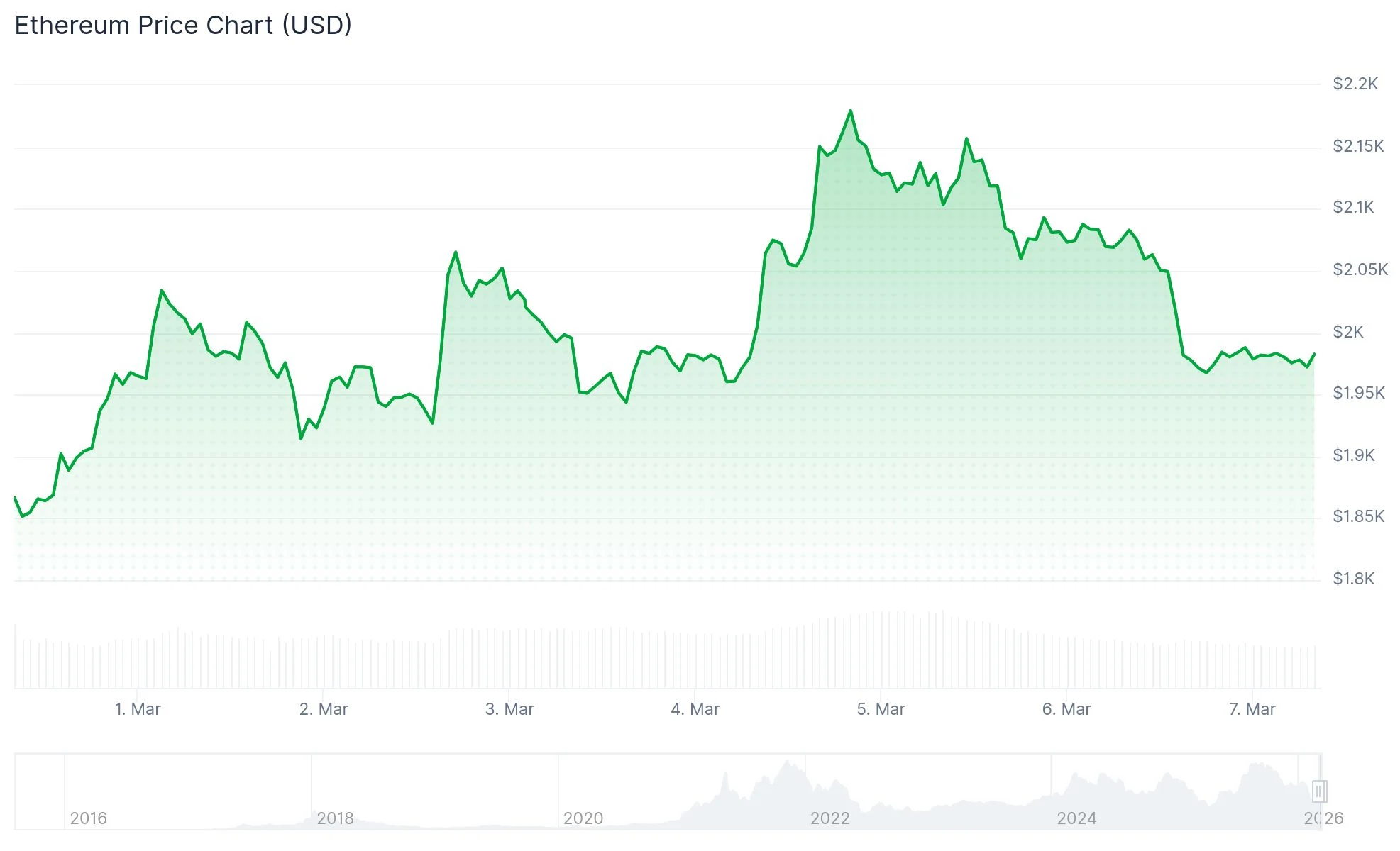
- ETH recovered from $1,830 lows to approach $2,200 before consolidating around the $2,000 zone
- Whale wallets and veteran holders continue accumulating at the current $2,000 support threshold
- Spot Ethereum ETFs in the United States experienced $90 million in net outflows over the past week
- The validator entry queue has exploded to 3.4 million ETH, a dramatic increase from 904,000 in early January
- Ethereum co-founder Vitalik Buterin unveiled the Minimmit proposal to streamline finality from two rounds to one
Ethereum’s recent price action has been marked by significant volatility. After dropping to approximately $1,830 in late February, the asset staged an impressive recovery, climbing to nearly $2,200. Following this rally, ETH has retraced and is currently consolidating around the psychologically important $2,000 threshold.
The $2,000 price point has emerged as a critical battleground. Blockchain analytics reveal that major wallet addresses have been accumulating during recent price weakness. Instead of distributing holdings, long-term market participants are increasing their positions. Futures market data indicates that derivatives traders maintain predominantly bullish positioning.
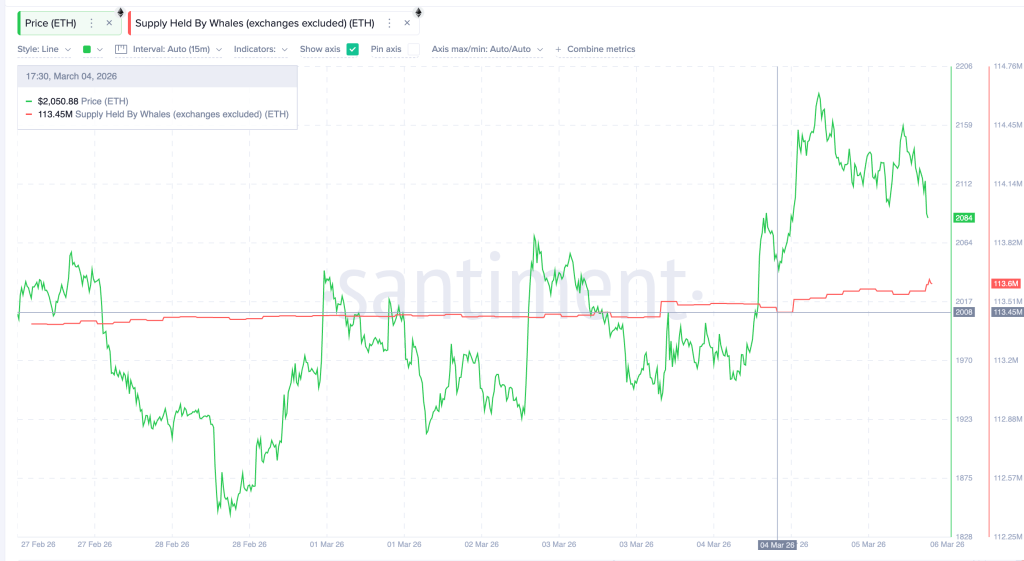
Analysis of cost-basis metrics reveals substantial ETH volume last changed hands near the $2,000 mark. This concentration suggests numerous investors have breakeven positions at current levels, creating a natural incentive to defend this price floor.
From a technical perspective, Ethereum is developing a converging wedge pattern. The asset attempted to breach $2,200 resistance but was rejected, establishing a lower peak. Meanwhile, an ascending support trendline continues to provide upside momentum. This compression pattern indicates an imminent breakout.
Should ETH successfully clear $2,200, technical analysts identify $2,400 and $2,750 as subsequent resistance targets. Conversely, a breakdown below $2,000 would likely expose support areas near $1,850 and $1,750.
Institutional ETF Withdrawals Create Headwinds
Spot Ethereum exchange-traded funds in the United States recorded $90 million in net withdrawals over the recent trading week. This outflow pattern suggests certain institutional participants are reducing their exposure. The capital exit has contributed to diminished near-term buying momentum.
The overall market sentiment remains measured. Macroeconomic uncertainties continue to influence investor behavior, with some large-scale market participants apparently trimming positions in anticipation of potential economic shifts.
Despite these challenges, Ethereum’s price has maintained its position above crucial long-term support levels. Bearish forces have been unable to trigger a more substantial downturn.
Technical indicators present a mixed picture. The Relative Strength Index currently sits at 49, indicating neutral momentum. The MACD remains in negative territory at -55.8. However, both the Commodity Channel Index and Stochastic Oscillator readings suggest building upward pressure.
Staking Demand Reaches Unprecedented Levels
Demand for Ethereum staking has accelerated dramatically. The validator activation queue has ballooned to 3.4 million ETH, representing a substantial increase from approximately 904,000 ETH recorded in early January. Current estimates place the waiting period at roughly 60 days.
Corporate entities and cryptocurrency exchanges are increasingly choosing to stake their ETH holdings rather than liquidate them. Market observers note that institutional players are prioritizing yield generation over keeping assets dormant.
In parallel developments, Vitalik Buterin introduced a significant proposal to enhance Ethereum’s consensus mechanism. The Minimmit proposal aims to replace the existing two-round Casper FFG finality protocol with a more efficient single-round alternative.
This architectural change involves important compromises. While fault tolerance would decrease from 33% to 17%, Buterin contends that censorship resistance would improve, and the threshold required to finalize invalid chain history would increase from 67% to 83% of staked ETH.
This modification represents one component of Ethereum’s comprehensive development strategy to reduce slot times from the current 12 seconds to potentially 2 seconds, while achieving single-digit second finality.
Ethereum is presently trading around $2,000, representing a significant decline from its previous cycle peak near $4,900.

A US federal judge has dismissed a civil lawsuit seeking to hold cryptocurrency exchange Binance and its founder Changpeng Zhao responsible for transactions allegedly linked to terrorist organizations involved in dozens of attacks worldwide.
Key Takeaways:
- A US federal judge dismissed a lawsuit accusing Binance and Changpeng Zhao of enabling crypto transactions tied to terrorist attacks.
- The court ruled that plaintiffs failed to show Binance intentionally supported or was directly linked to the alleged attacks.
- Plaintiffs may amend and refile the complaint despite the case being dismissed.
In a decision issued March 6, US District Judge Jeannette Vargas in Manhattan ruled that the plaintiffs failed to establish a credible connection between Binance and the attacks, according to a report by Reuters.
The lawsuit was filed by 535 plaintiffs, including victims and family members of victims, who claimed that digital asset transactions conducted through the exchange supported violent operations carried out between 2017 and 2024.
Plaintiffs Accuse Binance of Enabling Crypto Transfers Tied to 64 Attacks
The complaint alleged that several groups designated as foreign terrorist organizations, including Hamas, Hezbollah, Iran’s Revolutionary Guard, Islamic State, Kataib Hezbollah, Palestinian Islamic Jihad and Al-Qaeda, used cryptocurrency transactions facilitated through Binance to move funds connected to at least 64 attacks.
According to the filing, hundreds of millions of dollars in crypto transactions were allegedly processed through accounts associated with these groups.
The plaintiffs also argued that billions of dollars in trading activity with Iranian users indirectly benefited groups linked to the attacks.
Judge Vargas concluded that the allegations did not demonstrate that Binance or Zhao intentionally supported the operations.
In her ruling, she stated that the plaintiffs had not plausibly shown the defendants “culpably associated themselves with these terrorist attacks” or acted in a way that helped bring them about.
The judge added that the connection between the exchange and the alleged actors appeared limited to standard customer relationships.
False news is temporary. — CZ
Truth always comes with time. 
Adding some logic here. There are absolutely zero (0) motive for any CEX to have anything to do with terrorists. I imagine they don't actively trade (no fee revenue). They may try to deposit and then immediately withdraw… https://t.co/dOe8WjsySw
 BNB (@cz_binance) March 7, 2026
According to the ruling, the groups or their affiliates simply held accounts and conducted transactions on Binance in what the court described as an “arms’ length relationship.”
Vargas also criticized the scale of the lawsuit, noting that the complaint stretched across 891 pages and included more than 3,100 paragraphs.
Despite the seriousness of the accusations, she described the filing as unnecessarily lengthy.
The court allowed the plaintiffs the opportunity to revise and refile their complaint.
In court filings, Binance and Zhao rejected the accusations and reiterated their condemnation of terrorism. Zhao also argued that the lawsuit attempted to capitalize on the exchange’s earlier legal troubles.
Binance reached a settlement with US authorities in November 2023, agreeing to pay $4.32 billion in penalties after pleading guilty to violations involving anti-money-laundering and sanctions laws.
Binance Denies Iranian Sanctions Violations in Response to US Senate Probe
On Friday, Binance rejected allegations that it violated Iranian sanctions in a letter responding to an inquiry from US Senator Richard Blumenthal.
The probe followed a Wall Street Journal report claiming the platform processed roughly $1.7 billion in transactions linked to Iranian entities and sanctions-evasion activity connected to Russia.
In its response, Binance called the reporting “false” and unsupported by credible evidence. The exchange said it takes regulatory obligations seriously and disputed claims that it knowingly facilitated transactions tied to sanctioned parties.
Binance also stated that it investigated two Hong Kong-based partners mentioned in the report, Hexa Whale and Blessed Trust.
According to the company, internal reviews were launched after law enforcement inquiries, leading to the removal of Hexa Whale from the platform in August 2025 and Blessed Trust in January 2026 as part of its compliance process.
The post Binance, CZ Cleared in US Civil Suit Over Alleged Terror Financing appeared first on Cryptonews.
Florida lawmakers have approved a state-level framework regulating payment stablecoins, moving the legislation to Governor Ron DeSantis’ desk for final approval.
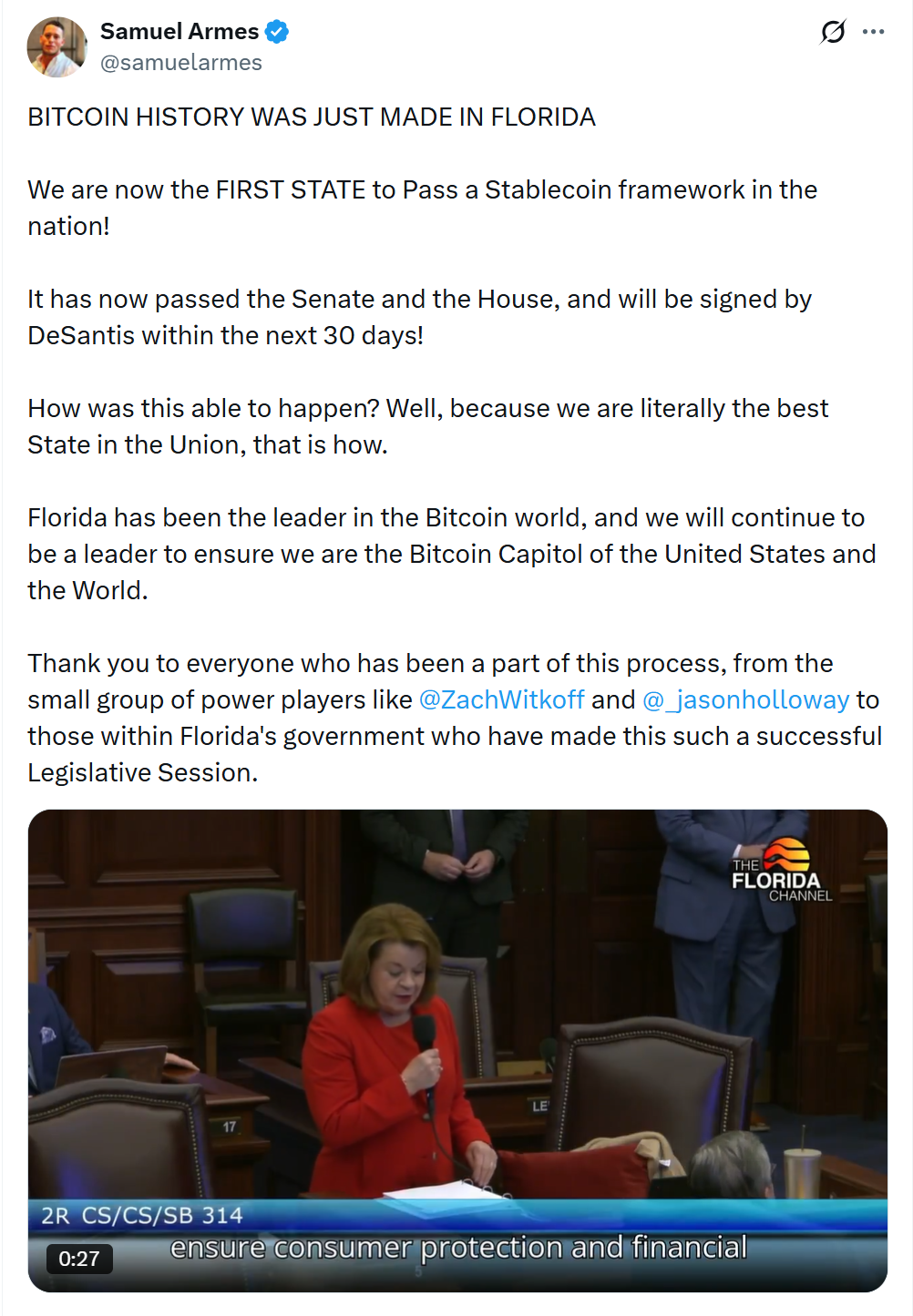
In a Friday post on X, Samuel Armes, founder of the Florida Blockchain Business Association, revealed that Senate Bill 314 has cleared the Florida Senate unanimously. The measure is set to become law once signed by DeSantis, which Armes expects within the next month.
“It has now passed the Senate and the House, and will be signed by DeSantis within the next 30 days!” he wrote on X.

The bill establishes regulatory guidelines for payment stablecoin issuers operating in Florida. Working alongside House Bill 175, the measure introduces consumer protection standards and financial oversight rules aligned with the federal GENIUS Act, which was signed into law in July.
Related: Florida narrows scope of revived Bitcoin reserve proposal for 2026
Florida bill amends money laundering law to include stablecoins
Under SB 314, Florida’s Control of Money Laundering in Money Services Business Act will be amended to explicitly include stablecoins. The update requires stablecoin issuers to comply with existing financial regulations while banning unlicensed issuance within the state. The legislation also clarifies that certain payment stablecoins will not be classified as securities.
Issuers based outside Florida must notify the state’s Office of Financial Regulation (OFR) before operating. Oversight will depend on the structure of the issuer. Some stablecoin operators will fall exclusively under the OFR, while others will face joint supervision alongside the Office of the Comptroller of the Currency.
The law also addresses potential risks tied to stablecoin incentives. Qualified issuers will be barred from paying interest or yield to holders if federal rules prohibit such payments.
Related: Trump sues JPMorgan in Florida court for $5B over debanking claims: Report
Florida revisits state crypto investment bill
In October last year, Florida lawmakers revived efforts to integrate cryptocurrencies into state investment strategies. The Florida House Bill 183, filed by Republican Representative Webster Barnaby, would allow the state and certain public entities to allocate up to 10% of their funds into digital assets. The revised proposal expands beyond Bitcoin (BTC) to include crypto exchange-traded products, crypto securities, non-fungible tokens and other blockchain-based assets.
HB 183 is a revised version of HB 487, which was withdrawn in June after failing to advance in a House operations subcommittee.
Magazine: Bitcoin may take 7 years to upgrade to post-quantum — BIP-360 co-author

Bitcoin has shown renewed volatility as buyers and sellers clash at key levels. Retail participants have been loading up after the price dipped below $70,000, while larger holders have been trimming positions. Over a period spanning Feb. 23 to Mar. 3, Bitcoin traded roughly between $62,900 and $69,600, underscoring the tug-of-war between accumulation by smaller wallets and profit-taking by whales. The latest moves come as the market tries to discern whether the correction is over or if another leg lower lies ahead, particularly after a brief rally that pushed the price toward $74,000 before retreating.
Key takeaways
- Retail demand increased as Bitcoin failed to sustain a break above $70,000, while large holders began to reduce their exposure after a sharp rally past $74,000.
- Whales, defined as wallets holding 10–10,000 BTC, reportedly accumulated heavily in late February into early March when the price moved in the $62,900–$69,600 range.
- From the Wednesday peak, these whales offloaded roughly 66% of their recent purchases, even as smaller holders continued to add to positions below 0.01 BTC.
- The Crypto Fear & Greed Index sank to 12, placing the market in “Extreme Fear” as the pullback intensified.
- Spot Bitcoin ETFs posted the largest outflow day in three weeks, with about $348.9 million sliding out of 11 products, signaling a shift in near-term demand dynamics.
Tickers mentioned: $BTC
Sentiment: Bearish
Price impact: Negative. Bitcoin traded around the mid-$60k range after peaking near $74k earlier in the week.
Trading idea (Not Financial Advice): Hold — watch for a clearer bid near key support zones before committing further risk).
Market context: The move comes amid a broader sell-off in risk assets and shifting ETF flows, with on-chain behavior showing growing retail interest while wholesale players trim exposure. The combination of real-time price action and fund outflows suggests sentiment remains cautious, even as some participants see value in recent pullbacks.
Why it matters
The paradox in today’s Bitcoin dynamics rests on diverging activity between retail and whale cohorts. Santiment highlighted that, after Bitcoin breached the $74,000 mark, “key stakeholders began taking profit,” a pattern that can precede further near-term weakness if demand does not re-emerge. The dataset shows that while smaller holders were accumulating, larger holders were actively realizing gains, a combination that can slow the pace of a sustained rally even when retail buyers persist.
From a price-structure perspective, the volatility has shifted the narrative from a straight-line ascent to a more cautious outlook. The market technicals are complicated by macro considerations, including risk-off sentiment and liquidity conditions that influence whether a deeper correction can be avoided. The latest price action—moving down from $74k and hovering in the low to mid-$60k zone—echoes a broader market that is trying to price in both the potential for a rebound and the risk that the lows might retest if demand falters. This is reinforced by the fear gauge in crypto markets, which dropped into Extreme Fear and reflects a broader uncertainty among participants about near-term direction.
On the ETF side, the data point of $348.9 million in net outflows across eleven spot Bitcoin ETF products marks the largest single-day drain in three weeks. The outflows could reflect profit-taking amid the pullback, but they also underscore that ETF-driven demand has not yet returned to the pace seen during prior uplegs. In a broader sense, the ETF flows are part of a larger mosaic—retail demand, institutional positioning, and on-chain behavior—that determines whether a low-risk entry point emerges or if the market faces another test of support around the $60k–$68k corridor.
Analysts have stressed that the pattern of rising retail accumulation while whales exit could signal that the correction isn’t fully complete. If demand from smaller investors remains resilient while large holders refrain from aggressive buying, Bitcoin could spend more time consolidating before the next leg higher. As Mn Trading Capital founder Michael van de Poppe noted in a subsequent post, a lack of support in the $67k–$68k region could lead to a renewed test of liquidity lows before buyers step in again. That view dovetails with the chart-level work some observers conduct to determine whether the market is forming a basin or merely pausing amid a broader downtrend.
The history of Bitcoin’s volatility also provides a frame for current conditions. After an all-time high near $126,000 in October, the price dipped to around $60,000 in February—a level some analysts consider a potential floor, though that assessment remains contested as new data flows in. The mix of lower price levels and risk-off currents creates an environment where both the narrative of value and the mechanics of supply-and-demand play critical roles in the next few weeks. The current data points—retail accumulation, whale distribution, ETF outflows, and the fear index—should be weighed together when evaluating potential trajectories for Bitcoin in the near term.
For market participants, the takeaway is that the market continues to reflect a balance of risk appetite and caution. The conditional nature of the moves—where strong on-chain demand from smaller buyers exists alongside prudence from larger holders—means that a decisive breakout or breakdown will likely require a fresh catalyst, whether it be macro news, regulatory signals, or a notable shift in ETF flows. Until then, traders will be watching price interaction around the $67k–$68k zone and the evolving sentiment indicators that accompany daily price changes.
What to watch next
- Monitor Bitcoin’s price behavior around the $67k–$68k support region; a break below could imply deeper liquidity testing.
- Track the ongoing flow of spot Bitcoin ETFs in upcoming reporting periods to gauge institutional demand resilience or fatigue.
- Observe the divergence between retail accumulation and whale distribution to assess whether the imbalance signals a longer bottom-building phase.
- Watch the Crypto Fear & Greed Index and related sentiment metrics for any reversal that might precede a price bounce.
Sources & verification
- Santiment: analysis noting wholesale profit-taking at $74k and heavy accumulation by whales between Feb. 23 and Mar. 3.
- CoinMarketCap price data referenced for current price context.
- Crypto Fear & Greed Index data source used to frame sentiment movement.
- Michael van de Poppe’s public commentary on price support in the $67k–$68k zone.
- Farside ETF flow data, outlining the $348.9 million net outflows across 11 spot Bitcoin ETF products.
Bitcoin (CRYPTO: BTC) market dynamics and potential path forward
Bitcoin (CRYPTO: BTC) has once again proven that market direction hinges on a combination of on-chain activity, macro risk sentiment, and fund flows. The latest sequence—retail accumulation even as whales take profits, followed by a price retreat from a $74k high—underscores the complexity of pricing in a market where multiple participant types pursue different time horizons. The data from Santiment points to a tactical pattern that, if repeated, could foretell continued volatility in the near term. On the other hand, ETF outflows remind market watchers that demand from traditional vehicles remains a critical swing factor that can either accelerate a rebound or extend the correction depending on how flows align with price action. The next few weeks will likely hinge on whether the $67k–$68k band provides a durable foundation or if liquidity tests push the price toward the next set of support levels, potentially revisiting the sub-$60k region if demand falters.
Bitcoin’s current trajectory remains a reading of market mood as much as a function of technical levels. Traders will want to align price action with the evolving narratives around risk appetite, regulatory signals, and the appetite of institutional players for exposure to a volatile asset class. The ongoing tension between retail demand and wholesale posture will continue to shape the path of least resistance for Bitcoin in the near term, even as the longer-term thesis remains intact for those who view the asset as a hedge against inflation and a flexible store of value in a volatile macro landscape.
Sources and verification: Santiment report on this week’s market dynamics; CoinMarketCap price data; Crypto Fear & Greed Index page; Michael van de Poppe’s X post; Farside ETF flow data.


The local regulator said the two exchanges have been offering trading services without the necessary approval.
The Virtual Asset Regulatory Authority (VARA), which is the main watchdog for cryptocurrency-related businesses in Dubai, has issued a formal cease and desist order to KuCoin and MEXC.
The regulator argued that it had come to its attention that the popular trading platforms “may be providing Virtual Asset activities to Dubai residents without the necessary regulatory approvals and misrepresenting” their legal statuses.
Aside from the cease and desist issued to all unlicensed VA activities, the official statement on KuCoin reads that investors and consumers must be aware of the potential risks.
“Engaging with unlicensed companies that are not in compliance with VARA Regulations, associated Rulebooks, and relevant UAE legislation exposes users to significant financial risks and potential legal consequences for violating regulatory requirements or criminal laws.”
It reasserted that KuCoin does not hold any license to provide crypto services in or from Dubai, which means that all such activities advertised or conducted by the exchange were “therefore in breach of the VARA Regulations.”
Dubai’s VARA introduced the comprehensive regulatory framework four years ago and requires all service providers to be licensed to operate legally in the jurisdiction.
A day before this notice against KuCoin, the regulator issued a similar alert against one of its competitors – MEXC. The message was identical, instructing a cease and desist order on all of its activities in and from Dubai.
Binance Free $600 (CryptoPotato Exclusive): Use this link to register a new account and receive $600 exclusive welcome offer on Binance (full details).
LIMITED OFFER for CryptoPotato readers at Bybit: Use this link to register and open a $500 FREE position on any coin!
TLDR:
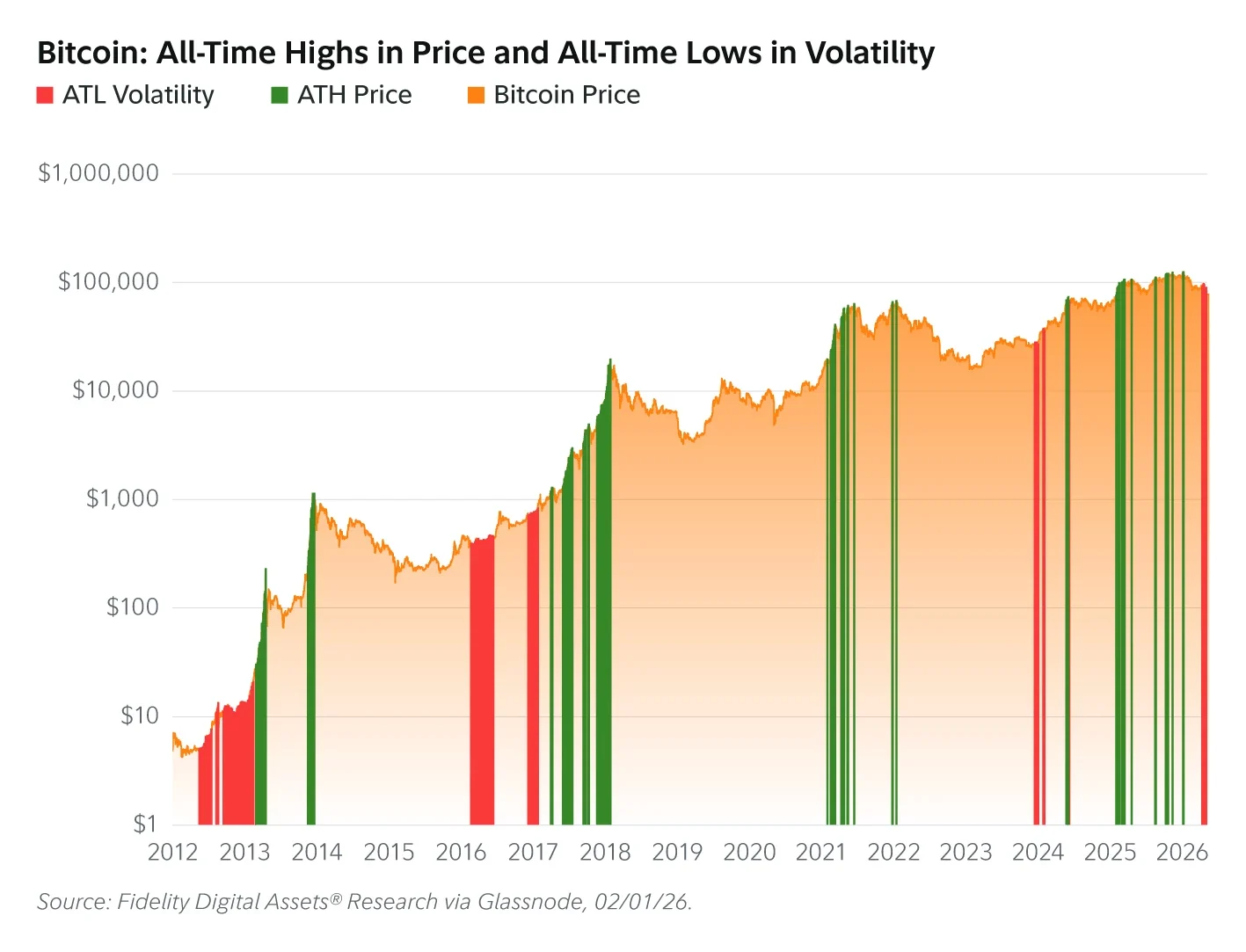
- Fidelity data shows Bitcoin volatility hitting record lows even months after the 2025 price peak near $126,000.
- Public companies and ETFs now hold nearly 12% of Bitcoin supply, signaling major institutional accumulation.
- Bitcoin’s MVRV ratio has stayed near 2x realized value this cycle, far below peaks seen in past bull markets.
- Fidelity’s profit-to-volatility ratio has remained above 0.015 since 2023, marking the longest stability period.
Bitcoin’s market behavior may be entering a new phase, according to recent research from Fidelity Digital Assets.
The firm argues that long-standing boom-and-bust cycles could weaken as institutional demand reshapes the market. Data shows volatility hitting record lows even months after Bitcoin reached new price highs.
The question now is whether the classic four-year Bitcoin cycle still defines the crypto market.
Bitcoin Volatility Trends Challenge the Classic Four-Year Cycle
Bitcoin reached a market capitalization near $2.5 trillion during its October 2025 peak. Prices climbed above $126,000 during that rally.
However, volatility moved in the opposite direction. One-year realized volatility recorded 17 new all-time lows in January 2026.
According to Fidelity Digital Assets research, this pattern differs sharply from previous cycles. Historically, volatility surged as Bitcoin approached market peaks.
The current trend suggests a shift toward a larger and more liquid market. Fidelity compared Bitcoin’s growth to large-cap technology companies reaching maturity.
The firm notes that Bitcoin’s market size has expanded rapidly across cycles. The asset is now twice as large as its 2021 peak valuation.
It also stands nearly ten times larger than the 2017 cycle peak. Compared with 2013, Bitcoin’s market capitalization has expanded more than 200-fold.
Fidelity’s data shows volatility began declining in late 2023. At the time, Bitcoin traded near $27,000 before starting its latest rally.
Institutional Demand Reshapes Bitcoin Market Structure
Demand patterns have changed significantly as institutions enter the market. Public companies and exchange-traded products now hold a growing share of supply.
According to Fidelity Digital Assets, 49 public companies hold more than 1,000 Bitcoin each. Combined holdings exceed one million BTC.
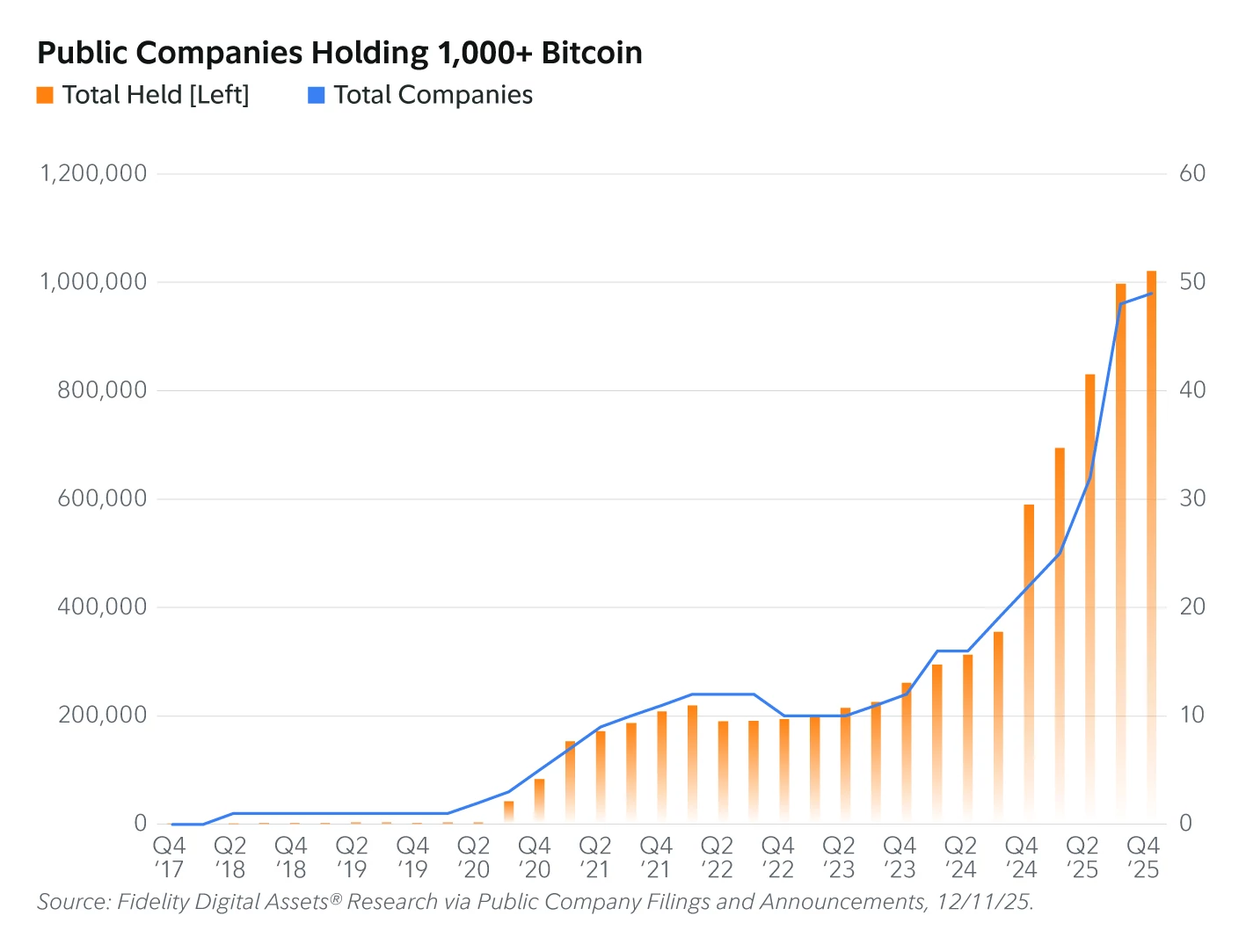
That amount represents more than five percent of Bitcoin’s circulating supply. The cohort has steadily increased holdings since early 2020.
Exchange-traded products have accelerated institutional accumulation. Spot Bitcoin ETPs launched in the United States in January 2024.
By January 2026, those vehicles collectively held nearly 1.3 million Bitcoin. This equals roughly 6.4 percent of the circulating supply.
Fidelity reported that the leading Bitcoin ETF surpassed $75 billion in assets within two years. Gold’s GLD ETF required almost seven years to reach that milestone.
On-chain metrics also suggest a calmer market cycle. Bitcoin’s market value to realized value ratio has remained near two throughout the current bull market.
Earlier cycles saw sharper expansions. The ratio reached six during 2013 and four during both the 2017 and 2021 cycles.
Fidelity estimates that reaching a ratio of four again would imply a $4.5 trillion Bitcoin market cap. That level corresponds to roughly $225,000 per coin.
The firm also introduced a “Profit to Volatility Ratio” metric. It compares profitable addresses with realized volatility.
That ratio has remained above 0.015 since late 2023. Fidelity describes this period as the longest stretch of stability in Bitcoin’s history.
TLDR:
- Claude Opus 4.6 found 22 Firefox bugs in 2 weeks, 14 flagged high-severity by Mozilla researchers.
- The 14 high-severity finds equal nearly a fifth of all such Firefox bugs Mozilla fixed in 2025.
- Claude succeeded in building working exploits in only 2 of several hundred automated attempts.
- Anthropic spent roughly $4,000 in API credits testing Claude’s exploit development capabilities.
Anthropic’s Claude Opus 4.6 identified 22 security vulnerabilities inside Firefox in just two weeks. Fourteen of those bugs were classified as high-severity by Mozilla. That figure represents nearly a fifth of all high-severity Firefox flaws remediated throughout 2025.
The findings emerged from a structured research partnership between Anthropic and Mozilla.
Claude AI Uncovers High-Severity Firefox Bugs at Record Speed
The collaboration began as an internal model evaluation.
Anthropic wanted a harder benchmark after Claude Opus 4.5 nearly solved CyberGym, a known security reproduction test. Engineers built a dataset of prior Firefox CVEs and tested whether the model could reproduce them.
Claude Opus 4.6 replicated a high percentage of those historical vulnerabilities. That raised a concern: some CVEs may already have existed in Claude’s training data.
Anthropic then redirected the effort toward finding entirely new bugs in the current Firefox release.
Within twenty minutes of beginning exploration, Claude flagged a Use After Free vulnerability inside Firefox’s JavaScript engine. Three separate Anthropic researchers validated the bug independently.
A bug report, alongside a Claude-authored patch, was filed in Mozilla’s Bugzilla tracker.
By the time that first report was submitted, Claude had already produced fifty additional crashing inputs. Anthropic ultimately scanned nearly 6,000 C++ files and submitted 112 unique reports to Mozilla. Most fixes shipped to users in Firefox 148.0.
Firefox 148 Ships Fixes as AI Exploit Research Raises New Alarms
Mozilla triaged the bulk submissions and encouraged Anthropic to send all findings without manual validation. That approach accelerated the pipeline significantly. Mozilla researchers have since begun testing Claude internally for their own security workflows.
Anthropic also tested whether Claude could move beyond discovery into active exploitation.
Researchers gave Claude access to the reported vulnerabilities and asked it to build working exploits. The goal was to demonstrate a real attack by reading and writing a local file on a target system.
Across several hundred attempts, spending roughly $4,000 in API credits, Claude succeeded in only two cases.
According to Anthropic’s published findings, the model is substantially better at finding bugs than exploiting them. The cost gap between discovery and exploitation runs at least an order of magnitude.
The exploits that did work required a test environment stripped of standard browser security features. Firefox’s sandbox protections were not present.
Anthropic noted that sandbox-escaping vulnerabilities do exist and that Claude’s output represents one component of a broader exploit chain.
Anthropic urged software developers to accelerate secure coding practices. The company also outlined a “task verifier” method, where AI agents check their own fixes against both vulnerability recurrence and regression tests.
Mozilla’s transparent triage process helped shape that approach throughout the research.

Google PM open-sources Always On Memory Agent, ditching vector databases for LLM-driven persistent memory

Tottenham stance on sacking interim manager Igor Tudor | Football

Fitness Influencer and Scientist Dies at 36


-

 Politics4 days ago
Alan Cumming Brands Baftas Ceremony A ‘Triggering S**tshow’
-

 Tech6 days ago
Unihertz’s Titan 2 Elite Arrives Just as Physical Keyboards Refuse to Fade Away
-
Business18 hours ago
Form 8K Entergy Mississippi LLC For: 6 March
-

 NewsBeat6 days ago
Abusive parents will now be treated like sex offenders and placed on a ‘child cruelty register’ | News UK
-

 Fashion14 hours ago
Weekend Open Thread: Ann Taylor
-
 NewsBeat7 days ago
Dubai flights cancelled as Brit told airspace closed ’10 minutes after boarding’
-
 NewsBeat7 days ago
The empty pub on busy Cambridge road that has been boarded up for years
-

 NewsBeat6 days ago
‘Significant’ damage to boarded-up Horden house after fire
-

 Tech2 days ago
Bitwarden adds support for passkey login on Windows 11
-

 Entertainment5 days ago
Baby Gear Guide: Strollers, Car Seats
-
 Sports2 days ago
499 runs and 34 sixes later, India beat England to enter T20 World Cup final | Cricket News
-
 NewsBeat6 days ago
Emirates confirms when flights will resume amid Dubai airport chaos
-
Politics6 days ago
FIFA hypocrisy after Israel murder over 400 Palestinian footballers
-

 NewsBeat5 days ago
Is it acceptable to comment on the appearance of strangers in public? Readers discuss
-

 Tech6 days ago
Viral ad shows aged Musk, Altman, and Bezos using jobless humans to power AI
-

 Video5 days ago
How to Build Finance Dashboards With AI in Minutes
-

 Fashion6 days ago
On the Scene at the 57th Annual NAACP Image Awards: Teyana Taylor in Black Ashi Studio, Colman Domingo in Yellow Sergio Hudson, Chloe Bailey in Christian Siriano, and More!
-

 Business3 days ago
Guthrie Disappearance Enters Fifth Week as Family Visits Memorial
-
 NewsBeat5 days ago
Ukraine-Russia war latest: Belgium releases video showing forces boarding Russian shadow fleet oil tanker
-
 Crypto World6 days ago
US Judge Lets Binance Unregistered Token Class Action Proceed