

Crypto World
Is Q-Day crypto’s next threat as blockchains rush quantum fixes?



CNN has renewed attention on Q-Day, the unknown future point when quantum computers may become strong enough to break common encryption systems.
Summary
- Q-Day warnings renewed concern over encryption systems that protect internet traffic and crypto wallets today.
- Solana clients Anza and Firedancer already test Falcon signatures for future post-quantum network protection now.
- NEAR researchers warn quantum attacks could create ownership disputes if stolen assets move on-chain fast.
The report said current internet security still depends on mathematical systems that a powerful quantum computer could one day crack.
The concern also reaches crypto because many blockchains rely on public-key cryptography to protect wallets and verify transactions. CNN noted that bad actors may already collect encrypted data for “harvest now, decrypt later” attacks, where stored data could be decrypted once stronger quantum machines exist.
Crypto networks start testing defenses
Crypto.news recently reported that Solana validator clients Anza and Firedancer added early Falcon versions to prepare for possible quantum attacks. Falcon is a post-quantum signature tool designed to give Solana a path toward stronger protection if current cryptography becomes unsafe.
The Solana teams said the tool can be activated if needed and should not create a major performance burden. Jump Crypto said Falcon-512 has a smaller signature size than other selected post-quantum standards, which may help protect speed and storage efficiency.
NEAR warns about ownership disputes
Near One has raised a different concern. Its research team said quantum attacks may not only expose private keys, but also create disputes over who owns crypto after stolen funds move on-chain.
Near One CTO Anton Astafiev said networks may struggle to know whether a transaction came from the real owner or an attacker. The team is preparing a testnet rollout using FIPS-204 quantum-safe signatures by the end of Q2 2026.
NIST urges migration before threat arrives
The U.S. National Institute of Standards and Technology has already released three post-quantum encryption standards. NIST said administrators should begin moving to the new standards as soon as possible because current encryption may face future quantum attacks.
NIST also says organizations should identify where weak algorithms are used and plan upgrades to quantum-resistant systems. For crypto, that means wallets, validators, exchanges, bridges, and custody firms may need long-term migration plans before Q-Day becomes a real network risk.

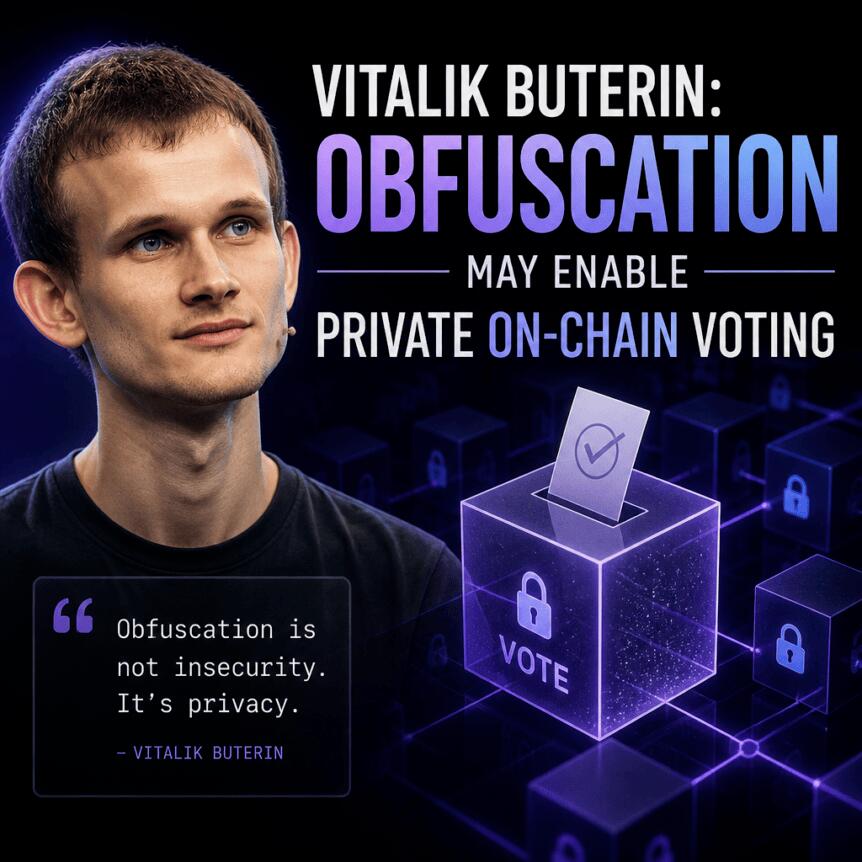
Ethereum co-founder Vitalik Buterin has laid out a longer-term cryptography blueprint for private, onchain voting that aims to avoid the need for a trusted group to handle ballots. In a technical essay published Monday, Buterin argues that a cryptographic technique known as indistinguishability obfuscation (iO) could let blockchain systems compute voting results while keeping individual votes hidden and limiting opportunities for collusion.
The proposal centers on replacing traditional threshold-style committees—groups that collectively decrypt encrypted votes—with protected programs designed to reveal only the final outcome. Buterin cautions, however, that the approach is not yet practical, with the most conservative versions requiring extremely heavy computation and faster variants depending on less-tested security assumptions.
Key takeaways
- Buterin’s proposal uses indistinguishability obfuscation (iO) to create “protected programs” that can compute vote tallies without exposing ballot contents.
- The design is intended to reduce reliance on threshold committees that jointly decrypt results, potentially lowering the trust needed for private onchain voting.
- Even with iO, blockchains remain essential because protected programs can’t stop being copied or support state updates on their own.
- Buterin describes current constructions as computationally impractical, positioning the idea as research direction rather than a near-term deployment plan.
From encrypted ballots to protected programs
Buterin frames iO as a method for hiding software logic. In his explanation, iO transforms a piece of code into a protected program such that others can run it to obtain the intended output, but cannot inspect the internal code or retrieve embedded sensitive data. He emphasizes that this approach focuses on concealing the program itself, rather than solely masking the data it processes.
In the context of voting, the idea would be to package the tallying and eligibility logic into an obfuscated program. Voters could submit encrypted ballots, and the system would execute the protected program to produce a final tally without exposing how individual participants voted. In effect, this would remove a key requirement of many private voting schemes: coordinating a set of operators (a threshold committee) that holds decryption capabilities and must behave honestly.
Buterin also notes that blockchains still have to do the heavy lifting for public coordination and evolving state. While iO can hide computation details, it cannot prevent copying or manage changing information by itself, so a blockchain—or similar distributed infrastructure—would remain necessary for the system to function over time.
Why dropping threshold committees matters
Private onchain voting typically involves operational trust assumptions, even when votes remain cryptographically protected. In many designs, groups of operators must safeguard information and follow the protocol correctly—particularly during decryption or tallying. Buterin argues that eliminating (or sharply reducing) the need for threshold committees could make decentralized governance more resistant to manipulation.
In his view, reducing this dependency could also lower the risk of insider interference and enable voters to participate without exposing voting behavior. However, the core promise is not only privacy for individuals; it is also a shift in who has meaningful control over the outcome. Instead of multiple parties jointly controlling decryption, the tally would be derived from running a protected program intended to reveal only what the system needs to disclose.
That said, the essay’s emphasis on security assumptions and computational feasibility underlines that the practical challenge is formidable. The approach is designed to minimize trust—but it still must be engineered so that security holds under realistic operating constraints.
Security trade-offs and why deployment is still out of reach
Buterin’s assessment is explicit: the idea, while conceptually aligned with “almost no trust assumptions,” is not ready for real-world use. He describes the most conservative constructions as requiring what he calls “galactic” amounts of computation—suggesting that the computational overhead would overwhelm any system intended for everyday participation.
He also points to a tension faced by cryptographic research more broadly: faster constructions tend to rely on weaker or less-tested security assumptions. In other words, an implementation that is technically feasible may not yet offer the same level of assurance as the most conservative theoretical design. This leads Buterin to characterize iO-based private voting less as a deployment-ready system and more as a long-term research direction.
For investors and builders watching Ethereum’s roadmap, the takeaway is that privacy research is moving toward more rigorous “how it’s computed” privacy—yet the path from cryptographic theory to production-grade systems will require major advances in efficiency and confidence in assumptions.
How this fits into Buterin’s broader privacy agenda
This iO voting essay builds on earlier work by Buterin linking advanced cryptography to stronger privacy and reduced coercion risk. In October 2024, he connected iO with private voting in an Ethereum roadmap he published, arguing that the technique could improve privacy guarantees.
He has also pushed for practical privacy steps within Ethereum’s ecosystem. In April 2025, Buterin proposed a more immediate privacy roadmap that called for integrating privacy tools into existing wallets. That proposal also advocated for stronger protections against data collection by infrastructure providers used by wallets to access Ethereum, reflecting an emphasis on privacy not just at the cryptographic layer but in the surrounding network services.
Buterin has additionally directed personal funds toward privacy-preserving projects. According to earlier coverage by Cointelegraph, on Jan. 30 he earmarked 16,384 Ether (ETH) (about $45 million at the time) to support initiatives focused on privacy, open infrastructure, and self-sovereign tools.
Read together, these threads show a consistent direction: privacy improvements are being pursued both through long-horizon cryptographic designs like iO and through nearer-term engineering changes that could reduce exposure to tracking and data collection.
For now, the most important question is what—if anything—can be improved to make iO-based voting computationally viable without sacrificing security confidence. Readers should watch for follow-up research that narrows the performance gap and clarifies which security assumptions would be acceptable for real deployments.

Bitmine Immersion Technologies said it added more than 27,000 Ether to its treasury last week after completing a $43 million purchase. The update comes as the company prepares for greater visibility with its inclusion in the Russell 1000, an index that many funds use as a benchmark for passive investing.
In a disclosure shared on Monday via PR Newswire, Bitmine said its Ether holdings reached just over 5.7 million ETH. The company reported buying the tokens at an average price of $1,569 per Ether and said it now holds about 4.7% of Ethereum’s 120.7 million token supply—moving it closer to its stated objective of owning 5% of the asset.
Key takeaways
- Bitmine reported a $43 million Ether purchase that increased holdings to just over 5.7 million ETH at an average $1,569 per token.
- The firm said its stake is now roughly 4.7% of Ethereum’s circulating supply, edging toward a 5% target.
- Bitmine’s Russell 1000 inclusion is expected to bring additional institutional demand through funds that track the index.
- Despite broader Ethereum developments, Bitmine’s chairman described the prior week as difficult for crypto investors after Ether fell about 8%.
- Other crypto-linked firms were also added to the Russell 3000 Index recently, expanding how traditional investors encounter crypto treasury businesses.
A growing Ether treasury amid a volatile week
Bitmine’s announcement frames the latest acquisition as part of a continued push to build a larger corporate Ether position. After its recent buy, the company said it holds slightly above 5.7 million Ether and has reduced the gap to its 5% supply goal.
The filing also highlights how market price swings can complicate treasury strategies even when the broader Ethereum ecosystem is active. Bitmine chairman Tom Lee characterized the preceding week as challenging for crypto investors, saying Ether fell by 8%. In his remarks, he noted Ethereum-related positives—including the creation of Ethlabs—and pointed to a softer tone from the Bank of England regarding stablecoins.
Even with those developments, Lee said the selloff played out in ways that can influence investor behavior. He later attributed some of the pullback to what he described as “window dressing,” where investors reduce exposure to assets that have declined over recent months.
Why Russell 1000 inclusion could change Bitmine’s investor base
Beyond the treasury update, the more market-facing development is Bitmine’s addition to the Russell 1000, which tracks the largest 1,000 US companies. Bitmine said this step may increase investor demand for its shares because many mutual funds, ETFs, and pension funds follow Russell indices and must buy constituents once they are added.
Lee previously discussed this mechanism when Bitmine was first under consideration for the Russell index in May. He said passive index funds can account for up to 25% of the market capitalization of stocks included in the index.
In Monday’s comments, Lee said Russell 1000 membership is expected to add “hundreds and possibly thousands” of additional institutional investors as equity owners of Bitmine. For a company whose business model is closely tied to holding and managing Ether exposure, a shift in the shareholder base can matter: institutional ownership patterns can influence liquidity, trading volume, and the range of investors willing to hold crypto-treasury equities over the long run.
Stock movement follows Ether, despite new corporate catalysts
Bitmine’s share performance on Monday reflected both the company’s corporate update and the broader pressure on Ether. The stock rose 1.7% to close at $13.80, according to the article, but it has fallen roughly 9% over the past week in tandem with Ether’s decline.
That pattern underscores an important tension for investors watching crypto treasury businesses: even when the company executes meaningful purchases or secures index inclusion, the underlying price of Ether can still dominate near-term equity performance. In other words, Bitmine’s catalysts may improve access to new capital sources, but the valuation of its holdings remains directly linked to market conditions for ETH.
Broader index adoption for crypto-related firms
The Russell inclusion story is not unique to Bitmine. The article noted that rival crypto treasury firms Sharplink and Forward Industries—along with Gemini and Galaxy Digital—were also added to the Russell 3000 Index on Friday. The Russell 3000 tracks the largest 3,000 US companies, which can create additional pathways for traditional market participants to build exposure to crypto-linked public equities.
For investors, this trend signals a gradual normalization of crypto-related businesses inside mainstream index ecosystems. However, it also raises a watchpoint: as more crypto treasury firms enter large-cap indices, their stock demand may become more mechanically tied to index-tracking flows, potentially increasing short-term trading activity around reconstitution dates.
At the same time, it does not remove the central risk for equity holders—Ether’s market volatility. Bitmine’s chairman’s remarks about window dressing and short-term reductions in exposure illustrate how quickly sentiment can shift even when broader Ethereum developments continue.
Investors should watch whether Bitmine’s Russell 1000 entry translates into sustained institutional ownership or whether near-term trading remains dominated by ETH price movements. The next key question is how the company continues to balance incremental Ether acquisitions with the equity volatility created by shifting crypto market sentiment.


In recent days, USDT has traded at a premium across several Indian exchanges, with premiums generally ranging between 7% and 10%, depending on liquidity and market activity. On CoinSwitch, USDT has traded at around a 9% premium over the past few days.
“At CoinSwitch, users always see the live buy and sell price before placing an order. We do not charge any hidden fees beyond our disclosed brokerage. The premium reflects prevailing market conditions rather than any platform-imposed markup,” Singhal said.
Both CoinDCX and CoinSwitch attribute the premium entirely to organic supply-and-demand dynamics: more buyers than sellers, thinner liquidity near the global reference price, and a market mechanism — not platform pricing decisions — setting the rate. Neither executive directly addressed the ED’s enforcement action or its effect on token supply in their statements.
Nevertheless, the supply squeeze that drove the premium unusually higher could be linked to the enforcement action.
Market makers and liquidity provides could have scaled back from sourcing USDT overseas after the ED’s action, which would show up exactly as a supply-side liquidity shortage, the same mechanism both Thakur and Singhal describe in general terms.
Operating on Indian exchanges has been relatively tougher for market makers because of a flat 30% tax on gains, no allowance to offset losses, and a restrictive 1% tax deducted at source (TDS). These rules have long contributed to market dislocations.
The U.S. Securities and Exchange Commission has secured a final default judgment in its case against NanoBit Limited and several linked defendants.
Summary
- SEC judgment orders NanoBit-linked defendants to pay over $5.5M after alleged WhatsApp investor fraud scheme.
- Regulators said the fake platform used group chats, false broker claims, and fake ICO pitches.
- The case shows fraud enforcement continues even as broader crypto rulemaking moves toward clearer standards.
According to the SEC litigation release, the U.S. District Court for the Eastern District of New York entered the judgment on June 16, nearly two years after the agency filed its complaint.
The court ordered NanoBit, Radiant Horizons Limited, Sweet Karma Fashion Inc., Zhao Tropical Deli Inc., Jiajie Liu and Hua Zhao to pay penalties, disgorgement and interest. The final judgment lists total payment obligations of about $5.52 million across the defendants.
SEC says NanoBit platform was fake
The case centered on claims that NanoBit operated as a fake crypto trading platform. The SEC said the defendants and other scheme participants used social media apps to reach investors before moving them into WhatsApp groups.
In its September 2024 complaint, the agency said the participants posed as financial industry professionals and built trust with investors. The SEC alleged that NanoBit falsely claimed an affiliate, NanobitUS Securities, was registered with the regulator.
WhatsApp groups and false broker claims
The SEC said the supposed financial professionals promoted fake initial coin offerings and presented NanoBit as a working trading venue. Investors allegedly saw platform screens that appeared to show crypto prices, account balances and trading activity.
“No transactions took place on the NanoBit platform” and that “investors’ funds in fact went to scheme participants,” the regulator said.
According to the SEC, more than $2 million was wired to bank accounts in Hong Kong, while hundreds of thousands of dollars in crypto assets were misused.
Fraud enforcement continues
The NanoBit judgment adds to a string of crypto fraud actions even as U.S. regulators change their wider approach to digital asset policy. As reported by crypto.news, the SEC had already named NanoBit and CoinW6 among relationship investment scam cases in its 2024 enforcement review.
As reported by crypto.news, the SEC also charged Texas resident Nathan Fuller in May over an alleged $12.3 million AI crypto arbitrage scheme. That case involved claims of guaranteed returns from a trading robot, according to the report.
The same fraud risks have spread beyond fake trading platforms. As reported by crypto.news, TRM Labs warned this month that scammers had created World Cup-related crypto fraud operations, including fake ticketing sites and a fixed-match betting scheme.
The SEC has also warned investors about group-chat scams. In a December 2025 investor alert, Investor.gov said people should “never rely solely on information from group chats” when making investment decisions. The agency also urged investors to check the background of anyone offering or selling investments.
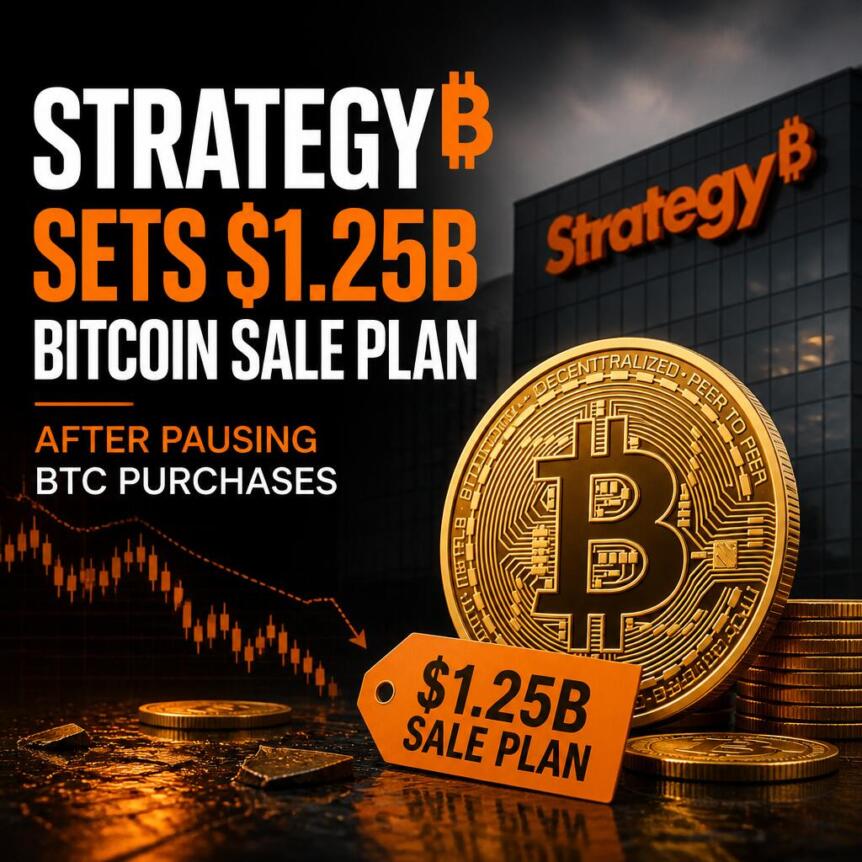
Strategy opened a new funding chapter after authorizing Bitcoin monetization for credit support, preferred security buybacks, and dividends. The company also paused Bitcoin purchases while raising $1.15 billion through MSTR stock sales. The move shifts part of its treasury policy from pure accumulation to broader capital management.
Bitcoin Monetization Plan Takes Shape
Strategy adopted its Digital Credit Capital Framework on June 29 through a new regulatory filing with broader funding options. The framework targets stronger liquidity, preferred security support, and long-term exposure to Bitcoin. It also aims to protect shareholder value as the firm manages larger credit obligations and capital needs.
The central tool is a Bitcoin Monetization Program, which allows controlled BTC sales for defined purposes rather than simple accumulation. Strategy may generate up to $1.25 billion and place the cash in its USD Reserve for near-term needs. The reserve can fund dividends, interest payments, cash buffers, and approved repurchase programs without selling new shares.
However, the company said the program does not require any Bitcoin sales under current conditions or future obligations. Therefore, Strategy may keep its full Bitcoin position if management avoids monetization and protects its treasury. Still, the recent 32 BTC sale raised market questions among traders and analysts after the new plan became public.
MSTR Stock Sale Funds Balance Sheet
Strategy reported no Bitcoin purchases for the week ending June 28, ending a steady accumulation phase after active weeks. The pause ended its recent buying streak, although the company kept its total holdings unchanged for now. Its treasury still holds 847,363 BTC, bought for an aggregate cost of $64.10 billion.
At the same time, Strategy sold 12.67 million MSTR shares under its at-the-market program to raise fresh cash. The sale produced about $1.152 billion in net proceeds for the company during the same period after fees. That capital gives management more room to handle payouts, reserves, and credit security needs without immediate Bitcoin buying.
The stock sale also adds context to the new framework and its wider treasury shift after the weekly update. Strategy has long used equity issuance and preferred securities to support Bitcoin accumulation while protecting BTC exposure. Now, it has added Bitcoin monetization as another funding option for balance sheet management as markets change.
Digital Credit Securities Buyback Gets Approval
Strategy also authorized repurchases of up to $1 billion in Digital Credit Securities under the new framework. The approval covers STRC, STRF, STRD, and STRK, depending on management’s capital structure view and pricing. The company said buybacks could occur if they improve liquidity, security pricing, or capital efficiency.
If Strategy uses Bitcoin proceeds for repurchases, it must route them through the monetization program. This link gives the company a formal path from BTC sales to credit support and cash reserves. Even so, the framework leaves final action with management and market conditions, not automatic triggers.
The company also lifted the annual STRC dividend rate to 12% from July 1. Strategy designed to help pull STRC closer to its $100 par value over time. STRC rose 9.48% in premarket trading to $81.64 after the announcement, showing a sharp early response.


Bitmine Chairman Tom Lee tied Ethereum’s (ETH) 8% weekly drop to quarter-end window dressing, arguing funds trimmed three-month losers.
The executive made the comments as Bitmine reported holdings of 5,700,040 ETH worth roughly $9 billion.
Lee Frames ETH Drop as Quarter-End Window Dressing
Window dressing refers to fund managers selling underperforming positions before quarter-end reporting dates. The practice allows them to present portfolios with fewer losing positions to clients, even though it does not improve the portfolio’s actual performance or returns.
Lee pointed to the term when describing Ethereum’s recent slide.
“This past week was a challenging one for crypto investors as ETH fell by 8% … We are nearing quarter-end for June, and it is not surprising to see ‘window dressing’ leading to investors reducing their holdings in assets which have fallen in the past 3 months,” he said.
The drop fits a wider decline. Ethereum has fallen nearly 22% over the past month, outpacing Bitcoin’s (BTC) 19% loss. It is also on track for a third consecutive red quarter.
Follow us on X to get the latest news as it happens
Treasuries Keep Buying as ETH Trades Below Cost
Nonetheless, Bitmine kept accumulating through the weakness. The firm acquired 27,084 ETH last week.
Its stake now equals 4.7% of the 120.7 million ETH supply, or 94% of its “Alchemy of 5%” target.
“The future roadmap for crypto remains positive as the dual drivers of Wall Street modernizing its legacy infrastructure on crypto rails and the future of agentic-AI payment systems on crypto rails remain intact. Bitmine remains focused on the longer-term horizon and continues to manage the company to be positively positioned for these exponential drivers,” Lee added.
Meanwhile, the second-largest Ethereum holder, SharpLink, has also resumed buying. The firm restarted its accumulation after an eight-month pause.
According to Lookonchain, it has acquired 39,196 ETH. Despite the renewed buying, SharpLink still holds an unrealized loss of nearly $1.7 billion, with an average acquisition cost of about $3,609 per ETH.
The renewed buying signals conviction among large holders even as prices sit far below their entry points. Whether quarter-end reporting marks a turn or deeper weakness may become clearer in July.
Subscribe to our YouTube channel to watch leaders and journalists provide expert insights
The post Tom Lee Ties Ethereum Selloff to Quarter-End Window Dressing appeared first on BeInCrypto.
Crypto World
MiCA’s transitional period ends July 1. Here is what European crypto users need to know


Disclosure: This article does not represent investment advice. The content and materials featured on this page are for educational purposes only.
The EU’s MiCA transition ends July 1, requiring crypto firms to hold CASP licenses as investors reassess platform compliance and regulatory status.
Summary
- EU MiCA rules enter full force on July 1, leaving most previously registered crypto firms without authorization.
- MiCA’s full rollout reshapes Europe’s crypto market as investors shift toward licensed trading platforms.
- Europe’s MiCA deadline prompts investors to verify exchange licenses before stricter crypto rules take effect.
The EU’s 18-month grace period for crypto firms is closing. With 83% of previously registered exchanges still unlicensed, European investors face real platform risk — and a narrow window to act.
The deadline is not a technicality. On July 1, 2026, the European Union’s Markets in Crypto-Assets (MiCA) regulation transitions from its 18-month grandfathering phase into full enforcement. Of the 1,200-plus crypto firms that previously held national VASP registrations across the bloc, only approximately 210 have converted to full CASP licensing under MiCA. The remaining 83% either did not complete the process, are mid-application without legal standing to continue operating, or have already quietly withdrawn from the EU market.
ESMA has stated clearly that after July 1, 2026, any entity providing crypto-asset services to EU clients without a MiCA licence will be in breach of EU law and must cease offering those services. This is not a grace period extension — it is the end of one.
What MiCA actually changes
MiCA, which entered into force in June 2023 and came into full application in December 2024, creates a unified licensing regime across all 27 EU member states. Under MiCA, CASPs — crypto-asset service providers including exchanges, custodians, brokers, and trading platforms — must meet strict requirements on governance, safeguarding of client assets, IT security, and disclosure. Authorization in one EU country gives firms passporting rights to serve clients across the entire Union.
The framework’s scope is deliberately broad. It covers exchanges and trading platforms, portfolio managers, custodians, and brokers. It also sets new standards for stablecoin issuers — major stablecoins like USDT remain non-compliant under MiCA, forcing exchanges to delist them and fragmenting liquidity in the European market.
For investors, the most consequential aspect of MiCA is what happens to assets held on platforms that do not make the cut. Firms that have not yet submitted a MiCA authorization application face a near-impossible timeline. Regulatory processing periods range from 25 to 40 business days for an initial completeness assessment alone. Those still mid-process have no guaranteed protection after the deadline passes.
The authorization landscape
The authorized cohort remains small relative to the broader market. As of March 2026, CASP authorizations crossed 40 fully approved firms across the EU, with 14 centralized exchanges holding licenses — led by Binance in France, Kraken and Coinbase in Ireland, Bitstamp in Luxembourg, and OKX in Malta.
Among the platforms that did not wait for regulatory pressure to force compliance is SwissBorg, a European wealth management app that secured its regulatory approvals through French authorities ahead of the July deadline. France is considered one of the more stringent MiCA jurisdictions, and authorization there covers passporting rights across the broader EU. SwissBorg‘s users can continue accessing its yield products, diversified investment themes, and trading infrastructure without service interruption — a position that contrasts sharply with platforms still working through the authorization queue.
Approximately 70% of EU-based crypto transactions now occur on MiCA-compliant exchanges, suggesting that despite the low firm count, volume has already concentrated around licensed platforms. Administrative fines under Article 111 can reach €15 million or 12.5% of annual turnover, whichever is greater, for non-compliance.
The timelines have not been uniform across member states. Transitional periods varied dramatically, with the Netherlands requiring compliance by July 2025, Italy by December 2025, and others extending to the July 2026 outer limit. In practice, some European investors have already been navigating a partially cleared market for months.
What investors should do now
The most immediate action is verification. ESMA publishes an interim MiCA register — updated weekly — that lists authorized CASPs, white papers, and entities flagged as non-compliant. Any platform that cannot be found in that register should prompt a closer look at where assets are currently held and what withdrawal options exist before activity is suspended.
Stablecoin allocations warrant particular attention. MiCA’s earlier June 2024 phase already reshaped the European stablecoin market through reserve requirements and redemption rules that hit asset-referenced tokens and e-money tokens first. The ongoing pressure on USDT’s EU distribution is a direct downstream effect of that earlier phase. Users holding non-compliant stablecoins on EU-facing platforms may find their trading pairs restricted or eliminated in the coming weeks.
ESMA has stressed that as national MiCA transitional periods expire across the EU, CASPs operating without authorization must implement orderly wind-down plans to minimize harm to clients. Orderly is the operative word — but with concentrated exit pressure expected at the deadline, users on non-compliant platforms should not assume that withdrawal processes will remain frictionless. The practical move is to migrate capital onto a licensed platform before that pressure peaks.
The structural shift
The compliance picture that emerges from MiCA’s full rollout is not simply a list of winners and losers among exchanges. It reflects a more fundamental restructuring of how crypto operates in Europe — one that brings it closer in legal character to traditional financial services, with the same investor protections, the same disclosure obligations, and the same oversight architecture.
Unlike national VASP registrations, MiCA creates a single authorization regime across all 27 EU member states, covering governance, custody standards, conflicts of interest, prudential safeguards, client asset protection, disclosure obligations, market abuse rules, and complaints handling.
Whether that brings European retail investors more security or simply more friction remains an open question — one that the industry and regulators are still actively working through. What is not open to debate is the deadline. July 1 is two days away, the authorized list is public, and the platforms that prepared early are already operating on the other side of it.
Disclosure: This content is provided by a third party. Neither crypto.news nor the author of this article endorses any product mentioned on this page. Users should conduct their own research before taking any action related to the company.

Sovereign wealth funds have been accumulating spot Bitcoin, a sign that Bitcoin’s current price level is becoming attractive to institutional investors, according to MidChains CEO Basil Al Askari.
While there has been a slowdown in retail crypto market participation, the opposite is being seen on the institutional and corporate side, Basil Al Askari said on Cointelegraph’s “Chain Reaction” podcast on Monday.
“I would be able to confirm that one, at least one, and possibly in the coming weeks, two sovereign wealth funds have been accumulating spot Bitcoin specifically,” he said.
A sovereign wealth fund is a state-owned investment fund, typically capitalized by a country’s reserves, so the move signals state-level conviction, not just private speculation. Sovereign wealth funds collectively control more than $13 trillion globally.
Al Askari, who heads MidChains, a regulated crypto trading platform focused on retail and institutions based in Abu Dhabi, said this low price point is seen very much as an “entry level for a lot of those mega funds” that have the patience to accumulate over an extended period of time.

Basil Al Askari speaking on Chain Reaction. Source: Cointelegraph
The potential impact on Bitcoin’s price is not going to be a massive cascade on the market immediately, he said, but it sends “a very clear signal” to other institutions that may be sitting on the sidelines and looking at these larger funds as leaders, seeking a “way to experiment and start to get involved” with Bitcoin.
Related: Bullish Bitcoin RSI divergence has analysts calling for 2022-style bear market bottom
“I do think this is what will happen, is that over the longer term period, we’ll start to see Bitcoin becoming more and more scarce as a result of larger holders with much longer time horizons on their holding periods as far as looking at investments.”
Abu Dhabi’s Mubadala Investment Company invested $437 million in BTC via BlackRock’s iShares Bitcoin Trust (IBIT) shares in February 2025, while Bhutan’s Druk Holding and Investments is one of the earliest and most direct sovereign holders of the asset, but it has been selling some this year.
ETFs outflow billions as corporates buy the dip
Coinbase’s head of institutional strategy, John D’Agostino, told CNBC earlier this month that the dip is being welcomed by institutional investors.
“I just got off a plane from the Middle East, and I can tell you that the family offices in the UAE and the government and sovereign funds that are putting the effort into buying this asset class are not unhappy at being able to buy it at a discount,” D’Agostino said.
The current situation has been mixed, with sustained US spot BTC exchange-traded fund outflows exceeding $4.1 billion so far this month. Meanwhile, corporate treasuries, primarily Strategy, which has scooped up 3,657 BTC this month, continue to accumulate.
Magazine: AI is banking the unbanked in Africa… faster than crypto


U.S. President Donald Trump is facing a short decision window after House Speaker Mike Johnson sent the 21st Century ROAD to Housing Act to the White House on Monday.
Summary
- Trump now faces a 10-day window as the housing bill’s CBDC ban moves toward law.
- The bill blocks the U.S. Fed from creating a CBDC or similar asset through 2030.
- Trump’s SAVE America push delayed a housing measure that passed with bipartisan backing last week.
Reuters reported that Trump did not commit to signing the bipartisan housing bill and described it as “a big yawn” while pressing Republicans to move on the SAVE America Act.
The clock matters because the U.S. Constitution gives a president 10 days, excluding Sundays, to sign or return a bill after presentment. If Congress remains in session and the president takes no action, the bill becomes law as if it had been signed.
CBDC ban sits inside housing measure
The 21st Century ROAD to Housing Act mainly focuses on housing affordability. The package seeks to expand housing supply, support manufactured housing, speed up some reviews, and place new limits on large investors buying single-family homes.
The same bill also carries a non-housing provision aimed at the Federal Reserve. The final package prohibits the Fed from creating a central bank digital currency through 2030. The language covers a CBDC and any asset that is substantially similar to one.
The CBDC clause has moved through Congress alongside broader digital asset debates. The housing bill passed the Senate in an 85-5 vote and the House in a 358-32 vote, giving the package strong support from both parties before it reached Trump.
SAVE America Act drives the standoff
Trump has linked the housing bill to the SAVE America Act, a voting measure that would require proof of U.S. citizenship for voter registration. He canceled a planned signing ceremony last week and said Republicans should focus on the election bill before other measures.
That position has frustrated some Republicans who want to campaign on housing affordability before the November midterms. Senator Bill Cassidy said it was “irresponsible” to postpone signing the housing bill over the SAVE Act and said relief for high housing costs should start quickly.
Trump also questioned parts of the housing package because Democrats supported it. He said the bill was bipartisan and added that Democrats were getting items he would not necessarily accept, according to reports.
Crypto policy faces a narrow July window
The housing fight comes as the Senate calendar also weighs on crypto legislation. As reported by crypto.news, the Senate adjourned until July 13, leaving lawmakers with less floor time to move the CLARITY Act before the August break.
The CLARITY Act remains central to crypto market structure talks. As reported by crypto.news, it has cleared the House, passed the Senate Banking Committee, and reached the Senate calendar, but it still needs floor action.
The same debate also touches the CBDC issue. As reported by crypto.news, the CLARITY Act includes anti-CBDC language that would bar the Fed from issuing a retail digital dollar without clear approval from Congress.
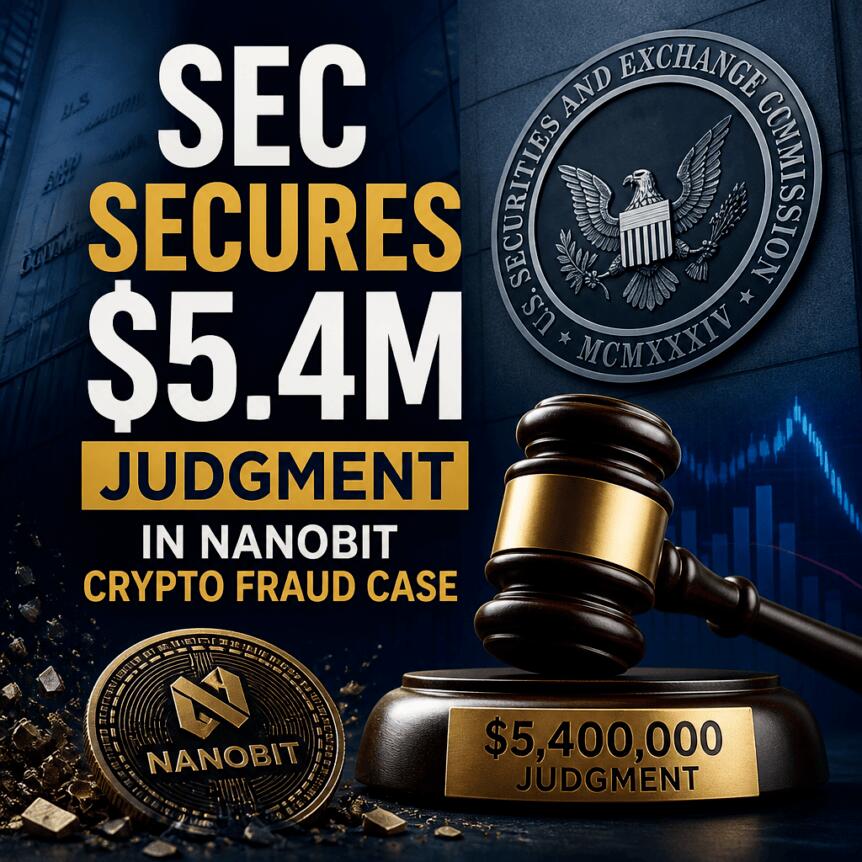
The US Securities and Exchange Commission (SEC) has secured a fraud judgment against NanoBit Limited, ending a case that began with allegations of a crypto-linked investment scam involving WhatsApp outreach and a fake trading platform.
According to the SEC, the agency brought the suit after it accused NanoBit’s operators of taking funds from at least 18 investors between 2023 and 2024—funds it said were diverted to insiders rather than used to operate a legitimate platform.
Key takeaways
- The SEC alleges NanoBit used impersonation and social media outreach to lure investors into depositing money into a fake platform.
- The SEC’s Monday announcement came after an Eastern District of New York court entered a final judgment on June 16 against multiple entities and individuals tied to the case.
- The court imposed permanent injunctions against the defendants, barring them from participating in the issuance, purchase, or sale of securities.
- NanoBit and its affiliates were ordered to pay multiple components including fines, disgorgement, and prejudgment interest, totaling nearly $1.8 million for the company-related parties.
SEC wins against NanoBit in a WhatsApp-driven fraud
The SEC said the scheme centered on how victims were recruited and what they were led to believe once they engaged. In its Monday litigation release, the agency described an approach in which NanoBit’s operators allegedly impersonated financial professionals within WhatsApp groups to convince investors to deposit funds.
Instead of reflecting trading activity, the SEC alleged the platform served as a stage to manufacture credibility and performance. The regulator claimed investors were shown a fake dashboard portraying rising returns, designed to give the appearance that their money was increasing.
To further strengthen the illusion, the SEC alleged the operators falsely represented that an affiliate—NanobitUS Securities—was an SEC-registered broker. The SEC also alleged that the platform promoted supposed token offerings, including fake initial coin offerings (ICOs) promising substantial returns.
Court findings and the size of the penalties
The SEC’s announcement referred to the court’s final judgment entered in the Eastern District of New York on June 16 against four entities and two individuals tied to the NanoBit fraud. The judge found that the defendants violated US securities laws and issued permanent injunctions preventing them from engaging in securities-related conduct.
As part of the enforcement outcome, the court ordered monetary relief that included a fine, disgorgement, and prejudgment interest. The SEC said NanoBit Limited was ordered to pay a $1.18 million fine, disgorgement of more than $532,000 for ill-gotten gains, and nearly $81,200 in prejudgment interest, for a combined total of nearly $1.8 million.
In addition, the SEC said NanoBit’s affiliates—Radiant Horizons, Sweet Karma, and Zhao Deli—each received $1.18 million fines. One of the alleged orchestrators, Jiajie Liu, was ordered to pay approximately $120,000 in penalties, disgorgement, and prejudgment interest.
What the SEC says happened to investors’ money
In the SEC’s September 2024 complaint, the regulator alleged that solicitation began outside the WhatsApp environment. It said NanoBit investors were contacted on social media, including Instagram, before being moved into WhatsApp groups tied to the scheme.
Once participants were onboarded, the SEC claimed the “NanoBit platform” never executed any real transactions. Instead, it said investors’ funds were directed to scheme participants, including bank accounts in Hong Kong, where the money was allegedly misappropriated.
The SEC further alleged that the amount taken from investors involved both fiat deposits and mismanagement of investors’ crypto assets. It said hundreds of thousands of dollars’ worth of investors’ crypto holdings were taken and routed to individuals connected to the fraud.
When investors attempted to withdraw, the SEC alleged they were confronted with excuses and asked to pay large fees. It also said some victims were removed from the WhatsApp groups after questioning whether the platform was legitimate.
Another data point in the SEC’s ongoing crypto fraud enforcement
The NanoBit ruling adds to a broader enforcement pattern in which the SEC targets crypto-themed scams that rely on messaging apps, fabricated performance, and false claims about regulatory status.
The SEC release also situated this case within continued scrutiny under the agency’s crypto enforcement efforts. It noted other recent fraud actions, including a May 29 charge against a Texas man accused of raising more than $12 million from roughly 150 investors by claiming to use AI-powered trading bots to generate guaranteed returns, and an April action against crypto executive Donald Basile and two companies he controlled for allegedly raising roughly $16 million from hundreds of investors through false claims tied to a token described as Bitcoin Latinum.
For investors, the practical takeaway is that the mechanics of the NanoBit allegations—social media recruitment, WhatsApp group pressure, and a “dashboard” narrative—mirror tactics frequently used in retail scams across asset classes. In particular, the SEC’s focus on impersonation and fabricated investment performance underscores how easily victims can be pulled into believing returns when verification is absent.
Going forward, traders and retail participants should watch for whether additional orders or parallel actions affect other individuals or entities connected to the WhatsApp outreach and alleged offshore fund routes, and whether the SEC’s detailed allegations prompt further scrutiny of similar “copy trading” and dashboard-based pitches that promise regulated brokerage status or guaranteed outcomes.

If You Want to Retire With XRP, Watch This Video

Germany humiliation, Jurgen Klopp’s Arsenal dig, Cody Gakpo tears – World Cup round-up

For first time, more central banks are set to shrink dollar holdings, survey finds


-
 Sports6 days ago
Two goals and an assist by sheer aura: Cristiano Ronaldo just entered the World Cup chat
-

 Fashion3 days ago
Weekend Open Thread: Staud – Corporette.com
-

 Politics4 days ago
The House | Manchesterism won’t survive the painful trade-offs unless it gets citizens on board
-

 Politics4 days ago
Potential 2028er World Cup attendee leaderboard
-

 News Videos1 day ago
MAJOR BITCOIN & MARKET UPDATE!!!! (MUST WATCH ASAP!!!)
-

 Business4 days ago
Asia stock markets slide as tech shares slump
-

 Tech4 days ago
A Look At A Gaggle Of Transputer Boards
-

 Crypto World6 days ago
Securitize Wraps Roubini's SEC-Registered ETF as Dubai VARA Digital Security
-
Crypto World6 days ago
Bitcoin (BTC) Dips Below $62K, Ethereum (ETH) Plunges 6% Daily: Market Watch
-
 Crypto World4 days ago
Dell (DELL) Shares Tumble Over 5% Following Analyst Downgrade to Hold
-

 Crypto World3 days ago
Coinbase, Circle Deepen Crypto Stock Losses Despite Resilient S&P 500
-
Business6 days ago
Entergy settles forward sale agreements, raises $672 million in cash proceeds
-

 Crypto World3 days ago
Kraken's xStocks Opens Bending Spoons IPO Registration to EEA Retail
-

 Sports3 days ago
FIH Pro League: India defeat Pakistan 7-1, register biggest win of campaign | Other Sports News
-

 Tech2 days ago
Bluekit phishing kit adopts browser-in-the-middle for login theft
-
 Crypto World4 days ago
Bitcoin Sparks $600M Hourly Liquidations With $65,000 Set To Become Resistance
-

 Tech3 days ago
Russian hackers now target Signal backup recovery keys
-
 Crypto World4 days ago
Hyperliquid Named on Singapore MAS Investor Alert Register
-

 Crypto World4 days ago
RTX holders must register wallets before token distribution begins
-

 Crypto World5 days ago
Ripple and SBI launch RLUSD in Japan after JFSA approval
You must be logged in to post a comment Login