
Crypto World
Jane Street reports over $1B in Bitcoin ETF shares



Jane Street reported more than $1 billion in U.S. spot Bitcoin ETF shares as of June 30, 2026, according to a quarterly regulatory filing released in August.
Summary
- Jane Street reported more than $1 billion in spot Bitcoin ETF shares at quarter end.
- BlackRock’s IBIT represented approximately $828 million, making it the firm’s largest disclosed Bitcoin ETF position.
- The filing covers holdings on June 30 and does not reveal Jane Street’s current positions.
- Jane Street owned ETF shares rather than Bitcoin held directly in wallets or institutional custody.
- Form 13F omits short positions and many derivatives, preventing conclusions about the firm’s net exposure.
The quantitative trading firm’s largest disclosed position was BlackRock’s iShares Bitcoin Trust, or IBIT. Jane Street reported roughly $828 million of IBIT shares in its second quarter filing.
The remaining exposure was distributed among other U.S. listed products. Those holdings included Fidelity’s Wise Origin Bitcoin Fund and Grayscale’s Bitcoin Trust. The combined value of Jane Street’s reported spot Bitcoin ETF shares exceeded $1 billion at the quarter’s close.
The disclosure concerns shares issued by investment funds. It does not establish that Jane Street directly owned the Bitcoin held by those funds.
Jane Street’s IBIT position rebounded during the quarter
Jane Street’s approximately $828 million IBIT position represented a sharp recovery from the previous quarter. At March 31, the firm reported about 5.9 million IBIT shares valued near $225 million.
The earlier reduction attracted attention because Jane Street had held more than 20 million IBIT shares at the end of 2025. As crypto.news reported, the firm reduced several fund positions while expanding its Ether exposure during the first quarter.
The second quarter filing indicates that Jane Street rebuilt its reportable IBIT position by June 30. However, changes in reported value can reflect both share transactions and movements in the fund’s market price. A Form 13F does not disclose when the shares were acquired or the prices paid.
The filing also cannot establish Jane Street’s motive. The firm is a major quantitative trader and liquidity provider in exchange traded products. Its holdings may support market making, arbitrage, hedging or other trading activities rather than a long term directional position.
The $1 billion disclosure does not equal direct Bitcoin ownership
Spot Bitcoin ETFs hold Bitcoin through fund custody arrangements while investors trade shares on regulated securities exchanges. Jane Street’s filing therefore reports ownership of securities rather than coins controlled through the firm’s blockchain addresses.
This distinction also means the filing cannot be converted directly into a specific amount of Bitcoin owned by Jane Street. Each fund has its own share count, net asset value and Bitcoin holdings. Jane Street’s position represents an economic interest in the funds at the reporting date.
Form 13F provides only a partial view of an institutional manager’s activity. SEC guidance requires covered managers to report the number and quarter end value of eligible securities, including ETF shares.
The reports do not provide a complete trading book. Short sales and many derivatives are absent. Separate put and call positions may appear when reportable, but they still do not reveal how each position interacts with the manager’s other trades.
Consequently, the filing does not prove Jane Street held more than $1 billion of unhedged exposure to Bitcoin. It only confirms that its reportable long ETF shares crossed that level on June 30.
U.S. institutions continue using regulated Bitcoin funds
Jane Street’s disclosure adds to evidence that major financial firms use U.S. spot Bitcoin ETFs for trading, portfolio exposure and liquidity management. BlackRock’s IBIT has repeatedly appeared as the largest crypto fund position in institutional reports.
Other institutions have also disclosed material IBIT holdings. In related coverage, Abu Dhabi’s Mubadala raised its reported position to approximately $566 million during the first quarter of 2026.
Banks have reported smaller positions through the same regulatory process. Barclays, for example, disclosed approximately $131 million of exposure in an earlier filing.
Those disclosures do not necessarily represent comparable strategies. A sovereign investor, bank, hedge fund and market maker can hold the same ETF shares for different reasons. Form 13F provides position data but does not require managers to explain their investment purpose.
No verified market reaction could be attributed specifically to Jane Street’s filing. Bitcoin and ETF prices also respond to fund flows, macroeconomic news and wider market positioning.
The next filing will show Jane Street’s September holdings
Jane Street’s next Form 13F will provide a snapshot of reportable positions held on Sept. 30. The SEC lists Nov. 16, 2026, as the filing deadline for third quarter reports.
That disclosure will show whether the firm maintained, expanded or reduced its Bitcoin ETF shares by quarter end. It will not reveal any changes made after Sept. 30 or positions closed before the reporting date.
Investors should therefore treat the current report as historical information. The June 30 holdings may have changed before the filing became public, and Jane Street’s undisclosed hedges could materially alter its net exposure.



The Hyperliquid Policy Center and Douro Labs submitted a joint comment letter to the U.S. Securities and Exchange Commission on Aug. 17 supporting the proposed repeal of Regulation NMS Rule 611.
Summary
- August 17 filing jointly backed the SEC proposal to repeal Regulation NMS Rule 611 entirely.
- Rule 611 prevents executions through protected quotations displaying better prices across connected U.S. trading venues.
- HPC and Douro asked regulators to recognize qualifying independent reference prices when NBBO is unavailable.
- Tokenized U.S. equities would remain subject to securities rules and broker best execution duties unchanged.
- The SEC comment period closed August 17, with no final repeal decision announced yet publicly.
Rule 611, commonly called the trade through rule, generally prevents trading centers from executing orders at prices worse than protected quotations displayed elsewhere. The framework uses consolidated market data to establish the National Best Bid and Offer, or NBBO.
HPC and Douro argued in their 22 page letter that this quotation system does not map cleanly onto automated market makers, onchain order books and markets operating continuously outside traditional exchange hours.
Douro Labs is a core contributor to Pyth Network. HPC is an independent advocacy organization focused on creating a regulated path for U.S. users to access onchain markets, including markets available through Hyperliquid.
SEC Rule 611 repeal would change order protection
The SEC proposed rescinding Rule 611 and Rule 610(e) on June 11. Rule 610(e) restricts locked and crossed quotations, where bids equal or exceed available offers.
The agency’s proposal would also remove related definitions from Rule 600 and make corresponding changes elsewhere in Regulation NMS. The SEC has not adopted the proposal, meaning the existing rules remain in force.
Rule 611 was adopted as part of Regulation NMS in 2005. It requires trading centers to establish procedures designed to prevent executions at prices inferior to protected quotations available through other connected venues.
SEC Chairman Paul Atkins said in June that the proposal was intended to simplify market structure and reduce costs. He also said the agency would take a “careful, deliberative approach” while reviewing public feedback.
HPC and Douro supported the repeal “without qualification.” They argued that the current framework assumes executable interest appears as firm quotations collected by securities information processors.
Automated market makers work differently. They calculate an execution price from a liquidity pool when an order is placed. Some onchain central limit order books display bids and offers, but those prices are not currently incorporated into the consolidated feeds used to calculate the NBBO.
Onchain markets require updated best execution guidance
Repealing Rule 611 would not remove brokers’ duty to seek favorable execution terms for customers. HPC and Douro said that obligation should remain the central investor protection standard.
Their letter asked the SEC to coordinate with the Financial Industry Regulatory Authority on principles based guidance for onchain execution. The groups said existing guidance does not fully address network fees, atomic settlement, transaction ordering risks or markets operating when the NBBO is unavailable.
An onchain venue may also calculate prices based on the size of an order and the liquidity available when it executes. As a result, one displayed reference price may not capture the final cost that a customer receives.
The groups proposed evaluating the effective execution price after accounting for protocol charges, network fees and market movement caused by the order. Settlement speed and reduced counterparty settlement risk could also form part of that assessment, according to the letter.
HPC and Douro further asked regulators to recognize qualifying independent reference prices when an NBBO does not exist or does not reflect onchain conditions. They said such benchmarks should use transparent methodologies and resist manipulation.
The filing cited Pyth as one possible model. Pyth receives pricing information from exchanges and trading firms involved in price formation, then publishes aggregated data onchain. The proposal did not request that the SEC endorse Pyth as the mandatory provider.
Tokenized stocks would stay within securities rules
HPC and Douro asked the SEC to confirm that tokenized versions of NMS stocks remain inside Regulation NMS and the wider best execution framework. Under that approach, investor protections would not depend on whether ownership records use a blockchain.
The request comes as tokenized stock products expand across crypto networks. As previously reported, Ondo brought 35 tokenized stocks and ETFs onto HyperEVM in June.
Such products can use different legal structures. Some represent claims against an issuer or special purpose entity rather than direct legal ownership of the underlying company shares. The structure must therefore be assessed separately from the blockchain used for trading or settlement.
In related coverage, an onchain platform launched trading for more than 70 tokenized equities across Ethereum and Solana. That system uses public market information to help keep token prices aligned with the underlying shares.
HPC and Douro also argued that onchain transactions may qualify for Rule 611’s existing exception for trades that do not use “regular way” settlement terms. They asked the SEC to confirm that interpretation if the repeal is delayed or rejected. This remains the groups’ legal position, not an SEC determination.
The SEC must decide whether to adopt the repeal
The public comment period for file S7-2026-20 closed on Aug. 17, according to the SEC docket. The joint submission arrived on the deadline alongside comments from exchanges, investment firms, trade groups and other market participants.
The SEC will now review the responses before deciding whether to adopt, revise or withdraw the proposal. A repeal would require a final Commission vote and an adopting release establishing the final text and effective date.
Not all commenters support removing the rule. Some responses warned that repeal could weaken an objective price protection standard and place greater reliance on individual brokers’ routing systems.
SEC Commissioner Mark Uyeda also acknowledged those questions in a June statement. He said removing Rule 611 could raise issues involving best execution, transparency, trading mechanics and investor confidence.
The next decision rests with the SEC. No final vote, adoption date or implementation timetable had been announced as of Aug. 18.
Ripple has partnered with Jeonbuk Bank in South Korea as the latter prepares to deploy Ripple Payments for cross-border remittances. The deal makes Jeonbuk Bank the first regional bank in the country to deploy the payment service.
The main objective is to support businesses that have traditionally faced several days of delays when moving money across borders via conventional transfers.
Expansion in Korea
The partnership will be used for international transfers for businesses such as import-export companies, IT startups, and online content creators. Traditional transfers can take days to complete as payments move through multiple intermediary banks via the SWIFT network. Ripple Payments handles settlement in seconds to minutes and operates 24/7.
Weighing in on the development, JB Jeonbuk Bank’s President, Park Choon-won, said,
“With this partnership with Ripple, JB Jeonbuk Bank is ready to move beyond its role as a regional bank and emerge as a digital finance leader that meets global standards. This partnership will become a new growth engine for the bank, and we will lead innovation that reshapes the financial paradigm, going beyond the adoption of new technology.”
The announcement follows two other Ripple deals in South Korea this year. In April, the fintech company teamed up with Kyobo Life Insurance to focus on tokenized government bond transactions. The companies previously said that they would assess the technical and regulatory requirements for the approach, using Ripple Custody to support the storage, transfer, and settlement of tokenized assets. This was Ripple’s first deal with a major insurance institution in the country.
KBank is also working with Ripple to test how blockchain infrastructure could be integrated into its existing cross-border transfer system. The internet-only bank is running a two-phase proof of concept. It plans to use the company’s Palisade digital wallet during this stage.
Beyond its work with banks and financial institutions, Ripple has also been expanding the reach of RLUSD in South Korea. One of the company’s executives recently revealed that the stablecoin is now listed on the four largest crypto exchanges in the country – Upbit, Bithumb, Korbit, and Coinone.
Price Faces Downside Risks
On the price side of things, XRP’s struggle around $1 has left the token vulnerable to another decline. One analyst has projected a potential decline of 20% to 40%. That would put the token between $0.85 and $0.65, a range that could serve as a macro accumulation zone.
Still, short-term momentum is showing some signs of stabilizing. Another market watcher said XRP’s four-hour RSI is holding near 42, while tighter price action suggests selling pressure has eased. For a stronger recovery, $1.015, $1.05, and $1.081 are levels to watch. A sustained move above $1.081 may open the way toward $1.145 and $1.20.
The post Important Ripple (XRP) Partnership Targets Cross-Border Remittances appeared first on CryptoPotato.


The Ethereum Foundation has warned that wallets, indexers and gas estimators could break as Glamsterdam changes the 21,000-gas assumption for some ETH transfers, with the upgrade due to activate on the Platåberget testnet on Aug. 20.
Summary
- Ethereum has warned that Glamsterdam could break wallets, indexers and gas estimators that rely on fixed gas assumptions.
- EIP 8037 will add a separate state gas charge for operations that create new state.
- A basic ETH transfer to an existing account will still cost 21,000 gas, while transfers to new accounts will cost more.
- Developers have been urged to test their software on the Platåberget testnet before Glamsterdam moves to Sepolia and Hoodi.
The Ethereum Foundation’s Protocol DevOps team said on Aug. 17 that any tool relying on a hardcoded maximum gas limit “will break,” naming wallets, indexers and gas estimators among the software likely to be affected. The team urged application and infrastructure developers to test their systems on Platåberget, a public testnet designed to stay online for several months.
Forkcast data shows Platåberget launched on Aug. 13, giving developers an early environment for Glamsterdam before the upgrade moves to Sepolia and Hoodi. The Glamsterdam fork is scheduled to activate on Platåberget on Aug. 20, according to the foundation, with public validator and builder deposits available as part of the testing process.
Glamsterdam could break hardcoded gas assumptions
Under the planned gas repricing package, the foundation said software can no longer safely assume that Ethereum has a single fixed gas ceiling or that common operations will continue to cost the same amount in every case. The changes are designed around a roughly 200 million gas floor and alter the price of individual operations as well as assumptions tied to the block gas limit.
For application developers, the immediate issue is software that sets fixed boundaries when estimating transaction costs. The Protocol DevOps team said such systems need to be reviewed before Glamsterdam reaches mainnet because the repricing touches wallets, indexers and gas estimators across the network.
The warning follows June 17 Glamsterdam upgrade coverage from crypto.news, which reported that Ethereum developers were already testing the full set of planned EIPs on development networks. At the time, Ethereum Foundation developer Parithosh Jayanthi said the upgrade would change the cost of actions on Ethereum, with high-level computation becoming cheaper while state becomes more expensive.
During the same testing phase, Jayanthi said developers had made “massive progress” but noted that no fixed mainnet timeline had been set. Deployment would depend on the results of testing and whether Ethereum client teams were ready to support the new rules.
EIP-8037 changes how new state is priced
A central part of the warning concerns EIP-8037, which introduces a separate state-gas dimension for operations that create new state. The foundation said creating an account, deploying code or writing a new storage slot will be metered at a fixed cost per state byte and charged at runtime.
Because of that change, a basic ETH transfer will not always carry the same gas cost. Sending ETH to an account that already exists will continue to cost 21,000 gas, with the amount broken into the base transaction cost, cold account access and the value-transfer cost. Sending funds to an address that does not yet exist will also incur a state-gas charge tied to creating the new account.
Developers should therefore revisit applications that treat 21,000 gas as sufficient for every ETH transfer, the Protocol DevOps team said. Gas estimators built around only one gas dimension may also return incorrect estimates once new state is metered separately.
EIP-8037 had already moved close to its final form by May. A May 11 protocol development report said the proposal had reached final-draft status and was being parameterised on a Glamsterdam development network. At the time, its cost-per-state-byte model was designed around limiting annual state growth to roughly 60 GiB at a 300 million gas block limit.
Under the parameters reported in May, new account creation could become roughly 8.5 times more expensive, while contract deployment costs could rise about tenfold. Separate metering for code deposits was designed to keep large contracts deployable, including code-heavy decentralised finance applications.
The state-gas model also changes where Ethereum accounts for the cost of permanent state. The foundation said account creation, new storage slots and deployed code will incur charges based on the amount of new state created, making applications that frequently add permanent data particularly important targets for testing before mainnet deployment.
Ethereum Glamsterdam upgrade also changes block production
Gas repricing is only one part of Glamsterdam. The foundation said the fork also includes enshrined proposer-builder separation, or ePBS, which changes how blocks are built, proposed and validated inside Ethereum’s core protocol.
Under ePBS, the split between the block-building process and the proposer role is incorporated into the protocol, alongside a new builder API flow and payload-timeliness checks. Infrastructure tied to Ethereum’s block-production and validation pipeline should expect to be affected, according to the foundation.
With Platåberget open for public participation, the Protocol DevOps team has encouraged solo stakers, distributed validator technology projects, custom software operators and large staking providers to test their infrastructure. The testnet allows users to deposit new validators and experiment with validator and builder-deposit workflows before the same changes move to longer-lived networks.
Block-Level Access Lists form another major component of the fork. The foundation said the lists will record state locations accessed during execution and post-transaction state changes, with BAL data stored separately from the block body and exchanged between execution-layer peers through the eth/71 networking protocol.
Earlier June reporting said the access-list design gives Ethereum clients advance information about which accounts and smart-contract data a block will use. The system can allow nodes to preload required data and process transactions in parallel when transactions do not access the same state, according to Ethereum.org.
Glamsterdam will also increase size limits for deployed contracts and initialisation code. The foundation said the maximum deployed contract size will rise from 24 KiB to 64 KiB, while the maximum initcode size will increase from 48 KiB to 128 KiB. Forward-compatible consensus data structures are also included in the planned fork.
Platåberget gives developers a longer testing window
Unlike the shorter development networks used during earlier Glamsterdam work, Platåberget is intended to remain available for several months. The Protocol DevOps team said the longer lifespan should give developers time to test post-Glamsterdam behaviour and identify failures before the changes reach Sepolia and Hoodi.
Its validator set is relatively small but open to public participation. For the initial testing period, the foundation has listed container images for consensus clients including Lighthouse, Lodestar, Nimbus, Prysm, Teku and Grandine, alongside execution clients including Besu, Geth, Erigon, Nethermind, Reth, NimbusEL and Ethrex. Tagged client releases remain optional while development teams prepare their own builds.
After feedback from Platåberget has been incorporated into specifications and client software, a non-finality devnet is expected to follow within the month to test difficult consensus scenarios, according to the foundation. Sepolia and Hoodi are due to receive Glamsterdam after the development networks remain stable, while Ethereum mainnet activation will follow successful upgrades on the long-lived testnets.
Development on Ethereum’s next scheduled fork is also proceeding separately. An Aug. 16 Hegotá planning report said developers were considering 66 proposals for the 2027 upgrade, although Fork Choice enforced Inclusion Lists was the only EIP formally scheduled for inclusion at the time.
Several proposals under review for Hegotá concern future gas and state pricing as Ethereum increases Layer 1 capacity. EIP-8368, for example, would recalibrate state-creation pricing if the block gas limit rises beyond the reference level used by Glamsterdam, while developers have discussed preparing Ethereum for a possible path towards a 600 million gas limit.
Crypto World
Provable Opens Early Access to Shield Swap, a Confidential Trading Venue Built for Compliance

Provable Inc. (“Provable”), the company behind Shield Wallet and Aleo, backed by established investors in financial technology and cryptography, today announced Shield Swap, a non-custodial trading venue designed to protect sensitive financial information while supporting compliance.
Beginning today, institutions, businesses, and government entities can request early access at shield.fi.
Confidential positions. Verifiable markets.
Public blockchains expose information that professional trading firms ordinarily protect, including wallet balances, portfolio composition, transaction history, and trading strategies. Shield Swap is designed to keep that participant-level information confidential without obscuring the market itself.
Pool reserves, trade prices, transaction sizes, and fees remain publicly verifiable. A participant’s identity, balances, portfolio, and links between transactions remain shielded.
Shield Swap’s shared anonymity set strengthens as participation grows. Participants can access their own wallet-level information through owner-controlled view keys, including balances, portfolio composition, and unrealized profit and loss.
Compliance without public exposure
Shield Swap produces an encrypted compliance record for every trade. Transfers of supported dollar-denominated stablecoins also generate transaction-specific records.
Using view keys and selective disclosure, participants can share the information required by a regulator, auditor, or counterparty without exposing their entire financial history. This allows firms to demonstrate compliance while preserving the confidentiality of unrelated positions and transactions.
The venue currently supports the world’s first confidential and compliant stablecoin, USDCx on Aleo, a dollar-denominated stablecoin backed 1:1 by USDC held in Circle xReserve. In addition, the venue also supports assets such as Wrapped Bitcoin, Ethereum, Solana, and Aleo in its beta period.
“Serious trading firms do not publish their books or broadcast their positions. Yet public blockchains have forced market participants to do just that,” said Howard Wu, founder and CEO of Provable. “Shield Swap takes a different approach: market activity remains verifiable, while identities, portfolios, and strategies remain confidential. Compliance is built into the system rather than added after the fact.”
Shield Swap opens to early access on Monday, August 17, 2026, with a public launch anticipated for Q4 2026.
About Shield Swap
Shield Swap is a non-custodial institutional trading venue for confidential, compliant digital asset markets. It keeps market activity publicly auditable while protecting participant identities, portfolios, and trading strategies. Selective disclosure gives participants control over who can access their financial information and for what purpose.
About Provable
Provable builds confidential and compliant infrastructure for financial markets. Its products include Shield Wallet and Shield Swap, and Provable is also the team behind Aleo, a Layer-1 blockchain powered by zero-knowledge cryptography. Provable develops the cryptographic systems, protocol infrastructure, and software that enable confidential transactions with programmable disclosure. More information is available at provable.com.
Early access is available at shield.fi.
Legal Disclaimer: Nothing herein should be construed as investment, legal, tax or any other kind of advice. Past performance is not indicative of future results.
The post Provable Opens Early Access to Shield Swap, a Confidential Trading Venue Built for Compliance appeared first on BeInCrypto.
BitMine Immersion Technologies added 9,926 Ethereum over the week ending Aug. 16, raising its reported holdings to 5,815,164 ETH.
Summary
- 9,926 ETH purchased last week raised BitMine’s reported treasury to 5,815,164 tokens by Sunday night.
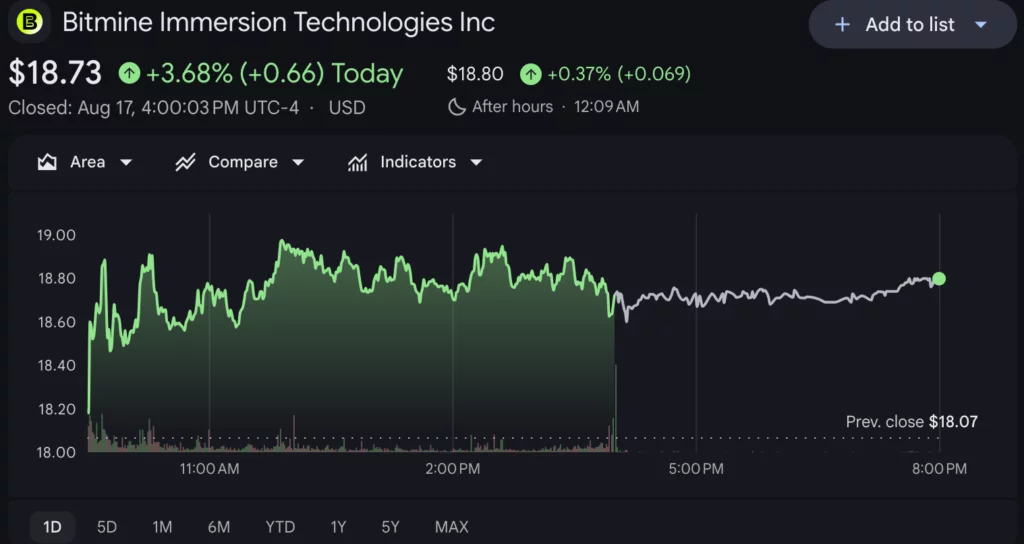
- BMNR shares rose 3.68% Monday to $18.73, then added 0.37% during after hours trading later.
- BitMine has staked 5,067,309 ETH, representing approximately 87% of its reported Ethereum treasury holdings currently.
- Annualized staking revenue of $250 million remains a company projection based on recent yields only.
- 1.7 million shares were repurchased last week under BitMine’s previously authorized $4 billion buyback program.
The U.S. company valued the tokens at approximately $11 billion using an ETH price of $1,893. BitMine said the position represented 4.8% of Ethereum’s estimated 120.7 million supply in its Aug. 17 release.
BMNR stock closed 3.68% higher at $18.73 on the New York Stock Exchange on Aug. 17. It gained another 0.37% to $18.80 in after hours trading, according to Google Finance data.
BitMine stock opened Monday at $18.20 and traded between $18.11 and $19.00. Approximately 30.95 million shares changed hands, compared with its reported average volume of 32.51 million.
Google Finance placed BitMine’s market capitalization at approximately $11.3 billion, based on 603.23 million outstanding shares. The market value was close to the company’s reported $11.4 billion in crypto, cash, marketable securities and other investments.
BMNR remained well below its 52 week high of $65.60. The stock was also above its 52 week low of $12.80. Those figures show that BMNR has experienced a wide trading range while BitMine expanded its Ethereum strategy.
BitMine ETH holdings approach the 5% target
BitMine calls its objective of holding 5% of Ethereum’s supply the “Alchemy of 5%.” Using the company’s stated supply estimate, the target would equal approximately 6.035 million ETH.
The current balance leaves BitMine roughly 219,836 ETH short. Its holdings represent about 96.4% of the tokens required. Changes in Ethereum’s supply could alter the final amount needed.
BitMine has reported weekly Ethereum purchases since adopting its treasury strategy on June 30, 2025. As previously reported, its Ethereum balance reached 5.74 million tokens in early July.
The latest acquisition was smaller than several earlier weekly purchases. In related coverage, the company previously added more than 100,000 ETH during a single week in May.
BitMine did not disclose the average purchase price for the latest 9,926 ETH. It also provided no deadline for completing its 5% supply target.
Staked ETH produces variable rewards
BitMine reported that 5,067,309 ETH was staked as of Aug. 16. The tokens were worth about $9.59 billion at the company’s reference price and represented 87.1% of its holdings.
Approximately 747,855 ETH remained outside staking based on the disclosed figures. BitMine said some of its tokens are staked through MAVAN, its Made in America Validator Network, alongside other staking partners.
The company projected $250 million in annualized staking revenue using a seven day yield of 2.61%. This is a company estimate rather than guaranteed revenue. Ethereum staking returns vary with validator participation, network activity, execution rewards and other factors.
Applying the same yield to BitMine’s entire ETH balance would produce approximately $287 million annually at the cited price. BitMine described that amount as a projection for when its treasury is fully staked.
The staking position has grown rapidly since December. As crypto.news reported, BitMine initially deposited 74,880 ETH for staking before expanding the program during 2026.
Share repurchases reach 20.8 million
BitMine repurchased 1.7 million common shares during the latest week. That raised total repurchases since July 1 to more than 20.8 million shares, according to the company.
The board increased its repurchase authorization from $1 million to $4 billion in April, an SEC filing shows. An authorization sets a spending limit but does not require BitMine to use the entire amount.
The announcement did not disclose the average price paid for the latest shares or the total amount spent. At Monday’s closing price, 1.7 million shares would have a market value of approximately $31.8 million. That calculation is an estimate, not the company’s reported cost.
Repurchases reduce the share count when the acquired stock is retired or held as treasury stock. However, future equity issuance or preferred stock conversions could offset that reduction.
The reported portfolio is valued at $11.4 billion
BitMine valued its combined crypto, cash, marketable securities and other investments at $11.4 billion as of Aug. 16. In addition to Ethereum, the company reported holding 210 Bitcoin and $78 million in cash and marketable securities.
The total included a $180 million position in Beast Industries and a $73 million stake in Nasdaq listed Eightco Holdings. BitMine refers to those investments as “moonshots.”
The reported total is not necessarily equivalent to assets calculated under accounting rules. Its value can also change quickly because Ethereum accounts for most of the portfolio.
Investors will next be watching BitMine’s SEC disclosures for further information about the repurchases and investment valuations. The company’s weekly updates will also show whether it continues acquiring ETH as it approaches its 5% target.
Jane Street – the popular quant trading firm with a heavy orientation toward crypto – disclosed more than $1 billion in U.S. spot Bitcoin ETF holdings as of the second quarter of this year.
BlackRock’s iShares Bitcoin Trust (IBIT) is currently dominating its portfolio. According to the firm’s latest Form 13F, filed on August 14th with the Securities and Exchange Commission (SEC), Jane Street holds roughly $828 million invested in IBIT, alongside other positions in products including Fidelity’s FBTC and Grayscale’s GBTC.
The filing covers the overall securities the firm holds at the end of the reporting period rather than direct Bitcoin ownership.
With that in mind, it turns out that the quant trading heavyweight also expanded its exposure across crypto exchange-traded funds beyond Bitcoin. As CryptoPotato recently reported, the same Q2 filing showed it holding more than 1.2 million shares of Bitwise’s spot XRP ETF, compared with just 20,605 shares three months earlier.
Jane Street also reported positions in XRP products from Franklin Templeton, Grayscale, Canary Capital, and 21Shares.
The Bitcoin numbers represent a serious increase from the first quarter. The company had previously cut its IBIT position by around 71% to about 5.9 million shares, which were worth approximately $225 million before rebuilding the stake during the second quarter.
That said, the holdings shouldn’t necessarily be interpreted as a one-sided bullish bet on Bitcoin. The firm is one of the largest market makers in the industry, and these filings provide only a quarter-end snapshot of long positions. They do not show the firm’s complete short, futures, swaps, or exposure to other derivative products.
The post Jane Street Reveals Over $1 Billion Invested in Bitcoin ETFs appeared first on CryptoPotato.


Binance reportedly plans to apply for authorization from the United Kingdom’s Financial Conduct Authority, seeking a potential return to the British market when the country’s comprehensive crypto rules begin in 2027.
Summary
- Binance reportedly plans an FCA application when Britain’s six month authorization window opens in September.
- The FCA still prohibits Binance Markets Limited from conducting regulated activities without its written consent.
- Applications run from September 30, 2026, through February 28, 2027, ahead of October 2027 implementation.
- Filing an application would not guarantee approval, permission to relaunch, or acceptance by British regulators.
- Authorized crypto firms must satisfy capital, governance, custody, financial crime, and consumer protection requirements standards.
The exchange intends to submit an application after the FCA opens its authorization gateway on Sept. 30, according to an Aug. 15 report from The Telegraph. Binance has not publicly confirmed that it filed an application or identified which legal entity would apply.
A successful application could allow Binance to resume regulated services for UK residents after the new framework takes effect on Oct. 25, 2027. Approval is not automatic, and the FCA has not said it expects to authorize Binance.
The regulator’s existing restrictions on Binance Markets Limited remain in force.
Binance must address restrictions dating from 2021
The FCA imposed requirements on Binance Markets Limited in June 2021, preventing the company from conducting regulated activities without the regulator’s prior written consent.
The watchdog’s current warning states that no other Binance Group entity holds UK authorization, registration or a license to conduct regulated activities in the country.
The FCA previously said Binance Markets Limited was not capable of being effectively supervised. It cited the wider group’s structure and complex, high risk products among its concerns.
Binance later withdrew an application to cancel unused UK permissions in 2023. The move left no Binance entity authorized to operate a regulated cryptocurrency business in Britain.
The exchange also stopped accepting new UK customers in October 2023 after the FCA introduced expanded financial promotion rules. Binance initially relied on an authorized company, Rebuilding Society, to approve its UK marketing.
The FCA later restricted Rebuilding Society’s ability to approve crypto promotions. Binance then announced through an official update that it would pause new registrations while searching for another compliant arrangement.
The FCA application window opens September 30
Britain’s new crypto authorization window will run from Sept. 30, 2026, through Feb. 28, 2027. The full regulatory regime starts on Oct. 25, 2027.
As crypto.news reported, companies operating in Britain must obtain fresh authorization before providing activities covered by the new framework. Existing registrations under anti-money laundering rules will not convert automatically.
Firms that apply within the window may qualify for transitional arrangements while the FCA assesses their applications. Those submitting applications after Feb. 28 will not receive the same protection and may need to stop relevant services until authorization is granted.
The FCA encourages applicants to file early. Its guidance says earlier applications provide more time for assessment and increase the period during which eligible companies can rely on transitional provisions.
An application is not a temporary license. Applicants must satisfy the regulator before receiving permission, and companies cannot assume they will be approved because they met the filing deadline.
FCA authorization would impose broader requirements
The new framework expands the FCA’s oversight beyond financial promotions and anti-money laundering registration. It covers trading platforms, dealing, arranging transactions, custody, staking, lending and certain stablecoin activities.
Authorized companies must follow prudential rules, operational resilience standards and financial crime controls. The framework also applies the Consumer Duty and the Senior Managers and Certification Regime to businesses conducting regulated crypto activities.
Trading platforms will face requirements involving disclosures, market abuse controls and asset admission standards. Custodians must meet rules governing client asset ownership, record keeping, reconciliation and private key management.
David Geale, the FCA’s executive director for payments and digital finance, said the regime would hold crypto companies to “similar standards” as other British financial services businesses.
The application review is therefore expected to examine Binance’s governance, ownership, compliance systems and ability to meet continuing supervisory requirements. The FCA can reject applicants that fail its minimum threshold or “fit and proper” tests.
Binance has not disclosed which UK services it would seek permission to offer. It also has not said whether a relaunch would cover spot trading, custody, staking or other products.
Binance faces competition from registered UK firms
Binance would enter a market where several competitors already hold FCA registrations under the existing anti-money laundering framework.
Coinbase, for example, secured permission to offer cryptocurrency services directly through its British entity in February 2025. IG Digital Assets later joined the FCA’s cryptoasset register.
Those registrations do not guarantee authorization under the 2027 framework. Every company conducting newly regulated activities must submit a fresh application or request a variation of its existing permissions.
Binance’s UK effort also follows regulatory setbacks elsewhere in Europe. The exchange withdrew its Greek application for authorization under the European Union’s Markets in Crypto Assets regulation in June.
In related coverage, Binance suspended most services for European Union residents after missing the licensing deadline. The company said it remained committed to finding another route into the European market.
The UK process is separate from the EU framework. FCA authorization would only address Binance’s position under British law and would not provide operating rights across the European Union.
A filing and FCA decision come next
The first verifiable development will be Binance’s submission of an application after Sept. 30. Neither the exchange nor the FCA has published an application notice.
The regulator does not guarantee that applications submitted during the window will receive decisions before October 2027. Eligible firms can continue specified activities under transitional provisions while awaiting a determination, but only if they satisfy the relevant conditions.
A Binance relaunch would require an affirmative FCA decision and any necessary removal or amendment of existing restrictions on Binance Markets Limited. The legal entity receiving authorization would also need to appear on the FCA register.
Until those steps occur, the reported application remains a plan rather than an approved UK return. Existing consumers should not interpret it as evidence that Binance currently holds an FCA license.
A Solana (SOL) whale that banked more than $20 million in 2023 has resurfaced after two years, buying $3.6 million in SOL.
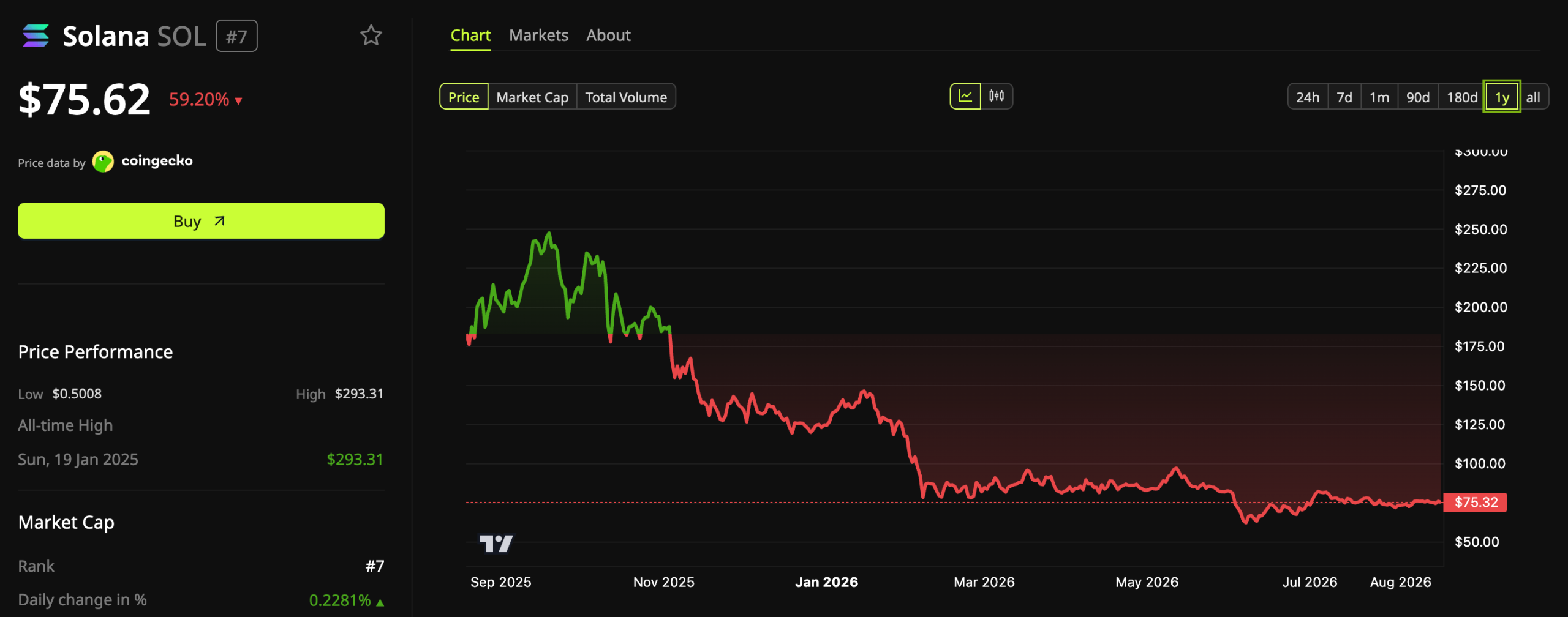
Blockchain tracker Lookonchain flagged the purchase. This comes as SOL trades roughly 74% below its January 2025 record high.
Dormant Whale Buys $3.6 Million in Solana After Two Years
The buy totaled 47,535 SOL. The wallet, tagged GvHYQQ, accumulated in 2023, before SOL began its climb.
It bought 291,790 SOL for $6.82 million across the August and October dips that year, averaging $23.37 per token. SOL then started climbing in late 2023.
The whale sold 191,789 SOL for $24.62 million at an average price of $128.36, locking in more than $20 million in realized profit. The address stayed silent for over two years afterward.
“Now, after 2 years of inactivity, the whale is buying the SOL dip again,” Lookonchain said.
According to Arkham data, the wallet still holds roughly 100,000 SOL from its original 2023 stack. The fresh buy lifts that position to about 147,535, worth close to $11.1 million at current prices.
Follow us on X to get the latest news as it happens
SOL Price Sits 39% Lower This Year
Meanwhile, SOL changed hands near $75. The altcoin has moved little over the past 24 hours. It is down about 1% across the past month.
The token has shed roughly 39% year-to-date. Over 12 months, the decline reaches 59%.

The backdrop is split. Several on-chain signals turned bearish in mid-August. Exchange netflows flipped positive, while decentralized exchange volume sat close to 80% below its April peak.
Institutional flows point the other way. Solana ETF inflows climbed to $10.26 million in the week ending August 14, nearly 70 times the prior week’s total.
With the macro and geopolitical backdrop still volatile, whether the bet pays off a second time is an open question.
Subscribe to our YouTube channel to watch leaders and journalists provide expert insights
The post Solana Whale That Made $20 Million in 2023 Starts Buying Again appeared first on BeInCrypto.


The U.S. Commodity Futures Trading Commission is preparing to request public input on futures tied to artificial intelligence computing capacity, according to an Aug. 17 Bloomberg report.
Summary
- CFTC plans public input on compute futures after completing White House regulatory review, Bloomberg reported.
- CME targets October 5 for two contracts priced through Silicon Data’s daily GPU rental benchmarks.
- Both CME and ICE say their planned compute products remain subject to regulatory review processes.
- Compute futures could help AI developers and cloud providers hedge changing graphics processor rental costs.
The agency reportedly sent a draft request to the White House Office of Management and Budget for review. Once that review ends, the CFTC could open a public comment period lasting 30 or 60 days.
No request had appeared on the CFTC’s public comment pages or in the Federal Register by Aug. 18. The exact questions, comment deadline and effect on pending contracts therefore remain unconfirmed.
The regulatory process comes as CME Group reportedly targets Oct. 5 for two compute futures contracts using Silicon Data benchmarks. The planned launch remains subject to regulatory review.
CFTC review could define compute as a derivatives market
Compute futures would allow market participants to trade contracts linked to the future cost of renting graphics processing units. GPUs provide the processing capacity needed to train and operate many artificial intelligence systems.
The market could give AI developers, cloud providers and data center operators a way to manage changing rental prices. Financial traders could also gain exposure to compute pricing without owning chips or operating data centers.
The CFTC’s reported request is broader than approval of an individual contract. It could seek information about benchmark reliability, market manipulation, settlement methods, liquidity and how exchanges define a standardized unit of compute.
A request for comment would not constitute a proposed rule or a final regulatory decision. It also would not automatically block CME’s target date unless the CFTC separately objects to the contracts or requires further review.
Bloomberg reported that the public consultation could complicate launch plans for CME and Intercontinental Exchange. The CFTC has not publicly confirmed a delay.
CME plans contracts using Silicon Data benchmarks
CME and Silicon Data first announced their partnership on May 12. The exchange said the planned futures would use daily benchmarks tracking on demand GPU rental rates.
Silicon Data collects pricing information across GPU markets, where costs can differ by hardware, provider, region and contract duration. CME argues that standardized benchmarks could make those fragmented prices easier to compare and hedge.
“Compute is the new oil of the 21st century,” CME Chairman and Chief Executive Terry Duffy said in the official announcement. His description represents CME’s assessment of the market rather than a regulatory classification.
Silicon Data CEO Carmen Li said existing compute prices can “vary dramatically” between providers and regions. The company claims its benchmarks provide consistent pricing for a market that has historically lacked transparent reference rates.
Reports now place CME’s intended launch on Oct. 5, but the date does not appear in the exchange’s original May announcement. CME has consistently stated that any launch remains subject to regulatory review.
Contract specifications, including size, expiration months and settlement procedures, will be needed before traders can assess the products fully.
ICE is developing competing compute contracts
Intercontinental Exchange announced separate plans in May to list U.S. dollar denominated, cash settled contracts using Ornn’s Compute Price Index.
Ornn’s index tracks transaction prices across GPU models including Nvidia’s H100, H200, B200 and RTX 5090. ICE said its contracts could provide price discovery across multiple types of computing hardware.
ICE later announced another planned product using NativX’s COIL Index. The benchmark tracks tokenized, energy normalized compute and connectivity. The related contracts would trade alongside ICE’s existing electricity and natural gas products.
Power is a major cost for data centers, making energy prices closely connected to compute economics. ICE said placing the products on the same exchange could let operators manage electricity and GPU price exposure together.
Both ICE projects remain subject to regulatory processes, and the exchange has not announced a fixed launch date. The development of several competing benchmarks could give users more choice but may also divide liquidity across contracts.
Crypto infrastructure is increasing AI capacity
The emerging derivatives market follows rapid investment in U.S. data centers and GPU infrastructure. External forecasts cited by Forbes place AI infrastructure spending near 2% to 2.5% of U.S. gross domestic product in 2026, although those figures are private estimates rather than government data.
Several cryptocurrency mining companies have converted power infrastructure to AI workloads. Their access to electricity, cooling equipment and large industrial sites makes some mining facilities suitable for high performance computing.
As previously reported, TeraWulf generated more revenue from AI hosting than Bitcoin mining during the first quarter of 2026.
In related coverage, Galaxy Digital delivered 133 megawatts of computing capacity to CoreWeave under a 15 year agreement at its former Bitcoin mining campus in Texas.
These long term arrangements show demand for tools that can measure and manage compute costs. They do not establish whether a standardized futures market will attract enough trading activity.
Public questions and contract filings come next
The next formal development would be OMB completion of its review and publication of the CFTC’s request. Only the published document can confirm the questions and response deadline.
CME must also complete the applicable CFTC contract filing process. Registered exchanges can submit new products through self certification, but the CFTC can review contract terms and require additional action where permitted by law.
Public feedback may focus on whether the underlying benchmarks resist manipulation, represent executable rental prices and remain reliable when newer GPUs replace older hardware.
Market participants may also address settlement disruptions, regional pricing differences and whether compute contracts resemble energy, commodity index or financial futures.
The Oct. 5 launch remains a target rather than a confirmed trading date. Regulatory review, contract filings and operational readiness could still change the timetable.
M&G Investments is betting on a rally in South Korean government bonds, arguing the Bank of Korea (BOK) will slow its rate hike cycle even as most investors brace for more tightening.
M&G is a London-based global asset manager listed on the FTSE 100, overseeing more than £300 billion for pension funds, insurers and other institutional clients worldwide.
A Central Bank Leaning Hawkish
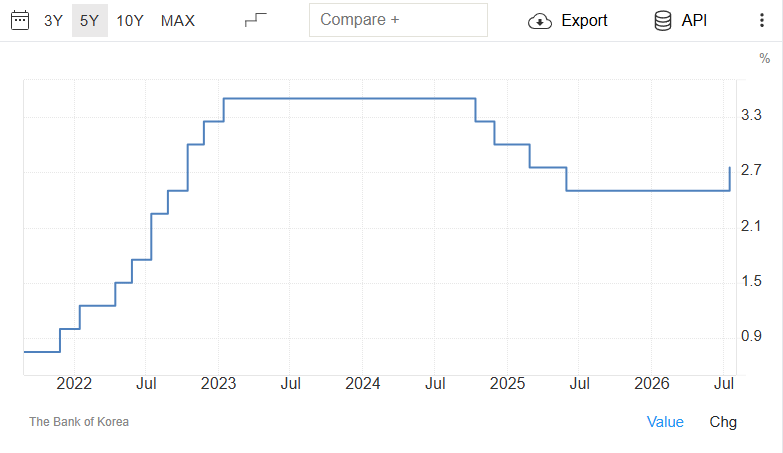
The BOK raised its benchmark rate a quarter point to 2.75% in July, its first rate hike since early 2023, after growth and inflation data ran hotter than expected. South Korea’s economy expanded 0.6% in the second quarter, and consumer prices rose 2.8% in July, still above the central bank’s 2% target.
Outgoing senior deputy governor Ryoo Sangdai said last week that further hikes remain likely, with policymakers weighing core inflation, growth momentum and financial stability risks ahead of the BOK’s Aug. 27 policy meeting.

Ryoo downplayed the recent won stabilization and a KOSPI pullback as factors for the board, saying inflation trends will carry far more weight in the decision.
“The scale of the increase may not be large, but it could be persistent.”
— Ryoo
M&G Sees an AI-Fueled Bond Rally Incoming
Even with this hawkish leaning, Low Guan Yi, M&G’s head of Asia fixed income in Singapore, argues the market’s rate hike bets have gone too far. She points to a semiconductor-driven tax windfall from Korean chipmakers and hardware suppliers, which should let Seoul cut back on bond issuance and tighten supply.
“We believe the Korean bond yield curve has priced in too many rate hikes.”
— Low
M&G has added to its Korean government bond holdings over the past two months, betting that the tighter supply outlook offsets the central bank’s hawkish signals.
The call comes as foreign investors pull back. Bloomberg reported that net foreign selling of Korean government bonds hit about $1.2 billion in July, the highest level since February 2025, pushing the 10-year yield up 22 basis points since the end of June.
That bond weakness follows a rough stretch for Korean risk assets, including the country’s worst KOSPI crash since 2008 earlier this month.
What Comes Next
Whether M&G’s call pays off hinges on the BOK’s Aug. 27 decision. A slower pace of hikes would validate the firm’s bond bet and support a rebound in Korean Treasury Bond prices.
A fourth straight increase, on the other hand, would vindicate the hawkish pricing in swap markets that Low argues has already gone too far.
The post M&G Backs Korean Bond Market Rally: Are Rate Hike Fears Overdone? appeared first on BeInCrypto.

Human Remains Found 15 Miles From Nancy Guthrie’s Tucson Home Not Linked to Case, Sheriff Says ‘At This Time’

Hyperliquid Policy Center backs SEC Rule 611 repeal

Hard Kick back in form at Caulfield in 2026

Weekend Open Thread: Staud – Corporette.com

Weekend Open Thread – Corporette.com

Weekend Open Thread: Brooks Brothers

Langkah Awal Membuat Financial Plan yang Akurat #financialplanning #keuanganpribadi

The Psychology of Money by Morgan Housel | Financial Freedom Tips in Hindi

Live Trading Setup Today | Gold, Crypto & Forex Market Analysis | Surya Trading Tips
-

 Fashion4 days ago
Weekend Open Thread: Ann Taylor
-
 NewsBeat6 days ago
Communication cards help banking customers access services or report scams
-
 Sports4 days ago
This U.S. Amateur is a glimpse into golf’s future in more ways than you think
-
 NewsBeat3 days ago
Myanmar says over 300,000 Rohingya refugees verified for repatriation as exodus enters ninth year
-

 Sports3 days ago
Birmingham 2026: Day 6 Timetable for Irish Athletes
-

 Politics3 days ago
SEQ Code: The Three Letter Boarding Pass Code That Could Give You The Worst Seat
-
 Entertainment6 days ago
Keke Palmer Subtly Hints At Sean Evans Drama With Cryptic Post
-

 Fashion7 days ago
Coffee Break: The Fonteyn Jane Flat
-

 Tech7 days ago
Zoom Screen-Sharing Bug Let People Fully Take Over Other Devices On A Call
-

 Fashion7 days ago
Should you refinance your debt? Pros, cons, and real numbers
-
 Tech4 days ago
11 Ways to Rank Your Videos
-

 Fashion7 days ago
Claire Life: Kicking Off MVAAFF With the C Suite Luncheon Featuring Phylicia Rashad, Letoya Luckett, and More!
-
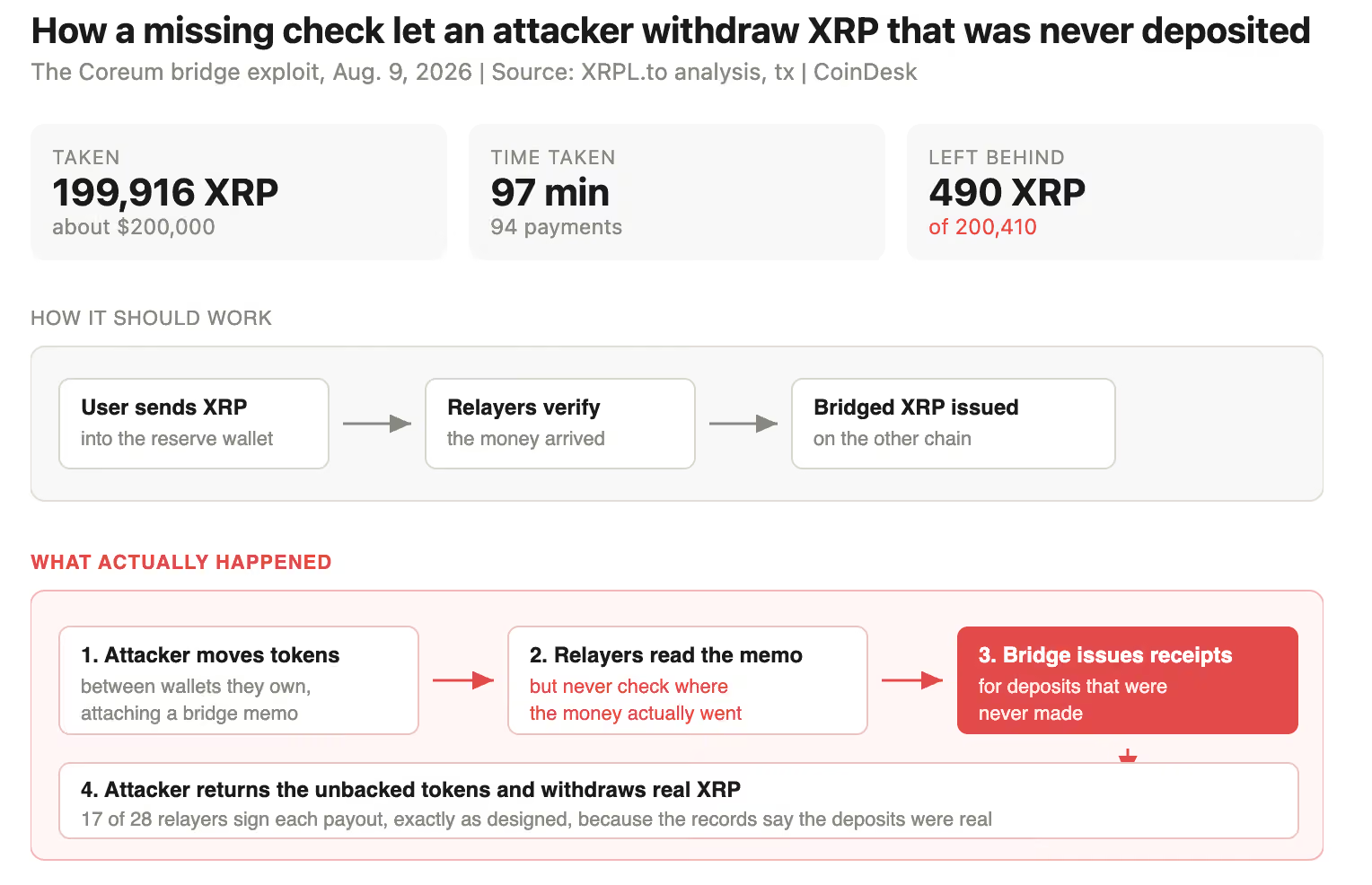 Crypto World6 days ago
XRP bridge drained after software mistook fake deposits for real ones
-

 Sports6 days ago
DeQuan Jones in ‘high spirits’ after successful leg surgery
-

 Fashion7 days ago
French Rose Gown with Cape Sleeves
-
 Entertainment7 days ago
Star Wars Officially Continues ‘The Last Jedi’ With a New Spin-Off
-

 Tech5 days ago
DeepSeek Harness launches as open source rival to Claude Code, alongside V4-Pro on API with higher prices
-
 Crypto World6 days ago
Perplexity AI Predicts an XRP Scenario Few Analysts Are Discussing
-

 Politics7 days ago
In the Chris Kaba case, the police watchdog capitulated to the mob
-

 Tech6 days ago
SpaceXAI’s Grok Bot turns agents into persistent digital coworkers that can operate your apps for $120-per-month
You must be logged in to post a comment Login