
Crypto World
Jump’s Hyperliquid Footprint Explodes as Trading Volume Nears $150 Billion


Jump Trading’s cumulative trading volume on Hyperliquid has nearly reached $150 billion since the firm made its first deposit on December 12, 2025, according to Hyperdash co-founder Hanson Birringer, who mapped the firm’s entire activity on the exchange.
Jump operates one master account alongside 16 subaccounts, and its trading now represents almost 8% of all perpetual futures volume on Hyperliquid and 19% of volume in xyz markets.
Jump’s Hyperliquid Activity
In July alone, its share rose to almost 18% of total exchange volume and 29% of xyz volume. Jump initially spent about a week testing the platform in December, during which it traded $153 million across BTC, SOL, and HYPE, before funding its master account and starting the sub-process creation.
Each wallet has a specific role, including separate accounts for crude oil, Brent, natural gas, and each new stock listing, while a larger book handles the S&P 500, XYZ100, SK Hynix, silver, gold, and memory-related names. The firm’s strategy is primarily driven by taker volume, as maker volume accounts for only 11% to 35% of fills across its activity. According to Birringer, this appears to be a hedging or arbitrage book paired with other venues to capture differences in spreads and funding rates.
Jump’s current book is long $32 million of Brent and $16 million of CL, while holding shorts in gold, silver, MU, NVDA, DRAM, SK Hynix, XYZ100, and megacap names. The positions total $145 million in notional against $63.6 million in account value. By individual market, the trading firm accounts for 38% of DRAM volume, 36% of NATGAS, 33% of Brent, 32% of SP500, 26% of XYZ100, and 16% of CL, compared with 2.6% of BTC volume.
Between April and August, the master account also increased its use of Hyperliquid’s gossip priority feature and paid 966 HYPE, mostly in May, before stopping. Jump has paid about $7 million in fees to the exchange so far, while generating only a few hundred thousand dollars of PNL, further supporting the view that its Hyperliquid activity is one part of a multi-venue market-making operation.
Its roughly $65 million of USDC margin on the exchange is also generating an additional $1.8 million in annual revenue for Hyperliquid through the recent AQAV2 fee accrual.
Institutional Exposure
HYPE hit an all-time high of $89.60 on September 6 and has remained close to that level three days later. The latest price rise came as new data revealed institutional holdings across three HYPE funds: the Bitwise Hyperliquid ETF, 21Shares Hyperliquid ETF, and Grayscale Hyperliquid Staking ETF. Bloomberg Intelligence ETF analyst James Seyffart recently said second-quarter 13F filings showed 30 investment managers holding a total of around $75 million in the funds.
Wealth High Governance Asset Management had the largest position at nearly $24 million, followed by OLP Capital Management at $10.5 million. UBS held $7.5 million, Bank of Montreal had about $6.7 million, and Jane Street Group held roughly $4.4 million. Other reported holders included Discovery Capital, Brevan Howard, Flow Traders, Virtu Financial, and HighTower Advisors.
Last month, Trump said Commodity Futures Trading Commission Chair Michael Selig was working to bring the perpetuals-focused trading platform into the US in a “fully compliant and legal fashion,” which added to expectations around its expansion into the country.
The post Jump’s Hyperliquid Footprint Explodes as Trading Volume Nears $150 Billion appeared first on CryptoPotato.

President Donald Trump said Wednesday that oil prices will not fall until right after the November midterm elections. He tied relief at the pump to an Iran war he expects Tehran to abandon once Americans vote.
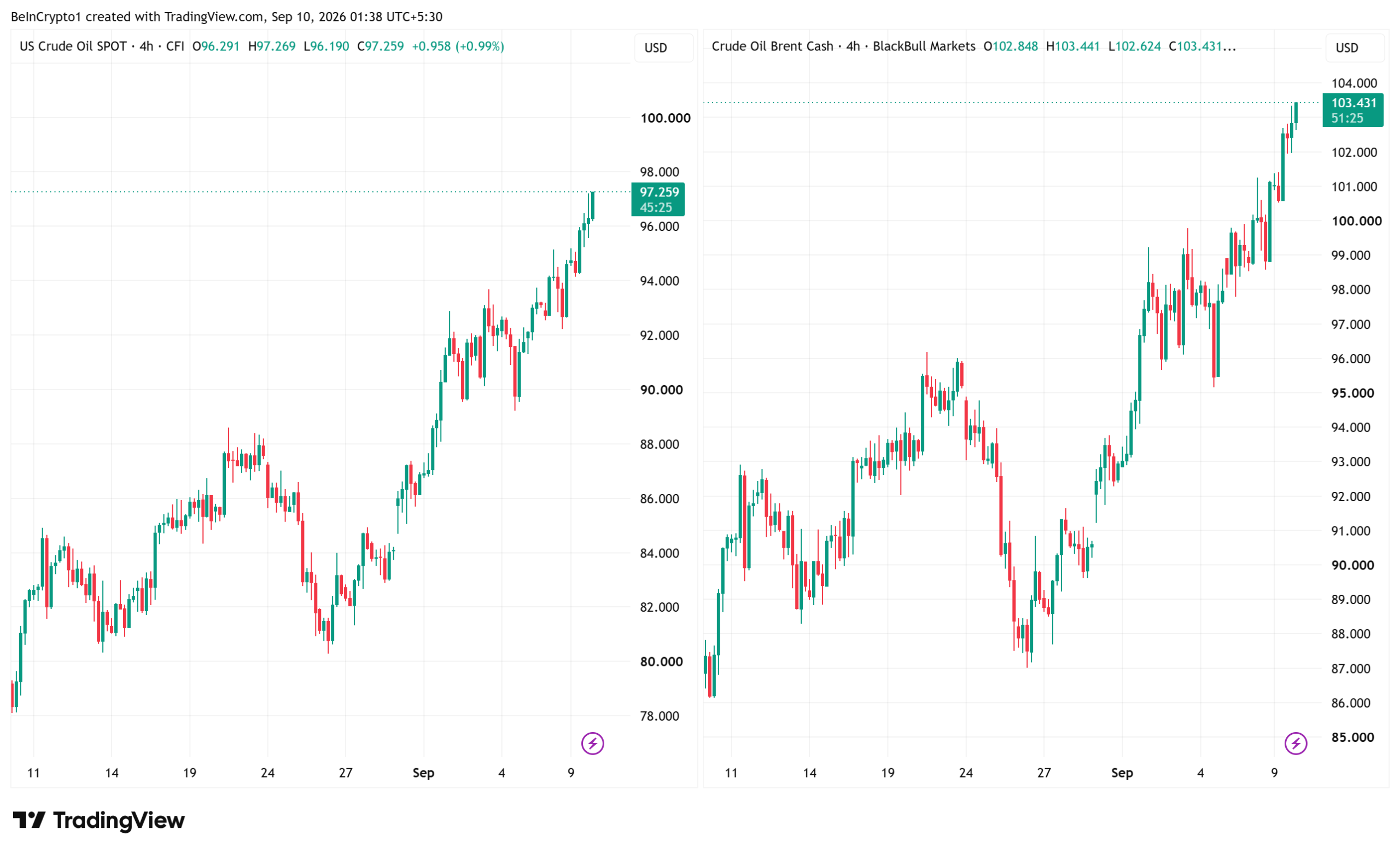
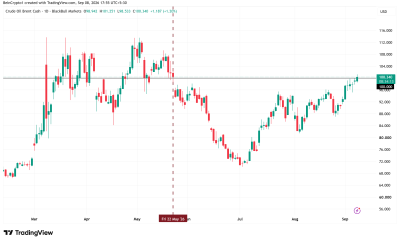
Brent crude, the global oil benchmark, climbed 3.78% to $103 the same day. That is its highest level since May, and it followed fresh strikes around the Strait of Hormuz.

Oil Sets the Political Clock
Trump spoke to reporters before flying to a Republican convention in Dallas, accusing Iran of dragging out the fighting to weaken his party in the midterms, the congressional elections held halfway through a presidential term.
“I think it’s going to take a little bit longer than the midterm,” he said.
He also argued Tehran is near collapse and would seek an end to the war immediately after the vote. No Iranian official has offered any such timetable. The conflict is now in its seventh month.
BeInCrypto reported a day earlier that Goldman Sachs saw $120 oil as Trump walked away from diplomacy. Wednesday’s remarks confirmed that reading.
“Bookmark this lie…Why should Americans pay the price for the wars of the Israeli regime?” the Consulate General of the Islamic Republic of Iran wrote in a post, responding to Trump putting a political clock on oil prices.
Follow us on X to get the latest news as it happens
Pump Prices and Crypto Feel the Squeeze
The American Automobile Association (AAA) put the national gasoline average at $4.22 a gallon on Wednesday. A month earlier drivers paid $4.01.
Traders are now pricing the same war twice, once in oil and once in risk assets. Crypto bettors currently give Democrats 51% odds of sweeping Congress, with record pump prices cited as a driver.

Republicans currently control both chambers of Congress. Elections are set for November 3.
History Says Wars Move Oil, Not Voters
Trump’s remarks notwithstanding, the record gives his timeline little support. Crude has collapsed after a midterm before, but never because Congress changed hands.
Oil ran from $17 a barrel in July 1990 to roughly $46 by mid-October. Prices then slid as coalition forces gained ground against Iraq and supply fears eased. The war resolving moved the market, not the November vote.
Academic work points the causality the other way. A World Bank study of 207 elections across 50 democracies found that a 1% oil shock cuts an incumbent’s re-election odds by 5.9 percentage points. Higher prices squeeze household spending, and voters punish whoever holds office.
“Trump’s latest lie is that the war will end immediately after the elections. The spin is that Iran is only holding out to influence the outcome of the election. It’s a very convenient take, as it lets Republicans off the hook, assuming voters are dumb enough to buy the excuse,” Peter Schiff challenged.
That makes the midterms far more likely to be a consequence of $100 oil than a cure for it. Whether Brent falls in November depends on the Strait of Hormuz reopening, and voters have no say in that.
The post Trump Gives Timeline for Oil Prices to Fall, Brent Pushes to May Highs appeared first on BeInCrypto.
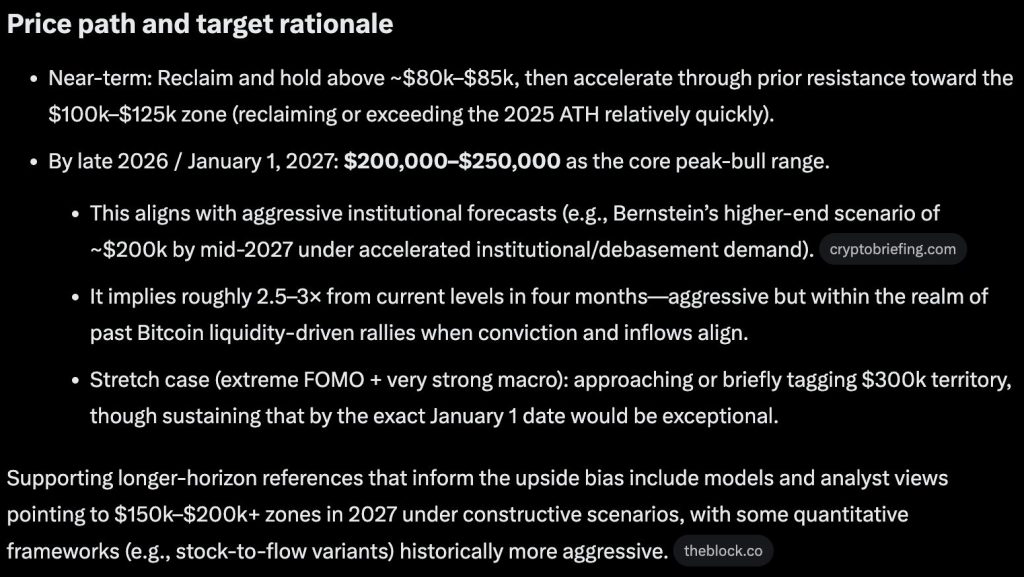
The Elon Musk-backed Grok AI predicts BTC could hit a quarter of a million dollars by January 1, 2027, a figure sure to excite the Bitcoin community. The model predicts BTC could reach between $200,000 and $ 250,000 by the end of 2026.
Grok AI points to prior cycles showing diminishing percentage returns as market cap grows, and the current structure (ETFs, larger institutional ownership) can both amplify upside and mute extremes compared with pure retail-driven eras.
However, Bitcoin hitting $250K in 2026 would be a major milestone for the world’s largest digital asset and could serve as a springboard toward $1M.

Grok AI Predicts: The Bitcoin Price Path to $250,000
Near-term: Reclaim and hold above ~$80k–$85k, then accelerate through prior resistance toward the $100k–$125k zone (reclaiming or exceeding the 2025 ATH relatively quickly).
By late 2026 / January 1, 2027: $200,000–$250,000 as the core peak-bull range. This aligns with aggressive institutional forecasts (e.g., Bernstein’s higher-end scenario of ~$200k by mid-2027 under accelerated institutional/debasement demand).
It implies roughly 2.5–3× from current levels in four months, aggressive but within the realm of past Bitcoin liquidity-driven rallies when conviction and inflows align.

Stretch case (extreme FOMO + very strong macro): approaching or briefly tagging $300k territory, though sustaining that by the exact January 1 date would be exceptional.
Supporting longer-horizon references that inform the upside bias include models and analyst views pointing to $150k–$200k+ zones in 2027 under constructive scenarios, with some quantitative frameworks (e.g., stock-to-flow variants) historically more aggressive.
Earn $50 and Enter $300K Prize Draw on EdgeX
Bitcoin Hyper Targets Early Mover Upside as BTC Tests Key Levels
A golden cross with historical 45-60% rally precedent is exactly the kind of setup that gets a trader’s pulse up, and rightly so. But here’s the disappointing math.
Even a 60% BTC move from here lands around $127,000, solid for holders, unremarkable for anyone chasing asymmetric upside at this market cap. That’s pushed capital rotation toward earlier-stage infrastructure plays sitting closer to the ground floor.
Bitcoin Hyper ($HYPER) is building the first Bitcoin Layer 2 with native SVM integration, smart contracts that run faster than Solana itself, bridged to Bitcoin’s base-layer security through a decentralized canonical bridge.
The presale has raised $33,116,236.62 at a current token price of $0.0136859, with staking rewards on offer for early participants. The pitch is straightforward: Bitcoin can secure trillions but can’t run an app; Hyper aims to fix that without touching BTC’s trust model.
Gain Access to New Bitcoin Layer 2 Early Here
Discover: The Best Crypto to Diversify Your Portfolio
The post Elon Musk Grok AI Predicts $250K Bitcoin Price by 2027 appeared first on Cryptonews.
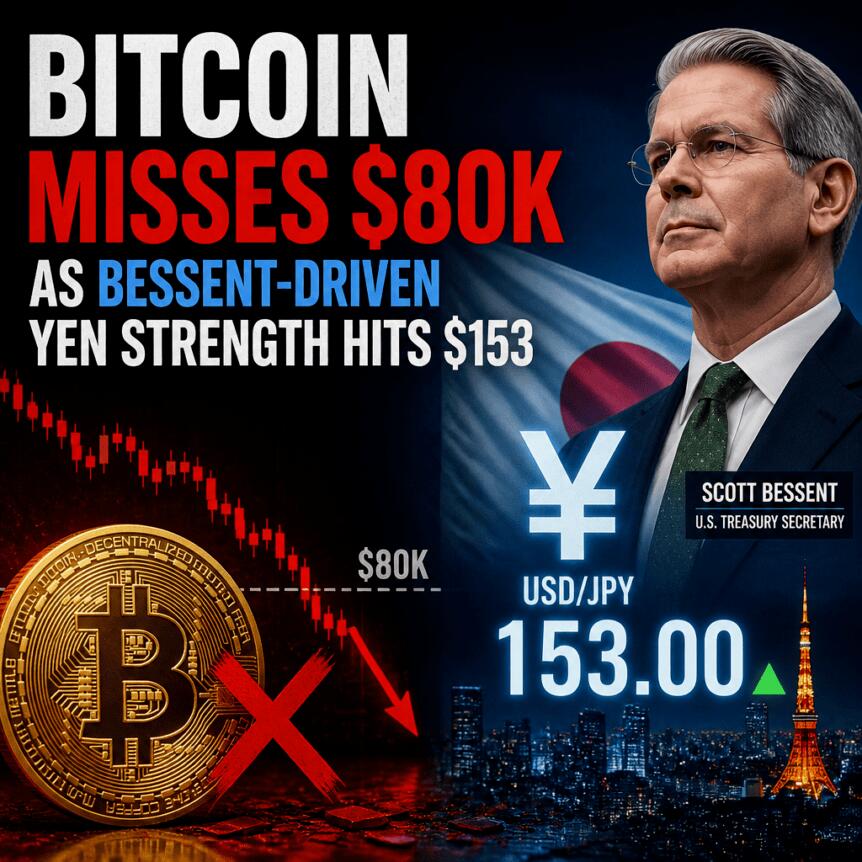
Bitcoin traded in a cautious range under $80,000 on Wednesday, weighed by a broader risk-off mood driven by escalating tensions tied to Iranian oil shipping and renewed pressure on macro liquidity conditions. At the same time, the Japanese yen strengthened sharply, keeping traders focused on the mechanics of the yen carry trade and the possibility of further currency market intervention.
Market moves unfolded as US stocks drifted lower and crude oil pushed higher after fresh US strikes on Iranian-linked oil tankers. Brent crude climbed above $101 per barrel for the first time since late July, while WTI traded above $96, according to price levels cited alongside TradingView charts.
Key takeaways
- Bitcoin struggled to regain $80,000 after a short-term bounce attempt, while BTC/USD remained roughly flat to slightly lower on the day.
- Oil’s jump—Brent above $101 and WTI above $96—added to pressure on risk assets amid US-Iran developments.
- The yen moved to its strongest level against the dollar since February, trading around 153 per USD, with yen shorts still positioned near record levels.
- Comments from US Treasury Secretary Scott Bessent revived attention on possible additional yen intervention, potentially accelerating an unwind in leveraged positions.
- Traders are also watching the Bank of Japan’s next decision, with expectations for a 0.25% rate hike on Sept. 28.
Bitcoin stalls as oil and equities soften
According to TradingView data referenced in the report, BTC/USD’s local upside attempt faded as the pair tried to retest $80,000. At the time of writing, Bitcoin was down about 0.4% on the day, signaling a lack of momentum rather than a decisive breakdown.
That hesitation tracked with weaker sentiment elsewhere. Fresh US strikes on Iranian oil tankers contributed to lower trading in US equities at the Wall Street open, while oil prices printed new three-month highs. The move in energy markets mattered for crypto largely because it reinforced the same macro mix investors often react to: geopolitical shocks, higher near-term inflation expectations, and tighter financial conditions.
Oil has been acting as a transmission channel for risk appetite this week. The article notes Brent’s surge above $101 per barrel, building on gains from the previous session, while WTI held above $96.
Yen strength returns carry-trade risks to the foreground
While oil set the tone for risk assets, the yen’s renewed strength became the centerpiece for traders watching cross-currency liquidity. The Japanese currency was cited as trading around 153 per dollar—its highest level versus the USD since February—and up significantly since early August (the report states a 6.5% rise from the start of August).
The underlying concern is the yen carry trade: when the yen strengthens, positions that borrow yen and buy higher-yielding assets can become vulnerable, forcing reductions and moving liquidity across markets. The article points back to earlier reporting that Japan and the US conducted repeated joint interventions in foreign exchange markets, which helped drive the yen higher rapidly.
That dynamic has also been complicated by speculation that Washington could limit Japan’s selling of US Treasuries as part of future intervention operations—an angle that, if true, would directly connect global reserve flows with yen liquidity.
Near-record yen short positioning raises the stakes
Wednesday’s focus intensified after Barchart flagged record yen short positioning at the start of September, citing Bloomberg data. The report says total yen shorts hovered above 5 trillion yen, a scale large enough to matter if price action forces an orderly unwind to turn into a faster scramble for exits.
In comments to Reuters, Charu Chanana, chief investment strategist at Saxo, argued that the yen’s continued climb could change the pace of de-leveraging. She noted that the carry trade may be particularly exposed because the unwind could be occurring before the Bank of Japan delivers the rate hike investors were expecting.
Chanana’s warning, as quoted in the article, was that while some yen shorts may already have been cut, positioning still appears sizable—meaning further yen gains could shift a gradual reduction in leverage into a more self-reinforcing unwind.
That matters for crypto because many traders treat liquidity conditions—especially those tied to global funding currencies like USD and JPY—as a key input for volatility and risk-taking. If leveraged positions unwind quickly, correlation spikes and sudden repricing can follow across multiple asset classes, including digital assets.
Scott Bessent renews intervention signals ahead of BOJ decision
The yen story also gained a political and policy dimension after renewed hints from US Treasury Secretary Scott Bessent. Earlier coverage cited in the article described how Bessent suggested the “door was open” to future yen intervention operations, and the current reporting says he reinforced those themes this week.
According to the Financial Times, Bessent made remarks at Southern Methodist University in Texas in which he suggested he has “asymmetric information” about how Japanese policymakers might respond if the US intervenes in the Japanese yen market. The quote, as presented in the report, framed intervention as something he can anticipate—particularly relative to traders positioned in the FX market.
These comments come alongside expectations for the Bank of Japan’s next meeting on Sept. 28. The article notes that traders are looking for a 0.25% interest-rate hike, and it also explains that the yen’s strength has been occurring while the market waits for BOJ action.
In practice, the timing is important: if intervention talk and yen strength persist while the rate decision draws near, the incentive for additional yen-short exposure may drop, while pressure to reduce carry-related leverage could rise.
For investors, the key takeaway is that Bitcoin’s lack of momentum near $80,000 is occurring in a macro environment where both geopolitical risk (via oil) and funding stress (via the yen carry trade) are moving in the same direction—toward tighter conditions for risk assets.
Traders should watch how quickly yen shorts unwind and whether Bessent’s intervention signals translate into more concrete FX-market actions, while also tracking oil’s trajectory and the lead-up to the Bank of Japan’s Sept. 28 decision, which could determine whether current volatility remains contained or escalates.

Investors in artificial intelligence stocks have been anticipating more huge initial public offerings, with Elon Musk’s Space Exploration Technologies (SPCX) already out of the gate, albeit with underwhelming results so far. With Anthropic preparing for what could be the largest technology IPO in market history, rival OpenAI is making news of its own. OpenAI has released its new frontier model…
Copyright ©2026 Investor’s Business Daily, LLC. All rights reserved. 87990cbe856818d5eddac44c7b1cdeb8


Mastercard has launched Agent Connect to give merchants one integration for product discovery, cart creation and customer-approved payments across AI shopping platforms.
Summary
- Agent Connect links merchants, AI agents, digital platforms, and payment providers through one connection.
- Merchants can provide current product, price, and inventory data from their existing catalogs.
- Agent Pay uses tokenized permissions to verify that customers authorized AI-initiated purchases.
- More than 30 companies support Mastercard’s payment system for autonomous software and machines.
Mastercard Agent Connect reduces separate merchant integrations
Mastercard said in a Sep. 9 announcement that Agent Connect allows merchants to participate in AI-assisted shopping without building a separate technical connection for every AI platform.
Through the service, an AI agent can search a participating merchant’s products, assemble a cart, and move the customer toward payment. A purchase can proceed after the customer gives authorization, keeping the final spending decision under the buyer’s control.
Instead of sending shoppers through several disconnected systems, the integration links merchants with AI agents, digital platforms and payment companies. Mastercard said businesses can use their existing catalogs to supply current prices, product descriptions, and stock information.
Keeping catalog data current matters because an AI agent may make a recommendation or prepare an order without the shopper visiting a conventional product page. Agent Connect gives the merchant a direct role in supplying the information used during that process.
Merchants also retain control over their branding, prices, and customer relationships, according to Mastercard. The payment company designed the service to keep businesses involved from the first product search through the completed transaction, rather than limiting their role to order fulfillment.
Such control may become more important as product searches move from merchant websites and search engines into conversational interfaces. For retailers, inaccurate prices or inventory details presented by an outside agent could lead to failed transactions, refunds, or customer complaints.
Agent Connect sits within Mastercard’s Agent Suite for Merchants, which brings AI shopping and payment services into the same commerce system. Businesses can use the suite within their own digital channels, allowing customers to search for products, compare options, receive recommendations, and complete checkout.
Mastercard adds Anthropic tools to its merchant suite
Working with Anthropic, Mastercard is also giving businesses access to a commerce agent blueprint that combines Claude models with Mastercard’s payment capabilities. Merchants can use the framework to develop shopping agents while retaining control over their digital storefronts.
Rather than focusing only on product discovery, the updated suite supports tasks that arise after payment. Mastercard said merchants can deploy AI agents to help customers monitor orders, request refunds, and process returns.
The partnership connects Anthropic’s models with the payment and authorization layers needed to move from a recommendation to a purchase. Consumer approval remains part of the process, while merchants continue to set product information and commercial terms.
Mastercard Chief Product Officer Jorn Lambert said changes in online shopping will place AI agents between many businesses and their customers.
“AI agents will change the buying interface again,” Lambert said.
Mastercard wants merchants to maintain control as that interface changes, according to the executive. The Agent Suite is structured to let businesses offer AI-supported services inside channels they manage rather than surrendering the entire shopping experience to outside platforms.
Mastercard’s work on Agent Connect follows its June rollout of an AI payment network supported by Ripple, Coinbase, Stripe, Adyen, Cloudflare, OKX, the Solana Foundation and other companies. As crypto.news reported at the time, more than 30 payment, blockchain, and technology firms backed the initiative.
Called Agent Pay for Machines, the system was designed for large numbers of small transactions initiated by autonomous software. Mastercard said users could set spending limits, authorization requirements and settlement conditions, while transactions could move through standard payment networks or stablecoin rails.
Agent Pay verifies customer authority before purchases
Mastercard Agent Pay provides the payment controls behind transactions initiated by AI agents. When a customer allows an agent to make a purchase, the system records that authority through a tokenized permission.
The token helps confirm that the agent has permission to act, separating an authorized purchase from an agent action that falls outside the customer’s instructions. Mastercard’s approach places identity, consent and payment credentials within the transaction process instead of treating the agent like an ordinary cardholder.
Customer authorization remains important when software compares products or prepares a cart based on a general request. An instruction to find a product within a budget, for example, does not necessarily give an agent unlimited authority to complete every related transaction.
With tokenized permissions, payment providers and merchants can receive information showing that an agent acted under a defined instruction. Mastercard said Agent Pay applies its existing security and payment infrastructure to transactions in which software acts for a consumer or business.
Stablecoins are also part of the company’s work on agent-led commerce. In May, MoonPay introduced a Mastercard stablecoin card that lets users authorize AI agents to spend assets held in on-chain wallets.
The MoonAgents Card converts crypto into fiat at checkout and works at merchants that accept Mastercard. According to MoonPay, agents can initiate payments without requiring users to preload a separate balance or first transfer their funds off-chain.
Combining card acceptance with stablecoin balances gives developers another route for building automated payment tools. Mastercard’s own systems can also support card or stablecoin settlement, depending on the product and participating payment provider.
Mastercard supports payments between software and machines
Agent Pay for Machines extends the authorization model beyond consumer shopping by allowing software applications and connected machines to transact with each other. Mastercard designed the service for repeated, low-value payments that may occur too frequently for manual approval each time.
Possible transactions could involve software paying for digital resources or machines purchasing services under preset conditions. Mastercard said the system can process payments through card networks or stablecoins, while owners retain control through spending and authorization rules.
More than 30 companies have joined Mastercard’s machine-payment initiative. Participants include Stripe, Coinbase, Adyen, Checkout.com, Cloudflare, OKX and Global Payments, bringing together payment processors, crypto companies and internet infrastructure providers.
Ripple and Coinbase previously linked stablecoins and blockchain infrastructure to the need for quick, programmable settlement between autonomous agents. During the June launch, RippleX Senior Vice President Markus Infanger said the XRP Ledger and RLUSD could provide fast settlement, predictable costs, programmable compliance and an audit trail.
Coinbase Head of Stablecoin Business Development Nina Coughlin said the exchange was working with Mastercard on an open and interoperable system for agent-led payments. The companies are combining established payment networks with programmable dollars and standards such as x402, according to her comments at the launch.
For U.S. merchants and payment companies, Mastercard’s regulated digital-asset operations provide another relevant layer. Its American subsidiary received a New York BitLicense in May, allowing it to conduct virtual-currency business in the state.
New York’s Department of Financial Services requires BitLicense holders to follow rules covering capitalization, cybersecurity, anti-money laundering controls, sanctions screening and consumer protection. Mastercard said the approval would support work involving stablecoins and tokenized bank deposits under the compliance standards used across its payment network.

Meanwhile, in the recent Hugging Face incident, OpenAI’s models broke out of the infrastructure meant to contain them and hacked another AI company to cheat on a cybersecurity benchmark. The episode drove home the fact that the problem of controlling AI systems remains unsolved. To Coxon, it made the sci-fi scenario of AI models escaping human control seem plausible, and perhaps urgent. “It’s not like some weird, distant, far-flung concern. It is the default trajectory in the next couple of years, unless people start taking some sort of action,” he says. (Anthropic and OpenAI did not immediately respond to a request for comment.)
Does Coxon regret his work advancing the technology that he now fears? “Definitely … But also the world did look very different three years ago, and I think it’s easy to see with the benefit of hindsight,” he says. “I guess it takes some time to fully internalize emotionally the fact that there’s a decent chance the whole thing goes wrong,” he adds.


“AI could kill us all by the end of this decade” – that’s exactly what British AI researcher Jacob Coxon said today, after quitting his job at Anthropic.
But why should anyone take him seriously? Because Coxon’s resume is the best possible example of a complete AI insider. Before Anthropic, he worked at OpenAI and was part of developing ChatGPT 4.5.
So, clearly, he should be a guy speaking from real concerns rather than just fearmongering? Let’s analyze the facts behind some of his wild cautions.
AI Could Kill Us All – But How?
It’s unlikely that Coxon means an AI model like Claude or GPT could physically turn into killing machines, like Terminator. What he probably means is that the superintelligence capabilities could make human cognitive function obsolete.
And the same concerns are also shared by prominent figures like Bill Gates.
OpenAI’s latest ChatGPT 6 Astra model claims to have achieved AGI, which basically means a machine being able to think like humans.
So, an AI can already start doing the research and developing processes to build another AI model itself. This is already happening to a limited degree, according to both OpenAI and Anthropic.
In that case, very soon, an AI might not need humans to keep upgrading its capabilities. How many jobs does that kill?
And when a full generation becomes accustomed to delegating creative and critical thinking to AI, originality dies first.
Perhaps that’s the death Coxon was referring to in his viral tweet.
AI Could Hack Everything
This is a more serious and immediate threat worth losing sleep over. The current gen AI models have catastrophic capabilities for breaching systems and overriding access.
Just months ago, an AI model hacked itself out of its sandboxed development environment and sent the developer an email – without any prompt. That’s a sci-fi movie scenario that is already real.
GPT-6 Astra has now officially crossed OpenAI’s “Critical” cybersecurity threshold. Astra scored 100% on ExploitBench.
To put simply, ChatGPT 6 can now find any known or unknown flaw in a real-world system, and exploit it without needing a human hacker behind the computer.
Sadly, human security hygiene is nowhere near that level. How many people still don’t use Two-Factor Authentication? How many still have a mediocre level of passwords? How many still accept browser cookies without reading a site’s description? Too many.
And that’s where the biggest killing blow from AI could come.
So What Can Humans Do?
A lot, actually. But it is not in the hands of us mere civilians. The biggest responsibility is on the regulators and policymakers. While the progression and development of Artificial Superintelligence is important, there needs to be some breaks.
And several praiseworthy initiatives are already in place. In New York, Mayor Zohran Mamdani imposed a one-year ban on children from using AI up to 8th grade, affecting nearly 600,000 students.
The EU AI Act is the world’s broadest binding AI law, which bans certain AI uses and requires developers of powerful general-purpose models to test for systemic risks, mitigate them, and secure their models.
In the UK, MPs and Lords are pushing proposals that could give authorities an AI “kill switch” and potentially halt development of superintelligent AI in Britain.
So, the fear that Jacob Coxon described in his Tweet today is realized and share my millions of people, including regulators. How they act on it is another question that only time can tell.
The post Anthropic Researcher Resigned Because AI Could Kill Us All. Can It Really? appeared first on BeInCrypto.


The expansion gives institutional and automated traders real-time access to Kalshi’s political markets as election betting activity continues to grow.

Israel Airspace closure odds remain in focus as regional tensions involving Iran and its proxies continue to shape assessments of potential restrictions on Israeli airspace. A Polymarket market titled “Israel closes its airspace by…?” has drawn over $29.9 million in trading volume, with the September 30 outcome currently pricing at 95% (Yes shares trading at 95¢, No at 5¢).

The high probability reflects traders monitoring the possibility of temporary flight suspensions or broader closures during the market’s resolution window.
Aviation officials recommended an immediate closure of Ben Gurion Airport in early September amid fresh Iranian missile launches. Authorities nevertheless kept operations open while carrying out ongoing situation assessments.
Why the Israel Airspace closure odds have risen
Market interest in the Israel Airspace Closure Odds follows renewed regional tension rather than a single confirmed policy decision. Hezbollah missile activity and Houthi threats remain part of the broader risk picture, alongside U.S.-Iran military exchanges since the breakdown of a July ceasefire and recent Iranian strikes on regional U.S. assets.
Regulatory caution has also been evident. The European Union Aviation Safety Agency issued an information note on August 31 that remains valid through September 30, advising heightened caution across the Tel Aviv flight information region due to risks associated with ballistic missiles and drones. This is an advisory for operators assessing risk, not a closure order for Israeli airspace.
Each of these factors could influence decisions on flight operations, but none, on its own, confirms that a nationwide civilian closure has occurred or will occur.
JUST IN: Iran announced that it has Targeted Two U.S. Warships and 18 other Vessels, from the Strait of Hormuz to the Persian Gulf
A large number of Oil Tankers appear to have been put Out of Action pic.twitter.com/pg8yJtMs5G
— Iran Observer (@IranObserver0) September 9, 2026
Discover: The Best Token Presales
What a market signal does – and does not – prove
A prediction market reflects the expectations of participants and the terms of the event being traded. It can be useful as an indication of how traders are interpreting headline risk, but it does not replace official notices, operational directives or the underlying facts on the ground. Readers should therefore separate a market’s implied view from a determination made by Israeli aviation or security authorities.
Historical aviation data illustrates why terminology needs careful handling. Flightradar24 reported in March that Israeli airspace was technically closed with prior permission required. At the same time, the tracker recorded 75 departing and 52 arriving aircraft at Ben Gurion Airport over a 24-hour period and described the airspace as only partially closed. That was a report from an earlier escalation cycle, not a statement of conditions in September, but it shows that a formal restriction can coexist with continuing flight activity.
What could change before September 30

Developments in the remaining period may affect both aviation operations and market expectations. A significant escalation in Iranian or proxy attacks could lead security and aviation authorities to impose additional temporary restrictions or a broader closure. Conversely, operations could continue under heightened caution and limited restrictions without a wider shutdown. The available evidence does not establish which outcome will occur.
For anyone following the contract, the most relevant information is likely to be official aviation notices, airport operating updates and EASA’s conflict-zone guidance. Those sources address the operational status directly. Market activity may show how participants are interpreting risk, but it should not be treated as confirmation that an airspace closure has been ordered.
Make Your Israel Airspace Prediction Count With $25 For Free on Kalshi
Don’t Miss: The Hottest Meme Coin Opportunities Silently Climbing the Crypto Ranks
The post Ben Gurion Stays Open as Israel Airspace Risk Rises appeared first on Cryptonews.

If your grandparent still has the item, ask to see it. Their act of holding it again—or simply studying its scratches, faded colors, or fraying edges—might shake loose a story they didn’t even realize they remembered.
“Who believed in you before you believed in yourself?”
The answer could introduce you to a teacher, mentor, neighbor, boss, or friend you’ve never heard about—yet whose encouragement altered the course of your family’s history.
For O’Krent, it was his third-grade teacher, Mrs. Glaze. One day, despite making him stay inside during recess because he couldn’t keep his mouth shut, she looked him in the eye and said: “You’re going to be somebody important someday.”
He never forgot it. An influential person isn’t always who you would expect, O’Krent says, and the best part of the story may emerge when you ask why your grandparent connected with them. What did they see in your grandparent—and how did their belief change what your grandparent saw in themselves?

MSCI rebalancing on Monday: Adani Energy, Groww set for big inflows; RIL, Jio Financial may face outflows

Trump Gives Timeline for Oil Prices to Fall, Brent Pushes to May Highs

Boosie Wants Women To Wear More Clothes Like In The 80s


-

 Crypto World20 hours ago
Bitcoin price risks $76K drop as $78K support weakens
-
 Tech1 day ago
Memory prices are slowing because buyers ran out of money
-

 Crypto World20 hours ago
Ethereum price stalls below $2,500 as ADX drops to 11
-

 Crypto World1 day ago
Robinhood Stock: How To Take Advantage With Reduced Risk
-
 Sports1 day ago
Phones confiscated, players sent home: Pakistan’s England tour turmoil revives memories of Mohammad Amir, Salman Butt and Mohammad Asif’s 2010 Lord’s spot-fixing scandal | Cricket News
-

 NewsBeat1 day ago
England up in reading, maths and science rankings as Scotland and Wales dip
-
 Crypto World13 hours ago
Bitcoin price holds near $79K as cycle drawdowns narrow
-
 Crypto World1 day ago
Brent Crude Oil Moves Above $100 for the First Time in 3 Months
-
 Business18 hours ago
Meta debuts long-awaited personal AI agent, Muse
-

 Crypto World1 day ago
Visa expands stablecoin card network to 160 programs
-

 Business1 day ago
Egyptian TV Presenter Sarah Khalifa, 11 Others Sentenced To Death In Major Drug Trafficking Case In Cairo
-
 Tech1 day ago
Strong Password Policy and Password Manager Guide
-
 Crypto World1 day ago
Intel Stock Jumps 9% on Chip Price Hike Report, US Stake Gains $36 Billion
-

 Sports1 day ago
Ballon d’Or 2026 Nominees: Lionel Messi In, Cristiano Ronaldo Out; Erling Haaland Included In Top 30
-
 NewsBeat1 day ago
Tehran’s assertive rhetoric signals a new and dangerous phase in conflict
-
 Tech1 day ago
Meta debuts its Muse AI agent. Will consumers trust it?
-

 Tech1 day ago
Google’s revived nuclear power plant gets $1.9B loan from US government
-
 Business24 hours ago
Oil Higher on Hormuz Escalation, Weighing on Sentiment
-
Business22 hours ago
Xometry at Goldman Sachs Communacopia + Technology Conference 2026: growth, AI and Siemens
-

 Crypto World1 day ago
Pump Fun and Kraken delete Hunter Biden $LAPTOP promotion
You must be logged in to post a comment Login