

Crypto World
Kalshi Eyes $40 Billion Valuation as Prediction Platform Considers IPO


Key Takeaways
- The prediction market platform is pursuing funding at a $40 billion price tag, approaching twice its May 2026 valuation of $22 billion
- Negotiations could reach completion by the third quarter of 2026
- Should the deal materialize, the company’s value would have multiplied eight times in less than twelve months
- Company leadership has acknowledged exploring a potential public listing, though not anticipated before 2027
- Legal challenges emerged as Kentucky filed suit against Kalshi and four competitors, alleging unauthorized sports wagering activities
The forecasting platform Kalshi is pursuing a significant capital injection that would establish its worth at $40 billion. This represents nearly twice the $22 billion figure achieved during its most recent financing, which concluded in May just weeks earlier.
Reporting from the Financial Times on Wednesday revealed these discussions, citing sources with knowledge of the negotiations. The financing arrangement could potentially finalize during the third quarter of 2026.
Kalshi’s previous capital raise in May — a $1 billion Series F investment — saw Coatue Management take the lead. The investor roster also featured Andreessen Horowitz, Sequoia Capital, Morgan Stanley, and Ark Invest.
Should negotiations conclude successfully at the $40 billion mark, the company’s worth will have expanded eight times over in under twelve months. In October 2025, Kalshi carried a valuation of merely $5 billion.
Widening Lead Over Competition
This prospective valuation would establish Kalshi’s dominance over its primary competitor, Polymarket. Reports from April indicated Polymarket was pursuing investment at a $15 billion valuation.
The competitive dynamics between these platforms have shifted considerably over recent months. Polymarket maintained superiority in transaction volumes throughout much of 2024, propelled by political election activity. Kalshi surged ahead around September 2025 following its strategic alliance with Robinhood to provide sports outcome contracts.
By May 2026, Kalshi reported notional trading activity totaling $17.9 billion monthly. During the identical timeframe, Polymarket registered $7.1 billion, based on Token Terminal figures.
Kalshi functions as a federally supervised exchange within the United States. Polymarket leverages blockchain technology and executes transactions using digital currencies.
Public Offering Under Consideration
Tarek Mansour, Kalshi’s chief executive, acknowledged Wednesday that management is evaluating a public market debut. During a CNBC appearance, he indicated that while an IPO remains under consideration, it wouldn’t occur prior to 2027.
“A company of our financial profile with the rate of growth that we’re seeing, that sort of conversation has to happen,” Mansour said.
The company’s origins trace back to 2018, with its public platform launching in July 2021.
The prediction markets sector is capturing increasing mainstream interest. Meta’s Mark Zuckerberg has allegedly instructed his team to develop a competing prediction markets application called “Arena,” the New York Times reported. Cboe Global Markets, a major exchange operator, also made its entry this week, unveiling “Cboe Predicts” featuring binary contracts linked to the S&P 500.
Regarding regulatory matters, Kentucky initiated legal proceedings against five prediction market operators last week, naming both Kalshi and Polymarket. State authorities claim these platforms operate unlicensed sports gambling services.
The US Commodity Futures Trading Commission has contested this action, maintaining it possesses sole jurisdiction over such platforms. The CFTC filed suit against Kentucky on Tuesday seeking to prevent the state’s regulatory enforcement.
Kalshi representatives declined to provide statements regarding the reported fundraising negotiations.


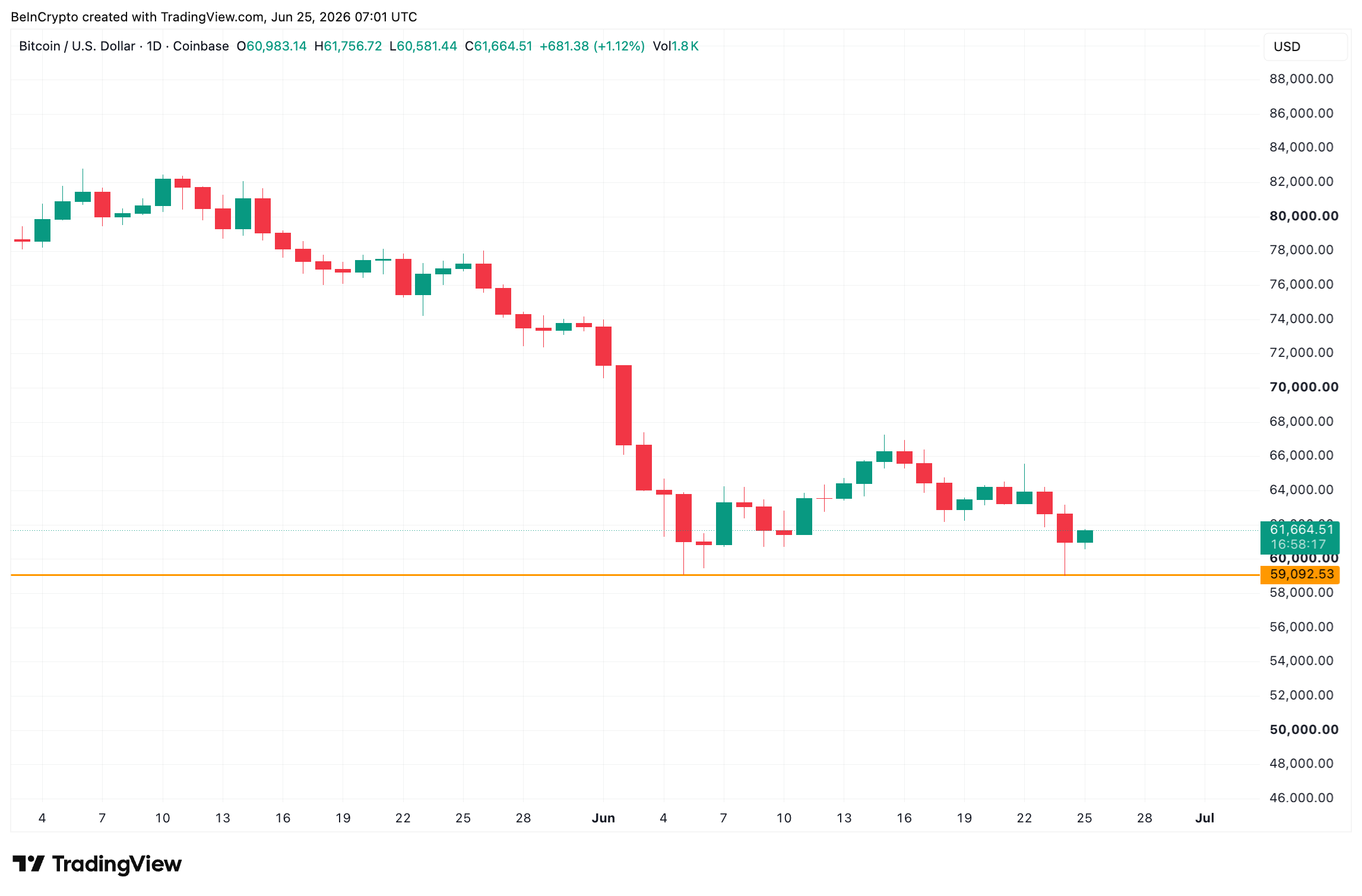
Ethereum has dropped to its lowest level in weeks, and most traders asking why is Ethereum down today will blame the obvious culprit, a market-wide sell-off. The more revealing part is who used the drop to buy.
The selling is real, and the Ethereum price has fallen harder than Bitcoin. Yet on the week’s sharpest leg lower, Ethereum held the line where Bitcoin gave way, and the largest wallets shifted from sellers to buyers.
The Ethereum Drop Is Real, but One Detail Breaks the Pattern
Over the past month, the ETH price is down about 21%, a touch worse than Bitcoin (BTC) near 20%. Over the week, ETH slid close to 5% against 3.7% for BTC.
Want more token insights like this? Sign up for Editor Harsh Notariya’s Daily Crypto Newsletter here.
On the scoreboard, then, Ethereum is the weaker asset. That is the easy read, and it is also where most analysis stops. The interesting part hides in the timing. When the market flushed into June 24, Bitcoin broke to a fresh low near its early-June bottom around $59,000.

Ethereum declined to follow. It carved a higher low and defended the floor it set earlier in the month, the first crack in the bearish story.

A higher low means little, however, unless the selling driving the Ethereum down move was already losing steam.
Selling Pressure Faded as ETH Whales Turned Buyers
The sell volume exploded with a single huge bar on June 5, then thinned out steadily through the month.
Selling firmed up again between June 23 and June 24, yet never came close to that June 5 peak. The flush that began the decline simply ran out of fuel.

As sellers tired, Ethereum whales moved the other way. Santiment’s Supply Held By Whales metric, which tracks the ETH held by the largest non-exchange wallets, fell from roughly 125.68 million on June 18 to 125.23 million by June 22, then rebuilt to about 125.3 million amid the late-June crash.

On-chain trackers also caught large wallets pulling ETH off exchanges during the drop. The pattern suggests whale accumulation quietly mopping up the last of the supply.
A whale bid is hollow, though, if the network those wallets feed is emptying out.
The Network Kept Working While Price Fell
Ethereum DEX volume, the value traded on decentralized exchanges, jumped about 36% into the low, from roughly $0.9 billion on June 22 to $1.3 billion on June 24. So the network wallets are certainly not emptying.
Trade counts climbed back above 390,000 on the same day. That points to on-chain activity rebuilding into the dip, not retreating from it.

Compared with the June 5 capitulation near $3 billion, the latest pickup looks measured rather than frantic. Traders engaged the low without the panic that marked the start of the slide.
The base layer told the same story. Daily transactions on the Ethereum network held near 2.7 million through the June 21 to 24 drop, above the 1.9 million pace a week earlier. Active wallets jumped to roughly 637,000 on June 24, the flush day, up from 514,000 the session before.

Stablecoins parked on Ethereum stayed near $158 billion, down just 2% on the week. Dollars sat tight on the chain even as price fell.

Steady usage and a returning whale bid stack the odds. Now the chart has to confirm them.
The Ethereum Price Levels That Settle the Debate
ETH trades near $1,655, just above the 0.236 Fibonacci level at $1,633.
The decisive level is $1,551, the higher low from June 24. Support held there while Bitcoin was busy making a fresh low, and it sits above the early-June floor near $1,505.
To take control, buyers must reclaim $1,683, then $1,724, and eventually $1,765. A push into that band lines up with a measured move of about 7%.

Clearing it would let the Ethereum price recover before Bitcoin even turns. The catch is that thin volume cuts both ways, so a single heavy session could undo the bid fast. A daily close below $1,551 would snap the higher-low structure and put $1,505 back in play.
The $1,551 support separates an early, whale-led ETH rebound from another slide toward the June lows.
The post Ethereum Price Crash Triggers a 36% DEX Volume Surge appeared first on BeInCrypto.


All 32 of the largest US banks would stay above minimum capital requirements during a severe recession, the Federal Reserve said Wednesday, even after absorbing more than $708 billion in projected loan losses under its annual stress test.
The exercise tested whether systemically important lenders could keep credit flowing through a downturn. Aggregate capital fell just 1.6 percentage points, from 12.8% to 11.2%, leaving banks well above regulatory floors.
What the Fed Stress Test Measured
The Dodd-Frank Act requires the Fed to conduct these tests annually. Congress mandated it after the 2008 financial crisis to ensure that large banks hold sufficient capital to withstand severe economic conditions.
The requirement covers banks with at least $100 billion in assets. This year’s pool of covered firms included JPMorgan Chase, Bank of America, Citigroup, Wells Fargo, Goldman Sachs, and Morgan Stanley.
The hypothetical scenario matched last year’s severity. It assumed unemployment would climb to 10%, that commercial real estate prices would drop by 39%, and that home prices would fall by 30%.
Economic output contracted 4.6% in the model. Equity markets dropped 58%, deepening losses on business loans.
Follow us on X to get the latest news as it happens
Where the Losses Landed
Credit cards accounted for the largest share of projected losses, at roughly $200 billion. Commercial and industrial loans added about $160 billion.
Commercial real estate contributed around $75 billion. Two forces pulled capital down. Heavier loan losses from larger balances and tougher assumptions. Weaker unrealized securities gains followed smaller modeled rate declines.
Higher interest income pushed in the opposite direction. Stronger recent bank earnings and smaller modeled rate cuts lifted projected capital, more than offsetting the two drags above.
Vice Chair for Supervision Michelle Bowman framed the outcome as evidence of resilience.
“Today’s results underscore the strength of the banking system. As we work to increase the transparency and accountability of the stress test, public feedback will help us continue to improve and instill greater confidence in the stress test and its results,” Bowman stated.
The results will not change the capital requirements. Current levels hold until 2027, when revised loss models incorporating public feedback take effect.
Subscribe to our YouTube channel to watch leaders and journalists provide expert insights
The post Big Banks Survive $708 Billion Loss Scenario in Fed Stress Test appeared first on BeInCrypto.


New forensic research published yesterday suggests that Hal Finney might not have been the second person to run a BTC node.
For 17 years, the man who tweeted “Running bitcoin” earned an unofficial title. In the eyes of many Bitcoin historians, Finney was the second person after creator Satoshi Nakamo to run a Bitcoin node.
Indeed, thousands of articles credit Finney as Bitcoin’s second participant.
However, it turns out that he might actually have been the third.
Although it is an indisputable, on-chain fact that Finney earned the first coinbase reward after Nakamoto for mining a block, forensic researcher Alex Waltz argues that another man was running a mining-capable node before Finney.
According to Waltz’s timestamps, although Dustin Trammell was running a node before Finney, an idiosyncratic network connectivity issue in Bitcoin software prior to version 0.1.3 prevented Trammell from connecting to Nakamoto’s nodes fast enough to outpace Finney.
A new timeline of Finney’s Bitcoin node
Waltz reconstructed a precise timeline of events during Bitcoin’s opening days.
Based on his analysis, and despite Trammell openly admitting that Finney mined a block before him, he believes that Trammell was running BTC mining software first.
Unfortunately, Trammell hadn’t remembered to flip on the software switch to actually mine. Still, according to Waltz, he was probably technically running the node software before Finney.
It’s important to remember that in January 2009, a Bitcoin wallet holder, Bitcoin node operator, and a BTC miner were often the same thing.
The early Bitcoin software client bundled wallet, node, and CPU mining software into one program. The node turned on immediately by default, the wallet was built-in, and mining began using that same software after a simple flip of a software switch.
Critically, running a passive, non-mining node wasn’t a common practice in 2009, despite its widespread popularity today.
Indeed, there’s at least an order of magnitude more non-mining Bitcoin node operators today than BTC miners. Not so in 2009.
Anyway, given this context, Waltz’s analysis leans on an email that Nakamoto sent to Trammell to place Trammell’s node ahead of Finney’s node in the revised Bitcoin timeline.
‘You couldn’t broadcast it to the network, so it didn’t get into the chain’
Here’s what happened.
Late in the day on January 12, 2009, Trammell emailed Nakamoto that he’d still been running Bitcoin software version 0.1.1 for a while, which earned an email response from Nakamoto urging Trammell to update to v0.1.3.
Importantly, that email response from Nakamoto on January 13, 2009 confirms that Trammell would have been experiencing a silent network communication outage with his out-of-date, v0.1.1 software.
“It’s the bug that was fixed in 0.1.3,” Nakamoto said.
“The communications thread would get blocked, so you would make connections, but they would go silent after a while.”
Nakamoto continued, “When you found a block, you couldn’t broadcast it to the network, so it didn’t get into the chain.”
As the creator of the software, Nakamoto apologized for the bug that misled Trammell on-screen about his node’s uptime status when in fact his node was disconnected.
“You weren’t receiving anything either to know that the network had gone on without you… This is all fixed in 0.1.3,” he wrote.
Satoshi ended his email to Trammell with a generous offer as a sort of apology for the bug: “If you give me your IP, I’ll send you some coins.”
That is a true moment of Bitcoin history.
With that, Waltz ends his argument for Trammell being the second operator of mining node software on the Bitcoin network.
Waltz then moves along to other curiosities about Bitcoin’s early weeks of operation.
Read more: This wild Satoshi theory links Paul LeRoux and Craig Wright
Who is Bitcoin’s second user: Hal Finney or Dustin Trammell?
Although the above argument isn’t irrefutably conclusive, it is somewhat compelling.
Not only does Trammell have evidence of unbroadcasted blocks from the earliest days of Bitcoin, which support Trammell’s claim about unreliable connectivity, he also has correspondence from Nakamoto acknowledging Trammell’s reason for not being able to broadcast blocks over the internet.
Plus, Nakamoto offers to compensate Trammell for his foregone coinbase reward.
It’s a true story that few people in the Bitcoin community have heard.
Now, of course, Trammell does not appear to have actually mined a block prior to Finney earning Bitcoin’s coinbase reward for Finney’s on-chain block 78 on January 10, 2009.
Still, Trammell might have been running a mining-capable node prior to block 78.
Obviously, whether running mining software while not mining constitutes being a “miner” will probably remain a matter of public debate.
Unseating Finney as Bitcoin’s second network participant will take even more heavy lifting by cryptographers and forensic investigators, yet Waltz has provided novel questions about the preeminence of Finney over less famous participants in the early Bitcoin community.
Rest in peace, Hal Finney
All of these questions would be easy to resolve if we could simply ask Finney himself. Sadly, Finney isn’t around anymore.
After a long battle with Lou Gehrig’s disease, he passed away in 2014.
There is, however, one last piece of surprising evidence.
Trammell Venture Partners, which in 2022 launched a Bitcoin venture capital fund series, describes Dustin Trammell as “the second node on the Bitcoin network” on its own website.
Because miner and node operator were essentially the same thing at that time, Trammell has therefore quietly claimed the second-to-Nakamoto title that Finney long received as a community-ascribed belief.
After Waltz published his analysis, Trammell admitted that he hadn’t switched on the mining function to outpace Finney in actually mining a block before block 78, yet per his own website, Trammell otherwise maintains that he was running a node before Finney.
Got a tip? Send us an email securely via Protos Leaks. For more informed news and investigations, follow us on X, Bluesky, and Google News, or subscribe to our YouTube channel.
Crypto World
Bitcoin (BTC) derivatives signal price panic. A weak U.S. inflation reading could trigger snapback: Crypto Daily


Besides, both core and headline readings may be seen as stale, or backward looking, considering the recent slide in oil prices. WTI crude futures have dropped to $70, significantly below the $100-plus level seen during the Iran war in March and April. Headline inflation is expected to hit 4.1%, the highest since early 2023, driven largely by energy prices.
“The main question is less whether both headline and core go up—they are widely expected to—but rather how “stale” these numbers already are,” economist Mohamed A. El Erian, the former CEO of Pimco, noted on X.
“These numbers come before the recent sharp fall in oil prices, which will result in lower headline inflation and ease some of the pressures on core. The question being debated is by how much, including whether May will prove to be the peak inflation month.”
Beyond inflation numbers, watch out for volatility in Strategy’s common shares, MSTR, and preferred stock, STRC, plus AI names on Wall Street. MSTR is flashing a well-recognized major bearish pattern (Check the Daily Signal). Stay alert!
Read more: For analysis of today’s activity in altcoins and derivatives, see Crypto Markets Today . For a comprehensive list of events this week, see CoinDesk’s “Crypto Week Ahead.”

Many altcoins, including Ripple’s cross-border token, joined bitcoin’s ride south yesterday, painting fresh lows. In XRP’s case, the asset dumped below $1.05 for the first time in nearly two years.
Many analysts caught the move, and some predicted an even more painful future. One extreme case envisions the token plunging below $0.20.
Most Critical Moment
The first popular analyst to weigh on XRP’s most recent moves was CasiTrades, outlining that the “move we’ve been waiting for is here.” Her comments coincided with the asset’s major correction yesterday that drove it to just under $1.05.
“The market is dropping hard, exactly the type of move we’ve been preparing for, and XRP is approaching the major support levels we’ve been tracking.”
She, like other analysts, believes the most important level to watch now for the cross-border token is the psychological $1.00 line. If it falls, she said she has put buy orders at $0.93, but there’s an even lower target at $0.87, where the macro Fib 0.854 sits. Consequently, she concluded that XRP is currently in its “most critical moment” in this market cycle.
“Correction is approaching its final level. The fear will be LOUD! People will likely start calling for lower and lower prices as the level is reached. They’ll tell you the market is going to zero. But don’t let someone else’s fear cause you to miss your own opportunity,” CasiTrades added.
She concluded that every major trend begins when the broader market’s sentiment is “at its worst.” The ongoing correction is “doing exactly what it should,” which makes it the “perfect market structure.”
Ali Martinez was even more bearish on XRP’s next targets. After asking his followers at which levels they plan to buy the asset, he showed a macro chart outlining a potential breakdown to $0.70, but there are also two highly unfavorable targets of $0.32 and even $0.15. Recall that XRP hasn’t traded at such low levels since the COVID-19 crash.
On the Flipside
Despite the current market sentiment, other analysts, such as Javon Marks, remain bullish on XRP’s future performance. As recently reported, the market observer with over 60,000 followers on X argued that the asset could aim for double-digit price levels during the next bull run, and outlined $17 as the potential top.
Ted Pillows was also quite optimistic, indicating that XRP has formed a similar pattern to its 2024 rally when it rocketed from $0.50 to $3.30 in months. If history repeats, he believes the asset could top at almost $8.50.
The post Ripple’s XRP Faces ‘Most Critical Moment’ in This Cycle as Analysts Outline Buy Levels appeared first on CryptoPotato.

Key Highlights
- Meta Platforms is transitioning content moderation responsibilities to artificial intelligence powered by large language models
- Approximately 50% of content review tasks are currently managed by AI systems in 2026
- The social media giant aims to exceed 90% AI-driven moderation for specific content categories before year’s end
- This initiative aligns with broader cost reduction efforts as CEO Mark Zuckerberg invests heavily in AI development
- The company has eliminated approximately 8,000 positions (representing 10% of total staff) while maintaining Strong Buy analyst consensus at $815.82 target price
Meta Platforms is aggressively accelerating its transition toward AI-driven content moderation. The tech behemoth, valued at $1.4 trillion, is systematically replacing human content reviewers with advanced large language models throughout its social media ecosystem, based on reporting from the Financial Times this Thursday.
META shares experienced a 0.81% decline during trading.
The social media company has already transitioned approximately half of all human content moderation requests to artificial intelligence systems throughout this year. Industry observers anticipate this percentage could surge beyond 90% for particular content classifications prior to 2026’s conclusion.
This represents a significant timeline acceleration. Meta had previously communicated intentions to maintain human reviewers as part of its moderation framework, with initial projections suggesting a multi-year phased approach.
Traditionally, Meta deployed a combination of proprietary automated detection systems alongside human moderators — including external contract workers — to identify posts and advertisements violating platform policies. User dispute resolutions were similarly managed by human staff.
Currently, artificial intelligence systems are assuming the majority of these responsibilities.
Zuckerberg’s Vision for an AI-Powered Organization
The content moderation transformation represents one component of a comprehensive cost optimization and AI investment initiative championed by CEO Mark Zuckerberg.
Meta recently reduced its global employee count by 10%, eliminating roughly 8,000 positions. Zuckerberg has publicly attributed artificial intelligence technologies with generating substantial productivity improvements company-wide.
“I think that 2026 is going to be the year that AI starts to dramatically change the way that we work,” Zuckerberg said publicly.
The organization has allocated billions toward acquiring AI expertise and infrastructure development, with Zuckerberg articulating his ambition to create “personal superintelligence” — highly customized AI assistants tailored to individual users.
Reports also indicate Meta attempted implementing monitoring systems to track U.S.-based employees’ screen activity for productivity assessment purposes, though the initiative was abandoned following employee resistance.
Concerns Regarding Implementation Speed and Platform Security
The aggressive transition has encountered obstacles. A recent AI chatbot security incident at Meta has sparked concerns about whether the company is advancing too rapidly with AI deployment.
Meta’s artificial intelligence tools now serve multiple functions beyond standard moderation, including detecting fraudulent schemes and eliminating prohibited content. These responsibilities continue expanding.
The company’s moderation infrastructure has historically relied upon third-party contractors managing complex cases requiring nuanced judgment. The impact on these positions as AI assumes greater responsibilities remains unclear.
Wall Street analysts maintain strong confidence in the stock. META carries a Strong Buy consensus rating supported by 31 Buy recommendations and 6 Hold ratings from 37 analysts surveyed during the past three months.
The consensus price target stands at $815.82, suggesting approximately 46% potential appreciation from present trading levels.
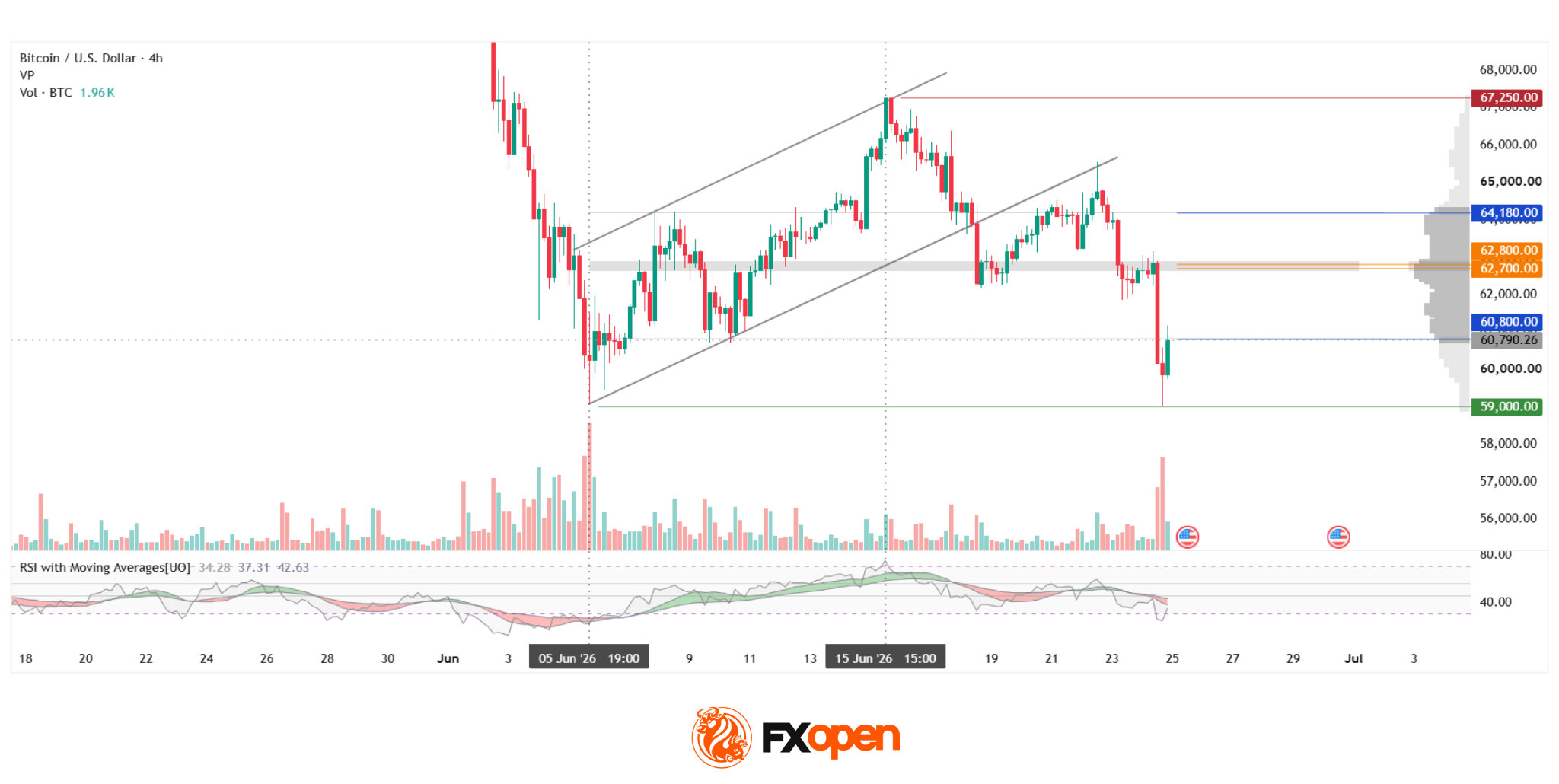
Bitcoin has come under the influence of several factors simultaneously. The wave of selling at the beginning of June was linked to Strategy’s first disclosed Bitcoin sale in several years, a prolonged series of outflows from spot ETFs, and a large transfer of funds from a Mt. Gox wallet to a new address. The run of outflows from US spot Bitcoin ETFs became one of the longest and largest since these products were launched in January 2024.
Bloomberg Intelligence analyst James Seyffart noted that around $9 billion has exited Bitcoin ETFs since their peak, although most long-term fund investors have chosen to maintain their positions.
Technical picture
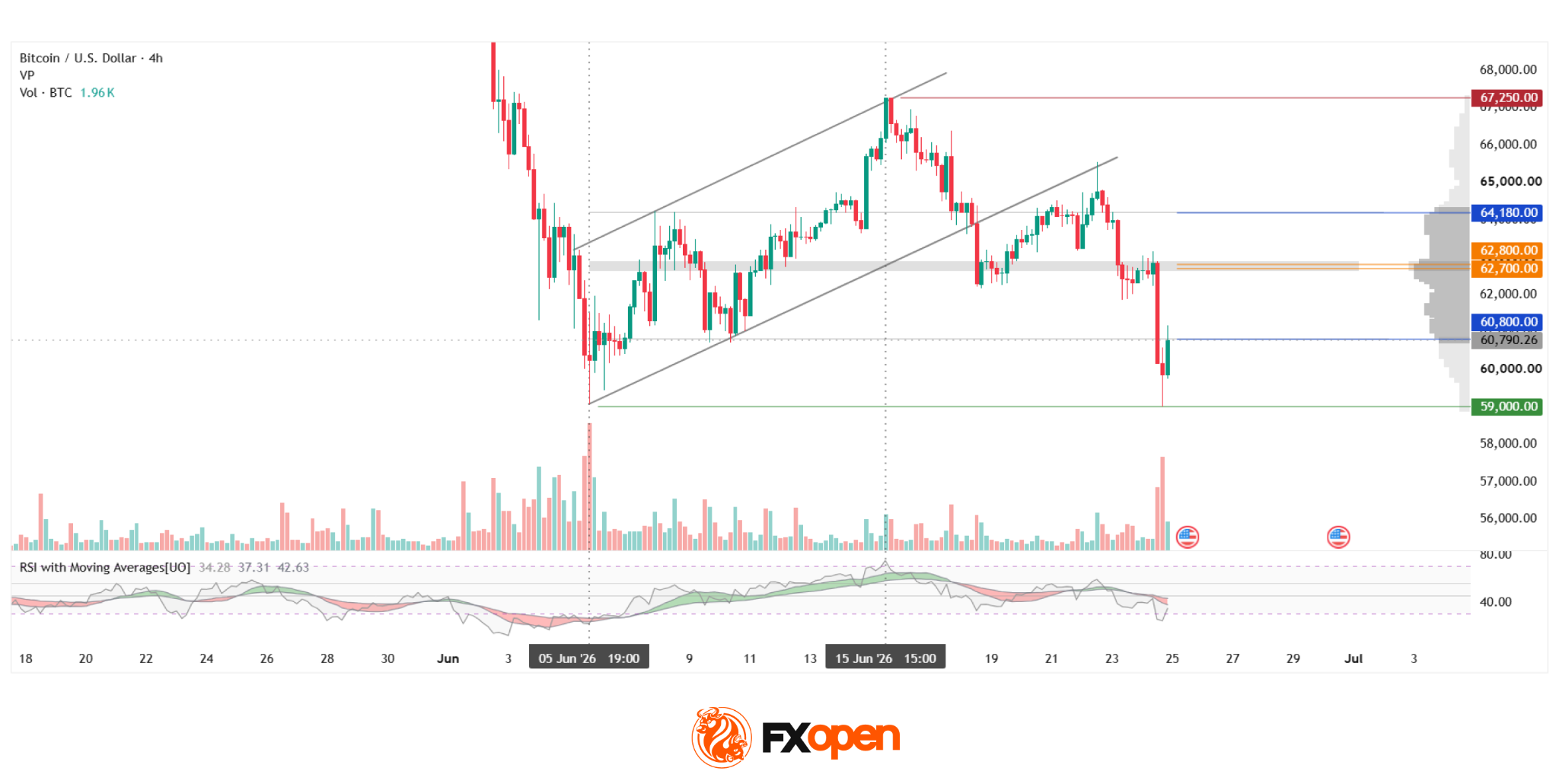
On the H4 chart of BTC/USD, an ascending corrective channel formed after an impulsive decline towards the $59,000 area. Price subsequently advanced to the upper boundary of the channel at $67,250, but failed to hold those levels. The channel was then broken to the downside, with quotations moving towards a test of the lower boundary of the current profile at $60,800.
The Point of Control (POC) is concentrated in the $62,700–$62,800 area and could attract market attention if price rebounds from the lower boundary.
The upper boundary of the profile is located near $64,180 and could act as resistance if the POC zone is breached. The RSI + MAs indicator stands at 34, 37 and 42 respectively. The oscillator remains below the neutral zone but has recovered from oversold territory, while the moving averages remain bearish and continue to point lower.
At the same time, vertical volume surged sharply during the decline on 24 June, which may have been interpreted by market participants as a sign that the local downtrend was nearing completion.
Summary
The unusually high volume recorded on 24 June, combined with the current RSI position, does not provide strong confirmation that the latest local impulse will continue, although the moving averages remain pointed lower for now.
Further price action may be influenced by upcoming US inflation data, as well as flows into Bitcoin ETFs, which experienced record outflows during June.
FXOpen offers the world’s most popular cryptocurrency CFDs*, including Bitcoin and Ethereum. Floating spreads, 1:2 leverage — at your service (additional fees may apply). Open your trading account now or learn more about crypto CFD trading with FXOpen.
*Important: At FXOpen UK, Cryptocurrency trading via CFDs is only available to our Professional clients. They are not available for trading by Retail clients. To find out more information about how this may affect you, please get in touch with our team.
This article represents the opinion of the Companies operating under the FXOpen brand only. It is not to be construed as an offer, solicitation, or recommendation with respect to products and services provided by the Companies operating under the FXOpen brand, nor is it to be considered financial advice.
Quick Summary
- Precious metal breached the $4,000 threshold for the first time since November 2025
- Yellow metal has plummeted approximately 30% from its January peak of $5,595.46
- Dollar strength at 13-month highs is pricing out international purchasers
- Traders now see 66% probability of Federal Reserve tightening by September
- Declining geopolitical risk premium has diminished safe-haven buying interest
The precious metal market is experiencing significant downward pressure as the strengthening U.S. dollar combined with mounting anticipation of Federal Reserve monetary tightening drives prices to their lowest point in seven months.
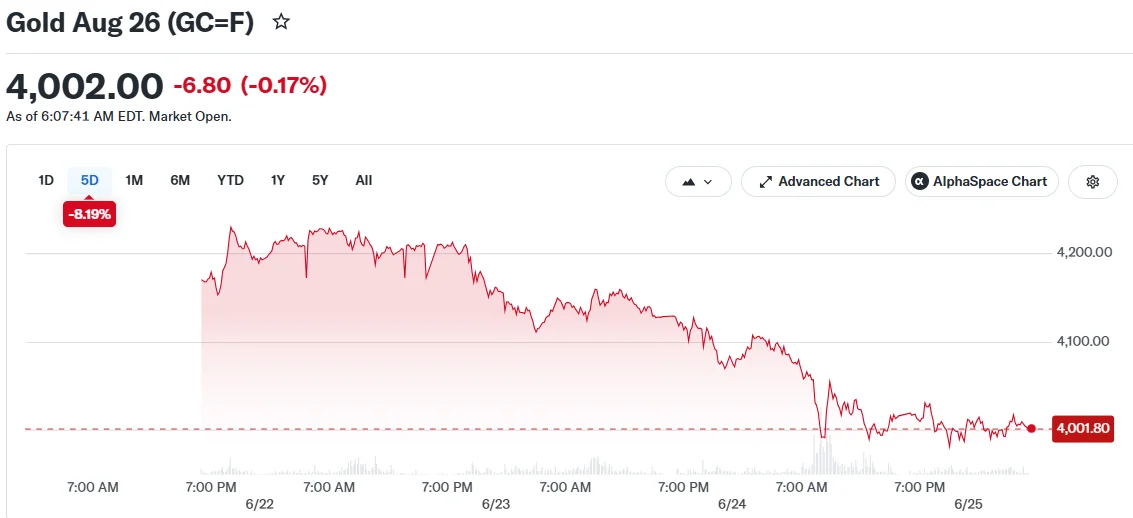
Spot gold declined 0.2% to settle at $3,984.83 per ounce during Thursday’s trading session. U.S. Gold Futures remained largely unchanged, hovering around the $4,008 level.
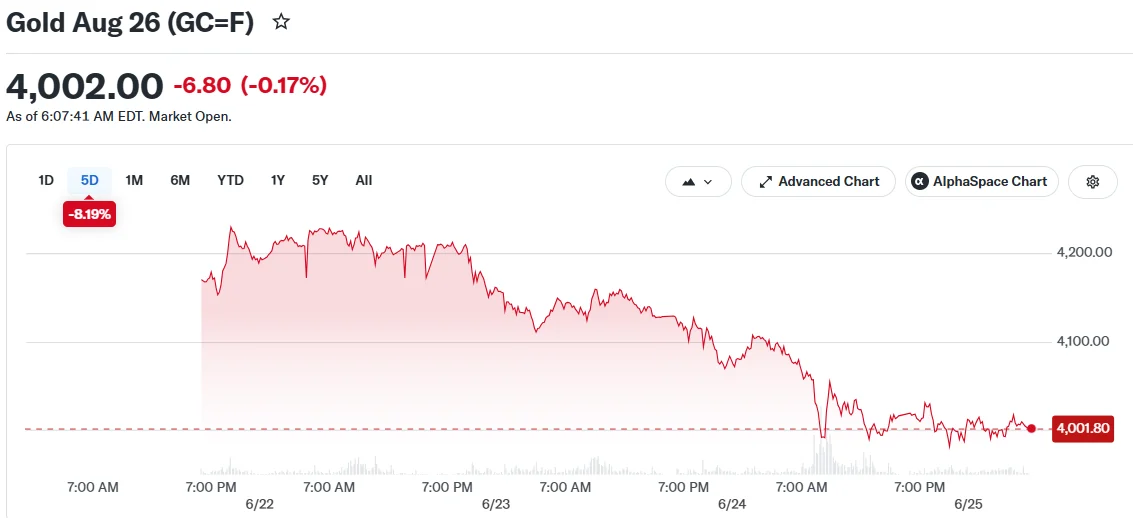
The yellow metal crashed through the psychologically significant $4,000 barrier on Wednesday, marking its first breach of this level since November 2025. Market participants had been closely monitoring this threshold as a critical support zone.
The precious metal has experienced a dramatic decline of nearly 30% from its all-time high of $5,595.46 recorded in January 2026. This represents a substantial correction within a relatively compressed timeframe.
The U.S. dollar’s performance has emerged as a primary catalyst behind the selloff. The currency has reached a 13-month peak following six consecutive sessions of appreciation.
A robust dollar increases the cost of gold for international buyers operating in alternative currencies. This dynamic typically suppresses demand for the precious metal.
Federal Reserve Policy Expectations Pressure Precious Metals
Market participants are currently assigning approximately one-third probability to an interest rate increase in July. These odds escalate to 66% for policy tightening by September, based on CME FedWatch analytical data.
Elevated interest rates create headwinds for gold since the commodity generates no income stream. As rates climb, investors can secure superior returns from fixed-income securities and cash equivalents, diminishing gold’s relative appeal.
ANZ research team noted that worries surrounding persistent inflationary pressure have triggered a “re-rating of monetary policy expectations.” They further observed that the Federal Reserve’s hawkish posture seems to have “derailed the debasement trade” that previously supported gold valuations.
ING market strategists indicated that gold’s underperformance demonstrates how market sentiment has pivoted away from defensive positioning toward focusing on the implications of rising rates and restrictive financial conditions.
Diminishing Geopolitical Risk Premium
Decreasing tensions across Middle Eastern regions have contributed to the downward trajectory. Advancement in U.S.-Iran diplomatic negotiations has eliminated portions of the risk premium that had underpinned gold valuations during the earlier months of this year.
Weakening oil prices have reinforced this transition. Investors demonstrate reduced appetite for gold as an insurance mechanism when geopolitical uncertainties appear to be subsiding.
Market observers are now directing attention toward Friday’s scheduled release of U.S. Personal Consumption Expenditures figures. The PCE represents the Federal Reserve’s prioritized inflation metric and could significantly influence projections for subsequent policy adjustments.
Silver registered a modest 0.1% gain to reach $57.50 per ounce on Thursday, recovering slightly after dropping more than 6% in the previous trading session. ING analysts observed that several of silver’s most robust demand catalysts are showing signs of weakening.
Platinum decreased 0.3% to settle at $1,581.60 per ounce. Copper futures advanced approximately 1.7% on the London Metal Exchange to reach $13,255.95 per ton.
Gold continues facing downward momentum with limited visible catalysts to reverse the prevailing trend ahead of the PCE data release.
Crypto World
CoinEx denies claims it served as $3.84 billion gateway to sanctioned Iranian crypto firms


Blockchain intelligence firm TRM Labs said CoinEx served as a gateway for the crypto sector in Iran, having traced more than $3.84 billion in flows between the exchange and sanctioned Iranian entities in the last seven years.
TRM Labs said CoinEx became the single biggest trading partner of Iran’s largest crypto exchange Nobitex, which accounted for around $2.7 billion of the flows, according to a report published Wednesday.
CoinEx had direct transaction exposure with more than 60 Iranian crypto platforms, according to TRM Labs’ analysis, which argued that this patterns suggested a coordinated relationship rather than organic market activity.
TRM Labs identified CoinEx exposure to several terrorist-linked entities, such as $6 million in transactions involving wallets associated with the Islamic Revolutionary Guard Corps and $374,000 of exposure associated with Palestinian Islamic Jihad.
The U.S. Treasury sanctioned an array of Iranian crypto exchanges as part of its campaign against the country’s government at the start of this month, including Nobitex, Wallex, Bitpin and Ramzinex, all of which are cited in TRM Labs’ report.
TLDR
- SK Hynix shares soared 13% during Thursday’s trading session in South Korea
- The memory chipmaker will debut ADRs on Nasdaq July 10, aiming for approximately $30 billion in value
- Competitor Micron delivered $41.5 billion in quarterly revenue, surging 346% annually and crushing analyst forecasts
- Micron’s leadership anticipates constrained memory markets extending past 2027
- SK Hynix shares have skyrocketed more than 300% throughout 2026, surpassing Samsung to claim the top spot among South Korean companies by market cap
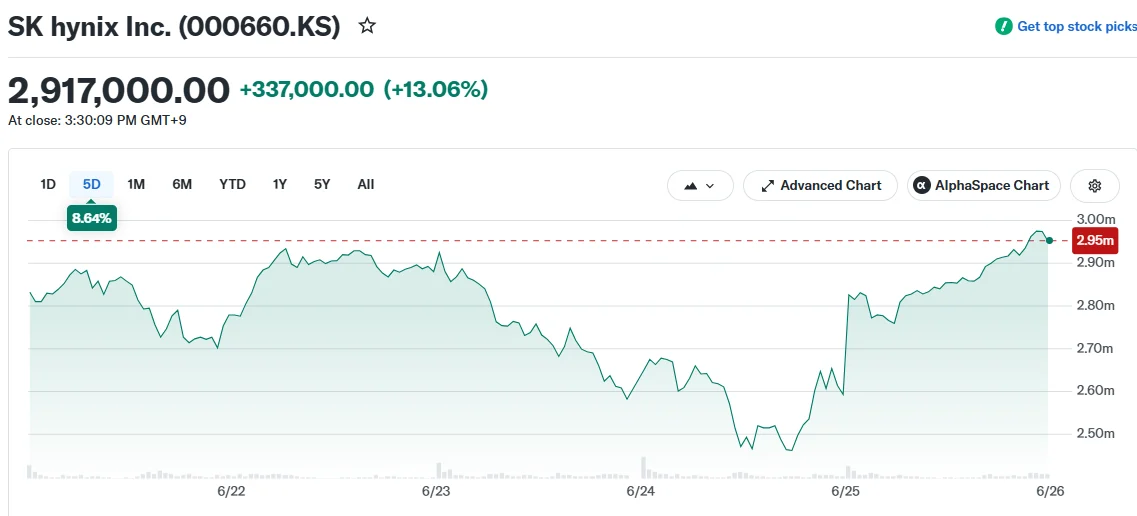
Shares of SK Hynix climbed as high as 15% to reach a new record of 2,987,000 won during Thursday’s session, ultimately settling with gains near 13% by the close in South Korea.
The dramatic rally stemmed from two powerful catalysts converging simultaneously — the announcement of a significant U.S. exchange debut and exceptional quarterly results from competitor Micron.
SK Hynix revealed Wednesday evening that it intends to debut American Depositary Receipts on the Nasdaq Global Select Exchange come July 10. The offering is expected to reach approximately $29–$30 billion.
Since the disclosure arrived after Korean markets had shut down Wednesday, Thursday represented the initial opportunity for shareholders to respond. Their response was emphatic.
The broader KOSPI Index also posted impressive gains, advancing more than 6%. This extended a powerful recovery from a 10% decline witnessed earlier during the week. The benchmark has now surged 112% throughout 2026.
Micron’s Quarterly Performance Provided Additional Momentum
Micron unveiled quarterly revenue totaling $41.5 billion, substantially exceeding Wall Street’s projection of $35.9 billion. This represents a remarkable 346% increase compared to the previous year.
Future outlook proved even more impressive. Micron projected revenue approaching $50 billion for its upcoming fiscal fourth quarter, once again surpassing expectations considerably.
Chief Executive Sanjay Mehrotra indicated he anticipates constrained market dynamics continuing beyond 2027, fueled by artificial intelligence demand spanning all product categories and fundamental supply limitations.
This forward-looking commentary carries significant implications for SK Hynix. Both organizations compete head-to-head in DRAM and high-bandwidth memory markets, indicating that favorable pricing environments for Micron typically signal similar conditions for SK Hynix.
SK Hynix’s Standing in Memory Chip Manufacturing
SK Hynix commands the high-bandwidth memory sector, which has emerged as among the most sought-after components powering AI infrastructure expansion. This strategic positioning has rendered the stock especially responsive to artificial intelligence developments.
The accelerated buildout of data centers by major technology corporations has constricted worldwide memory inventories throughout the past year. This dynamic has elevated prices for both conventional DRAM and HBM products.
SK Hynix, Micron, and Samsung have all benefited substantially from this demand wave. However, SK Hynix has outperformed both rivals.
The stock has climbed over 300% during 2026 alone, positioning it among the top-performing equities worldwide this year.
It recently eclipsed Samsung to capture the title of South Korea’s most valuable corporation — an achievement that would have appeared improbable until recently.
The forthcoming Nasdaq ADR listing scheduled for July 10 will provide American investors direct access to the shares for the first time via an exchange-traded instrument.
Micron’s quarterly performance represented the latest confirmation that AI-fueled memory demand remains robust entering the latter half of 2026.

13 BSE 500 stocks surged up to 200% in just 3 months; 3 turned multibaggers – Midcap Momentum

Ethereum Price Crash Triggers a 36% DEX Volume Surge

2026 NBA Draft ends with 64 New NBA Players


-

 Fashion6 days ago
Weekend Open Thread: Miami – Corporette.com
-

 Entertainment5 days ago
Renter of Home in Anne Heche Crash Denies Settlement With Son
-
 Sports2 days ago
Two goals and an assist by sheer aura: Cristiano Ronaldo just entered the World Cup chat
-

 Tech3 days ago
Microsoft accidentally kills epic Outlook email threads
-

 Business5 days ago
Soccer-U.S. defends Iran World Cup travel restrictions, says discussions ongoing
-

 Politics5 days ago
Andy Burnham and the meaning of Makerfield
-
Crypto World1 day ago
Bitcoin (BTC) Dips Below $62K, Ethereum (ETH) Plunges 6% Daily: Market Watch
-

 Politics7 days ago
BBC Reporter Discusses Cross Party Criticism Of Trumps Iran Deal
-

 Crypto World1 day ago
Securitize Wraps Roubini's SEC-Registered ETF as Dubai VARA Digital Security
-
Business1 day ago
Entergy settles forward sale agreements, raises $672 million in cash proceeds
-

 NewsBeat6 days ago
Keir Starmer Allies Question His Chances For No 10
-
 Business5 days ago
Wall Street Week Ahead: Investors see Micron earnings as pulse check of AI rally momentum
-

 Tech7 days ago
AWS enters the context layer race with a graph that learns from agents, not manual curation
-
 Crypto World5 days ago
Can Charles Hoskinson Really Rescue Cardano?
-

 Crypto World5 days ago
HIVE shares jump as $220M AI deal speeds Bitcoin mining pivot
-

 Crypto World5 days ago
Jake Chervinsky accuses CME of protecting derivatives monopoly
-

 Entertainment5 days ago
Jose Alvarado Wants Taylor Swift at More Knicks Games
-
 Tech4 days ago
Signal’s Meredith Whittaker says AI chatbots ‘are not your friends’ and calls Copilot agents a backdoor
-

 Tech3 days ago
Nearly 7,000 fake Amazon domains registered ahead of Prime Day 2026, researchers warn
-

 Sports6 days ago
FIFA World Cup 2026: Canada beat 9-men Qatar 6-0 to register first ever win | FIFA World Cup 2026
You must be logged in to post a comment Login