
Crypto World
Kalshi US Visits Surge 1,500% Amid Growing Regulatory Scrutiny

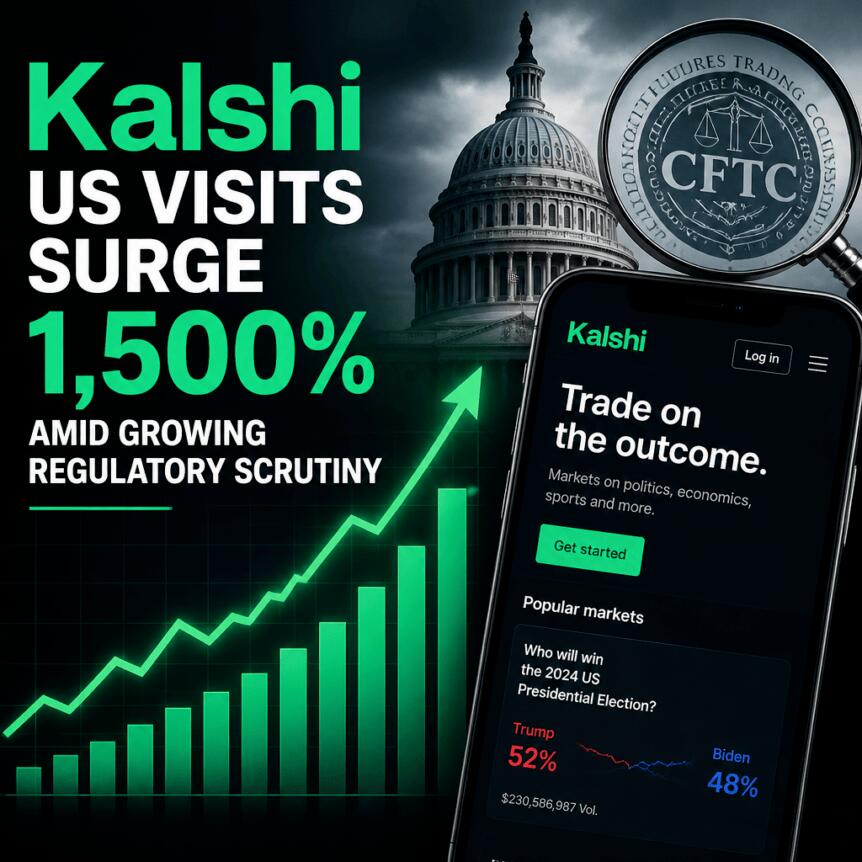
Kalshi’s rapid expansion in the U.S. is showing up clearly in web-traffic data, even as the company’s core business—event and prediction contracts—continues to face mounting legal scrutiny. According to Similarweb estimates reviewed by Cointelegraph, Kalshi logged 15.4 million visits from the United States in July, a dramatic jump from just under 1 million in August 2025.
The U.S. share of Kalshi’s traffic also remains dominant. In July, U.S. visitors accounted for nearly 80% of all visits, up from 72.8% in August 2025—an indicator that Kalshi’s growth is heavily concentrated in one market even as it draws some interest from elsewhere.
Key takeaways
- Kalshi reported 15.4 million U.S. visits in July, up roughly 1,520% from just under 1 million in August 2025, according to Similarweb estimates reviewed by Cointelegraph.
- U.S. traffic made up nearly 80% of Kalshi’s visits in July, rising from 72.8% in August 2025, showing continued concentration in the United States.
- Notional trading volume grew even faster than traffic, reaching about $40 billion in August versus $874 million a year earlier, per Dune Analytics.
- Sports-related contracts represented the majority of Kalshi trading activity in July, with sports accounting for 83% of volume, Barron’s reported.
- Canada and the UK generated meaningful traffic increases despite member-agreement restrictions, Cointelegraph reports it did not receive comment from Kalshi.
Traffic spikes, but trading is scaling faster
Web traffic has accelerated alongside Kalshi’s broader rise in prediction-market activity, but the trading numbers suggest the platform is expanding more sharply in market participation than in simple interest. Dune Analytics’ prediction market dashboard indicates Kalshi reached roughly $40 billion in monthly notional trading volume in August, compared with $874 million a year earlier—an increase of about 4,500%.
That same period also saw volume grow across the wider prediction-market sector, with monthly notional volume rising to $50.7 billion from about $2 billion. Kalshi accounted for nearly 79% of that latest total, underscoring that its platform has become the center of gravity for the industry’s trading flows as activity expands.
The composition of those trades matters, too. Barron’s reported Thursday that sports contracts were responsible for 83% of Kalshi’s trading volume in July. That detail is especially relevant given the legal backdrop: the dispute over whether certain contracts are regulated under federal authorities versus state gambling frameworks has repeatedly focused on the nature of the underlying events and how they should be classified.
Legal pressure remains tied to sports event contracts
Kalshi’s growth is unfolding while regulators and courts argue over the boundaries of oversight for prediction markets. The company’s expansion has been followed by increasing legal attention to whether its sports contracts are subject to federal supervision or fall within state gambling restrictions.
Earlier, Cointelegraph highlighted the fact that New Jersey has taken the dispute to the U.S. Supreme Court. The timing of Kalshi’s traffic and trading surge—at a moment when the legal process is still actively shaping how the business can operate—adds a layer of risk management pressure for users and counterparties watching what regulatory outcome could change market access.
Restricted jurisdictions still generate growing interest
Kalshi’s growth outside the United States is more modest, but the data shows that additional regions are contributing more visits than a year earlier. Canada generated about 450,000 visits in July, up from roughly 50,000 in August 2025. The UK increased to 296,000 visits from 31,000 over the same period.
These increases are notable because Kalshi’s member agreement currently prohibits users in certain jurisdictions from directly accessing or trading on the platform. Cointelegraph points to Kalshi’s published terms, which include restrictions on direct access and trading for members in jurisdictions where participation is not permitted.
In Canada’s case, Kalshi has also pursued an access pathway through partnerships. The company partnered with Canadian financial services firm Wealthsimple in June to provide access to nearly 4,000 eligible Kalshi contracts via a separate app. That arrangement may help explain why visits from Canada and other regions can rise even when direct platform participation is restricted.
Still, the traffic mix shifted in ways that complicate any simple read of demand. From August 2025 to July 2026, Canada’s share of Kalshi traffic slipped to 2.3% from 3.8%, while the UK’s share fell to 1.5% from 2.4%—even as visits from both countries increased in absolute terms. In other words, the rest of Kalshi’s user base grew so quickly that Canada and the UK lost relative share, despite higher traffic levels.
Cointelegraph said it reached out to Kalshi for comment about the traffic patterns from restricted jurisdictions, but did not receive a response by publication.
What investors and users should watch next
Kalshi’s surge in both U.S. attention and notional trading volume suggests demand for prediction contracts is scaling quickly, particularly in sports-linked markets. The next key variable is whether the legal pressure around classification and regulatory authority produces operational constraints—or clarity—that could affect market access and how quickly growth in restricted or regulated categories can continue.



Hargreaves Lansdown now sells Bitcoin (BTC) to about 2 million clients. However, it arrives five months too late, given that the tax break its savers wanted was closed in April.
Buy Bitcoin through a rival last winter, and the profit is tax-free for life. Buy the same thing at HL today and the taxman takes a cut.
Hargreaves Lansdown’s Bitcoin is for £100,000 Earners
According to a report in the Financial Times, nine products went live, delivering notes that track the Bitcoin price, and run by firms like BlackRock, Invesco, and CoinShares. Fees range from 0% to 0.35% per year.
HL was the last big British platform to say yes, waiting 330 days after the rules changed. However, on closer inspection, you notice that it only changed its shelf, not its mind, since they still label these products as high risk.
Most clients cannot buy them anyway, as HL requires £100,000 in yearly income or £250,000 in savings. Buyers also sit a short test and wait a day.
There is a catch in the product too. You never own any Bitcoin. Instead, you own a promise from the firm behind the note.
That makes 2 million the client list, not the buyer list, and anyone who qualifies must use a taxed account, or a pension they cannot touch until 55.
“After an appropriateness test and a 24-hour wait, a SIPP or Fund and Share account on HL can take listed Bitcoin exposure, even though you still do not hold the coins and a standard Stocks and Shares ISA remains closed to new buys,” one user noted.
Follow us on X to get the latest news as it happens
Britain’s Tax-Free Window Lasted 180 Days
That taxed account is the whole problem because savers once had a better option, and now it has gone. Britain barred ordinary savers from these products for years. The Financial Conduct Authority lifted that ban on 8 October 2025.
For a while, savers could hold Bitcoin inside an ISA. That is the tax-free account millions of Britons already use. Money made inside one is never taxed.
The tax office shut that door on 6 April 2026. The window had been open for 180 days. HL now turns up 150 days after it closed.
Savers who moved in time keep the tax break for good. The tax office left their holdings in place. HL’s clients get nothing.
Here is what that is worth. Put £20,000 in an ISA, double it, and you owe zero. Double it in a normal account, and the tax bill is about £4,080.
BeInCrypto called the reopening a symbolic step when Bitcoin ETNs returned to Britain. That reading holds up. The firm that said Bitcoin was no asset class now sells it. Just to the rich and in the wrong account.
Ministers say ordinary ISAs may get these notes back later.
The post Biggest UK Investment Platform Lists Bitcoin For 2 Million Users appeared first on BeInCrypto.


The U.S. is investigating a strike on a wedding in southern Iran, Vice President J.D. Vance said Thursday, as reports suggest American weapons killed at least five people and injured dozens of others.
“We’re investigating it because obviously we care,” Vance told reporters. “We want to know.”
The strike represents the U.S.’s latest controversial action in its war with Iran, raising questions about its conduct and civilian harm. Washington and Tehran have escalated their attacks this week, ending a lull in hostilities since July.
But Vance said he was “extremely skeptical” about reports coming from Iranian state media, arguing they have “not been a very good scribe about what’s happened in the conflict thus far.”
Iranian state media reported that a residential building in Kuhestak was attacked on Tuesday evening, where a wedding was being celebrated. Among the casualties was a 4-year-old kid. Reuters and the New York Times independently verified footage from the scene and found that a wedding was taking place when the building was struck.
Iran’s Ministry of Foreign Affairs said that it “will respond to these savage crimes with firmness”—and responded to a broader barrage of American attacks by launching missiles and drones at sites used by the U.S. in Middle East states. The Iranian Red Crescent Society, a humanitarian group, also urged a probe from the International Criminal Court to assess potential violations of international law.
The U.S. Central Command said Wednesday it was already looking into reports of the incident but argued that the “U.S. military never targets civilians, unlike the [Islamic Revolutionary Guard Corps],” referring to Iran’s armed forces branch.
Vance also defended U.S. military action, telling reporters: “If we do make mistakes, again, this is a big difference between us and Iran: when our military makes mistakes, they learn from them to try to get better from them.”
What we know about the strike
On the evening of Sept. 1, CENTCOM reported strikes on military targets, including “air defense sites, radar systems, maritime assets and facilities, mine laying capabilities, and communications sites.”
Iranian media later reported four deaths and at least 68 injured in Kuhestak, a coastal town on the Strait of Hormuz, where trade has been bottlenecked since the start of the U.S.-Iran war in late February. The strikes happened at around 9:30 p.m. local time, per the Red Crescent.
Analyses of footage from the incident conducted by Reuters and the New York Times reveal that wedding guests were gathered in a Kuhestak building. Amid the celebration, what was likely a U.S. munition hit the building and, as the Times put it, “brought down the roof.”
Experts told Reuters and the Times that weapon fragments seen in Iranian media were consistent with what Americans have used.
The attacks on Kuhestak also hit a communications tower roughly 100 m away from the building. A human rights group told the Associated Press that one of the four people initially reported killed—a 16-year-old—was struck by shrapnel near the tower rather than at the wedding. Iranian state television said Thursday that a 22-year-old woman had since died in hospital following the strike, bringing the reported death toll to five.
Axios reported that CENTCOM Commander Adm. Brad Cooper ordered an internal review of the strike.
Civilian casualties raise concern
The Red Crescent sent a letter to the International Criminal Court Wednesday calling for “an independent, impartial, thorough, and effective investigation,” citing the “civilian character” of the strike’s location.
The organization also argued that under the Rome Statute, intentionally directing attacks on civilians and knowingly launching a clearly excessive attack may constitute “war crimes.” However, both Iran and the U.S. are nonparties to the Rome Statute, so the ICC does not have automatic jurisdiction over them.
Still, “the laws of war state that civilians are protected from military attacks,” Melanie O’Brien, a professor of international law at the University of Western Australia, tells TIME. “A wedding is not a military objective, particularly in a civilian residential building. It is clear that there was a direct missile hit to the home. This would render the attack unlawful.”
It’s also not the U.S.’s first involvement in strikes that hit civilian structures without obvious military use and that endangered or killed civilians. On the first day of the war with Iran on Feb. 28, a U.S. Tomahawk missile hit a primary school in Minab—just 30 km (18 mi) away from Kuhestak—where more than 100 children were killed.
O’Brien, however, says she is skeptical about any result from the U.S.-led investigation of the wedding strike: “The U.S. track record is to only investigate when allegations gain significant public traction, and even when any convictions occur, the penalties are minor or pardons are given.”
[PRESS RELEASE – Chicago, United States, September 4th, 2026]
Liquid Mercury today announced that ACQUA1, LLC completed the initial closing of its MERC exchange offering on September 1, 2026.
ACQUA1 is a Liquid Mercury subsidiary that operates Liquid Mercury’s Lab Company program, licensing Liquid Mercury technology to companies primarily tokenizing real-world assets and receiving fees plus a minority equity stake in return. Liquid Mercury is the majority holder and Manager.
“Over the past 18 months, dozens of companies have approached Liquid Mercury seeking to tokenize their assets,” said Tony Saliba, CEO and founder of Liquid Mercury. “Many assumed they would need to raise capital and build this infrastructure from scratch. Licensing Mercury RWA lets them launch on systems that were already live and proven, at a fraction of the time and cost. ACQUA1 token holders now own a slice of the business that earns equity, plus fees from the companies in the Lab Company program.”
Verified accredited investors subscribed by exchanging MERC for non-voting Class B units of ACQUA1 at the initial conversion rate of 10 MERC per unit. Under its operating agreement, ACQUA1 must burn 100% of the MERC it receives at each closing within five business days and may not transfer, trade, lend, stake, pledge, or otherwise deploy it.
On September 2, all 563,230,000 MERC received at the initial closing were burned via a transfer to the dead address, as the offering documents require.
Initial Closing Highlights
- Initial closing: September 1, 2026
- MERC burned: 563,230,000
- Transferred to the dead address September 2, 2026
- Units issued: 56,323,000
- Non-voting Class B units of ACQUA1, LLC under Rule 506(c) of Regulation D
- 10 MERC per unit
- Evidenced on-chain by ACQUA1-C tokens
- ACQUA1-C tokens convert one-for-one into ACQUA1 tokens upon issuance
- Remaining closings: On or about October 30 and December 31, 2026
- ACQUA1 may skip or terminate at its discretion
- The conversion rate at subsequent closings may differ
Verification Links
Verified accredited investors can request full terms at acqua1.liquidmercury.com/contact.
About Liquid Mercury
Liquid Mercury powers professional crypto trading and digital asset marketplaces. The company delivers institutional-grade infrastructure, access to deep liquidity, and best-in-class trading tools and workflow automation across its Pro, OTC, and RWA platforms. Through Mercury RWA, Liquid Mercury is extending that infrastructure into tokenized real-world assets, with $MERC serving as the access and platform layer token. For more information, visit www.liquidmercury.com.
Investor Notice
This press release does not constitute an offer to sell or the solicitation of an offer to buy any securities. Class B units of ACQUA1, LLC and the ACQUA1 tokens representing them are offered and sold in reliance on the exemption from registration provided by Rule 506(c) of Regulation D under the Securities Act of 1933, solely to verified accredited investors as defined in Rule 501(a) of Regulation D, and solely pursuant to ACQUA1’s confidential private placement memorandum, as supplemented, and definitive subscription documents, which contain important information, including risk factors. ACQUA1 tokens are restricted securities, are subject to transfer restrictions under ACQUA1’s operating agreement and may remain illiquid indefinitely; investors should not assume that Rule 144 will be available. Statements regarding future revenues, valuations, portfolio performance, and subsequent closings are forward-looking and subject to risks and uncertainties; actual results may differ materially. The MERC contract has no burn function; tokens are removed from circulation by transferring to the dead address. Supply outstanding excluding the dead address is 5,436,770,000 MERC, as of the date of publication.
The post Liquid Mercury Announces Initial Closing of ACQUA1 Offering appeared first on CryptoPotato.
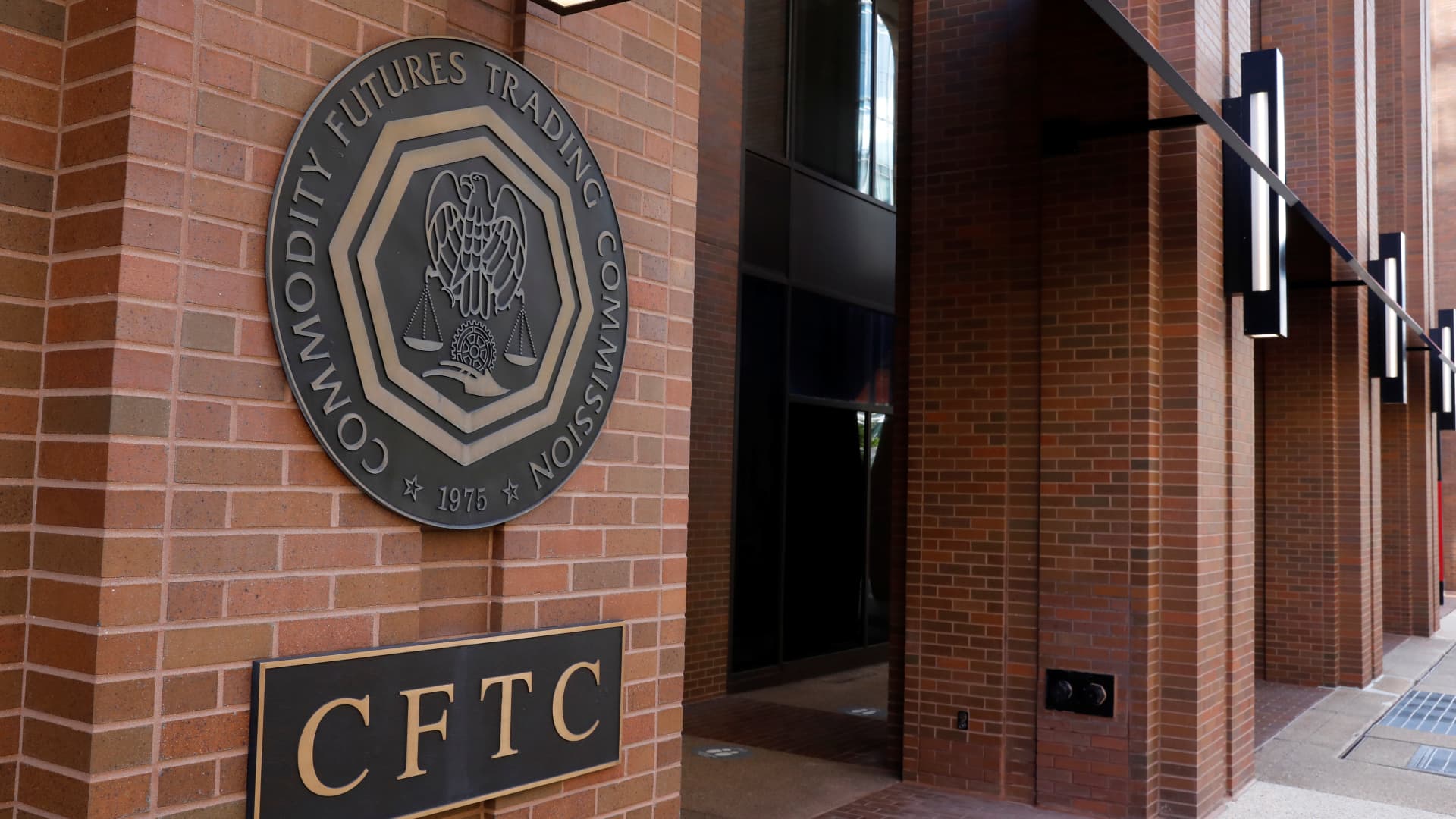
Signage is seen outside of the Commodity Futures Trading Commission headquarters in Washington, Aug. 30, 2020.
Andrew Kelly | Reuters
The White House has vetted candidates for the four open commissioner positions at the Commodity Futures Trading Commission, three people with knowledge of the matter told CNBC. When — or if — the White House will ultimately act on those potential candidates isn’t clear.
The CFTC’s five commissioners are mandated to be members from the political party in the White House and two from the opposing one. But at the moment, the CFTC — which regulates derivatives contracts — currently only has one, chairman Michael Selig.
Bloomberg News reported earlier this year bipartisan names that the White House was potentially considering for the open seats. In early July, the Trump administration sent a letter to Senate leadership claiming Democrats hadn’t delivered recommendations for vacancies on both the CFTC and Securities and Exchange Commission, explaining why it had yet to fill openings on both Wall Street regulatory bodies.
Senate Minority Leader Chuck Schumer, D-N.Y., sent a letter at the end of July with suggestions for the open Democratic slots at both regulatory agencies.
“Democrats support having full, bipartisan commissions,” a spokesperson for Schumer’s office said in a statement. “We have done our part and sent the White House names for the Democratic vacancies on the CFTC and SEC.” The spokesperson added the office hasn’t heard anything back from the White House, and that if the administration has vetted candidates and is ready to place nominations, it should act quickly and work with Democrats.
The White House did not respond to a request to comment for this story.
CNBC could not verify the names of who Schumer sent or if they were included in the candidates vetted by the White House.
As the Senate looks to pass the Clarity Act, a cryptocurrency market structure proposal, Democrats — whose votes are needed to receive the required 60 to pass — have criticized the White House for leaving the spots reserved for Democrats on the SEC and four bipartisan slots at the CFTC empty.
Michael Selig, chair of the Commodity Futures Trading Commission (CFTC), during a Bloomberg Television interview at the Commodity Futures Trading Commission (CFTC) headquarters in Washington, DC, US, on Thursday, Aug. 20, 2026.
Daniel Heuer | Bloomberg | Getty Images
One of the people with knowledge of the vetting situation and a Republican working on Clarity noted that it would be a key concession by the White House to guarantee it will fill vacant spots on the CFTC in order to secure passage of Clarity. However, the issue is just one of many dogging down the legislation, which include ethics concerns about President Donald Trump’s family’s crypto interests.
The Senate is set to have a key procedural vote on the Clarity Act on Sept. 15.
But the Republican working on the law told CNBC that if the proposal doesn’t get Senate approval, they expect that the White House won’t fill any of the four remaining commissioner seats at the CFTC, despite in their personal capacity preferring a full slate.
Calls for the White House to fill the four open commission slots at the CFTC have been bipartisan. In May, the House Agriculture Committee’s chairman Rep. Glenn “GT” Thompson of Pennsylvania and ranking member Rep. Angie Craig of Minnesota called on Trump to nominate commissioners to the vacancies. The committee handles issues related to the CFTC in the lower house.
Craig reiterated that call in a statement to CNBC. “The Trump administration needs to ensure CFTC has the staff and resources it needs to fulfill its mission, and that includes a full bipartisan panel of commissioners.”
On Tuesday, Thompson said that, similar to Schumer’s office, he has yet to hear anything from the White House about potential nominations.
“I’ve had no feedback,” he said. “But I truly believe that good governance means that the qualified people are put forth to be Senate confirmed to serve in those positions.”
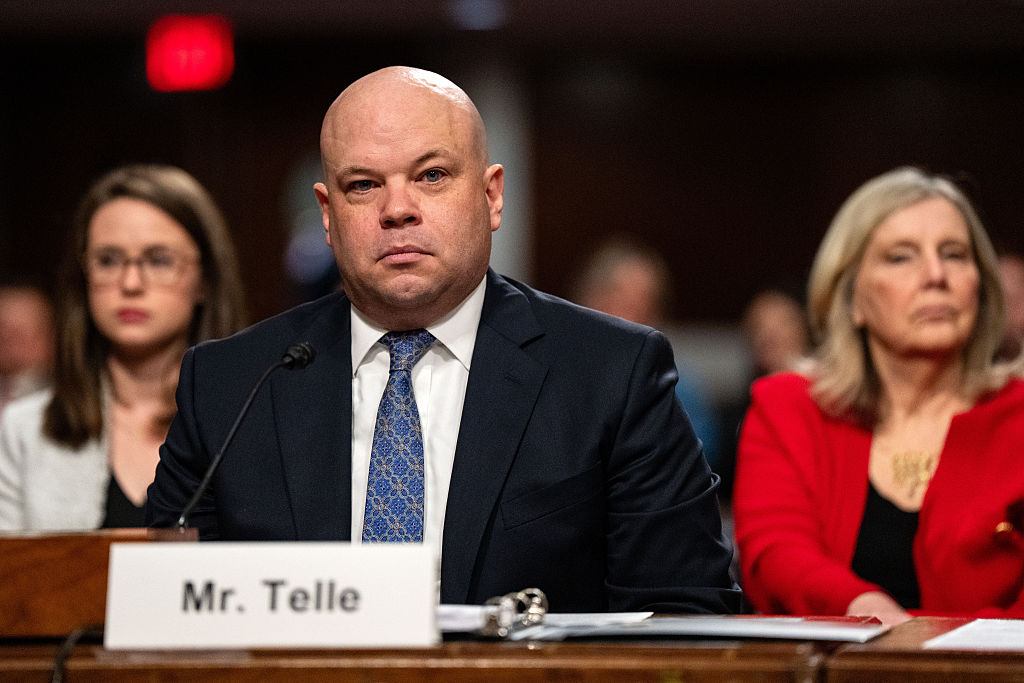
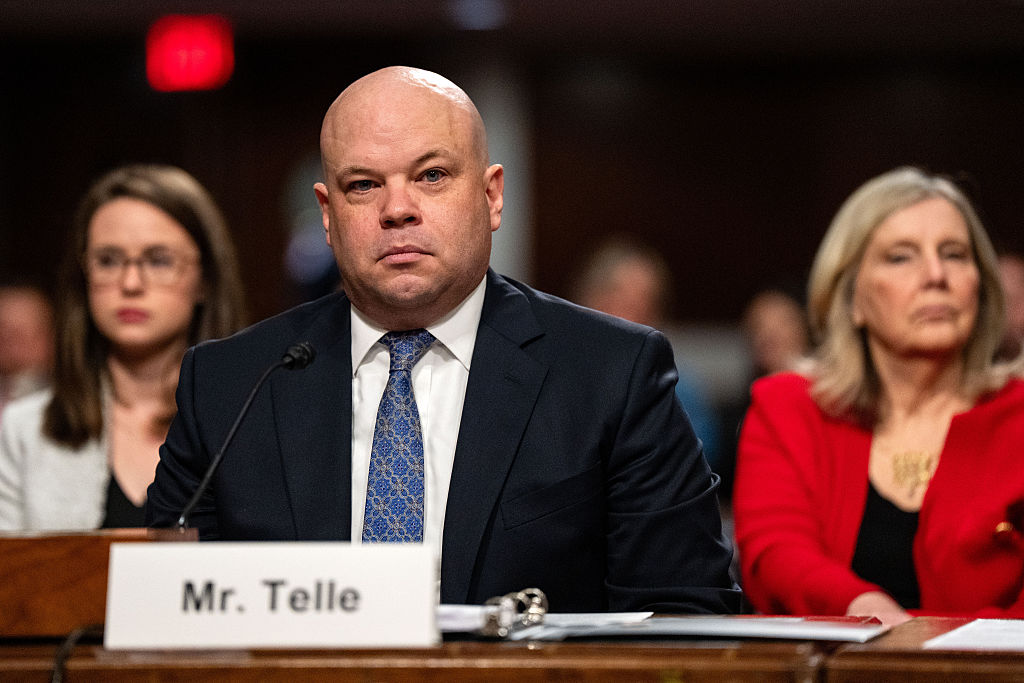
President Donald Trump announced on Thursday that Adam Telle, the Assistant Secretary of the Army for Civil Works, will temporarily replace Dan Driscoll as the Army’s top civilian leader following Driscoll’s abrupt resignation from the role earlier this week.
Trump lauded Telle as “a Great Patriot, who is respected by all” in a Truth Social post, saying Telle would take over as acting Army Secretary “effective immediately.”
The news comes after Driscoll, who Trump nominated as Army Secretary last year after returning to the White House, stepped down amid reports of tension between him and Defense Secretary Pete Hegseth.
Hegseth praised Trump’s announcement on Thursday, calling Telle “strong and whip smart.”
“Huge congrats to Adam,” Hegseth said in a post on X. “He is indeed a great Patriot — and will be an immediate asset to the @USArmy.”
Here’s what to know about Telle.
Telle has overseen the Army Corps of Engineers since last year
Telle was sworn into his current role as the Assistant Secretary of the Army for Civil Works last August, becoming the second person nominated by the President to an Army position in Trump’s second term to be confirmed by the Senate, according to Telle’s biography on the U.S. military’s website.
In that position, Telle has served as a civilian official in the U.S. Army Corps of Engineers, an agency that builds and maintains infrastructure, including dams. According to his bio, he has had “principal authority to establish policy direction and to provide supervision of all aspects” of the civil works tasks that the agency performs for the Army, including projects aimed at reducing flood and storm damage.
Telle previously worked under multiple Republican senators
Before being appointed to his current role in the Trump Administration, Telle served as the chief of staff to Republican Sen. Bill Hagerty of Tennessee from 2021-2025, according to Legistorm. He previously worked under another Republican, then-Sen. Thad Cochran of Mississippi, for about a decade from 2007-2017, and held various roles in the office, including deputy chief of staff and legislative director, according to Legistorm. While serving in Cochran’s office, he helped with the lawmaker’s work on Hurricane Katrina recovery, according to his Army bio.
Telle also served on the Senate Appropriations Committee’s subcommittee that was responsible for overseeing the Department of Homeland Security’s budget, according to his bio.
Telle served in the first Trump Administration
During Trump’s first term in the Oval Office, Telle served on the White House Office of Legislative Affairs’ Senate team and “was President Trump’s chief liaison to the Senate,” according to his Army bio.
Telle will take over as acting Army Secretary at a tumultuous time
Telle will step into his new role in the Army at a time of turmoil both abroad and within the Department of Defense.
The war in Iran, which began on Feb. 28, has now stretched on for longer than six months and has sparked backlash from many Americans.
And Telle will also be taking on the new position amid upheaval within the U.S. military’s senior ranks. About 20 military and civilian leaders have been ousted or have resigned since Hegseth took over the Department of Defense, including Driscoll earlier this week. Even some Republicans have criticized Hegseth for the chaos at the agency, including Sen. Thom Tillis of North Carolina, who has called on Trump to replace the Defense Secretary.
“[Hegseth] is creating a leadership void at the top of our military ranks,” Tillis said in a social media post this week. “I urge the President to find a new leader at the Pentagon who will retain and empower our military talent rather than diminish it.”


Crypto’s August rally put corporate conviction to the test. Bitcoin (BTC) miners that spent much of the crypto downturn courting AI investors are once again trading like leveraged bets on BTC, while Strategy and Strive are adding thousands more Bitcoin to their balance sheets.
The same concentration is playing out elsewhere. Bitmine is closing in on owning 5% of Ether’s (ETH) circulating supply despite billions in unrealized losses, while 21 major financial institutions are taking a different approach by developing stablecoins for payments and settlement.
Bitcoin rally puts miners back in the spotlight
Bitcoin’s August rally lifted beaten-down mining stocks by as much as 67%, reversing a trend that had favored miners pivoting to AI and underscoring the sector’s continued sensitivity to BTC market conditions.
BlocksBridge Consulting reported in a recent newsletter that Bitcoin’s roughly 23% rally in late August outpaced most AI-linked infrastructure stocks. Canaan, American Bitcoin and Cango gained between 41% and 67%, compared with about 21% for CoreWeave, 17% for Nebius and 15% for IREN. Meanwhile, some miners with greater exposure to AI and high-performance computing were flat or declined.
BlocksBridge cited three catalysts for the rally: an expansion of US Treasury liquidity-supporting buybacks, renewed regulatory optimism following a White House crypto meeting and a sharp short squeeze that liquidated more than $1.6 billion in positions.
The outperformance suggests investors may once again be rewarding direct Bitcoin exposure, although the sector still faces risks from the high costs of building out AI data-center capacity.
Strive, Strategy add to Bitcoin holdings as BTC rallies
Strive and Strategy added billions of dollars’ worth of Bitcoin to their corporate treasuries in the final week of August, with Strive buying 1,800 BTC for approximately $143 million and Strategy acquiring another 4,603 BTC.
Strive’s purchases between Aug. 24 and Aug. 28 lifted its holdings to 23,156 BTC, making it the fifth-largest publicly traded corporate Bitcoin holder. The company paid an average of $79,431 per BTC, including fees and expenses, after buying 1,110 BTC the prior week at an average price of $73,409.
Strategy, meanwhile, resumed buying, acquiring 4,603 BTC at an average price of $80,318 and lifting its holdings above 845,000 BTC after four sales since May.
The purchases coincided with a broader digital asset recovery that began Aug. 19, after the US Treasury announced plans to double certain long-term bond buybacks.
21 financial institutions plan a G7 stablecoin venture for 2027
A consortium of 21 major financial institutions, including Bank of America, Goldman Sachs and Citi, plans to establish a new company to develop and issue stablecoins, marking another sign of traditional finance’s push into digital dollars as regulatory frameworks take shape.
The group intends to launch a US dollar-denominated stablecoin in the first half of 2027 before expanding to other G7 currencies, with a euro offering next. The stablecoin will target wholesale, institutional and retail markets for cross-border payments and digital asset settlement.
The venture builds on an initiative announced last October by 10 banks exploring a 1:1 reserve-backed digital money on public blockchains. The consortium now spans North America, Europe, East Asia, the Middle East and Africa, and intends to comply with both the US GENIUS Act and the EU’s MiCA regulation.
Bitmine nears 5% of Ether supply after 65-week buying streak
Bitmine has extended its Ether buying streak to 65 consecutive weeks, adding 53,501 ETH last week as a broader crypto market recovery lifted the value of its digital asset portfolio.
The latest purchase brought Bitmain’s holdings to more than 5.9 million ETH, valued at roughly $14.8 billion based on an Ether price of $2,511 as of Sunday. The company now owns 4.9% of Ethereum’s 120.7 million circulating supply, putting it within striking distance of its stated 5% goal.
Bitmine chairman Tom Lee said Ether, Bitcoin and Solana have been the three best-performing major assets since June 30, with ETH leading gains.
“We believe this sets the stage for institutions to add to their crypto holdings given the substantial outperformance versus other macro assets,” Lee said.
Despite the accumulation, Bitmine is sitting on roughly $5.1 billion in unrealized losses on its Ether holdings, according to DropsTab data, reflecting sustained buying through the downturn that began in late 2022.
Crypto Biz is your weekly pulse on the business behind blockchain and crypto, delivered directly to your inbox every Thursday.
Crypto World
Rooney and Kate Mara Are Brilliant in Werner Herzog's Fractured Fairytale Bucking Fastard
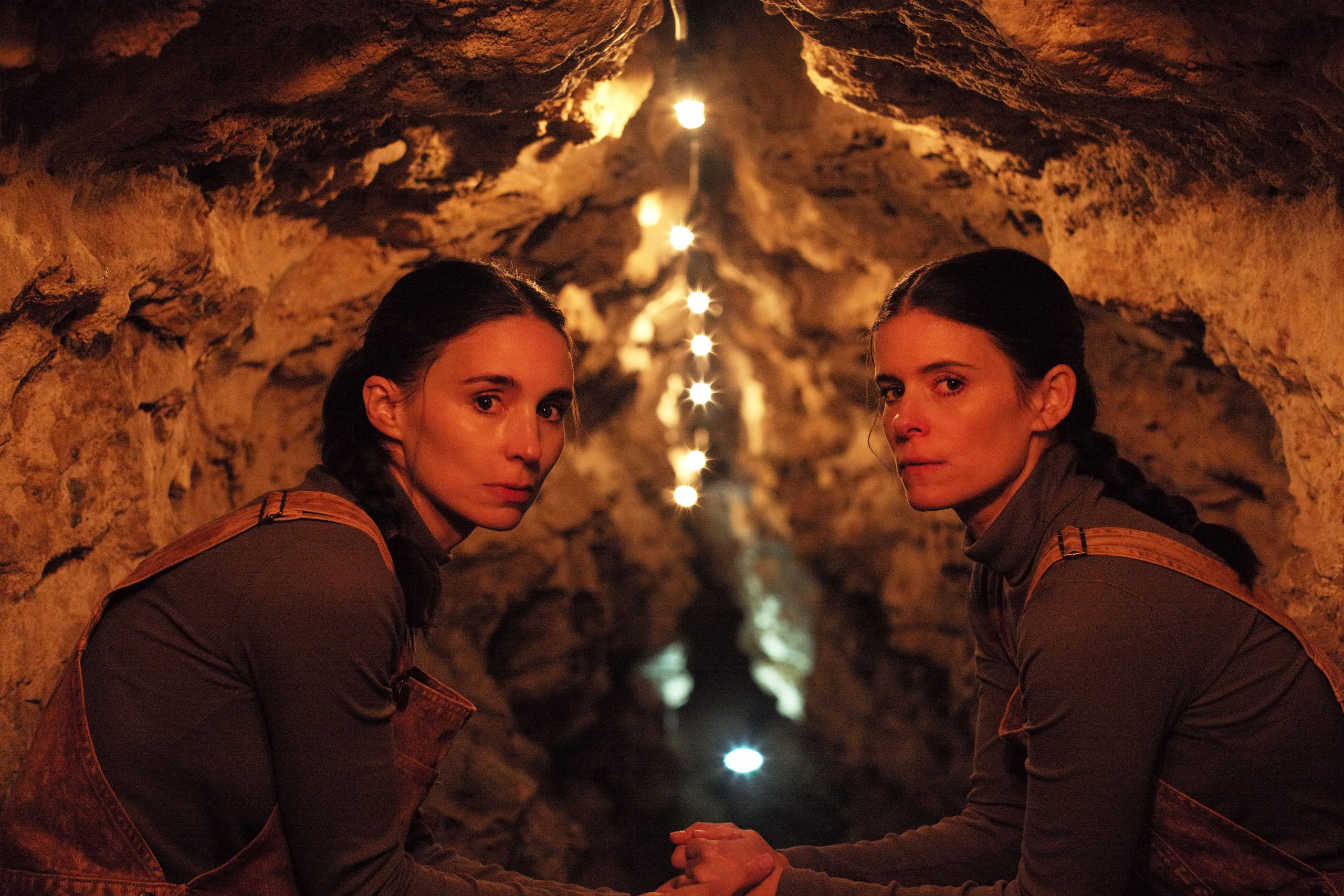
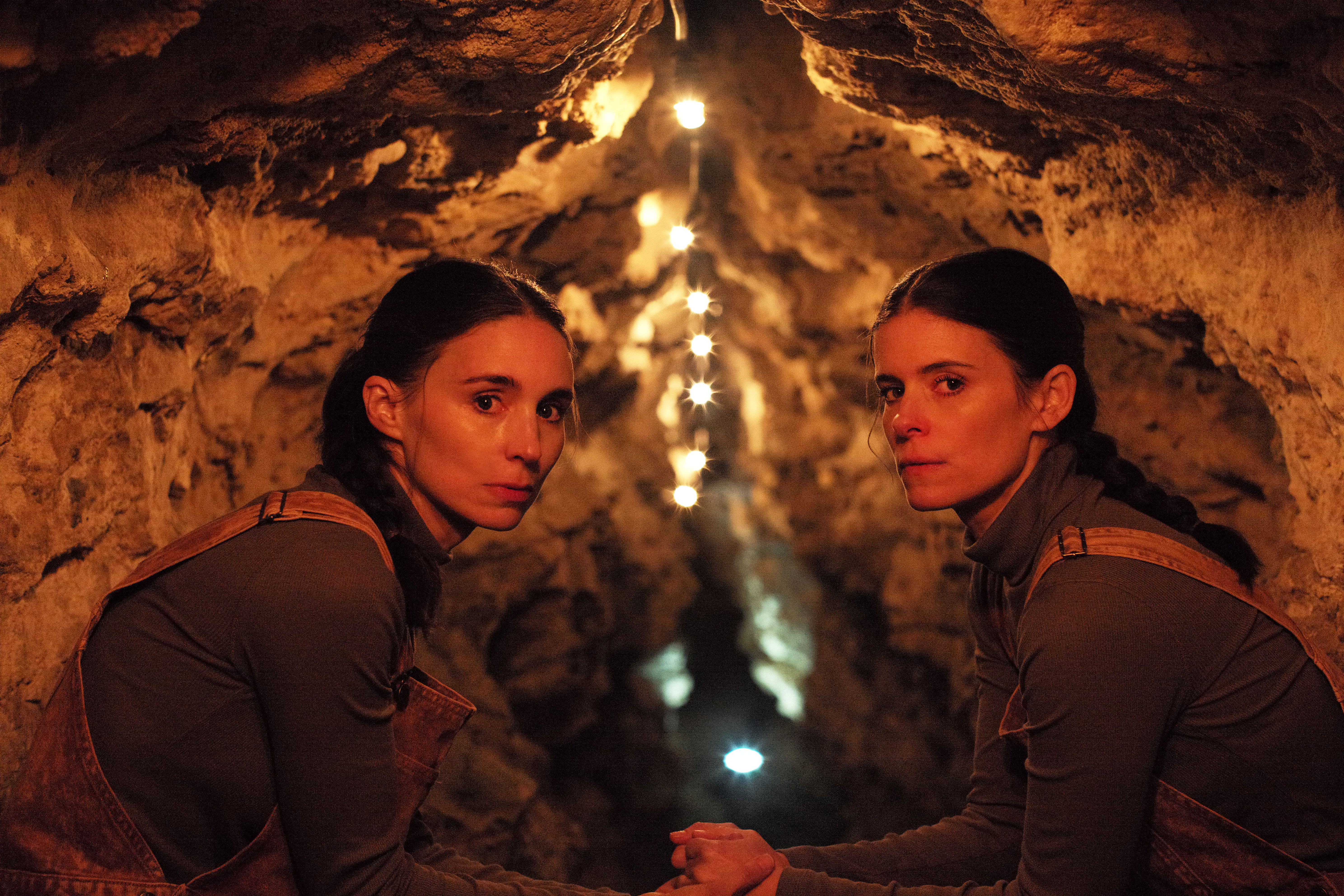
Almost nothing in Werner Herzog’s fractured fairytale Bucking Fastards, playing in competition here at the Venice Film Festival, makes literal sense. But it all makes a kind of sideways sense, especially if, before watching, you can will yourself into a Herzogian brainspace, a place where possibly nonexistent elephants roam the Earth, where ancient cave drawings bear witness to the enduring creativity and wonder of humankind, where mad dreamers insist it’s possible to haul a multi-ton ship over a mountain. In that context, two inseparable sisters who speak only in unison, who are crazily lovesick over the man who has spurned them, and who believe they can dig a literal tunnel into a land of freedom, acceptance, and love: in a world where our deepest desires are so seldom met, how nuts does that really sound?
Real-life sisters Rooney Mara and Kate Mara play Joan and Jean Holbrooke, sisters living in Ireland—they are not, they adamantly insist, twins—who share every emotion, every thought, every waking moment as if they were a single entity. They dress exactly alike, in droopy trenchcoats and modest granny-style skirts; they both wear their long, silky hair parted neatly in the middle and tied partially back, like identical waterfalls. They don’t finish each other’s sentences; instead, they form their thoughts and words in unison and speak as one. It’s an eerie effect the first time you hear it. Even more unsettling, it comes to sound completely normal as the movie wears on.
Joan and Jean have fallen for a single man, their handsome rapscallion neighbor Gareth Mulroney (a saucy, salacious Orlando Bloom). It’s love at first sight—or is that sights?—when he bursts into their local church, a tankard of beer in hand, stirring up nothing but trouble. Afterward, they breathlessly wait for him to emerge through the church doors. Their eyes gleaming like double constellations, they proposition him: “I’d love to show you my inner cowgirl!” they tell him, the words tumbling out more like a song than a sentence. He’s charmed, intrigued; he’s horny. The trio land in bed, with Gareth in the middle flanked by his semi-nude cutie cowgirls, who ooh and ahh over him adoringly. They’re Goldilocks and he’s their just-right. This is how a sex scene, as imagined by Herzog, plays out.
But their bliss is short-lived. That meet-cute and its aftermath are relayed in flashback as the sisters huddle together in a courtroom, essentially defending themselves against charges of stalking. Gareth, after dallying with Joan and Jean for a time, has thrown them over and taken a wife. They can’t believe it—in their futile rage, they set the interior of his car on fire. (Their procurement of the gasoline they use to do so is a cracked mini-adventure by itself.) They also set the postbox outside his house aflame. Before the bewigged judge, Gareth’s lawyer tries to argue that the relationship was purely sexual. Joan and Jean justify their actions plaintively. “It was love!” they cry in unison, and later, “I am never going to stop loving him!”

But there’s no hope. Their linked hearts are broken, and the court case has brought them both fame and embarrassment. A kind villager (John Kavanagh) takes pity on them, knowing that the best thing for them is to get away. He offers them the use of a flat he doesn’t need, located in another town. He urges them not to open the door to strangers, people who want only to take advantage of them. From there, Bucking Fastard becomes a set of wriggly vignettes more than a linear story. There’s a sleazy neighbor (Malcolm Adams) who attempts to take, and post on the Internet, pictures of them undressing. (They put their heads together and cook up a giggly-devious plan to outwit him.) A kind social worker, played by Domhnall Gleeson, tries to show them how to collaborate in the task of opening a tin of sardines. But soon even their cozy flat comes to feel like a prison: they strike out on an adventure, going to live with an aunt who loves them (Marion O’Dwyer) and who encourages them to explore a mysterious cave near her country property, one whose twists and turns ignite their two-for-one imaginations. A fox named Cupid, with a perpetually alarmed-looking face, becomes their mascot. Through it all, they continue to mourn their lost love. But perhaps they can find a new one?
What does any of this mean? Though the story was inspired by real-life twins from York, England, Freda and Greta Chaplin—who spoke in unison and, like Jean and Joan, did everything together—the meandering storyline is pure, sweet, gaga Herzog. The picture’s most radiant sequences take place in the girls’ beloved cave, where they toil for years to dig their way, admittedly nonsensically, to a better life. Herzog and his frequent cinematographer Peter Zeitlinger film the two of them, within a halo of light as they dutifully chip through a rocky passageway—their twin images are as luminous as a delicately carved shell cameo.
The Mara sisters are brilliant here, their eyes as hungry and haunted as those of an orphan in a Keane painting. You laugh with them, not at them, when they take revenge on that peeping tom. But there’s also something deeply touching about their refusal to give up on love. There’s a metaphorical idea shimmering beneath the surface of Bucking Fastard: it’s as if, through this strange and somewhat simple story, Herzog were trying to explore the things women want but don’t dare demand. Here, those longings are voiced in stereo. And yes, men can sometimes drive you crazy. What can you do?
The ending of Bucking Fastard might be considered a flaw; it’s hard to know exactly what has happened, or what it means. But then, an ambiguous ending is one we’re free to write ourselves. How can you not want the best for these dreamy, heartbroken girls, who at one point race through their cave in matching gauzy white gowns, like freedom-loving butterflies? You’ll want to believe that their hearts have at last found a home—a cave not of forgotten dreams, but of remembered ones, made sweeter with every recounting.
WhiteBIT Coin (WBT), Hyperliquid (HYPE), and Rain (RAIN) all printed all-time highs within the past 10 days. All three altcoins now trade just beneath those records rather than rolling over.
Two of the three sit within roughly 3% of a new peak. RAIN needs a far larger move, which makes it the outside bet of the group heading into the weekend.
WBT Price Sits 2.7% Below Its Record
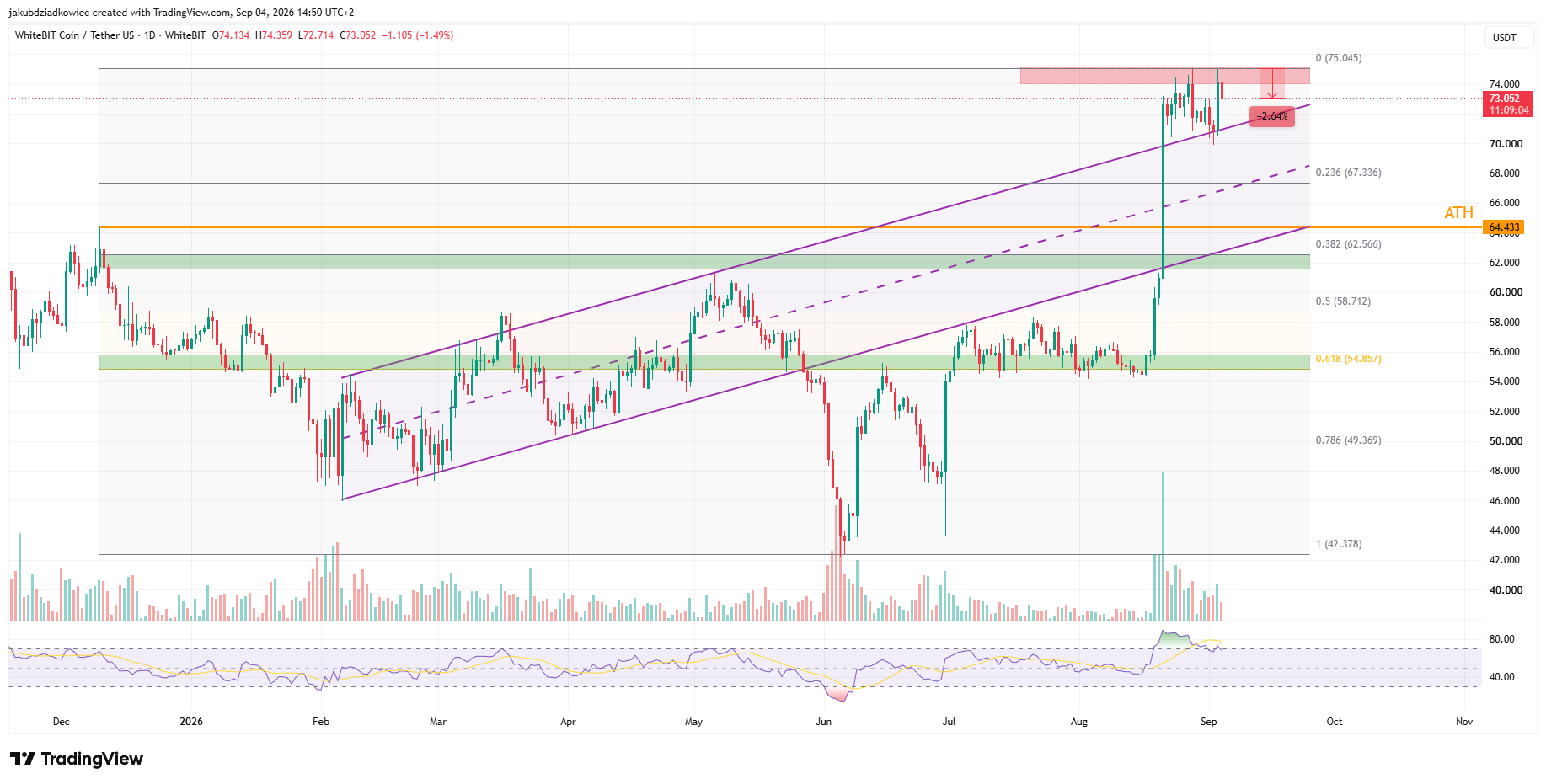
WBT trades at $73.05 after gaining 1.49% in 24 hours, giving it a market capitalization of nearly $8.6 billion. The token set its record of $74.87 on Aug. 25.
Price action has stayed in discovery mode since WBT cleared its former peak at $64.43. An ascending parallel channel formed in early February, broke down before the June selloff to $42.38, then recovered on Aug. 21.

The upper channel band near $72.50 has since held as support. Resistance runs from $73.50 to $75.05. WBT approached similar territory in early August without breaking through. Meanwhile, the relative strength index (RSI) reads 69, down from 80 in late August, which indicates cooling momentum.
HYPE Price Needs 3.1% for a New All-Time High
HYPE changed hands at $85.39 after a 3.36% daily gain. Its market capitalization is near $19 billion, ranks 10th by size, and its record of $88.06 arrived on Sept. 3.
Two objectives sit above the spot. A new peak requires 3.1%. The 1.272 Fibonacci extension at $92.37 demands 8.2% and caps a supply band starting at $88.50. Hyperliquid already featured among the altcoins flagged for September.

Support starts at the former record of $77.00. Below that, an ascending trendline from the February low runs near $57. It converges with the 0.618 Fibonacci level at $55.41 and has held three times since March. RSI near 66 suggests strength is fading, though HYPE has still gained about 70% since Aug. 2.
RAIN Price Must Climb 17% to Set a Record
RAIN trades at $0.01661 for a market capitalization near $11.8 billion. Its record of $0.01943 dates to Aug. 25, so a new peak this weekend would take almost 17%. That makes RAIN the least likely of the three.
Longer-term structure still favors buyers. A late-May breakout lifted RAIN from $0.0067, and the token has built higher lows while holding the $0.01624 shelf. RAIN traded near record levels in mid-July as well.

Resistance sits at the 1.272 Fibonacci extension of $0.01884, roughly 3% under the record. Support follows at $0.01420 and $0.01259. However, volume has thinned for four sessions and RSI has slipped from 78 to 60. Momentum may not carry price that far.
The post 3 Altcoins That Could Reach All-Time Highs This Weekend appeared first on BeInCrypto.

Chicago, United States, September 4th, 2026 – Liquid Mercury today announced that ACQUA1, LLC completed the initial closing of its MERC exchange offering on September 1, 2026.
ACQUA1 is a Liquid Mercury subsidiary that operates Liquid Mercury’s Lab Company program, licensing Liquid Mercury technology to companies primarily tokenizing real-world assets and receiving fees plus a minority equity stake in return. Liquid Mercury is the majority holder and Manager.
“Over the past 18 months, dozens of companies have approached Liquid Mercury seeking to tokenize their assets,” said Tony Saliba, CEO and founder of Liquid Mercury. “Many assumed they would need to raise capital and build this infrastructure from scratch. Licensing Mercury RWA lets them launch on systems that were already live and proven, at a fraction of the time and cost. ACQUA1 token holders now own a slice of the business that earns equity, plus fees from the companies in the Lab Company program.”
Verified accredited investors subscribed by exchanging MERC for non-voting Class B units of ACQUA1 at the initial conversion rate of 10 MERC per unit. Under its operating agreement, ACQUA1 must burn 100% of the MERC it receives at each closing within five business days and may not transfer, trade, lend, stake, pledge, or otherwise deploy it.
On September 2, all 563,230,000 MERC received at the initial closing were burned via a transfer to the dead address, as the offering documents require.
Initial Closing Highlights
- Initial closing: September 1, 2026
- MERC burned: 563,230,000
- Transferred to the dead address September 2, 2026
- Units issued: 56,323,000
- Non-voting Class B units of ACQUA1, LLC under Rule 506(c) of Regulation D
- 10 MERC per unit
- Evidenced on-chain by ACQUA1-C tokens
- ACQUA1-C tokens convert one-for-one into ACQUA1 tokens upon issuance
- Remaining closings: On or about October 30 and December 31, 2026
- ACQUA1 may skip or terminate at its discretion
- The conversion rate at subsequent closings may differ
Verification Links
Verified accredited investors can request full terms at acqua1.liquidmercury.com/contact.
About Liquid Mercury
Liquid Mercury powers professional crypto trading and digital asset marketplaces. The company delivers institutional-grade infrastructure, access to deep liquidity, and best-in-class trading tools and workflow automation across its Pro, OTC, and RWA platforms.
Through Mercury RWA, Liquid Mercury is extending that infrastructure into tokenized real-world assets, with $MERC serving as the access and platform layer token. For more information, visit www.liquidmercury.com.
Investor Notice
This press release does not constitute an offer to sell or the solicitation of an offer to buy any securities. Class B units of ACQUA1, LLC and the ACQUA1 tokens representing them are offered and sold in reliance on the exemption from registration provided by Rule 506(c) of Regulation D under the Securities Act of 1933, solely to verified accredited investors as defined in Rule 501(a) of Regulation D, and solely pursuant to ACQUA1’s confidential private placement memorandum, as supplemented, and definitive subscription documents, which contain important information, including risk factors. ACQUA1 tokens are restricted securities, are subject to transfer restrictions under ACQUA1’s operating agreement and may remain illiquid indefinitely; investors should not assume that Rule 144 will be available.
Statements regarding future revenues, valuations, portfolio performance, and subsequent closings are forward-looking and subject to risks and uncertainties; actual results may differ materially. The MERC contract has no burn function; tokens are removed from circulation by transferring to the dead address. Supply outstanding excluding the dead address is 5,436,770,000 MERC, as of the date of publication.
Contacts
Director: Kent Egan, Ryan Hansen
The post Liquid Mercury Announces Initial Closing of ACQUA1 Offering appeared first on BeInCrypto.


Polygon co-founder Sandeep Nailwal has launched a stablecoin donation channel for Nepal’s official disaster fund, with Blockchain for Impact pledging $100,000 to the campaign.
Summary
- The campaign accepts cryptocurrency before converting the funds into Nepalese rupees for the government relief fund.
- Polygon’s Open Money Stack, Coinme and Cross River Bank support the donation infrastructure.
- Blockchain for Impact has committed $100,000 to the Nepal relief campaign.
- The initiative follows separate Nepal relief commitments from Ripple and the Solana community.
Stablecoins provide a route into Nepal’s disaster fund
Sandeep Nailwal said in a Sep. 4 X post that he had opened a cryptocurrency donation route for people seeking to support relief and reconstruction in Nepal.
Rather than sending digital assets directly to a government-controlled wallet, the system collects cryptocurrency and converts the proceeds into Nepalese rupees. The local currency then enters the Prime Minister’s Disaster Relief Fund through recognized financial channels, according to Nailwal.
Polygon’s Open Money Stack provides the routing, bridging and conversion infrastructure behind the campaign. Coinme and Cross River Bank are also supporting the payment pathway, while Blockchain for Impact has pledged $100,000.
The campaign website says donors can contribute USDC through Ethereum or Polygon. Engage Nepal, a U.S.-based nonprofit organization, handles the collection and accounting process before delivering the converted funds to Nepal’s official disaster fund.
By accepting a dollar-backed stablecoin, the system avoids exposing the donated amount to the price swings associated with assets such as Bitcoin or Ether. Nailwal described stablecoins as suitable for cases in which money must reach people quickly, although the final transfer still relies on conversion services and conventional banking infrastructure.
Public blockchain records can show when a donation enters a listed wallet and when the assets move to another address. Nailwal’s announcement did not provide a schedule for converting the contributions or state when the government fund would receive each batch of proceeds.
Nepal crypto donations follow a deadly flood
The fundraising drive follows severe flooding caused by a glacier collapse in the Himalayan region on Aug. 26. Ice, rock, mud, and other debris entered the mountain river system, sending floodwater through settlements and damaging roads, bridges, and power infrastructure.
Authorities had reported at least 750 deaths and more than 3,000 missing people across Nepal and China’s Tibet region by Aug. 30. Nepal accounted for 734 of the reported deaths and 2,498 of the missing, according to figures cited in a recent relief report.
The Red Cross estimated that more than 90,000 people had been affected. Flooding also isolated some communities from food, clean water, and emergency services, while hundreds of workers were believed to be trapped in damaged hydropower tunnels.
World Central Kitchen said local restaurant partners were providing meals in the Rasuwa and Nuwakot districts. Mercy Corps, which has worked in Nepal since 2005, began coordinating food, water, and sanitation assistance with local organizations and government agencies.
Ripple committed $300,000 on Aug. 29 to support the work of both relief groups. The San Francisco-based blockchain company did not say whether XRP, its RLUSD stablecoin, or a conventional payment method would be used for the contribution.
Elsewhere in the crypto sector, the Solana Foundation and NFT marketplace Mallow sold nine advertising spaces on Solana’s X profile image through an auction. Bidders used USDC, and the organizers reported that the sale generated $166,946.50 for Nepal relief.
Under the auction process, Mallow was responsible for receiving the proceeds, moving them into USDC on Ethereum, and transferring the funds to Engage Nepal. The U.S. nonprofit would then deliver the money to the Prime Minister’s Disaster Relief Fund.
U.S. organizations handle part of the payment route
For donors in the United States, the Polygon-backed campaign uses several organizations operating within the country’s financial and nonprofit systems.
Engage Nepal operates as a U.S.-based 501(c)(3) organization and is led by former U.S. Ambassador to Nepal Scott DeLisi. Its role connects public crypto wallets with a legal entity that can convert and transfer funds through channels recognized by Nepal’s government.
Cross River Bank adds a regulated banking component to the arrangement. The New Jersey-based institution provides financial services to fintech and payment companies, placing a conventional bank between the onchain collection system and the fiat transfer.
Coinme, another U.S. participant, operates cryptocurrency cash and payment infrastructure. Nailwal did not break down the duties assigned to Coinme or Cross River Bank, though he identified both as supporters of the campaign alongside Polygon’s Open Money Stack.
Nepal’s government has not listed a cryptocurrency address on its official disaster-relief donation page. Its established options include bank transfers, cards, remittance services, and international payment systems, which means the campaign serves as an intermediary for donors who hold digital assets.
The structure also limits what blockchain records can prove. Onchain data can verify transactions involving the public donation wallet, but it cannot independently show how converted funds are spent after they enter a bank account or government relief program.
In response to the disaster, Nepalese officials have warned the public against unauthorized payment codes and personal accounts claiming to collect relief money. Donors using cryptocurrency face a similar verification issue because a public wallet address does not, by itself, confirm who controls it.
Nailwal returns to crypto-funded humanitarian work
The Nepal campaign extends Nailwal’s involvement in relief projects that began during India’s COVID-19 crisis in 2021. At the time, he created the India COVID-Crypto Relief Fund to collect digital assets from donors around the world.
Ethereum co-founder Vitalik Buterin later sent 50 trillion Shiba Inu tokens to the fund. The contribution was valued at about $1.2 billion when the transfer occurred, although converting a donation of that size required managing market liquidity, price volatility, and local rules.
In June 2023, Buterin and Nailwal directed another $100 million toward COVID-19 research and medical infrastructure in India. Under the arrangement, Crypto Relief supplied $90 million in USDC, while Buterin contributed the remaining $10 million, as previously covered here.
Crypto Relief was later reworked into Blockchain for Impact, the organization now contributing $100,000 to the Nepal campaign. BFI has concentrated on healthcare, biomedical research, and public-health programs in India.
As crypto.news reported in March 2025, BFI had allocated over $90 million to healthcare and research programs while pledging another $200 million for future projects. Its plans included work with more than 15 medical colleges, support for 50 research projects, and programs involving over 600 researchers.
Nailwal said at the time that combining blockchain transparency with collaborative funding could help ensure “every dollar is accounted for and maximized for impact.”
In his Nepal announcement, Nailwal also cited his personal connection to the region. Born in Kumaon in the Indian state of Uttarakhand, which borders Nepal, he said his maternal family came from the same area. Communities across the India–Nepal border have long maintained family, cultural, religious and commercial ties commonly described as roti-beti ka rishta, or a relationship built through shared livelihoods and marriage.

Chaos as Lindsay Clancy judge declares mistrial THEN puts it on hold for one hour after Hail Mary last effort from her lawyer
HPE Earnings Soar but Supply Constraints Aren’t Going Away

Biggest UK Investment Platform Lists Bitcoin For 2 Million Users





-

 Crypto World9 hours ago
IMF Says El Salvador’s Post-Review Bitcoin Purchases Used No Public Funds
-

 Sports9 hours ago
Alexandre Pato consortium’s Northampton Town investment approved
-

 Politics11 hours ago
A new European chapter for Gibraltar
-

 Crypto World2 days ago
CLARITY Act could advance within weeks, Atkins says
-

 Politics9 hours ago
33 Cosy Autumn Home Decor Ideas: Blankets, Pumpkin Decorations, And Candles
-

 Tech9 hours ago
JLab goes big on new headphones at IFA 2026
-

 Sports9 hours ago
Commanders’ Chig Okonkwo is a top breakout fantasy football candidate
-

 Politics8 hours ago
The House Article | When Nigel Farage enters No 10, he will not fall into Whitehall’s trap
-
 Crypto World9 hours ago
Bitcoin News: BTC to Gold Ratio Hits 18 as Both Assets Rally
-

 Crypto World9 hours ago
IMF Says El Salvador’s Bitcoin Buying After Audit Used No Public Funds
-

 Politics4 hours ago
How To Avoid Winter Colds: 4 Everyday Habits That Spread Germs, Says Pharmacist
-

 Politics7 hours ago
The House | Bin the lectures, bring gossip and be ready to banter: how the new PM should prepare for his Trump encounter
-

 Tech4 hours ago
beyerdynamic AVENTHO Y Debuts at IFA 2026 and Makes Wireless Headphones Less Disposable
-

 Business7 days ago
Onto Innovation Stock: AI’s Next Bottleneck Is Yield (NYSE:ONTO)
-

 Crypto World4 hours ago
Revolut, OpenReserve Win US Approval for Crypto Banks
-
 Sports6 hours ago
Enzo Maresca press conference LIVE Man City vs Coventry team news plus transfer reaction
-

 Sports4 hours ago
Golden Eaglets Drawn in Group B for 2026 WAFU B U17 Championship
-

 Crypto World4 hours ago
From warning to listing: UK’s largest retail investment platform opens access to crypto ETNs
-

 Sports13 hours ago
Devon Dampier throws for 3 TDs as No. 21 Utah demolishes Idaho
-
Crypto World12 hours ago
XRP Trading Activity Hits Highest Level Since February as Price Jumps 8%
You must be logged in to post a comment Login