
Crypto World
Kalshi won’t let you bet on its Supreme Court outcome



Prediction market Kalshi won’t let you bet on whether New Jersey’s case against it will reach the US Supreme Court, or what verdict the Supreme Court would issue if it ever did.
That’s according to Barron’s reporter Nick Devor, who claims that Kalshi’s policy means it “won’t have a way to hedge against the biggest risk to the company’s business.”
A Kalshi spokesperson told Devor that the firm could list a market on the Supreme Court’s actions if it wanted to, “but is not doing so on principle.”
Devor also notes that Kalshi doesn’t want to introduce a market which it could influence, as that would break its company policy.
Appeals courts are split over Kalshi
Last Friday, an appeals court ruled in Nevada’s favor that sports contracts aren’t swaps, putting them under the category of bets and within the scope of state regulation.
However, in April an appeals court sided with Kalshi after it sued New Jersey. The ruling stated federal regulators like the CFTC should have the final say over prediction markets and sports-related contracts.
Read more: American Indian tribes want Kalshi and Polymarket off their land
Because of this split across courts, New Jersey filed a petition with the Supreme Court this week asking it to decide on “whether prediction markets can offer sports wagers without following state sports-gambling laws.”
NFL says prediction markets threaten game integrity
The state of Michigan this week also banned Kalshi from offering event contracts to its citizens. It threatened a $500,000-a-day fine if it breached this new preliminary injunction.
The NFL also wrote to prediction markets yesterday, reiterating that it doesn’t want sports contracts on offer that are easily manipulated or “inherently objectionable.”
It said, “It is deeply concerning that bets within the objectionable categories that we identified months ago have been and continue to be listed as contracts on exchanges.”
Got a tip? Send us an email securely via Protos Leaks. For more informed news and investigations, follow us on X, Bluesky, and Google News, or subscribe to our YouTube channel.

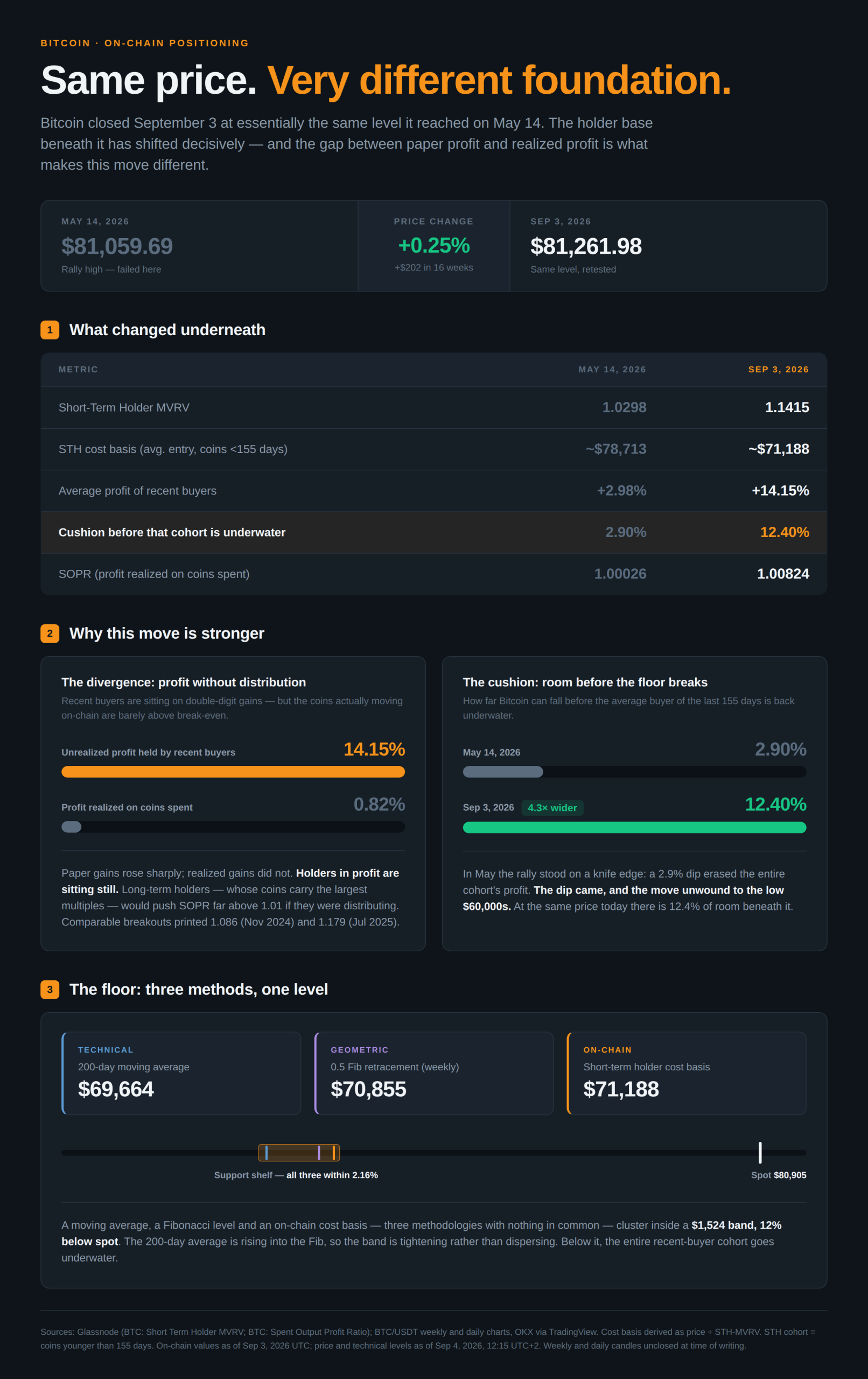
Bitcoin (BTC) price climbed to $81,050 on Friday, returning to the level it last touched on May 14. Recent buyers now sit far further from breakeven than they did then.
Glassnode data shows the average entry price for coins younger than 155 days has dropped sharply. Bitcoin, meanwhile, trades at almost the same level as in May.

Short-Term Holder Cost Basis Reset Almost $7,500 Lower
Short-Term Holder MVRV measures how far recent buyers sit above or below their average entry. The reading closed at 1.1415 on September 3, against 1.0298 on May 14.
Both dates share nearly the same price. May 14 closed at $81,059.69, while September 3 closed at $81,261.98, a difference of just 0.25%.

The implied cost basis, in contrast, tells a different story. It stood near $78,713 in May and sits near $71,188 today, a reset of roughly $7,500.
That changes the margin for error. In May, a 2.9% dip would have pushed the whole cohort back underwater. The dip arrived, and the rally unwound toward the low $60,000s.
Today the same cohort holds a 12.4% buffer, more than four times wider. Historically, that buffer has decided whether recoveries hold or fail.
SOPR Shows Profit Without Distribution
The cushion looks encouraging. Spent Output Profit Ratio, however, complicates the picture.
SOPR printed 1.0082 on September 3. Coins moving on-chain therefore changed hands at less than 1% average profit.
Comparable breakouts produced far hotter readings. SOPR reached 1.086 in November 2024 and 1.179 in July 2025.

Long-term holders appear inactive. Their coins carry the largest multiples, so meaningful selling would lift the ratio well above current levels.
Yet the same reading cuts both ways. Weekly volume keeps declining, and the spike behind last week’s breakout has not repeated. Thin participation may indicate tight supply among holders, or a move driven by derivatives rather than spot buyers.
Bitcoin Price Prediction and the $82,842 Trigger
The weekly chart shows a sequence of lower highs and lower lows since the $126,200 record. That sequence is now breaking. Bitcoin has printed a higher low and trades 35.8% below its all-time high.
A weekly close above $82,842 would confirm the first higher high since the record. The current weekly high reached $82,285, roughly $557 short.

Resistance sits immediately above at the 0.382 Fibonacci retracement near $83,917. A break of the trigger that stalls there would leave the reversal unconfirmed.
Support looks unusually well defined. The 200-day moving average sits at $69,664 and the 0.5 Fibonacci level at $70,855. The on-chain cost basis at $71,188 completes a band just 2.16% wide.
Bitcoin last tested that moving average as resistance on May 14. It now trades 16.3% above it.

Momentum warns against chasing. Daily RSI sits near 72 after touching 78 in late August, an early bearish divergence. Weekly RSI near 60, by contrast, still leaves room. A volume expansion would settle the argument.
Above $83,917 the reversal gains confirmation. Below $71,188 the buyers behind this move lose their profit.
The post Bitcoin Tests May Highs: Why Is This Time Different for Recent Buyers? appeared first on BeInCrypto.


Cointelegraph is committed to providing independent, high-quality journalism across the crypto, blockchain, AI, and fintech industries.
All news, reviews, and analyses are produced with full journalistic independence and integrity. For more details on our standards and processes, please read our Editorial Policy.
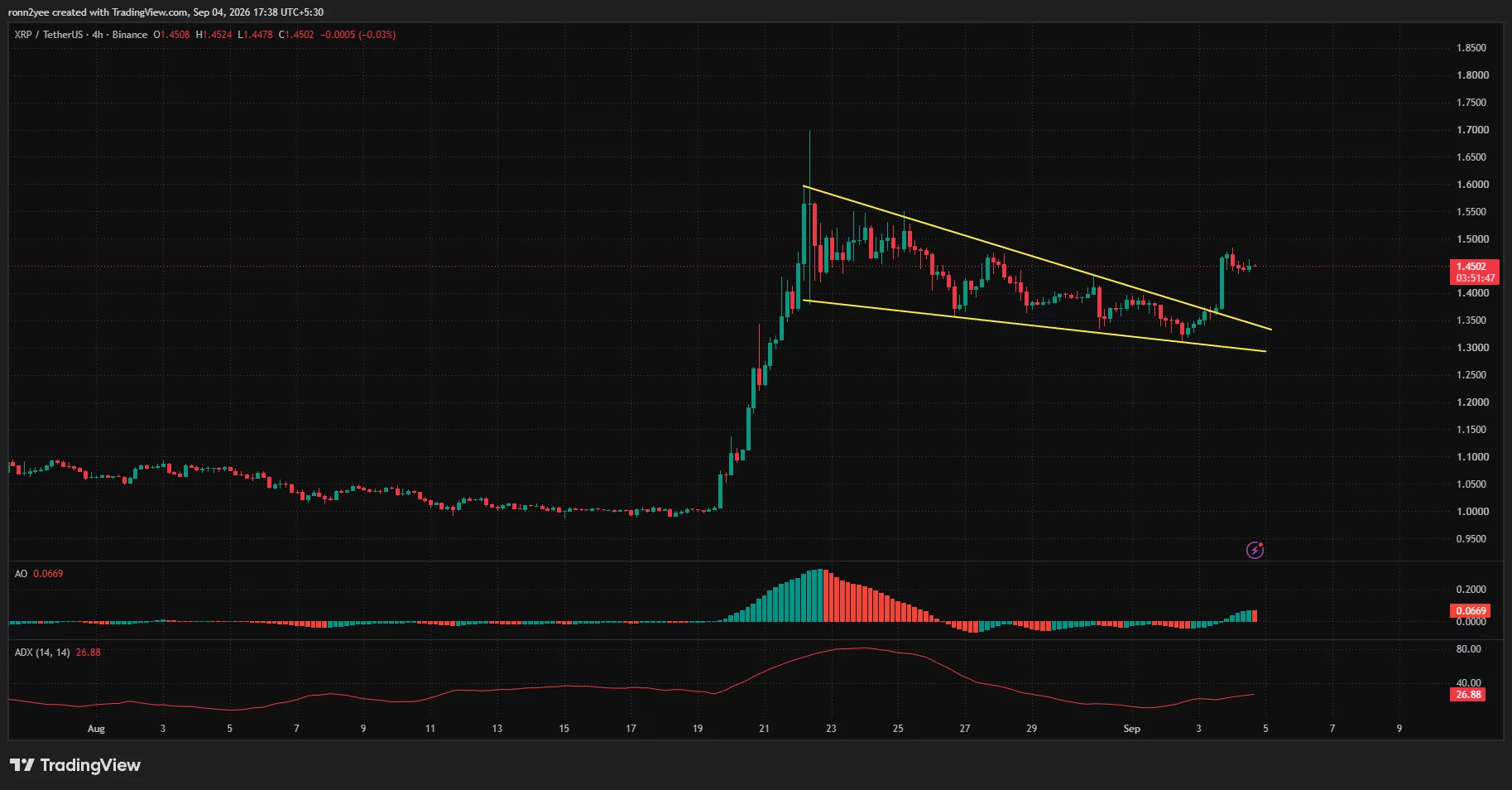
XRP price traded near $1.45 on Sept. 4 after breaking above a falling 4-hour channel, but resistance between $1.50 and $1.53 remains the next test for buyers.
Summary
- XRP price broke above a descending 4-hour channel after rebounding from support near $1.33.
- Daily RSI stands at 66.22, showing strong momentum without reaching the 70 overbought level.
- Liquidation clusters sit near $1.43 below price and between $1.48 and $1.53 above it.
- The Sept. 15 CLARITY Act vote and US inflation data could determine the next move.
XRP price action today
According to data from crypto.news, XRP (XRP) price was changing hands near $1.45 on Friday, consolidating after a sharp recovery from its early September low near $1.33.
The token briefly reached approximately $1.47 during the latest advance before losing some momentum. Even so, the pullback has remained shallow compared with the size of the breakout.
XRP’s 4-hour chart shows that price has moved above the upper boundary of a descending channel that had guided the market lower since its Aug. 22 rally. The channel formed after XRP spiked to a local high near $1.70 and then recorded a series of lower highs and lower lows.
The breakout occurred near $1.37 and was followed by a rapid move above $1.45. XRP is now holding above the former channel resistance, leaving the short-term bullish structure intact while that level remains defended.
The Awesome Oscillator stands at 0.0669 and continues to print positive bars. The reading indicates that short-term momentum remains stronger than longer-term momentum, although the latest bars show that the initial acceleration may be slowing.
The Average Directional Index has climbed to 26.88. An ADX reading above 25 normally points to a developing directional trend, giving the channel breakout more weight than a move occurring under weak trend conditions.
XRP faces resistance at $1.50 and $1.53
The first major barrier sits between $1.48 and $1.50, where XRP repeatedly struggled to hold gains following its August surge. A 4-hour close above the zone could allow buyers to challenge the descending channel’s starting area near $1.55.
The daily chart places additional resistance at $1.53. Crypto analyst ChartNerd identified that level as XRP’s 50-week exponential moving average, while the 20-week EMA sits much lower at approximately $1.28.
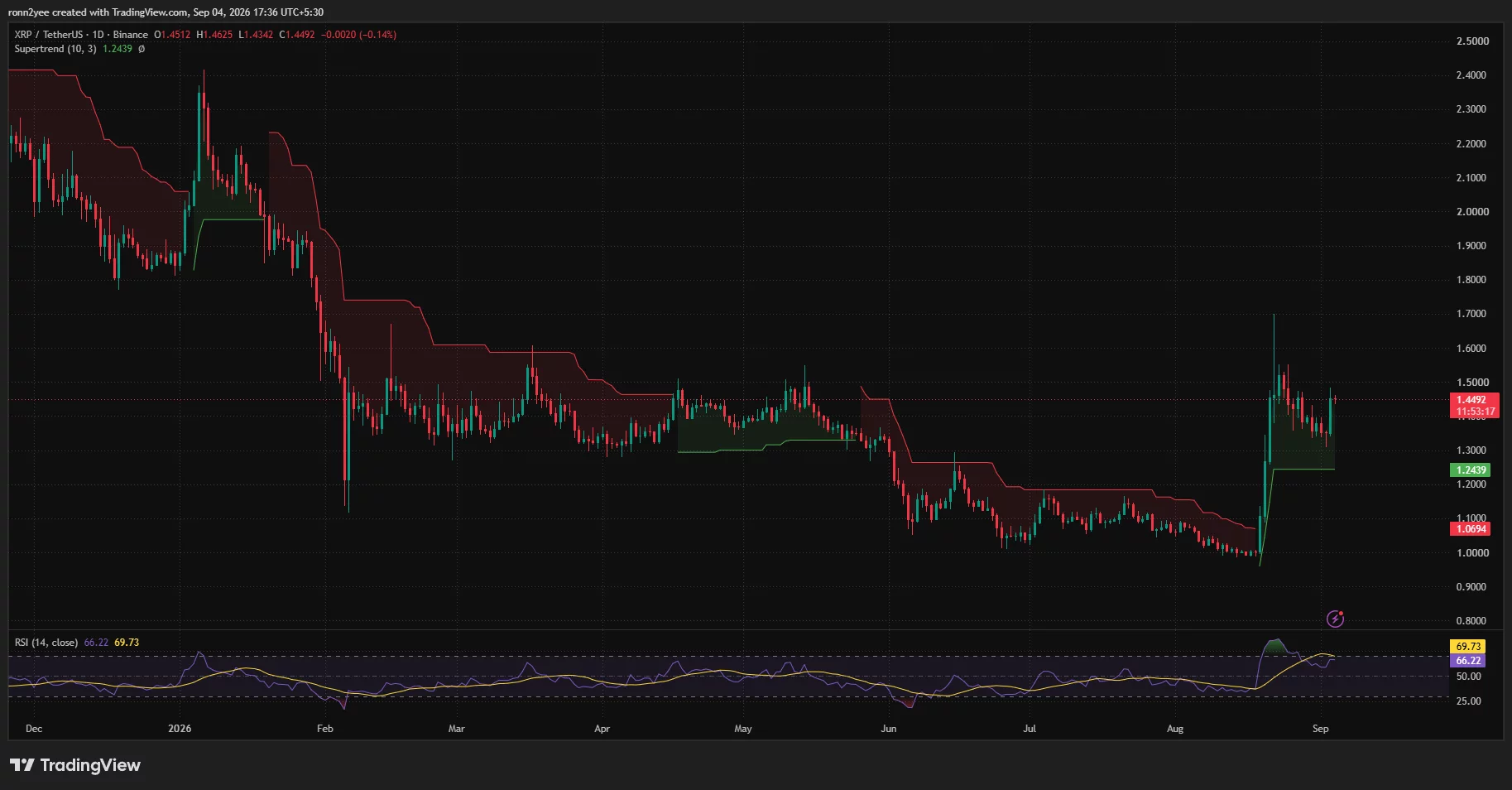
According to ChartNerd, XRP remains inside a large weekly compression range between the two averages. The analyst said a convincing move above the 50-week EMA could open the way toward $1.80, while repeated weekly closes below it would raise the risk of a deeper retracement.
Daily momentum supports another resistance test but also calls for some caution. XRP’s 14-day Relative Strength Index is at 66.22, below its signal average of 69.73 and just under the conventional overbought threshold of 70.
The reading shows that buyers still control the broader move, although momentum has cooled since XRP reached $1.70. A push above 70 alongside a price close over $1.53 would provide stronger confirmation that the recovery is extending.
Liquidation map puts $1.43 support in focus
CoinGlass’ three-day XRP liquidation heatmap shows the nearest large concentration of leveraged positions around $1.425 to $1.435. That liquidity sits just below the current market price and could attract a short-term sweep if XRP fails to hold $1.45.
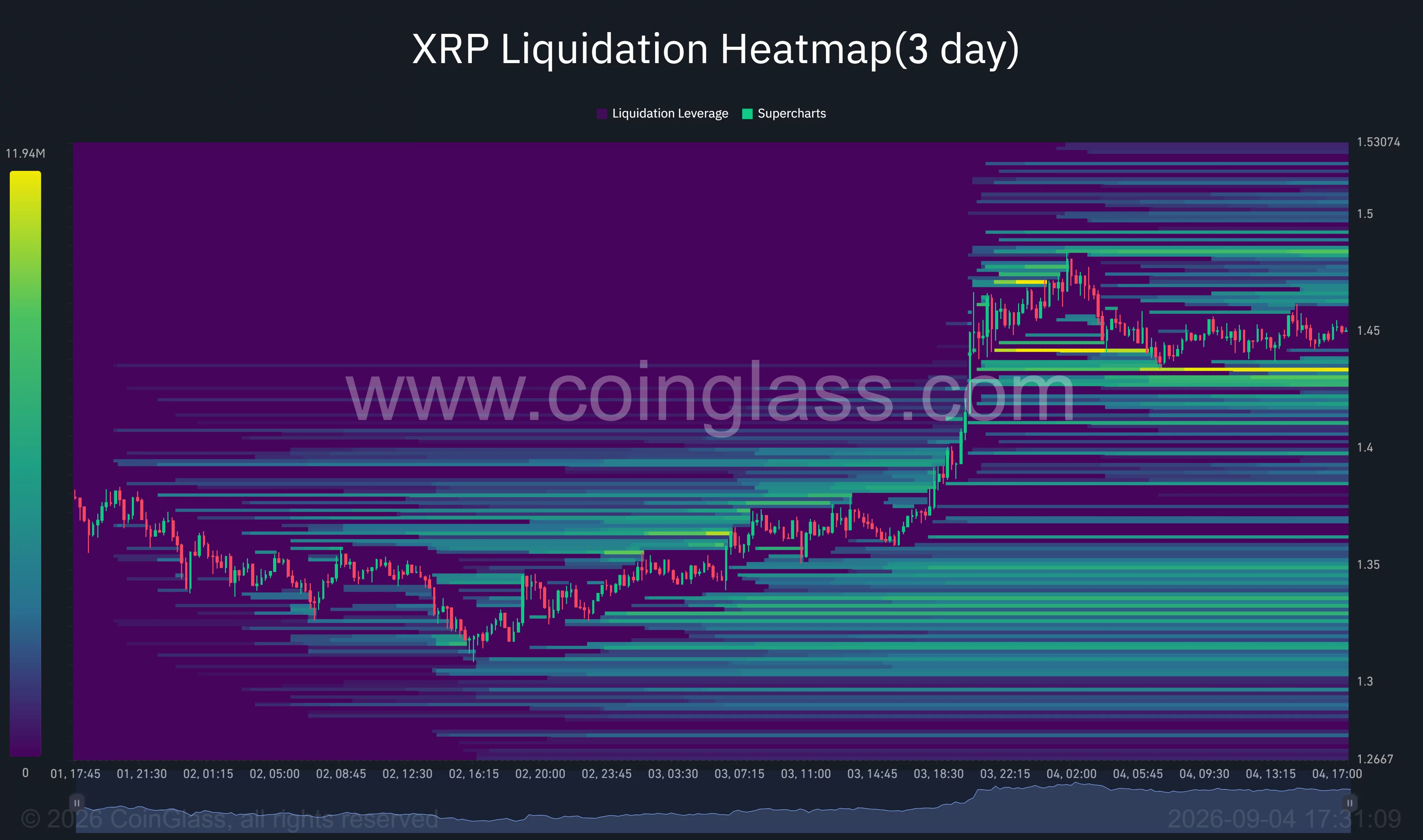
Further downside liquidity is spread across $1.40 and $1.37. The latter level is especially important because it overlaps with the former 4-hour channel resistance. A retest that holds above $1.37 would preserve the breakout structure.
A move below $1.37, however, would place the lower end of the former channel near $1.30 back in play. The daily Supertrend provides a wider structural support level at $1.2439, close to ChartNerd’s 20-week EMA near $1.28.
Above the market, liquidation positions are concentrated from approximately $1.48 to $1.53. A break into that zone could force short sellers to close their positions, adding market buy orders and potentially accelerating the move.
The heatmap does not guarantee that the price will reach either pool. It instead identifies areas where leveraged positions may be vulnerable if volatility increases.
Analysts see higher targets if the breakout holds
A separate analysis published by trader CW said XRP’s previous correction ended near the 0.5 Fibonacci retracement level. The token has since recovered above the 0.618 retracement, according to the analyst’s chart.
CW placed the next extended target at approximately $2.135, corresponding to the 1.618 Fibonacci extension. Reaching it would require XRP to clear several nearer barriers, including $1.50, $1.53, the August high near $1.70, and ChartNerd’s $1.80 target.
The nearer levels carry more importance for the current setup. A sustained move above $1.53 would complete the next stage of the breakout, while rejection could keep XRP confined between roughly $1.37 and $1.50.
US catalysts could raise XRP volatility
US-listed spot XRP exchange-traded funds recorded $110.49 million in net inflows during the week ending Aug. 28, their strongest weekly result of 2026. The figure followed an earlier increase in XRP ETF activity, with cumulative inflows reaching approximately $1.6 billion.
Traders are also watching the Senate’s Sept. 15 procedural vote on the CLARITY Act. The cloture motion requires 60 votes to advance and would end debate on the motion to proceed rather than pass the bill itself. The legislation could affect how US regulators divide oversight of digital assets.
Federal Reserve policy represents another near-term risk. Fed Governor Christopher Waller said on Sept. 3 that three-month core inflation had fallen from 4.76% in February to 3.05% through July.
Waller said he would support leaving rates unchanged if incoming inflation data confirms the cooling trend, but he did not rule out a hike if price pressures return. The August inflation report and the Fed’s Sept. 15–16 meeting could therefore influence liquidity across XRP and the wider crypto market.
For now, XRP’s 4-hour breakout favors buyers above $1.37. A close over $1.53 would strengthen the case for $1.70 and $1.80, while a loss of $1.37 would expose the $1.30–$1.24 support region.
Disclosure: This article does not represent investment advice. The content and materials featured on this page are for educational purposes only.
Crypto World
From warning to listing: UK’s largest retail investment platform opens access to crypto ETNs


The U.K.’s largest retail investment platform, Hargreaves Lansdown, has reversed course following the FCA’s decision to lift its retail ban on crypto ETPs in October.
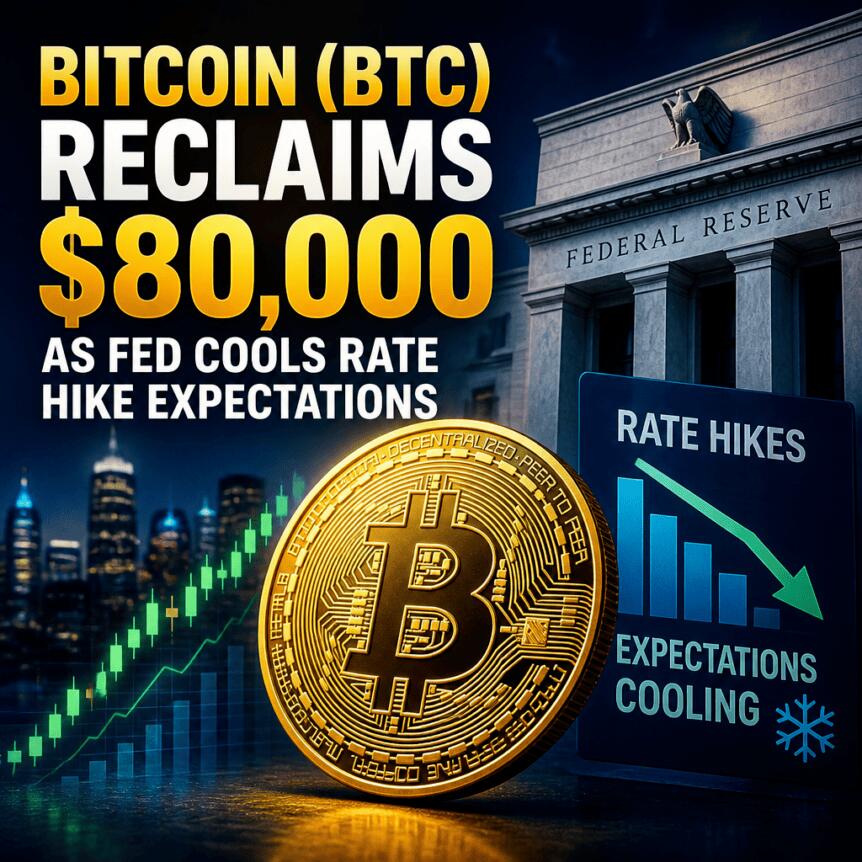
Bitcoin (BTC) reached another multi-month high after reclaiming $80,000, climbing to $81,749 on Thursday after Federal Reserve Governor Christopher Waller tempered expectations of a September rate hike.
However, the flagship cryptocurrency lost momentum after hitting a key resistance zone. If BTC holds above $80,000, it could target a move past $83,500 and confirm a falling wedge breakout.
Bitcoin (BTC) Back Above $80,000 After Rate Hike Odds Drop
Bitcoin (BTC) is currently trading around $80,826, up almost 4% in the past 24 hours. The rally helped the price overcome recent weakness and retest levels that halted its August rally. Buyers must convert $80,000 into support to sustain the latest breakout.
The reversal came after Federal Reserve Governor Christopher Waller cooled immediate expectations of a rate hike after the September FOMC meeting if incoming inflation data is favorable. However, he did not rule out a hike if inflation numbers come in higher. Waller’s comments put the focus on the upcoming August Consumer Price Index (CPI) data, making it a factor in whether interest rates remain stable or are raised higher.
Additionally, two- and ten-year Treasury bond yields fell, and the dollar weakened, creating a conducive environment for Bitcoin and other risk assets.
Corporate Demand Provides Additional Support
Returning corporate demand helped support Bitcoin’s latest resurgence. Strive CEO Matt Cole revealed the company could purchase over 20,000 BTC by the end of the year, helping shore up sentiment around the asset. The company disclosed a 1,800 BTC purchase earlier this week. The purchase was completed at an average price of $79,431, taking Strive’s total holdings to 23,156 BTC.
Capital-B, a company listed in France, raised €7.6 million through a private placement from Blockstream CEO Adam Back. The company disclosed it will use the proceeds from the raise to fund a 376 BTC acquisition. Returning corporate demand indicates renewed institutional confidence in the asset and suggests companies are buying and holding BTC on their books as a reserve asset again.
Weakening Dollar Pushes Bitcoin (BTC) Higher
Besides the Fed’s comments and declining Treasury bond yields, a weak dollar has also helped Bitcoin and the broader cryptocurrency market push higher. BTC’s move higher comes against the backdrop of a strengthening Japanese yen (JPY), which some reports state is likely due to central bank intervention.
The USD/JPY pair fell to 158.5 on Wednesday before sliding further to 155.4 on Thursday. This had a domino effect and put pressure on the US Dollar Index (DXY), pushing it down to 99. However, the suspected central bank intervention to prop up the yen has revived concerns about a carry-trade unwind. News outlet The Macro Paper commented on the probable intervention, stating:
“In the last 24 hours, USD/JPY has dropped almost 2.5%, which doesn’t happen without any major intervention. On top of that, BOJ is most likely expected to hike rates this month, with more rate hikes possible in Q4. This is the exact thing that happened in Q3 2024, when BOJ intervened and hiked rates together.”
Can Bitcoin (BTC) Overcome Key Resistance Zones
Bitcoin’s revival sees the cryptocurrency retesting the $81,000 to $82,500 zone that capped its August rally. A close above these levels could confirm a breakout and push the price towards $85,000. One analyst, Franklin, identified $83,450 as a key support level, adding that BTC was testing a falling wedge breakout. However, the price must close above resistance levels to confirm a breakout.
Momentum has strengthened as well, with the fear and greed index at 78 and the relative strength index (RSI) above 70, a level typically associated with overbought market conditions. Additionally, BTC is trading above all four moving averages on its daily chart (20-day at $74,775, 50-day at $68,489, 200-day at $69,602, and 100-day at $66,334). Bitcoin has also broken above the upper Bollinger Band on the 4-hour chart. This confirms substantial upside pressure, but could also suggest price action is getting stretched.
A look at CoinGlass’ liquidation heatmap shows that BTC has cleared several short clusters between $78,000 and $80,500. This likely triggered forced buying as traders closed their positions, accelerating upward momentum. The next major cluster sits between $81,300 and $81,600. If the flagship cryptocurrency clears this level, it could push towards $85,000, liquidating smaller clusters along the way. Meanwhile, downside liquidity is concentrated between $76,400 and $79,800. If the price falls below $80,000, it will likely drop towards these levels.
Disclaimer: This article is provided for informational purposes only. It is not offered or intended to be used as legal, tax, investment, financial, or other advice.

The great outdoors is leading to a great stock rally. On Friday, shares of American Outdoor Brands (AOUT) shot up roughly 35% after a blowout earnings call, as it recovered from a tariff-stricken fiscal year. American Outdoor Brands sells hunting and fishing equipment, gun accessories and camping gear under a variety of different brands. It had formerly been the parent…
Copyright ©2026 Investor’s Business Daily, LLC. All rights reserved. 87990cbe856818d5eddac44c7b1cdeb8
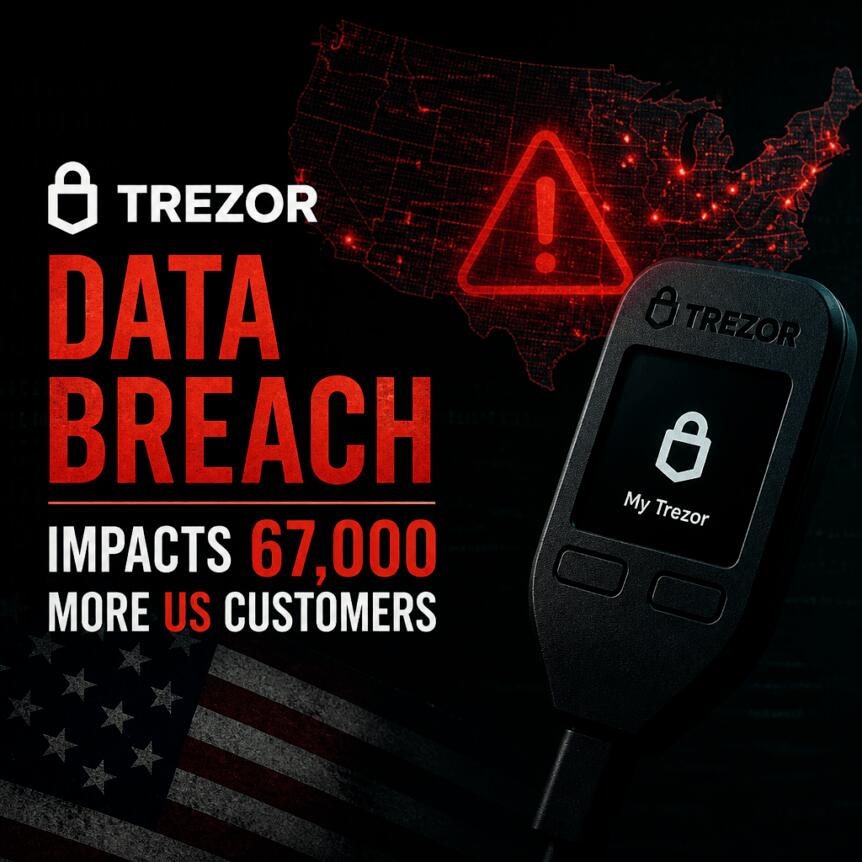
Trezor says the fallout from a data exposure tied to its shipping partner is wider than it first indicated. In a Friday post on X, the hardware wallet provider updated the number of potentially impacted US customers, saying an additional 67,000 people may have had their full order details exposed.
The company stressed that its own systems were not breached. However, it warned that exposed information—such as names, email addresses, shipping addresses, and order specifics—could still be used by criminals to target victims with convincing phishing attempts. The goal, Trezor said, would be to trick users into revealing seed phrases, the credentials that control funds stored in hardware wallets.
Key takeaways
- Trezor’s latest update suggests the shipping-related exposure may involve an additional 67,000 US customers.
- Company systems were not compromised, but order records were reportedly not deleted by the shipping provider for certain customer orders.
- Trezor believes the main risk is impersonation-based phishing aimed at extracting wallet seed phrases.
- Earlier estimates put the exposure at 14,000 users, indicating the scope expanded after further information from ShipMonk.
- Investors and wallet users should treat any “Trezor support” messages as suspicious until verified through official channels.
Updated scope: more US customers at potential risk
Trezor’s Friday X update referenced a new report from its shipping provider, ShipMonk. The hardware wallet firm said the affected population includes US customers who placed orders between November 2019 and August 2021. According to Trezor, these customers may have had their complete details exposed, including identity and contact information, delivery addresses, and order-specific data.
This revision matters because it changes the number of people who may need to take additional precautions. Trezor initially estimated in August that only 14,000 users had their data exposed through ShipMonk. The new figure indicates that the problem’s reach was underestimated at the time—or that additional affected orders were identified as the investigation progressed.
What was exposed—and why it can still be dangerous
Trezor said the exposed records included the full set of personal and purchase information that bad actors typically need to make impersonation scams credible. That includes users’ names, email addresses, shipping addresses, and order specifics.
Even though Trezor said its systems were not breached, the company argued that the exposed information could be used to carry out more targeted social engineering. The concern is not just general spam or list-based fraud; it is the possibility of messages that appear to come from Trezor, designed to pressure recipients into revealing their seed phrases or otherwise compromising their wallets.
In other words, attackers may not need technical access to a wallet to cause loss. If a scam convincingly imitates the legitimate support process—or references a customer’s order to establish trust—victims may be more likely to comply.
Why impersonation scams keep costing the industry
Security research underscores how effective phishing and related social engineering can be in crypto. In the first quarter, blockchain security firm Hacken reported that social engineering and phishing drove most of the industry’s losses. According to Hacken, these attacks accounted for $306 million of $482 million total losses in that period.
The mechanics are often straightforward: fraudsters send messages that mimic trusted brands, then guide victims toward actions that compromise accounts or keys. Trezor’s warning fits that pattern, targeting the most sensitive asset in self-custody setups—the seed phrase.
Earlier coverage also highlighted how phishing can lead to direct on-chain loss. In July, a crypto investor reportedly lost nearly $1 million after signing a malicious phishing token approval transaction on Ethereum.
Trezor’s prior communications and what remains unclear
While the latest update expands the number of potentially impacted customers, it aligns with earlier disclosures that Trezor had been tracking risk tied to contact and support interactions. In January 2024, Trezor reported that about 66,000 users were at risk of phishing attacks if they had contacted the company’s support team since December 2021.
That earlier statement focused on a different slice of risk—support-related contact—whereas the new update centers on order-related data tied to shipping. Taken together, the communications suggest that Trezor’s threat model evolved as more information became available and as different parts of the customer journey were assessed.
One important point remains: Trezor continues to state that its systems were not compromised. The danger appears to come from information that may have been retained or not deleted by the shipping provider for certain orders, enabling third parties to craft more personalized scams.
What readers should watch next is whether Trezor provides further detail on mitigation steps—particularly how it plans to reach potentially exposed customers—and whether additional countries or time ranges are affected. The company’s current update is limited to additional 67,000 US customers in the November 2019 to August 2021 window, but future revisions are possible if ShipMonk’s findings expand again.
For now, the practical takeaway for hardware wallet holders is to be especially cautious of any outreach that claims to be from Trezor, especially if it references an order. Verify through official channels before taking any action, and treat requests involving seed phrases as an immediate red flag.


Binance placed four cryptocurrencies under its Monitoring Tag on Sept. 4 while separately removing 14 tokens from the Binance Alpha recommendation list.
Summary
- Binance added AVA, GNS, SCR and TOWNS to its Monitoring Tag list on September 4.
- Tagged tokens remain tradable but face additional reviews and possible delisting if standards are unmet.
- Binance Alpha removed fourteen tokens from recommendations while preserving users’ withdrawal and selling functions afterward.
- The Alpha removals do not automatically remove those assets from Binance’s main spot exchange listings.
- Monitoring decisions consider liquidity, development, network security, communications, tokenomics and project team conduct during reviews.
AVA, Gains Network, Scroll and Towns Protocol received the Monitoring Tag following the exchange’s latest project reviews. The designation warns users that the tokens carry higher volatility and risk than other assets listed on the main Binance exchange.
In a separate notice, Binance Alpha removed MTP, BDXN, TALE, BOS, MAIGA, TIMI, SAROS, U, SERAPH, RVV, AIAV, PENGUIN, ODOS and SN3. Selling and withdrawals remain available for those assets.
Binance Monitoring Tag places four tokens under review
The Monitoring Tag does not immediately remove AVA, GNS, SCR or TOWNS from trading. Related Binance services also remain available following the designation, according to the exchange.
Instead, Binance will review the four projects more frequently. A token could eventually be delisted if the exchange determines that it no longer meets its listing requirements. Binance did not identify a separate violation or specific weakness for each project.
The exchange’s review criteria include trading volume, liquidity, development activity and the project team’s continuing commitment. Binance also examines network security, smart contract stability, public communication and responses to its due diligence requests.
Other considerations include token supply increases, changes to tokenomics and evidence of fraudulent, unethical or negligent conduct. Binance said it could add or remove the tag after future reviews.
Users trading Monitoring Tag assets on Binance Spot or Margin are generally required to complete a risk-awareness quiz every 90 days. They must also accept the exchange’s applicable terms. These requirements are intended to ensure traders understand the possibility of heightened volatility or delisting.
Binance Alpha removes 14 recommended assets
The Binance Alpha removals took effect at 16:30 UTC+8 on Sept. 4. Alpha is an early-stage token discovery feature within Binance Wallet rather than the exchange’s main spot market.
Removal from Alpha therefore differs from a full Binance spot delisting. It means the assets no longer appear on Alpha’s selected-token list, but it does not automatically terminate listings or services available through other Binance products.
The affected projects include Multiple Network’s MTP, Bondex Token’s BDXN, PrompTale AI’s TALE, BitcoinOS’s BOS and Maiga.ai’s MAIGA. MetaArena’s TIMI, Saros, Union, SERAPH and REVIVE were also removed.
The remaining assets are AI Avatar, Nietzschean Penguin, Odos and Nebula3. Binance said the projects did not meet Alpha’s standards following its latest review but did not publish individual reasons for each decision.
Users can withdraw the tokens through the Alpha assets page. They can also sell them using Alpha’s instant-order function or trade supported assets through Binance Wallet’s market interface.
Alpha removal is different from spot delisting
Binance Alpha provides access to early-stage projects that can carry limited liquidity and sharp price volatility. Inclusion does not guarantee that a token will receive a full Binance spot listing.
Likewise, removal does not mean the main exchange has delisted the token. Binance advised users to conduct independent research before trading the affected assets outside Binance Wallet.
A full spot delisting normally includes separate deadlines for trading, deposits and withdrawals. It may also affect futures, margin, loans, Earn products and other services. None of those broader deadlines were announced for the 14 Alpha tokens.
As crypto.news previously reported, Binance removed 20 other tokens from Alpha in May while separately preparing five assets for spot delisting. The two processes followed different notices and user deadlines.
Monitoring Tags can precede delisting without guaranteeing it
Monitoring Tags serve as warnings rather than final delisting decisions. Binance can remove a tag if a project addresses identified concerns and satisfies subsequent reviews.
However, tagged tokens face a heightened possibility of removal. In August, Binance delisted six cryptocurrencies after four had previously received Monitoring Tags. As crypto.news reported, withdrawals for those six assets remained open until October.
The latest announcement did not provide a deadline for the next review of AVA, GNS, SCR or TOWNS. Their project teams can respond publicly, but Binance retains control over its exchange listing decisions.
No verified market data established a common price reaction across all 18 affected assets when the notices were published. Price changes should therefore not be attributed to Binance’s decisions without token-specific trading evidence.
This Friday, we examine Ethereum, Ripple, Cardano, Binance Coin, and Hyperliquid in greater detail.
Ethereum (ETH)
Ethereum was flat this week. Still, the price held well above the support at $2,400. However, the volume has been falling since the initial rally, and volatility has decreased significantly compared to the early days.
While a consolidation period is normal, this is also a period of weakness in the price action when sellers could make their return. Nevertheless, as long as the key support is not challenged, buyers continue to have the upper hand.
Looking ahead, ETH must stay above $2,400 if it wants the rally to continue. So far, buyers appear in control, but the road towards $2,800 could be bumpier compared to the past few weeks.

Ripple (XRP)
XRP was also mostly flat this week, booking a modest 2% gain. The price has been moving sideways between $1.3 and the resistance at $1.6. This range also kept the price in check between February and May this year.
To get momentum back, this cryptocurrency will need to break away from this range. That will likely see volume and volatility return as well. Based on the current price action, buyers have the advantage, but this could change if they fail to clear $1.6.
Looking ahead, the market is showing some indecision here after a strong pump. While a continuation would put an end to the bear market, it is still too early to say this is it. That’s why buyers may be hesitating here.

Cardano (ADA)
ADA closed 5% higher this week after a good push from buyers, with the price retesting resistance at $0.23. At the time of this post, the resistance remains intact but could be put under pressure by any renewed buying.
For Cardano to confirm a bottom under $0.15, the price has to move beyond its current resistance. Buyers were rejected there in August. However, another push in September could be successful.
Looking ahead, this cryptocurrency is ripe for a strong rally as soon as $0.23 turns into a key support. That can easily see ADA move towards $0.30 and $0.40 if buying volume picks up.

Binance Coin (BNB)
This week, Binance Coin held well above the support at $690, but did not manage to distance itself much beyond that. That’s the reason why the price is up only 1% in the past seven days.
While momentum has been decreasing, BNB is very close to making a higher high. Any price above $745 would confirm it and likely see this cryptocurrency continue its rally towards $900 next.
Looking ahead, the market may be taking a pause right now before momentum returns. While the price action favors a continuation of the rally, a higher high is needed to give it confidence.

Hype (HYPE)
This week, Hyperliquid managed to break above the $85 resistance and closed 4% higher. This both confirmed a higher high and new price record. The question is if this level can hold as support or sellers will turn it into a resistance again.
If the latter, then buyers will likely move to the support at $76 next to defend the recent gains. Still, HYPE has been in a rally for weeks without any significant pullback or correction. One should be expected eventually.
Looking ahead, HYPE could continue its push higher until it hits the psychological level at $100. Sellers could be making a stand there if buyers decide to go for it. But for now, best to watch the price reaction at $85 in the coming days.

The post Crypto Price Analysis Sep-04: ETH, XRP, ADA, BNB, and HYPE appeared first on CryptoPotato.


The U.S. Treasury’s Financial Crimes Enforcement Network has linked approximately $12.7 billion in suspicious financial activity to digital asset investment scams largely run from overseas scam compounds, based on nearly 34,000 reports filed over more than two years.
Summary
- FinCEN linked roughly $12.7 billion in suspicious activity to crypto investment scams after reviewing 33,904 reports filed from September 2023 through December 2025.
- Money services businesses, mostly crypto firms, filed 55% of the reports and flagged $5.5 billion, while banks reported another $6.4 billion.
- Scammers used at least 22 digital assets, but proceeds were usually converted into stablecoins and almost exclusively into USDT before being moved through DeFi protocols or overseas exchanges.
- Older adults appeared in about 25% of reports, while victims across all 50 states funded losses through retirement accounts, mortgages, home equity and personal loans.
- Many operations were tied to scam compounds in Cambodia, Laos and Burma, where hundreds of thousands of workers have been trafficked through fake job offers.
The Financial Crimes Enforcement Network said Thursday that its analysis covered 33,904 Bank Secrecy Act reports filed by roughly 1,300 financial institutions between Sept. 8, 2023, and Dec. 31, 2025, giving regulators a view of how money moved through banks, crypto businesses and securities firms as victims were drawn into fraudulent investment schemes.
FinCEN described the operations as digital asset investment scams, sometimes called pig butchering, romance baiting or cryptocurrency confidence schemes. Criminal groups commonly use fake identities and relationships to gain victims’ trust before directing them toward fraudulent crypto investments.
The activity identified in the filings reached victims across all 50 states and several U.S. territories.
Crypto firms and banks flagged billions in scam activity
Money services businesses submitted 55% of the reports reviewed by FinCEN and identified $5.5 billion in suspicious activity. Most of the firms in that group were digital asset businesses.
Banks accounted for 41% of filings and reported $6.4 billion, while securities firms and other financial institutions made up the remaining share, with $784.5 million flagged.
Reporting increased throughout the period covered by the analysis. The monthly number of filings rose by an average of 10.9%, while the amount of reported suspicious activity increased by an average of 18%.
In October 2023, financial institutions submitted 590 reports involving $485.7 million. By December 2025, the monthly total had climbed to 2,482 reports covering $833.5 million.
FinCEN cautioned against treating the $12.7 billion total as a direct measure of victim losses. Suspicious activity reports can include attempted transactions, transfers reported by more than one institution and mistakes by filers, creating the possibility of double counting. The rise in filings may partly stem from increased use of the search term introduced in the agency’s 2023 alert on pig butchering scams.
Scam operators relied on familiar digital assets instead of creating tokens specifically for the fraud. At least 22 cryptocurrencies appeared in the filings, with Ethereum, Tether’s USDT and Circle’s USDC among the most commonly identified assets.
Regardless of what victims initially purchased, blockchain analysis cited by FinCEN found that proceeds were usually converted into stablecoins, almost exclusively USDT. The funds were then routed through decentralized finance protocols or digital asset exchanges outside the United States.
Repeated use of the same collection addresses provided another trail. Some financial institutions identified addresses receiving transfers from multiple victims at the same time, helping them connect seemingly separate transactions to the same scam network.
The use of stablecoins has appeared repeatedly in enforcement actions involving the same type of fraud. As crypto.news previously reported, the U.S. Secret Service worked with Coinbase to trace and recover USDT tied to pig butchering schemes in 2025. The Department of Justice sought the seizure of $225 million in USDT after investigators linked the funds to Southeast Asian fraud networks.
FinCEN finds older Americans were not disproportionately targeted
Older Americans appeared in roughly one-quarter of the suspicious activity reports, close to their share of the U.S. population.
FinCEN found elder exploitation in around 25% of the filings, compared with the 24.4% share of the population aged 60 or older. Based on that comparison, the agency concluded that older adults were neither disproportionately victimized nor disproportionately deprived of funds within the dataset.
Financial damage could still be severe. The FBI recorded $4.8 billion in fraud losses among Americans over 60 in 2024, a figure later cited by senators who introduced the GUARD Act to provide resources for blockchain tracing by local law enforcement.
Victims frequently financed transfers with money outside their regular savings. FinCEN found cases involving retirement accounts, home equity lines of credit, second mortgages and personal loans. One woman transferred nearly $640,000 from her retirement fund, while another victim lost more than $1 million over six months.
The agency devoted part of its analysis to the psychological toll of the schemes, warning that some victims may face a risk of self-harm after discovering that their money has been stolen. FinCEN directed people in crisis to the 988 Suicide and Crisis Lifeline.
Southeast Asia scam compounds rely on trafficked workers
Many of the criminal organizations identified by authorities operate from industrial-scale compounds in Cambodia, Laos and Burma, where workers can be recruited through fake employment offers before being confined and forced to participate in fraud.
The United Nations has estimated that hundreds of thousands of people have been trafficked into such operations, while Interpol has warned that the scam-center model has spread outside Southeast Asia.
Crypto transactions connected with human trafficking rose sharply in 2025. A February 2026 Chainalysis study found that crypto-linked trafficking payments increased 85% during the year across tracked services, including labor recruiters associated with Southeast Asian scam compounds. Stablecoins, laundering networks and regional escrow platforms were among the payment channels identified by the blockchain analytics firm.
Authorities have since pursued the financial infrastructure supporting the compounds. In March, the FBI and Thai police froze roughly $580 million in cryptocurrency and seized around 8,000 phones in an operation against organized pig butchering groups accused of targeting Americans.
The networks can extend beyond the people directly contacting victims. FinCEN said scam-center operators use online “guarantee marketplaces” to buy services including phishing tools, online accounts and money laundering. Professional money launderers can create shell companies and financial accounts, recruit money mules and route stablecoins through exchanges outside the United States.
Cambodia-based Huione became one of the most prominent examples of that infrastructure. Chinese authorities took custody of a former Huione Group chairman in April after the network had been linked to more than $89 billion in crypto transactions. U.S. authorities had previously designated Huione Group a primary money laundering concern over its alleged role in processing proceeds connected to Southeast Asian scams and other illicit activity.
U.S. authorities have expanded efforts to recover scam proceeds
American agencies have increasingly used blockchain tracing, asset freezes and cooperation with foreign law enforcement to pursue funds tied to the compounds.
FinCEN said its Rapid Response Program has interdicted $1.8 billion since 2015 and recovered just over $1 billion for 5,790 U.S. victims. The program allows the agency to quickly share financial intelligence with foreign financial intelligence units and seek intervention before suspected fraudulent transfers are moved beyond recovery.
The agency’s latest alert gives financial institutions indicators for identifying transactions connected to scam centers and encourages voluntary information sharing under Section 314(b) of the USA PATRIOT Act. FinCEN said such sharing can help institutions identify activity involving money laundering while providing qualifying participants with liability protections.
The scale of enforcement has continued to rise in 2026. U.S. prosecutors have pursued networks accused of combining investment fraud with forced labor, including the Cambodia-based Prince Group. Authorities sought forfeiture of more than 127,000 Bitcoin linked to its founder Chen Zhi, while prosecutors alleged workers confined in scam compounds were forced to contact prospective victims and direct them toward fraudulent cryptocurrency investments.
In January, Cambodian authorities detained Chen and transferred him to China. U.S. and U.K. authorities have accused him and Prince Group of involvement in cryptocurrency fraud, money laundering and forced-labor operations, allegations the company has denied.
FinCEN urged victims of cyber-enabled fraud to contact their financial institutions immediately and file complaints with the FBI’s Internet Crime Complaint Center or their nearest U.S. Secret Service field office.

Teen blamed a ‘demon’ for stabbing girlfriend, while mom helped cover it up, police say

Newcastle’s Siemens Energy Byker plant wins deal to build UK nuclear power station parts

Bitcoin Tests May Highs: Why Is This Time Different for Recent Buyers?

Weekend Open Thread – Corporette.com

Weekend Open Thread: Brooks Brothers

London Mayor Sadiq Khan handed a peerage by Keir Starmer alongside 15 other Labour figures… just days before the PM leaves No10

You’re gonna miss out #memecoins #moneymotivation #cryptocurrency #elonmusk #crypto #memecoin

#xrpcommmunity #cryptocurrency #xrp #xrpnews #xrparmy #xrpripple #cryptonews #usareels #trump #fyp

Roberto Vannacci – Ora aspetto l’articolo del Financial Times (03.09.26)
-

 Fashion7 days ago
Weekend Open Thread: Maeve – Corporette.com
-

 Crypto World5 hours ago
IMF Says El Salvador’s Post-Review Bitcoin Purchases Used No Public Funds
-

 Crypto World2 days ago
CLARITY Act could advance within weeks, Atkins says
-

 Politics8 hours ago
A new European chapter for Gibraltar
-

 Tech5 hours ago
JLab goes big on new headphones at IFA 2026
-

 Politics5 hours ago
33 Cosy Autumn Home Decor Ideas: Blankets, Pumpkin Decorations, And Candles
-

 Sports6 hours ago
Commanders’ Chig Okonkwo is a top breakout fantasy football candidate
-

 Sports5 hours ago
Alexandre Pato consortium’s Northampton Town investment approved
-

 Crypto World5 hours ago
IMF Says El Salvador’s Bitcoin Buying After Audit Used No Public Funds
-

 Business7 days ago
Onto Innovation Stock: AI’s Next Bottleneck Is Yield (NYSE:ONTO)
-
 Crypto World6 hours ago
Bitcoin News: BTC to Gold Ratio Hits 18 as Both Assets Rally
-

 Sports9 hours ago
Devon Dampier throws for 3 TDs as No. 21 Utah demolishes Idaho
-
Crypto World9 hours ago
XRP Trading Activity Hits Highest Level Since February as Price Jumps 8%
-

 Tech5 hours ago
Project Tube Shot Features Spark II Rocket and the Five-Foot Pipe That Gave a B Motor Extra Sky
-

 Crypto World2 days ago
Elon Musk Says Grok 4.7 Lands in 10 Days and Will Beat Every Model
-

 Politics5 hours ago
The House Article | When Nigel Farage enters No 10, he will not fall into Whitehall’s trap
-

 Tech6 hours ago
US law firm accuses UK AI software firm of unwanted contract renewal when it tried to leave
-

 Sports6 hours ago
Seven wickets in 21 balls: Sri Lanka’s Chamari Athapaththu scripts history with record-breaking spell
-

 Crypto World7 days ago
Bitcoin price tests $82K resistance as Brandt stays long
-
 Tech6 days ago
Hugging Face built a $4.5 billion empire on free AI models. Now Nvidia is buying it for $12.9 billion
You must be logged in to post a comment Login