
Crypto World
Key Shiba Inu (SHIB) Metric Hits Monthly High: Breakout Ahead or Not Yet?

Shibarium – Shiba Inu’s layer-2 scaling solution – has finally shown signs of revival, perhaps sparking hopes among the SHIB Army that the price could respond to the momentum.
Nonetheless, many other factors suggest that the self-proclaimed Dogecoin killer is not out of the woods yet and could experience an additional short-term decline.
Mixed Signals, But Bears Prevail
Shibarium officially saw the light of day in the summer of 2023 and was designed to advance the Shiba Inu ecosystem by lowering transaction costs, improving speed, and enhancing scalability. At first, the protocol processed millions of daily transactions, but an exploit in 2025 abruptly changed things for the worse.
The figure dropped to mere hundreds, signaling waning user engagement and slow network participation. Data shows that there has finally been some improvement on that front, with daily transactions topping almost 4,500 on August 9, the highest level since July 10.
Some popular voices from the crypto world have opined over the years that Shibarium’s progress is vital for the meme coin’s performance. One example is the early Bitcoin advocate Jeremie Davinci, who said in 2025:
“I like Shiba Inu, as you know, and I think it will do relatively well in this cycle, but it may not go as high as you expect. I think Shiba Inu has a lot of utility now that they have Shibarium, and basically, it’s a chain that you can actually run all kinds of applications. However, nobody is using it, and there are no applications for using your tokens on Shibarium yet. If they get that solved, Shiba Inu will go to the moon.”
It is important to note that Shibarium’s recent resurgence is far from what the community hopes to see, meaning a strong price reaction is more likely if activity returns to previous levels and breaks past them.
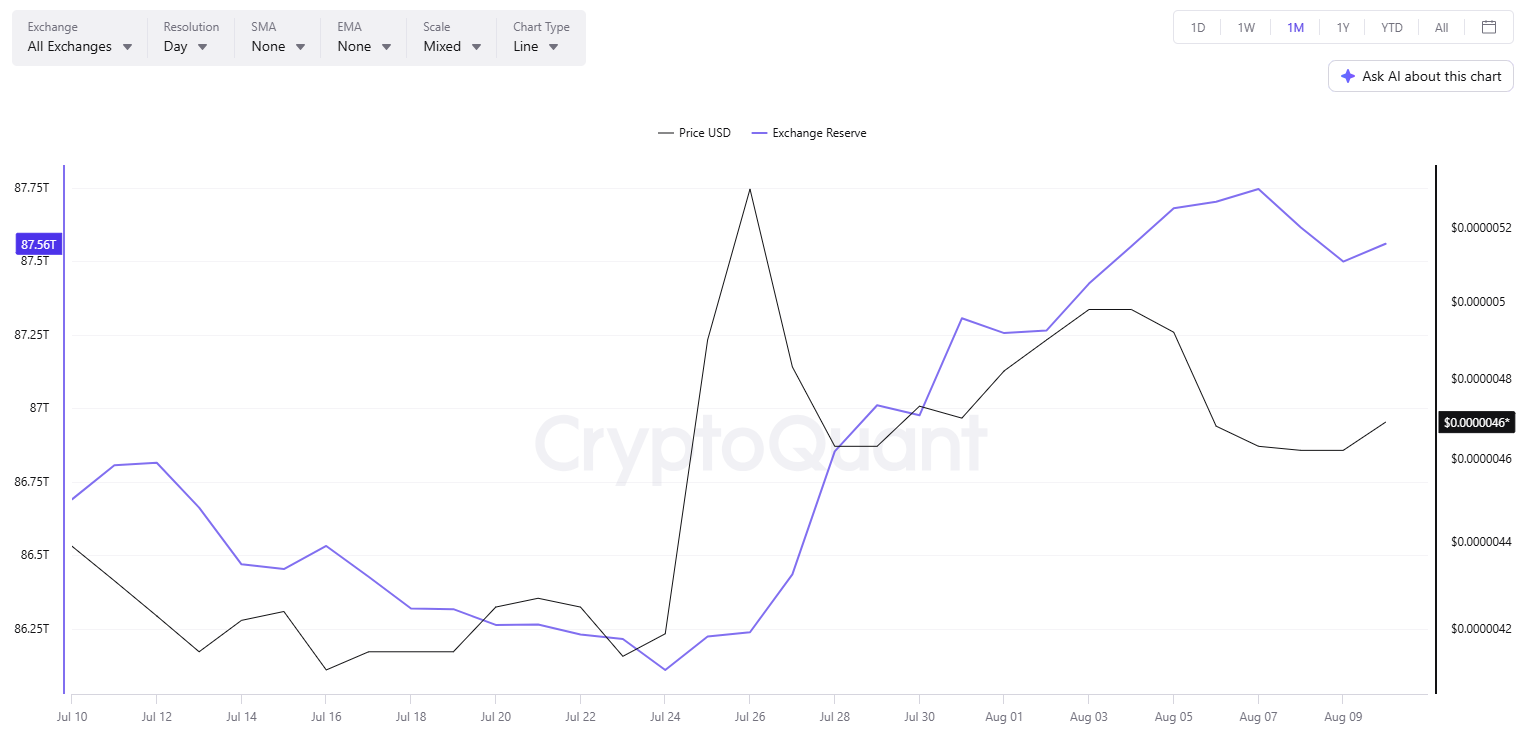
Meanwhile, other elements suggest that SHIB could head south soon. The amount of coins stored on exchanges has risen to around 87.5 trillion: the highest since the end of June. This suggests that investors have been flocking from self-custody methods toward centralized platforms, thereby increasing immediate selling pressure.
Next on the list is Shiba Inu’s burn rate, which has fallen by 75% over the past week. The program’s ultimate goal is to reduce the token’s circulating supply, thus making the price more valuable through scarcity. However, the team and community will have to up their game in that field to cause a meaningful ascent.

SHIB Price Outlook and Predictions
As of this writing, the meme coin trades at around $0.000004654, translating into a 20% plunge from the local top reached last month when a certain whale resumed accumulating after months of inactivity.
According to X user Kamran Asghar, SHIB is compressing within a descending wedge at key demand around $0.00000455-$0.00000465. They believe a breakout above the range near $0.00000475 would confirm a bullish reversal toward $0.00000520+.
The post Key Shiba Inu (SHIB) Metric Hits Monthly High: Breakout Ahead or Not Yet? appeared first on CryptoPotato.

A packed week of catalysts is about to test three altcoins. Between now and Aug 16, one faces a large token unlock, another must prove its earnings can hold, and a third races toward a mandatory network upgrade.
That makes this a ‘three altcoins to watch’ list, each pulling a different way.
Token
Outlook
Main Catalyst
Arbitrum (ARB)
Bearish
92.65M ARB unlock on August 15; whales reducing holdings ahead of added supply
Hyperliquid (HYPE)
Neutral / Mixed
Trading fees and perp volume; stronger activity would support HYPE buybacks and price recovery
TRON (TRX)
Bullish
GreatVoyage v4.8.2 upgrade by Aug. 16, rising network fees, and strong USDT activity
Arbitrum (ARB) Heads Into a Big Unlock as Whales Trim
Arbitrum starts the week under supply pressure. On August 15, about 92.65 million ARB unlocks, worth roughly $7.37 million.
That equals about 1.4% of the circulating supply, and most of it goes to the team, contributors, and investors.

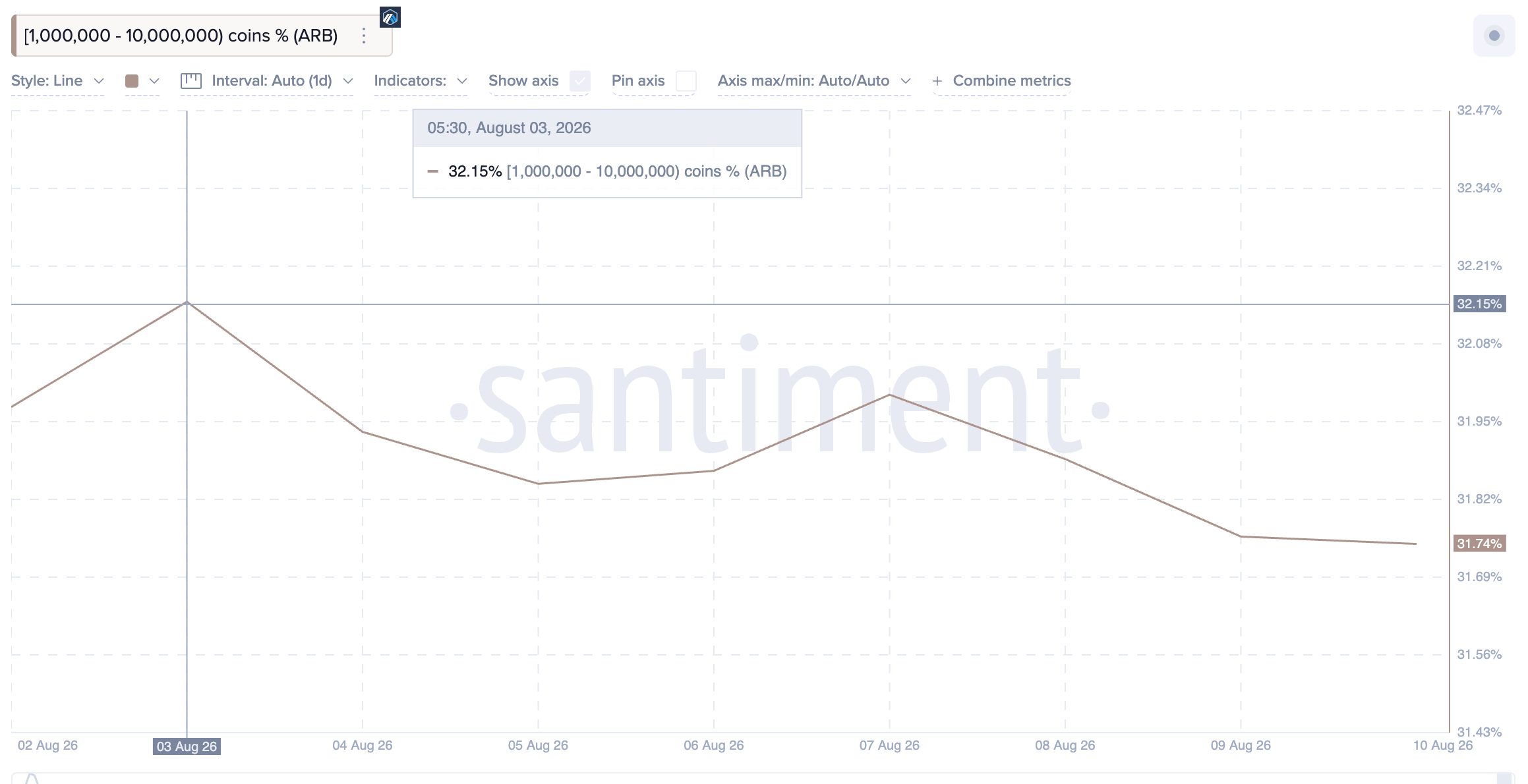
Large holders are already easing off considering the supposed supply pressure. Wallets holding 1 million to 10 million ARB slipped from 32.15% of supply on Aug 3 to 31.74% by Aug 10. This quiet whale distribution lines up with the coming token unlock.

However, the ecosystem has a longer-term boost. Robinhood built its new chain, which trades tokenized stocks, on Arbitrum technology.
It routes 8% of its net revenue to the Arbitrum treasury. For now, the token unlocks to watch tilt ARB bearish. The real risk is whether recipients move coins to exchanges.
Hyperliquid (HYPE) Earns Big, but Its Fees are Cooling
Hyperliquid is the mixed signal among the altcoins to watch. Its token has steadied this week, up almost 5%. Yet it still trades well below where it sat a month ago, down almost 18%. The question is whether the business supports that recent weekly bounce.
Want more token insights like this? Sign up for Editor Harsh Notariya’s Daily Crypto Newsletter here.
The protocol remains one of the highest earners in crypto. It booked about $9.37 million in fees and $6.44 million in protocol revenue over seven days.
That came on $38.9 billion in perpetual-futures volume, the value of leveraged bets on price. Annualized fees run near $1 billion.

However, weekly fees have cooled from the 30-day pace, and that is the crack to watch. Hyperliquid sends most of its trading revenue to a fund that buys back HYPE and burns it. That steady buying supports the price.
So those HYPE buybacks only hold up while trading activity stays high. If fees and volume climb again, the recovery has real backing. If they keep falling, the price is simply rising faster than the business behind it.

Hyperliquid’s case rests on trading activity that is now cooling. The next token, TRON, runs on network activity that keeps growing.
TRON (TRX) Guards a $90 Billion Base Before a Deadline
TRON closes the week with a hard deadline and the firmest setup. Node operators must install the mandatory GreatVoyage v4.8.2 “Pyrrho” network upgrade by Aug 16. It improves Ethereum compatibility and node reliability.
This matters because TRON is the leading stablecoin settlement rail for Tether’s USDT, the most-used stablecoin. It hosts about $91.7 billion, close to half of all USDT in circulation.
A clean upgrade lowers the risk of disruption for wallets, exchanges, and USDT transfers, which protects that base. Rising USDT on TRON already shows the demand.

The fundamentals support that view. Chain fees rose about 4.5% over the past week, and roughly four million accounts stay active each day.

TRX has also held near $0.33, keeping the token steady as the deadline nears.

That lead in stablecoin payments makes TRX the group’s bullish anchor.
Still, DeFi value locked slipped about 0.6% on the week, so settlement is strong even as broader DeFi growth stays unproven.
The post 3 Altcoins to Watch for the Second Week of August 2026 appeared first on BeInCrypto.


What this means: Strategy CEO Phong Le said the company has adjusted its approach after discovering that preferred stock investors put a premium on cash liquidity.
- Strategy now holds $4.75 billion in cash, providing about 2.7 years of dividend coverage, Le said in an interview on CoinDesk’s Public Keys with Jennifer Sanasie.
- Le said he initially assumed investors would value bitcoin highly because it is liquid and has appreciated significantly over time.
- But institutions and investors putting shorter-term money into Strategy’s products “value cash more,” he said.
The context: The cash cushion is part of Strategy’s push to evolve beyond simply buying and holding bitcoin into a broader digital credit business.
- Strategy has developed preferred-stock products such as STRC for investors seeking bitcoin-linked returns with less volatility.
- Le described a spectrum ranging from investors seeking amplified bitcoin returns to those looking for lower-volatility yields closer to traditional credit or money-market products.
- “Would I rather hold Bitcoin? Perhaps,” Le said. But making Strategy’s preferred products work ultimately supports MSTR and its bitcoin strategy, he argued.
Reading between lines: Le is pitching Strategy as a financial platform built around bitcoin rather than merely a leveraged bitcoin proxy.
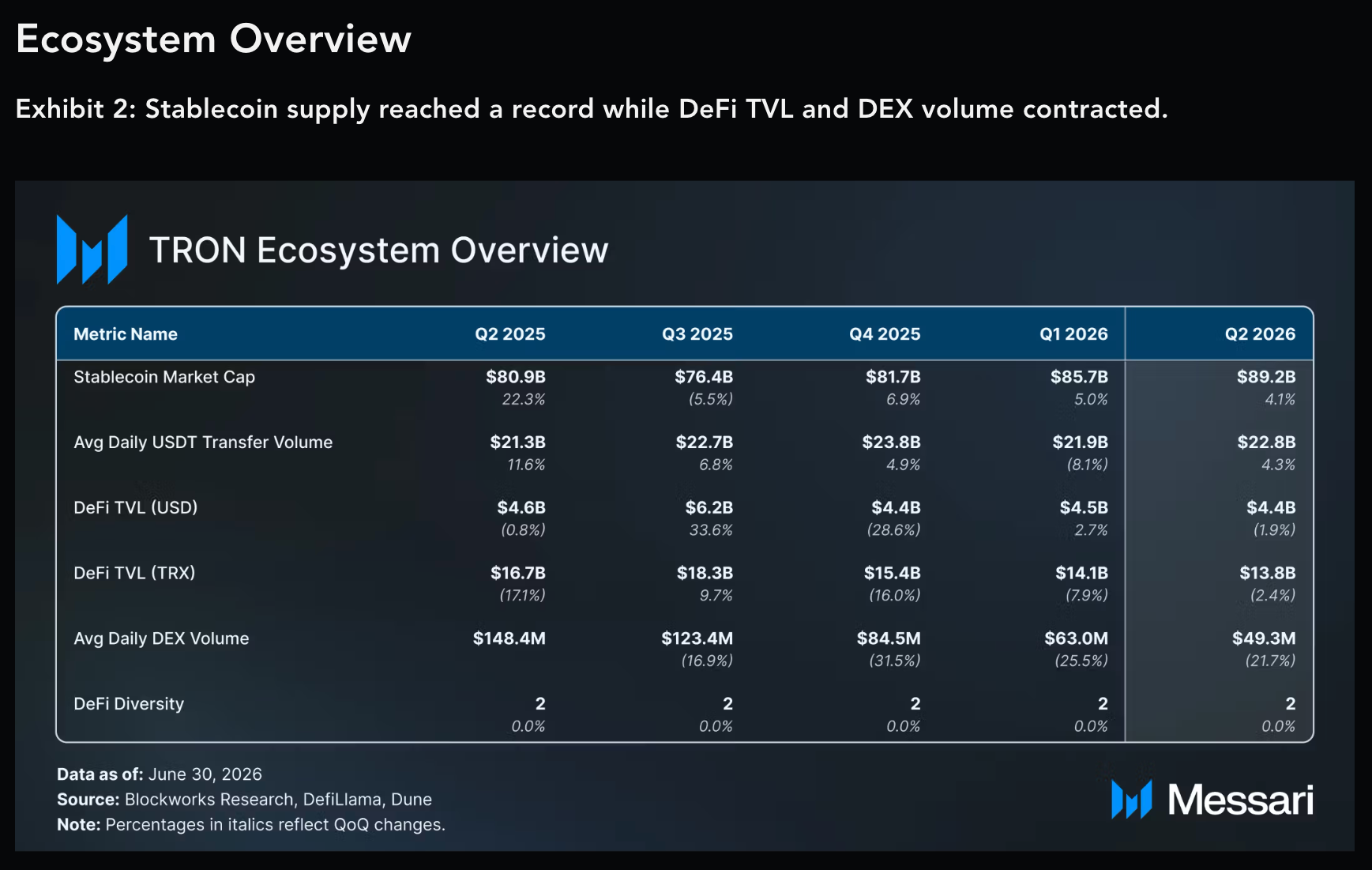
TRON, the layer-1 blockchain founded by Justin Sun, ended the second quarter with $87.9 billion in circulating USDT (USDT), surpassing Ethereum (ETH) while processing $2.1 trillion in USDT transfers during the period.
According to a Messari report, USDT accounted for 98.5% of TRON’s stablecoin market, which grew 4.1% quarter-over-quarter to a record $89.2 billion. Average daily USDT transfer volume also returned to growth, rising 4.3% to $22.8 billion after declining in the first quarter.
The increase coincided with record network usage. TRON averaged 11.8 million daily transactions during the quarter, up 8.7%, while average daily active addresses climbed 11.7% to 3.6 million. The network processed a record 14.6 million transactions on June 15, the report said.
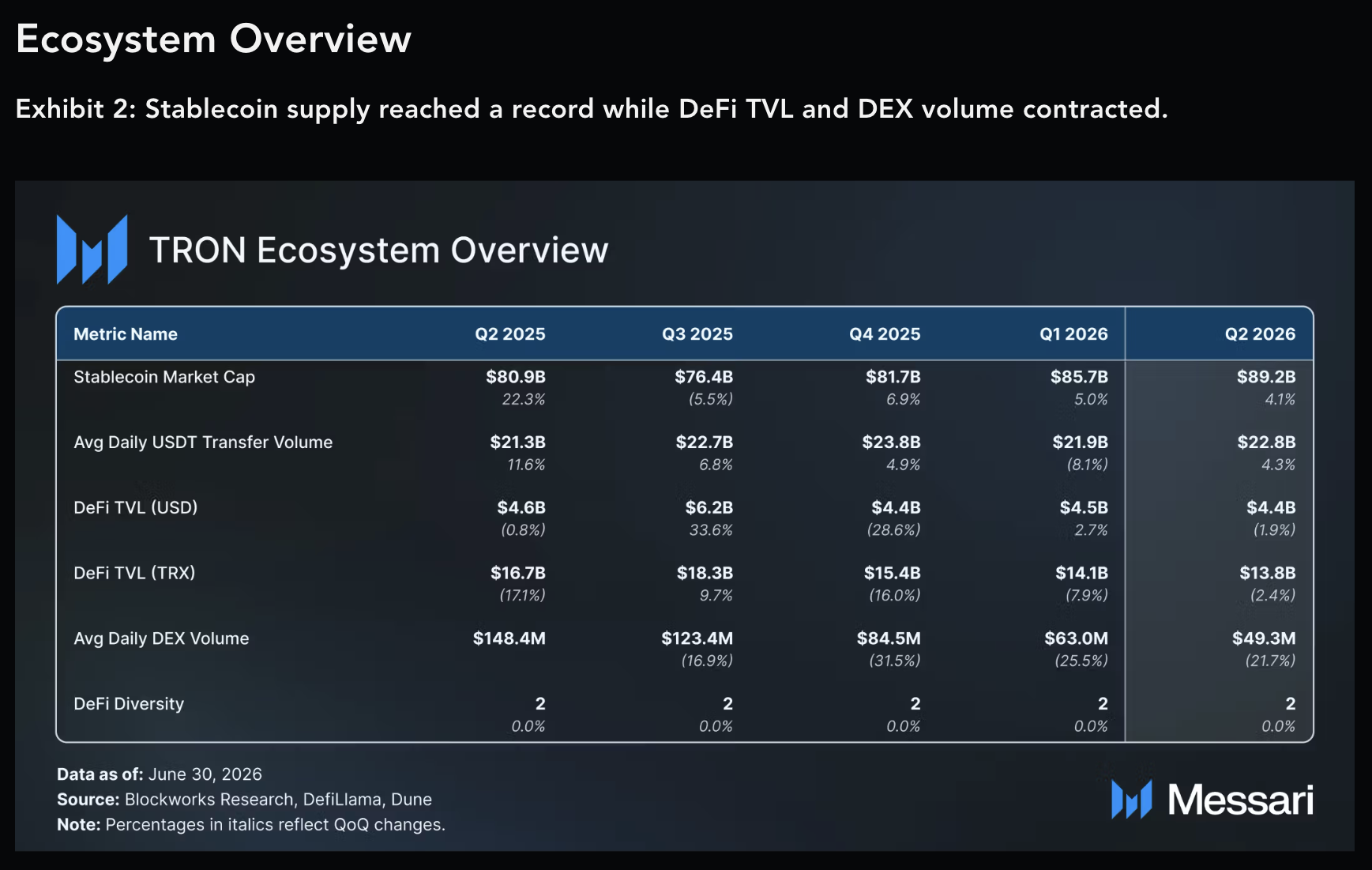
State of TRON Q2 2026 report. Source: Messari
Higher activity also helped reverse a two-quarter decline in network fees. Fees rose 15.9% to $699.4 million, their first quarterly increase since an August 2025 governance change cut the network’s energy unit price.
Growth was uneven elsewhere. DeFi TVL slipped 1.9% to $4.4 billion, while average daily DEX volume fell 21.7% to $49.3 million, marking a fourth consecutive quarterly decline. TRX supply also remained inflationary despite higher activity, with circulating supply increasing by 87 million tokens during the quarter as issuance continued to outpace burns.
Related: Base joins Ethereum, Tron, others in betting big on AI agent future
TRON expands institutional access
Institutional access to TRON widened during the quarter, with Securitize launching Hamilton Lane’s tokenized Senior Credit Opportunities Fund on the network, its first TRON-issued asset. The fund launched with about $4.3 million under management.
Asset manager Grayscale also added TRX (TRX), the native token of the TRON blockchain, to its list of assets under consideration, while a proposed staked TRX exchange-traded product from Canary Capital remained in registration.
Meanwhile, TRX saw broader market access during the quarter. Bitnomial launched spot TRX trading in the United States, while OKX Europe introduced MiFID-regulated TRX expiry perpetuals and Binance.US restored trading in the token.
That trend continued after the quarter ended, with Anchorage Digital adding native TRX staking and custody for TRC-20 assets in July, allowing institutional clients to stake TRX directly from its custody platform.
Magazine: Bitcoin will never fall below $60K again: Nansen founder


Ethereum staking has reached a record 41.7 million ETH, locking more than one-third of the cryptocurrency’s circulating supply despite a sharp decline in its market price.
Summary
- 41.7 million ETH is now staked, according to a CryptoQuant chart shared by Bitfinex.
- Staked ETH has increased by about 5.5 million ETH since January.
- ETH has fallen from approximately $3,400 to $1,900 during the same period.
- Ethereum developers are debating EIP-8363, which would reduce issuance as staking grows.
Ethereum staking climbs despite price decline
A CryptoQuant chart shared by cryptocurrency exchange Bitfinex on Aug. 10 showed that the amount of Ethereum (ETH) committed to staking had reached an all-time high of 41.7 million ETH.
The figure represents roughly one-third of Ethereum’s circulating supply. CoinMarketCap data places the asset’s supply near 120.7 million ETH, meaning approximately 34.5% is now staked.
“Staked ETH has climbed to a record 41.7 million, a third of all ETH in existence, while price fell from $3,400 in January to $1,900,” Bitfinex wrote.
The chart shows that staking deposits remained near 36 million ETH through late 2025 before beginning a sustained increase in February. Growth continued through the second quarter and accelerated again between June and August.
The increase comes despite ETH losing about 44% of its value from its January level. Ethereum traded near $1,900 when Bitfinex published the chart, showing that validators and long-term holders continued locking tokens even as spot-market conditions weakened.
crypto.news reported in January that 36.2 million ETH, or nearly 30% of the supply, had been staked. The latest figure represents an increase of approximately 5.5 million ETH in less than seven months.
Reinvested rewards keep staked ETH growing
Ethereum validators receive newly issued ETH for proposing blocks, attesting to transactions, and supporting network consensus. They may also collect priority fees and maximal extractable value.
Part of that income can be returned to staking, creating a compounding effect even when ETH’s dollar price falls. However, returns decline as more validators join because Ethereum distributes issuance across a larger staked balance.
Corporate treasury companies have become a major part of this trend. BitMine had approximately 4.9 million ETH staked as of July 12, equal to about 85% of its Ethereum holdings.
The company generated $45.7 million from staking and validation during the quarter ended May 31. Chairman Tom Lee projected that annual rewards could reach $284 million if BitMine stakes its entire ETH treasury, although returns depend on yields and validator conditions.
SharpLink has also committed most of its Ethereum treasury to staking. Its strategy continued generating ETH rewards even as lower market prices contributed to a $394.3 million second-quarter loss.
Record staking renews Ethereum issuance debate
The continued increase has renewed questions about how much ETH should be committed to network security and whether Ethereum’s reward curve encourages excessive staking.
EIP-8363, known as Tapered Issuance Burn, would burn a growing share of consensus-layer rewards as the staking ratio rises. The mechanism would remove issuance-based rewards when approximately half of Ethereum’s supply is staked.
As crypto.news previously reported, the proposal’s authors argue that the current system continues rewarding additional deposits even after they provide limited security benefits. EIP-8363 remains under review and has not been approved for an Ethereum upgrade.
SharpLink CEO Joseph Chalom has opposed the plan, arguing that native yield supports Ethereum’s institutional appeal and acts as a benchmark for returns across decentralized finance.
US institutions expand access to ETH yield
Staking has also become more accessible through regulated investment products in the United States. Grayscale distributed about $9.4 million in ETH staking proceeds to eligible ETHE shareholders in January, marking the first such payout by a U.S.-listed Ethereum product.
Morgan Stanley has also added staking provisions to its proposed Ethereum ETF. Its filing showed that 3.64 million ETH was waiting to enter validation as of May 18, implying an activation delay of approximately 63 days.
Continued institutional participation could remove more ETH from liquid markets. However, staking does not guarantee price appreciation, and the divergence between record deposits and ETH’s decline shows that supply constraints can be outweighed by broader selling pressure.

Wallets tied to crypto payments platform Coinsbuy were reportedly drained of more than $7.9 million in funds spanning Ethereum and TRON on Sunday, according to blockchain investigator SpecterAnalyst.
In a Telegram post, SpecterAnalyst said the attacker began routing the stolen assets into Monero via exchanges. The investigator also reported that ChangeNOW helped freeze a six-figure portion of the funds during the incident.
Key takeaways
- SpecterAnalyst alleges attackers moved stolen Ethereum and TRON funds into Monero through exchanges.
- ChangeNOW is reported to have frozen part of the assets, reducing what the attacker could immediately keep.
- Coinsbuy paused deposits and withdrawals after the incident, then restored both services.
- Coinsbuy says it covered all affected client funds from its own reserves, without client losses.
- The company offered a $100,000 reward for information identifying the responsible parties.
Reported theft and fund movement
SpecterAnalyst’s report claims the compromise involved multiple wallet addresses connected to Coinsbuy. The investigator identified three addresses associated with the stolen activity: two Ethereum addresses and one TRON address.
Rather than leaving the funds on-chain, the alleged operator reportedly initiated transfers aimed at increasing privacy. SpecterAnalyst stated that the attacker routed the proceeds into Monero through exchanges, a path commonly used in laundering attempts where the goal is to obscure fund trails across networks.
The investigator further indicated that ChangeNOW played a role in limiting the damage by freezing a portion of the stolen assets—described as a six-figure amount—after the incident began.
Coinsbuy confirms incident and compensates clients
Coinsbuy acknowledged the security incident in a statement shared with Cointelegraph, saying unauthorized withdrawals affected several platform wallets. The company said the impact was handled internally: all affected client funds were “fully covered… from our own reserves,” according to Coinsbuy’s statement, meaning users did not suffer financial losses.
Coinsbuy also stated that operations were restored and that the platform is “back to operating normally,” with deposits and withdrawals available again. In the immediate aftermath of the reported hack, the platform had temporarily paused those functions, a step that typically aims to stop further outflows while incident response teams assess wallet activity and implement controls.
While SpecterAnalyst reported a theft of more than $7.9 million, Coinsbuy did not confirm or dispute that figure. The company said it is investigating the event, but will refrain from disclosing technical details until the investigation is complete and its findings have been verified.
Reward program and what to watch next
Beyond compensating users, Coinsbuy said it is offering a $100,000 reward for information that leads to identification of those responsible. It also added that there would be an additional bonus for help recovering the stolen funds.
For affected users and monitoring communities, the most important open questions now center on how the compromise occurred and what controls failed—or were circumvented. Coinsbuy’s decision not to publish technical details yet means observers will need to watch for later disclosures that can clarify whether this was primarily a custody issue, an operational security lapse, a smart contract problem (if applicable), or something else entirely.
Given SpecterAnalyst’s claim that stolen funds were moved toward Monero via exchanges, the timeline for additional enforcement and tracing will likely depend on how quickly exchanges and compliance partners can identify related transactions and block further conversion or withdrawal routes. The reported freezing of a portion of funds highlights that intervention can matter during the early hours of such incidents, but it does not automatically indicate how much remains recoverable.
How this fits the broader crypto payments risk picture
Incidents like this underscore a persistent challenge for crypto payments and custody-adjacent businesses: even when clients are made whole, platform wallets become an attractive target because they concentrate balances, enable faster movement, and can provide an immediate payout surface if access controls are breached.
Coinsbuy’s statement that it covered client funds from reserves is a useful data point for users evaluating risk around payment providers—compensation reduces direct losses, but it still signals that operational disruptions can happen and that recovery efforts may be complex. The temporary halt in deposits and withdrawals also reflects the standard incident-response pattern: contain outflows, assess exposure, and then reopen services once systems are deemed stable.
Investors and builders in the sector may also want to pay attention to what controls Coinsbuy says it will improve later. The lack of technical disclosure right now makes it difficult to assess whether similar weaknesses could affect other platforms using comparable wallet management, exchange integrations, or withdrawal workflows.
Next, readers should look for updates from Coinsbuy’s investigation—especially any verified technical findings—and for additional reporting on whether more of the stolen funds can be traced, frozen, or recovered as the laundering path into Monero and off-chain exchange activity unfolds.


CT3 has announced the start of comprehensive preparations for the future listing of the CT3GB token. The company has begun scaling its data storage infrastructure, building financial and infrastructure reserves, and preparing its own tokenized economy, in which CT3GB will become the platform’s primary settlement asset. At the same time, the transition to a new data storage architecture based on specialized smart contracts is underway, while an independent audit of the entire core smart contract infrastructure will be conducted ahead of the listing.
Over the past several months, CT3 has significantly expanded the capabilities of its platform. One of the most important milestones was the implementation of automatic backup technology, following which demand for data storage services increased substantially. The growth in data volumes confirmed the platform’s readiness to support continuous data storage scenarios and became a signal to move on to the next stage of ecosystem development.
The company notes that further scaling cannot be considered separately from the platform’s economy. For this reason, preparations for the CT3GB listing began before the token enters the open market.
Transition to an In-House Settlement System
Today, most internal CT3 operations are carried out using the Polygon infrastructure. Following the launch of CT3GB, the company plans to transition all major financial processes within the platform to its own token.
CT3GB will be used to pay for data storage services, settle payments with infrastructure owners, distribute rewards, facilitate internal settlements between network participants, and carry out other operations required for the functioning of the CT3 Cloud ecosystem.
Thus, the token will become not merely an additional means of payment, but a fundamental element of the platform’s economy, facilitating the flow of value between users, storage infrastructure, and CT3 services.
Preparing the Economy Before the Listing
According to CT3, the sustainability of a tokenized economy is determined not by the moment of listing itself, but by the degree to which the infrastructure is prepared to operate after the listing.
That is why the company has already begun expanding its data storage network, increasing available computing capacity, and building reserves that will enable the platform to continue scaling without compromising performance.
Part of this strategy is being implemented through the Storage Contracts program. The company views it not as a separate stage of product development, but as one of the tools for building financial and infrastructure reserves. This approach makes it possible to gradually increase the network’s capacity while maintaining a high level of commercial utilization and, at the same time, creating the resource buffer required for the continued growth of the ecosystem after the listing.
A New Network Architecture
In parallel, CT3 continues to modernize its technology platform.
One of the key areas of development is the segmentation of the storage infrastructure into separate specialized smart contracts. Instead of relying on a single architecture, different products within the ecosystem are gradually being assigned their own contracts with independent capacity limits and resource accounting.
According to the company, this model will enable more efficient platform scaling, improve transparency in infrastructure utilization, and provide greater flexibility for developing new services without affecting products that are already operational.
Independent Audit Before the CT3GB Launch
Another mandatory stage of the preparation process will be an independent audit of the smart contracts.
Before CT3GB enters the public market, the company plans to complete a comprehensive review of the smart contract infrastructure that will support the token and the platform’s key services. The audit will focus on verifying the security of the contracts, the correctness of their business logic, and compliance with industry standards.
CT3 notes that the audit is considered an essential part of preparing for the public launch of the project’s economy and one of the factors that can help strengthen trust among users, partners, and cryptocurrency exchanges.
The Next Stage of CT3’s Development
The preparation for the CT3GB listing is part of CT3’s long-term development strategy aimed at creating a fully autonomous data storage infrastructure with its own economic model.
Once the preparations are complete, CT3GB will become the platform’s primary settlement asset and will be used for all internal operations across the ecosystem. At the same time, the value of the token will be driven not only by market demand but also by its practical utility in the day-to-day operation of CT3 Cloud services.
Infrastructure expansion, reserve creation, the implementation of a new storage architecture, and preparation for an independent audit are all part of a unified strategy designed to ensure that CT3GB launches within an ecosystem that is already prepared for further scaling and growth.
About CT3
CT3 is a technology company developing next-generation decentralized data storage infrastructure. The company’s ecosystem combines a distributed storage network, NFT-based access keys, automatic backup technologies, and a scalable smart contract architecture. CT3 solutions are designed for both individual users and the corporate sector, providing secure long-term data storage, backup, and protection of digital information.
The post CT3 Begins Preparing Its Ecosystem for the Launch of the CT3GB Economy appeared first on BeInCrypto.

Bitcoin is facing a major test at $65,400 this week as traders watch whether it can finally break through a resistance level that has repeatedly produced fakeouts.
Doctor Profit has described the setup as the “Old Man’s Punch,” and the outcome could determine its next major move.
Fear Has Switched Sides
The current area has seen significant selling in recent weeks. Doctor Profit believes that a brief move above the level would not be enough to confirm a breakout. Bitcoin has already moved above $65,400 several times, only to fall back and produce fakeouts. What the analyst wants to see instead is several weekly closes above the level.
If that happens, he said BTC would break the second major resistance zone of the current bear market. The next important levels are around $77,000- $78,000 and $83,000.
According to the analyst, there has been a shift in market psychology as the biggest fear now sits with stablecoin holders. He explained that fear of missing out has become greater than the fear of another major crash, which could lead to faster and more aggressive accumulation as more investors decide they do not want to remain in stablecoins if Bitcoin rises.
He divides the current risk into two groups. One group is seeking a few percentage points of improvement in its entry, while the other is positioned for the next cycle.
Bitcoin is now playing out inside the same $58,000-$74,000 range it traded in throughout 2024. The range was previously identified as an important reference for the 2026 bear market. The current setup is following that structure, building an accumulation zone between $54,000 and $64,000. The analyst said that these moves suggest that the asset is forming a bottom “exactly inside” the old 2024 box.
A rejection at this level would change the near-term picture. In that scenario, Bitcoin could target $61,500 with further potential downside toward $54,000. A market bottom can take several months to develop and does not necessarily form within days or weeks.
The macro calendar adds another layer of risk this week. CPI inflation data is due Wednesday, August 12, followed by PPI on Thursday, August 13. Doctor Profit considers CPI the main event, particularly with markets pricing in hike risk rather than cuts. An upside CPI surprise could put pressure on markets.
The next FOMC meeting is not scheduled until September 16, which leaves markets to react to these inflation reports without fresh Fed guidance in between.
Best ETF Week Since April
On the institutional front, US-based spot Bitcoin ETFs kicked off August with their strongest weekly performance in months and pulled in $853.54 million over five straight days of inflows. The week began with $170 million on August 3, followed by $211.49 million on Tuesday and $244.42 million on Wednesday.
The figures then slowed to $128.69 million on Thursday and $98.85 million on Friday. But the total surpassed the combined inflows of the previous four weeks and was the best weekly performance since mid-April.
The post Will the ‘Old Man’s Punch’ Finally Hit or Fail? Bitcoin (BTC) Faces a Critical Test appeared first on CryptoPotato.


Coinsbuy has offered a $100,000 reward for information identifying those behind unauthorized withdrawals that reportedly drained more than $7.9 million from its Ethereum and TRON wallets.
Summary
- Coinsbuy offered a $100,000 identification bounty and an additional asset-recovery bonus.
- The company said all affected client funds were covered using its reserves.
- Investigators traced stolen assets through exchanges, with some funds reportedly converted into Monero.
- Coinsbuy restored deposits and withdrawals but has not disclosed the attack method.
Coinsbuy launches $100K identification bounty
Coinsbuy announced the reward after confirming that unauthorized withdrawals affected several platform wallets on Aug. 9. The Panama-incorporated crypto payments company did not confirm or dispute the $7.9 million loss estimated by blockchain investigators.
The $100,000 reward will go to anyone who provides information leading to the identification of those responsible. Coinsbuy also promised an additional, unspecified bonus for assistance in recovering the stolen assets.
Coinsbuy said it is investigating the incident but will withhold technical details until its findings are complete and independently verified. No suspect or attack method has been publicly identified.
Blockchain investigator SpecterAnalyst initially reported that Coinsbuy-linked wallets lost more than $7.9 million across Ethereum and TRON at around 13:00 UTC on Sunday.
PeckShield later traced parts of the funds through ChangeNOW, FixedFloat, and BingX. ChangeNOW reportedly froze a six-figure amount before it could be moved further.
Coinsbuy covers affected customer balances
Coinsbuy temporarily suspended deposits and withdrawals after detecting the activity. Both services have since resumed, and the company said the platform is operating normally.
“All affected client funds have been fully covered by Coinsbuy from our own reserves, so our users have not experienced any financial losses.”
The company added that all services were fully available. Separate reporting indicated that Coinsbuy replenished the affected wallets to within 0.05% of their balances before the incident within 24 hours.
Around 282 ETH, valued at approximately $542,000 at the time, remained unmoved across five addresses in the latest reported on-chain review. Coinsbuy has not disclosed how much of the remaining cryptocurrency has been recovered or frozen.
The attacker reportedly routed portions of the assets through exchanges for conversion into Monero (XMR), a privacy-focused cryptocurrency that makes subsequent fund tracing more difficult.
Bounty follows other crypto recovery offers
Coinsbuy’s fixed identification reward differs from the percentage-based vulnerability bounties sometimes offered directly to exploiters in exchange for returning stolen assets.
In July, a TrustedVolumes attacker returned about $2 million in Ethereum while retaining another $2 million as a self-declared bounty. TrustedVolumes had previously invited the attacker to negotiate a vulnerability reward and return the funds.
Coinsbuy’s offer instead targets information that could identify those responsible, while providing a separate bonus for recovery assistance. The company has not published eligibility rules, a deadline, or payment terms for the reward.
The incident comes after crypto platforms lost approximately $110 million to hacks in July, according to Immunefi. The security platform also reported that confirmed and paid bug reports increased by 18% during the month.
Coinsbuy has not disclosed the attack vector
GoPlus Security said the cross-chain withdrawals appeared consistent with compromised hot-wallet keys or administrator access. This assessment remains unconfirmed, and moving funds across Ethereum and TRON does not, by itself, establish how the attacker entered Coinsbuy’s systems.
No U.S. authority has publicly announced involvement in the Coinsbuy investigation. However, a recent Bybit case showed that affected platforms may use American courts to obtain records and freeze assets passing through services with U.S. connections. Bybit recently secured U.S. court support to trace stolen funds from its $1.5 billion breach.
Coinsbuy said it would disclose further technical information only after completing and verifying its investigation. Until then, the reported loss, precise attack vector, and amount recovered remain unresolved.


Mysten Labs has introduced Tessera, a business-to-business settlement prototype that hides payment amounts while preserving controlled access for counterparties, regulators, and auditors.
Summary
- Tessera allows KYC-approved businesses to settle invoices using a confidential stablecoin.
- Payment amounts remain encrypted, while counterparties can view the transactions involving them.
- Seal MPC grants scoped, temporary access to regulators, tax authorities, and dispute arbiters.
- The prototype supports one-time transfers, recurring payments and disputed-payment arbitration.
Tessera brings private B2B settlement to Sui
In an Aug. 10 X thread, Sui presented Tessera as a closed settlement network for businesses. Approved members can settle invoices using a confidential stablecoin without publishing the value of each transaction onchain.
The blockchain continues to show who paid whom and when the payment occurred. However, the amount appears encrypted to outside observers.
“Institutions won’t settle on rails where competitors can see pricing and volume,” Sui said.
A company can see the amount attached to its own transactions, while a competitor viewing the same activity cannot. This design aims to prevent public blockchains from exposing supplier pricing, trading volumes, treasury movements, and other commercially sensitive information.
Membership is gated through know-your-customer checks. Network operators can onboard and fund members, freeze individual accounts, or pause the settlement network when necessary.
Tessera supports one-time transfers and recurring payment channels. If a transaction enters dispute, the network can temporarily give an arbiter access to the relevant payment.
Seal MPC controls who can view payment amounts
Tessera combines Sui’s confidential-transfer technology with Seal, Mysten’s system for encrypted data and programmable onchain access.
Seal uses threshold encryption to distribute control of decryption keys across multiple parties. Its policies can determine who receives access, what information they can view, and how long that permission remains valid.
Under the Tessera demonstration, a prudential regulator could receive visibility across the network. A tax authority could be limited to records involving one member, while an arbitrator could view only a disputed transaction and only while the case remains open.
These mandates are scoped, time-limited, and revocable. None of the authorized viewers can move the underlying money, according to Sui.
The prototype expands on confidential transfers opened for public testing in June. That system encrypts token balances and transferred amounts while leaving addresses, token types, and timestamps visible.
Sui’s confidential transfers use Twisted ElGamal encryption and zero-knowledge proofs to confirm that payments are valid without revealing their value. The network can therefore prevent overdrafts or unauthorized token creation while keeping amounts private.
Blockchains compete for institutional privacy
Public visibility has become a major obstacle for companies considering blockchain settlement. Businesses may not want competitors to monitor their payroll, supplier terms, trading positions, or treasury activity.
Other networks are addressing the same problem. XRP Ledger validators are considering confidential transfers aimed at a tokenized-asset market worth more than $530 million.
Circle has also introduced Arc Privacy for confidential institutional smart contracts. Like Tessera, Arc’s model seeks to hide sensitive financial activity while preserving access for audits and compliance reviews.
Tessera differs from anonymity-focused privacy coins because it does not conceal every part of a payment. Identified participants and authorized oversight remain central to its design.
For U.S. institutions, those controls could support internal compliance and reporting processes, but the announcement did not identify a stablecoin issuer, regulatory approval, or commercial launch jurisdiction.
SUI shows no clear reaction to prototype
SUI traded around $0.69 following the announcement, within a 24-hour range of approximately $0.684 to $0.704, according to CoinGecko. The token showed no clear price move tied specifically to Tessera.
Mysten has described Tessera as a prototype rather than a production network. Sui did not provide a public launch date, participating companies, or deployment schedule.
The next step will be determining whether the model can move beyond a controlled demonstration and support regulated businesses with different privacy, reporting, and dispute-resolution requirements.


Crypto.com has terminated plans for a multi-billion dollar digital asset treasury (DAT) stock, it’s slashing rewards for cardholders, top executives have departed, and its proprietary token, CRO, has declined 70% over the past year.
Indeed, Crypto.com, Trump’s publicly traded DJT, and another publicly traded company with a ticker symbol that stood for “Make CRO Great Again” terminated their proposed multi-billion dollar business combination over the weekend.
The proposed DAT stock was supposed to be “the first and largest publicly traded CRO treasury company.” It will not be the first nor largest anymore.
In preparation for the ultimately unsuccessful business combination, it had even switched its ticker symbol from YORK to MCGA, an obvious play on Trump’s MAGA acronym.
Kris Marszalek, Crypto.com’s CEO, forecasted MCGA would have become the world’s largest CRO holder, would have somehow exceeded the market capitalization of CRO itself, and would have kept its CRO purchases “forever.”
None of those forecasts came true.
The price of CRO slid below $0.05 on the cancelation news, its lowest price since October 2023, and the companies scrapped a second deal that had Crypto.com servicing ETFs by Yorkville America, the company behind the MCGA ticker.
As the once-solid relationship with the Trump brand showed signs of fraying, the three companies blamed “prevailing market conditions, and shifting business and stakeholder priorities.” Marszalek said “moving forward under current market conditions doesn’t make sense.”
Crypto.com slashes cardholder rewards for CRO stakers
The news made things worse for customers who were already upset about another Crypto.com decision.
In late July, Crypto.com emailed cardholders that it would be reducing cashback rates and other cardholder rewards like airport lounge access.
Specifically, as of October 1, the cashback rate of “Ruby” tier Crypto.com cards is dropping 50 basis points from 2% to 1.5%, and their monthly spending cap for those rewards falls from $1,250 to $750.
More importantly, “Icy White” tier cardholders lose their unlimited 4% cashback rate to a 3.5% rewards rate capped at $3,000 in spend.
Earning those rates required locking up CRO tokens, yet many cardholders noticed that the terms changed while their tokens remained locked.
“It’s about ethics and trust,” one argued, “it is reasonable to expect those conditions to be honoured for the agreed period.”
In addition to reduced cashback and lounge rewards, staking rewards for tokenholders who locked-up CRO for those card rewards are also reducing on September 10.
The Pro lock-up tier is dropping from 4% to 3%, and the top Private lock-up tier from 9% to 6%.
This is not the first time Crypto.com has lowered its incentives for cardholders. In May 2022, it slashed CRO card rewards so abruptly that community backlash forced a partial reversal within days.
Read more: Crypto.com breach exposed more data than CEO claimed, report
Team members were already heading for the exits
Crypto.com’s Chief Legal Officer Nick Lundgren resigned in April. Even though Crypto.com has a prediction market division, Lundgren joined a competitor, the prediction market Underdog, weeks later.
Crypto.com’s Chief Marketing Officer Steven Kalifowitz, the executive behind the $700 million, 20-year Crypto.com Arena naming deal, stepped down on June 30.
Chris Fargis, who oversaw Crypto.com’s prediction markets initiative, left on July 10 after less than a year in his role.
The departures followed deeper cuts.
In March, the exchange shed 12% of its staff, around 180 jobs. The firm’s derivatives arm, meanwhile, sued Washington’s state attorney general in July, arguing federal law shields its sports prediction markets from state gambling regulation.
On August 2, crypto deposits and withdrawals stalled across all networks for roughly three hours. “All user funds remain completely safe,” the status page said.
CRO traded near $0.047 at time of writing, down roughly 48% this year, -71% over the past 12 months, 95% below its November 2021 peak.
Protos reached out to Crypto.com for comment but didn’t hear back prior to publication time.
Got a tip? Send us an email securely via Protos Leaks. For more informed news and investigations, follow us on X, Bluesky, and Google News, or subscribe to our YouTube channel.
The post Is a crisis brewing at Crypto.com? appeared first on Protos.

Post narrows outlook after mixed third quarter

Blue Jays recall Woods Richardson, McAdoo, option Estrada, Schneider

What Distinguishes Fleetlines From Other Classic Chevy Sedans?


-

 Fashion3 days ago
Weekend Open Thread: Mattifying Sunscreen
-

 Fashion3 days ago
Frugal Friday’s Workwear Report: Cap-Sleeve Pointelle Crewneck Sweater
-

 Sports5 days ago
Jordan Coyle & Cordiamo take Laya Arena Stakes at RDS
-

 News Videos2 days ago
Can Astrology Help Find Gold and Silver Trends? A Financial Astrology Guide
-
 Business5 days ago
US stocks: Dow closes at record on Mideast optimism; SpaceX, AMD drag Nasdaq
-
 Crypto World7 days ago
US Tech Stocks See Largest 5-Week Inflow in History: Can Nasdaq Break Its Downtrend?
-

 Politics4 days ago
Reform UK And Greens Sink To Lowest Favourability Ratings To Date
-

 Business6 days ago
Nvidia Stock Climbs 2.5% as Chip Sector Rally Builds Ahead of AMD Earnings, Nvidia’s Own Report Looms
-

 Crypto World6 days ago
Polymarket targets $20 billion valuation as competition heats up in prediction market sector
-

 Tech6 days ago
OpenAI, Anthropic AI agents targeted real people and systems in cyber tests
-

 Business5 days ago
Supply chain issues impact Ingredion
-
 Crypto World6 days ago
CLARITY Act Senate Vote Locked In, But 60-Vote Hurdle Looms Large
-

 Tech3 days ago
Rinn Pharma & Biopharma to join NordicPharmaTrain network
-

 Business2 days ago
How to Start a Cleaning Business: A Step-by-Step Guide
-

 Crypto World7 days ago
The Senate has one week: CLARITY’s last August window
-
 Crypto World6 days ago
Dow and S&P 500 Hit Records on AI Earnings: When Will the Bubble Burst?
-

 Business1 day ago
Datadog: Best Of Breed For Multiple Reasons
-

 Business7 days ago
CNH Industrial Shares Jump Over 15% After Beating Estimates and Raising Full-Year Earnings Guidance
-
 Crypto World6 days ago
Dollar Index Trapped at 100 as Hawkish Fed Meets Official Selling
-

 Business2 days ago
BDC Weekly Review: Private BDC Q2 Numbers Are Strong
You must be logged in to post a comment Login