

Crypto World
Khamenei’s death raises questions about Trump’s China trip

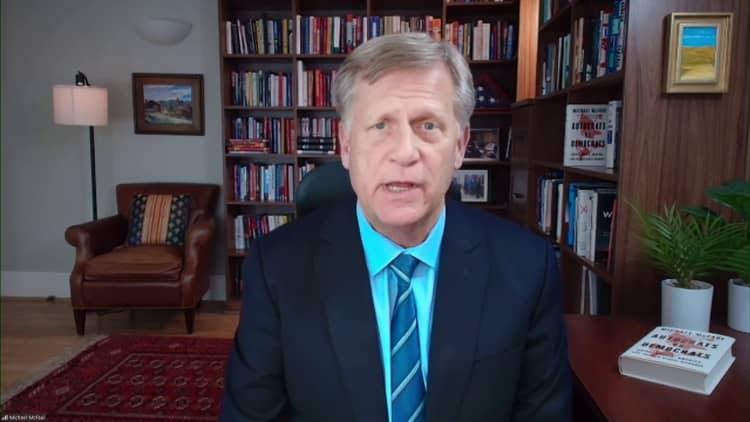
A monitor plays footage of US President Donald Trump announcing US and Israeli strikes against Iran in the James Brady Press Briefing Room of the White House in Washington, DC, U.S., on Saturday, Feb. 28, 2026.
Bloomberg | Bloomberg | Getty Images
BEIJING — Uncertainty is growing over U.S. President Donald Trump‘s high-stakes trip to China after Washington targeted a second foreign leader in two months.
Trump announced over the weekend that joint U.S.-Israel strikes on Iran killed its Supreme Leader Ayatollah Ali Khamenei. In early January, the U.S. also captured Venezuelan leader Nicolas Maduro and his wife from their residence.
Analysts say those actions could complicate Trump’s high-stakes trip to Beijing.
“President Xi Jinping won’t feel easy about the death of the top leader of Iran,” said George Chen, partner at The Asia Group, noting Beijing’s relatively good relations with Tehran and Caracas.
“How can Xi feel everything is normal and alright and be prepared to welcome Trump to visit in [a] happy mood?” he said. Chen added that “investors should manage their expectations on what Trump can achieve for his China trip — if he still goes.”
Trump is scheduled to visit Beijing from March 31 to April 2, following a fragile trade truce with China reached in late October. It would mark the first trip by a sitting U.S. president since 2017.
But Beijing has yet to confirm the dates.
China’s Foreign Ministry on Sunday condemned Khamenei’s killing and called it “a grave violation of Iran’s sovereignty and security.” Beijing urged for an immediate ceasefire, although it was less direct about the U.S. role than it had been after Maduro’s capture.
“I worry the U.S. side might use Iran, if it’s going poorly, to delay the trip,” said a foreign business executive tracking meeting preparations very closely, who requested anonymity due to the sensitivity of the matter.
“I think the risk [of the trip falling apart] is on the U.S. side more than the Chinese side,” the executive added.

U.S.-based prediction markets signaled a greater likelihood of a delayed Trump trip.
As of late Monday morning, Polymarket showed a sharp drop in expectations that Trump would visit China by March 31, to 42%, from 83.9% on Feb. 21, while wagers on a visit by April 30 remained high at 81%.
Kalshi showed a slight drop in expectations that Trump would visit China by 2027, though it remained a high 91%.
While many analysts still expect the trip to proceed, it’s less clear how U.S. businesses will navigate plans for deals in the world’s second-largest economy.
Several U.S. executives had been expected to accompany Trump on his Beijing trip, following a pattern of business delegations following leaders of different countries on their trips this year to China in a bid to strike deals.
“Prior to the attack on Iran, many American CEOs were already unwilling to go with Trump to China. Now the situation is even more tricky,” according to an active member of the American business community in China, who also requested anonymity due to the sensitivity of the matter.
The White House and China’s Foreign Ministry did not immediately respond to a CNBC request for comment.
The Chinese readout so far indicates an “unusually softer tone,” said Jack Lee, analyst at China Macro Group. He expects Trump to visit Beijing as planned, but is watching whether Washington signals restraint on arms sales to Taiwan.
The democratically self-ruled island, claimed by Beijing, remains a central flashpoint in U.S-China relations.
Risks of prolonged conflict
Trump, meanwhile, told British newspaper the Daily Mail that U.S. strikes on Iran could last four weeks — a point that Chinese state media highlighted Monday morning. That timeframe would run into the planned March 31 start date for his trip to China.
“If the conflict escalates into a regional war beyond what the U.S. originally planned, it’s not impossible that Trump might delay the trip,” said Yue Su, principal economist at the Economist Intelligence Unit.
“Still, I expect Trump and [Xi] to have a phone conversation about this at some point,” she said. Her base case remains that Trump goes ahead with his China trip later this month.
China this week kicks off an annual parliamentary meeting, where top diplomat Wang Yi typically speaks to the press. In mid-February, Wang told U.S. Secretary of State Marco Rubio on the sidelines of the Munich Security Conference that the U.S. and China should work to expand areas of cooperation.
In foreign policy, Beijing has prioritized its own interests by forging bilateral ties while encouraging multilateral engagement. Official statements around past U.S.-China meetings have noted the need to create “conditions” for developing bilateral relations.

Subscribe now
The U.S. actions in Iran have eroded trust between the two countries, said Dong Shaopeng, a senior researcher at Renmin University of China. While he still expects Trump and Xi to meet in a few weeks, he said he hopes the conflict does not spread to other countries in the Middle East.
State-affiliated Chinese columnist “Niutanqing” on Monday described the Iran “war” as more intense than the conflict in Ukraine, drawing several lessons. Of the several lessons from the turn of events, the columnist said that Khamenei’s death revealed “traitors” can emerge from within, and that negotiations may conceal the true intentions of an adversary, according to a CNBC translation of the post in Chinese.
If the Trump-Xi meeting proceeds as planned, it could offer an opportunity for broader peace talks while addressing strained U.S.-China relations.
“The issues that they have to work out, China-U.S. trade, are pretty important, and the meeting has been scheduled to be in place for a long time, and so cancelling it would be pretty radical at this point,” said Gary Dvorchak, managing director at Blueshirt Group.
“I don’t think it would … help the situation to cancel the meeting for any reason.”

Crypto World
Nasdaq follows Cboe joining world of ‘binary bets’ as prediction market craze hits Wall Street


The Nasdaq stock exchange wants to list binary options tied to its flagship stock indexes, a move that would let traders place yes-or-no bets on the direction of major equity benchmarks like the Nasdaq-100.
In a Monday filing with the U.S. Securities and Exchange Commission (SEC), the exchange said it also plans to offer binary options on the Nasdaq-100 Micro Index.
A binary option is a bet with only two outcomes. Either the condition is met, and the bettor walks away with a profit, or the option expires worthless. Nasdaq’s proposed contracts would be priced between 1 cent and $1, reflecting the market’s view of the probability that a specific outcome will occur.
If approved, the products would function similarly to contracts on prediction market platforms such as Polymarket and Kalshi, giving traders a new way to express short-term views on the performance of one of the market’s most closely watched stock indexes.
The filing marks Nasdaq’s entry into a fast-growing corner of derivatives markets that blends traditional finance with the mechanics of prediction platforms. Rival exchange Cboe also announced plans to expand into the prediction markets business as interest in event-based trading has surged.
That push follows the rapid growth of platforms such as Polymarket and Kalshi, which allow users to trade on the outcomes of events ranging from elections to economic data releases. Those platforms are regulated by the Commodity Futures Trading Commission (CFTC) because they offer event contracts tied to real-world outcomes.
Binary options, however, fall under the SEC’s jurisdiction. Nasdaq’s proposal underscores how established exchanges are seeking to adapt the prediction-style format to regulated securities markets. Nasdaq had not responded to a request for comment by publication time.
Crypto exchanges have also moved quickly.
Coinbase recently rolled out prediction markets on its platform, giving digital asset traders access to contracts linked to political, economic and cultural events. Gemini received CFTC approval in December to operate as a Designated Contract Market (DCM), allowing the firm to offer regulated prediction markets to U.S. customers.


Qivalis, the group of European Union banks developing a MiCA-compliant euro stablecoin, is in advanced discussions with crypto exchanges, market makers and liquidity providers as it prepares to roll out in the second half of this year, Spanish business daily Cinco Días reported on Monday.
The group, which includes ING, UniCredit, BNP Paribas, CaixaBank and BBVA, wants to ensure the token is available on regulated trading platforms from day one to ensure liquidity, according to Qivalis CEO Jan Sell.
The initiative is designed to provide a European alternative to the U.S.-dominated stablecoin market, contributing to the EU’s strategic autonomy in payments, the banks said. A euro-pegged token would allow businesses and consumers in the bloc to make blockchain-based payments and settlements using euros, without relying on traditional financial rails or foreign third-party providers.
The Netherlands-based venture is considering European and international venues as it seeks to position the stablecoin as a regulated alternative to U.S. dollar-denominated tokens and a tool for real-time cross-border corporate payments.
Spanish crypto exchange Bit2Me confirmed it has held talks with one of the group’s banks, though most platforms declined to comment.
Qivalis did not immediately respond to a CoinDesk request for confirmation.
According to Cinco Dias, Qivalis also disclosed details about the token’s reserve structure. The stablecoin will be backed 1:1, with at least 40% of reserves held in bank deposits and the remainder allocated to high-quality, short-term euro-area sovereign bonds diversified across EU countries. The reserves will be held with multiple highly rated credit institutions, and the design includes 24/7 redemption for token holders.
The consortium is seeking authorization from the Dutch central bank under the EU’s Markets in Crypto-Assets (MiCA) framework.
XRP (XRP) risked a further drop below $1 as its bearish technical setup converged with increased inflows to exchanges.
Key takeaways:
XRP faces overhead resistance at $1.42
XRP’s 13% rally to $1.43 between Saturday and Sunday ran into a resistance wall at $1.39-$1.43, causing it to retrace to the current price of $1.34.
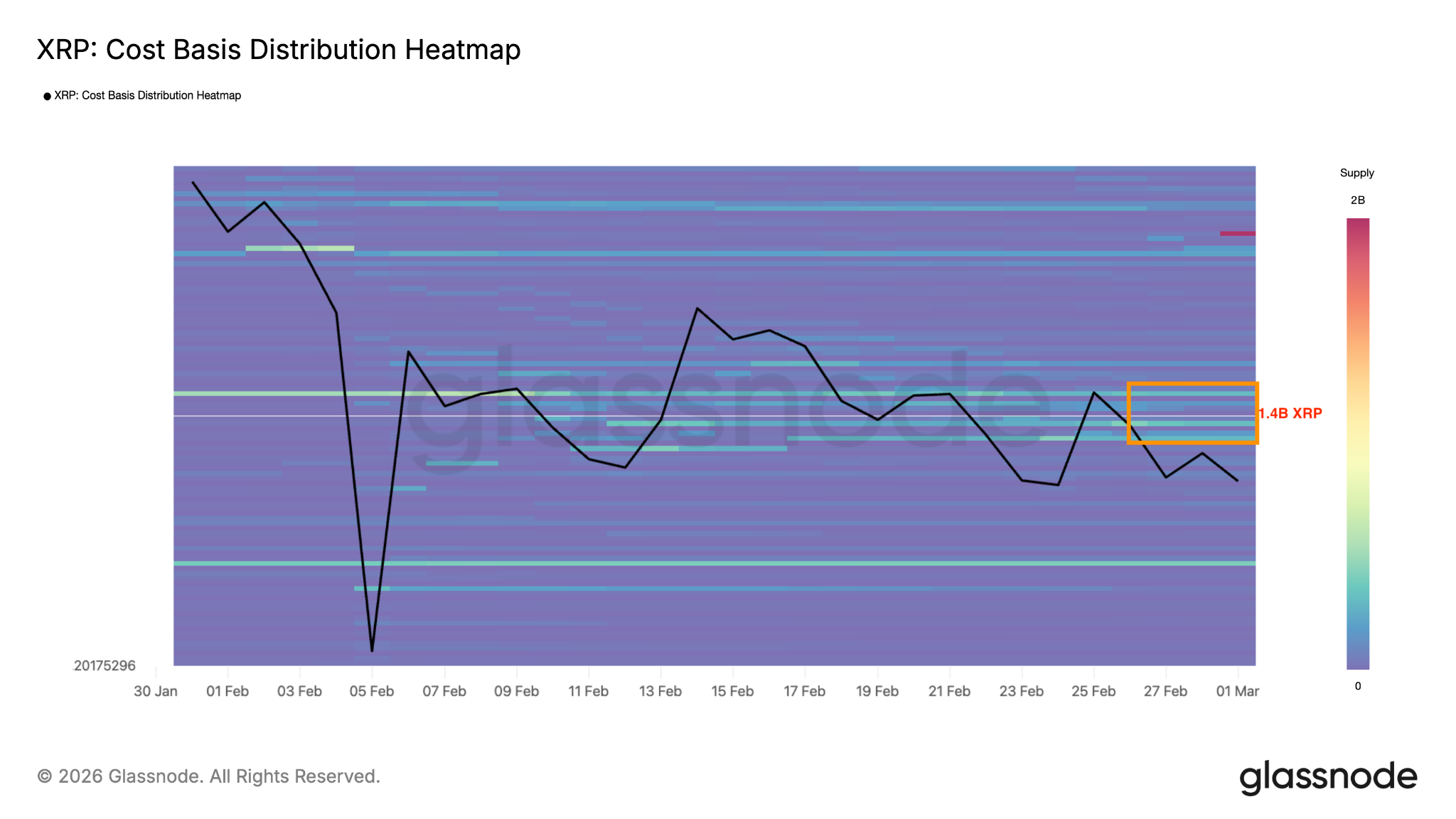
The cost-basis distribution heatmap shows that a large cluster of supply is within this area, where nearly 1.48 billion XRP were acquired over the last 30 days. This marks an area of stiff resistance for XRP, limiting upside potential.

The daily XRP price chart below shows that this area coincides with the upper trend line of a symmetrical triangle, which has suppressed the price since Feb. 1.
Related: XRPL Foundation patches ‘critical’ flaw that almost made it to mainnet
The XRP/USD pair is trading below the lower trend line of the triangle at $1.35. A daily candlestick close below this level would validate the symmetrical triangle, clearing the path for a deeper correction.
The measured target of the prevailing chart pattern, calculated by adding the triangle’s height to the breakout point, is $0.95, about 29% below the current level.

As Cointelegraph reported, a break and close below the lower boundary of a falling channel at $1.20 puts the Feb. 6 low of $1.11 at risk of breaking down. XRP may then tumble to the psychological support at $1.
Analyst BitGuru commented on the support level at $1.20-$1.22, saying:
“If this base holds and buyers step in, a rebound toward $1.80–$2.20 could happen quickly, signaling the start of a recovery move.”

Meanwhile, the two-day chart also puts a drop to $0.80 in play, fueled by selling from whales.
XRP supply on exchanges rises
Over the past week, more than 472 million XRP, worth about $652 million, were transferred to Binance, marking the largest inflow to exchanges in February, according to data resource CryptoQuant.
The transfer of tokens to exchanges often signals a potential willingness to sell or at least to position liquidity closer to the market.
“Such inflows typically reflect a more defensive posture from investors holding XRP,” CryptoQuant analyst Darkfost said in a QuickTake note on Monday, adding:
“When the amount of flows like this are recorded, they can create the conditions for a sudden wave of selling pressure capable of impacting price action in the short term.”

As a result, XRP balance on Binance has grown to 2.73 billion tokens from 2.55 billion in mid-February. This represents a total increase of about 180 million (+7%) in less than three weeks.

Increasing XRP supply on exchanges is a classic bearish signal that can outpace demand, increasing sell-pressure.
This article does not contain investment advice or recommendations. Every investment and trading move involves risk, and readers should conduct their own research when making a decision. While we strive to provide accurate and timely information, Cointelegraph does not guarantee the accuracy, completeness, or reliability of any information in this article. This article may contain forward-looking statements that are subject to risks and uncertainties. Cointelegraph will not be liable for any loss or damage arising from your reliance on this information.
Crypto World
Nvidia Commits $2 Billion Investment to Lumentum (LITE) in Major AI Infrastructure Deal

TLDR
- Nvidia commits $2 billion capital investment in Lumentum alongside a multibillion-dollar agreement to purchase advanced laser technology.
- LITE shares climbed 7.6% during premarket hours Monday after the partnership was revealed.
- Lumentum serves as the exclusive laser provider for Nvidia’s SpectrumX and QuantumX AI networking equipment.
- Stifel analysts elevated their LITE price target from $480 to $800 while reaffirming their Buy recommendation.
- LITE shares have skyrocketed approximately 897% during the past 12 months, approaching the 52-week peak of $765.
Nvidia revealed a significant $2 billion capital commitment to Lumentum Holdings (LITE) on Monday, accompanied by a multibillion-dollar agreement to procure advanced laser technology components.
This strategic partnership represents Nvidia’s expanded effort to develop optical networking infrastructure critical for artificial intelligence systems.
The arrangement is structured as nonexclusive, providing Nvidia with preferential access to future production capacity for sophisticated laser components manufactured by Lumentum.
LITE shares surged 7.6% during premarket sessions. Trading later on Monday showed the stock elevated approximately 4.9%.
Shares currently trade close to the 52-week peak of $765, representing a remarkable climb of nearly 897% over the previous 12-month period.
Lumentum maintains an exclusive role within Nvidia’s manufacturing ecosystem. The company serves as the singular provider of laser components utilized in Nvidia’s SpectrumX and QuantumX AI networking platforms, which employ co-packaged optics technology — an innovative approach that positions optical components directly adjacent to semiconductor chips.
Nvidia’s $2 billion capital injection will fuel Lumentum’s research initiatives, expand manufacturing capabilities, and support ongoing operations. A portion of these funds will be allocated to constructing a new production facility on U.S. soil.
“Optical interconnects and advanced package integration are foundational to the next phase of AI infrastructure, as they unlock ultrahigh-bandwidth, energy-efficient connectivity across AI factories,” Nvidia said in a statement.
Analyst Upgrades Follow the News
Stifel elevated its LITE price objective to $800 from $480 on Monday, maintaining its Buy recommendation. The investment firm indicated it is bringing its projections into closer alignment with broader market consensus.
Stifel highlighted the recent certification of Lumentum EML laser technology at Fabrinet and Nvidia’s networking division performance as encouraging indicators for Lumentum’s immediate business prospects.
The investment firm anticipates networking requirements within AI infrastructure deployments will expand significantly throughout coming years, propelled by demand from agentic artificial intelligence applications and reasoning-centric network architectures.
Based on InvestingPro information, 18 financial analysts have adjusted their earnings projections upward for the forthcoming reporting period.
Stifel acknowledged, however, that valuation analysis indicates the stock price may exceed fundamental value at present trading levels.
Strong Recent Earnings Add to the Case
Lumentum additionally delivered robust fiscal second-quarter 2026 financial results, surpassing Wall Street consensus projections for both revenue generation and earnings per share metrics.
The company’s forward guidance for the third quarter substantially exceeded market analyst expectations.
In response to these results, Needham elevated its price objective to $550, Rosenblatt boosted its target to $580, and Stifel had previously increased its target to $480 — all firms maintained Buy recommendations.
LITE stock value has approximately doubled since Barron’s published favorable coverage of the company during early January, identifying Nvidia’s implementation of co-packaged optics technology as a significant growth catalyst.
The Nvidia investment partnership and purchasing commitment were publicly announced Monday, March 2, 2026.

Bitcoin (BTC) acts as a barometer for global fear, but the latest geopolitical flare-up, which has many fearing for WW3, has failed to break the asset’s bullish prospects.
While headlines scream conflict, Bitcoin is holding the $60,000 line, eyeing a liquidity-driven breakout rather than a capitulation event.
Traders are now pricing in resilience, looking past the initial volatility to the underlying supply mechanics that favor the bulls.
The market climaxed with a sharp dip near $63,000 over the weekend before buyers stepped in, rejecting lower lows.
This price action suggests the market is desensitizing to headline risk, shifting focus back to the monetary drivers that typically fuel Q4 rallies. It is a clash of narratives: geopolitical uncertainty versus undeniable on-chain strength.
- Bitcoin Exchange Reserves have dropped to levels not seen since 2018, creating a significant supply shock as demand creates a floor.
- Spot BTC ETF Inflows are absorbing retail panic selling, with institutional players treating dips as accumulation opportunities.
- Global Liquidity M2 is expanding again, historically a primary driver for crypto asset repricing regardless of news cycles.
Indicator 1: Bitcoin Exchange Reserves Signal Supply Shock
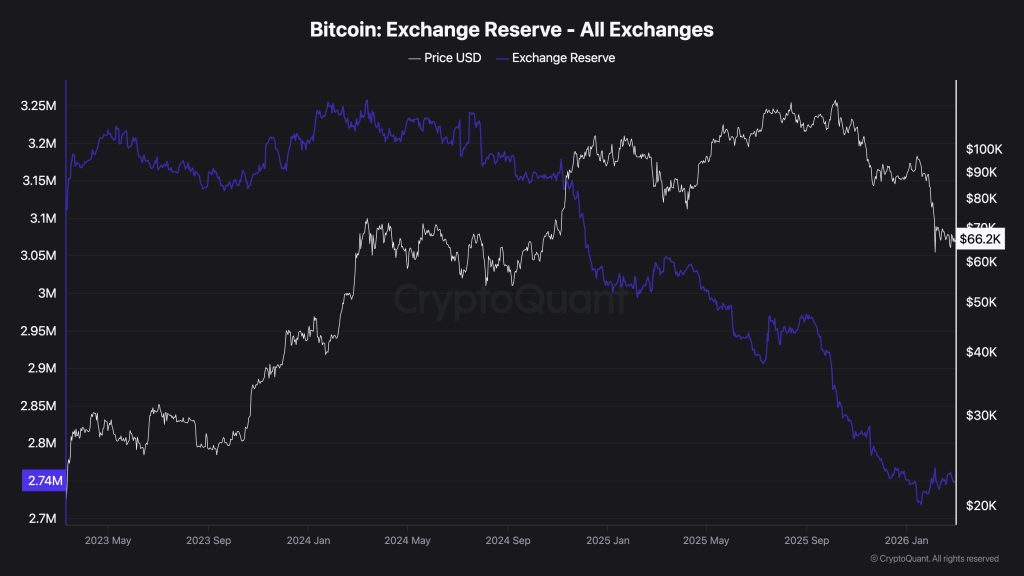
The most critical on-chain metric currently is the rapid depletion of Bitcoin Exchange Reserves. According to data from CryptoQuant, reserves have fallen to approximately 2.6 million BTC, the lowest level since 2018. This is a structural supply squeeze that cannot be ignored.
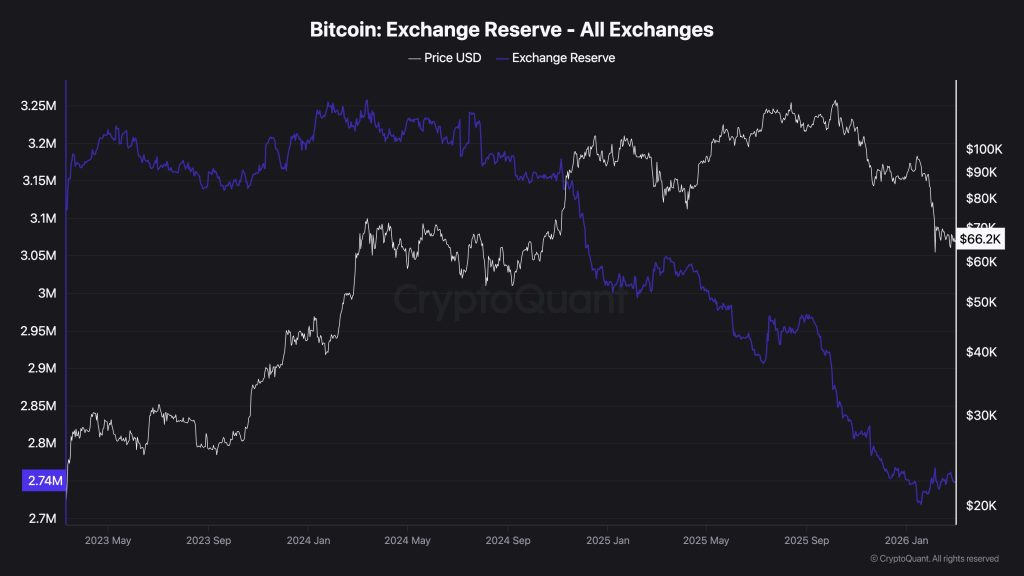
When coins leave exchanges, they move to cold storage or custody solutions, effectively removing them from the immediate sellable supply.
The implication is straightforward: fewer coins available for sale means it takes less buy volume to push prices higher. In previous cycles, sharp declines in exchange balances often preceded supply shock rallies.
This drain on liquidity suggests that while weak hands are selling into headline fear, long-term holders are moving assets off the ledger. We are witnessing a transfer of wealth from impatient retail traders to high-conviction entities who understand the scarcity mechanics of the halving year.
Discover: The best crypto to diversify your portfolio with
Indicator 2: Bitcoin (BTC) ETF Inflows vs. Spot Selling
Institutional demand continues to act as a massive buffer against spot market volatility. Despite the bearish sentiment on social media, Spot BTC ETF Inflows tell a different story.
Recent weeks have seen net inflows effectively neutralizing the selling pressure from short-term holders, with the last week generated net inflows of $787.3 million, according to data by SoSoValue.
So, funds like BlackRock’s IBIT continue to attract capital even as price action chops sideways. This divergence of falling price against rising inflows is a classic accumulation signal. Institutional accumulation is not slowing down; it is accelerating during dips.
Adding to this institutional bedrock, major financial players are deepening their infrastructure. Morgan Stanley has moved to hold client crypto directly, signaling that the smart money thesis remains focused on long-term adoption rather than short-term geopolitical noise.
Indicator 3: How Bitcoin is Breaking the Downtrend Despite WW3 Fears
Technically, Bitcoin is respecting critical levels. The weekend dip found support before reaching the psychological $60,000 barrier, a level many traders had eyed for aggressive longs.
Trader CrypNuevo noted on X that a trip to anywhere between $60,000 and $61,000 would be a prime long entry, but the market front-ran that level, showing eagerness to buy.
So my strategy for this week is: — CrypNuevo
Wait for Monday stock market opening reaction:
• If it's a bloodbath (unlikely imo), then I'll long Bitcoin around $61k-$60k ahead of de-escalation talk news.
• If it's a slight decline, sideways or pump, I won't long until later in the week.
 (@CrypNuevo) March 1, 2026
A clean break above $70,000 would invalidate the downtrending structure that has plagued the chart since March.
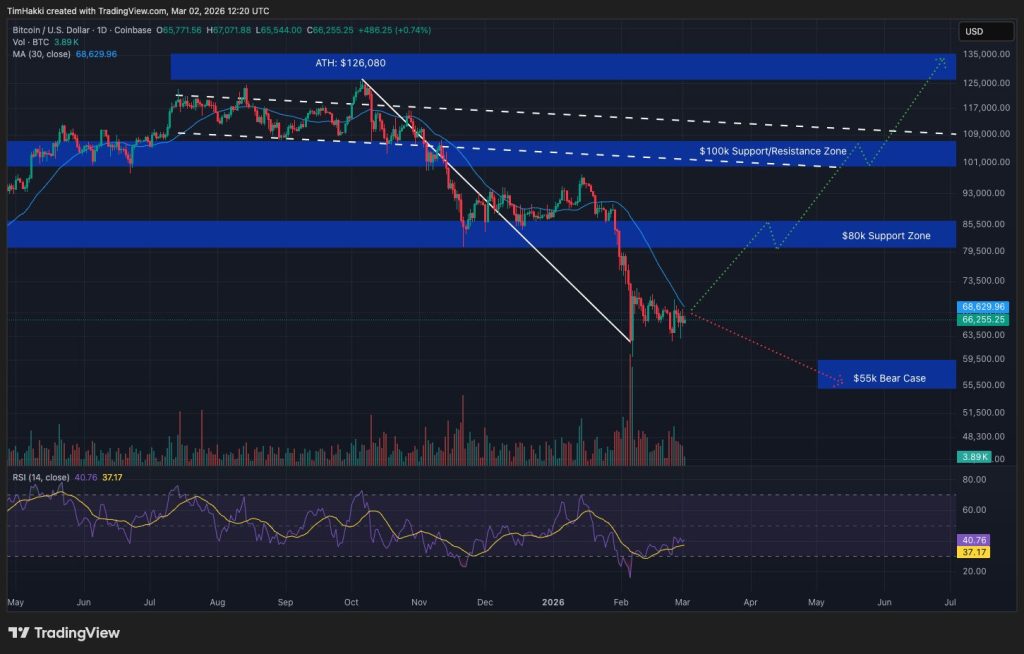
Support at $60,000 is the line in the sand; lose that, and the conversation shifts to $55,000 or lower. If Bitcoin can hold the line, the path back to six figures by Summer remains open.
Indicator 4: Global Liquidity and Central Bank Easing
Bitcoin is, above all else, a liquidity sponge. The current expansion of Global Liquidity M2, a measure of global liquidity that takes into account cash, checking and savings deposits, money market securities, and other near-cash assets, is the macro tailwind that bearish traders are overlooking.
As central banks from the ECB to the Fed signal or enact rate cuts, the cost of capital decreases, forcing money out of risk-free assets and into growth vehicles.
Historically, Bitcoin’s parabolic runs align perfectly with cycles of M2 expansion. We are currently in the early stages of a global easing cycle. While inflation data may cause temporary pauses in the Fed’s roadmap, the broader trend is clear: money printers are warming up.
Given the historic lag between M2 liquidity expansion cycles and Bitcoin bull markets, the injections hitting the system now will likely reflect in asset prices in Q4 2024 and Q1 2025.
Traders betting on a crash are effectively betting against the central bank liquidity cycle, a wager that rarely pays off in the crypto markets.
Discover: The best crypto to buy now
Indicator 5: Bitcoin Sees Geopolitical Resilience Despite WW3 Fears
The market’s reaction to recent Middle East tensions reinforces the “digital gold” narrative, albeit with high beta volatility.
While the initial reaction was a sell-off, Bitcoin rebounded swiftly after the shock, erasing nearly all losses within 48 hours. This V-shaped recovery is a hallmark of a resilient bull market structure.
Analyst consensus is shifting away from “World War Three” scenarios toward a contained conflict narrative, limiting the downside risk for risk assets.
However, the connection between energy prices and crypto remains tight. As oil prices react to Iran tensions, inflation expectations could tick up, complicating the Fed’s pivot. Yet, Bitcoin has shrugged off this correlation for now, trading more on idiosyncratic crypto flows than petrodollar dynamics.
Data from CoinGlass shows that the initial dip flushed out over-leveraged longs, resetting open interest to healthier levels. The market is now lighter, cleaner, and ready for organic price discovery without the weight of excessive leverage.
Ultimately, with institutional accumulation quietly putting a floor under price and Bitcoin Exchange Reserves draining, the path of least resistance appears to be upwards despite WW3 fears. The Bitcoin market has already priced in the conflict shock. Now it waits for the liquidity surge.
The post Bitcoin and WW3: 5 Key Indicators as BTC Eyes Global Liquidity Surge appeared first on Cryptonews.
Crypto World
Bitcoin miner turned Ethereum treasury firm stakes over $6B in ETH as BMNR shares slide and ether dips.
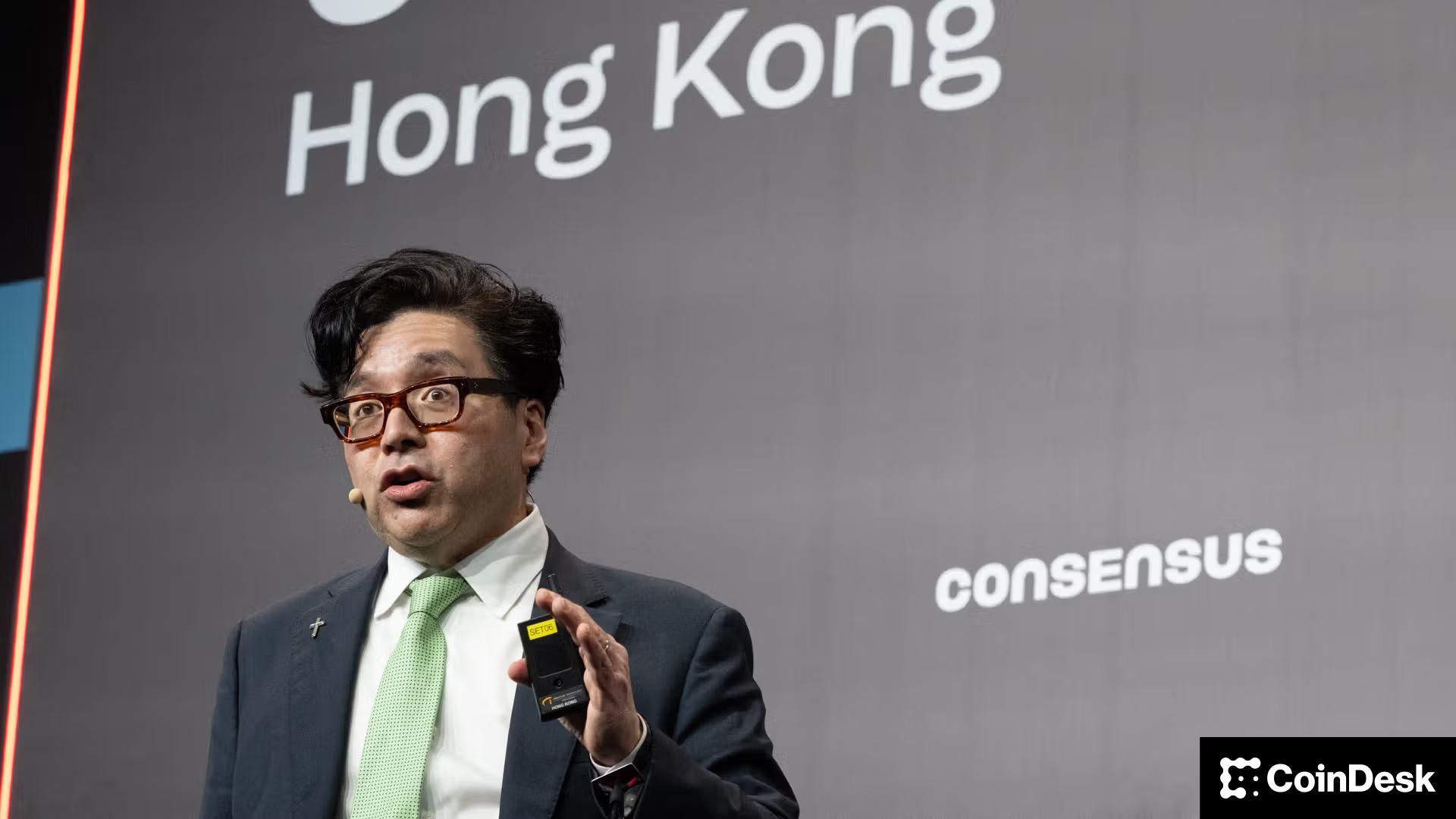
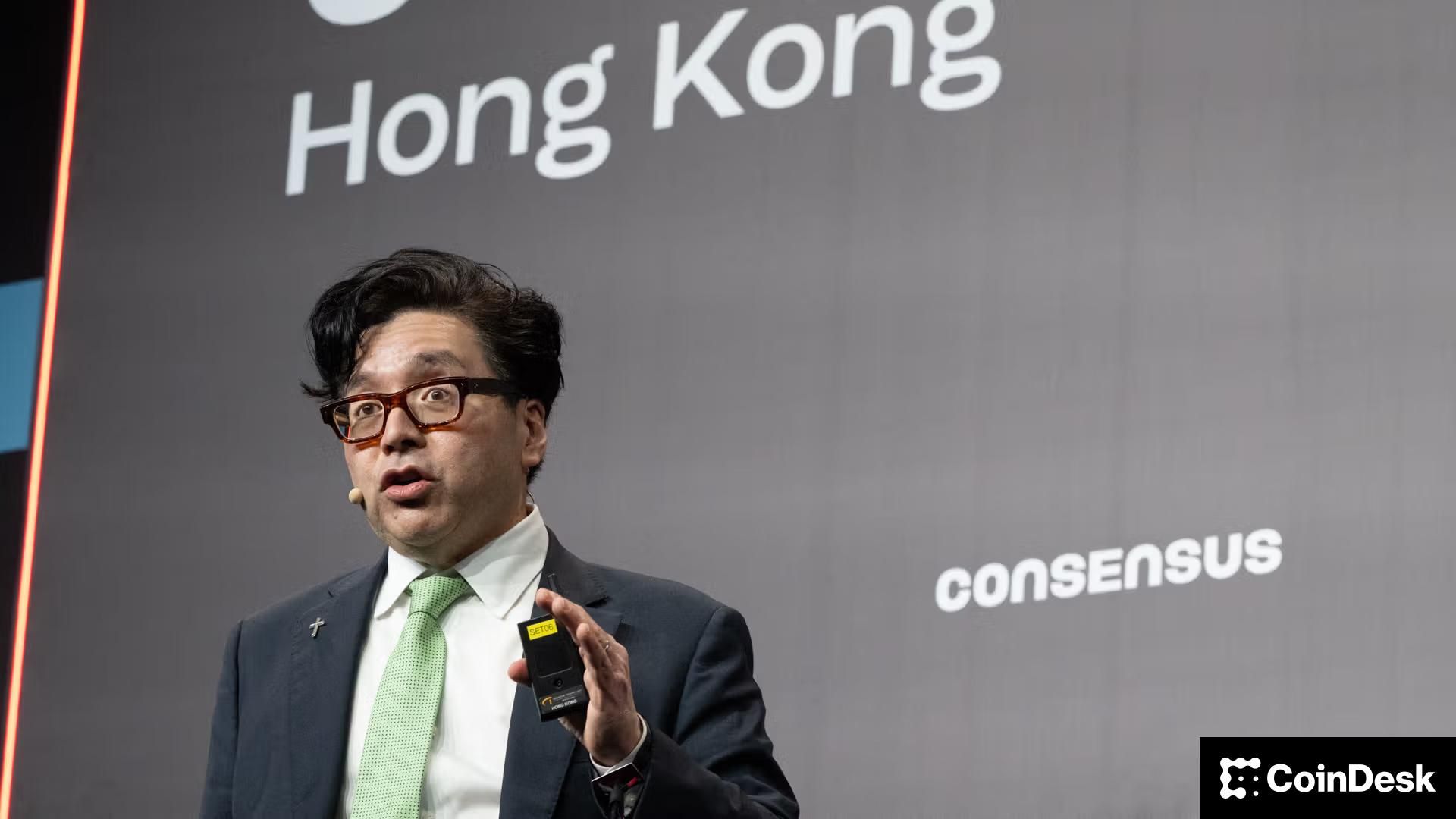
Bitmine Immersion Technologies (BMNR) on Monday reported purchasing nearly 51,000 more ETH tokens last week, increasing its holdings to 4.474 million.
“In the midst of this ‘mini crypto winter,’ our focus continues to be on methodically executing our treasury strategy and steadily acquiring ETH and in turn, optimizing the yield on our ETH holdings,” said Chairman Tom Lee.
The company said it now has 3,040,483 ETH staked, worth about $6 billion at current prices. Lee said annualized staking revenue stands at $172 million. At full scale, staking rewards could reach $253 million annually based on a 2.86% yield over the last seven days, Lee continued.
The company holds 4,473,587 ether (ETH), valued at $1,976 per token, along with 195 bitcoin and $868 million in cash, as well as a $200 million stake in Beast Industries and a $14 million investment in Eightco Holdings. Bitmine said its ether position represents 3.71% of Ethereum’s 120.7 million token supply.
Lee added that the firm is developing its Made in America Validator Network, or MAVAN, a staking platform slated for launch in early 2026. Bitmine said it is working with three staking providers as it builds the network.


Crypto prices are rebounding from their worst weekend levels in early U.S. trading on Monday alongside a sizable bounce in U.S. equity indices.
Roughly one hour into the session, the Nasdaq is down just 0.1% after futures at one point overnight had indicated a plunge of more than 2%. The S&P 500 and DJIA are also posting just very modest losses.
Gold remains higher by 2% and crude oil by 7%. The U.S. dollar index is having one of its strongest sessions in weeks, gaining 1%.
Bitcoin has moved up to $68,600, ahead 2.3% over the past 24 hours. Ether (ETH) is higher by 1.4%, with solana (SOL) and XRP (XRP) up similar amounts.
Crypto-related stocks are posting even larger gains, led by Circle’s (CRCL) 12% advance. Strategy (MSTR) is higher by 6% and Galaxy Digital (GLXY) by 4.7%.
On the macro side, the ISM manufacturing PMI came in at 52.4, for February, marking another month of sector expansion and the first consecutive run of prints above 50 since the fourth quarter of 2022. This follows Friday’s Chicago Business Barometer, which rose to 57.7 in February 2026 from 54 previously and well above expectations of 52.8. The reading signals only the second expansion since November 2023 and reflects the strongest pace of US activity growth since May 2022.
Against the backdrop of conflict in the Middle East, reaccelerating manufacturing activity, hotter-than-expected PPI data last week, and higher oil prices driven by geopolitical tensions, a March rate cut now appears effectively off the table ahead of the Federal Reserve’s March 18 meeting.
Normally, that might be considered a headwind for crypto prices, but it’s quite possible that markets had already priced in tighter than previously expected U.S. monetary policy.
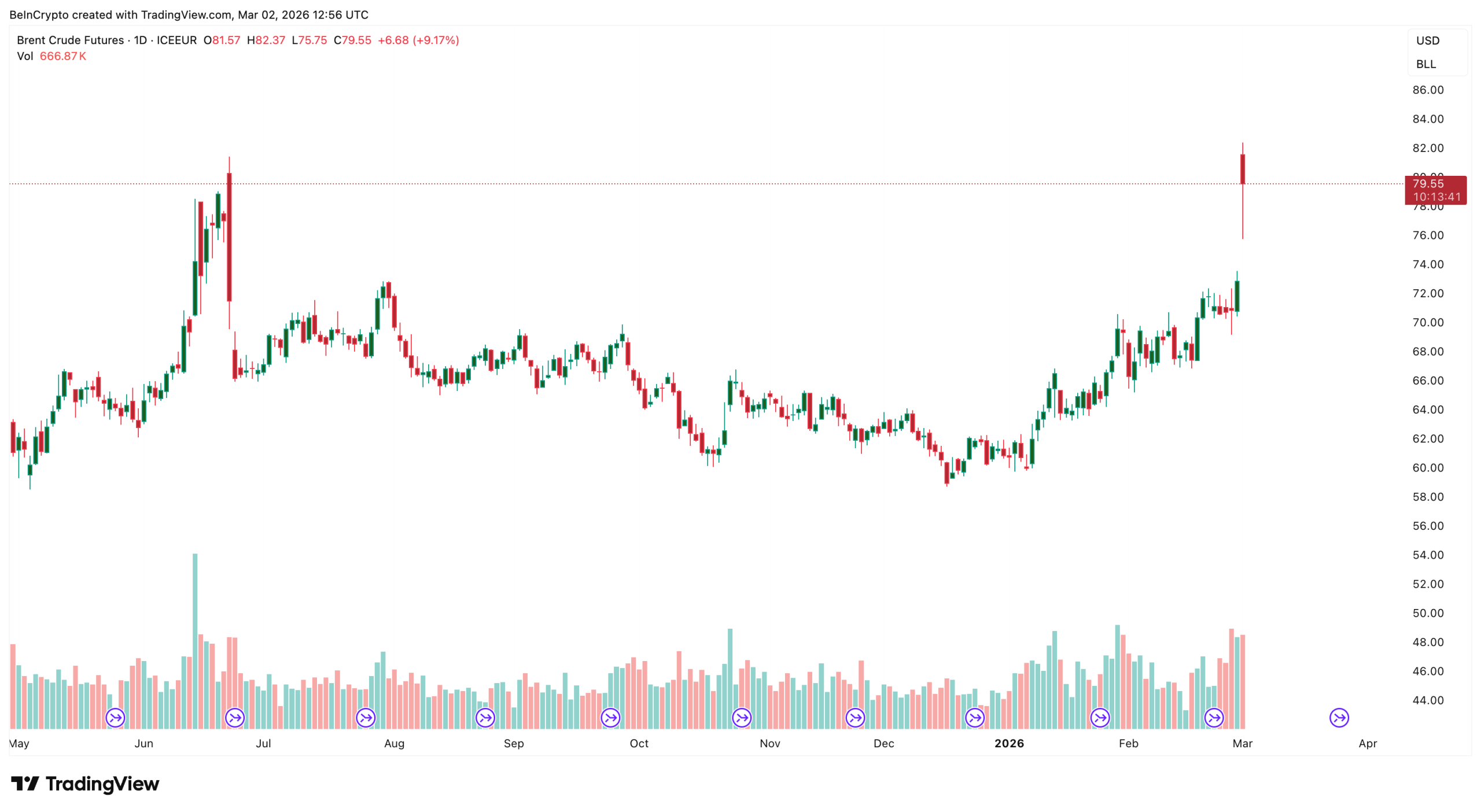
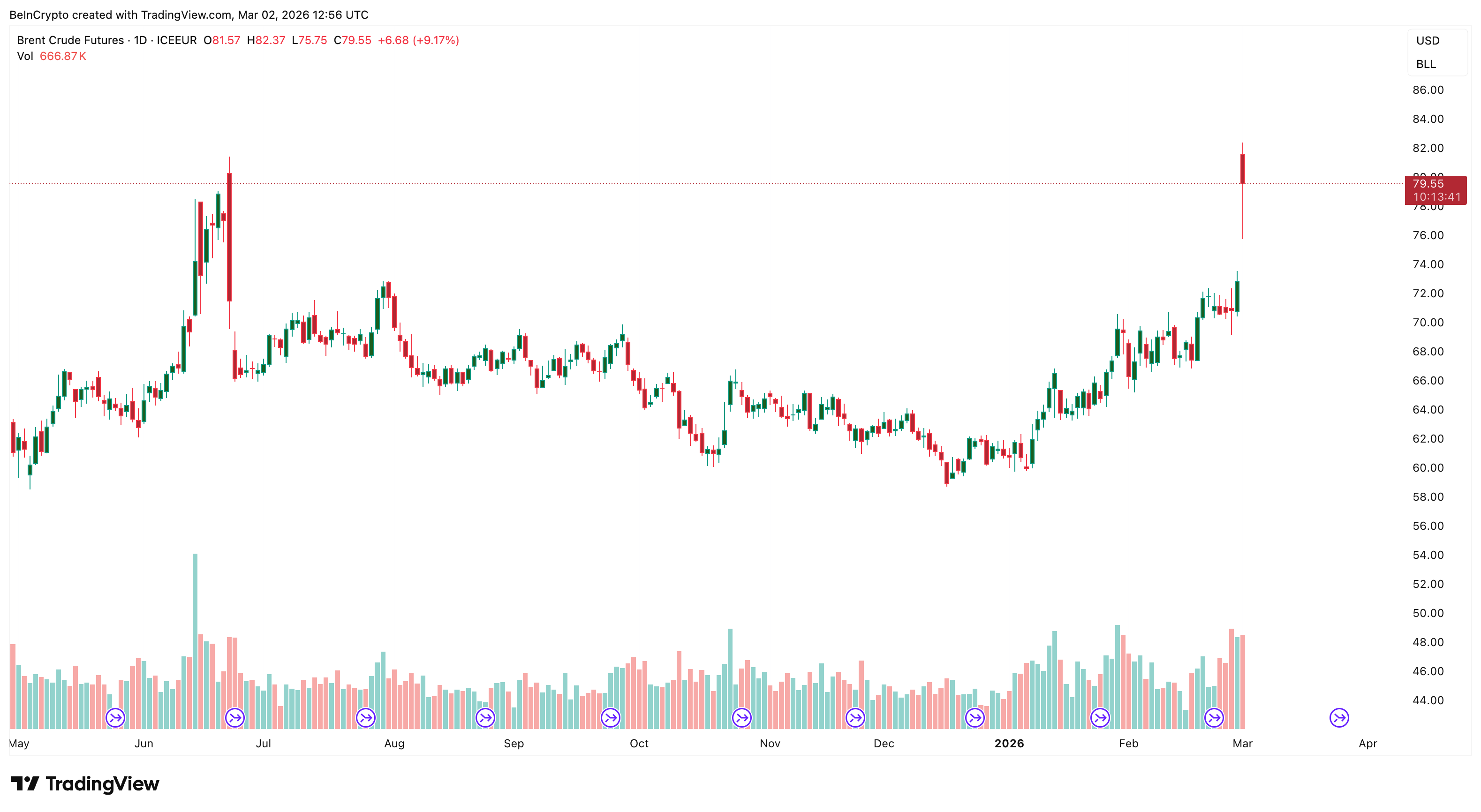
The oil price surged sharply this week after conflict in the Middle East pushed Brent crude futures (ICEEUR:BRN1!) to $82, marking its biggest shock in months. Brent is the global oil benchmark, widely used to price international crude, which makes it the clearest measure of the oil price reaction to geopolitical risk.
The breakout is tracked on the CFD (Contract for Difference) charts, which reflect price structure but not actual positions. However, futures data from ICE Futures Europe confirmed real traders entered the market, validating the oil price surge as both a geopolitical and positioning-driven move.
Oil Price Surge and Rising Dollar Create Early Stress at $82
The oil price jumped from around $72 to $82 after US-Israeli strikes on Iran. The retaliation raised fears of supply disruption through the Strait of Hormuz, a critical route carrying nearly one-fifth of global oil flows. This sudden repricing added a war premium, meaning traders pushed the oil price higher due to expected supply risk rather than immediate shortages.
This shock triggered a gap-up opening in Brent crude oil. Such moves often face early stress because markets tend to retest part of the jump before continuing higher.
That stress appeared near $82, as Brent crude oil corrected to $79.
The latest candle closed red with elevated volume. Volume in red indicates more trading occurred as the oil price corrected post-gap-up, indicating active selling pressure.
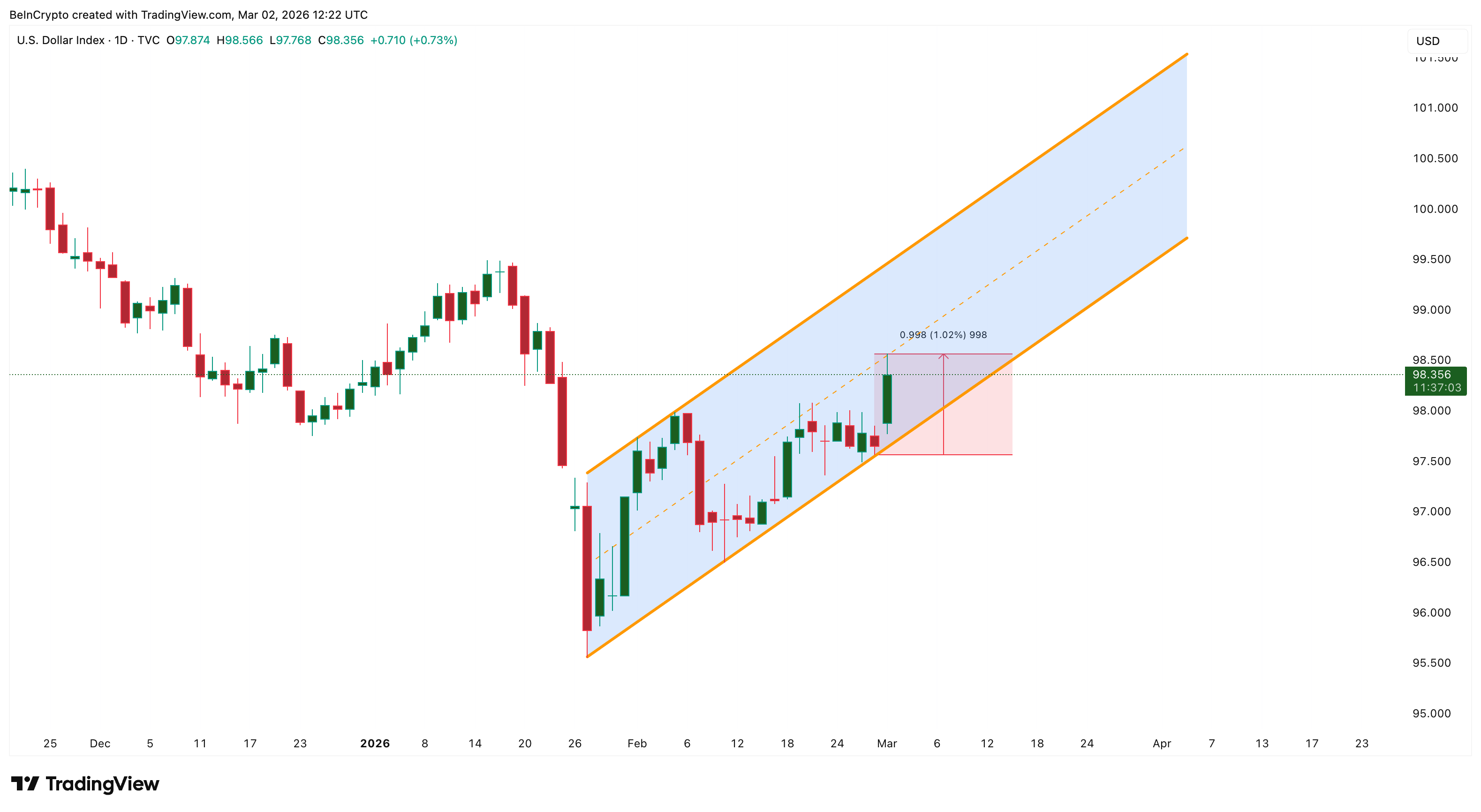
At the same time, the US Dollar Index (DXY), which tracks dollar strength against major currencies, has also been rising. Since oil trades globally in dollars, a stronger dollar makes oil more expensive for international buyers. A bearish sign.
But another key indicator shows the full picture. Open interest, often called OI, has risen sharply on Brent futures (ICEEUR:BRN1!). Rising open interest means new traders are entering the market rather than closing positions. This validates the short-term bullish bias.
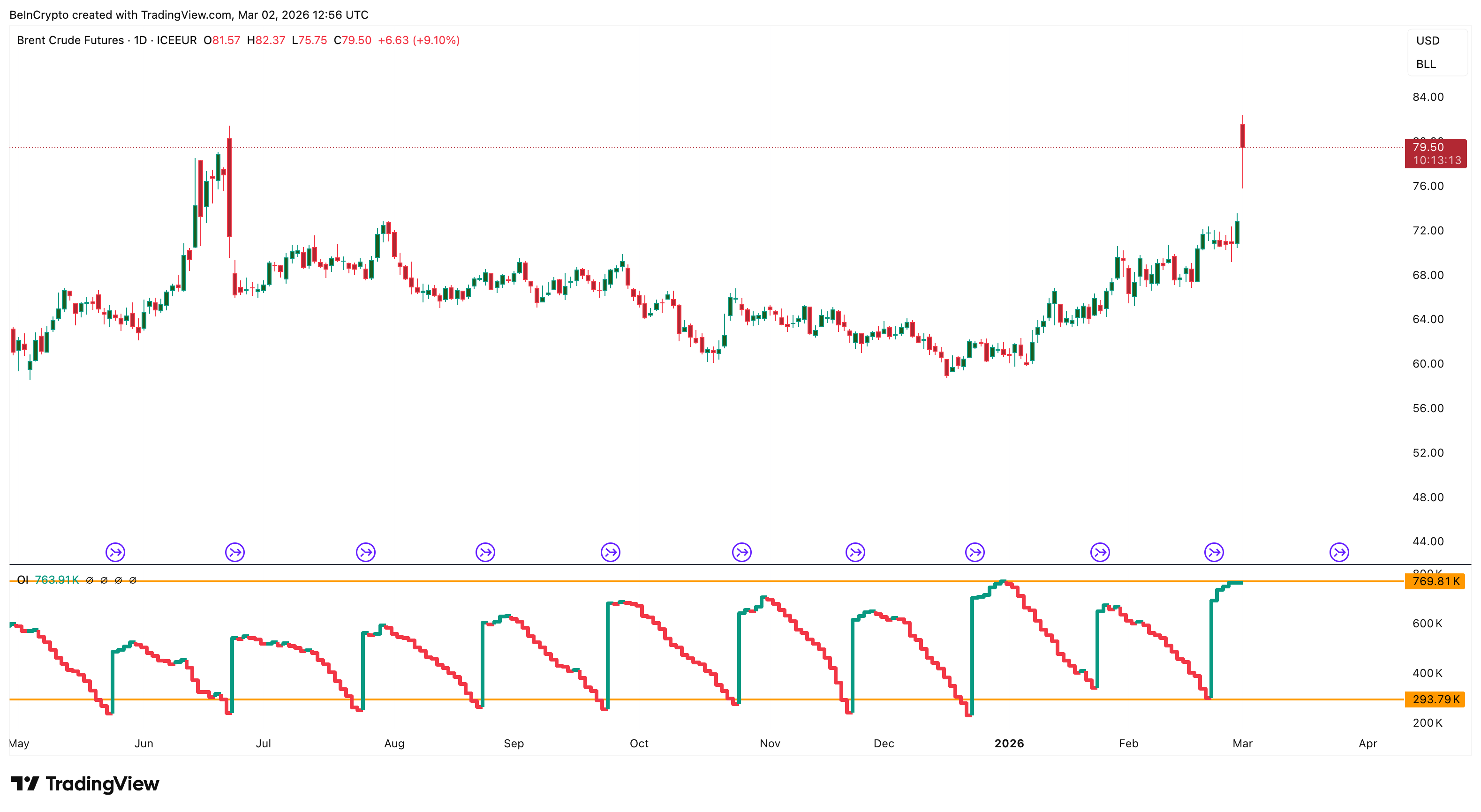
This shows the oil price is not falling due to a lack of interest. Instead, the market is absorbing selling while new positions continue building. However, traders need to keep an eye out for the flattening open interest.
Price rising while open interest is flat means the move is likely driven by short covering, not new buying, so the trend is weaker and may not sustain.
OPEC Supply Increase Adds Future Risk Even as War Drives Current Price
At the same time, OPEC, the Organization of the Petroleum Exporting Countries, announced it would increase production by 206,000 barrels per day starting in April. OPEC is a group of major oil-producing nations that control a large share of global supply.
Normally, a higher supply reduces the oil price because more oil becomes available.
However, the oil price continued rising because war risk affects supply immediately, while OPEC’s production increase happens later. This creates a conflict between short-term supply fears and longer-term supply growth.
The Strait of Hormuz remains central to this risk. Even the possibility of disruption is enough to keep traders cautious and maintain upward pressure on the oil price. This also explains why open interest has started to flatline and why selling pressure emerged after the gap-up opening, as traders remain cautious about chasing the oil price higher while the risk of sudden supply and macro shifts remains elevated.
Futures Positioning Shows Market Is Preparing for a Larger Oil Price Move
Futures positioning shows the oil price breakout is attracting strong participation. The sharp rise in open interest on Brent crude oil futures (ICEEUR: BRN1!), seen earlier, confirms that traders are actively opening new positions as volatility increases.
This positioning trend is spreading beyond traditional markets. Platforms like Aster, a crypto-based derivatives exchange, have launched oil perpetual futures.
The rise in oil trading on crypto platforms shows how widespread the positioning has become. It reflects broad positioning across financial markets.
Key oil price levels are tracked using the Brent crude CFD, while the Brent crude oil Futures are used to track volume and open interest.
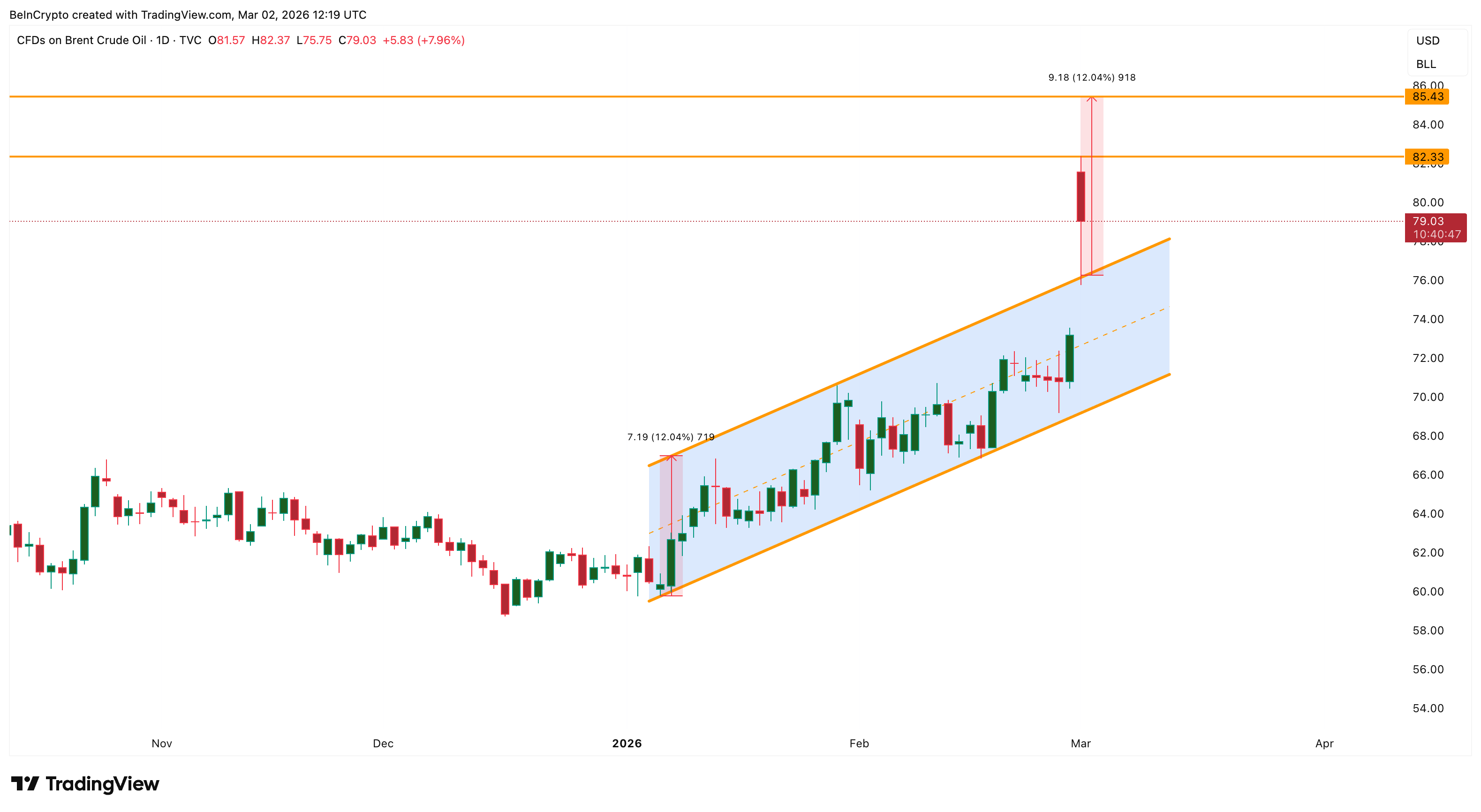
Per the chart, the first resistance remains $82, which aligns with the Fibonacci retracement (mentioned later).
If the oil price breaks above $82, the next target becomes $85, based on the ascending channel breakout projection. Above that, the next resistance levels appear at $93 and $104 if geopolitical risk continues. Adding to this current strength is the Exponential Moving Average (EMA) positioning.
This measures the average price over time while giving more weight to recent data, and recently confirmed a golden crossover where the 50-day EMA crossed above the 200-day EMA, a signal that previously preceded the latest upward move. The 100-day EMA is now rising toward the 200-day EMA, showing strengthening trend support.
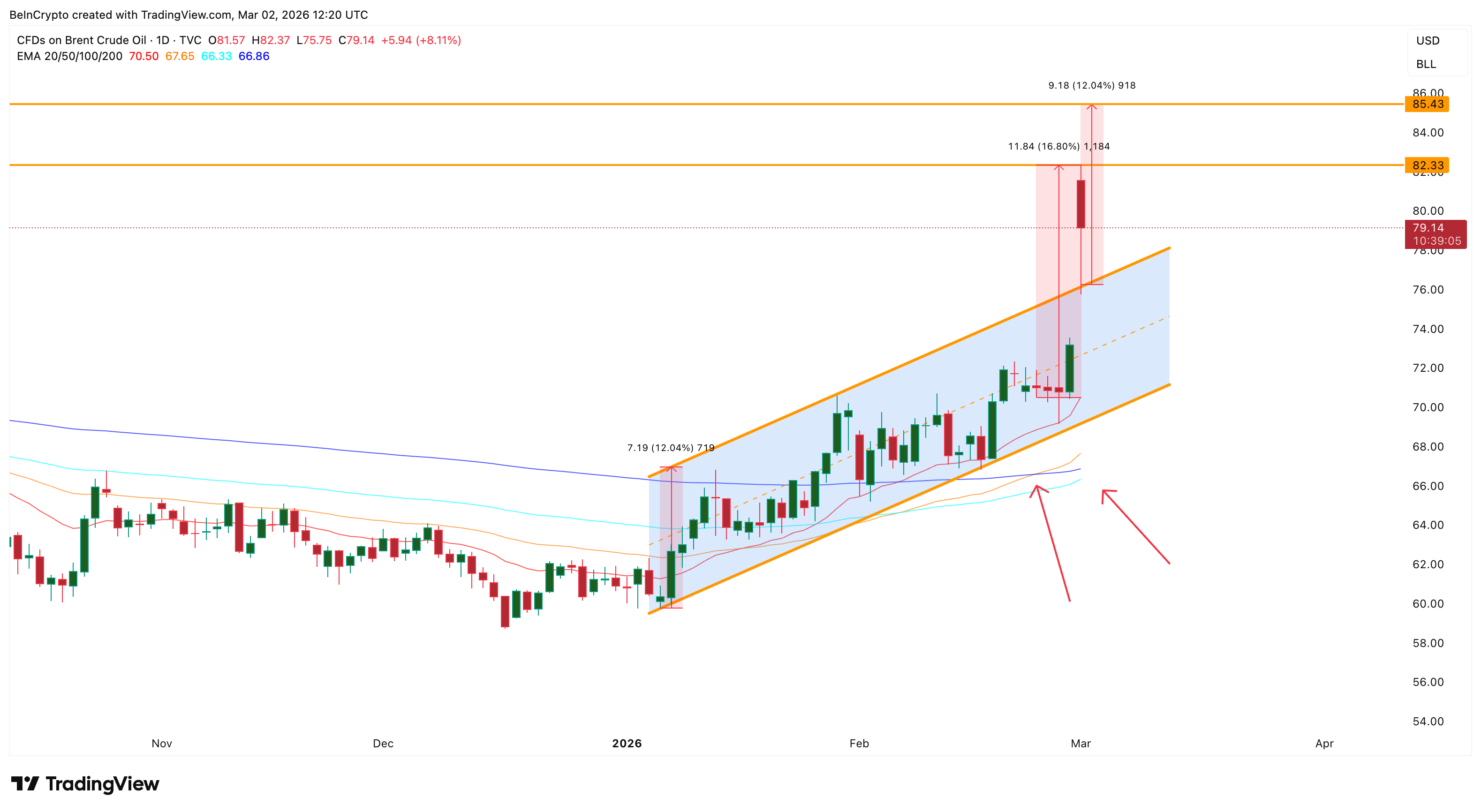
If that bullish crossover confirms, the $85 target, based on the ascending channel’s projection, might show up first.
However, the most important support level is $75.
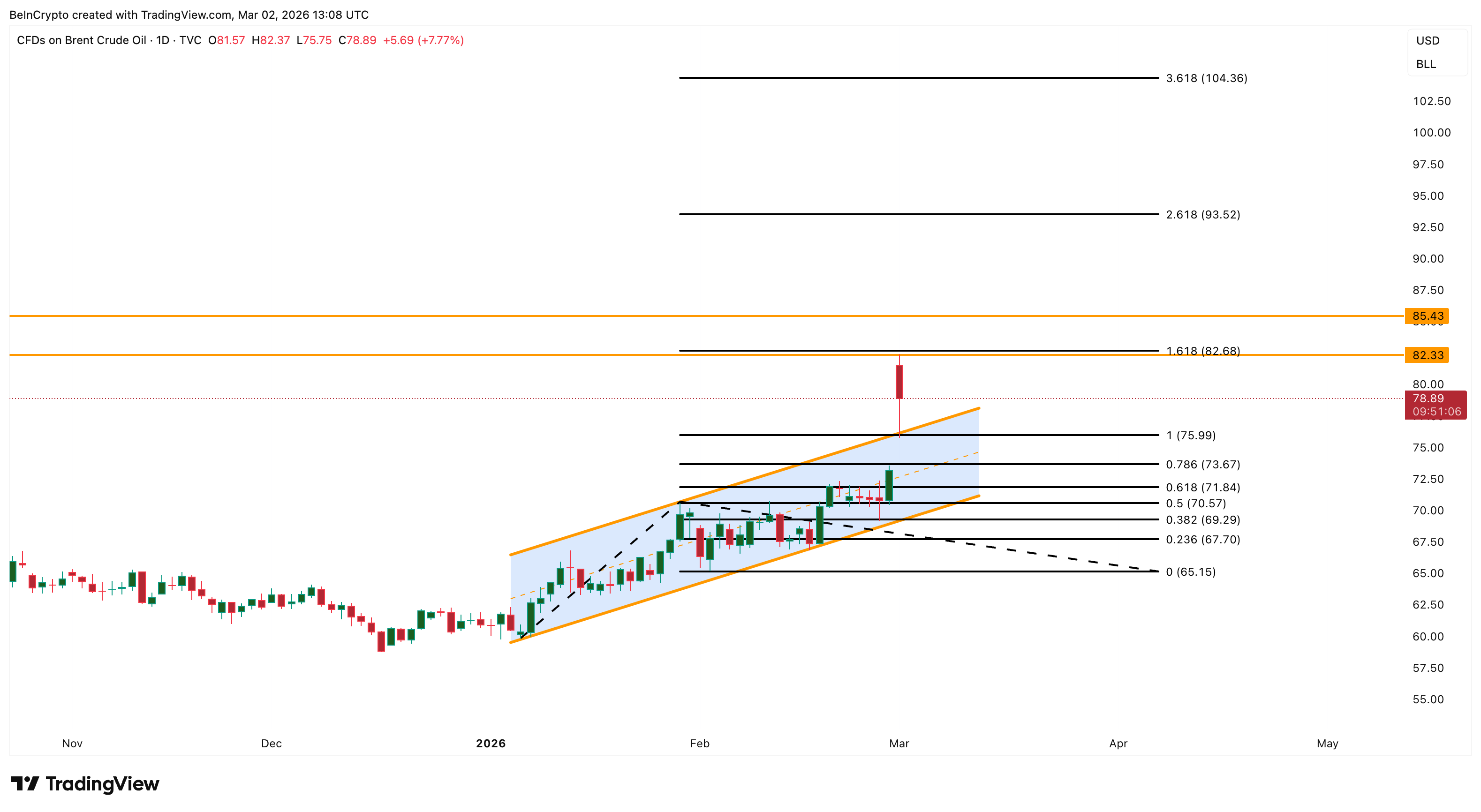
If the oil price falls below $75, it could decline toward $73 and $71. However, the bullish structure only weakens on possible peace talks and a dip under $67.


Institutional engagement with digital assets is no longer a uniform story. In recent years, major financial institutions have taken markedly different approaches to blockchain-based markets. Some have focused on tokenization, putting traditional instruments into programmable form. Banks, meanwhile, have explored tokenized deposit models and internal settlement rails as well as issuing their own digital assets like stablecoins.
Amid the growing wave of institutional capital entering digital assets, the more revealing question is not who participates, but how participation is governed inside the institution. Regulatory requirements, operational standards, and internal conviction often determine whether a strategy moves forward or stalls.
Speaking exclusively with BeInCrypto at Liquidity Summit 2026 in Hong Kong, Samar Sen, Head of International Markets at Talos, shared how those internal dynamics play out when institutions evaluate digital asset opportunities.
Adoption Requires More Than Rules
According to Sen, regulatory clarity remains the most decisive factor in institutional participation. He noted that progress across jurisdictions has helped reduce uncertainty, but clear rules remain essential for large-scale adoption.
“We’ve seen a lot of advancements in regulation all over the world,” Sen acknowledged.
While once the dominant concern, infrastructure has matured significantly. Institutional-grade custody, execution platforms, and portfolio management systems now operate across major markets, addressing many of the operational gaps that previously slowed adoption.
Yet even where regulatory frameworks have advanced, and infrastructure is in place, in many institutions, the remaining hurdle is internal. He said:
“There may be management that is still evaluating the underlying tech or still need some time to get around understanding the potential of the tech to revolutionize finance.”
That hesitation often reflects unfamiliarity rather than outright resistance, he added. For institutions built on decades of precedent, conviction takes time. As a result, digital asset initiatives can stall even when the external conditions appear favorable.
The Compliance Checklist Behind Institutional Trust
When asked what signals actually build trust for institutions evaluating crypto counterparties, Sen pushed back on the idea that visibility alone carries weight. While he acknowledged that industry gatherings and brand presence may help with awareness, institutional trust is earned differently.
“Typically, what builds trust will be, first of all, licensed or regulated entities within their jurisdictions,” Sen said.
He also added that institutions look for demonstrable internal controls, such as SOC 2 Type II certifications, audit trails, and operational safeguards. Track record also matters, particularly if leadership has experience in traditional finance and has built a reputation for delivering under regulatory scrutiny.
Peer adoption plays a role as well. Institutions often look outward, assessing who else is using the same infrastructure and how widely it has been adopted across the industry. He explained:
“If you’re a big bank, and you go to talk to a vendor to provide you with technology, if that vendor is providing that technology to some of your peers and competitors, that’s another way that can establish some kind of trust.”
Not All Institutions Move at the Same Speed
Although regulatory clarity and operational safeguards form the foundation, institutions are not entering digital assets uniformly. Sen described three distinct profiles emerging in the market.
Some organizations act as early movers. These firms understand the structural shift underway in capital markets and are willing to commit resources ahead of full certainty. They tend to invest in building internal digital asset teams and engage proactively with new infrastructure providers.
Others take a more measured approach. These fast followers prefer to wait for clearer regulatory direction or proof of concept before scaling exposure. Their risk appetite is lower, and they often rely on external validation before committing capital.
Then there are institutions that remain behind the curve. In some cases, leadership has yet to develop conviction around the underlying technology. In others, digital asset initiatives exist but lack internal coordination, resulting in fragmented or misaligned strategies.
Sen noted that institutions should not be expected to move in lockstep. He added that different risk tolerances and internal mandates shape the pace of adoption.
“And that’s okay because with digital assets and the underlying technology, there are many entry points to participate in the asset class, to get comfortable with the new providers and ecosystem participants. We are here to help navigate that.”

While regulation continues to loosen around crypto in the United States, largely thanks to a president who accepts bribes via his own meme and stablecoins, the opposite is occurring in China.
Indeed, dozens of Chinese nationals have taken to social media to report that just putting “Dogecoin” or “USDT” in the memo field of a transfer ends with the bank account being frozen — and the individuals have almost no recourse for their money getting unfrozen thereafter.
Drastic difference in banking regulations
Despite the near total normalization of buying, selling, trading, and creating cryptocurrencies in the US — including a stablecoin endorsed and partially owned by the president — China and its retail banks have taken on a much stricter set of rules and regulations.
In one instance, according to a site called Techub.info in China, two clients of China Construction Bank (the third largest bank in the world) had their accounts frozen after transferring a mere 250 yuan, or $35, between one another with the memo “Dogecoin this week.”
After sending the money the bank flagged the transfer under its virtual currency control risk management program.
Rednote users warn Chinese citizens
On Rednote, users are sharing the story with words of warning for others in China: never put bitcoin, virtual currency, any memecoin, or USDT as the reason for a fund transfer or you will absolutely face an account freeze.

Read more: China’s Regulation 42 forces Tether to kill its CNHT stablecoin
They add that the only way to get one’s bank account unfrozen is to prove to to bank officials that money wasn’t in fact used to purchase cryptocurrencies, write a statement as to why a cryptocurrency was referenced, and wait for the statements to be reviewed.
The entire process can take weeks to occur, if the account is unfrozen at all.
Needless to say, Chinese citizens are being more cautious than ever before when it comes to using their bank accounts for cryptocurrency trading.
Got a tip? Send us an email securely via Protos Leaks. For more informed news and investigations, follow us on X, Bluesky, and Google News, or subscribe to our YouTube channel.

US-Iran war adds to list of concerns

Mandy Neal speaks at weekend retreat run by TRTRehab of York

Nasdaq follows Cboe joining world of ‘binary bets’ as prediction market craze hits Wall Street

Smart energy pays enters the US market, targeting scalable financial infrastructure

Why Israel is blocking foreign journalists from entering

Bitcoin: We’re Entering The Most Dangerous Phase

Bitcoin Insider Reveals Why Institutions Are Scrambling To Buy The Dip! | Matt Hougan

Vitalik Buterin Is Selling His ETH: What It Means for Ethereum

Financial products Vs Purpose #FinancialPlanning#MoneyManagement#PersonalFinance#InvestmentTips
-

 Sports7 days ago
Women’s college basketball rankings: Iowa reenters top 10, Auriemma makes history
-

 Politics7 days ago
Nick Reiner Enters Plea In Deaths Of Parents Rob And Michele
-

 Fashion3 days ago
Weekend Open Thread: Iris Top
-

 Business6 days ago
True Citrus debuts functional drink mix collection
-

 Politics4 days ago
ITV enters Gaza with IDF amid ongoing genocide
-

 Tech2 days ago
Unihertz’s Titan 2 Elite Arrives Just as Physical Keyboards Refuse to Fade Away
-
Sports2 days ago
The Vikings Need a Duck
-

 Crypto World6 days ago
XRP price enters “dead zone” as Binance leverage hits lows
-

 NewsBeat5 days ago
Cuba says its forces have killed four on US-registered speedboat | World News
-
 NewsBeat2 days ago
Dubai flights cancelled as Brit told airspace closed ’10 minutes after boarding’
-

 Tech6 days ago
Unsurprisingly, Apple's board gets what it wants in 2026 shareholder meeting
-
 NewsBeat5 days ago
Manchester Central Mosque issues statement as it imposes new measures ‘with immediate effect’ after armed men enter
-
 NewsBeat2 days ago
The empty pub on busy Cambridge road that has been boarded up for years
-

 NewsBeat1 day ago
‘Significant’ damage to boarded-up Horden house after fire
-

 NewsBeat2 days ago
Abusive parents will now be treated like sex offenders and placed on a ‘child cruelty register’ | News UK
-
 NewsBeat6 days ago
Police latest as search for missing woman enters day nine
-

 Entertainment8 hours ago
Baby Gear Guide: Strollers, Car Seats
-

 Business5 days ago
Discord Pushes Implementation of Global Age Checks to Second Half of 2026
-

 Business4 days ago
Only 4% of women globally reside in countries that offer almost complete legal equality
-
 Tech3 days ago
NASA Reveals Identity of Astronaut Who Suffered Medical Incident Aboard ISS