
Crypto World
Last week’s rout delivered BTC’s biggest realized loss ever; bottoming signals grow

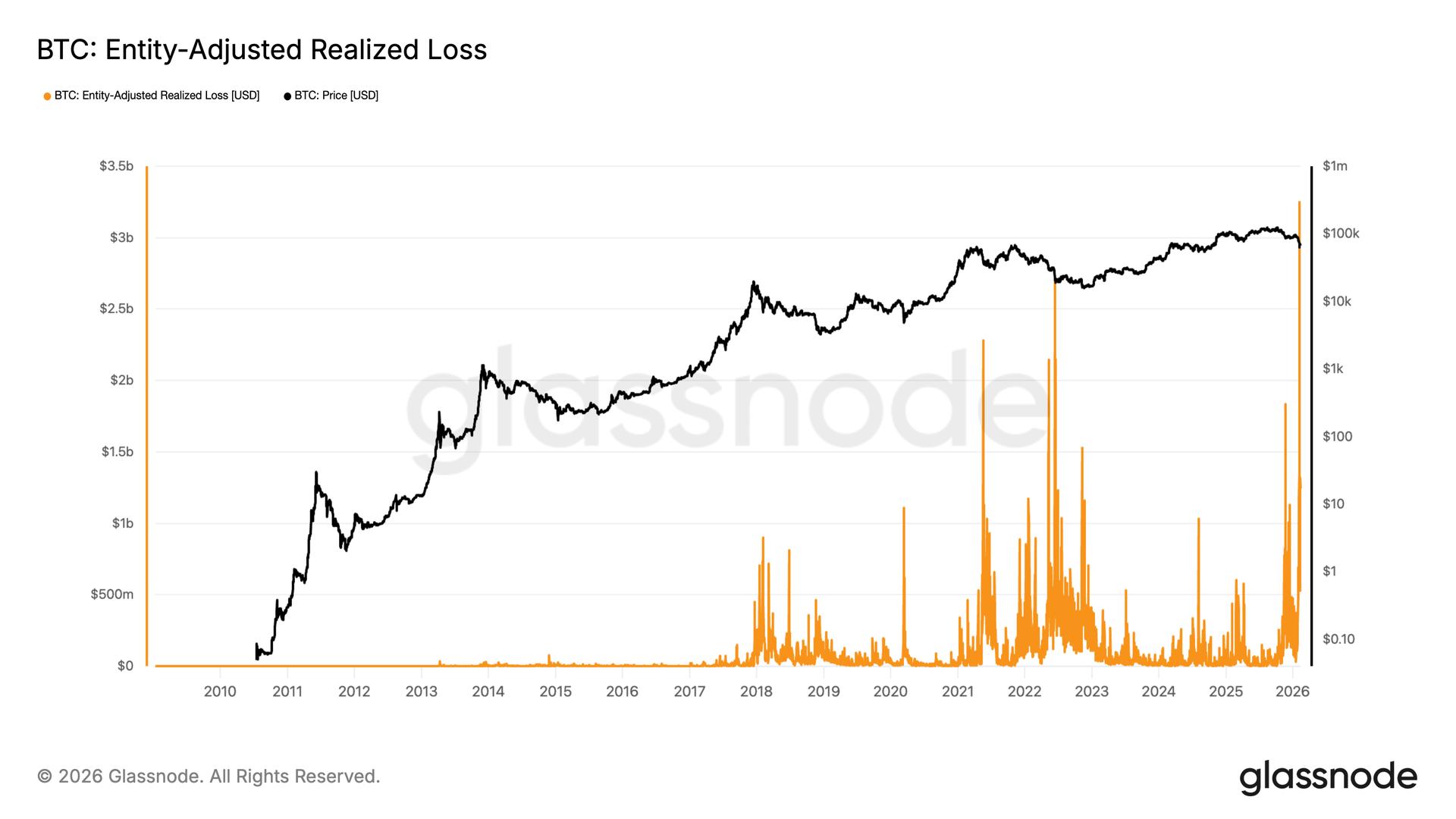
The largest realized loss in bitcoin history occurred during last week’s market downturn, shattering previous records as the asset plummeted from $70,000 to $60,000 on Feb. 5.
According to Glassnode, the Entity-Adjusted Realized Loss reached $3.2 billion. This metric exclusively tracks the USD value of moved coins sold below their acquisition price while filtering out internal transfers between the same entity.
This massive capitulation surpassed even the darkest days of 2022, eclipsing the $2.7 billion loss recorded during the collapse.
According to data platform Checkonchain, “Last week’s bitcoin sell-off meets the criteria of a textbook capitulation event. It occurred rapidly, on heavy volume, and crystallised losses from the lowest-conviction holders.”
With daily net losses exceeding $1.5 billion, the scale of this sell-off represents the most significant absolute USD loss ever crystallized in the network’s history. This points to more signs of a bear market bottom.
As of press time bitcoin is trading around $67,600.



Pearl is Olas’s consumer gateway to a future where narrow AI agents quietly trade, curate and create prediction markets at a scale humans will never touch, says co‑founder David Minarsch.
Summary
- Olas co‑founder David Minarsch traces Pearl back to early agent work at Fetch.ai and Valory, then pivots from B2B DAO tools to a consumer app for owning AI agents.
- Pearl backs tightly scoped, long‑running agents like Polystrat, which filters Polymarket markets, applies prediction tools and has at times outperformed human traders by 2–3x.
- Minarsch sees prediction markets as economic training grounds for AI, with agents already a large share of activity and the long tail of markets increasingly served by machines, under real regulation.
David Minarsch sat down with crypto.news on March 31 on the sidelines of ETHCC to explain why Pearl’s narrow, long‑running AI agents are remaking prediction markets from the inside out.
From Fetch.ai to Pearl
Minarsch’s route into autonomous agents is textbook crypto‑AI convergence. “I got drawn into the space by my background in economics and game theory,” he told crypto.news, recalling his move into crypto after several years working on machine learning applications.
At Fetch.ai, where he spent two years, his team built one of the first agent frameworks in crypto, anchored on a simple but loaded idea: wallets controlled by machines, not humans.
“We actually wrote a detailed paper on this, which was way ahead of its time,” he adds. In 2021, he spun those lessons out into Valory, the core lab behind Olas, which has since experimented with a range of applications and go‑to‑market strategies.
The first bet was B2B: autonomous agents sold to DAOs such as CowSwap, Balancer and Ceramic. “That went okay but never sort of really took off,” Minarsch concedes. The real pivot came in 2023, when “general purpose usable large language models like ChatGPT” landed and Olas “switched more to B2C.” Pearl is the result: “a B2C application which has different agents in it,” built for users, not governance forums.
By the time Pearl launched in February 2025, the rest of the industry had caught up to Olas’s early agent thesis. “The crypto space and the AI space had moved towards agents, now everyone is building agents or using agents or both,” Minarsch says. But he argues most people’s idea of an agent is still shaped by chat interfaces like ChatGPT: “a co‑pilot synchronous experience” where you prompt and it replies, in front of you, in real time.
Olas is explicitly betting against that dominant pattern. “When you have long long‑running agents with like autonomy but tightly scoped so they can’t just do anything but they can do interesting things within a certain scope. That’s where it becomes very interesting,” he says. Pearl is designed around those tightly scoped, background processes rather than generalist assistants, Minarsch points out.
“With Pearl we intentionally go very narrow in terms of the capabilities of an agent,” he explains. He points to new tools like OpenClaw—as both validation and warning. “OpenClaw validated a lot of our core assumptions that people do want llocal first experiences with AI agents,” he says, but “the product can do too much, which causes a bunch of problems, including secruity, but also just a problem for the user.”
In his view, that kind of system is built for tinkerers “who just sort of want to mold this thing into something that’s useful to them.” The “low friction user” wants to “just press a button” and get a consistent result. “I have one and I asked it to send me daily report and half the time it’s broken,” he says of OpenClaw. “That’s not a good product experience.” Pearl’s agents, by contrast, are designed to do one thing—trading, yield seeking, market creation—reliably. Limited scope, high definition, low problem latency.
Polystrat is the cleanest demonstration of that philosophy. Polystrat is an example because here’s just the idea: provide some capital, have it trade in prediction markets,” Minarsch says. Instead of facing Polymarket’s UX—wallet setup, funding, market selection, position sizing—the user delegates funds to Polystrat and lets the agent do the work.
“Polystrat is just like a user of Polymarket,” he stresses. “If you want to use Polymarket you as a human need to set up a wallet, fund it and then you’re faced with the decision of what market to trade in. Polystrat abstracts all this and the idea is for it to simply trade on your behalf.” The agent focuses on geopolitical and political news markets, “not so short‑lived” and generally closing “within the next four to five days.”
Technically, the flow is simple but ruthless. The agent filters markets using rules like liquidity and time to close, then applies “prediction tools,” which Minarsch describes as “workflows that sit on top of models and data sources.” “There’s many different prediction tools and the agent learns over time which ones to take and which ones not to take,” depending on the market. A local pricing and sizing engine converts those predictions into positions and the system trades autonomously on your behalf.
Performance wise, Polystrat ranges between 56 and 69% accuracy, Minarsch says. As a fleet, “our agents… have performed two to three times as well as human traders,” although they are “not yet at a fleet‑wide break even.” Individual Polystrat instances, however, can deliver “up to 100% ROI overall and like several 100% ROI per individual trade.” The goal is not anecdotes but a statistical edge: “to have a Polystrat fleet on average a positive ROI.”
Trading is only half the story. As more agents enter Polymarket and its predecessors, Minarsch sees prediction markets becoming “early prototypes for these market‑driven AI systems… environments that encode truth discovery at an economic scale.”
He doesn’t pretend the rails are clean. On controversial questions—or markets with contested outcomes—information lags and disputed outcomes are common. Polystrat nor other agents on Pearl attempt to solve that. “Polystrat itself is just a trading agent on top of Polymarket,” it’s neither consensus building nor a truth serum.
But AI is already reshaping participation, creation and policing. “It’s unclear exactly how many traders in prediction markets are already AI agents but it’s probably more than 30%,” Minarsch believes. “Potentially already more than half,” he adds. As such, humans have limited attention, so “the whole long tail of prediction markets will basically be served to AI agents,” he predicts.
Crucially, Minarsch breaks from crypto libertarianism on governance. “We take the view that there should be regulation of prediction markets,” he says flatly, citing markets that “effectively look like assassination markets” or “incentivizing bad behaviors.” With “a certain degree of regulation or self‑regulation,” more markets and more AI participants should “drive prices to equilibrium” and “improve the information embedded in the markets,” opening the door to derivatives, hedging and other instruments built on top.
Asked whether Olas agents could become “data liquidity providers operating autonomously across multiple networks,” Minarsch shrugs off the distinction. “Liquidity provision is effectively also trading strategy,” he says.
In that framing, Pearl is less a single app and more an operating system for narrow, long‑running agents: Polystrat for prediction markets, Optimus for yield, Omenstrat for market creation and whatever comes next for liquidity across venues. The consistent design choice is scope: each agent does one thing, over long horizons, with as little human intervention as possible.
“We were just very early to something that a lot of people are now doing,” Minarsch says of the agent wave. The difference now is that Pearl is pushing those agents into retail‑facing products, turning prediction markets into both a playground and a proving ground for AI‑driven liquidity and truth discovery.

Elon Musk’s aerospace company SpaceX has reportedly filed confidentially for an initial public offering, moving it closer to what could be the biggest public listing in US history.
SpaceX submitted its IPO confidentially to the US Securities and Exchange Commission, according to a report from Bloomberg on Wednesday, citing people familiar with the matter. The IPO could be finalized as early as June, the sources said.
SpaceX could seek a valuation exceeding $1.75 trillion in the IPO, sources told Bloomberg in February. A valuation of that size would make the aerospace company more valuable than Meta (META), Tesla (TSLA) and Bitcoin (BTC).
SpaceX could also raise up to $75 billion from the IPO, a size that would more than double Saudi Aramco’s record $29 billion debut in 2019.

SpaceX’s potential IPO follows its acquisition of Musk’s AI startup xAI in early February, putting the company in an AI race against OpenAI, Anthropic and other private AI startups.
OpenAI, the creator of ChatGPT, closed its last funding round with $122 billion in committed capital on Tuesday, bumping its valuation to $852 billion.
IPO investors to be briefed on more details this month
SpaceX reportedly told prospective IPO investors to expect briefings from company executives later this month, Bloomberg noted.
SpaceX is weighing a dual-class share structure that would give insiders, including Musk, greater voting control.
The IPO is expected to allocate up to 30% of shares for individual investors.
Wall Street firms Bank of America, Goldman Sachs, JPMorgan Chase, Morgan Stanley and Citigroup are expected to be involved in SpaceX’s transition to a public company.
SpaceX also continues to hold 8,285 Bitcoin worth more than $565 million on its balance sheet.
However, the company shifted its Bitcoin to a new wallet address in October, prompting speculation over whether it intends to hold the cryptocurrency in the long term.
Related: OpenAI kills off AI video app Sora after 6 months
Trading platforms such as Robinhood and Kraken have been seeking to offer tokenized shares in high-profile private companies like SpaceX, OpenAI and others on the blockchain, giving retail investors a way to invest in nonpublic companies.
Robinhood CEO Vladimir Tenev said in February 2025 that investors have had limited access to these private tech firms, but that blockchain tokenization could help broaden participation.
However, OpenAI is expected to file for an IPO in 2026, and Anthropic is also exploring a public listing, which would make their shares available for trading on regular stock exchanges.
Magazine: IronClaw rivals OpenClaw, Olas launches bots for Polymarket — AI Eye


Opinion by: Francesco Mosterts, co-founder of Umia.
Crypto prides itself on being a market-driven system. Prices, incentives, and capital flows determine everything from token valuations to lending rates and blockspace demand. Markets are the industry’s primary coordination mechanism. Yet, when it comes to governance, crypto suddenly abandons markets altogether.
Recent governance disputes at major protocols have once again exposed the tensions inside DAO decision-making. Participation remains extremely low and influence is highly concentrated. A study of 50 DAOs found “a discernible pattern of low token holder engagement,” showing that a single large voter could sway 35% of outcomes and that four voters or fewer influence two-thirds of governance decisions.
This is not the decentralized future crypto originally set out to build. The early vision of the industry was to remove concentrated power and replace it with systems that distributed influence more fairly. Instead, DAO governance often leaves most tokenholders passive while a small group determines the protocol’s direction.
Token voting was crypto’s first attempt at decentralized governance. It is a broken incentive system, and it needs to change.
The promise of token governance
The original “DAO” launched in 2016 as a decentralized venture fund where token holders would vote on which projects to finance. The earliest DAOs were inspired by the idea that organizations could run purely through code.
At crypto’s conception, token voting felt intuitive. It borrowed from familiar concepts like shareholder voting, yet DAOs promised a new form of management called “decentralized governance.” Tokens would represent both ownership and decision rights, meaning anyone who held them could participate in shaping the direction of a protocol.
Related: ‘Raider’ investors are looting DAOs
Token voting was supposed to solve problems seen across many industries, including centralized control, opaque decision-making, and misalignment between teams and users. It offered a simple promise: if the community owned the token, the community would run the project. In practice, however, this miraculous solution hasn’t delivered on its promise.
The reality of why token voting fails
Token voting comes with three core problems: participation, whales, and incentives.
Participation is self-explanatory: most token holders don’t vote. With lots of material to review, particularly when many governance decisions need to be made, governance fatigue is a real problem. The result of this, which we now see every day in crypto, is that most token holders are ultimately passive and a small minority decides the outcomes.
When it comes to whales, it is obvious that large holders are dominating. It’s demoralizing for ordinary voters who feel like their opinions don’t matter, even though the original promise of DAOs was that they would have a real voice. What is the point of voting if whales have the final say?
Finally, there’s an incentive problem. Voting has no economic signal. Votes hold the same weight whether you’re informed or not. There’s no cost to being wrong and no incentive for being right. There’s nothing motivating participants to research and vote according to their beliefs.
Realistically, in current governance, voting simply expresses opinions. It does not express conviction.
The missing piece lies in pricing decisions
Crypto is fundamentally market-driven, and it works remarkably well. Markets aggregate information, price risk, and reveal conviction in ways few other systems can. The industry has built markets for practically everything, including tokens, derivatives, blockspace, and lending rates. They sit at the core of how crypto coordinates economic activity. Yet when it comes to governance, the system suddenly abandons markets entirely.
Decision markets introduce pricing into governance. Instead of merely voting on proposals, participants trade outcomes, pricing the possible decisions and backing their views with capital. This transforms governance from a system of expressed preferences into one of measurable conviction.
By tying decisions to economic incentives, participants are encouraged to research proposals and think carefully about outcomes. The result is a governance process that reflects informed expectations rather than passive opinion.
This matters now
Crypto is reaching a turning point in how it coordinates decisions. Governance conflicts, treasury disputes, and stalled proposals have exposed the limits of token voting. Even major protocols struggle to translate tokenholder input into clear, effective action. This has left governance slow, contentious, and dominated by a small group of participants.
At the same time, interest in market-based coordination is resurging across the ecosystem. Prediction markets have demonstrated how effectively markets can aggregate information, while broader discussions around mechanisms like futarchy are returning to the forefront. These systems highlight markets as powerful tools for revealing conviction and aligning incentives.
If crypto believes in markets as coordination engines, the next step is applying that same logic to governance. The next phase of crypto coordination will move beyond simply trading assets and toward pricing and executing decisions themselves.
Token voting was crypto’s first attempt at decentralized governance, and it was an important experiment. It gave tokenholders a voice, but it didn’t solve the deeper incentive problem.
Markets already power nearly every part of the crypto ecosystem. They aggregate information, reveal conviction, and align incentives at scale. Extending that same mechanism to decisions is the natural next step.
Decision markets also extend beyond governance votes into capital allocation itself. If markets can price decisions about a protocol’s direction, they can also price decisions about what to build and fund. This opens the door to a new generation of ventures built directly on crypto rails, where projects can raise capital and allocate resources through transparent, incentive-aligned mechanisms from day one. Instead of relying on passive token voting, markets can actively guide how onchain organizations form and grow.
Governance without pricing is incomplete. If crypto truly believes in markets as coordination engines, the future of onchain organizations cannot be decided by votes alone, but by markets.
Opinion by: Francesco Mosterts, co-founder of Umia.
This opinion article presents the author’s expert view, and it may not reflect the views of Cointelegraph.com. This content has undergone editorial review to ensure clarity and relevance. Cointelegraph remains committed to transparent reporting and upholding the highest standards of journalism. Readers are encouraged to conduct their own research before taking any actions related to the company.


Summary
- Gnosis, Zisk and the Ethereum Foundation unveiled the Ethereum Economic Zone (EEZ) at EthCC in Cannes to unify fragmented Ethereum layer-2 networks.
- The framework targets over 20 L2s securing roughly $40 billion in value, enabling synchronous composability without relying on bridges and standardizing ETH as gas.
- Early backers include Aave and Centrifuge, with developers calling EEZ a “new era” for on-chain applications as Ethereum grapples with slowing fee revenue and a weaker deflationary narrative.
The Ethereum (ETH) ecosystem took aim at one of its biggest structural weaknesses at EthCC 2026, as Gnosis, Zisk and the Ethereum Foundation publicly launched the Ethereum Economic Zone (EEZ), a rollup framework designed to knit together an increasingly fractured layer‑2 landscape. Revealed on March 29 at the Palais des Festivals in Cannes, the initiative seeks to make dozens of Ethereum L2s behave “like one unified system,” in the words of project backers, by restoring synchronous composability between rollups and Ethereum mainnet while keeping security anchored to the base chain.
Ethereum Economic Zone launches
More than 20 operational Ethereum L2s currently secure about $40 billion in assets, yet function largely as isolated ecosystems, each with its own liquidity pools, deployments and bridge infrastructure. “Ethereum doesn’t have a scaling problem. It has a fragmentation problem,” Gnosis co‑founder Friederike Ernst said in comments shared with crypto media, arguing that “every new L2 that goes live has its own liquidity pool and bridging, creating another isolated walled garden.” The EEZ framework instead allows smart contracts on participating rollups to perform synchronous calls with each other and with Ethereum mainnet in a single atomic transaction, using ETH as the default gas token and removing the need for separate bridge protocols.
At EthCC, Ernst and Zisk developer Jordi Baylina presented the EEZ as an explicitly Ethereum‑aligned answer to the user‑experience and capital‑efficiency frictions created by the network’s L2‑centric scaling roadmap. According to coverage from outlets such as The Block and CoinDesk, the collaboration is co‑funded by the Ethereum Foundation and launches with Aave, Centrifuge and a Swiss‑based EEZ Alliance among its early partners, underscoring that DeFi blue chips see value in shared liquidity and cross‑rollup settlement. “The zone will facilitate a new era of blockchain innovation,” Zisk’s CEO Maria Roberts told conference attendees, adding that developers will be able to plug existing applications into the framework “pretty easily.”
The timing is not accidental. Ethereum’s shift of activity toward cheaper L2s has reduced fee revenue on mainnet and softened the narrative of ether as a strongly deflationary asset, with ETH trading near $2,000 even as the network still secures roughly $53 billion in DeFi total value locked and about $163 billion in stablecoins, according to recent market data cited by Phemex. By unifying L2 liquidity and simplifying cross‑network flows, EEZ’s architects are betting that a more cohesive Ethereum stack can keep capital and users inside the ecosystem, even as competing smart contract platforms and modular architectures fight for market share.
Kaiko reports Alameda gap still existsIn separate reporting on EthCC, organizers have described 2026 as “the year of professionalisation of Ethereum and the wider crypto ecosystem,” with the conference’s move to Cannes and the launch of institutional‑focused forums like Kaiko’s Agora strengthening the sense that Ethereum’s next phase will be defined as much by market structure and infrastructure as by new token launches.


Michael Selig, US President Donald Trump’s nominee leading the Commodity Futures Trading Commission (CFTC), said the agency was prepared to oversee the entire $3 trillion crypto industry, with no timeline for Congress to pass a crucial market structure bill.
In a Wednesday statement about his first 100 days as CFTC chair, Selig said that the commission was “ready to take responsibility” for the crypto market and reiterated his claim that it was the sole regulator to oversee prediction markets.
His comments come as the US Senate considers the CLARITY Act, a crypto market structure bill that has been effectively stalled in committee amid discussions over stablecoin yield and other issues.
“The same regulatory clarity being delivered to the crypto industry is being developed for prediction markets, which can serve as powerful tools for information discovery and are regulated by the CFTC under the Commodity Exchange Act,” said Selig.
Under Selig, who was confirmed by the Senate in December, the CFTC has adopted many policies signaling that the agency would soften its enforcement and regulation of digital assets compared to previous administrations. In March, the agency announced a memorandum of understanding with the Securities and Exchange Commission (SEC) as part of efforts to coordinate on regulation, including digital assets.
Related: Crypto exchange KuCoin agrees to $500K settlement, ending CFTC case
Although early drafts of the market structure bill suggested the legislation could give the CFTC additional authority to oversee digital assets, the SEC is expected to continue regulating cryptocurrencies it considers to be securities.
Lawmakers pressing CFTC on insider trading claims over prediction markets
US state authorities and federal lawmakers have been targeting prediction market platforms like Kalshi and Polymarket over alleged violations of gaming laws and claims of politicians using insider information to profit.
While many of the state-level actions continue to be litigated in court, Selig has claimed that the CFTC has “exclusive jurisdiction” over prediction markets and threatened legal action against any challenges to its authority.
In a Tuesday event, CFTC enforcement director David Miller said that the agency’s position was that event contracts on prediction markets were not “gaming” but rather “swaps” that fall under its purview.
Some lawmakers have also proposed legislation to ban elected officials with insider information from profiting from event contracts after suspicious trades on military actions involving Iran and Venezuela.
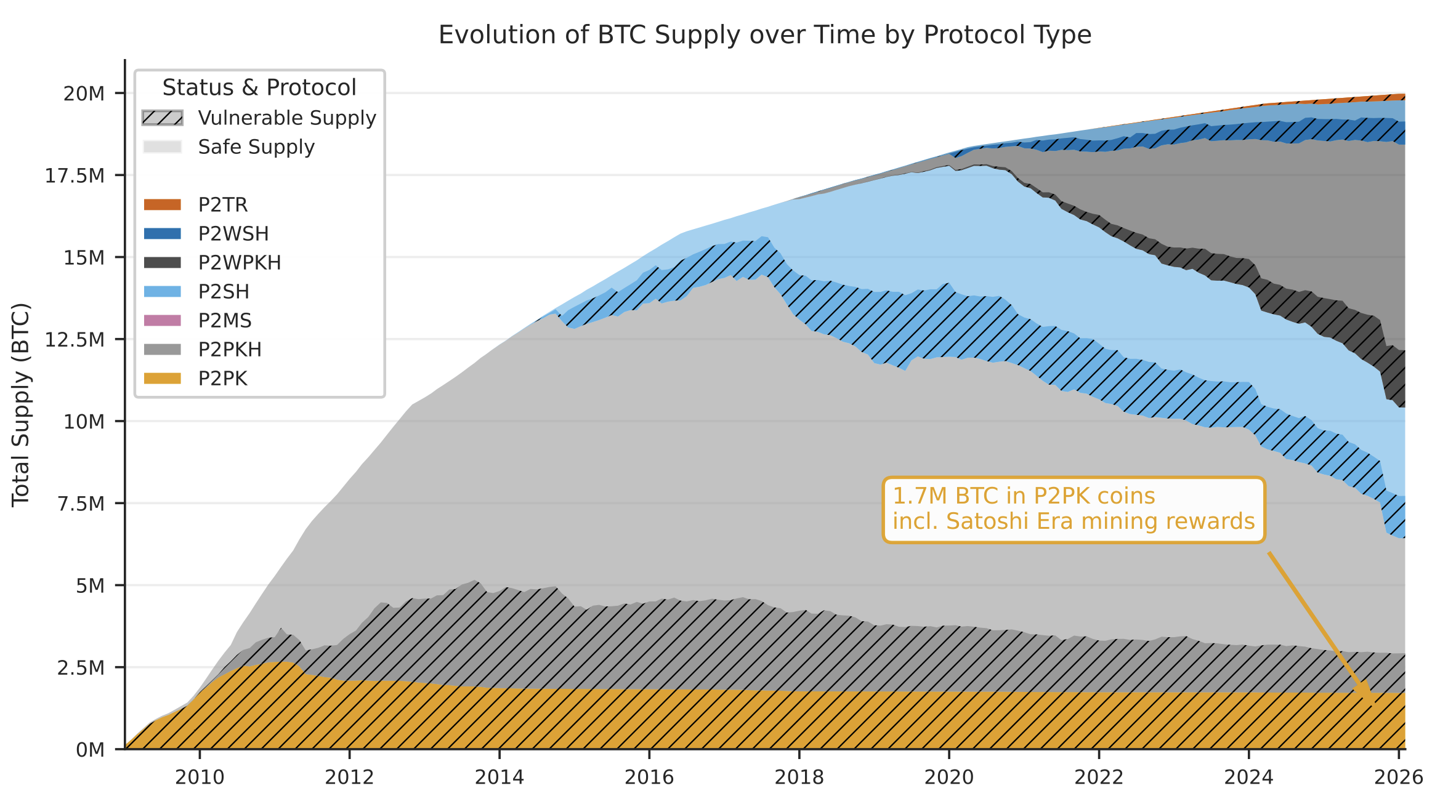
Naoris Protocol has launched its mainnet, introducing a layer-1 blockchain designed to use post-quantum cryptography for transaction validation and network security. The network is live with limited, invite-only participation, allowing early users to run validator nodes and process transactions.
According to an announcement shared with Cointelegraph, it integrates cryptographic standards finalized by the National Institute of Standards and Technology (NIST) to address risks in existing blockchains, where current encryption methods could become vulnerable over time.
Before mainnet, the protocol’s test network processed more than 100 million transactions and identified hundreds of millions of potential threats, according to the project, with activity spanning millions of wallets and nodes.
The system uses a consensus model called distributed proof of security (dPoSec) to verify transactions across nodes, while the NAORIS token is intended to support network operations as the economic model develops.
The rollout begins with a restricted group of validators and partners, with broader access expected to expand in phases.
The project lists advisers with backgrounds in cybersecurity, government and enterprise technology, and is backed by investors including Draper Associates.
Related: Is $450B in Bitcoin vulnerable to the quantum threat? Analysts weigh in
New research suggests quantum computing may arrive sooner than expected
The launch comes as revised estimates for quantum computing, which uses qubits and quantum states to process information differently from classical computers, are driving efforts to move away from current cryptographic standards.
New research from Google released on Monday suggests quantum computers may need far fewer resources than previously thought to break blockchain encryption. The study found fewer than 500,000 physical qubits could crack systems securing Bitcoin (BTC) and Ether (ETH), a roughly 20-fold reduction from earlier estimates.
The findings point to a shorter timeline for quantum risk, with Justin Drake, a researcher at the Ethereum Foundation, estimating at least a 10% chance that a quantum computer could recover a private key by 2032.

Researchers at California Institute of Technology working with Oratomic reached similar conclusions, recently finding that improvements in error correction (which reduce the number of qubits needed to stabilize computations) could lower the requirements for practical systems to 10,000 to 20,000 qubits, down from earlier assumptions of millions.
Based on these reductions, the researchers said a viable quantum computer could emerge by around 2030.
Blockchain developers are beginning to respond. In January, developers in the Solana ecosystem introduced a quantum-resistant vault that uses hash-based signatures to generate new keys for each transaction, reducing the exposure of public keys.
On March 24, developers from the Ethereum Foundation launched a “Post-Quantum Ethereum” resource hub outlining plans to upgrade the network’s cryptography, targeting protocol-level changes by 2029 while also noting the multi-year complexity of such a transition.
Crypto World
Crypto Will Never Die As Iran Signals De-Escalation and Whales Are Quietly Buying Pepeto While Retail Panics
The correction looks like chaos, but the pattern tells a different story. Bitcoin was born in 2009 after the 2008 crisis wiped out trillions, while banks got bailouts. Now, Iran’s president signaled readiness to end the war this week, sending crypto, stocks, gold and silver rallying simultaneously as markets priced in de-escalation for the first time since the conflict began according to Decrypt.
Governments that hold BTC in federal reserves need the price higher to manage $36 trillion in debt, and Fear 8 is designed to move cheap coins from retail into the wallets that understand the cycle.
The crypto news matters because the same forces shaking out retail are the ones that need crypto to explode, and while that shakeout runs, more than $8.69 million flowed into one presale.
Pepeto filled stages during extreme fear with the Binance listing confirmed, and the Pepe cofounder plus exchange tools plus confirmed listing is the rarest combination crypto produces once per cycle, because meme energy plus real utility at the same time is the setup that delivers the return.
The Real Crypto News: Iran De-Escalation Signals Recovery While Governments Need BTC Higher
BTC was added to US federal reserves because the national debt exceeds $36 trillion and holding assets that appreciate helps service it without printing more dollars, according to CoinDesk. Iran’s president signaling willingness to end the conflict sent Bitcoin climbing above $68,000 in hours as traders priced in the possibility of geopolitical stabilization for the first time this year according to Decrypt.
The Fear and Greed Index at 8 is the shakeout that transfers cheap coins from retail to large wallets, and on chain data shows whales continuing to accumulate BTC while retail sold, according to CoinGecko.
The crypto news confirms that the people who control the market are buying what retail is selling, and the presale crossing $8.69 million during that fear proves where the smart capital goes next.
The Exchange the Whales Are Entering Because the Tools Are What Makes the Listing Deliver
Pepeto
The verified exchange keeps filling while the broader market corrects, and more than $8.69 million flowing in during Fear 8 tells you everything about who is buying and why. Pepeto is at the center of the crypto news that matters.
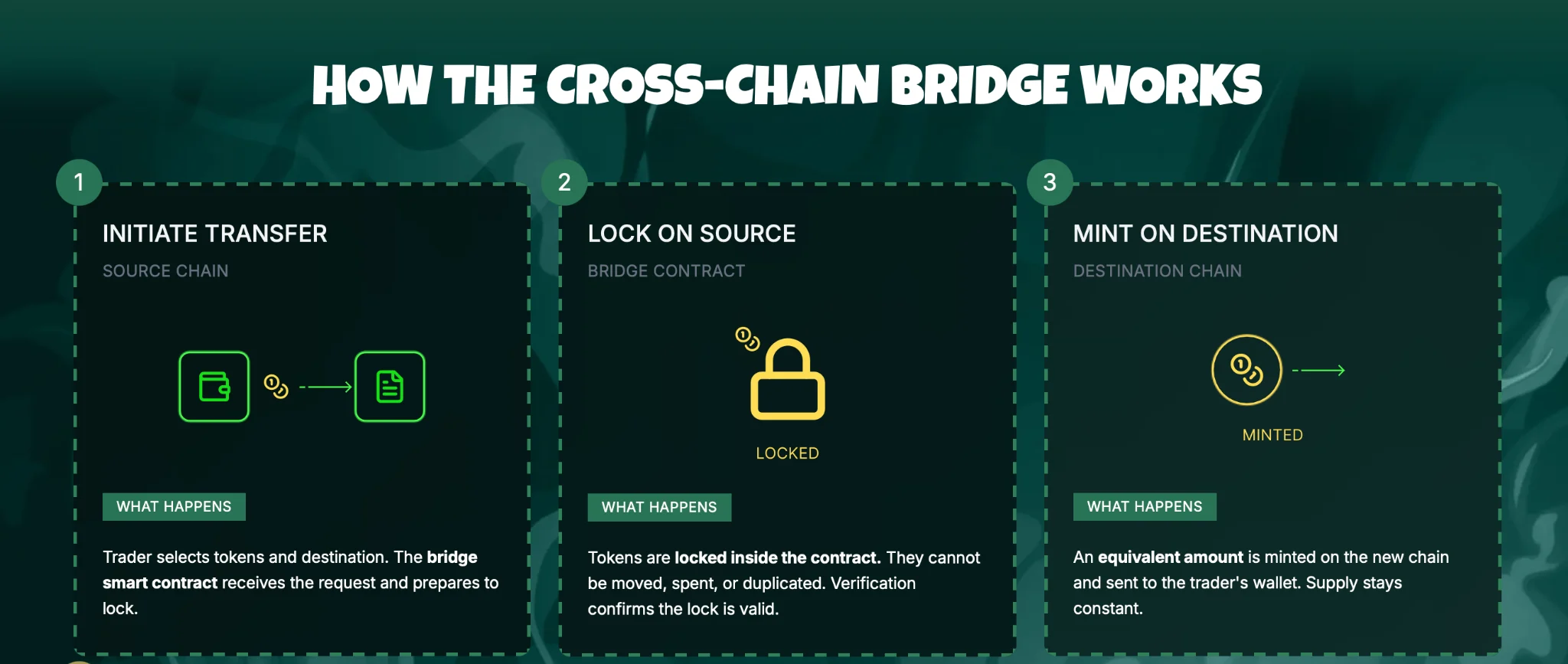
The platform puts every tool in one clean window. No jumping between tabs. Every tool is labelled and one action away from protecting your capital or pointing you toward the entry others miss. PepetoSwap removes every trading fee, and the cross chain bridge moves tokens at zero cost.
More than $8.69 million raised at $0.000000186 with 190% APY staking compounding positions while stages fill. SolidProof confirmed every contract is clean, and the mind behind the original Pepe coin that hit $11 billion on 420 trillion tokens put together the exchange with a former Binance expert directing the tools.
The Binance listing approaches, and the window at current pricing closes fast. After listing, price discovery begins, and the entry disappears permanently. Analysts project 100x, and Pepeto at this level could be the strongest move before the crypto news turns positive and the shakeout ends.
Solana
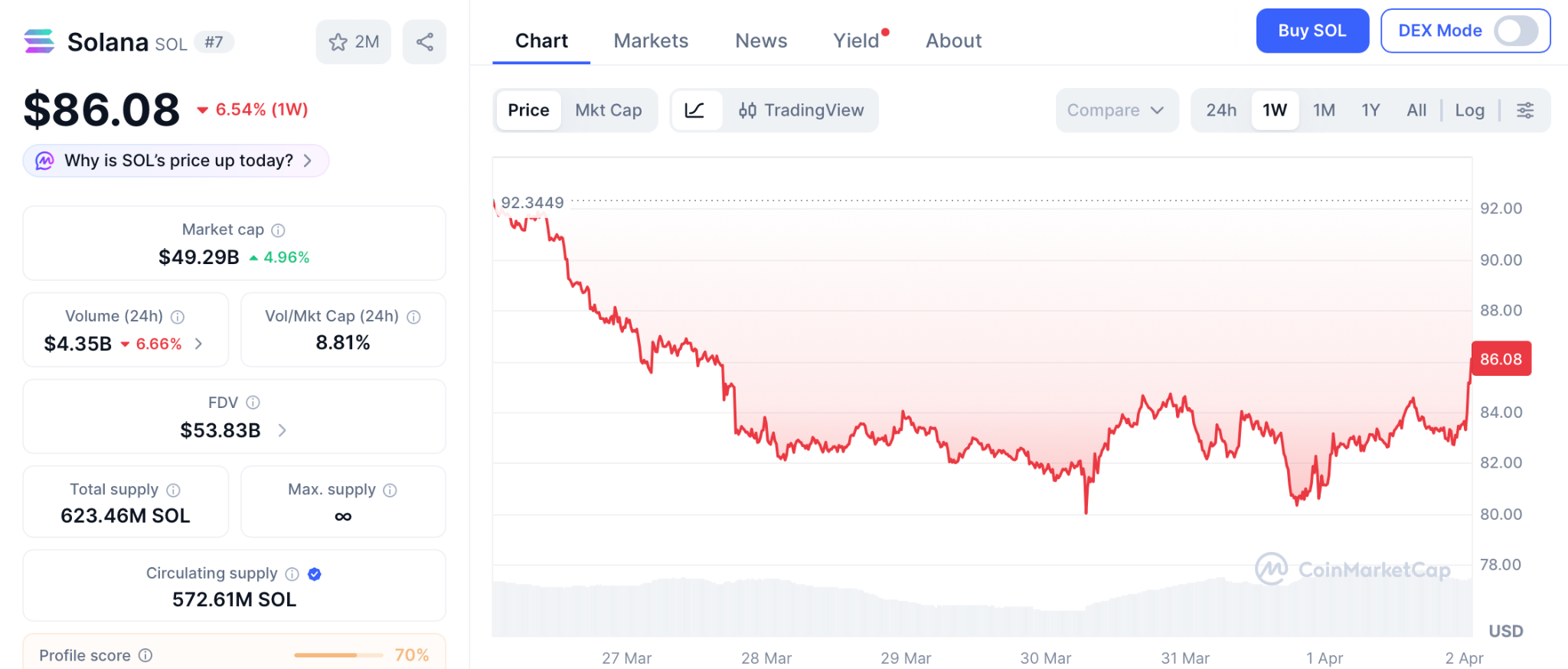
SOL trades at $86.08 according to CoinMarketCap, after declining from highs earlier this year. Bulls must defend $75 or risk a slide to $65.
Longer term targets point toward recovery, but that requires months of patience and geopolitical relief that is only now beginning to surface with the Iran de-escalation signals, while the presale at 100x from one listing delivers sooner.
River
River climbed 38% weekly after finding support with resistance above and a path higher if buying holds.
Strong weekly numbers, but the verified exchange with $8.69 million raised and a confirmed Binance listing at 100x offers the wider return from one event.
Crypto News Confirms the Pepe Cofounder Plus Exchange Plus Listing Is the Rarest Combination
The crypto news signals a potential turning point as Iran’s president opens the door to de-escalation, and governments that need BTC higher will eventually get what they need, but the 100x potential from the verified presale makes it the strongest move for anyone who wants to be on the right side of the cycle instead of the losing side.
The Pepeto official website is where entering now while whales load and retail panics is how you position alongside the same capital that built the recovery from every crisis, because the Pepe cofounder plus verified exchange tools plus confirmed Binance listing is the combination that delivers returns once per cycle, and the wallets inside already know it.
Click To Visit Pepeto Website To Enter The Presale

FAQs:
What is the real story behind the current crypto news correction?
Governments holding BTC in federal reserves need the price higher to manage debt. Iran signaling de-escalation sent markets rallying. The Fear 8 reading is a shakeout designed to transfer cheap coins from retail to whales.
Why are whales entering the Pepeto presale, according to the crypto news?
The verified exchange raised more than $8.69 million during extreme fear with a confirmed Binance listing. The Pepeto official website is where the same conviction driving institutional accumulation is flowing into the presale.
Will the crypto news improve, and should the reader wait for better conditions?
Iran de-escalation signals suggest the market may be turning, but the presale price disappears when the listing arrives. Waiting means paying the listing price instead of the presale price.
Disclaimer: This is a Press Release provided by a third party who is responsible for the content. Please conduct your own research before taking any action based on the content.


Crypto bull cycles over the past 5 years have been mostly about token speculation and, more recently, institutional adoption. But the next cycle will be dominated by real-world applications, according to Clem Chambers – founder of ADVFN, Europe’s leading stocks and markets website
Speaking at BeInCrypto’s Markets Intelligence Council, Chambers argued that the industry is moving past its trading-driven cycle.
“That era has probably ended and certainly is coming to an end. And then that will be replaced by use cases,” he said, pointing to a structural change in how value is created in crypto.
The Trade Is Crowded, The Utility Isn’t
His comments come as the current cycle shows clear divergence between price action and underlying activity. Bitcoin and Ethereum continue to attract institutional flows, especially in a post-ETF environment.
However, capital is concentrating at the top, while mid-tier tokens struggle to hold attention or liquidity.
At the same time, a different layer of the market is gaining traction. Tokenized real-world assets, stablecoin-based payment rails, and blockchain infrastructure tied to AI and data are seeing steady growth.
These sectors generate usage, fees, and in some cases, real revenue — something most speculative tokens failed to deliver in previous cycles.
Forget Tokens, Think Products
Chambers framed this shift bluntly.
“Forget Fi and look for apps, not Fi, apps, applications of tokens and blockchains,” he said.
Earlier cycles focused on financial primitives — DeFi protocols, yield farming, and token trading. The emerging trend centers on applications that users interact with directly, often without focusing on the underlying token.
This aligns with broader market signals in 2026. Tokenized funds from firms like BlackRock and growing stablecoin usage in payments show how blockchain is embedding into existing financial systems.
Meanwhile, infrastructure sectors such as decentralized physical networks and AI-linked protocols are attracting developer activity and venture funding.
However, this transition is uneven. Speculative trading still drives short-term price moves, and retail participation remains largely momentum-based.
Many application-layer projects also struggle with user retention and monetization.
Even so, the direction is becoming clearer. If previous cycles were driven by narratives around tokens, the next phase may depend on whether blockchain-based applications can deliver consistent utility.
Chambers’ argument reflects a broader reality: the market is starting to reward usage over hype.
Whether that shift fully defines the next cycle will depend on how quickly these applications can scale beyond crypto-native users.
The post The Next Crypto Bull Run Won’t Be About Coins or Viral Hype appeared first on BeInCrypto.
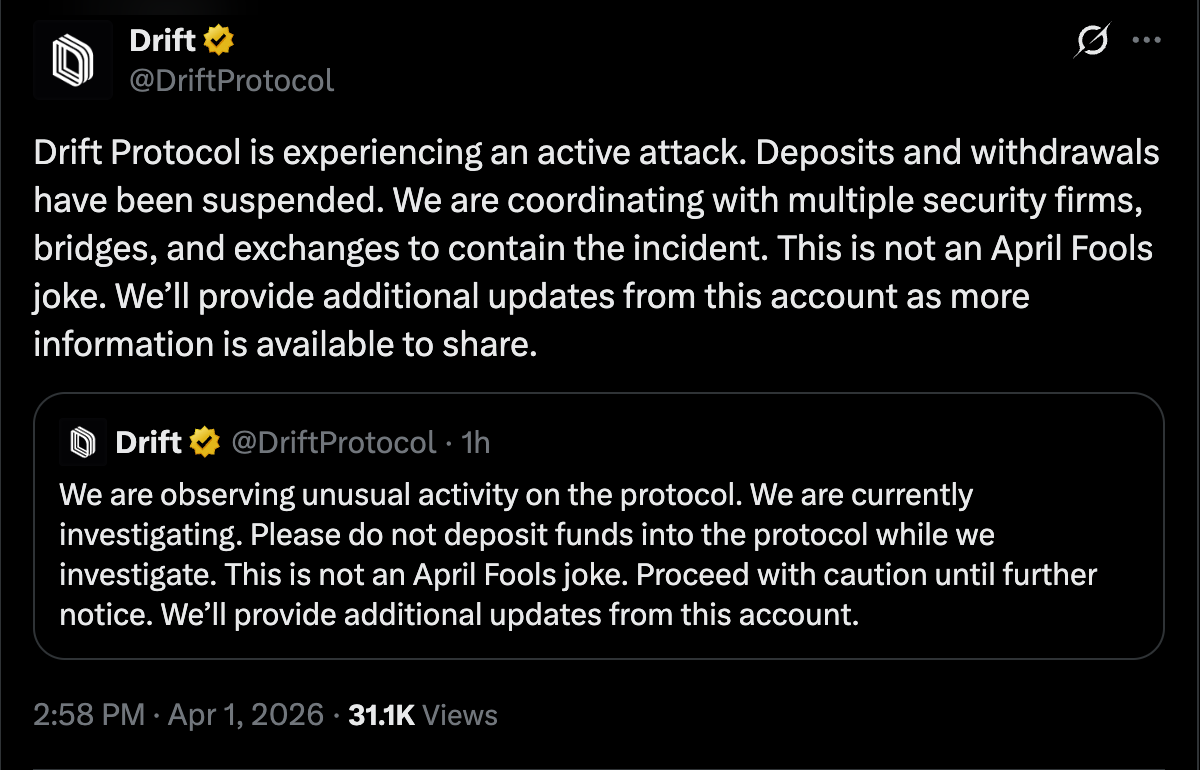
Drift Protocol, a decentralized cryptocurrency exchange (DEX), detected “unusual” trading activity on the platform on Wednesday, warning users not to deposit funds until the issue has been resolved.
The Drift team did not disclose the specific cause of the ongoing incident or the damage in its initial announcement and is currently investigating the issue.
In a subsequent update, the Drift team announced that deposits and withdrawals on the platform have been suspended.

Blockchain cybersecurity threat researcher Vladimir S said the exploit was likely due to a crypto wallet private key leak, and the total funds lost in the incident could be as high as $200 million.
“Admin signer was compromised, or whoever controls it intentionally executed these changes,” he said.
The stolen assets include wrapped versions of Bitcoin (BTC), Jito (JTO), the Fartcoin (FRT) memecoin, other altcoins, and various dollar, euro, and Japanese yen stablecoins, which have since been transferred to multiple wallets, according to Vladimir S.

The exploiter started converting the stolen assets to the USDC (USDC) stablecoin, bridging the funds to the Ethereum network and purchasing Ether (ETH), according to Solana treasury company DeFi Development Corp.
Cointelegraph reached out to Drift Protocol but did not receive an immediate response by the time of publication.
Cybersecurity exploits and hacks were responsible for $49 million in crypto losses during February, a sharp decrease from January, but a reflection of the ongoing security threats users and platforms face.
Related: Resolv temporarily halts protocol to ‘contain the impact’ of 80M USR exploit
Drift token impacted by the exploit
The price of the Drift (DRIFT) token briefly reached $0.68 on Wednesday, but fell by about 18% following news of the exploit, according to data from CoinMarketCap.

About 83% of the native crypto tokens of hacked platforms never recover to pre-hack prices, according to blockchain security company Immunefi.
“The stolen funds are only the first layer of damage,” Immunefi CEO Mitchell Amador told Cointelegraph in March.
“What follows is often more destructive: sustained token price suppression, reduced treasury capacity, leadership disruption, lost development time, and erosion of user trust,” he added.
Magazine: WazirX hackers prepped 8 days before attack, swindlers fake fiat for USDT: Asia Express
Crypto World
Paradigm Is Building a Prediction Markets Trading Terminal Targeting Professional Traders

TLDR:
- Paradigm partner Arjun Balaji has been leading the trading terminal project since late 2025 for pro traders.
- The firm is exploring prediction market indexes by bundling multiple markets into one single tradable product.
- Kalshi, backed by Paradigm, has raised at least $1 billion, pushing its valuation to a record $22 billion.
- Paradigm is raising up to $1.5 billion for a new fund expanding beyond crypto into AI and robotics sectors.
Paradigm, the prominent crypto venture capital firm, is developing a prediction markets trading terminal, sources say.
Partner Arjun Balaji has been leading the project since late 2025. The terminal targets professional traders and market makers. Paradigm has declined to comment on the initiative.
This move comes as mainstream financial institutions rush to capitalize on prediction markets’ growing popularity across sports, elections, and crypto pricing.
Paradigm Eyes Market-Making and Index Products
Beyond the trading terminal, Paradigm is weighing whether to establish an internal market-making desk. Two sources confirmed the firm has actively discussed this possibility. A market-making desk would position Paradigm as a direct participant, not just an infrastructure builder.
Separately, a third source says Paradigm is working with researchers on prediction market indexes. The concept involves bundling multiple prediction markets into one tradable product.
This mirrors how the S&P 500 packages hundreds of stocks into a single instrument. The firm has already started collecting prediction market data into a public dashboard.
Sources familiar with the matter noted that Balaji has been working on the terminal project since late 2025. They spoke on condition of anonymity to discuss private business dealings. Paradigm’s spokesperson declined to comment when approached for a response.
This activity places Paradigm squarely inside a rapidly growing sector. Prediction markets have become one of Silicon Valley’s most discussed areas over the past year. Traditional financial players are also moving in, adding further competitive pressure.
Kalshi and Polymarket Drive Sector Valuations Higher
Paradigm has been a consistent backer of Kalshi, one of the two dominant prediction market platforms. The firm joined three successive Kalshi fundraising rounds in 2025. Paradigm also led a December round that valued Kalshi at $11 billion.
Kalshi has since raised at least $1 billion in new financing, bringing its valuation to $22 billion. Paradigm co-founder Matt Huang sits on Kalshi’s board of directors.
One source confirmed that Paradigm’s trading terminal is “not competitive with Kalshi’s platform,” drawing a clear line between the two products.
Rival platform Polymarket is also seeing sharp valuation growth. The Wall Street Journal reported Polymarket is in talks to raise at a roughly $20 billion valuation.
A new venture firm focused entirely on prediction markets has also emerged, backed by the CEOs of both platforms.
Paradigm’s prediction markets push fits within a wider expansion beyond crypto. The firm is raising up to $1.5 billion for a new fund covering AI and robotics alongside digital assets.
The Wall Street Journal recently reported on the fund’s broader scope, marking a clear shift in Paradigm’s investment direction.
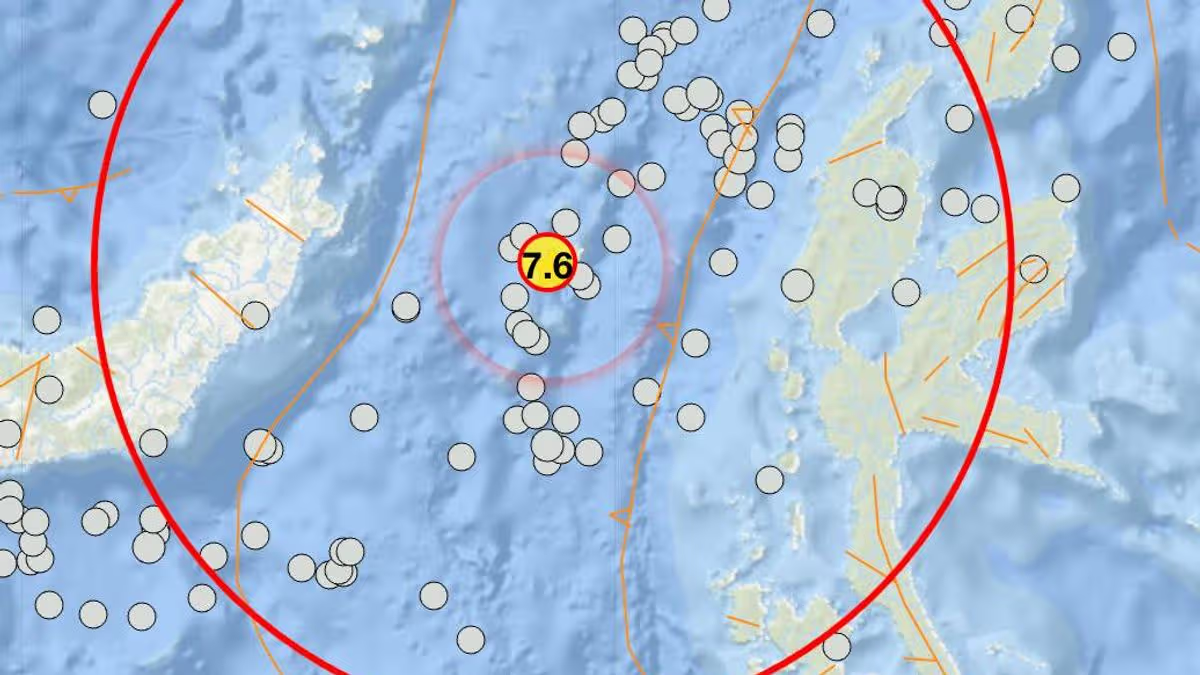
Magnitude 7.6 earthquake strikes Indonesia triggering tsunami warnings
Oil extends losses on Iran de-escalation hopes; markets eye Trump’s speech

Pearl, prediction markets and the long tail of AI liquidity


-

 News Videos7 days ago
Parliament publishes latest register of MPs’ financial interests
-

 Business6 days ago
Instagram, YouTube Found Responsible for Teen’s Mental Health Struggle in Historic Ruling
-
 Tech6 days ago
Intercom’s new post-trained Fin Apex 1.0 beats GPT-5.4 and Claude Sonnet 4.6 at customer service resolutions
-

 NewsBeat5 days ago
The Story hosts event on Durham’s historic registers
-

 Sports5 days ago
Sweet Sixteen Game Thread: Tide vs Michigan
-
Entertainment2 days ago
Fans slam 'heartbreaking' Barbie Dream Fest convention debacle with 'cardboard cutout' experience
-
 Entertainment4 days ago
Lana Del Rey Celebrates Her Husband’s 51st Birthday In New Post
-
Crypto World2 days ago
Dems press CFTC, ethics board on prediction-market insider trades
-

 Tech3 days ago
The Pixel 10a doesn’t have a camera bump, and it’s great
-

 Sports1 day ago
Tallest college basketball player ever, standing at 7-foot-9, entering transfer portal
-

 Crypto World4 hours ago
Gold Price Prediction: Worst Month in 17 Years fo Save Haven Rock
-

 Tech2 days ago
EE TV is using AI to help you find something to watch
-

 Tech2 days ago
Apple will hide your email address from apps and websites, but not cops
-

 Entertainment7 days ago
HBO’s Harry Potter Series Will Definitely Fail For One Big Reason, And It’s Not J.K. Rowling Or Snape
-

 Tech2 days ago
How to back up your iPhone & iPad to your Mac before something goes wrong
-

 Tech2 days ago
Flipsnack and the shift toward motion-first business content with living visuals
-

 Fashion6 days ago
En Vogue in Brown Leather and Tailored Neutrals by Atelier Savoir, Styled by J Bolin
-

 Politics2 days ago
Should Trump Be Scared Strait?
-

 Crypto World2 days ago
U.S. rule change may open trillions in 401(k) funds to crypto
-

 Fashion5 days ago
Weekly News Update, 3.27.26 – Corporette.com
You must be logged in to post a comment Login