
Crypto World
Layer 1 vs Layer 2 Debate Heats Up as BlockDAG’s 100x Math Challenges Bitcoin Hyper


People following crypto markets are now weighing two very different directions. One option is Bitcoin Hyper, which focuses on making Bitcoin faster and easier to use. The other option is BlockDAG (BDAG), a large-scale network that has entered its last presale phase with a final price window. Bitcoin Hyper aims to improve an existing chain, while BlockDAG has been built as a fresh system from the start, with its own structure and long-term plan.
Fixing an old system and building a new one are not the same. This gap matters when looking at future value. With a clear price difference that points toward strong upside, BlockDAG is gaining attention from those searching for the top ICO for 2026. The figures make the situation easy to understand. One project shows modest growth potential, while the other presents numbers that could change financial outcomes in a major way.
The Math Breakdown: Comparing 10x Growth and 100x Upside
Returns remain the main focus for early buyers in any presale. Bitcoin Hyper is currently priced near $0.0136. Analysts believe its price could move toward the $0.10 to $0.15 range after launch. If that happens, early buyers may see growth of around ten times their entry. This level of growth is positive, but it is also common across many digital assets during strong market phases.

By contrast, BlockDAG has set up a much wider gap. With its price fixed at $0.0005 as the presale reaches its final hours, the path toward a $0.05 target becomes very clear. That move reflects a 100x difference. To put this into simple terms, $500 placed into Bitcoin Hyper might rise to about $5,000. The same amount placed into BlockDAG holds the math to reach $50,000. When viewed side by side, these numbers explain why BlockDAG is often described as the top ICO for 2026. Bitcoin Hyper does not offer the same level of upside when comparing pure figures.
Core Network Design Versus Support Layer Use
Long-term value depends heavily on how a project is built. Bitcoin Hyper operates as a Layer-2 solution. Its role is to help Bitcoin move faster and handle more activity. While this approach has benefits, it also has limits. Layer-2 systems rely on the main chain for security and usage. If the main chain faces limits or if users move to other support solutions, growth can slow. Many teams are already working on similar Bitcoin scaling tools, which increases competition and reduces long-term room to stand out.

BlockDAG functions as a Layer-1 network. It runs independently and does not depend on another chain. Using a hybrid design, the network can process up to 10,000 transactions per second on its own system. History shows that Layer-1 networks such as Ethereum and Solana often reach higher values because they form the base layer on which others build on. Since BlockDAG controls its own network activity, its long-term ceiling is much higher. This core strength supports its position as the top ICO for 2026 for those focused on ownership of core infrastructure rather than added tools.
Community Size and Market Backing
Community strength plays a major role in shaping future performance. Bitcoin Hyper has collected close to $30 million so far, which shows solid interest. Still, this places it in the mid-range when compared with larger projects. Its reach remains limited, and wider adoption has yet to fully develop.
BlockDAG shows a very different scale. Presale funding has passed $451 million, and the project counts more than 312,000 holders. This wide base signals strong attention and trust from the market. A larger group of holders often leads to more discussion, stronger holding behavior, and better stability once open trading begins. Bitcoin Hyper remains far behind in these measures. When a project gathers nearly half a billion dollars before its presale ends, it suggests that market interest has already made a clear choice. This backing is one of the main reasons BlockDAG is viewed as the top ICO for 2026.
Final Hours Create Real Pressure
Timing often decides outcomes in crypto markets. Bitcoin Hyper continues its presale with no fixed end in sight. Buyers can afford to wait, observe trends, and decide later. This flexibility reduces pressure but also limits sudden price movement.
BlockDAG, on the other hand, has set a firm endpoint. The presale is ending in just a few hours, with only 600 million coins remaining in batch 36. Once this window closes, no more units will be available at the $0.0005 level. After the deadline passes, the supply is locked. This structure is driving fast action. Many participants are shifting attention to BlockDAG now because they know this option will not return. Bitcoin Hyper can still be reviewed later, but BlockDAG’s current pricing disappears when the presale ends. Scarcity at this scale naturally increases demand.
Long Story Short
Bitcoin Hyper offers a useful service for those interested in faster Bitcoin activity, but its growth range remains limited. A potential 10x outcome is respectable, yet it does not compare with the scale shown by BlockDAG. With its independent network design, more than 312,000 holders, over $451 million in presale funding, and a defined 100x price gap that expires within hours, BlockDAG stands apart.
Choosing between a support layer and a base network becomes simple when numbers and structure are considered together. Market participants looking for the highest ceiling and the strongest time pressure are turning to BlockDAG. As the remaining supply continues to shrink, BlockDAG reinforces its position as the top ICO for 2026. The final presale window is closing fast, making this the last chance before access at this level is gone.

Presale: https://purchase.blockdag.network
Website: https://blockdag.network
Telegram: https://t.me/blockDAGnetworkOfficial
Discord: https://discord.gg/Q7BxghMVyu
Disclaimer: This is a Press Release provided by a third party who is responsible for the content. Please conduct your own research before taking any action based on the content.



Vietnamese authorities have moved to curb a multi-city crypto fraud case tied to the ONUS platform, detaining several suspects accused of using false promotions and manipulated trading to siphon investor funds. The Ministry of Public Security said the operation centers on a group that sold digital tokens via ONUS, employing misleading campaigns and coordinated market activity to lure users while maintaining centralized control over price and liquidity.
Among those named by investigators are Vuong Le Vinh Nhan, connected to Vemanti Group and tied to XPLOR, the Singapore-based parent company of ONUS Pro; Tran Quang Chien, identified as the ONUS exchange’s technical administrator; and Ngo Thi Thao, director of HanaGold Jewelry JSC. Authorities allege the group created and promoted tokens including VNDC, ONUS and HNG through the ONUS platform, with the probe suggesting billions of dollars were raised from investors. No official loss breakdown has been published.
In parallel to Vietnam’s widening probe, Vemanti Group said it had learned of the indictments from the ministry and Vietnamese media, and it has engaged U.S. legal counsel to assess the situation. Vemanti described Nhan as a board chair and Chien as a board member, though the company has not issued a formal statement on the specifics of the case.
The ONUS platform bills itself as a digital asset ecosystem offering trading, staking and investment products, and has publicly highlighted a user base it characterized as “more than seven million.” Its official X account remains active with a substantial following, while CoinMarketCap lists the ONUS token with a self-reported market capitalization near $25 million, underscoring a sizable gap between public token metrics and the scale of the alleged losses described by authorities. ONUS has not published an official response to the allegations, and Cointelegraph reached out for comment without receiving a reply by publication time.
Key takeaways
- Vietnam’s Ministry of Public Security publicly linked the ONUS platform to a scheme involving false promotions and market manipulation that allegedly defrauded investors, with arrests across multiple cities and a broad net cast over more than 140 individuals questioned.
- Authorities name specific suspects tied to the ONUS operation, including board-linked figures and a technical administrator, suggesting a centralized scheme rather than decentralized trading.
- The case highlights a discrepancy between ONUS’s self-promotion of millions of users and tangible market metrics, such as a roughly $25 million self-reported ONUS token market cap on CoinMarketCap.
- Industry observers should watch how Vietnam’s authorities pursue asset tracing and potential sanctions, given the cross-border links and the involvement of a U.S.-listed affiliate in Vemanti Group.
Vietnam’s crackdown widens and what it signals for investors
The Ministry of Public Security described the investigation as a coordinated, multi-agency effort spanning several Vietnamese cities, with police summoning more than 140 individuals for questioning and seizing evidence as part of a broader push to dismantle large-scale crypto-fraud networks. The authorities framed the ONUS case as emblematic of how promoters can use tokens to simulate legitimacy while concentrating decision-making and price control in a central group.
Within the case’s named actors, the involvement of Vuong Le Vinh Nhan—connected to Vemanti Group and linked to XPLOR, the ONUS Pro parent entity—puts a spotlight on cross-border corporate structures behind some crypto ventures. Tran Quang Chien’s role as a technical administrator, and Ngo Thi Thao’s leadership at HanaGold Jewelry JSC, illustrate how diverse business ties can intersect with token issuance and platform management in Southeast Asia. Prosecutors have not released a full ledger of losses, leaving open questions about the actual financial impact on investors to date.
ONUS presents itself as a broader ecosystem with trading, staking and investment features, a claim that will be weighed against regulator scrutiny and the allegations of misrepresentation. The company’s supporter base and stated figures—such as a seven-million-user claim—contrast with market data that shows a more modest public footprint, inviting questions about user growth, real-world usage and liquidity depth. The absence of an official commentary from ONUS adds another layer of uncertainty for users and builders evaluating the platform’s future viability.
Regulatory context and cross-border risk to watch
The Vietnamese investigation arrives amid an environment where the country is frequently cited as one of the world’s most active retail digital asset markets. Vietnam’s regulatory posture toward crypto has been evolving, with authorities intensifying oversight of exchange activity, token offerings and investor protections. The unfolding ONUS case could inform forthcoming policy responses or enforcement approaches, particularly around token promotions, disclosures, and market manipulation risks.
Beyond Vietnam, the case resonates with broader concerns about crypto-related fraud networks in the region. In a separate development, India’s Central Bureau of Investigation reported the arrest of a Mumbai-based suspect involved in steering victims toward scam compounds in Myanmar, where individuals were forced to run online fraud operations including crypto investment scams and romance scams. The case underscores the transnational nature of many crypto fraud schemes and the demand for cross-border cooperation in tracing illicit proceeds and prosecuting perpetrators.
Vietnam ranks high in global crypto-adoption metrics, with Chainalysis placing it among the more active markets in 2025. Some observers view the ONUS developments as a stress test for enforcement capabilities, liquidity integrity and investor protection in economies where crypto activity is accelerating but regulatory clarity remains a work in progress. The interaction between regulatory risk, platform incentives and user trust will be critical for those evaluating regional exposure to ONUS-like ventures.
As the investigation unfolds, observers will be watching for any court filings, asset-recovery actions, and how disclosures—or the lack thereof—from ONUS, Vemanti, and associated entities influence regulatory decisions and market sentiment. The case may also influence how exchanges and platforms in Vietnam and the wider region approach token issuance hygiene, user onboarding, and the visibility of centralized controls within ostensibly decentralized ecosystems.
Readers should monitor official statements from Vietnamese authorities, updates from Vemanti Group, and any forthcoming court proceedings that could clarify the scope of the alleged fraud, the assets involved, and the potential remedies for affected investors.


Opinion by: Kirill Avery, founder and CEO of Alien
AI-generated voices are already being used in ransom scams. Synthetic agents now trade, vote and interact on blockchain networks. In this environment, the greatest threat to crypto is no longer scalability or regulation; it is the collapse of trust.
As deepfakes, bots and synthetic agents saturate every corner of the internet and as scams increased by 1,400% in 2025, authenticity is becoming a scarce resource.
Scarcity produces markets. Every major technological shift has centered on what becomes hard to fake and costly to produce. In the industrial era, it was energy. In the internet era, it was attention. In the AI era, it is authenticity.
In the AI era, the crypto industry will stop competing on throughput and start competing on proof of humanity, and most existing identity and compliance models will collapse under synthetic users.
The great flood of the unreal
The internet was built to connect us through information; however, it now overwhelms us with imitation. Every day, new stories expose how generative models are collapsing the boundary between the real and the synthetic.
A mother in Arizona receives a ransom call: Her daughter’s voice pleads for help, matching her tone, cadence and even her breathing. But it isn’t real; the audio was stitched together by an AI model trained on a few seconds of public video. Across the country, a job seeker completes what seems like a normal interview, unaware that the “recruiter” asking questions is an automated agent collecting behavioral data for resale.
These aren’t edge cases. They mark the transition from the information economy to the imitation economy, an era where an abundance of data no longer guarantees truth. The internet once promised to democratize knowledge. Now, it demands we verify everything we see and hear. The problem isn’t that technology can fake reality; it’s that humans can no longer tell the difference.
Newsrooms fight algorithmic propaganda, financial systems battle synthetic users, and governance dissolves in digital fog. Reality itself is subject to replication without friction.
Realness as the new scarcity
When anything can be generated, creation ceases to be a constraint, and verification becomes the bottleneck, with authenticity acquiring economic weight. Proof that something, or someone, is real becomes an asset class.
Gold represented physical scarcity, and bandwidth represented informational scarcity. Authenticity represents epistemic scarcity. It underwrites the credibility of every domain: Social media requires real followers, finance requires Sybil resistance, and entertainment requires verifiable creators.
In “Nexus,” Yuval Noah Harari described a coming inversion in which artificial intelligence will not need money but will transact in reputation, credibility and identity. Machines will value proof over possession. What they demand is not currency but confirmation of trust, reliability and truth. Authenticity becomes the medium of exchange between humans and the system.
The invisible infrastructure of trust
Proof of what’s real is becoming part of the market itself. That means we need new infrastructure to support it.
Instead of relying only on things like fingerprints or face scans, we’ll need cryptographic proofs, decentralized identities and systems that can continuously verify trust and behavior.
Authenticity won’t be a one-time check; it will be something we demonstrate over time through our actions. Just as the last century built systems to measure creditworthiness, this one will measure realness. A “realness score” could become the new credit score of the AI era, with identity verified by protocols, authenticity built into platforms and markets rewarding those who prove they’re genuinely human.
This infrastructure will serve AI as secure sockets layer (SSL) once served e-commerce: unseen, indispensable and lucrative.
Verified or synthetic
The next social divide will not be rich versus poor but verified vs. synthetic. Verified humans will gain access to finance, governance and digital legitimacy. Unverified entities will operate in restricted zones, powerful but distrusted.
Related: Science needs prediction markets that can’t be Sybil-attacked
The moral issue is not verification itself but control. Surveillance models corrupt authenticity by owning it. Decentralized verification prevents ownership, separating proof from power. Identity then becomes the new passport, but only a neutral system can stamp it without subjugation.
The business of trust
For decades, the internet’s economy has been built on buying attention, not trust. Companies pour billions into ad networks chasing impressions and clicks that never convert. A brand might spend $1 million on online ads, only to later discover that half of those “views” came from bots, click farms or automated scraping tools that never had the capacity to buy, believe or belong.
Businesses already feel the cost of synthetic engagement, but they have no way to measure or verify authenticity at scale. In an AI-saturated internet, that problem becomes existential.
Trust — not reach — will determine value. The next generation of networks won’t sell eyeballs; they’ll sell verified human attention. Imagine a marketing system where advertisers pay only for provably real interactions, a verified consumer who actually watched, engaged or purchased. That is what authenticity infrastructure enables: an economy where truth itself becomes a performance metric.
Proof of being
Humanity has always outsourced trust to gods, states, banks and algorithms. That chain ends now. The next leap forward demands that proof originates not from institutions or code, but from the individual.
The true destination of AI is not to surpass humanity but to define where its edges end, to create a world where humans and machines operate under mutual proof, mutual respect and shared accountability.
In an era where imitation is infinite, authenticity is the last scarcity. And in the economy that follows, the most valuable currency will not be digital; it will be human realness itself.
Opinion by: Kirill Avery, founder and CEO of Alien.
This opinion article presents the author’s expert view, and it may not reflect the views of Cointelegraph.com. This content has undergone editorial review to ensure clarity and relevance. Cointelegraph remains committed to transparent reporting and upholding the highest standards of journalism. Readers are encouraged to conduct their own research before taking any actions related to the company.

Key Highlights
- Vietnamese law enforcement launches comprehensive investigation into ONUS platform fraud allegations
- Investigation uncovers evidence of systematic trading manipulation and deceptive marketing practices
- Law enforcement connects ONUS-issued tokens to extensive fraudulent activities
- Authorities broaden investigation scope to include ONUS network participants and leadership
- Case demonstrates Vietnam’s intensifying regulatory enforcement in cryptocurrency sector
Law enforcement agencies in Vietnam have escalated a comprehensive fraud investigation centered on the ONUS cryptocurrency platform following the detention of numerous individuals across several jurisdictions. Officials claim the organization exploited ONUS infrastructure to orchestrate token price manipulation and illegally transfer funds via structured trading operations. This development positions ONUS within Vietnam’s most significant cryptocurrency regulatory enforcement initiative to date.
Widespread Investigation Launched Following ONUS Fraud Allegations
Criminal proceedings commenced against ONUS-related operations throughout Vietnam, including Hanoi and surrounding provinces. Vietnam’s Ministry of Public Security orchestrated a collaborative enforcement effort examining activities associated with ONUS token issuance and distribution. Law enforcement officials scrutinized methods by which ONUS enabled organized promotional campaigns and artificial trading conditions.
Investigators summoned over 140 people while securing documentation connected to ONUS-facilitated transactions. Authorities contend suspects leveraged ONUS infrastructure to artificially manipulate market supply and demand dynamics for numerous digital tokens. The investigation concentrated on uncovering centralized manipulation tactics embedded within ONUS platform operations.
Criminal charges encompass internet-based property theft and financial laundering connected to ONUS activities. Officials assert the organization utilized ONUS to disguise artificially manipulated tokens as authentic investment opportunities. The enforcement action exposes significant structural weaknesses in developing cryptocurrency platforms.
VNDC, ONUS, and HNG Tokens Central to Investigation
Law enforcement pinpointed digital assets VNDC, ONUS, and HNG as primary elements within the ONUS-connected fraud operation. Investigators claim the organization created and marketed these tokens via ONUS using systematically coordinated tactics. Officials assert suspects retained price manipulation capabilities while generating false market demand indicators.
Authorities publicly identified multiple individuals associated with ONUS management, including Vuong Le Vinh Nhan and Tran Quang Chien. Officials additionally named Ngo Thi Thao, associated with HanaGold Jewelry JSC, regarding promotional activities for these tokens. Subsequently, investigators widened their inquiry to encompass business entities connected to ONUS operations.
Officials indicated the ONUS-related operation collected billions of dollars, though detailed financial loss calculations remain undisclosed. Available market intelligence indicates the ONUS token maintains substantially reduced market capitalization figures. Accordingly, investigators continue examining inconsistencies between claimed transaction volumes and verifiable market information.
Investigation Escalates Regulatory Scrutiny in Cryptocurrency Sector
The ONUS enforcement action intensifies regulatory examination within a nation recognized as among the world’s most vibrant cryptocurrency markets. Chainalysis identified Vietnam among leading nations for grassroots cryptocurrency adoption throughout 2025. The ONUS investigation demonstrates escalating enforcement priorities addressing platform misuse within this rapidly expanding sector.
Officials connected the ONUS inquiry to extensive regional enforcement initiatives targeting cryptocurrency fraud networks. Recently in India, authorities apprehended individuals involved in international scam operations utilizing digital currencies. The ONUS investigation parallels comprehensive initiatives designed to dismantle sophisticated financial cybercrime organizations.
Vemanti Group confirmed connections between company leadership and persons identified within the ONUS investigation. The organization retained legal representation to examine developments concerning ONUS Pro and affiliated operations. Consequently, the investigation remains active as authorities extend examination throughout the ONUS ecosystem.


Intercontinental Exchange (ICE) completed a new $600 million direct cash investment in Polymarket on March 27, fulfilling the final tranche of a multi-billion-dollar commitment to the prediction market platform.
The announcement confirmed that ICE also expects to purchase up to $40 million in Polymarket securities from certain existing holders.
From $1 Billion Seed to Full $2 Billion Commitment
ICE first invested $1 billion directly in Polymarket in October 2025. That initial deal valued the prediction market at roughly $8 billion pre-money and $9 billion post-money.
It marked one of the largest institutional entries into DeFi by a traditional financial firm.
With today’s additional $600 million and the anticipated share purchases, ICE has now completed all obligations under its original investment arrangement.
The NYSE parent company said the combined investments will not materially affect its financial results or capital return plans.
However, the valuation attached to this latest tranche remains hidden. ICE stated those terms will surface only after Polymarket finishes its broader equity fundraising round.
A Platform Accelerating Toward Mainstream Finance
Polymarket’s trajectory since ICE’s first check has been aggressive. The platform now counts over 1.3 million traders and has processed more than $18.1 billion in cumulative trading volume.
Daily active users grew from roughly 20,000 to nearly 58,000 over the past year.
The platform also struck a multi-year exclusive partnership with TKO Group Holdings, becoming the official prediction market for UFC and Zuffa Boxing.
Plans for a professional trading tier with advanced analytics and institutional-grade execution tools are also underway.
Meanwhile, Bloomberg reported in November 2025 that Polymarket was seeking fresh capital at a $12 billion valuation, a 20% jump from its previous round.
Speculation around a potential US IPO intensified after founder Shayne Coplan rang the NYSE opening bell alongside ICE CEO Jeffrey Sprecher.
ICE’s role has also expanded beyond capital. The company became the exclusive global distributor of Polymarket’s event-driven data to institutional investors and agreed to partner on future tokenization initiatives.
Whether this deepening relationship stays a partnership or evolves into something closer to operational control will depend on what terms emerge from the ongoing fundraise.
The post Line Between Partner and Owner Blurs As ICE Pours Another $600 Million Into Polymarket appeared first on BeInCrypto.


Two Chinese container ships linked to Cosco briefly moved toward the Strait of Hormuz on Friday before turning back near Iranian waters, adding to market concern over shipping access in the Gulf.
Summary
- Two Chinese-linked ships turned back near Hormuz as Iran enforced stricter control over vessel movements.
- Iran warned certain ships against transit, calling the strait closed to its stated enemies.
- Bitcoin and Ethereum fell as geopolitical tension increased and uncertainty spread across global financial markets.
Meanwhile, the moves came as Iran’s Revolutionary Guard repeated that traffic tied to countries aligned with the United States and Israel would not be allowed through the waterway, according to a Bloomberg report.
The CSCL Indian Ocean and CSCL Arctic Ocean headed northeast from waters near Dubai before making U-turns close to Larak and Qeshm islands, near the narrow entrance to the Strait of Hormuz. The vessels are linked to China’s state-owned Cosco Shipping.
Iran turned back two Chinese ships on Friday, while the IRGC said it had forced three container ships of different nationalities to withdraw. The guard also said the strait was “closed” for shipping to and from ports tied to Iran’s “Zionist-American enemies.”
The Associated Press reported that Iran has been operating what analysts described as a de facto control system for vessels moving through Hormuz. Under that system, some ships have been required to pass through Iranian-controlled routes or seek approval before transit.
Reuters also reported that the UAE is now willing to support an international force to help reopen the strait. That report followed a wider drop in shipping traffic and growing concern over energy flows through one of the world’s most important oil chokepoints.
Crypto market falls as traders react to war risk
Bitcoin and Ethereum both traded lower on Friday as investors responded to renewed Middle East risk. Bitcoin last traded at $66,619, down about 4.0% on the day, while Ethereum traded at $1,990, also down about 3.9%.
Some social media posts claimed Iran had destroyed another tanker in Hormuz, but Reuters results reviewed here did not confirm that specific claim.


Intercontinental Exchange (ICE), the parent company of the New York Stock Exchange (NYSE), said it added another $600 million to its investment in prediction market platform Polymarket, closing out a previously announced funding agreement between the two firms.
The new capital comes on top of a $1 billion investment ICE made in October. ICE also plans to buy up to $40 million in additional shares from existing holders, bringing its total commitment close to $2 billion. The company said the investment will not materially affect its financial results.
Polymarket runs a marketplace where users trade on the outcome of real-world events, from elections to economic data releases. A trader, for example, might buy shares that pay out if inflation rises above a specified level. Prices shift in real time, reflecting crowd expectations.
The backing from ICE gives Polymarket more than capital. It ties the platform to one of the upcoming names in global markets. Rival platform Kalshi recently raised more than $1 billion at a $22 billion valuation, roughly double its previous mark. The company is already generating an estimated $1.5 billion in annual revenue, highlighting strong demand for event-based trading.
Investor interest has grown even as lawmakers question whether prediction markets are vulnerable to manipulation or insider activity. These concerns could shape how regulators treat both Polymarket and its peers in the coming years.
Polymarket has taken steps to position itself for that scrutiny. It acquired a licensed exchange and clearinghouse earlier this year while expanding its political and financial ties. It also recently announced a partnership with Palantir and TWG AI to build a surveillance system aimed at detecting suspicious trading and manipulation in its sports prediction markets.
ICE’s investment signals that large, traditional market operators see potential in the sector. If prediction markets gain broader approval, they could sit alongside stocks and futures as another way for traders to express views on the forthcoming events.
Quick Overview
- Australian regulators impose $10M penalty on Binance for systematic client misclassification
- Over 85% of Australian clients wrongly categorized, granting inappropriate derivative access
- Retail traders suffered combined losses exceeding $12M from risky products
- Flawed verification processes allowed unqualified users to bypass safety measures
- Federal Court ruling follows license cancellation and business shutdown
Australian regulators have imposed a $10 million penalty on Binance following discoveries of systematic client categorization failures that granted retail investors access to hazardous derivative instruments. The decision focuses on operational deficiencies within Binance Australia Derivatives. The judgment reveals substantial breakdowns in customer verification, regulatory oversight, and investor safety protocols.
Systematic Client Categorization Failures Put Retail Investors at Risk
Federal Court proceedings revealed that Binance incorrectly categorized over 85% of its Australian customer base as wholesale participants. A total of 524 retail investors gained unauthorized entry to sophisticated derivative instruments lacking mandatory protective measures. These violations spanned the period from July 2022 through April 2023.
The exchange permitted users to make multiple attempts at qualification assessments until achieving passing scores on necessary thresholds. Personnel neglected to authenticate documentation and investor declarations throughout the registration process. These practices undermined protective mechanisms established to shield retail market participants.
Binance erroneously granted approval to certain applicants under professional or exempted categories without conducting adequate verification. Users obtained entry to high-stakes financial products despite failing to meet eligibility standards. This oversight directly resulted in monetary damages throughout the impacted customer segment.
Regulatory Violations and Monetary Consequences
Binance acknowledged numerous violations of Australian financial services regulations. The platform failed to distribute required disclosure documentation and neglected to establish appropriate market targeting criteria. Additionally, it operated without a compliant dispute resolution mechanism.
Wrongly classified customers experienced substantial monetary setbacks throughout their trading operations. They sustained approximately $8.66 million in trading losses while paying close to $3.89 million in transaction fees. Combined financial damage surpassed $12 million.
Binance has already distributed over $13 million in restitution payments to impacted customers. Regulatory bodies additionally mandated that Binance assume legal expenses connected to enforcement proceedings. Overall financial repercussions escalated well beyond the imposed penalty.
Enforcement Measures and Industry-Wide Ramifications
Regulatory authorities launched investigations into Binance Australia’s operations during 2022 after initial compliance irregularities surfaced. Subsequently, officials revoked its financial services authorization in April 2023. This enforcement action compelled Binance to terminate its domestic derivatives operations.
Officials stressed that Binance neglected to establish fundamental compliance infrastructure from inception. Insufficient personnel education and supervision enabled recurring registration mistakes. Authorities characterized the violations as institutional rather than sporadic incidents.
This ruling establishes significant precedent for international cryptocurrency platforms entering regulated jurisdictions. Organizations must deploy rigorous customer verification protocols and sustain compliance structures from operational commencement. Binance currently encounters heightened regulatory examination alongside persistent oversight challenges across multiple territories.
Crypto World
Bitcoin Accumulation Trend Strengthens as Whales and Retail Add Holdings Amid Price Dip
TLDR:
- Bitcoin whales accumulated over 61K BTC in one month despite price hovering near key support levels
- Retail wallets matched whale accumulation pace, adding nearly 0.42% to holdings during market dip
- Historical trends show rallies often start when whales buy while retail sells, not current pattern
- Traders focus on $67K to $69K levels as Bitcoin remains range-bound with short-term setups forming
Bitcoin accumulation trend remains active as large and small holders continue adding to positions despite recent price weakness near the $68,000 level.
Data from Santiment shows coordinated accumulation across key wallet tiers, even as short-term price action stays range-bound.
This pattern reflects steady positioning during uncertainty, with market participants responding differently across timeframes while maintaining exposure to Bitcoin.
Whale and Retail Wallets Move in Parallel
Santiment data shows that wallets holding between 10 and 10,000 BTC added 61,568 BTC over the past month. This represents a 0.45% increase in holdings during a period of price retracement.
The accumulation occurred while Bitcoin briefly traded near $68,100, indicating sustained interest from larger market participants.
At the same time, smaller wallets holding less than 0.01 BTC also increased their holdings. Retail participants recorded a 0.42% rise over the same timeframe.
This places both cohorts on nearly identical accumulation paths, which is not always typical in similar market conditions.
Santiment shared this data publicly, noting that both whales and retail continue to accumulate despite macroeconomic uncertainty.
The firm also pointed out that historical cycles often behave differently. In previous cycles, strong upward moves followed periods where large holders accumulated while retail reduced exposure.
The current structure, therefore, presents a mixed signal. While accumulation is ongoing, the alignment between retail and large wallets suggests a more complex market phase. Price movement remains constrained, with no clear breakout confirmed yet.
Short-Term Trading Levels Remain in Focus
Market participants are also watching short-term price levels closely. Trader Lennaert Snyder outlined a cautious approach in a recent update.
He noted that Bitcoin is trading near the previous weekly low around $67,360, limiting late short opportunities.
According to his plan, short positions may only be considered after specific liquidity events. These include reactions near the $68,955 level or after addressing an imbalance around $86,399. Entry confirmation would rely on lower timeframe signals such as M15 engulfing patterns or structure breaks.
His commentary reflects a tactical approach to current price action. Rather than chasing moves, traders are waiting for confirmation signals before entering positions. This aligns with the broader range-bound structure seen in recent sessions.
At present, Bitcoin continues to trade within a narrow band, with both bullish and bearish setups dependent on key levels.
While accumulation data provides context, short-term execution remains driven by technical confirmation. As a result, market participants are balancing long-term positioning with immediate price reactions.


Ripple’s native token (XRP) stayed under pressure on Friday as traders watched a key chart level and fresh signals from the Ripple ecosystem.
Summary
- XRP trades near $1.34 after recent declines as analysts identify a critical decision zone.
- Analysts say reclaiming $1.80 and breaking $2.20 would confirm stronger upside momentum for XRP.
- Ripple adds AI security tools while institutional exposure like Goldman Sachs positions remains active.
CoinGecko data showed XRP at about $1.34 on Friday, with a 24-hour trading volume near $2.61 billion. The same data showed XRP down about 3% on the day and about 8% over the past seven days, with a market capitalization near $81.9 billion.
Crypto analyst EGRAG CRYPTO said XRP was at a “very sensitive level” and described the current area as a point where market direction could be decided. The analyst said a hold at this zone could support a move higher, while a break could send XRP toward deeper support around $1.15.
EGRAG also said the weekly structure matters more than short-term noise. In the post, the analyst pointed to $1.80 as a reclaim level and said a break and hold above $2.20 would be needed for stronger upside confirmation.
The analyst compared the current setup with earlier cycle behavior and said the signal had previously marked a zone near major bottoms rather than the exact low. “The cross marked a ZONE, not the exact bottom,” the post said.
Ripple adds AI tools to XRPL security process
Ripple said it is adding AI-assisted testing, a dedicated red team, and stricter review standards to strengthen XRP Ledger security before code reaches production. The company said the goal is to improve reliability as XRPL supports payments, tokenized assets, and institutional use cases.
Ripple said the new process will use AI across the XRPL development lifecycle to scan for vulnerabilities, review code changes, and model threat scenarios. The company said this work is part of the next phase of XRPL growth as network complexity increases.
Moreover, reports this week said Goldman Sachs disclosed more than $152 million in XRP ETF exposure through a recent SEC filing. That figure suggested that some institutional investors are still maintaining XRP-linked positions through structured products even as price action remains weak.
Disclosure: This article does not represent investment advice. The content and materials featured on this page are for educational purposes only.
Crypto World
Ondo, CC sidestep macro concerns with institutional deals as BTC, ETH prices slide: Crypto Daybook Americas
By Omkar Godbole (All times ET unless indicated otherwise)
Bearish macro headlines dominate crypto market sentiment, as they have done for most of the month, but concrete updates advancing mainstream blockchain adoption still have the ability to resonate with investors.
That’s evident from the 7% gain in Canton Network’s CC token over the past 24 hours. It’s the second-best-performing top-100 token by market value, behind Ondo Network’s ONDO token, which has risen 9%.
CC’s upswing follows Visa’s announcement that it joined Canton Network as a super validator, helping secure and validate transactions on the blockchain.
The move is pivotal because it brings a global payments giant onto a privacy-preserving network specifically built for institutions that want to transact on the blockchain without exposing sensitive data to other network participants.
Visa will help “extend privacy‑preserving blockchain infrastructure to banks and financial institutions around the world,” the firm said in an official announcement.
Privacy is widely seen as a key requirement for broader institutional adoption of the technology. At Consensus Hong Kong in February, investment banking giant JPMorgan and crypto firms Abraxas and B2C2 emphasized the need for privacy-preserving infrastructure, noting that institutions are unlikely to transact at scale on fully transparent networks where sensitive financial data could be exposed.
ONDO, too, is rallying primarily due to its pole position in the real-world asset tokenization sector, underscored by the early-week news of its partnership with Franklin Templeton to tokenize traditional assets.
The broader market remains under pressure due to geopolitical tensions and oil prices, which have traders pricing a Fed rate hike in two weeks.
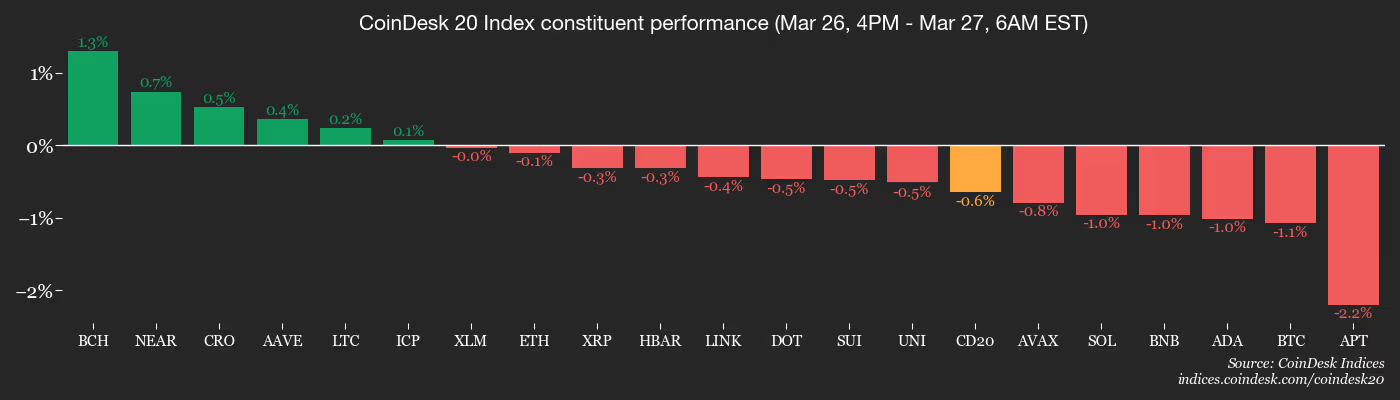
Bitcoin has dropped over 3% to $66,800 alognside similar losses in ether (ETH) and XRP (XRP). Solana’s SOL token fell over 5% and the CoinDesk 20 Index (CD20) lost 3% decline.
According to Marex, renewed outflows from spot ETFs are weighing on bitcoin.
“ETF outflows have returned in size, which removes a steady bid from the tape and makes dips feel less protected,” Marex’s analysts said in a morning note.
They added that with the quarterly options expiry out of the way, the market is more exposed to the real catalysts again: oil, war headlines, rates and risk appetite.
Speaking of risk appetite, it could remain weak as government bond yields across the advanced world, including the U.S. and Japan, are rising again. Stay alert!
Read more: For analysis of today’s activity in altcoins and derivatives, see Crypto Markets Today
What to Watch
For a more comprehensive list of events this week, see CoinDesk’s “Crypto Week Ahead“.
- Crypto
- Macro
- March 27, 10:00 a.m.: U.S. Michigan Consumer Sentiment Final for March est. 55.5 (Prev. 56.6)
- Earnings (Estimates based on FactSet data)
- March 27: Sphere 3D (ANY), post-market, -$4.68
- March 27: Bonk Inc (BNKK), post-market
- March 27: Mawson Infrastructure Group (MIGI), post-market, -$10.40
- March 27: ZeroStack (ZSTK), post-market, -$1.97
Token Events
For a more comprehensive list of events this week, see CoinDesk’s “Crypto Week Ahead“.
- Governance votes & calls
- Unlocks
- Token Launches
Conferences
For a more comprehensive list of events this week, see CoinDesk’s “Crypto Week Ahead“.
Market Movements
- BTC is down 6.13% from 4 p.m. ET Thursday at $66,329.42 (24hrs: -4.44%)
- ETH is down 8.13% at $1,987.25 (24hrs: -4.27%)
- CoinDesk 20 is down 3.34% at 1,909.22 (24hrs: -3.86%)
- Ether CESR Composite Staking Rate is unchanged at 2.74%
- BTC funding rate is at -0.0097% (-10.5930% annualized) on Binance

- DXY is up 0.10% at 100.00
- Gold futures are unchanged at $4,460.60
- Silver futures are unchanged at $68.82
- Nikkei 225 closed down 0.43% at 53,373.07
- Hang Seng closed up 0.38% at 24,951.88
- FTSE is down 0.69% at 9,902.97
- Euro Stoxx 50 is down 1.39% at 5,488.69
- DJIA closed on Thursday down 1.01% at 45,960.11
- S&P 500 closed down 1.74% at 6,477.16
- Nasdaq Composite closed down 2.38% at 21,408.08
- S&P/TSX Composite closed down 1.53% at 31,887.52
- S&P 40 Latin America closed up 0.44% at 3,481.68
- U.S. 10-Year Treasury rate is up 9 bps at 4.42%
- E-mini S&P 500 futures are down 0.51% at 6,492.00
- E-mini Nasdaq-100 futures are down 0.71% at 23,624.25
- E-mini Dow Jones Industrial Average Index are down 0.48% at 46,009.00
Bitcoin Stats
- BTC Dominance: 58.49% (-0.61%)
- Ether-bitcoin ratio: 0.02996 (0.07%)
- Hashrate (seven-day moving average): 994 EH/s
- Hashprice (spot): $31.97
- Total fees: 2.37 BTC / $164,687
- CME Futures Open Interest: 118,140 BTC
- BTC priced in gold: 15.1 oz.
- BTC vs gold market cap: 4.44%
Technical Analysis

- The chart shows bitcoin’s daily price swings in candlestick format since July last year.
- BTC has slipped to support of the trendline from Feb. 6 low, characterizing the price bounce within the broader downtrend.
- Should the support give way, we could see a deeper selloff that could test dip demand around February lows near $60,000.
- The latest pattern is similar to the one seen through December and January, which ended up deepening the selloff.
Crypto Equities
- Coinbase Global (COIN): closed on Thursday at $173.38 (–4.26%), –1.72% at $170.39 in pre-market
- Galaxy Digital (GLXY): closed at $19.61 (–8.06%), –1.33% at $19.35
- MARA Holdings (MARA): closed at $8.58 (+3.62%), –0.58% at $8.53
- Riot Platforms (RIOT): closed at $14.01 (–7.62%), –0.18% at $13.98
- Core Scientific (CORZ): closed at $15.79 (–7.39%), –0.51% at $15.71
- CleanSpark (CLSK): closed at $9.30 (–6.63%), –0.54% at $9.25
- Exodus Movement (EXOD): closed at $6.85 (–6.04%)
- CoinShares Bitcoin Miners ETF (WGMI): closed at $37.08 (–7.99%)
- Circle Internet Group (CRCL): closed at $98.27 (–5.38%), –2.35% at $95.96
- Bullish (BLSH): closed at $36.44 (–2.64%), –0.93% at $36.10
Crypto Treasury Companies
- Strategy (MSTR): closed at $132.93 (–4.46%), –0.99% at $131.61
- Strive Asset Management (ASST): closed at $10.41 (–4.06%), –1.15% at $10.29
- SharpLink Gaming (SBET): closed at $6.53 (–10.30%), –0.61% at $6.49
- Upexi (UPXI): closed at $1.07 (–10.08%), +1.87% at $1.09
- Lite Strategy (LITS): closed at $1.16 (–3.33%)
ETF Flows
Spot BTC ETFs
- Daily net flows: -$171.3 million
- Cumulative net flows: $56.14 billion
- Total BTC holdings ~1.29 million
Spot ETH ETFs
- Daily net flows: -$92.5 million
- Cumulative net flows: $11.6 billion
- Total ETH holdings ~5.76 million
Source: Farside Investors
While You Were Sleeping

How to get 300 Primogems

Understand Your Printer Better With The Interactive Inkjet Simulator

RIPPLE STABLECOIN RLUSD TO FOLLOW USDT IN YIELD TO INSTITUTIONS #stablecoin #crypto #cryptocurrency

Smart energy pays enters the US market, targeting scalable financial infrastructure

Why Israel is blocking foreign journalists from entering

Bitcoin: We’re Entering The Most Dangerous Phase
RIPPLE STABLECOIN RLUSD TO FOLLOW USDT IN YIELD TO INSTITUTIONS #stablecoin #crypto #cryptocurrency

Financial Planning for Your 20’s | Ft. Feroze Azeez | #SanjayKathuriaPodcast

URGENT: If you own XRP you NEED to WATCH this NOW
-
 Crypto World7 days ago
NIO (NIO) Stock Plunges 6.5% as Shelf Registration Sparks Dilution Worries
-
 NewsBeat2 days ago
Manchester United reach agreement with Casemiro over contract clause amid transfer speculation
-

 Fashion7 days ago
Weekend Open Thread: Adidas – Corporette.com
-

 Politics7 days ago
Jenni Murray, Long-Serving Woman’s Hour Presenter, Dies Aged 75
-

 Crypto World6 days ago
Best Crypto to Buy Now: Strategy Just Spent $1.57 Billion on Bitcoin During Fear While Early Investors Quietly Enter Pepeto for 150x Potential
-

 Crypto World6 days ago
Bitcoin Price News: Bhutan Sells $72 Million in BTC Under Fiscal Pressure, but the Smart Money Entering Pepeto Sees What the Market Does Not
-

 News Videos1 day ago
Parliament publishes latest register of MPs’ financial interests
-

 Sports4 days ago
Remo Stars and Kano Pillars Strengthen Survival Hopes in NPFL
-

 Sports4 days ago
Gary Kirsten Accuses Pakistan Cricket Board Of ‘Interference’, Mohsin Naqvi Responds
-

 Tech5 days ago
Give Your Phone a Huge (and Free) Upgrade by Switching to Another Keyboard
-

 Business5 days ago
No Winner in March 21 Drawing as Prize Rolls to $133 Million for Next
-

 Sports7 days ago
2026 Kentucky Derby horses, odds, futures, preview, date: Expert who nailed 12 Derby-Oaks Doubles enters picks
-

 Tech5 days ago
AI enters the chat: New Seattle dating app relies on tech to facilitate meaningful human connections
-

 News Videos4 days ago
Ch 9 Financial Management Part 1 | Detailed One Shot | Class 12 Business Studies Boards 2026
-
Business7 days ago
Columbia Sportswear enters $500 million credit agreement with JPMorgan Chase
-

 Tech6 days ago
Today’s NYT Connections Hints, Answers for March 22 #1015
-

 Business16 hours ago
Instagram, YouTube Found Responsible for Teen’s Mental Health Struggle in Historic Ruling
-
 Crypto World7 days ago
Small-cap Russell 2000 enters correction territory
-

 Business5 days ago
Will Duke Basketball Win It All? Duke Basketball Enters Second Round as Third Favorite to Claim NCAA Title
-

 Sports4 days ago
2026 Kentucky Derby horses, odds, futures, preview, date: Expert who hit 12 Derby-Oaks Doubles enters picks
You must be logged in to post a comment Login