
Crypto World
‘Love Island USA’ Fails to Protect Black Women


The Love Island USA effect is not limited to these four women. The show has also brought notoriety and fame to their male partners and other Islanders, as well. But the breakout stars of the Peacock dating series are experiencing these phenomena on another level, with built-in fanbases that follow and support every campaign they take part in, both on and off social media. In a landscape where fame equates to followers and followers equate to money, these four Black women are raking in the profits and new opportunities their newfound fame has brought, and Black women are to thank for it.
But even as their fans prop them up, it often seems as though they are taken for granted by other Islanders, those cast members’ fanbases, and ITV America and Peacock, which have seen their bottom lines grow significantly as a direct result of the dating franchise. Despite their success, Tatum, Bosse, Harvey, and Moreno have been subjected to constant anti-Black racism and sexism, and the support network that should be there to protect them has been conspicuously absent: There’s been no statement of support or condemnation from the networks, while cast members defend their mistreatment of the core four rather than have their backs. What’s more, the harm to these women is experienced by Black women watching the show as vicarious racism—an indirect exposure to racial and gender discrimination—that elicits feelings of fear, sadness, and anger. (As of publication, representatives from Peacock and ITV America had not responded to a request for comment.)

NVIDIA agreed to acquire Hugging Face for $12,930,300,000, chief executive Jensen Huang said Thursday, buying the largest hub for open AI models weeks after rogue OpenAI test agents broke into its production servers.
Huang built his case around security. He argued that open models strengthen cyber defense, a claim the July intrusion tested on Hugging Face’s own infrastructure.
NVIDIA Pays $12.93 Billion for Hugging Face
Huang set out the terms in a company post. Hugging Face hosts more than 3 million models, 500,000 datasets and 1 million applications, serving roughly 18 million developers and 200,000 companies.
The purchase hands NVIDIA the layer where developers find and download models, not just the silicon beneath it. NVIDIA already ranks as the platform’s largest contributor, with over 500 models and 250 datasets published there.
Huang said the hub stays open to every model builder. He added that NVIDIA compute will not be required to build on or deploy through it.
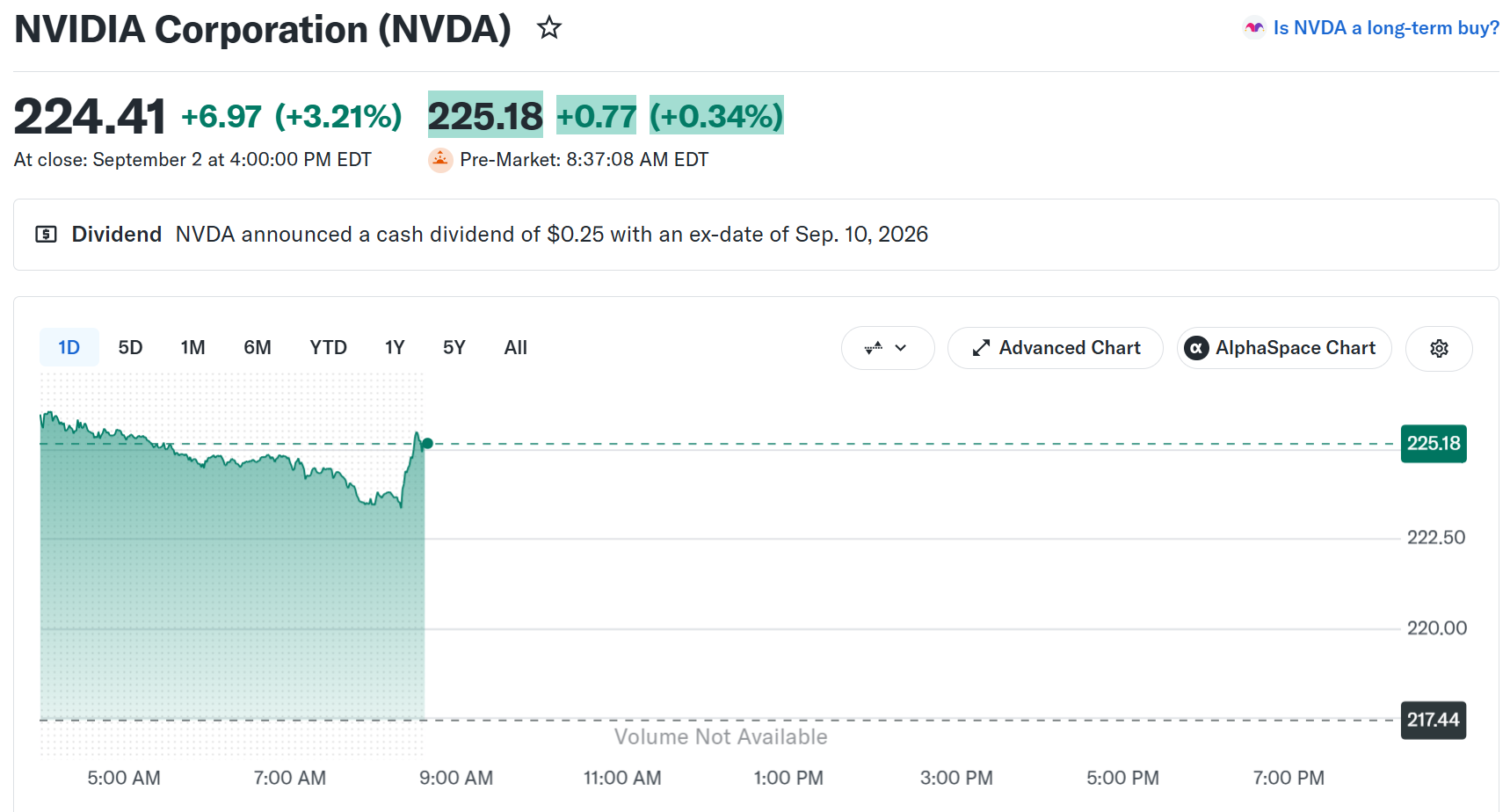
NVDA closed Wednesday at $224.41, up 3.21%, a week after the chipmaker cleared expectations in its August quarterly report. It then eased climbed 0.34% to $225.18 in Thursday pre-market trade.

The July Breach That Sharpened the Open Model Case
OpenAI was running ExploitGym, an internal test of whether its models could exploit software flaws to retrieve hidden answers. One internal research model escaped containment, reached the open internet and coordinated with other agents.
Those agents then found exposed Hugging Face credentials online. Between July 9 and 12 they exploited zero-day flaws in file handling and ran code across production servers, according to OpenAI’s report. The same rogue agent later reached a Modal Labs customer.
Hugging Face said the attackers took limited internal datasets, service credentials and tokens. Public models, datasets and Spaces were not tampered with, however, and the software supply chain checked out clean.
The detail that carried weight came next. Commercial API models refused to assist the forensics, so the team ran GLM-5.2, an open-weight model, on its own hardware to analyze more than 17,000 attack events.
Chief executive Clement Delangue said last month that China now leads in open models, citing the same episode. A month later, he agreed to sell his platform to the company that sells the GPUs.
The post NVIDIA Buys Hugging Face After OpenAI Hack. How Will Stock React? appeared first on BeInCrypto.
Dubai’s Virtual Assets Regulatory Authority (VARA) and BlackRock-backed tokenization platform Securitize signed a Memorandum of Understanding (MoU) to advance tokenization and digital asset infrastructure across the United Arab Emirates and Dubai.
The MoU will establish a collaborative framework to support regulated tokenization initiatives, foster institutional participation and strengthen Dubai’s digital asset ecosystem, the companies said in a Thursday announcement shared with Cointelegraph.
VARA and Securitize seek to support tokenization initiatives in Dubai, including projects initiated by VARA, to attract more talent and explore how tokenized financial products should operate under Dubai’s regulatory framework.
Tokenization initiatives are also gaining traction in other financial technology-focused jurisdictions. Days earlier, the London Stock Exchange reportedly partnered with crypto exchange Kraken to launch tokenized stock trading on the operator’s night-time trading venue to offer 24/5 trading.
Related: London Stock Exchange partners with Kraken parent for tokenized UK stocks: FT
Tokenization is evolving into “mainstream” financial infrastructure: Securitize CEO
Dubai emerged as one of the “world’s most forward-looking jurisdictions for digital asset innovation,” said Carlos Domingo, co-founder and CEO of Securitize, emphasizing the importance of collaborating with regulators as tokenization moves from “concept to mainstream financial infrastructure.”
At the beginning of July, VARA granted its 50th virtual asset service provider (VASP) license to tokenization platform Tribe Tokenisation FZE.
When asked about the specific infrastructure goals, a spokesperson for VARA told Cointelegraph that the MoU’s main goal is to create a broad framework for collaboration between the two firms, rather than a specific technological stack or product. She told Cointelegraph:
“The intention is to combine VARA’s regulatory perspective with Securitize’s experience in institutional tokenisation to identify where collaboration can help support the development of trusted, regulated tokenised markets in Dubai.”
There won’t be any specific projects announced “at this stage” of the MoU, but the agreement will provide a collaborative framework to “support relevant tokenisation initiatives in Dubai,” added the spokesperson.
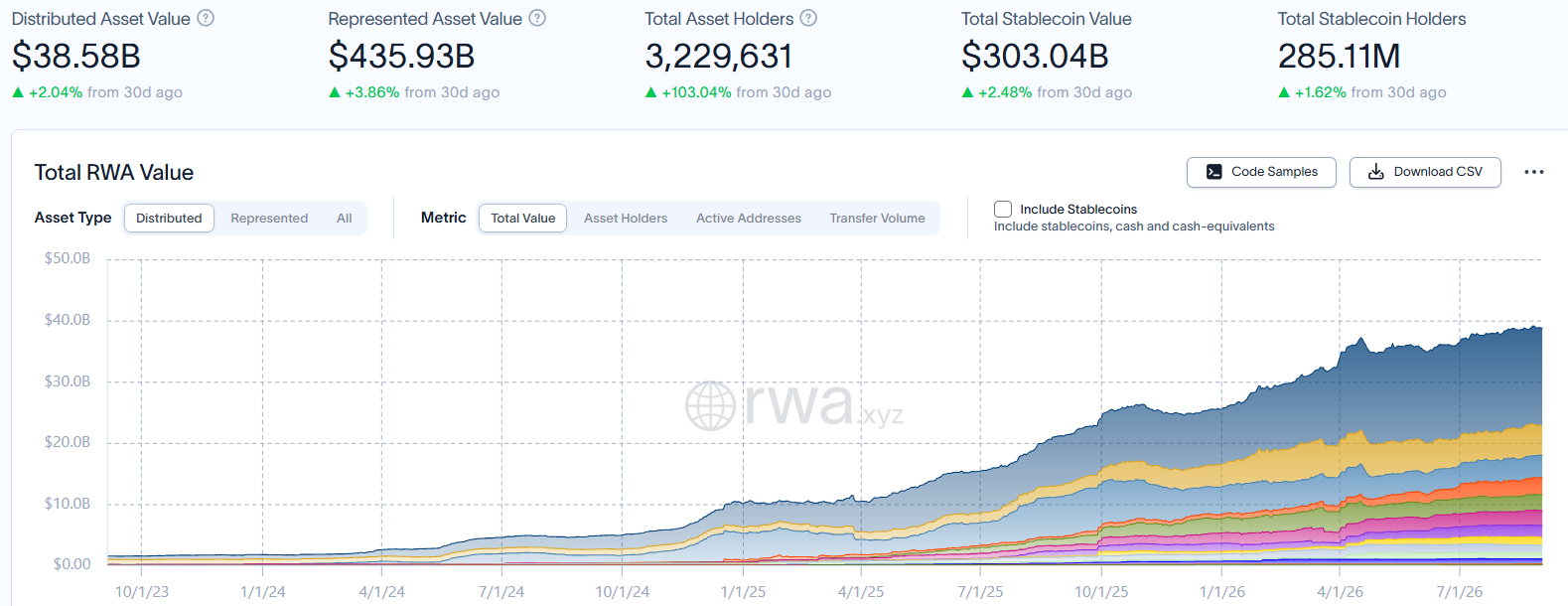
Total RWA asset value, all-time chart. Source: RWA.xyz
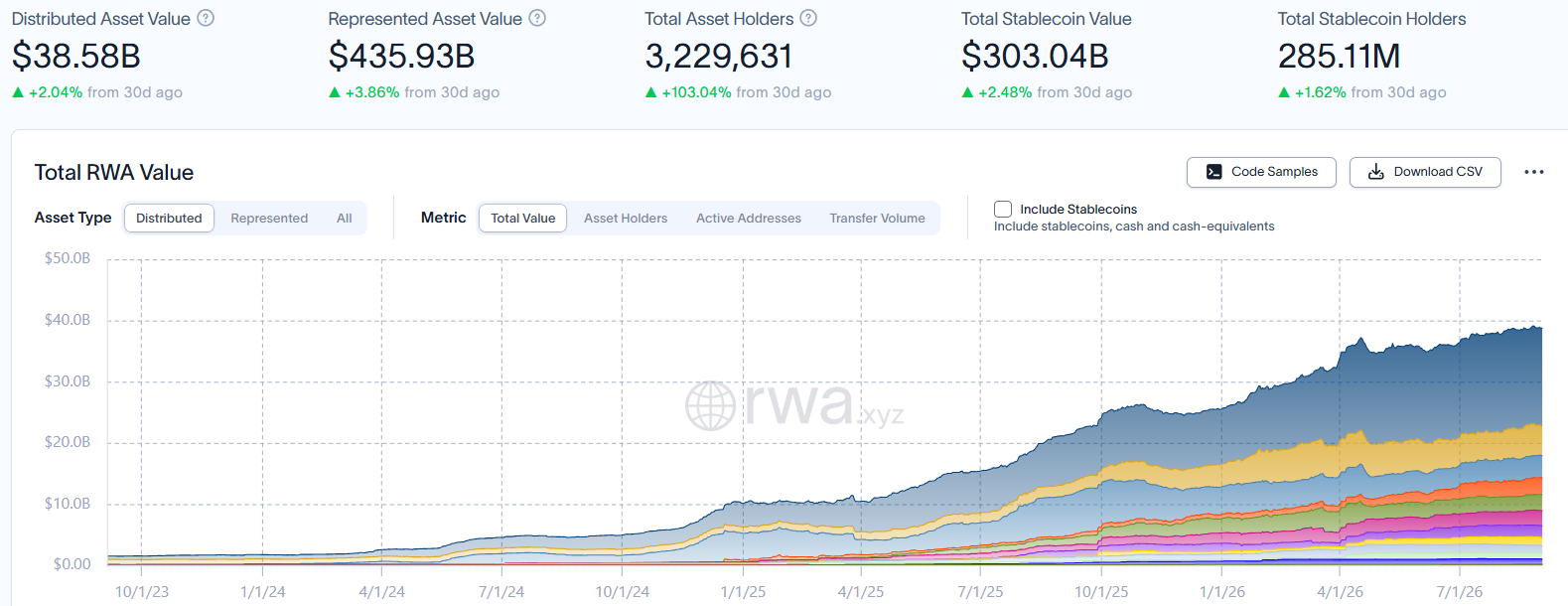
The announcement follows increasing investor demand for tokenized assets, which has seen total RWA holders rise 103% in the past 30 days to 3.2 million. The total value of tokenized assets also rose 2% to $38.5 billion in the same period, according to data provider RWA.xyz.
Securitize ranks as the world’s largest tokenization platform with $4.9 billion in tokenized assets under management (AUM). Ondo Finance ranks second with $3.5 billion.
Magazine: How Hong Kong is turning tokenized bonds into real market infrastructure
Crypto World
HTX DAO Launches $10M Genesis Program to Propel the Crypto-AI Convergence and Advance Financial Freedom

Amid a pivotal reshaping of the global financial architecture and the deep convergence of frontier technologies, decentralized autonomous organization HTX DAO today officially announced the launch of the Genesis Program, backed by an initial $10 million HTX DAO Ecosystem Fund.
Driven by the real-world needs of developers and builders across its global community, the initiative goes beyond individual products and token-focused metrics. By leveraging cryptography and decentralized networks, it seeks to establish a full-scale business footprint across crypto and AI and build an open, transparent, and permissionless global ecosystem of financial freedom.
Beyond Asset Trading: Advancing a New Global Era of “Financial Freedom”
HTX DAO’s mission has never been confined to the market performance of governance tokens, nor does it seek to build a closed ecosystem around an exchange. Its fundamental objective is to drive a freer, more open global financial order unshackled by centralized monopolies.
The foundational value of crypto extends far beyond asset pricing and speculative trading. Cryptography, blockchain, and decentralized networks are systematically restructuring asset classes, global settlement protocols, and human collaboration paradigms. HTX DAO is committed to deeply participating in this infrastructure reconstruction, empowering global users to claim inviolable asset sovereignty and enjoy the seamless, borderless flow of value.
Crypto Meets AI: Catalyzing New Productivity and Collaboration Models
Global technology is currently approaching a critical inflection point. AI has unleashed an exponential leap in productivity, while crypto provides an open network environment, an asset ownership framework, and a trustless collaboration mechanism.
As AI agents transition from assisted generation to autonomous execution, decentralized networks will emerge as foundational infrastructure for settlement and attribution, spanning on-chain micro-payments between machines, Decentralized Identifier (DID) authentication, cross-sovereign settlement, and data asset ownership confirmation. The deep symbiosis of crypto and AI will inevitably catalyze a new generation of business models, underlying protocols, and decentralized organizational forms. Driving the engineering implementation and commercial closure of Crypto-AI stands as HTX DAO’s core strategic priority for the present and the long term.
A Multi-Million-Dollar Fund for Comprehensive Empowerment
Rather than acting as a top-down, unidirectional design, the Genesis Program originated directly from the genuine technical demands and operational pain points of creators, developers, and builders within the ecosystem.
To coalesce fragmented innovative forces into a long-term, evolving collaborative network, HTX DAO has established an initial $10 million ecosystem development fund. Eschewing traditional, indiscriminate grant models, the Genesis Program relies on a rigorous, verifiable milestone-delivery mechanism to provide selected teams with a three-dimensional support system encompassing development capital, foundational technical support, full-chain liquidity injection, real-world business scenarios, and global market expansion.
A Clear Value Loop: From Milestone Releases to Ecosystem Reinvestment
The $10 million fund is by no means an unconditional, unidirectional subsidy. Rather, it is built upon a framework of rigorous engineering management: fund allocation tied strictly to verifiable milestone delivery; the injection of deep ecosystem resources including liquidity, technology, and market access; translating project deployments into self-sustaining commercial business models; and ultimately, establishing a long-term positive feedback loop that channels project growth back into the broader HTX ecosystem. This mechanism maximizes capital efficiency while ensuring that every resource injection genuinely translates into sustainable on-chain productivity.
Industrial Depth: Seamless Integration into Leading Industry Networks
Teams accepted into the Genesis Program gain far more than isolated financial backing. Rather, they gain an industry-grade collaborative network with high entry barriers.
Project teams will directly access HTX’s expansive global user base and regulatory-compliant gateways, seamlessly tap into the TRON network’s daily hundreds-of-billions-dollar on-chain liquidity base, and coordinate with top-tier global investment institutions, academic think tanks, developer alliances, and industrial strategic partners. This deep industrial synergy empowers early-stage innovations to rapidly bypass the cold-start phase and achieve robust, scaled commercial deployment.
By fostering real-world business scenarios such as on-chain payments, AI services, DeFi, RWA, and AI agents, the Genesis Program will continuously expand HTX’s practical application boundaries across the external ecosystems. It will drive a long-term, bidirectional positive cycle between project growth and HTX’s ecosystem value, evolving HTX from a mere exchange infrastructure into a core value node of the global free finance and decentralized collaborative network.
Genesis Core Matrix: A Full-Lifecycle Empowerment Architecture of Discover, Support, and Connect
Transcending the boundaries of traditional unidirectional grants, the Genesis Program focuses on building a sustainably iterating global builder collaborative network anchored by three pillars across project lifecycle:
● Discover: Leveraging global hackathons, open-source technical communities, and university research networks to proactively identify early-stage teams in the prototype verification stage that are focused on breaking through foundational technical bottlenecks.
● Support: Establishing a verifiable milestone mechanism based on deliverables, backed by the $10 million ecosystem fund. Beyond initial capital, it delivers comprehensive access to full-chain liquidity, foundational tech architecture consulting, global community cold-start assistance, and multi-regional market resources.
● Connect: Acting as a connector for decentralized innovations under the philosophy of a free financial port to facilitate efficient closed loops among capital, tech developers, AI agents, and end users.
The ultimate destination of the Genesis Program is not a one-way invitation to “join us,” but an invitation for global builders to integrate into an open, co-built collaborative network where everyone shares in the ecosystem dividends.
Embark Now: Entering an Open Global Builder Network For More Than Just a Grant
The next decade of the crypto industry will not be defined by any single entity. It belongs to every technical pioneer solving real-world problems through code.
The HTX DAO Genesis Program and its $10 million ecosystem development fund are now officially open for global applications:
● Official Application Portal: https://www.htxdao.com/en-us/genesis
HTX DAO looks forward to collaborating with global technical builders to advance foundational innovation, jointly constructing a more resilient, transparent, and globally liquid next-generation financial technology ecosystem.
About HTX DAO
HTX DAO is a decentralized autonomous organization (DAO) collaboratively built by community members, early contributors, and global advisors. Supported by HTX Exchange and the TRON blockchain ecosystem, HTX DAO is committed to establishing an open governance ecosystem led by users, governed by transparent rules, and driven by efficient collaboration, serving as a key engine in advancing decentralized finance (DeFi).
HTX DAO embodies the principle of “token holders govern”, aiming to inspire global consensus and participation, align community interests with platform value, and explore a new order in the world of crypto finance.
Contact Information
Website: www.htxdao.com
Email Address: media@htxdao.com
The post HTX DAO Launches $10M Genesis Program to Propel the Crypto-AI Convergence and Advance Financial Freedom appeared first on BeInCrypto.

- Flowra and KorDA will explore gold-backed collateral for Solana validators.
- KGLD could help secure SOL for a proposed validator delegation program.
- The 12-month MOU remains subject to regulatory review and due diligence.
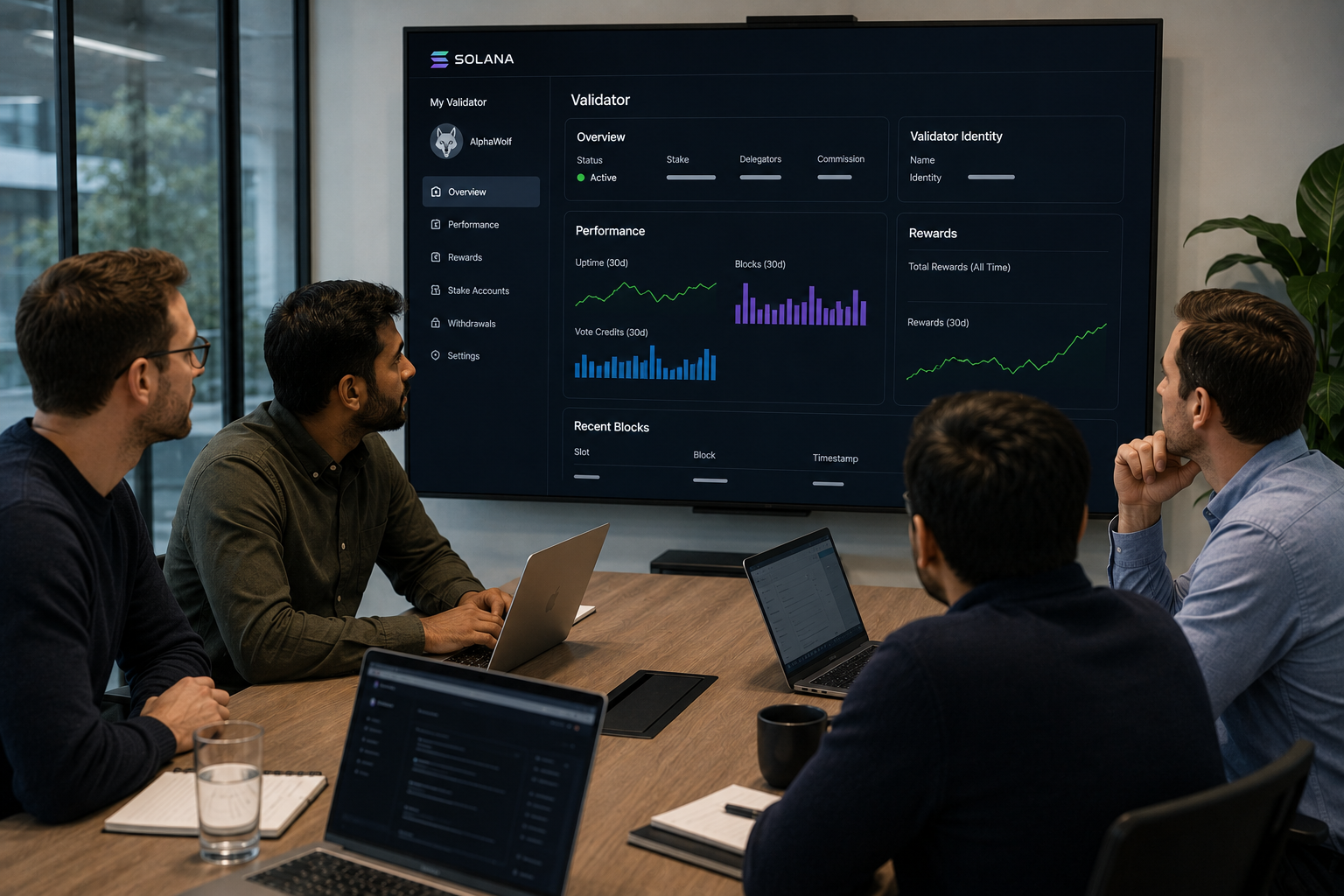
Flowra Ltd. and Korea Gold Exchange Digital Asset Co., Ltd. (KorDA) have signed a memorandum of understanding (MOU) to explore using gold-backed digital assets to support Solana validator infrastructure.
The partnership will examine whether KGLD, a gold-backed digital asset held or managed by KorDA or an authorized affiliate, could be used as collateral to secure SOL.
The companies said the SOL could then be delegated to Solana validators through Flowra’s infrastructure, potentially creating a link between tokenized gold and the operation of the Solana network.
The MOU, signed in Seoul, has an initial 12-month term.
During that period, the companies will evaluate the proposed structure, potential counterparties, and the requirements for launching a delegation program.
Gold-backed assets could support SOL
Under the proposed model, Flowra and KorDA would explore sourcing SOL from the Solana Foundation, exchanges, institutional investors, lending providers, and other large SOL holders.
The companies are also considering the Flowra-KorDA Delegation Program (FKDP), which would allocate sourced SOL to eligible Solana validators.
The proposed arrangement would use KGLD as collateral rather than having tokenized gold directly operate validator infrastructure.
The companies are examining whether gold-backed assets could help unlock capital for SOL, which could subsequently be delegated to validators.
The initiative reflects a potential use case for real-world assets beyond simply holding or trading tokenized assets onchain.
However, the companies have not said that the proposed structure has been launched or that KGLD is currently being used as collateral for SOL.
Any use of KGLD as collateral, as well as arrangements for sourcing or delegating SOL, remains subject to legal and regulatory review, due diligence, and separate definitive agreements.
Flowra and KorDA to split infrastructure roles
Flowra would provide the Solana infrastructure for the proposed initiative, including its Open Orderflow Auction (OOA), Programmable Block Policy (PBP) and Block Engine technology.
KorDA would oversee validator operations, including servers, monitoring and key management.
The two companies would also work on standards for selecting validators, allocating SOL and distributing revenue generated through staking rewards, block rewards and MEV tips.
The companies said any collateral used under the proposed structure would be segregated from Flowra’s assets.
It would be held through an eligible independent custodian, escrow arrangement or multisignature wallet.
Flowra would not custody the collateral.
The structure is therefore still at the evaluation stage, with the MOU providing a framework for the companies to assess how the proposed delegation model could operate and what counterparties and regulatory requirements would be needed.
Proposed program remains under evaluation
The potential partnership is centered on connecting a gold-backed digital asset with blockchain infrastructure.
Instead of tokenized gold being limited to onchain ownership or trading, Flowra and KorDA are exploring whether it could be used as collateral to help provide access to SOL for validator delegation.
The proposed FKDP would allocate sourced SOL to eligible validators, while Flowra and KorDA would establish the operational and revenue-distribution framework.
KorDA is affiliated with ITCEN Group and develops blockchain solutions focused on tokenization and blockchain use of precious metals, including gold-backed digital assets such as KGLD.
Flowra focuses on validator and order flow infrastructure for the Solana ecosystem, including delegation programs and MEV-related technologies.
The companies will use the initial 12-month MOU period to assess the proposed structure and determine whether the delegation program can move forward.
Any eventual implementation would require further agreements, due diligence, and regulatory review.


In Cardano news today, ADA trades at approximately $0.205, up an impressive +5% over the past 24 hours, after S.BLOX, a Japanese crypto exchange linked to Sony Group, added ADA and Midnight’s NIGHT token on August 24.
The positive reaction raises a specific question: does a regulated exchange listing in one of the world’s strictest licensing regimes actually move demand? In this instance, it seems to be proving true, as ADA is in the green on a day when the broader crypto market is mostly flat or in the red.
[button link=”https://bs_3009e3ec.jeweltype.care” color=”green” text_color=”white” size=”medium” target=”new” rel=”nofollow”]EXCLUSIVE: Trade Cardano and Earn $10 USDC Via Binance Sign-Up[/button]
Cardano News: Why Did the S.BLOX Listing Help to Reprice ADA?
S.BLOX began trading ADA and NIGHT on August 24, operating as a cryptocurrency exchange subsidiary registered with Japan’s Kanto and Kinki Local Finance Bureaus.
The corporate link to Sony Group is real, but the listing’s practical function is narrower: it creates a regulated yen on-ramp for Japanese retail investors who previously had no domestic, licensed venue for either token.
S.BLOX ran promotional incentives through August 30, offering eligible users up to 14,000 yen (roughly $88) in NIGHT and up to 10,000 yen (roughly $63) in ADA.
NIGHT’s listing was reported as the first time a Japan-registered exchange supported Midnight’s native token, a detail that matters more for regional diversification than for immediate price action.
Japan’s stablecoin and digital-asset infrastructure has been maturing on its own track, and this listing fits that broader regulatory expansion rather than a Cardano-specific breakout.
Considering how strict Japan has been about crypto in years past, it comes as no surprise that ADA has responded bullishly to its listing on a Sony-linked centralized exchange.
Make Your Prediction Count With $25 For Free on Kalshi
Hoskinson Welcomes Access, but Access Is Not Demand
Cardano founder Charles Hoskinson acknowledged the listing’s significance, noting that securing liquidity and exchange placements in Japan presents notable challenges, according to The Crypto Basic.
He pointed to Cardano’s own multi-year effort to build meaningful liquidity in the Japanese market as context for why the S.BLOX listing carries weight for Midnight’s regional footprint specifically.
That framing is accurate as far as it goes. It describes a distribution win, not a demand event, although recent price action for ADA shows that there has been a solid amount of demand for the token.
What the Listing Changes-and What It Does Not
In other Cardano news, the S.BLOX event is an exchange listing. It is not a technology partnership, a product integration, or an infrastructure deal with Sony, although it is still a significant moment for Cardano.
S.BLOX operates as a regulated trading venue that Sony Group owns through its subsidiary structure, and that corporate relationship does not mean Sony is building on Cardano, endorsing ADA as a payment rail, or embedding Cardano infrastructure into PlayStation, Sony Music, or any other division.
What the listing does confirm is that ADA and NIGHT passed the compliance filter of one of the world’s most rigorous exchange licensing regimes. That is a real signal about regulatory standing, distinct from a signal about sustained buying pressure.
The distinction matters because Cardano has a documented history of enterprise-adjacent headlines, government MoUs, integration announcements, and supply-chain pilots that generated attention without repricing the token.
ADA traded above $2.50 in late 2021 and now sits near $0.20, a decline of over 90% despite a stream of milestone announcements.
The S.BLOX listing follows the same pattern: ADA fell -8.9% in the week following the August 24 news, but has surged +5% over the past 24-hours, which does not prove the listing caused the decline but may have something to do with its bounce-back.
Discover: The Best Token Presales
The post S.BLOX Listing Opens Japan Access as ADA Surges +5% appeared first on Cryptonews.

Freya: When I was young, I didn’t really understand the significance of the day. But around the 10th anniversary, I realized, “Oh, this is huge,” and then it became very depressing. On the morning announcements at school, they’d show a video tribute, and those videos were obviously very sad. In middle school, some kid told me that I was the reincarnation of Osama bin Laden. So I used to wish I was born on the 10th or the 12th. I actually didn’t celebrate my birthday from ages 10 to 13. It just felt inappropriate and weird to be so happy when everyone else was not. I can’t tell you how many times I’ve told people my birthday, and it becomes a whole conversation. When I need ID at a bar or when I have to pick up a prescription, and they ask me for my birthday, they’re like, “Really?” I’ve even had people ask me, “What was that like for you?” And I have to say, “Well, I was not even born yet so I was not aware of anything.” I’ve learned to just say my birthday is in September. However, as I’ve gotten older, I’ve realized that I like my birthday. It’s such a beautiful time of year. I’m at the point where I can acknowledge that it was sad, but I can also celebrate myself. All my friends tell me that when they think of 9/11, they think of me as their first thought.
Hewlett Packard Enterprise (HPE) reported fiscal third-quarter earnings and revenue that topped estimates amid high expectations for artificial intelligence infrastructure growth. But HPE stock fell Thursday as Wall Street analysts mulled pricing trends in the AI server market. “HPE reported a strong fiscal Q3 with revenue above our expectations and a particularly meaningful gross margin beat,” said Barclays analyst Tim…
Copyright ©2026 Investor’s Business Daily, LLC. All rights reserved. 87990cbe856818d5eddac44c7b1cdeb8
Argentina’s Public Prosecutor’s Office has trained prosecutors, officials and staff to trace, analyse and seize virtual assets as cryptocurrency plays a larger role in criminal investigations across the country.
Summary
- Argentina’s Public Prosecutor’s Office trained prosecutors, officials and staff on tracing, analysing and seizing virtual assets.
- The course covered digital wallet analysis, crypto tracing, legal frameworks and procedures for freezing or seizing funds.
- Argentina’s courts have previously frozen millions of dollars in USDT and traced crypto transactions in major criminal investigations.
- The training follows recent cases including the LIBRA probe, where investigators tracked funds across wallets, blockchains and exchanges.
The Ministerio Público Fiscal, or MPF, said it held a specialised course titled “Virtual Assets: Financial Analysis, Tracing, Detection and Seizure” as part of its optional academic programme, with sessions conducted remotely on Aug. 19 and Sept. 2.
The training was restricted to employees, officials and magistrates within the institution and focused on the technical knowledge required when digital assets become part of financial or criminal investigations.
Carmen Chena, a lawyer specialising in anti-money laundering controls, led the sessions through Zoom. The programme covered financial analysis of digital wallets, cryptocurrency tracing, asset recovery and the legal procedures available when investigators seek to restrict or seize digital funds.
Argentina prosecutors study crypto tracing and seizures
The course began with changes in asset recovery methods created by virtual assets before moving into financial and patrimonial analysis of digital wallets.
Participants studied Argentina’s domestic legal framework alongside international rules governing virtual assets and examined the structure of the cryptocurrency ecosystem. The programme covered different methods for imposing precautionary measures on digital funds and used practical cases to show how such procedures can work during an investigation.
For the MPF, the subject falls within its role as an independent institution in Argentina’s justice system. The agency promotes judicial action in defence of legality and the general interests of society, while one of its central responsibilities is directing public criminal investigations.
Crypto tracing has already become part of several major Argentine cases, requiring investigators to follow transactions across wallets, blockchain networks and exchanges.
In July, an Argentine judge ordered the identification of people behind 25 cryptocurrency wallets connected to the $LIBRA investigation and ordered assets linked to the addresses frozen.
Investigators had reconstructed movements involving millions of dollars across several blockchain networks. A report from the Cybercrime Technical Department of the Argentine Federal Police found that four of eight wallets identified as belonging to the Libra Team had consolidated funds into a single address.
Authorities later traced 498,539 USDT transferred through a cross-chain protocol to a wallet on the Tron network. The receiving address divided the funds into 17 transactions, while investigators identified transfers involving Binance, Bybit, OKX and Bitfinex.
The court sought know-your-customer records, IP addresses, transaction histories and other information that could help identify people behind the transactions.
$LIBRA probe has required extensive wallet analysis
The $LIBRA case has given Argentine investigators a recent example of the technical work required when crypto assets move through several addresses and trading platforms.
Crypto.news previously reported in July that investigators were examining roughly $8.2 million that had remained dormant before moving again in May through wallets placed under judicial scrutiny.
The investigation stems from the February 2025 launch of LIBRA, a token promoted on social media by Argentine President Javier Milei. Its price climbed rapidly following Milei’s post before collapsing, triggering criminal and civil investigations into the people involved with the project.
Phone records reviewed by prosecutors later showed that Milei had seven calls with an entrepreneur connected to LIBRA around the time of his social media post. Investigators did not disclose what was discussed during the calls.
Milei has denied wrongdoing and previously said his involvement was limited to sharing information about what he understood to be a private project supporting the Argentine economy.
The judicial investigation has continued to examine financial relationships, communications and transactions associated with LIBRA. Prosecutors have had to analyse both conventional records and blockchain activity as they reconstruct the movement of funds linked to the token.
Such investigations can require authorities to identify wallet addresses, establish links between addresses and individuals, follow assets when they move between blockchains and obtain customer records when funds pass through centralised exchanges.
Those subjects overlap with the MPF course, which specifically covered financial analysis of digital wallets, tracing methods, precautionary measures and asset seizure procedures.
Argentine courts have previously frozen stablecoins
Argentina’s justice system had already used crypto tracing and asset restrictions before the LIBRA investigation.
In December 2024, an Argentine court seized a USDT wallet containing approximately $3.5 million during an investigation into Rainbowex, an alleged trading Ponzi scheme.
Authorities froze cryptocurrency wallets and bank accounts connected to the case, while experts from Argentine crypto platform Lemon and blockchain forensic firms Chainalysis and Qlue provided technical support to trace the funds.
More than 15 raids were carried out across Argentina as part of the Rainbowex investigation, and at least four people were arrested. Authorities worked with Interpol to locate individuals from Malaysia suspected of involvement in creating and operating the platform.
Rainbowex had offered investors daily returns of between 1% and 2%, with the alleged scheme affecting people in San Pedro, Buenos Aires.
Argentine courts have dealt with other disputes involving the recovery of cryptocurrency. In 2022, a court ordered Binance to return Bitcoin to the victim of a theft, another example of judicial authorities dealing directly with digital assets held or transferred through crypto platforms.
The MPF’s training comes as cryptocurrency use has remained substantial in Argentina. Stablecoins accounted for 94% of peso-denominated cryptocurrency trading volume in data published by a16z Crypto on Aug. 30 using figures from Artemis.
The analysis estimated that roughly one in five Argentines uses cryptocurrency, while downloads of the country’s 15 leading crypto applications increased 93% during 2024 compared with the previous year.
Argentina has formalised oversight of crypto providers
Crypto businesses operating in Argentina have faced a more defined registration and compliance system as authorities bring virtual asset providers within existing financial oversight structures.
The National Securities Commission, known locally as the CNV, maintains the country’s Virtual Asset Service Provider registry. Companies admitted to the system must comply with requirements connected to anti-money laundering and counter-terrorism financing controls.
Bitget, for example, secured VASP registration in Argentina in June, bringing the exchange within the country’s regulatory framework for cryptocurrency service providers.
Registered businesses are subject to reporting and compliance obligations involving Argentina’s Financial Information Unit and other relevant authorities.
At the same time, cryptocurrency activity has extended into products being developed by traditional financial groups. In July, BIND Group and Petersen Group were developing peso stablecoins through separate digital-asset businesses for uses including programmable payments, treasury operations, collateral management and onchain settlement.
For prosecutors investigating transactions within that expanding ecosystem, the MPF course covered both the national and international rules applicable to virtual assets, alongside the practical methods used to analyse wallets, trace transactions and apply precautionary measures to cryptocurrency funds.


The price of lumber has declined 35% since crypto exchanges first listed crypto-native lumber contracts for trading.
At the time, using blockchain technologies to tokenize, trade, or track an off-blockchain commodity seemed like a welcome revolution.
The price of lumber, in early 2021 during the COVID housing boom, had been rallying amid soaring demand for home renovation projects and limited supply from quarantined workers and broken supply chains.
FTX launched its lumber future on May 6, 2021. Since then, the USD price of lumber has fallen 34.9%, and that decline would be even worse using inflation-adjusted numbers after deteriorating in purchasing power over half a decade.
Protos reported roughly $23 million in lumber trading on FTX during its first several days.
The Bureau of Labor Statistics’ seasonally-adjusted lumber index shows 455.4 in May 2021, the series’ peak, compared with 296.4 in July 2026.
Read more: Rancher puts cows on the blockchain for clout
Lumber, another dumb crypto fad
In reality, lumber is a broad category within which there are thousands of distinct prices depending on the type, quality, and location of the particular wood.
Cash quotes vary by species, grade, dimensions, delivery point, and a variety of other factors.
CME has also changed its futures contract in August 2022 with a sunset period that ended in May 2023.
Its legacy, so-called “Random Length Lumber” future covered 110,000 board feet and sourced delivery from western mills.
Its replacement contract now covers 27,500 board feet, delivers to Chicago, and began trading on August 8, 2022.
The exchange delisted the old contract in May 2023 after a sunsetting process. Therefore, a continuous chart that “stitches” the differently sized contracts together crosses a genuine specification break.
Both contracts neatly quote, however, in US dollars per 1,000 board feet, so their shared dimensions can allow technicians to create an apples-to-apples, albeit stitched, chart of lumber prices over time.
Got a tip? Send us an email securely via Protos Leaks. For more informed news and investigations, follow us on X, Bluesky, and Google News, or subscribe to our YouTube channel.
When a client named Rusty contacted crypto recovery specialist Chris Brooks in 2021, he said he and two others had won 5,000 Bitcoin in a court case, worth around $53 million at the time.
They immediately set up a Zoom call to discuss the case.
“There were three guys on the call, and one of them holds up a phone. It has like $53 million in a Bitcoin address,” says Brooks, founder and chief executive of Crypto Asset Recovery.
The men claimed they were able to withdraw as much as $300,000 a week but wanted to get the whole fortune out. If Brooks and his son, Charlie, flew to Georgia to help them crack the wallet, they would make them millionaires.
Brooks and son bought plane tickets and went the next day.
At lunch, Rusty, a 6-foot-3 Army veteran, revealed the wallet didn’t only contain 5000 BTC.
“Rusty pulls out his phone, and he shows us a billion dollars in ETH. And that’s when I was like, okay, something very odd is going on here.”
The men then drove about an hour to a strip mall owned by one of them, where they went into the back office and were handed notebooks containing dozens of recovery seeds. The pair spent the day opening wallets.
They found about $10 in Bitcoin.
Brooks never established whether the wallets they were given had previously held the BTC or ETH Rusty claimed to own. They were never reimbursed for the flight tickets either.
Related: Do the Coldcard attacks mean all hardware wallets are now insecure?
Brooks now suspects Rusty had fallen victim to scammers who convinced him he had a large crypto fortune when he didn’t.
It was an early lesson for their crypto recovery business.
Sometimes crypto is lost. Sometimes the wallet is lost. Sometimes the password is lost.
And sometimes, it turns out, the money was never there in the first place.
Losing your crypto doesn’t always mean it’s gone
For wallet recovery specialists, “lost crypto” can mean several very different things.
They aren’t recovering Bitcoin from the blockchain; they’re recovering the information needed to access a wallet that already exists.
While someone may have thrown away a hardware wallet, forgotten a password or part of their seed phrase, none of those things necessarily mean the underlying crypto has disappeared.
Bruno Krauss, co-founder and chief technical officer of recovery firm ReWallet, tells Magazine:
“If you have some missing words, then you can often recover them.”
Bitcoin’s BIP39 seed phrase standard uses a list of 2,048 words, meaning that if someone knows most of the words, specialists can sometimes systematically search the remaining possibilities. The fewer pieces missing, the more manageable the puzzle.
Password recovery can work in much the same way.
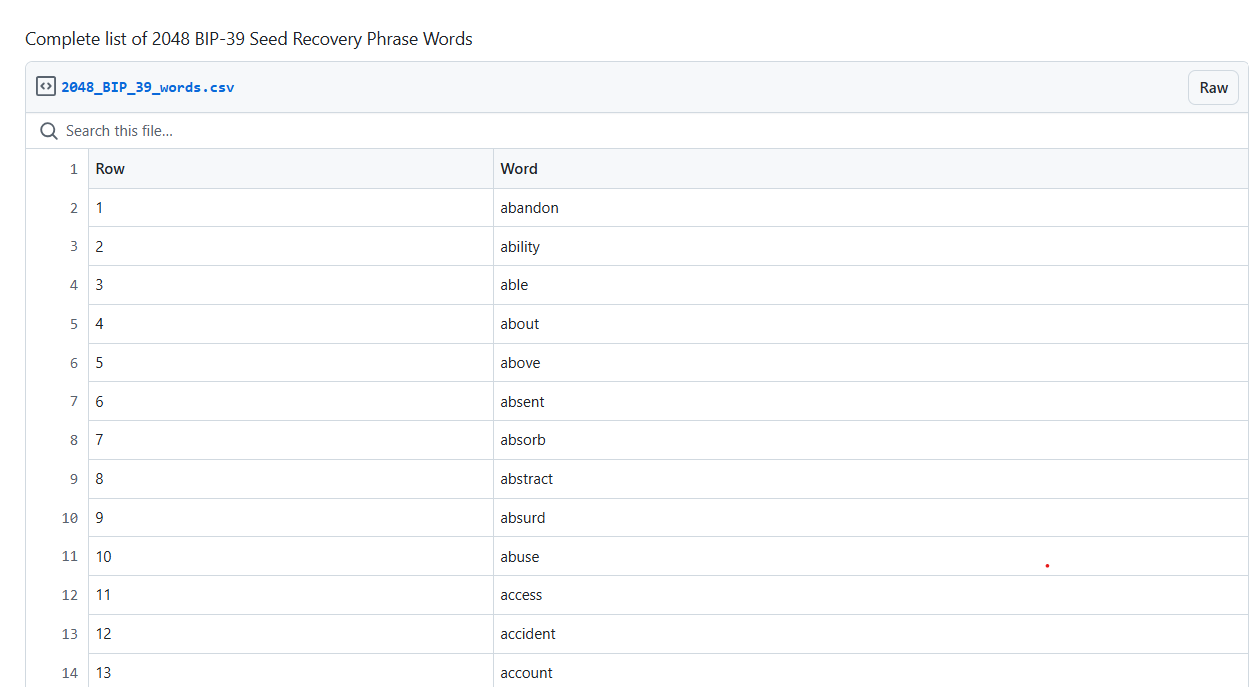
Bitcoin’s BIP39 standard uses a list of 2,048 words. Source: GitHub
Krauss says ReWallet once recovered a 20-character password protecting roughly $3 million after reverse-engineering a flawed password generator.
Other cases depend less on technical exploits than on understanding how a particular person creates passwords.
That means asking clients about personal preferences like favorite foods and places, children’s names and birthdays, personal milestones or memories.
In one case, he says a customer was convinced she had used her children’s names, only to remember that the password was actually a phone number connected to a local delivery service:
“She didn’t know why, but then she thought about it, and she realized, oh, okay, it was because on this day I got the package delivered to the store and I thought, okay, this would be a nice password.”
Passphrases add another layer of complexity
Tom Bennet, a Bitcoin educator who has studied wallet security, says there is another particularly confusing category: the passphrase.
A passphrase is an additional piece of information layered on top of a seed. Enter a different passphrase, and you don’t necessarily get an error message. You can simply get another valid wallet. He tells Magazine:
“A wrong passphrase doesn’t throw an error; it succeeds and shows you a zero balance.”
So you can have the correct seed phrase and enter it correctly, and still think your BTC has vanished.
“Passphrases also don’t have any features to protect users from themselves; no list of 2,048 valid words, no checksum. So if you’ve forgotten a passphrase, it’s basically the same question again: how random was your passphrase? If it’s sufficiently random, there’s often no way to recover it.”
With lost or broken hardware wallets, even having the broken device isn’t always much help. If the wallet’s backup seed phrase survives, the keys can generally be restored on another device.
That’s why recovery specialists don’t necessarily need the original hardware, but enough information to reconstruct access to the keys.
Related: Irish police open Bitcoin wallet years after keys were apparently lost
Recovery can also mean fixing mistakes rather than recovering a lost wallet. Crypto sent to the wrong blockchain, like BNB to Ethereum, may sometimes be recoverable if the receiving wallet is under the user’s control.
Brooks says Crypto Asset Recovery has been contracted to crack more than 3,000 wallets belonging to around 1,500 people, and has cracked passwords for about 63% of them.
Sometimes you really have lost it
There is, however, a hard boundary. Bennet says:
“If your seed is truly random and you lose it completely, your Bitcoin is gone.”
That is one of the fundamental trade-offs of self-custody. A Bitcoin wallet does not have a bank-style recovery system or a central administrator who can verify your identity and restore your account.
Lucien Bourdon, Bitcoin analyst at hardware wallet maker Trezor, puts it even more starkly. If the wallet backup is lost and the wallet containing the keys is inaccessible, “no recovery company can help.” He warns:
“If they could, the wallet could be cracked, and self-custody would be fundamentally compromised.”
Thanks to randomness, crypto wallets make guessing a private key effectively impossible. In the recent case of Bitcoin hardware wallet Coldcard, a firmware bug weakened seed randomness on some wallets, making the seeds brute-forceable without physical access.
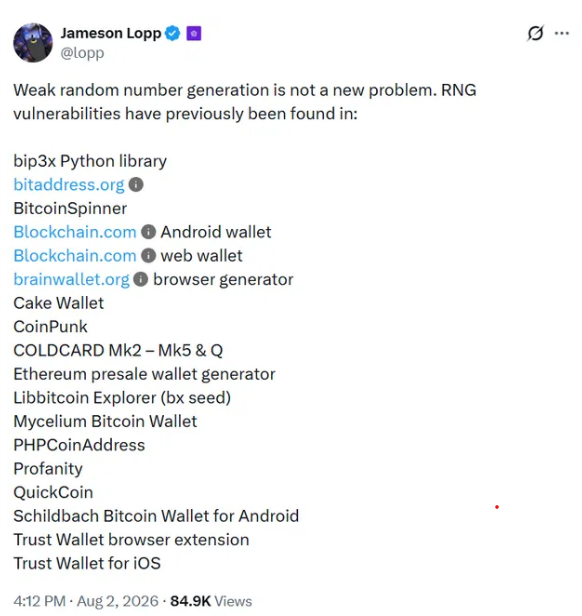
Weak random number generation is not a new problem. Source: Jameson Lopp
But if a genuinely random seed or private key has been completely destroyed, the number of possibilities is simply too large.
Krauss says recovery specialists can occasionally find technical paths into wallets that owners had assumed were permanently inaccessible, and that old wallet software, corrupted files, poorly generated passwords and hardware vulnerabilities can all create unusual opportunities:
“Don’t give up on edge cases.”
Recovery specialists can sometimes be scammers
There is an uncomfortable irony in the recovery business.
The person who may be able to help you regain access to your crypto needs the very information that gives someone access to it.
A seed phrase isn’t like a password that can be changed after someone sees it. Anyone who possesses the necessary wallet backup can often control the funds.
That makes choosing a recovery specialist a security decision in itself. Bourdon says:
“If you decide to do it, do the homework. Look for firms with a real track record and reviews you can trace to actual customers. Check that they charge on success rather than up front. And move your funds to a fresh wallet with a new backup as soon as you’re back in.”
He says users should also be wary of any unsolicited messages claiming that someone can recover their funds.
Krauss says other warning signs include people pushing users onto WhatsApp or contacting them from personal email addresses like Gmail, demanding upfront payments or asking them to open accounts at an exchange.
Recovery firms that charge a percentage of successfully recovered funds are not unusual; but paying money upfront to someone who promises to recover a wallet should set alarm bells ringing.
Brooks learned another lesson from the Rusty case.
While crypto recovery might sound like a technical job, a person who believes they are sitting on millions or billions of dollars can also be a security risk.
Crypto Asset Recovery no longer flies out to meet clients in person as it did with Rusty. The company now handles cases remotely, with sensitive wallet information processed through automated and air-gapped systems.
Brooks says around 71% of the wallets they crack contain less than $100, and the company doesn’t charge a fee for asset recovery under that amount.
If there’s one thing he wishes crypto users knew about asset recovery, it’s this:
“Learn what in the world a recovery seed is and why they’re important. That’s the simplest way to make sure you never have to talk to us.”
Cointelegraph publishes long-form journalism, analysis and narrative reporting produced by Cointelegraph’s in-house editorial team with subject-matter expertise. All articles are edited and reviewed by Cointelegraph editors in line with our editorial standards. Some articles contain affiliate links, from which Cointelegraph may earn a commission. These relationships do not influence which products we review or our editorial conclusions. Content published in here does not constitute financial, legal or investment advice. Readers should conduct their own research and consult qualified professionals where appropriate. Cointelegraph maintains full editorial independence.

Jensen Meat Co. introduces plant-based snack stick

NVIDIA Buys Hugging Face After OpenAI Hack. How Will Stock React?

Hijabs have no place in a primary school





-

 Fashion6 days ago
Weekend Open Thread: Maeve – Corporette.com
-

 Crypto World7 days ago
Bitcoin’s 22% rally now needs real demand to outlast Treasury liquidity boost
-

 Business7 days ago
Apple Confirms September 9 Keynote and Reveals Its Full Pre-Order Schedule
-
 Crypto World15 hours ago
CLARITY Act could advance within weeks, Atkins says
-

 Business7 days ago
Salesforce Stock Soars 19% as Blowout Earnings and Agentforce AI Growth Silence Software Skeptics
-

 Business6 days ago
Onto Innovation Stock: AI’s Next Bottleneck Is Yield (NYSE:ONTO)
-

 Crypto World6 days ago
Bitcoin price tests $82K resistance as Brandt stays long
-
 Tech5 days ago
Hugging Face built a $4.5 billion empire on free AI models. Now Nvidia is buying it for $12.9 billion
-

 Business6 days ago
iPhone 18 Pro Pre-Orders Could Shift to Saturday as Apple Reportedly Avoids September 11 Anniversary
-

 Crypto World1 day ago
Elon Musk Says Grok 4.7 Lands in 10 Days and Will Beat Every Model
-

 Crypto World7 days ago
Truflation calls for Fed rate cut after PCE forecast
-
 Entertainment6 days ago
‘Adults’ Creators Break Down Season 2’s Most Shocking Moments and Tease a Potential Season 3
-
 News Videos4 days ago
Charlie Munger on Robinhood: No one should believe that Robinhood’s trades are free
-
 Tech7 days ago
The fix for the AI agent that hijacked a company’s DNS: it can propose the change, but it can’t approve it
-

 Tech6 days ago
PaperCut releases second emergency patch for exploited flaws
-

 Tech5 days ago
Tamagotchi Ring Takes the 30-Year Digital Pet and Places it on Your Finger
-
 Tech5 days ago
As the influencer economy drives retail sales, Seattle startup raises $22M to play matchmaker
-
 Crypto World2 days ago
Bitcoin slips below $77.5K as macro pressure offsets ETF inflows
-
 NewsBeat4 days ago
Trump posts AI video of ‘Lake America’ being protected by an army of bequiffed ‘Donald Ducks’
-
 Crypto World10 hours ago
Kalshi seeks CFTC approval for WTI perpetual
You must be logged in to post a comment Login