Crypto World
Major cryptocurrencies under pressure as oil jumps 3%

BTC, ETH, XRP and others pulled back from their overnight highs as Iran-Israel tensions and oil rally triggered risk aversion in Asian stocks.

Crypto World
Former White House AI Adviser Calls Safety Fears ‘Hollywood Storytelling’
The White House’s most influential AI and crypto policy voice just called AI safety the ‘new Climate Change’, referring to the amount of ‘Hollywood storytelling’ involved. This comes six days after his administration signed an AI safety order.
On Monday, David Sacks, who served as the White House Special Advisor for AI and Crypto and now advises the administration through the President’s Council of Advisors on Science and Technology, reposted this on X:
Contradiction Inside the White House?
Six days before Sacks posted his tweet, President Trump signed an executive order asking AI companies to voluntarily submit their most powerful models to federal safety testing up to 30 days before public release.
The order directed federal agencies to develop safety benchmarks, assess AI models for cyber capabilities, and shore up critical infrastructure defenses.
Sacks helped build the policy environment that produced that order. However, he is now publicly raising the heightened safety concerns of some, similar to climate change scaremongering.
This appears to be a deliberate signal about the administration’s true stance on AI safety, regardless of the document issued a week ago.
This is not new. Sacks has framed regulatory interference in emerging technology as a power grab rather than a legitimate function before.
Sacks has also called AI safety advocates a “Doomer Industrial Complex“, a coordinated effort by former Biden staffers and effective altruists to inflate AI threat narratives for political purposes.
What the David Sacks Framing Means for Crypto and AI Tokens
Sacks also drove the CLARITY Act through its early legislative stages, and the crypto market structure bill is now working through the Senate.
His framing of AI regulation as a “takeover of the economy and information space” directly mirrors the argument his office used against aggressive crypto oversight: safety narratives are a cover for regulatory expansion, not genuine consumer protection.
Sacks seems to be building a single political argument against both AI and crypto regulation: safety concerns are political weapons, not technical realities. For AI-linked crypto tokens and the likes, the White House’s posture on AI regulation sets the tone for the next four years.
The administration that backed crypto helped move the CLARITY Act and, in 2025, the US stablecoin framework, the GENIUS Act, became law. The same administration is now framing heavy-handed AI safety as leftist pseudoscience.
The fight Sacks is previewing will determine whether AI safety regulation looks like climate policy: sweeping, expensive, and politically defining for a generation. He is betting it does not.
The post Former White House AI Adviser Calls Safety Fears ‘Hollywood Storytelling’ appeared first on BeInCrypto.
Crypto World
Strategy can survive Bitcoin at $30k, BTCTOP CEO says
BTCTOP CEO Jiang Zhuoer has pushed back against fears that Strategy could become a major Bitcoin seller if the market falls further.
Summary
- Jiang Zhuoer said Strategy has little reason to damage its “never selling Bitcoin” image.
- He argued a Bitcoin drop to $30,000 would keep Strategy’s leverage near manageable levels.
- The comments follow fresh concerns over STRC dividends, funding pressure, and Strategy’s Bitcoin sale.
In a post on X, Jiang said he does not believe Strategy will “substantially net sell BTC.” He argued that the company still has a strong reason to protect its public image as a long-term Bitcoin holder.

BTCTOP CEO questions Strategy selloff fears
Jiang said Strategy’s brand is closely tied to the idea that it does not sell Bitcoin in size. In his view, breaking that image could cost the company more than it gains from reducing exposure.
He said even a fall in Bitcoin to $30,000 would not make Strategy’s debt profile unmanageable. According to Jiang, its leverage ratio would rise from about 5% to around 10% under that scenario.
That view differs from recent market concerns. Some investors have warned that Strategy may face more pressure if Bitcoin, MSTR shares, and STRC preferred stock all weaken at the same time.
STRC interest logic stays in focus
Jiang also discussed Strategy’s STRC interest coverage model. He said the company can sell older, low-cost Bitcoin and book accounting gains to cover STRC interest.
He added that new STRC proceeds can still support further Bitcoin purchases. Under that structure, Strategy may keep the wider message that it remains a net buyer over time.
Crypto.news recently reported that Strategy sold 32 BTC between May 26 and May 31 at an average price of $77,135. The sale raised about $2.5 million and was linked to preferred stock dividend funding.
The sale was small compared with Strategy’s total Bitcoin holdings, but it drew attention because Michael Saylor had long promoted a no-sell Bitcoin stance.
Grayscale warns on funding pressure
As previously reported by crypto.news, Grayscale warned that weaker STRC and MSTR prices could limit Strategy’s ability to raise new capital for more Bitcoin purchases.
Grayscale said falling STRC prices may require Strategy to raise dividend rates, increasing cash obligations. That could make future Bitcoin sales more likely if other funding channels stay weak.
Strategy’s latest large buy came in May, when it bought 24,869 BTC for about $2.01 billion. That lifted its holdings to 843,738 BTC, more than 4% of Bitcoin’s fixed supply.
The company funded that purchase through MSTR common stock and STRC preferred stock sales, showing how central capital markets remain to its Bitcoin strategy.
For now, Jiang’s view is that Strategy still has room to manage a deeper Bitcoin drawdown. His argument rests on low leverage, accounting flexibility, and the company’s need to protect its long-term Bitcoin narrative.
Crypto World
Judge pauses lawsuit involving 3.8 million Bitcoin held in dormant wallets
A New York judge has halted proceedings in a lawsuit seeking ownership of 39,069 dormant Bitcoin wallets, delaying any attempt to secure a default judgment before a July 14 court hearing.
Summary
- A New York judge has paused a lawsuit seeking ownership of 39,069 dormant Bitcoin wallets and blocked any move toward a default judgment before a July hearing.
- The complaint argues that abandoned property laws could apply to self-custodial Bitcoin wallets, including addresses linked to Satoshi-era holdings and the Mt. Gox hack.
- An attorney seeking to appear as amicus curiae has challenged the plaintiffs’ legal theory, setting up a debate over whether dormant blockchain assets can be claimed under existing New York law.
According to court filings made public on June 5, New York Supreme Court Justice Kathy J. King signed an order to show cause on June 4 that stays all further proceedings related to the plaintiffs’ request for a declaratory judgment.
The order specifically blocks any application for an inquest or default judgment until oral arguments are heard on July 14 at the New York County courthouse.
Court records show King removed the phrase “and determination” from the standard stay language, leaving the case paused until the scheduled hearing rather than until a later ruling is issued.
A separate order filed the same day found an earlier request for injunctive relief to be moot, with the court citing the plaintiffs’ First Amended Complaint filed on May 1.
Challenge to dormant wallet ownership claim gains time
The lawsuit, filed under the caption ABC Company, XYZ Company, and Noah Doe v. John Does 1-39,069, seeks a court declaration that the plaintiffs legally own thousands of dormant Bitcoin addresses under New York Personal Property Law Article 7-B, the state’s lost-and-found property statute.
Filed on May 1 through Brooklyn law firm Lewis & Lin LLC, the complaint argues that plaintiff Noah Doe discovered a security vulnerability in October 2024 that allegedly left certain wallet owners permanently unable to access their Bitcoin.
According to the complaint, Doe developed a proprietary algorithm to identify wallets that he believes meet the legal standard for abandonment, reported the findings to the NYPD, and spent more than a year attempting to locate the owners.
The filing further states that Doe assigned ownership rights in all but 18 wallets to ABC Company in December 2025, after which ABC Company transferred a 17.7% interest to XYZ Company.
Public attention around the case increased after Sani, founder of blockchain analytics platform Timechain Index, highlighted the lawsuit on X in May. Sani estimated that the listed wallets held roughly 3.7 million BTC, worth about $285 billion at the time.
Separately, Galaxy Research estimated that 39,069 addresses named in the lawsuit contained approximately 3.8 million BTC. Using Bitcoin prices available when its analysis was published in May, Galaxy valued those holdings at roughly $293.5 billion.
Amicus filing challenges legal theory
Among the addresses identified in the complaint are the “1Feex” wallet, which public reporting has long linked to the 2011 Mt. Gox hack, and wallets that Galaxy Research said display Satoshi-era “Patoshi” mining patterns commonly associated with Bitcoin’s creator. The complaint also references the “12c6D” address, another wallet widely associated with Satoshi Nakamoto.
The plaintiffs’ valuation approach differs significantly from those estimates. According to the complaint, an unnamed expert assessed each wallet at less than $10 because of the uncertainty involved in recovering any value from the assets.
Meanwhile, opposition to the lawsuit has begun to emerge in court filings. Ian R. Cohen, an M&A attorney at IRC Legal Advisors LLC who states that he holds Bitcoin in self-custody, filed a motion on May 29 seeking permission to appear as amicus curiae.
In his filing, Cohen said he does not represent any party in the case and has no financial interest in the outcome. He submitted a 26-page proposed brief challenging the plaintiffs’ interpretation of New York’s lost-property law and its application to self-custodied Bitcoin wallets.
The case is expected to test whether dormant blockchain addresses can be treated as abandoned property under existing state law, a question that has not yet been formally resolved by New York courts.
Timechain Index founder Sani has also pointed to a potential procedural issue, noting that legal notices were reportedly sent to Pay-to-Public-Key-Hash addresses, while some older Satoshi-era holdings remain stored in Pay-to-Public-Key scripts that may not have received notice.
Crypto World
Anatomy of the June crypto crash: Fed, Iran, Saylor
The June 2026 crypto crash did not have one cause. It had a convergence.
Summary
- Bitcoin fell from above $80,000 to below $62,000 as four separate pressures converged.
- A hawkish Fed removed the expected liquidity support before geopolitical tensions accelerated the selloff.
- Strategy’s 32 BTC sale was small financially but damaged sentiment in an already fragile market.
- A record 13-day ETF outflow streak removed institutional demand as leveraged positions were liquidated.
Over a brutal stretch from late May into early June, Bitcoin fell from above $80,000 to below $62,000, Ethereum collapsed toward $1,500, roughly $250 billion evaporated from the total crypto market, and well over $1 billion in leveraged positions were liquidated.
But unlike a single-catalyst crash, this one was the product of four distinct forces arriving at once, each amplifying the others: a hawkish Federal Reserve that crushed hopes for rate cuts, fresh US-Iran military strikes that shattered a fragile ceasefire, Michael Saylor’s Strategy breaking a years-long vow by selling Bitcoin, and the longest Bitcoin ETF outflow streak ever recorded.
None of them alone would have produced a crash of this severity. Together, landing in a market already stretched thin on leverage, they produced a cascade.
This piece is the anatomy of that crash: the four forces, how they compounded, and why understanding the convergence matters more than blaming any single trigger.
The setup: a market primed to fall
Before the four forces hit, the market was already fragile, and that fragility is what turned a set of bad headlines into a $250 billion collapse.
Bitcoin had run up to around $82,000 by mid-May, recovering through the spring on an ascending trend that traders had come to rely on. But beneath the rising price, leverage had been accumulating.
The derivatives market filled with crowded long positions, funding rates ran hot as traders paid premiums to bet on further upside, and open interest swelled to levels not seen since the prior cycle’s peak.
This is the condition that makes a market dangerous: a large mass of leveraged long positions stacked at similar price levels, each with a liquidation point waiting below, like dominoes lined up and waiting for the first push.
A market in this state does not need a catastrophe to crash. It needs a trigger big enough to knock over the first domino, after which the leverage does the rest automatically.
The lower a leveraged long’s liquidation price is hit, the more forced selling it generates, which pushes the price down to the next cluster, which triggers more selling, in a self-reinforcing cascade that runs far faster than human reaction.
The market in late May 2026 was a tower of leverage waiting for a reason to topple.
That is the essential context for everything that followed. The four forces that arrived were the triggers, but the leverage was the fuel.
A market with less leverage would have absorbed the same headlines with a routine pullback. A market this stretched amplified them into one of the most violent deleveraging events in recent memory.
Understanding the crash means understanding that the four catalysts did not just push the price down directly; they lit a leverage structure that was primed to explode.
Force one: the Fed crushes rate-cut hopes
The deepest and most structural of the four forces was monetary policy, because it set the hostile backdrop against which everything else played out.
Through early 2026, crypto bulls had counted on Federal Reserve rate cuts to fuel the next leg up, because easy money and low rates push capital toward speculative assets.
Those hopes were systematically crushed. The April FOMC meeting produced an 8-4 vote to hold rates at 3.50% to 3.75%, the most dissents since 1992, signaling deep division but a hawkish majority.
Then a strong U.S. jobs report landed, undercutting the case for imminent cuts because a hot labor market gives the Fed no reason to ease. By early June, markets were pricing roughly a 68.8% probability of zero rate cuts in all of 2026.
The arrival of a new Fed chair added uncertainty, not relief. Kevin Warsh, sworn in on May 22, is the most crypto-literate chair in history, but he is also a monetary hawk, and he had not had time to establish his approach, leaving the market guessing.
His signals of independence from political pressure for cuts dashed hopes that a Trump-appointed chair would ease aggressively. The monetary backdrop therefore went from “cuts are coming” to “no cuts in 2026 and a hawk in charge,” which is precisely the environment that drains liquidity from risk assets like crypto.
This force was structural more than acute. It did not crash the market on a single day, but it removed the foundation the bull case rested on and created the risk-off backdrop in which the other three forces could do maximum damage.
With rate cuts off the table, there was no liquidity tailwind to cushion any shock, and every other negative catalyst hit a market that had lost its expected support.
The Fed did not light the fuse, but it soaked the market in the conditions that made the fire spread.
Force two: Iran shatters the ceasefire
The second force was geopolitical, and it provided the acute risk-off shock that monetary policy had set the stage for.
A fragile US-Iran ceasefire had been holding since April, keeping a lid on Middle East tensions. In early June, it shattered in a rapid sequence.
On June 1, Iran suspended talks with the U.S. over Israel’s actions in Lebanon. Trump publicly contradicted that the same day, claiming talks continued at a rapid pace, injecting confusion.
Then on June 2, Iran fired missiles at Kuwait and Bahrain, and the U.S. retaliated that night with strikes on an Iranian military facility on Qeshm Island.
The ceasefire was over, and the region was back to active military exchange.
The market effect was immediate and followed the classic risk-off pattern. Geopolitical conflict, especially involving a major oil-producing region and a critical shipping chokepoint, drives capital out of risk assets and into perceived safety.
It also pushed oil prices higher, adding an inflationary worry on top of the geopolitical fear. Crypto, sitting at the riskiest end of the asset spectrum, was among the first things sold as investors reduced exposure across the board.
The Iran strikes were the kind of sudden, frightening headline that prompts immediate de-risking.
This force was the acute trigger to the Fed’s structural backdrop. Where the rate-cut disappointment created the hostile environment, the Iran escalation provided the sharp shock that started the selling in earnest.
It was the geopolitical equivalent of the first push on the dominoes, sending the price down toward the leveraged liquidation clusters that were waiting.
Because it coincided with the other forces rather than arriving alone, its risk-off pressure stacked on top of everything else hitting the market in the same window.
Force three: Saylor breaks the vow
The third force was the one that hit sentiment hardest relative to its actual size: Michael Saylor’s Strategy selling Bitcoin for the first time in nearly four years.
On June 1, Strategy disclosed it had sold 32 Bitcoin, breaking a years-long vow never to sell.
In pure market terms, the sale was negligible: 32 coins worth about $2.5 million, a rounding error against the company’s holdings of more than 843,000 Bitcoin and against the tens of billions in daily global Bitcoin volume.
The sale itself moved nothing. But its symbolism moved a great deal.
Strategy and Saylor had become the standard-bearers for never-sell conviction, the most visible institutional believers whose refusal to sell was a load-bearing belief for a certain kind of Bitcoin holder.
When the filing showed Strategy selling, it did not register as a tiny dividend-funding operation, which is what it actually was. It registered as the ultimate diamond hands blinking.
In a fearful, over-leveraged market, that psychological blow was enough to accelerate the selling. Retail traders pointed to the Saylor sale as a primary cause of the crash, which says less about the sale’s real impact than about its outsized effect on sentiment.
This force illustrates the crash’s compounding nature perfectly. The Saylor sale would have been a non-event in a calm, unleveraged market.
But arriving alongside the Fed disappointment, the Iran shock, and the ETF outflows, into a market primed with leverage, it became the sentiment trigger that helped tip the price into the leveraged liquidation zones.
It is the clearest example of how the convergence mattered more than any single force: a $2.5 million sale helping to catalyze a $250 billion crash makes no sense in isolation and perfect sense as one of four blows landing simultaneously on a fragile market.
Force four: the record ETF exodus
The fourth force was the one that turned crypto’s largest source of demand into a source of supply: the longest Bitcoin ETF outflow streak ever recorded.
Since their January 2024 launch, the U.S. spot Bitcoin ETFs had become a major structural source of buying, a steady institutional bid that absorbed supply and supported the price through the 2024-2025 rise.
In the run-up to and through the crash, that bid reversed.
The ETFs recorded 13 consecutive trading days of net outflows from May 15 to June 3, the longest streak since launch, draining roughly $4.4 billion and flipping the year’s cumulative flows negative for the first time.
BlackRock’s IBIT alone shed around $3.3 billion. The single worst week saw $3.4 billion leave, the largest weekly outflow on record.
The significance is structural. ETF flows had become a dominant driver of Bitcoin’s price, by some estimates accounting for a large share of weekly price moves.
When the ETFs are buying, they cushion dips and amplify rallies. When they are selling, as during this streak, they remove the buyer that might otherwise have stabilized the market and become a source of supply that drags the price down.
At the exact moment the other three forces were pushing the price down, the ETF complex was not there to absorb the selling. The marginal institutional bid had turned into a marginal offer.
This force was both a cause and a symptom, which is what made it so damaging.
The outflows were partly driven by the same macro forces, the Fed and the risk-off shift, that were driving everything else, so they reflected the broader negativity.
But they also actively deepened the crash by removing demand and adding supply, creating a feedback loop: macro fear drove ETF outflows, which drove the price down, which deepened the fear.
With the ETF bid gone, the leverage cascade triggered by the other forces had nothing to absorb it, and the price fell through support level after support level.
Why the convergence is the real story
The lasting lesson of the June crash is that it was a convergence, not a trigger, and that distinction matters for understanding both this crash and how to read the next one.
The instinct after any crash is to find the single cause, and different observers picked different villains: the Saylor sale, the Iran strikes, the Fed, or the ETF outflows.
But the honest reading is that no single one of these would have produced a crash of this magnitude.
The Saylor sale was tiny. The Iran shock, in a healthy market, might have caused a modest dip. The Fed disappointment was structural background. The ETF outflows were serious but represented a fraction of lifetime inflows.
What made June a $250 billion crash was that all four arrived in the same narrow window, into a market primed with leverage, so that each amplified the others.
The Fed removed the support, Iran provided the shock, Saylor broke the sentiment, the ETFs removed the bid, and the leverage turned the combination into a cascade.
This is why the convergence framing is more useful than the blame framing.
If you believe the crash was caused by the Saylor sale, you would expect it to reverse once Strategy stopped selling, which misreads the situation entirely.
If you understand it as a convergence, you know that recovery depends on the underlying forces: whether the Fed pivots, whether the Iran tensions ease, whether the ETF flows turn positive, and whether the leverage has been fully flushed.
The crash was systemic in the sense that it emerged from the interaction of multiple forces, not from one cause that can be isolated and fixed.
The practical takeaway is to watch the four forces rather than hunt for a single explanation, because the same convergence logic governs the recovery.
The leverage cascade has likely flushed much of the excess, which is mechanically a reset. But the macro forces, the Fed’s rate path, the Iran situation, and the ETF flow direction, remain the variables that determine whether June was a capitulation bottom or a waypoint to lower levels.
The June 2026 crash was the anatomy of a convergence: four forces, one fragile leveraged market, and a cascade that none of them would have produced alone.
Understanding it that way is the difference between blaming a villain and reading the market, and only the second one helps you understand what comes next.
This article is for informational purposes and does not constitute financial or investment advice. Cryptocurrency markets are highly volatile. The figures and analysis described reflect data available as of June 2026. Always do your own research and consult with qualified financial professionals before making investment decisions.
Crypto World
RIpple-linked token steadies above $1.10 from four-month lows
XRP finally found buyers after one of its sharpest selloffs of the year, but the recovery looks more like stabilization than a trend change. The token bounced from levels last seen before the November 2024 breakout, yet every rally is still running into sellers, leaving XRP stuck between deeply oversold conditions and a market that hasn’t stopped de-risking.
News Background
• More than 25 million XRP left exchanges in recent days, extending a trend that typically points to accumulation rather than immediate selling.
• XRP-linked ETF products continued attracting capital, with roughly $118 million in inflows recorded during May and cumulative inflows approaching $1.4 billion.
• Analysts and forecasting models increasingly view the $1.10-$1.20 area as a potential stabilization zone after XRP’s recent 17% weekly decline.
Price Action Summary
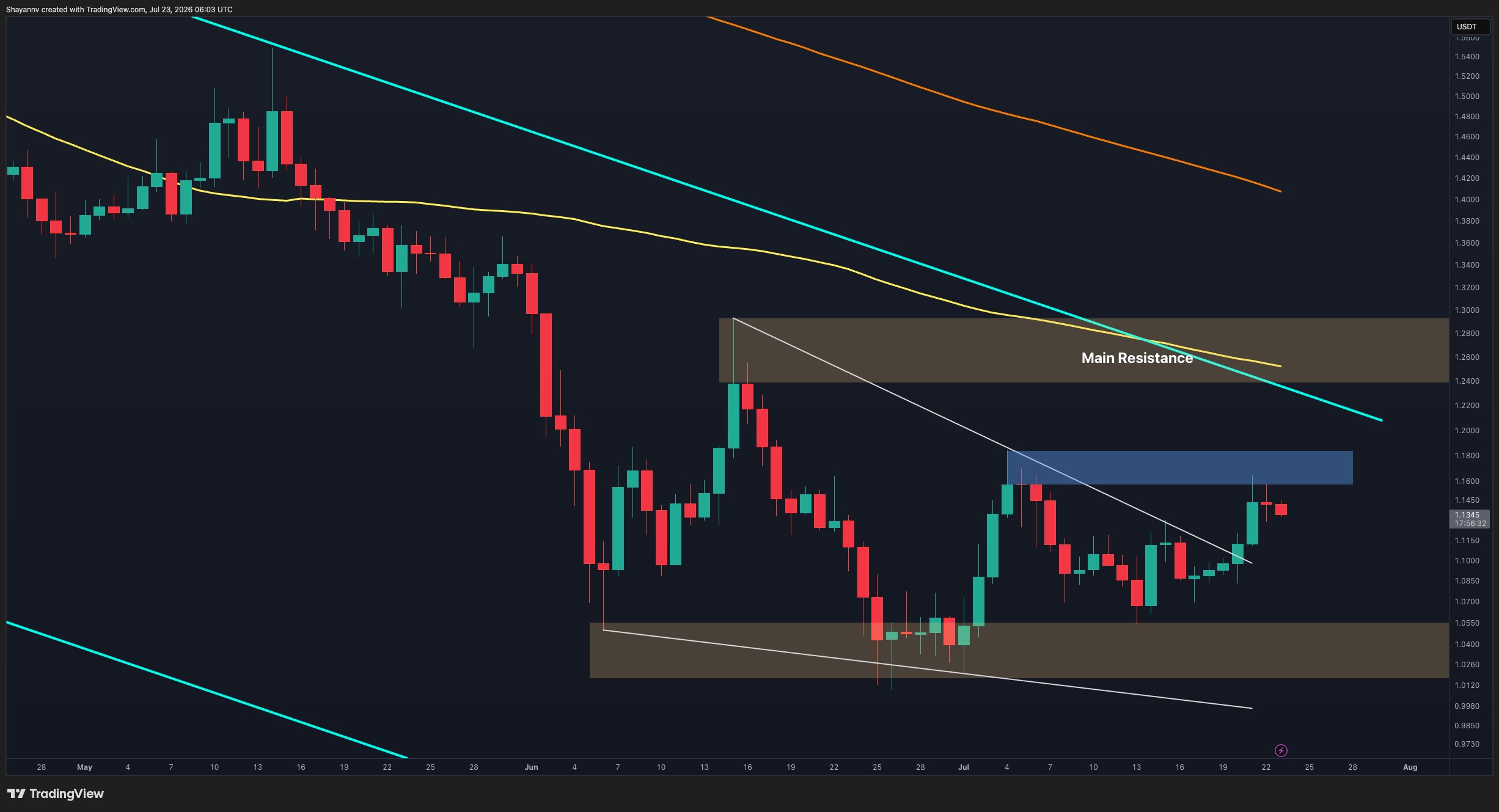
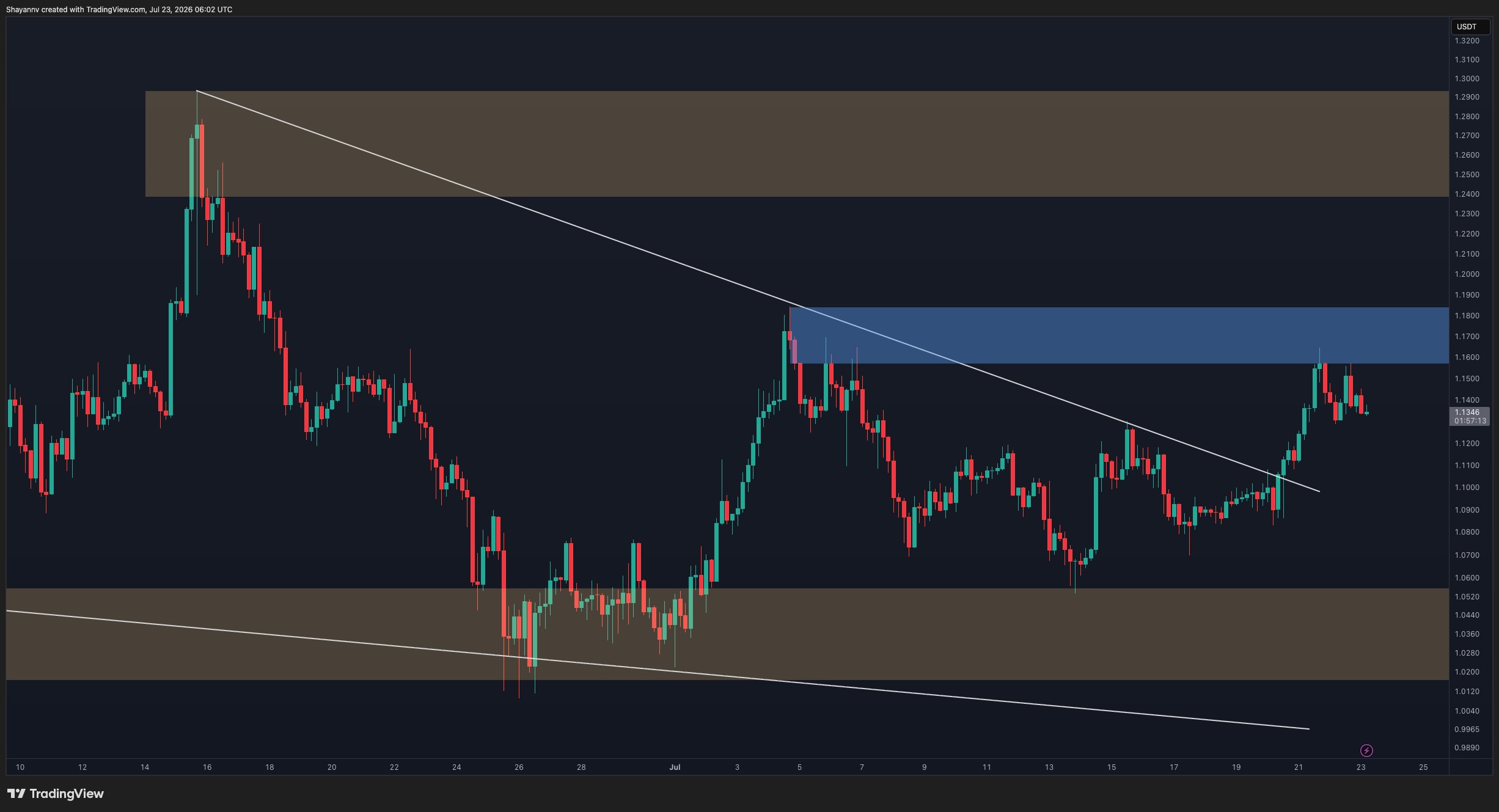
• XRP gained 1.6% over the session, recovering from lows near $1.09 and climbing back toward $1.14.
• The strongest move came during the 22:00 UTC session, when volume surged to 145.3 million XRP and pushed price through resistance near $1.1350.
• Momentum faded into the close, with XRP slipping from $1.1488 to $1.1386 before buyers stepped back in near support.
Technical Analysis
• The bigger story is that XRP remains trapped inside a descending channel despite the bounce. The recovery eased immediate downside pressure but did not break the broader pattern of lower highs.
• The RSI has fallen to one of its most oversold readings since before the November 2024 rally, a sign that selling may be becoming exhausted.
• Exchange outflows and ETF inflows continue to point toward accumulation beneath the surface, but price action still resembles a market trying to find a floor rather than one beginning a new uptrend.
• The bounce from $1.09 matters because it showed buyers are willing to defend the area, though follow-through buying remains limited.
What traders should watch
• $1.13-$1.14 is now the key near-term support zone after the latest recovery.
• $1.15 remains the first meaningful resistance level and the upper boundary of the current descending channel.
• A move above $1.20 would be the first sign that XRP is starting to repair the damage from the recent selloff.
• If support near $1.10 fails again, traders are likely to focus on whether the psychologically important $1.00 level becomes the next downside target.
Crypto World
Dollar Strength Returns as Crypto’s Biggest Near-Term Headwind
The US dollar climbed to its highest level in two months, raising fresh risks for Bitcoin (BTC) as markets increasingly price in a Federal Reserve interest rate hike later this year.
Stronger-than-expected US jobs data lifted the greenback and pushed investors toward cash and bonds. That shift leaves higher-risk assets like crypto facing a steeper climb in the near term.
Strong Jobs Data Powers the Dollar
BeInCrypto reported that US nonfarm payrolls increased by 172,000 in May, significantly surpassing market expectations. The stronger-than-expected jobs data pointed to continued resilience in the labor market despite rising energy costs.
Following the release, the US Dollar Index (DXY) closed above 100 for the first time in two months. The rally extended into Monday, with the index climbing to an intraday high of 100.174, its strongest level since April 6. At press time, the DXY was trading at 100.016.
Follow us on X to get the latest news as it happens
Traders quickly adjusted their expectations after the payrolls report. According to CME FedWatch data, markets are now pricing in more than a 70% probability of a Federal Reserve rate hike in December, up from 45% a week earlier.
Why a Strong Dollar Pressures Bitcoin
A stronger US dollar has historically posed challenges for Bitcoin and other risk assets. When the dollar rises, investors often shift capital toward safer, yield-generating assets, reducing demand for speculative investments such as cryptocurrencies.
BeInCrypto has previously reported on the inverse relationship that frequently emerges between the DXY and Bitcoin. Notably, Veteran financial trader Matthew Dixon sees the dollar index at a pivotal level. He argues the move could ripple across Bitcoin and altcoins.
“The inverse relationship isn’t perfect, but over multi-month periods it is quite strong. We are currently at a ‘make or break point on long term DXY which will likely have a serious impact on BTC & ALTs,” he said.
This comes as Bitcoin continues to experience heightened volatility. The cryptocurrency briefly climbed 5% to reclaim the $63,000 level earlier on Monday as geopolitical tensions in the Middle East fueled market swings. However, the rally proved short-lived, with Bitcoin surrendering most of its gains to trade at $62,615 at press time.
Investors are now turning their attention to the Federal Reserve’s mid-June policy meeting under Chair Kevin Warsh. Any hawkish signals suggesting higher interest rates for longer could provide further support for the dollar, potentially creating additional headwinds for Bitcoin and the broader cryptocurrency market
Subscribe to our YouTube channel to watch leaders and journalists provide expert insights
The post Dollar Strength Returns as Crypto’s Biggest Near-Term Headwind appeared first on BeInCrypto.
Crypto World
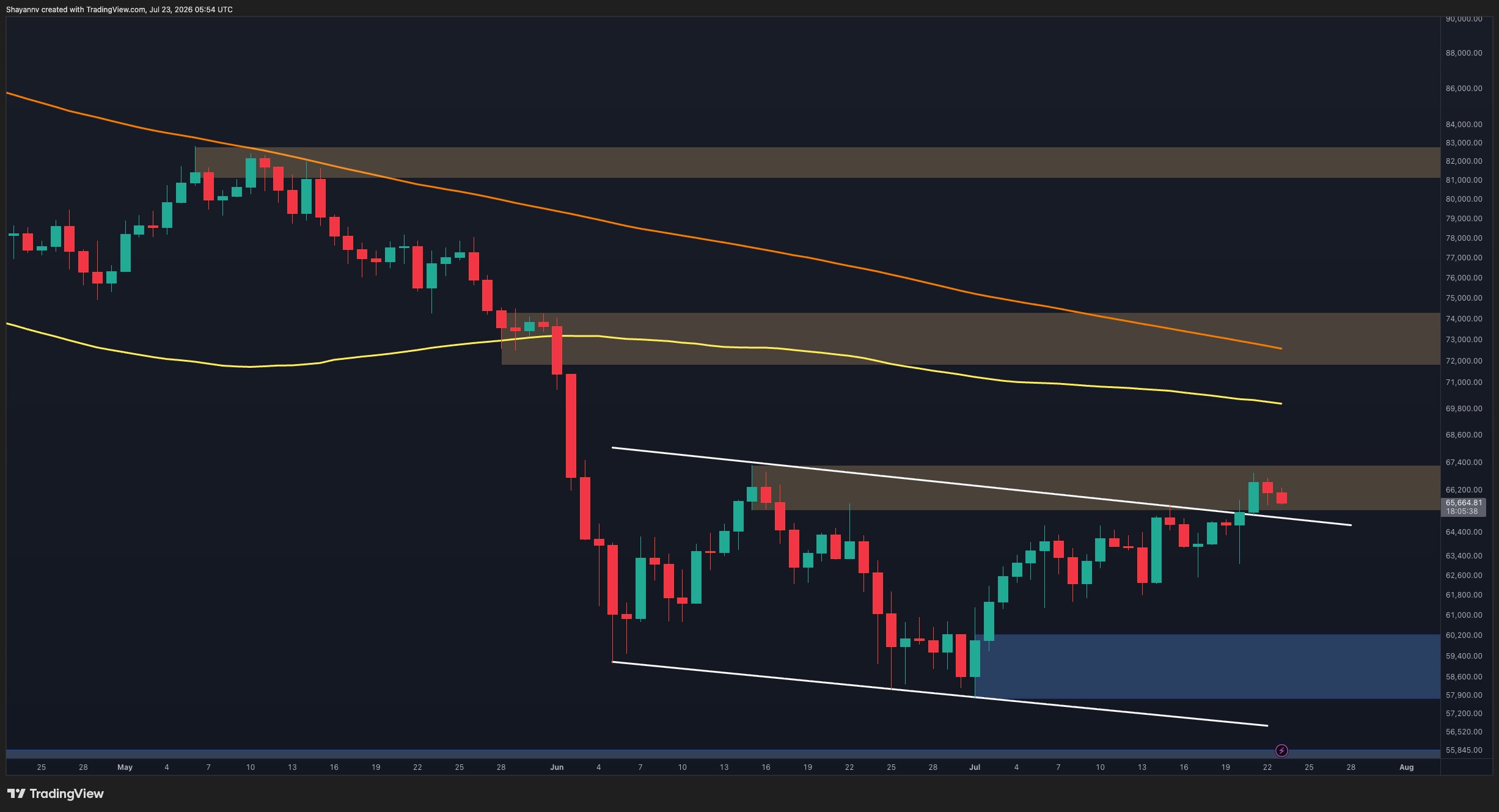
Bitcoin’s rebound triggers the most short liquidations since late April
Bitcoin’s recovery from last week’s lows has crushed the traders who bet against it.
Short sellers, who profit when prices fall, lost $504 million over the 24 hours to Monday morning, the most in a single day since late April, according to CoinGlass. Bets on rising prices lost just $151 million by comparison.
Total liquidations across crypto reached about $655 million and hit more than 104,000 traders. Bitcoin positions accounted for $315 million and ether for $201 million. The single biggest forced closure was a $12.3 million bitcoin futures position on the exchange OKX.
A liquidation is when an exchange automatically closes a leveraged bet that has moved too far against the trader.
The squeeze caps a volatile stretch for the world’s largest cryptocurrency. Bitcoin fell nearly 14% last week and briefly traded below $60,000, dragged down by Strategy’s first bitcoin sale since 2022, the unwind in artificial-intelligence stocks and a record run of outflows from spot bitcoin exchange-traded funds.
Many traders piled into shorts near the lows, then got caught when bitcoin rebounded to a high near $63,800 on Sunday, according to CoinDesk data.
The bounce lost some steam on Monday. Renewed strikes between Iran and Israel sent oil up more than 3% and Asian stocks sharply lower, with South Korea’s KOSPI falling almost 7%. President Donald Trump urged Israel not to retaliate further. Bitcoin slipped back to around $62,900, still well above last week’s floor.
Bitcoin reached as high as $63,700 on Monday morning before retreating, according to CoinDesk data, with volatility likely to stay high ahead of U.S. inflation figures and a wave of major IPOs including SpaceX.
Crypto World
Ethereum just touched $1,500. Is $1,000 next?
Ethereum has fallen to $1,500. In the depths of the June 2026 crypto selloff, ETH briefly touched the $1,500 level, a price last seen in the depths of previous bear markets and roughly 70% below its August 2025 all-time high of $4,953.
Summary
- Ethereum touched $1,500 after falling roughly 70% from its August 2025 all-time high.
- ETH has fallen harder than Bitcoin because of higher beta, weaker ETF demand, and leveraged liquidations.
- A continued Bitcoin decline toward $50,000–$55,000 could pull Ethereum closer to the $1,000 level.
- Bitcoin’s direction, the ETH/BTC ratio, ETF flows, and Fed policy will determine whether $1,500 holds.
The drop has been faster and deeper than Bitcoin’s, and it has pushed at least one analyst to flag the previously unthinkable: a possible decline toward $1,000.
For an asset that traded near $5,000 less than a year ago, the idea of a three in front of nothing is a brutal reset, and it has Ethereum holders asking the only question that matters right now. Is $1,500 the bottom, or a waypoint on the road to $1,000?
The honest answer requires separating the levels that matter, the forces driving the decline, and the specific conditions that would determine which way it breaks. This piece walks through how Ethereum got to $1,500, why it is falling harder than Bitcoin, what would have to happen for $1,000 to come into play, and what would have to happen to prevent it.
How Ethereum got to $1,500
The fall to $1,500 was not a single event but the culmination of a long decline that accelerated into capitulation.
Ethereum peaked at $4,953 in August 2025. From there it entered a grinding downtrend through late 2025 and into 2026, making lower highs and lower lows even as the broader crypto narrative stayed constructive. The June 2026 selloff turned that grind into a collapse.
As Bitcoin broke below $70,000 and then $62,000, Ethereum fell harder, sliding under $1,900, then $1,800, before touching $1,500 at the worst of the washout. That represents roughly a 70% decline from the peak, the kind of drawdown that defines a deep bear market, not a correction.
The immediate triggers were the same forces hammering all of crypto, amplified for Ethereum. A strong U.S. jobs report crushed hopes for near-term Federal Reserve rate cuts, sending risk assets lower across the board. Fresh U.S.-Iran tensions drove a broad risk-off move. U.S. spot Bitcoin ETFs bled through a record outflow streak, and Ethereum ETFs bled alongside them.
More than $1 billion in leveraged crypto positions was liquidated in cascades, with Ethereum longs among the hardest hit. Every one of these pressures pushed Ethereum down, and because ETH amplifies market moves, it fell further than Bitcoin at each step.
The $1,500 touch was the emotional low point, the level where the question shifted from “how far has it fallen” to “how much further can it go.” Reaching a price not seen since previous bear-market bottoms forced a psychological reckoning.
For holders who bought anywhere near the highs, $1,500 represents catastrophic losses, and the appearance of $1,000 price targets in analyst commentary signals that the market is now seriously entertaining scenarios that would have seemed absurd a year ago. To understand whether those scenarios are realistic, it is necessary to understand why Ethereum specifically has been the bigger loser.
Why Ethereum is falling harder than Bitcoin
Ethereum’s steeper decline is not random. It reflects both a mechanical reality and a structural one, and both point to why $1,000 is even being discussed.
The mechanical reason is beta. Ethereum has consistently exhibited higher beta than Bitcoin, meaning it amplifies whatever Bitcoin does in both directions. When Bitcoin rallies, ETH usually rallies more; when Bitcoin falls, ETH usually falls more.
This is because Ethereum sits one rung down the crypto risk ladder, with shallower liquidity and a smaller institutional base than Bitcoin’s “digital gold” position commands. In a risk-off cascade, capital flees the riskier asset first and fastest, so ETH dropped harder at every stage of the selloff. The 70% drawdown versus Bitcoin’s roughly 50% is beta in action.
The structural reason is the ETH/BTC ratio, which has been in a multi-year decline. This ratio measures Ethereum’s value against Bitcoin directly, stripping out the moves that affect all of crypto, and it has been grinding lower since 2021.
The driver is the institutional demand asymmetry. The January 2024 launch of spot Bitcoin ETFs gave Bitcoin a powerful, steady institutional bid that Ethereum’s later ETFs never matched at the same scale. Bitcoin gained a structural class of buyer; Ethereum did not.
When the broad market retreats, Ethereum has less institutional demand underneath it to cushion the fall. That is why it keeps losing ground to Bitcoin in relative terms and why its absolute price has fallen so much further from its peak.
Add the leverage dynamics and the picture sharpens. Ethereum has carried crowded long positioning and faced persistent whale selling through the downturn, and the liquidation cascades of the June selloff hit those crowded ETH longs hard, mechanically accelerating the decline.
Ethereum therefore fell harder for three compounding reasons: it amplifies market moves by nature, it lacks the institutional demand floor that supports Bitcoin, and its leveraged positioning was violently unwound.
Those same factors are why bears can credibly point further down. If the forces that drove ETH to $1,500 persist, the path to $1,000 is not mechanically blocked the way it would be for an asset with a firmer demand floor.
The case for $1,000
The $1,000 scenario is no longer a fringe call, and it rests on a coherent, if grim, logic worth laying out honestly.
The technical case starts with the absence of support. Having broken decisively below the levels that held in previous cycles, Ethereum is in a zone with little historical price structure to lean on.
When an asset falls through its established support levels, the next meaningful floor can be far below because there are few prior buyers anchored at intermediate prices to step in. The $1,500 level itself, once it fails to hold as support, becomes resistance, and the chart opens toward the psychologically significant $1,000 round number with limited technical obstruction in between.
The fundamental case rests on the same structural weakness that drove the decline. If the institutional demand asymmetry persists, with Bitcoin holding its ETF bid while Ethereum’s flows stay weak, and if the broader macro environment stays hostile with no Fed rate cuts and continued risk-off pressure, then nothing changes the dynamic that has driven ETH down.
The ETH/BTC ratio could keep grinding lower. In a scenario where Bitcoin itself falls toward the $55,000 or even $50,000 levels that some analysts flag, Ethereum’s higher beta would drag it proportionally further down, with $1,000 becoming a natural consequence of a deeper Bitcoin decline rather than an independent event.
The behavioral case is capitulation dynamics. Deep bear markets tend to overshoot to the downside, falling further than fundamentals justify as fear, forced selling, and exhaustion compound.
If the current selloff has more capitulation left to run, ETH could spike toward $1,000 in a final washout even if it does not stay there. The appearance of $1,000 targets in analyst commentary reflects this: it is not necessarily a prediction that Ethereum settles at $1,000, but a recognition that in a continued bear scenario, the combination of no support, persistent structural weakness, and capitulation overshoot could tag that level.
The bears are not being absurd. They are extrapolating the forces that are visibly in control.
The case against $1,000
The bull rebuttal is equally real, and it rests on the argument that the forces driving ETH down are cyclical rather than permanent, and that $1,500 is closer to a bottom than a waypoint.
The valuation case is that $1,500 already prices in enormous pessimism. A 70% drawdown from the peak is, historically, the kind of decline that has marked bear-market bottoms rather than midpoints.
Ethereum at $1,500 trades at a level that long-term holders and value-oriented buyers may see as deeply discounted relative to the network’s actual usage, developer activity, and position as the dominant smart-contract platform. The deeper the price falls below any reasonable estimate of fundamental value, the stronger the incentive for accumulation, which builds a floor.
The fundamental case is that Ethereum’s underlying position has not broken. It remains the leading smart-contract platform, the settlement layer for the largest share of decentralized finance and tokenized assets, and the base layer for a growing ecosystem of Layer-2 networks.
Its development continues, with scaling and efficiency upgrades on the roadmap, and the emergence of Ethereum treasury companies accumulating ETH introduces a new structural demand source that did not exist in previous cycles.
The treasury-company thesis, however, is under pressure from the decline. BitMine was reportedly sitting on roughly $9.58 billion in unrealized ETH losses, while SharpLink’s ETH position was down about $1.59 billion as the market fell. The losses do not automatically mean those firms must sell, but they show that the new demand source also carries balance-sheet risk when ETH declines.
If those treasury vehicles continue accumulating and the institutional demand gap with Bitcoin narrows, the structural weakness that drove the decline could begin to reverse, putting a floor under the price well above $1,000.
The macro case is that the entire selloff is hostage to forces that can turn. The decline has been driven heavily by the hawkish Fed outlook, the Iran risk-off move, and the AI-driven capital rotation away from crypto. None of those is permanent.
A Fed pivot toward rate cuts, an easing of Middle East tensions, or a cooling of the AI trade would relieve the pressure that drove ETH to $1,500. Because Ethereum amplifies moves in both directions, a market recovery would lift ETH faster than Bitcoin.
In the bull scenario, $1,500 marks the capitulation low of a cyclical bear market, and the same high beta that made the fall so brutal makes the eventual recovery sharp. The bulls are betting that the forces in control today are temporary and that betting on $1,000 means betting they persist indefinitely, which they rarely do.
What actually determines which way it breaks
Rather than guess, the useful approach is to identify the specific signals that distinguish the $1,000 path from the $1,500-was-the-bottom path, because they are different and observable.
The first is Bitcoin’s direction because ETH is currently trading as a high-beta bet on Bitcoin more than as an independent asset. As long as Bitcoin keeps falling, Ethereum’s beta means it will keep falling harder, and a Bitcoin decline toward $55,000 or $50,000 would likely drag ETH toward $1,000 mechanically.
If Bitcoin stabilizes and holds support, the single biggest downward force on Ethereum eases. Watch Bitcoin first; it tells you more about ETH’s near-term path than anything Ethereum-specific.
The second is the ETH/BTC ratio. This is the cleanest measure of whether Ethereum’s structural weakness is continuing or reversing.
If the ratio keeps grinding lower, Ethereum is still losing the relative-strength battle and the bear case has the upper hand. If it stabilizes and turns up, it signals that the institutional demand gap may be narrowing, which would support the bottom thesis.
The ratio is the dividing line between “ETH is just falling with the market” and “ETH is structurally broken.”
The third is the macro turn, specifically the Fed and the flow data. Because the selloff is heavily macro-driven, the signals that would flip the picture are a shift in rate-cut expectations and a reversal in ETF flows from outflows back to sustained inflows.
A Fed pivot or a series of softer inflation prints would relieve the pressure on all risk assets, and Ethereum ETF inflows turning positive would signal the institutional demand base is finally building.
Until those indicators turn, the forces that drove ETH to $1,500 remain in control, and the $1,000 scenario stays live.
The honest synthesis is that $1,500 is a genuine inflection point where both scenarios are credible. The broader context tilts the odds toward caution in the near term while leaving the bull case intact over a longer horizon.
In the near term, with Bitcoin still weak, the macro environment hostile, and the ETH/BTC ratio depressed, the forces that would carry Ethereum toward $1,000 are the ones currently in control. A further leg down cannot be dismissed, and the $1,000 targets deserve to be taken seriously rather than waved away.
Over a longer horizon, a 70% drawdown in the leading smart-contract platform, with intact fundamentals and a new treasury-demand source emerging, is the kind of setup that has historically rewarded patient accumulation once the macro turns.
The practical reading for a holder is that $1,500 is not a number to anchor to either as a guaranteed floor or a doomed level. It is the point where Ethereum’s fate splits, and which path it takes will be determined by Bitcoin’s direction, the ETH/BTC ratio, and the macro turn, not by where the price sits today.
Watch those three, not the round numbers.
This article is for informational purposes and does not constitute financial or investment advice. Cryptocurrency markets are highly volatile and price predictions are inherently speculative. The figures and analysis described reflect data available as of June 2026. Always do your own research and consult with qualified financial professionals before making investment decisions.
Crypto World
Gold Just Erased Its 2026 Gains But Four Banks Agree on What Comes Next
Gold just hit its lowest point of 2026, and the institutions that called the bull run are not flinching. It was triggered by the latest jobs report: the US economy added 172,000 jobs in May, nearly double the 85,000 analysts had forecast.
That single number sent the dollar higher, pushed bond markets to price a 68% chance of a Fed rate hike by December, and dropped gold 3.27% to $4,339, erasing all its gains for the year in a single session.
As BeInCrypto’s tracker of 2026’s top-performing assets showed, gold had been leading the field before this week’s reversal.
Why the US Jobs Report Drove Gold Price Down
When rate-hike odds rise, Treasury yields rise, and the cost of holding gold over a yield-generating bond increases. The Federal Reserve’s narrative has now fully reversed: markets entered 2026 pricing three rate cuts, and they now price a hike.
Cleveland Fed President Beth Hammack said the central bank may need to act soon to bring inflation back to 2%.
Additionally, the metal tracks rate policy more closely than almost any other macro variable.
What Goldman Sachs, JPMorgan, Deutsche Bank, and UBS Say About Gold Now
The sell-off has not moved Wall Street’s year-end views. Goldman Sachs holds a $5,400 year-end target.
JPMorgan puts the year-end case at $6,000 to $6,300, Deutsche Bank at $6,000, and UBS at $5,900.
All four see between 23% and 44% upside from current levels. Their shared thesis is that central bank buying, the structural shift by sovereign funds away from dollar-denominated reserves, and a geopolitical risk premium that Federal Reserve rate policy alone does not erase.
When Wall Street first set these targets, demand from non-Western central banks had reshaped the gold market, making it behave differently from previous cycles.
If the four banks are right, this week’s sell-off is the discount. If the Fed hikes and holds, gold’s structural bull case faces its first real test of 2026.
The post Gold Just Erased Its 2026 Gains But Four Banks Agree on What Comes Next appeared first on BeInCrypto.
Crypto World
HTX Delists Trump Family’s USD1 Token Amid Asset-Freeze Dispute
HTX, the crypto exchange linked to Justin Sun, has delisted the USD1 stablecoin issued by World Liberty Financial (WLFI) after asserting that WLFI froze HTX on-chain addresses in a sanctions-related review. In its update, HTX said WLFI’s project team unilaterally imposed a freeze on specific HTX on-chain addresses, restricting the on-chain circulation of WLFI assets tied to those addresses. As a result, HTX stopped accepting deposits or conversions of USD1 and announced a 1:1 conversion of USD1 holdings into Tether (USDT), with exact timing and procedures to be announced later. The exchange also suspended trading pairs involving USD1 or WLFI and stated it would pursue safeguards for user assets through potential legal remedies.
HTX’s decision arrives amid heightened regulatory pressure on crypto platforms in Europe and beyond. In late May, the United Kingdom designated HTX (formerly Huobi Global) under sanctions criteria, citing “reasonable grounds to suspect” that the exchange had supported Russia’s government through financial services. HTX has maintained that the sanctioned entity is Huobi Global S.A., distinct from the online HTX exchange, and that the UK designation should not impact HTX’s platform or user funds. The delisting underscores how sanction compliance and complex corporate structures can translate into rapid on-chain and trading frictions for users.
Key takeaways
- HTX delists World Liberty Financial’s USD1 stablecoin and halts USD1-related deposits, conversions, and several trading pairs, citing a WLFI-initiated address freeze.
- USD1 holdings on HTX will be converted 1:1 into USDT, with further timing details to be announced separately.
- HTX accuses WLFI of freezing addresses without adequate notice, contractual basis, or due process, and says it may pursue legal remedies to protect users.
- UK sanctions on HTX in May 2024 highlight the broader regulatory backdrop facing exchanges linked to high-profile personalities and political figures, though HTX asserts the sanctioned entity is distinct from the live exchange.
- Public cross-lawsuits frame a tense web: Justin Sun has previously sued WLFI over token freezes, while WLFI alleged defamation in a separate filing—illustrating how reputational and legal battles intersect with stability and compliance issues.
HTX delisting: how the dispute unfolded and what changes for users
In an official post, HTX stated that WLFI’s team “unilaterally imposed a freeze on specific HTX on-chain addresses based on sanctions compliance reviews.” The consequence, according to HTX, is a restriction on the on-chain circulation of WLFI assets associated with those addresses. To protect users, HTX decided to delist USD1 and to convert existing USD1 holdings into USDT at a 1:1 ratio. The exchange emphasized that the exact timing and mechanics of the conversion would be announced separately, but the immediate effect is a pause on deposits and conversions of USD1, as well as the suspension of WLFI/USDT, USD1/USDT, BTC/USD1 and ETH/USD1 trading pairs.
HTX’s statement also criticized WLFI for acting without sufficient prior communication, adequate contractual or legal grounds, or transparent disclosure. The exchange signaled that it would explore legal avenues to safeguard user rights and assets, indicating a possible broader legal battle should WLFI stand by the freezing action. This move reflects a broader tension inside the crypto liquidity ecosystem: sanctions compliance can collide with user rights and the integrity of on-chain assets, pushing platforms to make rapid, user-visible changes to stablecoins and trading liquidity.
Regulatory backdrop: sanctions, statements, and the path forward
The UK’s sanction action against HTX in May 2024 serves as a backdrop to HTX’s decision to delist USD1. The British government cited “reasonable grounds to suspect” that HTX had supported Russia’s government through financial services. HTX has asserted that Huobi Global S.A., the entity named in the designation, is a distinct corporate entity from the online HTX exchange. The company argued that such a designation should not automatically impact its platform or its users, yet the incident adds pressure on exchanges to maintain compliance while preserving user assets and liquidity.
World Liberty Financial has not publicly confirmed whether it froze HTX addresses. WLFI’s public statements, however, have underscored a stance on sanctions compliance. On X, WLFI stated that “in light of recent sanctions updates, World Liberty Financial maintains risk-based sanctions compliance controls.” The project has yet to provide detailed commentary on the HTX matter, and Cointelegraph notes that it contacted WLFI for comment. The lack of immediate public disclosure from WLFI leaves a gap in understanding the full scope of the address freezes and their rationale, complicating the assessment of responsibility and due process in the process.
Beyond this specific incident, the broader dispute intersects with ongoing personal and legal frictions between Justin Sun and WLFI. Sun, a crypto entrepreneur associated with HTX and serving on the exchange’s global advisory board, has previously pursued civil action against WLFI, alleging that WLFI froze his tokens and threatened to burn them “without any proper justification.” WLFI later countered with a defamation lawsuit against Sun, alleging false statements about WLFI’s token sale practices and alleged prohibited transfers. These overlapping lawsuits highlight how reputational and contractual disputes can evolve alongside regulatory actions, potentially impacting liquidity, market perception, and user confidence in affiliated platforms.
Market impact and investor perspective: what this means for users and builders
While the immediate action centers on USD1 and related WLFI assets, the episode raises several questions for investors, traders, and developers building on or around WLFI-linked instruments. First, the incident underscores the fragility of stablecoins and on-chain assets when sanction screens intersect with exchange-level enforcement. A unilateral address freeze, followed by asset delistings, can squeeze liquidity and complicate exit possibilities for users who hold instruments pegged to WLFI or USD1. Traders who previously relied on USD1 liquidity on HTX will need to adapt to convert liquidity into USDT, potentially widening spreads between WLFI-related pairs and other stablecoins until liquidity rebalances elsewhere.
Second, the episode illustrates how jurisdictional sanctions risk translates into operational risk for exchanges. HTX’s readiness to delist and convert holdings signals a risk-management approach aimed at protecting users, but it also introduces uncertainty for users who may have been holding USD1 or WLFI assets across multiple venues. The UK sanction action against HTX, while contested in terms of its impact on the online platform, contributes to a broader environment in which exchanges must balance regulatory compliance with user rights and asset usability.
For builders and auditors, the situation highlights the importance of transparent governance and clear communications around sanctions-driven actions. As WLFI and HTX navigate legal actions and potential regulatory clarifications, projects issuing on-chain tokens tied to financial instruments will benefit from robust dispute-resolution mechanisms, explicit on-chain freeze procedures, and predictable paths for user redress when asset freezes occur. The absence of a standardized framework for addressing such freezes can increase confusion and erode trust during already volatile periods in the crypto market.
What comes next: unresolved questions and watchpoints
Key questions remain about how WLFI will address HTX’s allegations of improper freezing, whether WLFI will provide detailed disclosures about the affected addresses, and how the conversion process from USD1 to USDT will unfold in terms of timing, fees, and eligibility. The UK sanction action against HTX adds a layer of regulatory scrutiny that may influence how other exchanges approach similar scenarios, especially when there are concerns about the delineation between sanctioned entities and live platforms. As the legal dispute between Sun and WLFI develops, readers should monitor whether additional lawsuits emerge and how courts interpret sanctions compliance, due process, and the protection of user assets in cross-border crypto arrangements.
For now, users of HTX holding USD1 or WLFI-linked assets should stay alert to further notices from HTX regarding conversion timelines, deposit options, and new trading restrictions. As WLFI responds and regulators weigh next steps, the market will be watching closely for the emergence of any precedent that could shape how stabilizers and sanction screening interact with on-chain asset flows in the months ahead.
Sources: HTX official post on X; UK sanctions update on HTX; World Liberty Financial statements on X; prior reporting on Justin Sun’s suits against WLFI and WLFI’s defamation suit against Sun.
-
Fashion3 days agoWeekend Open Thread: Evereve – Corporette.com
-
Business6 days agoJade Biosciences, Inc. (JBIO) Discusses Positive Interim Results From JADE101 Phase I Healthy Volunteer Study and Development Plans Transcript
-
Crypto World3 days ago
Jensen Huang Approves Samsung, SK Hynix, and Micron for NVIDIA (NVDA) HBM4 Memory Supply
-
Sports5 days agoFrench Open 2026 results: Alexander Zverev beats Rafael Jodar and will play Jakub Mensik in semi-finals
-
Tech6 days agoCryZENx Releases Fresh Playable Content Deep Inside Jabu-Jabu for His Ocarina of Time Remake
-
Business5 days agoTrump Taps Housing Chief Bill Pulte as Acting Intelligence Director After Gabbard Exit
-
Business1 day agoThe Pain Points Taking a Fragile Tech Rally Down a Notch
-
Crypto World3 days ago
LBank Surpasses 25 Million Users Worldwide as AFA Partnership Continues to Drive Global Growth
-
NewsBeat5 days agoRepublicans balk at Trump’s attempt to appoint a MAGA enforcer to lead National Intelligence
-
Tech3 days agoRCS Messages Between iPhone and Android Get End-to-End Encryption With iOS 26.5
-
Crypto World6 days ago
Seagate (STX) Stock Surges to Record High on AI Boom and Legal Settlement
-
Tech3 days agoMicrosoft launches MXC, an OS-level sandbox for AI agents, with OpenAI and Nvidia already on board
-
Tech3 days agoMeta steals a tactic from Tesla and builds data centers in tents
-
Crypto World5 days agoEU AI Data Center Project Faces Delays as Funding Gaps Grow
-
Entertainment5 days agoDid The Mandalorian And Grogu Already Ruin The Next Star Wars Movie?
-
Business5 days agoAehr Test Systems Stock Soars 17% Amid Surging AI Demand and Conference Spotlight
-
Crypto World3 days ago
Merlin (MRLN) Stock Soars 32% on Major USSOCOM Autonomy Milestone
-
Business6 days agoClaude AI Down Today Reason: Why Anthropic’s AI is not working today? What’s the latest quota update
-
Business1 day agoCryptos Could Be Casualties of SpaceX IPO as Bitcoin Hits Lowest Price Since 2024
-
Tech5 days agoInstagram will stop bombarding teens with the same kind of obsessively unhealthy content

You must be logged in to post a comment Login