
Crypto World
Major Pi Network Update Introduced as PI Fights for Key Support


While the vast Pi Network community anticipates an official confirmation of the successful deployment of protocol version 26, the Core Team actually surprised them by announcing that the Pi Node version 0.6.2 has been released.
Here’s what it means for the project, how Pioneers can benefit, and what’s next.
New Pi Node Version Is Here
The post on the only official X channel associated with the popular project informed that the new node version introduces improvements to SoloHost, node connectivity, and the Pi Desktop user experience. The team said five volunteer Node operators participated in an initial distributed computing test and all received jobs, performed the required computations, and returned the results to a Pi coordinator.
The test represents another step toward Pi’s plan to use the spare computing capacity of its node network for AI and other compute-intensive applications. The project currently has a network of claimed 420,000+ Pioneer-operated computers. The idea is that third-party clients could eventually tap into those resources, while participating node operators could be compensated in the native token for providing computing power.
The future is not yet a fully operational distributed computing marketplace. The latest experiment involved only five volunteers and is part of the project’s broader effort to develop the infrastructure into something usable by external clients.
Node 0.6.2 also introduced UPnP support, designed to make it easier for operators to automatically configure the ports required by Pi Desktop, alongside a new port checker and several SoloHost improvements.
Meanwhile, if you are curious about Pi Network’s latest initiatives, you can check our dedicated article here.
PI Price Update
It was a month ago when the native token slumped to its latest all-time low of $0.07. It rebounded swiftly and challenged the $0.10 resistance within days, but it was expectedly rejected given the current market state and its overall performance in the past year.
Although it dropped below $0.075 once again by the end of the month, the bulls ultimately stepped up and helped it reclaim the $0.08 level. It even tapped $0.094 days ago, but it was stopped again and now sits around $0.09 but on the wrong side.
Its market cap remains below $1 billion, while the upcoming token unlock by the end of the year spells trouble as the immediate selling pressure could intensify soon again.
The post Major Pi Network Update Introduced as PI Fights for Key Support appeared first on CryptoPotato.

Crypto World
Dow Jones Futures: Market Ready To Run? Sandisk Soars, Nvidia In Buy Area; Walmart, Target Due

Dow Jones futures will open Sunday evening, along with S&P 500 futures and Nasdaq futures. Walmart, Target and Ross Stores headline a big week of retail earnings. Viking Holdings and Alibaba (BABA) also are on tap. The stock market rally can’t quite decide if it’s ready to rev up again. The S&P 500 hit a new high Thursday. But a…
Copyright ©2026 Investor’s Business Daily, LLC. All rights reserved. 87990cbe856818d5eddac44c7b1cdeb8
Bitcoin could bottom in October before recovering to around $130,000 ahead of the 2028 halving, according to Swan Bitcoin CEO Cory Klippsten.
Bitcoin’s (BTC) price peaked above $126,000 in early October 2025, meaning that the “market should bottom in October,” Klippsten told Cointelegraph.
He argued that Bitcoin has so far bottomed about 12 months after each previous bull market peak, while cautioning against extrapolating from only a few previous cycles.
Klippsten’s prediction for an October bottom builds on a June interview with Cointelegraph, when he said Bitcoin may bottom earlier than in previous cycles as long-term holders accumulated a record share of supply, or 14.7 million BTC.
In the latest interview, Klippsten said Bitcoin could fall to $57,000, or even $53,000, before a quick recovery, and could reach around $130,000 ahead of the 2028 halving.
Other analytics providers are eyeing an earlier bottom. Markus Thielen, founder of 10x Research, said that Bitcoin could confirm a bear-market bottom in August with a monthly close above $63,000, which would turn several of the analytics firm’s cycle indicators bullish.
Related: H100 becomes Europe’s No. 2 Bitcoin treasury after 2,455 BTC deal
Altcoins are dead as money, crypto will become TradFi
Klippsten said altcoins are “basically dead” as competitors to Bitcoin as money, arguing that the best outcome for crypto and decentralized finance (DeFi) is to “become part of TradFi.”
When asked about his thoughts on altcoins that may outperform the broader market, Klippsten pointed to Hyperliquid, arguing that centralized crypto businesses will eventually be brought under traditional finance regulation.
“Hyperliquid is a business and it has a token. If it’s a business that’s centralized, it will eventually just get sucked up by TradFi and be thought of as an exchange and a bank.”
Hyperliquid generated $5.9 million in revenue during the past week, ranking as the industry’s fifth-largest DeFi protocol by weekly revenue, according to DefiLlama.
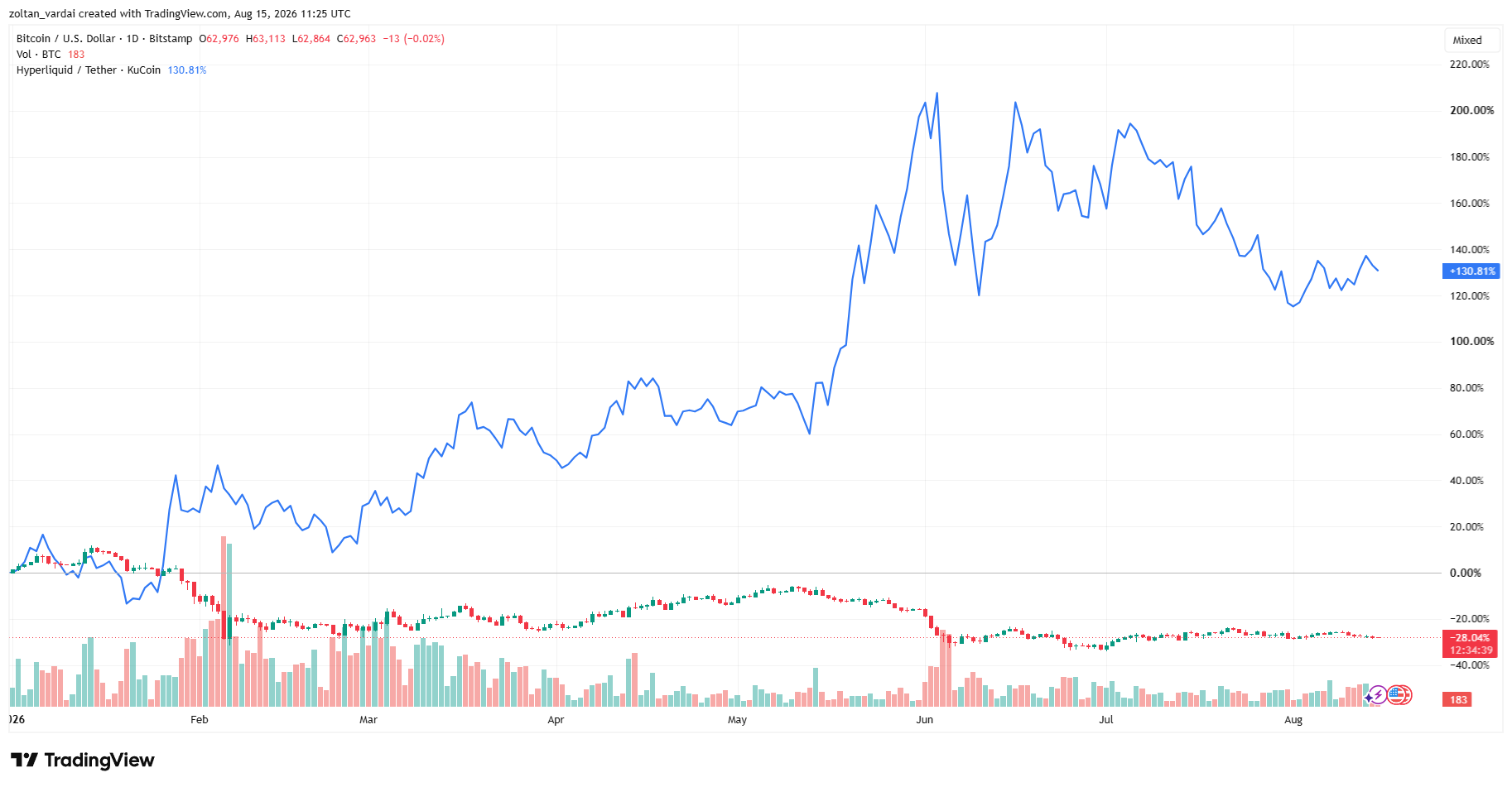
The Hyperliquid (HYPE) token rose 130% year-to-date, while Bitcoin’s price fell 28% during the same period, TradingView data shows.
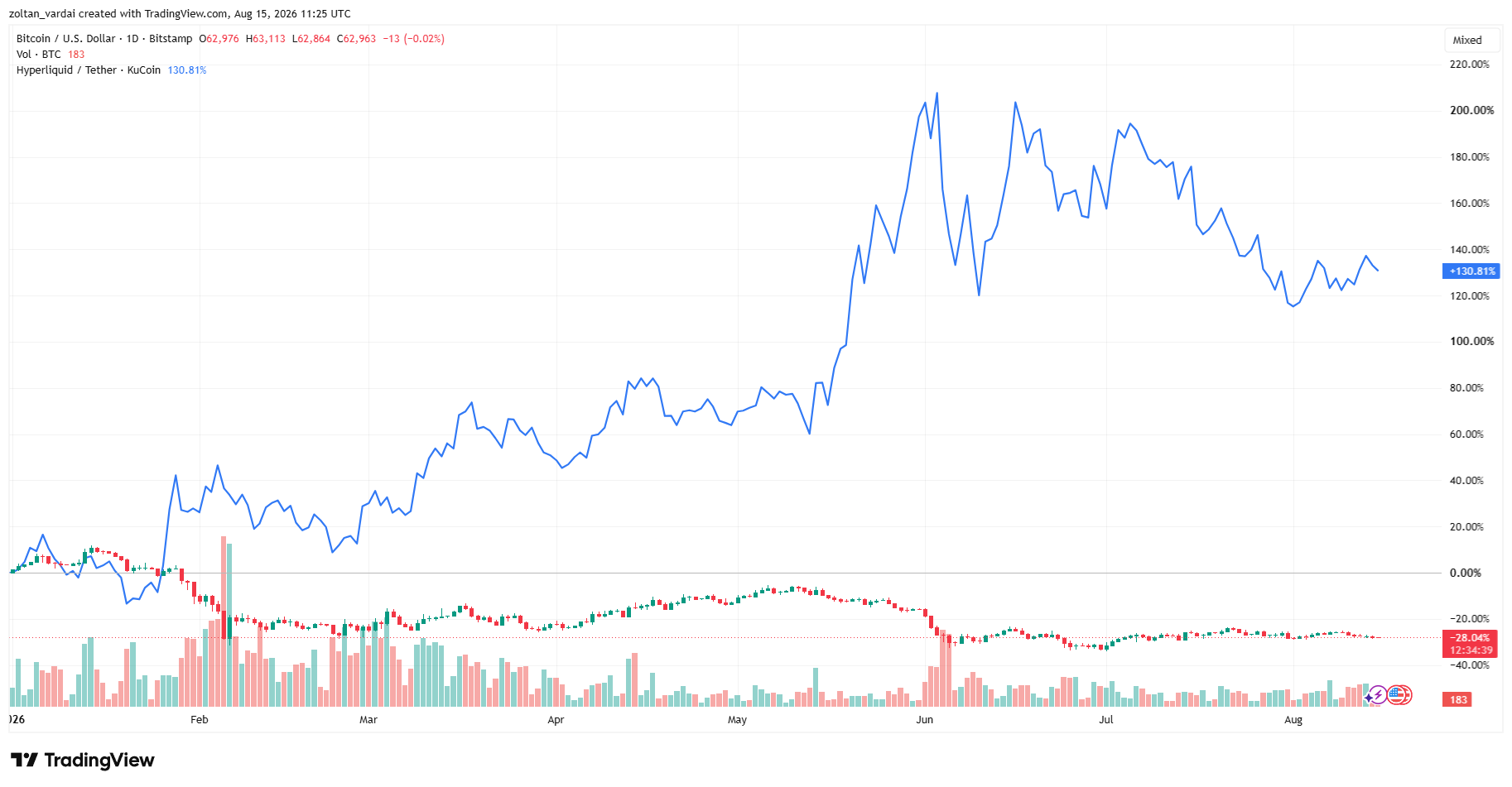
BTC and HYPE tokens, year-to-date chart. Source: Cointelegraph/TradingView
In a July report, crypto market maker Wintermute argued that the growing presence of institutional investors has changed the dynamics of altcoin markets, resulting in altcoin rallies becoming narrower and more selective. Wintermute said liquidity was concentrating in the assets institutions favored while activity across the market’s “long tail” weakened.
Magazine: Bitcoiners turn to dice throws as self-custody setups are re-evaluated
Disclosure: This article does not represent investment advice. The content and materials featured on this page are for educational purposes only.
CLARITY Act passage odds have dropped below 20% on Polymarket as XRP volatility drives renewed interest in UE Crypto’s cloud mining and yield services.
Summary
- XRP weakens as CLARITY Act odds fall, while investors turn to UE Crypto’s cloud mining and yield options.
- With CLARITY Act uncertainty weighing on XRP, UE Crypto is drawing interest from holders seeking alternative returns.
- Fading CLARITY Act expectations have pressured XRP, prompting some investors to explore UE Crypto’s cloud mining platform.
The probability of the CLARITY Act passing on Polymarket has plunged from 82% to below 20%. Can September 15 save the bill?
Amid XRP price volatility, market uncertainty, and the market fog surrounding the Digital Asset Market Clarity Act, XRP continues to show weakness, while UE Crypto’s cloud mining platform and stable yield mechanism have attracted significant attention from investors.
XRP has underperformed the broader cryptocurrency market, while investors’ interest in UE Crypto’s cloud mining and yield mechanisms has been reignited.
Faced with XRP price volatility and the market uncertainty surrounding the Digital Asset Market Clarity Act, an increasing number of XRP investors are turning their attention to UE Crypto in an effort to hedge against market risks.
UE Crypto positions its cloud mining platform as a new option for XRP holders, aiming to provide them with additional digital asset returns rather than relying solely on price appreciation.
Among the assets most closely linked to the market structure adjustments of the U.S. Securities and Exchange Commission (SEC) and the Commodity Futures Trading Commission (CFTC), XRP has already reflected the impact of this delay in its price. XRP is expected to directly benefit from the formal establishment of its classification as a digital commodity under CFTC regulation, but as the timeline has been delayed, inflows into its ETFs have also slowed.
This dynamic has been detailed in the article and is related to reduced XRP ETF inflows caused by uncertainty surrounding the CLARITY Act. This pattern has reappeared after every procedural setback, including the immediate price reaction previously recorded when the Senate vote was postponed.
Spot trading volume remains light, while a narrowing intraday trading range indicates that buyers have yet to demonstrate sufficient confidence. Daily trading volume stands at $885 million, down from $905 million yesterday, indicating that trader interest is weakening.
Last week, XRP fell -2%, while Bitcoin fell -0.28% and Ethereum fell -0.3%, making XRP one of the worst performers among major cryptocurrencies. Therefore, this sell-off is specific to XRP rather than a broader correction across the cryptocurrency market.
XRP’s only anticipated catalyst remains stalled. The CLARITY Act, which is intended to classify XRP as a federal commodity, missed the voting window before the Senate’s August recess and is now scheduled for a procedural vote on September 15. As a result, XRP’s price currently has no upward momentum for the next month.
The reason may be the current lack of market transparency — or, more specifically, the delay of the long-awaited Digital Asset Market Clarity Act.
As investors explore cloud mining and yield mechanisms, XRP’s price weakness has driven increased interest in UE Crypto.
Amid continued market volatility, XRP holders seeking cloud mining and yield strategies continue to show interest in UE Crypto.
As of August 15, 2026, the current price of XRP (XRP) is $1.00. Over the past 24 hours, the price has fallen by 0.1%, while the price movement over the past hour was 0%. From a longer-term perspective, the price fluctuation over the past 7 days was -3.3%, while the price fluctuation over the past month was -9.3%. Among the top ten cryptocurrencies by market capitalization, XRP recorded the largest seven-day decline, falling by -9.3%, while the overall market remained largely flat. The token’s price action appears to indicate that the Clarity trade is gradually being unwound.
Affected by market sentiment, XRP fell to a recent low, causing its market capitalization to shrink significantly and temporarily losing its position as the world’s fourth-largest digital asset. The increase in short-term volatility has prompted some investors to reassess their future XRP investment strategies.
Meanwhile, market traders are closely watching the upcoming period from September to October, when the CLARITY Act is expected to reach a decisive outcome. The implementation of this major regulatory catalyst is bound to have a strongly polarized impact on future market sentiment. However, before this critical legislative window arrives, the broader market remains trapped in a range-bound pattern, while XRP is also showing a stagnant consolidation pattern characterized by low trading volume and declining turnover.
To hedge against market risks, the UE Crypto cloud mining digital asset platform has attracted increasing attention from investors. Through its innovative underlying cloud computing architecture and yield aggregation mechanism, the platform aims to hedge against market volatility and improve returns.
As XRP volatility increases, UE Crypto has become a new option for investors.
Given the recent increase in XRP price volatility, more and more XRP holders are turning their attention to UE Crypto. Unlike highly volatile leveraged trading or strategies that rely solely on price appreciation, UE Crypto’s cloud mining platform provides a more convenient way to participate in digital assets. Users do not need to deploy mining machines or maintain hardware; they only need to select a computing power contract to participate in mining services. This allows them to focus on the long-term prospects of XRP while maximizing the benefits of their digital assets.
About UE Crypto
UE Crypto is headquartered in the United Kingdom and operates within European regulatory frameworks such as MiCA and MiFID II, continuously improving its transparency, operational standards, and user protection mechanisms.
The platform adopts a multi-layer security architecture, including:
- Annual financial and security compliance audits conducted by PwC.
- Digital asset custody insurance provided by Lloyd’s of London.
- Enterprise-grade network protection from Cloudflare and McAfee® security systems.
- Bank-grade data encryption and professional security infrastructure to provide multiple layers of protection for users’ assets and accounts.
UE Crypto supports a range of mainstream digital assets, including XRP, BTC, ETH, USDT, USDC, DOGE, LTC, and SOL, providing users with a more flexible and convenient digital asset service experience.
Start earning daily returns in just three steps
1. Register an Account
2. Choose a Mining Package
Choose a suitable cloud mining contract based on personal budget and needs, and start mining with one click.
3. Start Earning
Once the contract is activated, the system will automatically allocate computing power, and returns will be settled automatically every 24 hours. Users can withdraw their earnings at any time or continue participating according to their own needs, thereby achieving long-term compound growth of their assets.
Popular UE Crypto contracts
- BTC (Beginner Experience Contract)Investment amount: $100,
Contract duration: 2 days, Daily return: $4, Total return at contract expiration: $100 + $8 - Dogecoin (DOGE, Digital Intelligent System Contract)Investment amount: $500,
Contract duration: 5 days, Daily return: $6.25, Total return at contract expiration: $500 + $31.25 - BTC (Super Computing System Contract)Investment amount: $1,000,
Contract duration: 10 days, Daily return: $13.10, Total return at contract expiration: $1,000 + $131 - LTC (Algorithm-Driven System Contract)Investment amount: $5,000,
Contract duration: 25 days, Daily return: $72, Total return at contract expiration: $5,000 + $1,800 - BTC (Quantitative Intelligent System Contract)Investment amount: $10,000,
Contract duration: 35 days, Daily return: $158, Total return at contract expiration: $10,000 + $5,530
For more details about the contract plans, please visit the official UE Crypto website.
Overview: XRP’s $1 defense battle may be doomed to fail!
Market sentiment is extremely weak, and XRP is severely lacking reasons to rise ahead of the CLARITY Act vote in September. Whale support may only be temporary, and a break below $1 may already be counting down!
The massive amount of leverage accumulated since August is a double-edged sword. Once the $1 level is lost, a cascade of liquidations across leveraged positions could trigger an unforgiving sell-off, causing the decline to accelerate beyond everyone’s expectations.
Stop holding on blindly and switch tracks! The era of simply holding coins and waiting for a massive price surge is already over. Before the storm arrives, XRP holders have already begun turning their attention toward more diversified cloud mining digital asset platforms.
UE Crypto’s cloud mining digital asset platform has a yield mechanism that differs from highly volatile leveraged trading or strategies that rely solely on price appreciation. UE Crypto’s cloud mining services provide users with a low-risk, long-term alternative for participating deeply in the digital asset ecosystem, helping investors move away from short-term market noise, focus on the long-term value of their assets, and establish more resilient and sustainable passive income.
XRP falling below $1 is no longer the beginning of a loss, but the golden opportunity to join UE Crypto and unlock a whole new path to wealth growth.
Disclosure: This content is provided by a third party. Neither crypto.news nor the author of this article endorses any product mentioned on this page. Users should conduct their own research before taking any action related to the company.


That may happen. But last week showed that right now, institutions are choosing selectively.
Grayscale dropped plans for ETFs tied to Cardano, Polkadot and Hedera. None of the proposed products became effective, and no securities were sold.
Tokenization also got a reality check. Securitize shares fell 20% after its first earnings report as a public company missed expectations. Tokenized assets hit a record, and trading activity jumped. Revenue, however, fell short.
That is a useful snapshot of institutional crypto in 2026: Enthusiasm can be genuine without every product, token or business model being a winner. Wall Street isn’t simply “adopting crypto.” It is paying for stablecoin infrastructure, expanding certain ETF strategies and demanding that the businesses behind blockchain’s biggest narratives eventually produce revenue.
4. Tech and security: Coldcard shook self-custody. Bitcoin’s rebellion lasted two blocks.
The most consequential bitcoin flows of the week, however, may not have been selling at all.
About 210,000 bitcoin moved out of long-term holder wallets, according to Glassnode data, the most since December 2024. Normally, that kind of action might look bearish. This time, the transfers were the result of an unauthorized attack on Coldcard’s offline wallets.
Some affected users moved bitcoin into newly generated wallets, while others may have shifted toward regulated custodians or exchange-traded funds; U.S. spot ETFs attracted roughly $754 million during the period.
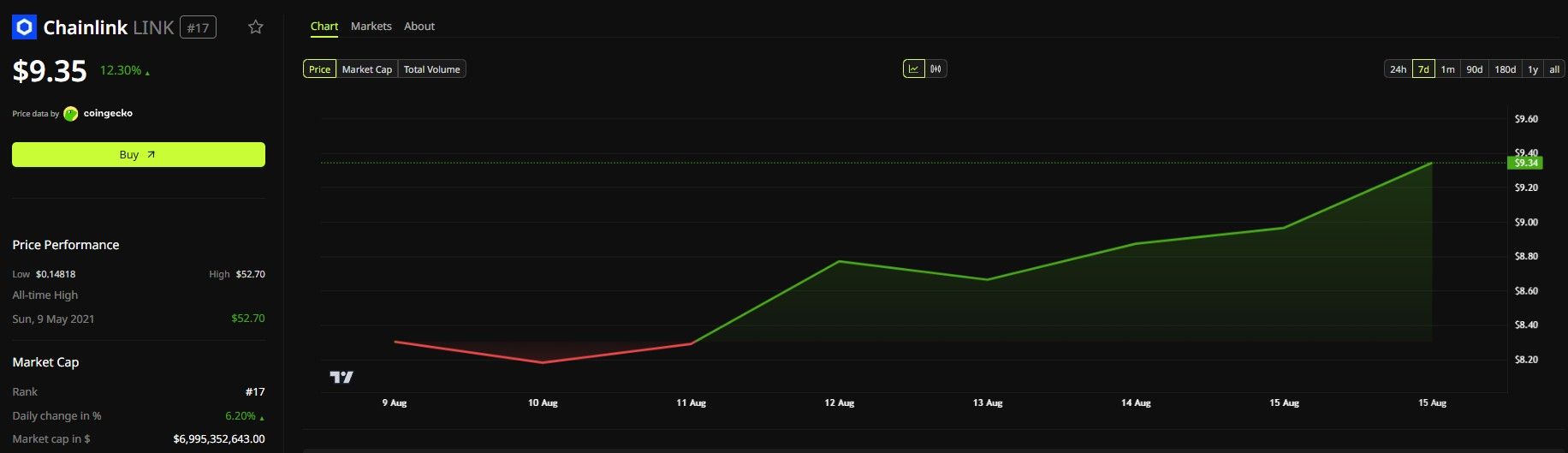
Chainlink (LINK) has left its bear market behind, according to analyst Michaël van de Poppe, who now expects a run toward $11. The token trades at $9.35, up 6.2% for the day.
The Dutch analyst points to higher highs and higher lows across the LINK chart. Meanwhile, Bitcoin sits in a quiet range, giving traders very little direction.
Chainlink Bull Market Case Rests on the $10.87 Barrier
Van de Poppe’s three-day Binance chart shows LINK closing a candle at $9.33 for a 4.98% gain. That candle opened at $8.887 and reached a high of $9.746.
The rally has run for four straight sessions since August 11. LINK has climbed 12.3% over the past seven days and holds a $6.97 billion market cap, ranking 17th.

Michaël van de Poppe put the shift plainly in a post on X.
“It’s no bear market anymore for $LINK.”
A rising trendline connects the lows since the spring selloff. Price now sits above that line, which supports the uptrend read.
Two resistance bands sit overhead. The first runs near $10.87, while the second waits around $14.42. His $11 target therefore sits just above the first band. Momentum on the lower oscillator has flipped positive after months below zero.
Relative strength against Bitcoin strengthens the argument. LINK has printed higher highs and higher lows on that pair for weeks. Van de Poppe reads this pattern as a fresh macro uptrend rather than a relief bounce.
Institutional demand adds weight to the setup. Daily whale transactions hit a five-month high this week after Standard Chartered set a $200 long-term target.
The token also leads several real-world asset rankings, which strengthens the fundamental case. However, a close back under the trendline near $8.70 would break the structure entirely.
BTC Keeps a Lid on the LINK Rally
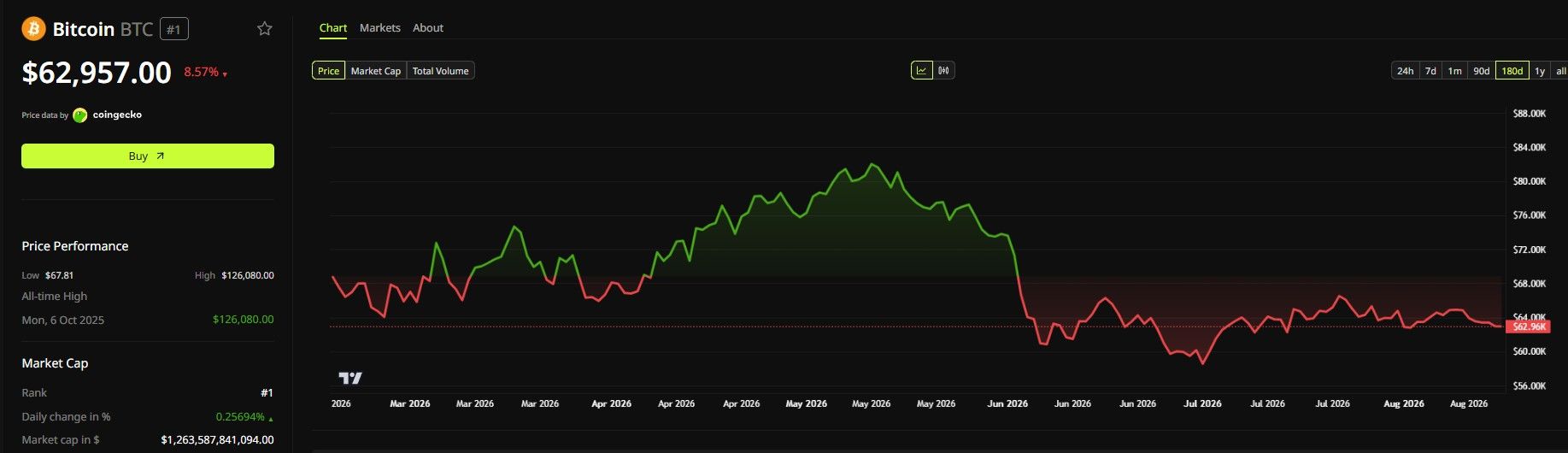
Bitcoin tells a duller story. BTC trades at $62,968, down 3.1% over the past seven days.
Van de Poppe marks repeated sweeps of the lows on his daily chart. Those sweeps already cleared long-side liquidity, and buyers keep defending the zone.
Supports now range between $ 58,115 and $ 62,275. Above spot, he flags $65,800 as the first hurdle and a heavier band near $73,674. Short-side liquidity sits above the market. Consequently, a squeeze into that pocket could trigger the next leg higher.
The analyst sees no reason to overtrade such a narrow range. Instead, he recommends steady accumulation for a multi-year hold. He also argues that every push higher raises the odds that the bottom has already formed. That reading fits a market where sellers no longer force lower lows.
Other analysts still debate how the current downturn will resolve. Some warn about a slide toward $50,000 driven by yen volatility.
Altcoins usually need Bitcoin to settle before they run. Recent dominance data suggests that rotation may have already started.
So LINK holds the stronger chart, yet Bitcoin still controls the timing.
The post Chainlink Bull Market Returns as Analyst Targets $11 for LINK appeared first on BeInCrypto.
Crypto World
Stock Market Week Ahead: Walmart, Target Lead Retail Earnings; Nvidia Among Stocks In Buy Areas

Here’s your Investing Action Plan, what you need to know for the stock market week ahead. Walmart, Target, Home Depot and Ross Stores headline a big week of retail earnings. Alibaba, Viking Holdings, Toll Brothers and Analog Devices also are notable companies reporting. Nvidia is among several stocks flashing buy signals as the market rally gains momentum. Five Stocks Around…
Copyright ©2026 Investor’s Business Daily, LLC. All rights reserved. 87990cbe856818d5eddac44c7b1cdeb8
Crypto World
TradFi obsession with permissioned blockchains is ‘race to the bottom,’ Etherealize CEO Vivek Raman warns


Similar systems, however, have been around the blockchain space for years in one form or another. Early adopters may recall the reams of banks that joined R3’s consortium effort back in 2016, for example, or the many enterprise players that flocked to the Linux-affiliated Hyperledger ecosystem. R3 didn’t make it to the end of the year before the big banks like Goldman Sachs, Morgan Stanley and Santander withdrew from the system.
“It’s like we’re having consortium chain 2.0,” said Raman in an interview. “This is going to end up being a race to the bottom for consortium chains. You’re going to have consortium chains versus consortium chains.”
Raman likened Ethereum’s mainnet to Hypertext Transfer Protocol, or HTTP, the base layer of the internet itself. A more secure, permissioned, privacy-enabled layer, HTTPS, sits on top. An open base layer is necessary, Raman said, because that’s the only way you can have maximum interoperability and maximum liquidity in one place, he said.
“We strongly believe, and always have done, that you need a global, open, permissionless infrastructure as the base layer,” Raman said. “Then you can build all the permissioning on top of it. Whether that’s at the app layer, whether that’s the L2 layer, that’s where you should have the customizability.”


Dartmouth College’s crypto ETF holdings have fallen 15% to about $12.4 million in the second quarter, even though its $9 billion endowment kept the same number of fund shares.
Summary
- Dartmouth’s reported crypto ETF holdings lost about $2.2 million in value during the second quarter.
- The endowment retained its positions in Bitcoin, Ether, and Solana-linked funds.
- Crypto prices have remained below their March 31 levels through Aug. 15.
- Dartmouth’s crypto ETFs represented about 0.14% of its estimated $9 billion endowment.
Dartmouth crypto ETF holdings have fallen to $12.4 million
The U.S. Securities and Exchange Commission filing submitted Thursday showed that Dartmouth’s trustees held about $12.4 million across three U.S.-listed crypto funds as of June 30.
Dartmouth reported positions in BlackRock’s iShares Bitcoin Trust, the Grayscale Ethereum Staking ETF, and the Bitwise Solana Staking ETF. Through the three products, the Ivy League university gained price exposure to Bitcoin, Ether, and Solana without reporting direct ownership of the tokens.
Compared with the endowment’s March 31 disclosure, the combined position declined by about $2.2 million from $14.6 million. The 15% reduction came entirely from changes in the funds’ reported market values because Dartmouth disclosed the same share count for each product at both quarter-end dates.
As previously reported by crypto.news, Dartmouth’s first-quarter filing valued its Bitwise Solana fund holding at about $3.3 million and its Grayscale Ethereum position at roughly $3.5 million. BlackRock’s Bitcoin ETF accounted for the largest part of the portfolio at approximately $7.7 million.
At $12.4 million, the three positions represented about 0.14% of Dartmouth’s estimated $9 billion endowment. The SEC report covers qualifying U.S.-listed securities and does not provide a complete account of the university’s assets, which may also include private investments, bonds, property, and holdings that do not appear on Form 13F.
Crypto prices have remained below March 31 levels
During the months following Dartmouth’s first-quarter disclosure, all three underlying cryptocurrencies lost value. Bitcoin closed March 31 at $68,233.31, while Ether finished at $2,104.71 and Solana at $83.11, according to historical data from Yahoo Finance.
By Aug. 15, Bitcoin was trading near $62,976, leaving it about 7.7% below its March 31 close. Ether had declined approximately 10.7% to around $1,880, while Solana’s price near $75.20 represented a drop of roughly 9.5%.
Fund values do not always change by exactly the same percentage as their underlying assets. Fees, staking rewards, each fund’s share structure, and differences between market-closing times can affect the reported value. Dartmouth’s 15% quarterly decline refers to the combined value of its ETF shares on June 30, rather than a calculated loss from directly holding BTC, ETH, or SOL through Aug. 15.
The filing also does not show Dartmouth’s purchase prices or indicate whether the positions produced a realized gain or loss. Since no shares were sold between the two reported quarter-end dates, the $2.2 million decline represents a reduction in disclosed market value rather than confirmed proceeds from a sale.
Dartmouth began reporting crypto-linked investments in 2025, placing it among the first U.S. universities to disclose digital asset exposure through exchange-traded products. Its choice of listed funds allows the endowment to hold crypto-linked securities within conventional investment and reporting systems instead of managing wallets and private keys.
SEC filings provide a delayed view of university holdings
Form 13F requires institutional investment managers with at least $100 million in qualifying securities under management to disclose certain long positions every quarter. The reports generally cover U.S.-listed shares, ETFs, some convertible debt, and listed options.
As explained in a June guide to 13F reports, the documents present positions held on the final day of a quarter and may be filed as many as 45 days later. Dartmouth’s latest report therefore shows what the endowment held on June 30, not necessarily its portfolio on the Thursday when the filing became public.
The form does not disclose short positions, hedges, or most private investments. It also excludes cryptocurrencies held directly because tokens such as Bitcoin and Ether are not Section 13(f) securities. Dartmouth could have other digital asset exposure outside the three disclosed funds, although the filing neither confirms nor rules out such holdings.
For U.S. investors, the report confirms that the university used securities traded through regulated markets rather than direct token custody. BlackRock’s IBIT provides spot Bitcoin exposure, while the Grayscale and Bitwise products combine exposure to their respective assets with staking provisions under each fund’s structure.
Dartmouth’s unchanged share counts also illustrate the distinction between a portfolio decision and a valuation change. A lower dollar figure in a quarterly filing does not by itself establish that an institution reduced its position because the value can fall while the number of shares remains constant.
A similar effect appeared in Morgan Stanley’s second-quarter filing. The bank increased its IBIT share count by 23% to approximately 16.5 million shares, but the position’s reported value fell nearly 18% from about $667 million to $549 million as Bitcoin and the fund declined during the quarter, according to an Aug. 14 report on its holdings.
Harvard has taken a different approach to crypto ETFs
Other university endowments have changed their crypto ETF positions rather than simply recording lower valuations. Harvard Management Company eliminated its BlackRock iShares Ethereum Trust holding during the first quarter after reporting 3,870,900 shares worth $86.82 million at the end of 2025.
Harvard also reduced its BlackRock Bitcoin ETF position from 5,353,612 shares at the end of 2025 to 3,044,612 shares on March 31. The remaining IBIT position was valued at approximately $116.97 million, according to its first-quarter SEC disclosure.
The filing did not state why Harvard exited its Ether position or cut its Bitcoin ETF stake. Unlike Dartmouth’s quarter-to-quarter report, Harvard’s filing showed that the endowment had changed the number of shares it owned.
Harvard, whose endowment is valued at about $57 billion, had not disclosed its second-quarter 2026 holdings as of Friday. Its next Form 13F will show only the qualifying U.S.-listed securities held on June 30 and will not reveal any trades completed after the quarter ended.
Crypto World
WLFI Pumps and Dumps as Trump-Backed World Liberty Gets Green Light for US Bank Charter

The Trump-family-backed World Liberty Financial has joined other cryptocurrency projects in receiving conditional approval from the Office of the Comptroller of the Currency (OCC) to establish a national trust bank in the US.
The positive developments led to an immediate price uptick for the underlying token, which was among the top-performing larger-cap alts following a 5.5% surge. However, it was quickly rejected at $0.06.
World Liberty Gets the Conditional Approval
As reported by multiple large media outlets, the OCC granted preliminary condition approval to World Liberty Trust Company, which is the name of the entity that applied for the national trust bank earlier this year. The move changes how the project operates its rapidly growing USD1 stablecoin.
Issuance and custody of the asset have so far been handled with the help of BitGo. Once the new bank becomes operational, though, World Liberty would be able to issue it directly, custody the assets backing it, and provide custodial services under federal supervision.
It’s worth noting that this doesn’t turn World Liberty into a traditional commercial bank, as the trust charter doesn’t allow it to take conventional deposits or make loans.
There are some hurdles before the bank can open. The approval is conditional, not final. It’s still necessary for the project to satisfy OCC requirements, including maintaining at least $20 million in capital, establishing adequate compliance and internal audit systems, and passing pre-opening examinations.
Nevertheless, the conditional approval is still a major milestone given how quickly USD1 has expanded its debut in March 2025. With it, World Liberty joins other industry giants. As reported last year, the OCC conditionally approved Ripple National Trust Bank and Circle’s First National Digital Currency Bank as newly created national trust banks.
WLFI Pumps and Dumps
The news of the approval resulted in an immediate boost for World Liberty’s native token. It traded at $0.055 yesterday before it shot up to a local peak of $0.06. However, that was short-lived, as it was rejected violently, and it’s currently back to $0.056, meaning a more modest increase of just 2.5%.
WLFI’s market cap stands at $1.8 billion, making it the 42nd-largest cryptocurrency by that metric.
The post WLFI Pumps and Dumps as Trump-Backed World Liberty Gets Green Light for US Bank Charter appeared first on CryptoPotato.
Two Abu Dhabi sovereign funds lost $118 million on their BlackRock Bitcoin ETF position last quarter. Neither sold a single share, new SEC filings show.
Mubadala Investment Company and the Abu Dhabi Investment Council together reported 22.94 million shares of the iShares Bitcoin Trust (IBIT) on June 30. That stake was worth $764 million, down from $881 million three months earlier.
Investor
First reported position
Latest confirmed holding
Mubadala
8,235,533 IBIT shares, $436.9m
14,721,917 shares
ADIC / Al Warda
2,411,034 shares, $147.6m
8,218,712 shares
Combined
—
22,940,629 shares
Bitcoin Peaked in May Before June Erased the Quarter
Yet the quarter-on-quarter number hides a violent round trip. Bitcoin (BTC) opened April near $68,079 and climbed to $82,139 by May 10.
IBIT touched $46.47 the following day. At that mark, the two funds sat at roughly $1.07 billion, well above where they started the quarter. June wiped it out. Bitcoin shed 17.9% that month and ended June at $58,559. The stake closed the quarter $302 million below its May peak.
Both funds also file a Form 13F, the quarterly report large investors submit on their US-listed holdings. Mubadala filed on Aug. 14, one day after the Investment Council disclosed its own book.
The share counts match exactly between the two quarters. Mubadala kept 14.72 million shares. The Investment Council kept 8.22 million. Only the price moved.
However, the two funds feel that loss very differently. IBIT accounts for just 1.4% of Mubadala’s $34.77 billion US book, which chipmaker GlobalFoundries dominates at 94.7%. The ETF still ranks second on that list.
The Investment Council runs a far tighter portfolio. Its $274 million IBIT stake equals 38% of a $714 million book, the largest position the fund discloses.
Mubadala had also bought more IBIT in the first quarter, when Harvard cut its stake by 43%. Neither fund disclosed a second crypto product.
Subscribe to our YouTube channel to watch leaders and journalists provide expert insights
Abu Dhabi Held While Other Institutions Trimmed
Elsewhere, institutional conviction cracked. Intesa Sanpaolo, Italy’s largest banking group, cut its IBIT holding by 93.7% and rotated toward staked Ethereum products.
Flow data tells a similar story. Spot Bitcoin funds shed 3,170 BTC in late July, while Ethereum funds drew inflows for a third straight week. Meanwhile, the average US spot Bitcoin ETF buyer sat 22% underwater at the end of July.

Prices have since steadied. Bitcoin reclaimed $65,000 in July and traded near $62,957 on Saturday, valuing the network at $1.26 trillion. That leaves the asset almost 50% below its record of $126,080, set on Oct. 6, 2025.
Sovereign wealth funds answer to a different clock than banks or endowments. Their mandates run for decades, and one weak quarter rarely forces a decision.
Quarterly filings capture a snapshot, not daily conviction. Sitting through a $302 million swing without trimming a share signals a long horizon rather than a trade. November’s disclosure will show whether Abu Dhabi’s patience outlasted the summer.
The post Bitcoin Drop Cost Abu Dhabi $118 Million: Will They Sell? appeared first on BeInCrypto.

Samsung says Claude Code can cut chip design work from weeks to days, but it still makes serious mistakes

What is the smartest mob in minecraft?

Manchester United vs AC Milan LIVE confirmed squad, early team news and how to watch fixture vs Ruben Amorim


-

 Fashion20 hours ago
Weekend Open Thread: Ann Taylor
-

 Business6 days ago
Datadog: Best Of Breed For Multiple Reasons
-

 Business6 days ago
How to Start a Cleaning Business: A Step-by-Step Guide
-

 Business6 days ago
BDC Weekly Review: Private BDC Q2 Numbers Are Strong
-
 NewsBeat4 days ago
Communication cards help banking customers access services or report scams
-
 Business4 days ago
Oil Price Today (August 11): Crude oil rises to $88 after Trump’s compensation demand dents Hormuz opening. Here’s why
-
 Crypto World5 days ago
Why Did Nvidia Stock Fall on Monday Despite a $500 Billion Wall Street AI Deal?
-

 Politics7 days ago
Be quiet, Miriam! – spiked
-

 Fashion6 days ago
Amazon Sundays: Closet Care Before Fall
-
 Entertainment7 days ago
Will Ferrell’s New Netflix Series Just Became One of the Streamer’s Biggest Hits of 2026
-

 Business6 days ago
5 Things You Must Know About Jorge Messi, the Father and Longtime Agent Who Shaped Lionel Messi’s Career
-

 Politics6 days ago
Ben-Gvir’s crocodile project halted but abuses at Ketziot Prison continue
-

 Crypto World4 days ago
Revolut wins French banking licence, creates second EU banking hub
-

 Business7 days ago
Mutual Fund Manager Scoops Up Beaten-Down Stocks
-

 Politics6 days ago
The Church of England’s ruinous reparations racket
-

 Politics6 days ago
Saudi Arabia used 86% of missile stockpile defending Iran attacks
-
 NewsBeat7 hours ago
Myanmar says over 300,000 Rohingya refugees verified for repatriation as exodus enters ninth year
-

 Politics6 days ago
The House Article | Burnham still needs to sell devolution to the public
-

 Politics6 days ago
What’s An EDT? The Rise Of ‘Extreme Day Trips’ As A Travel Trend
-
 Crypto World6 days ago
USDC and USDT Now Own 84% of Crypto Card Spend as the Euro Retreats
You must be logged in to post a comment Login