
Crypto World
Malone Lam Pleads Guilty in $245M Crypto Theft Case

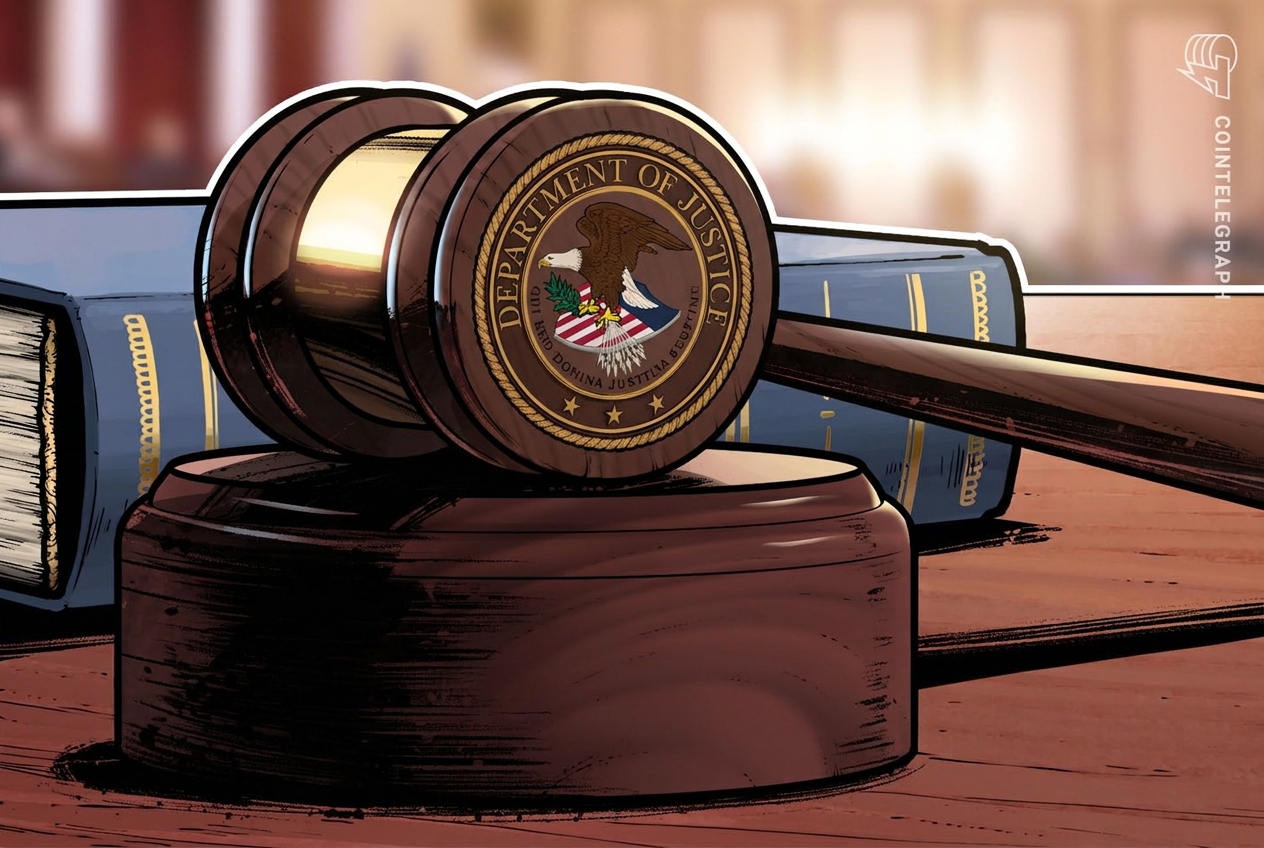
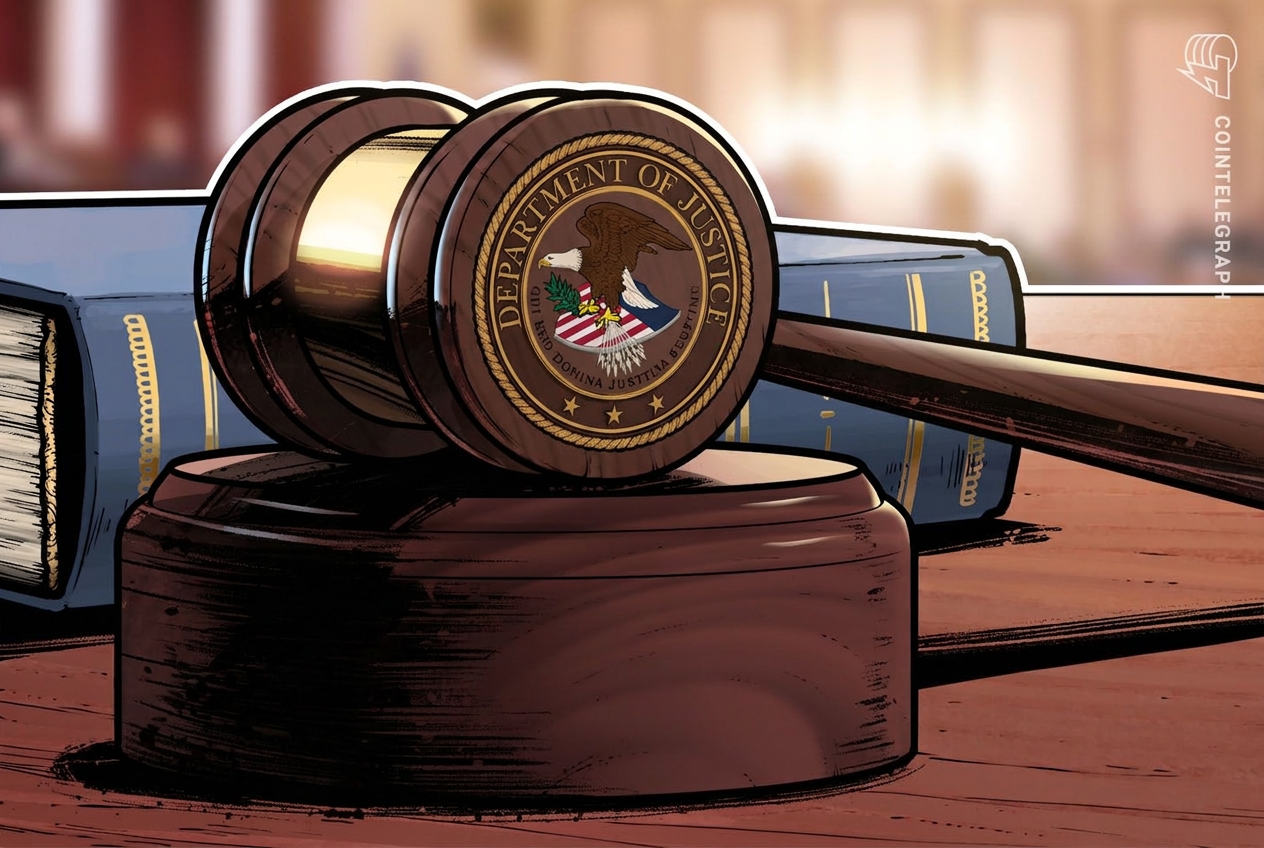
Singaporean national Malone Lam pleaded guilty to participating in a racketeering conspiracy that US prosecutors say used social engineering and home break-ins to steal and launder more than $245 million in cryptocurrency.
On Tuesday, the US Justice Department said that Lam organized the international operation, identified prospective victims and coordinated other conspirators. The enterprise was formed through connections on online gaming platforms and operated from no later than October 2023 through at least May 2025, according to court documents.
The plea establishes criminal responsibility nearly two years after Lam was charged over the theft of more than 4,100 Bitcoin, worth over $230 at the time, from a Washington, DC resident.
Lam pleaded guilty before US District Judge Colleen Kollar-Kotelly to one count of participating in a Racketeer Influenced and Corrupt Organizations (RICO) conspiracy. The judge scheduled a status hearing for Dec. 8, but the Justice Department did not announce a sentencing date.
From a 4,100 Bitcoin theft to a RICO case
Initially, prosecutors accused Lam and Jeandiel Serrano of fraudulently obtaining more than 4,100 Bitcoin from a single victim on Aug. 18, 2024.
In 2024, blockchain investigator ZachXBT identified the victim as a Genesis creditor. The attackers allegedly posed as Google support staff to compromise the victim’s accounts before impersonating Gemini support to persuade the victim to reset two-factor authentication and use screen-sharing software that exposed private keys.
Lam and Serrano were arrested on Sept. 18, 2024, and prosecutors unsealed their indictment the following day. Prosecutors alleged that the pair laundered the proceeds through crypto mixers, exchanges, pass-through wallets and virtual private networks.
Related: Liquid ‘white hats’ return $270M in Bitcoin as network prepares restart
On May 15, 2025, prosecutors announced a superseding indictment charging 12 additional defendants and expanding the case into an alleged RICO conspiracy involving more than $263 million in crypto thefts. It included a separate $14 million theft in July 2024 and an alleged home break-in targeting a hardware wallet.
Prosecutors also alleged that Lam continued directing associates from pretrial detention, including arranging delivery of luxury items to his girlfriend. The group’s members allegedly spent stolen funds on private jets, rental properties, watches and at least 28 exotic cars, while nightclub bills reached $500,000 per evening.
Magazine: Is Bitcoin too volatile to risk your retirement on?

XPeng’s humanoid robot IRON is on display during the 2026 Guangdong-Hong Kong-Macao Greater Bay Area International Auto Show on May 31, 2026 in Shenzhen, Guangdong province of China.
Vcg | Visual China Group | Getty Images
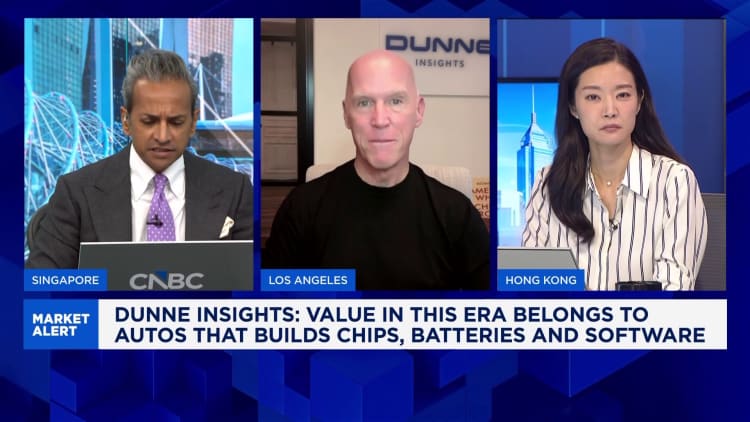
Chinese companies rushed into electric cars a decade ago, and now they are expanding into humanoid robots as the EV market sees a slowdown amid intense competition.
While the commercial viability of humanoids has come under scrutiny, it hasn’t dissuaded companies such as Xpeng from announcing robot production plans, at a time when China’s EV sales are headed for their worst year since 2021.
It’s part of a bid to reshape “capital valuation narratives,” said Kevin Li, associate director at Counterpoint Research. He added that the automakers are also looking to boost the perception that they are tech companies, and establish a second growth curve.
Xpeng shares have tumbled more than 45% this year, making them the worst performer among major EV players. Shares of EV giant BYD are down more than 13% as sales have slumped.
Chinese automakers accounted for more than half of the nearly 20 car companies globally that have entered the humanoid robotics sector through in-house development, investment or incubation as of August, according to Counterpoint.

The venture arm of EV company Nio has also invested in several humanoid robotics startups such as LimX Dynamics and Acorn Robot, according to PitchBook data.
The business diversification comes as slowing growth and weakening profitability put pressure on China’s EV makers. The average profit margin in China’s vehicle manufacturing sector stood at 1.5% in the first half of 2026, according to China Association of Automobile Manufacturers data cited by Counterpoint.
Xiaomi, Li Auto and Geely are also among EV makers making moves into the robotics sector, although their strategies differ.
“Given the slowing growth and weakening profitability in the EV market—particularly domestically—it is a natural strategic move for EV companies to diversify into new applications such as robotics,” said Jing Yang, director of Asia-Pacific corporate ratings at Fitch Ratings.
“This allows them to pursue alternative growth drivers, achieve economies of scale for shared advanced technologies, and potentially improve profitability over the medium term,” she said.
Investors aren’t buying the story yet.
Xpeng shares fell after it raised $900 million for its robotics business last month, the largest single round in China’s “embodied” AI industry, according to the company. Embodied AI refers to hardware-connected artificial intelligence.
The raise valued the car company’s robotics unit at more than $6.3 billion — on par with the $6.5 billion estimated value for Xpeng’s EV business, according to Citi.
Advantages over Tesla?
While there are similarities to how electric-car maker Tesla is developing its Optimus humanoid in the U.S., Elon Musk’s company, the Chinese automakers’ push into robotics have their own advantages, said Xiaoyi Lei, senior research analyst at Jefferies Hong Kong.
She pointed out that Chinese automakers can reuse a significant portion of their supply chain — Xpeng, for example, can use 85% of its motors, chips and smart driving software for humanoids. The robots can then be immediately deployed in the automakers’ stores and factories, rather than having to wait for consumers to buy them, she added.
Xpeng said Tuesday it plans to begin mass production of its robots by the end of this year, starting in its own stores and business venues. Next year, the company plans to launch the robots to the broader market in China and overseas.
Automakers also know how to build things at scale, Lei said. Producing thousands of robots that are reliable and serviceable is what Chinese automakers already do every day, she added.
“Chinese players are the ones actually pushing it into daily use,” Lei said, noting that in-house deployment makes it easier and cheaper for the automakers to collect data — which is critical for humanoid commercialization.
Xiaomi, a consumer electronics company that only launched its first electric car in 2024, started testing humanoid robots at its factory this year.
BYD can also deploy robots in its factories, Counterpoint’s Li pointed out. But he said over the medium-to-long term, Geely and Xpeng could better capture the benefits of diversifying beyond cars, pointing to Xpeng’s greater emphasis on its physical AI strategy.
Humanoid questions
Whether humanoid robots can generate demand beyond automakers’ own operations remains an open-ended question. Lei said Jefferies has yet to see firm external orders from the automakers it covers or clear guidance on external customers and robotics revenue for next year.
Leading humanoid company Unitree saw its shares skyrocket as they debuted in Shanghai last month, but the stock declined for 12 of the 16 sessions since its listing. Founder Wang Xingxing has cautioned that commercialization could still take years, with the humanoid sector’s ‘ChatGPT’ moment likely a decade away.
Reusing car technology for robots may not always be as straightforward as it sounds.
“I would say the real challenge is how they are going to make the algorithm and software stack that is used to be applied to the smart driving system also viable to the humanoid scenario, which is more difficult and more challenging,” Lei said.
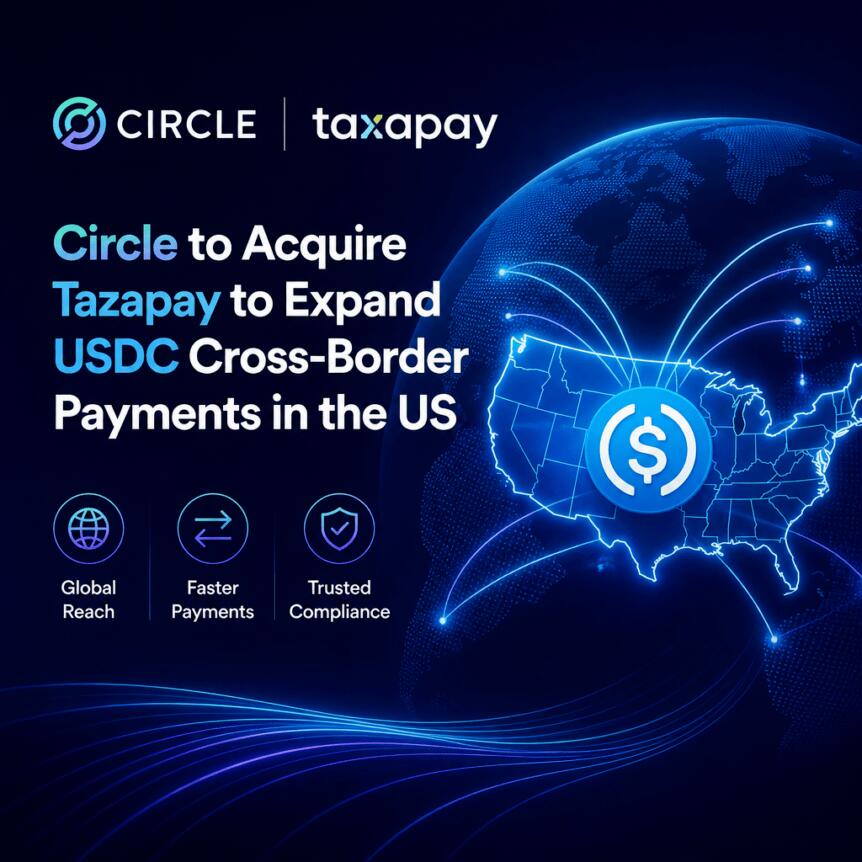
Circle has agreed to acquire Singapore-based cross-border payments platform Tazapay in a $400 million all-stock deal expected to close in 2027, the companies announced. The acquisition is structured as a Class A common stock purchase, with the final price subject to adjustments tied to Tazapay’s debt, transaction expenses, and cash levels, according to a filing with the US Securities and Exchange Commission.
The transaction will also depend on customary closing conditions and approval from the Monetary Authority of Singapore, Circle said in its Tuesday announcement. Circle previously invested in Tazapay through Circle Ventures, including during the startup’s August 2025 Series B round.
Key takeaways
- Circle is buying Tazapay for $400 million in an all-stock transaction expected to close in 2027.
- The SEC filing says the deal price will be adjusted for Tazapay’s debt, transaction expenses, and cash.
- Tazapay reports more than $25 billion in annualized payment volume and services over 60 banking and fintech partners.
- Circle says stablecoins make up about 60% of Tazapay’s transaction volume, supporting its cross-border routing ambitions.
- Circle says Tazapay customers should not see disruption to services, APIs, pricing, or support.
A $400 million all-stock acquisition aimed at faster global rails
Under the agreed terms, Circle will pay for Tazapay using Class A common stock. The SEC filing also states the purchase price is not fixed: it will be adjusted based on Tazapay’s debt, transaction expenses, and cash at closing.
Circle said the deal would require regulatory and procedural steps before completion, including approvals from the Monetary Authority of Singapore and other standard closing conditions. The company did not indicate any expected earlier-than-2027 timeline in the announcement.
Tazapay’s scale in Asia-Pacific and emerging markets
Tazapay positions itself as an infrastructure provider for cross-border payments, with a focus on local payout rails across many destinations. According to information Circle shared, Tazapay has more than $25 billion in annualized payment volume and serves more than 60 banking and fintech partners.
In August 2025, Tazapay told Newswire that its annualized payment volume was more than $10 billion, suggesting meaningful growth over time as the company expanded its network and partner footprint. The company also said it supports payout rails covering more than 100 markets.
Tracxn data cited in the coverage indicates Tazapay has raised $57.9 million across five funding rounds. Circle’s involvement through Circle Ventures included participation in the August 2025 Series B round, linking the corporate strategy behind the investment to the later acquisition.
Stablecoin-linked volume and the push for 24/7 routing
Stablecoins account for about 60% of Tazapay’s transaction volume, according to Circle. That share matters for Circle’s stated direction: the company is working to integrate stablecoin-based payment rails into mainstream cross-border flows.
Circle said the acquisition will expand its ability to route payments to and from Asia-Pacific and emerging markets. In comments attached to the announcement, Circle’s Irfan Ganchi, senior vice president of payments, described the goal of increasing Circle’s capability to originate and terminate payments globally “near-instant and 24/7” and said the effort is a step toward making USDC the default payment rail for cross-border commerce.
Tazapay has also been described as a design partner for the Circle Payments Network since 2025. Circle said that role, plus Tazapay’s existing infrastructure, is central to how it plans to scale routing capabilities after the acquisition.
What remains unchanged for customers and partners
Circle said Tazapay customers should see no disruption to their services, APIs, pricing, or support. For users and developers building on payment infrastructure, this kind of continuity promise is often as important as the acquisition headline—because it affects integration stability and operational risk during a transition period.
While the companies did not outline a post-close roadmap in the details provided, the focus on uninterrupted customer experience suggests the integration approach will be managed to avoid breaking changes. Circle’s statement also implicitly indicates that the product and developer-facing interfaces are expected to remain stable until closing, which is still set for 2027.
In the market, Circle’s NYSE-traded shares were down more than 2% in Tuesday’s premarket activity, according to Yahoo Finance, at last look. The move reflects how investors often react to larger corporate actions even when timelines extend into the future.
Why the deal matters for cross-border payments
The acquisition highlights a broader competitive theme in stablecoin-enabled finance: infrastructure providers are looking to secure distribution and routing where payment speeds and availability are crucial. By bringing Tazapay’s network—along with its reported stablecoin-heavy flow mix—into its own stack, Circle is effectively positioning itself to compete in the middle layer between banks, fintech apps, and on-chain settlement.
It also matters that the transaction is all-stock and subject to adjustments. For shareholders, the structure adds exposure to equity valuation and closing conditions; for Tazapay, the deal preserves involvement in a larger payments ecosystem rather than a purely cash exit. Circle’s requirement for Monetary Authority of Singapore approval underscores that cross-border payment infrastructure can carry regulatory weight even when stablecoins are a key component of the operating model.
As the deal works through approvals and closing conditions, readers should watch for additional detail on integration plans for the Circle Payments Network and how Circle intends to maintain continuity for Tazapay’s partners. The key uncertainty remains the timeline and the final share-based purchase price mechanics once the debt, expense, and cash adjustments are locked in ahead of the 2027 close.
All crypto eyes have turned to the two major events next week (and the CPI inflation data on Friday), with some favoring the FOMC meeting, while others put more emphasis on the CLARITY Act vote on September 15.
The XRP community appears to be in the second camp, as the countdown to the vote has become one of the biggest talking points among them, especially on X and Reddit.
One of the popular users going by the X handle RippleXity recently outlined the significance of the CLARITY Act on XRP since it could put the token “at the center.”
XRP Has an Advantage?
The highly anticipated legislation would establish a comprehensive framework dividing responsibility for crypto between the Securities and Exchange Commission and the Commodity Futures Trading Commission. For Ripple’s native token, one of those major regulatory questions has already been answered via a lengthy and painful lawsuit.
In March, the SEC explicitly identified XRP as a digital commodity, alongside BTC, ETH, SOL, ADA, and several other crypto assets. The watchdog said digital commodities derive their value primarily from the operation of their underlying networks and supply-and-demand dynamics rather than expectations of profits generated via the essential managerial efforts of others.
As such, the CLARITY Act could provide something more valuable over the long term: durability. Current SEC and CFTC interpretations can potentially be changed by future administrations, but federal legislation is considerably harder to reverse.
The bill would also establish a formal regulatory regime for digital commodity exchanges, brokers, and dealers, and give the CFTC an expanded role in overseeing spot digital commodities markets.
In a recent interview, Ripple’s CLO described September 15 as a “bellwether” for whether comprehensive crypto legislation can continue advancing through Congress. He also argued that the bill provides a much more permanent foundation than agency rulemaking alone.
Not the Final Vote
Although the XRP community is putting much hope on September 15, it’s worth explaining that the Senate will not vote on passing the CLARITY Act on that day. Instead, policymakers will vote on cloture on the motion to proceed to H.R. 3633, a measure that requires 60 votes and would allow the legislation to move toward formal Senate consideration.
Failure to move on, though, could effectively derail the bill’s chances of success this year, while the odds have significantly declined from over 70% to roughly 30% in months.
A major law-enforcement obstacle was removed last week when the National Sheriffs’ Association dropped its opposition, moving to a neutral position. However, a new report on Monday suggested that the unresolved ethics dispute may be even more serious.
Semafor claimed that several Republican senators now believe the legislation is likely to fail next week, especially if the White House doesn’t help bridge the divide over restrictions on government officials profiting from the industry.
Ultimately, XRP will likely benefit from a successful cloture vote, but in a more modest manner. The major impact can be expected once the bill becomes law. However, if the voting on September 15 fails, XRP, alongside the rest of the market, could fall hard. The situation can worsen a day later if the Fed hikes rates and displays an even more hawkish stance.
The post XRP and the CLARITY Act: Why September 15 Could Be a Major Test appeared first on CryptoPotato.

Authorities in Mexico have arrested two suspects accused of killing four people in a home invasion they allegedly carried out in search of a Bitcoin “cold wallet” believed to contain millions of dollars, according to La Jornada and an update from the Attorney General’s Office of the State of Mexico (FGJEM).
The alleged incident centers on Jonathan Meléndez, a keyboardist for the rock band Camilo Séptimo, along with his pregnant wife, their daughter, and a household employee in Atizapán de Zaragoza. Mexico’s FGJEM said the suspects may face lengthy prison terms if convicted, while investigators reportedly claim one suspect gained access to the residence through a personal connection.
Key takeaways
- Mexican prosecutors accuse two men of targeting a Bitcoin cold wallet during a multi-victim homicide in Atizapán de Zaragoza, La Jornada reported.
- Both suspects are scheduled for a hearing on Wednesday, where a judge will decide whether the evidence is sufficient to move forward with criminal proceedings.
- FGJEM said the suspects could face 25 to 70 years in prison per homicide victim if convicted, as reported by La Jornada.
- Officials reportedly alleged at least one suspect had a business relationship with one of the victims and used it to enter the home.
- Broader security reporting continues to show wrench-style attacks—coercing victims to access or hand over crypto—rising across 2026’s first half.
Arrests tied to alleged hunt for a Bitcoin cold wallet
La Jornada, citing an update from FGJEM, said two suspects—identified only as Diego Sebastián and Gerardo, with their surnames withheld—were arrested in connection with the killing of four people.
The case is now moving toward a judicial stage: Diario de México reported that the suspects are scheduled for a court hearing on Wednesday, during which a judge will determine whether there is enough evidence to sustain ongoing criminal proceedings.
FGJEM announced the arrests in an X post on Sept. 2. La Jornada also reported that prosecutors believe the men pursued a cold wallet they thought held millions of dollars in Bitcoin. Mexico’s security secretary, Omar García Harfuch, said in a Sept. 2 X post that one suspect used a relationship with a victim to get into the home.
Allegations around the victims and the alleged method of entry
According to La Jornada, prosecutors accuse the two suspects of killing Jonathan Meléndez, his pregnant wife, his daughter, and an employee during the attack at their residence in Atizapán de Zaragoza. The report also says the family’s golden retriever was killed.
The allegation about access is important for how the case could be framed in court. García Harfuch stated that one suspect was a business associate of one of the victims and allegedly leveraged that connection to enter the home, a claim that can matter for establishing planning, intent, and the suspects’ ability to reach the target location.
Potential sentences and what the next court step determines
La Jornada reported that FGJEM said the suspects could face 25 to 70 years in prison per homicide victim if convicted. While the precise charges and ultimate sentencing outcomes would depend on the court’s determination, the range underscores the gravity of the alleged crimes and the prosecution’s posture.
For investors and crypto users, this case also illustrates how physical coercion can become intertwined with cryptocurrency ownership. Unlike typical theft cases, wrench attacks depend on immediate access—often through forcing victims to unlock wallets, reveal credentials, or hand over control.
Why “wrench attacks” remain a growing crypto risk
The Mexico case aligns with broader security reporting on coercive “wrench attacks,” where criminals use violence or threats to compel victims to hand over cryptocurrency or provide access to wallets.
Blockchain security firm CertiK reported that in the first half of 2026 there were 20 publicly reported home invasions targeting crypto holders, compared with just a single incident in the same period a year earlier. CertiK also put the total number of wrench attacks worldwide at 52 in H1 2026, up 33.3% from 39 during H1 2025.
Chainalysis estimates that criminals stole more than $30 million in crypto through wrench attacks in the first half of 2026.
The overall increase is not limited to 2026. CertiK previously reported that wrench attacks rose in 2025, with 72 verified cases worldwide—up from 39 in the prior year, described as a 75% increase in earlier reporting. The same security reporting noted that France recorded the most attacks in 2025 with 19 confirmed incidents, and that Europe accounted for about 40% of attacks globally that year.
Separate reporting also highlighted the lethal stakes of such crimes: Russian outlet Fontanka reported that in October 2025 attackers killed convicted Russian crypto fraudster Roman Novak and his wife after kidnapping them and demanding access to crypto wallets.
What to watch as the Mexico case moves forward
With a Wednesday hearing scheduled to assess whether the evidence supports continued prosecution, the key developments to monitor are what prosecutors can substantiate about the alleged cold-wallet target and the suspects’ entry into the home—particularly the claimed relationship used to gain access. Separately, the rising global pattern of wrench attacks in 2025 and the first half of 2026 suggests crypto holders should keep security planning focused on physical coercion risks, not only on digital threats.
Crypto World
OpenAI Says It Solved Math's Deepest Problem But Mathematicians Say AI Stole Their Work


OpenAI says an AI system solved the Navier-Stokes problem. It is one of seven Millennium Prize Problems, math’s toughest open questions.
The company said 10,000 AI agents worked together for 88 hours to reach the proof. NYU professor Tristan Buckmaster disputes the credit.
What OpenAI Claims
The Navier-Stokes equations describe how fluids move, such as air or water.
OpenAI’s proof suggests the equations can reach finite-time blowup, when fluid speeds turn infinite instead of staying smooth.
The proof came from an unreleased model that OpenAI says outperforms its released GPT-6 Astra system.
GPT-6 Astra then spent 17 hours verifying the proof’s logic.
The Clay Mathematics Institute offers $1 million for solving any of the seven problems. OpenAI said it will not claim the prize.
The Credit Dispute
NYU professor Tristan Buckmaster says he and Anthropic mathematician Levent Alpöge were close to a related result.
Their work sat inside OpenAI’s Codex, a coding-focused AI model. Buckmaster said that may have exposed it to OpenAI’s team.
Buckmaster addressed the concern directly in a public statement:
“I do not know what their model did, or how. I do not know whether our data was used. I am not accusing anyone of anything.”
— Tristan Buckmaster, NYU mathematician
OpenAI researcher Sebastien Bubeck responded at a press briefing. He denied the company had accessed or used their unpublished work.
OpenAI also acknowledged something else. It cannot rule out that the researchers’ product use shaped its model’s training.
The dispute comes as OpenAI prepares for a reported $1 trillion public listing. Anthropic is pursuing an even larger valuation through its own IPO push.
The post OpenAI Says It Solved Math's Deepest Problem But Mathematicians Say AI Stole Their Work appeared first on BeInCrypto.
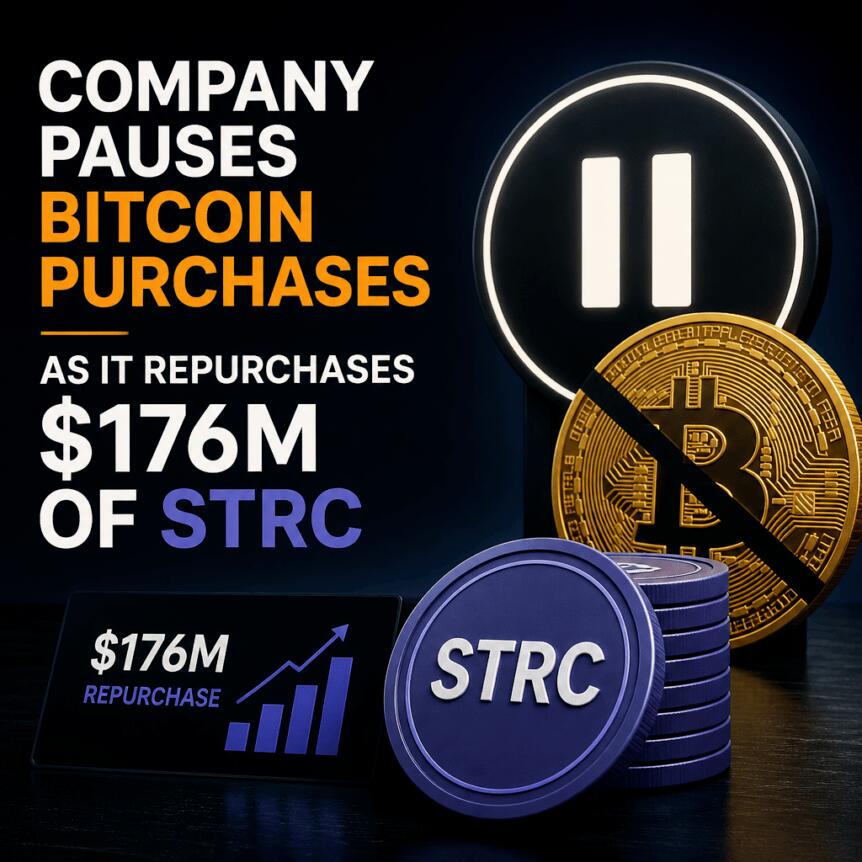
Strategy, the largest corporate holder of Bitcoin, did not add to its BTC treasury during its most recent reporting window. Instead, it used part of its financing machinery to repurchase shares of its preferred stock vehicle, STRC, signaling a shift toward capital structure management rather than fresh Bitcoin accumulation.
According to a Tuesday filing with the U.S. Securities and Exchange Commission, Strategy repurchased $176.3 million worth of STRC preferred shares—about 1.8 million shares—between Aug. 31 and Sept. 7. Over the same period, Strategy also increased the size of its Digital Credit Securities Repurchase Program to $2 billion. With no new Bitcoin purchases during this stretch, its treasury holdings were listed at 845,050 BTC, acquired for $63.6 billion at an average cost of $75,412 per coin.
Key takeaways
- Strategy paused Bitcoin purchases in the Aug. 31–Sept. 7 window while deploying capital to repurchase preferred stock via STRC.
- The company repurchased $176.3 million of STRC shares and raised its Digital Credit Securities Repurchase Program to $2 billion.
- Strategy’s BTC treasury remains unchanged at 845,050 BTC in the filing, with an average acquisition price of $75,412.
- STRC trading below its $100 par value can reduce Strategy’s ability to raise funds through STRC sales and may pressure dividend economics.
- Other corporate buyers—including Strive and Capital B—continued to add Bitcoin while Strategy stepped back.
Preferred-stock repurchases replace new BTC buying
Strategy’s latest SEC filing centers on STRC. The company reported that it repurchased 1.8 million STRC shares for an aggregate $176.3 million during Aug. 31 to Sept. 7, using the same preferred-stock structure that has become central to its broader Bitcoin strategy.
That pause matters for traders and investors because it highlights the operational choices behind BTC treasury growth. Even for the sector’s most prominent buyer, Bitcoin accumulation is not constant; it can be influenced by financing conditions, payout planning, and the mechanics of how Strategy converts capital markets activity into additional BTC exposure.
The filing also notes an expansion of Strategy’s Digital Credit Securities Repurchase Program to $2 billion. Repurchase programs can be used to manage outstanding securities and expected cash flows, but the practical implication for BTC holders is that not all incoming capital is being directed to new BTC purchases at any given moment.
What the SEC numbers imply for Strategy’s BTC treasury
With no new Bitcoin purchases disclosed for this interval, Strategy’s treasury remains at 845,050 BTC. The company attributes that position to $63.6 billion in total acquisition cost, equating to an average purchase price of $75,412 per BTC.
Investors often watch the timing of these disclosures closely because they help distinguish between periods of direct accumulation and periods dominated by corporate actions. In this case, the company’s reported BTC count stays flat, while capital markets activity is reflected through preferred-stock buybacks.
Strategy’s most recent prior large purchase was reported earlier in the year by Cointelegraph—its first BTC buy since mid-June, consisting of a $370 million acquisition. The contrast between that purchase period and the subsequent pause underscores that Strategy’s approach can move between “buy” and “structure” modes rather than progressing in a single uninterrupted line.
STRC trading below par raises questions about dividend funding
The filing comes alongside market pricing signals for STRC. In premarket activity on Tuesday, STRC was reported trading around $97.70—roughly 2.3% below its intended $100 par value. At the same time, Strategy’s Nasdaq-traded MSTR common stock was reported down more than 3% in Yahoo Finance’s last look.
That matters because STRC is not only a balance-sheet instrument; it’s also a funding tool. The article notes that STRC is one of Strategy’s main vehicles used to finance Bitcoin accumulation. If STRC trades below par, it can limit how much Strategy may raise through future STRC sales, potentially affecting the pace at which it can convert equity-like instruments into additional BTC exposure.
Lower pricing versus par can also complicate dividend expectations. The piece indicates that trading below par may “force the company to further increase its dividend rate,” connecting market pricing directly to payout needs. Strategy’s dividend framework is part of a broader plan: on June 29, the company unveiled a capital framework intended to allow Bitcoin sales to fund dividends, and it increased the annual dividend rate on its STRC preferred stock to 12%—a key detail for readers tracking how Strategy balances BTC exposure against shareholder returns.
While Strategy paused, other treasuries kept buying
Strategy’s decision not to purchase Bitcoin during this window coincides with continued accumulation by other corporate holders.
Strive, described as the fifth-largest corporate Bitcoin treasury, added 1,375 Bitcoin for $109 million, according to CEO Matt Cole’s disclosure on Monday. That purchase reportedly brought Strive’s total holdings to 24,531 BTC, with an average cost of $79,281 per Bitcoin. Ahead of Tuesday’s market open, Strive’s Nasdaq-traded ASST shares were reported down more than 2.5%, following a more than doubling in the prior month.
In France, Capital B also reported a purchase: it disclosed a $25 million Bitcoin acquisition on Monday—its largest in nearly a year—taking its holdings up to 3,521 BTC. The report also says that this move pushed Capital B ahead of H100 Group among publicly traded BTC holders.
These developments matter because corporate Bitcoin competition is increasingly about timing and financing. When Strategy pauses, it can leave space for other treasury operators to gain relative market position and momentum—both in absolute BTC holdings and in investor attention.
For readers, the next signal to watch is whether Strategy returns to BTC purchases immediately after this window, or whether it continues to prioritize repurchases and dividend mechanics through STRC and the expanded $2 billion Digital Credit Securities Repurchase Program.
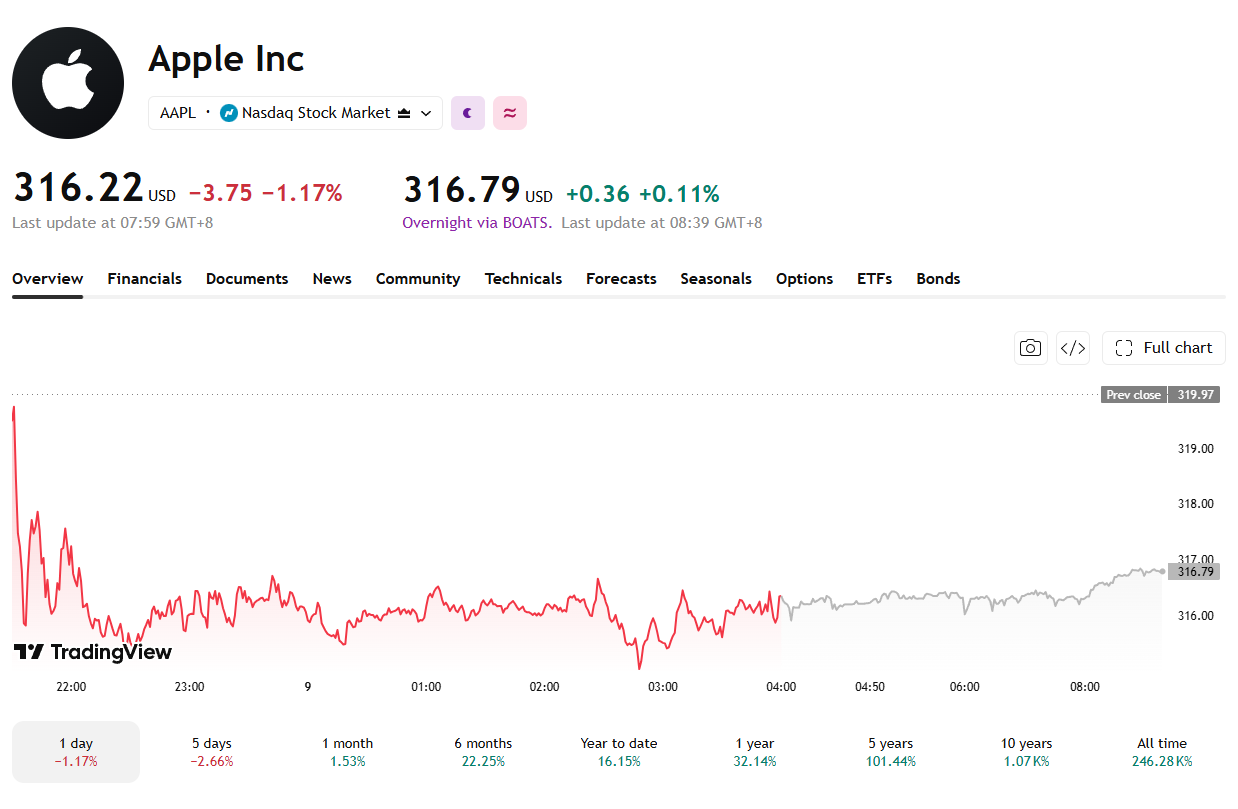
Apple unveils its first foldable iPhone and a refreshed iPhone 18 Pro lineup today, September 9, alongside a new A20 Pro chip, as AAPL stock closed 1.17% lower at $316.22 heading into the keynote.
The event marks the first major hardware reveal under new Chief Executive Officer John Ternus, who took over from Tim Cook on September 1. It also represents Apple’s biggest design shift since the iPhone X arrived in 2017.
What Apple Is Expected to Show
Apple has skipped a standard iPhone 18 this year. The company delayed that model to spring 2027. Its autumn lineup instead centers on the foldable iPhone at Ternus’s keynote debut, alongside the iPhone 18 Pro and the iPhone 18 Pro Max.
All three devices are expected to run the new A20 Pro chip, and Apple has tied that chip to on-device Siri artificial intelligence (AI) improvements.
The foldable device, widely rumored to open like a book, arrives after iPhone 18 Pro costs climbed on rising memory prices. Analysts expect that pressure to push its retail price above earlier generations.
AAPL Stock Slips Ahead of the Keynote
Apple shares fell to $316.22 on Tuesday, though the stock remains near the top of its 52-week range. HSBC held a Buy rating with a $366 price target heading into the event, while Citi projected 7.3 million foldable iPhone unit sales despite a price near $2,000.

Meanwhile, the launch follows fresh competition from China. Huawei introduced its tri-fold Mate XT2 on September 7, powered by an in-house Kirin 9050 Pro chip and priced between $2,980 and $3,725. Xiaomi debuted its passport-sized 18 Fold the same day, starting near $1,540.
Huawei Executive Director Richard Yu said pricing has become difficult as memory costs climb.
“Pricing right now is a real challenge, because memory costs have risen sharply. We adopted a lot of new technology, and the cost pressure has been enormous.”
Huawei led China’s smartphone market last quarter with a 22.6% share. Apple held 18.1% and Xiaomi held 12.4%, and Huawei also captured most of the country’s foldable shipments.
Whether Apple’s entry shifts that balance may depend less on today’s specifications than on how Ternus prices and positions the device against entrenched rivals.
The post Apple's Foldable iPhone Debuts Today: Will AAPL Stock Take Off? appeared first on BeInCrypto.
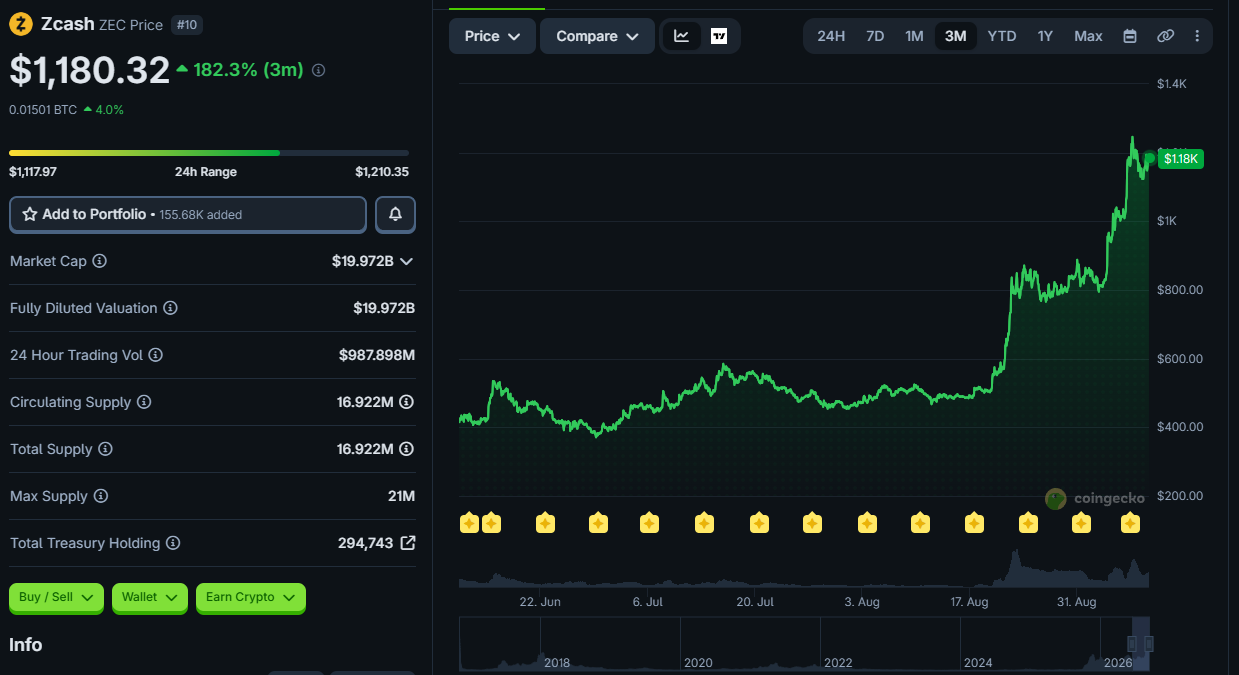
Some of Bitcoin’s oldest whales spent months privately urging early investor Dan Held to buy Zcash (ZEC) before the token’s rally past $1,000, he said in a recent interview.
Held, a former Kraken head of marketing who bought his first Bitcoin in 2012, said the messages came from investors with eight- and nine-figure net worths who have traded Bitcoin since 2013.
Whales Pitch Zcash to a Bitcoin Purist
Held said that over roughly three to six months, these investors pushed him to buy ZEC between $100 and $400. Many funded the trade by trimming a fifth to an eighth of their long term Bitcoin holdings.
Zcash has since crossed $1,000 last week, its first time above that level in nearly a decade, since it was launched. Rising Zcash ETF inflows into Grayscale’s ZCSH fund have added to the rally’s momentum.
Held said he still views the timing skeptically. He argued that crypto narratives typically form only after an asset has already moved, not before it. That pattern, he said, looks familiar in Zcash’s case as well.
Held Isn’t Convinced Yet
Held contrasted Zcash with Bitcoin’s fixed 21 million supply cap. He said the Zcash community accepted a tradeoff between privacy and supply auditability that Bitcoin’s community rejected.

He pointed to an episode from roughly six months to a year ago. Confusion over a possible exploit briefly made it unclear exactly how much ZEC was in circulation. Held said that kind of uncertainty would be intolerable for an asset marketed as digital gold.
Held added that he generally avoids buying whatever the market already loves. He said his best trades, including Bitcoin and SpaceX, came from assets nobody wanted at the time. On Zcash, he said, that is no longer the case.
Some Zcash short sellers have also been squeezed by the rally, a sign of how fast sentiment turned.
Whether the whales’ early timing proves right will likely take a full market cycle to judge.
The post Bitcoin Whales Were Urging Friends to Buy Zcash Before Its Rally to $1,000 appeared first on BeInCrypto.


Abraxas Capital has bought another 13,000 ETH worth $32.39 million in the spot market to hedge part of a 141,180 ETH short position on Hyperliquid valued at $353.27 million.
Summary
- Abraxas Capital bought another 13,000 ETH worth $32.39 million in the spot market, according to Lookonchain.
- The purchase was made to hedge a 141,180 ETH short position on Hyperliquid valued at $353.27 million.
- The latest spot purchase covers just over 9% of the short when measured by the number of ETH.
- Abraxas previously accumulated more than 211,000 ETH worth over $477 million during a six day buying run in May 2025.
Lookonchain said on Sept. 8 that Abraxas Capital purchased the additional Ether while keeping its much larger short position open on the decentralized derivatives platform. The blockchain analytics account described the transaction as another spot purchase made specifically to hedge the short.
At the values provided by Lookonchain, the latest purchase was made at an implied price of roughly $2,491 per ETH. The 13,000 ETH position equals just over 9% of the firm’s 141,180 ETH short when measured by the number of tokens.
Abraxas therefore remains heavily net short based solely on the positions disclosed by Lookonchain. Subtracting the latest 13,000 ETH spot hedge from the 141,180 ETH short leaves 128,180 ETH of net short exposure before considering any other holdings or positions controlled by the firm.
Abraxas Capital keeps $353 million ETH short open
Lookonchain valued the Hyperliquid short at approximately $353.27 million at the time of its post, compared with $32.39 million for the latest spot purchase.
The hedge gives Abraxas exposure to ETH in opposite directions. The short position benefits from a decline in Ether’s price, while the spot ETH gains value when the token rises. Lookonchain specifically characterized the latest purchase as a hedge, rather than a closure or reduction of the underlying short position.
Large leveraged positions have become common on Hyperliquid, where whale accounts have carried several billion dollars in combined positions this year.
In May, crypto.news previously reported that Hyperliquid whale positions had reached $4.039 billion. Long exposure stood at $1.981 billion, while shorts accounted for $2.058 billion, producing a long-to-short ratio of 0.96.
Both sides of the whale book were underwater at the time. Long positions carried roughly $30.8 million in aggregate unrealized losses, compared with approximately $14.6 million in losses on short positions.
One of the largest individual trades in the May snapshot involved an ETH whale using 15x leverage. The account held roughly $87 million in Ether exposure from an entry near $2,265 and was sitting on more than $3.6 million in unrealized losses.
A separate reading five days earlier placed Hyperliquid whale exposure at $4.236 billion. Long positions totaled $2.099 billion, or 49.55% of the total, against $2.137 billion in shorts.
The split produced a long-to-short ratio of 0.98, leaving large traders almost evenly positioned between bullish and bearish bets.
Abraxas has made large Ethereum purchases before
The latest transaction is not Abraxas Capital’s first large on-chain move involving Ether.
In May 2025, the investment manager withdrew 138,511 ETH valued at roughly $297 million from centralized exchanges over two days, according to Lookonchain. The transfers occurred during a sharp ETH rally that pushed the token above $2,300.
Abraxas then increased its holdings with another 33,482 ETH purchase worth $84.7 million.
Lookonchain data cited at the time showed that the firm had accumulated 211,030 ETH over six days, worth more than $477 million. The purchases followed the earlier withdrawal of approximately $297 million in ETH from exchanges.
The 2025 accumulation occurred under different market conditions and does not establish the purpose of the firm’s current positions. Lookonchain has specifically described the Sept. 8 spot transaction as a hedge against the Hyperliquid short.
Hyperliquid whale positioning has changed considerably at different points this year. In April, large trader positions totaled $3.4 billion, consisting of $1.737 billion in longs and $1.663 billion in shorts.
Long positions were carrying approximately $153 million in aggregate unrealized losses at the time, while shorts were sitting on roughly $161 million in unrealized profits.
An ETH whale tracked in the same dataset held a 15x leveraged long from around $2,148.70 and was down approximately $8.6 million.
Ethereum trades close to $2,500
Abraxas made its latest hedge while Ether remained close to the $2,500 level following a recovery from early September lows.
On Sept. 7, Ethereum traded near $2,493 after moving between approximately $2,475 and $2,537 during the session.
ETH had repeatedly failed to hold above $2,500, while its daily relative strength index had eased to 63.62 after the August rally.
Liquidation data cited in the report showed notable leveraged positions clustered around $2,430 below the market and between $2,540 and $2,600 above it. The nearest support zone was concentrated between roughly $2,423 and $2,475.
Ether had been trading considerably lower less than a week earlier. On Sept. 2, the token fell to an intraday low of $2,356 after failing to clear resistance close to $2,550.
Approximately $94.2 million in ETH futures positions were liquidated over 24 hours during the decline, while Ethereum fell below $2,400.
ETH remained above several medium-term moving averages at the time, including its 20-day simple moving average near $2,299 and its 50-day, 100-day and 200-day averages near $2,054, $1,903 and $2,030, respectively.
The token later recovered toward the $2,500 area, putting Abraxas’ latest 13,000 ETH spot purchase close to the same price zone.
Institutional demand for spot Ether has remained active during the recovery. U.S. spot Ethereum exchange-traded funds recorded $225.8 million in net inflows on Aug. 28, extending a nine-session buying streak to $1.42 billion.
BlackRock’s ETHA accounted for $1.02 billion, or roughly 72%, of the nine-day ETF inflows. Fidelity’s FETH recorded $56.2 million on Aug. 28, while BlackRock’s staked ETHB product added $20.7 million.
Lookonchain’s Sept. 8 figures put Abraxas Capital’s latest spot hedge at 13,000 ETH worth $32.39 million, while the firm’s Hyperliquid short remained at 141,180 ETH with a notional value of $353.27 million.


Sweden’s tax authority has ordered six crypto companies operating in Boden to pay nearly 540 million Swedish kronor (approx. $56 million) in additional taxes after finding that the firms used business structures to obtain tax benefits they were not entitled to.
Summary
- Sweden has ordered six crypto firms operating in Boden to pay nearly SEK 540 million in additional taxes.
- The tax agency said some companies concealed crypto mining activity to claim tax benefits they were not entitled to.
- Nine crypto companies have received tax adjustments totaling more than SEK 500 million between 2024 and 2026.
- Bikupan Datacenter has challenged its tax assessment and taken the dispute to Sweden’s Supreme Administrative Court.
Swedish public broadcaster SVT reported on Sept. 3 that the six companies accounted for most of the latest tax adjustments imposed on crypto businesses following a review by Skatteverket, the Swedish Tax Agency. The authority said some companies had structured their operations in ways that concealed crypto mining activity.
Patrik Lillqvist, head of intelligence at Skatteverket, said the arrangements were designed to secure tax advantages that would not have been available if the businesses had been classified as crypto miners.
“The companies that we have inspected often have a special arrangement to conceal that they are engaged in mining,” Lillqvist said, according to a translation of his remarks. “The purpose is to obtain tax advantages that the companies are not entitled to.”
The latest assessments form part of the agency’s review of the crypto industry between 2024 and 2026. Nine companies have received tax adjustments totaling more than half a billion Swedish kronor during that period, with six of them operating in Boden.
Sweden crypto tax review centers on mining operations
Boden, a city in northern Sweden, has attracted crypto miners for years because of its access to power and data center infrastructure. The region was already home to around 10 crypto mining companies by 2018, when operators were increasingly looking to Sweden as a location for mining facilities.
Tax treatment later became a source of tension between the industry and Swedish authorities. Sweden moved in 2023 to remove electricity tax relief previously available to data centers, a decision that affected Bitcoin miners operating energy-intensive facilities in the country.
The latest Skatteverket cases concern how companies described the nature of their businesses for tax purposes. According to the agency, some firms presented operations in a way that hid their role in creating new units of cryptocurrencies through mining.
SVT’s earlier investigation into Sweden’s crypto industry found in 2024 that companies had deprived the state of around 1 billion Swedish kronor in taxes, with most of the cases concentrated in Boden. The new assessments show that disputes involving the sector continued through 2026.
Lillqvist criticized companies that entered Swedish communities and used arrangements that the authority believes deprived the state of tax revenue.
“You come to a society and steal from it,” he said.
Several companies have challenged Skatteverket’s decisions in court. Sweden’s administrative court and administrative court of appeal have so far sided with the tax authority in the cases they have considered, according to SVT.
Bikupan Datacenter takes dispute to Sweden’s top administrative court
Bikupan Datacenter, which has operated in Boden and Robertsfors, is among the companies contesting the tax authority’s position.
The company has been granted corporate restructuring after becoming unable to pay its debts, while its tax dispute has reached Sweden’s Supreme Administrative Court. The case remains under consideration.
Bikupan is connected to HIVE Digital Technologies, whose Swedish operations have been caught in a longer-running disagreement over the tax treatment of its business. HIVE said in March that it was scaling down Bitcoin mining at its Boden facility as it challenged the way Swedish tax rules were being applied to the operation.
Johanna Törnblad, CEO of Bikupan Datacenter and HIVE’s Sweden country manager, rejected Skatteverket’s assessment of the company’s historical operations.
“When it comes to the historical operations of the Bikupa companies, we do not share the Swedish Tax Agency’s assessment,” Törnblad told SVT by email.
She said Bikupan’s restructuring application explains the company’s position that crypto mining itself was performed by external mining pools that were independent of the HIVE group.
Under the company’s account of its business model, the Bikupa entities sold computing capacity, or computing power, which could be used for workloads including artificial intelligence.
HIVE has been moving its Boden site toward AI computing
The distinction has become more relevant to HIVE’s plans for its Swedish infrastructure as the company moves resources toward high-performance computing and artificial intelligence.
Crypto.news previously reported in June that HIVE generated record fiscal 2026 revenue of $298 million while expanding its AI computing business. Its high-performance computing operation generated $19.5 million during the fiscal year, up 94% from $10 million a year earlier, while contracted annual recurring revenue from its BUZZ HPC unit reached $35 million.
HIVE reported 440 megawatts of global power capacity across Canada, Sweden and Paraguay at the end of the fiscal year. Its installed Bitcoin mining hashrate increased from 6.5 exahashes per second to 25.1 EH/s during the same period, although the company’s Bitcoin holdings fell to 150 BTC as of March 31.
Part of its AI expansion has involved repurposing infrastructure that was originally used for crypto mining. The company has been converting its Boden facility into a Tier 3 liquid-cooled high-performance computing data center designed to support 2,000 Nvidia GPUs.
The company had already disclosed plans in November 2025 to retrofit the Boden site from a Tier I mining facility into a liquid-cooled Tier III+ high-performance computing center, while expanding GPU infrastructure in Canada.
HIVE’s dispute with Swedish authorities has continued while Bikupan deals with its tax liabilities and restructuring proceedings. The company maintains that its historical Swedish entities provided computing power while independent external mining pools carried out the actual crypto mining.
Skatteverket has maintained the opposite position in its assessments, treating the reviewed operations as mining activity and arguing that the structures used by the companies gave them tax advantages for which they did not qualify. Bikupan’s challenge to that assessment remains before the Supreme Administrative Court.

Urgent warning to parents after deleted photos used to build creepy profiles of children

Billionaire wealth reaches $15.1 trillion in 2025: Altrata report

China’s EV makers shift gears to focus on humanoids as car market slows


-
 Tech16 hours ago
Memory prices are slowing because buyers ran out of money
-

 NewsBeat14 hours ago
England up in reading, maths and science rankings as Scotland and Wales dip
-

 Business18 hours ago
Egyptian TV Presenter Sarah Khalifa, 11 Others Sentenced To Death In Major Drug Trafficking Case In Cairo
-
 Tech18 hours ago
Strong Password Policy and Password Manager Guide
-

 Crypto World18 hours ago
Visa expands stablecoin card network to 160 programs
-
 Sports18 hours ago
Phones confiscated, players sent home: Pakistan’s England tour turmoil revives memories of Mohammad Amir, Salman Butt and Mohammad Asif’s 2010 Lord’s spot-fixing scandal | Cricket News
-
 NewsBeat14 hours ago
Tehran’s assertive rhetoric signals a new and dangerous phase in conflict
-
 Business7 hours ago
Oil Higher on Hormuz Escalation, Weighing on Sentiment
-

 Politics13 hours ago
The Ultimate September Reset Guide: How To Refresh Your Mind And Life This Autumn
-

 Business18 hours ago
Claim Your Share Of $50 Million Disney Streaming Price Settlement By Sept. 8 Tonight
-

 Tech13 hours ago
Google’s revived nuclear power plant gets $1.9B loan from US government
-
 Business12 hours ago
Copper hits record high, UltraTech’s Ultravolt on the offensive: A double whammy for cable makers in FY27?
-

 Fashion12 hours ago
Phia Is the Shopping App That Styles You From Your Own Closet
-

 Fashion11 hours ago
How to Safeguard Your Small Business Against Emerging Cyber Threats
-

 Crypto World18 hours ago
Iran Threatens to Target U.S. Energy Assets in Gulf If U.S. Strikes Again
-

 Business16 hours ago
US-Canada tariffs: Canada braces for prolonged trade war as counter-tariffs on US take effect
-

 Tech13 hours ago
ESP32-P4 Powers Video Alarm Clock
-

 Tech17 hours ago
Stoke Space raises another billion to rival SpaceX at re-flying rockets
-

 Business13 hours ago
Corning Stock Climbs On Multibillion-Dollar Verizon Network Deal
-
Crypto World13 hours ago
Zcash (ZEC) Rockets 2,200% as Privacy Coins Become Crypto’s Biggest Outlier
You must be logged in to post a comment Login