
Crypto World
Meme Coin Launchpads Captured 82% of Arc's First Day Trading Volume



Meme coin launchpads accounted for roughly 82% of the $410.8 million in decentralized exchange volume that Circle’s Arc network cleared on its first day of public mainnet.
Circle built Arc for financial markets, real-time money movement, and agentic economic activity. Instead, speculative traders set the tone on the first day.
Circle Pitched Institutions Meme Coin Traders Showed Up First
Arc is an open Layer 1 network built by Circle, the issuer of USDC (USDC). The company marketed Arc as an “economic operating system” for the internet. Its founding validator set includes BlackRock, Visa, Mastercard, DTCC, and ICE.
More than 100 institutional and ecosystem builders had already deployed on or tested Arc’s private mainnet before the public opening.
Asset managers, including Bitwise, BlackRock, and Janus Henderson, are moving tokenized funds onto the chain. Payment firms such as Visa and MoneyGram plan to run stablecoin settlement through it.
Trading venues arrived alongside them. Uniswap, Robinhood, and Pump.fun are among the platforms expanding spot, perpetual, and cross-chain markets.
“Today we are switching on something the world has never had before: an open, neutral, always-on economic operating system for the internet, secured by some of the most important financial institutions on Earth, and built for a world where both people and machines transact,” Jeremy Allaire, Co-Founder, Chairman, and CEO of Circle, said.
However, on-chain data compiled by analyst Adam shows the opening day belonged to a different crowd.
Arguspad Swallowed Half of Day One
Launchpad tokens generated $336.26 million of Arc’s first-day trading, according to Dune data. Arguspad alone handled $202.35 million of that total.
Follow us on X to get the latest news as it happens
Minara.fun followed with $36.41 million and Tollylabs with $19.65 million. Arguspad also minted 83,751 tokens in 24 hours, more than 86% of every token created on the chain.
Overall, traders minted 97,025 tokens and pushed 7.76 million transactions through the chain on September 16
Traders had flagged the setup before launch, drawing a straight line to Robinhood Chain. It cleared just $14.74 million on its own opening day, July 1. Arc’s debut ran nearly 28 times larger
Now, the key question is durability. Robinhood Chain cooled through August before reaching a $3.7 billion daily record this month, and Arc’s coming weeks will show whether institutional flow or launchpad churn sets the pace.
Subscribe to our YouTube channel to watch leaders and journalists provide expert insights
The post Meme Coin Launchpads Captured 82% of Arc's First Day Trading Volume appeared first on BeInCrypto.


Bitget, one of the world’s largest Universal Exchanges (UEX), has upgraded its Proof of Reserves (PoR) from four cryptocurrencies to 19 major assets, significantly widening the share of user holdings covered by its reserve verification infrastructure. The upgrade extends both platform-level reserve disclosures and personal Proof of Assets verification, giving users greater visibility into how assets held on Bitget are accounted for and the ability to independently verify their inclusion in reserve snapshots.
As exchanges expand the range of assets they support, reserve transparency needs to keep pace. The latest upgrade moves Bitget closer to making verification a standard layer across its ecosystem, rather than a safeguard limited to core cryptocurrencies.
The expanded coverage includes BTC, USDT, ETH, LTC, LINK, XRP, USDC, DOGE, BNB, SOL, ADA, NEAR, XAUT, TAO, SUI, ONDO, HYPE, PI, and USDGO. Through the upgraded PoR page, users can view the reserve ratio and amount of user assets for each supported asset, assess if reserves are sufficient, and see how user assets are distributed across different public blockchains.
Personal Proof of Assets verification has expanded across the same range, allowing users to independently check whether their holdings were included in a PoR snapshot using Merkle Tree verification. Detailed audit records, including Merkle hashes and snapshot information, remain available for users seeking deeper verification.
Bitget has published Proof of Reserves monthly since its launch in December 2022. As of August 2026, the platform had published 45 consecutive PoR reports, with its latest report showing a total reserve ratio of 122%, remaining above the 1:1 reserve standard. Bitget uses Merkle Tree technology to aggregate and verify user assets, allowing users to independently confirm whether their holdings are included in a particular Proof of Reserves snapshot. Users can also download the relevant data and further verify their asset records using publicly available verification methods.
“Users shouldn’t have to simply take our word for it, they should be able to verify their assets for themselves,” said Gracy Chen, CEO of Bitget. “Proof of Reserves has been part of Bitget’s transparency framework for nearly four years, and as the assets people hold on our platform become more diverse, that verification needs to expand with them. Expanding from four assets to 19 gives more users that visibility.”
For assets outside the scope of a particular audit, or where corresponding personal records have not yet been generated, Bitget’s Proof of Assets interface provides relevant notices to help users interpret their audit results accurately. As UEX brings a broader range of assets and markets into one trading environment, Bitget is extending the systems that allow users to independently examine what sits behind their holdings. Proof of Reserves, the Protection Fund, and Bitget’s broader security infrastructure form part of that approach, with the goal of making security increasingly measurable and verifiable as the ecosystem grows.
For more information, visit here.
About Bitget
Bitget is one of the world’s largest Universal Exchanges (UEX), serving over 125 million users and offering access to over 2M crypto tokens, 500+ tokenized stocks, ETFs, commodities, FX, and precious metals such as gold. The ecosystem is committed to helping users trade smarter with its AI agent, which co-pilots trade execution. Bitget is driving crypto adoption through strategic partnerships such as MotoGP™. Aligned with its global impact strategy, Bitget has joined hands with UNICEF to support blockchain education for 1.1 million people by 2027. Bitget currently expands in the tokenized TradFi market, providing the industry’s lowest fees and highest liquidity across 150 regions worldwide.
For more information, visit: Website | X | Telegram | LinkedIn | Discord
Risk Warning: Digital asset prices are subject to fluctuation and may experience significant volatility. Investors are advised to only allocate funds they can afford to lose. The value of any investment may be impacted, and there is a possibility that financial objectives may not be met, nor the principal investment recovered. Independent financial advice should always be sought, and personal financial experience and standing carefully considered. Past performance is not a reliable indicator of future results. Bitget accepts no liability for any potential losses incurred. Nothing contained herein should be construed as financial advice. For further information, please refer to our Terms of Use.
The post Bitget Broadens Proof of Reserves as 20+ Assets Become Verifiable appeared first on BeInCrypto.


South Korean police have reportedly referred 18 Polymarket users to prosecutors in an illegal gambling investigation involving 26 people who collectively wagered about 17.6 billion won (worth $12.7 million).
According to Asia Economy, data submitted by the National Police Agency to the office of Democratic Party lawmaker Yoon Kun-young showed that the Gangwon Provincial Police Agency had placed 26 people under investigation as of Tuesday and sent 18 of them to prosecutors. The report said the largest amount wagered by a single user was about 5.7 billion won ($4.1 million).
Police identified users by analyzing publicly available blockchain transactions, the report said. Polymarket lets users buy and sell contracts tied to the outcomes of real-world events and operates on a noncustodial, peer-to-peer structure with automated settlement. It does not maintain a conventional list of users by their real names, the report said.
Authorities reportedly said Polymarket transactions constitute illegal gambling under South Korea’s Criminal Act because users stake assets on outcomes that cannot be predicted with certainty. The users argued that Polymarket should instead be treated as a crypto-based derivatives investment market, according to the report.
South Korea moves against Polymarket
In June, Gangwon police launched South Korea’s first illegal gambling probe into local Polymarket users at the request of the National Police Agency. On Aug. 18, South Korean authorities moved to block Polymarket after determining that the prediction market provided an illegal gambling environment to users in the country.
The country’s media and communications review commission said the platform’s winner-takes-all structure encouraged speculative gambling, citing Polymarket’s role in operating markets, setting trading rules, providing crypto deposits, withdrawals, and settlement and collecting transaction fees.
Related: CFTC, US soldier accused of illegal Polymarket bet spar over interpretation of prediction markets
Polymarket argued that it did not provide Korean-language services or support payments in Korean won and that its noncustodial transactions and use of smart contracts meant it did not directly manage user funds. The commission rejected the argument, saying technical characteristics did not exempt a service from South Korean law.
Tae-Lim Kim, managing attorney at AXIS Law, told Asia Economy that the transactions could meet the legal requirements for gambling. He said describing them as prediction derivatives would be difficult to use as a direct defense in criminal proceedings, although the ability to trade contracts and exit positions before settlement could be relevant to a court’s assessment.
Magazine: Revolut ID thefts highlight KYC’s dangers: Here’s how to fix it
Faisal Bashir | Lightrocket | Getty Images
BEIJING — China’s artificial intelligence models may be enjoying rapid adoption but that isn’t yet translating into revenue, raising questions about company valuations.
All of China’s AI models combined generate only about 10% of the revenue reported for OpenAI and Anthropic, U.S.-based research firm Rhodium Group said in estimates published Thursday. That’s based on reports using an industry metric called annual recurring revenues, which attempts to capture fast growth by multiplying a recent monthly figure by 12.
DeepSeek’s ARR was the lowest among major Chinese AI companies, at $500 million, the Rhodium report said. MiniMax was next at $800 million, followed by Moonshot at $1 billion.
Z.ai told investors on Wednesday its latest ARR was $1.8 billion, according to a transcript seen by CNBC.
But even with $4 billion for ByteDance and $2.4 billion for Alibaba, that remained far lower than the $40 billion generated by OpenAI alone, not to mention $65 billion for Anthropic, Rhodium said.
Critically, the low revenue is far from keeping pace with how investors are valuing the Chinese startups.
“Valuations relative to revenue appear exorbitant for Moonshot and DeepSeek at present,” the Rhodium report said. The analysts noted estimated ratios of 50x and 163x, respectively, for the two startups.
That’s far above the 34x for OpenAI and 21x for Anthropic, the report said.
Z.ai forecast
To be sure, the Rhodium analysis could reference only the latest available figures from this summer, and usage of Chinese AI models has skyrocketed from low levels earlier this year.
Z.ai on Wednesday said it now expects its ARR by the end of the year to reach $3 billion, up from $2.4 billion previously forecast.
Rhodium also pointed out that Chinese AI labs are exploring ways to get a larger cut of revenue from third parties offering access to the models, whose open-source nature allows anyone with sufficiently capable hardware to download and run it independently of the developer.
U.S. models are mostly closed, and the cost per task for leading AI models from OpenAI and Anthropic is far higher than that of Chinese models, according to AI-comparison firm Artificial Analysis.
“The financing gap means it will be far more difficult for Chinese frontier AI labs to scale sustainably,” Logan Wright, partner at Rhodium Group, said in a statement to CNBC. He co-authored the report with research analyst Endeavour Tian.
“They will be heavily dependent upon a favorable climate in the equity market—historically that’s not an easy bet in China,” he said. “Government funding has been helpful on the hardware side of the buildout of compute capacity, but similarly will probably balk at direct funding for the frontier labs.”
Rhodium estimated more than 60% of equity investment in Chinese AI chips and servers came from state-affiliated sources.
It’s been a volatile year for Chinese AI companies that have listed.
Z.ai shares rose more than 5% in Thursday morning trading, recovering from a decline earlier this week following news of its second major fundraise in two months. The Hong Kong-traded stock has tumbled to levels seen this spring, after briefly more than tripling in price over the summer.
Shares of rival Minimax have struggled in recent months to hold above their IPO-day gains, after seeing shares spike in the spring.
—CNBC’s Jenny Lee contributed to this report.


H100 CEO Eirik Grøttum has increased his exposure to the Swedish Bitcoin treasury company through purchases totaling 407,163 shares for SEK 621,887, while H100 continues to report 3,506.4 BTC on its balance sheet.
Summary
- H100 CEO Eirik Grøttum bought 407,163 shares through Kode Oslo for SEK 621,887 this week.
- Kode Oslo now holds 2,771,787 H100 shares after purchases completed in August and September 2026.
- Companies associated with Grøttum collectively hold 5,399,464 H100 shares following the insider transactions disclosed today.
- H100 continues holding 3,506.4 Bitcoin after completing its Norwegian acquisition on August 10 this year.
- H100 issued 790,534,666 shares for the acquisition, which added 2,455.37 Bitcoin using no cash consideration.
H100 Group said in its Sept. 17 primary-insider disclosure that Kode Oslo AS carried out the purchases, with 405,663 shares acquired on Sept. 15 at an average SEK 1.53 and another 1,500 shares acquired on Aug. 19 at SEK 1.40. The combined average price was SEK 1.53 per share.
H100 CEO purchase lifts related holdings above 5.3 million
Kode Oslo now owns 2,771,787 H100 shares following the disclosed transactions. Grøttum serves on Kode Oslo’s board, owns 20% of the company and participates in its investment decisions, according to H100’s regulated notice.
A second associated entity, Olav Grøttum Holding AS, owns another 2,627,677 H100 shares. Grøttum owns that company entirely. Combined, the two businesses hold 5,399,464 H100 shares after the latest purchases.
The transaction concerns shares in H100 Group, not a new Bitcoin purchase by the company. H100’s disclosed Bitcoin position therefore remains separate from the CEO-related equity purchase.
Grøttum became H100’s chief executive on Aug. 11, one day after the company completed its large Norwegian Bitcoin-related acquisition. He previously served as CEO of Moonshot AS and had worked with H100 Chief Investment Officer Peter C. Warren managing Bitcoin holdings belonging to Geir Harald Hansen through Moonshot.
H100 said Grøttum’s background covers software development, quantitative trading, asset management and fintech. His appointment moved former CEO Johannes Wiik back into the chief operating officer role.
H100 still reports a 3,506.4 BTC treasury
H100’s latest company disclosures continue to place its treasury at 3,506.4 BTC. The position increased sharply on Aug. 10 when H100 completed its acquisition of NSD AS, which through a reorganization held Moonshot AS and PDI AS.
The transaction brought 2,455.37 BTC into the group, taking H100 from 1,051.03 BTC at the end of June to 3,506.4 BTC. H100 said the acquired companies had no outstanding financial debt.
No cash was paid for that acquisition. H100 issued 790,534,666 new shares to the sellers at SEK 1.86 each, representing consideration of approximately SEK 1.47 billion. The new shares increased H100’s outstanding share count to 1,128,931,358 immediately after the transaction.
The share issue represented roughly 70% of H100’s outstanding shares after closing. Geir Harald Hansen received a controlling position of approximately 69.2% through 781,676,551 shares following the deal, according to H100’s interim report.
H100 described the transaction as “the largest M&A transaction ever completed in the European Public Bitcoin Equity sector” and the first public-market acquisition completed on a Bitcoin-for-Bitcoin basis. Those descriptions are company claims and were not independently established across all European and global public-market transactions.
As crypto.news previously reported, the agreed valuation used Bitcoin at SEK 598,926.69, roughly $62,900, based on the Coinbase BTC/SEK spot price at the specified July 31 reference time. The figure was an acquisition valuation benchmark, not an open-market purchase price for 2,455.37 BTC.
Bitcoin exposure has become central to H100’s balance sheet
H100 began its Bitcoin treasury strategy on a much smaller scale. Its first purchase in May 2025 involved 4.39 BTC, after which the company raised equity and convertible financing to build its holdings.
By June 30, 2026, the company held 1,051.03 BTC before the Norwegian acquisition nearly tripled that amount. H100 describes itself as a technology company serving health and longevity providers while running an active Bitcoin treasury strategy.
The Bitcoin exposure has made H100’s reported earnings sensitive to cryptocurrency prices. Its second-quarter report showed an operating loss of SEK 88.7 million and a pre-tax loss of SEK 98.2 million. H100 said SEK 93.3 million of the pre-tax loss consisted of items that did not affect cash flow.
For the first half of 2026, the company reported a SEK 253.6 million pre-tax loss, while operating cash flow was negative SEK 12.7 million. Its equity ratio stood at 86% at June 30.
As crypto.news reported after the results, much of the quarterly accounting loss was linked to a non-cash write-down associated with Bitcoin’s lower valuation during the reporting period.
Grøttum wrote in the interim report that simply raising funds to accumulate Bitcoin was “unlikely to be sufficient on its own” for treasury companies. He said H100 planned to use capital allocation, capital-markets activity, acquisitions and operating cash flow alongside its Bitcoin holdings. The statement describes management’s strategy and does not guarantee future returns.
H100 is considering future share buybacks
The insider purchase follows a separate H100 announcement on Sept. 16 concerning new Swedish share-repurchase rules. Starting Dec. 5, Swedish public companies whose shares trade on multilateral trading facilities will be permitted to repurchase and hold their own shares. The change covers NGM Nordic SME, where H100 trades.
Grøttum said repurchases could become one of several capital-allocation options, particularly when H100 shares trade below net asset value. His comments describe a potential future tool, not an announced repurchase program.
H100 explicitly said no decision has been taken to repurchase its own shares. Any future program would require authorization from shareholders followed by a board resolution and disclosure under the applicable rules. The company’s Sept. 17 insider filing did not announce a change to its Bitcoin treasury, leaving the latest disclosed balance at 3,506.4 BTC.


The UK Financial Conduct Authority has targeted three London premises suspected of running illegal peer to peer crypto trading businesses, extending an enforcement campaign against unregistered digital asset activity.
Summary
- FCA targeted three London premises suspected of running illegal peer to peer crypto trading businesses in a Sept. 10 operation.
- Cease and desist letters were issued at all three locations as the FCA worked alongside HMRC and the Metropolitan Police.
- No peer to peer crypto businesses are currently registered with the FCA, while evidence from an April operation is supporting ongoing investigations.
According to the FCA, the operation was carried out on Sept. 10 alongside HM Revenue & Customs and the Metropolitan Police Service. Cease and desist letters were issued at all three locations, requiring traders to stop any suspected illegal crypto business.
Peer to peer crypto trading involves people buying and selling digital assets directly with one another. Personal transactions do not require FCA registration, but anyone conducting the activity by way of business in the UK must have the appropriate registration. No peer to peer crypto trading businesses are currently registered with the regulator.
The FCA said unregistered operators can provide a route for criminals to move and launder illicit funds because businesses operating outside its registration system avoid controls designed to detect and prevent money laundering.
“Working with partners, we continue to track and disrupt illegal crypto activity,” Steve Smart, executive director of enforcement and market oversight at the FCA, said. “Anyone running an unregistered peer-to-peer crypto business should assume we are looking at them.”
FCA expands crackdown on illegal peer to peer crypto trading
The latest operation extends enforcement activity that began earlier this year. In April, the FCA and partner agencies targeted eight London locations suspected of hosting unregistered peer to peer crypto businesses, crypto.news previously reported.
During the April 22 operation, the FCA worked with HMRC and the South West Regional Organised Crime Unit. Cease and desist letters were issued at all eight locations, while evidence collected during the inspections was retained for criminal investigations.
The regulator said evidence gathered during that operation is now being used to support ongoing criminal investigations and other enforcement action. Like the September action, the earlier inspections were conducted under the Money Laundering, Terrorist Financing and Transfer of Funds Regulations 2017.
FCA officials have focused their enforcement efforts on businesses conducting crypto activity without the registration required under the existing anti money laundering framework. The regulator has been responsible for supervising relevant UK crypto businesses for compliance with anti money laundering and counter terrorist financing requirements since 2020.
Detective Sergeant Sathish Alalasundaram of the Metropolitan Police Service said investigators face challenges because cryptocurrencies allow funds to move rapidly across jurisdictions.
“Law enforcement and partner agencies are working significantly hard to tackle criminal activity involving digital assets,” Alalasundaram said. “The complex nature of cryptocurrency, combined with the speed at which funds can be moved across jurisdictions, presents ongoing challenges for those investigating.”
He said the Metropolitan Police continues to adapt its investigative capabilities and disruption methods as criminals change how they use digital assets.
FCA has previously pursued unregistered crypto businesses
The London operations follow several enforcement cases involving crypto businesses operating without FCA registration.
One of the regulator’s earlier cases involved Olumide Osunkoya, who pleaded guilty in September 2024 to offenses linked to an illegal crypto ATM network that processed £2.6 million in transactions between December 2021 and September 2023.
Osunkoya admitted operating crypto ATMs without the required registration, along with offenses involving false documents and criminal property. He was later sentenced to four years in prison, becoming the first person in the UK to receive a criminal sentence for unregistered crypto activity.
Separate enforcement action in June 2024 resulted in two London residents being arrested on suspicion of operating an illegal crypto exchange. Authorities believed more than £1 billion in unregistered cryptoassets had been bought and sold through the business.
The FCA inspected offices connected to the suspects, while Metropolitan Police officers searched two residential properties and seized several digital devices. Both individuals were interviewed under caution and released on bail while the investigation continued.
Enforcement continued in July 2025 when the FCA and Metropolitan Police searched four premises in southwest London. Seven crypto ATMs were seized and two people were arrested on suspicion of money laundering and operating an illegal cryptoasset exchange.
UK cryptoasset businesses providing services covered by the existing Money Laundering Regulations must register with the FCA and comply with applicable financial crime controls. Operating covered services by way of business without the required registration can lead to enforcement action.
UK crypto oversight will expand in October 2027
The Sept. 10 operation comes shortly before the FCA opens applications for the UK’s incoming crypto authorization framework.
Under final FCA guidance published on Sept. 16, applications for the new regime will open on Sept. 30, 2026. Firms seeking transitional arrangements must apply by Feb. 28, 2027, before the framework becomes mandatory on Oct. 25, 2027.
The incoming system will expand FCA oversight beyond the anti money laundering and financial promotion requirements that currently apply to much of the sector. Activities covered by the new framework include operating cryptoasset trading platforms, safeguarding cryptoassets, dealing and arranging transactions, issuing qualifying stablecoins and arranging cryptoasset staking.
Existing registration under the Money Laundering Regulations will not automatically convert into authorization under the new system. Companies already registered with the FCA will need to assess their activities and seek the relevant permissions if they intend to continue providing regulated services after the new rules take effect.
The regulator finalized key crypto rules in June covering financial resilience, market integrity, stablecoins and consumer requirements. Firms supporting customers who buy, trade or hold crypto will face standards including capital requirements and stress testing, while market integrity provisions will cover conduct such as insider trading and market manipulation.
Until Oct. 25, 2027, crypto remains largely outside the UK’s full financial services regulatory framework apart from areas including anti money laundering requirements and financial promotions. The FCA advises consumers to use its Firm Checker to establish whether a crypto business has the required registration or permissions before dealing with it.
Revolut said Thursday it had received no direct contact from those claiming responsibility for a customer data breach despite multiple public ransom demands.
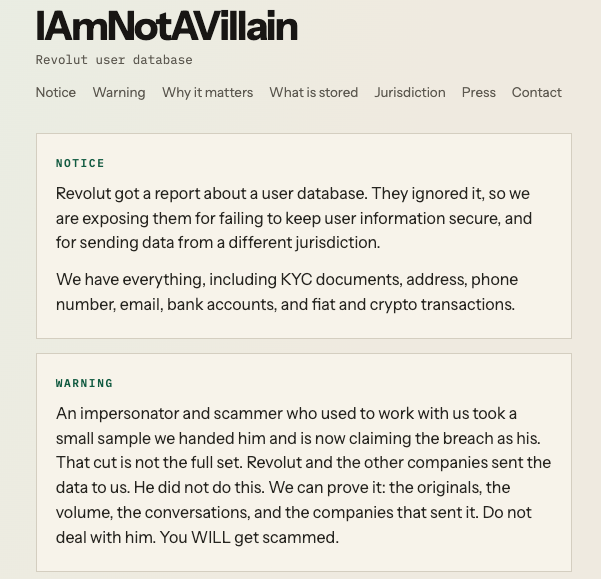
A group calling itself “IAmNotAVillain” publicly demanded 6,000 Monero (XMR), worth about $3 million, from Revolut within 24 hours, threatening to sell the customer records to other criminal groups, the Financial Times reported Wednesday.
“Revolut has not received any direct contact or demand from the individuals or group making these claims,” a Revolut spokesperson told Cointelegraph.
The public ultimatum is the latest development in a data breach Revolut first disclosed last week, with Italian authorities now widening their investigation into how a government email account was allegedly used to obtain customer data.
One breach, multiple ransom demands
Revolut’s claim that it has received no direct contact adds to uncertainty over who is behind the public ransom demand, as “IAmNotAVillain” is not the only name linked to claims of responsibility for the incident. Its website, iamnotavillain.xyz, was unavailable when checked by Cointelegraph at the time of publication.
An earlier group calling itself “Revolut Smilik” reportedly demanded 10,000 Bitcoin, worth about $780 million at the time, vastly more than IAmNotAVillain’s current $3 million Monero demand.
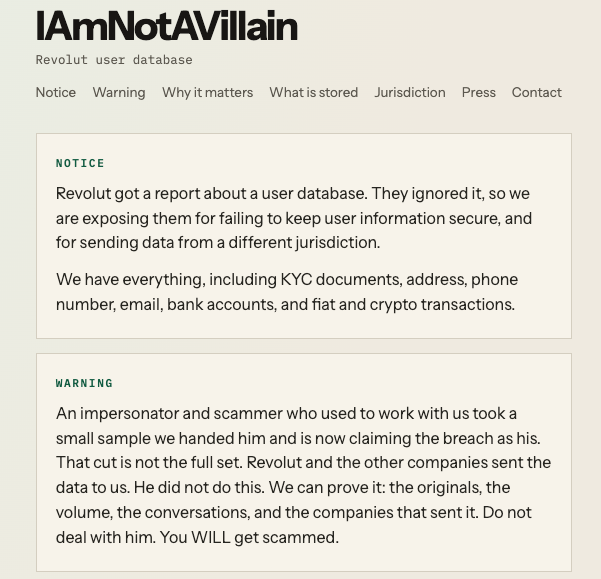
IAmNotAVillain disputed the competing claim in a notice on its website, alleging that a former associate had received only a small sample of the data before taking credit for the breach. The site warned others not to deal with the rival claimant.
Cybersecurity-focused account Dark Web Informer also flagged another website, revoloot.lol, associated with a separate actor claiming responsibility, further complicating efforts to establish who controls the stolen customer records. The revoloot.lol website was also unavailable when checked by Cointelegraph.
Italian authorities widen Revolut data breach probe
Italy’s National Anti-Mafia and Anti-Terrorism Directorate is also now involved because the suspected intrusion concerns a government entity, Italian news agency ANSA reported Wednesday.
Related: Italy investigates government email breach linked to Revolut data leak
Prosecutors in Reggio Calabria have opened an investigation into unauthorized access to a computer system of public interest, while investigators work to establish whether the institutional email account was breached or cloned.
Italy’s privacy regulator has separately asked banks to urgently review the security of their access systems and is examining whether other banks or financial institutions may have been involved.
Magazine: Revolut ID thefts highlight KYC’s dangers: Here’s how to fix it

XRP trades at $1.30 as of this writing, up a modest 1.5% over the last 24 hours, hardly the setup that screams $30 price prediction. Yet that’s exactly the target Ripple’s own legal team is stoking. Below, the case for why bulls think regulatory clarity still favors XRP, and why the near-term chart tells a more cautious story.
Ripple Chief Legal Officer Stuart Alderoty took to X this week, arguing that the Senate’s failure to advance the CLARITY Act changes nothing about XRP’s legal footing. “Don’t forget, Ripple and XRP stand on settled ground,” Alderoty wrote, citing the 2023 federal court ruling that found XRP itself is not inherently a security, plus a March 2026 joint SEC-CFTC interpretation that classified XRP as a digital commodity.
XRP advocate Jake Claver has gone further, mapping a path through $1.17, $1.90, $3.10 and eventually $5.20 en route to a $20–$30 long-term target. The market’s actual reaction has been considerably less enthusiastic, and the gap between legal optimism and price action is where this story gets interesting.
Earn $50 and Enter $300K Prize Draw on EdgeX
XRP Price Prediction: Can Ripple Coin Hit $1.45 This Week?
XRP fell nearly 10% the day the Senate blocked the CLARITY Act before clawing back to current levels near $1.30. That round trip says more about fragile sentiment than conviction buying.
Immediate support sits at $1.30–$1.33, with deeper floors at $1.25, $1.21, and $1.14 if that band cracks. Resistance clusters at $1.34, $1.40 and $1.45, with a real breakout requiring a reclaim of $1.50.

Technically, XRP broke below the $1.34 Fibonacci level and its 7-day moving average, a setup that leaves momentum fragile until buyers retake that zone. The liquidity backdrop has improved slightly, and XRP’s entry into a new derivatives market via Moscow Exchange adds a fresh demand channel worth watching.
Bull case happens when XRP reclaims $1.34, pushing through $1.45–$1.50, reopening the path toward higher Fibonacci extensions. Or it could move range-bound consolidation between $1.25 and $1.40 while the market digests the CLARITY Act fallout.
However, a break below $1.21 opens a retest of $1.06, with some chartists flagging $0.62 as a tail-risk pivot. None of these scenarios gets XRP to $30 without a multi-year structural repricing; see this competing AI-driven price model for a sense of how wide the analyst spread really is.
Trade XRP on Bybit and Get a Chance to Win Our $1,000 USDT Airdrop
Maxi Doge Targets Early Mover Upside as XRP Tests Key Levels
XRP’s commodity-status thesis is legitimate. Ripple’s payments infrastructure buildout gives the asset real institutional utility beyond speculation. But a token already carrying a market cap in the tens of billions needs an enormous influx of capital to 20x.
This math is unforgiving regardless of legal clarity. Traders chasing asymmetric upside at this stage are increasingly looking past majors toward earlier-stage plays where the entry price hasn’t already priced in the good news.
Maxi Doge ($MAXI) is one of the presale tokens capturing that rotation. Built on Ethereum and positioned around a “1000x leverage trading mentality.” The project has raised $4.8 million so far at a current price of $0.0002839, with dynamic APY staking live for early holders.
Features include holder-only trading competitions with leaderboard rewards and a dedicated Maxi Fund treasury for liquidity and partnerships. The gym-bro branding (“never skip leg-day, never skip a pump”) is deliberately unserious, but the mechanics like staking, treasury-backed liquidity, and community competitions are not.
Maxi Doge presale directly before the presale ends.
Discover: The Best Token Presales
The post XRP Price Prediction: Ripple’s Commodity Status Could Send XRP to $30 appeared first on Cryptonews.


A New York federal judge has denied Susquehanna’s bid to freeze nearly $100 million tied to dozens of traders accused of profiting from alleged insider information before China announced a crackdown on cross border trading platforms.
Summary
- Susquehanna’s request to freeze nearly $100 million linked to alleged insider trading has been denied by a New York federal judge.
- The court found insufficient evidence that defendants were likely to hide or dissipate the funds before a potential judgment.
- Susquehanna failed to show likely success on claims that traders used nonpublic information before China announced its May 22 crackdown.
- The judge denied both the preliminary injunction and an alternative request to attach the defendants’ assets.
According to a Sept. 14 opinion and order from the U.S. District Court for the Southern District of New York, Judge Arun Subramanian found that Susquehanna Securities and Susquehanna Investment Group had not shown they were likely to suffer irreparable harm without a preliminary injunction.
Susquehanna filed the lawsuit on June 29 against 100 unnamed defendants, alleging violations of Section 20A of the Securities Exchange Act of 1934 and unjust enrichment. Citadel Securities later joined the case as an intervenor.
The dispute centers on trading before a May 22 announcement concerning the Chinese government’s crackdown on cross border trading platforms. Susquehanna alleged that the defendants traded using material nonpublic information before the news caused a sharp decline in certain securities.
The market maker initially targeted 100 defendants but narrowed its request for a preliminary injunction to 40. It asked the court to prevent them from transferring, encumbering, removing or otherwise disposing of proceeds held at third party brokerage firms that Susquehanna claimed came from insider trading.
As an alternative, the company sought an attachment order that would allow assets to be seized to secure a potential judgment.
Susquehanna failed to show an imminent risk to the funds
Subramanian found that Susquehanna had not produced enough evidence to establish that the defendants were likely to dissipate or conceal their assets before a judgment could be enforced.
Susquehanna argued that the defendants’ allegedly suspicious trading created a significant risk that the proceeds could be moved beyond the court’s reach. The judge rejected the argument, finding that accepting it would effectively allow asset freezes as a matter of course in many insider trading or fraud cases.
The court separately considered defendants living in the United States, foreign defendants who had appeared in the case and foreign defendants who had not appeared.
For domestic defendants, Susquehanna pointed to their failure to appear as part of its argument that the funds could be dissipated. The court found no evidence showing that their absence meant they intended to frustrate enforcement of a future judgment, noting that some apparently had not yet been formally served.
Susquehanna raised a similar concern over defendants living outside the United States, arguing that their assets could be moved beyond the jurisdiction of U.S. courts. Subramanian found that the possible difficulty of enforcing a judgment overseas was not enough by itself to establish irreparable harm.
The company did not identify a pattern of defendants hiding funds, making fraudulent transfers or engaging in evasive conduct, according to the order. Some foreign defendants who had appeared in the case submitted evidence indicating that they had enough funds to satisfy a potential judgment.
Susquehanna came closest to establishing a potential risk when it said in a reply filing that one defendant, identified as John Doe 3, appeared to have removed more than $10 million from a relevant account before a freeze took effect.
The court found that the claim lacked supporting evidence and said moving money from an account did not necessarily show an attempt to avoid a judgment. Funds used for active trading could have been reinvested elsewhere or could have belonged to a fund, employer or client.
Trading patterns did not establish likely insider trading
Susquehanna faced another problem because the court found that it had not demonstrated a likelihood of success on the merits of its claims.
To prevail on its Section 20A claim, the company would need to establish that someone owing a fiduciary duty of trust and confidence used material nonpublic information to profit from trading or tipped the confidential information to others.
Susquehanna submitted trading charts that it said showed defendants buying highly risky, short dated put options expiring on or shortly after the May 22 announcement. The company argued that there was no plausible explanation for the pattern other than trading based on material nonpublic information.
One defendant, Zhengfei Li, offered a different explanation. His trading records showed two equally sized positions, with half expiring before May 22 and the remainder afterward.
Li said the pattern was consistent with repeated speculation based on market signals instead of precise knowledge of an announcement. He told the court that unusually heavy put option activity visible through public market information and investor discussions led him to buy his own put options.
Evidence submitted by Li showed a put to call ratio of roughly 49 to 1 on May 21, the day he entered positions expiring after the announcement. Another defendant said she bought put options for similar reasons and submitted messages showing her reaction when the Chinese crackdown became public.
The court said defendants could have noticed unusual market volatility or publicly available posts suggesting that negative news was approaching and traded on those signals. Information available publicly would not qualify as nonpublic information under the insider trading claim.
Subramanian noted that some defendants’ trading records appeared more suspicious than Li’s. Susquehanna, however, brought the defendants together in one lawsuit and relied on broad arguments instead of providing detailed individual treatment of each trader.
The judge pointed to the scale of the original case, which accused 100 defendants of receiving insider information even though Susquehanna later stopped seeking a preliminary injunction against more than half of them.
Susquehanna had not identified the alleged tipper, the fiduciary duty that person owed or the personal benefit received for providing the information. The court found that the large number of investors who were not connected to each other could support explanations other than insider trading.
China crackdown triggered the trading dispute
The May 22 regulatory action at the center of the case involved Chinese scrutiny of overseas trading services offered to mainland investors.
crypto.news previously reported that Chinese securities regulators had targeted cross border brokerage activity involving firms including Tiger Brokers, Futu and Longbridge. The action concerned companies providing mainland clients access to overseas markets without regulatory approval.
China had already tightened restrictions on crypto and real world asset tokenization in February, extending restrictions to offshore entities serving mainland users and maintaining limits on virtual currency related financial services.
Days after the May 22 development, China’s Supreme People’s Court said judicial authorities would study rules for virtual currency disputes and cases involving cross border financial activity.
Enforcement involving overseas fund movements continued in July, when a Shanghai court sentenced five people over an illegal foreign exchange network that prosecutors said used cryptocurrency to move more than $29.4 million abroad. Authorities said the network helped domestic clients transfer more than 200 million yuan overseas over three years.
Court rejects alternative request to attach assets
Susquehanna’s failure to establish likely success on the merits affected its alternative request for an attachment order.
Federal Rule of Civil Procedure 64 allows courts to seize property to secure a potential judgment when the remedy is available under the law of the state where the court sits. In New York, a party seeking attachment must show, among other requirements, that it is probable to succeed on the merits.
Susquehanna relied on the same arguments it presented in support of the preliminary injunction. Subramanian found that the company had not demonstrated likely success on either its Section 20A claim or its unjust enrichment claim.
The unjust enrichment allegation was based on the same underlying claim that defendants had engaged in illegal insider trading. The court found that Susquehanna had not clearly shown that the defendants traded using material information unavailable to the market.
Questions remained over the extent of Susquehanna’s losses because the market maker acknowledged using hedging strategies. The court said the record did not establish how much of the defendants’ alleged gains, if any, came at the plaintiffs’ expense.
Subramanian stressed that the ruling did not decide whether Susquehanna had adequately pleaded plausible claims for relief, an issue the court had not yet addressed. The higher standard required to freeze funds totaling just under $100 million had not been met.
The court denied both the preliminary injunction and the alternative attachment request. An earlier order restricting the funds was set to dissolve at 5 p.m. ET on Sept. 16.
Crypto World
HTX Research Examines Stock-Linked Memecoins: A New Connection Between Equity Assets and Crypto Liquidity

HTX Research, the dedicated research arm of HTX, has released a new report titled Stock-Linked Memecoins: Issuance, Liquidity, and the Emerging AMM Stack, a systematic study of a new asset category that emerged following the launch of Robinhood Chain.
These memecoins are paired directly with stock tokens representing names such as NVDA, TSLA, HIMS, and MU, using them as quote asset, narrative anchor, or liquidity base. The report finds that they combine public-equity price discovery, crypto attention, AMM inventory, and continuously traded sentiment into a single market structure — the short-term growth case holds, but durability depends on four conditions being met simultaneously.
A New Market Structure
A stock-linked memecoin is a second-order equity exposure. The stock token provides a first-order price anchor, while the memecoin trades the culture, events, and sentiment surrounding that stock, often with volatility far exceeding the underlying. It resembles an attention derivative on an equity theme rather than a legally structured equity derivative.
Robinhood Chain is unusually well-suited to this experiment. Robinhood brings a recognized retail-equity brand and stock tokens carrying familiar company symbols rather than an abstract RWA narrative; Uniswap became a major liquidity venue from launch; and O1 Launchpad productized the process of selecting a stock token, creating a memecoin, opening a Uniswap v4 market, and allocating trading fees. As of September 8, 2026, DeFiLlama reported approximately $901 million in Robinhood Chain TVL and $1.727 billion in 24-hour DEX volume.
Multi-Hop Routing and Toll Collectors on Attention
Value capture extends beyond the memecoin itself. A trader buying a stock-linked memecoin may travel from WETH to USDG to a stock token and finally to the memecoin, with a single order generating fees for several pools along the way. During a short-lived attention spike, volume rises sharply while liquidity remains thin, and liquidity providers become the ecosystem’s most direct toll collectors on attention.
High fees, however, do not imply high net returns. Risks, including out-of-range positions, one-sided inventory, impermanent loss, stock-market closures, stock-token premiums or discounts, and incentive-token depreciation can all outweigh headline fee income. As HTX Research emphasizes, fees are compensation for risk, not free interest — LPs bear the risk of continuously filling at the wrong price, while traders bear the risk of picking the wrong token.
The 100,000% APY Illusion
Market commentary has cited displayed APY above 100,000% for supplying high-fee Uniswap v4 liquidity to stock-linked memecoins. The report dismantles this figure, noting that a short observation window, sudden volume surge, small TVL base, and compound extrapolation are all it takes to display an extreme annualized rate. If a $100,000 position earns $200 in one hour, simple annualization produces approximately 1,752%, and hourly compounding turns it into an astronomical number. Annualized metrics also ignore denominator effects — when a memecoin collapses, dividing unchanged fees by a smaller ending TVL inflates the displayed yield.
The report proposes a more robust test: the fee-coverage multiple – realized fees and monetized incentives divided by losses relative to a simple hold portfolio, rebalancing costs, and hedging costs. Only a multiple above one indicates that market making has compensated for its risk. High APY still carries information value as a signal of dense order flow relative to effective depth, and professional LPs can treat it as a flow radar rather than a return promise.
Four Conditions and the Real Questions
HTX Research identifies four questions that will determine whether stock-linked memecoins evolve from an onchain experiment into a durable market structure:
- Are Robinhood’s native users actually moving onchain?
- Do stock-token redemption and pricing remain stable during extreme moves and market closures?
- Does issuance from O1 and comparable platforms turn into markets with two-sided depth after seven and thirty days?
- Can AMMs preserve effective depth and organic volume as subsidies fall?
If the answer to each is yes, stock-linked memecoins can become a high-volatility front end for the internetization of equities, with issuance platforms and AMMs forming a new market stack. If not, the current heat is more likely a temporary experiment driven by low float, heavy subsidies, cheap issuance, and transient attention.
Either way, 100,000% APY should never be the endpoint of research. As HTX Research points out, the relevant questions are who pays the fee, who carries the inventory, who can exit, who controls protocol parameters, and whether revenue survives after incentives stop.
This reflects HTX Research’s consistent approach to emerging market forms — dissecting structure, fee attribution, and risk sources before drawing conclusions from headline figures. HTX Research will continue tracking issuance, liquidity, and user-composition shifts across Robinhood Chain and comparable ecosystems, providing structural analysis grounded in onchain data.
About HTX Research
HTX Research is the dedicated research arm of HTX Group, responsible for conducting in-depth analyses, producing comprehensive reports, and delivering expert evaluations across a broad spectrum of topics, including cryptocurrency, blockchain technology, and emerging market trends. Committed to providing data-driven insights and strategic foresight, HTX Research plays a pivotal role in shaping industry perspectives and supporting informed decision-making within the digital asset space. Through rigorous research methodologies and cutting-edge analytics, HTX Research remains at the forefront of innovation, driving thought leadership and fostering a deeper understanding of evolving market dynamics. Visit us.
Connect with HTX Research Team: research@htx-inc.com
The post HTX Research Examines Stock-Linked Memecoins: A New Connection Between Equity Assets and Crypto Liquidity appeared first on BeInCrypto.
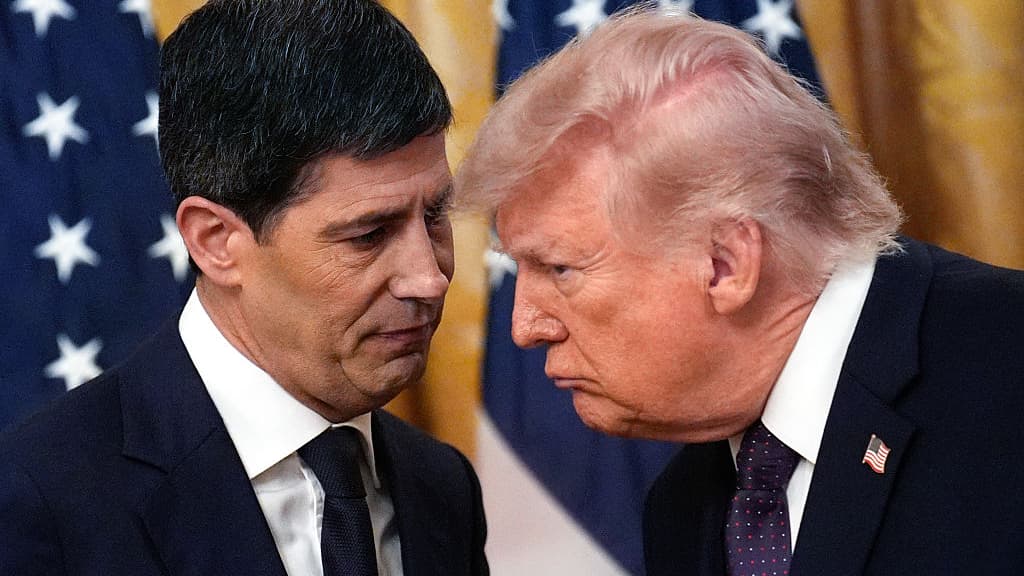
Price increases have repeatedly plagued U.S. consumers, especially at the pump, where the national average price for a gallon of gasoline has hit $4.43 up from $3.20 a year ago, data from the American Automobile Association shows.
A Fed statement issued along with Warsh’s announcement said that, in line with delivering price stability, the rate hike would “support a timelier return” to the 2% inflation goal. Based on the Fed’s preferred inflation measure, median inflation will hit 3.7% this year and is projected not to return to the 2% target until 2029.
What higher Fed rates mean for everyday Americans
Many consumer products such as credit cards and loans are pegged to the prime rate—which functions as a baseline for banks to set rates and adjusts relative to Fed rates. This means an increase is expected to make borrowing money for homes, autos, and other sizable purchases more expensive.
While the rate hike could present an opportunity for savers whose interests earned in deposits and savings are likely to go up, it’s a blow for Americans who are consistently using credit cards who resort to credit cards to cope with increasing cost of living in the U.S. According to the New York Fed, total credit card balances stand at $1.26 trillion in the second quarter of the year.

Dolly Parton’s Final Message Becomes A Lasting Goodbye

COMPLETE Financial Modeling Masterclass 2025! | Ft. Peeyush Chitlangia | KwK #202

Juvenile arrested by police after disturbance in Bradshaw



-

 Fashion6 days ago
Weekend Open Thread – Corporette.com
-

 Tech4 days ago
The Latest Weird Thing to Play Doom Is the Mapped-Out Brain of a Fruit Fly
-

 Business6 days ago
10 Most-Streamed Songs On Spotify In 2026 So Far, Led By Ella Langley’s Dominant Run On The Charts This Year
-

 Crypto World6 days ago
XAG/USD: Silver’s Short-Term Rally Meets Its Moment of Truth
-
 Crypto World7 days ago
2 Chip Stocks Broke Out This Week. Neither Was Nvidia
-

 Tech7 days ago
Battery life is the only iPhone 18 Pro and iPhone Duo upgrade I care about. Apple didn’t disappoint
-

 Crypto World6 days ago
OKX launches 10x OpenAI, Anthropic X-Perps in Europe
-

 Crypto World6 days ago
Diesel Tops $6 a Gallon for the First Time as 28 States Set Records
-

 Crypto World3 days ago
Elon Musk Drops a Bombshell: Grok 5 Could Be the AGI Breakthrough
-

 Business7 days ago
Western Digital Slips 2.7% as AI Storage Rally Cools After Record Cash and Guidance
-

 News Videos6 days ago
Facing Financial Fears
-

 Business4 days ago
Rivals Sam Altman and Elon Musk Rally Behind Dario Amodei’s Call for a Slowdown in AI Development
-
Crypto World6 days ago
Ethereum Price Analysis: Consolidation at $2.5K Tests Momentum as On-Chain Activity Surges
-

 Crypto World5 days ago
Can AI Build a Startup in 72 Hours? Elon Musk's Team Will Livestream the Test
-

 Entertainment5 days ago
News Specials, Movies, Shows, More
-
 NewsBeat3 days ago
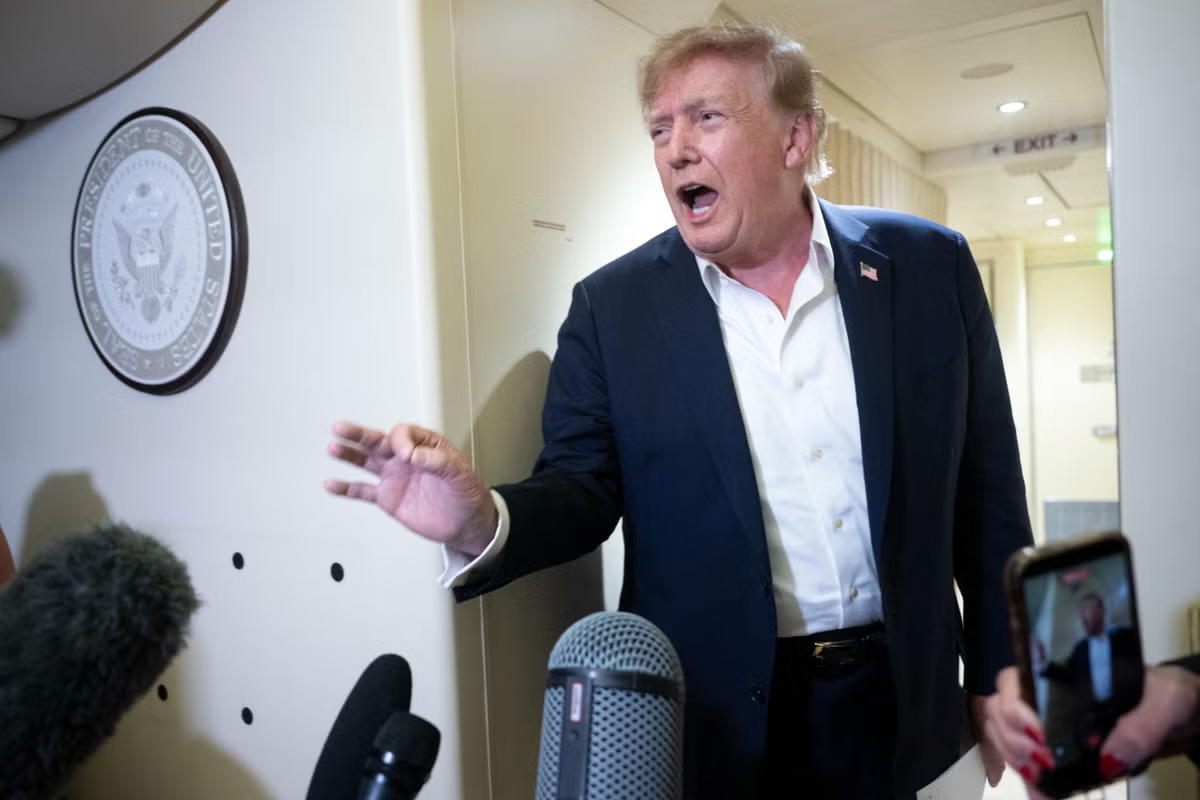
‘Sick conspiracy’: Trump says only guardrails AI needs is ‘a strong and smart (High IQ!) president’ in all-caps rant
-

 Crypto World2 days ago
Kraken Lets xStocks Holders Earn Yield Through DeFi
-

 Crypto World6 days ago
Bitcoin ETFs Pull $167M as 2026’s Best Inflow Run Slows
-

 Crypto World6 days ago
US CPI forecast at 3.4% as tariff risks build
-
 Entertainment5 days ago
New Horror Movie Officially Earns a Rare Stephen King Recommendation
You must be logged in to post a comment Login