
Crypto World
MetaMask Integrates Ondo Finance for Tokenized US Stocks and ETF Trading


TLDR:
- MetaMask users can now trade 200+ tokenized US stocks and ETFs directly through their wallet interface.
- Trading operates 24/5 from Sunday 8:05 PM ET to Friday 7:59 PM ET with continuous token transfer capability.
- Integration uses USDC on Ethereum mainnet through MetaMask Swaps to acquire Ondo Global Markets tokens.
- Service excludes major regions including US, UK, Canada, China, and European Economic Area jurisdictions.
MetaMask has partnered with Ondo Finance to introduce tokenized US stocks, ETFs, and commodities directly within its self-custodial wallet.
Eligible users in supported non-US jurisdictions can now access over 200 tokenized securities, including major stocks and ETFs, without traditional brokerage accounts.
The integration went live on February 3, 2026, marking a shift in digital asset management infrastructure.
Bringing Traditional Securities to Self-Custodial Wallets
The collaboration between MetaMask and Ondo Global Markets represents a notable development in blockchain-based financial services.
Users can now purchase, hold, and trade tokenized versions of popular US securities such as Tesla, NVIDIA, Apple, Microsoft, and Amazon. The offering also includes commodity-tracking ETFs like SLV for silver, IAU for gold, and QQQ.
This integration was announced at the Ondo Global Summit in Fort Worth, Texas. The launch comes as tokenized real-world assets have grown to exceed $22 billion globally.
MetaMask users can access these securities through the MetaMask Swaps feature, using USDC on Ethereum mainnet to acquire Ondo Global Markets tokens.
Joe Lubin, Founder and CEO of Consensys, addressed the limitations of existing market infrastructure. “Access to US markets still runs through legacy rails. Brokerage accounts, fragmented apps, and rigid trading windows haven’t meaningfully evolved,” Lubin said.
He added that bringing Ondo’s tokenized US stocks and ETFs directly into MetaMask demonstrates an improved model where people can move between crypto and traditional assets without intermediaries.
The move extends MetaMask’s functionality beyond cryptocurrency management into broader financial markets. For Ondo Finance, the integration expands distribution through one of the most widely adopted self-custodial wallets worldwide.
Ian De Bode, President at Ondo Finance, explained that MetaMask serves as the platform where millions already manage on-chain assets, and the integration introduces an entirely new asset class into that familiar experience.
Extended Trading Hours and Portfolio Management Features
MetaMask’s implementation of Ondo Global Markets tokens offers trading availability 24 hours daily, five days weekly.
Trading operates from Sunday 8:05 PM ET through Friday 7:59 PM ET. Token transfers remain available continuously, operating on a 24/7 basis throughout the week.
The GM tokens function as blockchain-based assets designed to track underlying securities’ market values. Users conduct transactions subject to applicable terms and fees.
De Bode noted that the integration offers users access to tokenized US stocks and ETFs with pricing that reflects traditional brokerage markets, bringing the economics of platforms like Robinhood into a self-custodial, on-chain wallet.
The platform launches with access to more than 200 tokenized US stocks and ETFs on Ethereum mainnet. Users can manage these tokenized securities alongside cryptocurrency holdings within a single multichain account.
The integration maintains the MetaMask app experience without requiring external platforms or applications.
Portfolio management occurs entirely within the MetaMask Mobile interface for eligible users. The service is available today in supported jurisdictions outside the United States.
However, numerous regions face exclusions, including the European Economic Area, United Kingdom, Canada, China, Singapore, and various other territories.
The restrictions apply to users in Afghanistan, Algeria, Belarus, and multiple additional countries spanning different continents.


Online gambling is one of the biggest digital industries in the world. Millions of players log in daily to online casinos, sportsbooks and betting platforms across dozens of regulated markets. The operators behind these platforms manage complex businesses spanning technology, compliance, payments, customer service and marketing. Yet when it comes to one of the most fundamental elements of brand building — public relations — most online gambling operators have been left to fend for themselves.
Kooc Media, a PR distribution agency that has worked with gambling and crypto clients since 2017, has announced a dedicated PR support service for online gambling operators. The service covers press release writing, guaranteed publication on established news websites, international newswire distribution and detailed campaign reporting. It is available to online casinos, sportsbooks, betting platforms, poker networks, bingo operators and any other business operating in the online gambling space.
Why Online Gambling Operators Need Dedicated PR
The relationship between the PR industry and online gambling has always been difficult. Most mainstream PR agencies will not take on gambling clients. Their internal policies classify betting and casino companies as restricted categories, regardless of whether the operator holds valid licences and operates in fully regulated markets. The few agencies that do accept gambling business tend to be small outfits with limited media networks and no ability to guarantee results.
This has created a situation where online gambling operators — many of which are substantial, well-funded businesses — operate without any structured PR support at all. They invest in affiliate marketing, paid advertising, social media management and influencer campaigns, but press coverage on independent news and finance publications remains out of reach for most.
The consequences go beyond missed headlines. Without regular media coverage, online gambling brands struggle to build the kind of independent credibility that players, regulators, investors and business partners all look for. An operator can spend millions on marketing and still be viewed with suspicion by a potential player who searches the brand name and finds nothing beyond the company’s own website.
Kooc Media has provided gambling PR alongside crypto PR since the agency was founded. The decision to formalise its online gambling offering into a dedicated service reflects growing demand from operators who have recognised the gap in their marketing and want a reliable way to close it.
“Online gambling operators have been underserved by the PR industry for years,” said Michelle De Gouveia, spokesperson for Kooc Media. “These are licensed, regulated businesses with genuine news to share. They deserve proper PR support and that is exactly what we are providing.”
How the Service Works
Kooc Media has built a PR model that removes the guesswork and unreliability that online gambling operators have experienced with traditional agencies.
The process starts with content. Operators can provide their own press releases or have Kooc Media’s in-house editorial team handle the writing. The agency’s writers specialise in gambling and crypto content and produce press releases that meet the editorial standards of the publications they will appear on. Whether the announcement covers a new market launch, a licensing achievement, a platform upgrade, a major sponsorship or a promotional campaign, the content is crafted to read as credible industry news rather than marketing material.
Publication happens first across Kooc Media’s owned network of news websites. The agency operates several established publications including Blockonomi, CoinCentral, MoneyCheck, Parameter, Beanstalk and Computing. These sites cover finance, technology, cryptocurrency and iGaming and carry strong domain authority accumulated through years of consistent editorial output. Because Kooc Media owns these publications, every placement is guaranteed. There is no pitch process, no editorial rejection risk and no uncertainty about whether the story will run.
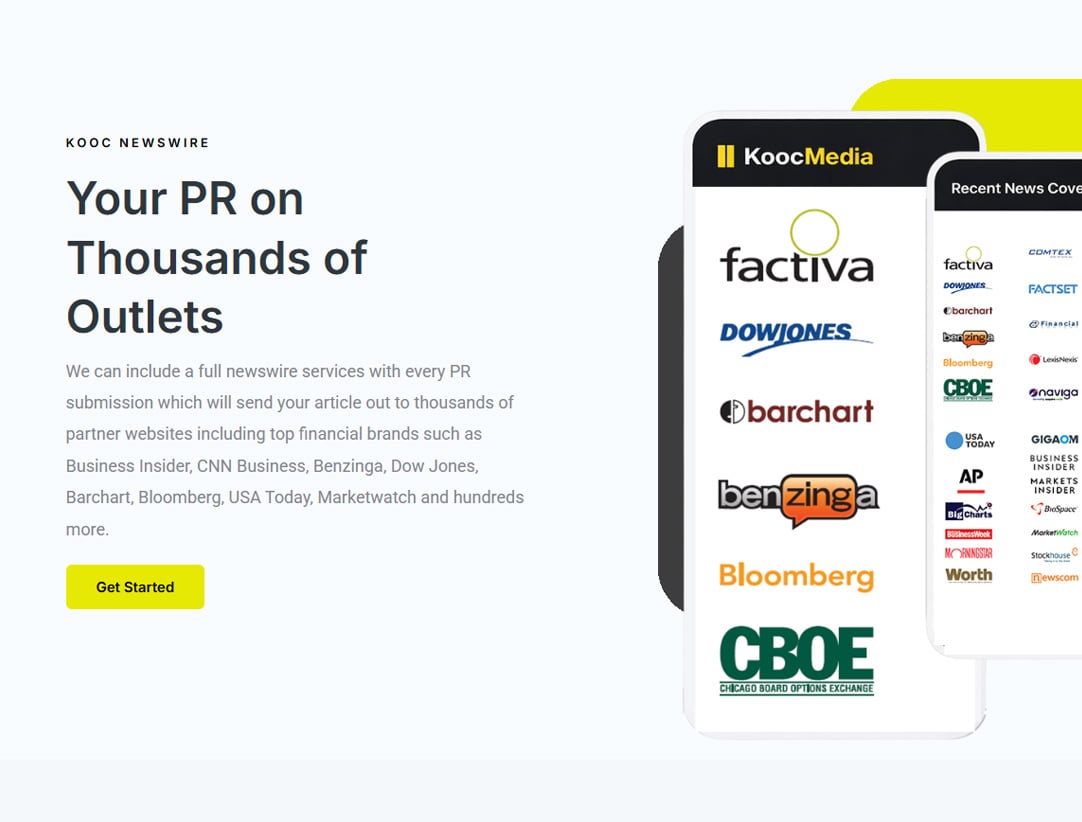
Distribution then extends through a partner network that includes hundreds of additional media outlets and thousands of syndication feeds spanning multiple regions and content verticals. Operators selecting premium packages can secure placements on major financial and business platforms including Business Insider, Bloomberg, Benzinga, MarketWatch and USA Today.
The full cycle can be completed in a single day. An operator can brief the agency in the morning and have live coverage across multiple publications by the afternoon. After distribution, a complete report is delivered listing every placement with a direct link to each published article.
The Business Case for PR in Online Gambling
Online gambling operators who invest in consistent PR gain advantages across several areas of their business simultaneously.
Player trust is the most direct benefit. Online gambling depends entirely on players trusting an operator with their money. Before signing up and depositing funds, most players conduct at least a basic search for the brand. What they find shapes their decision. An operator with articles on recognised news and finance publications appears established and legitimate. An operator with no media presence beyond its own site and a handful of affiliate reviews raises questions that many players will not bother to resolve — they will simply choose a competitor instead.
Search engine optimisation is a closely related benefit. Every article placed on a high-authority publication generates a backlink to the operator’s website. These backlinks are among the strongest signals search engines use when determining rankings. Online gambling operators compete fiercely for organic visibility on terms like “best online casino,” “top sportsbook,” “online betting sites,” “casino bonus offers” and “sports betting platform.” Operators who run consistent PR campaigns build a backlink profile that improves their rankings progressively, delivering organic traffic that does not require ongoing ad spend.
Regulatory and corporate credibility strengthens with media visibility. Online gambling is an increasingly regulated industry. Operators applying for licences, renewing existing ones or entering newly regulated markets benefit from demonstrating a visible and transparent public profile. Regulators assess brand reputation as part of their evaluation process. A documented track record of press coverage across credible publications supports that assessment. Similarly, operators pursuing investment, preparing for public listings or negotiating B2B partnerships find that media presence strengthens their position in those conversations.
Competitive differentiation rounds out the picture. The online gambling market is crowded. Thousands of casinos and sportsbooks compete for the same players, often with similar products, similar odds and similar promotional offers. Press coverage creates a layer of brand recognition that product features alone cannot replicate. The operator that a player has actually read about on a trusted website holds an advantage over the one they have never encountered outside of a banner ad.
Packages for Every Type of Operator
Kooc Media recognises that online gambling operators come in all sizes and stages. A newly licensed online casino preparing for launch has very different PR needs than a multinational betting group managing dozens of brands across multiple markets.
Standard packages provide a set number of guaranteed placements across the agency’s owned publications and partner outlets. They include optional content writing and comprehensive reporting. These packages suit operators who want steady, predictable media coverage on a regular basis — monthly announcements, quarterly updates, game launches, promotional campaigns, sponsorship news or regulatory milestones.
Custom campaigns are available for operators with specific strategic goals. A sportsbook launching operations in a newly regulated state or country needs a coordinated press push timed to the market opening. A casino group completing an acquisition needs corporate-level coverage aimed at business and financial media. An online betting platform rebranding after a merger needs press that introduces the new identity to players and industry stakeholders simultaneously. An operator adding cryptocurrency payment options needs coverage that bridges its traditional player base and the growing crypto gambling audience.
Kooc Media handles every element of these campaigns. Strategy, content creation, distribution scheduling and post-campaign reporting are all managed by the agency. Operators without dedicated PR or communications staff can use the service as a complete external press office. Those with existing marketing teams can use it as a specialist distribution channel that extends their reach beyond what internal efforts can achieve alone.
About Kooc Media
Kooc Media is a PR distribution agency founded in 2017, specialising in online gambling, crypto, fintech and technology. The company operates its own network of news publications and works with a broad partner distribution network to deliver guaranteed media coverage for clients. Services include press release writing, sponsored articles, homepage placements, newswire distribution and fully managed PR campaigns.
Kooc Media’s gambling PR packages are available now through the company’s website at https://kooc.co.uk.
Disclaimer: This is a Press Release provided by a third party who is responsible for the content. Please conduct your own research before taking any action based on the content.

Crypto World
MORPHO Breaks Out of Multi-Year Triangle: Can Bulls Push the Price to the $3.91 All-Time High?

TLDR:
- MORPHO broke out of a multi-year symmetrical triangle, clearing upper resistance at the $1.87 level.
- The initial price target stands at $2.65, aligning with the August 2025 highs following the breakout.
- A retest near $1.70 is considered a standard technical move and may offer a secondary entry point.
- Traders are advised to maintain a stop loss at $1.57 to keep the risk-to-reward ratio favorable.
MORPHO is drawing attention from technical analysts after breaking out of a multi-year symmetrical triangle pattern.
The token, currently trading around $2.02, cleared a key resistance trendline at $1.87. Analysts see this as a sign that the prolonged accumulation phase has ended.
Price targets of $2.65 and $3.91 are now on the radar for traders watching the chart structure closely.
Breakout Signals a Shift in Market Structure
Crypto analyst Ali Charts flagged the MORPHO breakout in a post on April 19, 2026. According to the analyst, the token cleared the upper resistance trendline of the symmetrical triangle at $1.87. This level now serves as the base from which the new trend is emerging.
The initial price target following the breakout stands at $2.65. That level aligns with the highs recorded in August 2025. A secondary macro target points to the previous all-time high at $3.91, should bullish momentum continue to build.
Symmetrical triangle patterns typically form during periods of price consolidation. A confirmed breakout from such a formation often attracts fresh buying interest.
The multi-year nature of this pattern adds weight to the move, as longer consolidations tend to produce stronger directional moves.
Retest Zone and Risk Management Levels to Watch
Ali Charts noted that multi-year breakouts often include a retest of the breakout zone before the next expansion phase.
A pullback toward $1.70 would fall within that range. The analyst described such a move as a standard technical development rather than a signal of weakness.
For traders who missed the initial entry, a retest near $1.70 could present a second opportunity. The area around the former resistance trendline may act as support on any dip. This is a common behavior seen across different assets following extended consolidation breakouts.
Risk management remains a priority for traders tracking this setup. Ali Charts placed a stop loss level at $1.57 to define the risk on the trade.
With a target of $2.65, the distance between entry and stop offers a favorable reward relative to the downside being risked.
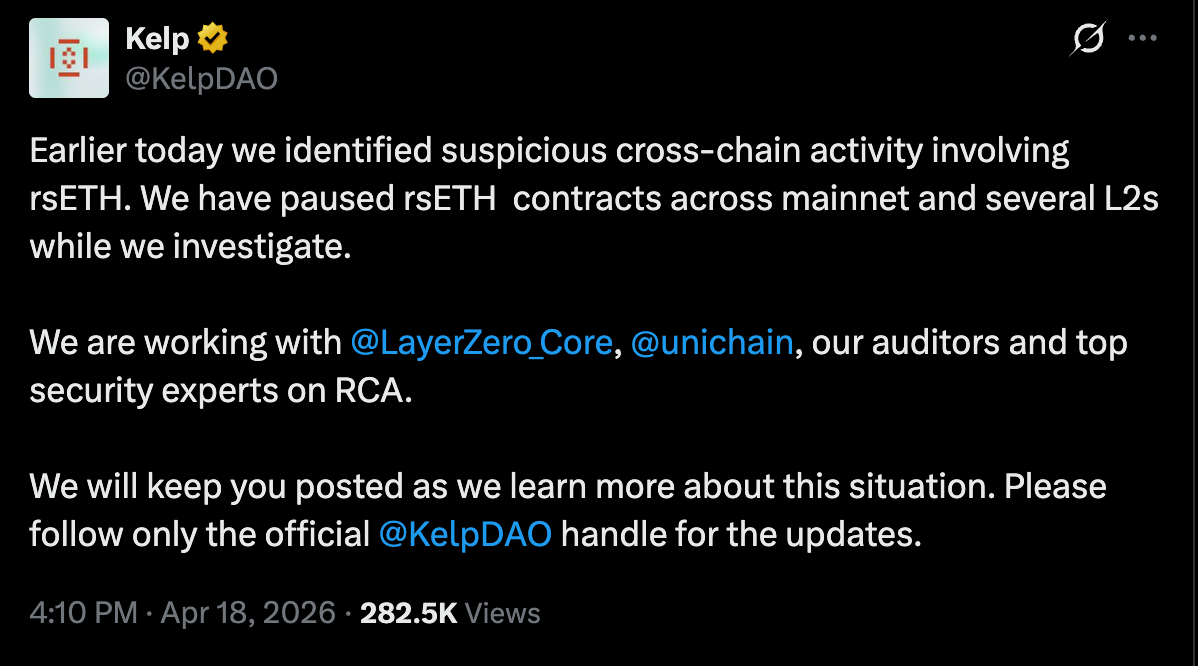
The exploit of the Kelp liquid restaking protocol shows how non-isolated lending and integrations in decentralized finance (DeFi) can cause broader ecosystem contagion, according to crypto industry executives and blockchain security firms.
Non-isolated lending on DeFi platforms, including earlier versions of the Aave lending protocol, exposes users to risks from all the various tokens used as collateral on the platforms, according to Michael Egorov, founder of the Curve Finance DeFi protocol.
Kelp was the target of a cyber attack on Saturday, causing the platform to pause smart contracts for its restaking token (rsETH) while it moved to investigate the attack that left the platform drained of about $293 million.
DeFi teams should also vet prospective digital assets to ensure that tokens do not feature single points of failure or attack surfaces before approving tokens as lending collateral on their platforms, Egorov said in an email.

He also warned against using cross-chain bridging architecture to transfer assets from one blockchain protocol to another, which was the root cause of this weekend’s Kelp exploit.
“Cross-chain is hard and potentially risky. Only use cross-chain infrastructure when absolutely necessary, and do it really carefully,” Egorov said.
He said the incident is a learning experience for DeFi, which the sector can use to grow and implement better cybersecurity protections as losses from crypto hacks, code exploits and scams reached $482 million in Q1 2026.
Related: DAO behind CoW Swap urges users to stay off platform after ‘hijacking’
Kelp exploit triggers “contagion” across the DeFi ecosystem
“This was not just a protocol exploit. It immediately became a cross-protocol contagion event,” blockchain security firm Cyvers told Cointelegraph.
At least nine DeFi protocols and platforms, including Aave, Fluid, Compound Finance, SparkLend and Euler, were affected in the incident and took action to freeze rsETH markets or mitigate the fallout from the Kelp exploit, Cyvers said.

“The challenge is no longer just preventing exploits at the contract level, but understanding how fast they can cascade across integrated protocols,” Cyvers CEO Deddy Lavid told Cointelegraph.
The exploit on Kelp followed the $280 million Drift Protocol decentralized exchange hack last week and at least 12 other crypto platforms and DeFi hacks earlier this month.
Magazine: ‘SEAL 911’ team of white hats formed to fight crypto hacks in real time
Crypto World
Stablecoins can help businesses turn costs into revenue, but not everyone needs to issue a token:


Stablecoins, the $300 billion class of digital dollars, may have started as a faster way to move money across the globe, but companies are now asking a different question: what can they actually do with them?
That shift is driving a new phase of adoption, according to Chunda McCain, co-founder of Paxos Labs, who says the industry is moving beyond basic infrastructure toward real business use cases.
“The first step was getting a stablecoin,” McCain said in an interview with CoinDesk. “The next question is: what now?”
Last week, Paxos Labs underscored that direction by raising $12 million in a strategic funding round led by Blockchain Capital, with participation from Robot Ventures, Maelstrom and Uniswap. The lab unit was incubated under Paxos, the New York-based digital asset firm behind popular stablecoins such as PayPal’s PYUSD (PYUSD) and the Global Dollar (USDG). Paxos itself builds stablecoins and the immediate underlying infrastructure, while Paxos Labs intends to build tooling for further use of those stablecoins.
With the fresh funds, Paxos Labs is building what it calls a “financial utility stack” that lets companies turn digital assets into products through a single integration.
Its newly launched Amplify Suite bundles three core tools: Earn, which offers yield on digital assets; Borrow, which enables lending against them; and Mint, which supports branded stablecoin issuance. The idea behind that is to let firms integrate tokens into a business, then layer on capabilities over time.
Turning cost into revenue
For years, enterprise crypto adoption focused on “first-touch” capabilities like trading, custody or issuing a stablecoin. Those steps opened the door but rarely generated returns on their own, according to McCain
“Stablecoins [have been] loss leaders for years,” he said.
The opportunity lies in how those assets are used. Payments are a clear example: merchants typically give up 2% to 3% in fees, while stablecoin rails can reduce those costs and even generate yield on balances held onchain.
“You turn what has always been a cost into revenue,” he said.
Some of the more novel use cases sit at the intersection of payments and credit. Payment providers already track merchant revenues and cash flow, which puts them in a position to underwrite loans, McCain argued.
That could allow merchants to access financing based on real-time performance, while earning yield on incoming payments and settling instantly across borders. These models are still early, but the building blocks are starting to come together, he said.
Not every firm needs its own token
To capture these benefits, not every firm needs its own stablecoin.
While companies like PayPal have launched branded tokens to control payments and margins, issuing one requires significant investment in liquidity, compliance and distribution.
“If you just need the economics, you don’t need to build your own,” McCain said.
Many firms can instead integrate existing stablecoins and still benefit from lower costs and added yield.
The shift may lack the hype when big firms like Western Union announce their own token, but it carries tangible impact on how businesses operate.
Stablecoins are starting to reshape margins, unlock credit and change how money moves globally, especially where traditional systems remain costly or slow.
“It might sound boring, but this is the math,” McCain said.
TLDR:
- The Federal Reserve recorded an $18.7 billion loss in 2025, marking its third consecutive year in the red.
- Rising interest payments on reserves and reverse repos continue to exceed income from bond holdings.
- Losses peaked in 2023 and narrowed by 2025, signaling a gradual shift as rate pressures stabilize.
- The Fed has paused Treasury remittances after years of profit, reflecting ongoing balance-sheet strain.
The U.S. Federal Reserve reported a third straight annual operating loss in 2025, extending a rare financial stretch. The latest figures showed a loss of $18.7 billion, continuing a trend that began in 2023 after a long period of steady profitability.
Fed Losses Extend Into Third Year
Recent data shared in a post by The Kobeissi Letter confirmed the central bank’s ongoing losses. The tweet noted that total losses reached $210.3 billion over three years.
It also pointed out that 2023 recorded the deepest loss, followed by a smaller deficit in 2024 and a narrower gap in 2025.
https://twitter.com/KobeissiLetter/status/2045690597764186307?s=20
The post explained that the losses stem from higher interest payments to banks and money market funds. At the same time, income from bonds and mortgage-backed securities remained lower. This gap between expenses and earnings has kept the Federal Reserve in negative territory since September 2022
Before this period, the central bank had a long record of profits. From 2000 to 2007, earnings remained stable between $20 billion and $35 billion. However, profits surged after the 2008 financial crisis as policy rates dropped and asset purchases increased.
Between 2009 and 2015, profits rose sharply, reaching a peak of around $115 billion. During those years, the Federal Reserve held large amounts of higher-yielding securities while funding costs stayed near zero. As a result, earnings remained elevated for several years.
Rate Hikes Shift Financial Structure
The financial position began to change as interest rates increased. From 2016 to 2022, profits started to decline, although they remained positive. Earnings moved within a range of $55 billion to $105 billion during that period.
Conditions shifted in 2023 when aggressive rate increases raised borrowing costs across the system. The Federal Reserve began paying higher interest on reserves and reverse repurchase agreements. Meanwhile, returns from its existing bond portfolio remained fixed at lower rates.
This shift caused expenses to exceed income, leading to the first annual loss in decades. The deficit reached about $115 billion in 2023, marking the lowest point in the data series. Losses continued in 2024 at roughly $80 billion before easing in 2025.
At the same time, the Federal Reserve stopped sending profits to the U.S. Treasury. This pause ended a long streak of remittances that had totaled over $1.36 trillion since 2008. The change reflects the current financial position rather than a structural limitation.
Despite the losses, the Federal Reserve continues normal operations. The system allows it to manage shortfalls without facing solvency concerns. The central bank records deferred assets instead of halting its functions.
Recent figures show that the scale of losses has started to narrow. The move from deeper deficits toward a smaller loss in 2025 signals a shift in pace. Future results will depend on interest rate trends and changes in funding costs.
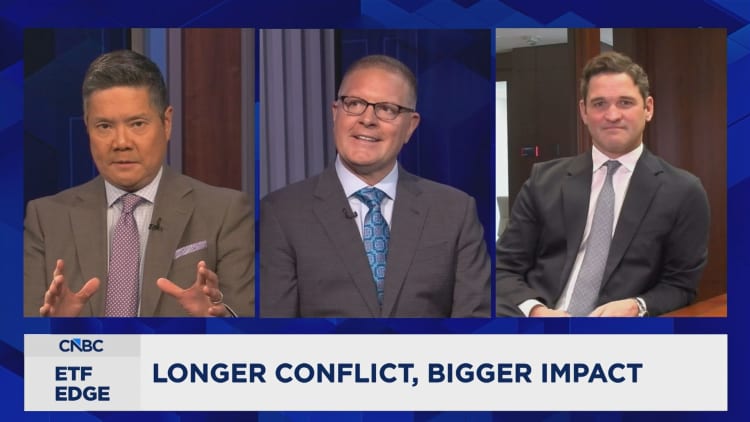

Cybersecurity and enterprise software stocks have been market dogs in 2026, with fears that AI will wipe out a wide range of companies in the enterprise space dominating the narrative. But they snapped a brutal losing streak this past week, joining in the broader market rally that saw all losses from the U.S.-Iran war regained by the Dow Jones Industrial Average and S&P 500.
Cybersecurity has been “a victim of some of the AI-related headlines,” Christian Magoon, Amplify ETFs CEO, said on this week’s “ETF Edge.”
It wasn’t just niche cybersecurity names. Take Microsoft, for example, which was recently down close to 20% for the year. Its shares surged last week by 13%.
A big driver of the pummeling in software stocks was a rotation within tech by investors to AI infrastructure and semiconductors and some other names in large-cap tech, Magoon said, and since cybersecurity stocks and ETFs are heavily weighted towards software companies, they were left behind even as those businesses continue to grow on a fundamental basis.
But Wall Street now has become more bullish with the stocks at lower levels. Brent Thill, Jefferies tech analyst, said last week that the worst may be over for software stocks. “I think that this concept that software is dead, and then Anthropic and OpenAI are going to kill the entire industry, is just over-exaggerated,” he said on CNBC’s “Squawk Box” on Wednesday.
“Big Short” investor Michael Burry wrote in a Substack post on Wednesday that he is becoming bullish about software stocks after the recent selloff. “Software stocks remain interesting because of accelerated extreme declines last week arising from a reflexive positive feedback loop between falling software stocks and changes in the market for their bank debt,” he wrote.
The Global X Cybersecurity ETF (BUG), is down about 12% since the beginning of the year, with top holdings including Palo Alto Networks, Fortinet, Akamai Technologies and CrowdStrike. But BUG was up 12% last week. The First Trust NASDAQ Cybersecurity ETF (CIBR) is down 6% for the year, but up 9% in the past week.
Piper Sandler analyst Rob Owens reiterated an “overweight” rating on Palo Alto Networks which helped the stock pop 7% — it is now down roughly 6% on the year. Its peers saw similar moves, including CrowdStrike.

Performance of Global X cybersecurity ETF versus S&P 500 over past one-year period.
Magoon said expectations may have become too high in cybersecurity, and with a crowding effect among investors, solid results were not enough to to push stocks higher. But the down-and-then-back-up 2026 for the sector is also a reminder that when stocks fall sharply in a short period of time, opportunity may knock.
“Once you’re down over 10% in some of these subsectors, you start to see the contrarians start to say, ‘well, maybe I’ll take a look at this,’” Magoon said.
He said AI does add both opportunity and uncertainty to the cybersecurity equation, increasing demand but also introducing new competition. But he added, “I think the dip is good to buy in an AI-driven world,” specifically because the risks to companies may lead to more M&A in cyber names that benefits the stocks.
For now, investors may look for opportunity on the margins rather than rush back into beaten-up tech names. “I think investors are still going to remain underweight software,” Thill said.
But Magoon advises investors to at least take the reminder to keep an eye on niches in the market during pronounced downturns. “The best-performing are often the least bought and do the best over the next 12 months versus late-in-the-game piling on,” he said.
While that may have been a mindset that worked against the last investors into cybersecurity and enterprise software in mid-2025 when the negative sentiment started building, at least for now, it’s started working for the stocks in the sector again.
Meanwhile, this year’s biggest winner is also a good example of what can be an extended trade in either a bullish or bearish direction. Last year, institutional ownership of energy was at multi-year lows, Magoon said, referencing Bank of America data. “Reverse sentiment can be a great indicator,” he said.
But he cautioned that any selective buying of stocks that have dipped does have to contend with the risk that there is a potentially bigger drawdown in the market yet to come in 2026. That is because midterm election years historically have been marked by large drawdowns. “If you think it is bad right now, it could get a lot worse,” Magoon said. But he added that there’s a silver-lining in that data, too, for the patient investor. The market has posted very strong 12-month returns after midterm election drawdowns end. So, for investors with a longer-term time horizon and no need for short-term liquidity, Magoon said, “stick in there.”
Sign up for our weekly newsletter that goes beyond the livestream, offering a closer look at the trends and figures shaping the ETF market.


Spot Bitcoin exchange-traded funds have recorded their strongest weekly inflows in several months.
Summary
- Bitcoin ETFs recorded nearly $1 billion inflows, marking strongest weekly performance since mid-January period.
- Ethereum and XRP ETFs followed with steady inflows, reflecting renewed investor interest across crypto markets.
- Rising ETF demand coincides with improved sentiment but ongoing geopolitical uncertainty still affects market stability.
Data shows that nearly $1 billion entered these funds over the past week, marking the best performance since mid-January.
April 17 stood out as the most active day, with over $663 million in net inflows. Among the leading products, BlackRock’s IBIT attracted the largest share, followed by Fidelity’s FBTC.
The weekly trend included only one day of outflows, while the rest of the sessions recorded steady inflows. This pattern reflects renewed investor activity after a period of lower demand.
Ethereum ETFs maintain positive momentum
Ethereum-based exchange-traded funds also posted consistent inflows during the same period. The funds extended a multi-day streak of positive performance, supported by ongoing market recovery.
Over the past week, Ethereum ETFs recorded more than $275 million in inflows. This represents the highest weekly total since January for these products.
Fidelity’s FETH led the inflows among Ethereum funds, followed by BlackRock’s ETHA. Other products also contributed smaller amounts, maintaining overall positive movement.
XRP and other assets see increased interest
XRP-linked exchange-traded funds also recorded notable gains. The products attracted over $55 million during the week, marking a three-month high in inflows.
Other digital asset funds, including those tracking Solana, reported moderate inflows as well. These movements suggest broader participation across multiple crypto-based investment products.
The rise in ETF activity across Bitcoin, Ethereum, and XRP points to a short-term increase in investor engagement within the sector.
Market conditions and ongoing uncertainty
The increase in ETF inflows followed improved sentiment linked to developments in global events. Reports of easing tensions earlier in the week supported market confidence.
However, conditions remain uncertain as new statements from U.S. and Iranian officials have created mixed signals. The situation has added volatility to financial markets, including cryptocurrencies.
Bitcoin and other digital assets continue to respond to external developments. Investors are monitoring both geopolitical updates and market data as ETF flows remain active.
Crypto World
Market Preview: Tesla (TSLA) Earnings and Iran Diplomacy Dominate This Week’s Trading Focus
Key Takeaways
- Major indices achieved fresh record territory last week, extending their winning streak to three consecutive weeks
- Tesla’s Q1 financial results arrive Wednesday, with focus on artificial intelligence and robotics initiatives
- Diplomatic progress with Iran regarding the Strait of Hormuz sent crude oil prices tumbling
- The Magnificent Seven technology stocks surged 9% in just five trading sessions
- Consumer spending patterns will be revealed Tuesday with the release of March retail sales figures
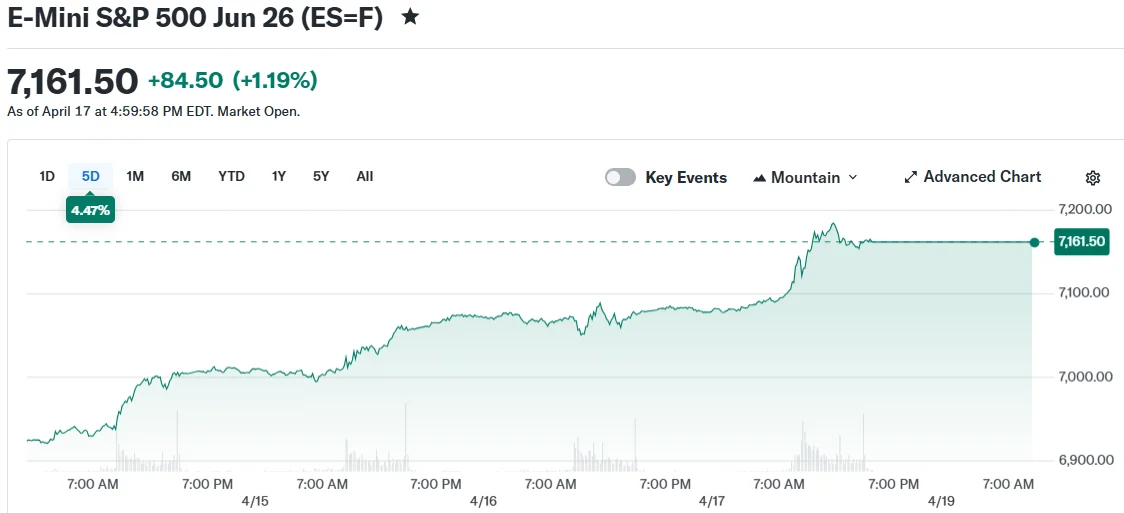
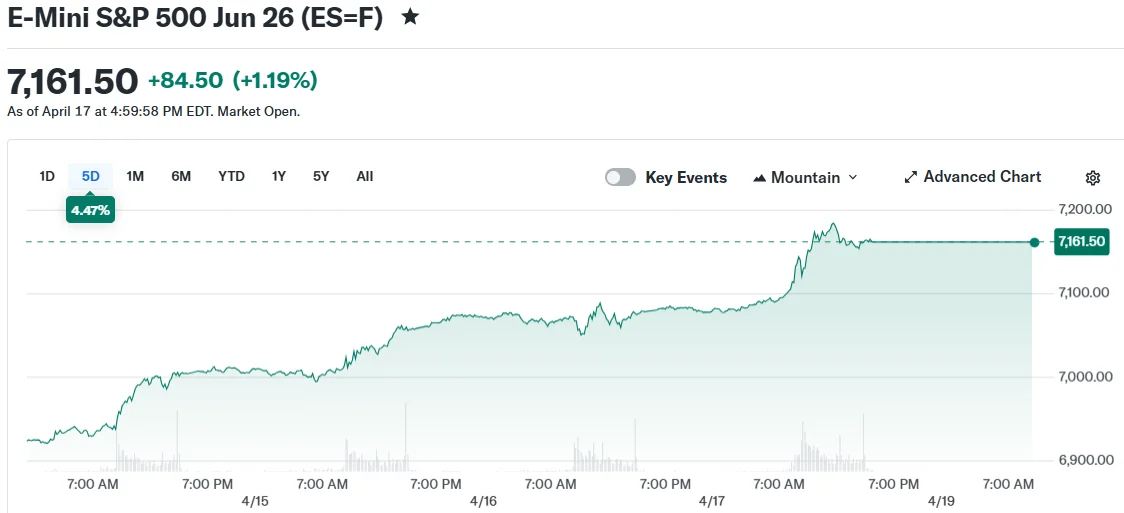
Equity markets delivered another impressive performance as benchmark indices pushed to unprecedented levels. The S&P 500 surged 4.5% during the trading week, while the Nasdaq climbed 6.8% and the Dow Jones Industrial Average advanced 3.2%. This marked the third straight week of positive returns across all three major indices.
The market surge was primarily fueled by encouraging developments in diplomatic relations between Washington and Tehran. Iran’s top diplomat announced Friday that the strategically vital Strait of Hormuz remained “completely open” to global shipping operations. President Trump confirmed Iran had committed to halting its uranium enrichment activities and pledged never to obstruct the critical waterway again. Additional diplomatic discussions were slated for the weekend.
Crude oil prices experienced significant declines following the diplomatic breakthrough. Energy analysts at Rystad Energy characterized the development as a “market-moving development of the first order.” However, industry observers cautioned that normalizing oil markets could require several weeks or even months. Numerous vessels remain stranded in Persian Gulf waters, while Middle Eastern crude production has declined by approximately 12.4 million barrels daily.
The elite group of Magnificent Seven technology stocks, monitored through a specialized exchange-traded fund, posted a remarkable 9% gain across five consecutive sessions and are nearing their historical peak values. Taiwan Semiconductor delivered first-quarter financial results that exceeded analyst projections, posting earnings per share growth of 66% compared to the previous year and revenue expansion of 40%.
According to HSBC’s Americas equity strategy chief, market participants should anticipate a “banner Q1 earnings season,” with technology stocks generating the greatest investor enthusiasm. The Magnificent Seven are projected to deliver 20% earnings expansion, significantly outpacing the 12% growth forecast for remaining S&P 500 constituents.
Tesla in the Spotlight
Tesla releases its first-quarter performance metrics on Wednesday. The electric vehicle manufacturer snapped an eight-week decline on Friday. Chief Executive Elon Musk revealed that Tesla has reached the concluding design phases for its AI5 semiconductor, engineered for electric vehicles, training infrastructure, and Optimus humanoid robots. Reuters additionally disclosed that Tesla is recruiting semiconductor specialists in Taiwan.
Tesla has unveiled ambitions to manufacture proprietary semiconductors at a proposed facility designated Terafab, with Intel serving as a strategic collaborator. Market analysts note that establishing internal chip manufacturing capabilities would represent an enormous technical undertaking.
UBS analyst Joseph Spak observed that the stock “trades more on sentiment, narrative and momentum than fundamentals.” He identified potential headwinds including electric vehicle demand concerns, energy infrastructure constraints, and gradual advancement on autonomous taxi services and Optimus development, while maintaining his view of Tesla as a frontrunner in physical artificial intelligence applications.
Additional Market Events
Intel releases quarterly results Thursday. The semiconductor giant reached its highest intraday valuation since 2000 during Friday’s trading session.
Airline sector reports from Alaska Air, United Airlines, and American Airlines will reveal how aviation companies are navigating elevated jet fuel expenses. United Airlines’ CEO Scott Kirby recently suggested a possible takeover of American Airlines.
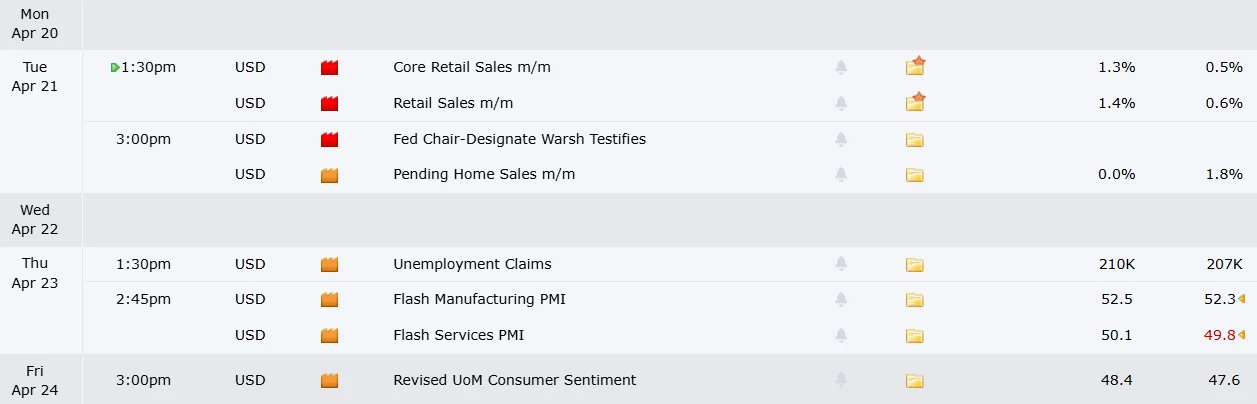
Tuesday delivers the Census Bureau’s March retail sales report. Economic forecasters anticipate a 1.3% monthly increase. The University of Michigan’s consumer sentiment index on Friday will also attract significant attention. Its preliminary April measurement plunged to a historic nadir of 47.6 earlier this month.
UnitedHealth Group announces results Tuesday, with shares facing headwinds from reports of a probe into its insurance billing procedures and an unanticipated executive transition.
Jefferies analyst Michael Toomey warned that the technology sector may be “very near the end of this rally,” and that markets will “consolidate in the near-term.”
Recent on-chain data shows a sharp rise in Bitcoin (BTC) movement to exchanges.
Summary
- Binance inflow CDD spike suggests long-term Bitcoin holders moving funds to exchanges for profit-taking.
- NUPL indicator rise signals improving sentiment and growing unrealized profits among Bitcoin investors.
- Bitcoin Composite Index remains above 1.0, indicating no confirmed market bottom formation yet.
On April 14, Binance recorded a major spike in Exchange Inflow Coin Days Destroyed (CDD), reaching about 2.59 million.
Analysts link this surge to long-term holders moving older coins. This behavior often appears when investors prepare to take profits after price recovery phases.
The spike occurred as Bitcoin climbed back toward the $75,000 range. Data suggests that older holdings, which remained inactive for long periods, are now entering exchanges.
Analyst CryptoOnchain stated ”this surge suggests long-term holders are securing profits” while referring to the timing of the inflow spike.
NUPL indicator signals rising market confidence
Another on-chain metric, Net Unrealized Profit/Loss (NUPL), has also shown movement. The indicator recently climbed to around 0.29, its highest level since late January.
This level is commonly linked to the “belief” phase in market cycles. It reflects growing unrealized profits among investors and a shift toward positive sentiment.
Analyst Arab Chain noted ”the market is showing renewed optimism and rising profits” based on the recent NUPL trend. The increase follows a period of volatility earlier in the year.
The indicator suggests that the market has regained balance after recent declines. It also shows signs of new capital entering the market.
Composite Index shows no clear bottom formation
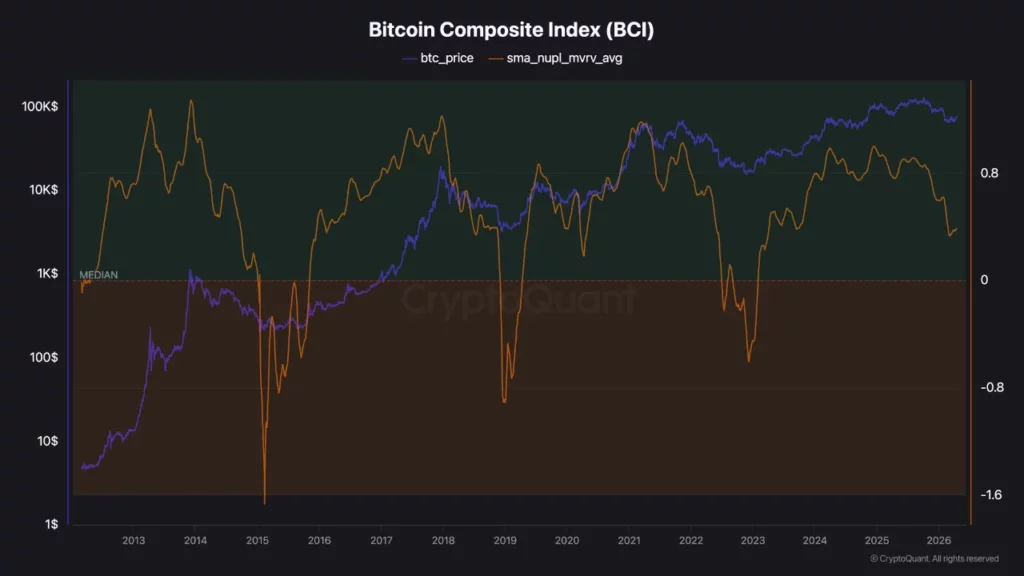
The Bitcoin Composite Index (BCI), which combines NUPL and MVRV data, remains above the key level of 1.0. Analysts use this level to assess whether the market has reached a bottom.
Historical data shows that strong accumulation phases often occur when the index drops below this threshold. Current readings suggest that such conditions have not yet been reached.
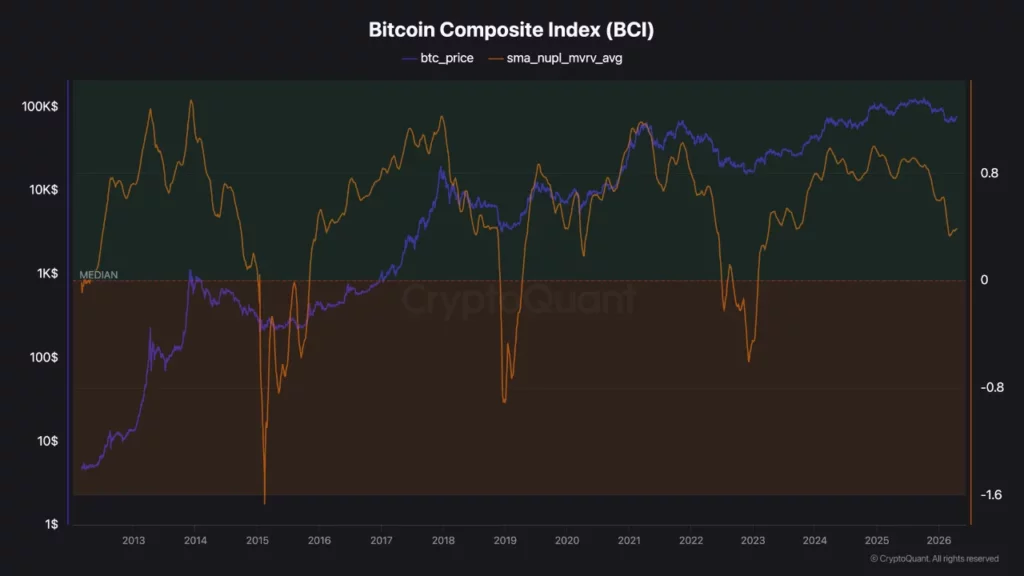
Analyst Zizcrypto stated ”the index remains above bottom levels, indicating normalization rather than full reset” when describing the current position.
This reading points to a market that is stabilizing rather than entering a deep accumulation phase.
Price movement and market conditions
Bitcoin recently failed to hold above $78,400 and has moved closer to $75,000. The price drop followed renewed geopolitical tension linked to developments in the Middle East.
The asset had earlier gained momentum after reports of progress in diplomatic talks. It moved from below $70,500 to above $76,000 before reaching a local high.
Market uncertainty returned after conflicting updates regarding the Strait of Hormuz. This led to a price correction of more than $3,000 from the peak.
The broader crypto market also declined, with total market value dropping by around $100 billion.
Disclosure: This article does not represent investment advice. The content and materials featured on this page are for educational purposes only.

Quick Summary
- Rakuten CEO Hiroshi Mikitani offloaded approximately $154.5M worth of ASTS shares, contributing to ~$274M in total insider sales last quarter
- The BlueBird 7 satellite deployment was postponed to April 19 from Kennedy Space Center
- Deutsche Bank reduced its price projection from $139 down to $117, referencing Amazon’s Globalstar purchase
- Short positions reached their highest level in eight months amid growing skepticism
- Major institutional players like Vanguard and Invesco expanded their holdings despite the turbulence
AST SpaceMobile (ASTS) endured a turbulent week as shares slid approximately 6%, pressured by a confluence of insider transactions, operational setbacks, and Wall Street recalibrations.
The most significant development came from Rakuten’s billionaire founder Hiroshi Mikitani, who liquidated 1.69 million shares on April 14 at an average execution price of $91.42, representing approximately $154.5 million. This substantial transaction rattled investor confidence. Taking a broader view, company insiders collectively divested roughly 3.08 million shares during the previous quarter, totaling approximately $274 million. Current insider ownership stands at around 30.9%.
Adding to the selling activity, Chief Technology Officer Huiwen Yao disposed of 40,000 shares on March 23 at $88.88, slashing his holdings by nearly 90%. Following this transaction, Yao retained just 4,750 shares.
BlueBird 7 Deployment Timeline Shifts
The BlueBird 7 satellite deployment, previously slated for an earlier date, has been rescheduled for April 19. The spacecraft will lift off from Kennedy Space Center aboard Blue Origin’s New Glenn-3 rocket, with the launch window opening at 6:45 a.m. and closing at 8:45 a.m. EDT.
This satellite features a sophisticated phased-array antenna spanning approximately 2,400 square feet, engineered to provide direct-to-device broadband connectivity to conventional smartphones. The system supports peak throughput exceeding 120 Mbps utilizing both 4G and 5G technologies.
A successful deployment would represent a critical technological validation for the company. ASTS maintains partnerships with more than 50 mobile network operators worldwide, collectively serving nearly 3 billion subscribers. Strategic partners encompass AT&T, Verizon, Vodafone, and Google.
The postponement amplified investor uncertainty. Short interest surged to its highest point in eight months as market participants adopted defensive positions ahead of the mission.
Wall Street Reassessments Intensify
Deutsche Bank trimmed its price objective from $139 to $117, highlighting competitive headwinds following Amazon’s announcement to acquire Globalstar. This development sparked concerns regarding ASTS’s competitive positioning within the satellite communications sector.
Scotiabank adopted a more aggressive stance, downgrading ASTS to “sector underperform” with a $45.60 target. B. Riley lowered its objective from $105 to $95 while maintaining a neutral stance. The consensus rating currently registers as “Reduce” with an average target of $77.10, substantially below present trading levels.
However, bearish sentiment isn’t universal. Deutsche Bank maintains its $117 projection. Jim Cramer offered favorable commentary about the stock during Mad Money. Barclays elevated its target to $65 from $60 following the successful BlueBird 6 deployment with ISRO, though maintaining an Underweight rating.
On the institutional front, Vanguard expanded its position by 13.4% in Q3 to nearly 20 million shares. Invesco amplified its stake by over 600%, while VanEck more than doubled its holdings. Overall institutional ownership currently represents approximately 61%.
ASTS disclosed Q4 2025 financial results on March 2, reporting revenue of $54.31 million, significantly exceeding the $39.53 million consensus forecast. EPS registered at -$0.26, falling short of the -$0.18 estimate. Management projected 2026 revenue between $150 million and $200 million.
Shares opened Friday trading at $85.53, positioned between the 50-day moving average of $88.90 and the 200-day moving average of $83.34. The 12-month trading range extends from $20.26 to $129.89.

Spennymoor man pleads guilty to causing GBH with intent

What Medicine She Was Taking and Crisis After 78 Days Without It

Kooc Media Announces Dedicated PR Support for Online Gambling Operators


-
 NewsBeat7 days ago
Pep Guardiola and Gary Neville agree over Arsenal title problem that benefits Man City
-

 Crypto World6 days ago
The SEC Conditionalises DeFi Platforms to Be Avoided for Broker Registration
-

 Fashion2 days ago
Weekend Open Thread: Theodora Dress
-

 Crypto World6 days ago
SEC Signals Exemption for Crypto Interfaces From Broker Registration
-

 News Videos4 days ago
Secure crypto trading starts with an FIU-registered
-

 Sports2 days ago
NWFL Suspends Two Players Over Post-Match Clash in Ado-Ekiti
-

 Crypto World5 days ago
SEC Proposes Certain Crypto Interfaces Don’t Need to Register as Brokers
-

 NewsBeat5 days ago
Trump and Pope Leo: Behind their disagreement over Iran war
-

 Business2 hours ago
Powerball Result April 18, 2026: No Jackpot Winner in Powerball Draw: $75 Million Rolls Over
-

 Politics2 days ago
Palestine barred from entering Canada for FIFA Congress
-

 Crypto World2 days ago
Russia Pushes Bill to Criminalize Unregistered Crypto Services
-

 Sports6 days ago
NWFL opens Pathway for new Clubs ahead of 2026 Season
-
 Entertainment6 days ago
Brand New Day’ Footage Reveals the Devastating Impact of ‘Now Way Home’
-
 Business3 days ago
Creo Medical agree sale of its manufacturing operation
-

 Politics7 hours ago
Zack Polanski demands ‘council homes not luxury flats for foreign investors’
-

 Crypto World6 days ago
Trump whales load up ahead of Mar-a-Lago luncheon.
-
Business6 days ago
Kering slides after Morgan Stanley downgrade, Gucci woes loom
-

 Tech6 days ago
Google adds E2E encryption to Gmail for iOS and Android enterprise users
-
Crypto World7 days ago
Sei Network Enters Quiet Reset Phase as On-Chain Metrics Signal a Slowdown in 2026
-

 Tech6 days ago
Apple glasses won’t go brand shopping like Meta did with Ray-Ban and Oakley
You must be logged in to post a comment Login