

Crypto World
MetaMask Unveils Self-Custodial Wallet for AI-powered DeFi Trading

MetaMask launched a self-custodial cryptocurrency wallet that allows artificial intelligence agents to transact across decentralized finance protocols within user-defined spending and security controls.
Users can connect the Agent Wallet to AI agent frameworks and authorize software agents to operate within protocol allowlists. The wallet is compatible with frameworks including OpenAI Codex, Claude Code, OpenClaw and Hermes, according to MetaMask.
MetaMask said transactions initiated by AI agents are screened through transaction simulation, threat detection and MEV protection systems before execution. Transactions flagged as malicious or outside a user’s predefined rules require manual approval.
Source: MetaMask
The wallet supports token swaps, perpetual futures trading, prediction markets and liquidity provision across Ethereum-compatible networks and Hyperliquid. MetaMask said transactions deemed safe by its security systems are covered by up to $10,000 in loss protection.
The product is currently available to a limited group of users through an early access program, with broader availability planned later this summer.
Related: MetaMask co-founder Dan Finlay leaves Consensys after 10 years
Industry interest grows in AI-powered transactions
Cryptocurrency companies are rushing to build infrastructure that allows AI agents to manage digital assets and make payments autonomously.
In February, Coinbase introduced Agentic Wallets, which allow AI agents to spend, earn and trade cryptos while interacting autonomously with onchain applications.
In May, Fireblocks launched Agentic Payments Suite, a platform designed to help AI agents send and receive stablecoin payments through Coinbase’s x402 protocol.
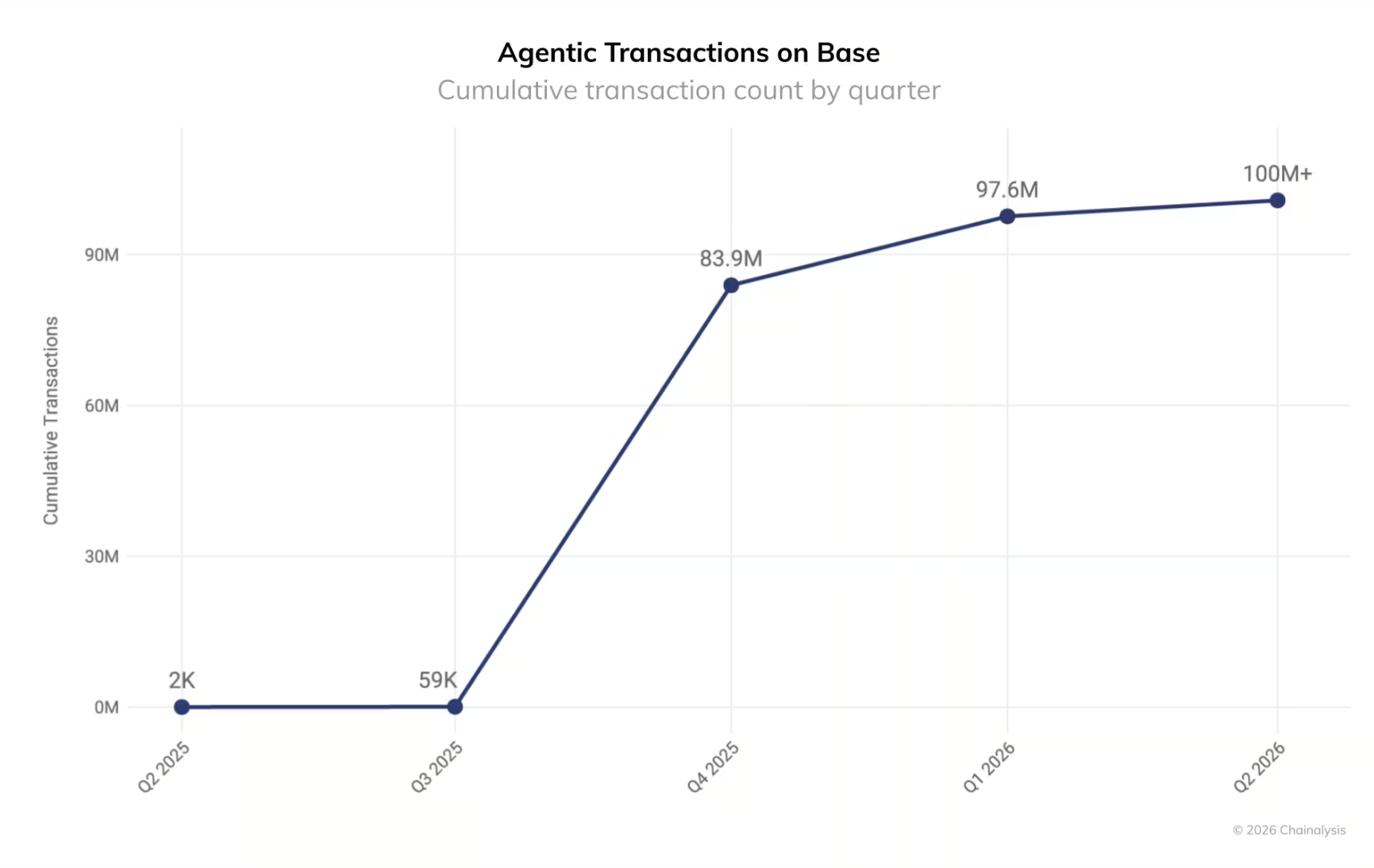
Cumulative agentic transfer volumes on Base. Source: Chainalysis
AI-driven payment activity appears to be gaining traction quickly. A June 3 Chainalysis report found that wallets using Coinbase’s x402 agent payment protocol generated more than 100 million transactions on Base within roughly nine months of launch.
The push extends beyond the crypto industry. In April, Visa launched Intelligent Commerce Connect, a platform that allows artificial intelligence agents to browse, select and pay for goods on behalf of consumers.
The growing interest has prompted bullish forecasts from crypto executives. Circle CEO Jeremy Allaire said billions of AI agents could be transacting with cryptocurrencies and stablecoins within three to five years. Former Binance CEO Changpeng Zhao said that crypto will become the native payment rail for autonomous software.
Magazine: Bitcoin miners are pivoting to AI, so why is the hashrate near ATHs?



The Hong Kong Monetary Authority (HKMA) published a white paper on quantum preparedness on July 27, rating its banking sector 2.3 out of 10 and targeting full readiness by 2030.
Bitcoin (BTC) faces the same quantum threat but has no regulator to set a deadline. Its transition depends entirely on community consensus, which remains divided.
Regulators Can Mandate. Bitcoin Must Agree
The HKMA’s first Quantum Preparedness Index found the sector at an early stage. Around half of the surveyed banks have no formal post-quantum cryptography (PQC) plan. Another 32% have not started their transition at all.
Even so, the regulator can force the pace. It announced a PQC toolkit developed with the Hong Kong University of Science and Technology, along with industry workshops. The target is a full score of 10 by 2030.
“The HKMA will continue to support the banking sector’s PQC transition, with the aim of achieving full sectoral readiness (a QPI score of 10) by 2030 through practical guidance, training, and industry engagement,” the regulator noted.
Bitcoin has no equivalent mechanism. Speaking on the BeInCrypto Experts Council, Oxford quantum computing lecturer Stefano Gogioso contrasted this with Ethereum (ETH), where a foundation at least shapes a post-quantum roadmap.
“Bitcoin has a completely different governance structure in that it doesn’t have one,” he said.
Subscribe to our YouTube channel to watch leaders and journalists provide expert insights
The Quantum Fix Exists, but Consensus Doesn’t
Proposals do exist. Developers merged BIP-360 into Bitcoin’s proposal repository in February. BIP-360 proposes introducing a new Pay-to-Merkle-Root (P2MR) output type through a soft fork. It functions similarly to Pay-to-Taproot (P2TR) but removes the key path spend.
“For clarity, this proposal specifically mitigates the risk of long exposure attacks on outputs that support tapscript and script trees. While some other Bitcoin output types, such as P2SH, are safe against long exposure attacks, taproot is not and taproot is the only currently activated output type that supports tapscript and script trees,” the proposal reads.
Follow us on X to get the latest news as it happens
A draft proposal, BIP-361, co-authored by Casa co-founder Jameson Lopp, would phase out Bitcoin’s legacy ECDSA and Schnorr signatures and, eventually, make coins that fail to migrate difficult to access.
This raises concerns about 1.7 million BTC in early pay-to-public-key addresses, the majority of which are attributed to Satoshi Nakamoto. Still, a greater obstacle remains. Everyone has to agree on what to do next.
CryptoQuant CEO Ki Young Ju previously warned that consensus, not code, is the real bottleneck. He noted that Bitcoiners rarely unite behind changes that seem to touch the network’s founding principles.
Thus, the HKMA will measure its banks against a deadline. Bitcoin’s readiness has no scorecard, and no one is empowered to create one.
The post Hong Kong Gave Banks a 2030 Quantum Deadline: Who Gives Bitcoin One? appeared first on BeInCrypto.


Binance co-founder Changpeng “CZ” Zhao backed crypto license passporting across ASEAN on July 28 during a fireside discussion at the ASEAN Tech Summit Manila 2026.
Summary
- CZ backed simplified ASEAN crypto licensing, allowing regulated firms to avoid full repeat applications regionally.
- ASEAN currently has no bloc-wide crypto passport, leaving approvals and supervision with national regulators separately.
- Four jurisdictions already use streamlined ASEAN fund authorisations, offering a limited model for future coordination.
The session covered digital assets, stablecoins and the future of regional finance.Zhao supported a proposal raised by FinTech Alliance PH founding chair Lito Villanueva. Under the idea, a crypto company licensed in one ASEAN jurisdiction could seek simplified approval elsewhere instead of submitting another complete application.
The proposal would still allow host regulators to assess applicants and impose local conditions. It would not automatically permit a company to operate across every ASEAN market.
ASEAN crypto license passport could reduce repeat filings
Crypto companies operating across Southeast Asia currently face separate licensing processes, compliance checks and supervisory requirements. Zhao argued that recognising some work completed by another regulator could reduce duplicated filings and lower market-entry costs.
A common process could also make regional expansion easier for exchanges, custodians and stablecoin payment providers. However, Zhao’s support does not amount to an ASEAN policy decision. No regulator or ASEAN body has announced a formal crypto passporting proposal, consultation or target date.
Binance has direct experience with fragmented licensing. The exchange is seeking more approvals across Asia while working through separate national requirements. Reuters reported in July that Binance planned to expand its regional licensing footprint but had not identified all the markets involved.
ASEAN regulators have already adopted cross-border recognition arrangements for parts of traditional finance. The ASEAN Collective Investment Schemes Framework allows qualifying funds authorised in one participating jurisdiction to seek streamlined approval in another.
Malaysia, Singapore and Thailand launched the framework in 2014. The Philippines later joined through a supplemental memorandum signed by the four national securities regulators.
The ASEAN Capital Markets Forum also operates the ACMF Pass. It allows eligible investment professionals to obtain fast-track registration for advisory work in participating jurisdictions without securing another full license.
Those programmes provide a procedural model, but they do not cover crypto exchanges or stablecoin issuers. They also preserve the power of host regulators to review applicants and enforce domestic rules.
National crypto rules remain the main obstacle
ASEAN members regulate digital assets through different laws, agencies and product classifications. Requirements can involve local incorporation, capital reserves, cybersecurity, custody, disclosures and anti-money-laundering controls.
The Philippines shows how several approvals can apply to one service. Binance and BlockShoals lacked the central bank license required for certain payment and transaction activities, despite participating in a Securities and Exchange Commission sandbox.
The Philippine SEC later allowed BlockShoals to begin sandbox testing using Binance infrastructure. However, the approval did not replace separate Bangko Sentral ng Pilipinas requirements. In related coverage, the testing programme included a 90-day integration period before user onboarding could begin.
A regional passport would therefore require regulators to agree which authority acts as the home supervisor and which responsibilities remain with each host country.
Europe provides a broader crypto comparison
The European Union’s Markets in Crypto-Assets Regulation provides the clearest direct comparison. MiCA allows an authorised crypto-asset service provider to offer services across EU member states after completing the required notification process.
That system relies on a shared legal rulebook, common authorisation standards and cooperation between national regulators. ASEAN does not currently have an equivalent regional crypto law.
Notably, Binance missed the full MiCA licensing deadline and restricted some European services. The case shows that passporting reduces repeated national applications but does not remove scrutiny during the original approval process.
ASEAN’s Digital Economy Framework Agreement may create another venue for regional cooperation. Negotiations have concluded, and the agreement is undergoing legal review before an expected November 2026 signing. Official descriptions cover digital payments, data governance and cybersecurity, but no published document confirms that crypto license passporting forms part of the agreement.
Any crypto passport would still require negotiations among national regulators, common minimum standards and an information-sharing system. For now, Zhao’s proposal remains a recommendation for future regional policy rather than an approved licensing route.
Elon Musk says he plans to give away nearly his entire fortune. The pledge answers a public challenge from Nobel Prize-winning economist Daron Acemoglu.
The challenge cited a claim Musk made in a video interview. He said robots and artificial intelligence (AI) will soon make goods so abundant that money loses its meaning. Acemoglu, however, asked Musk to back that claim with real money, not just words.
Musk’s Trillion-Dollar Challenge and Shrinking Fortune
Daron Acemoglu, a Massachusetts Institute of Technology (MIT) economist who shared the 2024 Nobel Prize in Economic Sciences, posted the challenge on X on July 27. He proposed that Musk donate his roughly $1 trillion fortune to charity no later than 2036.
Acemoglu argued the pledge would demonstrate genuine confidence in Musk’s own AI predictions. It would also, he wrote, ease public worry over the political influence of billionaires and trillionaires. He further asked for an impartial body to pick the charities, all effective and non-ideological.
The post quickly drew attention. Commentator Gad Saad amplified it on X, noting Acemoglu’s Nobel credentials. Musk answered within hours.
He offered no further detail on a timeline, dollar figure, or charitable vehicle. Therefore, the scope of his pledge remains unclear.
The challenge landed as Musk’s wealth kept falling. His net worth dropped to $695.7 billion on July 27, according to Forbes, after SpaceX shares slid another 4.8% to around $109.50. The stock has now fallen roughly 50% since its June 16 peak, even after a successful Starship test launch. Musk’s stake includes 4.8 billion SpaceX shares plus 350 million stock options, so each price swing moves his fortune sharply.
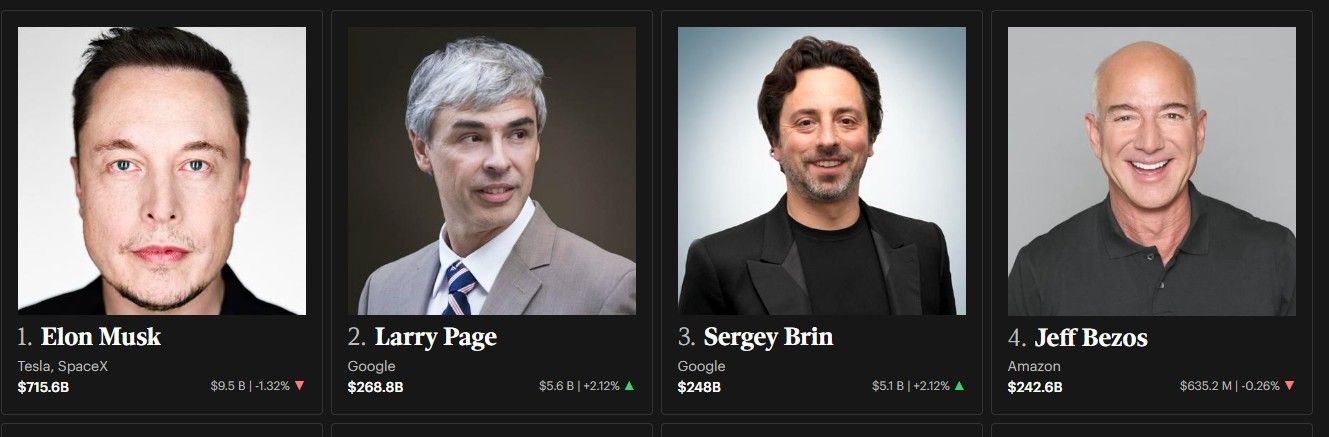
Forbes’ real-time billionaires tracker put his fortune at $715.6 billion on Tuesday, down 1.32%, or $9.5 billion, on the day. Google co-founders Larry Page and Sergey Brin followed at $268.8 billion and $248 billion, both up 2.12%. Amazon founder Jeff Bezos trailed at $242.6 billion, down 0.26%. All three remain well behind Musk despite his recent losses.

Musk recently called himself a former trillionaire after a SpaceX slide pushed his net worth below trillion status last month. He first crossed that threshold following SpaceX’s record Nasdaq debut in June, a milestone that fueled fresh debate over America’s widening wealth gap. Despite the recent drop, Musk still holds a commanding lead over the world’s next-richest people.
What Investors Will Watch Next
Acemoglu’s challenge adds fresh scrutiny to Musk’s AI forecasts, which he expanded on in a recent AI risk interview. Meanwhile, SpaceX shares face an August share lockup that could pressure the stock further. Some analysts still see room for a rebound, while others warn a slide below $100 would signal little investor confidence in the company’s AI ambitions.
Whether Musk formalizes his pledge remains an open question. His fortune’s next moves, and SpaceX’s, may ultimately decide the answer.
The post Elon Musk Accepts Nobel Economist’s Trillion-Dollar Charity Bet: Will He Deliver? appeared first on BeInCrypto.
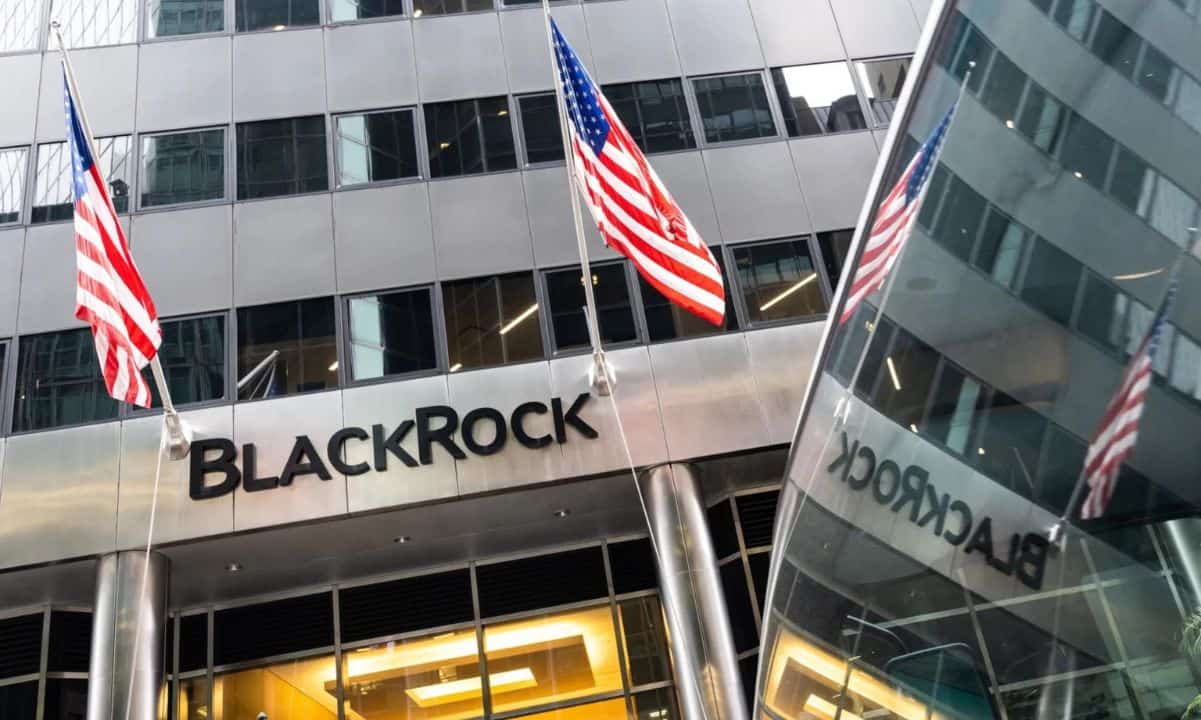
Bitmine chairman Tom Lee said on CNBC on Monday that crypto is recovering because it is being embraced outside the United States. Europe, Japan, and Russia are passing CLARITY Act-like bills to regulate the industry, which has spurred market momentum, he said.
Lee believes when this happens in the US, it will supercharge the market, which will become the programmable software layer of money.
“Because crypto is turning money into software, a lot of things can turn into money,” he said. Once that happens, things like loyalty points and reputation could start behaving a lot like money – especially in the hands of AI agents, one of crypto’s killer use cases.
This is why CLARITY Act matters more than many realize https://t.co/sckumOwJxa
— Thomas (Tom) Lee (not drummer) FundstratDirect.com (@fundstrat) July 27, 2026
Key Crypto Bill Still In Limbo
BlackRock Senior Managing Director and Global Head of Market Development Samara Cohen echoed the sentiment, stating that the measure is an “important step toward establishing a regulatory framework for digital assets that puts investors first.”
She added that the bill would “help the United States shape the next era of market structure — supporting innovation while preserving the transparency, resilience and investor protections that keep the US the global leader in capital markets.”
The CLARITY Act passed the House in July 2025 with strong bipartisan support and advanced out of the Senate Banking Committee on May 14, 2026.
However, recent negotiations have centered on an ethics and conflict-of-interest section barring the president and members of Congress from issuing or sponsoring digital assets. A merged Senate text was released on July 22, incorporating ethics provisions.
Senate Majority Leader John Thune said on July 23 that he doesn’t expect the bill to reach a vote before the summer recess, with ethics remaining the main sticking point.
No floor vote is currently scheduled, so the practical deadline for 2026 passage is before the Senate’s August recess, around August 7. Missing it would likely push action into the post-midterm “lame-duck” period or into 2027.
“The procedural steps … make finishing before recess extremely difficult,” said policy relations consultant Anne Kelley.
“I know many people are disappointed it won’t clear by early August. That does not mean CLARITY is done for the year.”
Opposition Wants More Concessions
“It does sound like a lot of concessions were given, but those who oppose the bill still want to extract something else,” said Lee, who remained hopeful that “anything could happen.”
In a separate post, Lee listed some of the major financial institutions supporting the CLARITY Act, which included Goldman Sachs, BlackRock, Fidelity, Franklin Templeton, and Charles Schwab. “Congress needs to act and pass this bill,” he said.
The post BlackRock Backs CLARITY Act as Tom Lee Predicts Programmable Money Revolution appeared first on CryptoPotato.

Binance co-founder Changpeng “CZ” Zhao backed crypto license passporting across ASEAN, arguing that firms regulated in one market should be able to enter others through a simplified approval process rather than applying from scratch.
Speaking Tuesday during the “One ASEAN, One Digital Economy” fireside chat at the ASEAN Tech Summit Manila 2026, Zhao backed an idea raised by FinTech Alliance PH founding chair Lito Villanueva for regulatory passporting or license portability. Zhao said regulators could still review applicants but should not require them to complete another full licensing application from scratch.
A regional licensing framework could reduce compliance costs, encourage competition and make it easier for crypto and stablecoin services to operate across ASEAN’s fragmented regulatory markets. Member states regulate digital assets separately, creating multiple approval processes for companies seeking a regional presence.
“I think that’s mostly a political problem,” Zhao said of cross-border coordination, adding that the technology was simple. He said allowing more licensed platforms to compete could improve services and lower costs for consumers.

Binance co-founder Changpeng Zhao (left) with FinTech Alliance PH founding chair Lito Villanueva (right) at the ASEAN Summit in Manila. Source: Aubrey Paller
ASEAN has precedents for regional passporting
ASEAN does not currently have a bloc-wide passport for crypto companies, but regional regulators have created streamlined cross-border arrangements elsewhere in finance.
The ASEAN Capital Markets Forum’s (ACMF) operates the Collective Investment Schemes Framework, which allows a fund authorized in its home jurisdiction to be offered in participating host jurisdictions through a streamlined authorization process. The framework was first operationalized in Malaysia, Singapore and Thailand in 2014, while the Philippines joined in 2021, according to the ACMF.
The forum also introduced the ACMF Pass under its Professional Mobility Framework. The arrangement lets eligible investment advisers licensed in one participating jurisdiction receive fast-track registration to provide advisory services in another without obtaining another license.
Related: Philippine bank BPI plans stablecoin payments pilot
These programs are narrower than the passporting idea Villanueva raised and Zhao supported, and remain subject to host-market requirements, but they show that ASEAN regulators have previously used mutual recognition and simplified approvals to deepen integration.
A direct crypto comparison exists in the European Union. Under the Markets in Crypto-Assets Regulation, an authorized crypto-asset service provider can use passporting rights to provide services across EU member states after notifying its home regulator of the countries and services involved.
Zhao said differences in national policies and regulatory approaches make alignment harder than building common technical rails. Still, he argued that firms already licensed in one market should face a lighter application process when entering another ASEAN jurisdiction.
Magazine: Inside the ‘fake police raid’ that forced a $1M Bitcoin transfer


A US exchange can list a new prediction market by filing a form saying the contract complies with the law, and start trading the next day. No approval required.
Summary
- Prediction market prices are well calibrated overall: studies of thousands of settled markets find outcomes occurring at close to their implied frequencies, with accuracy that beats individual experts and polls.
- The best-documented distortion is the favorite-longshot bias: cheap contracts win less often than their prices imply and expensive contracts win slightly more, so buyers of long shots earn systematically negative returns.
- Capital lock-up is the least discussed distortion: a contract paying $1 in six months is worth less than its probability today because the money is committed and earning nothing, which pushes long-dated prices below fair value.
- Calibration varies by domain and horizon, with political markets showing compression toward 50% at long horizons, attributed to opposing partisan bets cancelling instead of informing.
- Fees, spreads, and the maker-taker split move realized returns meaningfully on instruments priced in cents, and resolution risk sits underneath everything as the possibility that a correct forecast still fails to pay.
Behind that speed sits a trapdoor written into Dodd-Frank, three undefined words, and a rulemaking the CFTC opened this June to finally settle what they mean.
The most useful sentence ever written about prediction markets is that a contract trading at 70 cents implies a 70% probability, and the most useful next sentence is that this is an approximation with known, measurable errors. Both halves matter. The first is why journalists, analysts, and increasingly institutional data buyers treat these prices as forecasts: the mapping is real, and the empirical record supporting it is better than most critics assume. The second is why traders who read the price as literal truth lose money in patterned, predictable ways. Research covering hundreds of thousands of settled contracts across the largest venues now supports a precise account of where the mapping holds and where it bends, and the answer is not that markets are wrong but that a price is a market-clearing number produced by capital under constraints, not a probability produced by an oracle. This guide walks the evidence: the calibration record, then the five distortions, then how to read a price properly.
The mapping, and why it mostly works
Start with the good news, because it is stronger than the skeptical framing usually allows.
Calibration studies plot implied probabilities against realized frequencies: take every contract that traded at roughly 30 cents, check how often those events actually happened, and see whether the answer is close to 30%. Across large samples of settled markets, the resulting curve tracks the ideal diagonal closely. One analysis of thousands of markets on the largest regulated venue found overall accuracy above 90% across probability ranges, with the curve hugging the diagonal and no evidence of gross systematic error. Academic work examining more than 300,000 contracts reached a compatible conclusion: prices are informative, and they improve as markets approach settlement, which is exactly what an efficient information aggregator should do as uncertainty resolves.
Comparisons to alternatives are the second part of the case. Aggregated market prices have generally outperformed individual expert forecasts, single polls, and simple statistical models, because the mechanism rewards being right with money and punishes confident error, which is a stronger incentive structure than reputation. Market efficiency has also been improving as the sector grows: spreads on the leading venue compressed sharply as volume expanded, which mechanically improves price quality. For context, crypto.news has explained where the liquid markets live and why the venue structure matters for market quality.
So the base case is that these prices deserve to be taken seriously as probability estimates. The rest of this guide is about the five ways they deviate, each of which is measurable and each of which points the same direction: the deviations mostly hurt the participant who reads the price naively.
Distortion one: the favorite-longshot bias
The best-documented bias in the literature, imported from a century of horse-race betting research, is that markets overprice unlikely outcomes and underprice likely ones.
The evidence in prediction markets is now substantial. Studies of large Kalshi samples find that low-priced contracts win far less often than needed to break even, while high-priced contracts win slightly more often and deliver small positive returns. One analysis found that events priced above 80% occurred about 84% of the time, several points below what their prices implied, meaning even the favorites side of the bias produces a modest shortfall against expectations at that end of the range. The pattern shows up across politics, entertainment, and economic data releases, and across trade sizes and volumes, which argues against it being an artifact of one market type.
The explanations are behavioral and structural in combination: people systematically overestimate small probabilities, a finding that predates prediction markets by decades; cheap contracts offer lottery-like payoff profiles that attract optimistic buyers; and limited arbitrage capital means the mispricing is not fully competed away. For a participant, the practical implication is uncomfortable and simple: buying long shots at five or ten cents is, on the historical record, a systematically losing strategy, and the sellers of those contracts have been the ones collecting.
Distortion two: capital lock-up
The most underappreciated distortion has nothing to do with psychology. It is arithmetic about time.
Buying a contract at 70 cents commits 70 cents until settlement, earning nothing in the meantime. If settlement is a week away, the cost of that commitment is negligible. If settlement is a year away, the buyer has forgone a year of risk-free return on the capital, which at prevailing rates is a meaningful percentage of the stake. Rational participants therefore pay less than the true probability for long-dated contracts, and recent work formalizes this as settlement discounting: in collateralized markets where capital sits locked until resolution, the price-as-probability mapping is incomplete, because these venues are information aggregators embedded in capital markets, not frictionless probability oracles.
The practical consequences run in two directions. For a reader treating the price as a forecast, long-dated contracts systematically understate the true probability, and the effect compounds with the horizon. For a trader, the discount is not an anomaly to exploit but the market correctly pricing the cost of committed capital, which means an apparent edge on a distant contract may be entirely consumed by the opportunity cost of getting there. Any comparison between a prediction market price and a poll or model output should account for this, and almost none do.
Distortion three: liquidity and domain
Calibration is not uniform across markets, and the variation is systematic enough to have been decomposed.
Volume concentrates heavily: political and macroeconomic contracts have accounted for a majority of trading on the largest venues, which means those markets have the tight spreads, the professional participation, and the price quality that the calibration studies mostly measure. Thin markets on obscure questions inherit none of that, and a 40-cent price in a book with a fifteen-cent spread carries far less information than the same number on a Fed decision.
Domain matters beyond liquidity. Research examining calibration across knowledge domains, horizons, and trade sizes found that a handful of components accounted for the large majority of variation, with political markets showing pronounced underconfidence: prices compressed toward 50%, understating the probability of favored outcomes, at nearly every horizon and most strongly among the largest traders. The proposed mechanism is bilateral cancellation, in which opposing partisan bets pull prices toward the middle without adding information, and the same pattern replicated on a structurally different venue, which strengthens the finding.
There is also a category where calibration is close to meaningless: questions with no historical base rate. A market on whether an unprecedented technological milestone occurs by a distant date has nothing to anchor to, and its price reflects sentiment among a small self-selected group. Those markets are entertainment dressed as forecasting, and they should be read accordingly.
Distortion four: fees, spreads, and who you trade as
On instruments priced in cents, transaction costs are not a rounding error, and the research shows they fall unevenly.
Analyses of the maker and taker split find that participants providing liquidity earn better returns than those taking it, for two compounding reasons: makers obtain better prices by definition, and takers generally pay the fees. Layer the favorite-longshot bias on top and the worst realized outcomes concentrate among takers buying cheap contracts, which is also the most intuitive behaviour for a new participant. The gap is measurable in the return data across price deciles.
The spread deserves separate attention because it is the cost most often ignored. A two-cent spread on a 65-cent contract consumes roughly 3% of the position immediately on a round trip, which against an expected edge of a few percentage points can erase the trade’s entire rationale. Spread quality has improved substantially with volume, but it varies enormously by market, and checking it before sizing is the single highest-return habit available.
Distortion five: resolution risk
The last distortion is the one that turns a correct forecast into a loss, and it is structural, not statistical.
A contract pays according to its stated resolution criteria as adjudicated by its named source or process, and that adjudication can diverge from what an ordinary observer concludes happened. On regulated venues the source is typically a designated authority, which makes disputes rare but not impossible where wording is ambiguous. On blockchain-based venues, settlement runs through decentralized oracle processes with proposal, challenge, and token-holder voting stages that this publication examines in detail, and there the divergence risk is materially higher and has produced real disputed payouts. That is the risk underneath every price.
The correct way to hold this is as a haircut on every price. A contract at 90 cents is not a 90% chance of being paid; it is a roughly 90% chance the event occurs multiplied by the probability that the resolution process pays it as expected. In liquid markets with objective single-source criteria, that second factor is close to one. In ambiguously worded or contentious markets, it is meaningfully lower, and it is entirely absent from the headline number.
What the calibration research cannot tell you
Before assembling the method, one honest caveat about the evidence base, because the studies cited above have limits that their headline numbers conceal.
The samples are historical and venue-specific. The largest datasets cover a regulated exchange over a period running from 2021 through 2025, an era in which prediction markets were smaller, more concentrated among sophisticated participants, and dominated by categories with clean resolution sources. Calibration measured on that population may not describe a market that has since added tens of millions of retail accounts through brokerage distribution, expanded aggressively into sports, and grown volumes by an order of magnitude. More retail participation could improve calibration by adding diverse information or worsen it by adding correlated sentiment, and the honest answer is that nobody yet knows which dominates at current scale.
Selection also shapes what gets measured. Calibration studies necessarily examine markets that resolved, which excludes contracts delisted, withdrawn, or voided, and those are disproportionately the ambiguous or contested ones where the price-to-probability mapping would have performed worst. The measured record is therefore a record of the well-behaved subset, and the true error rate including resolution failures is worse than the curves show.
Regime change is the third limit. Calibration is a property of a market’s participant mix, incentive structure, and information environment, all of which are shifting fast: new venues, new distribution, institutional data buyers, leveraged product variants, and a legislative environment that could remove entire categories. Findings proven on one configuration do not automatically survive into the next, which is why the coming election cycle is the most informative calibration test the sector has faced, and why any confident claim about accuracy should be dated.
None of this undermines the base case. It sharpens it: prediction market prices have a good measured record on a specific historical population under specific conditions, and the correct posture is to use that record as evidence while treating the current, much larger, much more retail market as an ongoing experiment whose results are not yet in.
How to read a price properly
Assemble the five and a usable method falls out.
Treat the price as a strong prior, never a fact. Adjust upward for long-dated contracts to account for the capital lock-up discount. Discount extreme prices toward the middle, since long shots are overpriced and heavy favourites are slightly overpriced too. Weight the reading by liquidity, taking prices from deep, professionally traded markets seriously and thin ones as sentiment. Read the resolution criteria and apply a haircut where the wording admits argument. And when trading rather than reading, account for fees, the spread, and whether you are making or taking, because those costs land before any edge does.
None of this argues against the instruments. The calibration record is genuinely good, better than most alternatives, and improving with volume. It argues for reading them the way a professional reads any market-implied number, an inflation breakeven or an options-implied volatility: as information produced by capital under constraints, containing real signal and predictable distortions, and worth more to the person who knows which is which.
One last practical note, aimed at the readers who consume these prices without ever trading them, which is now most of the audience. Prediction market numbers increasingly appear in political commentary, market research, and media dashboards as substitutes for polls, and the substitution is usually presented without any of the qualifications above. A responsible citation of a market price does three things: it names the venue, since calibration differs by market structure and resolution architecture; it names the date and horizon, since the same question priced a year out and a week out carries different distortions; and it treats the number as one estimate among several, never the answer, because the research showing markets beat individual experts does not show them beating the combination of markets, models, and polls read together. Crypto.news has also covered who is buying these numbers as exchanges, sportsbooks, and data buyers fight over the value of market-implied probabilities.
The strongest version of the case for these instruments is that they add a real, financially disciplined signal to a forecaster’s toolkit. The weakest version, and unfortunately the most common in circulation, is that a number from a screen settles a question. The distance between those two readings is what this guide has been about, and it is entirely made of the five distortions above.
Frequently asked questions
Does a 70-cent contract mean a 70% probability?
Approximately. Calibration studies across thousands of settled markets find implied probabilities track realized frequencies closely, with overall accuracy above 90% across price ranges. The mapping is a good first approximation with documented deviations at the extremes, over long horizons, in thin markets, and after fees.
What is the favorite-longshot bias?
The tendency for cheap contracts to win less often than their prices imply and expensive ones to win slightly more. Research on large samples finds low-priced contracts deliver systematically negative returns while high-priced contracts yield small positive ones, with one analysis showing events priced above 80% occurring about 84% of the time. Buying long shots is, on the record, a losing strategy.
Why do long-dated contracts trade below their true probability?
Because capital is locked until settlement and earns nothing meanwhile. Committing money for a year to a contract paying $1 has a real opportunity cost, so rational buyers pay less than the fair probability, an effect recent research formalizes as settlement discounting. Any comparison of a long-dated market price to a poll or model should adjust for it.
Are prediction markets more accurate than polls or experts?
Generally yes, in the aggregate. Market prices have outperformed individual expert forecasts, single polls, and simple statistical models across many studies, because participants are financially rewarded for accuracy and penalized for confident error. The advantage is largest in liquid markets and smallest in thin ones with no historical base rate to anchor prices.
Which markets should be trusted least?
Thin ones, distant ones, and unprecedented ones. Wide spreads mean low information content; long horizons introduce the lock-up discount and, in political markets, documented compression toward 50%; and questions with no historical base rate, such as unprecedented technological milestones, have nothing anchoring their prices beyond the sentiment of a small self-selected group.
How much do fees and spreads matter?
Considerably, on contracts priced in cents. A two-cent spread on a 65-cent contract costs roughly 3% on a round trip, which can exceed a realistic edge. Research also finds liquidity providers earn better returns than takers, who both pay fees and receive worse prices, with the gap widest among buyers of cheap contracts.
What is resolution risk?
The possibility that a contract fails to pay as expected because of how it resolves rather than what happens in the world. Contracts settle against named sources and pre-written criteria, so ambiguity can produce outcomes that surprise participants, and on blockchain venues using decentralized oracle voting the risk is materially higher. Every price should be read with a haircut for it.
How should a careful reader use these prices?
As a strong prior rather than a fact: adjust long-dated prices upward for capital lock-up, discount extreme prices toward the middle, weight by liquidity, read the resolution criteria, and subtract transaction costs before assuming an edge. Treated that way, prediction market prices are among the most useful public forecasts available. This is educational information, not investment advice.
Disclaimer: This article is for information and educational purposes only and does not constitute financial or investment advice. Research findings cited reflect published studies of historical data and do not predict future accuracy, and trading event contracts carries risk of total loss of amounts invested. Always do your own research. Information is accurate as of July 27, 2026.


Delphi Digital analysts have renewed a debate over whether crypto tokens and company equity can share value without creating conflicting claims.
Summary
- Delphi analysts said equity usually captures company profits, limiting the value available to associated tokens.
- Projects can use vague token-equity boundaries to support valuations exceeding economic rights granted to holders.
- Buybacks, burns and fee sharing can connect token value to revenue, but execution remains project-specific.
During a July 15 roundtable, analyst Ceteris said token market capitalisations should usually remain below the value assigned to the related company because equity holders normally receive most business profits.
Delphi released the discussion under the title “Are Crypto Tokens Fundamentally Broken?”. The episode covered Grass, Venice and other projects where a private company operates alongside a publicly traded token.
Equity carries clearer rights to company profits
Equity gives shareholders an ownership interest in a company. Investor.gov states that stock represents a proportional claim on a corporation’s assets and profits. Common shareholders may also vote on company matters and receive dividends when directors approve them.
A crypto token may carry different rights. Some provide network access, rewards or governance votes. Others support staking, fee discounts or payments. Holding a token does not automatically give its owner a legal claim on company revenue, assets or sale proceeds. The rights depend on the project’s documents, contracts and legal structure.
Ceteris argued that this difference should restrain token valuations when a project also has equity investors. He said most “actual cash profits” ultimately flow to shareholders. The token’s market capitalisation “should generally be smaller” unless the project has a clear system that sends value to holders.
Ambiguity can support inflated token valuations
Ceteris said problems arise when projects leave the boundary between tokens and equity unclear. A company may market the token as the centre of an ecosystem while keeping revenue, intellectual property, customer contracts and sale rights inside the equity entity. Token buyers may then price the asset as though it captures the full business.
This setup creates groups with different interests. Equity holders may want the company to retain profits, raise capital or pursue a sale. Token holders may prefer fee sharing, buybacks, burns or stronger onchain governance. Management must decide which side receives value from the product.
The Delphi episode used Grass and Venice as examples. It did not claim every dual structure will fail. The speakers focused on whether projects disclose where revenue goes and whether token holders have enforceable or programmatic economic rights.
Governance alone may not solve the issue. As crypto.news explains in its governance-token guide, holders can vote on protocol proposals, but each project defines what those votes control. A token may govern incentives or technical updates without controlling the company that owns key software and commercial agreements.
Strong markets can hide structural weakness
Delphi Digital co-founder Yan Liberman said tokens may still perform when market conditions remain strong. Rising liquidity can lift prices even when a token’s link to revenue remains limited. Traders may focus on user growth, listings or market narratives instead of cash-flow distribution.
However, Liberman said the structure can weaken when business conditions deteriorate or shareholders seek an exit. A sale may transfer the operating company, brand or intellectual property to a buyer while leaving token holders outside the deal. The outcome depends on agreements linking the company and network.
The risk can also emerge when revenue falls. Equity investors hold formal claims within the corporate structure, while token support may depend on company decisions or governance votes. A project can reduce incentives, delay buybacks or change utility unless binding rules prevent those changes.
Equity also carries risks, including dilution, bankruptcy and operating losses. Tokens may offer global liquidity and transparent onchain systems. Delphi’s argument centred on pricing those different rights accurately rather than treating both assets as equal claims.
Projects test clearer token value accrual
Several crypto projects now use revenue-linked systems to narrow the gap. Buybacks use protocol income to purchase tokens. Burns permanently remove tokens from circulation. Fee sharing sends part of network revenue to eligible participants. Each model creates a clearer connection between activity and token economics.
As crypto.news reported, Hyperliquid has routed trading revenue into HYPE purchases through its Assistance Fund. The mechanism had used more than $1.16 billion in fees for token purchases by May 2026.
Meanwhile, Jito proposed using DAO revenue for JTO buybacks and permanent burns. The proposal would direct its share of JTX revenue toward the token mechanism through at least the fourth quarter of 2027.
Similarly, Uniswap’s fee programme converts protocol income into UNI burns across supported networks. The system links protocol fees with token supply reduction instead of sending dividends directly to holders.
These systems do not turn tokens into equity. Holders may still lack claims on company assets, dividends or acquisition proceeds. Still, automated and disclosed mechanisms make token demand easier to measure through revenue, buyback volume, supply changes and governance controls.
The Delphi roundtable called for lower expectations when those links remain weak. Its central test asks which asset receives the cash generated by the business. When equity captures income and the token relies mainly on market demand, assigning both similar valuations may overstate the token’s economic position.


South Korean crypto exchange Upbit announced trading support for Ripple USD on July 28, adding RLUSD pairs against the Korean won,
Summary
- Upbit added RLUSD trading against won, Bitcoin and Tether on July 28 in South Korea.
- Deposits and withdrawals support only XRP Ledger, with destination tags required for incoming RLUSD transfers.
- Ripple officially reported $1.51 billion circulating RLUSD backed by $1.62 billion reserves on July 16.
Bitcoin and USDT. Trading was scheduled to begin at 2:00 p.m. Korea Standard Time, subject to the exchange securing sufficient liquidity.
Deposits and withdrawals were due to open within two hours of the announcement. Upbit limited transfers to the XRP Ledger version of RLUSD, excluding the token’s Ethereum and other supported-network versions.
Upbit placed temporary limits on RLUSD trading
Upbit planned several controls during the opening period. Buy orders were restricted for approximately five minutes after trading began. Sell orders priced more than 10% below the previous day’s closing price were also restricted for the same period.
For roughly two hours after launch, users could submit only limit orders. Market orders and other conditional order types were unavailable during that window. Upbit said it could postpone trading if the available liquidity did not meet its requirements.
The exchange quoted RLUSD at 1,468.76 won, 0.00001583 BTC and 0.9995 USDT at 11:00 a.m. KST. Those figures preceded the scheduled opening and did not represent completed trades on the new Upbit markets.
Broader market data continued to show RLUSD trading near its intended $1 peg on July 28, with an estimated circulating supply of about 1.59 billion tokens.
RLUSD deposits require the XRP Ledger issuer address
Upbit identified rMxCKbEDwqr76QuheSUMdEGf4B9xJ8m5De as the supported address for RLUSD deposits. Ripple’s official documentation confirms that this is the RLUSD issuer account on the XRP Ledger rather than a smart-contract address in the Ethereum sense.
Customers must also enter the correct destination tag when transferring RLUSD to Upbit. XRP Ledger exchanges commonly use one wallet address for multiple customers and rely on destination tags to credit each deposit correctly.
Upbit warned that unsupported-network deposits could require a lengthy return process. Transfers from exchanges that do not meet South Korea’s Travel Rule requirements may not be credited. Personal-wallet transfers are limited to addresses whose ownership has been verified through Upbit.
RLUSD gains another South Korean trading channel
The Upbit listing expands RLUSD’s availability in a market where XRP has historically recorded high retail trading activity. The stablecoin was already available through Coinone, giving Ripple an earlier domestic distribution channel.
As previously reported, Coinone’s RLUSD support formed part of Ripple’s growing presence in South Korea, where the company has also pursued tokenised securities and payment projects.
RLUSD is issued by Standard Custody & Trust Company, a Ripple subsidiary holding a New York limited-purpose trust charter. The New York Department of Financial Services lists RLUSD as approved for issuance in the state and includes it on its virtual currency Greenlist.
Ripple says RLUSD is backed by cash and highly liquid, short-term assets held in segregated reserve accounts. Its transparency page reported $1.5086 billion in circulating RLUSD and $1.6191 billion in reserve funds as of July 16. The company publishes monthly third-party reserve reports.
XRP Ledger liquidity will be the next measure
The listing gives Korean traders direct access to RLUSD without first converting funds through another offshore venue. The KRW pair may also support price discovery between South Korea’s domestic currency market and global dollar-stablecoin markets.
Notably, RLUSD generated $2.5 billion in XRP Ledger trading activity during an earlier reporting period, according to data published by Ripple-backed Evernorth. The report said RLUSD/XRP trading accounted for nearly $900 million of that amount.
However, the Upbit announcement did not provide a trading-volume target or forecast how much RLUSD would move onto the exchange. Post-listing volume, order-book depth and deposits will show whether the three markets attract sustained activity.
The exchange will also monitor deposits for compliance with its Travel Rule and source-of-funds requirements. No additional network support was announced, meaning Ethereum-based RLUSD holders must bridge or exchange their tokens for the XRP Ledger version before depositing.


The European Securities and Markets Authority has added 15 crypto-asset service providers to its interim Markets in Crypto-Assets register.
Summary
- ESMA added 15 authorised CASPs, lifting the register to 309 distinct providers across European markets.
- BNY’s Belgian subsidiary gained approval for crypto custody and transfer services under the MiCA framework.
- Germany contributed four new entries, while Denmark added three as post-deadline licensing activity continued steadily.
The additions lifted the list to 309 distinct authorised providers, based on the latest register file dated July 23 and published through ESMA’s MiCA page on July 24.
The new entries include BNY SA/NV, the Belgian banking subsidiary of U.S. financial services group BNY. The National Bank of Belgium authorised the unit on July 20 for crypto-asset custody and transfer services.
BNY joins banks and payment firms on the register
BNY SA/NV joins the MiCA register as traditional banks expand their regulated digital-asset operations in Europe. BNY describes itself as a global financial services platform. It reported $62.6 trillion in assets under custody or administration as of June 30. Its Belgian subsidiary already serves as a major European custody bank.
Three German cooperative banks also appeared among the new entries. They were Raiffeisenbank Falkenstein-Wörth, Spar- und Kreditbank Rheinstetten and VR-Bank Augsburg-Ostallgäu. Germany also added JT Technologies, taking the country’s total for this update to four rather than three.
The register also added BitPay B.V. in the Netherlands and Coinify ApS in Denmark. Both companies provide digital payment services. Denmark’s other additions were SafeLynx Technologies and Januar, which provides payment and banking infrastructure for digital-asset companies.
ESMA adds providers from eight European jurisdictions
The 15 additions came from eight jurisdictions. Germany led with four entries, followed by Denmark with three. Bulgaria and Latvia each added two providers. Belgium, Cyprus, Liechtenstein and the Netherlands each contributed one.
Bulgaria’s entries were Altcoins BG and Digital Assist. Latvia added Bleap and Nodu Digital. The remaining providers were Damoon Technology Europe in Liechtenstein and SG Digital Assets in Cyprus. ESMA’s register lists each firm with its national regulator, approval date and permitted services.
The published CSV contains 312 rows, but some firms appear more than once. A register comparison by NorthPoint counted 309 distinct entity-and-regulator pairs. This explains why some trackers may show a higher total when they count authorisation records instead of separate providers.
MiCA register expands after July transition deadline
The update followed the end of the European Union’s MiCA transition period on July 1. Companies that previously operated through national registrations must now hold a CASP authorisation for covered services or take steps to stop those activities. ESMA says national regulators supply the register data and that it republishes the files weekly.
A MiCA authorisation granted by one national authority can support cross-border services after the required passporting process. However, approval only covers the services listed for that provider. BNY’s entry covers custody and administration of crypto-assets and transfer services on behalf of clients. It does not list exchange or trading-platform operations.
As crypto.news previously reported, ESMA added 14 providers in the prior update, taking the register to 294. That group included Ripple Payments Europe, Portugal’s Bison Bank and Hrvatska poštanska banka in Croatia. Ripple said its Luxembourg authorisation supported regulated payment services across Europe.
Related coverage also reported that MiCA’s July deadline changed market access for firms that had not completed licensing. Some providers restricted new accounts or adjusted European services, while authorised companies began competing for customers moving to regulated platforms.
Compliance costs remain a concern for licensed firms
The rising CASP count shows that national authorities continue processing applications after the transition deadline. It does not show how quickly each provider will launch services or whether every authorised business can support the long-term cost of compliance.
Gate Europe chief executive Giovanni Cunti recently warned that some licensed firms may “not be capable to sustain the cost and the resources” needed over time. He said the framework creates a smaller regulated market, while ongoing staffing, reporting, security and capital requirements may remain difficult for some operators.
ESMA’s register serves as a public record of authorisation, not a rating of a company’s financial strength or service quality. The regulator also notes that register information may not appear immediately because national authorities first send the data to ESMA.
The addition of BNY and three German banks adds more traditional finance names to the MiCA system. At the same time, the new group includes payment companies, infrastructure providers and smaller crypto businesses. Future weekly files will show whether the number of authorised providers continues rising after the July 1 deadline.


Every legal event contract in America is listed by a designated contract market, a federal exchange license created for grain futures and now the most sought-after permission slip in crypto. Here is what a DCM actually is, what its holder must do, why the licenses have been changing hands, and what the status does and does not protect.
Summary
- A designated contract market is an exchange registered with the Commodity Futures Trading Commission under Section 5 of the Commodity Exchange Act, permitted to list futures, options, and event contracts and to serve retail customers directly.
- DCMs must comply continuously with 23 statutory core principles covering manipulation prevention, surveillance, rule enforcement, financial integrity, and recordkeeping, verified through periodic rule enforcement reviews.
- A DCM cannot function alone: contracts must clear through a registered derivatives clearing organization, and customer-facing brokerage generally involves a futures commission merchant, making the framework a three-license structure.
- The license became strategically valuable when prediction markets scaled: Kalshi obtained DCM status in 2021, Crypto.com assembled the full set of registrations, Gemini’s entity was certified, and Robinhood and Susquehanna acquired an existing licensed exchange and clearinghouse and rebranded it.
- Core Principle 3 makes the exchange the frontline regulator of its own market, an obligation the CFTC underlined in a 2026 advisory telling venues to vet event contract design and monitor trading as volumes grow.
The single most consequential fact about prediction markets in the United States is one almost nobody outside compliance departments can name: the specific federal registration that makes them legal. It is called a designated contract market, abbreviated DCM, and it was designed for exchanges trading futures on physical commodities. Nothing about grain or crude oil anticipated a contract on which party controls the Senate, yet the same registration category now underpins the entire American event-contract industry, from Kalshi’s political markets to the World Cup contracts routed through a Robinhood-affiliated venue. Understanding what a DCM is explains a great deal that otherwise looks arbitrary: why some platforms can serve US retail customers and others cannot, why exchanges have been bought rather than built, why the CFTC keeps addressing exchanges instead of traders, and what protection the license actually confers on someone with money at risk.
What the license is
A designated contract market is a board of trade, in the statute’s antique phrasing, that operates under CFTC oversight pursuant to Section 5 of the Commodity Exchange Act, with the detailed requirements set out in Part 38 of the Commission’s regulations.
Two features define it. First, breadth of product: a DCM may list futures and options contracts on all types of commodities, a category federal law defines expansively enough to include interest rates, indices, digital assets, and the occurrence of events. Second, breadth of access: a DCM may admit all types of traders, including retail customers, which is the property that matters most for this industry. Certain instruments, notably swaps, are generally off-limits to non-professional participants unless executed on a DCM, so the license is the mechanism by which ordinary people gain lawful access to products otherwise restricted to institutions.
Registration is not a one-time approval. A DCM must comply at all times with 23 core principles written into the statute, covering prevention of market manipulation, trade surveillance, position limits, financial integrity of transactions, protection of market participants, recordkeeping, and the operation of a credible self-regulatory program. The Commission’s Division of Market Oversight examines compliance through periodic rule enforcement reviews, which are exactly what the name suggests: audits of whether the exchange is enforcing its own rulebook.
The three-license structure
A DCM registration on its own does not produce a functioning market, and the reason clarifies most of the corporate activity in this sector.
Three categories divide the regulated derivatives stack. Futures commission merchants act as brokers, soliciting and accepting customer orders and holding customer margin in segregated accounts. Designated contract markets are the exchanges where contracts are listed and matched. Derivatives clearing organizations are the clearinghouses that guarantee trades, manage margin, and stand between counterparties to absorb default risk. Every contract a DCM lists must clear through a registered DCO, which means an exchange without clearing access is an exchange that cannot operate.
The separation is deliberate, designed to limit conflicts of interest by keeping the party that brokers orders, the party that matches them, and the party that guarantees them distinct. In practice the largest operators assemble more than one registration, which is why announcements of a firm obtaining its full set of licenses represent genuine capability expansion and not paperwork. It also explains why the assets changing hands in this sector tend to be exchange-and-clearinghouse pairs: buying only half the stack leaves the buyer dependent on someone else for the other half.
Why the license became valuable
For most of its history the DCM category was unglamorous infrastructure. Prediction markets changed that, and the sequence is worth following.
Kalshi obtained DCM designation in 2021, the first purpose-built prediction market to do so, and registered an affiliated clearinghouse in 2024, giving it the complete stack. That combination is what allowed a startup to offer federally regulated event contracts to American retail customers, and it converted regulatory status into the company’s primary competitive asset. As the category grew, the CFTC saw a marked increase in DCM applications from firms focused on prediction markets, enough that the Commission issued an advance notice of proposed rulemaking in March 2026 partly in response. A crypto-native exchange entity affiliated with Gemini was certified as a DCM, a notable expansion of the Commission’s willingness to license firms originating in digital assets, though the entity operates as a centralized venue with conventional clearing, fiat collateral, and standard identity checks. Crypto.com’s derivatives arm assembled the full complement of registrations. Interactive Brokers built ForecastEx.
And then came the transaction that revealed the license’s true nature as an asset: Robinhood, alongside Susquehanna International Group, acquired an existing CFTC-licensed exchange and clearinghouse, previously operating under other names, and rebranded it. That is the license changing hands. The regulatory standing that Kalshi spent years and litigation securing was, for a well-capitalized buyer, available for purchase. The Commission’s own rules even contemplate this pathway, with procedures for reinstating dormant contract markets that have stopped listing products. A license is a durable, transferable good, and the industry learned that lesson in public.
The frontline regulator burden
The obligation that shapes daily practice most is Core Principle 3, which requires a DCM to ensure the contracts it lists are not readily susceptible to manipulation and to conduct surveillance of trading in them.
The Commission spelled out what that means for event contracts in a March 2026 advisory addressed to DCMs, reminding them that these products sit fully under the Commodity Exchange Act and Part 38, pointing to Appendix C as the guide for listing and surveillance, and stating plainly that exchanges are the frontline regulators of their own markets. The advisory flagged sports and similar real-world contracts as higher risk, signaling that venues listing them face a higher bar to show the products are not gambling in substance, and it told exchanges to reassess compliance continuously as volumes and product complexity grow.
The practical translation is that a DCM is not merely a permission to list. It is an obligation to police: to vet whether each contract’s resolution criteria and underlying market can be manipulated, to monitor trading for abuse including by participants with non-public information, to enforce its rulebook against its own customers, and to document all of it for examination. The surveillance and enforcement programs that prediction market venues have been publicizing, screening tools blocking candidates from trading their own races, integrity vendors flagging athletes and officials, in-app reporting for suspicious activity, are core-principle compliance made visible, undertaken by exchanges that answer for their markets’ integrity in a way no offshore venue does.
How a firm actually gets one
The pathway matters, because the choice between applying and acquiring has shaped the competitive landscape more than any product decision.
The application route runs through Part 38 of the Commission’s regulations, with the criteria and procedures set out in the Commodity Exchange Act and elaborated in appendices providing guidance to applicants. A prospective DCM must show, in detail and in advance, how it will satisfy each core principle: the design of its contracts and why they resist manipulation, its trade surveillance systems and the staff running them, its rulebook and disciplinary procedures, its financial resources, its technology and system safeguards, its recordkeeping, its emergency authority, and its governance including conflict-of-interest arrangements. The submission is a description of an operating exchange written before the exchange operates, and the Commission reviews it against a statutory clock while asking questions. Firms in this space have described the process as measured in quarters, not weeks, and it consumes senior legal and compliance capacity throughout.
The acquisition route is faster and increasingly common. Licenses attach to entities, so buying the entity conveys the standing, subject to the Commission’s review of the change in control and continued compliance. The Commission’s rules also address contract markets that have gone dormant, meaning they hold designation but have stopped listing products: a dormant DCM must apply for reinstatement before listing or relisting, though the application may rely on previously submitted materials that still accurately describe conditions. That provision is the formal basis for what the market saw this year, when a licensed exchange and clearinghouse that had passed through multiple owners and business models was acquired and relaunched under a new name and a new strategy. The regulatory achievement of one era becomes the acquisition target of the next.
The strategic consequence deserves to be stated plainly, because it cuts against the intuition that regulation protects incumbents. In this category, the license is a purchasable input with a market price, and the durable advantages sit elsewhere: in distribution, in liquidity relationships, in brand, and in the compliance organization that keeps a venue in good standing once it has one. A startup that treats its DCM registration as its moat has misidentified its asset, and the events of this year in prediction markets are the demonstration.
What the license does and does not protect
For a participant deciding where to trade, the honest accounting has two columns.
What DCM status provides: a federally supervised venue subject to examination; contracts cleared through a registered clearinghouse that guarantees performance and manages default risk; customer funds held under the segregation rules applying to regulated derivatives intermediaries; exchange rules the venue is obliged to enforce; a surveillance program with a regulator checking that it functions; and a defined complaint and enforcement path when something goes wrong. Against an unlicensed offshore book, that is a substantial difference in kind.
What it does not provide: any guarantee that a contract is a good trade, any protection against losing the amount staked, any assurance that a market will resolve the way an ordinary reading of events suggests, or any immunity from the legal turbulence around the category. A DCM’s contracts remain subject to the Commission’s authority to review and prohibit products involving certain enumerated activities, state gaming regulators continue to contest sports contracts regardless of federal registration, and pending federal legislation could remove entire product categories from licensed venues. Registration answers the question of whether the venue is lawful. It does not answer whether the product will still be listed next year, which is the live question in this category and the reason product availability should be treated as provisional.
A closing note on the category’s odd historical shape, because it explains why the license fits prediction markets so imperfectly. The designated contract market framework was built for exchanges trading standardized futures on physical commodities, where the underlying is a bushel or a barrel, the participants are producers and processors hedging real inventory, and speculation exists to give those hedgers someone to trade with. Every core principle assumes that world: contract design that resists manipulation of a physical market, position limits protecting a deliverable supply, surveillance aimed at cornering. Event contracts arrive with no deliverable supply, no producers, and an underlying that is an occurrence rather than a commodity, and the framework has been asked to stretch across that gap by analogy.
It has stretched further than most observers expected, which is a testament to how broadly federal law defines a commodity, and the strain is visible in exactly the places the industry fights: whether a contract on a game “involves gaming,” whether an exchange can meaningfully surveil manipulation of an election, whether position limits mean anything on a binary payout. The pending rulemaking on public-interest determinations is the Commission’s attempt to fit the old frame to the new object, and the parallel legislative proposals are attempts to decide the question in one move instead. Either way, the underlying reality is worth carrying: the entire American prediction market industry operates on a permission structure designed for grain, and the fit is the argument.
A final orientation point for readers tracking the sector. Because the license is the gate, most of the important news in prediction markets is license news, and it is usually reported in language that obscures the stakes. An exchange “receiving CFTC approval” may mean a full designation, an amendment expanding an existing registration, a clearinghouse registration completing a stack, or a change-of-control approval following an acquisition, and those are very different events with very different competitive consequences. A firm “self-certifying” a contract is not receiving approval at all. And an entity described as “CFTC-regulated” may hold any one of the three registrations, only one of which permits listing contracts for retail trading.
Reading these announcements precisely is the difference between understanding the competitive map and repeating a press release. The questions worth asking of any such story are simple: which registration, held by which legal entity, permitting what activity, and does the group also control clearing. Answer those four and the strategic meaning of almost any development in this sector becomes legible, including the ones the participants would prefer to leave vague. Crypto.news has also explained the product these venues list,what a DCM may do without asking,the industry these licenses built, and the wider regulatory structure.
Frequently asked questions
What does DCM stand for and what is it?
Designated contract market: an exchange registered with the Commodity Futures Trading Commission under Section 5 of the Commodity Exchange Act and Part 38 of the Commission’s regulations. DCMs may list futures, options, and event contracts on all types of commodities, and may admit retail customers directly, which is what makes lawful retail access to these products possible in the United States.
Why do prediction markets need this specific license?
Because event contracts are derivatives under federal law, and only a registered exchange may list them for trading by US customers. Without DCM status a venue cannot lawfully offer these products to American retail participants, which is why every domestic prediction market operates through one, either obtained directly or acquired.
What are the core principles?
Twenty-three statutory requirements a DCM must satisfy continuously, covering prevention of manipulation, contract design, trade surveillance, position limits, financial integrity, participant protection, recordkeeping, and self-regulation. The CFTC’s Division of Market Oversight verifies compliance through periodic rule enforcement reviews, which examine whether the exchange actually enforces its own rulebook.
Can an exchange operate with a DCM license alone?
No. Every contract listed on a DCM must clear through a registered derivatives clearing organization, and customer brokerage generally involves a futures commission merchant. The three registrations serve different functions, brokering, listing, and clearing, and are deliberately separated to limit conflicts of interest, which is why major operators assemble more than one.
Why have companies been buying DCMs rather than applying?
Because the license is a transferable asset and applications take time. Robinhood and Susquehanna acquired an existing licensed exchange and clearinghouse and rebranded it, obtaining in a transaction the standing that a startup builds over years. The Commission’s rules even provide for reinstating dormant contract markets, making acquisition a recognized pathway.
What is Core Principle 3 and why does it matter for event contracts?
It requires a DCM to list only contracts not readily susceptible to manipulation and to conduct surveillance of trading in them. The CFTC’s March 2026 advisory applied this directly to prediction markets, describing exchanges as the frontline regulators of their own venues, pointing to Appendix C for listing and surveillance guidance, and flagging sports contracts as higher risk requiring a stronger showing that they are not gambling in substance.
Does trading on a DCM make me safe?
Safer in specific, limited ways. You get a supervised venue, clearinghouse-guaranteed performance, customer fund segregation, enforceable exchange rules, and a regulator with examination authority. You do not get protection from losing your stake, assurance that a market resolves as you expect, or immunity from the legal uncertainty around the category, including the possibility that specific contract types are prohibited.
Can the CFTC stop a DCM from listing a contract?
Yes, under a special provision of the Commodity Exchange Act permitting the Commission to prohibit event contracts that involve certain enumerated activities, including gaming and activity unlawful under state law, when it determines they are contrary to the public interest. The Commission has used that authority against political contracts and proposed a rulemaking in June 2026 to define the process and terms more clearly. This is educational information, not investment or legal advice.
Disclaimer: This article is for information and educational purposes only and does not constitute financial, investment, or legal advice. Regulatory requirements, license holdings, and product availability change, and the legal treatment of event contracts is subject to active litigation, rulemaking, and pending legislation. Always do your own research. Information is accurate as of July 27, 2026.

Hong Kong Gave Banks a 2030 Quantum Deadline: Who Gives Bitcoin One?

Prep for Siri AI on Apple Vision Pro with visionOS 26.6
“I made a prediction about him 10 years ago”


![Bitcoin Is Getting Ready For A Sizeable Move! [Time To Pay Attention]](https://wordupnews.com/wp-content/uploads/2026/07/1785221163_maxresdefault-80x80.jpg)


-

 Fashion4 days ago
Weekend Open Thread: Brooks Brothers
-

 Crypto World7 days ago
Grayscale Files For Worldcoin ETF, WLD Registers Sharp Rise
-

 NewsBeat7 days ago
How a former Blue Peter presenter stunned America’s Got Talent judges
-

 Tech1 day ago
Intel is reversing course and bringing hyper-threading back to its server chips
-
 Business6 days ago
New Jersey voter registration controversy explained: How 6,600 noncitizens got on the rolls, and what happens next
-
 Entertainment7 days ago
Johnny Depp’s R-Rated Gothic Cult Classic Gets New Release Ahead of Sydney Sweeney Remake
-

 Crypto World5 days ago
Ethics, other provisions in crypto Clarity Act to be further discussed
-

 Politics20 hours ago
Luke Littler dismantles Gerwyn Price to retain title in Blackpool
-
 Sports1 day ago
Commonwealth Games boxing: Jadumani Singh seals dominant 5-0 win over Pakistan’s Sumama Rehman to enter quarter-finals | Commonwealth Games News
-

 Sports4 days ago
2026 3M Open leaderboard: Scottie Scheffler finds putter in Round 1, sits three back
-

 Fashion4 days ago
16 Dresses for the High Summer Event
-

 News Videos4 days ago
The Peugeot Family: How 200 Years of an “Old Money” Dynasty Died in A Boardroom
-

 Politics2 days ago
Spain sweeps the board at 2026 World Cup with individual awards
-
 Entertainment4 days ago
A New Post-Apocalyptic Gundam Anime Series Blasts Into SDCC
-

 News Videos1 day ago
BITCOIN JUST ENTERED THIS CRITICAL ZONE…
-

 Crypto World2 days ago
XRP Ledger adds $2.6B as RWA inflows rank second
-

 Crypto World5 days ago
Uniswap (UNI) pushes deeper into tokenized RWAs with permissioned trading pools
-

 Crypto World6 days ago
Sablier Labs Enters Maintenance Mode, Halts Development
-

 Tech3 days ago
Anthropic launches Claude Opus 5, a cheaper AI model for coding, agents and enterprise workflows
-

 Entertainment2 days ago
Sara Gilson Killed By Husband After Viral “Pedophile” TikTok Video
You must be logged in to post a comment Login