

Crypto World
MiCA is Turning Europe Into a Licensing Test for Every Type of Crypto Company

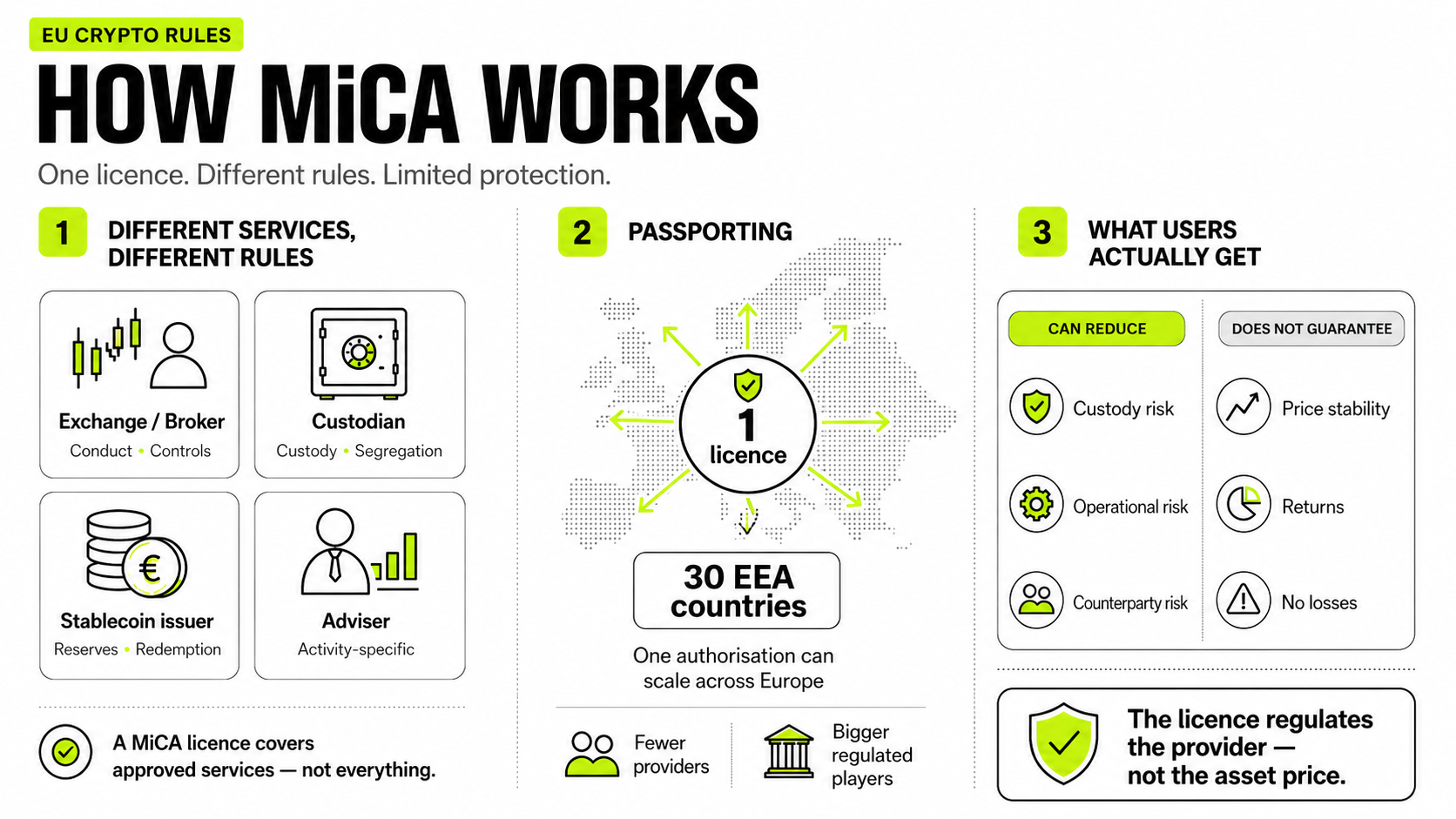
Europe entered a new phase of crypto regulation on July 1, 2026, when the final transitional period under the Markets in Crypto-Assets Regulation expired. Crypto-asset service providers operating under earlier national regimes had until this date to obtain MiCA authorisation or begin ending their EU activities.
The deadline has reduced the number of providers able to serve the region, strengthened the commercial value of an EU licence, and raised new questions about product access, passporting, and consistent enforcement across member states.
BeInCrypto interviewed Philipp Bohrn, vice president of group governance at Bitpanda, Mike Schwitalla, chief commercial officer at Crypto Finance Group, and Chagri Poyraz, chief strategy officer at OSL Group, about how MiCA is changing Europe’s crypto market.
MiCA is now changing which companies can reach European users, which assets appear on their platforms and how regulated providers describe the protection attached to their services.
Europe’s Crypto Market Splits Along Regulatory Lines
MiCA became fully applicable in December 2024, although existing companies could continue operating under national transitional arrangements. Those arrangements lasted until July 1, 2026 at the latest, or ended earlier when a company received or was refused authorisation.
European users may now need to confirm whether a familiar exchange, broker or custodian appears in ESMA’s register. Some providers have transferred clients to authorised European entities, while others have restricted account functions or withdrawn from the region.
Mike Schwitalla, chief commercial officer at Crypto Finance Group, described the deadline as the point at which the distinction between regulated and unauthorised providers became visible to users.
“Many retail investors may only now be realizing that some platforms they have used for years might not be authorized to continue operating in the European market,” Schwitalla said. “As a result, users are increasingly assessing the regulatory status of their providers and, in some cases, whether they need to migrate assets to licensed institutions.”
The decline in provider numbers may concentrate activity among companies able to meet the requirements and absorb customers leaving unauthorised platforms.
It could also strengthen relationships between licensed crypto companies and banks, asset managers or corporate counterparties whose internal policies require regulated service providers.
Philipp Bohrn, vice-president of group governance at Bitpanda, said the absence of authorisation after the extended preparation period gives users relevant information about a company’s regulatory standing.
“It is now becoming clearer which companies are authorised, supervised and accountable in Europe, and which are operating outside that framework,” Bohrn said.
Authorisation creates accountability around the provider, although it leaves the financial risks of crypto assets intact. European supervisory authorities continue to warn consumers that protections vary according to the product and service involved.

One Regulation Creates Different Tests Across the Industry
MiCA covers several types of crypto businesses, yet the obligations depend on the services each company provides.
Trading platforms and brokers face requirements involving governance, market conduct, client information, and operational controls.
Custodians must maintain custody policies and agreements with clients, while applicants holding customer assets must describe how those assets and funds will be segregated.
Stablecoin issuers operate under a separate set of requirements covering reserves, disclosures, redemption, and supervision. The European Banking Authority also assesses whether asset-referenced tokens and electronic money tokens qualify as significant, which can bring additional oversight.
Advisers, order executors and portfolio managers encounter obligations linked to their own activities. A single MiCA licence therefore represents authorisation for specified services rather than a universal approval covering every product offered by a company.
“A broker, an exchange, a custodian, a stablecoin issuer and an advisory provider do not all face the same obligations,” Bohrn said. “For established European players that have already invested in governance, compliance, custody standards and risk management, MiCA is demanding but also a natural next step.”
The difference is especially important for global companies accustomed to serving several European countries through national registrations or cross-border access. MiCA requires an authorised European entity with effective management and a genuine presence in an EU member state.
Banks encounter a different calculation. Rather than obtaining every technical and regulatory capability internally, they can work with authorised custodians, brokers and trading providers whose systems have already undergone supervisory review.
Schwitalla said this changes the point from which financial institutions can begin developing digital-asset products.
“A bank looking to offer digital asset services does not need to build every capability from scratch,” he said. “It can work with an already regulated and proven provider that has met the requirements of one of the world’s most comprehensive crypto regulatory frameworks.”
Passporting Rewards Licensed Firms as Product Choice Contracts
A MiCA authorisation obtained in one member state can be passported across the EU, allowing a provider to offer approved services without seeking a separate licence in every national market.
This arrangement gives licensed firms access to a large regional customer base through one authorisation process. It may also reduce the regulatory burden for banks and other institutions seeking partners across several European countries.
Chagri Poyraz, chief strategy officer at OSL Group, said the combination of passporting and a reduced pool of authorised competitors gives licensed firms a significant commercial advantage.
“A single authorization now passports across all 30 EEA countries, which means licensed firms get a genuinely borderless European market, stronger banking relationships, and enterprise counterparties who will only work with fully regulated entities,” Poyraz said.
Users may experience the same process as a reduction in access. Companies may withdraw from Europe rather than complete authorisation, while regulated platforms may remove assets or services that create additional compliance concerns.
Stablecoin markets have already shown how European rules can change product availability. Several exchanges restricted or removed trading pairs involving stablecoins whose issuers had yet to meet applicable MiCA requirements.
A July 2026 study found that MiCA-related delistings reduced USDT trading on exchanges with greater European exposure and increased USDC’s relative share on those venues.
Some lending, staking, and decentralised finance products remain outside MiCA or fall under other regulatory assessments. The licence held by a provider, therefore, cannot be treated as approval of every service displayed beside its regulated offering.
ESMA has warned about this “halo effect,” under which customers may assume products offered by an authorised company receive equivalent regulatory treatment.
A MiCA Licence Protects the Service, Not the Asset Price
The distinction between provider supervision and investment protection will become increasingly important as companies market their authorisations.
MiCA introduces standards covering governance, complaints, conflicts of interest, disclosures and custody. It also gives authorities powers to supervise providers and intervene where crypto products create significant investor-protection or market-integrity concerns.
These requirements can reduce operational and counterparty risks, although they cannot prevent token prices from falling, guarantee returns or place every crypto asset within a compensation scheme.
“MiCA authorisation is not a guarantee that prices will be stable, or that users cannot lose money,” Bohrn said. “It means the provider has met regulatory standards around how it operates.”
Companies will need to distinguish between regulated services, products governed by separate EU legislation and activities outside the current framework. The explanation becomes especially relevant when one application contains custody, spot trading, derivatives and lending products carrying different legal treatment.
Schwitalla said providers should describe compliance through the controls applied to the company rather than presenting authorisation as protection from investment losses.
“A regulated provider can reduce operational, custody and counterparty risks, but it cannot remove market risk,” he said. “The industry has a responsibility to avoid creating a false impression that regulatory approval is equivalent to a guarantee of returns or protection from losses.”
Enforcement Will Decide Whether MiCA Creates One European Market
MiCA’s common rules still depend largely on national authorities responsible for authorising and supervising providers.
This division has already raised concerns about differences in licensing standards. France’s markets regulator warned in May that companies operating without authorisation could face blacklisting or prosecution, while also questioning whether applications were receiving equivalent scrutiny across member states.
Passporting works effectively when regulators trust authorisations issued elsewhere in the bloc. Major differences in application reviews or ongoing supervision could recreate fragmentation through enforcement, even where the underlying law remains common.
“The most interesting issue is enforcement and passporting in practice,” Bohrn said. “If implementation becomes fragmented, Europe will have created a common rulebook without a truly common market.”
Enforcement will also reveal the difference between policies written during an application and controls operating under everyday market conditions. Transaction monitoring, governance and risk systems require continuous adjustment as companies add products and process higher volumes.
“A licence names the controls – it doesn’t prove they work,” Poyraz said. “Watching enforcement separate those two groups over the next few quarters will tell us far more about where this market is heading than any single new rule will.”
ESMA has begun building the mechanisms needed for this phase. Its central registers cover authorised providers, crypto-asset white papers and entities identified as non-compliant, while national authorities retain responsibility for most company-level supervision.
Future revisions commonly described as MiCA 2.0 may address areas such as decentralised finance, lending and other activities left partly outside the first regulation. The immediate concern remains the operation of the current framework across national borders.
MiCA has already reduced the number of companies able to serve European crypto users. Its longer-term impact will depend on whether passporting produces a genuine single market, whether supervision remains consistent and whether users understand the limits attached to regulatory authorisation.
Europe has completed the licensing stage. The conduct of authorised firms and the response to those operating outside the rules will now determine the quality of the market that remains.
The post MiCA is Turning Europe Into a Licensing Test for Every Type of Crypto Company appeared first on BeInCrypto.



Among others abandoning the treasury approach include Sequans Communications (SQNS), which sold 1,025 BTC before disposing of nearly 80% of its remaining holdings to repay convertible debt. It has ruled out further purchases and plans to monetize its remaining 658 BTC.
Nakamoto (NAKA), whose shares have fallen 99% since its May 2025 SPAC deal, sold around 284 BTC to raise $20 million for working capital following its acquisitions of BTC Inc. and UTXO Management. It sold roughly 40 BTC received through its derivatives program, according to VanEck’s Sigel. Almost 70% of its remaining 5,342 BTC were pledged against a Kraken loan maturing in December, creating what Sigel described as a potential binary event.
It’s not only specialist treasury companies that are reducing their holdings of the largest cryptocurrency. Crypto miners including Bitdeer and MARA Holdings are selling bitcoin to repurchase or repay debt and repurpose their energy-supply deals and computing resources to power AI data centers.
Other sellers include Empery Digital, which has reportedly sold almost half its bitcoin to finance buybacks and debt repayment, and Strategy, which has sold about 3,620 BTC in recent weeks and authorized additional sales to support its U.S. dollar reserves.
Strategy, which started the investment trend, remains the largest publicly listed holder of bitcoin, with more than 840,000 BTC. CEO Michael Sayler remains bullish.


The Council of the European Union has sanctioned Justin Sun-owned HTX and Huobi Global S.A in a move that it hopes will “further cripple Russia’s economy and war machine.”
HTX and Huobi are now officially on the EU’s “list of credit and financial institutions and entities providing crypto-assets services or payment services established outside of the Union that are significantly frustrating the purpose of the prohibitions in this Decision, Decision 2014/145/CFSP, Regulation (EU) No 833/2014 and Regulation (EU) No 269/2014.”
One of the payment networks being targeted is the A7 Network, which is behind the A7A5 stablecoin.
Read more: UK sanctions HTX for alleged Russian sanctions violations
The sanctions targeting HTX follow the United Kingdom Foreign, Commonwealth, and Development Office sanctions against Huobi Global S.A., which claimed that it was providing financial services to Russia, including interacting with the A7 Network.
At the time, HTX tried to claim that “the listed entity Huobi Global S. A. is distinct from the online HTX exchange.”
However, a Protos review determined that Huobi Global S.A. was the owner of the HTX trademark in the United States and had described itself in court filings as the firm that “owns and operates HTX.”
Furthermore, these European Union sanctions explicitly list HTX alongside Huobi Global SA.
HTX moves its reserves and wallets
Following this, HTX disclosed that it had moved over $1 billion worth of its reserves to an undisclosed custodian.
HTX says on its proof of reserves page that in order to verify these quantities, we should “please directly contact the third-party custodians.”
However, HTX hasn’t responded to requests from Protos for the identity of that custodian.
More recently, blockchain intelligence firm TRM Labs has claimed that HTX has been rapidly churning through wallets.
This means that other cryptocurrency entities that want to prevent transactions from the sanctioned HTX are struggling as their list of HTX-related addresses ends up out of date.
Ari Redbord, global head of policy at TRM Labs, described the behavior as “HTX changing its wallets every few hours to stay a step ahead of screening built on static lists.”
HTX told The Block that these practices “reflect routine, security-driven platform operations common across the industry.” It adds that it “categorically rejects any characterization implying otherwise.”
These additional sanctions are likely to complicate HTX’s business.
Protos reached out to HTX for comment, but it didn’t respond before publication.
Got a tip? Send us an email securely via Protos Leaks. For more informed news and investigations, follow us on X, Bluesky, and Google News, or subscribe to our YouTube channel.


A US police union representing more than 382,000 members has reversed its position and endorsed the latest CLARITY Act after lawmakers added language addressing its concerns about cryptocurrency investigations.
Summary
- The National Fraternal Order of Police has reversed course and endorsed the latest CLARITY Act.
- The union says revised provisions preserve law enforcement powers to investigate crimes involving digital assets.
- Senate delays and election-year disputes have pushed Polymarket’s 2026 passage odds down to 33%.
According to former Fox Business reporter Eleanor Terrett, the National Fraternal Order of Police now supports the bill after reviewing provisions tied to the Blockchain Regulatory Certainty Act. The union believes the language protects the ability of police and prosecutors to pursue crimes involving digital assets.
In a July 24 letter to Senate Banking Committee Chairman Tim Scott and ranking member Elizabeth Warren, FOP National President Patrick Yoes backed the latest version of H.R. 3633, formally known as the Digital Asset Market Clarity Act.
Yoes wrote that revised Section 10604, which amends the BRCA, does not restrict law enforcement agencies or prosecutors from addressing illegal conduct involving cryptocurrencies. According to the letter, the clarification directly answers concerns the union raised during earlier negotiations over the legislation.
Terrett, however, reported that the BRCA provisions remained unchanged in the latest bill released Wednesday. She noted that it was unclear which changes the FOP was referring to when it announced its support.
The apparent inconsistency leaves open whether the union assessed language added at an earlier stage, received separate assurances from lawmakers, or interpreted an existing provision differently. Neither the FOP letter nor Terrett’s report identified a specific newly amended passage beyond Section 10604.
Revised provisions preserve crypto enforcement powers
Explaining its reversal, the FOP cited several sections that it believes will help federal, state and local agencies investigate financial crimes involving digital assets. The union said investigators need clear authority and practical tools as they confront fraud, organized crime and illicit finance conducted through crypto networks.
Among those provisions, the legislation would create safeguards addressing fraud linked to digital asset kiosks. According to the FOP, the measure also applies anti-money laundering and sanctions compliance duties across parts of the crypto industry.
The letter pointed to rules intended to help investigators act before suspected criminal funds leave their reach. Those provisions would protect digital asset companies and stablecoin issuers from liability when they voluntarily delay suspicious transactions or respond to a law enforcement request.
Given how quickly cryptocurrencies can cross jurisdictions, the FOP argued that temporary transaction holds could give investigators time to prevent losses, recover stolen assets and disrupt illegal activity. The union presented those protections as an important tool for cases in which funds might otherwise disappear before officers can intervene.
Bank Secrecy Act provisions also contributed to the union’s support. According to the letter, the revised bill updates the treatment of digital assets under rules governing monetary instruments, helping existing reporting and enforcement requirements apply more clearly to crypto activity.
Other sections direct government agencies to share information and coordinate their responses to illicit finance risks. The FOP added that the bill would strengthen international cooperation on anti-money laundering enforcement and sanctions involving digital assets.
Under Title IX, the legislation would establish a grant program for state and local digital asset enforcement work. The FOP said it would also create a national security and law enforcement training program, form a digital asset cyber innovation center and introduce measures designed to protect older consumers from deception.
Addressing protections for software developers, the union said the bill would not prevent authorities from investigating crimes, prosecuting offenders or applying existing criminal laws. Its letter specifically cited 18 U.S.C. § 1960, a federal statute covering certain unlicensed money-transmitting activity.
The FOP also pointed to language preserving liability for people who knowingly transfer funds tied to criminal offenses or promote unlawful activity. According to the union, this distinction gives responsible developers legal certainty without shielding individuals who intentionally assist illegal transactions.
Senate delay pushes CLARITY Act beyond the August recess
The endorsement has arrived as the CLARITY Act faces a shrinking congressional timetable. As crypto.news reported earlier on July 24, Senate Majority Leader John Thune does not expect the Senate to approve the market structure legislation before lawmakers leave Washington for the August recess.
Thune’s position removes a deadline that crypto industry supporters had treated as important for completing the bill in 2026. Following the development, Polymarket traders lowered the probability of the legislation becoming law this year to 33%.
Attention has therefore moved to the session after the November midterm elections. During that period, lawmakers will return to government funding measures, defense legislation and other unfinished bills that will also compete for limited Senate floor time.
According to Wintermute head of policy and advocacy Ron Hammond, the CLARITY Act still has enough bipartisan backing to pass but has become trapped in election-year disputes. Hammond attributed the immediate obstacle to political messaging rather than a shortage of votes in the Senate.
With Democrats preparing to campaign against President Donald Trump and alleged corruption, Hammond expects some lawmakers to avoid backing a major cryptocurrency bill before the election. His assessment suggests the FOP endorsement may resolve one law enforcement dispute without removing the political barriers delaying a Senate vote.
In its letter, the FOP described the latest provisions as a meaningful effort to provide stronger investigative tools, clearer compliance paths and better coordination between agencies. The union said its initial concerns had been satisfactorily addressed and offered to work with lawmakers to secure passage of the amended bill.

Leading economist Peter Schiff has warned that rising oil prices could drive July CPI numbers higher after a drop in the June CPI, which was largely due to oil declining by 30%.
Oil prices have risen sharply after renewed US-Iran hostilities, Houthi attacks on Saudi-linked tankers, and fresh oil supply concerns.
Peter Schiff Flags Inflation Concerns Ahead Of Fed Meeting
Schiff’s warning comes amid renewed US-Iran tensions and supply chain concerns after Iran imposed a blockade on the Strait of Hormuz and the Bab el-Mandeb Strait. The economist noted that June CPI numbers were lower due to a substantial drop in crude prices. However, the recent increase in prices could undermine June’s progress and drive inflation higher in July.
Schiff stated in a post on X,
“Investors celebrated the June CPI, as a 30% fall in the price of oil led to a larger-than-expected decline. But so far in July, the price of oil is already up 30%, back above $90 per barrel.”
Schiff said that if prices went back above $100, it would mark a 43% increase from recent lows, and would adversely impact July CPI numbers. Brent crossed the $100 mark hours after the warning of Houthi-led attacks on Saudi oil tankers.
“If the price hits $100 by month-end, that will be a 43% rise. July CPI could be a doozy.”
Schiff argued that June’s lower CPI numbers were due to lower oil prices, and higher prices in July could completely reverse progress and drive inflation higher.
“No, it’s just that the only reason June CPI fell so much was the 30% drop in oil. That will likely be completely reversed by an even bigger rise in the price of oil in July.”
Oil Prices Could Push July Inflation Numbers Higher
US Bureau of Labor Statistics data showed a 0.4% decline in headline CPI, as against the expected 0.1% decline. Meanwhile, annual inflation fell from 4.2% to 3.5%, below the expected 3.8%. The decline was primarily attributed to declining energy prices.
US Bureau of Labor Statistics data show the energy index declined 5.7% in June, its largest decline since April 2020, when gasoline prices fell by nearly 10%. Meanwhile, Core CPI remained unchanged, but was 2.6% higher than last year.
However, energy prices are 15.7% higher than last year, while gasoline prices are up 26.7% over the same period. This could push household expenses even higher if oil prices remain high for the rest of the month.
Renewed Geopolitical Headwinds
Oil prices have spiked after another flare-up in the Middle East following an attack on Saudi oil tankers. Iran has also blockaded the Bab el-Mandeb Strait through the Houthis, a route Saudi exporters rely heavily on since the restrictions in the Strait of Hormuz. Reuters has reported a drastic decline in Iranian oil exports, which fell from 2 million barrels per day to nearly zero during the ongoing conflict. Goldman Sachs analysts also issued a dire warning, telling Reuters Brent could cross $120 if the ongoing disruptions continue.
Diplomatic efforts have also stalled, with US Secretary of State Marco Rubio accusing Iran of being unwilling to negotiate while maintaining Washington remained committed to negotiations. US and Iranian military activity also increases the risk of damaging crucial oil infrastructure.
Fed Meeting Takes Center Stage
Focus now shifts to the Federal Open Market Committee (FOMC) meeting, scheduled for July 28 and 29. Rising oil prices could influence the Federal Reserve’s decision on interest rates. Policymakers believe one report is not sufficient to establish a downward trend.
Governor Chris Waller had said after the June report that the Fed needed to see several months of softer data before it could establish that inflation was moving towards its 2% target. Analysts expect the Fed to maintain its target range at 3.50%-3.75%.
Disclaimer: This article is provided for informational purposes only. It is not offered or intended to be used as legal, tax, investment, financial, or other advice.

Senate Democrats are mounting a fresh push to rewrite the CLARITY Act’s ethics provisions after dismissing the White House-backed proposal unveiled by GOP senators, according to Politico.
Senator Ruben Gallego blasted the latest draft and said that the proposal Republicans sent back was “not a serious effort” despite months of bipartisan negotiations.
Dispute Deepens in Senate
At the center of the dispute is how to prevent President Donald Trump from profiting from digital assets. Democrats insist they cannot support ethics rules that are enforceable only by the Department of Justice. Negotiations involving Gallego, Senators Cynthia Lummis and Bernie Moreno, and the White House ultimately collapsed over whether state attorneys general should also have authority to enforce the provisions.
In an interview on Thursday, Gallego said,
“I can’t imagine that that’s a serious effort – after all the work that we’ve done with our Republican colleagues, that they would take the months and months of work and somehow interpret that and turn around and think what they offered was even remotely close.”
Gallego added that he is now working with Senator Thom Tillis and other unnamed Republicans on a counterproposal, while insisting, “We are still in this fight.”
Lummis defended the proposal while Tillis said the White House-approved language was “good,” but acknowledged that further changes may be necessary to secure the 60 votes needed to advance the legislation. Tillis added that another round of discussions with the White House is expected to determine whether additional revisions would be “acceptable” to the president.
The disagreement has also put the bill’s timeline in doubt. Senate Majority Leader John Thune said that he no longer expects the Senate to pass either the CLARITY Act before lawmakers leave for the August recess.
Hopes that the CLARITY Act could provide the US crypto industry with long-awaited regulatory clarity have been one of the factors supporting bullish expectations for the market this year. However, prediction market odds of the bill’s passage declined amid disagreements over ethics provisions and other issues that have slowed negotiations.
Middle Ground
Coinbase CEO Brian Armstrong recently warned that parts of the company’s business could move overseas if the US fails to pass clear crypto legislation. While Coinbase wants to keep most of its operations in the country, the exec said regulatory clarity is needed to prevent capital, businesses and users from shifting offshore.
Amid the ongoing standoff, crypto commentator Crypto Sensei recently proposed a compromise to break the deadlock. In a recent post on X, he suggested keeping the DOJ as the primary enforcer while imposing statutory deadlines for investigations, creating an independent ethics review body to oversee DOJ decisions, and allowing state attorneys general to intervene only under limited conditions if the DOJ fails to act.
He also called for annual disclosures detailing ethics complaints, investigations, and enforcement actions for greater transparency.
The post Dem Senator Slams GOP’s CLARITY Ethics Proposal as ‘Not a Serious Effort’: Report appeared first on CryptoPotato.
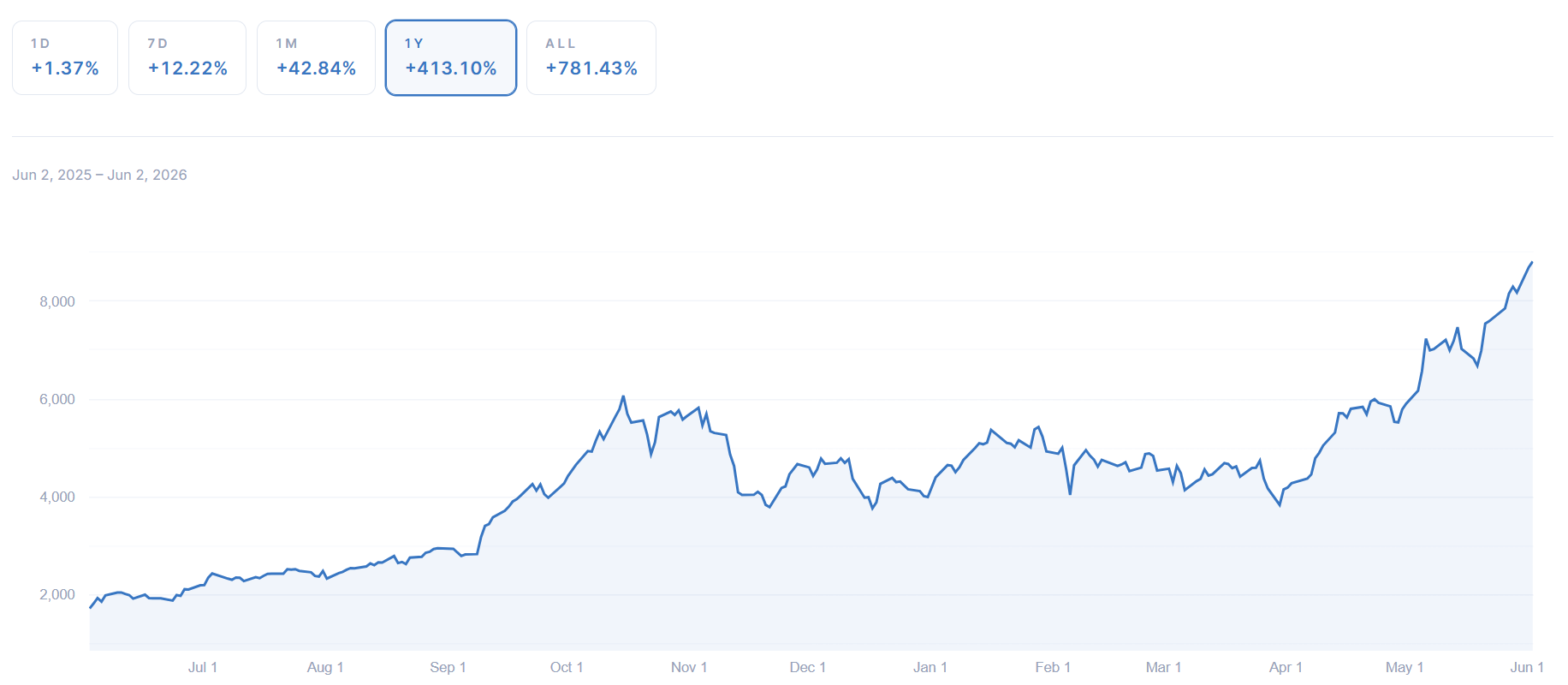
Crypto markets showed renewed signs of life this week as institutional investors fueled the longest streak of inflows into US spot Bitcoin exchange-traded funds (ETFs) since April and crypto-linked stocks rallied on optimism over US regulation. But the more intriguing story may be unfolding outside crypto: AI’s grip on speculative capital is beginning to loosen.
After dominating markets for nearly two years, the AI trade is becoming more selective as investors distinguish between companies with sustainable earnings and those riding the hype cycle. The Philadelphia Semiconductor Index, or SOX, recently slipped into a technical bear market after falling 20% from its recent high, although it remains well above year-ago levels.
Some analysts believe the shift could mark the beginning of a broader rotation back into digital assets. While it’s too early to call a lasting trend, improving regulatory clarity, a recovery in ETF demand, and easing enthusiasm for AI are creating a more constructive backdrop for crypto than investors have seen in months.
Bitcoin ETFs post six-day inflow streak as market sentiment improves
US spot Bitcoin ETFs extended their inflow streak to six consecutive trading days, attracting $203.1 million in fresh capital as institutional demand showed tentative signs of recovery.
The latest inflows brought the six-day total to roughly $930 million, marking the funds’ longest winning streak since April as Bitcoin briefly climbed above $67,000. The renewed demand coincided with improving market sentiment, with the Crypto Fear & Greed Index recovering from “extreme fear” to “fear.”
Since launching in January 2024, US spot Bitcoin ETFs have attracted $51.8 billion in cumulative net inflows and now hold $80.9 billion in net assets, although they remain down $4.84 billion on a year-to-date net flow basis. Analysts said Bitcoin needs to hold above the $65,000-$65,500 range to strengthen the case for a sustained bullish breakout.
Crypto rally gains momentum as AI trade shows signs of cooling
The rally in Bitcoin and broader digital asset markets coincided with progress on US crypto legislation and a cooling AI trade, fueling expectations that capital may be rotating back into crypto.
The broader crypto market rallied alongside crypto-related stocks, with Coinbase, American Bitcoin and Cipher Digital posting double-digit percentage gains. Sentiment brightened after US Treasury Secretary Scott Bessent said lawmakers were at the “1-yard line” on the CLARITY Act, legislation that would establish a regulatory framework for digital assets.
Analysts also pointed to fading momentum in AI equities as another potential catalyst. FRNT Financial CEO Stephane Ouellette said that slowing enthusiasm for AI stocks and growing confidence in the interest-rate outlook could support a breakout in Bitcoin. The SOX Index, a benchmark for AI chipmakers, had recently fallen more than 20% from its recent high after concerns over elevated valuations and AI infrastructure spending.
AI infrastructure deals drive rally in Bitcoin mining stocks
Bitcoin mining stocks surged after Hut 8 and IREN unveiled multibillion-dollar AI infrastructure agreements, reinforcing the sector’s lucrative shift toward data centers and cloud computing as digital asset markets continued to struggle.
Hut 8, IREN, Cipher Digital, CleanSpark and MARA Holdings each gained after Hut 8 announced a 15-year, $9.8 billion lease for its AI data center campus and IREN disclosed $2.8 billion in cloud services contracts with AI developers. The deals underscore how miners are diversifying beyond Bitcoin production as mining economics become more challenging, with IREN now projecting more than $4 billion in annual recurring AI cloud revenue by the end of 2026.
While investors have rewarded the AI pivot, analysts say it also raises new questions around execution and funding. Blocksbridge Consulting estimates the sector will require roughly $50 billion in additional capital to achieve its AI ambitions, even as insider stock sales have drawn increased scrutiny.
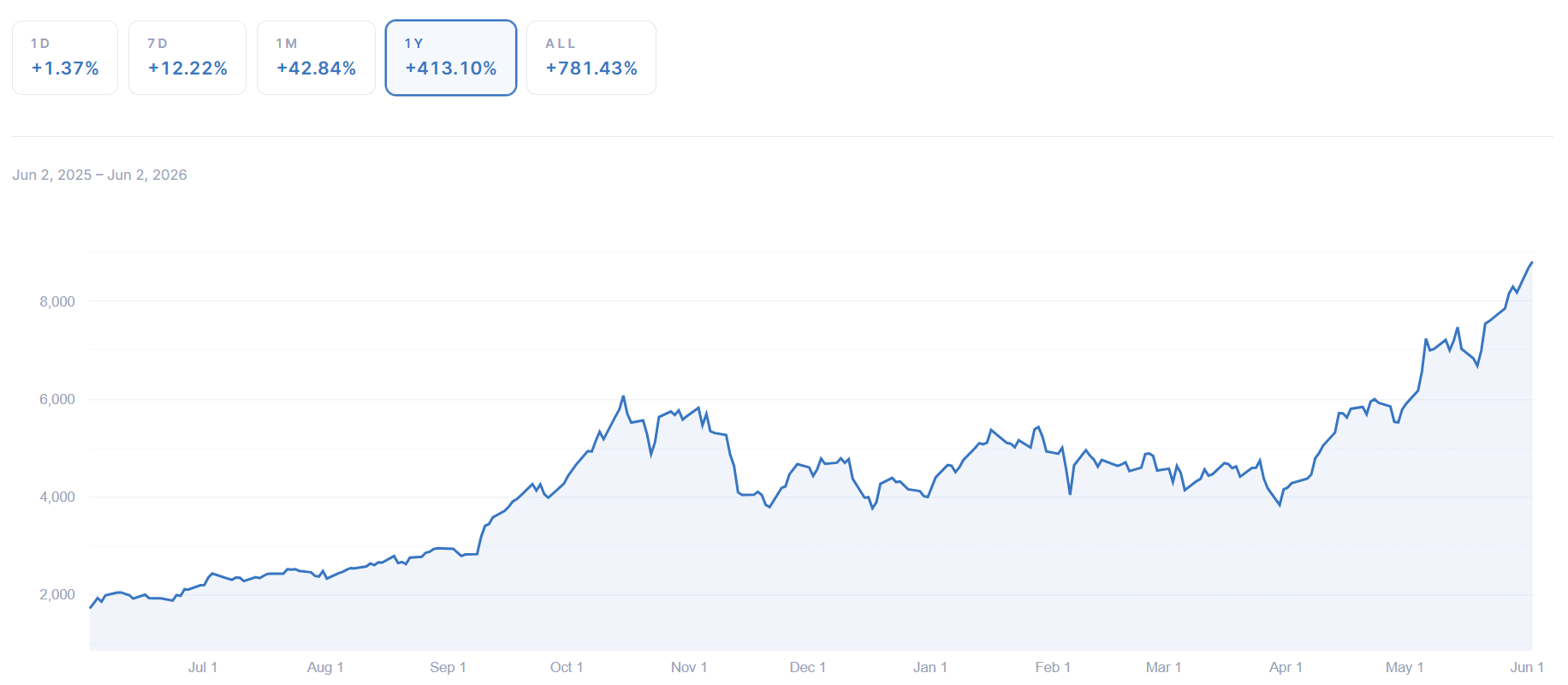
The TEM AI Infrastructure Growth Index. Source: The Energy Mag
Bernstein sees tokenization, prediction markets driving Robinhood’s next growth phase
Bernstein raised its price target on Robinhood, arguing the brokerage’s long-term growth will be fueled by tokenized assets and prediction markets rather than traditional crypto trading.
The investment firm increased its price target on Robinhood shares to $160 from $130 while maintaining an Outperform rating. Analysts forecast prediction markets will become the company’s fastest-growing business, generating $1.7 billion in revenue by 2028. Bernstein also identified tokenized equities as a major growth opportunity, citing Robinhood’s Arbitrum-based layer-2 network as key infrastructure for bringing real-world assets onchain.
The bullish outlook comes as Wall Street accelerates its tokenization push, with companies such as Broadridge, Alpaca, Securitize and Cantor Fitzgerald expanding blockchain-based securities infrastructure.
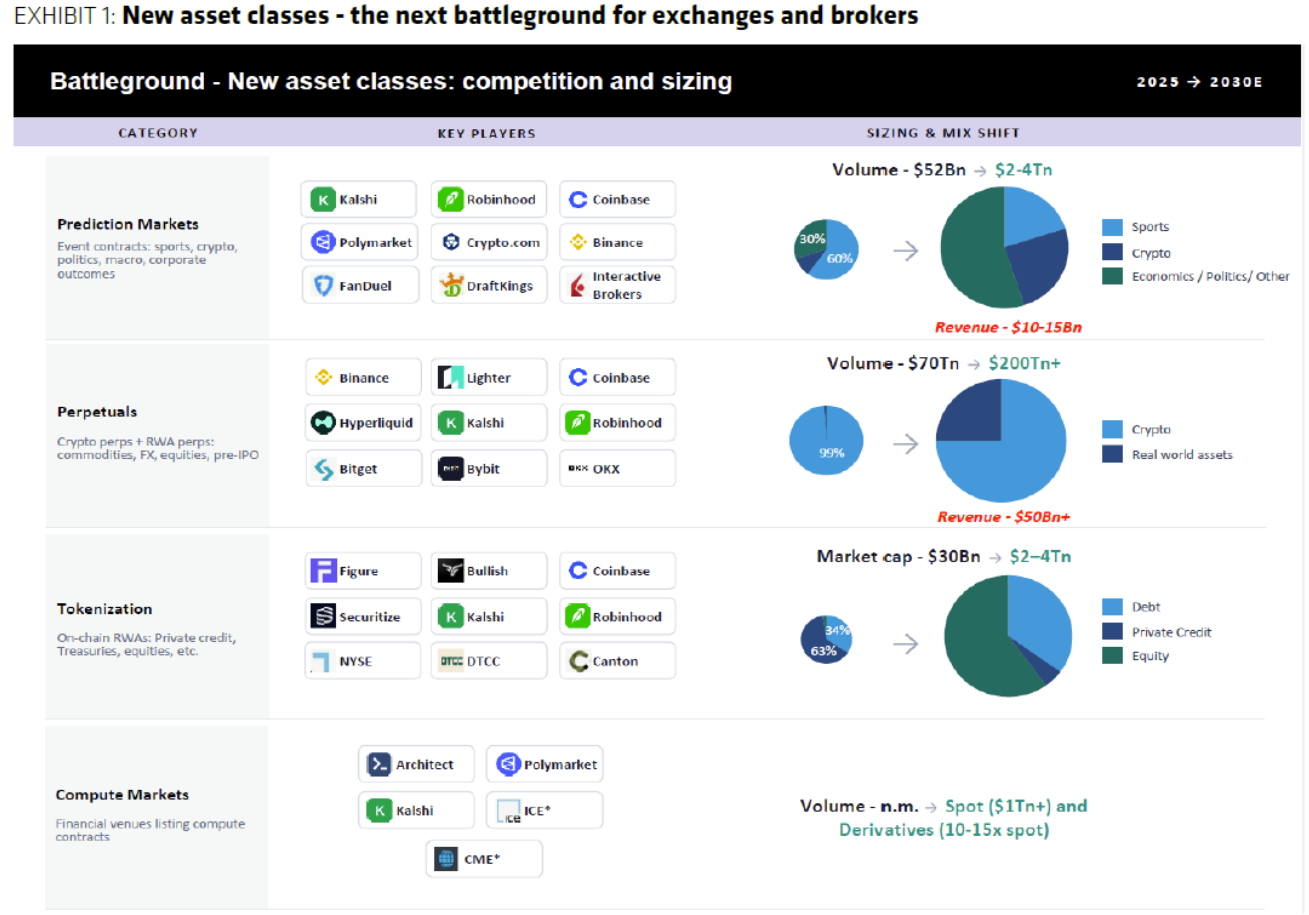
Bernstein identified prediction markets, perpetual futures and tokenized equities as key competitive battlegrounds for Robinhood. Source: Bernstein
Crypto Biz is your weekly pulse on the business behind blockchain and crypto, delivered directly to your inbox every Thursday.
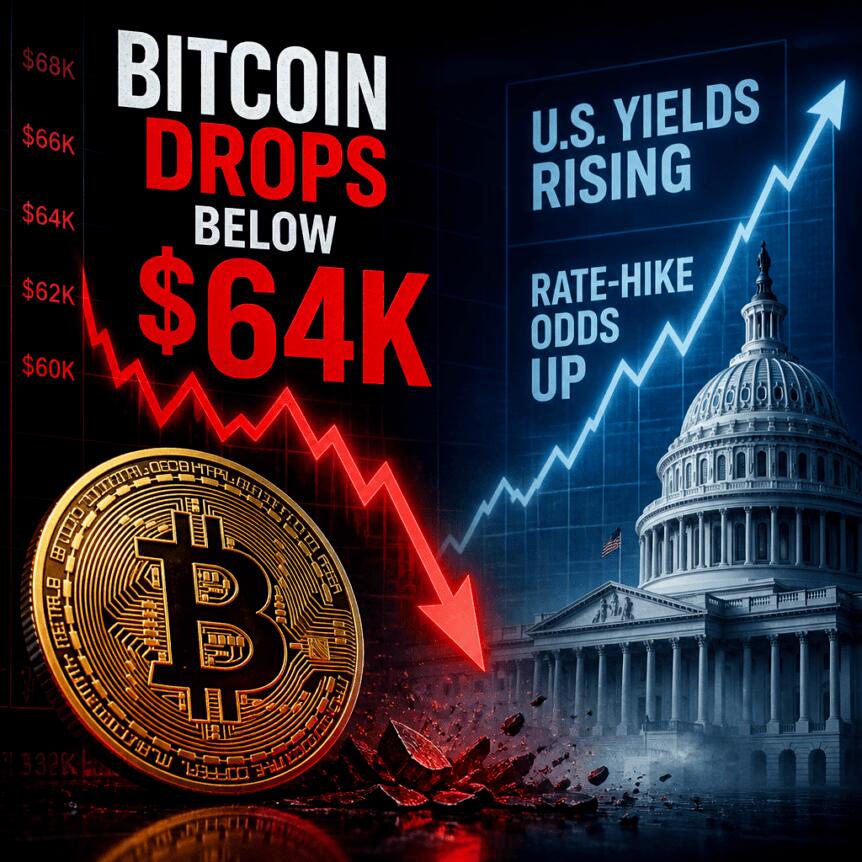
Bitcoin slipped more than 1.6% on Friday, with selling pressure strengthening soon after Wall Street opened. The move came as traders grew more cautious toward risk assets amid renewed pressure from US bond yields and shifting expectations for Federal Reserve policy.
According to TradingView data cited in market commentary, BTC/USD pushed toward the $64,000 area as bulls struggled to defend earlier gains. The pullback highlights how closely crypto trading has continued to track traditional macro signals—especially rates.
Key takeaways
- BTC weakened quickly after the US market open, with price action approaching the $64,000 level.
- US Treasury yields rose enough to reinforce a more hawkish Fed outlook, which weighed on risk sentiment.
- Market monitoring pointed to concentrated buy-side liquidity on Binance that some traders believe may help stabilize short-term dips.
- CME FedWatch pricing still leaned toward no change at the next meeting, while September hikes remained a key debate.
- Several analysts framed the current pattern as a repeat of past market behavior, including 2022-style rejections near key moving averages.
Yields stay elevated, pushing rate expectations higher
Geopolitical tensions and broader macro headwinds were cited as factors damping appetite for risk. A report from Mosaic Asset Company highlighted that rising Treasury yields were a principal driver behind the sell-off.
Mosaic linked the moves to volatility across the yield curve, describing ongoing “massive moves” even after the latest US consumer inflation reading came in weaker than expected. In its framing, the short end of the curve—particularly the two-year yield—has outsized influence on expectations for where the Fed’s policy rate may go next.
Specifically, Mosaic said the two-year yield sits at 4.31% and remains “well above” the Federal Reserve’s target range, adding downward pressure to risk assets as traders adjusted expectations toward additional hikes.
To gauge how the market was positioning, the report referenced the CME Group FedWatch Tool. That data showed expectations that the Fed would hold rates unchanged at the next scheduled decision, while markets continued to price a 0.25% hike in September—one of two increases expected before the end of 2026.
Mosaic further argued that these rate probabilities were contributing to weakness beyond crypto, noting they were “placing downward pressure on stock indexes.” For traders, the practical takeaway is that BTC’s near-term trading range may remain highly sensitive to continued yield spikes and any incremental repricing of Fed probabilities.
Traders watch $64,000 as structure test intensifies
On the crypto side, short-term technical monitoring focused on how BTC would behave as it approached the $64,000 zone. One recurring theme in trader commentary is that liquidity placed below spot prices can sometimes blunt sell-offs—at least temporarily.
Crypto trader Killa described what they called a “textbook setup,” saying BTC was repeating a pattern they have observed multiple times. In an earlier post from early June, Killa had referred to a “plunge protection team” active on Binance, suggesting that layered bid liquidity could absorb downside if triggered.
That same idea resurfaced in current monitoring: Killa pointed to an order-book view showing multiple levels of liquidity below the prevailing price. The implication, as Killa presented it, is that the holders behind those bids may not necessarily be seeking immediate fills—meaning the market could see stability during the initial leg of a drawdown, even if longer-term trend signals remain uncertain.
Another analytics account, Wealthmanager, emphasized the importance of the $64,000 area as a structural checkpoint. In its warning, the account stated that a break below $64,000 would “invalidate” the low-timeframe market structure. For active traders, this frames the current move not just as volatility, but as a test of whether the market can hold a near-term support regime.
Rejection theory returns: 2022 behavior vs. moving-average tests
Separate from the liquidity-focused view, analyst Rekt Capital reinforced a longer-pattern interpretation. The trader argued that BTC/USD was repeating tendencies seen during its 2022 bear market, pointing to behavior around the 50-month exponential moving average (EMA).
Rekt Capital said BTC has shown “no evidence” contradicting that thesis, summarizing that the asset still appears to follow historical patterns. In the cited analysis, the reference area included a 50-month EMA level near $65,950, where BTC has recently faced rejections.
While this does not automatically predict immediate direction, it does matter for how traders may set expectations: if BTC continues to reject around the same macro-relevant moving average, rallies may struggle to sustain, and any breakdown toward lower support levels could occur faster than bulls anticipate.
What to watch next as macro and crypto narratives compete
The current drawdown sits at the intersection of macro rate expectations and crypto-specific market microstructure. On one hand, bond yields have been acting as a direct sentiment driver, with Mosaic’s assessment pointing to the two-year yield as a key variable shaping expectations for Fed actions. On the other hand, trader observations about Binance order-book liquidity suggest there may be pockets of demand ready to cushion deeper drops.
Going forward, traders should watch whether BTC can reclaim and hold levels around the mid-$60,000s—especially the area referenced by moving-average analysis—or whether the market breaks through the $64,000 structure threshold. In parallel, any renewed shift in CME FedWatch probabilities, alongside further changes in the two-year Treasury yield, could quickly determine whether Friday’s sell-off becomes a broader risk-off move or fades into consolidation.


India’s Internet Freedom Foundation (IFF) has condemned a government order directing GitHub to remove repositories for Jack Dorsey’s decentralized messaging app BitChat, calling the move unconstitutional and warning it threatens free speech and open-source software.
The statement came a day after India’s cybercrime agency ordered GitHub to disable access to three BitChat repositories within three hours, saying the decentralized messaging app could be used to bypass internet shutdowns, evade lawful surveillance and facilitate unlawful activities.
In its statement posted on X on Friday, IFF argued the order exceeded the government’s legal authority because it was issued under Section 79(3)(b) of India’s Information Technology Act instead of the country’s formal website-blocking process, which includes procedural safeguards. The group called on the government to withdraw the notice and publish all takedown orders issued under the provision.
The organization also disputed the government’s justification, noting the order did not identify any unlawful content in the repositories and instead argued the app’s decentralized design, which enables communication over Bluetooth without internet access or centralized servers, was itself grounds for removal.
BitChat is a decentralized messaging app that routes encrypted messages between nearby devices over Bluetooth without relying on internet connectivity or centralized servers.
Since its release in July 2025, the app has gained traction during protests, natural disasters and internet shutdowns, with downloads and adoption surging during periods of unrest and internet outages in countries including Madagascar, Nepal, Uganda, Jamaica and Iran.
Magazine: A quantum roadmap would push Bitcoin much higher: Charles Edwards

In this video, we’ll explore the key economic events and market trends, shaping the financial landscape. Get ready for insights into financial markets to help you navigate the week ahead. Let’s dive in!
In this episode of Market Insights, Gary Thomson unpacks the strategic implications of the most critical events driving global markets.
👉 Key topics covered in this episode:
✔️Fed Interest Rate Decision — 29 July, 09:00 PM GMT+3
The Federal Reserve is widely expected to leave interest rates unchanged. Investors will be watching Kevin Warsh’s comments for fresh clues on inflation, the labour market and the outlook for monetary policy. Could the Fed’s guidance have a greater impact than the rate decision itself?
✔️Bank of England Interest Rate Decision — 30 July, 02:00 PM GMT+3
Markets also expect the Bank of England to keep rates on hold. With inflation easing but oil prices creating fresh uncertainty, markets will focus on the MPC’s voting split and any signals about future interest rate decisions.
✔️US PCE Price Index — 30 July, 03:30 PM GMT+3
The Fed’s preferred inflation gauge could reshape expectations for interest rates, despite being released after the Fed meeting. Will inflation continue to cool, or could an upside surprise revive expectations of tighter monetary policy?
✔️Microsoft, Meta, Apple & Amazon Earnings
Big Tech earnings will test whether record AI spending is beginning to translate into stronger business performance. Investors will be looking beyond headline results for signs that AI investments are delivering measurable returns.
The combination of central bank decisions, inflation data and Big Tech earnings could drive significant moves across currencies, equity indices and technology stocks as markets head into August.
In this environment, traders closely monitor incoming data, being flexible and getting ready for short-term volatility.
Gain insights to strengthen your trading knowledge.
💬 Don’t forget to like, comment, and subscribe for more market insights every week.
Watch it now and stay updated with FXOpen.
This article represents the opinion of the Companies operating under the FXOpen brand only. It is not to be construed as an offer, solicitation, or recommendation with respect to products and services provided by the Companies operating under the FXOpen brand, nor is it to be considered financial advice.


Farmers in Parana, Brazil, struggling to get banks to loan them cash, became the first to tokenize livestock and place 10 dairy milk cows’ tokens for trade on the country’s B3 national stock exchange. They generated nearly $20,000 in credit backed by their cattle, signaling the potential of tokenizing RWAs as a financing tool.
The dairy cow tokenization in Brazil is a world first and serves as a test in a real-world scenario in which farmers are facing increasingly stringent lending limits imposed by local banks on small agricultural businesses.
“We take the cow, which is a real and tangible asset, and transform it into a digital asset backed by a unique code monitored in real time,” Thiago Martins of Cowmed, a Brazilian Agtec company, told CNNBrasil recently.
Martins and his company did not immediately respond to a CoinDesk request for comment.
“This digitization allows for formal registration with B3 as a movable asset,” Martins added. “The process is simple and gives the producer an advantageous opportunity to finance themselves, opening a new alternative for collateral at a time of strong credit restrictions in agribusiness.”

Brave Lissie Harper has shamed Andy Burnham into a U-turn. If he wants to avoid proving himself utterly hopeless already, this is what he must now do: AMANDA PLATELL

10 Reasons Behind His Surprising Decision to Join Philadelphia’s Sixers

Bitcoin treasury companies unwind holdings as the DAT model comes under pressure


-

 Fashion7 days ago
Weekend Open Thread – Corporette.com
-

 Politics6 days ago
The House | The City of London can help the new chancellor deliver growth in every postcode
-

 Crypto World6 days ago
Ripple Payments Joins MiCA With 14 Firms, Does It Mean Anything For XRP?
-

 Politics5 days ago
Democrats look to World Cup watch parties to register thousands of voters
-

 Crypto World7 days ago
Ripple wins EU-wide access as ESMA adds it to MiCA register
-

 Crypto World3 days ago
Grayscale Files For Worldcoin ETF, WLD Registers Sharp Rise
-

 Tech4 days ago
Sail Virtually Aboard The “Itanic” With IA-64 Emulator
-

 NewsBeat4 days ago
Unregistered fitter used Gas Safe logo on business flyers
-
 Tech4 days ago
Turtle Beach Command Series KB7 review: a nifty screen-equipped gaming keyboard
-

 News Videos5 days ago
Big Money Is Entering XRP
-
 Business3 days ago
New Jersey voter registration controversy explained: How 6,600 noncitizens got on the rolls, and what happens next
-

 Crypto World6 days ago
Kaspersky exposes OkoBot’s 20-module crypto wallet attack
-

 Business7 days ago
Airlines warn Sunshine Protection Act could disrupt flight scheduling
-
 Entertainment3 days ago
Johnny Depp’s R-Rated Gothic Cult Classic Gets New Release Ahead of Sydney Sweeney Remake
-

 NewsBeat7 days ago
Durham County Council to send out electoral registration emails
-

 Crypto World7 days ago
MiCA Licensing Faces Delays as ESMA Adds 14 CASPs to Register
-

 Crypto World2 days ago
Ethics, other provisions in crypto Clarity Act to be further discussed
-
 NewsBeat4 days ago
Shanghai science forum photos show China’s AI and robotics advances in rivalry with US
-

 Crypto World6 days ago
Chip Stocks Enter Bear Market After Moonshot Ai Unveils Kimi K3 Model
-

 Tech4 days ago
Watch Flock Safety CEO Garrett Langley discuss the future of surveillance at TechCrunch Disrupt 2026
You must be logged in to post a comment Login