
Crypto World
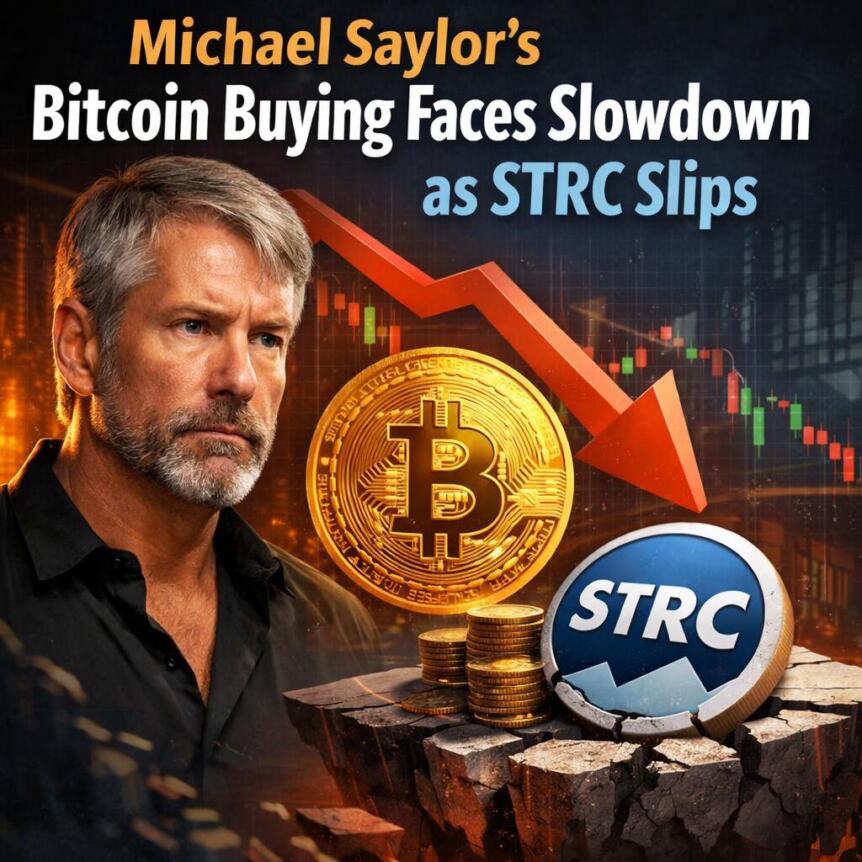
Michael Saylor’s Bitcoin Buying Faces Slowdown as STRC Slips

STRC Pricing Pressure Impacts Funding Mechanism
Strategy’s preferred stock STRC continues to trade below its $100 par value across recent sessions. The stock recorded modest movement while remaining under the benchmark level required for efficient issuance. This pricing trend directly affects the company’s ability to raise capital through its at-the-market programme.
The structure of STRC depends on maintaining prices close to its face value for optimal performance. When the stock trades below par, the company must adjust dividend yields to attract demand. Consequently, this reduces efficiency in raising funds for Bitcoin purchases.
Recent trading activity shows reduced volume compared to typical levels, which adds further pressure on liquidity. The stock also moved ex-dividend recently, influencing yield adjustments and pricing behaviour. These combined factors create limitations for sustained capital generation.
Bitcoin Acquisition Strategy Faces Near-Term Constraint
The funding model plays a central role in supporting Strategy’s aggressive Bitcoin acquisition plan. The company relies on proceeds from stock issuance to finance large-scale purchases. Therefore, weaker STRC pricing conditions directly limit buying capacity.
If the discount persists, Strategy may need to offer higher yields to stabilise demand for its preferred shares. This approach can increase funding costs while lowering net proceeds available for Bitcoin accumulation. As a result, acquisition pace could slow temporarily.
Data from recent activity indicates that no new proceeds were recorded through the STRC programme this week. This marks a sharp contrast to earlier periods when consistent inflows supported active buying. The absence of fresh capital signals a pause in risk under current conditions.
Recent Bitcoin Purchases Maintain Long-Term Positioning
Despite short-term constraints, Strategy recently executed a major Bitcoin acquisition valued at over $2.5 billion. The company added more than 34,000 BTC at an average price near $74,400. This purchase significantly expanded its already dominant position in the market.
Total holdings now exceed 800,000 BTC, reinforcing Strategy’s status as one of the largest corporate holders. The firm’s average acquisition cost remains close to current market levels. This positioning reflects a long-term accumulation strategy rather than short-term speculation.
Earlier in the year, consistent capital inflows enabled frequent purchases across multiple weeks. The company raised substantial funds through STRC offerings during that period. However, current funding conditions differ, which may influence near-term activity.
Previous Pause Highlights Sensitivity to Capital Flows
In March, Strategy halted Bitcoin purchases after a period of rapid accumulation. The pause coincided with STRC trading below its par value for an extended duration. This pattern mirrors the current situation, highlighting the link between stock pricing and acquisition activity.
During that earlier phase, the company had completed multiple large purchases supported by strong capital inflows. Once funding slowed, acquisition activity also declined. This sequence demonstrated the dependence on efficient market conditions for sustained buying.
Current market behaviour reflects similar dynamics as STRC struggles to regain its benchmark level. Without improved pricing, issuing new shares remains less effective. Therefore, Strategy may adjust its Bitcoin buying pace until funding conditions stabilise.



Pi Network has set a hard deadline of April 27 for all Mainnet node operators to upgrade to Protocol 22, warning that any node still running version 21.2 after the cutoff will be automatically disconnected from the network.
Summary
- Pi Network issued a mandatory Protocol 22 upgrade deadline of April 27 for all Mainnet nodes, with non-compliant nodes to be automatically disconnected.
- The upgrade is described as a critical infrastructure step preparing the network for full smart contract functionality, expected under Protocol 23 in May 2026.
- PI traded at approximately $0.1687 on April 23 with an $1.73 billion market cap, largely unmoved by the technical development activity despite the network surpassing 18 million KYC-verified users.
Pi Network’s Core Team posted on X that all Mainnet nodes must complete the upgrade to Protocol 22 before April 27 to remain connected to the network. Nodes that fail to make the transition will fall out of consensus and be disconnected automatically, as the upgrade requires strict version alignment across Pi’s infrastructure to maintain network synchronization and stability.
Pi Network Protocol 22 Upgrade Deadline Puts Node Operators on Notice
Protocol 22 introduces a dual-interface setup allowing node operators to use both a node screen and a desktop Pi application simultaneously, enabling balance checks and network feature access from a computer rather than only a phone. Node operators must update their software to version 0.5.4, and the Pi Core Team says the upgrade takes under 15 minutes if operators follow the correct traffic redirection protocols to avoid resyncing issues. As crypto.news reported, Pi Network also expanded smart contract tools on Testnet on April 17, introducing subscription smart contract capability designed to support recurring blockchain-based services and business models, with PiRC2, the second Pi Request for Comment, opening the design to technical review and community feedback before any Mainnet rollout.
Why the Protocol 22 Deadline Matters for What Comes Next
Protocol 22 is not the destination but the foundation. The upgrade is explicitly positioned as the prerequisite for Protocol 23, which is expected to introduce full smart contract functionality in May 2026. Smart contracts would allow developers to build automated, condition-based transactions and more complex decentralized applications directly on Pi’s blockchain, transforming the network from a transactional system into a programmable platform. Pi Network’s 18 million KYC-verified users give it a structurally different developer environment from most other Layer-1 networks, where identity verification is not built into the architecture. As crypto.news tracked, PI surged more than 30% on its March Kraken listing as the market responded to the expanding exchange access and roadmap milestones, though the rally faded quickly, reflecting the market’s consistent pattern of treating each technical development as a sell-the-news event rather than a re-rating trigger.
PI Price Has Not Responded to the Technical Progress
Despite a busy stretch of protocol upgrades, PiRC1 launch, and the approaching Protocol 22 deadline, PI has remained largely unmoved. As crypto.news documented, CoinGecko showed PI at $0.1687 on April 23, with a 24-hour trading volume of approximately $11.17 million and a market cap of $1.73 billion, ranking it 49th. Co-founders Nicolas Kokkalis and Chengdiao Fan are both scheduled to speak at Consensus 2026 in Miami in early May, with sessions framed around utility, identity, and trusted participation, the same themes underpinning the Protocol 22 and PiRC1 rollouts. Traders appear to be watching whether the combination of the April 27 deadline, Testnet smart contract progress, and the Consensus 2026 appearance can give the project a fresh catalyst for price action heading into the Protocol 23 launch.
Pi Network has not confirmed whether the Protocol 23 smart contract rollout will be preceded by an additional community feedback period similar to the PiRC1 and PiRC2 processes, or whether it will move directly to Mainnet deployment upon readiness.

Are you ready to experience the thrill of online gaming? Look no further than 4Bet, the premier online casino that offers a wide range of games and features to suit every player’s taste. In this guide, we’ll take you on a journey through the world of 4Bet, highlighting its most popular games, features, and benefits.
4Bet is a well-established online casino that has been in operation for several years, and it has built a reputation for being a reliable and trustworthy platform. With a user-friendly interface and a vast array of games, 4Bet is the perfect destination for players of all levels.
One of the standout features of 4Bet is its impressive game selection. With over 1,000 games to choose from, you’ll never be bored. From classic slots to table games, video poker, and live dealer games, there’s something for everyone at 4Bet. And with new games being added all the time, you’ll always find something fresh and exciting to play.
But 4Bet is more than just a game selection. It’s also a community-driven platform that offers a range of features to enhance your gaming experience. With features like 4rabet login, 4rabet app login, and 4ra bet, you can easily access your account and start playing in no time. And with 4rabet official website, you can stay up-to-date with the latest news and promotions.
So, what are you waiting for? Sign up for 4Bet today and start experiencing the thrill of online gaming. With its user-friendly interface, vast game selection, and range of features, 4Bet is the perfect destination for players of all levels. And with its commitment to providing a safe and secure gaming environment, you can trust that your experience will be nothing but positive.
So, don’t miss out on the fun. Join the 4Bet community today and start playing your favorite games. With its 4rabet online, 4rabet login, and 4ra bet features, you’ll never be far from the action. And with its 4rabet official website, you’ll always be up-to-date with the latest news and promotions.
Ready to get started? Click the link below to sign up for 4Bet and start playing today!
4Bet: A Comprehensive Guide to Games and Features of the Online Casino
Are you ready to explore the world of 4Bet, a popular online casino that offers a wide range of games and features? In this guide, we’ll take you through the ins and outs of 4Bet, helping you to make the most of your online gaming experience.
4Rabet Login: Getting Started
To start playing at 4Bet, you’ll need to log in to your account. Simply visit the 4Rabet official website, click on the “Login” button, and enter your username and password. If you’re new to 4Bet, you can register for an account by clicking on the “Register” button and filling out the required information.
Once you’re logged in, you can access a variety of games, including slots, table games, and live dealer games. You can also take advantage of 4Bet’s loyalty program, which rewards you for your deposits and gameplay.
4Bet also offers a mobile app, which allows you to play on the go. Simply download the 4Rabet app login, and you’ll be able to access your account and play your favorite games from anywhere.
One of the standout features of 4Bet is its live dealer games. These games are broadcast live from a studio, and you can interact with the dealers and other players in real-time. It’s a unique and exciting way to play online, and it’s definitely worth trying out.
Another great feature of 4Bet is its customer support. The site offers a range of support options, including live chat, email, and phone support. This means you can get help whenever you need it, whether you’re having a problem with your account or just need some advice on how to play a particular game.
Overall, 4Bet is a great choice for anyone looking for a fun and exciting online gaming experience. With its wide range of games, loyalty program, and excellent customer support, it’s a site that’s definitely worth checking out.
Games Offered by 4Bet
4Bet is a popular online casino that offers a wide range of games to its users. On the 4rabet official website, you can find a variety of games, including slots, table games, and live dealer games. To access these games, simply log in to your 4rabet account using the 4rabet login feature.
One of the most popular games offered by 4Bet is its selection of slots. With hundreds of games to choose from, you’re sure to find something that suits your taste. From classic fruit machines to more complex video slots, there’s something for everyone. And with new games being added all the time, you’ll never get bored.
But 4Bet isn’t just about slots. The platform also offers a range of table games, including blackjack, roulette, and baccarat. These games are available in both online and live dealer formats, giving you the option to play with real dealers or against the house. And with the 4rabet app login feature, you can access these games on the go.
So why choose 4Bet? With its wide range of games, user-friendly interface, and 4rabet app login feature, it’s the perfect choice for anyone looking to try their luck at online gaming. And with new games being added all the time, you’ll never get bored. So why wait? Sign up for 4Bet today and start playing!


Ethereum opened at $2,375.12 on Thursday April 23, 2026, rising 2% from Wednesday’s open as Bitcoin led a broad morning rally past $78,000, though ETH pulled back to $2,316.88 by 7:10 a.m. ET as traders remained cautious over the lack of progress in Iran peace talks and continued US naval activity near the Strait of Hormuz.
Summary
- Ethereum opened at $2,375.12 on April 23, 2026, up approximately 2% from Wednesday’s opening price, tracking Bitcoin’s move above $78,000 for the first time since early February.
- ETH pulled back to $2,316.88 by 7:10 a.m. ET as traders weighed stalled Iran ceasefire talks and ongoing naval blockade activity against improved macro sentiment.
- Spot Ethereum ETFs logged a ninth straight day of net inflows totaling over $530 million, providing institutional support beneath the price action.
Ethereum opened at $2,375.12 on Thursday and quickly retraced, settling near $2,316.88 by early morning as Bitcoin’s own rally above $78,000 proved difficult to sustain. Yahoo Finance confirmed ETH was up 2% from Wednesday’s opening price, though the reversal pattern was consistent with the cautious risk environment that has defined markets since the Iran ceasefire extended without progress toward a formal peace agreement.
Ethereum Price April 2026 Rally Tracks Bitcoin but Traders Hold Back
Thursday’s morning move followed Bitcoin’s strongest open since early February, with BTC briefly clearing $78,000 before giving back gains as rising oil prices introduced fresh inflation concerns. As crypto.news reported, ETH rose nearly 5% on Wednesday to $2,402, with spot Ethereum ETFs recording a ninth consecutive day of net inflows totaling over $530 million, the open interest in ETH futures climbing to $32.7 billion, and a bullish crossover forming between the 20-day and 50-day exponential moving averages on the daily chart. Thursday’s price action is being watched closely for whether that institutional inflow momentum can hold the $2,300 level as a support floor, with $2,574 identified as the next meaningful resistance aligned with the 50% Fibonacci retracement level.
The Geopolitical Ceiling Keeping ETH Range-Bound
The broader pattern for Ethereum in April 2026 has been one of sharp macro-driven rallies followed by partial retracements, all within a narrowing range anchored by the Iran conflict. As crypto.news documented, ETH surged more than 9% on April 14 to a 10-week high of $2,393 as ceasefire diplomacy briefly lifted risk sentiment, with $123.5 million in short liquidations accelerating the move. That rally also stalled near the same $2,400 zone ETH is testing again this week, reinforcing it as a key resistance ceiling the asset has not been able to close above convincingly since the war with Iran began in February. Iran fired on three ships near the Strait of Hormuz on April 22, and while the US extended the ceasefire indefinitely, the naval blockade remains in place, sustaining the geopolitical risk premium that has kept crypto and risk assets broadly range-bound.
What Would Change the Ethereum Outlook
A sustained close above $2,500 would be the first meaningful structural signal that Ethereum’s rally has shifted from macro relief trading to a genuine trend. As crypto.news tracked, ETH has held its multi-year ascending support trendline that connects bear market lows going back to 2019, with the April monthly low of $2,017 testing and holding that level. The monthly MACD histogram has turned positive at 129.89, the first constructive macro momentum signal since the late 2025 decline from the $4,800 peak. Ethereum’s Glamsterdam upgrade, expected in the first half of 2026, targets significant gas limit increases, parallel transaction execution, and lower Layer-2 transaction costs, providing a fundamental catalyst that could eventually support price independent of the macro environment.
ETH remains approximately 53% below its August 2025 all-time high of $4,953.73, and traders are watching whether the combination of institutional ETF inflows, smart contract network growth, and improving technical structure can produce a sustainable recovery above the $2,500 resistance zone.
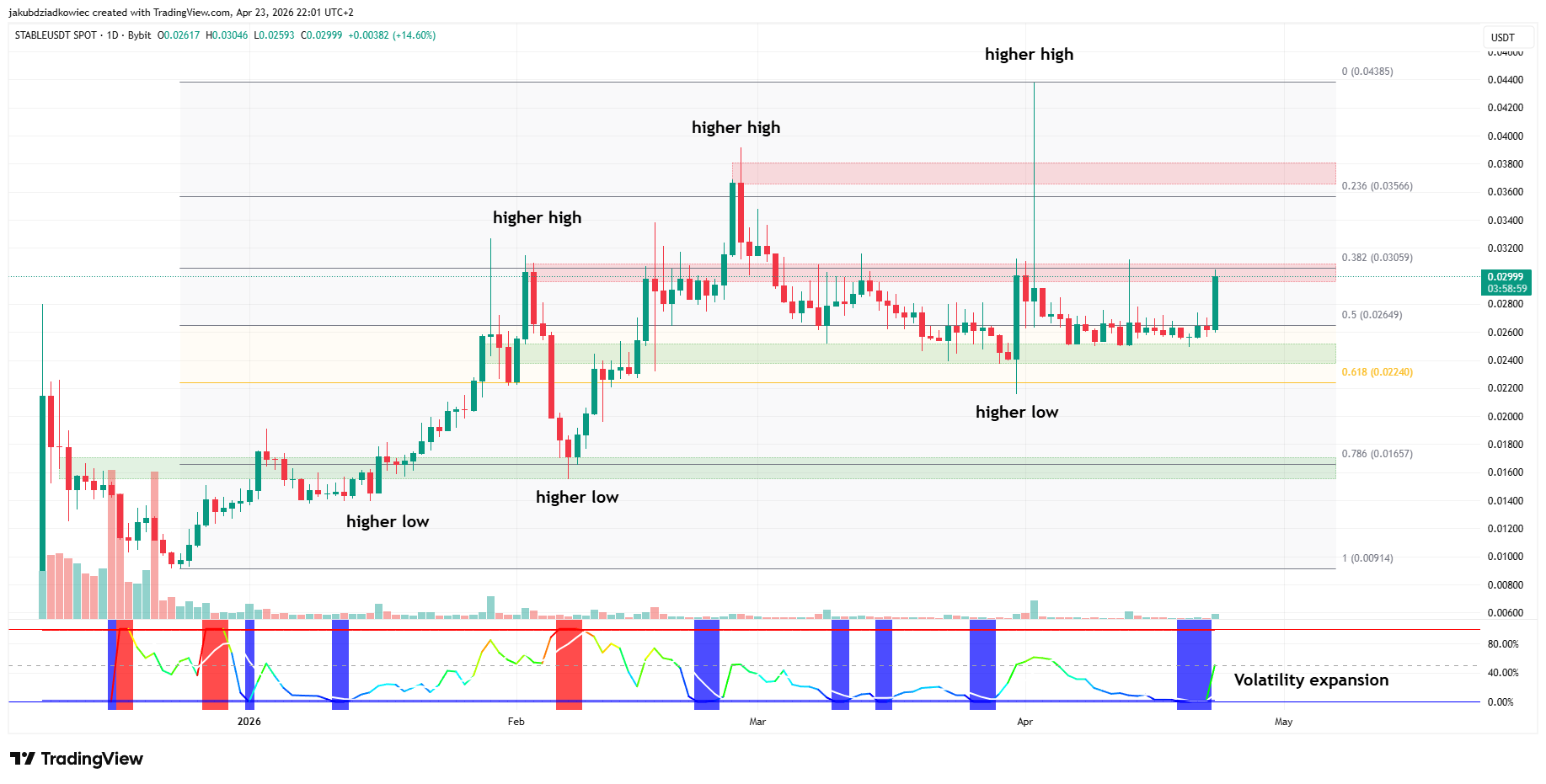
STABLE (STABLE) rallied 14.6% on April 23 to trade at $0.02999, breaking weeks of tight consolidation with the strongest daily volatility reading since early February. The move coincided with a Relative Strength Index breakout on the daily chart.
The rally pushes the token toward the 0.382 Fibonacci retracement at $0.03059, a level that capped every bounce across March and April. A sustained close above that line would clear the path to the next resistance cluster.
Daily Chart Holds a Higher-Low Structure Above the 0.5 Fib
The daily chart frames a higher-timeframe structure that remains constructive. STABLE has printed a series of higher lows since its December bottom near $0.00914, along with three higher highs. The April 22 low at $0.02580 preserved that structure and sits directly on the 0.5 Fibonacci retracement at $0.02649.
Price now trades at $0.02999, just below the 0.382 Fibonacci level at $0.03059. That ceiling has rejected multiple rally attempts since March 7, making it the most important short-term resistance on the chart.
A daily close above $0.03059 would confirm continuation toward the 0.236 retracement at $0.03566 and the February 27 high near $0.0389.
Critical support sits at $0.02649. A break below that invalidates the current leg and exposes the 0.618 retracement at $0.02240. Other altcoins have stalled at equivalent retracement clusters this cycle, including ORDI at its own 0.382 level.
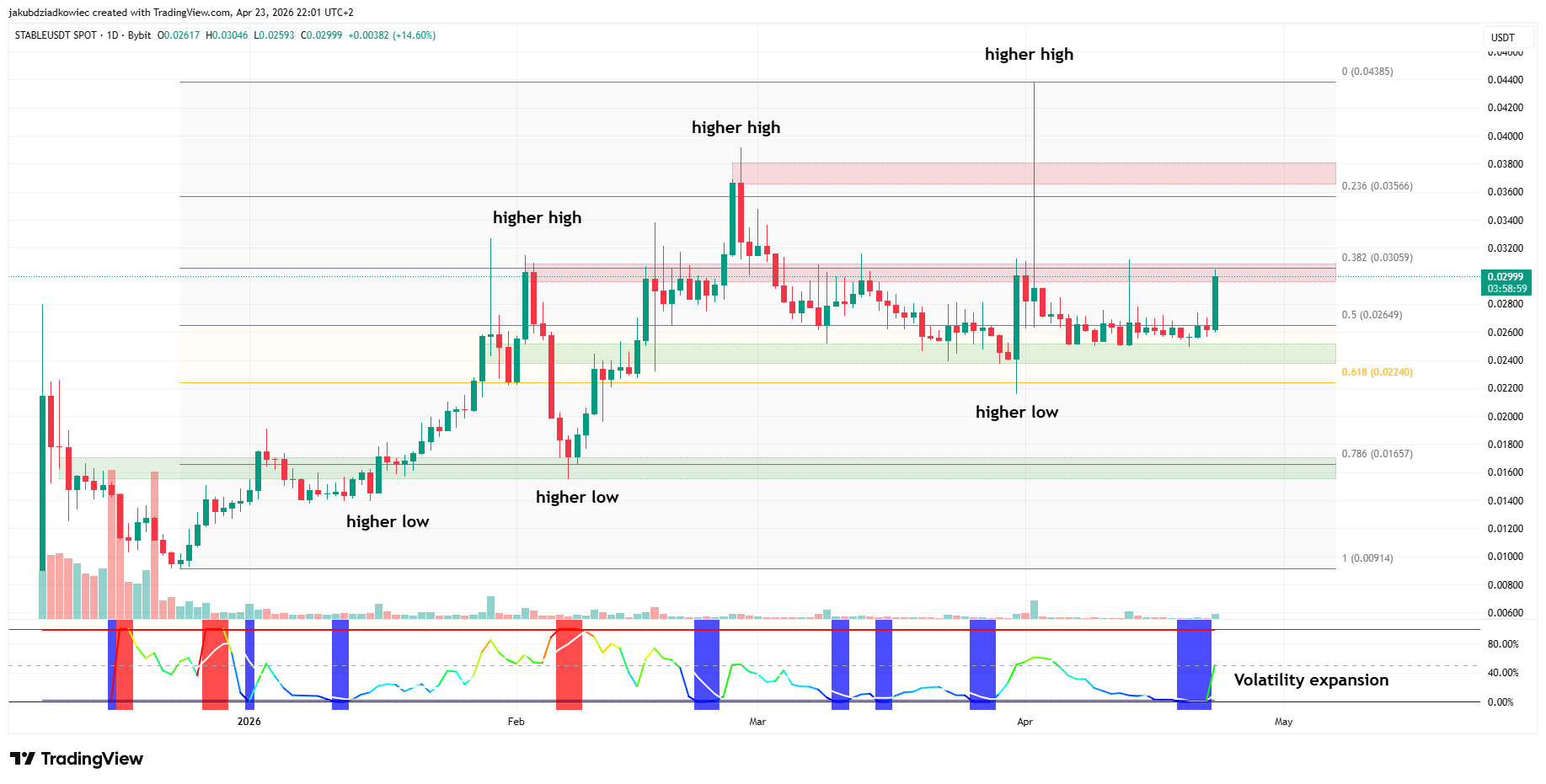
Daily RSI Breaks a Three-Month Resistance Line
The STABLE Relative Strength Index (RSI) finally pushed above a descending trendline that had capped every rally since late January. The indicator jumped from near 50 into the mid-60s on the April 23 candle. It was the first decisive move above 60 in more than 10 weeks.
The trendline originated at the RSI peak above 80 set in late January, just before STABLE printed its all-time high near $0.04385. Each subsequent rally stalled at progressively lower RSI readings, producing a steady sequence of lower highs that mirrored the price correction.
A clean break above this line often precedes a shift from distribution to accumulation. The reading still sits well below the overbought threshold at 70, leaving room for further upside before momentum exhausts itself. Similar momentum setups preceded the recent HBAR breakout attempt.
Momentum flips bearish only if RSI closes back below 50. That outcome would confirm a false breakout and hand control back to sellers.
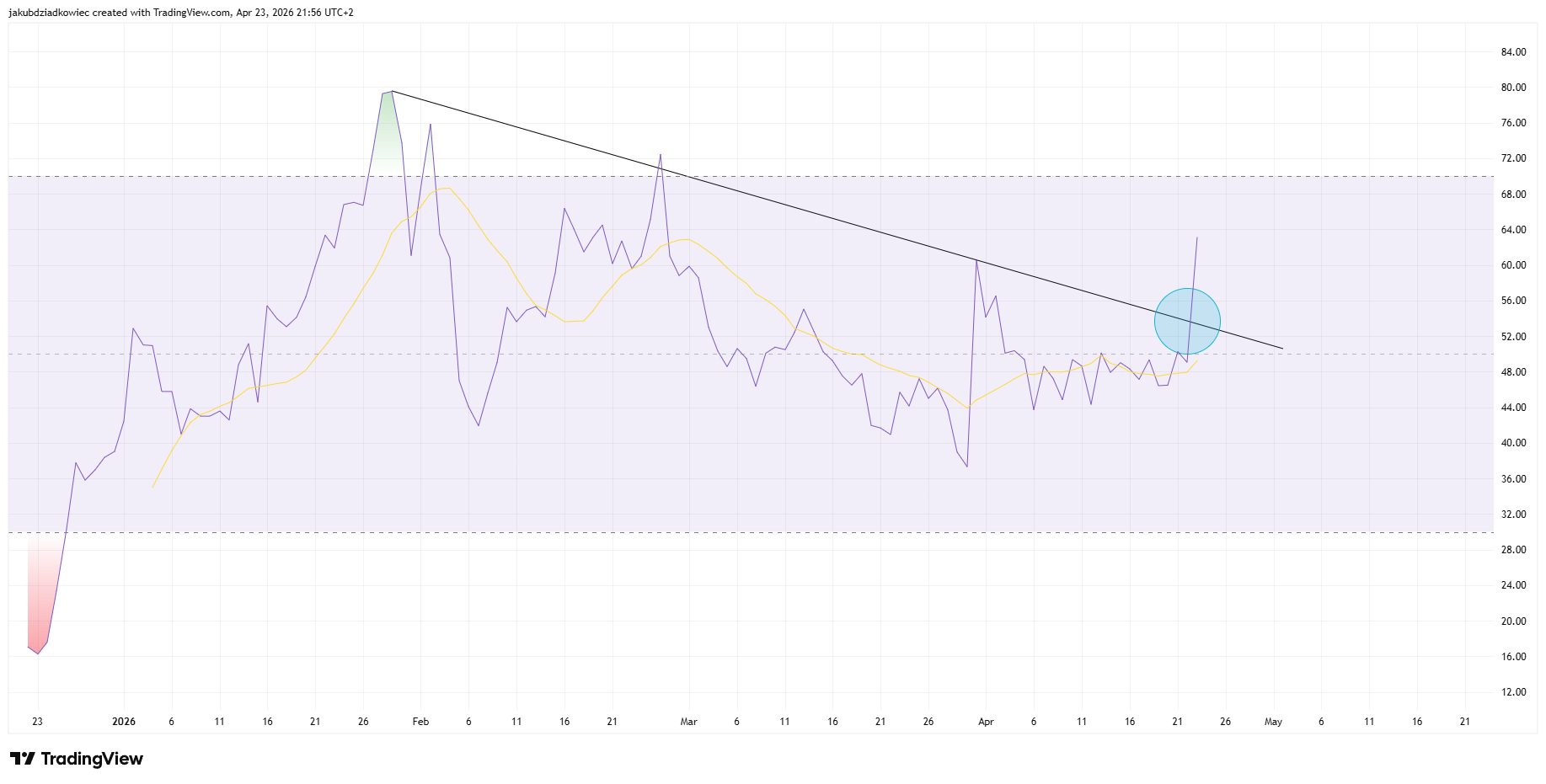
STABLE Price Prediction Points to the $0.0367 W-Pattern Target
The 4-hour view delivers the clearest roadmap for the next move. STABLE carved out a rounded W pattern between April 2 and April 23, with the neckline near $0.03100. Price broke above the neckline on April 23 and stalled around $0.03003 by session close.
The measured move projects a $0.03673 target, roughly 22% above the April 22 low near $0.02580. That zone aligns with the 0.236 Fibonacci retracement at $0.03566, creating a dense resistance cluster between $0.03566 and $0.03673. Volume confirmed the breakout leg, printing the largest bullish candle in more than two weeks.
However, the token must first clear the 0.382 Fibonacci level at $0.03059 on the higher timeframe. A rejection from the $0.03059 to $0.03100 band would likely send STABLE back toward the 0.5 Fibonacci support at $0.02649. A recovery in broader Bitcoin strength would accelerate the upside.
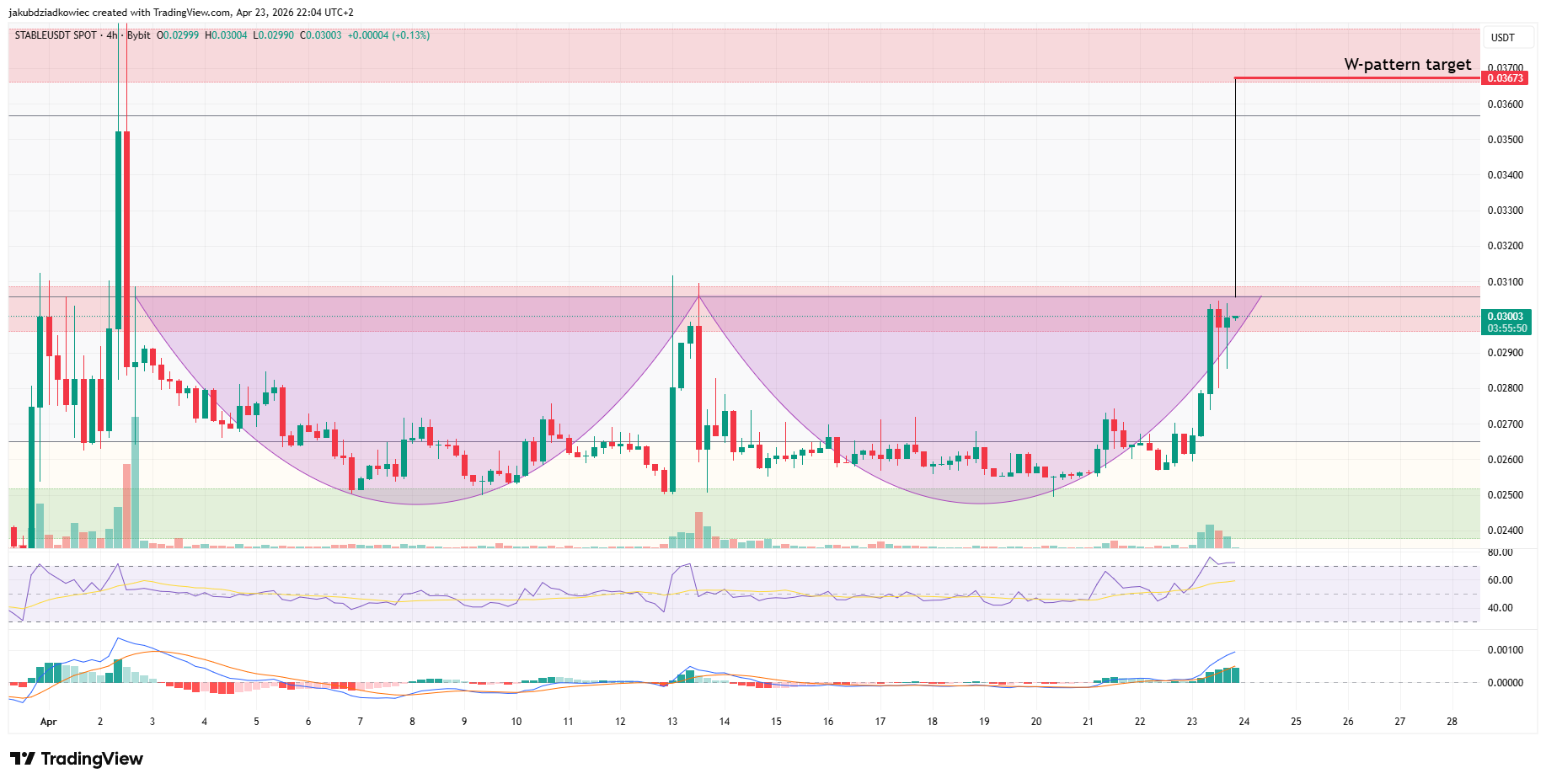
The binary is clear. STABLE either clears $0.03059 and confirms a path to $0.03673, or fails and slides back into the mid-range.
The post STABLE Price Rallies 20%, Here’s Why and Where It’s Going Next appeared first on BeInCrypto.
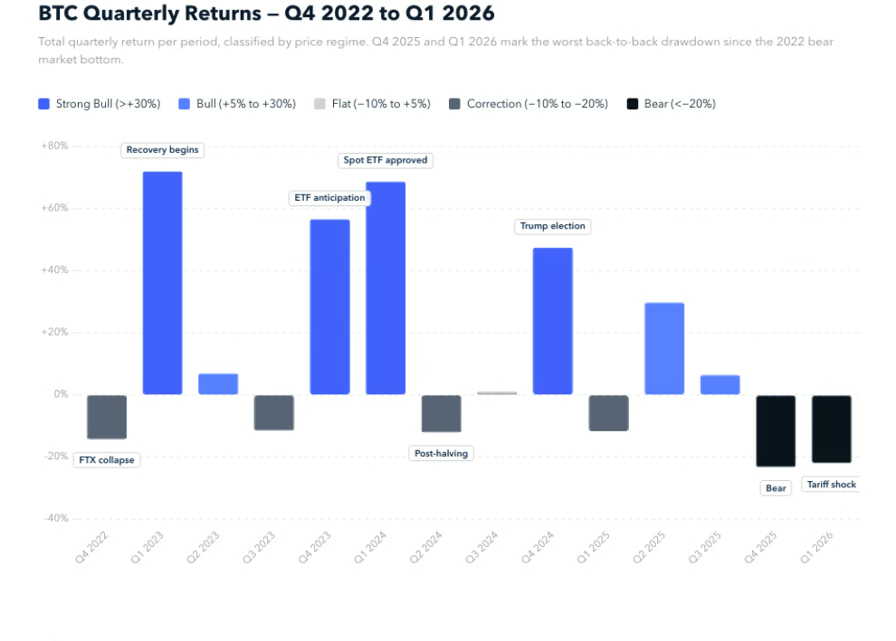
Global crypto adoption declined in the first quarter as retail activity weakened under mounting macroeconomic and geopolitical pressures, underscoring the sector’s continued sensitivity to broader market conditions.
TRM Labs’ Q1 Global Crypto Adoption Index showed an 11% year-over-year drop in retail crypto volumes, to $979 billion. The decline marked a second consecutive quarterly contraction and the sharpest pullback since the 2022 bear market.
The downturn was largely driven by a stronger US dollar, higher interest rates and a broader risk-off environment, all of which weighed on retail participation, TRM said. The softer demand coincided with a 22% drop in the price of Bitcoin (BTC) during the quarter.
Bitcoin’s correction followed a late-2025 peak above $126,000, with prices trending lower through the first quarter alongside a broader decline in digital asset markets.
Bitcoin’s quarterly returns between Q4 2022 and Q1 2026. Source: TRM Labs
Related: Crypto Biz: Will Bitcoin secure safe passage through the Hormuz Strait?
Emerging markets diverge from advanced economies
The report highlighted a growing regional divide in crypto adoption, with advanced economies such as the United States, South Korea, the United Kingdom and Germany posting the steepest declines in trading volume. In these markets, where crypto is largely used as a speculative asset, higher opportunity costs and weaker risk appetite pushed investors elsewhere.
Part of that shift was tied to the outbreak of the Iran war in late February, which disrupted energy flows and heightened sensitivity to geopolitical developments across global markets.
By contrast, markets where crypto serves a more functional role, including payments and savings, showed greater resilience. Turkey stood out, with volumes rising 7% year over year, while activity across Latin America and South Asia remained broadly stable.
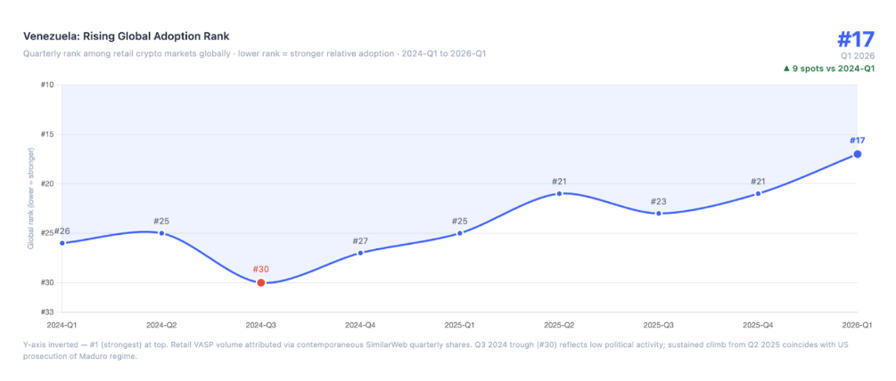
The study also flagged Venezuela as a major growth market for crypto adoption amid ongoing sanctions. Source: TRM Labs
“This divergence reflects a fundamental difference in demand: where domestic monetary policy is constrained or capital controls limit alternatives, crypto functions as a store of value and shadow dollar system,” TRM said.
Related: Stablecoin supply reaches $315B in Q1 as USDC rises, USDT declines
GraniteShares has delayed the launch of its 3x Long and 3x Short XRP Daily ETFs from April 23 to May 7, marking the fifth postponement in three weeks and raising fresh questions about whether the SEC will ultimately clear 3x leveraged crypto products under the framework it applied to reject similar products from ProShares in December 2025.
Summary
- GraniteShares delayed its 3x Long and 3x Short XRP Daily ETFs from April 23 to May 7 using Rule 485, which allows issuers to shift effective dates without restarting the SEC review process.
- The delay is the fifth since the original April 2 target date, following the same 3x leverage structure that caused the SEC to push back on ProShares, which withdrew its entire 3x crypto lineup in December 2025.
- If the May 7 date is missed, the funds may not launch in 2026, according to 247 Wall St., as the regulatory window for 3x leveraged crypto ETFs remains unresolved.
GraniteShares has pushed the launch of its 3x Long and 3x Short XRP Daily ETFs from April 23 to May 7, 247 Wall St. reported, citing a Rule 485 filing under the Securities Act of 1933 that allows issuers to shift launch dates without restarting the full regulatory review process. The effective date has now moved five times: from April 2, to April 9, to April 16, to April 23, and now to May 7.
GraniteShares 3x XRP ETF Faces Repeated SEC Scrutiny on Leverage Structure
The delay pattern mirrors the regulatory resistance that ended ProShares’ 3x crypto ETF ambitions. In December 2025, the SEC sent formal letters to ProShares, Direxion, and Tidal Financial citing Rule 18f-4, which caps fund leverage at 200%, forcing ProShares to withdraw its entire 3x crypto lineup, including a 3x XRP product essentially identical to what GraniteShares is now attempting to list. GraniteShares’ eight leveraged funds, covering 3x Long and 3x Short versions for Bitcoin, Ethereum, Solana, and XRP, have all been moved to May 7 simultaneously, which 247 Wall St. noted suggests the SEC is working through concerns about the 3x structure itself rather than any asset-specific issue. As crypto.news reported, Teucrium demonstrated that 2x leveraged XRP products are achievable under the current regulatory framework, having launched its 2x Long Daily XRP ETF on NYSE Arca in April 2025 and subsequently built over $440 million in assets.
What the Products Would Offer If They Clear
The GraniteShares 3x Long XRP Daily ETF would deliver 300% of XRP’s daily price movement using swaps and futures contracts, settling entirely in cash with no direct XRP held. The 3x Short XRP ETF would deliver 300% of the inverse daily movement, giving US retail traders their first regulated vehicle to short XRP at triple leverage through a standard brokerage account. GraniteShares Advisors LLC would serve as investment adviser, with Jeff Klearman and Ryan Dofflemeyer as portfolio managers. As crypto.news tracked, spot XRP ETFs have recorded over $1.24 billion in cumulative inflows since November 2025, providing a clear demand signal that GraniteShares is trying to extend into the higher-leverage segment of the market.
The May 7 Window Is Now the Critical Test
If GraniteShares launches on May 7, the delay will be read as routine procedural process, consistent with how Volatility Shares navigated its 2x XRP product. If it delays a sixth time, 247 Wall St. noted, the SEC is likely moving in the same direction it took with ProShares, and the 3x XRP products may not launch in 2026 at all. As crypto.news documented, XRP ETF demand hit an 11-week high in mid-April with $17.11 million flowing in on a single day, and the market has been watching the GraniteShares filing as a potential next catalyst for broader XRP trading infrastructure. The annualized historical volatility on XRP from 2020 to 2025 sat at 95.5%, the highest among the four assets covered in GraniteShares’ filing, which may be part of the SEC’s calculus on the risk profile of a 3x product tied to the asset.
GraniteShares has not issued a public statement explaining the delay, and the Rule 485 filing contains no indication of what specific SEC concerns, if any, are driving the repeated postponements.


JPG Store, the leading Cardano (ADA) NFT marketplace, announced it will permanently shut down on May 23, 2026, alongside its Comet platform.
The team cited operational unsustainability as the reason for the closure. JPG Store has served the Cardano ecosystem since 2021, facilitating NFT trading for thousands of users.
What JPG Store Users Need to Know
The shutdown will proceed in two phases. A restriction mode began on April 23, disabling new listings, offers, loans, and minting. Users can still buy existing listings, cancel active orders, and repay loans during this period.
On May 23, the website will redirect to a shutdown notice page. All marketplace functionality will then cease.
Users with NFTs in self-custody wallets do not need to take any action. Their assets remain fully accessible through other platforms that aggregate JPG Store smart contracts or through the Cardano CLI.
However, those using social login wallets must migrate their assets to standard Web3 wallets such as Lace, Eternl, or Flint within the 30-day window.
Users with active listings, pending offers, or open loans should cancel or settle those positions before the deadline.
Assets left in smart contracts after the shutdown will still exist on-chain. However, recovering them will require technical knowledge or third-party tools.
Another NFT Marketplace Falls
JPG Store’s closure adds to a growing list of NFT marketplace shutdowns in recent months. Nifty Gateway, owned by Gemini, shut down in February 2026.
Immutable also wound down its marketplace amid declining trading volumes across the sector.
The team shared open-source contract repositories and smart contract addresses to support ongoing community development on Cardano.
“While we deeply value the people who have supported us, the platforms have reached a stage where they are no longer sustainable to operate,” wrote JPG Store in the post.
The post Leading Cardano NFT Marketplace JPG Store Announces Shutdown appeared first on BeInCrypto.
Key takeaways:
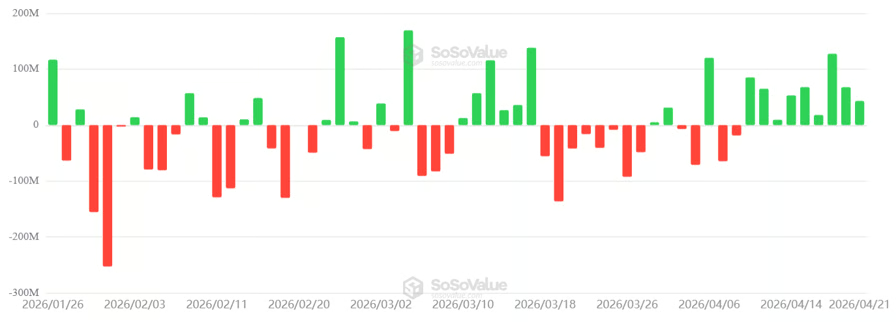
- The spot ETH ETFs recorded ten consecutive days of net inflows, totaling $633 million.
- Weekly DApps revenue on the Ethereum network fell to $13 million, following a broader decline seen in Solana and BNB Chain.
Ether (ETH) struggled to trade above $2,400 on Thursday, but consistent inflows into Ethereum spot exchange-traded funds (ETFs) reflect the bulls’ attempt to regain momentum. Ether’s price rallied alongside Bitcoin’s (BTC) recovery to $79,000, prompting traders to question whether ETH will attempt a run to $3,000.
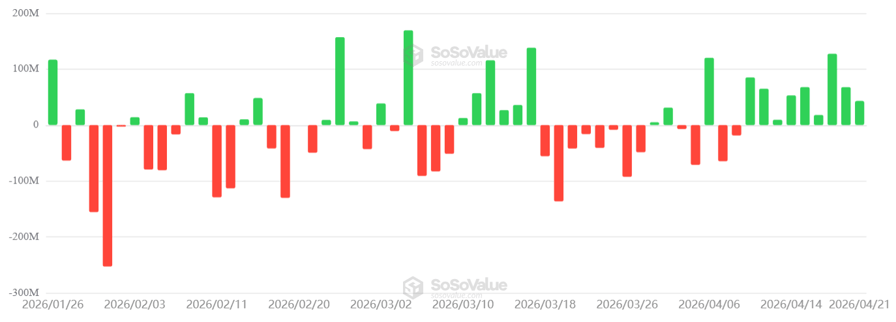
Spot ETH ETF daily net flows, USD. Source: SoSoValue
On Wednesday, the ETH spot ETFs completed 10 consecutive days of net inflows, totaling $633 million. This shows that traders are gradually reclaiming confidence after ETH abruptly fell by 42% between Jan. 28 and Feb. 6. The cryptocurrency market crash reduced interest in decentralized applications (DApps), which proved especially burdensome for ETH investors.
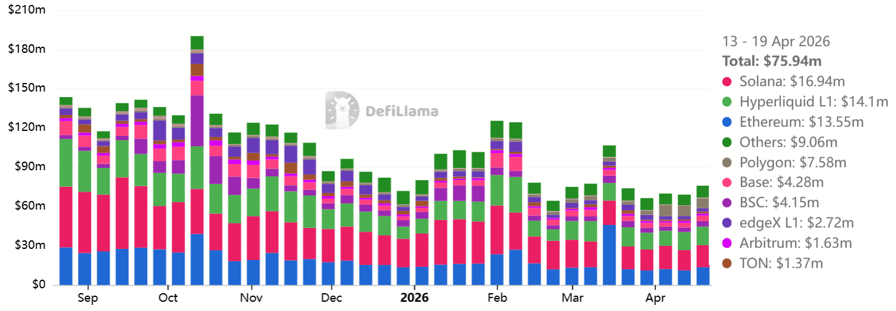
Weekly DApps revenue by chain, USD. Source: DefiLlama
DApp revenues on the Ethereum network dropped to $13 million per week in April, nearly 50% lower than six months prior. However, the decline in decentralized exchange (DEX) volumes has also plagued other major competitors to a similar extent, including Solana, BNB Chain, and Hyperliquid. The aggregate weekly blockchain DApps revenue has fallen to $73 million, down from $130 million in October 2025.
Ethereum well-positioned to capture demand for DApps
Despite recent bullish momentum, ETH is down 22% year-to-date in 2026, while the broader cryptocurrency market capitalization is down 14%. Ether’s underperformance may be interpreted as a buying opportunity, especially as the Ethereum network remains the leader in total value locked (TVL) and its layer-2 solutions have gained significant market share in DEX volumes.
Regardless of the ETF inflows, the demand for bullish leveraged ETH positions has plummeted to its lowest level in four months.
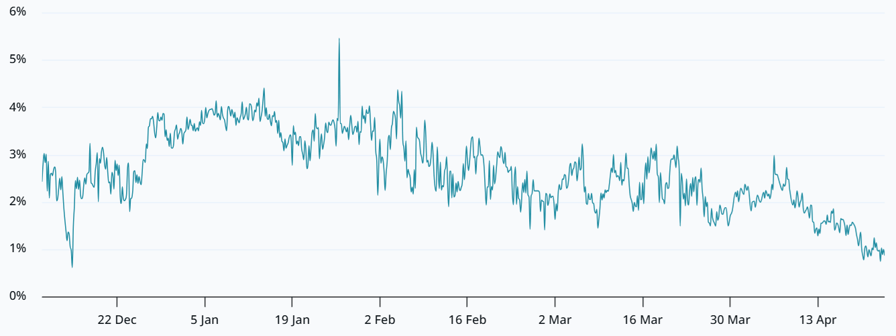
ETH 2-month futures basis rate. Source: Laevitas
The annualized ETH monthly futures premium relative to regular spot markets (basis rate) dropped to 1% on Thursday, well below the 4% neutral threshold. Still, it is incorrect to assume that professional traders are bracing for downside solely due to a lack of confidence in derivatives markets. The uncertain macroeconomic environment might explain trader skepticism, especially after major tech companies’ quarterly earnings disappointed investors.
IBM (IBM US) shares dropped nearly 10% on Thursday due to investor concerns regarding increased competition from the artificial intelligence sector, according to Yahoo Finance. In parallel, Morgan Stanley trimmed its price target on Oracle (ORCL US) due to uncertainty in the margin profile and buildout costs of the company’s expanding investment in AI computing data centers.
Related: BlackRock drives 7-day Bitcoin ETF inflow streak as BTC nears $80,000
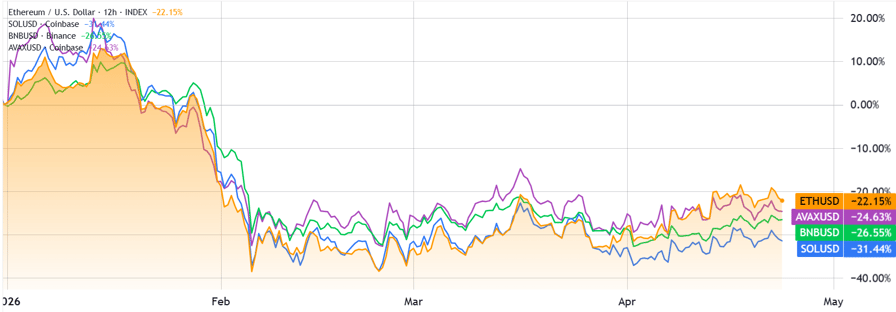
ETH vs. BNB, SOL, AVAX. Source: TradingView
Ether’s potential bullish momentum likely depends on reduced risk aversion toward cryptocurrencies, as its price chart relative to some competitors shows striking similarities. The recent spot Ether ETF inflows, while relevant, are not enough to justify a decoupling, especially as activity in the DApps sector has yet to show signs of improvement.
There is no indication that ETH is bound for $3,000, but the Ethereum network seems well-positioned to capture an eventual pickup in demand for decentralized computation.
The crypto-aligned Fellowship political action committee (PAC), led by stablecoin issuer Tether’s head of government affairs, reported spending more than $3 million on advertising related to US Senate and House races, with the majority going toward to support a Texas Republican candidate.
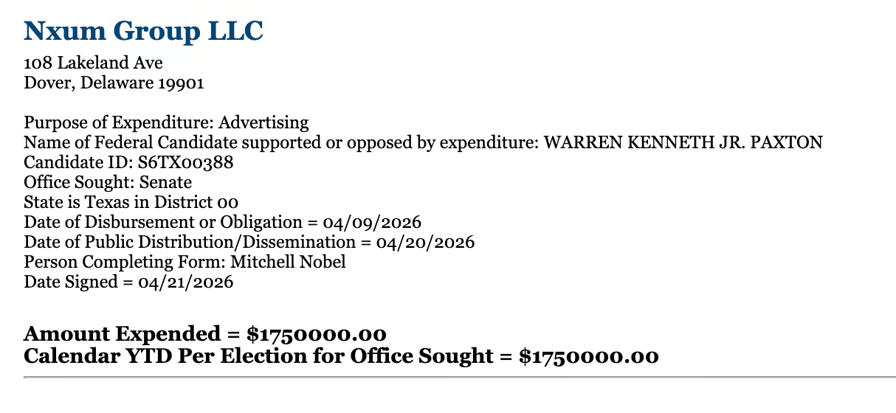
In a Tuesday filing with the US Federal Election Commission (FEC), Fellowship PAC disclosed that it had spent $1.75 million in support of Texas Attorney General Ken Paxton. The Republican is facing off against incumbent Senator John Cornyn in a May 26 runoff to determine who will become the party’s candidate for the 2026 US Senate race.
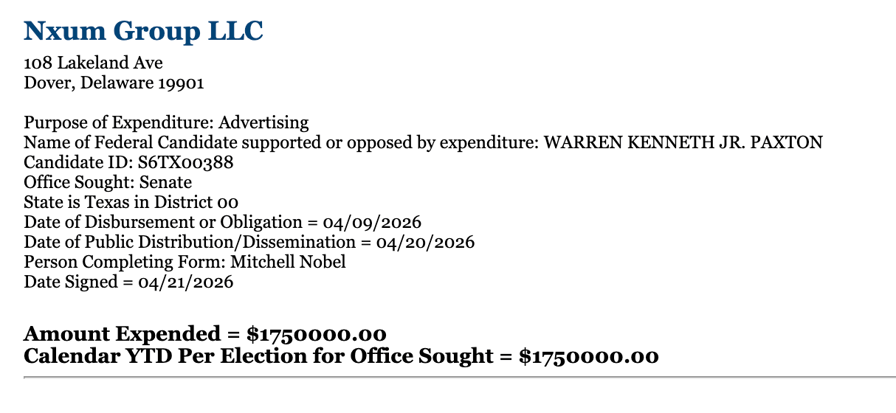
Fellowship PAC expenditure report on Ken Paxton. Source: FEC
In addition to Paxton, the PAC reported spending $350,000 on advertising for Mike Collins in Georgia’s Senate race, $350,000 on Barry Moore in Alabama’s Senate race, and $250,000 and $350,000 on Blake Miguez and Julia Letlow, respectively, for House and Senate races in Louisiana. All expenditures went through the Nxum Group, a marketing company co-founded by former White House crypto adviser and Tether US CEO Bo Hines.
Fellowship launched in September, claiming to have more than $100 million from undisclosed investors aligned with the crypto industry. Although the PAC has since reported $11 million in contributions to the FEC, no other filings or public records showed backers associated with crypto.
Crypto-backed PACs like Fellowship and Fairshake are expected to influence the results of the 2026 US midterm elections through spending on media and advertising to support candidates they consider “pro-crypto.” Fairshake and its affiliates reported spending more than $131 million in 2024, possibly influencing voters in key battleground states.
Related: Texas Lt. Gov. calls for study of crypto, prediction markets
Paxton’s time as Texas Attorney General was plagued by corruption allegations, leading to his impeachment in the state’s House of Representatives in 2023 — he was later acquitted by the Texas Senate. Either Paxton or Cornyn will likely face off against Democratic candidate James Talarico in November’s US Senate election.
Kalshi suspends and fines Texas candidate over insider trading
As US state primaries continue and the general election approaches, many prediction market users are betting on the outcomes of events related to big and small races, including some candidates themselves.
On Wednesday, prediction markets platform Kalshi announced financial penalties and bans on three candidates in Minnesota, Texas and Virginia after they were found to have placed bets on their respective races. The Texas candidate, Ezekiel Enriquez, “purchased less than $100 worth of contracts related to his own candidacy” for Texas’ 21st Congressional District, according to Kalshi.
“Under the terms of the settlement, Kalshi suspended Enriquez from direct or indirect access to Kalshi for a period of 5 years and imposed a financial penalty of $784.20,” said the company.
Magazine: How to fix suspected insider trading on Polymarket and Kalshi

Key Highlights
- INTC shares climb following earnings beat powered by AI infrastructure demand
- Data center segment expansion fuels Intel revenue growth and after-hours rally
- Intel posts margin improvements and accelerating AI momentum in Q1 results
- Robust AI workload demand drives Intel stock appreciation after report
- Intel gains on expanding data center operations and enhanced earnings forecast
Shares of Intel Corporation (INTC) finished the trading session higher before experiencing a significant after-hours rally following the release of first-quarter 2026 financial results. The stock closed at $66.78, representing a 2.31% gain, before jumping to $76.53 in extended trading. This momentum stems from robust AI workload requirements, expanding data center operations, and enhanced execution throughout primary business divisions.
Data Center Strength and AI Infrastructure Fuel Revenue Growth
Intel delivered first-quarter revenue totaling $13.6 billion, representing a 7% year-over-year increase. This expansion resulted from accelerating demand for processors and AI infrastructure solutions throughout enterprise and cloud computing environments. Beyond top-line growth, the company achieved a gross margin of 39.4%, demonstrating enhanced product portfolio mix and effective expense management.
While GAAP results reflected losses attributed to restructuring initiatives and accounting modifications, non-GAAP metrics revealed stronger underlying operational performance. Non-GAAP net income reached $1.5 billion, climbing 156% compared to the same period last year. Per-share earnings rose to $0.29, underscoring enhanced profitability throughout business divisions.
The Data Center and AI division emerged as the primary growth driver, producing $5.1 billion in revenue with a 22% year-over-year increase. The Client Computing Group contributed $7.7 billion, demonstrating consistent demand throughout PC and edge device markets. Overall Intel Products revenue advanced 9%, confirming strength across fundamental operations.
Product Innovation and Collaborative Initiatives Enhance Market Position
Intel broadened its product lineup with newly introduced Xeon processors and Core Ultra series chips spanning multiple market segments. These releases address enterprise, mobile, and edge computing applications with advanced AI functionality and performance improvements. Beyond product introductions, Intel reinforced collaborative relationships to expand its infrastructure footprint worldwide.
The semiconductor manufacturer revealed a multi-year partnership with Google for deploying Xeon processors throughout specialized cloud computing instances. This collaboration encompasses joint development of customized infrastructure processing units designed to enhance AI workload performance. Intel also secured its position as the host CPU supplier for NVIDIA’s DGX Rubin platform systems.
Additionally, Intel progressed its foundry objectives by increasing assembly and testing capabilities in Malaysia. This expansion addresses growing demand for sophisticated packaging technologies and strengthens supply chain stability. Intel participated in the Terafab consortium alongside prominent technology companies to drive semiconductor manufacturing advancement.
Forward Guidance Reflects Sustained AI and Manufacturing Growth Trajectory
Intel provided second-quarter 2026 revenue guidance ranging from $13.8 billion to $14.8 billion, suggesting continued demand stability. The organization anticipates non-GAAP earnings per share of $0.20, underpinned by margin expansion and operational effectiveness. GAAP forecasts remain subdued due to persistent restructuring effects.
The company continues refining its manufacturing infrastructure to address expanding customer needs. This strategy focuses on enhancing supply chain responsiveness and supporting increasing requirements for AI-optimized semiconductor solutions. Intel prioritizes production capacity scaling while strengthening its financial position.
Intel’s forward outlook demonstrates sustained expansion propelled by AI implementation and data center proliferation across international markets. The organization continues transforming its operational framework while broadening partnerships and product offerings. Consequently, the post-earnings stock appreciation corresponds with improved fundamentals and superior execution capabilities.


Audeze Brings the SLAM to AXPONA 2026 as Its Signature Tech Spreads Across the Lineup

Sunderland rail passengers warned of bank holiday disruption

Pi Network Protocol 22 Deadline in 4 Days

Manchester United reach agreement with Casemiro over contract clause amid transfer speculation

US brings back mandatory military draft registration

Steven Gerrard disagrees with Gary Neville over ‘shock’ Chelsea and Arsenal claim | Football


-

 Sports7 days ago
NWFL Suspends Two Players Over Post-Match Clash in Ado-Ekiti
-

 Fashion6 days ago
Weekend Open Thread: Theodora Dress
-

 Politics6 days ago
Palestine barred from entering Canada for FIFA Congress
-
Entertainment4 days ago
NBA Analyst Charles Barkley Chimes in on Ice Spice McDonald’s Fiasco
-

 Tech5 days ago
Auto Enthusiast Scores Running Tesla Model 3 for Two Grand and Turns It Into Bare-Bones Go-Kart
-

 Business4 days ago
Powerball Result April 18, 2026: No Jackpot Winner in Powerball Draw: $75 Million Rolls Over
-

 Politics5 days ago
Zack Polanski demands ‘council homes not luxury flats for foreign investors’
-

 Crypto World6 days ago
Russia Pushes Bill to Criminalize Unregistered Crypto Services
-

 Politics3 days ago
Gary Stevenson delivers timely reminder to register to vote as deadline TODAY
-

 Business2 days ago
Rolls-Royce Voted UK’s Most Iconic Trade Mark as IPO Register Hits 150
-

 Politics1 day ago
Disabled people challenge government SEND proposals over segregation concerns
-

 Politics1 day ago
Making troops accountable for war crimes threatens US alliance, ex-SAS colonel warns
-

 Crypto World6 days ago
Russia Introduces Bill To Criminalize Unregistered Crypto Services
-

 Politics1 day ago
Starmer handler McSweeney to be dragged from shadows by Foreign Affairs Committee
-

 Politics1 day ago
Zack Polanski responds to home secretary’s taser threat
-
Politics1 day ago
Wings Over Scotland | How To Get Away With Crimes
-
 Crypto World5 days ago
Kelp DAO rsETH Bridge Hack Drains $292M as DeFi Losses Top $600M in Two Weeks
-

 Politics1 day ago
‘Iran is still a nuclear threat’
-

 Crypto World2 days ago
New York sues Coinbase, Gemini over prediction market offerings
-
 Sports7 days ago
Kevin Kisner apologizes for Masters criticism: ‘I crossed the line’
You must be logged in to post a comment Login