
Crypto World
Miden to launch privacy-focused USDC-backed stablecoin using Circle’s xReserve



Privacy has emerged as a key barrier to bringing more financial activity onchain. Public blockchains expose transaction histories, balances and counterparties by default, a level of transparency that is difficult to reconcile with how businesses and financial institutions operate.
Trading firms don’t want to reveal positions, companies can’t publish payroll and treasury activity and individuals may not want their financial lives visible on a block explorer. Privacy infrastructure aims to bring the confidentiality of traditional finance onchain while preserving crypto’s programmability and verifiability.
Stablecoins are cryptocurrencies designed to maintain a steady value, typically by tracking the U.S. dollar. They have become a key piece of crypto infrastructure, providing a bridge between traditional money and blockchains while enabling faster payments, trading and settlement without the volatility of assets like bitcoin or ether .
Miden sees USDCx as the foundation for a broader category it calls “PriFi,” spanning private institutional trading, B2B payments, payroll, cross-border payments and corporate treasury management.
The company spun out of Polygon as an independent project in April 2025 and is backed by a16z crypto, 1kx, Hack VC and others.
Read more: The future of crypto payments won’t include on-ramps or bridges, Fun CEO says

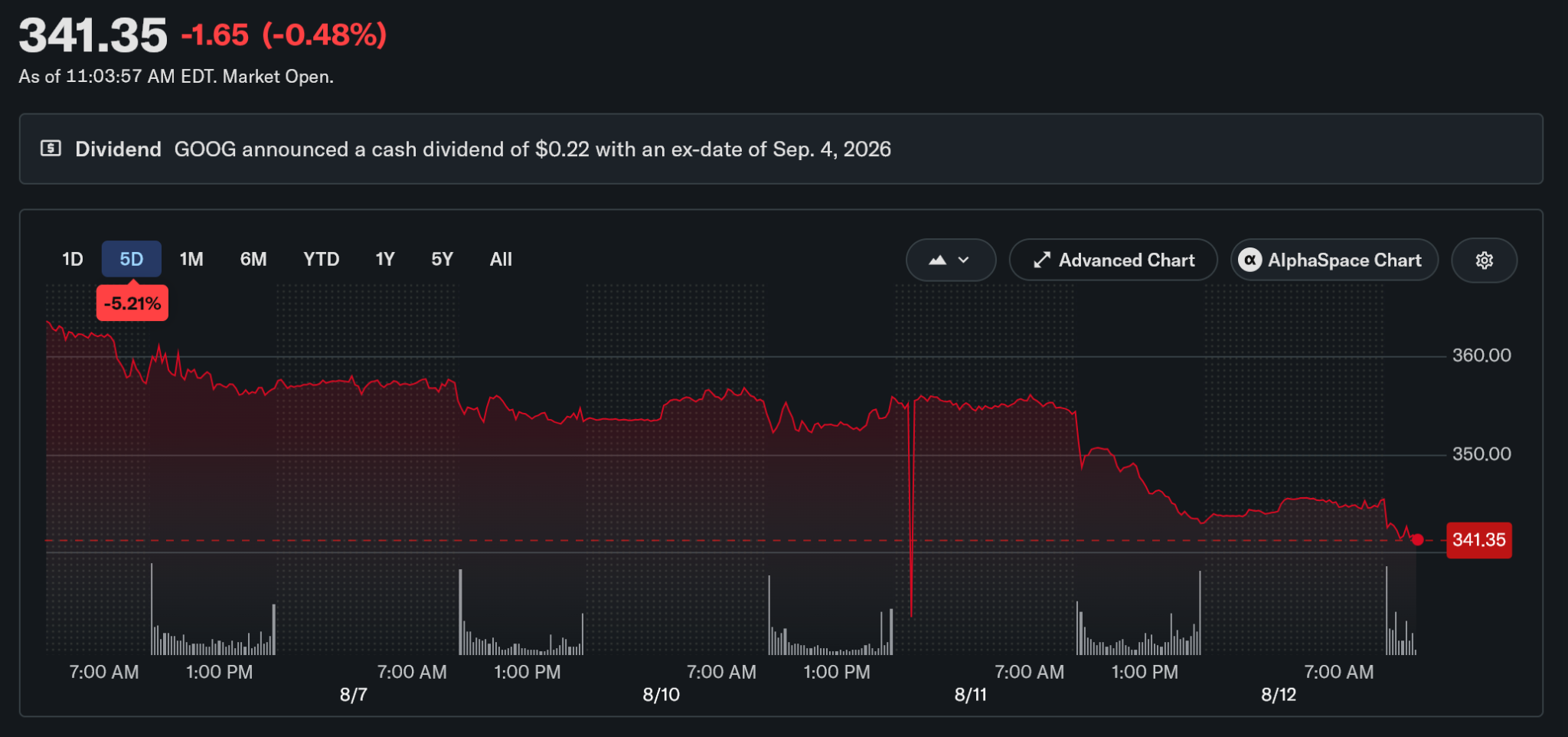
Google has unveiled the Pixel 11 lineup, but the new phones arrive with unusually modest hardware upgrades, higher prices, and even a downgrade in RAM on some models.
The Pixel 11, Pixel 11 Pro, Pixel 11 Pro XL and Pixel 11 Pro Fold bring Google’s new Tensor G6 chip and several AI-powered software features. However, the physical changes are limited compared with previous generations.
What is Changing on the Google Pixel 11 Lineup
Some of the main hardware changes include:
- The standard Pixel 11 gets a 56% larger main camera sensor, faster 25W wireless charging and a smaller camera bump.
- Battery-life claims remain largely unchanged from last year.
- Most camera sensors are unchanged, while Google has not announced any meaningful graphics-performance improvement for Tensor G6.
- The Pixel 11 Pro gets a brighter display and a 30% larger telephoto sensor, but its main camera specifications remain largely similar.
- The Pro models now start with 12GB of RAM, down from 16GB on last year’s starting configurations.
- Google also removed the body-temperature sensor and replaced it with a new LED-based “Highlight” notification feature.
The biggest change may be the price.
The Pixel 11 starts at $899, up from $799. The Pixel 11 Pro starts at $1,099, while the Pro XL rises to $1,299.
The Fold also gets a $100 price increase despite keeping the same 256GB starting storage.
Why Google Is Cutting Back on Hardware
The weak upgrade cycle comes as smartphone makers face a global memory shortage driven by the AI boom.
AI data centers consume huge amounts of high-bandwidth memory, server DRAM and enterprise storage. Memory makers such as Samsung, SK hynix and Micron are therefore shifting more production toward higher-margin AI hardware.
That has made smartphone memory significantly more expensive.
TrendForce estimated that LPDDR5X mobile memory contract prices jumped 78% to 83% quarter-on-quarter in Q2 2026.
Earlier data showed the cost of an 8GB RAM and 256GB storage configuration had already risen close to 200% year-on-year.
Manufacturers are responding by cutting memory specifications, increasing prices or limiting hardware upgrades.
Alphabet Shares Reverse Early Gain
Alphabet shares initially rose about 0.6% at Wednesday’s market open, briefly approaching a 1% gain.
However, the stock later reversed course and fell about 0.2%, even as the broader Nasdaq remained higher.

There is no evidence that Pixel 11 reviews caused the decline. Still, the early reversal comes as Google asks consumers to pay more for phones whose biggest improvements increasingly come from software and AI rather than new hardware.
The post Google Pixel 11 Launch Disappoints as Alphabet Stock Falls appeared first on BeInCrypto.
Lumentum Holdings (LITE) reported fiscal fourth-quarter earnings and revenue that topped consensus estimates amid high expectations. The company’s fiscal first-quarter 2027 guidance for Lumentum stock came in slightly above views. The company reported fiscal Q4 earnings after the market close on Tuesday. “Lumentum reported a quarter with revenue effectively in-line and gross margin above, the same dynamic in the prior…
Copyright ©2026 Investor’s Business Daily, LLC. All rights reserved. 87990cbe856818d5eddac44c7b1cdeb8


That is the flaw volatility exposes. Markets have become faster, more global and more interconnected, while capital movement remains slow and fragmented. Closing that gap requires a different way of thinking about cash, collateral and settlement.
Stablecoins are no longer peripheral
Settlement remains one of the weakest links in capital markets. Institutions can execute trades globally in milliseconds, but the transfer of value that supports those trades can still take days. That delay creates funding pressure, operational risk and unnecessary capital drag.
This is where stablecoins become relevant to institutional markets. Strip away the noise and the use case is straightforward: they allow cash-like value to move with the speed and programmability of digital assets. For firms still working around T+1 or T+2 settlement, nostro and vostro accounts, and hard cut-off times, that is not a marginal improvement. It changes what is operationally possible.
The market has already moved beyond theory. Stablecoin market capitalisation is now around $320 billion, and recent industry data points to record levels of on-chain transfer activity. The more important point, however, is not the headline number. It is that regulated institutions are beginning to treat stablecoins and tokenised cash as settlement infrastructure rather than crypto-market curiosity.
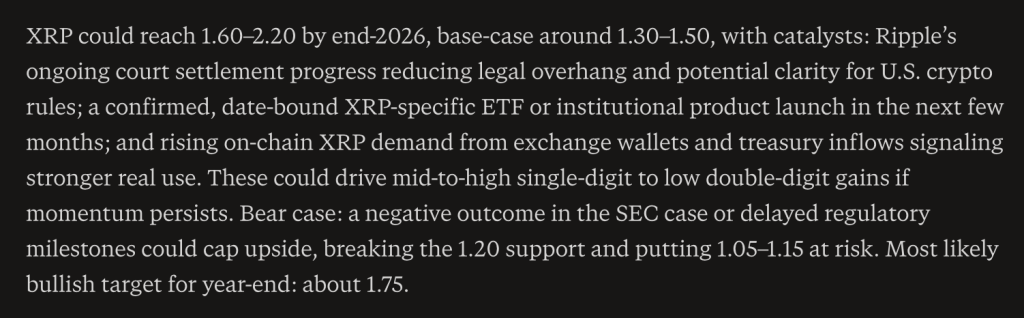
A 70% rally from here would only get XRP to the middle of Perplexity’s target range. Perplexity AI predicts XRP can reach $1.60-$2.20 by the end of 2026, with its latest XRP Price Prediction settling on $1.75 as the most likely bullish target.
That is a bold reversal call with XRP sitting at $1.0235. Perplexity co-founder and CEO Aravind Srinivas’s AI sees legal clarity, institutional products and real network demand as the fuel.
Ripple’s ongoing court settlement progress could finally shrink the legal discount that has followed XRP for years. Clearer US crypto rules would give the market one less reason to price in regulatory risk.
An XRP-specific ETF or institutional product launch could bring fresh capital into the asset. Rising on-chain demand from exchange wallets and treasury inflows would add something even more important: evidence that XRP is being used, not merely traded.
Get those pieces moving together and $1.60-$2.20 stops looking absurd. The model puts $1.30-$1.50 closer to its base case, with $1.75 its preferred bullish year-end target.
The bear case is already knocking. A negative SEC outcome or delayed regulatory milestones could break $1.20 support and expose the $1.05-$1.15 region, levels XRP is already trading below.
Discover: Everyone’s Got a Take. Get Free $25 to Actually Trade Yours
AI Predicts XRP: Ripple Is Running Out of Room Near $1
The chart tells a much uglier story than the forecast. XRP has collapsed from above $3.00, carved out a long sequence of lower highs and now sits just above the psychologically important $1.00 mark.
There is no convincing reversal yet. The structure still resembles a descending trend grinding into support, with $1.00-$0.99 acting as the immediate floor and $1.10-$1.20 forming the first meaningful resistance zone.
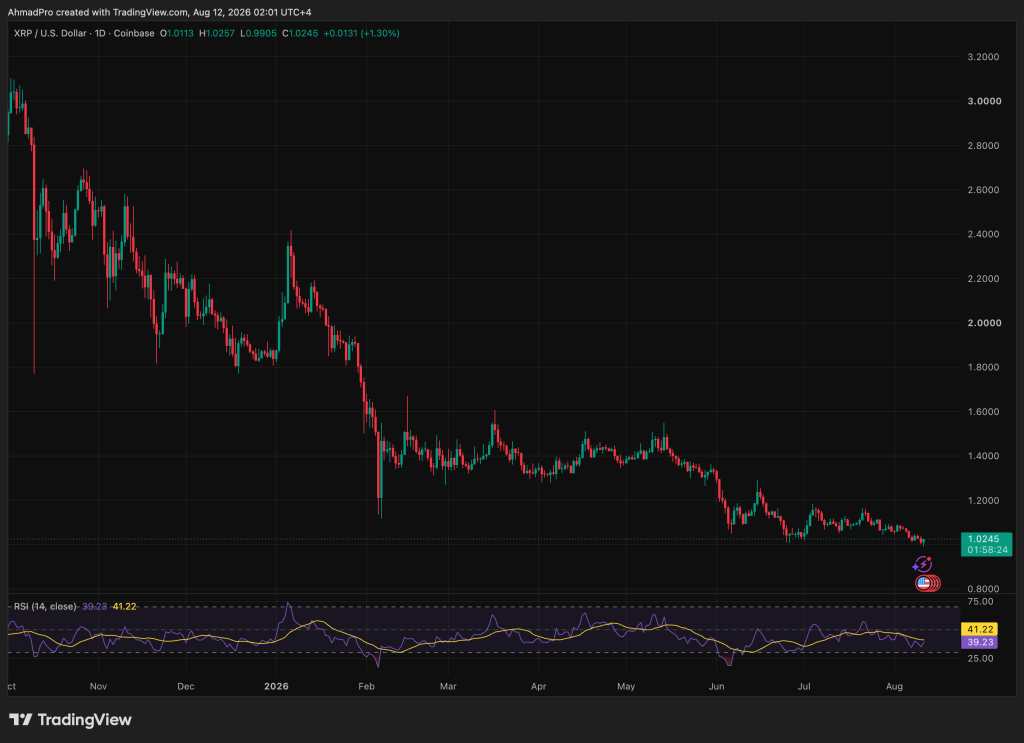
XRP closed at $1.0235, up 1.20% for the session after trading between $0.9905 and $1.0257. That intraday recovery kept $1.00 alive, but one green candle does not erase months of selling.
RSI sits at 38.94 while its signal line reads 41.20. The 2.26-point gap keeps momentum tilted toward sellers, although XRP has not yet entered deeply oversold territory.
This is where Perplexity AI’s $1.75 call gets tested. XRP first needs to stop defending $1.00 and start attacking $1.20 before a run toward $1.60-$2.20 deserves serious attention.
Discover: Your Market Calls Are Worth Something. Start With Free $25 on Kalshi
Bitcoin Hyper Takes the Opposite Side of the Crypto Speed Problem
XRP’s thesis depends heavily on institutional access and clearer rules. Bitcoin Hyper attacks a different bottleneck: making Bitcoin useful for faster, cheaper on-chain activity without abandoning the network that made it valuable.
Bitcoin Hyper combines Bitcoin Layer 2 infrastructure with the Solana Virtual Machine, bringing high-speed execution, low fees and smart contract functionality into a Bitcoin-focused ecosystem. Its Canonical Bridge is designed to move BTC between Bitcoin and the Layer 2, while decentralized governance gives the network a path beyond centralized control.
That creates a sharper proposition than simply betting on another standalone chain. Bitcoin Hyper is effectively betting that Bitcoin’s next chapter is not just about holding BTC, but actually putting that capital to work.
For investors watching whether the next crypto expansion reaches beyond simple price appreciation, Bitcoin Hyper puts that thesis front and center.
→ Get up to $25 to trade your first market on Kalshi
cta url=”[https://cryptonews.com/ext/bybit-airdrop-campaign”]Don’t Miss Out on Our $1,000 USDT Airdrop on ByBit[/cta]
The post Perplexity AI Predicts an XRP Scenario Few Analysts Are Discussing appeared first on Cryptonews.

Commodities Trader Marex Jumps 13% On Earnings, Flashes Buy Signal

The House passed a stopgap funding bill 220-205 on July 21, moving its proposed government-funding deadline from September 30 to December 4 and placing it after the midterms. This has led to the odds of a Government shutdown happening across all predition markets.
But that is no longer the full picture: on August 8, the Senate passed its own version 90-6, extending funding through December 11 instead. The two versions still need to be reconciled, meaning Congress has moved closer to avoiding an October shutdown without yet completing the process.
For Bitcoin traders, that distinction matters. The immediate September 30 cliff looks less threatening, but the underlying funding fight has largely been pushed deeper into the year rather than eliminated.

Discover: Everyone’s Got a Take. Join Kalshi and Get a Free $25 to Actually Trade Yours
Odds of a Government Shutdown: A Rescheduled Fight, Not a Settled One
The disputes behind the funding deadline were not settled by the July House vote. The House measure simply extended current funding largely at existing levels through December 4, while the Senate’s subsequent version would run through December 11 and contains provisions absent from the House bill.
The Senate bill also restricts the administration’s ability to redirect certain funds and temporarily blocks a White House rule requiring political review of federal grants. Those differences mean the legislation must return to the House before it can reach President Trump’s desk.
Meanwhile, House Republicans have separately advanced a $95 billion budget plan covering Iran-related defense and intelligence spending, farm assistance and parts of President Trump’s election-law agenda. The baseline appropriations fight has therefore been postponed rather than permanently settled.
Discover: Your Market Calls Are Worth Something. Start With Free $25 on Kalshi
What the Prediction Markets Are Saying
Kalshi and Polymarket run event contracts that pay according to whether defined outcomes occur under each market’s resolution rules. The October 1 shutdown market therefore measures whether a shutdown occurs around that specific deadline, not whether another funding confrontation emerges in December.
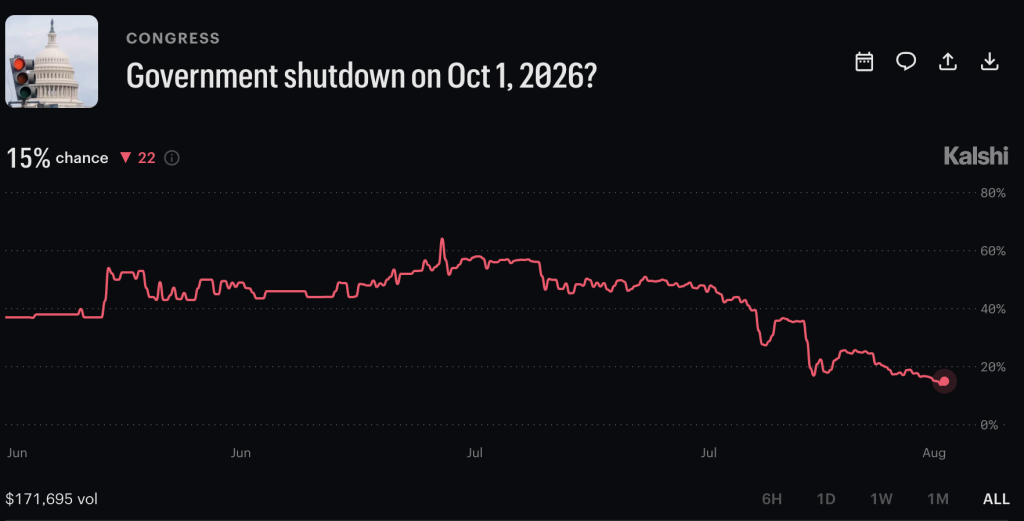
That distinction has become even more important since the Senate vote. With both chambers now backing temporary funding beyond the midterms, the probability of an October shutdown should not be treated as a proxy for the broader probability of another fiscal confrontation later in 2026.
Prediction markets have also proved highly sensitive to congressional developments during previous funding fights. The Department of Homeland Security shutdown that began February 14, for example, generated large swings in contracts tracking when funding would return as negotiations evolved.
Why Bitcoin Traders Are Watching December Aside from the Odds of a Government Shutdown
Shutdown risk can matter for crypto because fiscal uncertainty, liquidity expectations and broader risk sentiment can all influence Bitcoin. But the relationship is not mechanical, and a shutdown by itself does not guarantee either a Bitcoin rally or decline.
Arthur Hayes has separately argued that potential Federal Reserve intervention to support the Japanese yen could expand dollar liquidity and ultimately benefit Bitcoin. His broader liquidity thesis makes the policy response surrounding fiscal or monetary stress potentially more important for Bitcoin than the political event itself.
A December funding standoff would also arrive after the midterm elections and during year-end market positioning. For traders considering a liquidity-driven framework, the key issue is therefore not only whether a shutdown occurs, but what fiscal and monetary conditions develop around it.
Bitcoin’s Other Near-Term Catalysts
On August 12, Bitcoin remained below $65,000 after briefly reaching about $65,200 earlier in the week. The congressional funding timeline is only one of several macro variables influencing the market.
July CPI is due on August 12, leaving the Federal Reserve’s September decision sensitive to another inflation surprise. Market expectations remain divided over whether policymakers could raise rates again, meaning a hotter-than-expected inflation print could reset the rate outlook independently of developments in Congress.
The Strait of Hormuz relief trade has also unraveled after President Trump demanded decades of compensation from Iran, pushing oil prices higher. Bitcoin has struggled to establish a sustained move above $65,000 amid the renewed geopolitical uncertainty.
That leaves Bitcoin exposed to several simultaneous catalysts: inflation, Federal Reserve expectations, oil prices, Iran-related developments and the evolving U.S. funding negotiations. Any attempt to attribute its next move solely to shutdown odds would therefore oversimplify the macro picture.
Don’t Miss Out on Our $1,000 USDT Airdrop on ByBit
The post Congress Pushes Odds of a Government Shutdown to December as Bitcoin Watches appeared first on Cryptonews.

Binance-linked entities and stablecoin payments card provider RedotPay are sparring over whether a Singapore legal case tied to their wider Hong Kong dispute is winding down after a hearing held on Aug. 7.
RedotPay told Cointelegraph that it expects Binance to discontinue the Singapore proceedings following that hearing and said it will seek legal costs if the claimant withdraws. Binance, however, pushed back, telling Cointelegraph that reports claiming it is withdrawing its Singapore claims are false and that it is continuing to pursue its case.
Key takeaways
- RedotPay expects Binance-linked parties to discontinue the Singapore proceedings after an Aug. 7 hearing.
- Binance says it is not abandoning its Singapore claims and has notified the court and RedotPay accordingly.
- The Singapore dispute is part of a broader, parallel legal battle that includes a Hong Kong case seeking nearly $473 million.
- The parties’ next steps will likely hinge on whether the Singapore case is formally withdrawn and how costs are handled.
Dispute over whether the Singapore case is ending
The disagreement is the latest turn in a cross-jurisdiction fight that has already drawn attention for its size. According to a RedotPay spokesperson, RedotPay expects Binance to stop the Singapore proceedings after the Aug. 7 hearing. In that scenario, RedotPay said it would request legal costs stemming from the discontinuance and that the parties would attempt to reach an agreement on those costs.
Binance’s response is direct. In comments to Cointelegraph, a Binance spokesperson said the claim that Binance would withdraw its Singapore case is incorrect. Binance stated that it is “not abandoning its claims” and that it has informed both the court and RedotPay of its position.
While both sides reference the same Aug. 7 hearing, their public descriptions of what follows diverge—one side treating discontinuance as the likely outcome, the other insisting the case remains active. For market participants, this matters because procedural developments can affect timelines, litigation exposure, and leverage in related negotiations, particularly when disputes are running simultaneously across regions.
Hong Kong lawsuit seeks nearly $473 million in damages
The Singapore action forms part of a broader legal fight between Binance-affiliated entities and RedotPay, including a separate case in Hong Kong. Earlier coverage from Bloomberg, as cited by Cointelegraph, reported that Nest Trading, DistributedTechnologies and Chaintecs Consulting Singapore had filed a petition in Hong Kong against RedotPay’s co-founders.
The Hong Kong plaintiffs allege that RedotPay diverted more than 470,000 Binance Card users. Their core claim is that RedotPay allowed Binance Pay funds to be used for stablecoin card top-ups outside the terms of a commercial agreement. Damages were estimated at $472.8 million, based on a claimed lifetime customer value of $925 per user.
In parallel, Chaintecs pursued related proceedings against RedotPay affiliates in Singapore, where a hearing had been scheduled for Aug. 7—prompting the current exchange about discontinuance and costs.
RedotPay has rejected the allegations. It told Cointelegraph it would defend itself through the legal process, characterizing the claims as “unfounded allegations” at the time they first surfaced.
What the Binance Pay and RedotPay partnership enabled
RedotPay and Binance’s connection in this dispute traces back to their partnership announced in December 2023. RedotPay said at the time that it had established Binance Pay functionality, allowing Binance Pay users to make direct deposits to RedotPay cards.
Binance later ended support for the integration. RedotPay told Cointelegraph that Binance discontinued the Binance Pay support as of April 3, 2026, citing a review of its merchant partners. That operational change occurred months before the legal controversy gained mainstream attention.
In disputes like these, contract implementation details and timing often become pivotal. The plaintiffs’ theory in the Hong Kong matter centers on whether RedotPay used Binance Pay funds in a way allegedly inconsistent with the commercial agreement. The fact that Binance later ended the integration after reviewing merchant partners adds another dimension, even though it does not, on its own, resolve the underlying contention over what was permitted during the partnership period.
Why the Singapore procedural fight matters
Even without a final decision on the merits, the question of whether the Singapore proceedings continue—or are discontinued—can influence how both sides manage risk and strategy across the broader dispute. If Binance were to discontinue in Singapore, RedotPay’s statement suggests it would treat the matter as a cost event that could become a negotiation point between the parties.
Binance’s statement, on the other hand, signals that it does not view the Singapore claim as concluded. That stance implies further litigation steps may follow, at least unless the court records and filings later reflect a withdrawal.
Until the Singapore case’s status is clarified through court action, filings, or formal orders, the public accounts remain in tension: RedotPay expects a discontinuance and costs discussion, while Binance says it has no plans to withdraw its claims.
Readers should watch for official court documentation in Singapore after the Aug. 7 hearing—particularly any formal discontinuance order or cost determination—and for whether the procedural posture there shifts the momentum in the parallel Hong Kong damages case.
Pi Network’s native token, which has been on a major downfall over the past several months, is among the top-performing cryptocurrencies today (August 12).
Its resurgence comes amid rumors that the controversial project has completed yet another ecosystem update.
PI Rises
The token’s price jumped by 4% over the past 24 hours to reach almost $0.09. This means that PI has outperformed nearly all top 100 digital assets, including Bitcoin (BTC), Ethereum (ETH), Ripple (XRP), Solana (SOL), and many more. Its market capitalization stands just below $1 billion, making it the 65th-largest cryptocurrency.
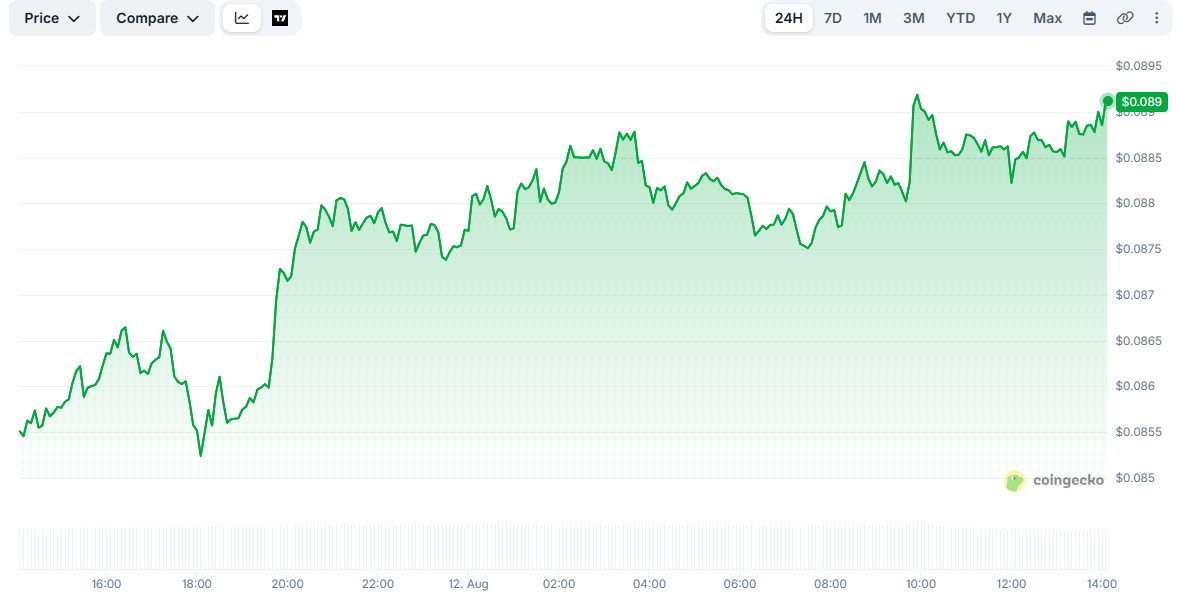
It remains unclear what exactly fueled the resurgence. One might speculate that the momentum is tied to rumors suggesting that protocol version 26 has already been deployed.
Not long ago, Pi Network urged all mainnet node operators to complete the upgrade by August 11 to remain connected to the network. While the Core Team has not yet issued an official announcement on the matter, certain X users claimed the upgrade is already in effect.
Rizo suggested that protocol v26 has been rolled out, and that attention is now turning to version 27, which should be the final upgrade in this series. X user amrOnChain also weighed in, saying that Testnet 2 is now officially on protocol v26, and the node has been upgraded to the latest version.
“The final stretch is here. From v19 to v26, 8 successful upgrades completed. Only one remains before the network is fully up to date. This is the moment we’ve been building toward,” the X user added.
Sustainable Rally or Pullback Ahead?
According to some market observers, PI has the potential to chart additional gains in the near future. X user Crypto With Gopal claimed it has formed a large triangle pattern. He added that the price has been compressing between descending resistance and rising support, displaying tightening momentum and bulls defending the lower range.
That said, the analyst predicted that a “clean breakout” above $0.10 could trigger a more substantial pump to $0.15 – a level last witnessed at the end of May.
It is worth keeping in mind that traders and investors should remain cautious since a downside move is also on the table. PI has been rejected several times after showing signs of life, while the reigning bear market isn’t exactly helping.
The post Pi Network (PI) Climbs 4% After the Community Shares a Major Milestone appeared first on CryptoPotato.


The Commodity Futures Trading Commission (CFTC) enacted its “emergency authority” yesterday and ordered prediction market Kalshi to keep operating in New York state.
It gave the order after Kalshi told the CFTC that a lawsuit in New York is causing a “market emergency.”
The lawsuit, filed by State Attorney General Letitia James in July, seeks a nationwide temporary restraining order against Kalshi and damages equal to three times its gains — a sum the CFTC says is over $36 billion.
It accuses Kalshi of running an illegal gambling operation that failed to secure a license with the New York State Gaming Commission.
CFTC chairman Michael S. Selig said, “Congress did not intend for derivatives exchanges to be regulated under a patchwork of state gaming laws,” adding that “New York has no business regulating these interstate financial markets.
“The Commission is required by law to ensure order in these markets, and that is what we have done today.”
Read more: The revolving door for lawyers between Kalshi and DOJ
Kalshi and Polymarket both advised by Trump family
Kalshi and rival Polymarket both employ members of the Trump family as their advisors, and both are continuing to fight regulatory court cases across the US.
Kalshi was also sued in July by flight tracking service FlightAware which claims that the prediction market is using its data and brand to display canceled flight markets without FlightAware’s permission.
The New York lawsuit was also supported by a coalition of American Indian tribes who want to block Kalshi’s operations, which it claims are undermining gaming laws on their land.
Got a tip? Send us an email securely via Protos Leaks. For more informed news and investigations, follow us on X, Bluesky, and Google News, or subscribe to our YouTube channel.

Prediction market infrastructure is getting a more institutional-style upgrade. Kalshi says its live order book for event contracts is now available through data provider DoubleZero Edge’s dedicated fiber network, allowing subscribers to consume real-time market depth in a machine-readable form.
The companies announced on Wednesday that the arrangement will be the first of its kind for a prediction market supplying its real-time order book data on sports and crypto perpetuals event contracts through that dedicated distribution channel. Instead of assembling market data from order books and API responses, users can subscribe to a purpose-built feed designed to reduce the engineering effort required to integrate prediction-market liquidity.
Key takeaways
- Kalshi’s real-time order book for sports and crypto perpetuals event contracts is now distributed via DoubleZero Edge’s dedicated fiber network.
- DoubleZero Edge positions the feed as a turnkey, machine-readable alternative to building infrastructure using raw order books and API responses.
- Sports is Kalshi’s second-largest category by weekly notional volume, with crypto in third place, according to Dune data.
- The move comes as Kalshi remains embroiled in ongoing US jurisdiction disputes over whether its sports event contracts are regulated as derivatives or treated as wagers.
Dedicated fiber distribution for prediction-market order books
At the center of the announcement is how market data is delivered. DoubleZero Edge provides a dedicated fiber network and a corresponding data feed, which the companies say will stream Kalshi’s live order book information for relevant contracts.
From a user perspective, that matters because prediction markets often require low-latency, structured data pipelines to support faster market analysis, algorithmic trading strategies, and more reliable execution. The companies’ messaging emphasizes that data access is a “critical part” of market structure, and they argue that the broader ecosystem has lacked similar distribution-grade infrastructure as crypto, perpetuals, and prediction markets have expanded.
DoubleZero co-founder Austin Federa framed the initiative as bringing “institutional-grade infrastructure” to industry participants. In practical terms, the pitch is less about changing the underlying contracts and more about improving how market participants can ingest and process market depth at scale.
Where Kalshi’s volume sits across sports, crypto, and exotics
The announcement also highlights Kalshi’s product mix. According to Dune data shared in the original coverage, exotics lead Kalshi’s weekly notional trading volume at 39.4%, followed by sports at 37.8%. Crypto ranks third at 20.3% in the same weekly notional-volume breakdown.
Sports being the second-largest category helps explain why the order book distribution focus includes sports event contracts. It also signals that demand for structured, low-latency access isn’t limited to crypto-linked products; it spans the broader set of markets Kalshi operates.
These percentages are based on weekly notional volume and are attributed to Dune via a referenced query on its platform. (See: Dune data.)
Regulatory pressure remains: sports contracts and competing jurisdiction claims
The new data distribution capability lands in the middle of a regulatory fight that has been escalating for months. Kalshi’s sports event contracts have become the subject of a jurisdictional dispute involving state regulators and the US Commodity Futures Trading Commission (CFTC).
State authorities have argued that Kalshi’s sports contracts amount to wagers and should therefore fall under state gambling laws. Kalshi and the CFTC counter that the contracts are derivatives, placing them under the CFTC’s exclusive authority.
Legal actions cited in the reporting illustrate how unsettled the status remains. In late June, a Michigan judge temporarily blocked Kalshi from allowing residents to place bets on sporting events. Around the same time, Kentucky filed suit against multiple prediction market platforms—including Kalshi and Polymarket—alleging they operate unlicensed sports betting services.
Nevada also issued a temporary ban on Kalshi earlier in March, according to the same reporting. Meanwhile, the CFTC has taken the opposite tack by suing several states. The agency’s argument, as described in earlier coverage, is that federally regulated event contracts fall under its exclusive jurisdiction.
For market participants, these disputes are more than legal background—they can affect where contracts are accessible and under what compliance frameworks traders can operate. Even as the infrastructure for order book delivery improves, the ability to participate may still depend on jurisdiction-specific rulings and enforcement outcomes.
Broader visibility for Kalshi markets
The story also connects Kalshi’s markets to broader consumer-facing visibility. Earlier in July, OpenAI began displaying Kalshi’s prediction market odds for FIFA World Cup matches in ChatGPT search results, according to prior coverage.
This kind of display can increase public awareness of event markets and may expand the audience beyond traditional traders and developers. However, it also underlines that prediction markets are increasingly part of mainstream information flows—an environment where legal clarity becomes even more important.
What to watch next
Kalshi and DoubleZero Edge’s dedicated fiber feed could make it easier for institutions and serious builders to integrate prediction-market order books without custom plumbing, but the larger question for users is whether contract access will remain stable as courts and regulators continue to argue over jurisdiction. Watch upcoming rulings and any further adjustments to where and how sports event contracts can be offered.

Google Pixel 11 Launch Disappoints as Alphabet Stock Falls

Members of Trump’s cabinet remained on decoy plane, after Trump’s quiet exit

Jobs report miss worsens housing market and affordability outlook


-

 Fashion5 days ago
Weekend Open Thread: Mattifying Sunscreen
-

 Fashion5 days ago
Frugal Friday’s Workwear Report: Cap-Sleeve Pointelle Crewneck Sweater
-

 News Videos4 days ago
Can Astrology Help Find Gold and Silver Trends? A Financial Astrology Guide
-

 Sports7 days ago
Jordan Coyle & Cordiamo take Laya Arena Stakes at RDS
-
 Business7 days ago
US stocks: Dow closes at record on Mideast optimism; SpaceX, AMD drag Nasdaq
-

 Politics6 days ago
Reform UK And Greens Sink To Lowest Favourability Ratings To Date
-

 Business7 days ago
Supply chain issues impact Ingredion
-

 Tech5 days ago
Rinn Pharma & Biopharma to join NordicPharmaTrain network
-

 Business4 days ago
How to Start a Cleaning Business: A Step-by-Step Guide
-

 Business3 days ago
Datadog: Best Of Breed For Multiple Reasons
-

 Business4 days ago
BDC Weekly Review: Private BDC Q2 Numbers Are Strong
-
Sports7 days ago
Spider-Man: Brand New Day ending explained: Is Peter Parker alive?
-
 NewsBeat17 hours ago
Communication cards help banking customers access services or report scams
-

 Fashion7 days ago
Suit of the Week: Me + Em
-

 Tech6 days ago
Price Hikes May Be Coming for PC Motherboards Next
-

 Business6 days ago
Brightwater secures funding for WA-first dementia projects
-
 Crypto World6 days ago
Galaxy Digital Stock Slides 14% as Crypto Prices Hit Earnings
-

 Politics7 days ago
The Not-So Talented Mr Arday
-

 Fashion5 days ago
Weekly News Update, 8.6.26 – Corporette.com
-

 Politics7 days ago
Comedian Jimmy Cricket Has Died, Aged 80
You must be logged in to post a comment Login