
Crypto World
MoneyGram expands on Solana with global crypto-to-cash service



MoneyGram, which serves roughly 60 million active customers, views blockchain rails as a way to make cross-border transfers faster, cheaper and easier to track, without requiring customers to think about the technology powering them. Ramps fits into the vision as it connects digital assets into MoneyGram’s extensive brick-and-mortar network to help everyday customers turn tokens into local cash.
“The future of payments is built on access,” MoneyGram CEO Anthony Soohoo said in a statement. “Bringing MoneyGram Ramps to Solana is another step toward building a truly open, global payments network.”
MoneyGram has spent several years building connections between its traditional payments network and crypto. In 2022, it rolled out a service with the Stellar Development Foundation that allowed users to move between cash and Circle’s USDC stablecoin through its retail network, giving crypto wallets a physical entry and exit point for digital dollars.
The firm took that strategy further in June, announcing MGUSD, its own dollar-backed stablecoin issued by Bridge, the stablecoin infrastructure company owned by Stripe, on the Stellar network.
The company has also been deepening its ties with Solana, becoming a validator in June, helping process and secure transactions on the network.
MoneyGram was also listed as a one of the partners in Open USD, the Stripe-led stablecoin initiative that aims to share revenue with a consortium of backers.



Cole Villemain (aka “ColeThereum”), the Pudgy Penguins co-founder who left the project after allegations of misusing its treasury, is selling NFTs again.
On Sunday, the controversial founder previewed his new collection launching on Robinhood Chain to over half a million views.
That attention was split among those celebrating Cole’s return and an equally-sized population who remembers the disappointing crypto projects from his past.
Villemain faced allegations of treasury misuse at Pudgy Penguins, and he had plenty of earlier controversies. In August 2021, for example, blockchain sleuth ZachXBT profiled one of his pre-crypto ventures, a dropshipping site called eBoy Outlet.
That store’s online reviews, according to ZachXBT, were “filled with instances of customers not receiving orders, refunds, or responses from support.”
Villemain denied wrongdoing and claimed to have refunded customers who failed to receive the merchandise they ordered.
He also founded My Fucking Pickle, another NFT collection that crashed within weeks of his creation. “Have to love cash grab projects,” ZachXBT wrote.
The floor price of those NFTs is now $13, down 98% from their June 27, 2021 high above $540.
Villemain’s new Robinhood Chain collection seems to be themed around fantasy videogames, although details are sparse on its splash homepage. No NFTs are mintable, and Villemain cautioned, “No contract or site is live yet.”
Rather than Ethereum, Villemain chose a new blockchain by the Robinhood brokerage.
That venue is already problematic. Robinhood Chain failed to focus on its original mission of real world asset tokenization, per the CEO’s own admission, as memecoins overran the blockchain instead.
Robinhood pitched its blockchain, which launched on July 1, as a home for tokenized stocks and US Treasuries. Protos documented wallet drainers, phishing pages, rug-pulls, and collapsing memecoins proliferating across Robinhood Chain during early July.
Villemain’s X bio offers his own disclosure, “All tweets are sarcasm or theatrics and not financial advice.”
Read more: Pudgy Penguins removes ‘racist’ post after Manchester City complaint
Nostalgia for NFTs and their -98% returns
Nostalgia seems to be Villemain’s entire sales pitch. He described his own marketing plan as “running back one of the oldest tricks in the book of 2021 NFT projects,” and declared himself “delusional enough to believe I can drop the #1 NFT on Robinhood Chain.”
Not everyone is feeling wistful. “The space never changes,” posted one developer.
“Same guy who did early meme NFT cash grabs, co-founded Pudgy Penguins, then got kicked out after treasury-drain accusations is now launching a new NFT project on Robinhood Chain. Half of Crypto Twitter is acting like none of that ever happened.”
Another X user predicted a repeat disappointment, “This is not the first time he’s launched something and rug pulled it using his luck with PP as a cosign for legitimacy.”
“He disappeared long enough for you and many to have no clue who he is,” one skeptic posted, “Only to come back and do the same thing.”
Indeed, NFT trading volumes declined 97% by 2022 and many NFTs declined 98%, including once-six-figure NFTs that crashed 99%.
On January 5, 2022, an investor alleged Pudgy Penguins founders drained the project’s ETH. The next day, NFT holders voted the founders out through a community vote in the project’s Discord.
Villemain announced a January break from X to focus on “mental health.” By April 2022, the remaining leaders had sold Pudgy Penguins to a group led by Los Angeles entrepreneur Luca Netz for 750 ETH, then about $2.5 million.
Netz turned the underperforming NFTs into physical penguin toys that have moved more than a million units through Walmart, Target, Walgreens, and other non-blockchain sales venues.
Got a tip? Send us an email securely via Protos Leaks. For more informed news and investigations, follow us on X, Bluesky, and Google News, or subscribe to our YouTube channel.


Dubai-based maritime asset tokenization platform Shipfinex partnered with ADI Chain to tokenize a pipeline of around 35 vessels worth $500 million, as it looks to open new financing channels for shipowners.
According to the company, the vessels will be placed in separate special-purpose vehicles, with the resulting tokens potentially representing vessel-backed credit, charter-linked income or other economic interests in individual ships.
ADI Chain, an Abu Dhabi-based blockchain focused on stablecoins and real-world assets, will provide the distribution and settlement infrastructure. Primary allocations and distributions are expected to use UAE dirham-, US dollar- and other currency-denominated stablecoins.
The planned tokenization represents a small share of the broader shipping market. The world fleet and orderbook were valued at about $2.1 trillion at the start of 2026, according to Clarksons Research data.
The partnership is still in the pilot and operational-readiness stage, with no Maritime Asset Tokens publicly issued and the regulated issuance route still being finalized.
The deal comes as the market for tokenized real-world assets (RWAs) continues to grow. Assets tracked by RWA.xyz totaled about $38.1 billion as of Aug. 9, led by $16.2 billion in US Treasury debt and $4.9 billion in commodities.
In a report released Monday, Standard Chartered forecast that tokenized RWAs could reach $4 trillion by the end of 2028, according to Geoff Kendrick, the bank’s global head of digital asset research.
Magazine: 10 weirdest things ever tokenized… including farts
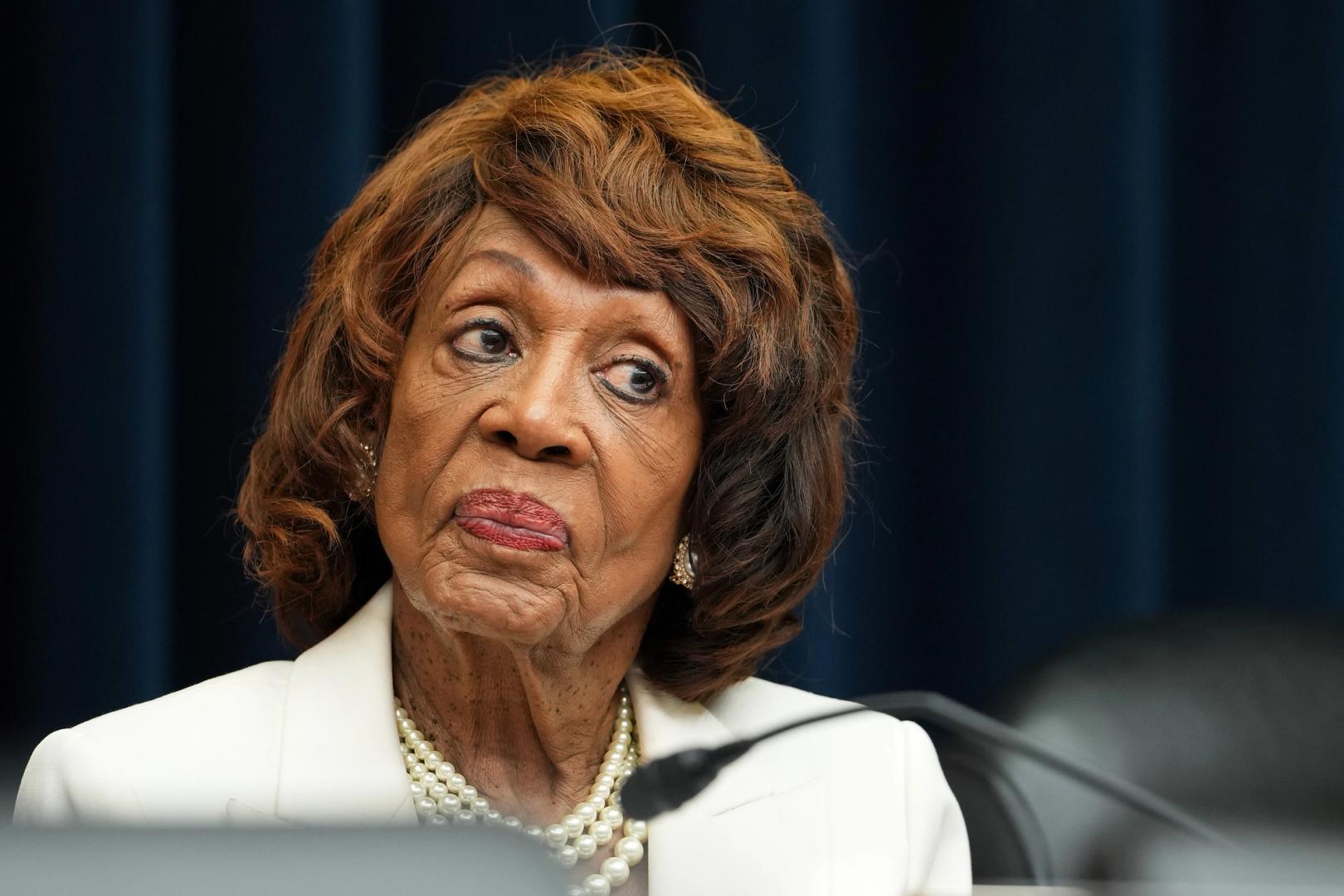
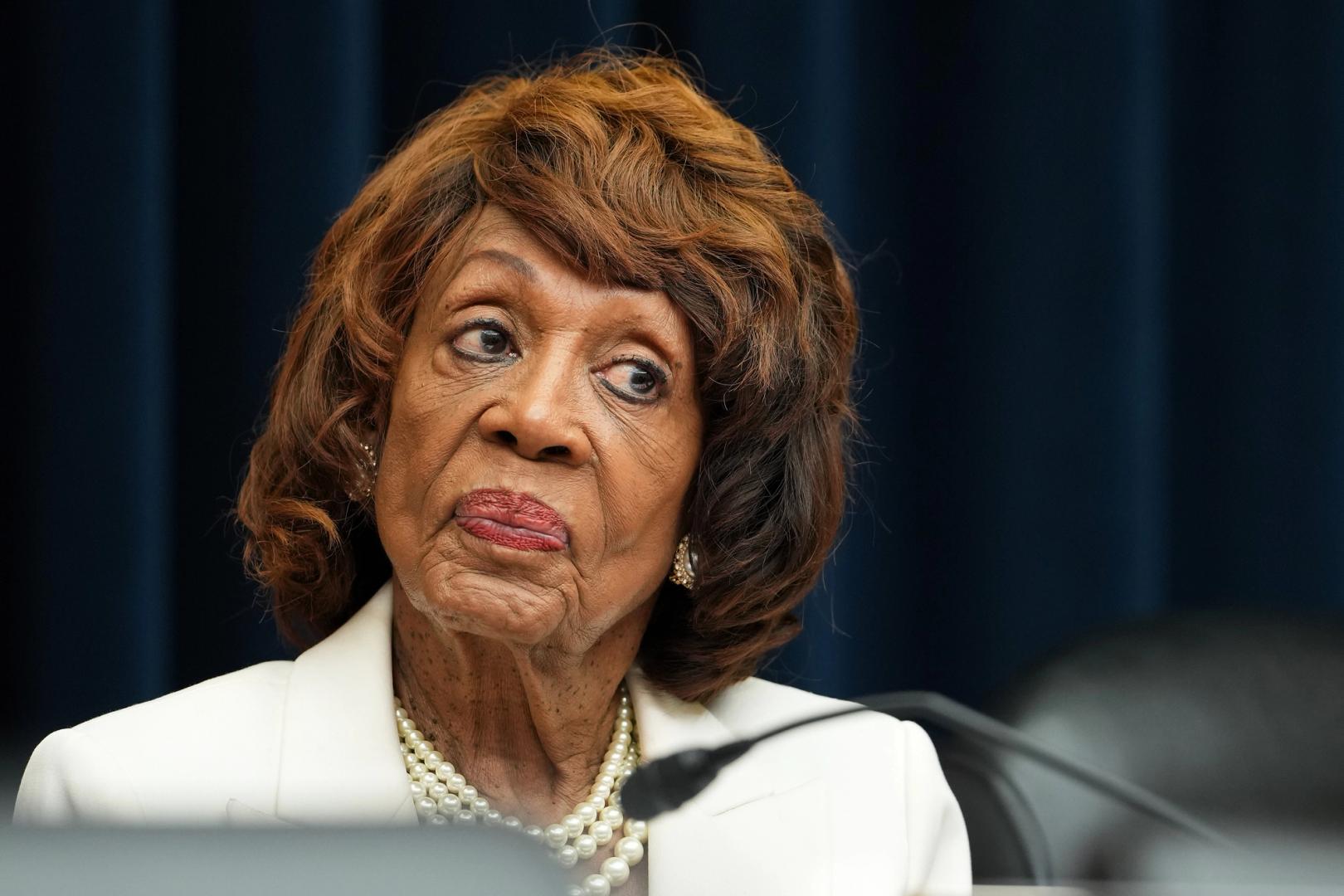
“I voted against the GENIUS and Clarity acts because they fail to adequately address abuse and instead open the door to corruption,” she said last year. “At a time when the current occupant of the Oval Office is personally benefiting from crypto and memecoin ventures, these bills do nothing to close conflict-of-interest loopholes.”
But if Waters and Brown are running the crypto show in the House, the White House will still have its same occupant. Even if the Democrats win a stronger majority than the narrow GOP advantage of the past two years, the next session could become a mess of go-nowhere, message-sending bills. If the party won the Senate majority, too, that wouldn’t help assure Democrats an ability to get legislation converted to law.
On the Senate side, Senator Warren has been among the crypto industry’s most prominent Capitol Hill detractors, trying to keep a steady spotlight on what she’s portrayed as the president’s crypto corruption. However, under her time as the ranking Democrat on the Senate Banking Committee, she watched her fellow Democrats go against her on crypto matters, gathering for negotiations on the legislation she opposed.
She may have more sway were she to lead the committee and control the advancement of her members’ bills. If she were to follow in the footsteps of the most recent Democrat who ran the banking panel, former Senator Sherrod Brown, she could go for years without allowing a crypto measure through the gate. (Brown, who was defeated by Republican crypto advocate Senator Bernie Moreno two years ago with the help of a massive $40 million crypto PAC boost, is also running again for the other Ohio Senate seat.)


Bitcoin (BTC) whales and spot exchange-traded funds (ETFs) are absorbing supply, yet on-chain data shows the wider recovery still lacks depth.
Strong accumulation now sits against weak network activity and thinning liquidity, suggesting the market has not yet moved from a fragile bounce to a durable trend.
The Accumulation Case Looks Strong
CryptoQuant data show that addresses holding more than 10,000 BTC accumulated 46,420 BTC over a 60-day period through August 9. That reading is the highest since March 15 and nearly double the mid-March peak of 23,238 BTC.
Wallets holding 0.1 to 1 BTC reduced balances by roughly 9,700 BTC over the same period.
“This is a notable shift in positioning. The largest holders are increasing their exposure while smaller holders are reducing theirs,” an analyst wrote.
Santiment separately counted 90 wallets holding at least 10,000 BTC, a six-month high.
Follow us on X to get the latest news as it happens
Institutional demand also strengthened last week. Spot Bitcoin ETFs drew about $853.54 million in the week ending August 7. That was their best week since April 17, according to SoSoValue.
Why Bitcoin’s Recovery Still Looks Fragile
Nonetheless, the latest signals look softer. Spot Bitcoin ETFs reversed to a net outflow on Monday, an early sign that the inflow streak may be losing momentum.
Glassnode also reported that active addresses, transfer volume, and fee generation have drifted toward lower bounds. Profitability has improved only modestly, and realized losses still exceed realized profits on-chain.
The report describes the market as a transitional recovery that has yet to broaden into a full expansion.
“Improving institutional flows, stronger taker demand, and less defensive options positioning provide a constructive backdrop, but subdued spot liquidity and weak network activity suggest the recovery has yet to develop into a broad-based expansion,” the firm said.
Liquidity also remains thin. One CryptoQuant analyst noted monthly trading volume on Binance fell about 45% year-over-year in July, while OKX dropped roughly 57%. Shrinking depth lets modest flows swing prices sharply.
Another CryptoQuant analyst flagged a bearish top formation, with a downside target near $51,336, about 21% below current levels.
With US inflation data due this week, the coming sessions may show whether accumulation can pull the recovery wider.
Subscribe to our YouTube channel to watch leaders and journalists provide expert insights
The post Bitcoin Whales Add 46,000 BTC but Weak Network Activity Clouds Recovery appeared first on BeInCrypto.
Michael Saylor’s Strategy has sold 6,948 BTC in 2026, raising $431.8 million as part of its BTC monetization program.
Saylor first announced in May that Strategy would soon start selling its BTC. Then in late June, the company revealed it would sell its accrued BTC as part of a monetization program to raise $1.25 billion for its USD reserve.
The money would be spent on preferred stock dividends, digital credit securities or Class A common stock.
Strategy’s K-8 filings reveal that its first sale of 32 BTC took place in late May. This sale made the firm $2.5 million while BTC was worth $77,135 at the time.
The company then sold:
- 1,363 BTC between June 29 and June 30
- 2,225 BTC between July 1 and July 5
- 1,638 BTC between July 27 and August 2
- 1,690 BTC between August 3 and August 9
This most recent sale is reflected in Strategy’s latest filing.
Read more: Is a crisis brewing at Crypto.com?
These sales netted the firm $80.8 million, $135.2 million, $104.73 million, and $108.6 million, respectively. The price of BTC has fallen 13% since the selling began.
Before June 21, Strategy was mostly buying BTC, building up 163,554 BTC in 2026. These purchases cost the firm over $12.7 billion.
Strategy’s first BTC purchase was in August 2020, when it spent $250 million buying 21,454 BTC.
As of August 9, the company now holds 840,447 BTC, currently worth $53.82 billion.
It paid $63.36 billion for all this BTC, which means that it is down -$9.5 billion on its BTC investments.
Even with its $4.65 billion USD reserve included with its BTC horde, that’s still $4.9 billion less than it bought all the BTC for.
Read more: Every time Michael Saylor said he’d never sell bitcoin
Saylor’s pivot to offloading BTC was controversial among followers who believed him when he said he wouldn’t be selling.
Strategy had only ever sold BTC once back in 2022, before buying significantly more BTC two days later.
In February 2025, when BTC was above $84,000, Saylor famously said, “Sell a kidney if you must, but keep the BTC.”
The price of the asset has since fallen 24% to $64,042, while his advice was ultimately abandoned by his firm.
Got a tip? Send us an email securely via Protos Leaks. For more informed news and investigations, follow us on X, Bluesky, and Google News, or subscribe to our YouTube channel.
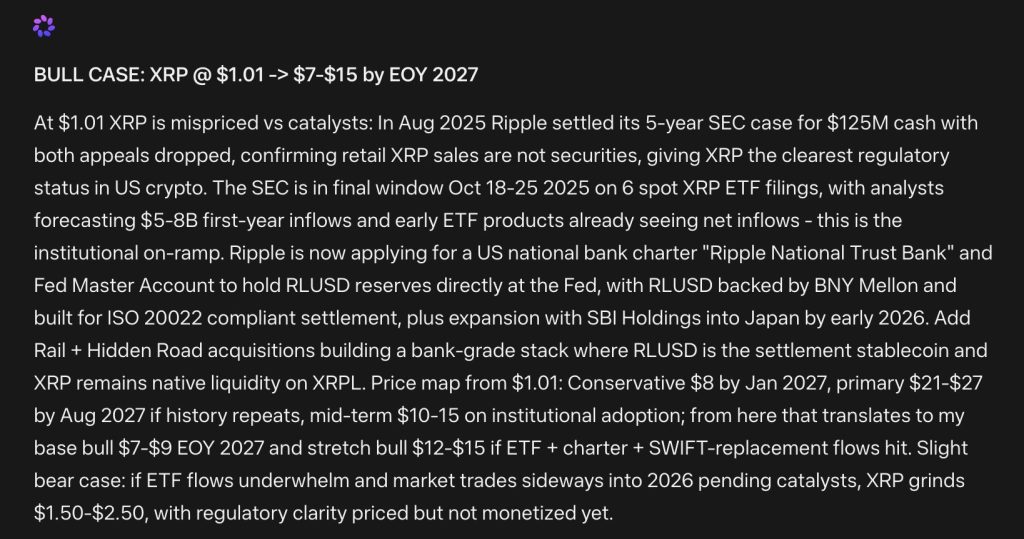
A bank charter application changes what a token can become. Meta AI predicts XRP is mispriced against that backdrop at $1.01, and the price prediction reaches $7 to $9 by the end of 2027 with a stretch case of $12 to $15.
The regulatory foundation came first. Ripple settled its 5-year SEC case for $125M cash in August 2025 with both appeals dropped, confirming retail XRP sales are not securities.
Meta AI calls that the clearest regulatory status in U.S. crypto. Six spot XRP ETF filings followed, with analysts forecasting $5B to $8B in first-year inflows.
Early ETF products are already seeing net inflows. That is the institutional on-ramp the thesis depends on.
The banking layer is more ambitious. Ripple is applying for a U.S. national bank charter and a Fed Master Account to hold RLUSD reserves directly at the Fed.
RLUSD is backed by BNY Mellon and built for ISO 20022 compliant settlement. Expansion into Japan with SBI Holdings arrives by early 2026.
The Rail and Hidden Road acquisitions build a bank-grade stack around it. RLUSD becomes the settlement stablecoin while XRP remains native liquidity on the ledger.
The bear case is a matter of timing. If ETF flows underwhelm and the market trades sideways into 2026 pending catalysts, XRP grinds between $1.50 and $2.50, with regulatory clarity priced but not monetized.

Discover: Everyone’s Got a Take. Get Free $25 to Actually Trade Yours
XRP Price Prediction: Ripple Wants A Seat At The Fed And XRP Sits At A Dollar
The chart offers no support for any of this yet. XRP traded above $3.30 last August and has fallen consistently since. October brought a sharp drop toward $2.40. February broke $1.80 and carried price down near $1.15.
Spring built a range between $1.30 and $1.55. June ended it, and the decline has not paused since. July and August have produced a slow bleed lower. Price now sits at the lowest level anywhere on this chart.
The close reads $1.02208, down 0.69% and $0.00709 on the day. The session ranged from $1.01505 to $1.04020. Support sits at $1.01, then $1.00 as the psychological floor beneath it. Resistance appears at $1.10, then $1.20 and $1.40.
RSI reads 37.09 with its signal line above at 41.54. The oscillator trails by roughly 4.5 points, which confirms sellers still hold the market.
That reading sits near oversold territory without entering it. Momentum is weak and pointed downward.
Meta AI is describing infrastructure being assembled while price ignores it. Reclaiming $1.10 would be the first small sign that gap is starting to close.
Discover: Your Market Calls Are Worth Something. Start With Free $25 on Kalshi
Everyone’s got a Predicts Even Meta AI, Yours Can Carry a Price And Make You Money.
Reading the chart is free. Backing the call costs something, which is exactly why the odds on Kalshi tend to move before the headlines do.
It’s a CFTC-regulated exchange for event contracts: the Fed, inflation, crypto price levels, resolved against a defined source. Being right on a slow timeline still loses if the contract expires first, so mind the dates.
→ Get up to $25 to trade your first market on Kalshi
Don’t Miss Out on Our $1,000 USDT Airdrop on ByBit
The post Mark Zuckerberg Meta AI Predicts XRP Could Be the Story of 2027 appeared first on Cryptonews.

Everpure (P) stock jumped in early trading Tuesday on news that the data storage company has landed its second “design win” with a top-five cloud hyperscaler. The rally is extending a recent break out for Everpure, which has climbed 46% year-to-date. Everpure — recently rebranded from the name Pure Storage — announced the design win and supply agreement in a…
Copyright ©2026 Investor’s Business Daily, LLC. All rights reserved. 87990cbe856818d5eddac44c7b1cdeb8
Bitcoin Knots said on August 11 that it plans to choose a new proof-of-work algorithm for the stalled BIP-110 chain after the minority fork produced only two blocks.
The move sets up another confrontation over Bitcoin’s block policy, while the main network continues producing blocks normally.
Knots Pushes New Algorithm as the Fork Stalls
Knots told users not to downgrade or switch to software that weakens Bitcoin’s consensus rules, warning that doing so could expose them to false confirmations from invalid blocks.
Anyone who had already switched was told to upgrade to the latest Knots client, which the project said would attempt to repair the chain state automatically, and miners restarting nodes were told to add the line maxtipage=2592000 to their configuration file.
It also said a new proof-of-work algorithm would be selected at 14:00 UTC on August 11 through a deterministic random process among proposed candidates. A hash was posted alongside the algorithm announcement as what Knots called a proof of fairness for the random selection process.
The announcement came after the BIP-110 chain stopped at block 961,633, as had been reported by CryptoPotato.
“The Bitcoin network is under attack, and block production has slowed significantly,” wrote the Knots team. “The community is preparing mitigations to resolve the situation.”
However, a community note attached to the post pointed out that the main Bitcoin chain had continued normally. It described the reported “attack” and slowdown as affecting only the minority BIP-110 fork, which split at block 961,632 with roughly 2.5% support.
The episode has also exposed a sharp disagreement over what constitutes Bitcoin consensus. In a Sunday post, Adam Back argued that BIP-110 lacked sufficient consensus and that economic users and the market had effectively ignored the fork.
Luke Dashjr takes the opposite view. He wrote that BIP-110 has community support and argued that a proof-of-work change could remove the miners he considers responsible for attacking the fork. He later said, “There’s only one Bitcoin chain, and it just activated BIP110.”
The developer has also reportedly been removed as an editor of Bitcoin’s formal improvement proposal repository this week over what was described as a conflict of interest in how he handled the proposal.
Miners and Developers Remain Split
The mining pool Roughnecks, which had been producing blocks on the BIP-110 branch, announced early Saturday that it was pausing operations, calling the pause an escalation rather than a retreat. By Sunday, it reversed course, saying it would resume mining “ASAP” on the stalled chain tip using software it referred to as Knots-RDTS, adding, “We’re wildcatting again.”
Trey Sellers, a Bitcoin holder active in the replies, questioned the economics of that decision, noting that block rewards need 100 confirmations to mature and the fork was producing at most one block a day. Roughnecks responded that it doesn’t give financial advice and that participants should expect the possibility of no return at all.
By the time Roughnecks posted its Sunday update, the main Bitcoin chain had already reached block 961,865, and later tracking put the gap even wider, with one monitor showing the standard chain at 961,980 against a BIP-110 branch still stuck at 961,633.
Bitcoin’s price barely reacted to any of the drama and was trading around $64,000 at the time of writing, down just over 1% in 24 hours and about 47% below its level a year ago, after twice failing to hold above $65,400 in recent sessions.
The post Bitcoin Knots Plans New Proof-of-Work Algorithm After BIP-110 Enforcement Fails appeared first on CryptoPotato.
Crypto World
Bitcoin (BTC) price stuck below $65,000 as Iran stalemate, Strategy sale squeeze market
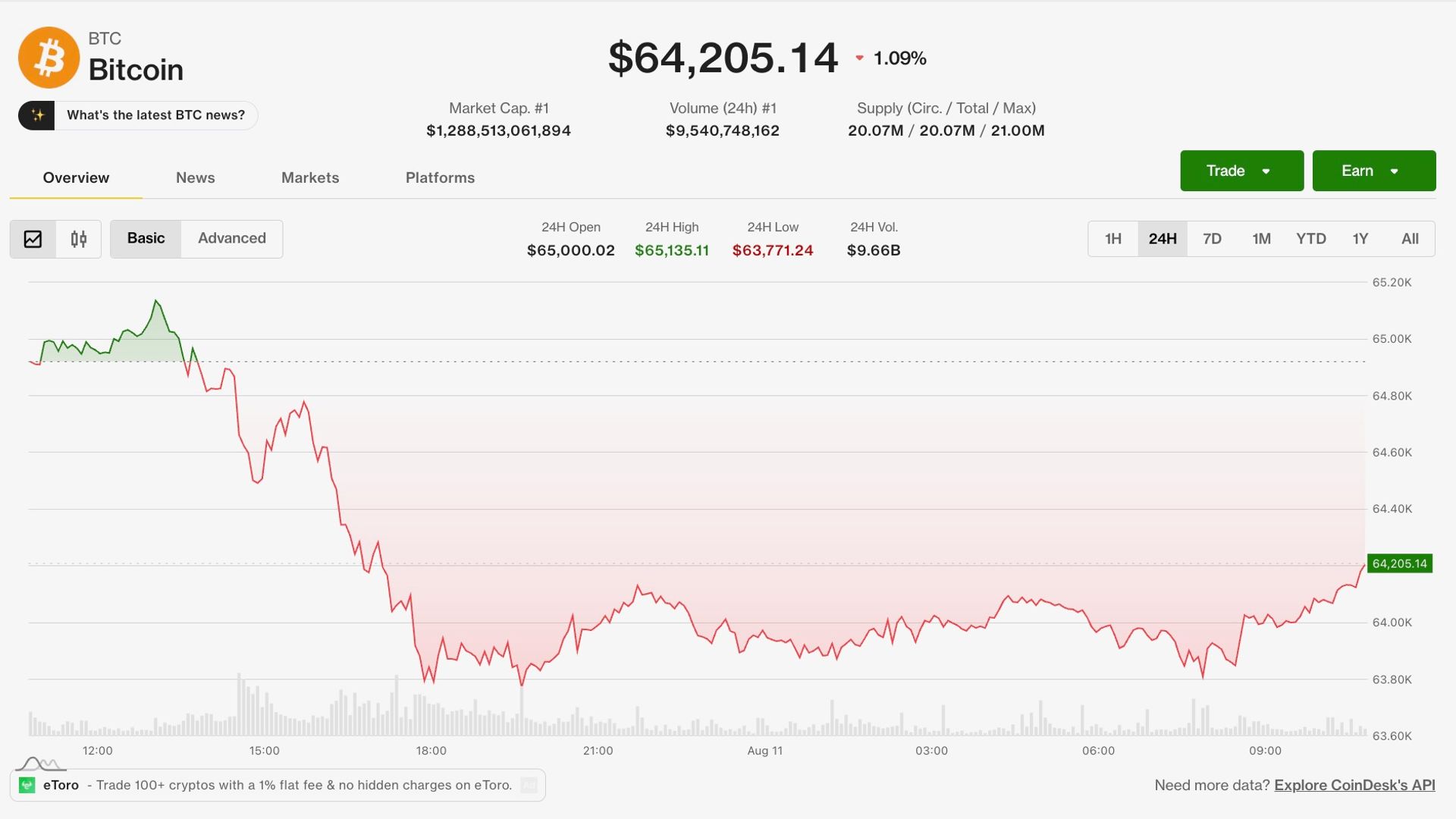
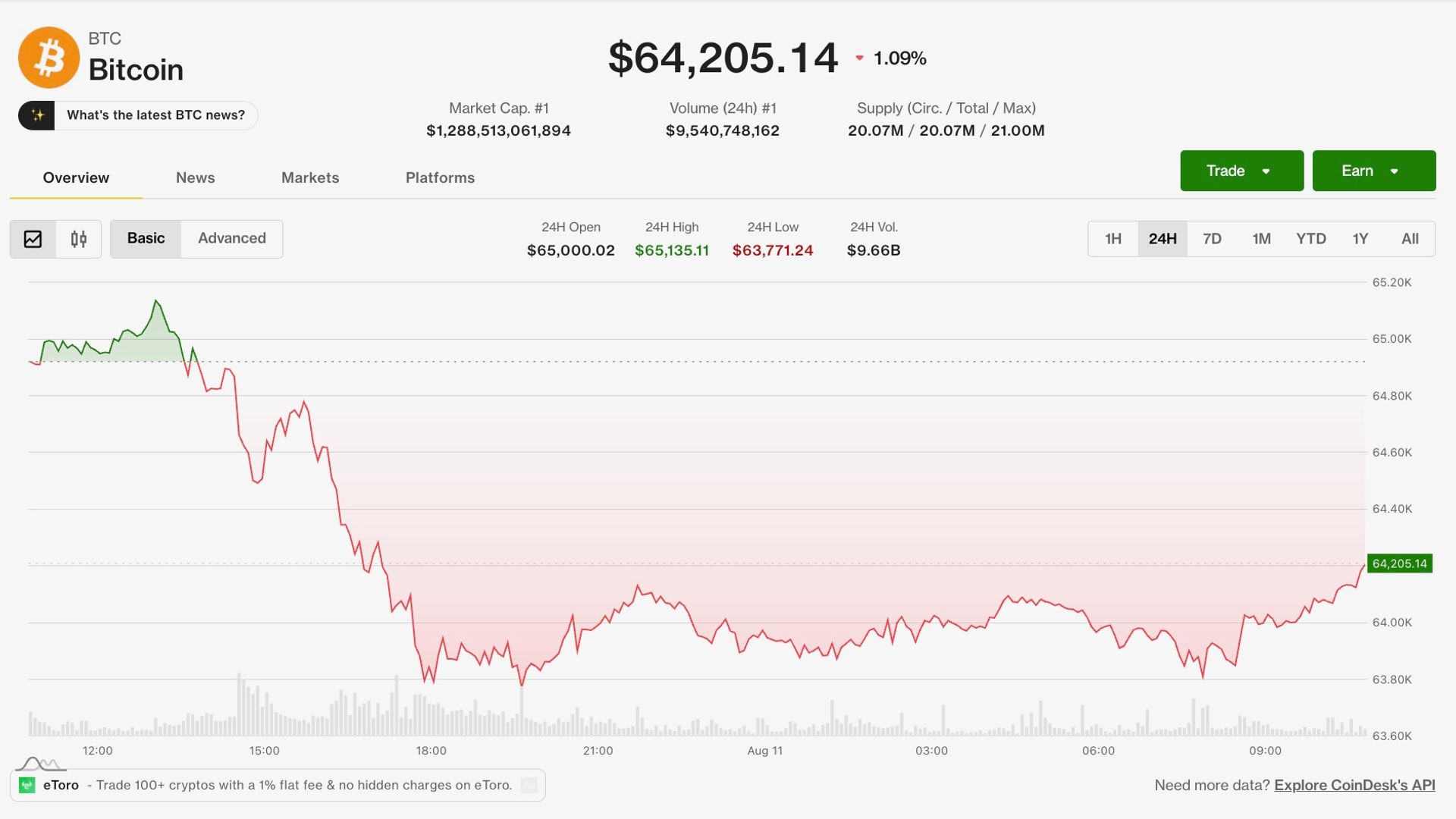
The crypto market was little changed on Tuesday after falling overnight as the short-lived optimism around a Strait of Hormuz deal evaporated.
President Donald Trump’s demand for 50 years of compensation from Iran as a condition of any negotiation dashed hopes of a near-term resolution and pushed Brent crude up to $89.08, more than 12% above last week’s low.
Bitcoin has gained 0.26% since midnight UTC, but remains down 1.68% over the past 24 hours. Ether , outpacing bitcoin since midnight, is 2.4% lower on the day. Traditional markets are equally subdued, with U.S. equity index futures remaining flat as traders focus on Wednesday’s CPI report as the week’s key catalyst.
Strategy’s sale of a further 1,690 BTC on Monday, the fourth consecutive weekly reduction, added an extra layer of pressure. The company has not bought bitcoin since June.
Derivatives positioning
- Futures volume surges, open interest flat: Trading volume in crypto futures surged 51% to $143.15 billion in 24 hours. Total open interest (OI) remained steady around $115.6 billion, signaling churn rather than fresh positional trading.
- Taker ratio turns neutral: The long-short taker volume ratio has reverted to neutral, with longs and shorts each accounting for nearly half of volume, versus a bullish tilt a day earlier. A taker is an entity that sucks liquidity from an order book by trading at available prices.
- XRP leads OI gains: Payments-focused token XRP added the most OI of the day, with active futures contracts growing 14% to 2.72 billion tokens, the highest since October. XRP remains under pressure, threatening to dip below $1 for the first time since 2024. The downside pressure is evident in XRP’s negative 24-hour cumulative volume delta (CVD), showing shorts trading more aggressively via market orders than passive limit orders. The lone bright spot: Funding rates remain slightly positive.
- Other OI movers: LINK, ETH and HBAR are among the other OI gainers, while CC, ZEC and AVAX are the leading OI losers.
- Bears lead the price action: Bears appear to be leading price action in most tokens, as evidenced by negative 24-hour CVD for most coins, including bitcoin. LINK and TRX are the exceptions.
- Funding rates diverge: XMR’s funding rate hovers at an annualized 39%, the most bullish among majors, while CC’s sits at -14%, the most negative, indicating an investor bias toward bearish bets.
- Bitcoin volatility index bounces: Bitcoin’s 30-day implied volatility index, BVIV, abandoned its long-held floor of around 36% to jump nearly 5% to 38.64% as BTC’s spot price fell back below $64,000. Traders might want to keep an eye out for a continued spike in the index, given its inverse correlation with spot price.
- Call skew weakens: In the Deribit-listed options market, the one-week call skew in BTC and ETH weakened and may flip negative, suggesting a fresh downside bias if Wednesday’s U.S. CPI print comes in hotter than expected, validating higher-for-longer Fed interest-rate expectations.
- Implied Volatility Stays Compressed: For now, one-week implied volatility for BTC and ETH, calculated from options prices, remains compressed, pointing to little stress ahead of the inflation report.
- Volume leans toward upside bets: The 24-hour volume rankings show a bias toward the BTC $70,000 call expiring Sept. 25 and the $2,000 ETH call expiring the same day.
Token talk
- Curve DAO token was the 24-hour standout, surging 9.49% and extending a weekly gain of 27.29%, making it one of the stronger DeFi performers in a difficult market.
- Lighter (LIT) added to its recovery, advancing 6.40% over 24 hours and 2.26% since midnight to $2.43. It is now up nearly 20% on the week as the decentralized derivatives token rebuilds from its July pullback.
- Chainlink gained 2.59% since midnight, extending a run that has it up 4.40% on the week as institutional demand for oracle infrastructure picks up in tandem with the tokenized real-world asset narrative.
- Zcash (ZEC) led the losses, falling 1.97% since midnight to $486, giving back ground after several weeks of outperformance. The broader privacy coin sector is also under pressure, and XMR shed 0.72%.
- CoinMarketCap’s “Altcoin Season” indicator recovered from Monday’s low of 37/100, rising to 41/100 as investors stepped in to capitalize on oversold tokens.


SharpLink, the second-largest Ether treasury company, reported a net loss of $394 million for the second quarter of 2026, compared to a $103 million net loss during the same period last year.
The loss included $321 million in unrealized crypto losses and $76 million in impairments on staked Ether (ETH) tokens, according to a Monday announcement.
The Miami, Florida-based Ether treasury company said it generated $11.5 million in revenue, including $11.1 million from ETH staking. Cash and cash equivalents totaled $56 million, up from $28 million in December 2025.
SharpLink holds 632,784 Ether, worth $1.2 billion, and 181,321 ETH, or $343 million, through various liquid staked Ether tokens, which exposes the company to the second-biggest crypto’s price movement. Ether fell around 23% during the second quarter of 2026, according to CoinMarketCap.
SharpLink resumed its Ether purchases with a $7.8 million buy in late June, after pausing buying for eight months. It bought another 10,000 Ether for about $16 million days later.
SharpLink’s stock price fell 3.9% on Monday, extending its 30% year-to-date decline, according to Yahoo Finance data.
The company ranks as the second-largest Ether treasury company, with its current 863,000 ETH holdings worth $1.46 billion. Bitmine is the largest corporate Ether holder, with 5.54 million ETH, worth $9.4 billion, according to StrategicEthReserve data.
Magazine: Ethereum’s EEZ could pull other blockchains into its orbit

UK weather: Summer 2026 on course to be hottest on record, says Met Office
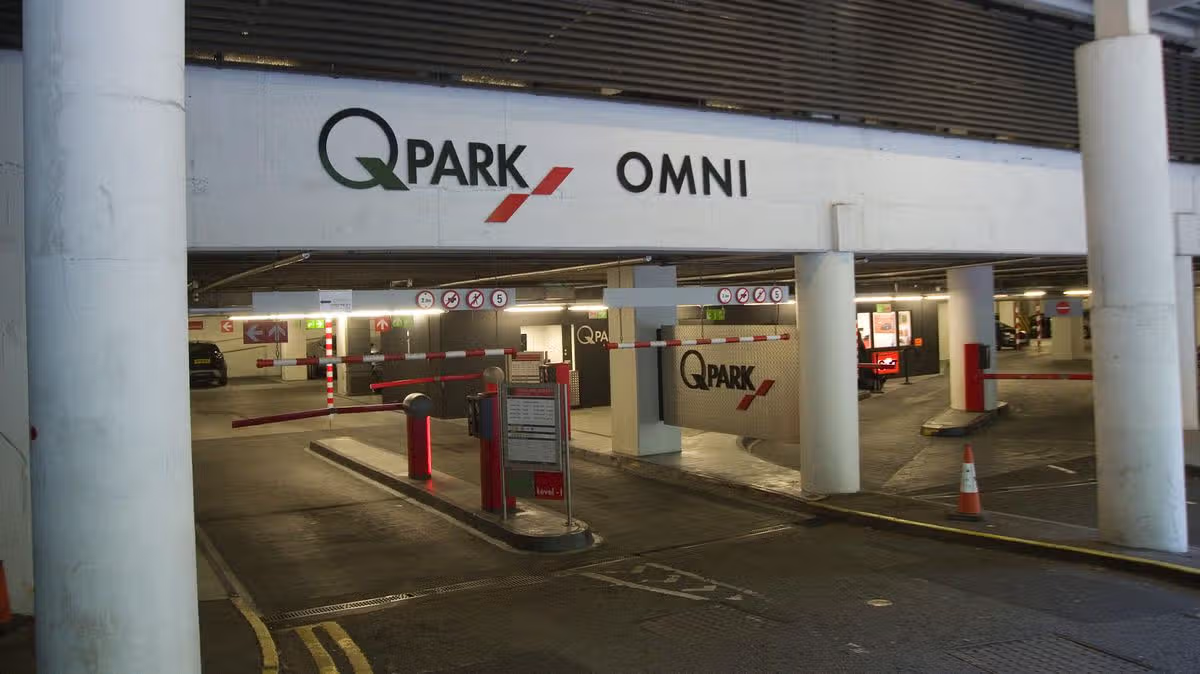
Q-Park takes on 20 former NCP car parks

The controversial return of Pudgy Penguins founder ColeThereum


-

 Fashion4 days ago
Weekend Open Thread: Mattifying Sunscreen
-

 Fashion4 days ago
Frugal Friday’s Workwear Report: Cap-Sleeve Pointelle Crewneck Sweater
-

 Sports6 days ago
Jordan Coyle & Cordiamo take Laya Arena Stakes at RDS
-

 News Videos3 days ago
Can Astrology Help Find Gold and Silver Trends? A Financial Astrology Guide
-
 Business6 days ago
US stocks: Dow closes at record on Mideast optimism; SpaceX, AMD drag Nasdaq
-

 Politics5 days ago
Reform UK And Greens Sink To Lowest Favourability Ratings To Date
-

 Business7 days ago
Nvidia Stock Climbs 2.5% as Chip Sector Rally Builds Ahead of AMD Earnings, Nvidia’s Own Report Looms
-

 Tech7 days ago
OpenAI, Anthropic AI agents targeted real people and systems in cyber tests
-

 Crypto World7 days ago
Polymarket targets $20 billion valuation as competition heats up in prediction market sector
-

 Business6 days ago
Supply chain issues impact Ingredion
-

 Tech4 days ago
Rinn Pharma & Biopharma to join NordicPharmaTrain network
-

 Business2 days ago
How to Start a Cleaning Business: A Step-by-Step Guide
-
 Crypto World7 days ago
Dow and S&P 500 Hit Records on AI Earnings: When Will the Bubble Burst?
-

 Business2 days ago
Datadog: Best Of Breed For Multiple Reasons
-

 Business3 days ago
BDC Weekly Review: Private BDC Q2 Numbers Are Strong
-
 Crypto World7 days ago
Dollar Index Trapped at 100 as Hawkish Fed Meets Official Selling
-

 Business6 days ago
McDonald’s (MCD) Q2 2026 earnings
-

 Fashion6 days ago
The Bright Side of Black and White
-

 Fashion6 days ago
Suit of the Week: Me + Em
-

 Business7 days ago
Apple UK encryption challenge filed against Home Office
You must be logged in to post a comment Login