
Crypto World
Moonshot’s Kimi rattled markets. U.S. agencies now say it was trained on American models



Moonshot, whose Kimi model rattled markets earlier this year, is among six Chinese AI firms accused of systematically extracting capabilities from U.S. models.



Cointelegraph is committed to providing independent, high-quality journalism across the crypto, blockchain, AI, and fintech industries.
All news, reviews, and analyses are produced with full journalistic independence and integrity. For more details on our standards and processes, please read our Editorial Policy.


Biden says the token is about “resilience, redemption and recovery” and will give coins to nearly one million wallets that lost money on TRUMP.

Bitcoin staged a strong rally in August, surging by almost 30%. While some believe that the bear market is over, others argue that the risk of a devastating plunge still lurks over the world’s largest crypto asset.
Alphractal founder Joao Wedson said that BTC’s Balanced Price currently stands near $38,400, but historical evolution does not necessarily mean prices must return to that level.
Deep Bottom Pattern
The Balanced Price metric has historically been effective at identifying deep cycle bottoms of the crypto asset, but the cumulative time between its main interactions with the zone has continued to increase, moving from 732 days to 1,120, then 1,200, and 1,420 days.
In the current cycle, Bitcoin has already spent approximately 1,400 days since its last interaction with the Balanced Price. At the same time, the amount of time BTC spends below the metric has steadily declined. Earlier cycles saw prices stay below it for several weeks, later for around 20 days, and in 2022, the asset remained below the zone for practically just one day.
The Balanced Price is currently near $38,400. It adjusts Bitcoin’s aggregate market cost basis using the long-term spending footprint of older coins and creates a valuation zone that has historically appeared during periods of extreme capitulation. While this does not mean it must return to $38,000, Wedson’s observation raises the possibility that BTC could eventually break from its historical pattern and never revisit the zone. If the pattern does repeat, however, the $40,000 region may still have an on-chain basis as a possible capitulation target.
Meanwhile, Bitcoin investors are becoming increasingly confident that the market bottom is already behind them. Wedson found that “Very Bullish” sentiment is now dominating social media. This conviction is far stronger than the uncertainty seen after the late-2022 and early-2023 bottom. However, such widespread optimism could become a risk of its own, particularly if bullish traders are caught off guard by another sharp decline.
In that scenario, forced liquidations among bulls may trigger another wave of selling.
Faster Path to a New ATH
One trader expects the crypto asset to set a new all-time high in Q4 next year and believes that it could be trading above $126,000 by November 2027. Killa said that Bitcoin’s market cycles are continuing to shorten, which has helped it to reach new all-time highs faster with each cycle. Based on the 2022 cycle alone, he estimates that BTC should establish a new ATH no later than February 2028.
However, the trader claimed that the current cycle is moving faster, after having bottomed roughly three to four months earlier, which could bring the timeline forward.
The post Bitcoin’s Historic Capitulation Zone Is Near $38.4K: But Something Is Changing appeared first on CryptoPotato.
Bybit launched three FX perpetual contracts on Sept. 8, expanding its derivatives business into major global currency markets. The exchange introduced USDT-settled contracts tracking EUR/USD, GBP/USD and USD/JPY.
Summary
- Bybit launched USDT-settled perpetual contracts tracking EUR/USD, GBP/USD and USD/JPY with continuous trading and leverage.
- All three contracts offer maximum leverage of 100x and remain tradable around the clock daily.
- Traders receive price exposure without owning euros, pounds, dollars, yen, or underlying currency deposits directly.
- The products use USDT collateral, indefinite maturities, funding rates, and Bybit’s Unified Trading Account system.
- Global over-the-counter foreign exchange turnover averaged $9.6 trillion daily during April 2025, BIS data showed.
The Bybit FX perpetuals operate continuously and offer leverage of up to 100x. They do not expire. Traders can therefore maintain positions without rolling contracts into later maturities, although periodic funding payments may affect the cost of holding them.
The contracts provide synthetic exposure to currency movements. Buyers do not own euros, pounds, dollars or yen. Profits, losses and collateral are denominated in USDT.
Bybit FX perpetuals provide synthetic currency exposure
The three products follow their respective spot exchange rates, according to Bybit’s official release. Their tickers are EURUSDUSDT, GBPUSDUSDT and USDJPYUSDT.
Bybit integrated the contracts with its Unified Trading Account. The exchange also applies funding rates and dynamic leverage, using mechanisms commonly found in cryptocurrency perpetual markets to keep contract prices close to their reference rates.
Continuous trading is a key difference from conventional FX access. The contracts remain available on weekends and holidays, when activity in the underlying institutional foreign exchange market is limited or closed.
That feature also creates additional pricing risk. Weekend news may cause a Bybit contract to move before deeper FX markets reopen. Thin liquidity or a lack of active price discovery could widen spreads and produce temporary differences between the perpetual contract and its underlying reference.
Leverage of 100x increases liquidation exposure
Bybit allows maximum leverage of 100x on the new contracts. High leverage lets traders control positions much larger than their posted collateral, but it also reduces the price movement needed to trigger liquidation.
The precise liquidation level depends on entry price, maintenance margin, fees and the exchange’s risk rules. Funding payments can also reduce returns or increase losses when positions remain open for extended periods.
USDT settlement removes the need to hold each underlying currency. However, it introduces exposure to the stablecoin and to Bybit’s custody, liquidation and settlement systems. These risks differ from holding currency through a bank or regulated foreign exchange broker.
Bybit said the products are intended for traders who understand leveraged derivatives. Access may also depend on jurisdiction, account eligibility and local regulations. The launch announcement did not establish that the contracts would be available to every Bybit customer.
Bybit expands a suite covering more than 200 assets
The listings extend Bybit’s TradFi Perpetuals suite, which launched in April 2026. The exchange says the range now covers more than 200 products tied to equities, commodities, exchange-traded funds and pre-IPO companies.
Crypto exchanges have increasingly added derivatives linked to traditional assets. As crypto.news previously reported, open interest in TradFi perpetuals exceeded $2 billion between late May and July, based on CryptoQuant data. Binance, Bybit and Gate accounted for about 70% of the segment in that report.
In related coverage, Bybit expanded its TradFi lineup beyond 200 contracts after adding synthetic products linked to Unitree Robotics and Moonshot AI. Those instruments also provide price exposure without ownership of the referenced companies.
The FX launch broadens that strategy from stocks and commodities into currency trading. Bybit did not publish opening volume, liquidity or open-interest figures for the three new contracts. There was therefore no verified market reaction available at publication.
Crypto exchanges target the $9.6 trillion FX market
Foreign exchange remains the world’s largest over-the-counter financial market. Daily turnover averaged $9.6 trillion in April 2025, up 28% from $7.5 trillion in 2022, according to official data from the Bank for International Settlements.
Bybit is entering a market already targeted by other crypto exchanges. Kraken introduced five FX perpetual futures in April 2025 with leverage reaching 50x, according to its product announcement. BitMEX followed in April 2026 with six currency pairs offering leverage of up to 100x, its official release showed.
The next test will be whether Bybit can maintain deep liquidity and close tracking during weekends, holidays and periods of currency volatility. Funding rates, spreads and index methodology will determine how closely the contracts follow the underlying FX market.
Traders will also need to monitor regional restrictions and contract specifications. Bybit has not announced additional currency pairs or a timetable for expanding the FX range.
AI is splitting the Magnificent Seven into separate camps instead of lifting the group as one trade, Plexo Capital founding managing partner Lo Toney told CNBC’s “Squawk Box” this week.
CNBC’s Jim Cramer had urged investors days earlier to revisit the group, arguing years of AI spending are starting to pay off. “I think it’s time to buy,” Cramer said.
The Magnificent Seven’s AI Divide
Toney pushed back on treating the seven stocks as one trade again. He said two things now separate them, infrastructure control and the ability to profit from it.
Hyperscalers are cloud giants building massive AI data centers. Toney places Google, Microsoft, and Amazon in this group. They still must prove that spending pays off, a test also facing other Nasdaq stocks that already doubled this year.
Meta and Apple sit in a different category, Toney said. They do not need AI as a standalone business. Instead, they use it to strengthen advertising and hardware franchises they already own.
Tesla is a third case. It is turning AI into physical products and services, a path carrying its own regulatory and profitability questions, Toney said.
Nvidia (NVDA) sits apart too. Toney said the chipmaker profits while its customers prove out the economics themselves. That position now extends into software.
Nvidia agreed on September 3 to buy the open-source AI platform Hugging Face for about $12.9 billion. Its own upcoming earnings remain the clearest test of whether that spending is paying off broadly.
Google’s AI Advantage
Applying his framework, Toney named Alphabet’s Google (GOOGL) as his preferred pick. It owns its data centers and custom chips while monetizing AI through search, YouTube, cloud, and its self-driving unit, Waymo.
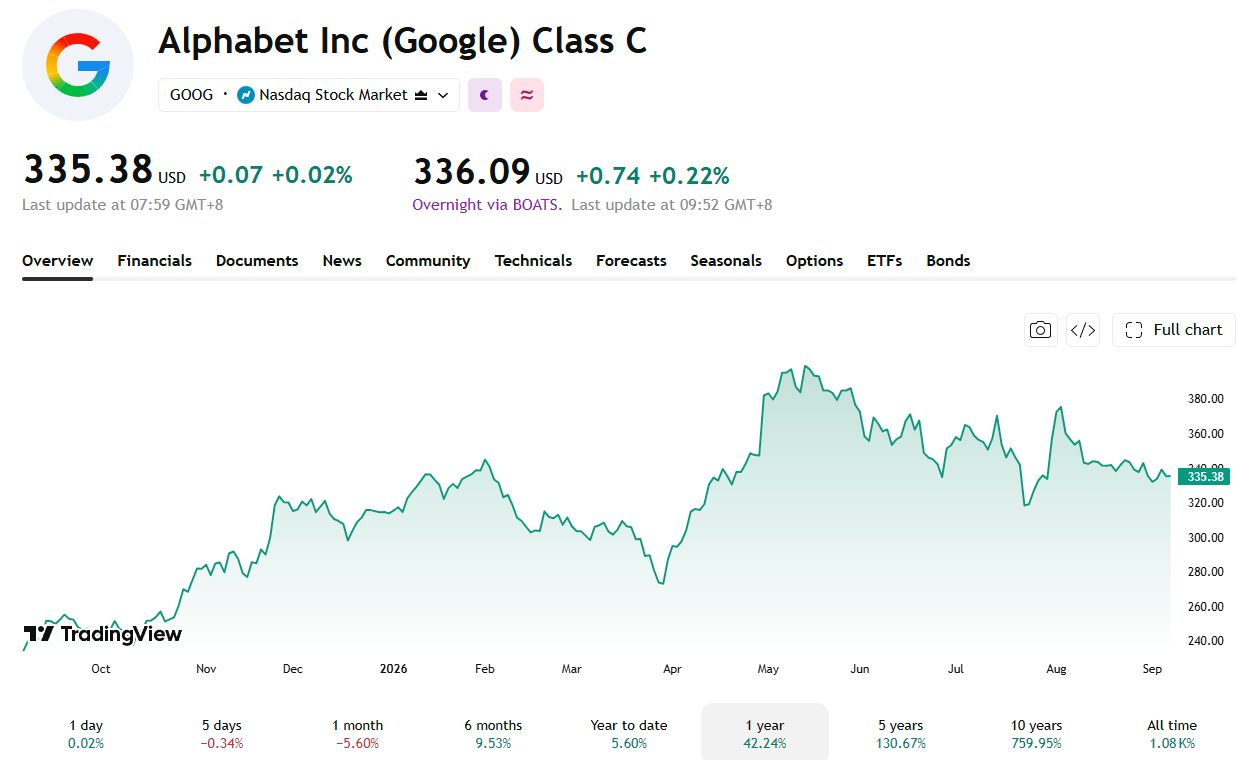
He pointed to Google shares up roughly 42% in the last 12 months against a Wall Street consensus target implying about 25% more upside, a wider gap than most peers Jim Cramer has recently favored.

Not every Magnificent Seven stock will move together as AI reshapes their economics. Some names still owe investors proof that spending converts to profit, while Toney argues others are already collecting.
The post AI Is Splitting the Magnificent Seven Into Winners and Laggards, Says Lo Toney appeared first on BeInCrypto.
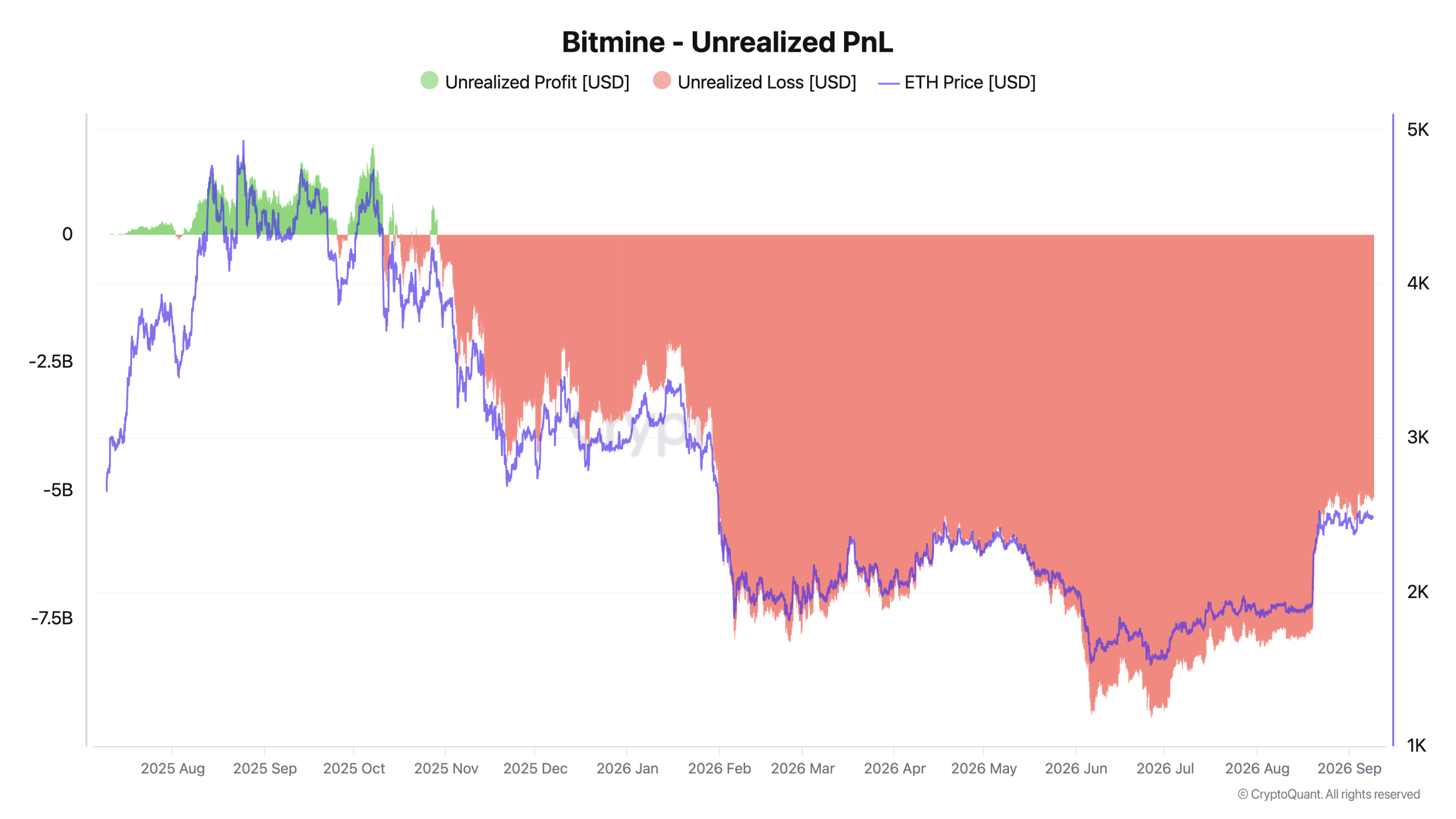
BitMine Immersion Technologies chairman Tom Lee expects institutions to buy crypto after a strong quarter so far. The firm holds 5.9 million Ethereum (ETH) tokens that sit far below their purchase cost.
The company valued its combined crypto, cash, and equity holdings at $15.7 billion on September 7.
Lee Points to a Quarter Crypto Led
In the firm’s weekly update, Lee said ETH has been the best-performing macro asset during the quarter. He put its lead over the S&P 500 at 5,430 basis points through last Friday. ETH, Bitcoin (BTC), and Solana (SOL) rank as the top three assets since June 30.
He tied that run directly to institutional demand.
“We believe this sets the stage for institutions to add to their crypto holdings given the substantial outperformance of crypto versus other macro assets in calendar Q3 so far,” Lee said.
The statement came alongside a buying update. BitMine acquired 28,086 ETH over the past week, lifting total holdings to 5.9 million tokens.
Each purchase pulls the firm closer to 5% of the supply and deeper into a position that is underwater. CryptoQuant data puts the unrealized losses at roughly $5 billion.
Follow us on X to get the latest news as it happens

ETH’s rally has narrowed that shortfall. The token has added 29.7% over the past month, according to BeInCrypto Markets data. Still, the gap before the position turns green remains wide.
Staking Revenue Softens the Blow
BitMine is not waiting on price alone to close the gap. The firm has staked over 5 million ETH, or 85% of its holdings.
Lee put annualized staking revenue at $330 million. The staking reward climbs to $386 million at scale, using a 7-day yield of 2.61%.
Meanwhile, the stock has also benefited from the crypto rally. Lee said BMNR gained 99% quarter-to-date, ranking fourth in the Russell 1000 index.
BitMine needs roughly 171,000 more tokens to reach 5%. At last week’s pace, that takes about six weeks.
Subscribe to our YouTube channel to watch leaders and journalists provide expert insights
The post Will Institutions Buy Crypto After Ethereum's Q3 Run? Tom Lee Thinks So appeared first on BeInCrypto.


Plattsburgh officials are considering a 12-month moratorium on new and expanded cryptocurrency mining, artificial intelligence and other high-energy computing facilities while the New York city updates its zoning rules.
Summary
- Plattsburgh proposes a twelve-month moratorium covering new and expanded high-energy computing facilities within city limits.
- Facilities primarily using 300 kilowatts or more for crypto, AI, or cloud computing qualify automatically.
- Existing lawful operations may continue, but expansions requiring municipal approval would remain prohibited during moratorium.
- City officials say the pause would support zoning updates addressing electricity, noise, cooling, and safety.
- The Common Council’s next regular meeting is scheduled for September 17, according to city records.
Mayor Wendell Hughes introduced Local Law P-2 on Aug. 20. The Common Council held a public hearing on Sept. 3 but has not adopted the proposed crypto mining and AI data center ban.
The measure would cover commercial facilities primarily devoted to cryptocurrency mining, blockchain validation, AI computing, machine learning, cloud computing, digital asset processing, server farms and colocation services.
A covered facility must require High Density Load Service under the city code or have a connected electrical demand of at least 300 kilowatts.
Plattsburgh targets facilities using at least 300 kilowatts
The proposed law would temporarily prevent city departments from issuing land-use approvals for covered high-energy facilities.
Restricted approvals would include building permits, zoning permits, special-use permits, site-plan approvals and certificates of occupancy. The restriction would apply to new facilities, expansions, building conversions and the reopening of facilities after operations ceased.
Electrical consumption alone would not bring an ordinary commercial or industrial business under the proposed law. Computing must represent the facility’s primary purpose or a substantially similar use.
Existing lawful facilities could continue operating during the moratorium. They could also perform routine maintenance, ordinary repairs and equipment replacements that do not materially increase electricity demand or computing capacity.
However, an existing operator could not expand, enlarge or materially intensify its facility when that change requires municipal approval.
Companies facing an “extraordinary hardship” could apply for relief. The Common Council would need to hold a public hearing and issue written findings explaining its decision.
The moratorium would pause approvals during zoning work
Plattsburgh is conducting a wider review of its zoning regulations. City officials said existing rules do not adequately address newer categories of high-energy computing.
The city’s review may examine appropriate zoning districts, electrical thresholds, utility infrastructure, noise, cooling systems, fire protection and emergency response. It may also consider battery storage, decommissioning and financial assurance requirements.
Local Law P-2 describes the measure as a temporary planning action. It says the moratorium is not intended to decide rights involved in existing litigation, contracts, permits or utility arrangements.
The city owns and operates the Plattsburgh Municipal Lighting Department. Officials said unusually large power users can affect utility planning, reserve capacity, capital spending, reliability and municipal finances.
Hughes told local media that some data center proposals can demand about 50 megawatts. Plattsburgh’s total power allocation is approximately 105 MW, meaning one project could potentially consume close to half that amount.
His statement describes a possible project size rather than the documented electricity use of an approved development. The mayor also said existing high-energy facilities were not raising residential electricity rates.
Plattsburgh previously halted Bitcoin mining in 2018
The proposal revives a land-use debate that made Plattsburgh one of the first U.S. cities to halt new commercial cryptocurrency mining.
The Common Council adopted an 18-month moratorium in March 2018 after mining facilities increased demand for the city’s allocation of low-cost hydroelectric power.
When demand exceeded that allocation, Plattsburgh needed to purchase more expensive electricity on the open market. Those costs affected residents’ bills.
Officials later adopted rules requiring special-use permits for new commercial mining operations and expansions. Those regulations also addressed noise, fire safety and heat generated by mining equipment.
The 2026 proposal is broader. It covers AI, cloud computing and large data centers alongside cryptocurrency mining and blockchain validation.
That expansion reflects the growing overlap between mining and AI infrastructure. Both industries seek sites with available grid connections, cooling systems and large amounts of power.
As crypto.news reported, Bitcoin mining companies are converting existing facilities into AI data centers as mining economics weaken and demand for computing capacity rises.
One recent example involved Hyperscale Data, which stopped Bitcoin mining at its Michigan facility while preparing the property for an AI computing customer.
The proposal still requires further review and a vote
Local reporting said the proposed measure must undergo county review before returning to the Common Council. Plattsburgh has not published a final adoption date.
The council’s next regular meeting is scheduled for Sept. 17 at 4:30 p.m., according to the city’s public calendar. However, the currently available information does not confirm that Local Law P-2 will receive a final vote during that meeting.
The council must also comply with New York’s State Environmental Quality Review Act before adopting the law.
If approved, the moratorium would begin when the city files it with the New York secretary of state. It would expire 12 months later unless the council repeals it early or extends it through another local law.
During that period, officials would attempt to develop permanent rules for high-energy computing facilities. The proposal does not require the city to complete every listed study before the moratorium ends.
No publicly traded miner or data center operator has disclosed a material project affected by the proposal. There is therefore no verified market reaction directly connected to the hearing.
The measure’s next confirmed milestone is the council’s Sept. 17 meeting. County review, environmental compliance and a council vote remain necessary before the moratorium can take effect.
Strategy doubled its Digital Credit Securities Repurchase Program to $2 billion on Sept. 8 after spending $176.3 million buying back STRC preferred shares instead of acquiring more Bitcoin.
Summary
- Strategy purchased no Bitcoin and sold no ATM shares during the latest weekly reporting period.
- The company spent $176.3 million repurchasing 1,810,885 shares of its STRC preferred stock during week.
- Strategy doubled its digital credit securities repurchase authorization from $1 billion to $2 billion total.
- Bitcoin holdings remained at 845,050 coins, acquired for $63.73 billion including fees and expenses collectively.
- Dollar reserves totaled $5.10 billion, while deployable USD Cash stood at $1.44 billion separately reported.
The company disclosed in an SEC filing that it repurchased 1,810,885 STRC shares between Aug. 31 and Sept. 7. It used existing USD Cash to finance the transaction.
Strategy did not buy or sell Bitcoin during the period. It also sold no common or preferred shares through its at-the-market offering programs.
The weekly activity left Strategy with approximately 845,050 BTC. The company acquired those holdings for $63.73 billion, including fees and expenses, at an average cost of approximately $75,412 per coin.
Strategy directs $176 million toward STRC buybacks
STRC, formally called Variable Rate Series A Perpetual Stretch Preferred Stock, is one of several preferred securities Strategy uses within its Bitcoin-focused capital structure.
The security carries a $100 stated amount and pays a variable cash dividend. Strategy’s official information page shows a 12% annualized dividend rate for record dates beginning in September.
Strategy has sought to keep STRC trading close to its stated amount. Buying shares below $100 allows the company to reduce the number of outstanding preferred shares while paying less than their stated value.
The average price of the latest repurchases was approximately $97.36 per STRC share, calculated from the reported expenditure and number of shares. The filing did not provide individual execution prices.
Strategy repurchased no STRF, STRK or STRD preferred shares during the week. It also made no repurchases under its separate MSTR common-stock authorization.
The company retained $1.19 billion of available capacity under the expanded Digital Credit Securities Repurchase Program as of Sept. 7. Its separate MSTR program still had its entire $1 billion authorization available.
The $2 billion authorization covers preferred securities
Strategy’s board increased the preferred securities repurchase authorization from $1 billion to $2 billion. The total includes commissions, fees, expenses and all purchases already completed under the program.
The authorization does not require Strategy to spend the remaining $1.19 billion. Future purchases will depend on market prices, available liquidity and decisions by management or the board.
Strategy created the original program as part of a wider digital credit capital framework announced on June 29. That framework gave the company more flexibility to manage discounts across its preferred securities.
The company also raised STRC’s annualized dividend rate to 12% under that framework. Strategy said it would maintain that rate until the security demonstrated “sustained, healthy trading” near $100.
That language describes a company objective rather than a guarantee. STRC’s dividend remains adjustable, and Strategy states that future cash dividends are not guaranteed.
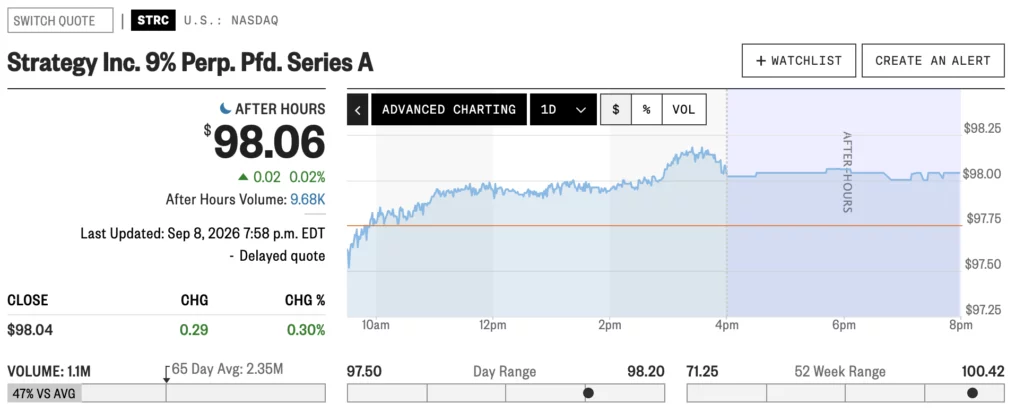
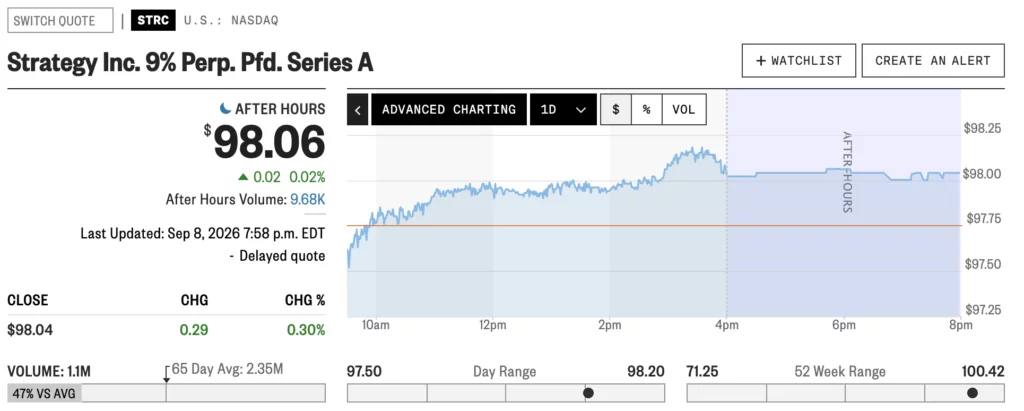
STRC closed at $98.04 on Sept. 8, gaining 0.30% during the session, according to MarketWatch. The price remained 1.96% below its $100 stated amount but stood above the average price paid in the latest buyback.
As previously reported, STRC remained below $100 despite earlier repurchases, leading Strategy to use both dividend policy and buybacks to support the security.
Strategy keeps its 845,050 BTC position unchanged
The lack of a Bitcoin purchase represents a one-week pause rather than a formal change to Strategy’s treasury policy. The company bought approximately $370 million of Bitcoin during the preceding reporting period.
Strategy’s holdings have fluctuated during 2026 as the company began using selective Bitcoin sales alongside equity issuance and cash reserves. Its capital framework permits certain sales to finance preferred dividends, repurchases and reserve requirements.
In June, Strategy held 846,842 BTC after buying 1,587 coins for approximately $100 million. In related coverage, Strategy’s Bitcoin reserve reached 846,842 BTC following that purchase.
The company subsequently sold Bitcoin during several reporting periods. One August filing showed Strategy selling 1,638 BTC for $104.7 million while directing funds toward STRC dividends, repurchases and its dollar reserve.
As crypto.news reported, Strategy used a Bitcoin sale to support preferred-stock obligations. The latest filing shows no further disposals between Aug. 31 and Sept. 7.
Strategy’s average acquisition price of $75,412 means the value of its treasury remains sensitive to Bitcoin trading around that level. The filing provided cost information but did not record an updated fair value for the holdings.
No ATM sales during the week also meant Strategy did not issue additional MSTR or preferred shares to finance Bitcoin purchases. The pause reduced immediate dilution but supplied no new capital through those programs.
Cash reserves support dividends and future purchases
Strategy reported a USD Reserve balance of approximately $5.10 billion on Sept. 7. The company maintains that restricted-purpose pool to support preferred dividends and interest payments on outstanding debt.
A separate USD Cash balance stood at $1.44 billion after the STRC repurchases. Management can use that cash for Bitcoin purchases, additional reserve funding, capital management or comparable corporate purposes.
The distinction matters because the USD Reserve primarily supports fixed financial obligations. USD Cash gives management broader flexibility but can decline when Strategy buys Bitcoin or repurchases securities.
Strategy’s USD Reserve has expanded rapidly. It stood at $3.75 billion at the end of July, when the company said the balance covered approximately 2.1 years of expected preferred dividends and debt interest.
The company did not publish an updated coverage period for the $5.10 billion reserve in its latest filing. Coverage can change with dividend rates, preferred shares outstanding, debt levels and future capital transactions.
MSTR closed at $136.52 on Sept. 8, down $6.28, or 4.40%, according to Yahoo Finance. Bitcoin and other crypto-related equities also declined during the session, preventing the move from being attributed solely to Strategy’s filing.
The next update will show whether Strategy resumes Bitcoin purchases, conducts more STRC buybacks or returns to its ATM programs. The company did not commit to a specific transaction or spending schedule.
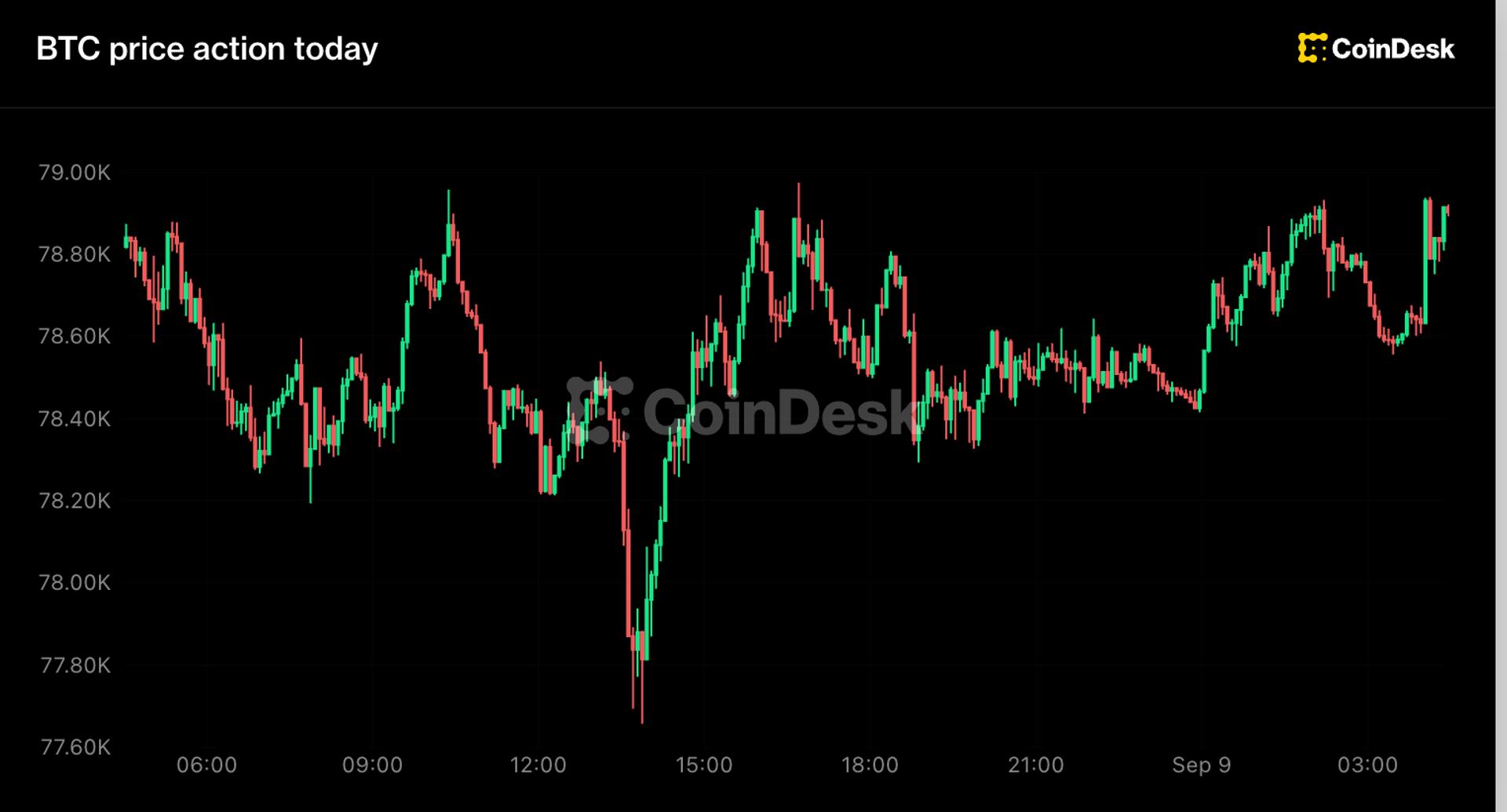
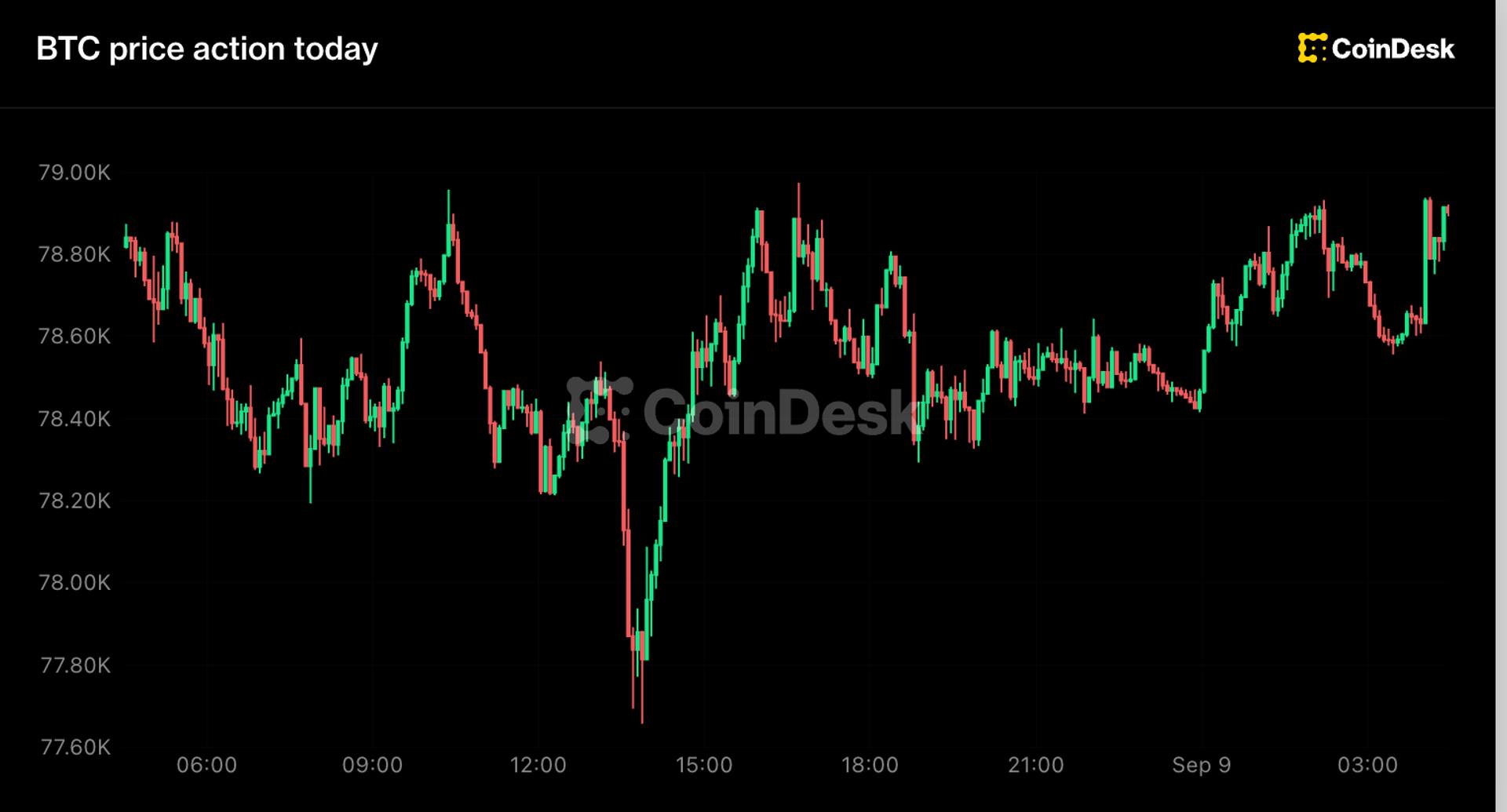
Bitcoin fell to nearly $77,600 on Tuesday before clawing most of it back, leaving it little changed on the day while zcash gained roughly 43% on the week and Grayscale’s new fund crossed half a billion dollars.

XPeng’s humanoid robot IRON is on display during the 2026 Guangdong-Hong Kong-Macao Greater Bay Area International Auto Show on May 31, 2026 in Shenzhen, Guangdong province of China.
Vcg | Visual China Group | Getty Images
Chinese companies rushed into electric cars a decade ago, and now they are expanding into humanoid robots as the EV market sees a slowdown amid intense competition.
While the commercial viability of humanoids has come under scrutiny, it hasn’t dissuaded companies such as Xpeng from announcing robot production plans, at a time when China’s EV sales are headed for their worst year since 2021.
It’s part of a bid to reshape “capital valuation narratives,” said Kevin Li, associate director at Counterpoint Research. He added that the automakers are also looking to boost the perception that they are tech companies, and establish a second growth curve.
Xpeng shares have tumbled more than 45% this year, making them the worst performer among major EV players. Shares of EV giant BYD are down more than 13% as sales have slumped.
Chinese automakers accounted for more than half of the nearly 20 car companies globally that have entered the humanoid robotics sector through in-house development, investment or incubation as of August, according to Counterpoint.

The venture arm of EV company Nio has also invested in several humanoid robotics startups such as LimX Dynamics and Acorn Robot, according to PitchBook data.
The business diversification comes as slowing growth and weakening profitability put pressure on China’s EV makers. The average profit margin in China’s vehicle manufacturing sector stood at 1.5% in the first half of 2026, according to China Association of Automobile Manufacturers data cited by Counterpoint.
Xiaomi, Li Auto and Geely are also among EV makers making moves into the robotics sector, although their strategies differ.
“Given the slowing growth and weakening profitability in the EV market—particularly domestically—it is a natural strategic move for EV companies to diversify into new applications such as robotics,” said Jing Yang, director of Asia-Pacific corporate ratings at Fitch Ratings.
“This allows them to pursue alternative growth drivers, achieve economies of scale for shared advanced technologies, and potentially improve profitability over the medium term,” she said.
Investors aren’t buying the story yet.
Xpeng shares fell after it raised $900 million for its robotics business last month, the largest single round in China’s “embodied” AI industry, according to the company. Embodied AI refers to hardware-connected artificial intelligence.
The raise valued the car company’s robotics unit at more than $6.3 billion — on par with the $6.5 billion estimated value for Xpeng’s EV business, according to Citi.
Advantages over Tesla?
While there are similarities to how electric-car maker Tesla is developing its Optimus humanoid in the U.S., Elon Musk’s company, the Chinese automakers’ push into robotics have their own advantages, said Xiaoyi Lei, senior research analyst at Jefferies Hong Kong.
She pointed out that Chinese automakers can reuse a significant portion of their supply chain — Xpeng, for example, can use 85% of its motors, chips and smart driving software for humanoids. The robots can then be immediately deployed in the automakers’ stores and factories, rather than having to wait for consumers to buy them, she added.
Xpeng said Tuesday it plans to begin mass production of its robots by the end of this year, starting in its own stores and business venues. Next year, the company plans to launch the robots to the broader market in China and overseas.
Automakers also know how to build things at scale, Lei said. Producing thousands of robots that are reliable and serviceable is what Chinese automakers already do every day, she added.
“Chinese players are the ones actually pushing it into daily use,” Lei said, noting that in-house deployment makes it easier and cheaper for the automakers to collect data — which is critical for humanoid commercialization.
Xiaomi, a consumer electronics company that only launched its first electric car in 2024, started testing humanoid robots at its factory this year.
BYD can also deploy robots in its factories, Counterpoint’s Li pointed out. But he said over the medium-to-long term, Geely and Xpeng could better capture the benefits of diversifying beyond cars, pointing to Xpeng’s greater emphasis on its physical AI strategy.
Humanoid questions
Whether humanoid robots can generate demand beyond automakers’ own operations remains an open-ended question. Lei said Jefferies has yet to see firm external orders from the automakers it covers or clear guidance on external customers and robotics revenue for next year.
Leading humanoid company Unitree saw its shares skyrocket as they debuted in Shanghai last month, but the stock declined for 12 of the 16 sessions since its listing. Founder Wang Xingxing has cautioned that commercialization could still take years, with the humanoid sector’s ‘ChatGPT’ moment likely a decade away.
Reusing car technology for robots may not always be as straightforward as it sounds.
“I would say the real challenge is how they are going to make the algorithm and software stack that is used to be applied to the smart driving system also viable to the humanoid scenario, which is more difficult and more challenging,” Lei said.

LSU roster finalized: Lane Kiffin doesn’t add ex-NFL players Dae’Quan Wright, Zxavian Harris to Tigers

World’s Largest Gun Aims to Shoot Satellites Into Space

Bitcoin Is Entering Its Most Powerful Wave Ever


-
 Tech17 hours ago
Memory prices are slowing because buyers ran out of money
-

 NewsBeat16 hours ago
England up in reading, maths and science rankings as Scotland and Wales dip
-

 Business19 hours ago
Egyptian TV Presenter Sarah Khalifa, 11 Others Sentenced To Death In Major Drug Trafficking Case In Cairo
-
 Tech20 hours ago
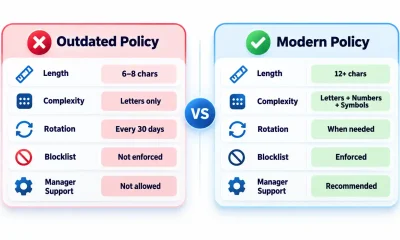
Strong Password Policy and Password Manager Guide
-
 Sports19 hours ago
Phones confiscated, players sent home: Pakistan’s England tour turmoil revives memories of Mohammad Amir, Salman Butt and Mohammad Asif’s 2010 Lord’s spot-fixing scandal | Cricket News
-

 Crypto World20 hours ago
Visa expands stablecoin card network to 160 programs
-
 NewsBeat15 hours ago
Tehran’s assertive rhetoric signals a new and dangerous phase in conflict
-
 Business8 hours ago
Oil Higher on Hormuz Escalation, Weighing on Sentiment
-

 Politics14 hours ago
The Ultimate September Reset Guide: How To Refresh Your Mind And Life This Autumn
-

 Business19 hours ago
Claim Your Share Of $50 Million Disney Streaming Price Settlement By Sept. 8 Tonight
-

 Tech14 hours ago
Google’s revived nuclear power plant gets $1.9B loan from US government
-
 Business14 hours ago
Copper hits record high, UltraTech’s Ultravolt on the offensive: A double whammy for cable makers in FY27?
-

 Fashion13 hours ago
Phia Is the Shopping App That Styles You From Your Own Closet
-

 Fashion13 hours ago
How to Safeguard Your Small Business Against Emerging Cyber Threats
-

 Crypto World19 hours ago
Iran Threatens to Target U.S. Energy Assets in Gulf If U.S. Strikes Again
-

 Business17 hours ago
US-Canada tariffs: Canada braces for prolonged trade war as counter-tariffs on US take effect
-

 Tech14 hours ago
ESP32-P4 Powers Video Alarm Clock
-

 Tech9 hours ago
Meta debuts its Muse AI agent. Will consumers trust it?
-

 Tech18 hours ago
Stoke Space raises another billion to rival SpaceX at re-flying rockets
-

 Business14 hours ago
Corning Stock Climbs On Multibillion-Dollar Verizon Network Deal
You must be logged in to post a comment Login