

Crypto World
Morgan Stanley’s E*TRADE Launches Spot Crypto Trading

Morgan Stanley’s E*TRADE platform has launched spot cryptocurrency trading, allowing eligible clients to buy, sell and hold Bitcoin, Ether and Solana through a partnership with crypto infrastructure provider Zero Hash.
Clients can view their crypto holdings alongside stocks and other traditional investments on the E*TRADE platform, while transfer functionality for moving digital assets on and off the platform is expected later this year.
The self-directed channel served 8.6 million households and held about $1.56 trillion in client assets as of March 31, according to Morgan Stanley’s latest financial supplement.
According to Thursday’s announcement, trades carry a 50-basis-point fee, while custody and transaction services are handled through separate Zero Hash accounts that are not covered by FDIC or SIPC protections. Morgan Stanley said it expects to transition the digital asset services to Morgan Stanley Digital Trust, its national trust bank currently in organization.
Morgan Stanley also introduced several non-crypto updates across the customer platform, including fractional share trading, a revamped retirement planning tool and new features for its Power E*TRADE Pro desktop platform.
The rollout follows a pilot launched in May, when the company began testing the service with a limited group of users before expanding access to eligible E*TRADE clients.
Related: Stanford study says 5-minute Bitcoin prediction markets enable settlement manipulation
Morgan Stanley broadens crypto strategy
Beyond retail spot trading, Morgan Stanley has expanded its digital asset business into stablecoin reserve services and crypto exchange-traded funds this year.
In April, the Wall Street giant launched a stablecoin reserve offering that allows issuers to hold the assets backing their tokens in one of the firm’s money market funds while earning interest.
The same month, the company launched its spot Bitcoin ETF with a 0.14% management fee, making it the lowest-cost Bitcoin ETF on the US market at the time. The fund debuted on NYSE Arca as the first spot Bitcoin ETF launched by a major US commercial bank.
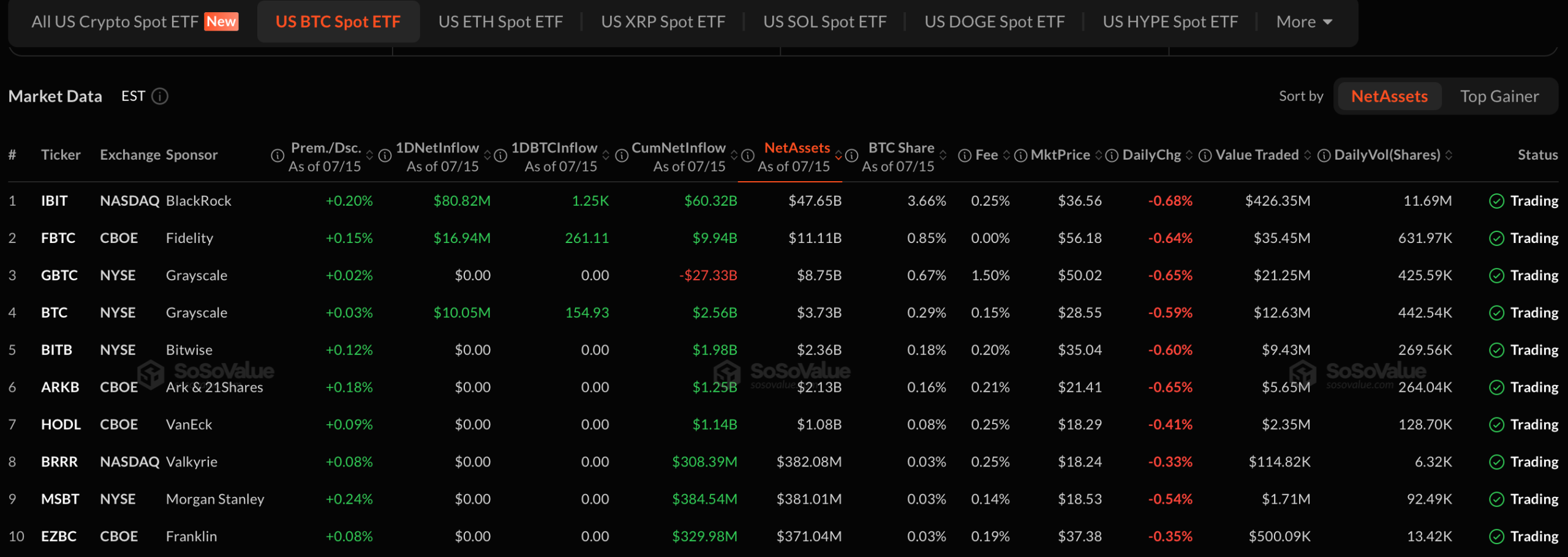
During its first six trading days, the ETF attracted more than $100 million in net inflows, surpassing the cumulative inflows of WisdomTree’s spot Bitcoin ETF, which launched in January 2024. At the time of writing, the fund has attracted about $385 million in cumulative net inflows, according to SoSoValue data.
In June, Morgan Stanley amended its proposed spot Ether and Solana ETF filings to set management fees at 0.14% after first applying to list the funds in January.
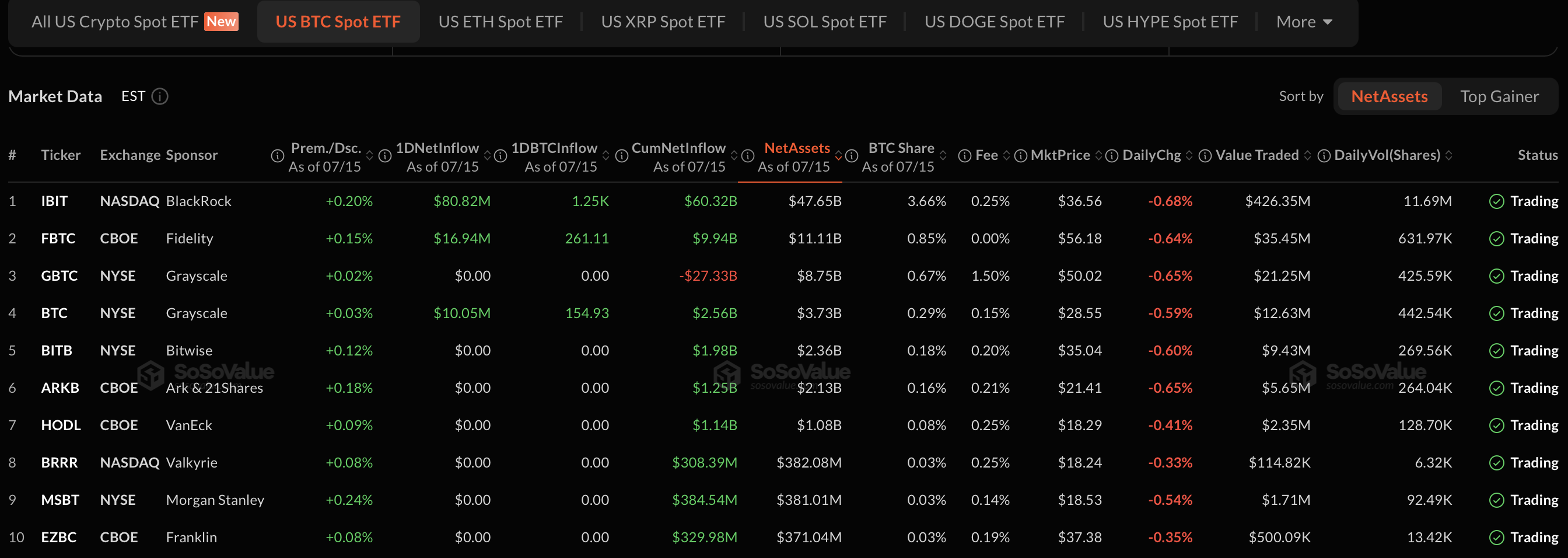
Top 10 Bitcoin ETFs. Source: SoSoValue
Magazine: Gambling on random Pokémon cards: Onchain gagcha hits record high as crypto sinks

Zama says a lending vault that accepts only confidential USDC has grown into one of the largest USDC vaults on Morpho’s Ethereum deployment, weeks after opening to depositors.
Summary
- Zama says confidential USDC deposits reached $23.23 million, ranking eighth among Ethereum Morpho USDC vaults.
- The vault lets users earn DeFi yield while keeping individual balances and deposit positions encrypted.
- Morpho’s growing institutional use shows privacy tools are entering established onchain lending infrastructure at scale.
According to a July 16 post from Zama, the Steakhouse Confidential Prime USDC vault held $23.23 million at Ethereum block 25,544,806. The company said that placed it eighth by total deposits among Morpho V1 and V2 USDC vaults on Ethereum. The ranking and deposit figure reflect Zama’s stated snapshot and can change as users deposit or withdraw funds.
Confidential USDC moves into established DeFi infrastructure
The Steakhouse Confidential Prime USDC vault opened on June 23. Steakhouse Financial curates the strategy, Morpho provides the lending infrastructure, and Zama supplies the confidentiality technology.
Users deposit confidential USDC, or cUSDC, rather than standard USDC. Zama uses Fully Homomorphic Encryption to keep individual balances and transaction amounts encrypted while allowing the assets to interact with applications on Ethereum. Deposits ultimately enter a strategy using Morpho lending markets backed by collateral including cbBTC, WBTC and wstETH.
Zama points to $23.23M TVL as a demand signal
Zama described the vault’s growth as evidence that users are willing to place capital into confidential financial infrastructure. The company said “capital is ready to flow through confidential rails,” while acknowledging that an ongoing incentive program has also helped attract deposits.
The vault launched with a 12-week reward program on top of the yield generated by its underlying Morpho strategy. Zama said the native strategy was producing about 4% when the product launched, while additional incentives rewarded early depositors. The company had reported more than $14 million deposited by July 2, before the total reached the $23.23 million figure reported on July 16.
Morpho attracts more institutional-style vault products
The confidential vault arrives as Morpho attracts asset managers, wallets and professional curators. Bitwise launched its first onchain vault on Morpho in January, targeting stablecoin lending through a non-custodial structure.
Morpho has also expanded through consumer wallet integrations. As reported by crypto.news, Trezor added access to Steakhouse-curated USDC and USDT vaults in May. Those developments place Zama’s product within an existing lending market rather than requiring users to move liquidity to a separate blockchain.
Confidential finance still faces compliance questions
Zama’s confidential USDC system has already faced a test involving the underlying stablecoin. In May, a US court order led Circle to temporarily freeze a Zama contract holding about $12.5 million in USDC. The order was later lifted, and Zama said the funds returned to normal operation.
As previously reported, the episode prompted Zama to accelerate work on compliance and controlled disclosure tools. The company says its system encrypts transaction details rather than making users anonymous and plans tools that can respond to legal and regulatory requirements.
Zama argues that its cross-chain confidentiality model can add privacy where liquidity already exists instead of requiring a new Layer 1 or Layer 2. The $23.23 million vault provides an early test of that approach, although continued deposits after the incentive program ends will offer a clearer measure of lasting demand.


Morpho has restored its frontend and API after a temporary disruption that its engineering team linked to a possible Amazon Web Services CloudFront outage.
Summary
- Morpho restored its app and API after a suspected AWS CloudFront outage disrupted frontend access.
- The incident affected web infrastructure while Morpho’s onchain lending contracts continued operating independently during disruption.
- Recent integrations have made Morpho infrastructure increasingly important across wallets, exchanges and institutional DeFi products.
Morpho principal engineer Julien reported that app.morpho.org and api.morpho.org were partially unavailable on July 16. He said the team suspected a “potential AWS CloudFront outage” and was working on a way to restore traffic.
Morpho restores services after partial outage
Around three hours later, Julien confirmed in a follow-up update that the affected services had recovered. He said “all Morpho services are back and stable,” although performance could still experience some effects following the disruption.
The outage affected access to Morpho’s application and API rather than triggering a reported failure of its underlying lending contracts. Morpho’s API documentation describes the service as an interface that provides applications with onchain and offchain data about markets, vaults and user positions. The protocol’s lending activity operates through blockchain-based infrastructure separately from that interface.
AWS operates CloudFront as a content delivery network used to deliver websites, applications and APIs. Morpho did not confirm a final root cause in the updates and referred only to a possible CloudFront problem. AWS maintains a public service health dashboard for tracking disruptions and recovery across its infrastructure.
YEET also reports website disruption
YEET co-founder Mando separately said the project’s website had gone offline during the same reported AWS CloudFront disruption. According to the project, the website outage did not affect user assets or funds, while its team worked to restore access.
The incidents show how decentralized applications can still depend on centralized web infrastructure for interfaces and data delivery. A frontend outage can prevent users from accessing a website even when the underlying blockchain and smart contracts remain active.
For users, that distinction means a website becoming unavailable does not automatically mean assets stored in onchain contracts have disappeared. However, disruptions to interfaces and APIs can temporarily make it harder to view positions or interact with protocols through their standard websites.
Morpho’s infrastructure now supports wider DeFi access
The temporary disruption comes as Morpho has expanded its role across several large crypto platforms. As previously reported, Coinbase uses Morpho infrastructure for USDC lending products, with Steakhouse Financial managing vault allocations.
Hardware wallet provider Trezor has also integrated Morpho vaults. Users can access USDC and USDT lending strategies through Trezor Suite while signing transactions on their hardware wallets.
Morpho has attracted traditional financial firms as well. Apollo Global Management agreed to a structure that could see its affiliates acquire up to 90 million MORPHO tokens over 48 months as part of a wider relationship with the protocol.
Recovery limits the immediate disruption
Morpho’s application and API were functioning again following the engineering update. Julien warned that performance could remain affected temporarily but described the services as stable.
No loss of user funds or failure of Morpho’s onchain lending contracts was reported in connection with the event. The disruption instead affected the access layer used by users and developers to interact with protocol data.
One anonymous wallet has spent a year absorbing the supply that everyone else is selling. It is now the largest single holder of PI, nobody has claimed it, and at today’s price it is sitting on one of the worst trades in the token’s short history.
Summary
- A wallet tracked as GAS…ODM has accumulated more than 400 million PI, making it the largest single holder outside the Pi Foundation’s own reserves, built by pulling tokens off OKX, Gate.io, and MEXC over roughly a year.
- No party has claimed ownership. The two dominant theories are a Pi Core Team buyback wallet managing supply, or an exchange stockpiling inventory ahead of a listing.
- The accumulation is real support, but it has not worked: PI broke below $0.10 in July to a fresh all-time low near $0.071, down roughly 97% from its $2.99 peak.
- The uncomfortable arithmetic: a stake valued near $148.5 million when it was reported at 331 million tokens is worth a fraction of that today. Whoever the whale is, they are deeply underwater.
- The deeper story is concentration. Pi markets itself as the people’s cryptocurrency, yet 22 wallets hold over 10 million PI each and roughly 84% of accounts hold less than 10 PI.
Every crypto community has a wallet it watches. Pi Network has GAS…ODM, and the watching has become something closer to a devotional practice. For roughly a year, this single anonymous address has done the one thing almost nobody else in the Pi ecosystem has been willing to do: buy, relentlessly, into a collapsing price, pulling millions of tokens off exchanges week after week while daily unlocks poured fresh supply into a market that could not absorb it, a dynamic crypto.news examined in its coverage of the supply schedule the whale is fighting. It is now the largest single holder of PI outside the project’s own foundation wallets. Nobody knows who controls it. The community has variously called it a core team buyback, an exchange preparing a listing, and, with a straight face, the new Satoshi wallet. What the data actually shows is more interesting than any of those theories, and considerably less flattering.
What the wallet has actually done
The mechanics are unusually legible, because Pi’s block explorer makes them so. Tracking data from PiScan shows the address labelled GAS…ODM systematically withdrawing PI from centralized exchanges, principally OKX, Gate.io, and MEXC, in multimillion-token transfers over an extended period. By mid-2025 the wallet had amassed roughly 331 million PI, a position valued at approximately $148.5 million at the prices of the time. By late May 2026, on-chain data showed it had crossed 400 million tokens, with days on which it added more than 1.5 million PI in a single session, and a pattern of near-daily accumulation that had held through the spring.
Two features of the behavior distinguish it from ordinary trading. First, the direction is one-way. The wallet withdraws from exchanges into self-custody and does not send tokens back, which is the on-chain signature of an entity removing supply from circulation instead of flipping it. Second, the timing clusters around weakness. Inflows to the wallet intensified during price dips, with buying accelerating as PI slid toward support zones. That is a pattern rarely produced by a discretionary trader, because it requires either conviction that borders on indifference to drawdown, or a mandate that is not about profit at all.
The scale is what makes it consequential. At 331 million tokens the wallet was already the sixth-largest holder in the ecosystem, exceeding the balances held by exchange wallets at platforms like Bitget and MEXC. Crossing 400 million made it the largest single non-foundation holder. For context on how much supply that represents, daily unlocks currently add roughly 6.5 million PI to the float, which means the whale has absorbed something on the order of two months of continuous unlock supply in a market where finding a buyer for a single day’s worth has proven difficult.
The theories, and what each would mean
Two explanations dominate the community discussion, and they carry radically different implications. The first, and most widely held, is that GAS…ODM belongs to the Pi Core Team, functioning as a buyback wallet that repurchases tokens during unlock periods to stabilize price and manage supply. The circumstantial case is decent: the accumulation intensified exactly when supply pressure peaked, the behavior looks mandated rather than opportunistic, and a project sitting on a large treasury has both the means and the motive to defend its token during a distribution phase. The Core Team has never acknowledged any role.
The second theory holds that the wallet belongs to a major exchange quietly building inventory ahead of a listing. This gained traction because the accumulation coincided with persistent speculation about tier-one listings, and because exchanges genuinely do pre-position inventory before opening a market. The theory has weakened as time has passed, though. Kraken and OKX opened PI markets in 2026 and the accumulation continued regardless, while Binance and Coinbase have still not listed. No exchange has confirmed ownership of the address.
The implications diverge sharply. If it is the Core Team, then a substantial share of what looks like organic market demand for PI is the project buying its own token, which means the price signal is partly manufactured and would collapse further if the buying stopped. That is not illegal, and treasury management is common, but it is material information that holders do not have. If it is an exchange, the accumulation is inventory instead of conviction and says nothing about the token’s prospects. If it is neither, and the wallet belongs to a private entity making a long-horizon bet, then it is simply the largest and most patient position in the ecosystem. The honest answer is that nobody outside the wallet knows, and the ambiguity itself is the point: an unattributed entity controls a supply block large enough to move the market, and the ecosystem has decided to read that as reassurance.
The bull case: someone knows something
The optimistic interpretation, which dominates Pi community sentiment, treats the wallet as a vote of confidence expressed in the only language that cannot lie, which is money. Sustained accumulation through a brutal drawdown does suggest calculated intent instead of casual speculation. Whoever is behind it has watched PI fall through support level after support level and kept buying, which is either information or conviction, and the community has understandably preferred to believe it is the former.
There is a supply-side argument that has genuine force. Pi’s central problem is float: roughly 1.21 billion PI are scheduled to enter circulation across 2026, a daily drip averaging about 6.5 million coins, which at recent prices means the market must absorb tens of millions of dollars of new supply every month simply to hold price flat. Any entity permanently removing hundreds of millions of tokens from exchanges into self-custody is directly countering that mechanic. Tokens sitting in a cold wallet are not sell pressure. If the whale keeps buying and never sells, the effective float shrinks, and a smaller float is the precondition for any eventual repricing.
The wallet has also had a measurable psychological effect on the ecosystem, which matters for a project whose entire thesis rests on community. Sentiment tools turned positive on the accumulation narrative, and ecosystem activity has continued regardless of price: Pi App Studio brought thousands of applications online, Ecosystem Directory Staking has drawn tens of millions of PI from users spotlighting projects, and the Pi2Day product launches pushed fee-in-PI utility. A visible whale creates a feedback loop, where perceived smart-money confidence sustains builder enthusiasm, which sustains the ecosystem that any future demand would need. In that reading, GAS…ODM has been load-bearing for morale even when it failed to be load-bearing for price.
The bear case: it did not work
Now the arithmetic, and it is unkind. When the wallet’s position was reported at 331 million tokens, the stake carried a headline value near $148.5 million. PI has since broken below the $0.10 line that held through the spring, setting a fresh all-time low near $0.071 in July after a roughly 15% single-day plunge ahead of the next unlock wave. Against a peak of $2.99, the token is down roughly 97%. Run the same 400 million tokens at a price near $0.08 and the position is worth a small fraction of what it was when the accumulation made headlines. Whoever GAS…ODM is, it is one of the worst-performing large positions in the token’s history, and it is still adding.
That reframes the bull case considerably. The community reads persistent buying as insight, but persistent buying that coincides with a 97% drawdown is equally consistent with an entity that is trapped, mandated, or simply wrong. If the wallet is a Core Team buyback, then the defense has failed on its own terms: hundreds of millions of tokens were spent absorbing supply and the price broke to new lows regardless, which is the definition of an unsuccessful intervention. Buying every dip does not signal knowledge when every dip is followed by a deeper one.
The supply argument also has a rebuttal in the data. PiScan has shown tagged exchange wallets holding roughly 545 million PI in aggregate, with net inflows continuing, and inflows to exchanges typically precede selling instead of accumulation. The whale’s buying has not been enough to offset the broader movement of supply back toward trading venues. One wallet, however large, is fighting a structural release schedule that never pauses. A single buyer can absorb a discrete event. A continuous daily drip is a different opponent, because it does not stop for sentiment, news, or price, and it compounds.
The concentration problem nobody wants to discuss
The whale story points at something larger and more awkward than one address. Pi Network’s founding promise was democratic distribution: a currency anyone could mine from a phone, with no expensive hardware and no venture allocation. The on-chain reality of ownership looks nothing like that. PiScan data has shown just 22 wallets qualifying as whales holding at least 10 million PI each, alongside millions of accounts holding almost nothing. Roughly 84% of the more than 15.9 million accounts fall into the smallest category, holding less than 10 PI, worth pocket change. The Pi Foundation’s own top wallet has held tens of billions of coins.
Set that against the token’s marketing and the tension is obvious. A network built on the pitch of mass participation has produced an ownership structure where a handful of addresses, most of them associated with the foundation, dominate supply, and where the largest independent accumulator is an entity that will not identify itself. That is a decentralization question with real regulatory weight, given that market-structure legislation moving through Congress contemplates decentralization tests for classifying digital assets. Pi’s defenders point to millions of migrated wallets and a vast know-your-customer base as evidence of genuine distribution. The rich list points the other way.
None of this is unique to Pi, and every major token has concentration issues. But most of them never claimed otherwise. The gap between the people’s-cryptocurrency framing and a wallet map dominated by whales and microbes is the kind of thing that becomes a problem precisely when price stops going up, because that is when holders start reading the ledger instead of the roadmap. Fourteen million accounts holding less than four dollars each is not a distributed economy. It is a marketing funnel with a blockchain attached.
What a buyback would actually mean
It is worth taking the Core Team theory seriously for a moment and following it to its conclusion, because if it is true the implications reach well past one wallet. Token buybacks are ordinary corporate behavior in crypto. Projects with treasury reserves routinely purchase their own tokens to support price, absorb unlock supply, or retire float, and several of the largest names in the sector run formal buy-and-burn programs that they disclose openly. The mechanism is not the problem. Disclosure is.
Pi’s approach to supply management is unusual in a way that makes the whale theory more plausible. The project leans on halvings and a declining mining rate instead of burns, which means it has no mechanism for permanently destroying supply, a difference that matters when looking at why Pi has no burn valve for supply. Every coin ever mined eventually reaches circulation through migration and unlocks. A project in that position, watching roughly 6.5 million tokens hit the float daily with no burn valve to relieve pressure, has exactly one lever left if it wants to defend price, which is to buy the tokens back with treasury funds and sit on them. That is precisely the behavior GAS…ODM exhibits.
If that is what is happening, holders are entitled to know, and the silence becomes the story. A disclosed buyback is a strategy that investors can price: they know the size, the mandate, the funding source, and the conditions under which it stops. An undisclosed one is something else entirely, because market participants are reading manufactured demand as organic conviction and making decisions on that basis. The community has spent a year interpreting the wallet as smart money validating the project. If the smart money turns out to be the project validating itself, every inference drawn from that accumulation collapses at once, and it collapses fastest for the people who bought because a whale was buying.
There is a harder question underneath. A buyback funded from treasury is a transfer: the project spends reserves that belong, in some diffuse sense, to the ecosystem in order to support a price that benefits current holders, including the largest ones. When it works, nobody objects. When it fails, and PI is at a record low after a year of it, the reserves are gone and the price went down anyway. That is the worst of both outcomes, and it is the scenario the on-chain data is most consistent with. Pi’s own venture fund history is instructive here: the project announced a $100 million fund and, more than a year later, has little disclosed deployment to show for it. A pattern of large announced commitments with thin subsequent disclosure is the context in which an unattributed nine-figure wallet should be read.
None of this is proven, and it should not be presented as though it were. The Core Team has never acknowledged the wallet, and the exchange-inventory theory remains live. But the range of explanations is narrow, and every one of them is more interesting than the reading the community has settled on. Either the project is quietly spending reserves to defend a line it has already lost, or an exchange has been sitting on inventory for a listing that has not come, or an unidentified party has made an enormous and enormously bad bet. Those are the options. None of them is a reason to buy.
What to watch
The useful signals from here are narrow and specific. The first is whether GAS…ODM keeps buying below $0.10. Accumulation through the previous drawdown was notable but occurred at higher prices; continued aggressive buying into a token trading at a fresh all-time low would tighten the case that the entity is mandated instead of opportunistic, because no discretionary buyer averages down through a 97% decline without a reason external to profit.
The second is attribution. Any confirmation of ownership, whether from the Core Team acknowledging a buyback program or an exchange claiming the address, would immediately reprice the narrative in one direction or the other. Silence has served the bullish reading well, because an unattributed whale can be whatever the community needs it to be. Clarity would remove that optionality.
The third is whether the supply math changes at all. Roughly 1.21 billion PI enter circulation across 2026, with the next tranche reported above 127 million tokens, up from about 103.7 million the previous month. Absorbing that requires demand the ecosystem has not yet produced, and the Pi2Day fee-in-PI products are the project’s first real attempt to create demand that exists independent of speculation. If those products show genuine usage measured in actual fees rather than announcements, the whale’s thesis, whatever it is, gets stronger. If they do not, then one wallet is holding a position that gets larger and less valuable every month, and the most-watched address in the Pi ecosystem will end up as a case study in how supply design shapes price and how much money it takes to fail to hold a line.
Frequently asked questions
What is the GAS…ODM wallet?
It is an address on the Pi Network blockchain, tracked via the PiScan explorer, that has accumulated more than 400 million PI by systematically withdrawing tokens from centralized exchanges including OKX, Gate.io, and MEXC. It is the largest single holder of PI outside the Pi Foundation’s own wallets, and no individual, company, or exchange has publicly claimed ownership of it.
Who is behind the Pi whale wallet?
Nobody knows. The two dominant theories are that it belongs to the Pi Core Team and operates as a buyback wallet to stabilize price during unlock periods, or that it belongs to a major exchange stockpiling inventory ahead of a listing. The Core Team has not acknowledged any role and no exchange has confirmed involvement. A third possibility is a private long-horizon investor.
How much is the whale’s position worth?
Far less than it was. When the stake was reported at 331 million tokens, it carried a headline value near $148.5 million. PI has since fallen to a fresh all-time low near $0.071 after breaking below $0.10, roughly 97% beneath its $2.99 peak. At current prices the same holdings are worth a fraction of the earlier figure, meaning the position is deeply underwater.
Does whale accumulation mean PI will recover?
It has not so far. The wallet bought persistently through a drawdown that took the token to successive record lows, which means accumulation alone has failed to hold price. Removing tokens from exchanges does reduce immediate sell pressure, but roughly 1.21 billion PI enter circulation across 2026 at about 6.5 million coins per day, and one buyer has not offset a continuous release schedule.
Why does the identity of the wallet matter?
Because the implications differ completely. If it is the Core Team, then some of what appears to be organic market demand is the project buying its own token, which is material information holders lack and which would reverse if buying stopped. If it is an exchange, the accumulation is inventory and says nothing about the token’s prospects. The ambiguity lets the community read it as confidence.
How concentrated is PI ownership?
Heavily. PiScan data has shown 22 wallets holding at least 10 million PI each, while roughly 84% of more than 15.9 million accounts hold less than 10 PI. The Pi Foundation’s top wallet alone has held tens of billions of coins. That distribution sits awkwardly against Pi’s marketing as a cryptocurrency anyone can mine and own from a phone.
Why does Pi keep falling despite ecosystem growth?
Supply. Migration, second migrations, and referral rewards all enlarge the tradable float, which means the project’s most celebrated milestones are, in pure supply terms, bearish for price in the short term. The same process that turns PI into a usable asset also releases the coins that weigh on it. Product launches aim to create fee-driven demand, but that demand has not yet matched the unlock schedule.
What would change the picture?
Three things. Confirmed attribution of the whale wallet, which would reprice the narrative immediately. Evidence that the fee-in-PI products generate real recurring demand measured in usage rather than announcements. And any structural change to the unlock schedule that slows the daily drip. Absent those, the token faces a continuous supply stream that a single large buyer has already failed to absorb.
This article is for information and educational purposes only and does not constitute financial or investment advice. On-chain wallet attribution is speculative, ownership of the address discussed here is unconfirmed, and the theories described are community interpretations instead of verified facts. Nothing here is a recommendation to buy or sell any asset. Always do your own research. Prices and on-chain figures are accurate as of July 16, 2026, and move quickly.
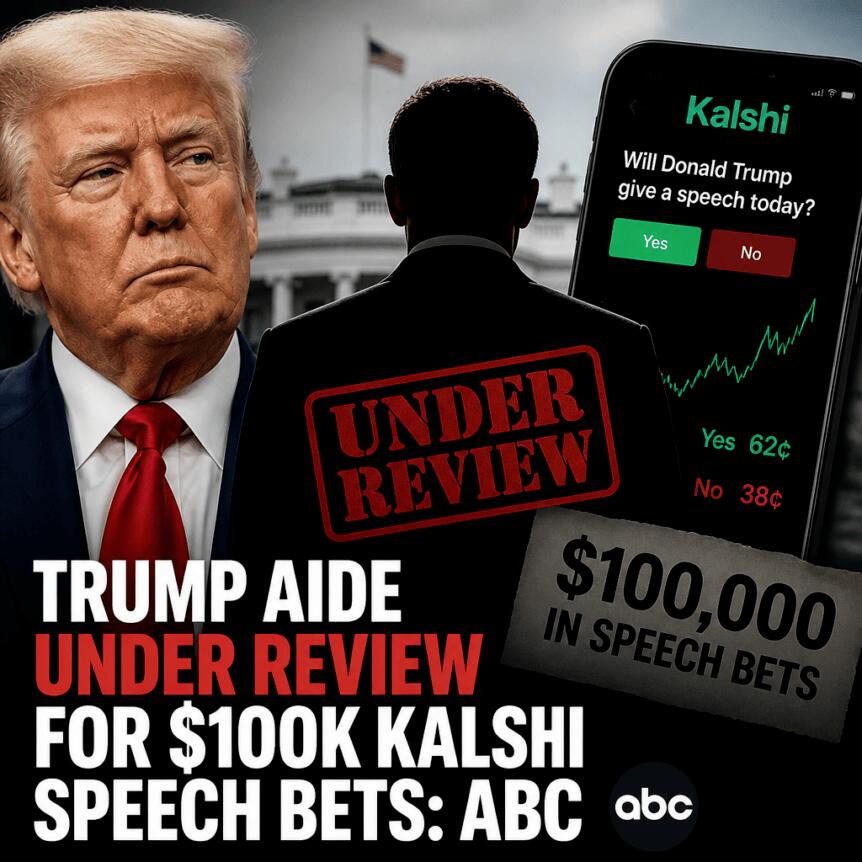
Prediction markets are facing renewed insider-trading scrutiny after a U.S. White House staffer, long involved with President Donald Trump’s teleprompter, was reportedly in talks with federal regulators over allegations that he profited from bets tied to the president’s speeches. ABC News reported Thursday that the matter centers on whether Gabriel Perez—who has served as a technical assistant operating the teleprompter since 2016—used nonpublic information to place wagers on Kalshi markets linked to specific remarks.
According to ABC News, Perez allegedly bet on more than a dozen Kalshi “Mentions” contracts—products that let users wager whether certain words, phrases, or topics will appear in public speeches—earning over $100,000 in profits. The report adds that Kalshi’s surveillance flagged the activity and referred it to the Commodity Futures Trading Commission (CFTC).
Key takeaways
- ABC News says teleprompter operator Gabriel Perez placed Kalshi “Mentions” bets tied to Trump speeches and earned more than $100,000.
- Kalshi reportedly detected the trades through its monitoring systems and referred them to the CFTC.
- Federal scrutiny of prediction markets appears to be intensifying as lawmakers and regulators focus on potential access to nonpublic information.
- Recent high-profile Polymarket-related allegations and wallet-pattern investigations have already heightened compliance concerns across the sector.
How the Kalshi “Mentions” markets came under scrutiny
Kalshi’s “Mentions” markets are designed around verifiable speech outcomes: users wager on whether particular words, phrases, or topics will appear when a public figure delivers a prepared message. ABC News reports that Perez allegedly used this structure to place bets on language expected to be included in Trump’s remarks.
The ABC report further claims that investigators found evidence suggesting Perez sometimes exited positions mid-speech when Trump reportedly skipped prepared passages that contained words he had wagered would be mentioned. If accurate, the timing detail points to a key question at the center of insider-trading concerns: whether the trades were based solely on public expectation and market pricing, or on knowledge obtained before the speech content became public.
ABC News said regulators uncovered bets connected to more than a dozen speeches over roughly a three-month span, including Trump’s State of the Union address and remarks made at the World Economic Forum.
Regulatory escalation and the CFTC referral
ABC News attributes the discovery process to Kalshi’s surveillance systems. The exchange’s monitoring reportedly detected the betting pattern and prompted a referral to the Commodity Futures Trading Commission. That referral matters because it indicates the activity was treated not just as a compliance question for a private platform, but as a potential issue for federal oversight.
The report also says the White House placed Perez on unpaid administrative leave following publication of the allegations. White House press secretary Karoline Leavitt stated that Trump called the alleged conduct a “disgrace.”
While the ABC News account describes negotiations with federal regulators to settle the matter, it does not provide details about the specific allegations’ legal theory, possible violations, or whether an agreement has been reached. Readers should watch for official regulatory filings or enforcement action that clarifies what conduct regulators believe occurred and what standard they applied.
Why this is a broader warning for prediction markets
The Kalshi teleprompter story arrives at a time when prediction markets have seen both rapid growth and increasing concern about market integrity. In recent months, multiple incidents have raised questions about whether traders may sometimes benefit from information that is not available to the general public.
In March, Cointelegraph previously reported on concerns surrounding Polymarket traders who earned roughly $1 million after correctly betting the United States would strike Iran before the end of February. That episode drew attention after Bloomberg, citing analytics firm Bubblemaps, reported that some wallets placed bets only hours before explosions were first reported in Tehran.
Cointelegraph also reported separate allegations involving traders making more than $1.2 million by betting on an onchain investigation into DeFi platform Axiom shortly before investigator ZachXBT published accusations related to insider activity. Another example highlighted by Cointelegraph involved a trader who reportedly made about $400,000 by wagering on the capture of Venezuelan President Nicolás Maduro shortly before that news became public.
Across these cases, the common thread is not simply that traders were right—it’s that the timing of certain trades appeared unusual relative to public knowledge. Investigators and lawmakers are increasingly focused on whether that timing could reflect nonpublic access rather than genuine forecasting skill.
Lawmakers push for tighter rules around political outcome trading
Beyond platform-level surveillance, U.S. lawmakers have also signaled they want clearer guardrails for prediction markets tied to political or public-policy outcomes. Last month, Republican Representative Bryan Steil, who chairs the House subcommittee on digital assets, introduced legislation aimed at restricting members of Congress and their immediate families from trading prediction market contracts connected to public policy and political events, according to Cointelegraph’s earlier coverage.
That kind of proposal aligns with the concern surfaced by the teleprompter operator case: prediction markets can involve content that effectively becomes “public” only when a speech is delivered, an official announcement is made, or an event is confirmed. If insiders—whether due to their job duties or privileged access— can anticipate specific wording or developments, markets built on public outcomes can drift toward information asymmetry.
Even when the underlying platform uses monitoring tools, enforcement depends on whether regulators believe the trades reflect actionable misconduct under existing market rules or analogous legal frameworks. The direction of travel in U.S. policy suggests more scrutiny is likely, particularly for markets that depend on politically sensitive disclosures.
What to watch next
For investors, traders, and builders, the key unknown is how regulators frame and prove the alleged information advantage in the Kalshi case. Watch for official regulatory statements or filings from the CFTC that clarify the scope of the conduct, the standard being applied to speech-linked contracts, and whether this becomes a template for future enforcement against other prediction market participants.
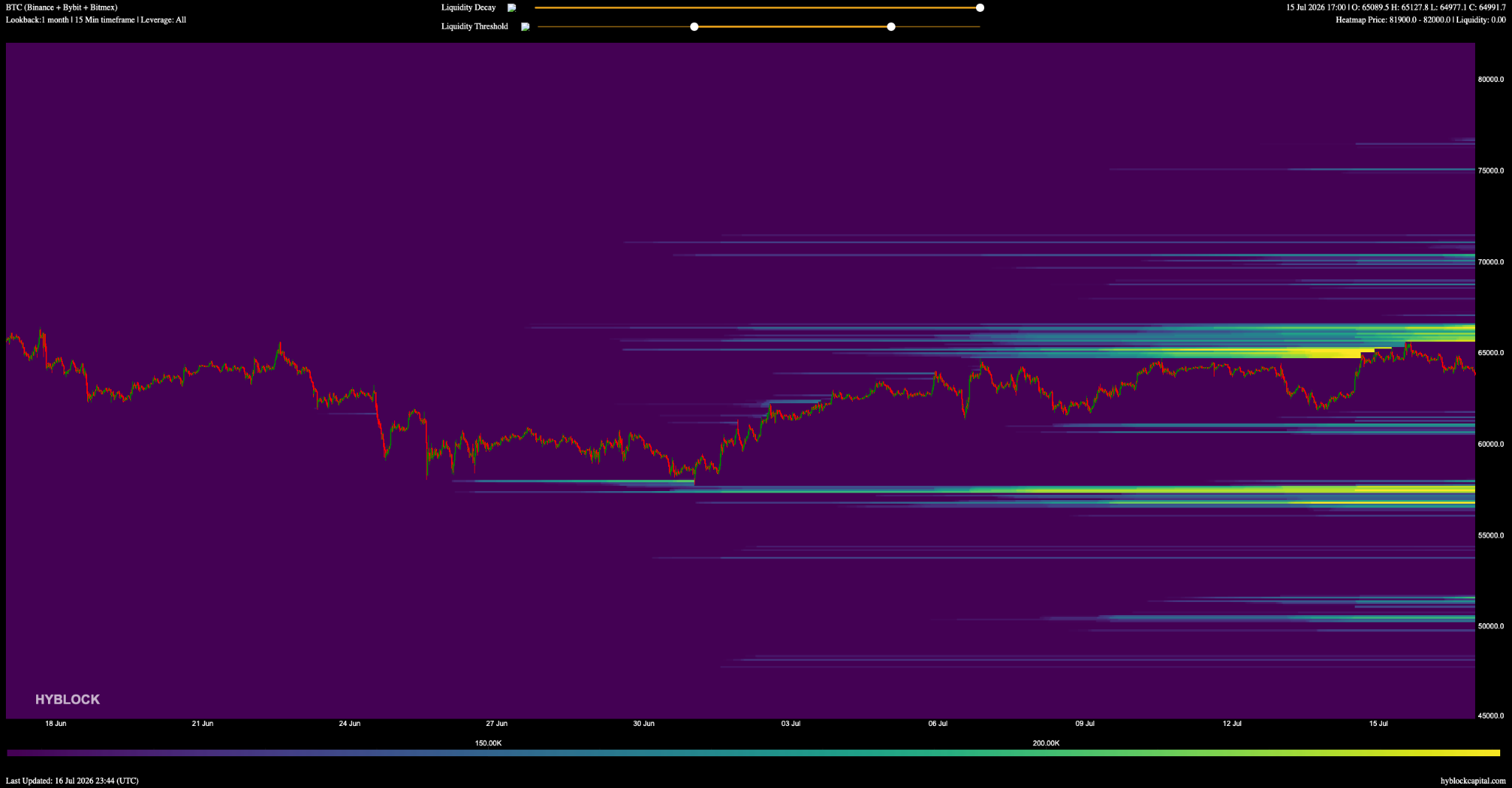
Increased activity across Bitcoin’s (BTC) futures markets is playing the dominant role in its short-term price action, which keeps tracing back to where leveraged positions are stacked. Prices tend to gravitate toward where liquidity is most concentrated, and as Bitcoin battles to hold above $64,000, reviewing current liquidation scenarios may provide insight into BTC’s next move.
Liquidation heatmap data shows a cluster of short positions concentrated between $65,500 and $66,000, roughly 3% away from current market pricing. A push through $65,600 may put that shelf in play and could accelerate a larger rally toward $67,000.
Below market pricing, support is layered in the $63,500 to $63,750 range, with the closest cluster 1% away, and larger liquidity pools are found at $63,000-$63,250 (about 1.5% down) and $62,500-$62,750 (about 2.3% down).
Combined, long-side liquidity across the tracked window outweighs short-side liquidity by nearly two to one, potentially signaling that the bulk of a leverage built up over the past month hasn’t fully closed out.
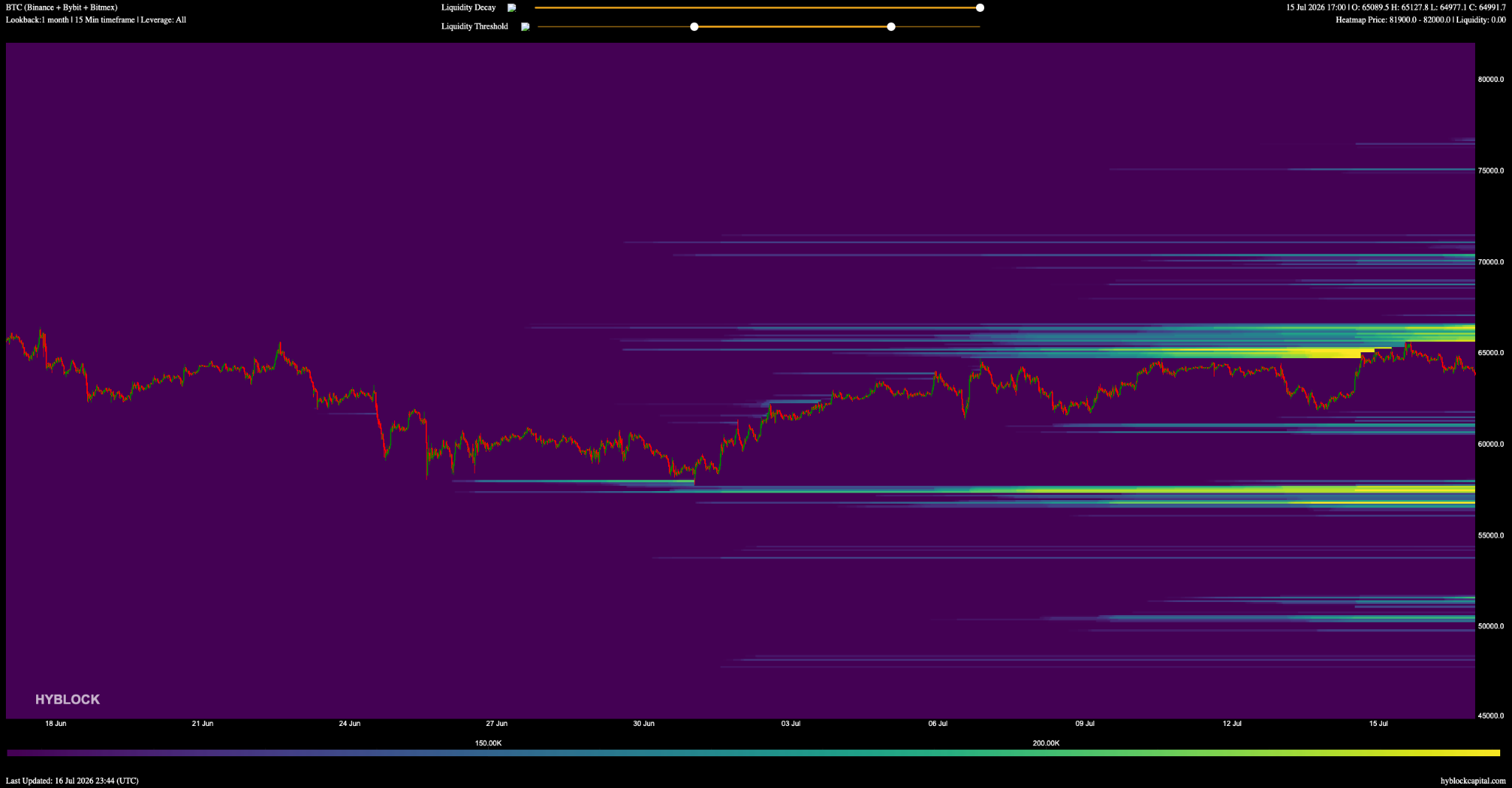
BTC liquidation heatmap, 1-month lookback. Source: Hyblock
In the most bearish scenario, a wide liquidation band near $55,000 (which has built up over the full month lookback) is visible and stands out more than almost anything else on the chart. This magnet could exert its pull on price if support in the $62,500 to $63,750 were to give way.
The last few weeks of price action suggest that Bitcoin may remain rangebound between $60,000 and $67,000, and BTC’s aggregate open interest and funding rate back this view.
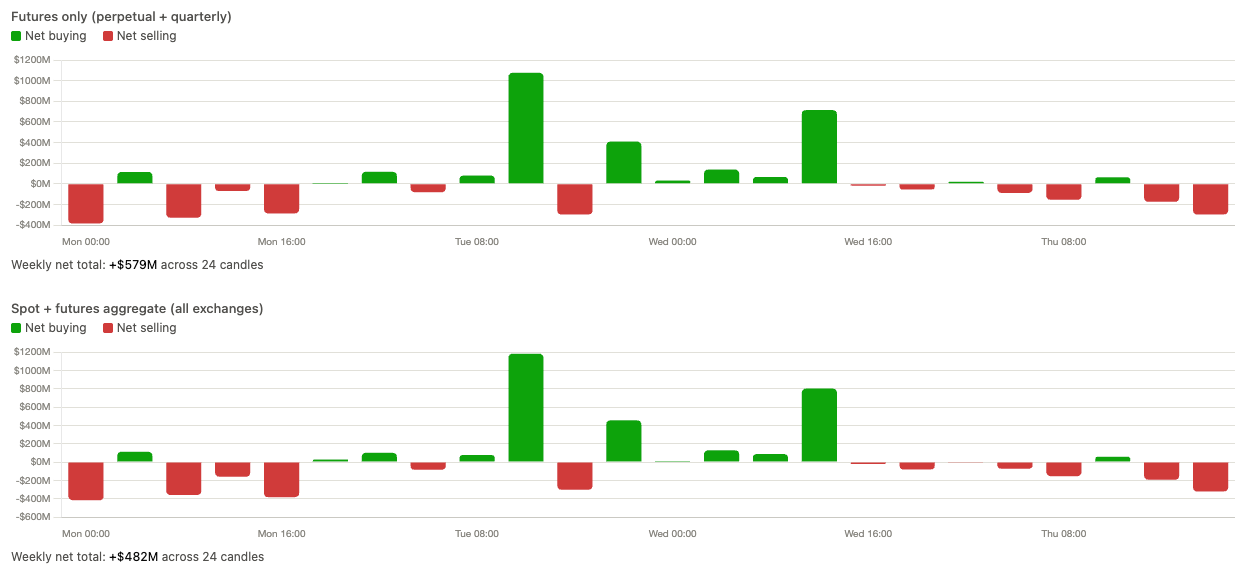
BTC spot and cumulative volume flows. Source: Hyblock
While OI has come down more than 3% from Tuesday’s peak, BTC price has barely moved, and as funding cooled toward neutral, spot and futures flows have favored the buy side over the past week.
Ethereum price has retreated from a two-month high after traders locked in profits, though analysts still expect a push toward $2,000 while key support holds.
Summary
- Ethereum price pulled back after a 5% CPI-driven rally as traders booked profits near $1,930.
- Strong support around $1,850 keeps the technical outlook intact, with $2,000 remaining the next key target.
- Liquidation clusters, ETF flows, and Fed expectations will likely determine Ethereum’s next move.
The June U.S. CPI and PPI data initially fueled a risk-on move across crypto markets, lifting ETH more than 5% before sellers emerged near a major resistance area. The rally briefly pushed Ethereum above a multi-month descending trendline, but momentum faded around $1,930 as short-term traders adopted a classic sell-the-news strategy.
The pullback drove Ethereum (ETH) price as low as $1,878 before buyers returned around the $1,880 region, which now serves as the first line of support after the breakout attempt.
Derivatives activity accelerated the reversal. Funding rates climbed as leveraged longs entered the market during the move above $1,900, leaving positions vulnerable once upside momentum stalled. The retreat triggered a wave of long liquidations across major exchanges, adding forced market-selling pressure to an already weakening spot market.
Macro markets also turned less supportive as the trading session progressed. Oil prices rebounded sharply after the inflation data, reviving concerns that energy costs could complicate the Federal Reserve’s path on interest rates.
Treasury yields moved higher alongside the U.S. Dollar Index, reducing appetite for risk assets and encouraging some investors to rotate capital toward traditional fixed-income markets instead of cryptocurrencies.
Technical structure continues to favor another test of $2,000
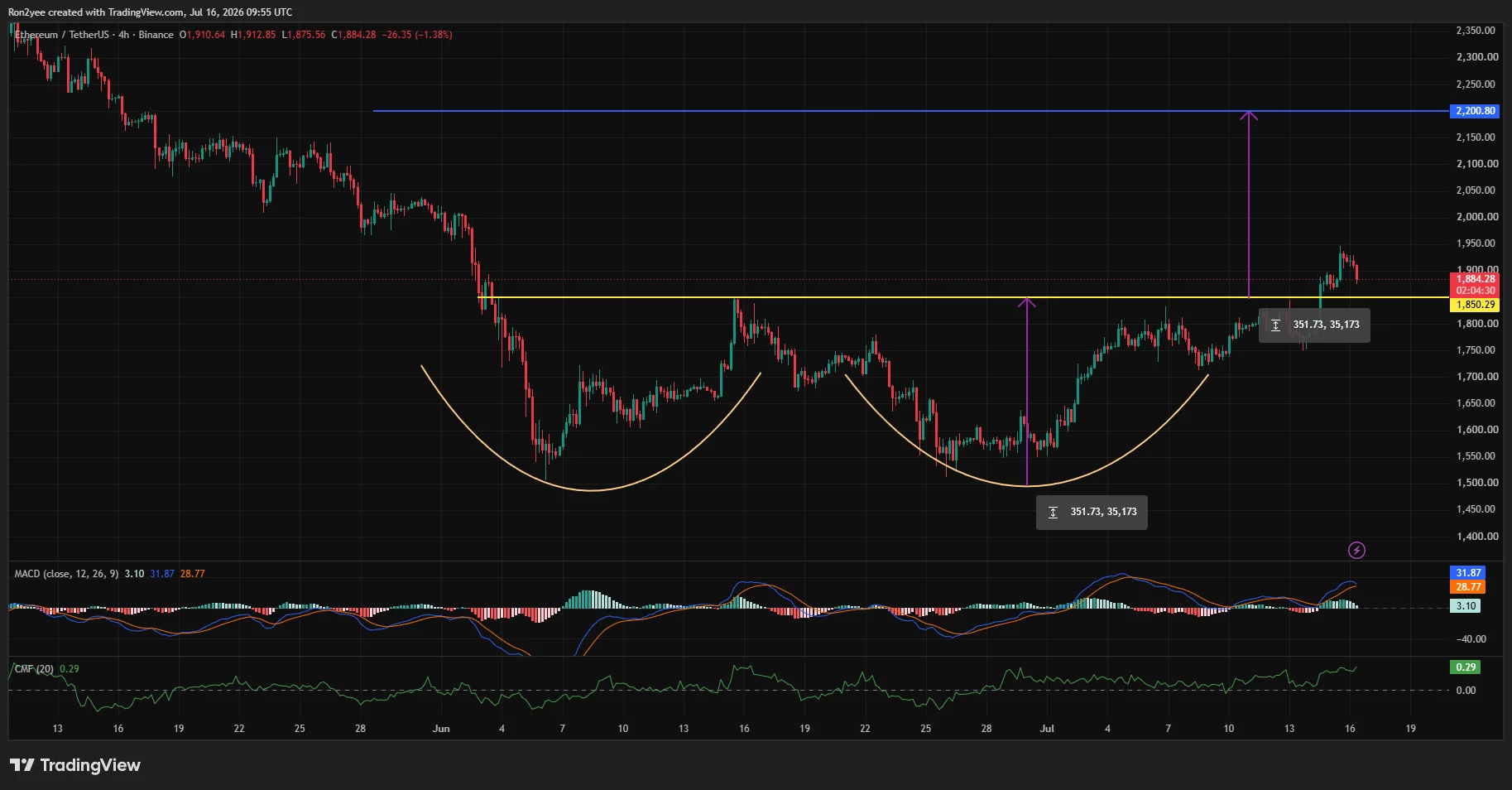
Ethereum’s 4-hour chart still presents a constructive technical picture despite the latest rejection. Price has completed a second rounded-bottom formation after rebounding from the June lows near $1,500 and recently reclaimed the horizontal resistance around $1,850.
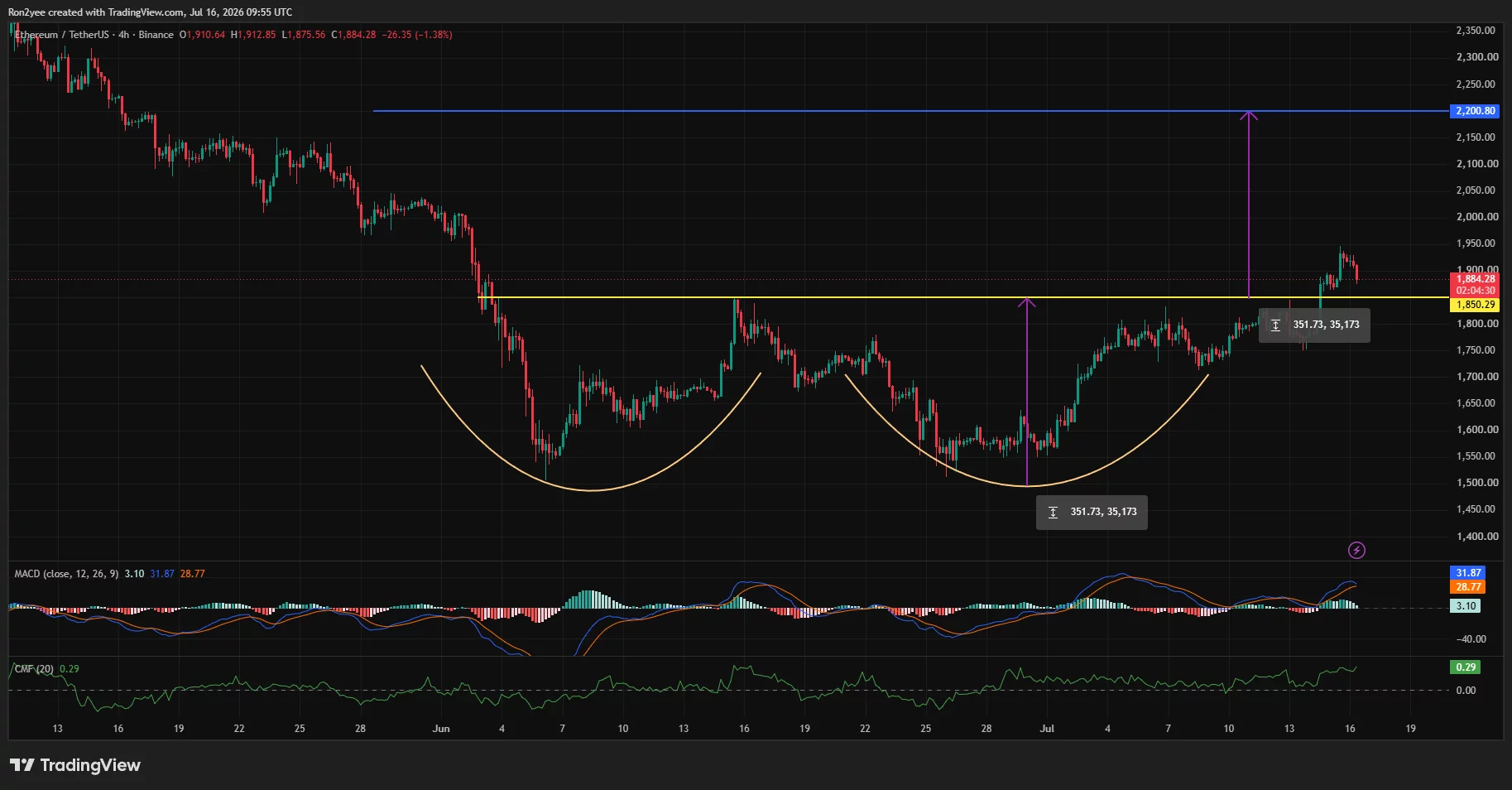
This former ceiling now represents the primary support level, while the measured move from the pattern projects an upside target near $2,200 if buyers regain control above the recent highs.
Momentum indicators continue to lean positive. The MACD remains above the zero line with its signal line intact despite a modest slowdown after the rejection, while the Chaikin Money Flow holds around 0.29, showing capital has continued entering Ethereum over recent weeks instead of exiting the market. Together, those indicators suggest the recent decline has so far resembled profit-taking rather than a complete trend reversal.
Liquidation data also identifies the next battleground. CoinGlass’ 3-day ETH liquidation heatmap shows one of the largest clusters of leveraged positions concentrated between roughly $1,840 and $1,860, reinforcing the importance of that support zone.
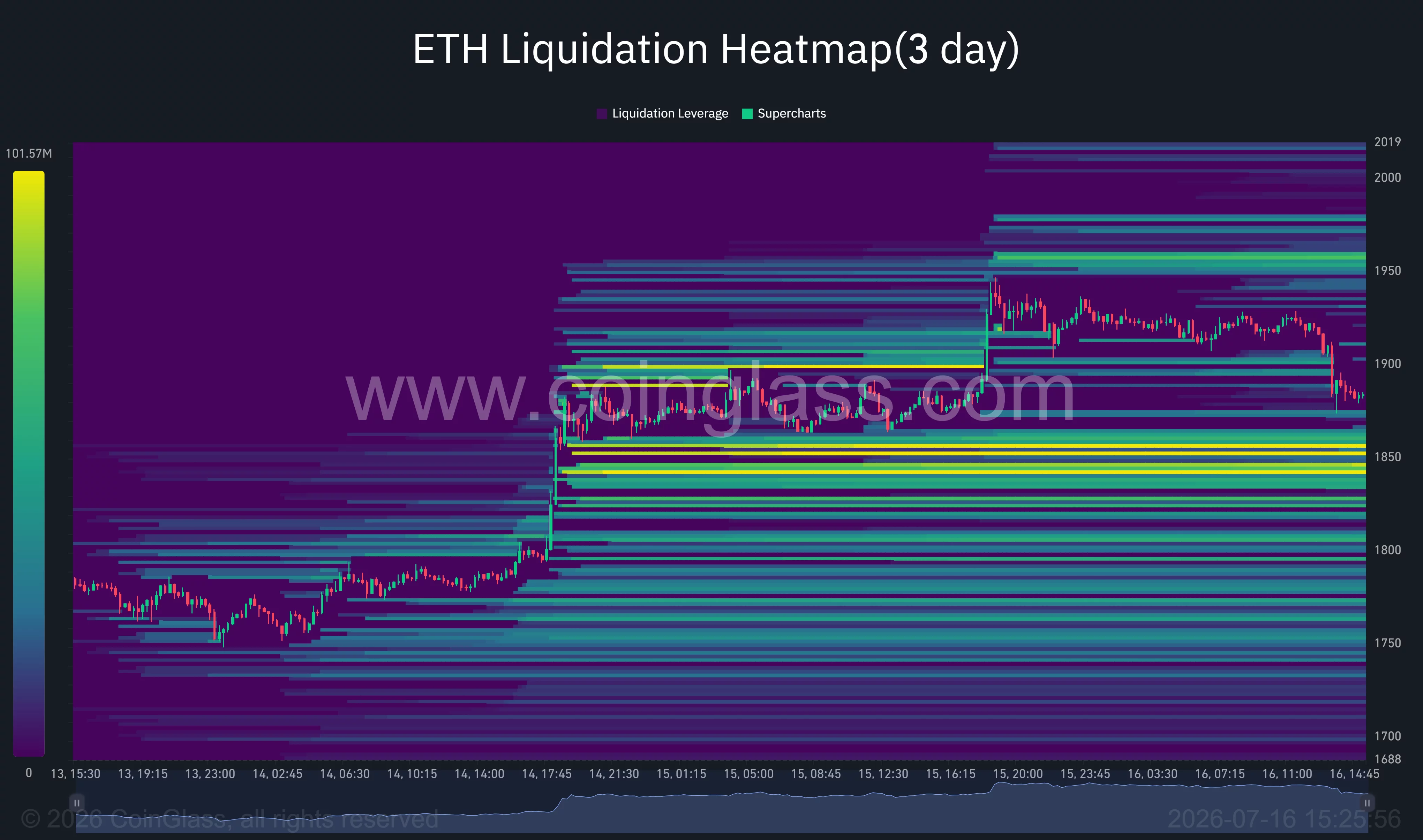
A successful defense there could allow Ethereum to target liquidity around $1,950 before challenging the psychological $2,000 level, where another large concentration of short liquidations sits waiting above price.
Commenting on the move, analyst Ted Pillows noted the recent decline remains a healthy pause rather than the start of a larger correction.
“As long as Ethereum holds above the $1,850 level, the next move will be towards $2,000.”
Separately, according to Michaël van de Poppe, the current environment remains a buy-the-dip market, adding, “There’s a lot more upside going to come on this one.”
Loss of $1,850 could delay the bullish breakout
Several risks could still invalidate Ethereum’s recovery. A decisive break below the $1,850 support would negate the recent breakout and expose the asset to a deeper retracement toward the $1,750-$1,800 region, where another concentration of liquidity has formed. Failure to hold that area would shift attention back toward the June base near $1,500.
Outside the charts, macro developments remain an important variable. Renewed strength in the U.S. dollar, higher Treasury yields, persistent spot ETF outflows, or fresh geopolitical tensions that lift energy prices could reduce demand for crypto assets again.
Exchange inflows from larger holders and continued capital rotation into AI and technology equities also present headwinds, making sustained spot buying essential if Ethereum is to convert its recent breakout into a move above $2,000.
Disclosure: This article does not represent investment advice. The content and materials featured on this page are for educational purposes only.


Crypto exchanges have increasingly positioned themselves as bridges between digital asset markets and traditional finance.


Binance co-founder Changpeng Zhao has weighed into the growing Bitcoin versus artificial intelligence debate as investors compare two of the market’s largest growth themes.
Summary
- CZ says Bitcoin protects against inflation while artificial intelligence offers growth without the same hedge.
- Crypto capital has rotated toward AI, but softer inflation data helped Bitcoin recover above $65,000.
- Upcoming AI listings may compete for liquidity, though macro conditions remain the larger market driver.
In a July 16 post on X, Zhao offered a direct distinction between the two. “AI is great, but it does not protect you against inflation. Bitcoin does.” His comment presents Bitcoin as monetary protection rather than treating AI and crypto as competing technologies with the same purpose.
CZ draws a line between Bitcoin and AI
Zhao’s latest comment comes weeks after he identified artificial intelligence as one factor behind weaker crypto market conditions in 2026. As previously reported by crypto.news, he said new industries such as AI had attracted some speculative capital that might otherwise have entered digital assets.
However, Zhao has not taken a negative position on artificial intelligence itself. In May, he said he preferred investments in the infrastructure supporting AI, including data centers, computing systems and energy. His investment activities have also remained focused largely on Web3, according to earlier crypto.news coverage.
AI investment competes with crypto for capital
The debate has gained attention as major AI companies attract large amounts of investor capital. The expected public listings and fundraising plans involving OpenAI and Anthropic have raised questions about whether investors could sell other liquid assets, including crypto, to fund new equity positions.
A recent crypto.news analysis examined whether major technology listings could drain liquidity from digital assets. The report found that large IPOs can create short-term competition for capital because investors often need to sell existing holdings to fund new allocations. However, broader factors including monetary policy and geopolitical risk also played a major role in Bitcoin’s 2026 decline.
The connection between the two sectors is also becoming less direct. Some former Bitcoin miners are moving part of their infrastructure toward AI computing. As reported by crypto.news, TeraWulf is seeking financing for an AI data center tied to a 20-year Anthropic agreement after expanding beyond its original Bitcoin mining business.
Bitcoin’s inflation case remains tied to macro conditions
Zhao’s statement frames Bitcoin as protection against inflation, but recent price action has shown that the cryptocurrency also responds strongly to interest-rate expectations and global liquidity. Bitcoin recovered above $65,000 after softer US producer inflation reduced expectations for another Federal Reserve rate increase.
June producer inflation came in below market forecasts, helping Bitcoin and other risk assets move higher. Traders reduced expectations for tighter monetary policy following the data, while Ethereum also recovered above $1,900.
That market reaction shows why the Bitcoin versus AI debate does not offer a simple choice between two assets. AI companies compete for investment capital, while Bitcoin trades within a wider market shaped by inflation, interest rates and liquidity.

A stablecoin depeg is not one event. It is two very different events that look identical on a price chart, and confusing them is how traders lose money on coins that were never actually broken.
Summary
- A depeg happens when a stablecoin’s market price moves meaningfully away from its target, almost always one dollar, and does not quickly return. Drift of a fraction of a cent is normal and not a depeg.
- The distinction that matters is between a liquidity depeg, where the exchange price falls but redemption at the issuer still works, and a reserve depeg, where the backing itself has failed. They look the same on a chart and end completely differently.
- The reference cases: TerraUSD collapsed entirely in May 2022, erasing roughly $60 billion. USDC fell to about $0.87 in March 2023 and fully recovered because its reserves were sound.
- Oracles turn depegs into disasters. A protocol that reads a $0.90 exchange price and liquidates collateral can destroy solvent positions in a coin that is still fully backed.
- The GENIUS Act now requires US payment stablecoin issuers to hold full reserves in liquid assets and disclose monthly, which reduces reserve-failure risk without touching liquidity-driven depegs at all.
The word stablecoin contains a promise, and the promise is arithmetic: one token, one dollar, forever. When the number on the screen reads $0.94, something in that arithmetic has broken. What most people never learn is that two entirely different things break, they produce identical-looking charts, and only one of them is a real emergency. In March 2023, USDC traded as low as 87 cents while Circle’s redemption desk continued honoring dollars at par. In May 2022, TerraUSD traded down through the same levels and never came back, taking roughly $60 billion with it. Same visual, opposite outcomes. Learning to tell them apart in real time is one of the more valuable skills in this market, and it starts with understanding what holds a peg up in the first place.
What a depeg actually is
A stablecoin depeg occurs when the market price of a stablecoin deviates from the value it is designed to track and does not promptly revert. Most stablecoins are soft-pegged, meaning small deviations are expected and normal. A coin trading at $0.998 is not depegged. It is a market with an ordinary bid-ask spread.
The threshold is about degree and duration together. A move to $0.995 for a few minutes during a volatile session is noise, corrected by arbitrage almost immediately. A move to $0.90 that persists for days is a broken mechanism. Between those poles is a spectrum, and where a specific event falls on it depends on how far the price went, how long it stayed, and crucially whether the primary redemption channel kept working.
Depegs run in both directions, which surprises people. A stablecoin can trade above its peg when demand outstrips the supply that can be minted quickly, or when a liquidity pool becomes imbalanced. During the March 2023 turmoil, Tether briefly traded as high as $1.15 as capital fled USDC and Curve’s main stablecoin pool skewed hard. Trading above a dollar is a depeg by definition, and it signals stress just as a discount does.
What holds a peg up
Four mechanisms hold the price near target, and understanding them is what lets you diagnose a break.
Reserves and backing. Each token is supposed to have real value behind it: cash, short-term Treasury bills, repo, crypto collateral, or some mixture. Under the GENIUS Act, signed in July 2025, US payment stablecoin issuers must hold full reserves in liquid assets and disclose their composition monthly. Reserves are the ultimate backstop, but they only defend the peg if holders can actually reach them.
Arbitrage through mint and redeem. This is the real engine. If a token trades at $0.98 and an authorized party can redeem it with the issuer for a full dollar, they will buy every cheap token on the market and redeem for a two-cent profit. That buying pressure lifts the price. The mechanism works precisely as well as the redemption channel does, and no better. Note the constraint: Tether’s minimum redemption is $100,000, which means most holders cannot redeem directly and must sell into the market instead.
Secondary market liquidity. Between arbitrage windows, ordinary exchange liquidity absorbs flow. Deep order books and well-balanced pools soak up sell pressure with minimal price impact. Thin ones do not.
Collateral design. Crypto-backed stablecoins such as DAI overcollateralize, requiring roughly 150% collateral value, with automatic liquidation if it falls below a threshold. Algorithmic stablecoins hold no meaningful collateral and rely instead on minting and burning a paired token to absorb supply and demand.
The four are ranked by fragility. Fiat-backed coins with functioning redemption are the sturdiest. Overcollateralized crypto-backed coins are next, vulnerable when their collateral itself is impaired. Algorithmic designs are the weakest, because their backing is circular: the stablecoin’s value depends on demand for a token whose value depends on the stablecoin.
The distinction that matters
Here is the single most useful idea in this article. When a stablecoin’s exchange price drops, ask one question: is the redemption channel still working?
If it is, you are watching a liquidity depeg. Too many people want out at once through a venue with insufficient depth. The price on that exchange falls because the order book cannot absorb the flow, not because the dollars behind the token vanished. The asset’s redemption value is intact. Arbitrage will close the gap once someone with redemption access shows up.
If it is not, you are watching a reserve depeg. The backing is impaired, inaccessible, or was never sufficient. Nobody arbitrages, because there is no profitable trade in buying a token you cannot redeem for more than you paid. The gap does not close. It widens.
Cain O’Sullivan, co-founder of Hyperdrive, has made this point directly: an exchange price is often not a true representation of the actual redemption value of the asset. The market price and the redemption value are two different numbers, and during stress they diverge violently.
The practical test has three parts. Check whether the issuer’s mint and redeem facility is still operating. Check whether the discount is uniform across venues or concentrated on one. And check whether the reserves are disclosed, liquid, and reachable. A discount on one exchange while the coin trades near par elsewhere is a venue problem. A discount everywhere with redemption frozen is an issuer problem.
The cases worth knowing
TerraUSD, May 2022. The reserve failure. UST was algorithmic, holding no meaningful collateral, and maintained its peg through a mint-and-burn relationship with its sister token LUNA. When confidence broke and holders rushed the exit, the mechanism did what it was designed to do and minted LUNA to absorb the selling. LUNA’s supply exploded from roughly 342 million to about 6.5 trillion tokens, destroying its value, which destroyed the only thing backing UST. Around $60 billion of value was erased and the broader market lost several hundred billion more. The US Treasury Secretary cited it as evidence of rapidly growing risks in the sector. This is the textbook reserve depeg: no collateral, circular backing, no recovery.
USDC, March 2023. The liquidity depeg that looked fatal. Circle disclosed that $3.3 billion of its roughly $40 billion in reserves was trapped at the collapsed Silicon Valley Bank. USDC fell to around $0.87. DAI depegged alongside it, because USDC made up over half of DAI’s collateral, a clean illustration of contagion through collateral chains. But the reserves were real. When the FDIC announced a systemic risk exception covering the bank’s depositors, the peg restored fully. Anyone who panic-sold at $0.88 realized apermanent loss on an asset that was solvent the entire time.
Tether, June 2023. The pool imbalance. USDT slipped to about $0.977 when its share of Curve’s main stablecoin pool ballooned past 70% against a balanced target near a third. Nothing about Tether’s reserves changed. The pool became lopsided, and a lopsided pool prices the overweight asset down. Kaiko noted it looked like a possible deliberate attempt to break the peg.
USDR, October 2023. Collateral that could not be sold. Real USD faced roughly $10 million in redemption requests that drained its liquid DAI reserves, leaving collateral consisting largely of tokenized real estate. The assets existed. They could not be liquidated fast enough to meet redemptions. Illiquid backing is functionally the same as absent backing during a run.
USDe, October 2025. The oracle depeg. During a market-wide liquidation event of roughly $19 billion, Ethena’s USDe briefly printed 65 cents on Binance while trading at near parity on decentralized venues such as Curve. The protocol was around 110% collateralized and its design held. What failed was Binance’s internal oracle and order book depth. The 65-cent print was a venue artifact, not a valuation.
xUSD, November 2025. The disclosure shock. The token fell roughly 77% in a single day after its issuer disclosed a $93 million loss tied to one external fund manager. It had traded at a dollar until the moment the mechanism behind it was revealed to be impaired.
How a depeg spreads
Depegs rarely stay contained, and the transmission runs through three channels.
Collateral chains. When one stablecoin backs another, impairment travels. DAI followed USDC down in 2023 for exactly this reason. Today’s version of the question is which assets sit inside which reserves, and tokenized money market funds have begun appearing in stablecoin reserve baskets, which creates new linkages worth tracking.
Oracle-driven liquidation. This is the most destructive channel and the least understood. DeFi lending protocols price collateral using oracles. If an oracle reports the market price of a stablecoin at $0.90, the protocol sees undercollateralized loans and liquidates them, even when the stablecoin is fully backed and will be at par within hours. Those liquidations dump more supply, pushing the price lower, triggering more liquidations. O’Sullivan describes the result as a death spiral in an asset that never actually failed. The fix is pricing collateral by redemption rate instead of by market quote, anchoring valuation to actual backing.
Reflexive panic. A depeg is a bank run in public. Once the price prints below a dollar, holders who never thought about reserves start selling, which pushes it further below, which convinces more holders. In 2022, Tether processed over $13 billion in redemptions within a week as fear spread from Terra, and Tether was not the coin that failed.
Why the stakes keep rising
The stablecoin market now exceeds $300 billion, with the largest coins holding close to 90% of supply, and the sector functions as the settlement layer for most crypto trading. That combination of scale and concentration is the systemic worry. A depeg of a minor token is a bad day for its holders. A depeg of a dominant one is a repricing of the entire market’s unit of account, because trading pairs, collateral, and DeFi accounting are all denominated in it.
The GENIUS Act addresses one half of the problem well and the other half not at all. Full liquid reserve requirements and monthly disclosure make reserve failures materially less likely for compliant US issuers, which is the half that killed Terra. It does nothing about liquidity depegs, oracle mispricing, or thin pools on individual venues, which is what produced the USDC, USDT, and USDe episodes. The likeliest future depeg is therefore not a collapse. It is a solvent coin printing a scary number on one exchange while a protocol somewhere liquidates people who did nothing wrong.
The three families, ranked by how they break
Because the failure mode depends almost entirely on the design, it is worth walking each family and naming exactly what kills it.
Fiat-backed coins. USDC and Tether are the archetypes. Each token is meant to correspond to a dollar or dollar-equivalent held off-chain in cash and short-term Treasuries. The strength is obvious: the backing is boring, liquid, and reachable. The weakness is that it lives in the traditional banking system, which introduces a counterparty crypto cannot audit. USDC did not depeg in 2023 because of anything on-chain. It depegged because a bank in California failed. That is the structural exposure of the entire category: the safest stablecoin design is only as safe as the least safe bank holding its reserves. The second weakness is redemption access. If direct redemption carries a $100,000 minimum, as Tether’s does, then the arbitrage that defends the peg is available to a small set of large players, and everyone else is a price-taker on the secondary market. The peg is defended on your behalf by people whose interests may not align with yours during a panic.
Crypto-backed coins. DAI is the reference. Collateral sits in smart contracts, overcollateralized at around 150%, with automatic liquidation if the ratio breaks. The strength is transparency: you can verify the collateral yourself, on-chain, right now, which is impossible with a bank account. The weakness is that crypto collateral is volatile, and a market crash triggers mass liquidations exactly when liquidity is thinnest. The subtler weakness is composition. DAI followed USDC down in March 2023 because USDC made up more than half its collateral. A crypto-backed coin backed substantially by a fiat-backed coin inherits every risk of the fiat-backed coin and adds liquidation mechanics on top. Verifying that collateral exists is not the same as verifying it is uncorrelated.
Algorithmic coins. TerraUSD is the tombstone. No meaningful collateral, with stability maintained by minting and burning a paired token. The design’s appeal was that it scaled without needing reserves, which is another way of saying it produced dollars from confidence. The failure is not a bug; it is the mechanism working as specified. When holders sold, the protocol minted LUNA to absorb them, which diluted LUNA, which reduced the value of the only thing backing UST, which prompted more selling. The technical term is a death spiral and the plain term is that the backing was circular. Every purely algorithmic design shares this property: the collateral’s value depends on demand for the stablecoin whose value depends on the collateral. Under stress, both variables go to zero together.
The practical hierarchy that falls out is unromantic. Fiat-backed coins with transparent reserves and functioning redemption fail rarely and recover when they do. Crypto-backed coins fail more often, recover usually, and inherit whatever their collateral is exposed to. Algorithmic coins fail rarely and terminally. The frequency ranking and the severity ranking run in opposite directions, which is exactly why the category confuses people: the coins that wobble most are the ones most likely to come back, and the one that never wobbled until the day it died is the one that took $60 billion with it.
Reading a depeg without panicking
If you hold stablecoins, the practical guidance is unglamorous and short.
Know what backs your coin, and whether that backing is liquid. Cash and short-dated Treasuries are reachable in a crisis. Tokenized real estate is not. Algorithmic backing is not backing.
Watch redemption, not price. The exchange quote is the noisiest signal available during stress. Whether the issuer is still honoring redemptions at par is the informative one.
Compare across venues. A discount on one exchange and parity elsewhere is a liquidity event. A uniform discount is a solvency question.
Do not sell into a liquidity depeg on reflex. Every holder who dumped USDC at $0.88 in 2023 paid twelve cents for the privilege of being wrong about a solvent asset. Equally, do not hold an algorithmic coin through a break on the theory that it recovered last time, because Terra did not.
Understand that spreading holdings across several stablecoins reduces single-issuer exposure and does nothing about correlated collateral. If three coins all hold the same asset in reserve, you own one risk wearing three names.
The uncomfortable truth is that a depeg is a test that reveals what a stablecoin always was. The peg was never a property of the token. It was a claim about a mechanism, and stress is the only thing that ever checks whether the claim was true.
Disclaimer: This article is for information and educational purposes only and does not constitute financial or investment advice. Stablecoins carry issuer, reserve, regulatory, and liquidity risk, and past recoveries do not indicate future ones. Nothing here is a recommendation to buy, hold, or sell any asset. Always do your own research. Information is accurate as of July 16, 2026.
Frequently Asked Questions
What is a stablecoin depeg?
A depeg occurs when a stablecoin’s market price moves meaningfully away from its target value, almost always one dollar, and does not quickly return. Most stablecoins are soft-pegged, so drift of a fraction of a cent is normal market noise. A depeg is defined by both degree and duration: a large move, or a smaller one that persists for days, indicates the stabilizing mechanism has broken down.
Why do stablecoins depeg?
Four broad causes. Liquidity imbalances, where too many holders sell at once into insufficient exchange depth. Reserve problems, where the backing is impaired, inaccessible, or illiquid. Design flaws, particularly in algorithmic coins whose backing is circular. And external shocks such as a bank failure, regulatory action, or a code bug. Liquidity causes are far more common than reserve failures.
Is a depeg always a collapse?
No, and this is the most important distinction. If the issuer’s redemption channel still works and reserves are sound, arbitrage restores the peg. USDC fell to roughly $0.87 in March 2023 and recovered completely once its reserves were confirmed. If the backing has actually failed, as with TerraUSD, there is no recovery, because nobody will buy a token they cannot redeem for more than they paid.
What happened with TerraUSD?
UST was algorithmic, holding no meaningful collateral, and maintained its peg by minting its sister token LUNA to absorb selling. In May 2022, confidence broke, the mechanism minted LUNA supply from roughly 342 million to about 6.5 trillion tokens, and LUNA’s value collapsed, destroying the only backing UST had. Around $60 billion was erased, with several hundred billion more lost across the broader market.
Can a stablecoin trade above one dollar?
Yes, and that is also a depeg. It happens when demand exceeds the supply that can be minted quickly, or when a liquidity pool becomes imbalanced. Tether traded as high as roughly $1.15 during the March 2023 stress as capital fled USDC and Curve’s main pool skewed. A premium signals stress in the same way a discount does.
How do oracles make depegs worse?
DeFi lending protocols price collateral using oracle feeds. If an oracle reports a market price of $0.90 for a stablecoin that is fully backed, the protocol sees undercollateralized loans and liquidates them. Those liquidations add sell pressure, pushing the price lower and triggering more liquidations. Ethena’s USDe printed 65 cents on Binance in October 2025 while trading near par on Curve, driven by venue oracle and order book failure rather than any reserve problem.
Does the GENIUS Act prevent depegs?
Partially. It requires US payment stablecoin issuers to hold full reserves in liquid assets and disclose composition monthly, which materially reduces the risk of reserve failures like Terra’s. It does nothing about liquidity depegs, oracle mispricing, or thin liquidity on individual venues, which caused the USDC, Tether, and USDe episodes. Compliant issuers are safer, not immune.
How can I protect against a depeg?
Understand what backs each coin you hold and whether that backing is liquid and reachable. Prefer issuers with transparent, regularly attested reserves. Treat algorithmic designs with far more caution. Watch whether redemption is functioning instead of reacting to an exchange quote, and compare pricing across venues to separate a local liquidity problem from a genuine solvency problem. Holding several coins that share the same reserve assets does not diversify the risk.
Ondo price has surged nearly 20% over the past 24 hours after the protocol unveiled tokenized U.S. equities backed by DTC tokenized entitlements, lifting ONDO well ahead of a largely range-bound crypto market.
Summary
- ONDO jumped 20% after launching tokenized U.S. equities through the DTCC Tokenization Service pilot.
- A breakout above a multi-month falling wedge has shifted focus toward the $0.47 resistance level.
- Short liquidation clusters near $0.38-$0.39 could fuel additional upside if bullish momentum continues.
The rally gathered pace after Ondo announced its integration with the Depository Trust Company and participation in the DTCC Tokenization Service pilot, allowing on-chain exposure to assets such as the SPDR S&P 500 ETF (SPYon) and Circle stock (CRCLon).
The launch strengthened Ondo’s position in the rapidly expanding real-world asset sector and pushed daily trading activity sharply higher as buyers piled into the token.
Commenting on the move, crypto analyst Michaël van de Poppe argued that the catalyst could have lasting effects rather than a one-day spike. “I don’t think the run will stall, there’s more in the tank to come on this one,” he wrote on X after highlighting Ondo’s DTCC partnership announcement.
Technical breakout has opened the path toward higher resistance
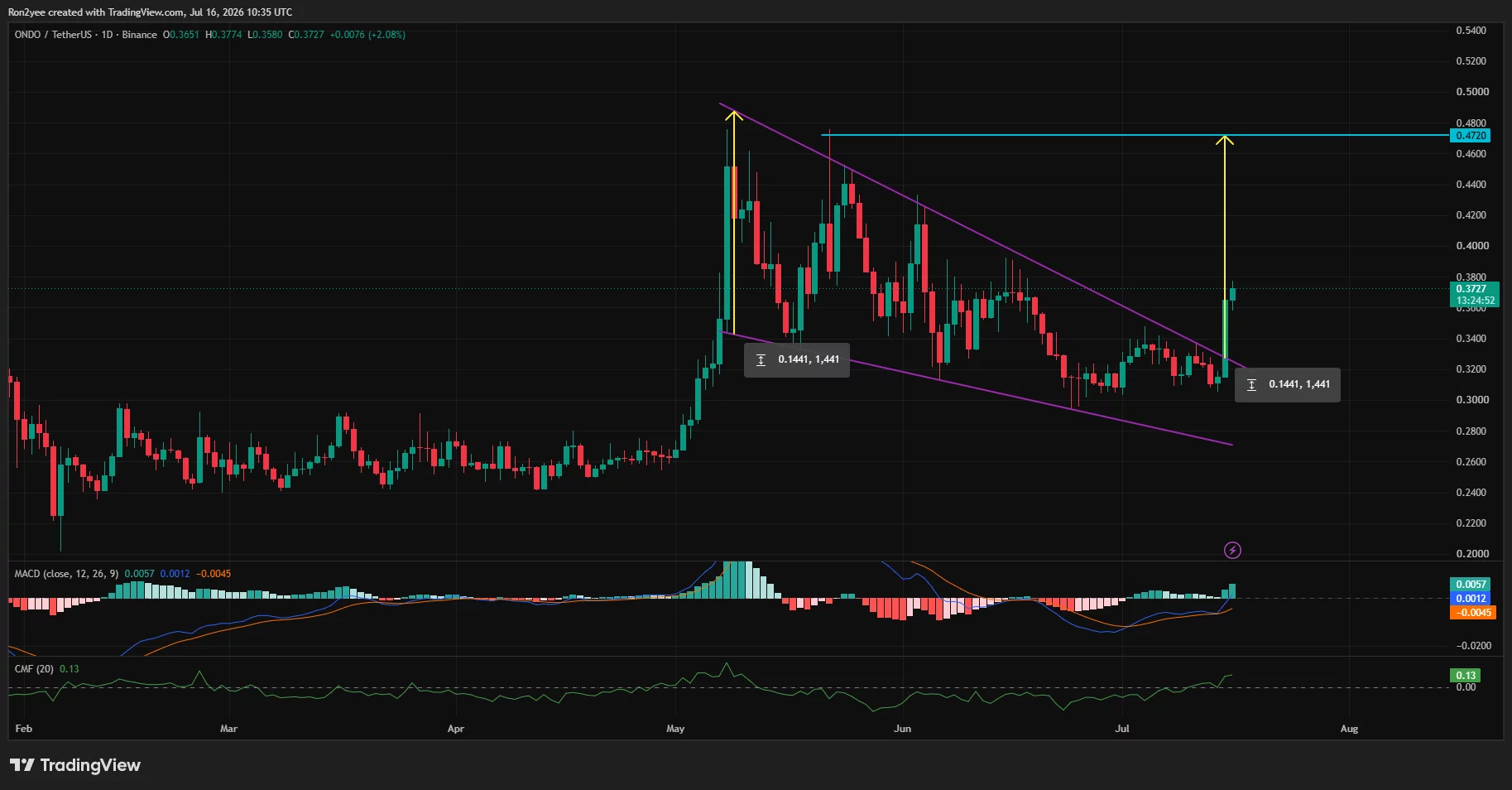
The daily chart shows Ondo (ONDO) breaking decisively above the upper trendline of a descending wedge that had contained price action since May. The breakout also invalidated a series of lower highs and pushed the token back above the short-term resistance area near $0.34. At the time of writing, ONDO is trading around $0.37, with the next major resistance sitting near $0.47, the level where the token previously reversed in May.
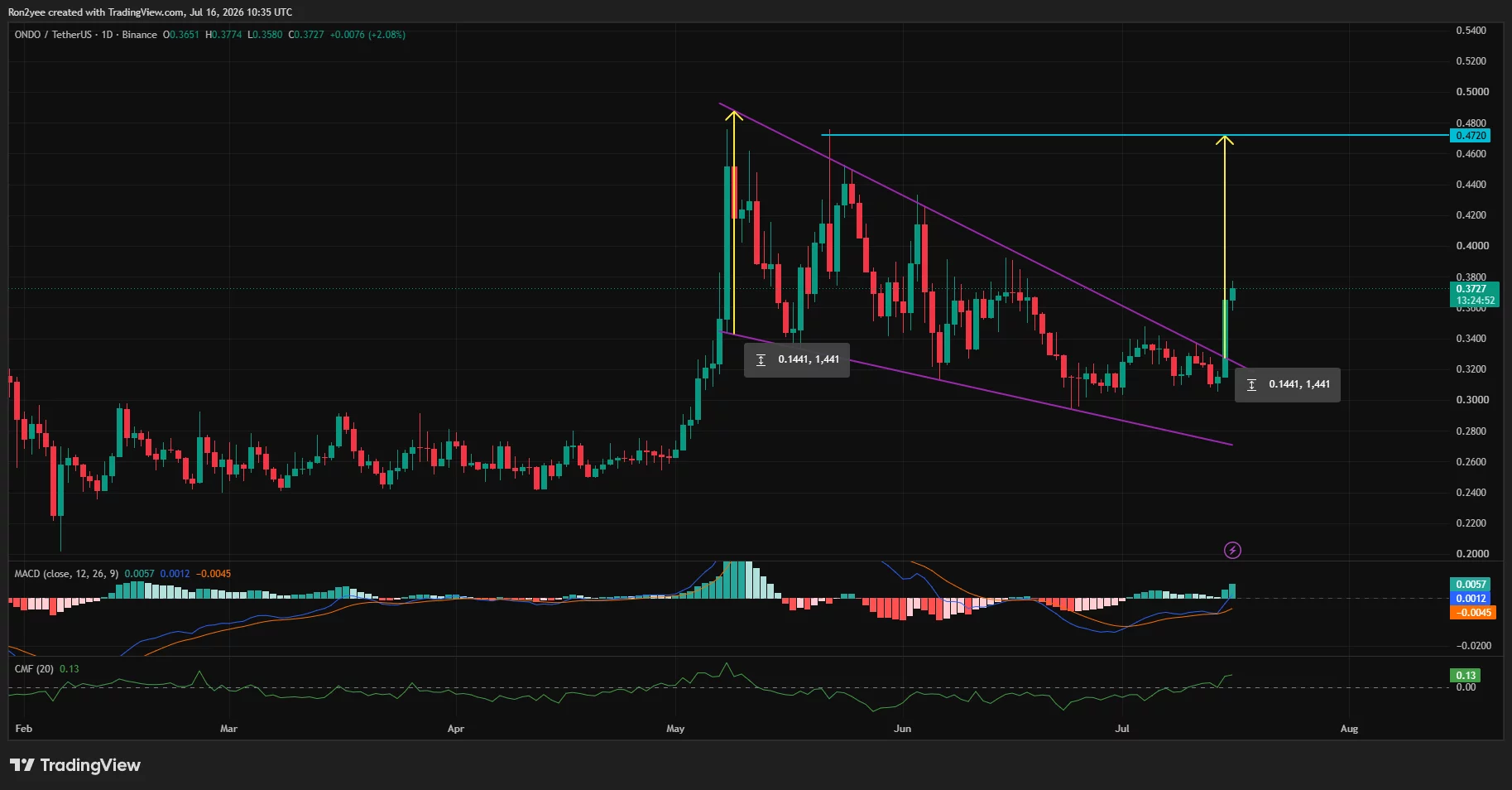
Momentum indicators have also turned constructive. The MACD has completed a bullish crossover with expanding positive histogram bars, while the Chaikin Money Flow has climbed to around 0.13, suggesting fresh capital has entered the market alongside the breakout.
Maintaining support above the former wedge resistance around $0.34–$0.35 would keep the bullish structure intact, whereas a loss of that zone could expose the token to a retest of the $0.32 area.
Derivatives positioning also favors elevated volatility. CoinGlass’ three-day liquidation heatmap shows dense short liquidation clusters between $0.38 and $0.39, just above the current market price.
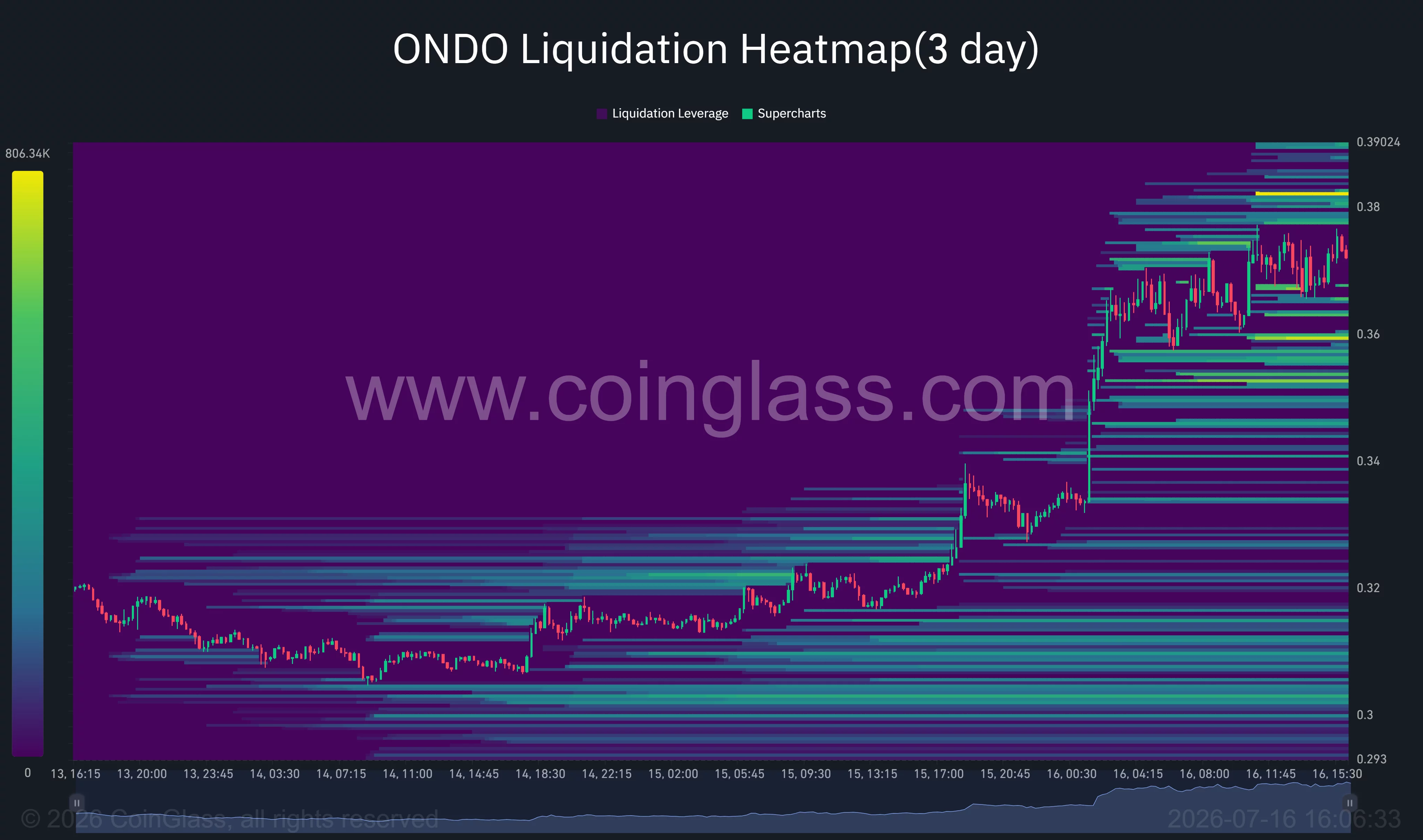
A sustained push into that range could trigger another wave of forced short covering. Below the market, sizeable liquidity remains concentrated around $0.35 and $0.34, making those levels the first areas traders are likely to watch if momentum weakens.
Institutional adoption continues to strengthen Ondo’s investment case
The latest product launch adds to Ondo’s institutional strategy, which centers on bringing regulated financial assets onto public blockchains instead of replacing traditional markets. Participation alongside firms involved in the DTCC ecosystem, including major Wall Street institutions, has strengthened investor confidence in Ondo’s long-term role within tokenized securities infrastructure.
The product rollout also expands utility across the network. Ondo Perps now allows eligible users outside the United States to trade perpetual futures linked to tokenized equities with leverage while using tokenized stocks as collateral.
At the same time, marketing campaigns with partners such as Trust Wallet have widened retail access to assets including NVDAon, GOOGLon, and TSLAon through zero-fee promotions, adding another demand driver beyond speculative trading.
Although macro uncertainty surrounding interest rates continues to limit risk appetite across digital assets, ONDO has attracted capital through a project-specific catalyst rather than a marketwide rally.
As long as buyers defend the breakout zone and institutional adoption continues to expand, traders will likely focus on whether the token can challenge the $0.47 resistance over the coming sessions.
Disclosure: This article does not represent investment advice. The content and materials featured on this page are for educational purposes only.

At 42x subscription, SBI Funds IPO draws record buzz

Zama’s confidential USDC vault climbs to No. 8 on Morpho

Castillo King’s debut win 2026: Tommy Berry’s tactical decision pays off


-

 Fashion6 days ago
Weekend Open Thread: Nutriplenish Leave-In Conditioner
-
 NewsBeat9 hours ago
London Mayor Sadiq Khan handed a peerage by Keir Starmer alongside 15 other Labour figures… just days before the PM leaves No10
-

 Sports7 days ago
Super Eagles star Moses Simon opens up on Liverpool transfer regret
-

 Crypto World24 hours ago
CFTC blocks Kalshi from unwinding Michigan trades after court order
-

 Business22 hours ago
Nvidia Stock Slips After Big Tuesday Rally as Huang Confirms Vera Rubin Chip Is Now in Production Today
-

 Politics2 days ago
Young campaigners urge incoming PM to act on outdoor junk food ads
-

 News Videos2 days ago
XRP BOMBSHELL… XRP OMBOARDED FOR TRANSACTIONS!!!
-

 Tech3 days ago
Get Your ESP32 Sunny Side Up With This Solar Dev Board
-
 Entertainment1 day ago
Disney’s Most Ambitious Failed Star Wars Attraction Is Coming to SDCC
-

 Tech2 days ago
Dark Secrets Emerge When Jailbreaking LLMs
-

 Crypto World4 hours ago
Injective Submits SEC Transfer-Agent Registration to Onchain Ownership Records
-
 Sports1 day ago
New Cornerback Enters Vikings Trade Rumor Mill
-
 Tech3 days ago
Cloudflare Precursor Watches Your Mouse and Keyboard To Decide If You Are Human
-

 News Videos3 days ago
how to make coin bank box with cardboard #scienceproject #money #diy #shorts
-
 Entertainment1 day ago
Vicki Gunvalson Defends Discussing Heather Dubrow’s Money
-

 Crypto World2 hours ago
Claude Fable 5 Slips to Second in AI Coding Leaderboard
-
Crypto World2 days ago
Ripple, Coinbase, Circle Join Linux x402 Foundation to Help Shape AI Payments
-

 Business2 days ago
ACCC warns AI could lift insurance costs in risk-prone areas
-

 NewsBeat1 day ago
Watch: Is Donald Trump facing a popular backlash on immigration?
-

 Sports1 day ago
Michigan officials not expected to discuss AD Warde Manuel at Thursday meeting
You must be logged in to post a comment Login