
Crypto World
Morpho Unveils Fixed-Rate Protocol Morpho Midnight



Morpho is the second-largest lending protocol in DeFi, with $7.7B in TVL.
Morpho, DeFi’s second-largest lending protocol by value locked, has officially named its long-in-development fixed-rate product: Morpho Midnight.
Co-founder and CEO Paul Frambot announced the name on X today, April 14, emphasizing that Midnight is not a sequel to Morpho Blue. “It is a completely new paradigm for onchain lending, and should not be considered a ‘V2’ of Blue,” Frambot wrote.
The distinction is structural, according to Frambot’s X post. Morpho Blue offers pool-based, open-term variable-rate markets with externalized risk management. Midnight introduces intent-based, fixed-term, fixed-rate markets with externalized management of both risk as well as rate, a different mechanism for pricing and matching lenders and borrowers.
The two protocols will coexist and complement each other within the broader Morpho network, per the X post. Frambot first flagged the naming overhaul of Morpho’s fixed rate market in early March, when he dropped versioning terminology (Markets V1/V2) in favor of distinct brand identities for each product.
Frambot added in today’s announcement that more details on Midnight are expected as security audits finalize.
Morpho currently holds approximately $7.7 billion in total value locked, per data from DefiLlama, making it the second-largest lending protocol in DeFi, following Aave with $26.3 billion in TVL.
Last June, The Defiant reported on Morpho’s V2 launch, which introduced fixed-rate and fixed-term loans, with the aim to bring DeFi lending closer to traditional finance structures, which Midnight now builds on.
Last month, the Ethereum Foundation made its second deployment into Morpho Vaults, bringing its total commitment to nearly $19 million and citing the protocol’s immutable, open-source architecture as a model for cypherpunk-aligned DeFi infrastructure.
This article was written with the assistance of AI workflows. All our stories are curated, edited and fact-checked by a human.



Five US banking lobbies issued a joint statement saying the proposed language on stablecoin yield in the Clarity Act falls short of its goal of protecting bank deposits.
The five trade groups backed the senators’ goal but demanded stronger text. It included the American Bankers Association, the Bank Policy Institute, the Consumer Bankers Association, the Financial Services Forum, and the Independent Community Bankers of America.
US Banks Want Tighter Stablecoin Yield Language in Clarity Act
Senators Thom Tillis and Angela Alsobrooks released the bipartisan compromise on stablecoin rewards. This came after months of talks with banks, the White House, and crypto firms.
The provision bars deposit-style yield but leaves room for rewards tied to genuine on-platform activity. The banking groups acknowledged the senators’ efforts to address deposit flight risks. They said their forthcoming feedback would aim to preserve community lending while accommodating innovation.
“Senators Tillis and Alsobrooks are seeking to achieve the correct policy goal – prohibiting the payment of yield and interest on stablecoins; however, the proposed language falls short of that goal. It is imperative that Congress get this right,” the statement read.
Follow us on X to get the latest news as it happens
The banking groups in particular pointed to Section 404. The text lets crypto exchanges pay yield through user membership programs, provided the payouts are not structured like bank interest. The lobbies called this a major loophole that lawmakers must close.
They also objected to rewards calculated on the basis of duration, balance, and tenure. Banks argue this setup directly rewards idle stablecoin holdings, defeating the prohibition’s purpose of preventing deposit flight.
“We will be sharing our detailed suggestions for strengthening the proposed language with lawmakers in the coming days, and we will continue to work in good faith to help Congress embrace innovation while protecting the deposits that drive local lending and economic activity in their communities,” they added.
Tillis Defends the Compromise
Tillis pushed back on Monday. He said on X that banks had a seat at the table for months of negotiations.
“Our compromise prohibits stablecoin rewards from resembling interest on bank deposits, our core concern over deposit flight… Some in the banking industry may not want either of these things to happen, and we respectfully agree to disagree,” he said.
Tillis warned against letting “the perfect become the enemy of the good.” The lobbies will submit detailed suggestions within days, ahead of an expected Senate Banking Committee markup later this month.
Subscribe to our YouTube channel to watch leaders and journalists provide expert insights
The post Banks Say Stablecoin Yield Language Falls Short, Senator Tillis Disagrees appeared first on BeInCrypto.


Bitmine chairman Tom Lee has said the crypto market may be entering an early recovery phase even as investor sentiment remains cautious.
Summary
- Tom Lee has said crypto may be entering an early recovery phase even as sentiment remains cautious.
- Bitmine has purchased over 101,745 ETH worth $242 million, taking its total holdings past 5.1 million ETH.
- More than 4 million ETH has been staked by the firm, accounting for about 10.5% of total staked supply.
According to Bitmine Immersion Technologies chairman Tom Lee, recent market trends resemble past cycle transitions where prices begin to recover while investor sentiment remains subdued.
In a note on Monday, Lee said “crypto spring…has commenced,” adding that sentiment has stayed cautious even as prices strengthen.
Lee tied that outlook to policy developments in the U.S., stating that the outcome of the CLARITY Act, whether it is passed or rejected, would confirm the return of favourable conditions for digital assets. His note came after more than six months of weak pricing following the October 2025 market downturn, a period that analysts have tracked closely for signs of reversal.
According to the company’s latest disclosure, Bitmine purchased over 101,745 Ether worth about $242 million in the past week, pushing total holdings beyond 5.1 million ETH. The firm said this represents roughly 4.29% of Ethereum’s circulating supply of about 120.7 million tokens.
Lee said the company is “continuing our aggressive accumulation,” pointing to a faster pace of purchases over the past four weeks.
Earlier updates from the company showed holdings around 5.07 million ETH, while on-chain data tracked by Arkham indicated that more than 4 million ETH has already been deployed into staking programmes.
Valued at roughly $9.3 billion, the stash accounts for roughly 10.5% of the total staked Ethereum supply, according to the same data.
Company disclosures show the strategy combines continued purchases with staking, allowing Bitmine to generate yield while reducing liquid supply in the market. Internal targets cited in reports indicate the firm is working toward securing up to 5% of Ethereum’s total supply over time.
Ethereum outlook tied to institutional and AI demand
Lee said Ethereum’s positioning remains supported by institutional adoption trends, noting that “Wall Street tokenizing on the blockchain” continues to drive demand. He added that emerging AI systems are increasingly relying on neutral public blockchains, which he said strengthens Ethereum’s role in the ecosystem.
Performance data cited by Lee shows ETH has outperformed the S&P 500 by 1,380 basis points since the start of the war referenced in his note, placing it among the strongest performing assets alongside crude oil.
On-chain data and company filings indicate Bitmine remains one of the largest holders of Ether, with its growing allocation placing it among the most active institutional participants shaping supply dynamics in the Ethereum market.


Moscow Exchange plans to publish four more crypto indexes from May 13, widening its benchmark list beyond Bitcoin and Ethereum.
Summary
- MOEX will add SOL, XRP, TRX and BNB indexes from May 13 for professional investors.
- Binance will supply 50% of pricing data, while Bybit, OKX and Bitget provide the rest.
- Existing Bitcoin and Ethereum indexes will update every 15 seconds during trading and weekend sessions.
The new indexes will track Solana, XRP, Tron and BNB under the tickers MOEXSOL, MOEXXRP, MOEXTRX and MOEXBNB.
The exchange plans to calculate prices with data from Binance, Bybit, OKX and Bitget. Binance will carry a 50% weight. Bybit will provide 20%, while OKX and Bitget will each provide 15%.
Crypto benchmarks move closer to live pricing
From May 13, Moscow Exchange also plans to update all digital currency indexes more often. Existing benchmarks, including MOEXBTC and MOEXETH, are expected to update every 15 seconds during trading hours and extra weekend sessions.
The shift may make the benchmarks more useful for products tied to digital asset prices. However, the exchange has not presented the new altcoin indexes as tradable products yet. It said they “could become” underlying assets for future instruments, leaving timing and terms open.
Meanwhile, the planned indexes fit Russia’s controlled route for crypto-linked market products. Crypto.news reported in June 2025 that Moscow Exchange listed a Bitcoin ETF futures contract tied to BlackRock’s IBIT product, but access stayed limited to qualified investors. The exchange said: “Trading in this new product will begin on June 4, 2025, and will be exclusively available to qualified investors.”
That model remains central to Russia’s approach. The country allows crypto exposure through selected financial products, but it has not opened broad spot crypto trading on local regulated venues. Crypto.news also reported that Russia had explored a trading pilot for top-tier investors, led by the Finance Ministry and the Bank of Russia.
Regulators target activity outside formal channels
The index launch comes as Russian officials try to move crypto activity into supervised channels. Crypto.news reported in February 2026 that Deputy Finance Minister Ivan Chebeskov estimated Russian crypto turnover at about 50 billion rubles per day, or more than 10 trillion rubles per year.
Moreover, Chebeskov said much of that activity remained “outside the regulated zone, outside our control.” The Bank of Russia has also called for penalties against transactions outside approved rules. Crypto.news cited Governor Elvira Nabiullina, who said: “Fraudsters are taking advantage of the gray market.”
More crypto indexes may follow
Moscow Exchange plans to expand its benchmark list to ten crypto assets. Possible additions include Dogecoin, Cardano, Hyperliquid and Chainlink, based on the current list under review.
The exchange has also discussed futures tied to crypto indexes, including possible perpetual futures on Bitcoin and Ethereum. Direct cryptocurrency trading remains a separate goal. The current roadmap points to early 2027 for that step.


Strive, Inc. has pushed its Bitcoin treasury past 15,000 BTC after its latest purchase added to a months-long accumulation run.
Summary
- Strive has crossed 15,000 BTC after buying 444 bitcoin for $33.9 million, according to its SEC filing.
- Company disclosures show the treasury has grown by over 2,200 BTC since its Semler Scientific acquisition in January 2026.
- Investor filings indicate Strive raised $225 million through its SATA preferred stock, with demand exceeding $600 million.
According to an 8-K filing with the U.S. Securities and Exchange Commission, the Dallas-based firm bought 444 BTC for $33.9 million at an average price of $76,307 per coin, taking its total holdings above the 15,000 BTC threshold. CEO Matt Cole disclosed the purchase on X alongside the filing, confirming the company’s continued pace of accumulation.
The new total builds on a prior disclosure from April 24, when Strive reported holding 14,557 BTC following a separate purchase of 789 BTC at $77,890 per coin. Company filings show that the latest addition lifts the treasury’s value to roughly $1.2 billion at current market prices.
Strive’s treasury expansion tied to structured capital strategy
SEC disclosures dated May 1 show Strive holding $97.9 million in cash and cash equivalents, alongside a $50.4 million position in Variable Rate Series A Perpetual Stretch Preferred Stock tied to Strategy, the firm led by Michael Saylor.
The filing also listed 63,129,587 Class A shares and 9,893,844 Class B shares outstanding, along with 4,959,536 shares of its own preferred stock trading under the SATA ticker.
Strive has framed its approach as a Bitcoin-first capital model. Company materials describe Bitcoin per share as the internal benchmark for capital allocation, with Cole steering the firm toward what he has called “digital credit” products built around Bitcoin exposure.
Investor filings show the SATA preferred stock at the center of this structure. In January 2026, Strive raised $225 million through an oversubscribed offering, with demand exceeding $600 million, while the instrument carried an annualized yield close to 13%. Company disclosures noted that the product held its peg even during a roughly 50% drawdown in Bitcoin prices.
As previously reported by crypto.news, Strive became a top 10 public corporate Bitcoin holder last month, with its balance rising to 14,557 BTC. In previous company statements, Strive reported it held 12,798 BTC following its January 2026 acquisition of Semler Scientific, a deal that brought the medical technology company under it as a subsidiary.
Statements from Strive and data referenced by BTCtreasuries indicate the company has added more than 2,200 BTC since that acquisition, a pace that has pushed it into direct competition with long-established treasury holders.
Positioning alongside Strategy’s treasury model
Public filings show Strategy remains the largest corporate Bitcoin holder, with 818,334 BTC acquired at a cumulative cost of about $61.8 billion and an average price of $75,537 per coin, accounting for nearly 4% of Bitcoin’s fixed supply.
Strive’s $50.4 million allocation to Strategy-linked preferred stock signals exposure to similar balance sheet structures across corporate treasury strategies.
Market data at the time of writing showed Strive’s shares trading at $16.23, down 0.05% on the day, while historical pricing data indicates the stock has declined about 88% over the past six months during a period that included a deep Bitcoin drawdown followed by a partial recovery.

Prime Minister Narendra Modi condemned the missile and drone attacks on the United Arab Emirates after three Indian nationals were injured in Fujairah.
Summary
- PM Modi called the Fujairah attack unacceptable after three Indian nationals were injured in the UAE.
- Pakistan and Canada condemned Iran’s missile and drone strikes, urging restraint and regional de-escalation.
- Hormuz tensions kept oil, shipping and Bitcoin volatility in focus after the UAE attack.
He said India stood with the UAE and called the targeting of civilians and infrastructure “unacceptable.”
India’s Ministry of External Affairs also criticised the strike and urged an end to attacks on civilians. Officials said the injured Indian nationals were receiving medical care, while the Indian Embassy in the UAE worked with local authorities.

Moreover, Pakistan’s Prime Minister Shehbaz Sharif also condemned the attacks on civilian infrastructure in the UAE. In a post on X, he said Pakistan “strongly condemns the missile and drone attacks on civilian infrastructure in the United Arab Emirates last night.”
Sharif said Pakistan stood with UAE President Mohamed bin Zayed and the Emirati people. He added that the ceasefire should be respected to allow space for dialogue and regional stability.
Canada’s Prime Minister Mark Carney also condemned Iran’s missile and drone attacks on the UAE. He said Canada stood in solidarity with Mohamed bin Zayed and the people of the UAE.
Carney also praised defensive steps taken to protect civilians and civilian infrastructure. He said Canada called for de-escalation and diplomacy in the region.
Fujairah attack raises concern over Hormuz
The UAE accused Iran of carrying out the strikes, including an attack linked to a fire at an oil facility in Fujairah. Reports said the attacks came as tensions around the Strait of Hormuz continued to pressure shipping and energy routes.
Modi also pointed to the need for safe navigation through the Strait of Hormuz. He said free movement through the waterway was vital for regional peace, stability and global energy security.
The UAE said its air defences intercepted ballistic missiles, cruise missiles and drones launched from Iran. Iran has not issued a full official response, while an Iranian military official told state media that Tehran had no plan to attack UAE oil facilities.
Bitcoin volatility stays in focus
Crypto.news reported that Bitcoin recently moved above $80,000 after U.S. President Donald Trump announced “Project Freedom” amid Strait of Hormuz tensions. The report said the move triggered more than $160 million in Bitcoin short liquidations.
Crypto.news also reported earlier that Iran denied claims it was collecting Strait of Hormuz tolls in Bitcoin or stablecoins. The outlet said maritime security firms had warned of scam emails asking stranded vessel operators for crypto payments.

TLDR
- Elon Musk has resolved an SEC enforcement action regarding delayed Twitter stock disclosure by agreeing to a $1.5 million settlement payment
- Federal regulators claimed Musk’s 11-day filing delay allowed him to acquire shares at reduced prices, resulting in approximately $150 million in avoided costs
- The settlement, paid through Musk’s trust, includes no acknowledgment of liability or wrongdoing
- This $1.5 million settlement represents the highest penalty ever imposed by the SEC for violations of this nature
- Tesla shares declined 0.16% in pre-market activity following the announcement, extending year-to-date losses to approximately 13%
Elon Musk has reached a settlement agreement with the U.S. Securities and Exchange Commission regarding allegations that he failed to timely disclose his accumulation of Twitter shares. Under the terms, a trust bearing Musk’s name will remit $1.5 million to resolve the matter. The settlement contains no acknowledgment of liability.
The regulatory agency initiated legal proceedings in January 2025, mere days before President Biden’s term concluded. The complaint centered on Musk’s alleged failure to file required disclosures for 11 days after surpassing the 5% ownership threshold in Twitter shares during late March and early April of 2022.
Federal securities regulations mandate that investors publicly report their holdings once they exceed 5% ownership in any publicly traded company. According to the SEC’s allegations, Musk’s delayed filing enabled him to continue accumulating shares at artificially suppressed prices before market participants could respond to the information.
Throughout this disclosure gap, Musk acquired more than $500 million in Twitter stock. His eventual disclosure revealed a 9.2% ownership position. The SEC calculated that the filing delay resulted in approximately $150 million in cost savings for Musk.
While the SEC initially sought disgorgement of the full $150 million, observers with knowledge of the proceedings indicated that establishing such damages in litigation would have presented significant evidentiary challenges. The negotiated resolution requires only the $1.5 million monetary penalty.
According to Alex Spiro, Musk’s legal counsel, his client has been “cleared of all issues related to the late filing of forms in the Twitter acquisition.” Musk previously characterized the filing delay as unintentional and contended that the SEC’s enforcement action violated his constitutional free speech protections.
A Long History With the SEC
This settlement marks another chapter in Musk’s ongoing relationship with the securities regulator. In 2018, he resolved separate charges by paying $20 million after publishing tweets claiming he had “funding secured” to take Tesla private. That earlier agreement also mandated his resignation as Tesla’s board chairman and implemented pre-approval requirements for certain social media communications.
The Twitter-related settlement was formally filed on May 4 in federal court in Washington, D.C. The resolution came approximately three months after a federal judge denied Musk’s motion seeking dismissal of the enforcement action.
The agreement emerged following the unexpected March departure of Margaret Ryan, the SEC’s enforcement division chief, who resigned after internal disagreements with agency leadership. Under current Chairman Paul Atkins, the SEC has been recalibrating its enforcement priorities and approach.
According to a source with direct knowledge of the matter, the $1.5 million penalty establishes a new record as the largest civil penalty ever assessed for this particular category of disclosure violation.
What It Means for Tesla
Tesla shares experienced a modest 0.16% decline in pre-market trading following news of the settlement. Year-to-date, the stock has fallen approximately 13%.
Current Wall Street consensus rates Tesla as a Moderate Buy, reflecting 13 Buy recommendations, 12 Hold ratings, and 5 Sell opinions. Analysts’ average price target of $410.21 suggests potential upside of roughly 4.5% from present trading levels.
For Musk personally, whose net worth Forbes estimates at $789.9 billion, the $1.5 million settlement payment represents an immaterial financial impact.



The crypto market resumed its uptrend on Tuesday, rising 1.2% to $2.76 trillion as oil prices eased, after Iranian officials hinted at progress in U.S.-Iran peace negotiations.
Summary
- Crypto market rises 1.2% to $2.76T as Bitcoin tops $81K; rebound triggers $225M in short liquidations.
- Sentiment improves as the Crypto Fear and Greed index moves to neutral; oil prices ease on signs of progress in U.S.-Iran talks.
- Focus shifts to U.S. Nonfarm Payrolls and JOLTS data, which could shape Fed policy outlook and market direction.
Bitcoin (BTC) climbed 3.5%, briefly moving above the $81,000 level before settling at around $80,855 at press time. Ethereum (ETH) gained 1% to trade above $2,381, while other major assets such as XRP (XRP), Solana (SOL), and Tron (TRX) showed relatively muted price action. Among the top performers on the day were Toncoin (TON), MemeCore (M), and Morpho (MORPHO).
The rebound across digital assets triggered a wave of short liquidations, with roughly $225 million in bearish positions wiped out over the past 24 hours, according to derivatives data. The move suggests that traders positioned for further downside were forced to exit as prices pushed higher.
Market sentiment also improved notably. The Crypto Fear and Greed index rose by 10 points, moving out of fear territory and back into neutral levels, reflecting a shift in investor outlook after days of caution.
The recovery in crypto prices came alongside a pullback in oil and energy markets. Comments from Iran’s foreign minister helped ease concerns, as officials indicated that recent attacks in the UAE and against U.S. interests may have been attempts to provoke a larger conflict. They added that ongoing talks between Iran and the United States, reportedly mediated by Pakistan, continue to show signs of progress.
Tensions had escalated earlier after U.S. President Donald Trump warned of severe retaliation following reports of Iranian missile strikes in the UAE and unverified claims of a U.S. naval vessel being targeted in the Strait of Hormuz.
Traditional safe-haven assets such as gold and silver posted modest gains during the session, while Asian technology stocks also edged higher, mirroring the cautious recovery seen in risk assets.
Looking ahead, investors are turning their attention to upcoming U.S. macroeconomic data, including Nonfarm Payrolls and JOLTS job openings figures.
These releases are expected to offer further clarity on the strength of the labor market and could influence expectations around Federal Reserve policy, which remains a key driver for both crypto and broader financial markets.
Disclosure: This article does not represent investment advice. The content and materials featured on this page are for educational purposes only.
Key Highlights
- Pavel Durov announced Telegram will take over from TON Foundation as the primary force driving the TON blockchain, sending Toncoin (TON) up more than 30%.
- The messaging platform will operate as TON’s primary validator, with Durov emphasizing a renewed commitment to “technological excellence.”
- Network transaction costs have decreased by 83%, falling to practically zero and boosting attractiveness for both users and developers.
- Daily trading activity skyrocketed 600%, surpassing $630 million within 24 hours, while market capitalization reached $4.5 billion.
- Meme coins built on TON experienced dramatic gains, including Dogs soaring over 90% and Notcoin climbing 26%.
Toncoin (TON) experienced one of its most significant daily price surges in recent months following an announcement from Pavel Durov, the founder and CEO of Telegram, who shared a critical governance change for the TON blockchain via his X account.
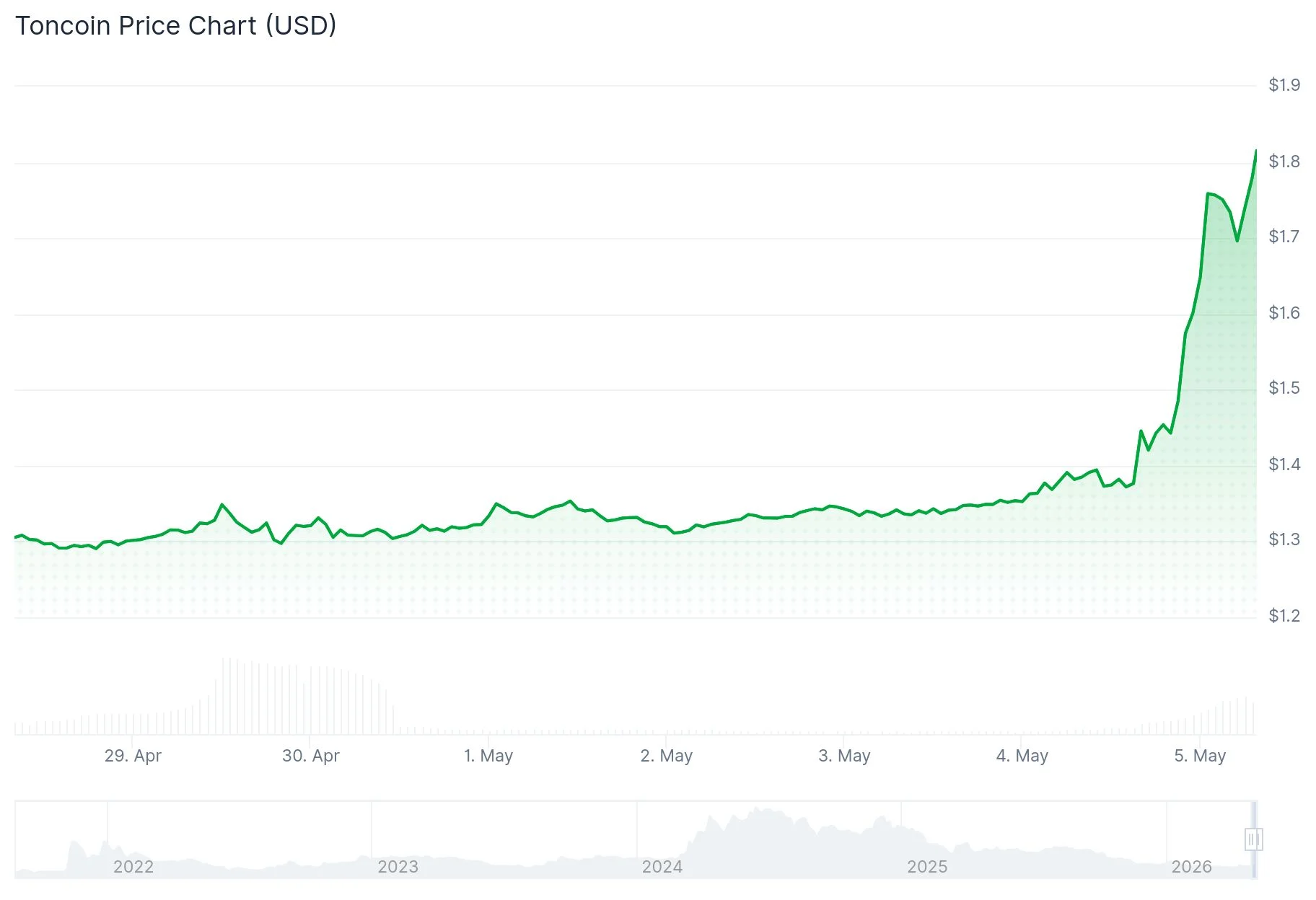
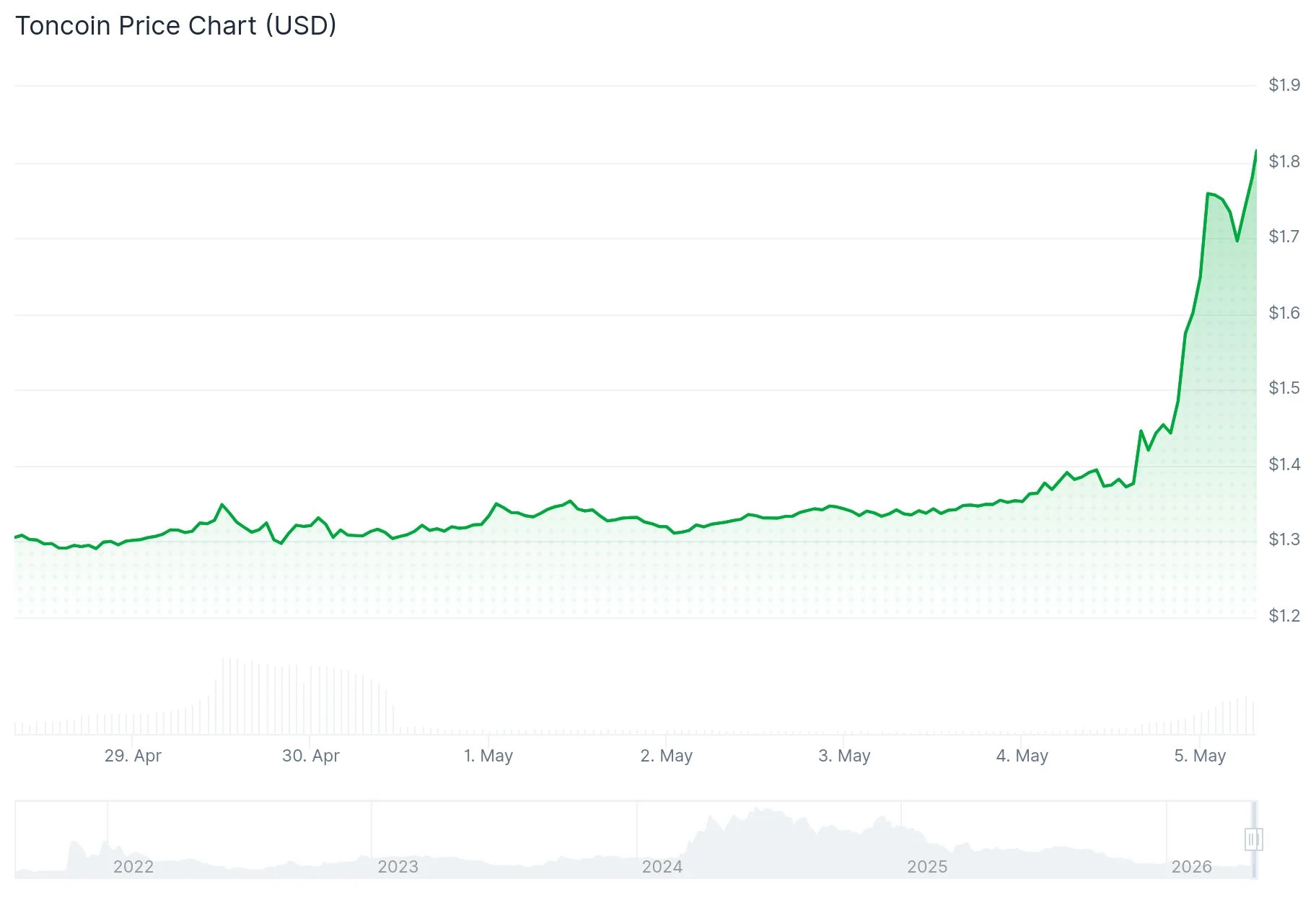
In his announcement, Durov revealed that Telegram would “replace the TON Foundation as the driving force behind TON and become its largest validator.” Despite the brevity of the message, the market response was swift and substantial. TON’s price surged from $1.37 to a peak of $1.84 over the following 24 hours, representing approximately 34% growth.
Cryptocurrency analyst Sam Cooling emphasized that the significance of this development extends far beyond simple organizational restructuring. With Telegram’s massive user base of 950 million monthly active accounts, the platform is now officially integrating its operations with a single blockchain infrastructure—establishing what Cooling characterizes as “structural demand for TON that didn’t exist under a community-run foundation.”
Market activity confirmed this assessment. Trading volume exploded by 600%, exceeding $630 million over a 24-hour period, while Toncoin’s market capitalization climbed to $4.5 billion.
Durov further revealed that TON’s transaction costs have been reduced by a factor of six, now approaching zero. He announced that significant upgrades—including a redesigned ton.org website, enhanced developer resources, and network performance enhancements—are scheduled for release within the next two to three weeks.
Telegram’s new role as TON’s primary validator gives the company direct authority to validate network transactions, collect staking incentives, and exercise significant influence over future protocol governance. This integration also creates a tighter connection between Telegram’s revenue model and the TON ecosystem.
What the Telegram-TON Connection Means in Practice
A practical illustration of this integration is visible in the Telegram Ad Platform. Advertisers must acquire advertising space using Toncoin, while channel operators receive 50% of ad revenue distributed in TON. Telegram intends to expand this model through Telegram Stars by the third quarter of 2026. Every advertising transaction generates buying pressure for TON, while revenue distributions circulate the token throughout the ecosystem.
The blockchain has already processed 1.5 billion transactions during the first quarter of 2026 alone. Total value locked within the TON ecosystem reached $1.2 billion by April 2026. The TON v4 upgrade deployed in March 2026 implemented sharding technology capable of processing more than 100,000 transactions per second.
Durov also demonstrated personal commitment by investing $5 million into TON liquidity pools in late 2024.
Meme Token Surge Across the TON Ecosystem
The price rally extended well beyond Toncoin itself. The aggregate market capitalization of meme tokens built on TON increased 67% within a single day, based on CoinGecko data.
Notcoin, a tap-to-earn token distributed through Telegram mini-applications, appreciated 26%. Dogs, a community-driven meme token on TON, skyrocketed more than 90%—despite still trading approximately 96% below its peak value. Lower-capitalization tokens experienced even more dramatic movements, with Morfey climbing nearly 1,000%, Resistance Duck surging 645%, and Cubigator advancing 390%.
At press time, TON was changing hands near $1.44, representing approximately 6% daily gains, with trading volume reaching $232 million—a 235% increase compared to the previous day.
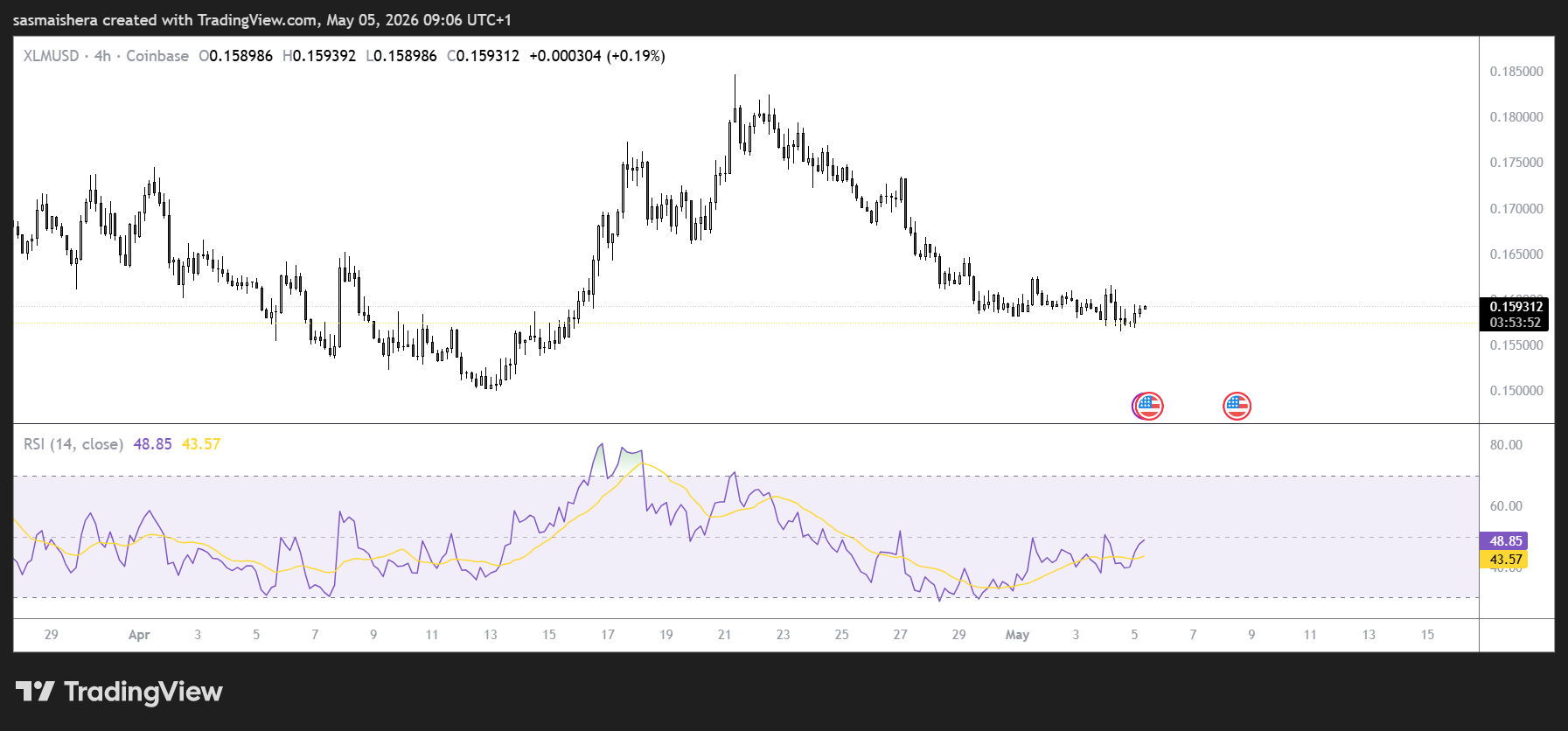
Stellar’s native token XLM remains under pressure on Tuesday, with muted price action reflecting a broader lack of conviction across altcoins. XLM has stabilized around $0.158 as traders weigh conflicting on-chain and derivatives signals.
On-chain data hints at mild bullish bias
Data from CryptoQuant points to a neutral-to-slightly bullish backdrop for XLM. XLM presents a bullish picture, with buy-side dominance emerging but broader indicators staying largely flat. This combination points to mild bullish pressure, though not strong enough to confirm a clear trend reversal.
Data obtained from CoinGlass highlights a divided market. The long-to-short ratio sits below 1 (0.77 for XLM), indicating that a larger share of traders are positioned for downside. This typically reflects a bearish tilt in sentiment.
However, funding rate data tells a different story. XLM has flipped into positive territory, meaning long traders are paying shorts—often a sign of improving bullish sentiment and growing demand for long exposure.
The divergence between bearish positioning (long/short ratios) and improving funding rates underscores a market stuck in indecision.
Until either bullish momentum strengthens or bearish pressure intensifies, both XRP and XLM are likely to remain range-bound. A confirmed breakout above XRP’s $1.40 resistance or stronger follow-through in XLM could provide the first real directional signal for traders.
Stellar price forecast: XLM remains in consolidation mode
The XLM/USD 4-hour chart is bearish and efficient as XLM is trading at $0.159 on Tuesday, maintaining a bearish near-term bias as it holds beneath the key EMAs.
The 50-day EMA at roughly $0.165, the 100-day EMA near $0.176, and the 200-day EMA around $0.208 all sit overhead as layered resistance, suggesting rallies are likely to be capped while the pair remains below this stack.
The RSI on the daily chart hovers around 43, suggesting subdued demand, while the MACD remains in negative territory, indicating that downside momentum persists despite recent stabilization.
If the rally persists, initial resistance is seen at the 50-day EMA around $0.165, followed by the 100-day EMA near $0.176.
A daily candle close above these levels could see XLM extend its rally towards the 23.6% Fibonacci retracement at $0.201, ahead of the 200-day EMA close to $0.208.

On the downside, immediate support sits on the nearby intraday pivot around the current price, with stronger support emerging toward the prior trendline break area near $0.139.
A break below this level could see XLM retest the $0.136 support zone in the near to medium term.
TLDR:
- Moscow Exchange will launch MOEXSOL, MOEXXRP, MOEXTRX, and MOEXBNB indexes starting May 13, 2026.
- Pricing data will be sourced from Binance, Bybit, OKX, and Bitget based on their trading volume share.
- All crypto indexes will update every 15 seconds during trading sessions, replacing the once-daily calculation.
- The exchange plans to expand crypto benchmarks to ten and eventually enable direct crypto trading by 2027.
The Moscow Exchange is set to expand its cryptocurrency benchmark offerings beginning May 13, with four new crypto indexes covering Solana, Ripple, Tron, and Binance Coin.
These additions come as Russia’s largest securities exchange continues building out its digital asset infrastructure. The move also brings updates to existing Bitcoin and Ether indexes.
As with current crypto instruments on the platform, access remains limited to professional investors only.
New Indexes and How They Will Be Calculated
Starting May 13, the exchange will begin calculating and publishing four new indexes: MOEXSOL for Solana, MOEXXRP for Ripple, MOEXTRX for Tron, and MOEXBNB for Binance Coin.
To determine pricing, the platform will draw from four major crypto exchanges based on their share of total trading volume.
Binance will account for 50% of the data, while Bybit will contribute 20%. OKX and Bitget will each supply 15% of the pricing inputs.
This multi-source approach aims to produce more balanced and representative index values across different trading platforms.
Along with the new listings, the frequency of index calculations will also change. From May 13, all digital currency indexes — including the existing MOEXBTC and MOEXETH — will update every 15 seconds throughout the trading day and during weekend sessions. Currently, these indexes are calculated once per day, with results published by 18:00 Moscow time.
The Moscow Exchange has indicated that these indexes may serve as underlying assets for new financial instruments in the future.
However, all crypto-related tools on the platform remain accessible only to professional investors, in line with current Russian regulations.
Expansion Plans and the Road Ahead
Beyond the four incoming indexes, the Moscow Exchange has set a target of reaching ten cryptocurrency benchmarks in total.
The preliminary list for upcoming additions includes Dogecoin (MOEXDOGE), Cardano (MOEXADA), Hyperliquid (MOEXHYPE), and Chainlink (MOEXLINK).
The exchange’s derivatives market product group head, Maria Silkina, confirmed that the platform intends to offer perpetual futures for Bitcoin and Ether at a later stage.
A futures contract obligates the seller to deliver and the buyer to purchase an asset at a set price within a defined period. In settlement futures, profit or loss is calculated based on the difference between the contract price and the strike price.
Russia’s Bank of Russia opened the door for such instruments in May 2025, permitting financial institutions to offer professional investors derivatives, securities, and digital assets tied to cryptocurrency prices. Actual delivery of digital currencies, however, is not permitted under these arrangements.
By November 2025, the exchange had already launched several instruments, including futures on its Bitcoin and Ether indexes, as well as the iShares Bitcoin Trust (IBIT) and iShares Ethereum Trust (ETHA) ETFs. The Moscow Exchange expects to enable direct cryptocurrency trading by early 2027.
Two Vikings Listed as Dark Horse Candidates for Rookie of the Year

ScarCruft hackers push BirdCall Android malware via game platform

Legacy starts with real protection cold wallet + LLC. #investing #xrp#cryptocurrency #wealth

Manchester United reach agreement with Casemiro over contract clause amid transfer speculation

US brings back mandatory military draft registration

Steven Gerrard disagrees with Gary Neville over ‘shock’ Chelsea and Arsenal claim | Football


-

 Business6 days ago
Most Commercial Energy Audits Miss the Real Losses
-

 Fashion6 days ago
Kylie Jenner’s KHY Enters a New Era with ‘Born in LA’
-

 NewsBeat2 days ago
Channel 5 – All Creatures Great and Small series 7 new post
-
 Tech4 days ago
Trump’s 25% EU auto tariff breaches Turnberry Agreement that also covers semiconductors and digital trade
-
 Sports4 days ago
Paul Scholes issues Marcus Rashford reality check as agreement emerges over Man United star
-

 Crypto World7 days ago
CFTC’s AI will review U.S. crypto registration applications, chairman tells CoinDesk
-

 Business6 days ago
Barclay Brothers Avoid Bankruptcy: HSBC Drops High Court Petitions After IVA Deal
-
 Business6 days ago
Tesla Officially Registers Elon Musk’s Stock: What Investors Need to Know
-

 Tech7 days ago
Get Ready for More Brain-Scanning Consumer Gadgets
-

 Tech6 days ago
Texas Instruments made a new flagship graphing calculator: the TI-84 Evo
-

 Business4 days ago
Two Powerball Tickets Split $143 Million Jackpot in Indiana and Kansas
-
 Crypto World4 days ago
CoreWeave (CRWV) Stock Climbs 8% Despite $45M Insider Share Dump
-
Business2 days ago
Winning Numbers Drawn as Jackpot Resets to $20 Million
-
Crypto World6 days ago
Securitize and Computershare Enable Tokenized Equity Issuance for Over 25,000 U.S.-Listed Stocks
-

 Crypto World5 days ago
Gibraltar Proposes Tokenized Funds Regulation to Bolster Compliance
-

 Fashion2 days ago
Mary J. Blige Vegas Residency Looks: Crystal-Embellished Fjolla Haxhismajli, Todd Fisher, and More!
-

 Business6 days ago
Alexandria Real Estate Equities, Inc. (ARE) Q1 2026 Earnings Call Transcript
-

 Tech5 days ago
Official SAP npm packages compromised to steal credentials
-

 Sports6 days ago
Antrim GAA: Hurlers cancel training as row with board deepens
-

 Crypto World2 days ago
Linux Copy Fail: ‘A Trivially Exploitable Bug’
You must be logged in to post a comment Login