

Crypto World
Moscow Exchange to Launch SOL, XRP, TRX, and BNB Crypto Indexes on May 13


TLDR:
- Moscow Exchange will launch MOEXSOL, MOEXXRP, MOEXTRX, and MOEXBNB indexes starting May 13, 2026.
- Pricing data will be sourced from Binance, Bybit, OKX, and Bitget based on their trading volume share.
- All crypto indexes will update every 15 seconds during trading sessions, replacing the once-daily calculation.
- The exchange plans to expand crypto benchmarks to ten and eventually enable direct crypto trading by 2027.
The Moscow Exchange is set to expand its cryptocurrency benchmark offerings beginning May 13, with four new crypto indexes covering Solana, Ripple, Tron, and Binance Coin.
These additions come as Russia’s largest securities exchange continues building out its digital asset infrastructure. The move also brings updates to existing Bitcoin and Ether indexes.
As with current crypto instruments on the platform, access remains limited to professional investors only.
New Indexes and How They Will Be Calculated
Starting May 13, the exchange will begin calculating and publishing four new indexes: MOEXSOL for Solana, MOEXXRP for Ripple, MOEXTRX for Tron, and MOEXBNB for Binance Coin.
To determine pricing, the platform will draw from four major crypto exchanges based on their share of total trading volume.
Binance will account for 50% of the data, while Bybit will contribute 20%. OKX and Bitget will each supply 15% of the pricing inputs.
This multi-source approach aims to produce more balanced and representative index values across different trading platforms.
Along with the new listings, the frequency of index calculations will also change. From May 13, all digital currency indexes — including the existing MOEXBTC and MOEXETH — will update every 15 seconds throughout the trading day and during weekend sessions. Currently, these indexes are calculated once per day, with results published by 18:00 Moscow time.
The Moscow Exchange has indicated that these indexes may serve as underlying assets for new financial instruments in the future.
However, all crypto-related tools on the platform remain accessible only to professional investors, in line with current Russian regulations.
Expansion Plans and the Road Ahead
Beyond the four incoming indexes, the Moscow Exchange has set a target of reaching ten cryptocurrency benchmarks in total.
The preliminary list for upcoming additions includes Dogecoin (MOEXDOGE), Cardano (MOEXADA), Hyperliquid (MOEXHYPE), and Chainlink (MOEXLINK).
The exchange’s derivatives market product group head, Maria Silkina, confirmed that the platform intends to offer perpetual futures for Bitcoin and Ether at a later stage.
A futures contract obligates the seller to deliver and the buyer to purchase an asset at a set price within a defined period. In settlement futures, profit or loss is calculated based on the difference between the contract price and the strike price.
Russia’s Bank of Russia opened the door for such instruments in May 2025, permitting financial institutions to offer professional investors derivatives, securities, and digital assets tied to cryptocurrency prices. Actual delivery of digital currencies, however, is not permitted under these arrangements.
By November 2025, the exchange had already launched several instruments, including futures on its Bitcoin and Ether indexes, as well as the iShares Bitcoin Trust (IBIT) and iShares Ethereum Trust (ETHA) ETFs. The Moscow Exchange expects to enable direct cryptocurrency trading by early 2027.


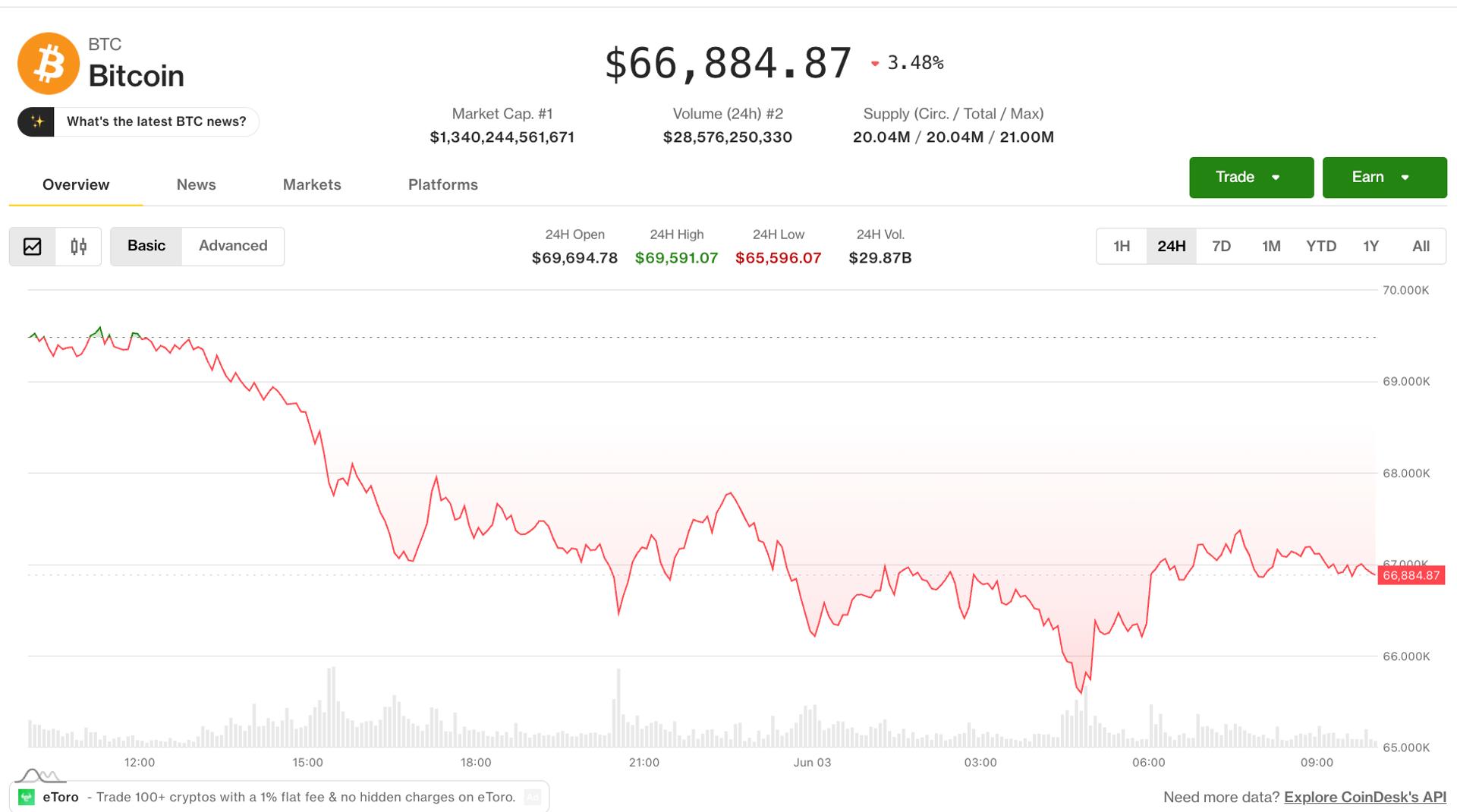
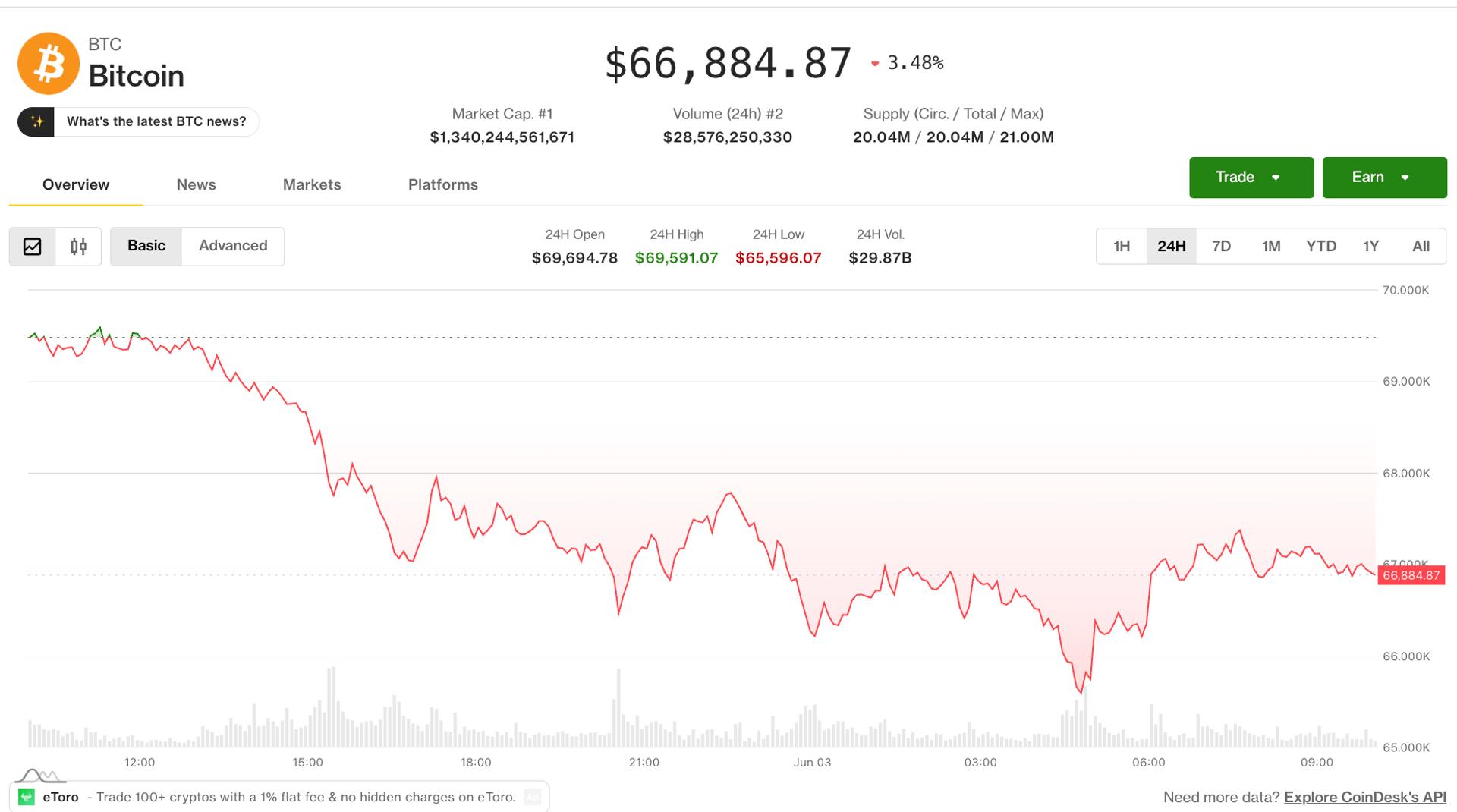
Bitcoin recovered 0.7% on Wednesday, but remains at a crucial crossroads after a 9.5% decline since Sunday.
The largest cryptocurrency traded recently near $67,000, firmly in the middle of a range that persisted between February and April after a failed breakout attempt above $81,000 last month.
If bitcoin tumbles below $60,000 it would probably trigger a wave of liquidations and a possible slide to as low as $54,000, a level of support dating back to both 2024 and 2021.
Ether (ETH), meanwhile, trades at $1,870 after rising by 0.9% since midnight UTC, although the bounce comes after a selloff that saw it tumble to its lowest point since February.
The U.S. stock market rallied to record highs again on Tuesday. The divergence is starting to trigger concerns among some crypto investors because the two asset classes have historically moved in tandem.
AI crypto tokens continued to outperform the peers. NEAR, RENDER and FET all rose by around 9% on Wednesday following Tuesday’s market-wide selloff.
Derivatives positioning
- Over $1.7 billion in leveraged crypto futures bets were liquidated in the past 24 hours, double the day-earlier amount.
- Most liquidations were bullish long positions after BTC slumped to $65,500 earlier today. The 24-hour volume surged 27% to nearly $300 million while cumulative industry-wide notional open interest (OI) fell just over 2%.
- The combination of large liquidations and falling open interest suggests aggressive crowding out of leveraged bullish plays and a reduction in new leveraged exposure.
- Open interest in bitcoin futures hovers at record highs above 800K BTC, up for the third straight day even as spot prices decline. That validates the downtrend and points to an influx of new shorts or bearish positioning.
- The seven-day OI-adjusted cumulative volume delta is negative, indicating bears are leading price action by actively shorting with market orders rather than using passive limit orders.
- Most major tokens, including ETH, ADA, SUI, XRP and SOL, also show negative seven-day and 24-hour cumulative volume deltas, signaling bear leadership across markets. Funding rates for these tokens remain slightly positive to slightly negative, implying the bearish side is not overcrowded and there’s room for further downside.
- Open interest in ZEC futures, however, has risen for the third straight day to 2.43 million ZEC as the token has gained 6.3% over seven days, bucking the broader malaise. ZEC also shows a positive 24-hour CVD alongside HYPE, indicating bullish sentiment.
- Fear is creeping back in. BTC and ETH 30-day implied volatility indices (BVIV and EVIV) jumped sharply Tuesday, posting their largest single-day gains since the Feb. 5 crash. Continued increases in the measure could presage further market pain.
- Options flow on Deribit shows traders paying up for downside protection. The one-week put-call skew climbed to nearly 20% early today, reflecting an outsized demand for puts. The most traded instruments in the past 24 hours were the $70K put expiring June 5 and the $55K put expiring June 26.
- In block flows, BTC call spreads and ETH put spreads were the most favored bets.
Token talk
- Ethena (ENA) is one of Wednesday’s top-performing altcoins, rising by 9.3% since midnight UTC and more than 20% in 24 hours after Coinbase (COIN) said it will integrate Ethena features in a new savings account product.
- There was a notable gain for privacy coin zcash (ZEC). The token has risen 2% since midnight and 12% in the past 24 hours as it attempts to steer itself away from danger.
- CoinMarketCap’s “Altcoin Season” indicator is now at 53/100, the highest since early March as investor appetite for high-risk altcoins remains despite weakness among the crypto majors.
- Humanity protocol (H) appears to be entering a corrective phase after it lost a quarter of its value in 24 hours following a 200% rally in the past week, with clear profit-taking occurring. Daily trading volume dropped 55% to $314 million.


- Ethena (ENA) jumped nearly 20% after the Coinbase open-market token purchase news.
- Anchorage deal expands Ethena into institutional lending markets.
- The next key resistance level sits at around $0.1367.
Ethena’s ENA token has recorded a sharp intraday jump of about 19.5%, pushing the price to roughly $0.1025 at press time.
The sudden rebound has brought Ethena back into focus, especially as trading activity surged to more than $410 million in 24-hour volume, signalling a clear spike in market participation.
While the broader trend remains down over longer timeframes, the short-term price action reflects a strong shift in sentiment tied to recent ecosystem developments.
Coinbase Ventures’ investment in Ethena
A major driver behind the latest rally is Ethena’s deepening relationship with Coinbase.
Coinbase Ventures made its first-ever investment in Ethena by purchasing ENA directly on the open market, a move that immediately stood out to traders because it signalled direct alignment rather than a private funding allocation.
Coinbase Ventures is proud to back @Ethena through an open market purchase of ENA.
Ethena is a critical player in onchain finance, and we are excited for the closer partnership with Coinbase and USDC.
— Coinbase Ventures 🛡️ (@cbventures) June 2, 2026
More importantly, Coinbase is not treating Ethena as a passive investment. The two are working on a broader rollout of on-chain savings and financial products designed for Coinbase’s user base of more than 100 million accounts.
This includes integration of Ethena’s synthetic dollar ecosystem into Coinbase-linked savings products, with early initiatives expected to launch within days of the announcement.
The market reaction reflects how distribution can shift valuation expectations.
Access to Coinbase’s retail and institutional ecosystem introduces a potential pathway for Ethena’s USDe and related yield products to reach users far beyond crypto-native platforms.
That potential expansion is a key reason ENA saw a sharp repricing in such a short window.
Anchorage Digital partnership
Alongside Coinbase, Ethena has also expanded its infrastructure reach through a partnership with Anchorage Digital.
The collaboration introduces a framework for institutional off-chain lending using Anchorage’s Atlas platform, which handles collateral custody, risk monitoring, and liquidation controls.
This setup allows institutions such as asset managers and trading firms to access crypto credit markets without taking direct custody of assets.
Anchorage holds collateral within a regulated structure while Ethena manages capital deployment into lending operations.
The lending system is designed to unlock new yield streams beyond Ethena’s existing synthetic dollar mechanics.
It also marks a shift in strategy, as Ethena moves from purely DeFi-based yield generation toward a hybrid model that includes institutional credit exposure.
Ethena’s underlying technicals remain stable
While ENA has been volatile, the technical analysis shows no signs of instability.
And looking at the Ethena charts, technical indicators show a mixed signal environment with a majority in the neutral zone.
Oscillators lean slightly bearish, while moving averages are evenly split between buy and sell signals.
The 14-day RSI sits at 39.56, placing it in a neutral zone where neither buyers nor sellers dominate momentum.
ENA currently trades below all its exponential moving averages (EMAs), including the 10-day, 20-day, 50-day, 100-day, and 200-day EMAs, suggesting the broader structure remains bearish.

Outlook for ENA price movement
Despite the strong daily move, Ethena remains in a broader downtrend when viewed over longer periods.
The token is still trading significantly below previous highs, and the technical structure remains mixed.
Short-term indicators show momentum returning, with price action recently breaking above multiple resistance levels during the intraday rally.
However, the presence of resistance from shorter-term exponential moving averages suggests that the move is still developing rather than fully confirmed as a trend reversal.
At the same time, total value locked within the Ethena ecosystem remains above $4.5 billion, indicating that usage levels have not collapsed alongside price.
This divergence between protocol activity and token valuation is now one of the central points of market focus.
Future price movement is likely to depend on whether upcoming product launches tied to Coinbase integration translate into measurable user adoption.
If onboarding through Coinbase and institutional lending flows begin to scale meaningfully, Ethena’s valuation could continue to re-rate alongside its expanding financial infrastructure footprint.
If ENA holds above the $0.10 breakout level and the onboarding through Coinbase and institutional lending flows begin to scale meaningfully, a move toward the next resistance near $0.1367 is plausible.
However, there is a risk of a “sell the news” reaction after the launch, or if the broader market sell-off intensifies, it could potentially push the price back to test support at $0.095.
XRP (XRP) dropped to $1.25 on Tuesday after a market-wide sell-off, erasing all the gains made since early February.
Key takeaways:
- XRP fell to $1.25 after a broader market sell-off, testing a long-term trend line and the 50-month exponential moving average support area.
- Support weakness has traders looking at $1 and under next, while optimists see a “bear trap” forming.
- June has historically been a weak month for XRP, with traders increasing bets on a drop below $1.20.
XRP price action teases “bear trap”
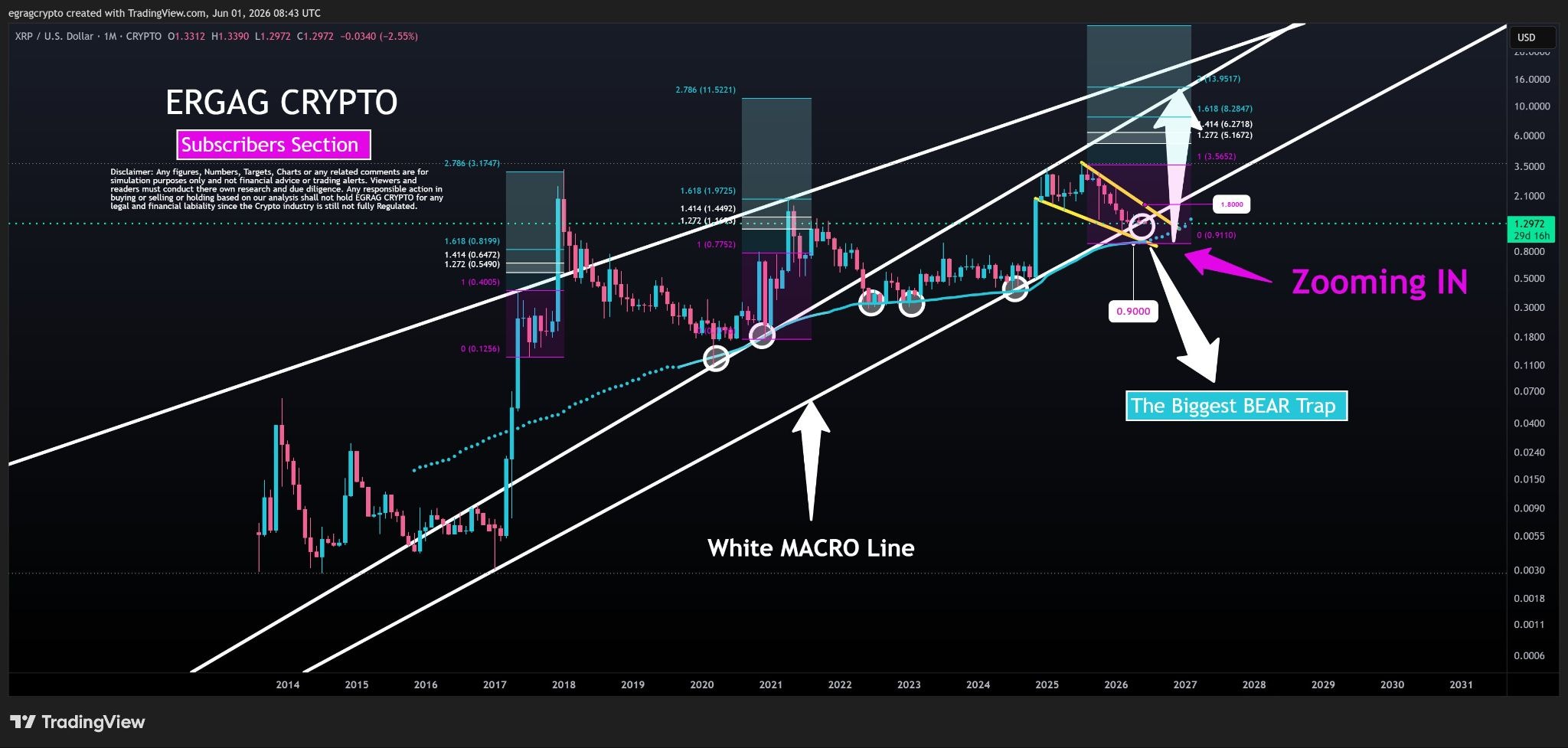
Data from TradingView shows that the XRP price opened June at $0.33, just below the 50-month exponential moving average (EMA).
More importantly, XRP is also trading “directly on/slightly below the White MACRO Trend Line,” analyst Egrag Crypto said in a Monday post on X, referring to the multi-year ascending trend line that has supported the price since 2017.
Related: Three key XRP metrics suggest ‘explosive price expansion’ is next
In previous instances, when XRP opened the month below the 50 EMA during macro drawdowns, the “structure often begins to form a bottoming zone,” as shown in the chart below. Currently, the price is trading below the macro trend line. The price might wick below it before recovering, as seen in 2020, 2023 and 2024.
“The market is leaning heavily bearish,” Egrag Crypto said, adding:
“If XRP reclaims the 50 EMA and the Macro trend line, this setup could become one of the biggest bear traps of the cycle.”
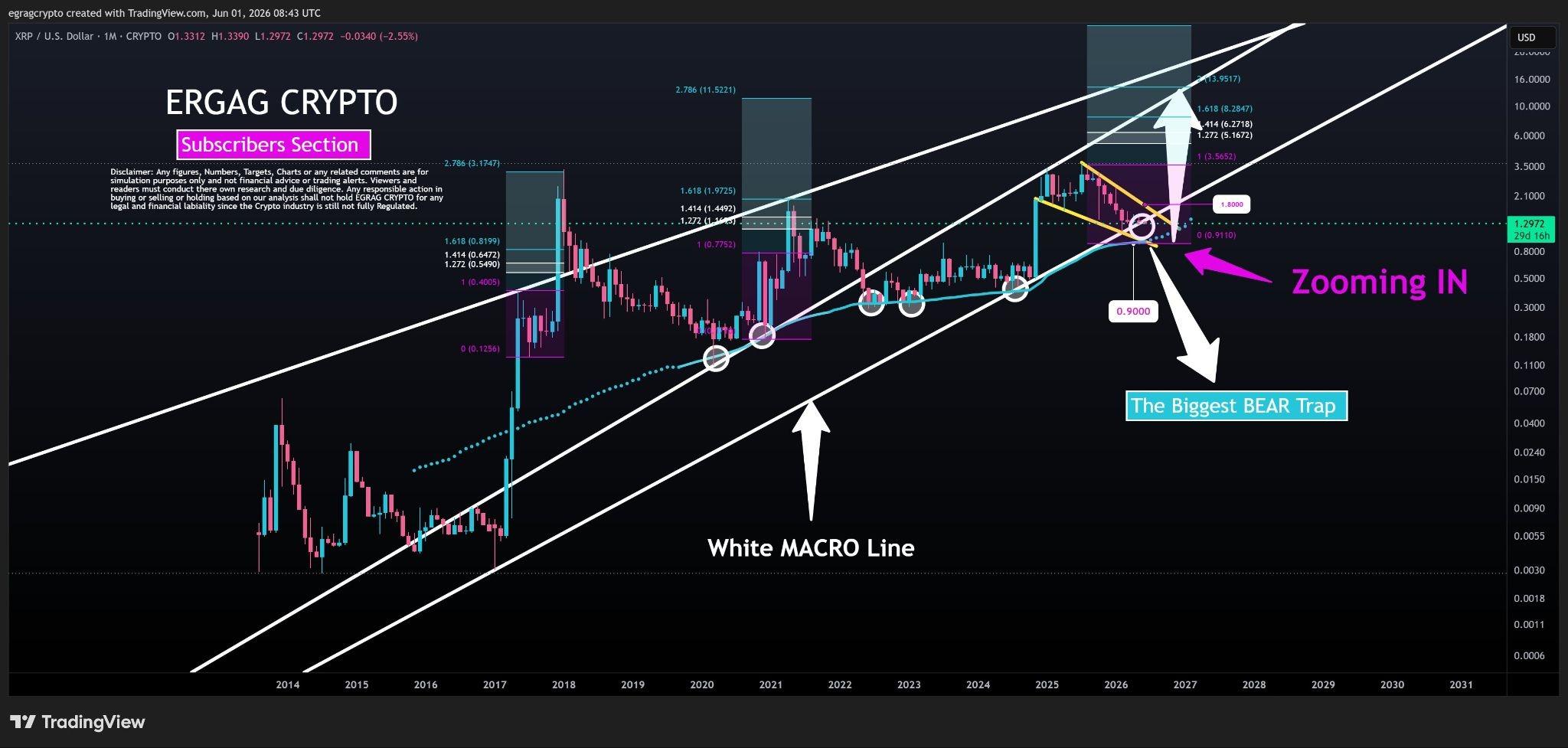
XRP/USD one-month chart. Source: X/Egrag Crypto
For analyst ChartNerd, a target for new local lows lay at around $0.70-$0.90.
“Many of you admire this beautiful $XRP fractal, which leaves the door open to a $0.90/$0.70 XRP before any major reversal,” the trader summarized alongside a chart showing a potential bottoming zone for XRP.
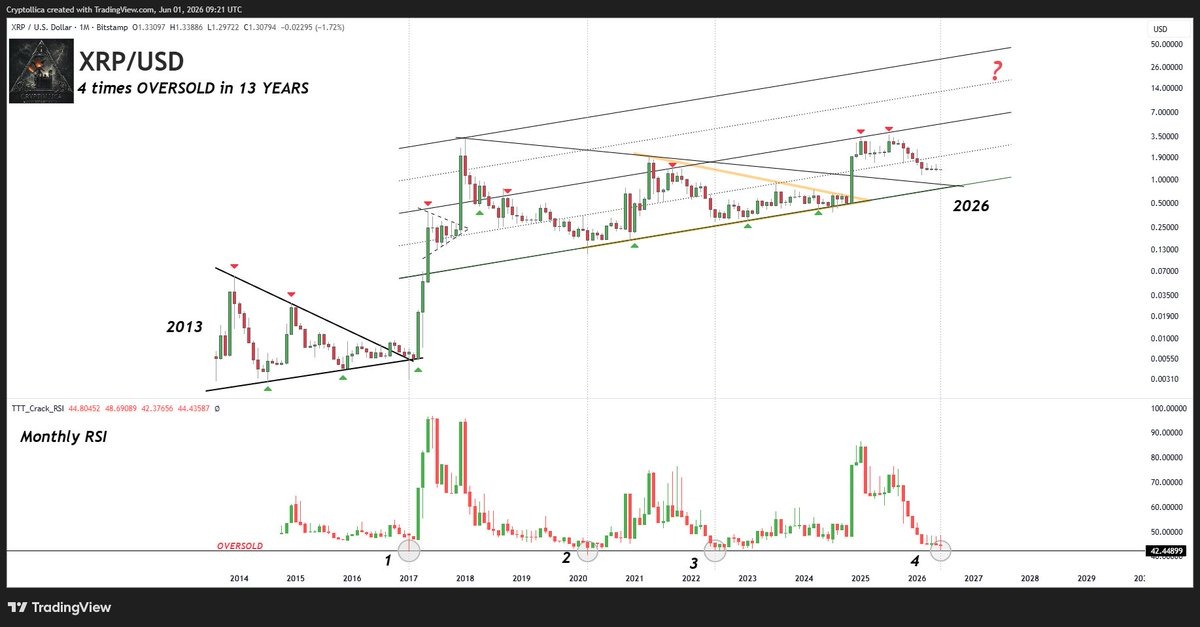
XRP/USD monthly chart. Source: X/ChartNerd
Fellow analyst Kamile Uray said $1.26-$1.30 was an important support zone, which bulls were required to defend to prevent a deeper correction toward $0.94-$1.11.
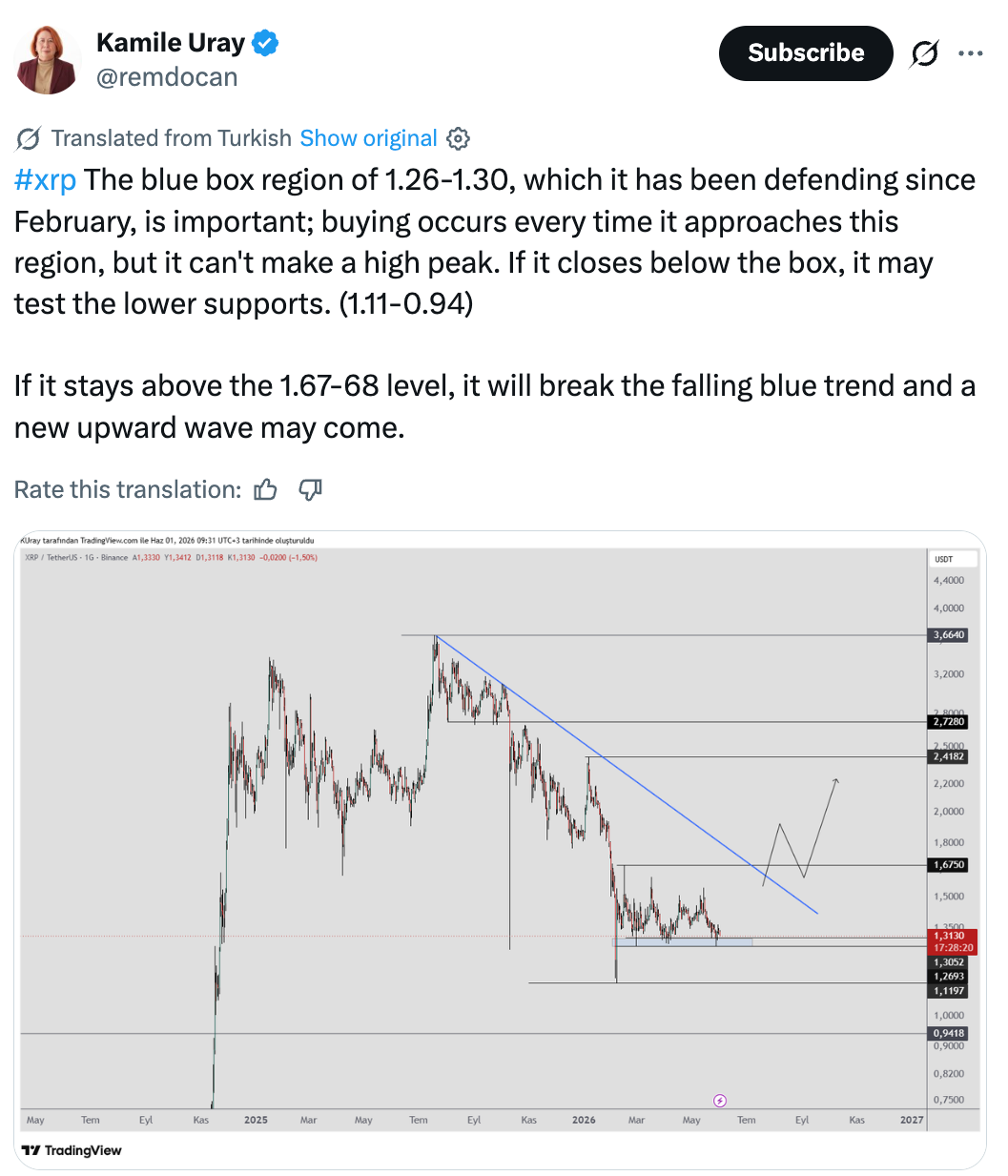
XRP/USD daily chart. Source: X/Kamile Uray
As Cointelegraph reported, XRP could drop to retest the Feb. 6 low of $1.11 and then the psychological support at $1 after the $1.27 support was broken.
June is usually a bad month for XRP
Unfortunately for the bulls, XRP tends to struggle in June. Since 2014, the price has closed in the red for eight of the past 12 months, with average returns of about −5%.
The June losses were even more pronounced in years where XRP closed May in the red, according to data from Cryptorank.
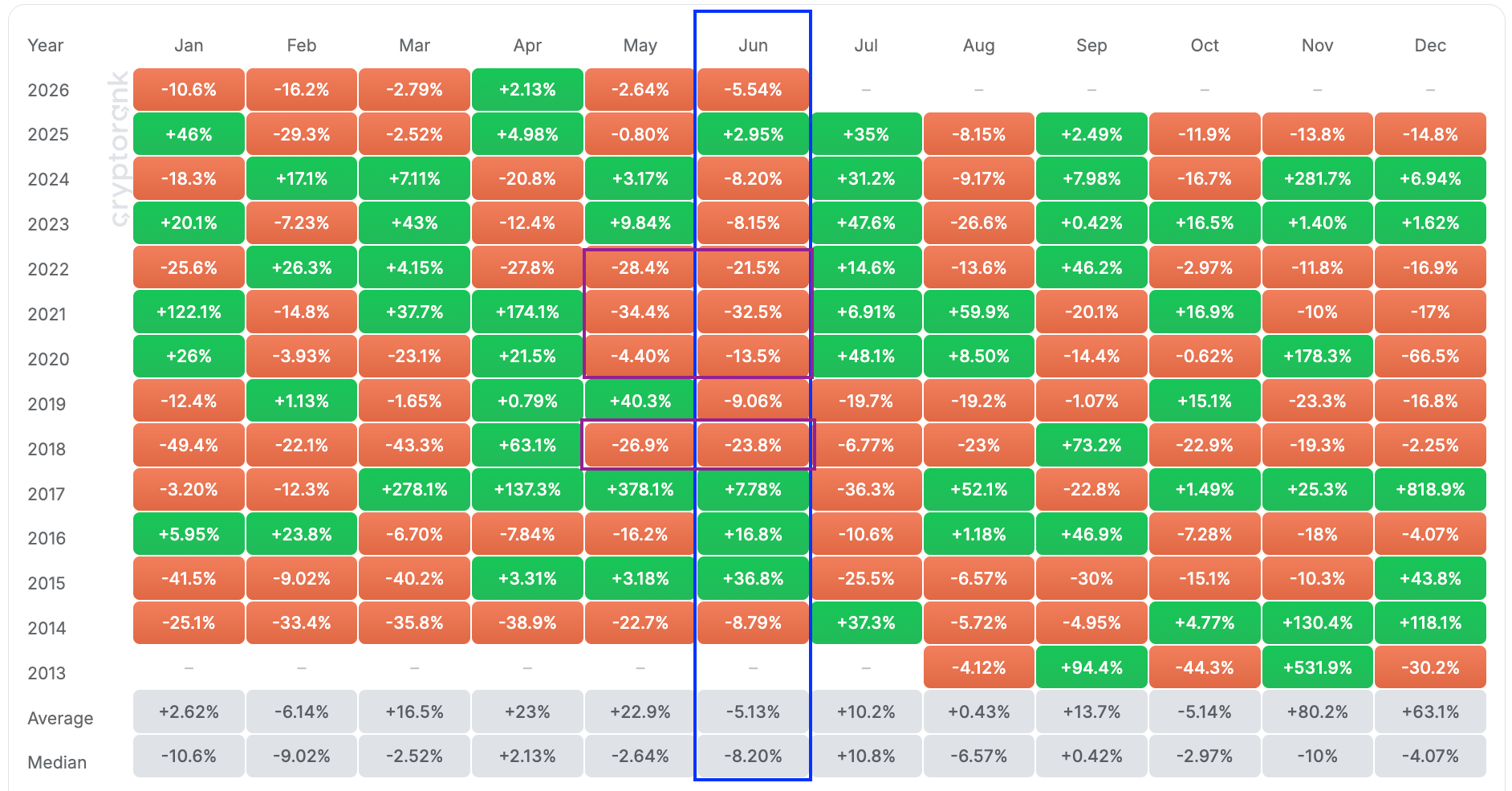
XRP monthly returns. Source: Cryptorank
The chart above shows that the losses are significantly higher in bear cycles, such as 2018’s -23.8% and 2022’s -21.5%.
The -34.4% drop in June 2021 is an outlier due to the US Securities and Exchange Commission’s lawsuit against Ripple, which took a toll on XRP price for years.
If history is anything to go by, XRP’s price action could continue trending lower in June, with a possible recovery beginning in July.

Key Highlights
- ALAB shares climb 11.14% following enhanced Taiwan operations announcement
- Company expands Cloud-Scale Interop Lab to accelerate rack-scale AI validation
- Stock surge linked to strengthened partnerships with AMD, NVIDIA, Arm, and major Taiwan ODMs
- Enhanced Taiwan presence aimed at reducing AI platform deployment timelines
- Expansion positions Astera Labs closer to global AI hardware supply chain
Shares of Astera Labs (ALAB) experienced significant upward momentum following the semiconductor company’s announcement of expanded Taiwan facilities and enhanced Cloud-Scale Interop Lab capabilities. The stock finished trading at $355.76, representing an 11.14% gain, before experiencing modest pre-market retreat to $354.20, a decline of 0.44%. This slight pullback suggested investors took some profits after the substantial intraday advance driven by AI infrastructure growth prospects.
Astera Labs, Inc. Common Stock, ALAB
Company Strengthens Taiwan Operations for AI System Development
Astera Labs announced its enhanced Taiwan presence will bolster engineering capabilities, operational efficiency, and collaboration with key ecosystem partners throughout the AI hardware value chain. The expanded Cloud-Scale Interop Lab facility aims to accelerate platform validation processes. This strategic positioning brings Astera Labs into closer proximity with leading semiconductor manufacturers, server producers, and contract manufacturers.
Taiwan occupies a critical position in global AI system manufacturing, as the region serves as a primary hub for rack-scale platform assembly and integration. Astera Labs’ enhanced local presence seeks to minimize bottlenecks in debugging processes, diagnostic procedures, and qualification workflows. Furthermore, the company anticipates that increased on-site support will enable customers to transition systems from development to production environments more efficiently.
This expansion complements Astera’s recent enhancements to its Scorpio fabric switch product line. The updated portfolio accommodates flexible 32-to-320-lane configurations designed for advanced rack-scale AI infrastructure. Therefore, the expanded Taiwan operations provide additional resources to address sophisticated connectivity requirements across distributed AI computing clusters.
Strategic Partnerships Accelerate Platform Validation Cycles
Astera Labs identified key technology partners including AMD, Arm, Intel, and NVIDIA as collaborators benefiting from the enhanced Taiwan operations. The company also maintains active relationships with prominent Taiwan-based original design manufacturers such as GIGABYTE, Ingrasys, Inventec, Quanta Cloud Technology, and Wiwynn. This comprehensive partner network facilitates integrated validation spanning chip architecture, system design, and volume manufacturing.
Contemporary AI infrastructure initiatives demand accelerated coordination among semiconductor vendors and system integrators. Training platforms and inference deployments require thorough testing protocols before entering large-scale production. Accordingly, Astera’s expanded laboratory provides collaborative space for early-stage platform verification among multiple stakeholders.
The company indicated its Taiwan-based team will expand expertise across hardware engineering disciplines, technical support functions, quality assurance, and operational management. These competencies help minimize development cycle duration during product refinement and platform certification processes. They enable more responsive troubleshooting when customers encounter design challenges or integration complications.
Stock Performance Reflects Growing AI Infrastructure Focus
The 11.14% closing gain for ALAB demonstrated robust investor interest following the Taiwan expansion disclosure. The modest pre-market decline indicated short-term position adjustments after the significant single-day advance. However, the stock retained the majority of its gains, maintaining investor attention on Astera’s strategic position within AI infrastructure development.
Astera’s core business operates within the rapidly expanding semiconductor connectivity sector serving AI data center applications. Rack-scale architectures demand high-performance interconnects among GPUs, CPUs, memory subsystems, switching fabric, and networking components. Consequently, validation efficiency has emerged as a critical determinant in AI computational capacity deployment timelines.
The Taiwan facility expansion strengthens Astera’s geographic positioning within the ecosystem responsible for advanced AI system production. It also facilitates enhanced customer engagement at industry events like Computex 2026, where AI infrastructure continues as a prominent focus area. Thus, the ALAB share price rally reflects heightened investor interest in companies positioned to enable AI infrastructure scaling and deployment.


Best Buy has begun selling Tangem’s crypto hardware wallets across more than 200 US stores. The move puts the Swiss firm’s cold storage devices on mainstream electronics shelves for the first time at this scale.
It is Tangem’s largest US retail expansion to date, adding to its presence at Walmart and Amazon. The rollout lands as more holders move crypto off exchanges and into self-custody.
Crypto Hardware Wallet Demand Climbs After a Record Theft Year
Hardware wallets keep private keys offline, away from exchanges and internet-connected apps. That design has drawn buyers who now grasp the importance of self-custody as platforms keep losing customer funds.
Stolen crypto reached $3.4 billion in 2025, according to Chainalysis. The $1.5 billion Bybit breach ranked as the largest single hack in the industry’s history. That total topped the prior year and renewed scrutiny of how exchanges guard deposits.
Theft also reached individuals, with roughly 158,000 personal wallet compromises last year. Stricter platform rules and identity checks have pushed more users toward self-held keys.
Analysts at Mordor Intelligence expect the hardware wallet market to reach $2.25 billion by 2031. They value it near $720 million in 2026, with retail shoppers driving most sales. That demand has widened the field of best hardware wallets competing for shelf space.
Two Tangem products are on Best Buy shelves. One is a credit card-sized NFC card. The other is the Tangem Ring, a ceramic wearable.
Both keep private keys on a secure chip rather than on a server or phone. Tangem uses backup cards in place of a written recovery phrase, though owners can still import one.
Tangem is not alone in the push. Trezor is simplifying crypto self-custody for newcomers, while Block Inc. has taken its own self-custody Bitcoin wallet to a wide market. Whether big-box distribution turns casual shoppers into self-custody users is the question the industry will watch next.
The post Tangem Pushes Offline Crypto Hardware Wallets Into 200 US Stores appeared first on BeInCrypto.
Crypto World
BeInCrypto Institutional Research: 20 Biggest Capital Markets & Infrastructure for Digital Assets


The BeInCrypto Institutional 100 Awards 2026 enters its final week with the Capital Markets & Infrastructure pillar now narrowed to 20 shortlisted firms across five categories.
This pillar covers the firms building the regulated core of institutional crypto: asset managers, trading infrastructure providers, liquidity firms, custodians, and ratings or analytics providers. The winners were announced at Proof of Talk in Paris on June 2, 2026.
The shortlisted firms are listed alphabetically within each category and are not ranked.
Best Digital Asset Manager
These firms built the regulated investment products that now carry institutional digital asset exposure through ETFs, ETPs, tokenized funds, and advisor platforms.
| Shortlisted Firm | Why It Made the Shortlist |
| 21Shares | FalconX completed its acquisition of 21Shares in November 2025, bringing 55 listed products and more than $11 billion in AUM into a broader institutional prime brokerage stack. |
| BlackRock | IBIT became the market benchmark for spot Bitcoin ETF exposure, while BUIDL made BlackRock a leader in tokenized money market funds. |
| Fidelity Investments | Fidelity combines ETF issuance with in-house custody through Fidelity Digital Assets, creating one of the most vertically integrated digital asset product stacks. |
| VanEck | VanEck continues to push beyond Bitcoin and Ethereum through Solana filings, mining equity exposure, active digital asset strategies, and developer-support commitments. |
Best Institutional Trading Infrastructure
This category focuses on the systems institutions use to route, finance, execute, and manage digital asset trades.
Shortlisted Firm
Why It Made the Shortlist
FalconX
FalconX expanded through acquisitions of Arbelos, Monarq, and 21Shares, building a broader stack across prime brokerage, asset management, options, and tokenized gold.
Ripple Prime
Ripple’s $1.25 billion acquisition of Hidden Road created a crypto-owned global multi-asset prime broker with roughly $3 trillion in annual clearing volume.
Talos
Talos closed a $45 million Series B extension at a $1.5 billion valuation, backed by Robinhood, Sony, BNY, Fidelity, and other strategic investors.
Wintermute
Wintermute’s NODE platform gives institutions zero-fee OTC access across more than 250 assets and 60 venues, with recent expansion into tokenized commodities.
Best Liquidity Provider
Liquidity providers keep institutional crypto markets functioning through two-way prices, OTC execution, stablecoin flows, and market-making across venues.
Shortlisted Firm
Why It Made the Shortlist
B2C2
Majority-owned by SBI Holdings, B2C2 supports institutional stablecoin and OTC flows and named Solana as its primary stablecoin settlement rail in 2026.
Cumberland (DRW)
Cumberland remains one of the longest-running institutional crypto OTC desks, backed by DRW’s multi-asset trading infrastructure.
GSR
Standard Chartered’s SC Ventures invested in GSR in May 2026 at a valuation above $1 billion, validating its role in bank-grade crypto liquidity.
Wintermute
Wintermute handles around $5 billion in average daily flow and expanded its institutional OTC platform into tokenized gold in 2026.
Best Digital Asset Custody Provider
Custody has become one of the core trust layers for institutional crypto, supporting ETFs, banks, asset managers, and tokenized products.
Shortlisted Firm
Why It Made the Shortlist
BitGo
BitGo became the first crypto-native custody firm to list on the NYSE in January 2026, with roughly $104 billion in assets on platform.
Coinbase Custody
Coinbase Custody holds more than 80% of US Bitcoin and Ethereum ETF assets and supports a large institutional and government client base.
Fireblocks
Fireblocks processes more than $4 trillion in annual digital asset transfers and expanded into embedded wallets and crypto accounting through acquisitions.
Ripple Custody (Metaco)
Ripple combined Metaco and Palisade to build a custody and wallet infrastructure platform serving banks, fintechs, and crypto-native firms.
Best Digital Asset Ratings & Analytics Provider
Institutional capital depends on third-party risk signals before allocation. This category covers blockchain intelligence, ratings, stablecoin analysis, and on-chain risk infrastructure.
| Shortlisted Firm | Why It Made the Shortlist |
| Chainalysis | Chainalysis remains central to crypto investigations and compliance, with more than 1,000 customers and new AI-agent tools for blockchain intelligence. |
| Elliptic | Elliptic closed a $120 million Series D in May 2026 and screens more than 1 billion transactions weekly across hundreds of institutional customers. |
| Moody’s Ratings | Moody’s published its first stablecoin deposit-rating methodology in March 2026, bringing traditional credit-rating standards into digital assets. |
| S&P Global Ratings | S&P expanded its Stablecoin Stability Assessments on-chain through Chainlink DataLink, making ratings usable by institutions and DeFi applications. |
About the BeInCrypto Institutional 100
The BeInCrypto Institutional 100 is an annual research program covering 25 categories across six pillars: Capital Markets & Infrastructure, Access to Digital Assets, Tokenization & On-Chain Finance, Enterprise Blockchain, Regulation & Governance, and Retail to Crypto Bridge.
The 2026 evaluation window ran from April 2025 through March 2026. Shortlists were selected through a combination of BeInCrypto’s editorial research methodology and blind scoring by an external panel of institutional digital asset practitioners.
Each category follows one of three scoring tracks, depending on the market’s data profile. Public filings, regulatory registers, audited reports, on-chain data, ETF flow trackers, and nominee disclosure forms were used where available.
Final blended scores are not published. Inclusion on the shortlist reflects the combined outcome of research and judge review.
Editorial contact: awards@beincrypto.com
The post BeInCrypto Institutional Research: 20 Biggest Capital Markets & Infrastructure for Digital Assets appeared first on BeInCrypto.
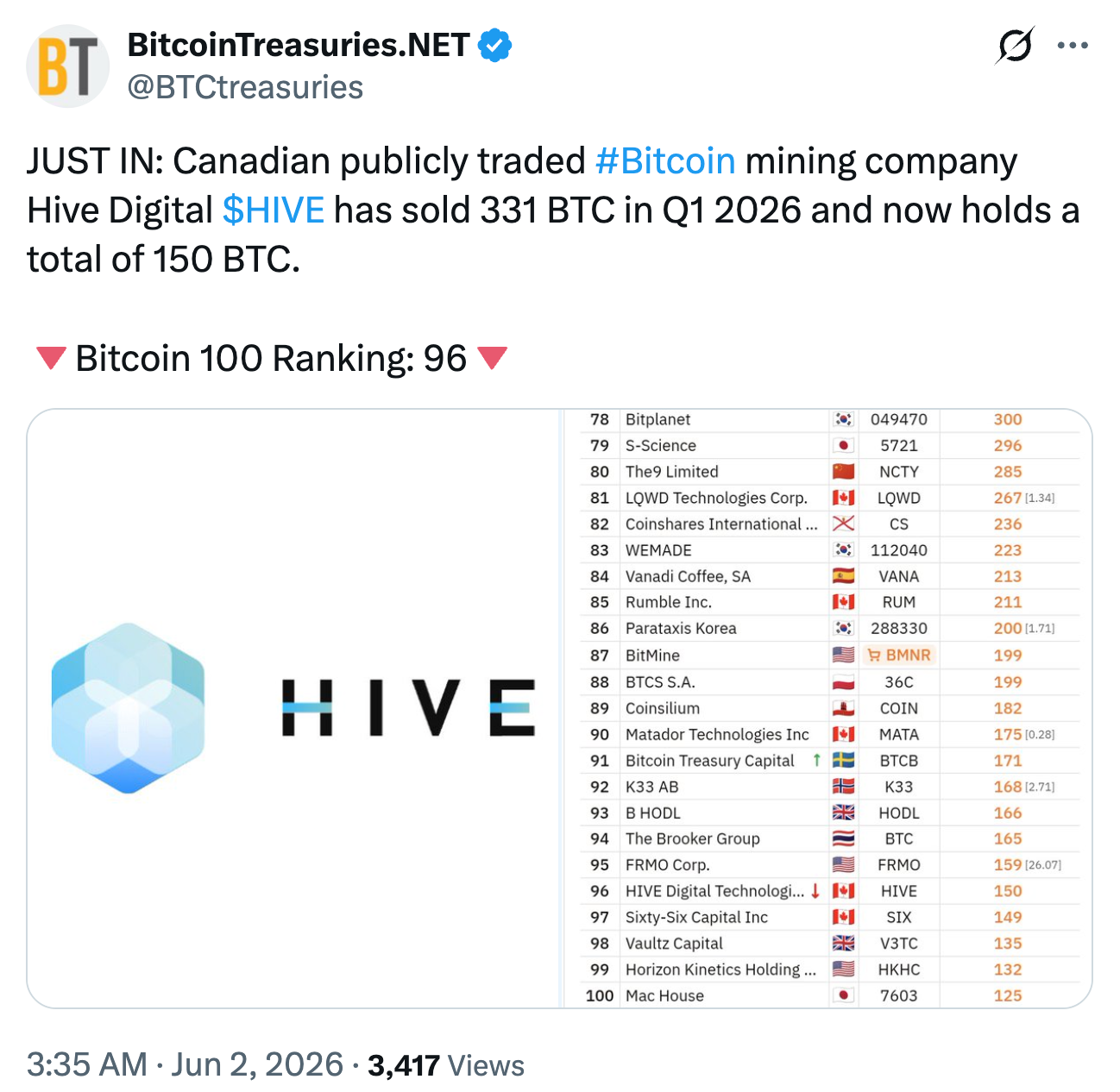
Canadian Bitcoin miner HIVE Digital Technologies’ Bitcoin holdings fell by 331 BTC in the latest quarter, even as the miner reported a sharp rise in annual revenue from Bitcoin mining and high-performance computing (HPC).
The company reported holdings of 150 Bitcoin (BTC) in its fiscal year update on Monday, down from 481 BTC at the end of Q4 2025, according to company figures and CoinGecko data. The 331 BTC reduction represents about $23 million in value at current prices, with Bitcoin trading roughly 21% lower year-to-date.
HIVE did not explicitly say it sold Bitcoin. The company mined 2,885 BTC during fiscal 2026 and generated $297.8 million in revenue, up 158% from a year earlier, driven largely by expanded Bitcoin mining capacity and HPC revenue.
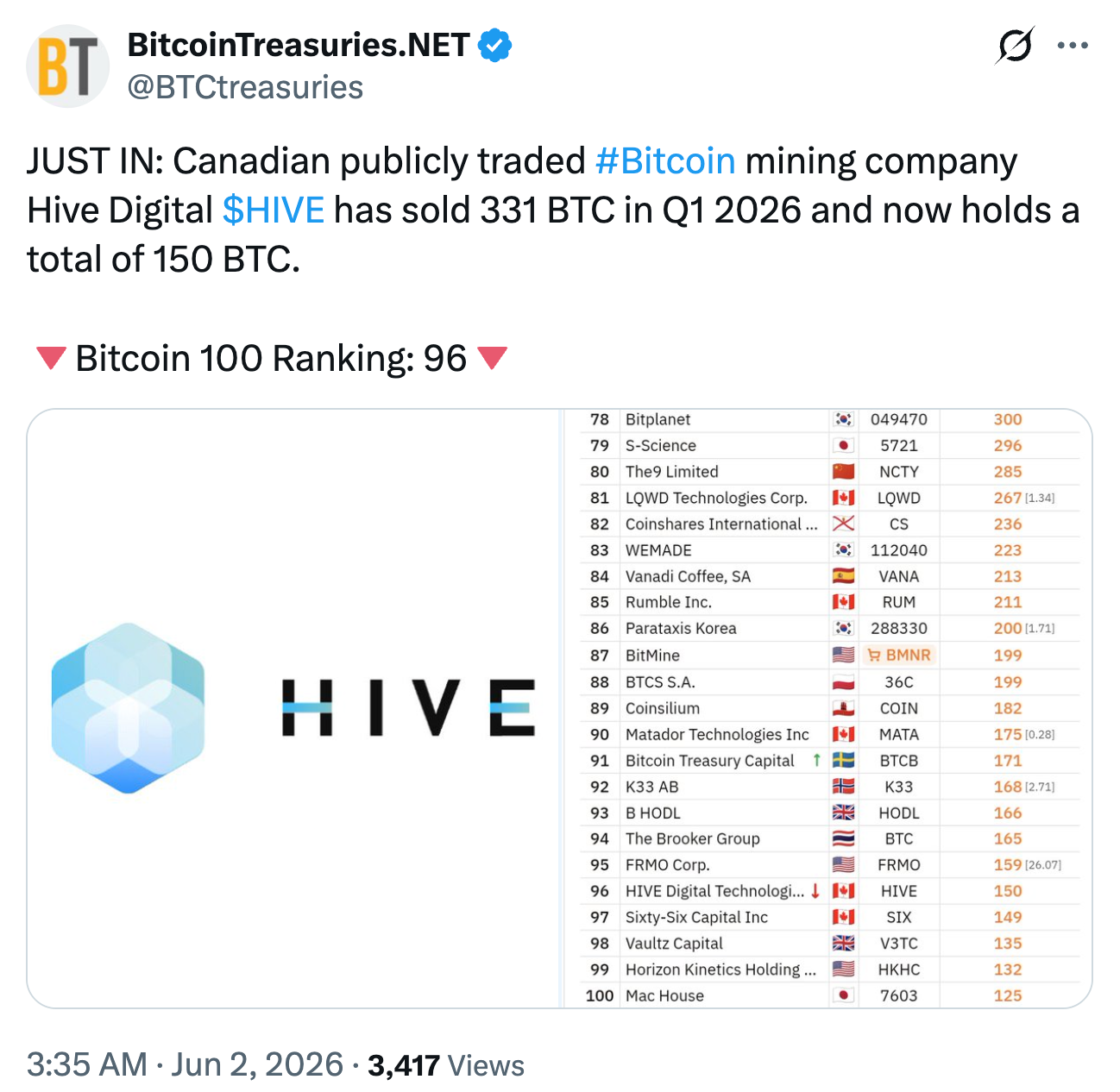
Source: Bitcoin Treasuries
The shrinking Bitcoin treasury highlights how public miners are balancing accumulation against expansion costs as they invest in energy-heavy mining sites and diversify into AI computing infrastructure.
Revenue jumps to $297.8 million as mining drives growth, costs rise
HIVE’s total revenue rose to $297.8 million from $115.3 million a year earlier, with digital currency mining revenue rising to $278.3 million, while HPC contributed $19.5 million, almost doubling year-over-year.
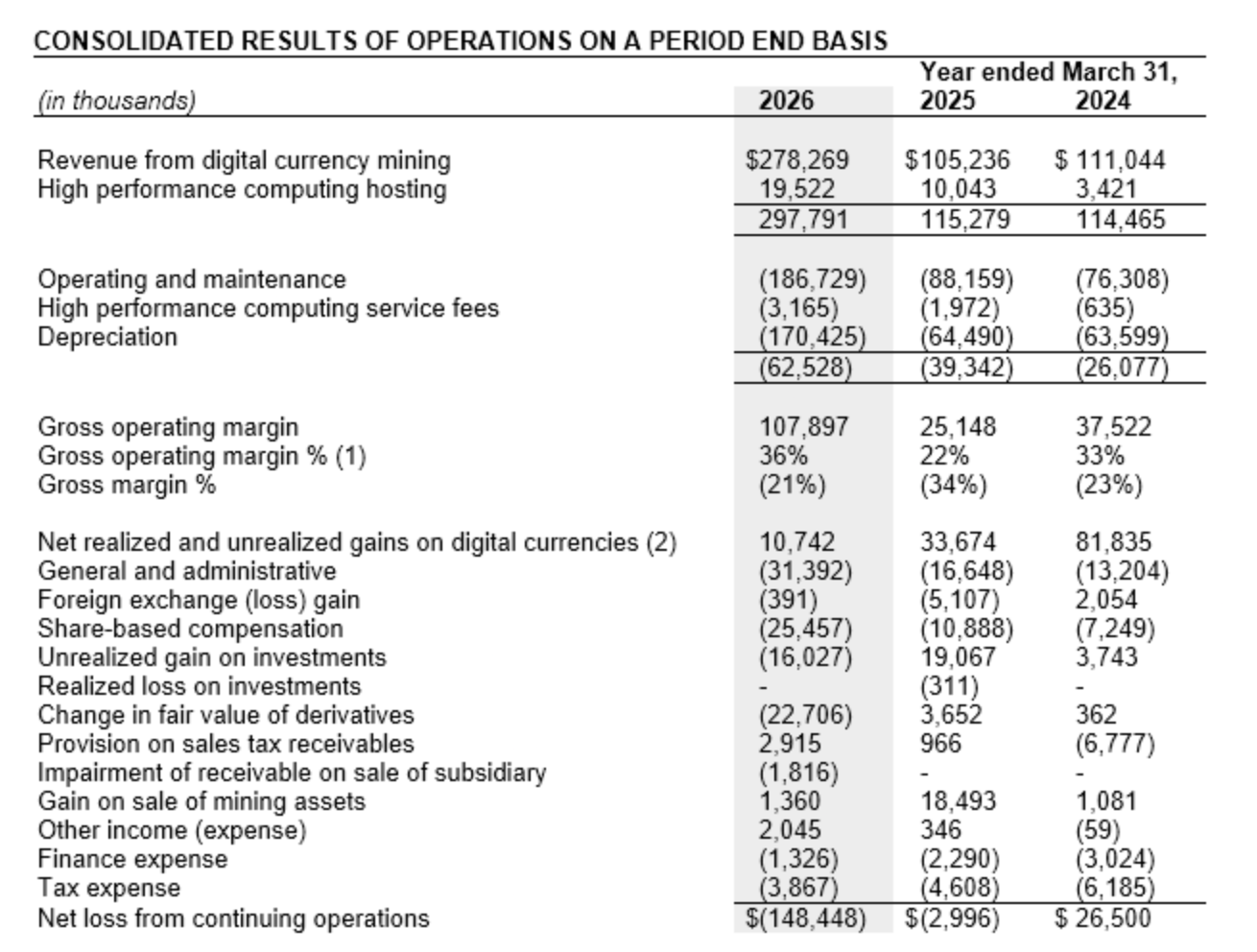
Source: HIVE Digital Technologies
Despite the sharp increase in revenue, rising costs continued to pressure results. Operating and maintenance expenses climbed as HIVE expanded its mining and data center footprint, while depreciation rose to $170.4 million, nearly triple the prior year and one of the largest expenses on the income statement.
Related: TeraWulf acquires Kentucky AI data center site with planned 1 GW capacity
Miner bets on AI alongside Bitcoin
HIVE said its HPC business revenue is up from $10 million a year earlier, as demand for AI computing services increased.
The company said contracted annual recurring revenue from its HPC division reached $35 million by year-end, supported by deployments of Nvidia-powered GPU clusters and new enterprise contracts.
It also highlighted plans for a 320-megawatt AI data center project in the Greater Toronto Area, which it said could eventually host more than 100,000 GPUs.
The expansion underscores a broader trend among public Bitcoin miners, many of whom are seeking new revenue streams from AI and cloud computing as mining economics become more competitive and capital-intensive.
Magazine: HYPE chases $100 target, ETH could dump below $1800: Market Moves
Silver (XAG/USD) was already on soft footing as speculators trimmed their bullish bets, and a fresh Iran escalation has now reignited the oil bid that works against it. Silver price has slipped over 1% day-on-day, at the time of writing.
The metal trades near $74, well off its January record near $121. Two forces are stacked against it, cooling speculative demand and an oil market that just turned higher on Middle East risk.
Speculators Were Already Pulling Back Before the Oil Move
The softness in silver did not start with this week’s headlines. Positioning data showed speculators cutting bullish exposure well before oil moved up over 2% on Iran war escalation.
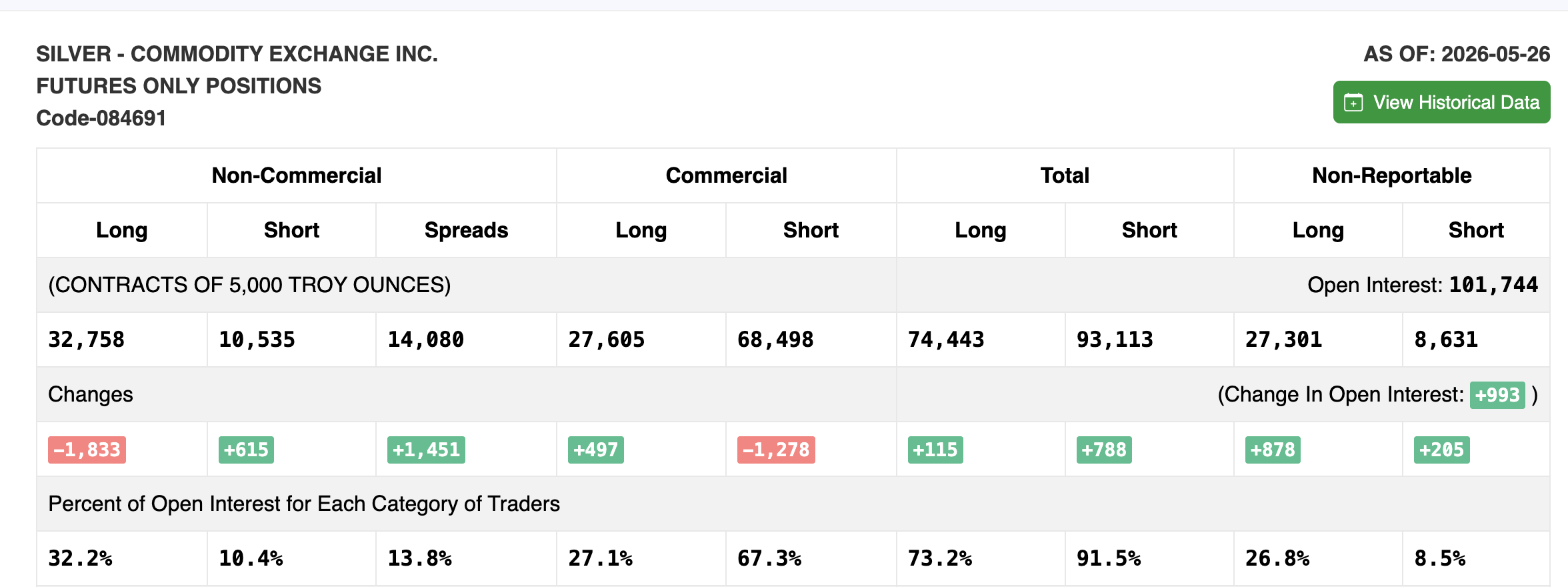
In the COMEX silver Commitments of Traders (COT) report for May 26, large speculators reduced their long bets and added shorts.
Want more insights like this? Sign up for Editor Harsh Notariya’s Daily Newsletter here.
Non-commercial traders, the group that includes funds and other speculators, cut longs by 1,833 contracts and added 615 shorts. That is the profile of a crowd taking money off the table as the Silver prices remain rangebound for quite sometime, down 1% month-on-month.

Commercial hedgers went the other way, trimming shorts by 1,278 and adding 497 longs, so they turned a little less bearish. Total open interest, the number of contracts still live, rose by 993 to about 101,744. The market did not empty out. Positioning simply leaned more cautious.
JPMorgan has said it stays cautious on silver until the froth from the 2025 run shakes out further. The COT positioning shows the same caution.
Then Iran Reignited the Oil Bid, and Silver Trades Against Oil
On Monday, Iranian state media said Tehran had suspended talks with the US. It also vowed to fully close the Strait of Hormuz, which carries about a fifth of the world’s oil. Oil jumped on the news. Crude Oil (WTI) rose more than 5% on June 1, reversing a stretch of declines built on ceasefire hopes. The WTI surge is now over 8%, week-on-week.
That matters for silver because the two move in opposite directions. Their rolling 30-day correlation, a measure of how closely two assets track each other, sits near minus 0.42, firmly negative.

When oil spikes on supply fear, it lifts inflation and rate worries and raises energy costs for industrial buyers. Silver has tended to fall as oil climbs, and the gap is wide. Since early March, crude has gained roughly 28% while silver slipped about 10%.
The late-May truce talk briefly worked the other way. Silver rose on May 29 as oil eased, but Monday’s escalation flipped that.
Cash Sellers Hit Silver While Options Buyers Stayed Long
The pressure carried into the spot and tokenized markets. Silver fell over 1% on 30-day window and showed net selling near $48 million on Hyperliquid, with gold close behind at minus $50 million. Volume in silver ran around $5.3 billion, so the selling came with real flow.

The options market told a different story. On the iShares Silver Trust (SLV), the put-call ratio, which weighs bearish puts against bullish calls, sat at 0.44 by volume and 0.53 by open interest on June 2.

Both readings are well below 1, meaning calls outnumber puts. Options traders kept a bullish lean even as spot sellers pushed the price down.
That split frames the standoff. The cash sellers are reacting to the immediate oil headwind, while the options crowd is paying up for a rebound, in line with the COT’s commercial side. The selling is about the recent hype, but the call buying bets the weakness proves short-lived. One more signal speaks to silver’s longer-term demand.
A Solar-Demand Model Flags Silver at a Rare Discount
The last signal points to silver’s industrial side. A custom Silver vs Solar Lag Model has dropped to about minus 2.77. The tool tracks the gap between silver’s price and a signal built from solar-driven demand.
The model maps onto silver’s big turns. It ran up to its upper band around the January 29 record high above $121. It last bottomed at its floor near minus 3.35 in mid-May 2025, when the silver price sat close to its $32 base. From that floor, the metal ran all the way to the record.
Now the model is back near that floor at minus 2.77, with the silver price around $74. The reading puts the price at a wide discount to what the solar-demand signal implies. It is the same kind of discount that came before the last leg higher, though one signal is not a guarantee.

That discount lines up with the other forward-looking signals. Commercial hedgers trimmed their shorts into May 26, and the SLV options lean call-heavy. Each leans against the speculators cutting longs and the cash sellers reacting to oil.
The discount matters because silver is in short supply. Demand has outrun supply for five years, and 2026 is set to be the sixth. High prices are nudging solar makers to use less silver per panel, so industrial demand should dip about 2% this year. But supply is shrinking too, so the shortage keeps widening.
For now the signals split. Higher oil can keep silver under pressure in the near term. But the shortage, the bullish options, and the cheap model reading suggest the drop may be a pause, not a top.
The post Silver Bleeds $48 Million as Oil Pressure Roars Back appeared first on BeInCrypto.

Bitcoin critic Peter Schiff is back with another bleak BTC call, warning that the asset could collapse below $20,000 once it breaks through the $50,000 level.
He made the prediction with Bitcoin trading at around $67,000, down more than 4% in 24 hours and over 16% across 30 days.
Why Schiff Thinks the Worst Is Still Ahead for BTC
According to Schiff, the real problem for Bitcoin isn’t the price drop itself but rather the mood surrounding the OG cryptocurrency.
“There’s way too much complacency in Bitcoin for the market to be anywhere near a bottom,” he posted on X. “When Bitcoin breaks $50K, it should be a quick fall below $20K.”
The gold advocate believes that drop will be big enough to shake the conviction of many long-term holders, enough for them to “finally throw in the towel.”
Earlier, he had posted, wondering whether a BTC crash would take broader risk assets down with it or whether it would only be confined to digital assets, suggesting that either outcome could push investors toward “value and safety.” And for those that have been listening to him for a long time, that language tracks closely with his longstanding case for gold.
Schiff also once again weighed in on Strategy, targeting its STRC stock. At the time he was writing, it was trading below $96, pushing its current yield to around 12%, which led the economist to argue that if investors lose confidence in the company’s ability to pay that yield, the price would continue to drop, which would force the firm to raise the official coupon to stabilize STRC at its $100 face value, something he described as a “death spiral.”
That’s a pointed critique, considering Strategy recently sold part of its holdings, 32 BTC to be precise, for the first time since 2022, with the $2.5 million earned from the sale earmarked for preferred stock dividends.
Remember, Michael Saylor’s company holds over 843,000 BTC, so for all intents and purposes, that 32 BTC that was sold was almost like a rounding error against its full position, but Schiff seems to be betting that the STRC structure is more fragile than it looks.
What Others Are Saying
Not everyone thinks an almighty BTC drop would shake the confidence of long-term HODLers as Schiff suggested, with crypto commentator Alex Marzell claiming that the only thing a move to $20K would test is his available cash.
Bitget CEO Gracey Chen shared a similar opinion, saying she was waiting to buy Bitcoin near $50,000. According to her, the asset’s long-term health depends on global money printing pushing up commodities, including BTC and gold.
However, she also pointed out that there were a few short-term risks, including CPI pressure and potential rate hikes, as well as possible selling by whales like Strategy and Mt. Gox creditors. Furthermore, she suggested that heavy AI-sector IPOs could drain a lot of liquidity from the market.
Meanwhile, CryptoQuant head of research Julio Moreno said that the overall Bitcoin demand is contracting at a monthly pace of 232,000 BTC, and he added that the correction was down to weakening demand and not stock market or macroeconomic developments as other market watchers have previously suggested.
His outlook matches a recent report from Bitfinex, which said that Bitcoin was entering a “slow bleed” phase that’s being driven by distribution and fading investor conviction.
The post Peter Schiff Warns Bitcoin Could Plunge Below $20K as Complacency Sets In appeared first on CryptoPotato.

Bitcoin is down by 4% today as a fresh quantum computing development from Microsoft reignites one of crypto’s most consequential long-term debates that swing price prediction. Are quantum machines becoming dangerous? Will the industry be ready when they do?
At its annual Build conference, Microsoft unveiled Majorana 2, a topological quantum chip it describes as 1,000 times more reliable than its predecessor, with average qubit lifetimes of 20 seconds and peak lifetimes approaching 1 minute.
The company credited its agentic AI platform, Microsoft Discovery, with accelerating development by automating measurements, identifying materials, and surfacing manufacturing flaws. Microsoft Technical Fellow Chetan Nayak put it plainly: “We’re 1,000 times better.” The company now targets scalable quantum computing by 2029.
That date lands uncomfortably close to timelines already circulating among cryptographers. Will it affect Bitcoin? In a good or bad way, if it will?
Discover: The Best Crypto to Diversify Your Portfolio
Bitcoin Price Prediction: Quantum Risk Overhang
On the long time frame, Bitcoin is consolidating in a well-defined range, with support clustered between $63,000 and $65,000, a zone anchored by prior demand and the 50-day moving average. Resistance sits at the $73,000–$75,000 local high.
We should be watching the $70,000 level closely. A clean breakout above it would expose a run into the high-$70Ks. The same range we flagged as the next meaningful target, driven by ETF inflows and post-halving supply dynamics rather than quantum headlines.
Conversely, a close below $66,000 risks a deeper retrace into the low-$60Ks, where the next significant demand shelf sits.

If macro tailwinds hold, ETF demand absorbs sell pressure, Bitcoin could test $80,000+ by Q3. But if quantum narrative plus macro deterioration triggers a sentiment reset, sub-$65,000 becomes the operative level to watch.
As Forbes analysis notes, the realistic threat window for Bitcoin’s ECDSA signatures runs from the early to mid-2030s. 21Shares research narrows that window to 2029–2035, with the ledger itself secure and only signature schemes at risk. Near-term price is still macro’s game.
Microsoft’s quantum roadmap is a reminder that tech giants are reshaping crypto’s landscape faster than markets expect.
Discover: The Best Token Presales
Bitcoin Hyper Targets Bitcoin Fix as Bitcoin Quantum Threat Snowballs
Bitcoin consolidating under $70,000 is a reasonable outcome, but for investors who entered during this cycle’s earlier legs, the asymmetric upside at the current market cap is shrinking. That dynamic is pushing capital toward earlier-stage infrastructure plays with genuine Bitcoin-native utility.
The quantum narrative adds urgency: if Bitcoin’s base layer faces a decade-long upgrade cycle, the scaling and programmability layer becomes more critical, not less.
Bitcoin Hyper ($HYPER) is positioning directly inside that gap. It is the first-ever Bitcoin Layer 2 with Solana Virtual Machine (SVM) integration, delivering sub-second finality and smart contract execution faster than Solana itself, while anchoring to Bitcoin’s security model via a Decentralized Canonical Bridge for BTC transfers.
The presale has raised $32.7 million at a current price of just $0.013681, with staking available at high APY for early participants. Funding momentum has been consistent, reflecting a genuine appetite for Bitcoin programmability infrastructure.
The post Bitcoin Price Prediction: Microsoft Quantum Breakthrough Could Change Bitcoin’s Future appeared first on Cryptonews.

The trainers with the most wins at Royal Ascot

Game Dodecahedron Runs AArch64 Assembly

Court update as man accused of killing Ian Huntley in prison sees trial date set



-

 NewsBeat7 days ago
Israel says it has killed new Hamas military leader in Gaza City airstrikes
-

 Tech5 days ago
Waymo dominates autonomous vehicle registrations as Tesla trails behind
-

 News Videos5 days ago
This is BROKEN! INSANE 5x MONEY CAR WASH WEEK! The NEW GTA Online UPDATE Today! (GTA5 New Update)
-
 Tech4 days ago
SpaceX just won a second Golden Dome contract. This one is $4.16 billion.
-

 News Videos5 days ago
SHE IS KILLING XRP!!! WATCH URGENT AND ACT FAST
-
 NewsBeat4 days ago
FIRST NIGHT REVIEW: Take That bring the Circus back to life in spectacular sun-soaked style
-

 Business2 days ago
Jade Biosciences, Inc. (JBIO) Discusses Positive Interim Results From JADE101 Phase I Healthy Volunteer Study and Development Plans Transcript
-

 Tech7 days ago
The Samsung pay deal is the moment Korean unions changed register
-
Crypto World5 days ago
CFTC Has Approved the First Regulated Bitcoin Perpetual Contract in the U.S.
-
Crypto World7 days ago
SpaceX’s $2 Trillion IPO: Why Tech Giants Nvidia (NVDA), Apple (AAPL), and Microsoft (MSFT) May Face Pressure
-

 Business4 days ago
Is the Spurs Phenom Already Better Than Prime Diesel?
-
 NewsBeat5 days ago
Novak Djokovic v Joao Fonseca LIVE: French Open latest scores and results after Jannik Sinner’s shocking collapse
-
 Crypto World5 days ago
Snowflake (SNOW) Stock Rallies on Strong Q1 Results and AI Product Growth
-
 Entertainment4 days ago
Weak ‘Supergirl’ Box Office Tracking Amid Milly Alcock Backlash
-

 Business4 days ago
Demand Conditions Improve In Chemicals Sector In April 2026
-
 Crypto World5 days ago
MicroStrategy Moves $30 Million in BTC to Coinbase Prime: Is the Bitcoin Sell-Off Already Here?
-

 Politics4 days ago
The House | Inside Andy Burnham’s Makerfield Campaign: “Nobody Thinks This Is In The Bag”
-

 Tech5 days ago
This Week In Security: Ubiquiti Fixes, And FreeBSD Joins The Club You Don’t Want To Join
-

 Entertainment5 days ago
Maddox Jolie-Pitt Legally Requests to Drop Brad’s Surname
-
 Entertainment4 days ago
One of the Greatest Sitcoms of All Time Shoots Up Apple TV’s Charts 11 Years Later
You must be logged in to post a comment Login