
Crypto World
Multiliquid Metalayer Roll Out Instant Redemptions for Tokenized RWAs

Multiliquid and Metalayer Ventures have launched an institutional liquidity facility designed to unlock instant redemptions for tokenized real-world assets on Solana. The arrangement, raised and managed by Metalayer, with Uniform Labs providing the underlying infrastructure via Multiliquid’s protocol, aims to replicate traditional finance liquidity tools for crypto-backed RWAs. The facility acts as a standing buyer, ready to purchase tokenized assets at a dynamic discount to net asset value, enabling holders to swap into stablecoins immediately. The move comes as BIS warned last year that liquidity mismatches in tokenized money-market funds could amplify stress during heavy redemption periods. Initial assets include tokenized Treasuries and products from VanEck, Janus Henderson, and Fasanara.
Key takeaways
- The facility functions as a standing buyer of tokenized RWAs, purchasing assets at a dynamic discount to NAV to enable instant redemptions for holders.
- Metalayer Ventures provides and manages the capital backing redemptions, while Multiliquid supplies the smart contract infrastructure used for pricing, compliance enforcement and settlement.
- Initial inclusions encompass tokenized Treasuries and select alternative investment products issued by VanEck, Janus Henderson and Fasanara.
- Solana has emerged as a growing venue for tokenized RWAs, with about $1.2 billion represented across 343 assets, according to RWA.xyz data, roughly 0.31% of the market.
- Within the broader ecosystem, Canton Network dominates by total RWAs (> $348 billion), followed by Ethereum (CRYPTO: ETH) and Provenance, each with around $15 billion in tokenized assets.
- The initiative is partly a response to liquidity risks highlighted by the BIS, underscoring the need for scalable liquidity rails in tokenized markets.
Market context: The launch reflects a broader industry push to build on-chain liquidity infrastructure for tokenized real-world assets, aligning with macro trends toward institutional-grade mechanisms that bridge traditional finance and crypto markets while navigating evolving regulatory signals.
Why it matters
For investors and traders, the new facility could reshape how tokenized RWAs are funded and redeemed. By providing a standing buyer that can absorb redemption pressure, the mechanism reduces the time needed to convert on-chain asset positions into stablecoins, mitigating liquidity squeeze risks that can arise when redemptions spike. This is particularly important for assets such as tokenized Treasuries and other income-oriented products, where sudden shifts in demand could otherwise lead to volatile pricing or forced liquidations.
From a technology and market structure perspective, the arrangement showcases how traditional financial concepts—repo markets, prime brokerage and overnight lending—can be mirrored on a blockchain layer. Uniform Labs’ role in offering the pricing and market-support framework, backed by Multiliquid’s pricing contracts and settlement logic, demonstrates a clear path to scalable, auditable, and compliant on-chain liquidity for RWAs. The emphasis on compliance enforcement within the smart contracts is also notable, given the need to align on-chain activity with real-world asset issuance standards.
The inclusion of issuers such as VanEck, Janus Henderson and Fasanara points to a pragmatic roadmap: established asset managers are willing to pilot tokenized offerings on Solana, signaling confidence in the ecosystem’s ability to deliver timely redemptions and predictable pricing. As tokenized assets proliferate, the ability to redeem quickly into stablecoins becomes a differentiator for platforms seeking to attract institutional capital while maintaining liquidity resilience in stressed markets.
On the ecosystem side, Solana’s growing share in tokenized RWAs underscores diversification in the sector. The latest data from RWA.xyz places Solana at about $1.2 billion across 343 assets, contributing roughly 0.31% of the total market value—but with momentum: annualized growth in RWA value on Solana exceeded 10% over the past month. Within the same market, Canton Network remains the largest chain by RWAs, surpassing $348 billion in total value, while Ethereum (CRYPTO: ETH) and Provenance sit behind with approximately $15 billion each. This hierarchy reflects a multi-chain landscape where liquidity, settlement speed, and regulatory alignment are all critical to realizing scalable tokenized markets.
The BIS warning cited last year—about liquidity mismatches in tokenized money market funds—serves as a cautionary backdrop for these developments. The new facility aims to address that risk by introducing a predictable liquidity backstop, reducing the likelihood that redemptions outpace available liquidity and forcing asset managers to liquidate positions at unfavorable prices. While the approach is still early-stage and focused on a subset of RWAs, it signals an important shift toward institutional-grade liquidity infrastructure in the tokenized asset space.
What to watch next
- Live deployment: Monitor the first issuances and the timing of the facility’s onboarding of tokenized RWAs on Solana.
- Expansion of asset roster: Track new issuers and additional asset classes added to the platform beyond VanEck, Janus Henderson and Fasanara.
- Pricing and settlement dynamics: Observe how the dynamic discount to NAV behaves under stressed conditions and how settlement latency evolves.
- Regulatory signals: Watch BIS and other regulators for updates that could influence tokenized money market standards and liquidity facilities.
- Ecosystem integration: Look for interoperability with other Solana-based liquidity layers and DeFi protocols to broaden the utility of tokenized RWAs.
Sources & verification
- The official announcement detailing the liquidity facility and its participants, shared with industry press.
- Bank for International Settlements, Liquidity in tokenized money market funds report, BIS Bulletin 115.
- RWA.xyz data on Solana’s tokenized asset value and asset count.
- Asset issuers’ materials and publicly available press releases from VanEck, Janus Henderson, and Fasanara regarding tokenized product offerings.
Liquidity rails for tokenized RWAs on Solana
Multiliquid and Metalayer Ventures have introduced a structured liquidity facility designed to address a core hurdle in tokenized real-world assets: the speed and reliability of redemptions. By establishing a standing buyer that purchases tokenized RWAs at a dynamic discount to net asset value, the system creates an immediate exit path for holders who wish to convert on-chain positions into stablecoins. The mechanism is underpinned by a clear division of labor: Metalayer Ventures supplies the capital that backs redemptions, while Multiliquid’s smart-contract layer handles pricing, compliance checks, and settlement. Uniform Labs, the developer behind Multiliquid’s infrastructure, provides the market-support framework that makes pricing and enforcement practical at scale.
The initial rollout focuses on tokenized assets issued by traditional asset managers, with a baseline emphasis on tokenized Treasury funds and select alternative investments. This implies that a portion of the on-chain market will be anchored by established asset-management brands, which could help attract institutional participants seeking predictable redemption dynamics and on-chain visibility. The protocol’s design uses a dynamic discount to NAV rather than a fixed price, allowing the vehicle to respond to changing market conditions and redemptions pressures in real time while maintaining capital efficiency for the purchaser.
Solana’s position as the launch platform highlights a broader narrative about where tokenized RWAs can flourish. The network is increasingly viewed as a venue for on-chain asset customization and rapid settlement, supported by a growing ecosystem of tooling and standards for real-world asset tokenization. Data from RWA.xyz show that Solana hosts around $1.2 billion in tokenized RWAs across roughly 343 assets, representing about 0.31% of the total market—yet the tiered growth in value over the last month points to a steady acceleration in on-chain RWAs. In the wider market, Canton Network holds the lion’s share of tokenized RWAs, with more than $348 billion, while Ethereum (CRYPTO: ETH) and Provenance sit at about $15 billion apiece, highlighting a multi-chain environment where liquidity, speed and regulatory alignment influence where issuers select to tokenize real-world assets.
Last year’s BIS warning emphasized the fragility that can accompany liquidity mismatches in tokenized money-market funds. The newly announced facility responds by providing an on-chain liquidity backstop designed to absorb redemption surges and deliver certainty to counterparties. While the initiative is still in early stages and focused on a limited set of assets, it signals a meaningful evolution in how on-chain liquidity can be engineered to support broader adoption of tokenized RWAs, bridging traditional finance risk controls with blockchain-based settlement and compliance mechanisms.

Crypto World
Sky-backed Obex spreads $1 billion across credit, energy and AI assets to expand stablecoin yield
Obex, the Framework Ventures-backed incubator, began deploying $1 billion on Wednesday to link the Sky ecosystem’s USDS stablecoin with income from tangible assets like AI data centers, housing and energy, boosting real-world strategies beyond crypto-native sources of yield.
The first group of assets includes products from Maple, USD.ai, Daylight, Centrifuge, Securitize, River, TVL Capital and Better. Each aims to bridge crypto markets with parts of the real economy, including lending, housing finance, energy and AI infrastructure, often by turning those assets into blockchain-based instruments via tokenization.
The firms will work with Obex to add new tokenized products designed to generate yield and increase USDS use across their platforms. They will also work to develop and roll out new yield-generating tokenized assets.
Sky, one of the oldest decentralized finance (DeFi) lending protocols and issuer of the $10 billion USDS, is trying to move past the closed loops that have long defined crypto lending. The protocol brought in $435 million in annualized revenue in 2025 and plans to push the dollar-pegged stablecoin’s supply above $20 billion next year.
Obex is aiming to help Sky get there by plugging new sources of income into the system. Last year, it obtained a mandate to allocate up to $2.5 billion of Sky’s USDS reserves into real-world assets to generate yield.
“We’re moving beyond circular DeFi yield sources and toward high-quality yield from structured credit markets, fintech, energy infrastructure, AI CapEx, real estate, and other productive sectors,” said Parker Edwards, a partner at Framework Ventures.
The push reflects a broader shift toward tokenization, in which assets such as loans, funds, or infrastructure projects are represented on blockchain networks. Proponents say this can make it easier to move capital, track ownership and open access to a wider pool of investors.
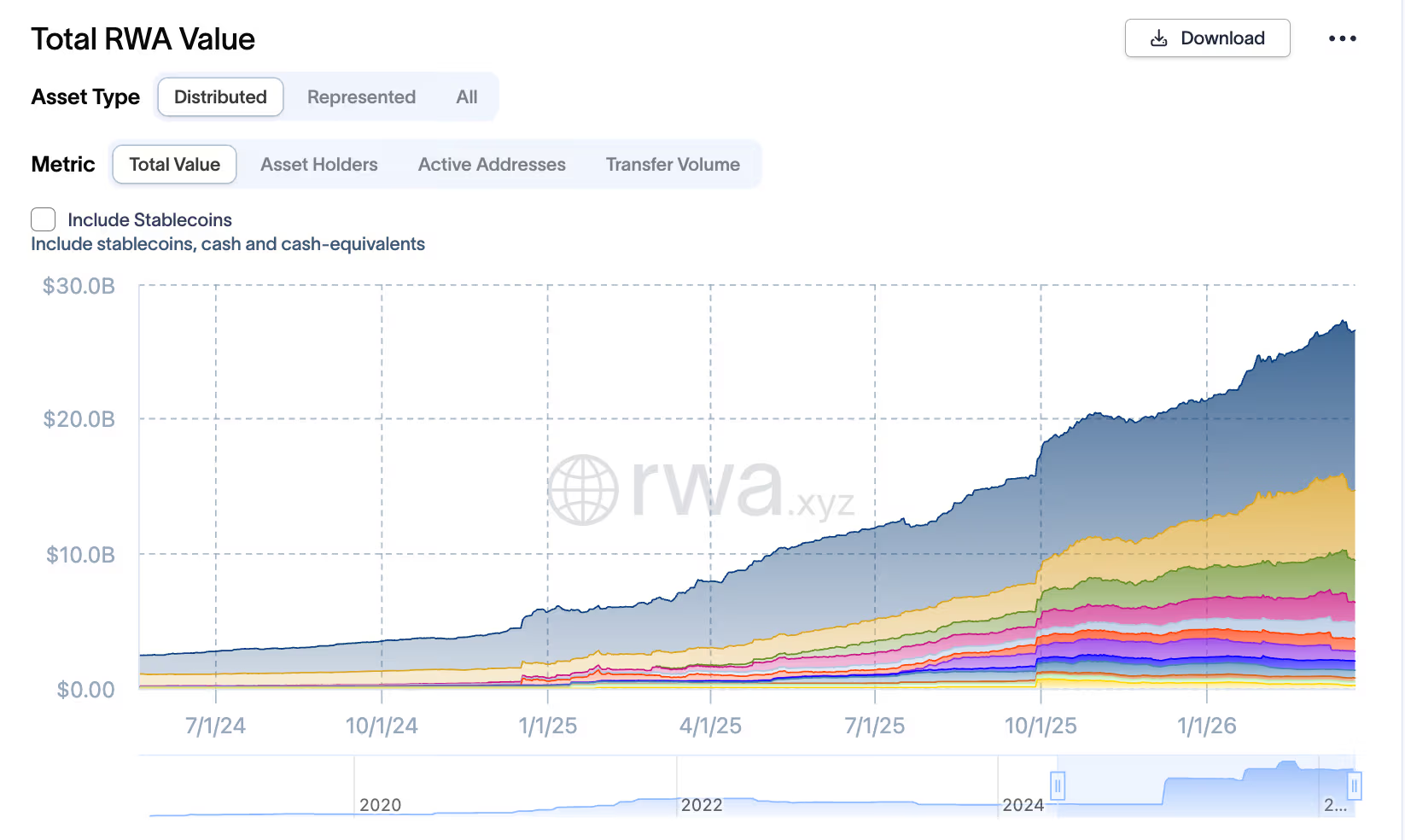
The market for tokenized real-world assets is growing rapidly, and tripled in value to $26 billion in the past year, RWA.xyz data shows. That growth has been driven by demand for more stable and predictable returns than those typically found in crypto lending and other speculative strategies.

Bitcoin (BTC) price struggled to break above $72,000, as several key onchain metrics highlighted weakening demand for BTC, casting doubts on its upside potential.
Key takeaways:
-
Bitcoin investors shift to distribution as whales and smaller cohorts aggressively sell under weak market conditions.
-
Bitcoin whale transaction count hits multi-year lows, as smart money waits for policy and geopolitical clarity.
-
Bitcoin’s hash rate fell sharply amid rising energy costs, increasing chances of miner capitulation.
Bitcoin investors “shift to distribution”
Bitcoin investors have are increasingly risk-off, distributing their BTC holdings amid the recent price weakness fueled by the US and Israel-Iran war and other macroeconomic headwinds.
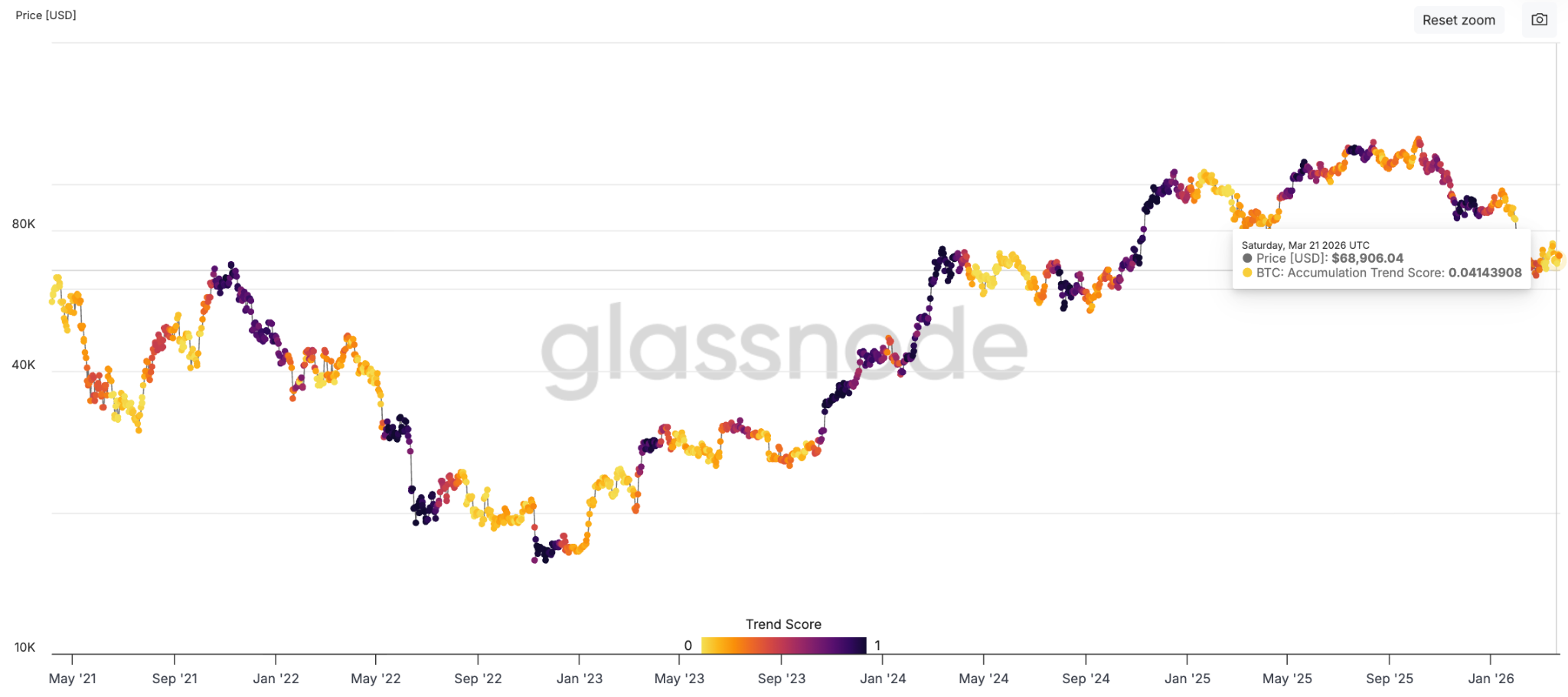
Glassnode’s Accumulation Trend Score (ATS) is near zero (light yellow), indicating that the whales are distributing their BTC holdings or not accumulating.
Related: Bitcoin retakes $71K as US sends Iran 15-point ceasefire plan
The drop in the trend score indicates a transition from accumulation to distribution across almost all cohorts. This shift mirrors a similar pattern observed in early 2025, which aligned with Bitcoin’s drop to $74,500 in April 2025.

Additional data from Glassnode shows a “shift toward distribution or inactivity” among small to mid-sized entities holding less than 1,000 BTC.
This is in contrast to “Q4 2024, where broad cohort accumulation preceded a sustained rally,” the onchain data provider said in a Tuesday post on X, adding:
“Heavy participation across wallet sizes remains a precondition for any durable recovery.”

Bitcoin whale activity “historically quiet”
Reflecting this distribution or inactive accumulation trend is Bitcoin’s whale activity, which has become “historically quiet,” according to Santiment.
Last week, daily BTC transactions above $100,000 fell to just 6,417, the lowest since September 2023. Meanwhile, transfers exceeding $1 million dropped to 1,485, levels last seen in October 2024.
The declining whale activity is largely due to market participants waiting for “clarity from the CLARITY Act,” as well as a long-term solution to the war, according to the data analytics company.
This indicates that “smart money is reluctant to make moves with so much policy and global uncertainty at play,” Santiment added.

Declining Bitcoin network activity
Bitcoin’s inability to sustain the recovery is further evidenced by low network activity and less onchain demand.
CryptoQuant’s Bitcoin network activity index, which tracks key indicators such as daily active addresses, total transactions count, and UTXO count, has been declining since August 2025.
This points to “weaker demand across the network,” CryptoQuant analyst Maartunn said in a recent post on X.

This aligns with weak onchain fundamentals such as liquidity and network growth as tracked by Bitcoin Vector’s fundamental index.
This metric “keeps trending lower and remains well below the strengthening zone,” Bitcoin Vector said in a Tuesday X post.
The onchain data provider described the current market conditions as “stability without support,” rather than a healthy consolidation, adding:
“As long as onchain conditions stay weak, upside looks increasingly dependent on flow, short covering, or external catalysts, not organic strength. If fundamentals don’t recover, this kind of divergence usually doesn’t support a sustained mid-term recovery.”

Bitcoin mining hash rate drops 22%
Bitcoin’s hash rate, a metric that shows the level of mining activity, has dropped sharply over the last couple of weeks, meaning miners are shutting down machines.
The hash rate has fallen to 813 EH/s on Wednesday, from 1.2 ZH/s on March 5, representing a 22% decrease.

Rising energy costs, exacerbated by the US and Israel-Iran war, compressed the hash price below $34 per PH/s/day, which is below many miners’ breakeven levels.
“Bitcoin miners are losing $19,000 on every coin they produce, and difficulty just dropped 7.8% as the miner exodus accelerates,” analysts at Token Metrics said in a recent post on X, adding:
“If difficulty drops another 5%+ within the next 7 days, miner capitulation is accelerating and spot sell pressure will intensify.”
This article does not contain investment advice or recommendations. Every investment and trading move involves risk, and readers should conduct their own research when making a decision. While we strive to provide accurate and timely information, Cointelegraph does not guarantee the accuracy, completeness, or reliability of any information in this article. This article may contain forward-looking statements that are subject to risks and uncertainties. Cointelegraph will not be liable for any loss or damage arising from your reliance on this information.


Startale Group said it closed a $63 million Series A round, adding $50 million from SBI Group to a $13 million first close from Sony Innovation Fund in January.
The Singapore-based company, which operates in Japan, builds blockchain tools for both financial firms and retail users. Its products include Strium, a blockchain for tokenized securities and other real-world assets, yen stablecoin JPYSC, dollar stablecoin USDSC and the Startale app, a consumer app tied to Sony-backed layer-2 network Soneium.
The funding brings together Startale’s two most important strategic partners, the firm said. SBI has worked with the company on Strium and JPYSC, while Sony has backed Startale through its investment arm and its work on Soneium.
The round reflects Startale’s push to build across several layers of the onchain economy, from financial infrastructure and settlement tools to end-user applications.
Startale said it will use the funding to scale Strium for tokenized securities and real-world asset trading, expand adoption of JPYSC and USDSC and develop the Startale app into a broader platform for asset management, payments and onchain services to become a “SuperApp.”
CEO Sota Watanabe said the company will also use the funding to push tokenized stocks tied to Japanese equities and expand yen stablecoin adoption this year.
The round lands as Japan works to test how blockchain systems can connect to existing financial infrastructure. Japanese Finance Minister Satsuki Katayama said earlier this year she fully supports crypto trading integration into the country’s stock exchanges.
Crypto World
Ripple Partners with Singapore’s Central Bank on Cross-Border Settlement Infra for Trade Finance


The pilot is part of a broader MAS initiative to extend settlement capabilities using tokenized bank liabilities and regulated stablecoins.
Ripple has joined a pilot program run by the Monetary Authority of Singapore (MAS), partnering with trade finance platform Unloq to build blockchain-based cross-border settlement infrastructure, according to a press release today, March 25.
The pilot will leverage Unloq’s trade finance platform, which bundles trade obligations, settlement conditions, and financing workflows into a single execution layer, alongside Ripple’s XRP Ledger and its enterprise-focused stablecoin, RLUSD. The pilot is part of BLOOM — short for Borderless, Liquid, Open, Online, Multi-currency — a MAS initiative to extend settlement capabilities using tokenized bank liabilities and regulated stablecoins. MAS is both Singapore’s central bank and primary financial regulator.
The use case targets a persistent inefficiency in global trade: payments that must be released only when predefined commercial conditions — like shipment verification — are confirmed, according to the release. Ripple says the structure improves risk transparency and could open up financing access for small and medium sized businesses caught in cross-border settlement limbo.
“Singapore continues to take a leading role globally in providing the regulatory clarity necessary for the digital asset space to thrive,” said Fiona Murray, Ripple’s managing director for the Asia Pacific region.
Singapore is known for having one of the earliest and most robust crypto-specific regulatory frameworks globally. The Defiant previously covered how MAS finalized its stablecoin regulatory framework back in August 2023, which requires issuers to peg to a single G10 currency and maintain full reserve backing — conditions RLUSD is designed to meet.
As The Defiant reported, RLUSD crossed $1 billion in circulating supply late last year, and the stablecoin’s supply now sits at $1.43 billion. Last August, Ripple acquired stablecoin infrastructure platform Rail for $200 million to bolster its payments ecosystem. In October, the firm completed its acquisition of global prime broker Hidden Road in October, which it rebranded to Ripple Prime.
The company has been pushing RLUSD into enterprise rails across multiple jurisdictions, including a partnership with OpenPayd to enable euro and sterling cross-border flows.
This article was written with the assistance of AI workflows. All our stories are curated, edited and fact-checked by a human.
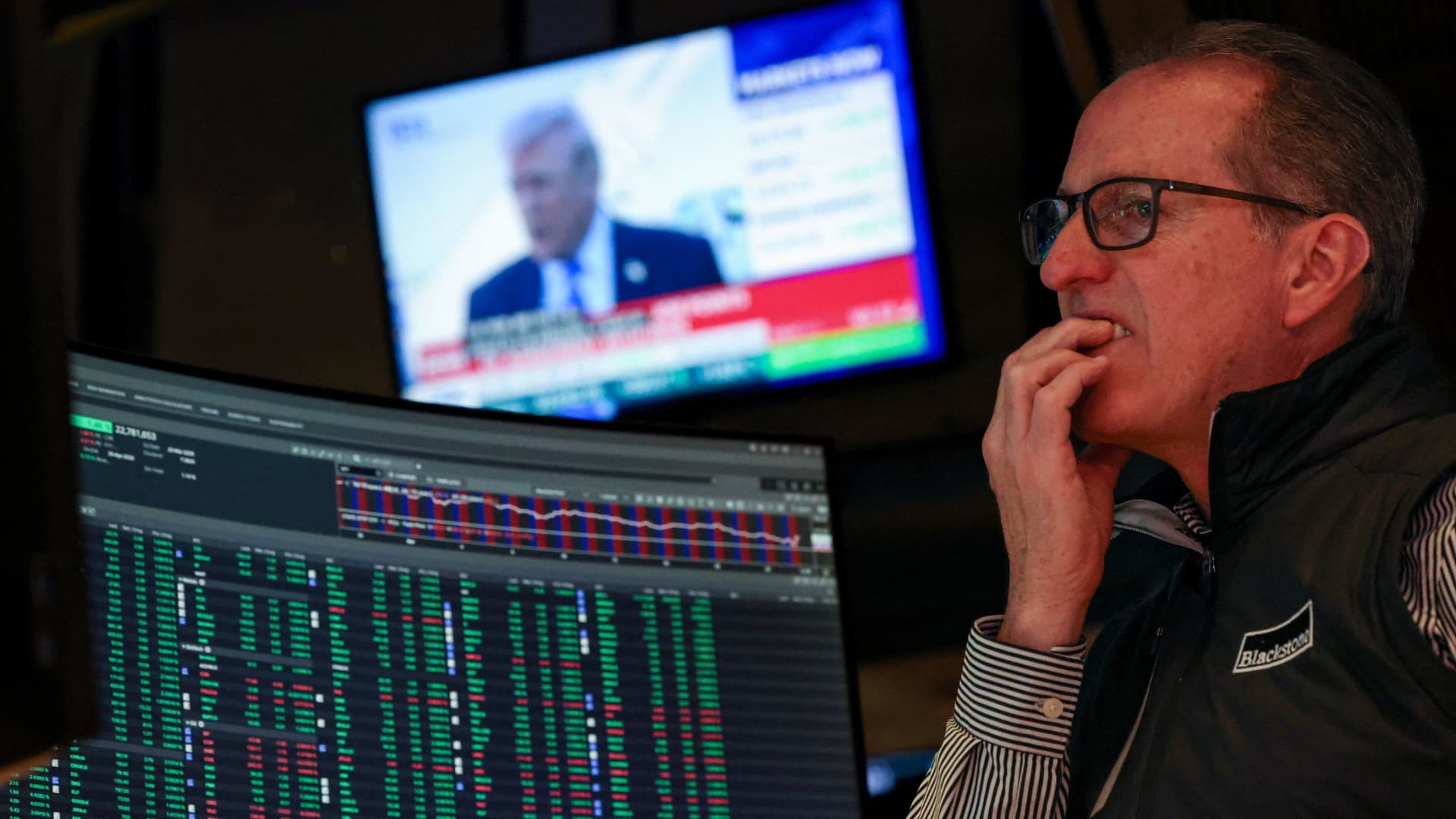
A trader works on the floor at the New York Stock Exchange (NYSE) in New York City, U.S., March 23, 2026.
Brendan McDermid | Reuters
Citrini Research, the firm that rattled markets earlier this year with a provocative bearish call on artificial intelligence, is out with another warning — this time arguing an oil-driven slowdown could send equities lower.
Founder James van Geelen said persistently high energy prices risk weighing on consumers and corporate earnings, creating a backdrop where stocks struggle even as the Federal Reserve eventually pivots toward rate cuts.
“If the war doesn’t end, equities will go lower,” van Geelen wrote in a Substack post early Wednesday, pointing to geopolitical tensions as a key driver of sustained oil strength.
Stocks recouped some of the losses Wednesday following reports that the U.S. has given Iran a plan to bring the conflict to an end, sending crude prices tumbling. However, the two countries appear to be very far apart, with Tehran turning down the U.S.’s ceasefire offer and demanding sovereignty over the Strait of Hormuz.
The latest call builds on Citrini’s growing reputation for contrarian macro views. In February, the firm published a widely circulated note arguing that the AI boom itself could ultimately hurt the economy, pushing unemployment as high as 10% if white-collar jobs are replaced by machines.
Slowdown ahead?
The core of Citrini’s current thesis is that elevated oil prices act as a tax on growth, eroding purchasing power and tightening financial conditions without the Fed needing to take further action. With policy rates already near neutral, van Geelen argued that simply holding rates steady would be restrictive enough as the energy shock filters through the economy.
“We live in a different world now, rates are close to neutral,” he wrote. “If oil stays high, it would be restrictive enough simply to leave them where they are while oil prices filter through the rest of the economy and cause a slowdown.”
That dynamic leaves equities particularly vulnerable, he said. Even in a scenario where geopolitical tensions ease quickly, Citrini sees limited upside for stocks. Consumers would still emerge “slightly weaker” after absorbing higher fuel costs, dampening the strength of any rebound, he said.
The firm’s view also challenges a common bullish narrative that rate cuts would provide a backstop for equities. Instead, van Geelen suggests any eventual easing would likely come in response to deteriorating growth, a backdrop historically associated with further equity declines rather than sustained rallies.
“The Fed knows that raising rates isn’t going to magically make more oil supply,” he wrote, arguing policymakers are more likely to “look through” the shock before ultimately cutting rates as conditions worsen.


The Solana Foundation is positioning the network as core infrastructure for an emerging “agentic” internet, where AI systems—not humans—initiate and execute economic activity.
“AI is not really a vertical. It’s a platform shift… affecting everything across every industry, including crypto,” said Vibhu Norby, chief product officer of the Solana Foundation, during a panel at the Digital Asset Summit (DAS) in New York.
At the center of Solana’s strategy is payments. Norby said the network has already “processed 15 million payments onchain from agents,” largely tied to machine-to-machine commerce. “The programmatic aspect of crypto payments is what is making it interesting for agents,” he said, adding that “stablecoins are going to be the default thing that agents use to pay for any computational resource.”
This shift could fundamentally reshape internet business models, Norby believes. “Agentic payments are probably going to change the entire way that the internet is monetized,” he said, pointing to the ability to support sub-cent, pay-per-use transactions that traditional rails cannot handle.
The Solana Foundation argues that the network’s performance-focused design gives it an edge in this new paradigm. “Agents are cold, calculated machines… they don’t subscribe to crypto religiosity,” Norby said. “If you ask an agent what’s the best way to pay for something with crypto, most of the time, Solana is showing up at the top.”
At the same time, advances in AI are eroding long-standing developer barriers, noting that tools now allow developers and machines to build across ecosystems more easily.
In response, Solana developers are building directly for AI systems. “What agents like is APIs and documentation and skills,” Norby said, pointing to initiatives like machine-readable “skill” files and AI-first developer platforms.
Looking ahead, Norby expects a dramatic shift in user behavior: “The default way people will interact with crypto is going to be through their agent… 95 to 99% of all transactions… will be coming from LLMs.”
Read more: Solana Foundation taps Mastercard, Western Union, Worldpay for institutional developer platform


CoinMarketCap dropped a wordless rocket meme just as its own Fear & Greed Index bounced from extreme fear and Bitcoin ripped from $67k back toward $71k.
Summary
- CoinMarketCap (@CoinMarketCap) posted a single rocket emoji alongside a stylized AI-generated rocket-shaped lava lamp image on March 24.
- The post came exactly one day after CoinMarketCap’s own Crypto Fear & Greed Index hit 8 out of 100 — deep in “extreme fear” territory — as traders aggressively dumped XRP, Solana, and DeFi positions amid geopolitical anxiety and macro pressure.
- The broader market context was significant: Bitcoin (BTC) had just surged from a recent low of $67,000 back toward $71,000 on March 24.
CoinMarketCap (@CoinMarketCap), one of the world’s most widely cited cryptocurrency data platforms with over 70 million monthly users, posted a wordless bullish signal on March 24 at 4:00 PM UTC — a rocket emoji and an AI-generated image of a metallic, rocket-shaped lava lamp — at the precise moment sentiment across crypto markets was attempting to reverse from some of its deepest fear readings in years. The post accumulated 34,500 views, 598 likes, and 75 retweets, becoming one of the most-engaged posts in crypto’s trending feed that day.
The timing was pointed. Just 24 hours earlier, CoinMarketCap’s own Crypto Fear & Greed Index had printed at 8 out of 100, locking in one of the deepest “extreme fear” readings of the current cycle, as traders liquidated positions across major altcoins including Solana (SOL) and XRP (XRP). The broader total crypto market capitalization had held around $2.36 trillion even as investors rotated aggressively into cash and stablecoins.
The fear had been building for months. As crypto.news reported in February, the Fear & Greed Index plunged to a yearly low of 5 on Feb. 6 — a level not seen since the depths of 2022 — as the global crypto market cap shed roughly $2 trillion from its 2025 peak. By mid-March, sentiment had crept back toward neutral. But a fresh wave of geopolitical anxiety around Iran dragged it back toward single digits.
The catalyst for the reversal was geopolitical rather than on-chain. U.S. President Donald Trump signaled a pause in military escalations against Iran on March 24, opening the door to diplomatic talks. The announcement triggered an immediate “risk-on” rotation across financial markets. Bitcoin, which had dipped to approximately $67,000 in the preceding days, climbed nearly 4% to breach $71,000 — recovering its market capitalization toward $1.33 trillion, according to Fortune. The wider crypto market cap moved to approximately $2.44 trillion, per CoinMarketCap data, with BTC dominance still elevated at close to 58%.
It was into this precise inflection point that CoinMarketCap chose to post its rocket image. The platform, described in its own documentation as “the Home Of Crypto” and the operator of what it calls “the most trusted” sentiment gauge in mainstream financial media, offered no caption beyond a single emoji. The community read the signal clearly: @DogelonMars replied “Comfy in spot,” while @CaptainBNB_bsc wrote “It’s mesmerizing, I could watch it all day.”
CoinMarketCap’s Fear & Greed Index runs on a 0–100 scale and draws from five data pillars: price momentum across the top 10 non-stablecoin assets, volatility measures on Bitcoin and Ethereum, options put/call ratios, stablecoin supply ratios, and CMC’s proprietary social trend data. CoinMarketCap itself states that “extreme fear likely indicates undervalued asset prices” — and by its own measure, markets had been in that territory for weeks.
Whether the rocket post marks an inflection or a head-fake remains to be seen. But as a sentiment artifact, it captured something real: after months of fear, the data’s own publisher was finally reaching for the launch button.

A decentralized crowdfunding approach is being pitched as a lifeline for NFT artists when market conditions turn sour and traditional middlemen tighten their hold. An on-chain experiment led by longtime collector Batsoupyum and curator Lanett Bennett Grant makes a persuasive case: commit to 1 Ether each week to fund emerging Ethereum mainnet works, share the artists’ stories, and avoid profit-driven flips. The model emphasizes direct, transparent capital flows from collectors to creators, with no centralized gatekeepers dictating who deserves attention.
Originating in an opinion piece by Joshua Kim, CEO and founder of DonaFi, the concept argues that a self-sustaining, on-chain funding pipeline can bypass the friction and fees of conventional platforms. In a bear market, when liquidity is scarce and attention concentrates elsewhere, this approach tests whether a small, committed community can keep artists productive and visible.
Key takeaways
- On-chain, platform-agnostic crowdfunding can deliver predictable funding to artists without relying on gatekeeping or monthly platform fees.
- During downturns, direct from-collector funding can supplement shrinking primary sales and help artists stay active in the ecosystem.
- The approach pairs financial support with narrative context, ensuring supporters see exactly where funds go and artists’ stories travel with each transaction.
- Early supporters demonstrated a network effect—more participants pledged, matched funds, or offered exhibitions—without permission from a central authority.
Crowdfunding without platforms or promises
Everything happens on-chain and in public, one purchase at a time. Artists receive direct payment and gain immediate visibility, while collectors know precisely how funds are allocated. The social layer—stories, context, and curation—travels alongside the transaction rather than getting filtered through a platform’s user interface.
Monthly open calls create a repeatable pipeline for discovery and support. The point isn’t a single philanthropic gesture; it’s sustained visibility and cash flow that can keep artists producing during a downturn. The model strips crowdfunding down to essentials: capital, trust and consistency.
A bear market proving ground
NFT bear markets don’t just depress floor prices; they shrink income for aspiring artists who rely on primary sales to fund new work and cover living costs. In this experiment, the community’s response was swift and tangible. Punk6529 matched the weekly ETH pledge. Sam Spratt contributed $20,000. Bob Loukas added $100,000. Galleries opened exhibitions, and platforms like Foundation pledged to feature works. Crucially, none of these contributions required permission or centralized coordination—the momentum spread through the ecosystem organically.
That rapid, permissionless response illustrates the strength of decentralized crowdfunding in downturns. It prioritizes conviction over optimism and demonstrates a pathway for artists to receive steady support even when demand in the broader market falters.
A networked approach to crowdfunding
What distinguishes this model from traditional patronage is its networked nature. Each participant amplifies the others; collectors don’t replace markets, but help stabilize them. Artists aren’t pigeonholed into charity narratives; their work is valued on its own merits. Platforms and galleries don’t compete with the effort—they extend it, enabling broader visibility and ongoing dialogue between creators and supporters.
As the original proposal notes, decentralized crowdfunding works because it aligns incentives without coercion. No one is locked in or promised upside; yet the outcome—a steady stream of support and authentic storytelling—can arrive swiftly.
Related: AI agents will have growing pains before innovation can start links to broader conversations about technology-enabled creativity and the evolving role of automation in art markets.
Why this model matters in 2026
This isn’t merely about salvaging NFTs; it’s about proving that decentralized capital can function when speculation cools. In a market where hype wanes, what endures is community, transparency and conviction—foundations that artists need to thrive. If the next phase of NFTs is to matter beyond hype cycles, it will depend on collectors showing up consistently, moving funds on-chain to creators, and telling their stories alongside the art.
Decentralized crowdfunding won’t fix every problem artists face, but in a downturn it already accomplishes something far more important: it keeps artists alive in the ecosystem when other channels go quiet.
As this model evolves, observers will want to see whether more artists participate, whether funding can scale beyond a few high-profile contributors, and how broadly the storytelling and on-chain transparency can be sustained. The coming months will indicate whether this on-chain approach becomes a durable backbone for creator ecosystems or remains a powerful, yet niche, instrument in the NFT landscape.


An independent government review warned that crypto assets could channel foreign money into British politics.
The United Kingdom has imposed an immediate moratorium on all cryptocurrency donations to political parties, Prime Minister Keir Starmer announced on Wednesday.
The move follows the publication of the Rycroft Review, a 50-page independent assessment of foreign financial interference in UK politics led by former senior civil servant Philip Rycroft.
The government will legislate the moratorium through amendments to the Representation of the People Bill currently before Parliament, and the new rules will apply retrospectively to any crypto donations received from Wednesday onward, Communities Secretary Steve Reed confirmed in the House of Commons.
Why Crypto
The Rycroft Review cited a combination of concerns specific to crypto assets as the basis for its recommendation, including the incomplete regulatory framework for crypto — particularly at the international level — the difficulty of tracing ultimate ownership, the proliferation of different cryptoasset vehicles with varying degrees of traceability, and the emergence of AI-assisted technologies that can fragment crypto holdings into amounts small enough to fall below the £500 threshold at which political donations must be declared.
No crypto donations have reached the reporting threshold to date, according to the review, meaning the Electoral Commission has had no visibility into the scale of crypto flowing into party coffers.
The review framed the moratorium as a pause rather than a permanent prohibition. Rycroft wrote that the measure should be understood as an interval for the regulatory environment to catch up with the reality of cryptoassets, not a prelude to an outright ban. The legislation would include a mechanism to lift the moratorium once Parliament and the Electoral Commission are satisfied that adequate regulation is in place.
Rycroft also acknowledged that the ban is not a complete seal. Donors would still be able to convert crypto holdings to fiat and donate the proceeds, at which point traditional anti-money laundering checks would apply.
The UK Parliament’s Joint Committee on the National Security Strategy last month described crypto’s presence in UK politics as an unacceptably high risk to the integrity of the political finance system, and endorsed the review’s findings today.
Reform UK in the Crosshairs
The moratorium lands squarely on Nigel Farage’s Reform UK, the only major British party to actively court crypto donations. Reform became the first mainstream UK party to accept Bitcoin donations last year, and its largest donor — Thailand-based Christopher Harborne, a major Tether investor — has donated £12 million to the party over the past year, including a single £9 million contribution.
The Electoral Commission has said that Reform has not shared any crypto wallet addresses with the regulator, limiting the watchdog’s ability to independently verify the party’s crypto funding sources.
Reform UK MPs walked out of the House of Commons during Starmer’s announcement. The Prime Minister took a direct shot at Farage, telling MPs that there was only one party leader willing to say anything if paid to do so.
Broader Crackdown
The crypto moratorium is one of 17 recommendations in the Rycroft Review, which found that foreign interference in UK politics from Russia, China, and Iran is persistent and growing more acute. The review was triggered by the November 2025 conviction of Nathan Gill, Reform UK’s former leader in Wales, who was sentenced to more than 10 years for accepting Russian bribes.
Alongside the crypto ban, the government immediately adopted a £100,000 annual cap on political donations from British citizens living overseas. Rycroft also recommended limiting corporate donations to a party’s reported taxable profits — a measure aimed at closing a loophole that could allow foreign individuals to funnel money through UK-registered shell companies.
The Rycroft Review also warned of threats beyond direct political financing, noting that foreign-linked social media bots and disinformation campaigns represent a relatively cheap way for hostile states to interfere in democratic processes. Rycroft separately flagged what he called a potential new threat from allies like the United States, citing a willingness of foreign actors and private citizens to interfere in politics abroad in pursuit of their own agenda.
This article was written with the assistance of AI workflows. All our stories are curated, edited and fact-checked by a human.
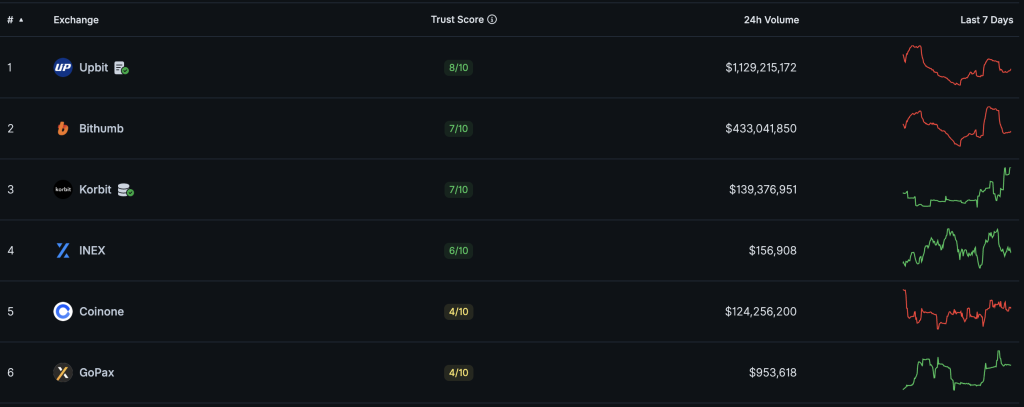
South Korea’s political deadlock over virtual asset taxation has broken under the weight of market reality. Lawmakers from both major parties have agreed to delay the planned 20% Crypto Tax on gains until 2027 following data revealing $110 billion in annual capital flight. This bipartisan reversal is a strategic pivot driven by a retail exodus that has drained liquidity from domestic exchanges in favor of offshore derivatives platforms.
The Financial Services Commission (FSC) confirmed that outflows accelerated in the second half of 2025, with $60 billion leaving the country in just six months. Traders are not just cashing out; they are moving capital to jurisdictions that offer the leverage and hedging tools currently banned on local soil.
- Capital Flight: Annual outflows hit an estimated $110 billion in 2025, with 57% of volume moving to Binance to access futures and leverage.
- Political Response: Both the ruling People Power Party and opposition Democratic Party agreed to delay the 20% tax implementation to 2027.
- Market Impact: Operating profits for domestic exchanges plunged 38% in H2 2025 as traders bypassed local spot-only restrictions.
The Mechanics of the Exodus
The data paints a picture of a market structure failure. While the FSC noted a 14% increase in outflows to 90 trillion won ($60 billion) in the second half of the year, the drivers are structural, not sentimental.
Domestic giants like Upbit and Bithumb are legally restricted to spot trading. In a volatile market, this restriction renders them obsolete for sophisticated traders looking to hedge downside risk or speculate with leverage.

This is not a sell-off. It is an arbitrage migration. A joint report by CoinGecko and Tiger Research estimates that 57% of the total outflows flowed directly to Binance.
South Korean traders now account for approximately 13% of Binance’s futures volume. The net result is a massive transfer of fees abroad; foreign exchanges earned an estimated 2.7 times more revenue from Korean users than domestic platforms did in 2025.
The disparity has crushed local profitability. Despite a 31% rise in deposits to 8.1 trillion won ($5.4 billion), operating profits for South Korea’s 18 exchanges collapsed by 38% to 380.7 billion won ($253.4 million). The volume is there, but the high-value transactional velocity has moved elsewhere. We are seeing similar liquidity demands globally; EDX Markets launching KRW perpetual futures suggests institutional players are already positioning to capture this volume offshore if domestic regulations don’t adapt.
The FSC report explicitly linked the outflows to “arbitrage and other similar activities,” a tacit admission that the current regulatory framework is bleeding value.
Regulatory News: The Policy Gap
The decision to delay the tax is an emergency brake, not a solution. The opposition Democratic Party, previously adamant about implementing the tax in 2025, capitulated after realizing the Capital Flight could permanently cripple the domestic fintech sector.
With 11.1 million crypto accounts in the country, representing over 20% of the population, the political cost of taxing a shrinking market became untenable.
The post Regulatory Backlash: $110B in Outflows Forces South Korea to Rethink Crypto Tax appeared first on Cryptonews.

10 best games on Nintendo Switch Online – from Zelda to EarthBound
Sky-backed Obex spreads $1 billion across credit, energy and AI assets to expand stablecoin yield

Salah leaves Liverpool with an unbelievable legacy


-
 Crypto World5 days ago
NIO (NIO) Stock Plunges 6.5% as Shelf Registration Sparks Dilution Worries
-

 Fashion5 days ago
Weekend Open Thread: Adidas – Corporette.com
-

 Politics5 days ago
Jenni Murray, Long-Serving Woman’s Hour Presenter, Dies Aged 75
-
 NewsBeat8 hours ago
Manchester United reach agreement with Casemiro over contract clause amid transfer speculation
-

 Crypto World4 days ago
Best Crypto to Buy Now: Strategy Just Spent $1.57 Billion on Bitcoin During Fear While Early Investors Quietly Enter Pepeto for 150x Potential
-

 Crypto World4 days ago
Bitcoin Price News: Bhutan Sells $72 Million in BTC Under Fiscal Pressure, but the Smart Money Entering Pepeto Sees What the Market Does Not
-

 Tech6 days ago
inKONBINI Lets You Spend Summer Days Behind the Register
-

 Sports2 days ago
Remo Stars and Kano Pillars Strengthen Survival Hopes in NPFL
-
 NewsBeat7 days ago
Residents in North Lanarkshire reminded to register to vote in Scottish Parliament Election
-

 Politics6 days ago
Gender equality discussions at UN face pushbacks and US resistance
-

 Business3 days ago
No Winner in March 21 Drawing as Prize Rolls to $133 Million for Next
-

 Business7 days ago
Who Was Alex Pretti? 5 Key Facts About the ICU Nurse Killed by Federal Agents in Minneapolis
-

 Sports2 days ago
Gary Kirsten Accuses Pakistan Cricket Board Of ‘Interference’, Mohsin Naqvi Responds
-

 Tech3 days ago
Give Your Phone a Huge (and Free) Upgrade by Switching to Another Keyboard
-

 Tech7 days ago
Inventec’s bizarre VeilBook laptop hides its touchpad under a sliding keyboard just to give cooling fans a little breathing room
-

 Sports5 days ago
2026 Kentucky Derby horses, odds, futures, preview, date: Expert who nailed 12 Derby-Oaks Doubles enters picks
-
Sports6 days ago
Vikings Free Agency Enters Phase 2 with Key Questions
-

 Tech3 days ago
AI enters the chat: New Seattle dating app relies on tech to facilitate meaningful human connections
-

 News Videos7 days ago
Amazing Cardboard Gadget That Turns Paper Into Money #techgadgets #ytshorts
-

 Tech7 days ago
Corsair K100 Air Wireless Mechanical RGB Keyboard Packs Full Power Into a Slim Frame
You must be logged in to post a comment Login