
Crypto World
Mysten Labs CTO Sam Blackshear joins Anthropic



Mysten Labs cofounder and chief technology officer Sam Blackshear said on Aug. 6 that he is leaving the Sui developer to join Anthropic for defensive security research.
Summary
- Sam Blackshear is leaving Mysten Labs to join Anthropic for defensive security research involving AI.
- Evan Cheng will assume Mysten’s technical vision while continuing as the blockchain company’s chief executive.
- Blackshear plans to remain an adviser to Mysten Labs and developers across the Sui ecosystem.
- Move’s creator said a foundation is being developed and he intends to remain involved afterward.
- Anthropic is expanding defensive cyber research as frontier models improve software vulnerability discovery capabilities rapidly.
Blackshear announced the move in posts on X, saying the role would let him return to hands on technical work while studying a new problem area. He did not disclose his starting date, reporting line or specific projects at Anthropic.
Blackshear said he was motivated by a period in which the “balance of power between attackers and defenders is shifting.” The comment is his assessment, not a measured industry result. However, Anthropic’s recent research supports the broader concern. The company said Claude Opus 4.6 could identify high severity software vulnerabilities at scale, while its Frontier Red Team studies how advanced models could strengthen defense and offensive activity.
Blackshear will remain involved with Mysten and Sui
Blackshear said he would remain a close adviser to Mysten Labs and respond to Sui ecosystem builders who seek his help. Mysten’s leadership page identified him as a cofounder and CTO before the announcement, alongside cofounder and chief executive Evan Cheng. Blackshear said Cheng will now set the company’s technical vision, although Mysten had not published a separate succession statement.
The departing executive credited Cheng with recruiting many of Mysten’s strongest technical employees and noted his previous leadership experience at Apple and Meta. Blackshear also thanked Mysten Labs staff and the wider Sui community. His advisory role may provide continuity, but the company has not disclosed whether it will appoint another CTO or redistribute his duties.
Mysten was founded by former Meta engineers and became the original contributor to the Sui layer one blockchain.
Mysten Labs partnered with Google Cloud to use generative AI in code development and auditing. The collaboration included tools trained on Move and an AI based auditing system designed to identify vulnerabilities in Move, Rust, TypeScript and Solidity code. That work placed artificial intelligence and blockchain security within Mysten’s strategy before Blackshear joined Anthropic.
Move Foundation plans remain at an early stage
Blackshear created Move while working at Meta and has spent more than eight years developing the language. Sui Foundation materials describe Move as a smart contract language designed around ownership, scarcity and safer handling of digital assets. Its resource model aims to prevent certain programming errors, while Sui’s version adds an object centered structure and programmable transaction blocks.
Blackshear said a Move Foundation is “in the works” and that he hopes to remain involved. The statement is forward looking. He did not provide a launch date, governance structure, leadership team or funding plan. It is also unclear whether the proposed foundation would oversee the language across several blockchains or focus on narrower technical standards.
A separate foundation could provide a neutral forum for language development, documentation and governance. Still, no official organization or timetable accompanied Blackshear’s departure, so its eventual scope remains uncertain.
In related coverage, the $260 million Cetus Protocol exploit showed that a secure programming language cannot remove every application level risk. Researchers said the affected contracts executed permitted instructions, while the failure involved pricing and liquidity controls above the language layer. The incident showed why smart contract safety also depends on protocol design, monitoring and operational response.
Anthropic is expanding defensive security research
Blackshear joins Anthropic as the company increases research into AI enabled cyber threats. Anthropic reported in June that it studied 832 accounts linked to malicious activity and mapped their behavior across the MITRE ATT&CK framework. It said it banned those accounts and found AI assistance across reconnaissance, malware development, evasion and other attack stages.
Anthropic is also testing defensive uses of its models. Project Glasswing brought together about 50 partners to search critical software for vulnerabilities, while separate work with Pacific Northwest National Laboratory used Claude in simulated attacks on a water treatment system. These company reported results do not prove defenders will consistently stay ahead, but they show the research field Blackshear is entering.
Blackshear’s background in programming languages, static analysis and automated bug finding fits that work. Before Mysten, he worked on Move and related security tools at Meta. Sui’s official archive identifies him as Move’s creator and a former principal engineer at the company.
What happens next depends on announcements from Anthropic and Mysten Labs. Anthropic has not detailed Blackshear’s team or research agenda. Mysten has not confirmed a replacement CTO. Developers will also watch whether the proposed Move Foundation receives formal leadership, funding and a launch schedule.

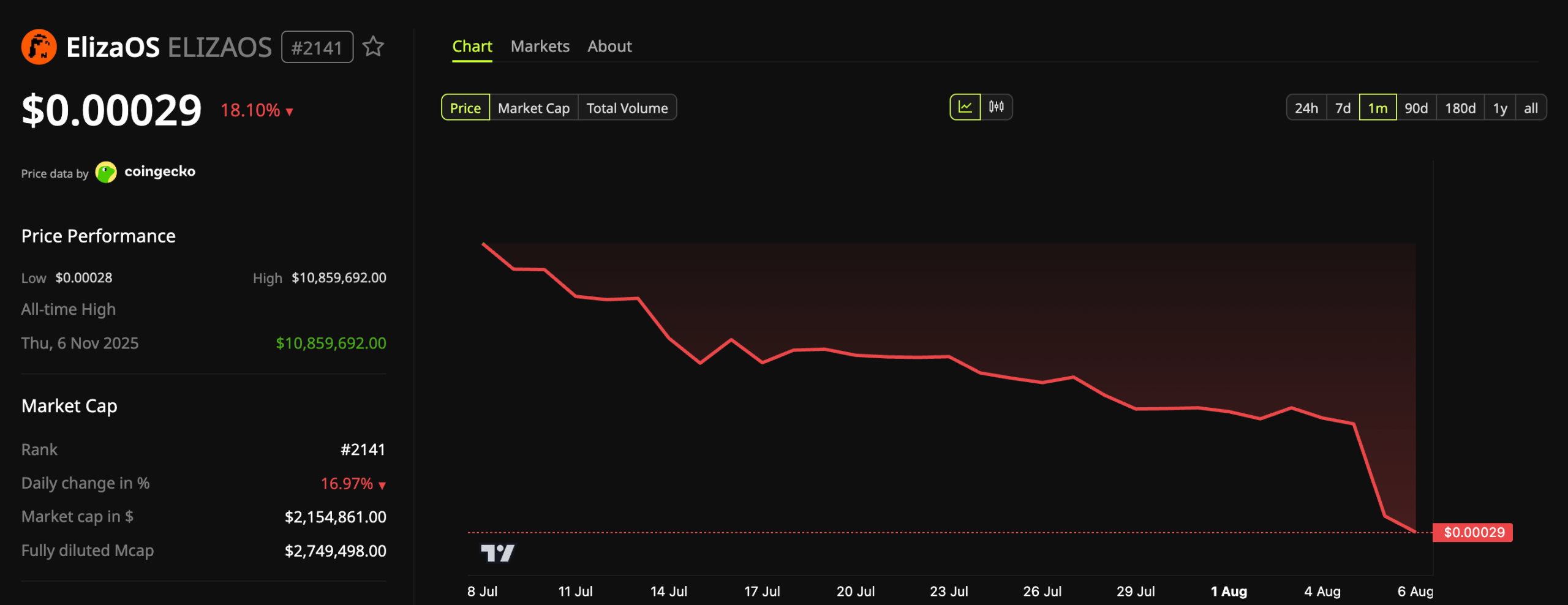
Eliza Labs founder Shaw Walters declared the ElizaOS (ELIZAOS) token “dead” and said the foundation is winding down, sending the altcoin token to a record low.
Walters posted the statement on X, telling holders that no supply, buybacks, or foundation support remain to defend the price.
What Happened With ELIZAOS
Walters said law firm Burwick sued the project, and his side settled with a group of holders. The team handed over what he described as the rest of the treasury and all remaining money.
He called the claim “ridiculous” but said the project lacked the capital to fight it in court. Burwick filed the federal class action in the Southern District of New York on April 22, 2026.
The complaint alleged that the project engaged in false advertising, deceptive practices, negligent misrepresentation, and unjust enrichment. It also challenged the migration from ai16z to ElizaOS, which expanded supply from 1.1 billion to 11 billion tokens.
“According to the complaint, on-chain data reflects losses across at least 3,945 customer wallets, with total class harm believed to be in the hundreds of millions of dollars,” the text read.
The ai16z token launched on Solana (SOL) in October 2024. The project rebranded to ElizaOS in January 2025. At its January 2025 peak, ai16z carried a market capitalization of nearly $2.4 billion.
Follow us on X to get the latest news as it happens
Why the ELIZAOS Token Crashed and What Walters Does Next
ELIZAOS fell to a record low near $0.000284 earlier today. At press time, it traded at $0.00029, down about 18% on the day. That left the token with a market capitalization of nearly $2.15 million.

Walters revealed that he never sold his ai16z holdings and drew only a modest salary, comparable to that of the project’s other engineers. He said he no longer owns any tokens and will never attach a token to Eliza again.
“The token is dead. Completely. The foundation is winding down. I am starting over, since I own the IP, and I am never letting a token come close to Eliza again, maybe,” he added.
Walters said he wants the industry to break with its casino mentality and focus on building real products. He added that he has turned bearish on crypto while staying optimistic about artificial intelligence (AI).
Subscribe to our YouTube channel to watch leaders and journalists provide expert insights
The post ElizaOS Token Collapses to All-Time Low as Foundation Shuts Down appeared first on BeInCrypto.
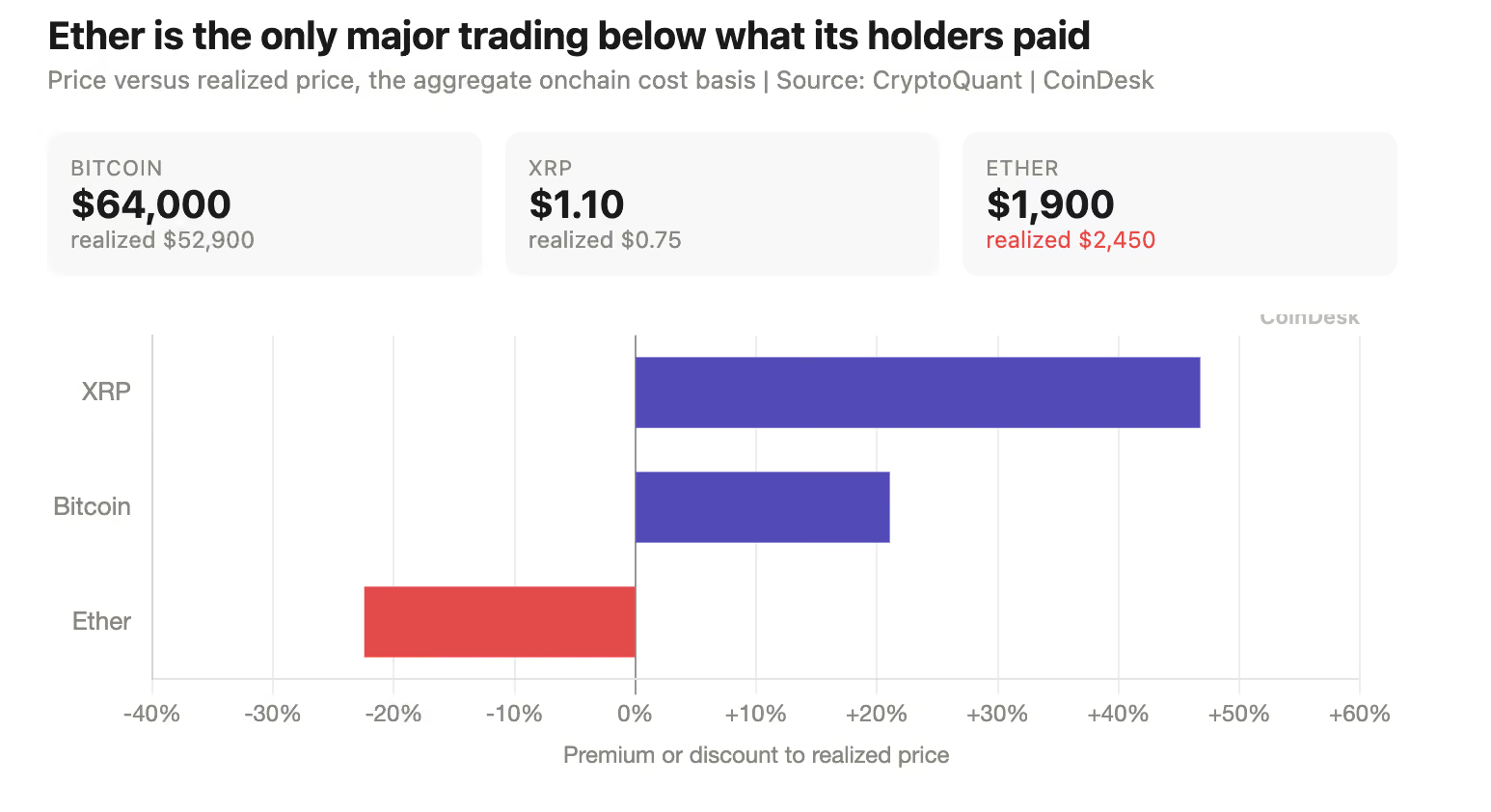
Ether’s holder base is splitting, however. Wallets holding 10,000 to 100,000 ETH have risen from about 14 million ETH in mid-2025 to record highs near 19.6 million now.

The 100,000-plus cohort fell to roughly 2.6 million ETH in mid-2025 before climbing to about 4.6 million by May 2026, an addition CryptoQuant put at roughly 1.8 million. The 1,000 to 10,000 cohort has gone the other way, peaking near 15.6 million ETH in January 2026 and falling to about 12.9 million since.
Bitcoin whales, excluding exchange and mining-pool addresses, bottomed near 2.87 million BTC in December 2025 and hold about 3.06 million now, buying hardest as price fell below $60,000 in June. That remains roughly 170,000 BTC below the 2025 bull-cycle peak near 3.23 million.
CryptoQuant calls this the last stage of the decline while stating plainly that valuation leaves room for one more leg lower before a floor is confirmed.
Ether below cost basis is the thing to watch. It is the only one of the three where the market has already capitulated on paper, and CryptoQuant noted ETH bottomed in early 2025 at a similar level and a similar distance from its lower band.


Disclosure: This article does not represent investment advice. The content and materials featured on this page are for educational purposes only.
ZIGChain has secured a strategic investment from Laser Digital to expand institutional-grade investment products onchain.
Summary
- Laser Digital invested in ZIG and will support institutional risk governance for ZIG Markets products.
- ZIGChain targets at least $100 million in total value locked across planned institutional-grade vault products.
- The partnership plans onchain private credit, PayFi, invoice financing, SME financing, and stablecoin infrastructure products.
ZIGChain announced that Laser Digital has made a strategic investment in ZIG and partnered with ZIG Markets. Laser Digital, the digital assets arm of Nomura Group, will help structure products and design risk controls. The ZIGChain Laser Digital partnership aims to bring private credit, PayFi, invoice financing, small-business funding, and stablecoin-based services onchain for institutions and everyday users.
ZIGChain Laser Digital partnership sets governance role
Under the agreement, Laser Digital will provide product structuring support, risk framework design, and governance for a pipeline of ZIG Markets vault products. ZIG Markets serves as the product and access layer within the wider ZIGChain ecosystem. Its role includes finding and developing financial opportunities in regional markets. The partnership focuses on emerging-market origination rather than adding another source of onchain yield, according to the companies’ joint public announcement.
The partners said the model combines ZIG Markets’ regional origination capabilities with Laser Digital’s global asset management experience. Laser Digital will apply institutional risk standards and oversight to products linked to emerging-market private credit. Nomura identifies Laser Digital as its digital asset subsidiary, while ZIGChain presents its network as infrastructure for onchain investment opportunities.
$100 million TVL target for vault products
ZIGChain is targeting at least $100 million in total value locked across the planned institutional-grade vault products. The announcement did not disclose the size of Laser Digital’s investment in ZIG. It also did not provide detailed terms for individual vaults or a timetable for reaching the TVL goal.
The pipeline will cover private credit and related financing products. The companies plan to explore PayFi, financing for small and medium-sized enterprises, invoice factoring, and stablecoin-enabled products. Their stated goal is to make categories that have often been hard to access at scale available through onchain infrastructure with formal risk controls.
Private credit forms central part of plan
The partners described onchain private credit as a leading use case within more than $30 billion of tokenized real-world assets. They said global asset managers have increased activity, but credible institutional origination from emerging markets remains limited. The collaboration seeks to address that gap through regional access and institutional governance.
Abdul Rafay Gadit, co-founder and chief commercial officer of ZIGChain, said onchain finance has attracted capital but still needs greater institutional credibility. “Our partnership with Laser Digital brings institutional governance, product expertise, and global best practices to our offering,” he said. Gadit added that the approach could make the products more accessible to banks, family offices, and other investors.
First product expected in coming months
Dr. Jez Mohideen, co-founder and chief executive of Laser Digital, said execution risk in onchain finance has often been underestimated. He said ZIG Markets brings regional depth and an origination record, while Laser Digital will apply the risk frameworks used across its broader offerings. “The shared vision remains to make the next generation of asset management products accessible to those moving serious institutional capital,” Mohideen said.
The agreement follows ZIGChain partnerships with Beehive, Taurus, and ADI Foundation, along with a growing pipeline of real-world asset products across MENAP and other markets. The first product under the Laser Digital partnership is expected to launch in the coming months. The companies said they will release more details as the product nears completion.
Disclosure: This content is provided by a third party. Neither crypto.news nor the author of this article endorses any product mentioned on this page. Users should conduct their own research before taking any action related to the company.
Circle Internet Group said on Aug. 5 that its Coinbase USDC agreement had renewed on existing terms, keeping the stablecoin at the center of the U.S. exchange’s products.
Summary
- Circle renewed its Coinbase USDC agreement on existing terms for three additional years through 2029.
- USDC circulation reached $73.3 billion, rising 19% from the same quarter last year despite weakness.
- Circle generated $701 million in quarterly revenue and reserve income, up 7% year over year.
- Circle rejected quarterly dividends, favoring reinvestment in products, distribution partnerships and strategic opportunities over payouts.
- Coinbase held 30% of USDC circulation on its platform at the quarter’s end in June.
Circle confirmed the renewal during its second quarter 2026 earnings call.The agreement’s initial term began in August 2023. Circle’s collaboration agreement filed with the Securities and Exchange Commission provides for automatic three year renewals when both companies continue meeting their contractual obligations. The latest renewal therefore extends the arrangement into 2029.
Chief Financial Officer Jeremy Fox Geen also said Circle had no plan to introduce quarterly dividends. Management intends to retain capital for products, infrastructure and other strategic opportunities rather than begin regular shareholder payouts.
Circle and Coinbase preserve their USDC economics
Circle and Coinbase established their current commercial arrangement on Aug. 18, 2023, after closing the Centre Consortium structure that had previously governed USDC. Coinbase received a minority ownership interest in Circle, while Circle assumed sole responsibility for issuing and governing USDC.
Under the filed collaboration agreement, Coinbase supports USDC across its products and receives payments linked mainly to income earned from the assets backing the stablecoin. Circle retains an issuer allocation before the remaining income is divided according to where USDC balances are held. Coinbase also receives part of the reserve income generated by USDC held outside either company’s platform.
The arrangement makes Coinbase more than an exchange listing USDC. Circle reported that 30% of USDC circulation was held on Coinbase’s platform at the end of the second quarter. By comparison, Circle held $12.4 billion, or 17% of circulation, within its own platform infrastructure.
USDC circulation reached $73.3 billion at quarter end, up 19% from a year earlier. Circle’s total revenue and reserve income rose 7% to $701 million, although a lower reserve return rate offset part of the benefit from circulation growth.
New partners can still join the USDC network
The renewed Coinbase USDC agreement does not prevent Circle from signing other distribution arrangements. Circle said it had more than 150 partners with economic incentives to integrate, distribute and support USDC across exchanges, wallets, payment applications and financial platforms.
Circle and Coinbase have also cooperated on third party agreements. Circle moved about $4.4 billion in USDC to a Coinbase linked address through HyperEVM after Coinbase became Hyperliquid’s USDC treasury deployer. Arkham described it as the largest recorded USDC transfer at the time.
Circle later said approximately 90% of Hyperliquid’s USDC was held within Coinbase’s platform at the end of the quarter, while around 10% remained on Circle’s platform. However, management declined to disclose how the three companies divide the associated reserve income.
In related coverage, JPMorgan warned that the Hyperliquid agreement could pressure Circle and Coinbase’s margins. The bank’s estimates are external forecasts and not figures confirmed by either company.
Circle rejects quarterly dividends to fund growth
Fox Geen said Circle wanted to maintain a strong balance sheet that could support investment during different market conditions. He also said retained capital would allow the company to pursue strategic opportunities when they arise.
Circle believes shareholder returns from reinvesting in its platform will be “far greater” than returns from quarterly dividends, according to Fox Geen.
The claim is forward looking and is not a guaranteed return. Product execution, interest rates, regulation, competition and distribution expenses will determine whether the strategy produces the outcome management expects.
The position is consistent with Circle’s latest annual report. The company said it had not declared or paid cash dividends and did not expect to do so in the foreseeable future. Its board may still reconsider the policy based on Circle’s financial condition, capital requirements and other business factors.
For U.S. investors, the decision confirms that Circle continues to present itself as a growth company rather than an income stock. Circle began trading on the New York Stock Exchange in June 2025 after pricing its initial public offering at $31 per share.
U.S. regulation strengthens Circle’s investment case
Circle’s capital allocation decision comes as it invests in regulated U.S. infrastructure. In July, the company received final approval from the Office of the Comptroller of the Currency to establish Circle National Trust.
As previously reported, Circle National Trust will initially provide custody services to Circle and its affiliates. Its approved plan may later support institutional custody and management of assets backing USDC, although Circle has not confirmed when those services will begin.
The OCC is also developing rules to implement the GENIUS Act. Its proposed stablecoin framework covers reserves, redemption, custody, capital, audits, supervision and issuer applications. Circle therefore faces continued compliance spending as the federal system moves from legislation toward operating rules.
Meanwhile, distribution remains one of Circle’s largest expenses. The company recorded $330.6 million in Coinbase related distribution costs during the first quarter of 2026, compared with $303.2 million a year earlier. Circle said these expenses could increase as reserve income grows and it adds more distribution partners.
Circle reported $460.6 million in distribution and transaction costs during the fourth quarter against $733.4 million in reserve income. Those figures show why investors monitor not only USDC circulation, but also how much reserve income Circle retains after paying major partners.
What happens next
The renewal removes an immediate source of uncertainty surrounding Circle’s most important commercial relationship. Investors will now watch future SEC filings for any additional disclosure about the renewed term, distribution costs or changes to the agreement.
Circle’s dividend policy could also change later, but only through a future board decision. For now, management plans to direct available capital toward USDC distribution, regulated infrastructure, payments and new products rather than quarterly payouts.
South Korean crypto exchange Upbit opened trading for Cap’s CAP token on Aug. 6 across its Korean won, Bitcoin and Tether markets.
Summary
- Upbit opened CAP trading against Korean won, Bitcoin and Tether at 14:00 KST on Thursday.
- CAP deposits and withdrawals use Ethereum, with Upbit warning users to verify the contract address.
- Upbit restricted purchases and low priced sell orders, while limiting order types for two hours.
- Bithumb previously listed CAP in June, making Upbit its second major South Korean won market.
- CAP traded near $0.02735, gaining 15.3% daily, although listing effects could not be isolated independently.
According to the exchange’s official CAP listing notice, trading was scheduled to begin at 14:00 Korea Standard Time. Deposits and withdrawals were expected to open within two hours of the announcement.
The listing gives CAP direct access to Upbit’s won market about five weeks after Bithumb introduced its own CAP/KRW pair. At the time of research, CoinGecko data showed CAP near $0.02735, up about 15.3% over 24 hours, with a market value around $42.5 million. The data showed stronger activity around the announcement but did not establish how much of the move came from Upbit’s decision.
Upbit opens three CAP markets with early restrictions
Upbit said it would support CAP deposits and withdrawals only through Ethereum. The exchange identified the supported contract as 0x99991c6aabba5a096f24f250b73580f5179b9999 and warned that transfers through other networks would not be credited normally. CoinGecko and several exchange records display the same Ethereum contract for the official Cap token.
The exchange also applied controls commonly used during new listings. Buy orders were blocked for about five minutes after trading began. Sell orders priced more than 10% below the previous day’s closing price were also restricted for about five minutes.
For the first two hours, traders could place only limit orders. Upbit applied similar opening controls when listing Derive in its KRW, BTC and USDT markets in July.
Upbit noted that the launch could be delayed if deposits failed to provide enough liquidity. Its reference table placed CAP at 40.69 won at the previous close and 39.85 won at 10:50 KST. It also listed reference prices of 0.00000043 BTC and 0.02833 USDT shortly before publication.
CAP listing expands its South Korean access
The Upbit addition does not mark CAP’s first South Korean won market. Bithumb listed the token on June 30, supporting Ethereum deposits and opening CAP/KRW trading at 14:00 KST. Its reference price was 36.54 won.
The new Upbit markets broaden local access by adding BTC and USDT pairs alongside direct won trading. The structure lets local users buy CAP with fiat while giving existing crypto holders additional routes through Bitcoin and Tether.
Upbit has used this three market format for several recent listings. In related coverage, the exchange opened KRW, BTC and USDT trading for OriginTrail in May. However, early market responses to exchange additions have varied widely.
CAP’s current valuation also requires context. CoinGecko reported a circulating supply of 1.56 billion tokens against a total supply of 10 billion. At the quoted price, its fully diluted value was about $273 million, far above its circulating market value. Future token releases could therefore change the amount available for trading.
Cap ties stablecoin yield to covered credit
Cap describes itself as a credit platform that combines cUSD, stcUSD and a marketplace of borrowers, underwriters and liquidators. Its official documentation says users can mint cUSD against approved dollar assets and stake it for stcUSD, which accrues rewards generated through the protocol.
The project says borrowers must secure backing from delegated collateral before accessing reserve assets. If a borrower defaults or its position becomes undercollateralized, liquidators can sell delegated collateral and return assets to the reserve.
Cap describes this structure as offering “full downside protection” for stablecoin holders.
The statement is a project claim rather than an independent guarantee. The structure does not remove smart contract, collateral, liquidity, governance or liquidation risks. Cap’s documentation also says cUSD is designed to remain redeemable against a basket of approved reserve assets.
CAP serves as the protocol’s governance token. Official documentation lists governance functions covering protocol parameters, collateral management, operator onboarding and fees.
The project assigns 46.72% of the token supply to ecosystem development. The team and investors may each receive up to 20%, while 10% went to a community offering and 3.28% to an Echo community sale.
What traders should watch after the launch
The first test will be whether Upbit’s three markets attract lasting liquidity after the temporary order restrictions expire. Early listing moves can reverse quickly, particularly when a token has a relatively small circulating market value and most of its total supply is not yet circulating.
Past Upbit additions have produced mixed results. Venice Token traded lower after receiving KRW, BTC and USDT markets, while other tokens recorded sharp early rallies. These cases show why a listing does not guarantee a lasting price increase.
Users must also follow Upbit’s deposit rules. The exchange said transfers from virtual asset service providers outside its approved Travel Rule network might not be credited and could require a lengthy return process.
Deposits involving personal wallets require ownership verification. Upbit may also request information about the source of funds when it receives large transfers with unclear origins.
CAP continues trading on Bithumb, Coinbase, Bybit and other global venues. Traders will therefore watch won volume, differences between Korean and international prices, deposit availability and any further Upbit notices. CoinGecko listed Bithumb as CAP’s largest tracked market at the time of research.


GSR increased Bitcoin’s allocation in its Core3 model portfolio on Aug. 5 as trading activity slowed and volatility eased across Bitcoin, Ether and Solana.
Summary
- Solana fell 40.21% year to date, the steepest decline among GSR’s three tracked assets overall.
- GSR allocated 44.1% to Ether, 36.5% to Solana and 19.3% to Bitcoin in its model.
- Core3 lost 57.78% yearly, trailing the equally weighted basket by 7.94 percentage points before costs.
- Ether led 30 day returns at 5.16%, while Solana dropped 9.64% during the same period.
- GSR increased Bitcoin exposure as trading activity weakened and volatility eased across the three assets.
The latest Core3 model portfolio assigned 44.1% to Ether, 36.5% to Solana and 19.3% to Bitcoin. The weights total 99.9% because GSR rounds each allocation.
Despite Bitcoin receiving the smallest weight, it remained the strongest of the three assets in 2026. BTC had lost 24.82% year to date. Ether was down 35.49%, while Solana recorded the deepest decline at 40.21%.
Over one year, Bitcoin fell 47.08%, compared with losses of 44.73% for Ether and 54.89% for Solana. The figures show broad weakness across the three assets rather than a decline isolated to one blockchain.
GSR Core3 model shifts toward Bitcoin
GSR said market conditions remained subdued during the latest week. Price changes were modest, while trading activity and volatility declined. The firm interpreted those conditions as a quieter market without a strong directional trend.
As a result, the model raised its Bitcoin allocation and cut its Ether position. GSR attributed the change to proprietary signals rather than recent price performance alone.
The shift is clearer when compared with GSR’s July 15 allocation. At that point, the model held 53.1% in Ether, 37.6% in Solana and only 9.2% in Bitcoin. Bitcoin’s weight therefore rose 10.1 percentage points by Aug. 5, while Ether’s fell nine points.
Ether still delivered the strongest return over the most recent 30 days, gaining 5.16%. Bitcoin rose 1.26%, while Solana lost 9.64%. However, GSR said the lower Ether weighting indicated “relatively stronger forward looking opportunities elsewhere.”
That assessment is a model based view, not a confirmed prediction of future returns. GSR said the portfolio uses quantitative signals that can change as prices, volume and volatility move.
Solana leads losses despite falling volatility
Solana’s 40.21% year to date decline was the largest among the Core3 assets. It also lost 54.89% over one year, compared with the portfolio’s 57.78% decline.
However, SOL produced the best weekly result, rising 1.86%. Bitcoin gained 1.19%, while Ether fell 0.54%. The mixed figures support GSR’s description of a market with limited short term direction.
Solana’s measured volatility also eased sharply. Its 30 day volatility stood at 37.39%, below Ether’s 41.69%, although still above Bitcoin’s 29.89%. Solana’s 60 day reading remained higher at 54.92%, showing that its calmer recent trading followed a more unstable period.
Solana previously approached support near $60 after whale selling, weaker decentralized finance activity and market liquidations weighed on the asset. The network’s planned upgrades continued to support its longer term development case, but they had not prevented sharp token losses.
The broader weakness also extended beyond SOL. As previously reported, the crypto market excluding Bitcoin and Ether lost almost 23% during the first half of 2026. The decline occurred even as some blockchain networks continued recording strong usage.
Core3 trails a basket weighted equally
The Core3 portfolio lost 37.86% year to date and 57.78% over one year. An alternative portfolio allocating equal amounts to Bitcoin, Ether and Solana declined 33.99% and 49.84% over the same periods.
Core3 therefore trailed the equally weighted basket by 3.87 percentage points in 2026 and 7.94 points over one year. Its larger exposure to Ether and Solana increased losses when those assets fell more sharply than Bitcoin.
The result also shows the difference between a changing allocation model and a passive basket. The model attempts to adjust exposure based on GSR’s signals. An equally weighted portfolio simply maintains broadly similar exposure to all three assets.
Earlier allocations show that those signals can change rapidly. On July 8, GSR held 46.7% in Ether, 40.1% in Solana and 13.1% in Bitcoin after Ether led weekly performance and volatility declined.
Ether has struggled against Bitcoin during 2026, with the ETH to BTC ratio reaching multiyear lows. Institutional demand concentrated in Bitcoin, competition from Solana and questions over Ether’s value capture have weighed on its relative performance.
What traders will watch next
GSR’s next weekly allocation will show whether the model continues moving toward Bitcoin or reverses the shift. Trading volume, relative momentum and changes in volatility will remain central to that decision.
The model’s 30 day volatility stood at 38%, compared with 35.87% for the equally weighted basket. Its 60 day volatility was slightly lower than the comparison portfolio, at 42.64% versus 43.69%.
Investors should also distinguish the model results from returns available through a live investment strategy. GSR said its figures are hypothetical, exclude transaction and management fees and do not include staking rewards.
The firm also said the material is intended for professional investors and does not constitute investment advice. GSR may trade the assets for its own account, take positions that differ from its published commentary and sponsor products using related methods.
Those disclosures matter because the portfolio’s allocations are not neutral market forecasts. They reflect a proprietary framework whose positions and past returns may not translate into future performance.


Tornado Cash processed 968 deposits on July 23, its busiest day of 2026, according to L2Beat data. The spike shows large-scale attackers have returned to the privacy protocol since the U.S. Treasury lifted sanctions in March 2025 — and that its baseline usage keeps climbing even as developer Roman… Read the full story at The Defiant
Alex Kuptsikevich of FxPro said in an email that bitcoin has gained momentum since Monday, when buyers stepped in during the dip toward $62,500 and pushed price back above the 50-day moving average. Optimism is centred more on bitcoin than on the wider market, he said, which is typical of the early stages of a long-term shift.
The equity backdrop turned less helpful. The MSCI All Country World Index snapped a five-day run to fall 0.2% as chipmakers retreated on both sides of the Pacific. Korea’s Kospi, a bellwether for the AI trade, dropped 4.4% with SK Hynix and Samsung leading losses.
S&P 500 and European futures edged higher.
Meanwhile, Gold rose 0.4% to its strongest since June as traders trimmed rate-hike expectations, with Brent under $80 a barrel after Iran said it had reached an agreement with Oman on a shipping route through the Strait of Hormuz.
SoftBank reports later Thursday. It has put $34.6 billion into OpenAI through Vision Fund 2 since September 2024 and owns chip designer Arm, so its numbers are read as a gauge of whether the private side of the AI trade is holding up.


President Trump has called Federal Reserve Chair Kevin Warsh repeatedly since May, The Wall Street Journal reported. Trump reaches out in bursts, then goes quiet for stretches, people familiar with the calls said.
The calls have touched on how the Iran war and artificial intelligence (AI) are affecting the economy, the sources said. One person said rates have not come up since Warsh’s Senate confirmation. That keeps intact the wall between the White House and monetary policy.
A Bond Market Already on Edge
The contact lands as bond investors already question Warsh’s independence. Last week, the Federal Open Market Committee (FOMC) voted 9-3 to hold rates steady. Warsh then gave evasive answers at his press conference.
The 30-year Treasury yield jumped afterward to its highest level since before the 2007-08 financial crisis. Three FOMC members had pushed for an immediate hike. Warsh sidestepped questions about why he disagreed with them.
The three later explained their dissenting rate hike votes in separate remarks. That added to the sense that Warsh keeps his cards close to the vest. He also testified before Congress in July, weeks before the FOMC split became public.
Loretta Mester led the Federal Reserve Bank of Cleveland from 2014 to 2024. She said she wants confidence that the Fed knows what it is doing. She does not think Warsh’s approach of saying little is sustainable.
Nixon Tried This With Burns
Direct presidential contact with a Fed chair is not new. Nixon pressured Fed Chair Arthur Burns to loosen policy ahead of his 1972 re-election bid. Tapes released decades later capture that pressure campaign.
“I really don’t care what you do in [or after] April.”
Nixon told Burns that in February 1972. The exchange comes from a 2006 Journal of Economic Perspectives paper that transcribed the Nixon tapes.
Burns cut the discount rate before that November’s election. The following year, the federal funds rate jumped from 4.49% to 9.71% as the Fed reversed course. Inflation ran hot through the rest of the decade.
Historians still debate whether Burns acted from conviction or political pressure. Either way, the episode remains a cautionary tale about central bank independence.
Trump’s calls to Warsh look narrower than Nixon’s push for rate cuts. They have centered on Iran and AI, not borrowing costs directly. Still, the parallel adds context to the independence question trailing Warsh.
He gets another chance to address it at the Fed’s Jackson Hole retreat this month.
The post Trump Has an Open Line to the Fed Chair. Nixon Tried That Too. appeared first on BeInCrypto.
US-listed spot Bitcoin exchange-traded funds (ETFs) are attracting fresh capital as a high-profile cryptocurrency custody incident puts renewed focus on digital asset security.
Spot Bitcoin ETFs recorded $211.5 million in net inflows on Tuesday, adding to Monday’s $170 million, according to data from SoSoValue.
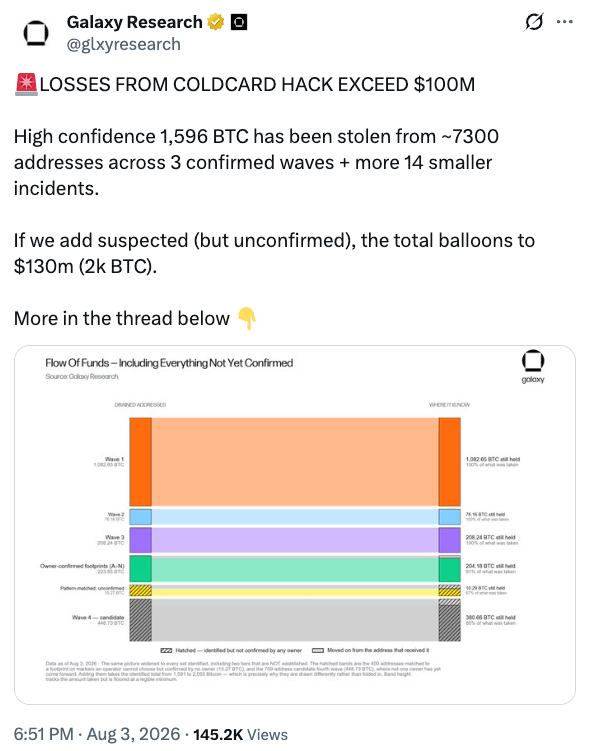
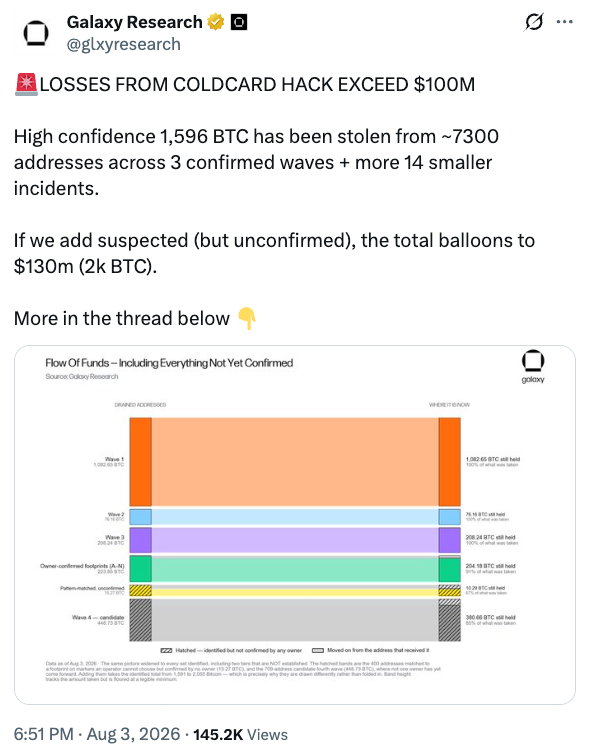
The inflows came as the ongoing Coldcard hack drew attention from analysts, with Galaxy Research estimating that the attack may have affected as many as 7,300 addresses and resulted in about $130 million in suspected Bitcoin (BTC) losses from users of the hardware wallet.
The developments have renewed a long-running debate in crypto over whether institutional custody solutions offered through regulated financial products could become more attractive as investors weigh the risks and responsibilities of self-custody.
Galaxy ETF returns to inflows as Bitcoin funds rebound
BlackRock’s iShares Bitcoin Trust (IBIT) led the ETF recovery, recording $111 million in inflows on Monday and $170 million on Tuesday, according to Farside Investors data. Fidelity’s Wise Origin Bitcoin Fund (FBTC) followed, adding about $33 million and roughly $20 million on the respective days.
Invesco Galaxy Bitcoin ETF (BTCO) recorded $6.7 million in inflows on Monday, marking its first positive daily flow since July 1. The inflow represented about 3.9% of BTCO’s cumulative net inflows of $172 million, according to Farside.
Source: Galaxy Research
Galaxy Research, the research arm of crypto investment company Galaxy Digital, has emerged as one of the most prominent sources tracking the Coldcard incident. Alex Thorn, Galaxy Digital’s head of firmwide research, and his team have regularly published estimates on affected addresses and potential losses linked to the incident.
Coldcard hack gives new weight to Bitcoin ETF custody argument
Eric Balchunas, senior ETF analyst at Bloomberg Intelligence, said the Coldcard hack could encourage greater migration toward Bitcoin ETFs, as investors reconsider the role of institutional custody.
In a post on Tuesday, Balchunas said ETFs’ reliance on traditional financial institutions to safeguard assets could increasingly be seen as an advantage. He wrote that what was once considered a “bug” by some crypto users may “all the sudden seem like a feature” as investors compare institutional custodians with smaller crypto companies.
Related: Boltz pauses service after wave of AI-assisted hacking attempts
Separately, Balchunas also pointed to broader changes in the ETF market, including the closure of Hashdex’s spot Bitcoin ETF and BlackRock’s planned reverse split for its Ethereum ETF.
BTC steady as traders weigh custody concerns
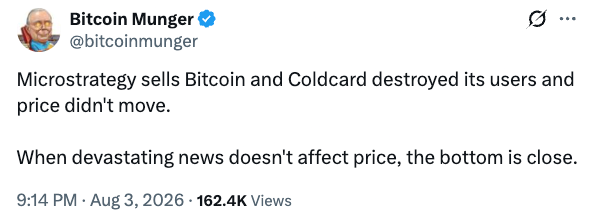
Bitcoin remained relatively stable as traders assessed the Coldcard incident and other sources of selling pressure, including the latest 1,638 BTC sale by Michael Saylor’s Strategy.
At publishing time, BTC traded at $64,113, down around 0.8% over the past seven days, according to CoinGecko. The asset’s lowest price during that period fell below $62,500.
Source: Bitcoin Munger
Some observers argued that those behind the Coldcard incident may face challenges moving or converting the affected funds because Bitcoin transactions can be publicly tracked. Crypto commentator Shagun wrote in an X post on Sunday that large fund movements would likely attract scrutiny from blockchain researchers, exchanges and other market participants.
Magazine: Sorry everyone, Bitcoin is headed down to $43,500: Michael Terpin

LG Electronics, APL Apollo Tubes among 7 mid & smallcap picks by Axis Securities for August

ElizaOS Token Collapses to All-Time Low as Foundation Shuts Down

‘His name’s probably Vaibhav Sooryavanshi’: Jos Buttler backs teenage Indian star to break his T20 run record | Cricket News


-

 Fashion6 days ago
Weekend Open Thread: Wit & Wisdom
-

 Politics5 days ago
Meta enters AI-training agreement with far-right ‘propaganda rag’ Newsmax
-

 Politics4 days ago
Zack Polanski: an incitement to murder Nigel Farage?
-

 Crypto World5 days ago
MicroStrategy Post-Earnings CLARITY Act Push Could Add New Catalyst for Its Stock
-

 Crypto World5 days ago
XRP Ledger v3.3.0 brings five institutional features
-

 News Videos7 days ago
Bitcoin Enters the 3rd Stage of the Bear Market
-

 Politics7 days ago
Luke Littler’s dominance sparks GOAT debate
-

 Sports6 days ago
Seema Kaliramna Wins Discus Throw Bronze, Takes India’s CWG Medals Tally To 17
-

 Crypto World5 days ago
New York sues Kalshi over prediction market gambling
-

 Crypto World4 days ago
Crypto PAC spending tops $2M in Michigan House race
-

 Business3 days ago
DTCR: Deleveraging And A Hedge Fund Collapse Point To A Possible AI Bottom
-

 Business6 days ago
Trump Announces Hamas Disarmament Agreement as Iran Strikes Kuwait Air Base and US Attacks Pause Overnight
-
 Crypto World5 days ago
3 Fed Officials Just Explained Their Rate Hike Vote: Is Inflation Winning?
-

 Tech4 days ago
ESET tracks rise in malicious AI skills and adaptable malware
-
 Tech6 days ago
Gemini Spark can now use Chrome logins and saved passwords to run errands on your behalf
-

 Sports5 days ago
France Cricket implodes: letters hidden in a drawer and a board at war
-

 NewsBeat7 days ago
Four people die trying to cross Channel in small boats
-
 Tech6 days ago
Building A Reproduction PlayStation Motherboard
-
Crypto World4 days ago
XRP Ledger urges node upgrade after manifest flood
-

 Crypto World5 days ago
Moneyflip CEO charged in $40K murder-for-hire plot
You must be logged in to post a comment Login