

Crypto World
National police union reverses course to back the CLARITY Act



A US police union representing more than 382,000 members has reversed its position and endorsed the latest CLARITY Act after lawmakers added language addressing its concerns about cryptocurrency investigations.
Summary
- The National Fraternal Order of Police has reversed course and endorsed the latest CLARITY Act.
- The union says revised provisions preserve law enforcement powers to investigate crimes involving digital assets.
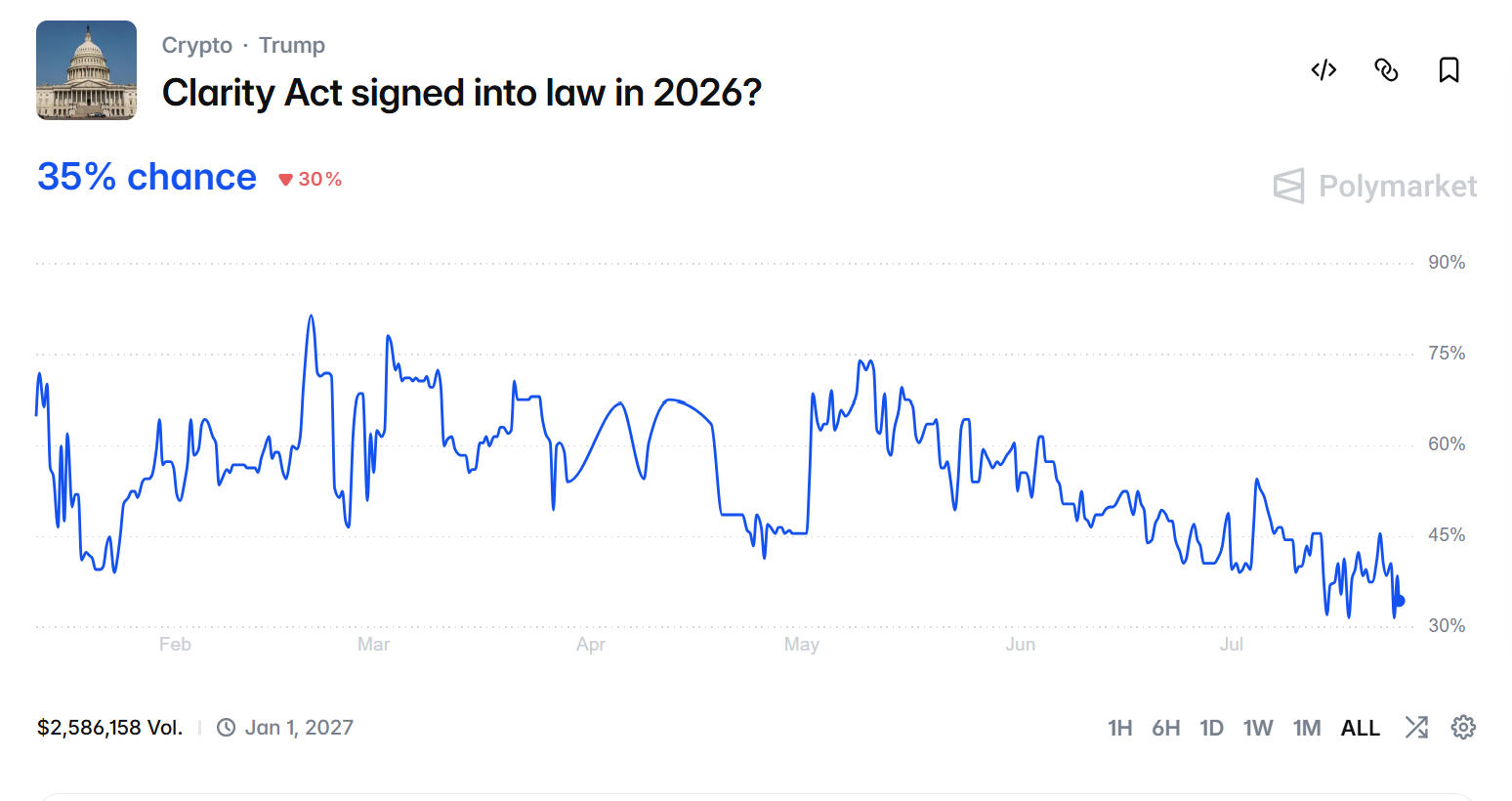
- Senate delays and election-year disputes have pushed Polymarket’s 2026 passage odds down to 33%.
According to former Fox Business reporter Eleanor Terrett, the National Fraternal Order of Police now supports the bill after reviewing provisions tied to the Blockchain Regulatory Certainty Act. The union believes the language protects the ability of police and prosecutors to pursue crimes involving digital assets.
In a July 24 letter to Senate Banking Committee Chairman Tim Scott and ranking member Elizabeth Warren, FOP National President Patrick Yoes backed the latest version of H.R. 3633, formally known as the Digital Asset Market Clarity Act.
Yoes wrote that revised Section 10604, which amends the BRCA, does not restrict law enforcement agencies or prosecutors from addressing illegal conduct involving cryptocurrencies. According to the letter, the clarification directly answers concerns the union raised during earlier negotiations over the legislation.
Terrett, however, reported that the BRCA provisions remained unchanged in the latest bill released Wednesday. She noted that it was unclear which changes the FOP was referring to when it announced its support.
The apparent inconsistency leaves open whether the union assessed language added at an earlier stage, received separate assurances from lawmakers, or interpreted an existing provision differently. Neither the FOP letter nor Terrett’s report identified a specific newly amended passage beyond Section 10604.
Revised provisions preserve crypto enforcement powers
Explaining its reversal, the FOP cited several sections that it believes will help federal, state and local agencies investigate financial crimes involving digital assets. The union said investigators need clear authority and practical tools as they confront fraud, organized crime and illicit finance conducted through crypto networks.
Among those provisions, the legislation would create safeguards addressing fraud linked to digital asset kiosks. According to the FOP, the measure also applies anti-money laundering and sanctions compliance duties across parts of the crypto industry.
The letter pointed to rules intended to help investigators act before suspected criminal funds leave their reach. Those provisions would protect digital asset companies and stablecoin issuers from liability when they voluntarily delay suspicious transactions or respond to a law enforcement request.
Given how quickly cryptocurrencies can cross jurisdictions, the FOP argued that temporary transaction holds could give investigators time to prevent losses, recover stolen assets and disrupt illegal activity. The union presented those protections as an important tool for cases in which funds might otherwise disappear before officers can intervene.
Bank Secrecy Act provisions also contributed to the union’s support. According to the letter, the revised bill updates the treatment of digital assets under rules governing monetary instruments, helping existing reporting and enforcement requirements apply more clearly to crypto activity.
Other sections direct government agencies to share information and coordinate their responses to illicit finance risks. The FOP added that the bill would strengthen international cooperation on anti-money laundering enforcement and sanctions involving digital assets.
Under Title IX, the legislation would establish a grant program for state and local digital asset enforcement work. The FOP said it would also create a national security and law enforcement training program, form a digital asset cyber innovation center and introduce measures designed to protect older consumers from deception.
Addressing protections for software developers, the union said the bill would not prevent authorities from investigating crimes, prosecuting offenders or applying existing criminal laws. Its letter specifically cited 18 U.S.C. § 1960, a federal statute covering certain unlicensed money-transmitting activity.
The FOP also pointed to language preserving liability for people who knowingly transfer funds tied to criminal offenses or promote unlawful activity. According to the union, this distinction gives responsible developers legal certainty without shielding individuals who intentionally assist illegal transactions.
Senate delay pushes CLARITY Act beyond the August recess
The endorsement has arrived as the CLARITY Act faces a shrinking congressional timetable. As crypto.news reported earlier on July 24, Senate Majority Leader John Thune does not expect the Senate to approve the market structure legislation before lawmakers leave Washington for the August recess.
Thune’s position removes a deadline that crypto industry supporters had treated as important for completing the bill in 2026. Following the development, Polymarket traders lowered the probability of the legislation becoming law this year to 33%.
Attention has therefore moved to the session after the November midterm elections. During that period, lawmakers will return to government funding measures, defense legislation and other unfinished bills that will also compete for limited Senate floor time.
According to Wintermute head of policy and advocacy Ron Hammond, the CLARITY Act still has enough bipartisan backing to pass but has become trapped in election-year disputes. Hammond attributed the immediate obstacle to political messaging rather than a shortage of votes in the Senate.
With Democrats preparing to campaign against President Donald Trump and alleged corruption, Hammond expects some lawmakers to avoid backing a major cryptocurrency bill before the election. His assessment suggests the FOP endorsement may resolve one law enforcement dispute without removing the political barriers delaying a Senate vote.
In its letter, the FOP described the latest provisions as a meaningful effort to provide stronger investigative tools, clearer compliance paths and better coordination between agencies. The union said its initial concerns had been satisfactorily addressed and offered to work with lawmakers to secure passage of the amended bill.


The company announced the launch of a new platform, dubbed ‘Ripple Mint,’ that gives institutional customers a single way to access, mint, redeem, and manage RLUSD.
It said the main objective is to make digital dollars easier to access, integrate, and operate at scale as stablecoins become more deeply embedded in trading, payments, and treasury operations.
Pushing RLUSD’s Institutional Reach
According to the official blog post, Ripple Mint expands RLUSD access beyond traditional platform-based workflows by allowing institutions to manage the stablecoin either through a user interface or through programmatic integrations.
With Ripple Mint, institutions can mint and redeem RLUSD directly from the issuer, bridge the stablecoin across supported blockchains, monitor funds throughout the full transaction lifecycle, and integrate RLUSD operations into their own internal systems and workflows.
The rollout will not affect existing customers of the stablecoin, who will now be able to use the platform for both manual operations and automated integrations. The company has also introduced new APIs and webhook notifications that allow customers to automate RLUSD workflows, query transaction status throughout the minting and redemption process, access account balances programmatically, and receive real-time updates on important events such as fiat receipt, mint processing, on-chain settlement, and payout completion.
Alongside the launch of Ripple Mint, Ripple also made a strategic investment in Notabene, a company focused on regulated on-chain transaction infrastructure.
The two companies said they will work together to grow enterprise stablecoin payments by integrating RLUSD into Notabene Flow, the firm’s B2B stablecoin payments platform. The focus will also be on exploring how trusted payment authorization can complement Ripple Payments.
The partnership combines Ripple’s enterprise payments ecosystem and RLUSD with Notabene’s institutional network, which reportedly spans more than 2,300 connected institutions across over 100 jurisdictions, serves more than 280 customers, and facilitates more than $2 trillion in annualized transaction volume.
Expansion
Ripple’s RLUSD has continued to expand its presence since launching and now has a market capitalization of nearly $1.6 billion. Last August, Ripple partnered with Japan’s SBI Holdings to distribute the stablecoin in the country through SBI VC Trade starting in the first quarter of 2026.
In March 2026, the company joined the Monetary Authority of Singapore’s BLOOM initiative with Unloq to test RLUSD and the XRP Ledger for programmable cross-border trade settlement.
A month later, OKX listed the stablecoin to expand its global access, liquidity, and trading utility. More recently, it was also included in Mastercard’s expanded stablecoin settlement program.
The post Ripple Doubles Down on RLUSD With Mint Launch and Notabene Investment appeared first on CryptoPotato.

Depending on the scale you are looking at BTC, you can determine that the asset is either almost 50% away from its all-time high or it’s actually millions of percentages above its price observed a decade ago.
From a technical perspective, the current $65,000-$66,000 region could actually mean that there’s a massive opportunity on the table, at least according to popular analyst Crypto Rover.
… Like Buying at $2
The analyst outlined a specific chart to his 1.6 million followers on X that uses a long-term logarithmic regression curve to claim that the cryptocurrency’s price has followed a predictable upward trajectory for over a decade with little deviation. The green markers show historical touchpoints after which the asset went on a massive run as its price continued along the curve.
Some of the previous instances where it touched the lower level included $2 over a decade ago, $10, $200, $3,500, and, most recently, $16,000, during the bear cycle in 2022. Each of those was followed by tremendous rallies that led to subsequent all-time highs.
Rover’s chart now argues that BTC’s current range at $65,000-$66,000 means the asset has slipped into this same familiar territory, suggesting it’s a comparable ‘on-curve’ entry point rather than an overextended top. Consequently, he concluded that buying BTC now is “no different from buying it at $16,000, $3,500, $200, $10, or even $2,” implying similar long-term upside potential relative to the historical growth path.
WOW: According to this Bitcoin chart, buying Bitcoin at $66K is no different from buying it at $16K, $3.5K, $200, $10, or even $2. pic.twitter.com/cFpLOQ5K8n
— Crypto Rover (@cryptorover) July 24, 2026
What About the Bottom?
Debating whether BTC’s bottom is already in or not has been most analysts’ favorite topic in the past several months. Jelle also weighed in on the matter today, indicating that the asset is still working on it, with its price now “turning the previous local consolidation into support.” He predicted another leg up to fill a void left at $70,000 soon. However, that resistance level could become too strong for the rather minimal bullish sentiment now, he warned.
Michaël van de Poppe noted that the cryptocurrency has dipped into the “oversold territory on the Puell Multiple.” History shows that similar occasions in the past have led to the bottom formation “shortly after,” such as the bear cycles in 2015, 2018, 2020, and 2022.
The popular analyst predicted that this time it “won’t be different,” as BTC prepares for a more profound leg up. For now, though, its upside rallies have been halted at inception levels.
The post Buying Bitcoin Today Is Like Buying It at $2, Says Analyst appeared first on CryptoPotato.

Jack Mallers says Bitcoin’s bear market has left him “getting my ass kicked,” but the Strike founder believes that is exactly what makes the asset different from traditional financial systems.
In an essay published Friday, just days after stepping down as CEO of Twenty One Capital, Mallers argued that Bitcoin’s painful downturns expose reality instead of hiding it.
Mallers Says Bitcoin’s Pain Has a Purpose
Mallers wrote that he originally drafted the essay on July 11, before resigning from Twenty One Capital, intending to publish it the following Monday. That plan changed after he was told to wait until his departure became public.
In the opening note, he acknowledged that the company he believed he was building and the direction it ultimately took “were no longer the same,” leading him to step away. He also accepted responsibility for helping create expectations that “were not ultimately fulfilled,” while making clear that the essay was not intended as a defense of his decision.
Instead, Mallers used Bitcoin’s latest bear market as a lens through which to examine leadership, conviction, and failure. Although BTC is trading almost 50% below its all-time high, he argued that the emotional toll extends far beyond financial losses.
“I am not writing this from the peaceful other side of the storm,” he wrote. “I am still in it.”
Drawing a contrast with traditional finance, Mallers said governments, banks, and institutions frequently soften the consequences of poor decisions through interventions such as bailouts and refinancing. Bitcoin, by comparison, refuses to do that.
“The world I am used to keeps trying to protect me from the lesson,” he noted. “Bitcoin does not.”
He described volatility as information rather than weakness, maintaining that price swings expose excessive leverage, poor decisions and fragile business models instead of concealing them.
Bear Markets Expose Weakness, They Don’t Create It
Looking back at the collapse of FTX in 2022, the former Twenty One CEO contended that BTC did not create the fraud, as the bear market simply removed conditions that had allowed weak businesses and unsustainable leverage to survive.
He also admitted that previous bull markets had shaped his own behavior. Reflecting on product announcements made during the 2022 Bitcoin Conference, Mallers wrote that he had started confusing “attention for proof of work” and “vision for execution,” calling the admission one of the hardest sentences he had written.
His resignation from Twenty One became another example of that same lesson. While declining to explain every detail behind his departure, Mallers said the experience forced him to test whether the principles he had spoken about publicly were genuine when faced with easier alternatives.
His comments come amid ongoing debate as to whether Bitcoin’s bear market has already bottomed out. Some analysts, including those from Grayscale, say the macroeconomic conditions are more important now than the classic four-year cycle. However, others still expect one last dip before a sustained recovery.
But Mallers didn’t spend a lot of time predicting prices, with his argument being much simpler: the discomfort of a bear market is precisely what keeps Bitcoin honest.
The post After Twenty One Exit, Jack Mallers Says Bitcoin Taught Him Hard Lessons appeared first on CryptoPotato.
Momentum behind the CLARITY Act is building fast. But the Senate’s top leader says the crypto bill will likely not pass before the August break.
The bill would set the first clear US rules for crypto. It would decide which agency watches over which coins. Backers finally have the support they wanted. What they still lack is time and votes from both parties.
CLARITY Act Support is Growing Fast
More than 200 crypto groups have asked the Senate to vote. They include the Blockchain Association, the Crypto Council for Innovation, and the Digital Chamber. The groups sent a letter urging fast action. Clear rules, they say, would keep crypto firms in the country.
The bill also got stronger this week. Senator Cynthia Lummis released new text that protects customers better. It would keep your crypto yours if an exchange fails. That is not what happened when Celsius and Voyager collapsed in 2022. Their customers lost access for years and got back only part of their money.
Police support is growing fast, too. One group backed the bill last week. Now the biggest has joined. The National Fraternal Order of Police, which speaks for more than 382,000 officers, endorsed the revised bill on Friday.
It said its “initial concerns have been satisfactorily addressed” after lawmakers fixed the developer protection rules.
But the Votes are Not There Yet
Here is the problem. The bill needs 60 votes in the Senate. Republicans hold only 53 seats. So at least seven Democrats must vote yes. Right now, none will.
This is not a new bill. The House already passed it in July 2025. Back then, 78 Democrats voted for it. The bill would hand most crypto oversight to the CFTC, a market regulator, rather than the SEC. But the Senate is a tougher room.
The real fight is about President Donald Trump. He made about $1.4 billion from crypto last year, according to his own disclosure. Most came from his $TRUMP meme coin and his firm World Liberty Financial. Democrats call that a conflict of interest.
Republicans added new ethics rules to ease those worries. But Democrats say the rules are full of holes. Only Trump’s Justice Department could enforce them. Its acting head, Todd Blanche, used to be Trump’s personal lawyer. States are blocked from stepping in.
There is more. A loophole protects coins created before an official takes office. That covers the $TRUMP coin, launched days before Trump was sworn in. And the rules would end in 2029 anyway.
So the two Democrats who once backed the bill now say no. One of them, Angela Alsobrooks, called the plan “wild and unserious and stone crazy.” Party leader Chuck Schumer has also told Democrats to focus on Trump before the elections. That raised the political cost of a yes vote.
Time is Running Out
The calendar is tight. The Senate works for one more week in August. Then it leaves until September 14. After that, budget and defense bills fill the schedule.
Senate leader John Thune said he hopes to at least get the bill started. But he does not expect a final vote in time. “I don’t think we’ll be able to get them done,” he told reporters.
Bettors are losing faith, too. On the betting site Polymarket, the odds of passage this year fell to about 37% on Friday. In the spring, they were above 80%.

The research firm Galaxy also cut its odds to 50%, from 75% in May. In the Friday update, the research firm cut further to just 30%.
Some insiders still hope. They blame banks for dragging out the bill. They believe its best chance comes after the November elections.
The votes are there, but the election politics are louder. The latter will dissipate after November and that’s a narrow but very possible window,” Fortune reported, citing Ron Hammond, head of policy at trading firm Wintermute.
Until the bill passes, crypto rules sit on orders that a future president could undo. After November, Democrats could win more seats and change the deal. The next two weeks may decide whether the Senate acts in time.
The post CLARITY Act Unlikely To Pass Before August Break, Says Senate Leader appeared first on BeInCrypto.
Coinbase Institutional and Glassnode have maintained a neutral Q3 2026 crypto outlook as a 12% quarterly market contraction clashes with early signs of Bitcoin accumulation.
Summary
- Coinbase and Glassnode maintain a neutral Q3 outlook despite early Bitcoin accumulation signals.
- Weak ETF demand and rising leveraged longs leave crypto vulnerable to renewed selling.
- Hawkish Fed policy and geopolitical tensions continue to restrict market liquidity.
Coinbase Institutional Research and Glassnode based the outlook on more than 25 charts covering onchain activity, institutional flows, macro conditions and cross-asset correlations. Their joint “Charting Crypto Q3 2026” report argues that improving Bitcoin data has not yet overcome pressure from tighter liquidity, geopolitical tensions and weak exchange-traded fund demand.
Released on July 24, the report shows that the total crypto market capitalization, excluding stablecoins, fell about 12% during the second quarter. Stablecoin supply reached record levels during the same period, which Coinbase and Glassnode interpreted as a sign that some sellers moved into dollar-linked tokens instead of withdrawing from the crypto market completely.
Bitcoin’s relationship with traditional assets also changed sharply. According to the report, its 90-day correlation with the S&P 500 dropped to 0.12 from 0.58 in the fourth quarter of 2025, while its correlation with gold climbed to 0.57.
Coinbase Institutional and Glassnode said those readings suggest Bitcoin has traded less like a technology stock and more like a store of value driven by interest rates and available liquidity. The researchers still stopped short of calling a lasting market bottom.
Onchain data points to an early Bitcoin bottoming process
Several Bitcoin indicators suggest that the correction may be entering an accumulation stage, according to Coinbase Institutional and Glassnode. Coins last moved within the previous three months remain close to multi-year lows, while the share of Bitcoin supply held at a profit has fallen beneath its lower statistical band.
The researchers said similar profitability levels have historically appeared during accumulation rather than distribution. However, long-term holders appear to have paused their purchases, leaving the onchain picture divided between low valuations and limited conviction from established investors.
“With valuation compressed, we read this as the early innings of a bottoming process rather than a durable low already in place,” Coinbase quantitative strategist Colin Basco wrote in the report.
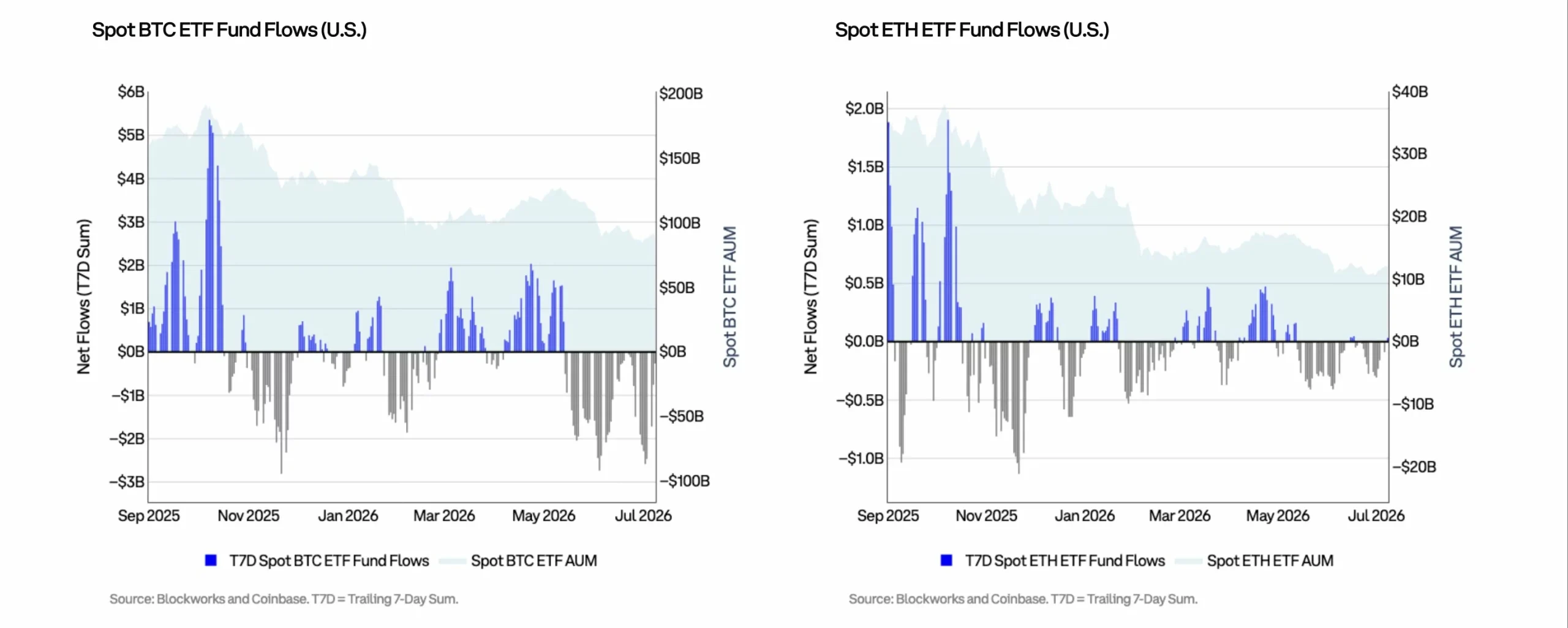
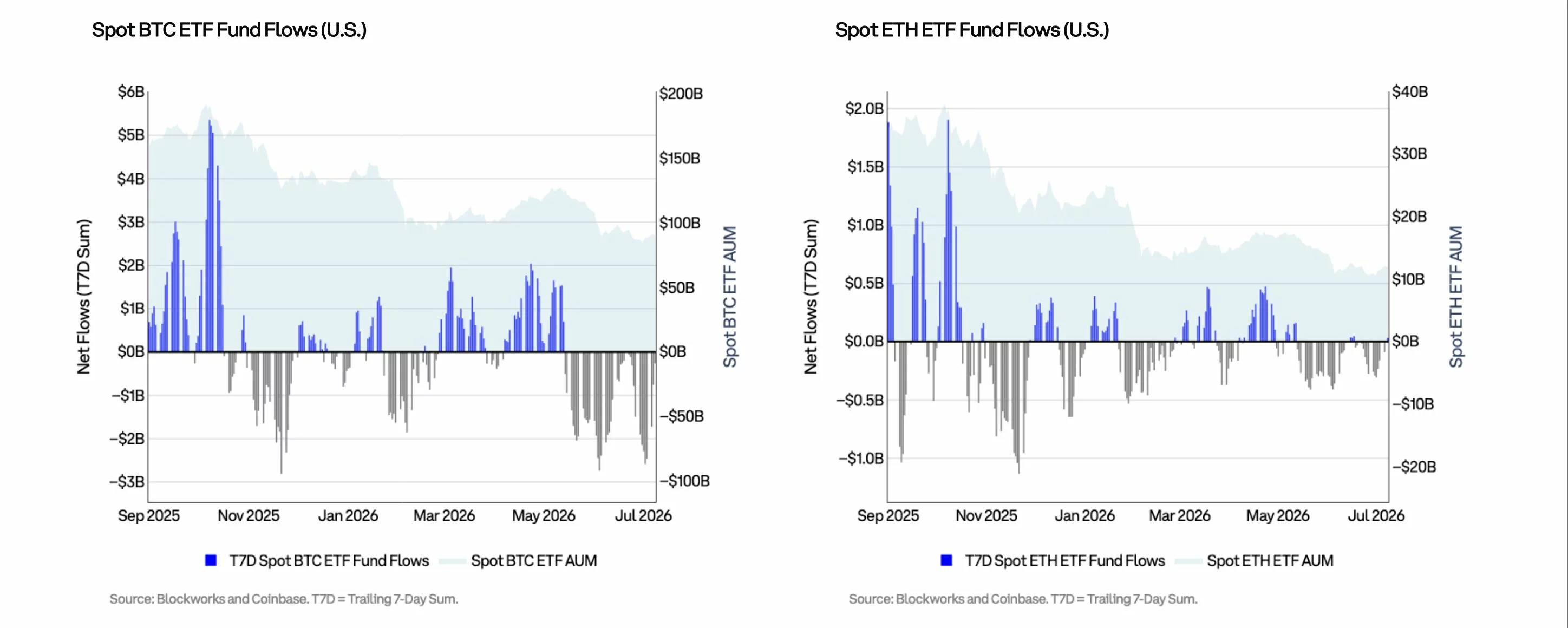
Spot ETF activity offers another cautious signal. Coinbase and Glassnode found that U.S. Bitcoin and Ethereum ETF flows remained negative throughout the first half of 2026, although the pace of withdrawals began to slow. The report said the easing outflows could indicate that institutional demand is stabilizing, but it did not treat the change as confirmation of a recovery.
Ethereum entered a weaker onchain position by the end of the quarter. According to the report, ETH returned to full capitulation territory, leaving the average holder underwater as falling prices pushed aggregate unrealized returns into negative territory.
At the same time, leveraged long exposure increased even as spot demand remained thin. Coinbase Institutional warned that this combination could leave derivatives traders exposed to another forced deleveraging event, similar to the liquidations seen around previous cycle lows. The firm said a clear recovery above overhead resistance would offer stronger evidence of a reversal than another test of support.
Fed policy and geopolitical risks keep the Q3 outlook neutral
Macroeconomic conditions remain the main obstacle to a sustained crypto recovery, according to Coinbase Institutional. At its June meeting, the Federal Reserve held interest rates between 3.50% and 3.75% for a fourth consecutive meeting under Chair Kevin Warsh.
Despite leaving rates unchanged, the Fed raised its 2026 inflation forecast to 3.6%, reduced its growth estimate and lifted its median year-end policy-rate projection to 3.8%. Coinbase Institutional described the message as hawkish and mildly stagflationary, adding that higher rates and a firmer dollar could restrict the liquidity available to risk assets.
Geopolitical threats add another source of pressure. The report identified a renewed U.S.-Iran escalation, another rise in oil prices and possible selling by major digital-asset treasury companies as bearish catalysts for the quarter.
Against those risks, Coinbase Institutional recommended patience and controlled exposure rather than buying brief rallies. Its neutral view leaves room for accumulation but requires stronger price confirmation before the researchers can identify a completed market bottom.
The cautious forecast comes as Coinbase extends its services outside the United States. On July 22, the company opened an office at One Raffles Quay in Singapore and announced plans to increase its workforce there from about 150 to around 200 employees over the next 18 months.
In Canada, Coinbase is preparing to bring tokenized stocks, prediction markets and other traditional financial products into its “Everything Exchange” model. The company said its June System Update also introduced an SEC-registered AI investment adviser and trading agents alongside plans for stock options, pre-IPO products and tokenized equities.
Product executive Jordan Fish, known as Cobie, has separately acknowledged that Coinbase became distant from crypto-native users after disputes damaged trust in Base. Fish now oversees the Base App and Coinbase trading products, while Jesse Pollak has returned his attention to the Base blockchain.
Those product and regional plans concern Coinbase’s longer-term development, while its research team’s Q3 position remains tied to current liquidity and market data. For the outlook to improve, Coinbase Institutional and Glassnode are looking for stronger ETF demand, reduced leverage risk, and a decisive Bitcoin move above resistance.


Coinbase cut 700 jobs in May, and Lawrence Brock’s team ran those layoffs. Eleven weeks later, the Chief People Officer reportedly quit.
Brock leaves on August 17. He will advise Coinbase until November 30. Dominique Baillet is expected to take his job.
From Coinbase Layoffs to His Own Exit
Coinbase filed the plan with regulators on May 5. It cut about 700 roles, or 14% of staff. That took headcount from roughly 5,000 down to 4,300.
The cuts cost $50 million to $60 million. Almost all of that was cash for severance. Coinbase gave two reasons. It wanted to spend less, and to rebuild “for the AI era.”
Most of the bill lands in the second-quarter accounts. Coinbase reports those numbers on July 30. Brock walks out 18 days later.
Follow us on X to get the latest news as it happens
He Had Done This Before
May was not his first round of cuts. In June 2022, Brock froze hiring and pulled offers from people who had not yet started.
“We will also rescind a number of outstanding offers for people who have not started yet. This is not a decision we make lightly, but is necessary to ensure we are only growing in the highest-priority areas,” he wrote that in a company post 12 days before Coinbase cut 18% of staff.
Brock runs hiring, pay, and workplace policy. Both rounds of cuts went through his team.
His own deal is softer. It pays $182,500 for three months of advice. The filing calls that three months of his salary, which works out to $730,000 a year.
One block of his stock keeps vesting on November 20. The rest is cancelled. The filing gives no reason for his exit and does not link it to the layoffs.
Fourth Senior Exit Since July 8
Chief Legal Officer Paul Grewal stepped down to join a startup this month. Molly Abraham took his place as general counsel.
Jesse Pollak then admitted his on-chain social bet had failed. He handed the Base app back to Coinbase. Greg Tusar, co-head of Coinbase Institutional, is moving to a policy job, The Information reported.
However, none of these seats went to an outside hire. Coinbase is promoting its own people while it builds what it calls the everything exchange. That means stocks, derivatives, and regulated prediction markets next to crypto.
Chief Executive Brian Armstrong pitched the May reorganization as fitting Coinbase for the AI era. Brock built the machinery, then left before anyone could judge it. July 30 gives the first real answer.
The post Coinbase Layoffs Architect Exits Weeks After Cutting 700 Jobs appeared first on BeInCrypto.


Nvidia, Meta and Microsoft have joined 22 other organizations in warning U.S. policymakers that sweeping controls on open-weight AI models could weaken American leadership as competition with China intensifies.
Summary
- Nvidia, Meta and Microsoft oppose sweeping U.S. restrictions on open-weight AI models.
- The coalition favors targeted enforcement against intellectual-property theft and other proven misuse.
- Elon Musk backed the letter as concerns over Chinese AI competition increased.
The open letter has called for targeted legal and commercial measures to address misuse instead of restrictions covering technologies that support legitimate AI development. Its signatories include IBM, Palantir, Mistral, Hugging Face, Mozilla, Andreessen Horowitz and the Linux Foundation.
Open-weight models allow businesses, researchers and governments to download software, customize it and operate it on their own infrastructure. According to the letter, this access makes advanced systems easier to adapt while giving organizations more control over their data, security and computing systems.
Rather than treating open and closed systems as rivals, the companies described both as necessary parts of the AI market. They argued that open models support competition, lower deployment costs and give developers more freedom to inspect or modify the technology they use.
Open models remain central to U.S. AI competition
Publishing his first post on X, Nvidia CEO Jensen Huang shared the letter and defended a market where both development methods can exist. Huang argued that open models support cybersecurity, safety, national control and the spread of AI tools across industries.
“For my first post, I’m sharing a letter NVIDIA signed on why open models matter…The world needs both frontier closed models and frontier open models.”
Elon Musk also backed the letter in a reply to Huang’s post. Musk’s xAI develops Grok, a chatbot competing with products from OpenAI and Anthropic, although xAI was not identified among the 25 signatories listed in media reports.
The companies issued their warning as the Trump administration considers action against Chinese AI developers accused of using American technology without permission. U.S. Treasury Secretary Scott Bessent stated this week that officials would examine whether Chinese models had been trained through unauthorized use of outputs from U.S.-built systems.
According to Bessent, sanctions and Entity List restrictions could apply if Chinese companies conducted industrial-scale distillation that crossed into intellectual-property theft. The Treasury secretary also stated that the administration supports open-source AI, separating lawful development practices from alleged attempts to copy protected American technology.
Distillation uses the output of one model to help train or improve another system. In their letter, Nvidia and the other signatories described the method as a common tool for model improvement, testing and validation, while cautioning policymakers against treating every use of it as theft.
“Distillation, or the practice of using one model’s outputs to help train or improve another, is a widely used technique for model improvement, evaluation, and validation.”
Drawing on the history of open-source software, the coalition argued that developers have long learned from existing systems and used shared tools to produce new products. The signatories maintained that authorities should pursue proven legal violations directly without blocking techniques used by legitimate researchers and companies.
China’s recent progress has added pressure to the policy debate. Moonshot AI’s Kimi K3 reached first place on the Frontend Code Arena, according to the benchmark, placing a Chinese model ahead of several established U.S. products in that category.
Former White House AI and crypto adviser David Sacks has warned that such gains could threaten the U.S. position in the AI race. U.S. officials have separately accused Moonshot of distilling Kimi K3 from Anthropic’s Fable model, though Moonshot’s alleged conduct remains part of the policy dispute rather than an established finding, according to Reuters.
Human oversight and spending risks remain in focus
Debate over open models has developed alongside questions about how companies and traders should use AI. As crypto.news reported on July 24, Gate founder and CEO Dr. Han supported using AI to collect information and study market signals while leaving final trading decisions to people.
During an episode of the Gatecast podcast, Dr. Han argued that automated tools could help users navigate millions of digital assets and tens of thousands of decentralized applications. However, he maintained that traders must examine the information produced by those systems before acting on it.
“AI + human intelligence” will become a more effective approach in the future, Dr. Han said.
His position places AI in an assistant role rather than giving automated systems full control over investment decisions. According to Dr. Han, machines can process large quantities of market data quickly, while human judgment remains necessary when users assess risks and decide whether to trade.
Financial concerns have also followed the rapid expansion of AI infrastructure. Earlier in July, former Fidelity fund manager George Noble warned that a collapse in the AI investment boom could cause 17 times more damage than the dot-com crash, which erased about $5 trillion from the Nasdaq.
Noble linked that risk to the large amount of capital entering data centers, chips and related infrastructure. According to the former fund manager, losses could spread beyond technology companies if expected returns fail to cover the money committed to AI development.
“The fallout from this could really be much more significant,” Noble said while discussing rising AI capital expenditure.
While Noble’s warning concerns financial exposure rather than open-weight regulation, the two debates share a central policy issue: how the U.S. can manage risks without stopping useful development. Nvidia and its fellow signatories have argued that focused enforcement offers that balance, allowing authorities to pursue theft or misuse while preserving access to open AI technology.


- The lawsuit was filed the day BitMEX announced its shutdown.
- Lawsuit alleges excess Bitcoin collateral was retained.
- Plaintiffs claim losses totalling 622.66 BTC.
BitMEX is facing fresh legal trouble after a class-action lawsuit accused the cryptocurrency derivatives exchange of deliberately engineering customer liquidations to take possession of traders’ Bitcoin collateral.
The lawsuit was filed on the same day the company announced plans to shut down its operations, placing renewed attention on allegations surrounding its liquidation system and trading practices.
The case, filed in the US District Court for the Southern District of New York, seeks to recover hundreds of bitcoins that the plaintiffs claim were wrongfully taken through forced liquidations.
Lawsuit claims more than 622 Bitcoin were wrongfully seized
The lawsuit was brought by BKX Services Inc. and investor David Namdar, who allege they collectively lost 622.66 BTC because of BitMEX’s liquidation process.
According to the complaint, BKX Services lost at least 305.81 BTC, while David Namdar claims losses exceeding 316.85 BTC.
The plaintiffs argue that these losses were not the result of normal market conditions but stemmed from a liquidation system that allegedly operated in BitMEX’s favour.
The complaint accuses the exchange of intentionally triggering liquidations that enabled it to retain customers’ remaining Bitcoin collateral.
It further alleges that BitMEX profited from these liquidations instead of returning any excess collateral after positions were closed.
The plaintiffs are seeking damages and other legal remedies, arguing that the exchange’s practices caused significant financial losses over multiple trading events.
Plaintiffs challenge BitMEX’s liquidation model
At the center of the lawsuit is BitMEX’s liquidation engine, which the plaintiffs claim was designed to benefit the exchange rather than protect traders from excessive losses.
BitMEX became one of the largest crypto derivatives platforms by offering leveraged trading of up to 100x, allowing traders to control positions much larger than their deposited collateral.
While leverage can increase profits, it also raises the risk of liquidation when the market moves against a position.
The complaint alleges that traders’ positions were liquidated even when the remaining collateral exceeded the amount required to cover losses. Instead of returning the excess Bitcoin after closing the positions, the lawsuit claims BitMEX retained those funds.
The plaintiffs also allege that server outages and disruptions during periods of heightened market volatility contributed to liquidations that could have been avoided.
According to the filing, these incidents prevented some traders from managing or closing their positions before they were automatically liquidated.
The lawsuit argues that these practices allowed the exchange to accumulate customer Bitcoin through forced liquidations rather than simply covering trading losses.
Legal action coincides with BitMEX shutdown announcement
The timing of the lawsuit has drawn attention because it was filed on the same day BitMEX announced that it would cease operations.
The company said it plans to shut down on September 23, 2026, following a strategic review of its business.
As part of the closure process, customers have been advised to close open positions and withdraw their assets before operations end.
The legal action now adds another layer of uncertainty to the exchange’s final weeks of operation.
While the shutdown announcement focused on the company’s decision to wind down its business, the lawsuit raises separate allegations regarding the handling of customer funds and liquidation practices.
The claims made in the complaint have not been proven in court, and the lawsuit represents allegations brought forward by the plaintiffs.
The court proceedings will determine whether BitMEX or its related entities bear legal responsibility for the alleged losses.
The case also revives long-running scrutiny of BitMEX’s liquidation system, which has been the subject of debate within the cryptocurrency trading community for years.
As the exchange prepares to end its operations, the outcome of this lawsuit could become one of the most closely watched legal disputes involving a crypto derivatives platform and its treatment of customer collateral.


Mirae Asset reportedly plans to use the South Korean crypto exchange as a hub for tokenized assets, stablecoins and digital finance.


LMAX Group has enlisted Morgan Stanley and KBW to assess a sale or public listing that could value the institutional trading company at up to $5 billion.
Summary
- LMAX has tapped Morgan Stanley and KBW to review strategic options worth up to $5 billion.
- A Nasdaq IPO is preferred, although a sale, SPAC merger or European listing remains possible.
- LMAX’s foreign exchange business allows the company to wait through weak crypto market conditions.
Three people familiar with the private discussions said LMAX is working with Morgan Stanley and KBW, an investment bank owned by Stifel, as it reviews several strategic paths.
According to one of the people, LMAX could pursue a direct sale, merge with a special purpose acquisition company, or launch an initial public offering in the United States or Europe. A Nasdaq IPO currently ranks as the company’s preferred option, the person added.
No final decision has been made, and another person familiar with the process said LMAX is not under pressure to enter the public market while cryptocurrency prices remain weak. According to the source, revenue from the company’s established foreign exchange operations gives it room to wait for better market conditions.
The potential $5 billion valuation would be five times the level attached to LMAX in July 2021. At the time, private equity firm J.C. Flowers agreed to buy a 30% stake for $300 million, placing the group’s value at about $1 billion.
LMAX said the J.C. Flowers investment would support its expansion across institutional foreign exchange and cryptocurrency markets. The transaction also gave the company additional capital as regulated financial firms began developing services tied to digital assets.
Nasdaq leads LMAX’s listing options
London-based LMAX operates trading venues and infrastructure for banks, brokers, hedge funds and asset managers. According to the company, its services cover foreign exchange and digital assets through an agency execution model that gives clients access to transparent order books and low-latency systems.
Britain’s Financial Conduct Authority regulates the group, a status LMAX has used while building products for institutions that require regulated venues. The company’s focus differs from retail-led crypto exchanges because its clients include financial firms seeking execution, liquidity and settlement services.
LMAX has also benefited from increased institutional participation following the approval of spot Bitcoin exchange-traded funds in the United States, according to people familiar with the company’s review. Those sources linked the expansion of regulated crypto products to renewed interest from banks and asset managers seeking digital asset exposure.
Even with that interest, the timing of any listing remains uncertain. One person familiar with the discussions said current crypto market weakness has reduced the need for an immediate transaction, while LMAX’s foreign exchange business continues to protect it from relying entirely on digital asset trading activity.
A Nasdaq debut would place LMAX alongside a growing group of cryptocurrency and market infrastructure companies seeking access to U.S. public capital. However, the people familiar with the talks said a sale and other listing structures remain under consideration, leaving LMAX free to change course if market conditions or buyer interest improve.
LMAX builds its institutional crypto stack
During the past year, LMAX has added products that connect custody, collateral management and round-the-clock trading. In February, the company introduced a 24/7 multi-asset exchange designed to support foreign exchange, precious metals, digital assets, commodities and tokenized securities.
LMAX said the platform allows institutional clients to trade both traditional and tokenized instruments outside standard market hours. By combining several asset classes within one venue, the company sought to extend its operations beyond spot cryptocurrency trading.
A month earlier, Ripple invested $150 million in LMAX through a strategic agreement intended to increase institutional use of the RLUSD stablecoin. According to the companies, LMAX would integrate RLUSD into its trading and settlement network, giving institutional clients another option for moving funds between digital asset markets.
LMAX continued that product push in May by launching Kiosk, a hosted portal that lets clients deposit digital assets into LMAX Custody and use them as collateral across multiple markets. As previously reported by crypto.news, Kiosk supports spot foreign exchange, precious metals, cryptocurrencies, contracts for difference and perpetual futures.
According to LMAX, the portal combines custody, collateral access and trading support within one workflow. Its tools include deposits, withdrawals, API credential management, WalletConnect access, security controls and treasury management.
The company said Kiosk is intended for institutions that want to use digital assets without dividing custody and trading functions among several systems. Clients can retain assets in LMAX Custody while using them to support positions offered through the group’s trading network.
LMAX’s review comes during an active period for crypto acquisitions. Kraken parent Payward has agreed to acquire derivatives platform Bitnomial, while Bullish, the owner of CoinDesk, has announced a $4.2 billion deal to purchase Equiniti and expand into tokenization and transfer agency services.
For LMAX, the strategic review gives its advisers several ways to value a business spanning foreign exchange, crypto execution, custody and tokenized markets. Morgan Stanley and KBW will evaluate those options as the company weighs buyer interest against the timing and potential pricing of a Nasdaq listing.

8 Upcoming Comedy Shows, Ranked by Anticipation

Intel Stock Falls 4.18% Friday Despite Strong Earnings Beat, as July’s Sharp Rally Continues to Cool
Ripple Doubles Down on RLUSD With Mint Launch and Notabene Investment


-

 Politics6 days ago
The House | The City of London can help the new chancellor deliver growth in every postcode
-

 Crypto World6 days ago
Ripple Payments Joins MiCA With 14 Firms, Does It Mean Anything For XRP?
-

 Politics5 days ago
Democrats look to World Cup watch parties to register thousands of voters
-

 Crypto World7 days ago
Ripple wins EU-wide access as ESMA adds it to MiCA register
-

 Crypto World3 days ago
Grayscale Files For Worldcoin ETF, WLD Registers Sharp Rise
-

 Tech4 days ago
Sail Virtually Aboard The “Itanic” With IA-64 Emulator
-

 NewsBeat4 days ago
Unregistered fitter used Gas Safe logo on business flyers
-

 Fashion3 hours ago
Weekend Open Thread: Brooks Brothers
-
 Tech4 days ago
Turtle Beach Command Series KB7 review: a nifty screen-equipped gaming keyboard
-

 News Videos5 days ago
Big Money Is Entering XRP
-
 Business3 days ago
New Jersey voter registration controversy explained: How 6,600 noncitizens got on the rolls, and what happens next
-

 Crypto World6 days ago
Kaspersky exposes OkoBot’s 20-module crypto wallet attack
-
 Entertainment3 days ago
Johnny Depp’s R-Rated Gothic Cult Classic Gets New Release Ahead of Sydney Sweeney Remake
-

 NewsBeat7 days ago
Durham County Council to send out electoral registration emails
-

 Crypto World2 days ago
Ethics, other provisions in crypto Clarity Act to be further discussed
-

 Crypto World7 days ago
MiCA Licensing Faces Delays as ESMA Adds 14 CASPs to Register
-
 NewsBeat4 days ago
Shanghai science forum photos show China’s AI and robotics advances in rivalry with US
-

 Crypto World6 days ago
Chip Stocks Enter Bear Market After Moonshot Ai Unveils Kimi K3 Model
-

 Tech4 days ago
Watch Flock Safety CEO Garrett Langley discuss the future of surveillance at TechCrunch Disrupt 2026
-

 Tech5 days ago
Subway Sandwich Computers Get a Second Life as Gaming Machines
You must be logged in to post a comment Login