
Crypto World
Netflix reveals main cast for upcoming FTX series


Netflix has rounded out the main cast of its upcoming FTX collapse drama The Altruists, revealing six actors who have been chosen to appear alongside Julia Garner’s Caroline Ellison and Anthony Boyle’s Sam Bankman-Fried (SBF).
The series will reportedly cover the massive growth of SBF’s crypto exchange between 2019 and 2021 and its spectacular collapse in 2022 which wiped billions of dollars from the crypto market.
Netflix says the series will follow SBF and Ellison, “two hyper-smart, ambitious young idealists who tried to remake the global financial system in the blink of an eye… before they were accused of stealing $8 billion.”
Here are the major cast members announced so far.
Changpeng Zhao
Terry Chen will be playing the role of Changpeng Zhao.
Chen starred in the 2000 comedy Almost Famous and played a corrupt Chinese businessman in season two of House of Cards. The 51-year-old will be stepping into the shoes of SBF’s biggest rival.
Read more: Binance probed by DoJ, files lawsuit against WSJ
Zhao and SBF met on occasions during FTX’s heyday, but Zhao would later contribute to the firm’s collapse when he announced that his crypto exchange Binance would liquidate the FTX-linked asset “FTT.”
Dr. George Lerner
William Mapother will be playing the role of FTX’s company therapist, Dr. George Lerner.
Lerner was SBF’s psychiatrist during the FTX years and was tasked with coaching 100 of the firm’s employees through its most chaotic period. Some employees reportedly wouldn’t share everything they knew with Lerner out of fear that SBF would find out.
Mapother’s character reportedly “knew SBF best,” and would help him to explore his “seeming rejection of earthly pleasures.”
Mapother has previously starred in the TV series Lost, and is known for his work in The Mentalist, and In The Bedroom. He is also Tom Cruise’s cousin, and co-founded the film financing firm Slated.
Sarah Fisher Ellison
Dirty Dancing and Ferris Bueller’s Day Off star Jennifer Grey has been cast to play Caroline Ellison’s mother, Sarah Fisher Ellison.
Ellison is a senior lecturer at the MIT Department of Economics, who, alongside her husband, struggled to grasp the damage their daughter caused while working for FTX and pleaded for leniency in her sentencing.
Duncan Rheingans-Yoo
Canadian actor Hudson Williams shot to fame in the hit hockey series Heated Rivalry, and will play the role of Duncan Rheingans-Yoo.

Read more: Sam Bankman-Fried was planning Tucker Carlson interview for years
Rheingans-Yoo co-founded crypto trading firm Modulo Capital, which received $475 million from FTX shortly before the exchange collapsed. Fellow co-founder Lily Zhang will be played by Marianna Phung, who starred in the series Poly is the New Monogamy.
A bankrupt FTX would later claw back $460 million from the firm.
Sam Bankman-Fried
The most important role in the series goes to Anthony Boyle, who will play FTX’s curly-haired CEO.
Boyle has starred in House of Guinness, Manhunt, Say Nothing, and featured in the Tolkien and Tetris movies.
SBF oversaw the operation that misappropriated billions of dollars worth of customer funds and used them to make investments through FTX’s sister firm, Alameda Research.
These days, SBF is spending his days serving out a 25-year sentence in jail while trying, and failing, to secure a pardon from US President Donald Trump.
Read more: Sam Bankman-Fried begs Trump for pardon, gets bipartisan ‘No’
Caroline Ellison
Starring alongside Boyle will be Julia Garner, playing the role of SBF’s romantic partner and former FTX exec, Caroline Ellison.
Ellison and SBF worked together at trading firm Jane Street before the pair moved on to FTX. Ellison helped SBF grow his empire until it collapsed and she would later testify against him in court.
She said that for the duration of their relationship, SBF was her boss. At one court trial, she claimed, “I wanted more from our relationship but often felt he was distant or not paying much attention to me.”
Garner recently starred in the Oscar-nominated horror Weapons, and is known for her work in Ozark, Marvel’s Fantastic Four: First Steps, and The Assistant.
Read more: When will FTX customers get their money back?
Lucy and Hannah
Playing the unknown characters of Lucy and Hannah are Hannah Galway and Elizabeth Adams.
Galway is known for her work on Billy the Kid and The Institute, while Adams is known for The Wayward and Trouble in Suburbia. It’s not clear how their characters fit into the FTX saga.
FTX execs
Other roles that have already been cast include a number of former FTX executives.
Among them are former Alameda Research CEO, Sam Trabucco, who’ll be played by Andor and Alien Earth star Alex Lawther. Trabucco resigned before the collapse of FTX and seemingly disappeared, leading to rumours that he was on the run.
Another prominent exec who will be featured is Ryan Salame, who’ll be played by Matt Rife. The former FTX exec used customer funds to help build SBF’s political influence through illegal political donations.
Read more: Whoever’s running SBF’s X account keeps following memecoin shills
Other execs set to appear include Constance Wang, Nishad Singh, Gary Wang, and Claire Watanabe, who will be played by Madison Hu, Karan Sonit, Euguen Young, and Naomi Okada, respectively.
Paul Reiser will play SBF’s dad, Joe Bankman, while SBF’s mum, Barbara Fried, will be played by Robin Weigert.
SBF’s social fixer and former head of FTX luxury partnerships, Lauren Platt, will be played by Maddie Hasson.
Got a tip? Send us an email securely via Protos Leaks. For more informed news and investigations, follow us on X, Bluesky, and Google News, or subscribe to our YouTube channel.

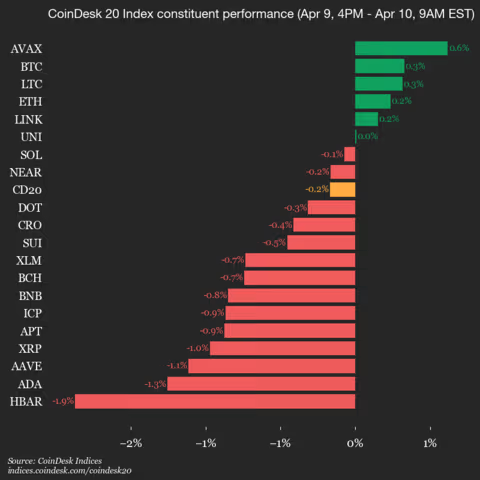
CoinDesk Indices presents its daily market update, highlighting the performance of leaders and laggards in the CoinDesk 20 Index.
The CoinDesk 20 is currently trading at 2007.93, down 0.2% (-3.4) since yesterday’s close.
Six of 20 assets is trading higher.

Leaders: AVAX (+0.6%) and BTC (+0.3%).
Laggards: HBAR (-1.9%) and ADA (-1.3%).
The CoinDesk 20 is a broad-based index traded on multiple platforms in several regions globally.
Bitget is expanding its product suite with IPO Prime, a proxy offering tied to the pre-initial public offering (pre-IPO) phase of SpaceX. The exchange said the initial token, preSPAX, will give retail users economic exposure to SpaceX’s post-IPO performance without granting direct ownership of SpaceX shares. SpaceX has not endorsed, approved, or authorized the offering, and Bitget emphasized that the instrument is a tokenized exposure rather than a security stake.
Key takeaways
- Bitget launches IPO Prime, offering pre-SPAX as a Republic-issued token designed to track SpaceX’s post-IPO performance without giving holders equity in SpaceX.
- The preSPAX subscription window runs April 18–21, with distribution on April 21 and subsequent OTC trading slated for later that day. VIP users reportedly receive early access via exclusive airdrop rounds.
- SpaceX’s IPO status remains unconfirmed publicly, but Bloomberg’s report highlights investor interest and potential valuation in the trillions of dollars range.
- IPO Prime fits a broader trend of crypto exchanges angling for TradFi access, placing tokenized versions of traditional assets—stocks, ETFs, and pre-IPO exposures—on crypto trading platforms.
- Industry peers and traditional market players are already experimenting with tokenized or expanded access to mainstream assets, signaling a potential shift in how retail investors participate in early-stage or pre-IPO opportunities.
Bitget’s bet on tokenized pre-IPO exposure
Bitget frames IPO Prime as a “new route” to traditional finance opportunities, part of the company’s broader aim to build a “universal exchange” that brings more TradFi assets under tokenized wrappers. The platform’s rollout centers on a subscription-based model, allowing users to apply for allocations through a tiered structure and then receive a proportional stake in the instrument.
Cointelegraph, she said: “Pre-IPO exposure used to be limited to small circles, but tokenization has changed that, providing access to traditional assets that were typically out of reach. preSPAX is our first offering and we will be bringing more such opportunities to our users this year.”
“Pre-IPO exposure used to be limited to small circles, but tokenization has changed that, providing access to traditional assets that were typically out of reach. preSPAX is our first offering and we will be bringing more such opportunities to our users this year.”
TradFi on chain: a wider push for tokenized access
Bitget’s IPO Prime sits within a broader pattern of crypto exchanges courting traditional financial products through tokenized wrappers. The concept is not unique to Bitget; several other crypto platforms have previously or currently pursued similar paths to broaden their investor base and offer a one-stop venue for traditional and digital assets.
Earlier this year, Bitpanda, a Vienna-based exchange, announced an expansion of its product suite to include around 10,000 stocks and exchange-traded funds (ETFs), signaling a push into regulated equity access via a crypto-enabled interface. Other industry actors have pursued comparable moves: Kraken unveiled a program in 2025 to offer 11,000 U.S.-listed stocks and ETFs with commission-free trading as part of a broader “phased national rollout,” while Coinbase has integrated stock trading into its ecosystem and reoriented its wallet toward a broader “everything app” concept aimed at 24/7 access to stocks, ETFs, and crypto assets. The industry framing sees these efforts as part of a broader “universal exchange” agenda to unify traditional and digital asset markets under a single platform.
Delphi Digital, a crypto research firm, has described the trend as the onset of a “super app” era in which users gravitate toward platforms that aggregate assets and trading products. The implication is that value could tilt from standalone protocols to the platforms that capture the most user attention and trading activity, as tokenized TradFi products become increasingly routinized for retail participants.
Industry peers emphasize that tokenized pre-IPO products are part of a broader expansion into professional-grade finance on crypto rails, raising both opportunities and questions. On the upside, greater accessibility could unlock early-stage and high-growth exposure for a wider audience. On the downside, investors must evaluate the liquidity, valuation methodologies, and regulatory underpinnings of tokenized pre-IPO instruments, which operate at the intersection of securities, derivatives, and digital assets.
Bitget’s strategy is not happening in a vacuum. The same week Bloomberg highlighted SpaceX’s rumored confidential IPO filing, reigniting interest in a potential post-IPO trajectory for the aerospace company. If SpaceX proceeds to public markets, tokenized pre-IPO instruments could become a more visible ladder for retail investors to engage with a stock-market-ready asset—albeit one that remains subject to the evolving regulatory and listing framework governing tokenized assets.
What to monitor next
Investors should track how pre-IPO tokenization evolves in practice: the accuracy of post-IPO performance tracking, liquidity dynamics in the OTC window, and the degree of regulatory clarity surrounding tokenized exposure to privately held companies. The SpaceX narrative—whether the company confirms an IPO timeline or refrains from public disclosure—will be a crucial backdrop for assessing the real-world demand for such products. Additionally, the reception of IPO Prime among users, and how Bitget and similar platforms refine their tiered allocations and airdrop strategies, will indicate how quickly tokenized pre-IPO access could scale across the market.
For readers seeking historical context, the broader trend toward TradFi assets on crypto platforms has already drawn attention from both crypto media and traditional financial circles. If the momentum continues, the next 12 to 18 months could define how retail investors navigate a blended landscape where tokenized stocks, ETFs, and pre-IPO exposures sit alongside digital assets in a single, cross-asset trading environment.
As markets watch SpaceX’s publicly announced or speculative IPO trajectory, IPO Prime stands as a concrete signal that crypto exchanges are actively testing the perimeter of traditional finance within blockchain-enabled product rails. Whether this approach will endure or face regulatory pushback remains to be seen, but the track record of Bitget’s latest launch indicates a continuing push to normalize access to otherwise exclusive financial opportunities.
Further reading and related coverage from the crypto press illustrate how the space is evolving. For example, reports on Bitpanda’s expansion into stocks and ETFs and Kraken’s broadened U.S. listings highlight a shared industry direction. Readers can also review Cointelegraph coverage on how exchanges are pricing, listing, and managing risk around traditional assets in a crypto context, as well as parallel analyses of the broader regulatory and market implications of these developments.
What remains uncertain is the precise regulatory treatment of tokenized pre-IPO products and how safeguards for retail investors will be enforced as these platforms scale. Yet the momentum is clear: tokenization is reshaping access to mainstream assets, and SpaceX’s rumored IPO is now part of a wider experiment in how the crypto industry can bridge private markets and public markets for a global audience.

$1 billion. 24 hours. Two founders of the world’s two largest crypto exchanges are airing grievances on X. Binance founder CZ issued his ultimatum to OKX CEO Star Xu on April 9, 2026: accept a billion-dollar bet to settle disputed claims about his personal life, his marriage status, or be publicly branded a liar. Star Xu rejected it within minutes, firing back on regulatory grounds and pivoting to a harder question about whether CZ’s Binance stake has been legally separated from his ex-wife.
I typically ignore all these false claims attacks. But… — CZ
You can apologize now. I am officially divorced.
I won't post any legal docs online, as I respect privacy of my ex-wife, and I appreciate the time we spent together.
I am happy to bet $1 billion USD (or any number you… https://t.co/G9GAl6nMqL
 BNB (@cz_binance) April 9, 2026
This is not a personality dispute. The feud has reignited the sharpest structural debate in centralized exchange infrastructure: what does Proof of Reserves actually prove, and which exchange has more to lose when the question gets loud? BNB and OKB are the instruments through which the market is answering that question right now.
The 24-hour deadline expired in a few hours. No bet was accepted. The damage, reputational, liquidity-wise, and potentially regulatory, is already priced in transit.
Discover: The best crypto to diversify your portfolio with right now
What is Actually Happening with CZ Binance and OKX Star?
The Binance vs OKX rivalry has always been fought on volume and product breadth. Now it is being fought on trust, and trust, unlike volume, is hard to recover once it fragments.
CZ’s $1 billion challenge was framed as a personal transparency bet, but the subtext is unmistakably about exchange solvency optics. OKX Star Xu counter-framing, invoking UBO regulatory status, and demanding clarity on CZ Binance stake ownership.
What a $1B Proof of Reserves challenge would actually involve matters here. Both the pre-research context and Xu’s own posts suggest the implicit demand is a synchronized, real-time audit locking personal equity or stablecoin holdings into multi-sig escrow. Talking about escrow, an oldtimer in crypto Twitter, Cobie, commented on CZ’s post about whether the bet needs an escrow to settle.
CZ’s defense is familiar: the audit would silence FUD. In October 2025, traders blamed the exchange for $19 billion in liquidations during a flash crash, alleging the platform locked them out during peak volatility.
CZ’s post-prison positioning as an elder statesman, investing in AI, education, and blockchain projects, donating all memoir proceeds to charity.
Discover: The best pre-launch token sales with high upside potential
Traders Rotate to L3 Infrastructure
While Exchange tokens offer stability and consistent ecosystem growth, the sheer market capitalization of major L1S often limits the potential for exponential short-term multiples. The question is always: can a $1B asset 10x overnight? Unlikely. Consequently, volume often rotates from established giants into emerging infrastructure plays during consolidation phases.
Smart money is increasingly tracking Layer 3 (L3) solutions that promise to unify fragmented liquidity. LiquidChain ($LIQUID) has emerged as a focal point in this narrative, positioning itself as the “Cross-Chain Liquidity Layer” capable of fusing Bitcoin, Ethereum, and Solana execution environments.
A new layer emerges. Only a few see it first.
The future is LiquidChain⟁https://t.co/vqvBcdSj94 pic.twitter.com/R7ZeZ0NPGl
— LiquidChain (@getliquidchain) March 24, 2026
The project distinguishes itself through a “Deploy-Once Architecture” and single-step execution, aiming to solve the user experience nightmare of bridging assets manually. The LiquidChain presale has already raised more than $650K, with early participants securing an entry price of $0.0143 with more than 1600% APY bonus. The contract is also audited by Certik, a benchmark in crypto safety.
The post CZ Binance vs Star OKX: The $1 Billion Bet Crypto Twitter appeared first on Cryptonews.


- Dogecoin (DOGE) stalls near $0.095 as profit-taking caps upside.
- DOGE price is currently compressing between the $0.089 and $0.095 range.
- A breakout is likely as volatility builds ahead of April 20.
The price action around Dogecoin continues to sit in a tight and indecisive range, with recent trading showing very little directional strength.
At the time of writing, DOGE was trading around $0.092, moving inside a narrow 24-hour band between $0.091 and $0.0947.
Each attempt to push higher has been met with immediate resistance at $0.0947, while pullbacks continue to find support around $0.091, creating a balanced but fragile structure, where price remains stable on the surface but increasingly tense underneath.
Profit-taking pressure keeps bulls in check
A key factor limiting DOGE’s upside momentum is consistent profit-taking near local highs.
Over the past trading sessions, price has repeatedly failed to hold above $0.094–$0.095, with every move into this zone triggering selling and pushing price back toward the mid-range near $0.092.
This behaviour is reinforced by the broader weekly structure.
Despite minor gains of around 1% over the past 7 days, DOGE remains largely unchanged across longer timeframes, with only +0.8% over 30 days.
This lack of trend continuation suggests that buyers are not committing beyond short-term trades.
On top of that, derivatives positioning has added scepticism to the upside.
The presence of notable short positions in the market shows that some traders are actively betting against sustained rallies.
This does not guarantee downside movement, but it does explain why upward pushes struggle to build momentum.
Compression builds as technical structure tightens
From a technical perspective, DOGE is clearly in a compression phase.
The 24-hour range of roughly $0.091 to $0.0947, combined with a 7-day range of just over $0.089 to $0.095, highlights how tightly the price is coiling.
This structure aligns with a descending triangle pattern, where lower highs continue to form while support remains anchored near the $0.089–$0.090 zone.

At the same time, price is also trading inside a broader Ichimoku cloud on the 4-hour chart, which typically signals indecision and equilibrium rather than a trending market.
These overlapping structures matter because they all point to the same conclusion: volatility is being compressed.
When multiple technical signals converge like this, the market often prepares for a sharp expansion move.
However, direction remains undefined until either support or resistance breaks convincingly.
Liquidity positioning and the “Doge Day” factor
Beyond chart structure, short-term market dynamics are also shaping sentiment.
Robinhood transferred 327 million DOGE (valued at about $30 million) from cold storage to hot wallets on April 9.
While this is not direct buying pressure, it is widely interpreted as preparation for increased trading activity.
This timing is notable as it coincides with growing attention toward the upcoming “Doge Day” period around April 20.
Historically, these events tend to increase retail participation and short-term volatility, even if they do not always produce sustained trends.
At the same time, broader crypto conditions have provided only mild support.
Bitcoin’s modest gains have helped stabilise sentiment across the market, but DOGE has not shown strong independent momentum. Instead, it continues to trade within its own compressed structure.
Key Dogecoin price levels that will define the next move
For now, DOGE remains in a consolidation phase where patience matters more than prediction.
Once price finally breaks out of the current range, the move is likely to be fast, sharp, and decisive, simply because the market has already spent days building pressure without releasing it.
As the market awaits the next move, the most important DOGE price level for traders remains the $0.09 psychological support zone.
Dogecoin price has held above this level consistently, and any sustained breakdown below $0.089 would mark a clear shift in structure.
Below that, the next area of interest sits near $0.088, where previous accumulation has occurred.
On the upside, resistance remains firmly in place between $0.094 and $0.095.
A daily close above $0.095 would be an important technical signal, suggesting that buyers are finally absorbing overhead supply.
If that happens, the next potential target would be the $0.104 region, which marks a previous local high.

Cryptocurrency exchange Bitget has launched IPO Prime, a proxy offering tied to the pre-initial public offering (IPO) phase of Elon Musk’s aerospace manufacturing and space transportation company, SpaceX.
Bitget said Friday that IPO Prime will start with preSPAX, a Republic-issued token designed to give retail users economic exposure tied to SpaceX’s post-IPO performance. The exchange said the product does not give buyers direct ownership of SpaceX shares, and that SpaceX has not endorsed, approved or authorized the offering.
The launch highlights how crypto exchanges are bringing more traditional investment products onto blockchain rails in a bid to attract users with round-the-clock access to assets that have historically been harder for retail investors to reach.
The announcement comes as Bloomberg reported that SpaceX is said to have confidentially filed for an IPO, with valuation targets ranging from $1.75 trillion to over $2 trillion, though the company has not publicly confirmed the move.

Bitget said the offering will be available across all jurisdictions where the exchange is compliant, through a subscription-based model where users can apply for allocations through a tiered structure.
Bitget said the subscription window for preSPAX will run from April 18 to April 21, with distribution on April 21 and OTC trading scheduled to begin later that day. Gracy Chen, Bitget’s CEO, told Cointelegraph that VIP users will receive early access through two exclusive pre-launch airdrop rounds ahead of the broader rollout.
“Pre-IPO exposure used to be limited to small circles, but tokenization has changed that, providing access to traditional assets that were typically out of reach. preSPAX is our first offering and we will be bringing more such opportunities to our users this year.”
Crypto-native companies with similar pre-IPO offerings include Solana-based PreStocks, Orderbook and Republic. Competitors from traditional finance include Nasdaq Private Market, Hiive, Forge Global and EquityZen.
Related: Crypto exchanges chase TradFi commodities market as pricing gaps persist
Crypto exchanges vie for universal exchange ambitions through TradFi products
Bitget positions the pre-IPO platform as a “new route” to traditional finance opportunities and part of the company’s “universal exchange” ambitions, seeking to bring more TradFi assets under tokenized wrappers.
Other large cryptocurrency exchanges have also launched access to TradFi investment products in a bid to widen their investor base. In January, Vienna-based crypto exchange Bitpanda said it was expanding its offering to include about 10,000 stocks and exchange-traded funds (ETFs).
In April 2025, Kraken announced the launch of 11,000 US-listed stocks and ETFs with commission-free trading in an effort to bring “equities and digital assets together” under one trading platform, as part of a “phased national rollout.”
Coinbase exchange also launched stock trading at the end of 2025 and rebranded its wallet app as an “everything app,” as the first step to enable 24/7 trading of stocks and ETFs along with crypto assets.
Crypto research firm Delphi Digital called the phenomenon the “super app” race, predicting an “aggregation era” for the crypto industry, as value shifts from protocols to platforms with the most users and trading products.
Magazine: Can Robinhood or Kraken’s tokenized stocks ever be truly decentralized?

The Japanese government has amended the Financial Instruments and Exchange Act to classify crypto assets as financial instruments, a move that expands regulatory oversight and tightens the rules governing issuers, exchanges, and market conduct. According to Nikkei, the changes also ban insider trading and other trading practices based on undisclosed information. The amendment will require cryptocurrency issuers to disclose information on an annual basis, enhancing transparency across the sector.
Previously scoped under the Payment and Settlement Act, crypto assets were regulated by Japan’s Financial Services Agency (FSA) as potential payment instruments. The new framework repositions digital assets within the same regulatory orbit as traditional securities and financial instruments, a shift that aligns with rising institutional participation and the sector’s growing capital inflows. By reclassifying crypto as a financial instrument rather than solely a payment method, Japan signals a move away from experimental payments toward a market structure more closely linked to its stock market ecosystem.
Key takeaways
- Crypto assets are reclassified as financial instruments, broadening regulatory oversight and introducing annual disclosure requirements for issuers.
- Insider trading and other information-based market manipulation are explicitly banned, with tighter enforcement for unregistered exchanges.
- The reforms aim to strengthen fairness, transparency, and investor protection as crypto market activity becomes more institutionalized.
- Japan plans to legalize crypto exchange-traded funds (ETFs) by 2028, with major players such as Nomura Holdings and SBI Holdings expected to develop crypto-linked ETPs.
- Crypto profits will be taxed under a flat 20% rate, reflecting broader tax reform efforts to equalize treatment with other asset classes.
Regulatory shift: Crypto moves under the Financial Instruments umbrella
The amendment marks a deliberate move to treat digital assets as part of the formal financial infrastructure rather than niche payment tools. By placing crypto assets under the Financial Instruments and Exchange Act, Tokyo signals that crypto markets will face the same disclosure, governance, and market integrity standards that govern equities and other financial products. The annual disclosure requirement for issuers is designed to shore up transparency and reduce information gaps for investors, a priority as institutional investors increasingly eye digital assets.
Japan’s Financial Services Agency has repeatedly underscored the importance of integrating crypto markets with mainstream finance. The shift follows a broader government push to ensure that market infrastructure can safely support growing participation from institutions and professional investors, while preserving clear rules for participants and clear expectations for disclosures.
Enforcement and market integrity: stronger rules for exchanges and insiders
Alongside the reclassification, the amendment tightens enforcement against fraud and non-compliance. Notably, the reform expands penalties for unregistered crypto exchanges, with higher fines and stiffer sentences intended to deter unauthorized operations. Nikkei reported that the measure also criminalizes insider trading and other activities that rely on undisclosed information, aligning crypto market conduct with established securities laws and enforcement norms.
In framing the broader policy direction, Finance Minister Satsuki Katayama emphasized the government’s commitment to expanding growth capital while ensuring market fairness and investor protection. In remarks following the Cabinet meeting, she stressed that a robust market infrastructure and transparent exchange operations would be essential to ensure citizens benefit from digital and blockchain-based assets.
These developments come in the context of earlier signals from Tokyo that crypto should sit under the same umbrella as traditional finance. In January, Katayama indicated that exchanges and market infrastructure would be central to enabling citizens to benefit from digital assets, a sentiment that has now translated into concrete regulatory steps.
From experiments to mainstream finance: ETFs on the horizon
Japan is also pursuing a more ambitious path for crypto adoption by targeting the legalization of crypto exchange-traded funds (ETFs) by 2028. A January report outlined plans to usher crypto ETFs into the mainstream, with major financial groups taking the lead. Nomura Holdings and SBI Holdings are among the early contenders expected to develop crypto-linked exchange-traded products, signaling a transition from speculative trading to diversified investment vehicles that could broaden access to digital assets for retail and institutional investors alike.
The push toward ETFs sits alongside broader policy aims to simplify the tax treatment of crypto profits. In December, Tokyo signaled support for a flat tax rate on crypto profits—set at 20%—a move designed to streamline compliance and reduce the tax drag on profitable trading strategies. While tax policy does not directly dictate market structure, it shapes incentives for trading, reporting, and the overall attractiveness of crypto-related investment products for both individuals and institutions.
Implications for investors, issuers, and the market
For investors, the government’s reclassification and disclosure obligations could unlock greater confidence in crypto assets as investable instruments. Annual disclosures may improve visibility into project fundamentals, governance, and risk, helping investors price assets more accurately and compare crypto offerings with traditional securities. The expected rise in enforcement against unregistered exchanges could also push players toward registered venues, potentially reducing counterparty risk during periods of volatility.
For issuers and platform operators, the shift imposes new compliance and governance expectations. Issuers will need robust disclosure practices and ongoing transparency about project status, financial health, and governance structures. Exchanges and trading venues will need to align with stricter regulatory standards to maintain registration and avoid penalties, a change that could raise compliance costs but improve market quality in the long run.
From a market structure perspective, the ETF pathway could be a catalyst for broader adoption of crypto products. If the plan to authorize crypto ETFs by 2028 comes to fruition, traditional asset managers and brokerages may expand their crypto productラインups, potentially driving higher net inflows and more predictable demand. The 20% flat tax on crypto profits could further streamline investment decisions, reducing tax-related complexity and contributing to a more straightforward investment thesis for crypto assets within retirement and taxable accounts.
However, several uncertainties remain. The precise list of assets captured by the new framework, the exact format and frequency of issuer disclosures, and the regulatory steps required to launch crypto ETFs all require further clarifications from authorities. Market participants will be watching for detailed guidance on definitions, compliance timelines, and the practical implications of the annual reporting regime as the reforms take effect.
Overall, Japan’s regulatory recalibration signals a notable shift in how the world’s third-largest economy treats crypto. By integrating digital assets into the same regulatory ecosystem that governs securities and market infrastructure, Tokyo aims to reduce information asymmetries, curb illicit activity, and foster a more robust channel for capital formation in digital assets. The coming months are likely to reveal how quickly and concretely these changes will unfold in practice, and which firms move fastest to adapt to the new regime.
Readers should monitor updates on the disclosure requirements for issuers, the final list of assets encompassed by the act, and the regulatory timetable for ETF approvals. As Japan tests the waters of mainstream crypto finance, the balance between investor protection and innovation will shape the trajectory of crypto adoption in one of Asia’s most influential markets.


Alibaba Group’s latest AI video model has moved to the top of a global benchmark. It shows that Chinese firms are becoming more competitive in the tools used for advertising, content creation, and entertainment.
Summary
- Alibaba Group’s HappyHorse-1.0 topped global AI video benchmarks shortly after its anonymous debut on Artificial Analysis.
- The model was later confirmed as part of Alibaba’s ATH AI Innovation Unit, driving gains in its Hong Kong-listed shares.
- Rival setbacks from OpenAI and ByteDance have opened room for Alibaba to strengthen its position in video generation.
The model, called HappyHorse-1.0, first appeared on the benchmarking platform Artificial Analysis on April 7 without disclosing its origins at the time. It quickly rose to the top of blind-test rankings across both text-to-video and image-to-video categories, drawing widespread attention across the industry.
Developers for the model later disclosed that it is part of Alibaba’s ATH AI Innovation Unit and is still under active development. The announcement was made through a newly created account on X, confirming the company’s involvement after days of uncertainty.
Before the disclosure, speculation around the identity of the developer had intensified, with guesses ranging from Tencent to Alibaba or even an independent team.
Following the confirmation, Alibaba’s shares in the Hong Kong market closed 2.12% higher on Friday shortly after the company confirmed its involvement in the project. The stock had previously gained 6.75% earlier in the week, led by a recovery in tech stocks as U.S.–Iran tensions showed signs of easing and speculation around the model intensified.
The company has been expanding its AI presence in China’s competitive market, including building on its Qwen large language model and chatbot ecosystem. It had also introduced video generation features earlier, though none achieved the same level of attention or ranking performance in such a short duration.
HappyHorse-1.0 can improve Alibaba’s standing in video generation, a segment where rivals have faced hurdles recently. One of its competitors, OpenAI, recently discontinued its Sora video platform as it shifted toward coding tools, enterprise services, and AGI development due to high compute demands. Meanwhile, ByteDance paused the rollout of its Seedance 2.0 model following copyright disputes with major studios and streaming platforms.
Chief Executive Officer Eddie Wu has placed AI at the centre of Alibaba’s long-term strategy, which includes investments in chips, cloud infrastructure, and data centres. The company has a track record of embedding its models into e-commerce, advertising, and entertainment services, and a similar integration path could be considered for HappyHorse.
Alongside developments in video generation, Alibaba is expanding its underlying infrastructure. The company is working with China Telecom on a new data centre project in southern China, part of a national effort to strengthen domestic computing capabilities.
The facility will deploy 10,000 of Alibaba’s Zhenwu AI chips, designed to handle both training and inference workloads. The system is built to support models with hundreds of billions of parameters, placing it among the most advanced clusters currently in operation.
Alibaba said the chips can function as a unified system, allowing the cluster to operate like a single supercomputer with a latency of about four microseconds, improving efficiency for large-scale AI tasks.
In a separate development, Alibaba Cloud disclosed it had led a funding round of roughly $275 million for Chinese AI startup Shengshu Technology. The round also drew participation from Baidu Ventures and Luminous Ventures, following an earlier RMB 600 million raise completed just two months ago.
Shengshu Technology develops video generation tools through its Vidu platform, competing with products from ByteDance, Alibaba, Kuaishou, and emerging startups such as PixVerse. The investment signals continued competition in the segment, even as infrastructure and model development accelerate in parallel.


As expected, U.S. inflation accelerated last month, driven mostly by rising energy costs linked to the Middle East conflict. Core prices, though, surprised to the downside.
The Consumer Price Index (CPI) rose 0.9% in March, according to a Friday report from the Bureau of Labor Statistics. Economists had forecast a 0.9% rise, and February’s increase was 0.3%.
On a year-over-year basis, CPI was higher by 3.3% against expectations of 3.3% and February’s 2.4%.
Core CPI, which excludes food and energy costs, was more subdued, rising 0.2% in March versus forecasts of 0.3% and February’s 0.2%. Year-over-year core CPI rose 2.6% versus forecasts of 2.7% and February’s 2.5%.
Trading in a tight range around the $72,000 level in the hours ahead of the news, the price of bitcoin rose to $72,400 in the moments following the report.
Amid the war in Iran and the resulting surge in oil prices, markets over the past weeks have shifted from pricing in a series of Fed rate cuts this year to pricing in one or more rate hikes, and now expect no change in U.S. central bank monetary policy.
Ahead of this morning’s data, there was about a 99% chance the Fed would stay on hold at its late-April meeting and a 97% chance of the same at the mid-June meeting, according to CME FedWatch.
Disclosure: This article does not represent investment advice. The content and materials featured on this page are for educational purposes only.
April surge in crypto presales sees multiple projects compete for early investor capital.
Summary
- April 2026 sees surge in crypto presales, with BlockchainFX leading as funding nears $15 million
- BlockchainFX has attracted more than 22,000 investors, offering multi-asset trading app and nearing presale close
- The project’s final presale phase boosts demand as bonuses and pricing incentives drive last-minute investor interest
April has turned into one of the most active months for early-stage crypto in recent memory. Mutuum Finance, IONIX Chain, Ozak AI, and BlockchainFX are all staking their claim in the top crypto presale race, each attracting capital at a pace that’s hard to ignore. With launch timelines converging and presale windows closing fast, the difference between early entry and late regret is narrowing daily.
BlockchainFX leads the pack, and the numbers make that case without much spin. Over $14.18 million raised, 22,900+ participants, and a live presale at $0.035 on a trading app already handling crypto, stocks, forex, ETFs, and commodities under one roof. The market has had its choppy patches lately, but that’s exactly when ground-floor entries in platforms with actual product-market fit tend to age best.
BlockchainFX: A launch countdown already ticking
The softcap is $15 million, and BlockchainFX has already crossed $14.18 million with 22,900+ investors on board. Once that target is hit, the presale ends and BFX moves to a listing price of $0.05, up from the current $0.035. Standing out among top crypto presales this April, BFX has analysts pointing to a $1 post-launch target, which would translate to returns above 2,700% from today’s entry. That’s not a typo.
BlockchainFX earned “Best New Crypto Trading App of 2025” while running a live beta, already logging thousands of daily users and millions in daily trading volume. Licensed by the Anjouan Offshore Finance Authority (AOFA) and backed by multiple third-party security audits, this is a presale with both regulatory standing and live product credentials. In a market full of projects promising the moon before shipping a single feature, that combination means something real.
LAUNCH50: 50% extra bfx, right before the gates close
BFX has activated bonus code LAUNCH50 for this final presale window, adding 50% extra tokens to every purchase made before launch. A $10,000 entry at $0.035 normally yields roughly 285,714 BFX tokens. With LAUNCH50 applied, that becomes approximately 428,571 tokens. At the $1 analyst target post-launch, that same $10,000 entry could return roughly $428,571. Purchasing $100 or more in BFX also enters investors into the $500,000 Gleam giveaway automatically.
BlockchainFX needs just $820,000 more to hit its $15 million launch trigger, and that gap is closing faster than most expect. Once hit, LAUNCH50 ends along with the $0.035 entry price. Buying is straightforward through MetaMask, Trust Wallet, or card payment directly on the BlockchainFX platform. Investors who arrive after launch do so without the bonus tokens and without today’s pricing. Both losses are permanent.
Mutuum Finance: Ethereum lending protocol crosses $21 million
Mutuum Finance has raised over $21 million on Ethereum, running a dual-market model that combines Peer-to-Contract liquidity pools with Peer-to-Peer lending. Users can earn yield or borrow against crypto collateral without surrendering asset custody, and the funding total reflects genuine demand for this kind of non-custodial capital access. Among DeFi protocols currently raising, MUTM is one of the better-capitalized options in the cycle.
For investors scanning top crypto presales in April, MUTM is a credible DeFi contender with serious money behind it. The flexibility between instant liquidity and custom loan terms gives the platform a practical range for different borrower needs. Product readiness and launch timeline are worth sizing up carefully before placing any significant allocation here alongside more mature options currently in the field.
IONIX Chain: AI-native Layer 1 with 500k TPS and $6.69 million raised
IONIX Chain is an AI-native Layer 1 blockchain with a Quantum AI Consensus mechanism capable of over 500,000 transactions per second at near-zero gas fees. With $6.69 million raised targeting DeFi and real-world asset applications, the technical ambition is clear. For infrastructure-focused investors who care about raw throughput and genuine scalability credentials, IONIX makes an argument worth spending real time with.
Building AI directly into the consensus layer rather than treating it as a feature bolt-on gives IONIX a technically distinct architecture. Among top crypto presales with a strong technical identity, IONX has found its audience. The $6.69 million raised shows meaningful early momentum, though pre-launch infrastructure plays carry standard category risks and deserve careful evaluation against the broader competitive field.
Ozak AI: Predictive market intelligence powered by blockchain
Ozak AI has raised $6.65 million, combining machine learning with blockchain to deliver predictive financial intelligence. Customized Prediction Agents provide real-time forecasts and risk assessments for crypto and traditional assets, while DePIN-based infrastructure secures the data processing layer. The platform targets investors who want actionable, data-backed signals rather than running portfolio decisions on sentiment and noise.
The Prediction Agents give Ozak AI a practical utility angle that keeps it grounded compared to AI tokens operating entirely on narrative. For investors browsing top crypto presales with a genuine AI use-case focus, OZ is worth evaluating. The $6.65 million raised is a solid signal for an early-stage project, though it still trails the larger fundraisers pulling the most capital in this April cycle.

April has one crypto presale with a closing door, and it’s not hard to spot
Based on the latest research, BlockchainFX is the best crypto presale available right now, and that window is genuinely closing. A live product, regulatory licensing, $14.18 million raised, and the LAUNCH50 bonus code still active for 50% extra tokens make this the standout entry across all top crypto presales in April 2026.
The launch trigger sits just $820,000 away. That is not a long wait, but it is the last one at this price.
For more information, visit the official website, X, and Telegram.
Disclosure: This content is provided by a third party. Neither crypto.news nor the author of this article endorses any product mentioned on this page. Users should conduct their own research before taking any action related to the company.
Crypto World
A Developer Just Built Quantum-Safe Bitcoin Without Changing a Single Line of the Protocol: Is This the Fix BTC?

Researcher Avihu Levy published a working implementation of Quantum Safe Bitcoin on April 9, 2026 – no protocol change required.
The scheme operates entirely within Bitcoin’s existing script constraints, making it available to any user willing to absorb the compute cost today.
Bitcoin’s governance culture makes a Bitcoin soft fork extraordinarily difficult to coordinate. BIP-360, which Levy co-authored and which was merged into Bitcoin’s official repository in February 2026, laid out a quantum-resistant address standard, but it requires protocol-level consensus that could take years to materialize.
Quantum-Safe Bitcoin Transactions Without Softforkshttps://t.co/1lx5waX9VV pic.twitter.com/Ni7pA6dEsC
— Avihu Levy

 (@avihu28) April 9, 2026
Quantum Safe Bitcoin sidesteps that bottleneck entirely. It’s not a theoretical workaround; Levy shipped GPU-accelerated CUDA code, Python pipelines, and complete Bitcoin scripts alongside the academic paper.
How QSB Actually Works – Hash Puzzles, Not Elliptic Curves
Standard Bitcoin transactions rely on ECDSA signatures over the secp256k1 curve. Shor’s algorithm can compute discrete logarithms efficiently, meaning a sufficiently powerful quantum computer could forge those signatures and drain any wallet with an exposed public key.
Post-quantum cryptography addresses this – but every known implementation requires larger signatures and new opcodes, which means a soft fork.
Levy’s approach cuts the elliptic curve dependency at the root. The scheme, built on Binohash (Robin Linus, 2026), replaces the standard signature verification with a hash-to-signature puzzle. The Bitcoin script hashes a transaction-bound public key via OP_RIPEMD160 and interprets the resulting 20-byte output as a DER-encoded ECDSA signature.
A random 20-byte string satisfies DER structural constraints with probability roughly 2−46 – that’s approximately one in 70 trillion attempts – which defines the proof-of-work target.
The critical distinction: this puzzle’s security rests entirely on RIPEMD-160’s preimage resistance, not on any elliptic curve assumption.
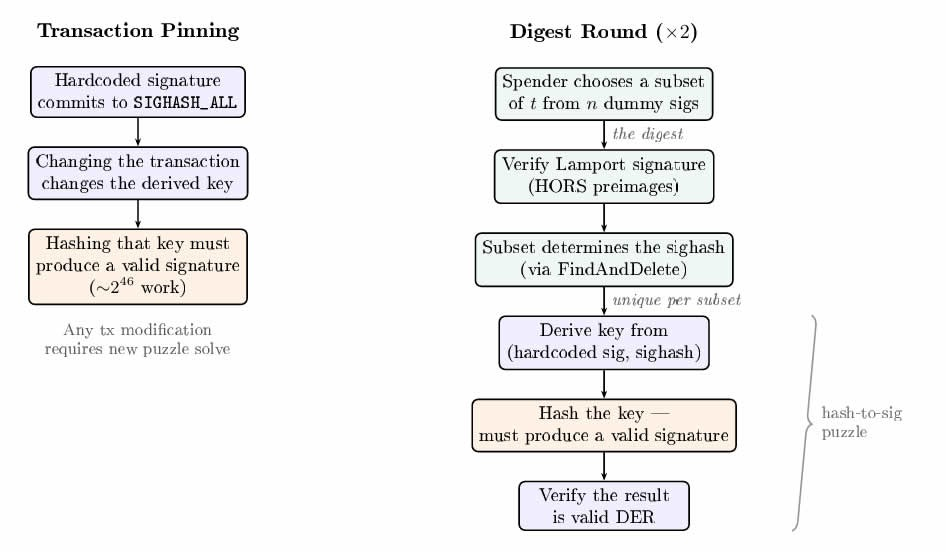
Shor’s algorithm attacks discrete logarithms. It does not break hash functions. That single architectural decision is what makes Quantum-Safe Bitcoin resistant to the quantum threat without touching the protocol.
The construction works in three phases. First, transaction pinning: the prover searches over (sequence, locktime) parameter pairs until the recovered public key’s RIPEMD-160 hash produces a valid DER signature – approximately 246 work.
Second, two digest rounds: for the pinned transaction, the prover searches over subsets of dummy signatures; each subset alters the scriptCode via FindAndDelete, producing a different sighash and a different recovered key.
Find a subset whose recovered key hashes to a valid DER signature (~246 candidates per round). The total computational cost is $75–$150 per transaction on cloud GPUs.
Zero-Knowledge Proofs and Dashlink enter the picture as an efficiency layer for proof verification. The QSB construction leverages post-quantum cryptography principles by anchoring security to hash-based assumptions – the same foundation underpinning ZK-friendly hash functions used in modern Zero-Knowledge Proofs.
Dashlink’s role is to compress the verification burden so that proof validation stays within Bitcoin’s existing 10,000-byte script limit and 201-opcode ceiling. No new opcodes. No consensus change. The scheme is consensus-valid under rules Bitcoin already enforces.
Bitcoin Hyper Targets Early Mover Upside
Bitcoin Hyper (HYPER) is currently in presale, targeting early-mover upside in the Bitcoin yield infrastructure layer – a sector drawing serious institutional attention as US spot Bitcoin ETFs pulled in $471.3 million in a single week.
The presale has raised $32 million to date, with the current token price at $0.0093 and staking APY running at 86% annualized for early participants.
The core technical differentiator: Bitcoin Hyper operates as a Bitcoin-native Layer 2 executing smart contracts with BTC as the settlement asset – bypassing the wrapped-token credit risk that plagues existing BTC DeFi infrastructure.
That’s a specific, verifiable architecture claim in a space full of vague interoperability promises.
Research Bitcoin Hyper here before the presale window closes.
The post A Developer Just Built Quantum-Safe Bitcoin Without Changing a Single Line of the Protocol: Is This the Fix BTC? appeared first on Cryptonews.

Nigel Farage unveils ‘Vote Reform. Get Starmer out’ slogan

March 2026 CPI: Inflation surged as Iran war took a toll on consumer prices
Hedera (HBAR) drops 1.9%, leading index lower

Why Israel is blocking foreign journalists from entering

Bitcoin: We’re Entering The Most Dangerous Phase

Alan Cumming Brands Baftas Ceremony A ‘Triggering S**tshow’

Daily Market Coverage Apr. 8, 2026 9AM-11AM (ET) | Yahoo Finance

What is Finance? | Definition Financial Company|Financial Information| Accounts Video #financial

Psalm 23 Prayer for Financial Prosperity and Abundance #Psalm23 #DivineProtection #FaithInGod
-

 Fashion7 days ago
Weekend Open Thread: Spanx – Corporette.com
-

 Business5 days ago
Three Gulf funds agree to back Paramount’s $81 billion takeover of Warner, WSJ reports
-

 Sports6 days ago
India men’s 4x400m and mixed 4x100m relay teams register big progress | Other Sports News
-

 Business6 days ago
Expert Picks for Every Need
-

 Tech3 days ago
How Long Can You Drive With Expired Registration? What Florida Law Says
-

 Business5 days ago
No Jackpot Winner, Prize to Climb to $231 Million
-

 Fashion4 days ago
Massimo Dutti Offers Inspiration for Your Summer Mood Board
-

 Fashion3 days ago
Let’s Discuss: DEI in 2026
-

 Crypto World2 days ago
Bitcoin recovers as US and Iran Agree a Ceasefire Deal
-

 Business6 days ago
Akebia Therapeutics, Inc. (AKBA) Discusses Pipeline Progress and Strategic Focus on Kidney Disease Treatments at R&D Day – Slideshow
-

 Crypto World1 day ago
Canary Capital Files SEC Registration for PEPE ETF
-

 Politics6 days ago
The UK should not pay a penny in slavery reparations
-

 Tech4 days ago
Samsung just gave up on its own Messages app
-

 Tech4 days ago
Haier is betting big that your next TV purchase will be one of these
-

 Fashion7 days ago
Weekly News Update, 4.3.26 – Corporette.com
-
Sports7 days ago
A Kevin O’Connell Theory Can Now Be Retired
-

 NewsBeat7 days ago
Kemi Badenoch talks ‘spring cleaning’ Reform defections
-

 Tech4 days ago
Gamer Restores the Original PlayStation Portal From Two Decades Ago
-

 Tech7 days ago
Flat tire? Dead battery? Speedy’s serves stranded Seattle riders as a quicker e-bike picker-upper
-

 Tech4 days ago
The Xiaomi 17 Ultra has some impressive add-ons that make snapping photos really fun
You must be logged in to post a comment Login