

Crypto World
New Crypto Mutuum Finance (MUTM) Reports V1 Protocol Progress as Roadmap Enters Phase 3



Mutuum Finance (MUTM) has officially confirmed a major step in its roadmap with the activation of its V1 protocol on the Sepolia testnet. This development comes during a period of mixed market sentiment. Investors are increasingly looking for “proof of work” over theoretical promises.
By moving its core logic into a live testing environment, Mutuum Finance is demonstrating that its infrastructure is ready for public scrutiny. The project has raised over $20.6 million with strong community support..
Technical Infrastructure
Mutuum Finance is built on the Ethereum network and aims to provide a professional-grade liquidity market. Mutuum Finance has designed a dual-market mechanism. This allows the protocol to serve different types of users, from small retail participants to large institutional allocators.
P2C (Peer-to-Contract) Market: This model manages high-liquidity assets like ETH and USDT through automated pools. Interest rates are dynamic, adjusting in real-time based on pool utilization and market demand.
P2P (Peer-to-Peer) Marketplace: This marketplace supports “long-tail” or niche assets such as SHIB or DOGE. It allows lenders and borrowers to bypass automated formulas and negotiate custom interest rates and loan durations directly.
The primary goal of this design is to create a liquidity ecosystem that handles different risk profiles in one place. By separating the markets, Mutuum Finance aims to offer instant, algorithmically stable liquidity for major assets (P2C) while still providing a secure venue for the more volatile, speculative tokens (P2P) that traditional pooled protocols often exclude.
Key Features of the V1 Protocol
The activation of the V1 protocol on the Sepolia testnet is a full-scale demonstration of the protocol’s mechanics. In this environment, users can interact with the smart contracts using “test” tokens. This allows the community to verify the safety and efficiency of the system without risking real capital.
One of the core features being tested is the mtToken system. When a user deposits an asset, they receive an mtToken as a digital receipt. These are yield-bearing assets. As borrowers pay interest, the value of the mtToken increases. During the V1 testing phase, users can observe exactly how their test balances grow over time.
Additionally,the roadmap also introduces mechanisms to reward users who stake mtTokens in specialized modules designed to strengthen the platform’s security. the project’s roadmap highlights a buy-and-redistribute mechanism. Under this future system, users who stake their mtTokens in a specialized Safety Module will be rewarded with dividends paid out in MUTM tokens.
The V1 protocol includes live monitoring of Stability Factors. Every loan is assigned a score based on the value of the collateral compared to the borrowed amount. To keep the system safe, the protocol uses decentralized oracles to get accurate price data. If a user’s Stability Factor drops too low, the system’s liquidation bots are triggered to protect the lenders’ funds.
V1 Protocol Performance and Roadmap State
The activation of the V1 protocol on the Sepolia testnet has transitioned the project into a functional phase. As of March 2026, the protocol has successfully launched the V1 protocol on the Sepolia testnet, marking a significant milestone in its development. the protocol has reached a major milestone with testnet Total Value Locked (TVL) surpassing $190 million. This high volume of simulated liquidity allows the team to stress-test the system’s ability to handle large-scale lending and borrowing demand before the official mainnet launch.
Mutuum Finance’s roadmap recently transitioned into Phase 3, a stage focused on scaling the protocol’s architecture and hardening its security layer. While infrastructure optimization is a major pillar of this phase, it includes a wide array of technical and ecosystem developments designed to prepare the platform for global institutional use. Beyond the core protocol activation, the transition through these phases has introduced several critical upgrades:
- Risk Management Innovation: The protocol offers easy-to-use borrowing presets that help users navigate different risk profiles based on their preferences. This feature automatically sets the Stability Factor, helping users navigate market volatility without needing deep technical knowledge of LTV ratios.
- Protocol Security Layer: Building on a manual audit by Halborn Security and a 90/100 CertiK trust score, Phase 3 involves continuous “hardening” of the smart contracts. This includes refining the codebase using data from the Sepolia testnet to ensure the liquidation bots and interest rate models perform under extreme stress.
- Cross-Chain Research: Current development is also exploring the technical requirements for future cross-chain compatibility, ensuring that Mutuum Finance’s liquidity pools can eventually interact with networks beyond Ethereum.
The goal of these combined efforts is to transform Mutuum Finance from a tested V1 protocol into a fully realized decentralized ecosystem capable of handling diverse asset classes and complex liquidity structures.

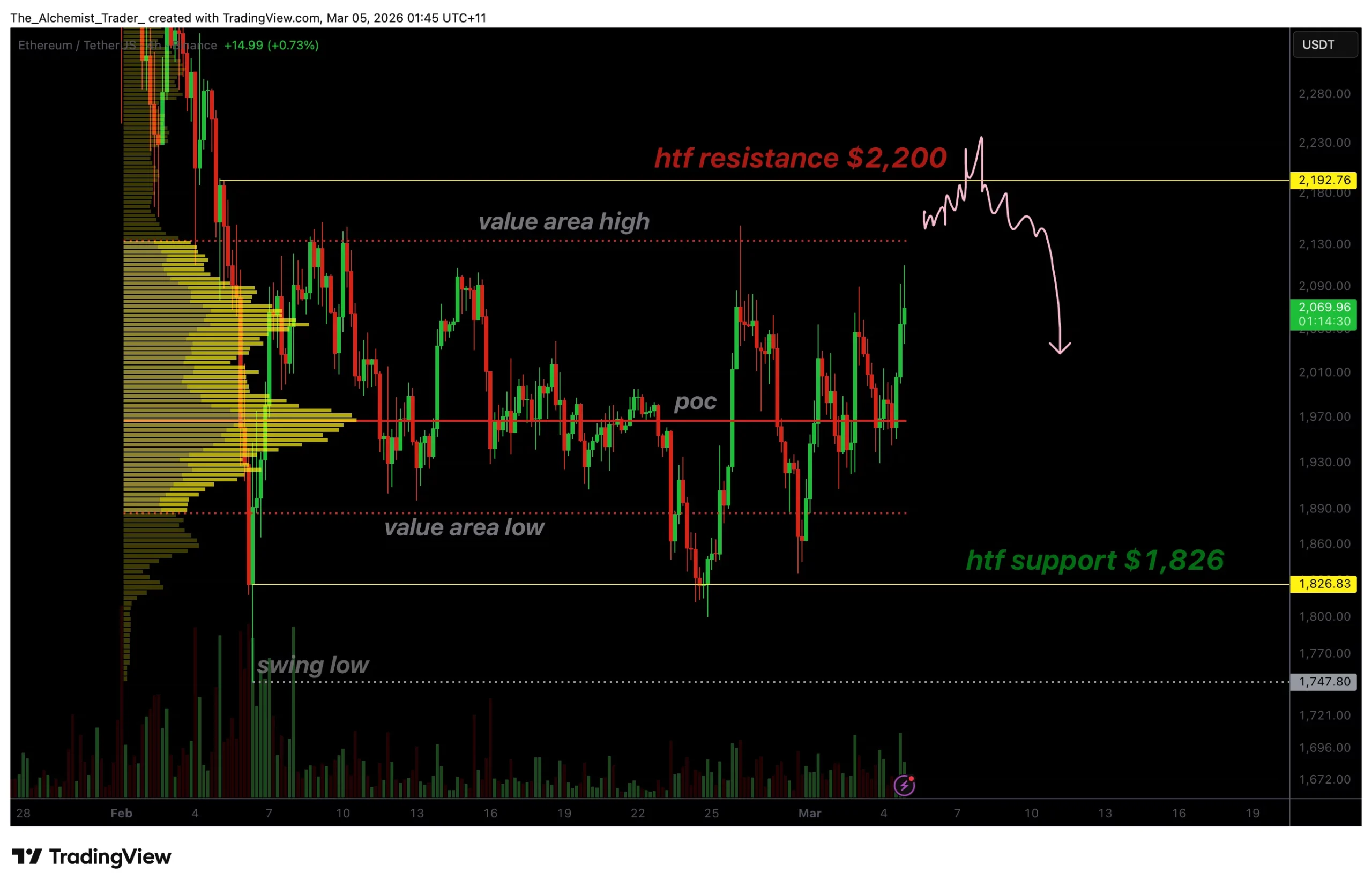
Ethereum price has begun showing early signs of recovery as local market structure turns bullish. Consecutive higher highs and higher lows above key volume levels now place the $2,200 resistance zone in focus.
Summary
- Higher highs and higher lows signal bullish structure shift
- $1,862 high timeframe support held at value area low
- $2,200 major resistance becomes next upside target
Ethereum’s (ETH) recent price action suggests a shift in short-term momentum after a successful defense of major support. While the broader market remains range-bound, the internal structure has begun to show bullish characteristics.
This shift is raising the probability of a continued move higher toward the next significant resistance level.
Ethereum price key technical points
- Bullish Structure: Higher highs and higher lows forming above the Point of Control.
- Key Support Held: $1,862 acted as strong high timeframe demand.
- Upside Target: $2,200 high timeframe resistance above the value area high.
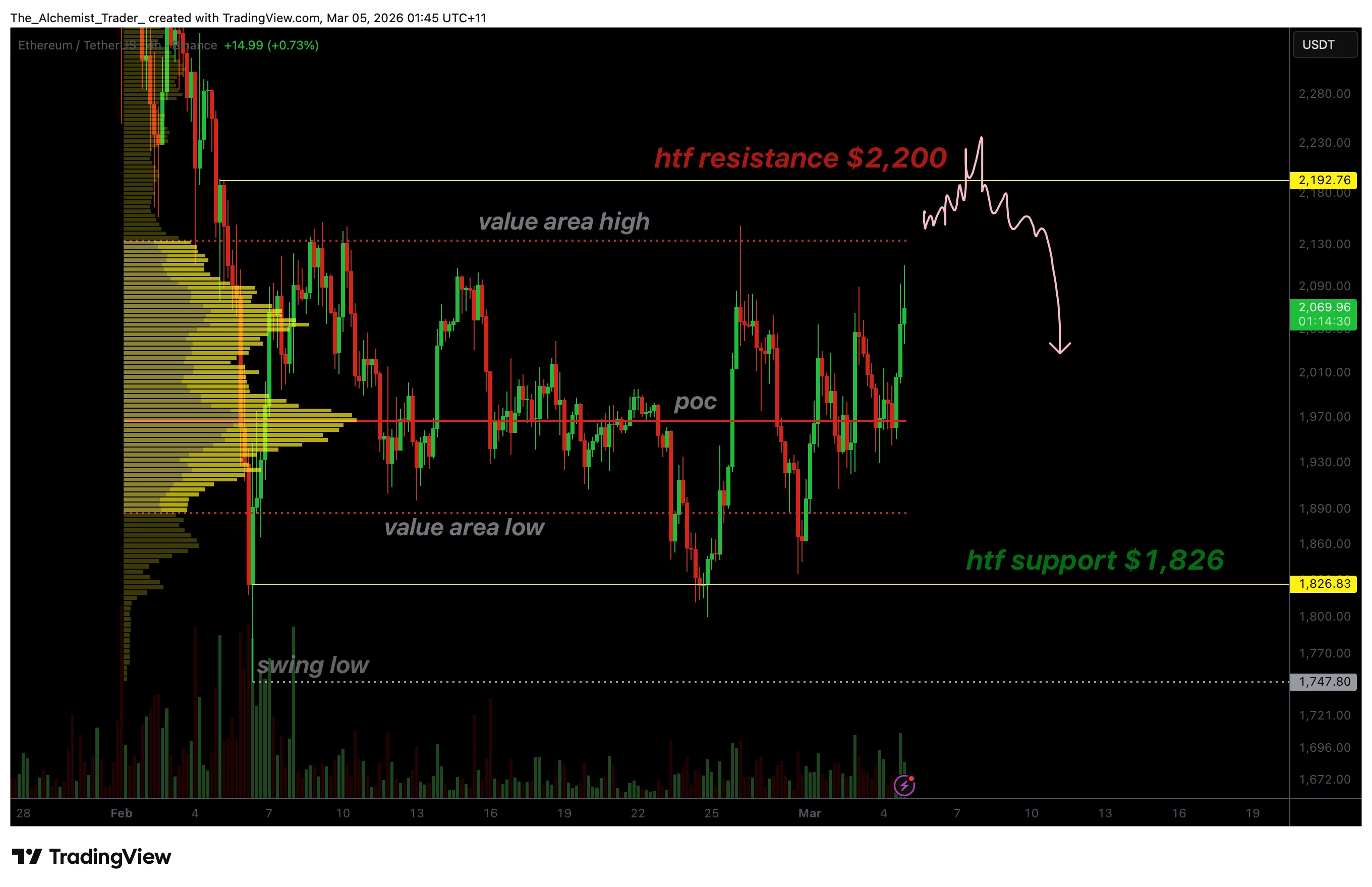
Ethereum’s current price action reflects an important local structural change. After previously trading in a corrective phase, the asset has begun forming consecutive higher highs and higher lows, a classic signal that momentum may be shifting in favor of buyers. This structural transition occurred as price reclaimed and held above the Point of Control (POC), which represents the area with the highest traded volume within the current trading range.
Holding above the POC typically signals that the market is establishing acceptance at higher prices. When buyers manage to sustain price above such an equilibrium level, it often opens the probability of a continuation move toward the upper boundary of the range.
A key factor supporting this shift was Ethereum’s reaction at the $1,862 high timeframe support level. This region aligns closely with the Value Area Low, a technical level where markets frequently find demand. The strong defense of this zone provided the catalyst for the initial bullish rotation that is now unfolding.
From a market structure perspective, this reaction marked the beginning of the internal trend shift. Buyers stepped in aggressively at support, absorbing selling pressure and pushing price back above key volume levels. The resulting momentum has allowed Ethereum to build a short-term bullish structure within the broader range environment.
Despite this positive development, it is important to note that Ethereum remains confined within a larger trading range on higher timeframes. Range-bound markets often produce multiple internal rotations between support and resistance before a decisive breakout occurs. As a result, short-term bullish expansions can still occur even while the broader structure remains neutral.
The next major technical level to watch is the $2,200 resistance zone, which sits above the current Value Area High. This area represents a significant supply region where sellers previously stepped in. If Ethereum continues to maintain its current bullish structure, price could attempt to test this level in the near term.
However, resistance zones such as $2,200 often attract selling pressure, particularly within range environments. Should price reach this area, the market may encounter renewed supply that could trigger a rotational move back toward support levels.
Volume dynamics will play a key role in determining the outcome. A strong expansion in bullish volume as price approaches resistance would increase the probability of a breakout attempt. Conversely, weakening participation could lead to rejection and continuation of the broader range-bound structure.
Overall, Ethereum’s internal market structure currently favors upside continuation, but the presence of strong overhead resistance means traders should remain cautious.
What to expect in the coming price action
If Ethereum maintains higher lows above the Point of Control, the probability of a rally toward the $2,200 resistance zone increases. However, failure to break and hold above this level could trigger another rotation within the broader range, sending price back toward high timeframe support near $1,862.
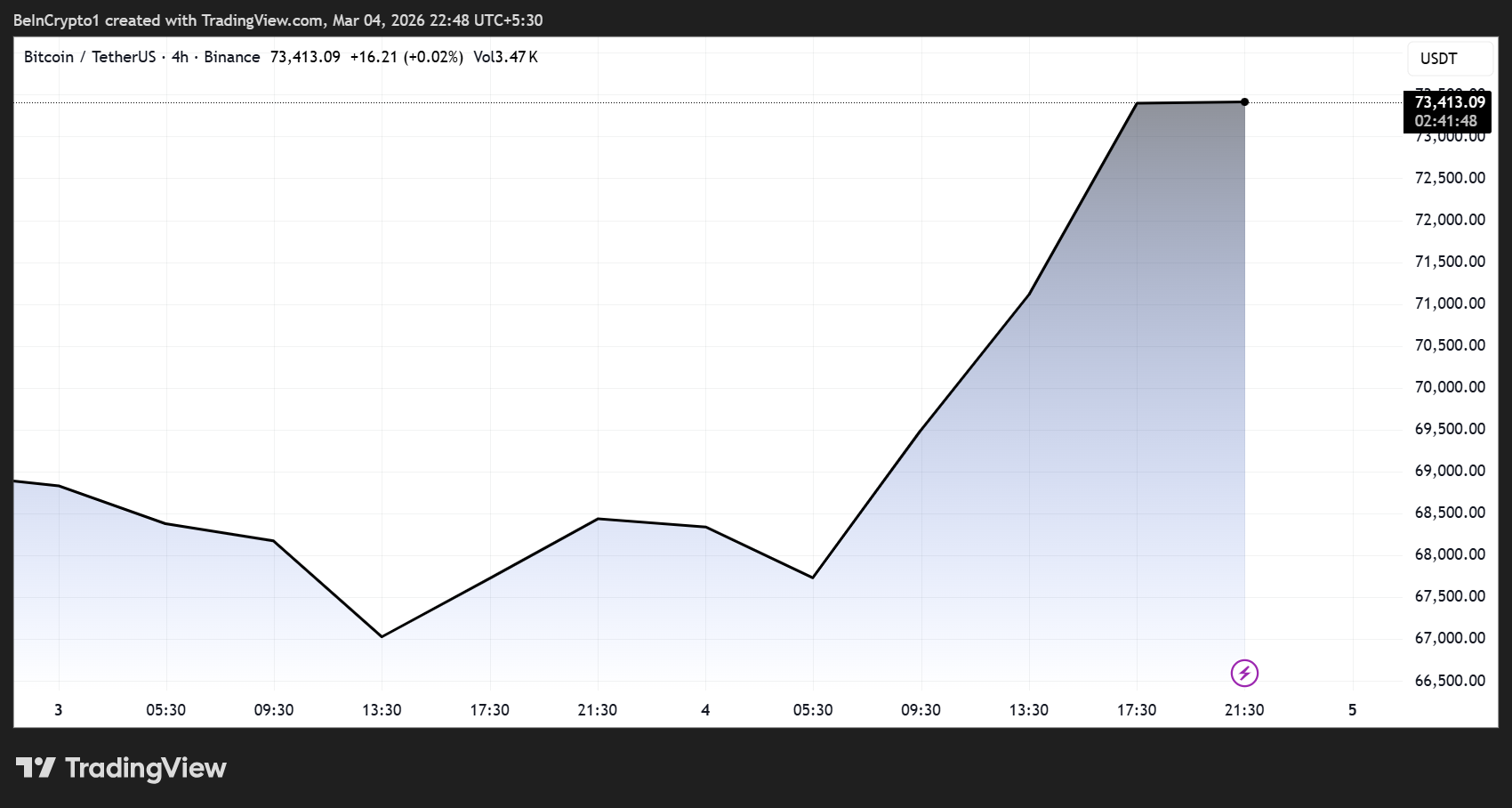
Over $530 million in Bitcoin (BTC) short positions were liquidated today as the White House nominated pro-Bitcoin Kevin Warsh as Federal Reserve Chairman, triggering a broad crypto market rally.
Bitcoin is up by 9% in 12 hours, adding $123 billion to its market cap. Ethereum (ETH) climbed 11% over the same period, adding $26 billion.
Bitcoin Short Sellers Caught Offguard As White House Officially Nominates Pro-BTC Fed Chair
Bitcoin reclaimed the $73,000 psychological level and was trading for $73,413 as of this writing.
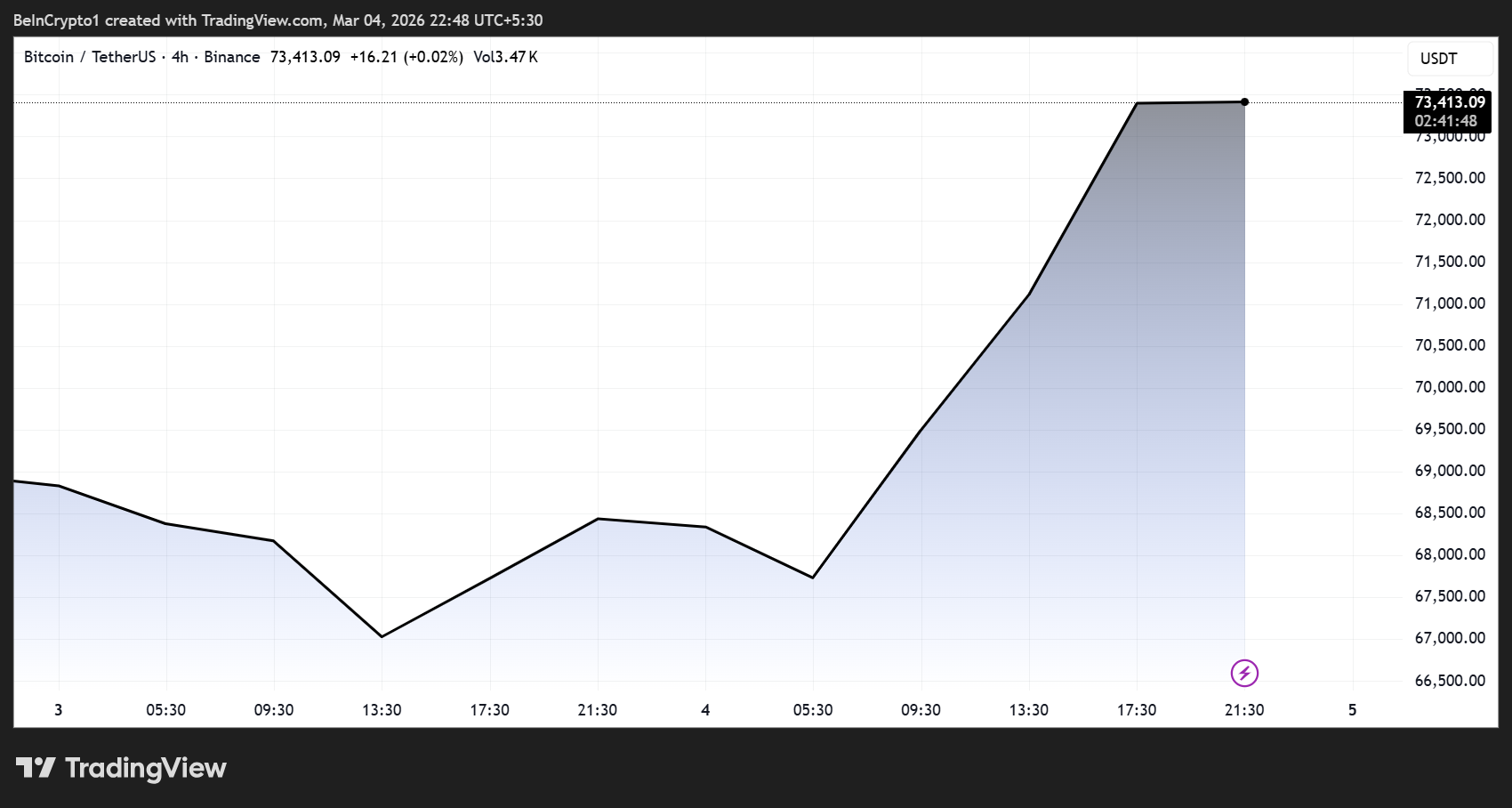
The move forced a cascade of short liquidations across derivatives markets, with Coinglass data showing nearly $30 million in short positions blown out over the past hour. This brings total liquidations to $530 million over the last 24 hours.
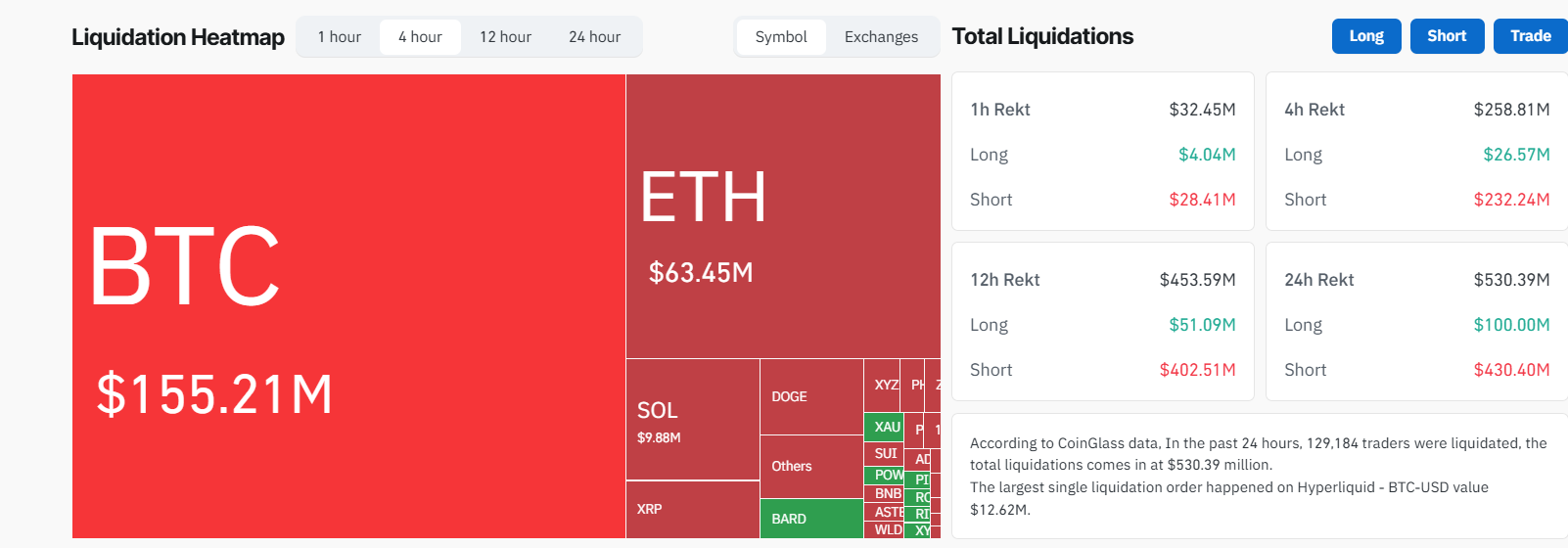
The move caught short sellers exposed. Traders betting against BTC and ETH were squeezed out as prices rose sharply, amplifying upward momentum through forced buybacks.
Warsh Nomination Serves as Macro Catalyst
The policy trigger behind the rally came from Washington. The White House officially nominated Kevin Warsh, a former Federal Reserve Governor widely regarded as sympathetic to digital assets, to serve as Fed Chairman for a four-year term.
“Kevin Warsh, of Florida, to be Chairman of the Board of Governors of the Federal Reserve System for a term of four years. Kevin Warsh, of Florida, to be a Member of the Board of Governors of the Federal Reserve System for a term of fourteen years from February 1, 2026,” read the announcement.
Meanwhile, the divergence between Bitcoin and traditional safe havens widened. Bitcoin is up by almost double digits, while Gold fell 3%. This stark contrast suggests capital rotation from traditional stores of value into digital assets.
The Warsh nomination and Saylor’s public stance, indicating potential for buying more BTC than sellers can offload, point to a market increasingly driven by macro policy expectations and institutional positioning.
[PRESSS RELEASE – New York, United States, March 3rd, 2026]
Threshold Network, the decentralized blockchain protocol behind tBTC, has introduced an update to its decentralized application featuring an all-in-one Unified Bitcoin App that enables users to route Bitcoin across major chains through a single interface.
This new unified routing interface brings minting, redeeming, bridging, tracking, and native BTC swaps into a single application: The Threshold App. Users can now move Bitcoin across ecosystems through a coordinated system, rather than stitching together multiple tools or navigating between different Decentralized protocols.
This release simplifies how Bitcoin enters and moves across DeFi, offering a more user-friendly on-chain experience with tBTC. Whether a transaction requires a swap, a bridge, or multiple steps, execution is seamlessly coordinated through a single interface
Coordinated Execution Instead of Fragmented Workflows
Historically, moving BTC into tBTC and across chains required multiple disconnected workflows: minting in one app, bridging via another protocol, swapping on separate exchanges, and manually checking the best price for each transaction. This fragmented process introduced friction, higher execution risk, added costs, and unnecessary complexity for users attempting to access DeFi with Bitcoin.
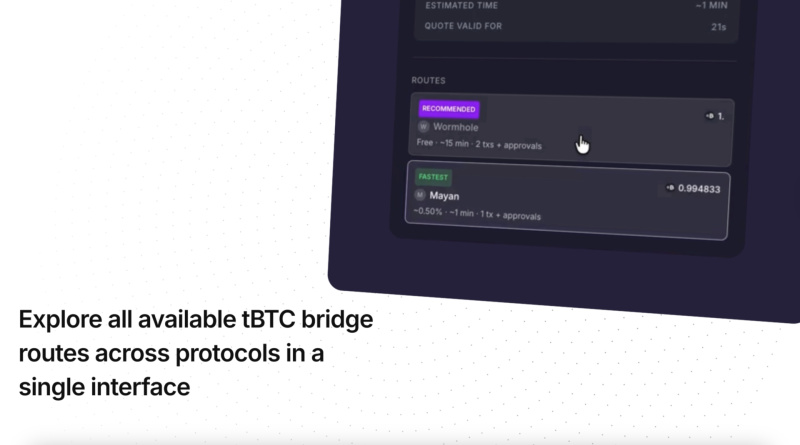
The Threshold All-in-one Bitcoin Liquidity App streamlines this experience by consolidating minting, bridging, swapping, and cost tracking into a single coordinated interface. Instead of manually comparing bridges and liquidity venues, users receive optimized routing options based on cost, speed, and reliability, such as the fastest or lowest-cost path: all within the Threshold Network App.
By abstracting multi-step transactions into a single seamless flow, the router significantly lowers the barrier for Bitcoin holders to use BTC across major ecosystems, including Ethereum, Arbitrum, Base, Sui, Starknet, and other integrated chains. The result is a simpler, more efficient way to move Bitcoin into DeFi.
 Native BTC Execution with Deep Liquidity
Native BTC swaps are integrated directly into the routing engine, leveraging deep Ethereum liquidity to deliver competitive pricing and more efficient execution compared to fragmented, chain-specific pools.
“Capital should move efficiently across chains without requiring users to manage infrastructure decisions,” said MacLane Wilkison, Co-Founder of Threshold Network. “The new Threshold Bitcoin app coordinates liquidity sourcing and settlement behind the interface, enabling more efficient Bitcoin deployment across ecosystems.”
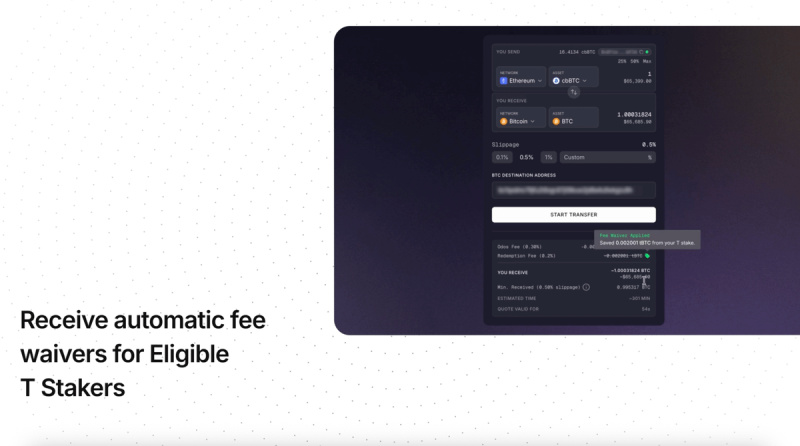
The update also strengthens the utility of Threshold’s token (T). The App tracks staked $T from the connected wallet and automatically applies minting and redemption fee waivers for eligible users. Gasless minting remains available as an opt-in feature, further reducing transaction costs.
Additionally, the router enables streamlined conversions from assets such as WBTC and cbBTC directly into tBTC on the destination chain, providing more direct and efficient access to Bitcoin liquidity across DeFi ecosystems.
Integrated Infrastructure Across Major Networks. Currently, the router connects Bitcoin, Ethereum, Arbitrum, Base, Sui, and Starknet within one coordinated framework. It integrates native tBTC mint and redeem flows, established bridging infrastructure, and DEX aggregation to ensure reliable settlement across chains.
All transactions are tracked in real time and are fully resumable. If a user disconnects or closes a session, progress is preserved. Fee logic is staking-aware, with eligible T stakers seeing applicable redemption fees waived directly within the interface.
 New Features:
- Unified Routing Interface: Enables minting, redeeming, swapping, and bridging from a single entry point. Users select source and destination assets, and the system automatically constructs the optimal execution path.
- Multi-Chain Connectivity: Supports Bitcoin, Ethereum, Arbitrum, Base, Sui, and StarkNet within a single coordinated framework. Users can move BTC or tBTC across ecosystems without managing separate bridge interfaces.
- Smart Route Discovery and Ranking: Automatically evaluates possible transaction paths and ranks them by cost, speed, reliability, and simplicity. Users are presented with clearly labeled best options.
- Native BTC Swaps: Provides direct access to BTC liquidity with competitive execution, while enabling seamless conversion of assets such as cbBTC or wBTC into tBTC on a user’s chosen destination network.
- Integrated Liquidity and Bridging Stack: Connects tBTC mint and redeem flows with established bridging infrastructure and DEX aggregation to coordinate multi-step transactions seamlessly.
- Resumable Transactions: Persists in-flight operations, allowing users to refresh, disconnect, or return later without losing progress. Reduces failed cross-chain flows and operational friction
- $T Staking-Aware Fee Display: Recognizes T staking status and surfaces fee waivers directly in the interface, reinforcing participation incentives.
- Unified tBTC Explorer and Transaction Tracking: The new explorer section of the app consolidates historical mint, redeem, bridge, and swap activity into a single view, improving transparency and user oversight.
Impact for Users and Stakeholders
This release expands the utility of tBTC across six ecosystems while increasing throughput across minting, bridging, and swap flows. By embedding routing intelligence directly into the protocol interface, Threshold captures more activity within its infrastructure and further strengthens staking incentives tied to network usage.
With this launch, Threshold advances its role from Bitcoin asset issuance to core infrastructure for Bitcoin mobility, coordinating capital movement seamlessly across chains and unlocking more efficient access to decentralized finance.
Users can explore the new Bitcoin App today at https://app.threshold.network
About Threshold Network
Threshold Network is the decentralized protocol behind tBTC, a non-custodial, 1:1 Bitcoin-backed asset secured by a 51-of-100 threshold signer model. tBTC enables native BTC to move across chains like Ethereum, Base, Sui, Arbitrum, and Starknet without requiring custodians or compromising security. With over 6 years of proven security and about $5.1B in bridge volume, Threshold offers the most battle-tested, trust-minimized Bitcoin infrastructure on-chain.
Binance Free $600 (CryptoPotato Exclusive): Use this link to register a new account and receive $600 exclusive welcome offer on Binance (full details).
LIMITED OFFER for CryptoPotato readers at Bybit: Use this link to register and open a $500 FREE position on any coin!


For many, the passage of the GENIUS Act closed the doors on the creation of a Central Bank Digital Currency (CBDC). Stablecoins, though digital, were marketed as a private form of currency, in contrast to a government-issued digital dollar.
Aaron Day, a fellow at the Brownstone Institute and a staunch critic of the crypto industry, argued that the GENIUS Act facilitates increased government surveillance despite this ban.
Surveillance Concerns Under the GENIUS Act
The GENIUS Act explicitly prevents the Federal Reserve from issuing a CBDC directly to individuals or through a third party. Its goal was to block the creation of a government-issued digital dollar at all costs.
Its July 2025 passage tied in nicely with President Trump’s early campaign promises to oppose the creation of a CBDC, describing it as a form of tyranny.
According to Day, stablecoins and CBDCs are essentially the same thing. The only difference is that the former is privately issued, whereas the latter is issued by a central bank. Yet, as long as the government is involved, the degree of surveillance remains the same.
“The issuance by the Federal Reserve is not actually the part of this that people are concerned about. The Federal Reserve is a private organization that is a collection of banks. Whether you end up having a stablecoin issued by Jamie Dimon at JP Morgan Chase or by the Federal Reserve doesn’t matter,” Day told BeInCrypto.
What privacy-preserving people are really concerned about, he argued, is a government entity being able to program, track, and censor money.
This line of thinking has prompted him to define the GENIUS Act as a “backdoor CBDC.” Day highlighted the urgency of the issue, especially given the exponential growth in stablecoins.
“Last year, there was $33 trillion worth of stablecoin transactions. Globally, this is larger than the amount processed through Visa,” he said, adding, “What they’ve done essentially is they’ve taken stablecoins… and they put [them] under the surveillance and control of Congress.”
According to him, this level of surveillance already existed before the passage of the GENIUS Act. The recently signed bill only represents a new degree to an already established order.
Day noted that most of the dollar is already digital.
When asked for examples, he pointed to the Bank Secrecy Act (BSA). This legislation, passed in 1970, requires financial institutions to assist government agencies in detecting and preventing money laundering, terrorism financing, and other illicit activities.
According to Day, the BSA allows government agencies to engage in overreach in certain contexts.
“We have something called suspicious activity reports. Anytime you do a financial transaction through your bank greater than $10,000, a report is automatically generated and sent to the Treasury Department. This shows you that we already have tracking within the system,” he said.
While these tools are often used for public protection, government agencies can implement them without specific authorization.
Day pointed to a specific example. In March 2025, the Financial Crimes Enforcement Network (FinCEN), a bureau of the US Treasury Department, issued a geographic targeting order to combat money laundering activities in the southwest border of the United States.
As part of that order, FinCEN mandated that money services businesses in 30 ZIP codes report transactions over $200.
“Understand what this means. The Treasury Department, without Congress, without a bill, without a law, can simply send a memo and banks will start adjusting the dollar transaction amount with which they start automatically reporting to Treasury,” he said.
In light of these examples, he argued that surveillance frameworks already exist. The GENIUS Act merely allows Congress to supervise stablecoins, potentially expanding control over digital currencies in ways that mirror those of a CBDC.
One day after recording its worst single-session loss in history, South Korea’s KOSPI surged more than 11% on Thursday, staging one of the most dramatic reversals the index has ever seen.
No major economy is more acutely wired to Middle East instability than Seoul — and this week proved it.
The Bounce of KOSPI and KOSDAQ
South Korea’s two main stock indices — the large-cap KOSPI and tech-heavy KOSDAQ — are among Asia’s most actively traded markets and a key barometer of Korean retail investor sentiment.
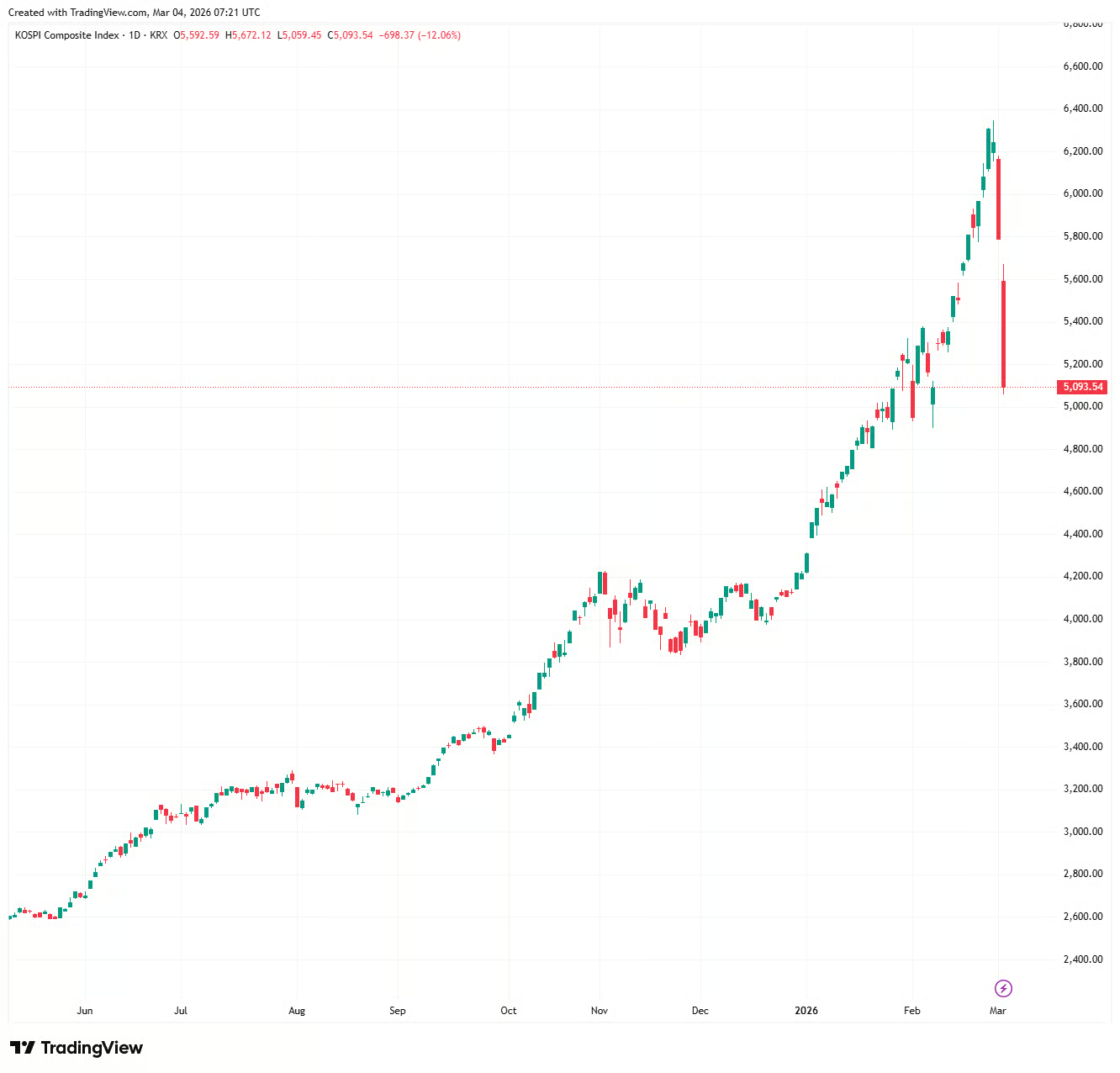
By mid-morning, the KOSPI had climbed to 5,682 — up from Wednesday’s close of 5,093 — after touching an intraday high of 5,715. The KOSDAQ recovered above the 1,000 level, gaining over 11%. A buy-side sidecar was triggered in early trade — a striking contrast to Wednesday’s sell-side sidecar and full circuit breaker halt. The won strengthened sharply, pulling back from an overnight high of 1,505 to trade near 1,461.
The catalyst: oil prices stabilized, with Brent crude holding at $81.40 and WTI at $74.66, and reports of back-channel contacts between Washington and Tehran lifted sentiment across Asian markets. Wall Street had closed higher on Wednesday, with the Nasdaq up 1.29%, led by Tesla (+3.44%), Amazon (+3.95%), and Nvidia (+1.66%).
Samsung Electronics and SK Hynix — which had shed 21% and 22.75% respectively from their late-February peaks — rebounded 13–15% in early trade. Foreign investors, who had used both stocks as first-resort liquidity during the panic, returned as net buyers of over 710 billion won by mid-morning. Retail investors added another 600 billion won alongside them.
Why Korea Fell Harder Than Anyone Else
The scale of the crash and recovery reflects a structural reality. Over the two sessions on March 3–4, the KOSPI and KOSDAQ fell 18.43% and 17.97%, respectively — the worst and second-worst performances globally. Japan fell 6.57%, Taiwan 6.46%, and China’s Shenzhen Composite just 3.76%. US indices barely registered, declining less than 0.35% combined.
Korea imports over 70% of its energy from the Middle East and operates an export-dependent economy with high sensitivity to commodity shocks. When US-Israel strikes on Iran triggered Strait of Hormuz closure fears, global risk was concentrated in Seoul with exceptional force. Wednesday’s KOSPI decline of 12.06% surpassed even the 12.02% drop recorded the day after 9/11 — a threshold that had stood for 25 years.
What Comes Next
Analysts are cautiously optimistic but warn that the path forward depends on geopolitical developments. One analyst argued that a prolonged Hormuz blockade is self-defeating for Iran. It would cut Tehran’s foreign exchange revenues while inviting further military response. Another pointed to a potential mediator as the key turning point. At current index levels, he said, “the case for buying is strong.”
Mirae Asset set a near-term KOSPI recovery target of 5,800. Kiwoom Securities suggested the two-day selloff had effectively front-loaded the war risk premium in full.
What It Means for Crypto
For crypto markets, as BeInCrypto reported Wednesday, Korea’s retail investor base showed some resilience during the crash — with newly listed tokens on Upbit and Bithumb posting double-digit gains even as equities collapsed. But Thursday’s equity rebound may quickly reverse that dynamic.
With foreign and retail investors pouring over 1.3 trillion won back into equities in a single morning session, the stock market’s gravitational pull reasserts itself. Korea’s crypto volumes had already dropped by more than 80% during the KOSPI’s 85% bull run since President Lee’s election, and a sharp V-shaped equity recovery threatens to drain whatever crypto inflows emerged during the two-day panic.
The won pulled back from 1,505 to near 1,461. That partial recovery reduces the currency-hedge appeal that briefly boosted digital assets. The effect is already visible in the data: Bitcoin rose 6.4% in dollar terms over the past 24 hours, but gained only around 5% on Upbit in won terms — the won’s sharp rebound absorbed more than a percentage point of that gain.
If geopolitical risk continues to ease, the KOSPI could push toward Mirae Asset’s 5,800 target. Korean retail capital — historically the most swing-sensitive in global crypto markets — would likely follow equities. Not digital assets.


Bitcoin has hit its most extreme weekly oversold level on record as selling slows.
Summary
- Research firm K33 says bitcoin is in its deepest weekly oversold zone ever.
- The move follows months of selling from long-term holders and institutions, though that pressure is now easing.
- Bitcoin (BTC) reclaimed $71,000 with roughly 7% daily gains as derivatives metrics show cautious but stabilizing positioning.
Bitcoin (BTC) has entered the most extreme weekly oversold zone in its history, according to a new report from research firm K33, even as early signs suggest that sustained sell pressure from long-term holders and institutions is finally starting to ease.
The firm notes that over the past several months, systematic selling from older wallets and ETF-related flows pushed prices lower and kept sentiment muted, despite ongoing interest in spot products. Now, with bitcoin back above $70,000 and net outflows slowing, K33 argues that the market is moving into a phase where forced or programmatic selling is less dominant, allowing spot demand to have a clearer impact on price. At the same time, derivatives indicators point to a market that is still cautious rather than euphoric, with traders paying for downside protection even as spot rebounds.
K33’s oversold signal is rooted in longer-term momentum and breadth metrics, rather than short-term intraday swings, highlighting how extended the prior drawdown had become relative to previous cycles. The report emphasizes that similar readings in past years often preceded medium-term recovery phases, though the timing and strength of those rebounds varied depending on macro conditions and liquidity. In this cycle, the backdrop includes U.S. spot bitcoin ETFs that continue to attract steady, if uneven, inflows, as well as growing interest from corporates and fintech platforms like Coinbase that are integrating digital assets more deeply into their product stacks. For now, the firm characterizes bitcoin’s current state as one of “exhausted sellers” rather than a fully confirmed trend reversal.
Derivatives still signal caution
Despite the oversold reading and price recovery, K33 stresses that derivatives markets are not yet signaling a return to aggressive risk-on behavior. Funding rates on major perpetual futures have normalized from previous extremes and sit near neutral, suggesting that leveraged longs are no longer crowding in at any price, but are also not completely absent. Open interest has climbed from local lows in a more measured fashion, indicating that new positions are being added without the kind of unchecked leverage build-up that often precedes sharp liquidations. Options markets, meanwhile, show persistent demand for puts and elevated implied volatility around key macro and policy dates, reflecting ongoing concern about downside scenarios.
For traders and asset managers, the combination of record weekly oversold conditions and still-cautious derivatives positioning creates an environment where upside follow-through is possible, but not guaranteed. Short-covering rallies can be powerful in this type of setup if spot demand continues and ETF flows stay positive, yet any renewed wave of macro stress or regulatory headlines could quickly reignite selling. Institutional desks focused on structured products and basis trades may see opportunities to re-enter yield strategies as spreads normalize, while long-only investors weigh whether current levels offer an attractive entry point in light of K33’s historical analogs. The key test in the coming weeks will be whether bitcoin can hold above reclaimed support zones while leverage remains contained, confirming that the market has transitioned from forced selling into a more sustainable, accumulation-driven phase.
Escalating geopolitical tensions amid the war in Iran are part of the reasons behind South Korea’s worst stock market crash in decades.
The benchmark market index in South Korea, KOSPI, saw a massive decline during the last trading session, dropping by more than 12%. Undoubtedly, this last drop represents a significant escalation from earlier market movements and highlights the increasing volatility in local equity markets amid the war in Iran.
Worst Stock Market Crash Since 2008
As of this writing on Wednesday, KOSPI is down by more than 12%. On the previous trading day, the benchmark index lost another 7%, marking what appears to be the worst performance since 2008.
Both Kosdaq and KOSPI hit the threshold for an emergency circuit breaker on Korea’s stock exchange, triggering 20-minute trading halts.
Commenting on the matter in a report for CNBC was Lorraine Tan, Asia’s director of equity research at Morningstar, who said:
“The decline in the KOSPI can broadly be attributed to the single-name concentration that we see in the Korean markets. […] We believe that the drop in share prices is partly driven by profit taking after a strong runup amidst a risk-off environment but also implies growing concern that the AI datacenter adoption pace might slow down due to its significantly higher energy costs than regular data centers.”
Additionally, analysts point out that South Korea’s economy is highly sensitive to oil prices, making it even more vulnerable during the war in the Middle East.
Global Tensions in Markets
Markets in Japan are also under pressure. Japan’s flagship market index, the Nikkei, is down over 5% over the last 48 hours, while the US Stock Market has been able to recover somewhat following statements from respective parties.
Crypto markets remain flat on the day. Bitcoin is up 0.6% in the past 24 hours, while the majority of altcoins are trading in the range between -1% and +1%. The total capitalization is around $2.3 trillion, down 0.1% on the day, according to CoinMarketCap.
You may also like:
Binance Free $600 (CryptoPotato Exclusive): Use this link to register a new account and receive $600 exclusive welcome offer on Binance (full details).
LIMITED OFFER for CryptoPotato readers at Bybit: Use this link to register and open a $500 FREE position on any coin!
Crypto World
Crypto market rallies as top Federal Reserve official maintains support for interest rate cuts


The crypto market rally resumed on Wednesday as a senior Federal Reserve official maintained his view that the bank should cut interest rates despite the rising inflation jitters.
Summary
- The crypto market rallied on Wednesday. Stephen Miran said that he supported interest rate cuts.
- He argued that the labor market was not strong and that inflation was largely contained.
- The rally also happened amid rumors that Iran had reached out to the United States.
Bitcoin (BTC) zoomed past the key resistance level at $72,000, leading to a broader rally among other altcoins. SPX6900 jumped by 20%, while Aerodrome Finance, Kite, Zcash, and Decred soared by over 10%. The market capitalization of all cryptocurrencies rose by 6.48%, while the futures open interest rose to over $95 billion.
Stephen Miran supports interest rate cuts
One major reason why the crypto rally is happening is that Stephen Miran, a top Fed official appointed by President Donald Trump, expressed his support for interest rate cuts despite the ongoing geopolitical tensions and higher crude oil prices.
Miran has always argued that inflation is still low and that the labor market was still under increased pressure. As such, he believes that cutting interest rates will be ideal to supercharge the economy. He said:
“When you look at the totality of labor-market data, there’s still evidence to me that it needs more support from monetary policy.”
Miran, however, is part of the bank’s minority in his support for more interest rate cuts. The most recent Fed minutes showed that some officials supported hiking rates in the last meeting, citing the elevated inflation, which has remained above the 2% target for over four years.
Inflation may remain above this range for longer as Trump plans to implement a new 15% universal tariff as soon as this week. Also, the ongoing war in Iran has pushed crude oil and natural gas prices to the highest level in months. Higher energy prices often lead to higher inflation because they are used in transport, manufacturing, and other activities.
Crypto market rally also triggered by hopes of talks between the US and Iran
The crypto market rally also happened as investors cheered a report saying that Iran had reached out to the United States for talks on how to end the ongoing war. Officials from the government’s intelligence office made the approach on Sunday, a day after the war started.
Still, it is unclear whether the two sides will meet soon to talk, as they are both confident of victory. Trump has insisted that the US was ready to fight the war as long as possible. He has also not ruled out a ground operation in the country. Similarly, Iran has maintained that it was prepared to continue fighting.
Solana price is approaching the critical $95 Fibonacci resistance as rising volume and open interest signal a potential breakout or sharp rejection.
Summary
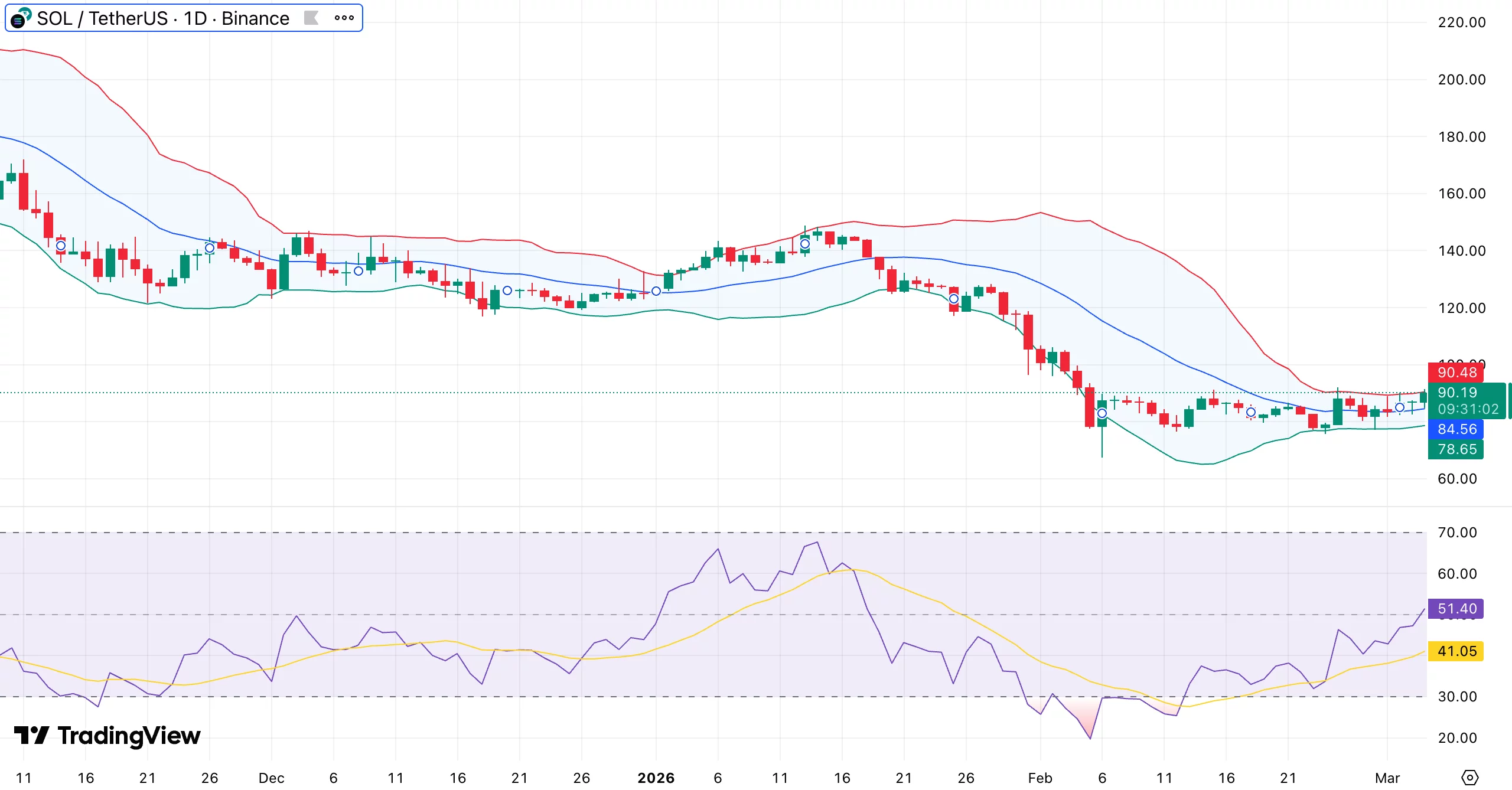
- Solana trades at $90.20, nearing key Fibonacci resistance at $95.
- Volume and open interest are rising as traders position for a breakout.
- A move above $95 targets $105–$110, while rejection risks a drop toward $85.
Solana (SOL) is trading at $90.20 at press time, down 7.4% over the past 24 hours. The token just touched the top of its seven-day range between $77.47 and $90.68.
It has gained 7.4% in the last week but is still down 12% over the past month and nearly 70% below its January 2025 all-time high of $293.31.
Derivatives data from CoinGlass shows traders stepping back in. Volume has risen 13% to $17 billion, while open interest climbed 6% to $5 billion.
This mix indicates that fresh positions are being opened as the price approaches a technical decision zone.
$95 emerges as a key decision point
The $95 area stands out on the chart.
If we measure the recent move from the swing high near $120 to the swing low around $80, the 38.2% to 50% Fibonacci retracement falls close to $95.
This is usually the first serious resistance during a recovery bounce. In many cases, rallies slow down or reverse at this level.
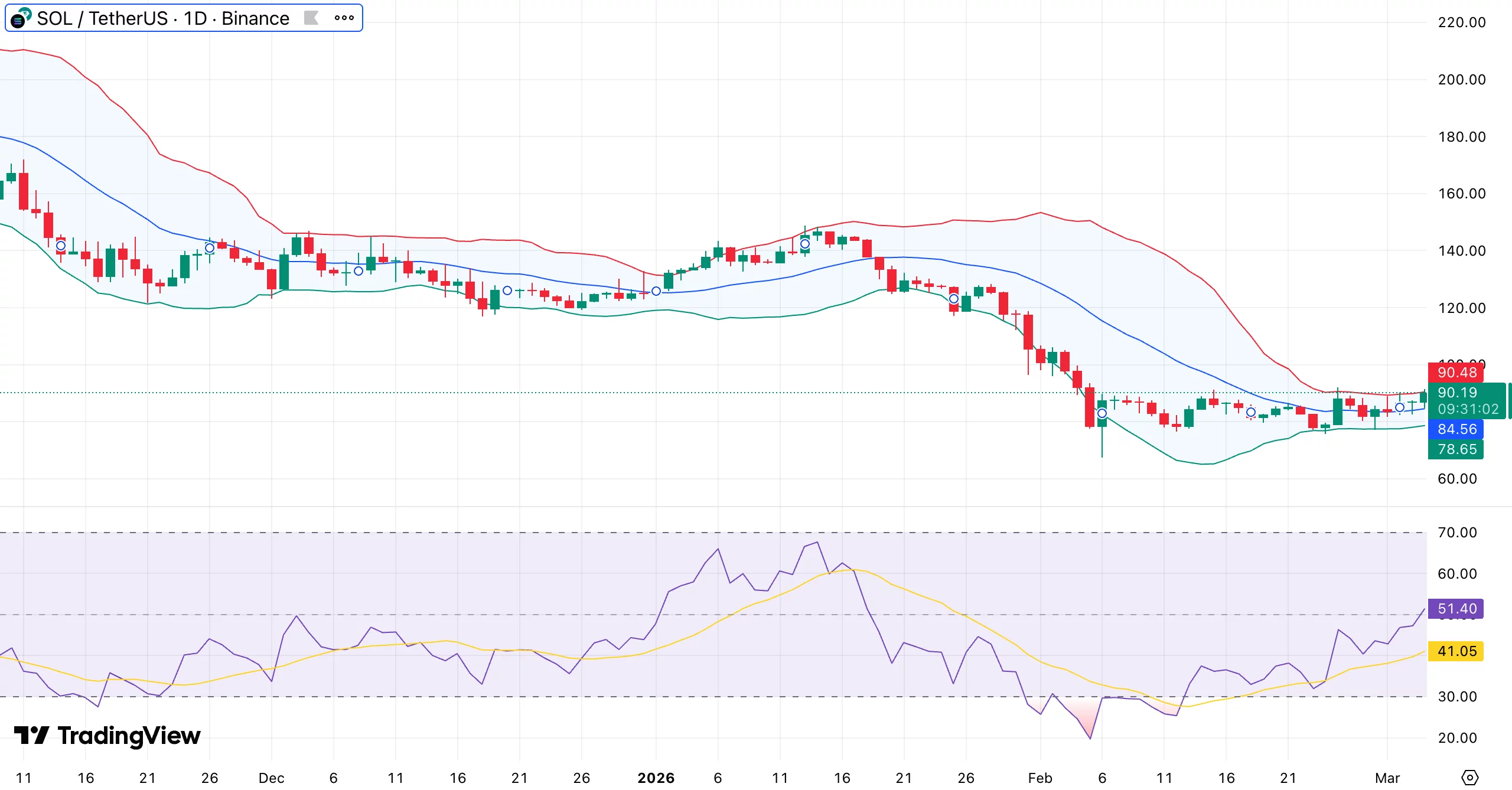
The $92–$97 region also acted as support before the price broke down. That old support may now act as resistance. Liquidity likely sits just above $95, which makes the area even more sensitive.
Price is also moving toward key moving averages, such as the 50-day EMA or 100-day SMA. When static resistance and dynamic resistance meet, the level tends to carry more weight.
RSI has recovered from oversold conditions below 30 and is now approaching the 50 mark. If momentum stalls there, sellers may regain control. Volume on the bounce has not exploded, which suggests this could still be a corrective move rather than a full trend reversal.
If SOL pushes above $95 and holds, the next upside zone sits around $105–$110. If it gets rejected, $85 could come back into view.
Solana price short-term outlook
For March 2026, the short-term outlook remains cautiously optimistic. Some analysts expect a move into the $95–$105 range if buying pressure continues. A break above $100 is possible, but volatility is still elevated and sentiment across crypto remains fragile.
Prediction markets show mixed positioning. While some traders are betting on a move above $110, many still anticipate that SOL will remain below $100 in the near future.
Fundamentally, institutional investment in Solana-related products has increased. DeFi, stablecoins, and memecoins are all still experiencing on-chain activity. The longer-term narrative is further supported by payment use cases such as Visa’s USDC settlements.
For now, the chart is clear. A daily close above $95 would shift short-term structure in favor of buyers. If that level holds as resistance, the broader downtrend stays intact.
Crypto World
Transacta Partners with CryptoJets to Support Growing Demand for Crypto Payments in Private Aviation

[PRESS RELEASE – Tallinn, Estonia, March 4th, 2026]
CryptoJets, a global private jet and helicopter brokerage, has announced a partnership with Transacta to support the growing demand for cryptocurrency payments in private aviation.
The growing demand for fast and secure crypto payments
Demand for cryptocurrency payment options in luxury travel continues to grow as wealth shifts toward younger generations. The private aviation sector is increasingly embracing digital currencies, driven by both practical needs and broader market development.
Built for travelers who value privacy, speed, and flexibility, CryptoJets operates with access to a global network of more than 5,000 charter operators, providing on-demand private jet and helicopter services to clients worldwide.
As the volume of crypto-funded bookings continued to grow, the company identified the need to further optimize payment speed, settlement reliability, and geographic coverage. Through its partnership with Transacta, CryptoJets is expanding its route network and operational capacity across 180 countries while offering clients a more streamlined way to process high-value charter payments.
“Crypto payments have already been part of how our clients prefer to pay,” said Erik Rand, Head of Operations at CryptoJets. “This partnership allows us to process those payments faster, improve settlement across markets, and scale our operations without compromising on compliance or client experience.”
Expertise in settling high-value transactions for luxury merchants worldwide
Built on years of experience working with luxury businesses, Transacta delivers payment solutions for merchants handling large, complex deals — without operational friction and under bespoke client requirements.
Transacta‘s financial rails allow CryptoJets to process large transactions in crypto and settle them in fiat to their bank account within 1–2 business days, meeting all legal requirements.
“We’re starting a new chapter together with CryptoJets. And for us, this partnership is a challenge we’re excited to take on — improving the speed and overall quality of payment processing for high-value charter transactions.” said Dmitrijs Maceraliks, CEO of Transacta.
About Transacta:
Founded in Estonia in 2018, Transacta (previously Transcrypt OÜ) offers a regulated payment infrastructure that enables merchants to accept crypto payments with instant fiat settlement. Transacta is licensed by the Estonian Financial Intelligence Unit, registered with FinCEN in the U.S. and FINTRAC in Canada, and operates under FINMA supervision.
Binance Free $600 (CryptoPotato Exclusive): Use this link to register a new account and receive $600 exclusive welcome offer on Binance (full details).
LIMITED OFFER for CryptoPotato readers at Bybit: Use this link to register and open a $500 FREE position on any coin!

‘Make it a help’ – Michael Carrick sends message to Manchester United players after Newcastle defeat

My legacy is anchored in Steel – Ellipal Seed Phrase Steel #ellipal #crypto #seedphrase

Your star sign’s Venus in Aries love life tarot horoscope reading


-

 Politics6 days ago
ITV enters Gaza with IDF amid ongoing genocide
-

 Politics2 days ago
Alan Cumming Brands Baftas Ceremony A ‘Triggering S**tshow’
-

 Fashion5 days ago
Weekend Open Thread: Iris Top
-

 Tech4 days ago
Unihertz’s Titan 2 Elite Arrives Just as Physical Keyboards Refuse to Fade Away
-
Sports5 days ago
The Vikings Need a Duck
-
 NewsBeat4 days ago
Dubai flights cancelled as Brit told airspace closed ’10 minutes after boarding’
-

 NewsBeat4 days ago
‘Significant’ damage to boarded-up Horden house after fire
-
 NewsBeat5 days ago
The empty pub on busy Cambridge road that has been boarded up for years
-

 NewsBeat4 days ago
Abusive parents will now be treated like sex offenders and placed on a ‘child cruelty register’ | News UK
-

 Entertainment3 days ago
Baby Gear Guide: Strollers, Car Seats
-

 Business7 days ago
Discord Pushes Implementation of Global Age Checks to Second Half of 2026
-
 Tech6 days ago
NASA Reveals Identity of Astronaut Who Suffered Medical Incident Aboard ISS
-

 Business6 days ago
Only 4% of women globally reside in countries that offer almost complete legal equality
-
 NewsBeat4 days ago
Emirates confirms when flights will resume amid Dubai airport chaos
-
Politics4 days ago
FIFA hypocrisy after Israel murder over 400 Palestinian footballers
-

 Crypto World6 days ago
From Crypto Treasury to RWA: ETHZilla Retreats and Relaunches as Forum Markets on Nasdaq
-

 NewsBeat3 days ago
Is it acceptable to comment on the appearance of strangers in public? Readers discuss
-

 Tech4 days ago
Viral ad shows aged Musk, Altman, and Bezos using jobless humans to power AI
-

 Business7 days ago
World Economic Forum boss Borge Brende quits after review of Jeffrey Epstein links
-

 Video7 days ago
Xii English top Selected mcq “Money Madness” Board Exam 2026, #chseodisha #hksir #mychseclass