

Crypto World
New Fed Chair Sworn In, Crypto Regulation Risk to Institutions Rises

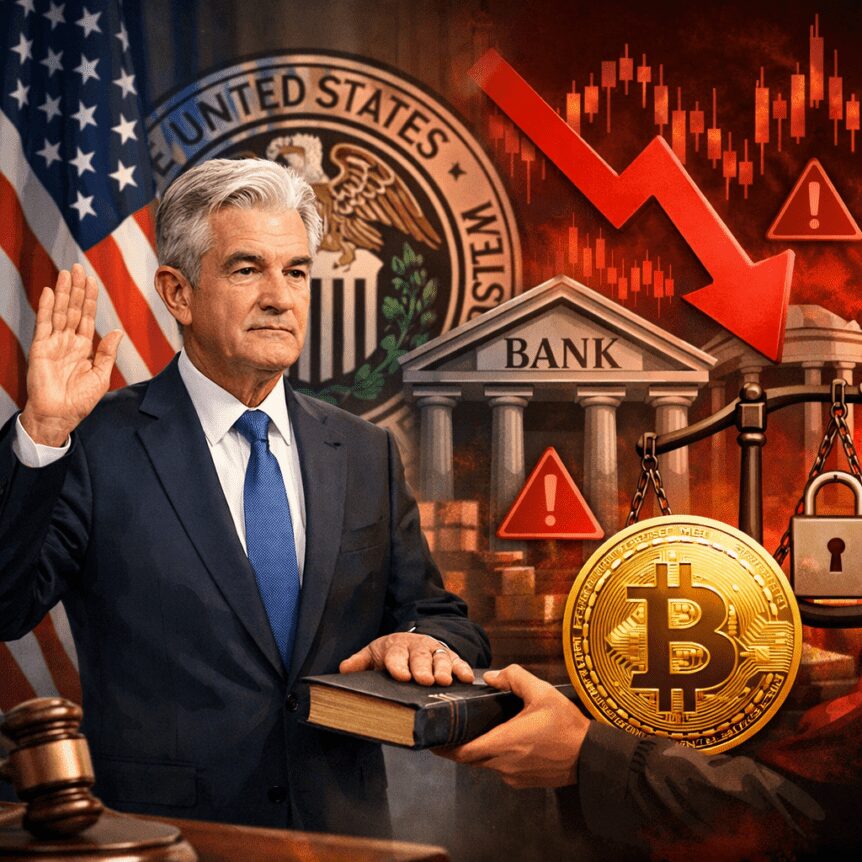
Kevin Warsh is poised to be sworn in as the next chair of the U.S. Federal Reserve Board of Governors this Friday, a transition that will place him at the center of monetary policy formation at a moment of heightened scrutiny over inflation, growth, and financial stability.
According to Cointelegraph, the Senate voted largely along party lines to confirm Warsh as the Fed’s new chair, succeeding Jerome Powell. The nomination comes as President Donald Trump has publicly pressed for a rate-cutting stance, a position that has fed ongoing debate about the Fed’s independence and its policy trajectory. In recent months, Trump publicly urged that the chair should be lowering interest rates, a stance that has intensified market and political discussion about looming shifts in policy direction.
With Warsh slated to assume the chair’s duties, synthetic market indicators have begun to price in divergent views on the policy path. Prediction-market platform Kalshi shows approximately 38.2% odds of the federal funds rate being lowered before 2027, a drop from roughly 96% observed in February. Meanwhile, CME Group’s FedWatch tool continues to signal a high probability that rates will remain at their current target of 3.50%–3.75% through the summer, with a 98.8% probability of no change through the end of June and more than 94% through July.
As the Fed chair, Warsh will wield substantial influence over policy deliberations and the setting of the federal funds rate, a task closely watched by financial markets, lenders, and institutions that rely on predictable policy signals. The next Federal Open Market Committee meeting is scheduled for June 16, providing a potential inflection point for policy if the new leadership signals a shift or confirms the status quo.
During Warsh’s confirmation hearing, concerns were raised about governance and potential conflicts of interest. Massachusetts Senator Elizabeth Warren argued that confirming Warsh could create opportunities for the Fed to direct favorable outcomes toward financial interests, citing the possibility of special accounts or bailouts tied to affiliations with private entities. Warsh disclosed assets exceeding $100 million ahead of the hearing, including holdings in AI and crypto-related ventures, a disclosure that has prompted ongoing discussions about independence, disclosure standards, and perception of risk within a central bank leadership role.
Key takeaways
- Kevin Warsh is set to be sworn in as the chair of the Federal Reserve Board, signaling a leadership transition with potential implications for monetary policy inference and regulatory posture.
- The confirmation vote in the Senate was described as largely along party lines, reflecting the broader political dynamics surrounding the central bank’s independence.
- Market expectations show a divide: Kalshi’s contract pricing indicates a 38.2% chance of a rate cut before 2027 (down from 96% in February), while CME FedWatch places a high probability on rate stability through mid-year and into summer.
- Warsh’s asset disclosure — reportedly more than $100 million, including investments in AI and crypto — has amplified discussions about governance, personal exposure, and conflict-of-interest risk for a central bank chair.
- Lawmakers are pressing for rapid CFTC nominations amid ongoing debates over crypto market structure, enforcement priorities, and the Digital Asset Market Clarity Act (CLARITY), underscoring the regulatory dimension of the evolving crypto landscape in parallel with traditional financial oversight.
Federal Reserve leadership and policy trajectory
The impending swearing-in of Warsh as Fed chair places him at the apex of a complex policy milieu that includes inflation dynamics, growth concerns, and financial stability considerations. While the Fed’s policy stance will ultimately be guided by the FOMC’s deliberations, leadership signals can shape the tempo of policy normalization or accommodation. The central bank operates with a mandate to maximize employment and price stability, and the appointment of a new chair often influences market interpretations of the committee’s appetite for rate adjustments or balance-sheet actions in the near term.
From a regulatory and compliance perspective, the transition underscores the importance of ensuring that chair-level commitments align with established institutional safeguards, independence norms, and robust governance practices. The ongoing dialogue around potential conflicts of interest and asset disclosures highlights the critical need for transparent governance frameworks within key U.S. financial authorities.
Market sentiment, risk assessment, and policy signaling
The divergence between prediction-market pricing and traditional probability tools reflects a broader ambiguity about the policy path under Warsh’s leadership. Kalshi’s pricing suggests a meaningful probability of a rate cut only beyond the near-term horizon, whereas the Fed’s own projections and futures markets continue to show a strong tilt toward policy stability in the coming months. This discrepancy matters in practice for institutions managing interest-rate risk, the pricing of secured funding, and risk-management frameworks that rely on forward-looking policy expectations.
Regulatory and institutional implications are evident in how market participants calibrate their capital planning, liquidity management, and lending practices. A shift toward a more aggressive rate-reduction stance could alter the pricing of risk across debt markets, impact leverage conditions for banks and nonbank lenders, and influence the valuation of income-oriented assets. Conversely, a confirmed stance of steady policy could reinforce the current macroeconomic assumptions underpinning credit markets and risk models.
Regulatory nominations, oversight, and the crypto-policy backdrop
Even as Warsh approaches the chair’s desk, lawmakers remain focused on the regulatory architecture governing financial markets, particularly the crypto sector. The CFTC’s leadership lineup has come under scrutiny amid debates about who should oversee innovative trading platforms and how rulemaking should evolve in tandem with digital asset market developments. Since December, the CFTC has been led by Michael Selig, with Acting Chair Caroline Pham replaced, and the regulator has taken a more assertive stance regarding platforms that host prediction markets and other digital-asset-related activity.
House lawmakers have urged the Trump administration to nominate a full slate of CFTC commissioners to address urgent regulatory issues and to provide clarity on rulemaking if the Digital Asset Market Clarity Act (CLARITY) were to become law. The evolving policy framework for crypto markets and the broader digital-asset ecosystem remains a dynamic area of federal regulation, with potential cross-border considerations and implications for licensing, enforcement, and market structure standardization.
According to Cointelegraph, these developments reflect a broader regulatory calibration: balancing innovation and investor protection, ensuring effective oversight of new trading venues, and aligning U.S. policy with a rapidly changing market landscape. The regulatory trajectory and the precise stance on crypto market infrastructure will be pivotal for exchanges, fintechs, and institutions seeking to operate within a coherent U.S. framework that can interface with international standards.
Institutional and compliance implications
The combination of a new Fed chair, ongoing questions about independence and disclosure, and the regulatory push around crypto markets creates a multifaceted environment for financial institutions. Banks and nonbank lenders alike must monitor policy signals that affect funding costs, capital adequacy planning, and risk governance. Compliance teams should prepare for potential shifts in disclosure requirements, governance expectations, and the regulatory posture toward digital assets, including how the CLARITY framework might influence licensing, reporting, and cross-border operations.
From a policy-history perspective, the Warsh appointment sits within a lineage of central-bank leadership where governance clarity and preemptive risk management are increasingly prioritized. The unfolding discussions about special accounts, bailouts, or other policy tools underscore the importance of maintaining a transparent framework that preserves independence while addressing public-interest concerns.
Closing perspective
As Warsh takes the helm, the key question is how quickly and in what direction monetary policy will respond to evolving macro forces and political considerations. Watch for signals from the Fed’s communications and the June 16 FOMC meeting, alongside ongoing Congressional and regulatory activity around crypto-market oversight. The coming weeks will illuminate how the new leadership balances independence, economic stability, and regulatory alignment in a rapidly changing financial landscape.



Nexo launched the Nexo Card in Argentina, giving eligible users a way to spend digital assets or borrow against them through one product. The card supports debit mode for direct spending and credit mode for borrowing against crypto collateral without selling holdings.
- Nexo’s dual-mode card lets eligible Argentine users spend crypto or borrow against holdings without selling.
- Buenos Aires now anchors Nexo’s Latin America strategy after Buenbit acquisition and Argentina football partnership.
- Andres Ondarra’s appointment gives Nexo a local lead with finance, fintech and crypto experience depth.
The company said users can switch between both modes inside one interface. Nexo also said the card supports purchases in Argentine pesos and U.S. dollars, with cashback on eligible spending and interest on idle in-app balances.
Nexo said the product is available through its app and website for eligible clients in Argentina. The launch gives the company a local payments tool in a market where crypto use remains tied to saving, payments and access to dollar-linked assets.
Incoming Argentina general manager Andres Ondarra said, “Argentine clients have spent a decade making digital assets part of how they manage wealth.” He added that the card lets users spend, borrow and earn “without having to sell.”
Ondarra takes over Argentina operations
The card launch came with Nexo’s appointment of Andres Ondarra as General Manager of Nexo Argentina. Ondarra will oversee local operations from Aug. 1, according to the company.
Ondarra has more than 25 years of experience across traditional finance, fintech and crypto in Latin America. Nexo said he will focus on client trust and the company’s growth in the country.He succeeds Federico Ogue, who led Nexo’s Argentina expansion and is moving to a new venture. Ogue had also been tied to Buenbit, the Argentine crypto platform acquired by Nexo.
crypto.news reported in April that Nexo became the official regional digital asset partner of Argentina’s national football team across South America. That report also said Nexo was building its local presence after the Buenbit deal.
Buenos Aires becomes Nexo’s Latin America hub
Nexo said Buenos Aires now serves as its regional hub for Latin America. The company plans to use the city as a base for client support, partnerships and local infrastructure.
Argentina has become a key market for crypto firms because many users already hold digital assets. Nexo said the country processed about $93.9 billion in digital-asset transactions over three years, ranking behind Brazil in Latin America.
The card fits that market by turning crypto balances into a spending and borrowing tool. Users do not need to sell assets before using credit mode, though access may depend on eligibility and account terms.
Nexo also says the card offers fee-free ATM withdrawals up to $1,000 and fee-free foreign-currency spending up to $2,000 each month. These features target users who want to connect crypto balances with daily spending.
Crypto cards gain ground in high-inflation markets
The launch comes as more companies test crypto-linked cards in Latin America and other inflation-hit markets. crypto.news reported that Western Union plans a stablecoin-backed prepaid card for countries facing currency pressure.
crypto.news also reported that Nubank wants to test stablecoin use within its credit card system. That plan shows how large fintech firms are looking at dollar-linked digital assets as a payment and settlement tool.
For Nexo, Argentina gives the company a market where crypto already has strong use among retail users. The Nexo Card adds a local product that connects payments, borrowing and yield features in one app.
The rollout may also test how users respond to hybrid crypto cards. Nexo’s next stage in Argentina will depend on user demand, local rules and how well the product works for everyday payments.


Bitcoin held above $62,000 on Thursday while the assets that are supposed to absorb a war premium moved in opposite directions.
Brent crude climbed 1% to $78.80 a barrel, a third consecutive session of gains, after the U.S. military completed another round of strikes against Iran and both sides raised the prospect of closing the Strait of Hormuz.
Gold extended its slide to a fourth day at around $4,060 an ounce. Government bonds in Japan, Australia and New Zealand fell, extending Wednesday’s global selloff, with two-year Treasury yields pushing toward their 2026 high.
Bitcoin traded at $62,009, down 1.2% over 24 hours and up 1.6% on the week. Ether was at $1,730, also off 1.2% on the day but up 5.7% over seven sessions. Solana was the laggard at $77.25, shedding 1.8% and 1.7% on the week. XRP slipped 0.7% to $1.09, TRON added 4% over seven days, and hyperliquid’s HYPE gained 5.9% on the week despite a 1.2% daily dip.
The escalation reignited inflation concerns and pulled forward rate expectations.
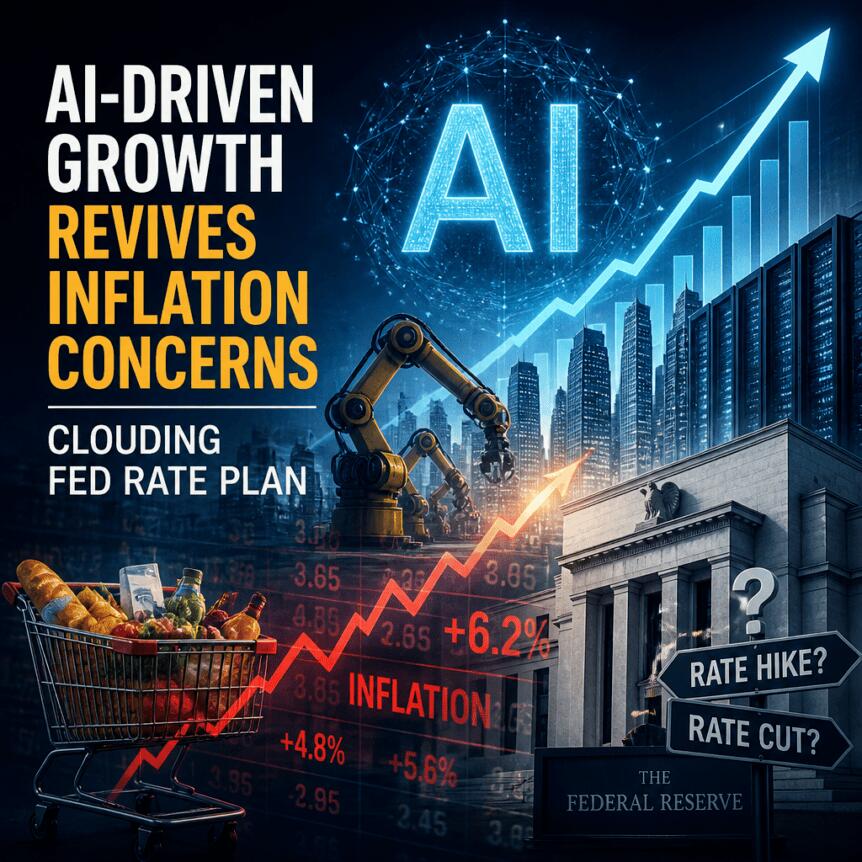
Federal Reserve officials were divided last month on whether to raise interest rates or keep them steady, as meeting minutes released Wednesday pointed to accelerating demand for artificial intelligence infrastructure as a factor sustaining inflation.
The minutes cover the first Federal Open Market Committee (FOMC) meeting under Chair Kevin Warsh and highlight how strong AI-driven spending may keep prices elevated for certain technology inputs—especially chips—and for electricity used to power data centers.
Key takeaways
- FOMC meeting minutes cited “ongoing strong demand for AI infrastructure” as likely to sustain upward pressure on prices for technology products and electricity.
- Officials expected inflation to stay “elevated in the near term,” with risks still “tilted to the upside.”
- Projections implied a hawkish path: the “dot plot” showed hikes, not cuts, with many members expecting at least one increase before the end of 2026.
- The Fed’s year-end PCE inflation projection rose, reinforcing the view that policy may remain restrictive for longer.
AI demand enters the Fed’s inflation discussion
According to the minutes, many participants argued that demand for AI infrastructure is acting as an inflation support rather than a one-time impulse. They specifically noted that continued demand for technology products and electricity could keep price pressures from fading quickly.
In practice, the minutes’ logic points to the economics of AI buildouts: higher demand for semiconductors used by data centers, combined with competition for energy, can lift consumer prices across a wide range of electronic goods, devices, and power-related costs. This process is often described in policy and financial circles as “chipflation.”
For crypto and other risk-sensitive assets, the implication is straightforward: higher inflation tends to reduce liquidity and spending power while supporting higher interest rates—conditions that can weigh on speculative exposure.
Near-term inflation expected to remain sticky
Fed participants anticipated inflation would remain “elevated in the near term.” They also discussed the possibility that disinflation could improve if the Middle East conflict eases, but they judged that the overall balance of risks to inflation was still skewed upward.
AI played a dual role in these deliberations. The minutes state that strong AI-related investment can lift growth above potential output, which can in turn contribute to more persistent inflationary pressure—essentially keeping demand strong while costs remain elevated for critical inputs.
“Most participants remarked that growth in economic activity that exceeded that of potential output, owing in part to strong AI business investment, could contribute to more persistent inflationary pressures.”
Dot plot and projections reinforce “higher for longer”
While the minutes reflect a split among officials, the broader policy signal leaned hawkish. The Fed’s dot plot, as cited in the report, suggested rate increases rather than cuts. Nine of 18 voting members projected at least one rate hike before the end of 2026, while six expected two 25-basis-point increases.
Inflation expectations also moved in the minutes’ framing: the central bank’s PCE inflation projection for year-end increased from 2.7% to 3.6%. Together, those changes point to an outlook where the Fed may need to tolerate a longer period of restrictive policy to bring inflation back toward target.
At the Fed’s June meeting, rates were held steady at 3.5% to 3.75%. In parallel, CME futures markets indicated a roughly 70% probability that rates would remain unchanged at the next meeting scheduled for July 29, according to the CME FedWatch tool.
Why AI infrastructure may complicate monetary policy
One notable theme in the discussion was how AI infrastructure buildout can produce near-term inflation pressure even while promising longer-term productivity improvements. Nick Ruck, director of LVRG Research, told Cointelegraph that the Fed’s recent meeting underscores this tension: massive AI infrastructure expansion can lift inflation through surging demand for semiconductors, energy, and data centers, even as it sets the stage for productivity gains over time.
That mix matters because it challenges a common policy assumption that technological investment uniformly improves efficiency quickly enough to ease inflation. If the cost of deploying AI systems remains concentrated in specific supply chains and energy systems, the benefit to productivity may arrive later than the price pressure created by demand for the underlying infrastructure.
Ruck’s comments also framed the issue as one that may require solutions beyond traditional monetary tools—particularly approaches that improve how resources are allocated and reduce bottlenecks in the digital economy. While the minutes focused on conventional price dynamics, the investor takeaway is that AI-driven inflation can interact with monetary policy in ways that are harder to neutralize quickly.
What it could mean for crypto market conditions
In general, elevated inflation and restrictive rate expectations tend to tighten financial conditions, which can reduce risk appetite and liquidity. The minutes’ emphasis on technology and electricity price pressures strengthens the case that inflation may not fall as quickly as some investors might hope, especially if AI-related capex continues expanding.
At the same time, investors are also watching for how the Fed’s approach could evolve if inflation pressures prove to be structural rather than transitory. That question is likely to remain central for markets, including crypto, where broader liquidity conditions often play an outsized role in determining price behavior.
Readers should watch the next phase of Fed communication for signs that officials see AI-related inflation as temporary supply bottlenecks or as a more persistent feature of the pricing environment—because that distinction could shape how long “higher for longer” expectations last and, by extension, how supportive macro conditions remain for risk assets.


Offchain Labs co-founder Steven Goldfeder said fees from Robinhood Chain and other Arbitrum Layer 2 networks will send 10% of net protocol revenue back to the Arbitrum ecosystem. He said the split sends 8% to the tokenholder-controlled Arbitrum DAO treasury and 2% to development funding.
Summary
- Robinhood Chain gives Arbitrum a direct revenue stream as enterprise L2 adoption expands quickly.
- The split sends 8% to tokenholder treasury and 2% to developer funding inside the ecosystem.
- Robinhood Wallet support adds bridges and swaps, widening access to the Arbitrum-built network for users.
Goldfeder said, “as enterprise adoption accelerates, Arbitrum is ready to capture revenue.” He also said 100% of fees collected on Arbitrum One will go to the Arbitrum treasury. The update gives Arbitrum a clear revenue route from external chains that use its technology stack.
The Arbitrum DAO factsheet describes the fee base as protocol net revenue. That wording shows the model focuses on revenue after network costs, rather than a simple share of every user payment. The split applies to chains deployed outside Arbitrum One under the Arbitrum Expansion Program. Such reporting may also help the DAO compare revenue across partner chains.
Robinhood Chain goes live in Wallet
Robinhood Chain is now live in Robinhood Wallet, according to the update shared by Wu Blockchain. Users can bridge assets from Solana, Ethereum, Arbitrum and other networks to Robinhood Chain, then make swaps inside the app.
The rollout follows Robinhood’s public mainnet launch earlier this month. crypto.news reported that Robinhood Chain is an Ethereum Layer 2 network built with Arbitrum technology and designed for tokenized stocks, real-world assets and DeFi tools.
The network moved from testnet to mainnet after months of development. crypto.news previously reported that the first testnet week processed more than 4 million transactions, as developers tested tokenized stock assets and finance tools before the public rollout.
Tokenized stocks anchor the new network
Robinhood has made tokenized stocks a central product on its new chain. The company said eligible users in more than 120 countries can trade tokenized equities through Robinhood Wallet and supported decentralized exchanges.
crypto.news reported that Robinhood also launched perpetual futures tied to commodities, ETFs and currencies for eligible European users. The same rollout included Stock Tokens, Robinhood Earn and plans for AI-linked trading accounts.
Those products give Robinhood Chain early activity across trading, lending and liquidity venues. Uniswap supports a dedicated automated market maker, while other infrastructure partners support data, custody and on-chain routing.
Revenue model may shape Arbitrum’s next phase
The Arbitrum DAO factsheet said Robinhood Chain went live on July 1 as a dedicated Arbitrum chain that settles to Ethereum. It said the chain returns 10% of protocol net revenue under the Arbitrum Expansion Program license.
The same factsheet said 8% flows to the Arbitrum DAO treasury and 2% goes to the Arbitrum Developer Guild. That structure gives tokenholders and builders a share of fees from chains built outside Arbitrum One.
Crypto.new reported that Robinhood Chain forms part of a wider corporate chain trend, alongside Base and other branded networks. The report said Robinhood uses its own tokenized equity business as the anchor for the chain.
For Arbitrum, the fee plan links enterprise adoption to ecosystem funding. The next test will be real usage. If Robinhood Chain handles steady trading, swaps and lending activity, the Arbitrum treasury and developer funds may receive a recurring revenue stream from the network.
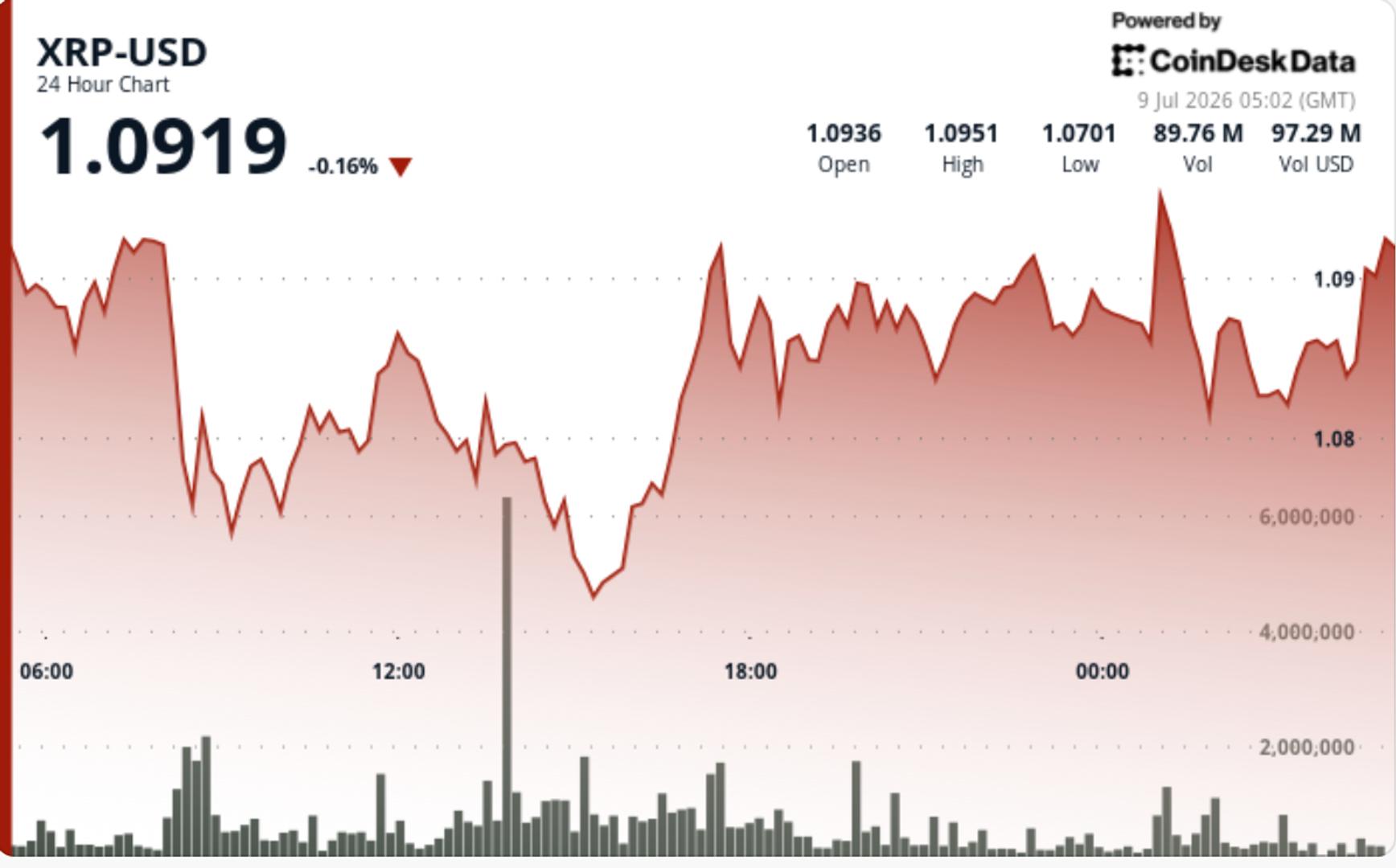
• Volume during that move reached 688,000 XRP, about 120% above the session average, before momentum faded.
• Earlier selling took XRP to a session low near $1.0742 after volume rose to 80.2 million, about 83% above the 24-hour average.
Technical Analysis
• The key development is that XRP continues to defend the $1.00-$1.05 support zone, which analysts say aligns with longer-term moving average and trendline support.
• The near-term chart remains weak despite the small bounce. Lower highs at $1.1133, $1.0993 and $1.0932 show sellers are still capping recovery attempts.
• XRP needs to hold above $1.088-$1.091 to build a cleaner move toward $1.093-$1.095.
• The larger setup remains a compression trade rather than a breakout. Monthly wedge and channel patterns may point to higher targets, but confirmation requires a sustained move above nearer resistance first.
• Relative weakness against bitcoin remains a risk, with the XRPBTC pair testing support near 1,700 sats.
What traders should watch
• $1.00-$1.05 remains the key support zone. Losing it would put $0.90 and then $0.80 back in focus.
• $1.088-$1.091 is the immediate resistance area after capping the latest breakout attempt.
• $1.20-$1.25 is the next major zone, where candle resistance and the 100-day moving average sit.
• A move above $1.40 would be the first stronger sign that XRP is breaking out of its broader compression.
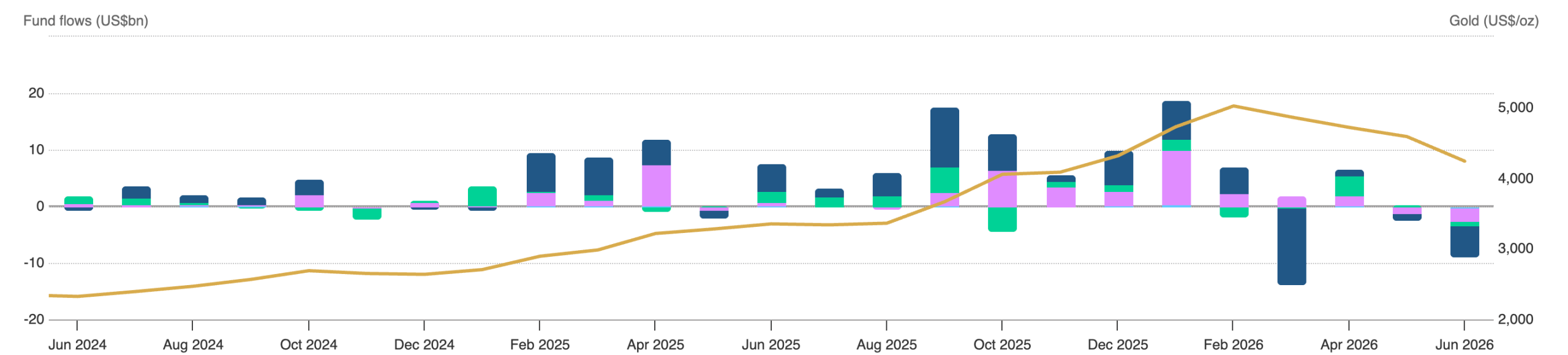
Investors pulled $8.9 billion from gold exchange-traded funds (ETFs) in June, with North American products accounting for $5.5 billion of the withdrawals as bullion’s price slide deepened.
The monthly retreat came as gold recorded its fourth straight losing month. The metal fell 11.7% as a hawkish Federal Reserve and Middle East tensions steered investors away from the metal.
Gold ETF Outflows Accelerated in June
According to the World Gold Council report, total assets under management fell 13% to $526 billion in the month. In addition, holdings dropped 74 tonnes to 4,047 tonnes. The selling followed a sharp price pullback that reset investor allocations.
During the month, New Fed Chair Kevin Warsh signaled a hawkish stance, and the US-Iran conflict lifted inflation fears. Together, they raised expectations of higher rates ahead. Rising real yields and a stronger dollar increased the opportunity cost of holding non-yielding gold.
North American funds recorded $7.7 billion in outflows across the first half, the region’s weakest start to a year since 2013. European funds lost $818 million in June after the European Central Bank hiked rates 25 basis points, its first increase since September 2023.
Follow us on X to get the latest news as it happens

Markets outside the big three regions also turned negative. Combined outflows totaled $262 million in June, bringing their 2026 net buying to $106 million. Australia accounted for most of that drop at $197 million, and South Africa gave up $36 million.
“Looking ahead, regional gold ETF flows could stabilise…Meanwhile, uncertainties surrounding geopolitics, economic growth and financial markets linger. This backdrop may continue to support investor demand for portfolio protection and sustain interest in gold ETFs as a strategic safe-haven allocation,” the report read.
A Positive First Half Despite the June Drop
Nonetheless, global flows were still positive at $8 billion over the first half of 2026. Asia led with $12 billion in additions, its strongest first half on record. That came despite a $2.3 billion June outflow, the region’s worst month ever, driven mainly by Chinese funds.
India bucked the trend, drawing inflows as local investors treated the price dip as an entry point. Collective global holdings rose 18 tonnes across the half, though assets under management fell 6% on the lower price.
Subscribe to our YouTube channel to watch leaders and journalists provide expert insights
The post Gold ETFs Lose $8.9 Billion in June as Global Outflows Accelerate appeared first on BeInCrypto.


Bitcoin remains in deep value territory after trading below two major on-chain cost-basis levels for about five months, according to Glassnode. The firm said BTC is still below the True Market Mean near $76,600 and the short-term holder cost basis near $72,200.
Summary
- Bitcoin trades below key cost-basis levels, keeping deep value conditions active but still technically unconfirmed.
- ETF outflows have slowed, yet weak volumes show institutional demand has not fully returned.
- Long-term holder losses remain elevated, leaving sell-side pressure as Bitcoin’s main recovery barrier.
These levels matter because they track the average price paid by active investors and recent buyers. When Bitcoin trades below both, many market participants hold coins at a loss. Glassnode said this phase can support long-term accumulation, but it has not yet confirmed a market bottom.
Bitcoin recently bounced from about $58,300 to $64,400. The move showed short-term strength, but it did not bring BTC back above the main recovery levels. Glassnode said, “The evidence suggests this process is approaching its later stages,” but it also warned that the realized price near $53,000 cannot be ruled out.
The setup keeps the focus on whether Bitcoin price can reclaim the $72,200 and $76,600 areas. Until then, BTC remains exposed to selling pressure and weak risk appetite.
Long-term holders are still realizing losses
Glassnode data shows that long-term holder loss realization has increased sharply since February. The share of total realized value from long-term holder losses rose from 15% in early February to 43%.
This group includes investors who bought near cycle highs and held through months of drawdown. Some are now exiting as the bear market lasts longer than expected. Glassnode said these sellers have become a major force stopping Bitcoin from reclaiming higher levels.
Daily long-term holder realized losses recently reached about $280 million. That was the highest level since December 2022. The firm said this pressure has not yet cooled enough to confirm that sellers are exhausted.
The next few weeks may be key for this metric. A steady drop in realized losses would show that long-term holders are selling less. Without that change, Bitcoin’s recovery may remain limited.
ETF outflows keep institutional demand weak
Bitcoin ETF flows remain another weak point. Glassnode said the 30-day average of spot Bitcoin ETF netflows has improved from about $193 million in daily outflows to $88.9 million. Still, flows remain negative.
crypto.news reported that U.S. spot Bitcoin ETFs recorded about $4.5 billion in net outflows in June. The same report said June became the worst month for the products since their January 2024 launch.
There has been some relief since then. crypto.news reported that spot Bitcoin ETFs recorded $221.7 million in net inflows on July 2, ending a 10-day outflow streak. That followed nearly $2.7 billion in withdrawals during the prior 10 trading sessions.
However, Glassnode said ETF trading volume remains weak. Daily ETF trading volume sits between $650 million and $950 million, about 80% below the October 2025 peak. This shows that institutional demand has not fully stabilized.
Options data shows caution despite reduced shorts
Derivatives data gives a mixed picture. Glassnode said the options open-interest put/call ratio has dropped to 0.56, its lowest level of 2026. This means traders are holding far fewer puts than calls.
That shift suggests short demand has eased. It also shows that traders have reduced some defensive positions after Bitcoin’s recent bounce. Still, the options market continues to price demand for downside protection.
crypto.news reported that BlackRock’s Bitcoin ETF flow drought recently eased while Bitcoin flashed a fresh rally signal. The update added to signs that parts of the market are trying to stabilize after heavy selling.
Glassnode said Bitcoin may be in the later stage of a bear-market bottoming process. But it said confirmation still needs three conditions: lower long-term holder selling, stable ETF flows, and a recovery above key cost-basis levels. Until those signals appear together, Bitcoin’s bottom remains unconfirmed.


Kraken leads MiCA-regulated crypto exchanges in liquidity, according to DefiLlama’s MiCA exchange dashboard. The data cited by Wu Blockchain showed Kraken with $399.71 million in spot liquidity and $206.90 million in perpetual liquidity, placing it first in both categories.
Summary
- Kraken leads MiCA exchanges in liquidity, giving larger traders deeper order books across regulated European markets.
- Coinbase remains the closest rival, but DefiLlama data shows Kraken ahead across core liquidity metrics.
- MiCA licensing has changed Europe’s exchange race, making liquidity and market coverage key user factors.
DefiLlama’s live MiCA-regulated exchanges dashboard later showed Kraken still ahead, with more than $400 million in spot liquidity and more than $220 million in perpetual liquidity. The live figures may change because liquidity data moves with market depth, prices and exchange activity.
Coinbase ranked second in the figures cited by Wu Blockchain, with $305.23 million in spot liquidity and $167.39 million in perpetual liquidity. DefiLlama’s live page still placed Coinbase among the top regulated venues, but behind Kraken in the main liquidity table.
The gap matters for traders who need deeper order books. Higher liquidity can help reduce slippage when users place larger orders. It can also make an exchange more useful for active traders, market makers and institutional clients.
Coinbase and Crypto.com remain close rivals
Coinbase remains Kraken’s closest large rival among MiCA-regulated exchanges. The exchange has built its European base in Luxembourg, where it uses a MiCA license to serve users across the bloc.
crypto.news reported that Coinbase opened its Luxembourg MiCA hub as the EU deadline approached. The exchange said Luxembourg became its MiCA home for all 27 EU member states.
Crypto.com also ranked among the larger MiCA exchange venues by spot liquidity. Wu Blockchain cited $130.84 million in spot liquidity for Crypto.com, while DefiLlama’s live dashboard showed a similar range.
Bitstamp, Bybit, OKX, Gate and Backpack showed smaller liquidity pools. Bitstamp and Bybit stood near $50 million in spot liquidity in the cited data. OKX, Gate and Backpack were lower in spot liquidity, though Backpack and OKX had recorded perpetual liquidity.
Market coverage gives Kraken another lead
Kraken also leads the listed exchanges in market coverage. Wu Blockchain cited 1,704 markets for Kraken, followed by Coinbase with 1,074 markets and Crypto.com with 883 markets.
Market coverage shows how many trading pairs and products a platform supports. It does not guarantee better prices by itself, but it gives users more routes to trade assets under one regulated platform.
Gate, Bitstamp, Bybit, Backpack and OKX showed smaller market counts. The cited data listed Gate at 303 markets, Bitstamp at 298, Bybit at 133, Backpack at 125 and OKX at 65.
For European users, the mix of liquidity and market coverage may shape where activity moves after MiCA. Exchanges with deeper liquidity and more markets may attract users who left platforms without full authorization.
MiCA changes Europe’s exchange race
MiCA has changed how crypto exchanges operate in Europe. The framework requires crypto asset service providers to hold approval if they want to serve users under the bloc’s unified rules.
crypto.news reported that Kraken secured its MiCA license from the Central Bank of Ireland in June 2025. The license allows Kraken to offer regulated services across the European Economic Area.
Other exchanges also moved before the July 1 deadline. crypto.news reported that OKX expanded services across 28 EEA markets after securing MiCA approval through Malta.
The new data shows that licensing alone does not decide the race. Liquidity, trading products and market coverage now separate regulated exchanges from each other. Kraken currently leads those metrics among the listed MiCA platforms, while Coinbase, Crypto.com and other venues continue to compete for European users.
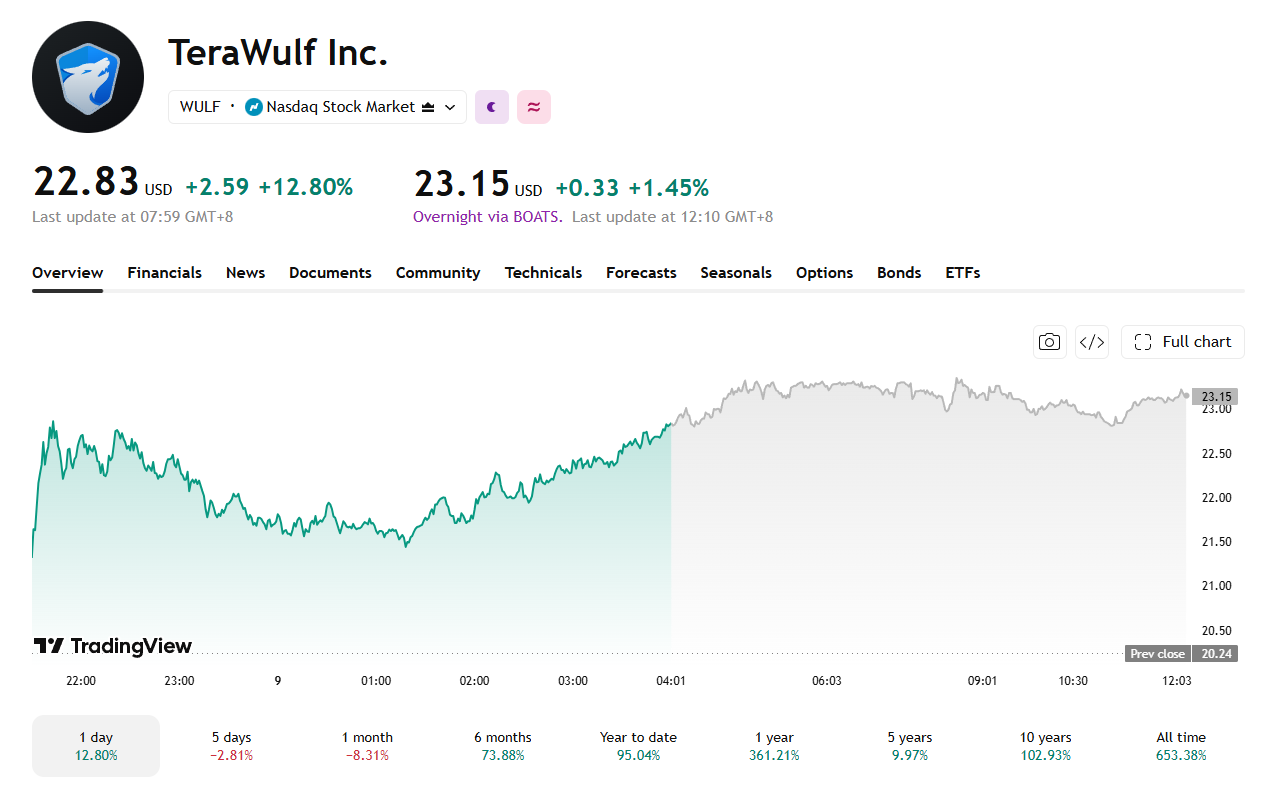
TeraWulf (WULF), IREN, and Hut 8 (HUT) all rallied yesterday, July 8, but Bitcoin’s price had nothing to do with it. Each saw their stock prices continue to rally on separate AI infrastructure news.
All three companies were in the top 16 best performing stocks for Wednesday, July 8 as investors reward their shift no matter what Bitcoin does on the day.
TeraWulf’s Anthropic Deal Set the Tone
TeraWulf stock rose more than 12.8% after signing a 20-year lease with Anthropic for a Kentucky data center. The site will support 401 megawatts of critical IT load, online by early 2028.

Analysts project roughly $19 billion in revenue over the lease’s term. Compass Point raised its price target to $40 from $28 after the deal and kept its buy rating.
CEO Paul Prager said the lease confirms the company’s AI infrastructure pivot and locks in a long-term revenue stream. TeraWulf also sold its stake in a Texas project, freeing cash for AI infrastructure investment elsewhere.
IREN and Hut 8 Caught the Same Bid
IREN climbed 8.01% after Freedom Capital Markets upgraded the stock to buy. The firm argued the recent pullback had created more upside than the market recognized. A Nvidia keynote appearance on July 8 also lifted sentiment around Bitcoin miner stocks.
Hut 8 jumped 9.69% in a single session after joining several Russell growth and small-cap indexes. Index inclusion suggests institutions are noticing the shift toward AI. The stock is up 383% over the past year.
The pattern is clear across the sector, visible in crypto stocks to watch beyond these three names. Miner valuations now track AI leasing headlines more closely than bitcoin mining stocks ever tracked Bitcoin’s price.
Whether that holds once AI capex slows is the question for the second half of 2026.
The post Bitcoin Miners Bet Big on AI Infrastructure and Win. TeraWulf, IREN, Hut 8 Surge appeared first on BeInCrypto.

Over three weeks ago, the Ripple team launched a new software update for the XRP Ledger (XRPL). Although the infrastructure upgrade (v3.2.0) has been running for close to a month now, not all of the network’s validator nodes have adopted it. In fact, more than half of the nodes are still running on the old version (v3.1.3) and are yet to come on board.
Data from XRPScan shows that only 43%, accounting for 357 out of 828 nodes, have upgraded to v3.2.0. On the other hand, 51%, that is 426 of the nodes, are still running on v3.1.3.
XRPL Launches New Upgrade
The latest infrastructure upgrade introduces several new features to the XRPL. One of them is the rebranding of the core server software from rippled to xrpld. The update also optimizes institutional usage by significantly reducing operating costs and implementing 30% to 40% lower memory usage across network nodes.
Additionally, v3.2.0 improves security, developer experience, and network efficiency, adding another confidence layer for builders. These features will add to the bug fixes and improvements to permissioned domains and vaults implemented during the v3.1.3 maintenance rollout in late May.
It is worth mentioning that despite the majority of nodes still operating on v3.1.3, roughly 61% of XRPL validators running on rippled versions have adopted the new upgrade. Also, 89% of the Unique Node List (UNL), which is the ledger’s trusted set of validators, are currently running on the software.
The XRPL needs 80% of the UNL to activate any network upgrades. With 31 out of 35 UNL validators having cleared the threshold, the network treats v3.2.0 as sufficiently updated. So, it is only a matter of time before other nodes jump on the bandwagon.
V3.2.0 Amendment Under Voting
In the meantime, the XRPL is trying to approve and implement security fixes associated with v3.2.0. The fixes, bundled in an amendment titled fixCleanup3_2_0, are yet to be approved, as it is still under voting on the XRPL.
The XRPL needs 28 out of 35 UNL votes to cross the threshold and approve the amendment; however, the network has gotten 17 so far. This means only 48.57% of trusted validators have voted so far.
If approved, fixCleanup3_2_0 will deploy fixes for single-asset vaults, lending protocol, multi-purpose tokens, permissioned domains, and permissioned decentralized exchanges.
The post Ripple Rolls Out New XRPL Upgrade, but Less Than Half of Nodes Have Upgraded appeared first on CryptoPotato.

Caitlin Clark’s injury return goes poorly in Fever loss to Sparks

Meta’s new AI tool can generate images of you using your Instagram photos, and you’re opted in by default

M6 traffic LIVE as drivers face long delays on stretch of motorway


-

 Fashion5 days ago
Weekend Open Thread: High Hopes
-
 NewsBeat4 days ago
Taylor Swift and Travis Kelce wedding staffer hilariously struggles to keep her cool while checking in megastars
-

 Fashion3 days ago
Open Thread: What Great Books Have You Read Recently?
-

 Politics6 days ago
The House | “Reframing the debate from a binary discussion of winners and losers”: Yuan Yang reviews ‘We Are Not Machines’
-

 Crypto World6 days ago
Standard Chartered Secures MiCA License as ESMA Adds 37 New Crypto Firms
-

 News Videos2 days ago
Whats Hidden Inside This Cash Register? #treasure #reselling #money
-
 Tech2 days ago
Anthropic’s new “J-lens” reveals a silent workspace inside Claude that mirrors a leading theory of consciousness
-

 Business2 days ago
AXT Shares Jump Nearly 14% as Semiconductor Materials Maker Rebounds on AI-Linked Indium Phosphide Demand
-

 Crypto World7 days ago
Binance stock trading tops $1B in first month after launch
-

 Sports2 days ago
Joshua Pacio ‘more complete’ ahead of ONE rematch vs Malachiev
-
 Crypto World5 days ago
ESMA Expands Crypto Register by 37 Firms Following MiCA Transition Period
-
Crypto World2 days ago
SK hynix (000660.KS) Stock Dips as $28B Nasdaq ADR Offering Drives AI Memory Expansion
-

 Crypto World4 days ago
South Africa proposes crypto tax guidance under existing rules
-

 News Videos3 days ago
Best Time to Enter Small Caps Right Now? Another Bull Run? | Financially Free
-

 Tech4 days ago
Lenovo laptops are now shipping with YMTC SSDs, a sign of Chinese NAND entering the mainstream
-
 NewsBeat7 days ago
New exhibition reflects five decades of movement between island of Ireland and GB
-

 Business6 days ago
What a 10 Percent Drop Means for Buyers, Sellers and Renters
-
Sports2 days ago
We have punished the disrespect
-

 Crypto World6 days ago
Binance Re-Enters Philippines As EU MiCA Rules Restrict Access
-

 News Videos3 days ago
Avoid entering in FOMO #bitcoin #cryptocurrency #trading #scalping
You must be logged in to post a comment Login