
Crypto World
Nursing Homes Have Become Last-Resort Housing


Many patients in that situation wind up living on the streets or in shelters, despite efforts to find them permanent housing. A surprising number of older adults, however, find themselves in a nursing home—even if they don’t need or want that level of care.
According to research from the United Health Foundation, one in 11 people in nursing homes have “low-care needs,” meaning they do not require physical assistance for bed mobility, transferring, using the toilet, or eating. The ratios vary by state, from a low of 2.5% in Hawaii to nearly 23% in Oklahoma.
Synovec recalls one client in her 50s who lost her housing while she was in the hospital getting treatment for a stroke. Although a family member was willing to take her in, she couldn’t navigate their second-floor apartment. The stroke left her without the use of one arm and with mild cognitive problems, but she still was able to manage most daily activities, including taking the bus to visit family, friends, and her church. She needed some help—for example, with getting dressed—but she valued her independence.



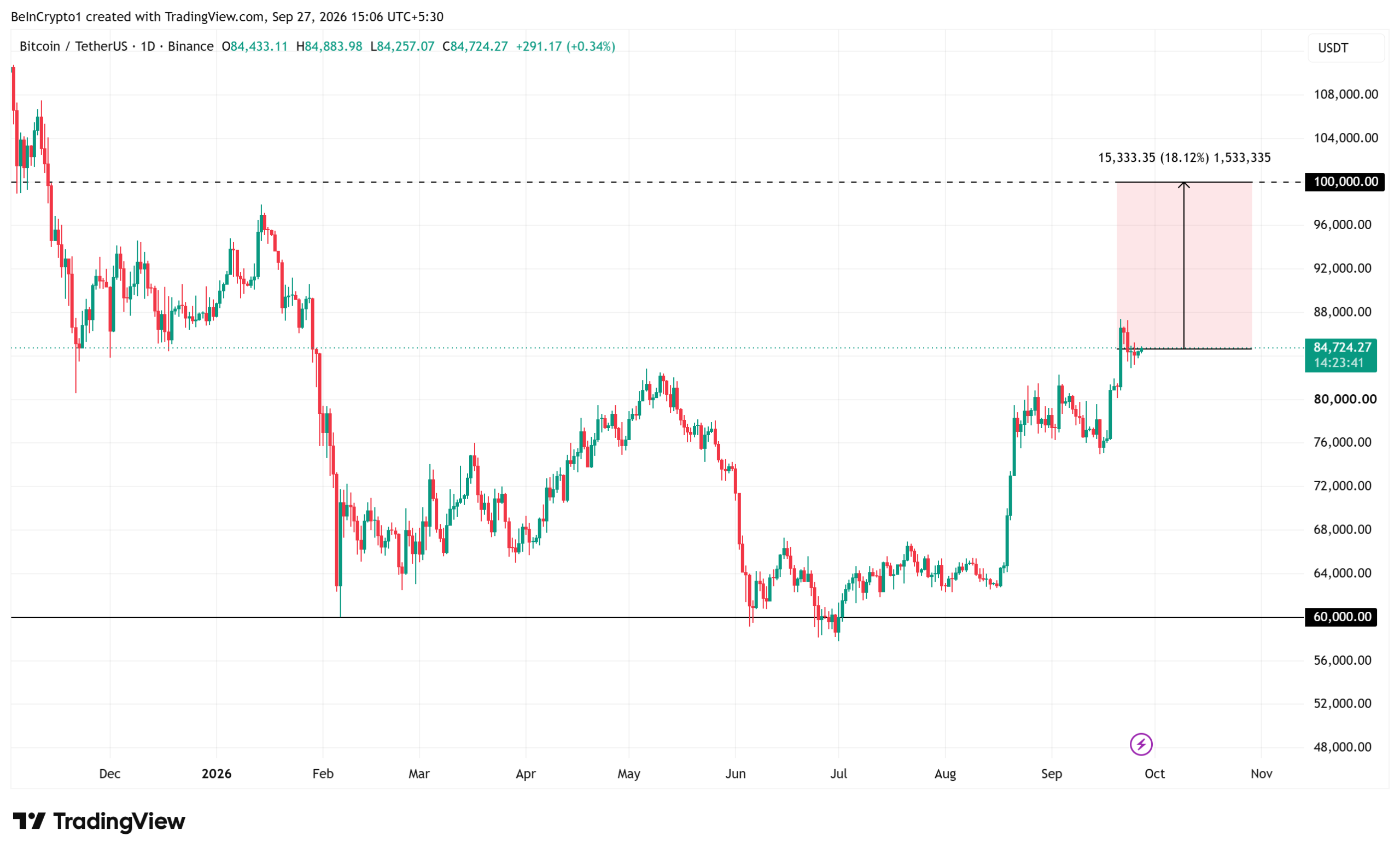
Bitcoin continues to hold above $80,000, the level Fidelity’s Jurrien Timmer says would confirm a bottom and open a path to $100,000.
Bitcoin (BTC) traded at $84,647 on Sunday, about 18% short of that target. Futures speculators, meanwhile, are adding to record bullish bets.

Bitcoin Breaks the $80,000 Level Fidelity Flagged
Timmer is director of global macro at Fidelity Investments, one of the largest US asset managers. He set out the trigger in a post, citing a double bottom chart pattern, where price hits a similar floor twice, then climbs.

“Bitcoin is looking particularly interesting here as it challenges key resistance at $80k. If it breaks it will confirm a double bottom targeting $100k,” Timmer wrote.
Timmer’s weekly chart marks this year’s lows at $60,033 in February and $57,742 in late June.
His charts use data through September 20. Since then, Bitcoin has crossed $80,000 and touched about $87,500 before easing.
Why Fidelity Sees $300,000 Bitcoin by 2029
Timmer also pointed to Bitcoin’s power law, a model that fits its long-run price to a curve over time. On that model, he says holding $60,000 signals a new bull market aimed at $300,000 in 2029.

“Bitcoin’s power law math continues to suggest that a new cyclical bull market is underway after holding $60k, targeting $300k in 2029,” the Fidelity executive added.
That marks a turn. In December, Timmer raised bear market concerns, warning of a possible drop to between $65,000 and $75,000. Bitcoin later fell further.
Can the Bitcoin Rally Hold?
Tom McClellan, editor of The McClellan Market Report, tracks the Commitments of Traders (COT) report. The US Commodity Futures Trading Commission (CFTC) publishes it weekly to show who holds futures positions.
McClellan says speculators such as hedge funds recently hit a record net long position. That means their bets on rising prices far outweigh bets on falling ones.

“What is unusual is that with the pop earlier this week, these traders actually were adding more longs instead of harvesting gains. That is a strong statement that they expect more gains to come,” McClellan wrote.
Other signals are mixed. In August, BeInCrypto flagged three warning signs, including weaker exchange-traded fund (ETF) flows and spot demand.
This month, BeInCrypto also reported CryptoQuant’s bull market line at $81,700, Bitcoin’s one-year average close. The current Bitcoin price sits about $3,000 above it.
That leaves a narrow cushion. A slip back under $80,000 would undo the break Timmer’s $100,000 target depends on.
The post Fidelity's $100,000 Bitcoin Signal Just Flashed appeared first on BeInCrypto.

Hester Peirce plans to leave the Securities and Exchange Commission on Oct. 2, leaving Chair Paul Atkins and Commissioner Mark Uyeda to handle a crypto offering proposal still open for comment. The agency can legally operate with two commissioners. Whether the two agree on what its final rules should say is the question her exit brings forward.
Summary
- Peirce plans to leave on Oct. 2, leaving 2 commissioners in office unless a replacement arrives.
- SEC rule 200.41 permits a quorum of 2 when only 2 commissioners hold office.
- A federal appeals court upheld an SEC decision issued by 2 commissioners in 1996.
- Comments on Regulation Crypto Assets are due Oct. 20, 18 days after Peirce’s planned exit.
- The SEC’s Sept. 17 stock trading exemption lasts 5 years under its published terms.
The Securities and Exchange Commission’s largest proposed crypto offering rule cannot be finalized before the public finishes commenting on it. That deadline is Oct. 20. Hester Peirce plans to leave the commission on Oct. 2, according to her resignation letter. Count the dates: the final 18 calendar days of public comment on Regulation Crypto Assets will arrive after the commissioner who led the agency’s Crypto Task Force has left.
That does not stop the proposal. Nor does it prevent a vote by the two commissioners expected to remain, Chair Paul Atkins and Mark Uyeda. The SEC’s own quorum rule permits the commissioners in office to constitute a quorum when fewer than three hold office. A federal appeals court upheld that arrangement in a case nearly 30 years ago. The question after Peirce leaves is less dramatic and more consequential: can Atkins and Uyeda agree on a final text after comments arrive, and who will carry the task force’s work to that decision?
Peirce has not been the only official shaping the agenda. Atkins chairs the commission and publicly supports the proposal. Uyeda helped launch the Crypto Task Force while serving as acting chair in January 2025 and has issued his own statement supporting the August proposal. The three have approved work together. From Oct. 2, if the membership remains as currently listed, there is no third vote available to resolve a disagreement between the two who remain.
The departure date moved forward, and the rulemaking did not
Peirce joined the SEC in 2018. The commission’s membership page currently lists her alongside Atkins and Uyeda and says her term expired in 2025; SEC commissioners may remain for a limited period after a term expires if they have not been replaced. She had previously indicated that she would join Regent University School of Law, leading earlier accounts to place her departure in November. Her subsequent resignation set Oct. 2 as the exit date. As of Sept. 27, the SEC’s membership and Crypto Task Force pages still identify her as serving. Their status should be checked again on the day she actually leaves.
The date corrects a point in our own archive. An earlier crypto.news feature on the SEC’s delayed crypto vote said she would depart in November and suggested that operating with two members would create an untested quorum problem. The new Oct. 2 date supersedes the earlier calendar. More significantly, the quorum claim needs correction: the rule expressly allows two sitting members to form a quorum, and a federal appeals court has already upheld its use. The risk of a divided two-person commission is real, but it is a voting and policy risk, not an automatic inability to meet.
The pending Regulation Crypto Assets docket, file S7-2026-27, gives this change an unusually clear measure. The SEC issued the proposal on Aug. 18. The Federal Register published it on Aug. 21. The docket lists Oct. 20 as the deadline for public comments. The proposed rule contains two tailored Securities Act registration exemptions for investment contracts involving crypto assets: one for up to $5 million over four years and another for up to $75 million in any 12-month period. It proposes a conditional route for an asset to cease being subject to an investment contract once promised essential managerial work has ended.
Those numbers are proposed limits, not permissions that an issuer can use today merely because the SEC published a draft. The SEC must review comments, decide whether to revise the draft and vote on a final rule before the new exemptions can operate. A material revision could require further notice and comment. An Oct. 20 deadline starts the next stage; it is not a deadline by which the commission must approve the measure.
Two commissioners are a lawful quorum, not an unprecedented experiment
The SEC ordinarily has five seats, and the standard quorum is three. Rule 200.41 contains an exception: when fewer than three commissioners are in office, the members who are in office constitute the quorum. The SEC’s listed membership as of Sept. 27 consists of three officials. If Peirce leaves Oct. 2 and no replacement takes office, Atkins and Uyeda would meet the text of that exception.
This is not merely an agency’s untested assertion about its own powers. In Falcon Trading Group v. SEC, 102 F.3d 579, the U.S. Court of Appeals for the District of Columbia Circuit considered a challenge to an SEC decision issued in December 1995 when only two commissioners held office. The petitioners argued that a five-seat commission could not act through two members. In December 1996, the court upheld the SEC’s quorum rule and the decision made under it.
The court reasoned that Congress had empowered the SEC to make rules needed to carry out its functions and had not imposed a conflicting statutory quorum. That is a direct precedent for the legitimacy of the two-member quorum. It concerned an enforcement-related administrative decision, not Regulation Crypto Assets or a final crypto rule. It therefore does not pre-approve the contents or procedure of any future crypto regulation. A party could still challenge a final rule on other statutory or administrative grounds.
The practical limit is arithmetic. Two commissioners voting yes can approve a measure that requires commission approval. If one supports a proposed final rule and the other opposes it, there is no third sitting member to make a majority. An abstention or recusal would raise a distinct procedural question that cannot be resolved by simply assuming the remaining official may act alone on every matter. Staff can continue preparing recommendations, receiving comments and administering existing rules while a commission vote is unavailable. The exact authority for a particular staff or delegated action depends on its own governing rule.
The finding changes how to read Peirce’s departure. Losing a commissioner reduces the number of decision makers and leaves less room to negotiate a contested final text. It does not switch off the SEC. The difference matters because a project deciding whether to submit a comment by Oct. 20 should not assume that its submission will go to an agency legally incapable of finishing the work.
The Crypto Task Force loses its named leader, not its entire staff
The SEC’s Crypto Task Force page still identifies Peirce as its leader. Uyeda announced its formation on Jan. 21, 2025, while serving as acting chair. He said then that the task force would coordinate work across SEC divisions and offices. The commission has since issued an interpretation, a proposed offering rule and relief for a specific tokenized stock trading model. They are agency actions or proposals, not personal orders signed by Peirce alone.
The agency has not, on its public task force page as of Sept. 27, identified a successor. That is a specific open question. Atkins could name a new commissioner or otherwise reorganize the work, subject to the powers available to the chair and the commission. The present record supports neither the assertion that the task force will close nor the claim that a named replacement has already taken over. Its channels for public submissions and meetings are still displayed on the SEC site.
Peirce’s role has nevertheless been distinctive. Her 2020 token safe harbor proposal argued that teams building decentralized networks should have time to develop before facing all the consequences of conventional securities registration. When the SEC proposed its new offering framework on Aug. 18, she described the proposed exemptions in her own statement. She has pressed the agency to write paths a project can follow instead of relying on individual enforcement cases to set the boundary. Removing her from the commission removes one participant in the final vote and one source of institutional memory about the arguments behind the draft.
It does not remove the work from everyone else. Uyeda’s statement on the same Aug. 18 proposal thanks staff in the divisions of Corporation Finance, Trading and Markets, Investment Management and Economic and Risk Analysis, along with the task force and other offices. Drafting, economic analysis, legal review and public comments run across that structure. A public announcement of who will lead the task force after Oct. 2 would reveal how the SEC intends to coordinate those people, but the people do not all depart with Peirce.
The unfinished rules are at different stages
Three frequently grouped SEC crypto measures have different legal statuses. Confusing them makes Peirce’s exit seem either more destructive or less important than it is.
First, the SEC’s March 17 interpretation of federal securities law has already been issued. It explains the commission’s view of how existing law applies to certain crypto assets and activities, including staking and wrapping. A change in personnel does not automatically withdraw it. An interpretation also lacks the same permanence as an act of Congress; future agency action or a court’s reading of the statute could change the operative guidance.
Second, Regulation Crypto Assets is a proposed rule. Its $5 million and $75 million offering paths remain drafts. The SEC’s docket gives the public until Oct. 20 to respond to file S7-2026-27. This is the measure whose next substantive steps will fall most clearly to the commission after Peirce’s departure. Its final content can change in response to comments on investor disclosures, investor eligibility, state-law treatment and the conditions under which an investment contract ends.
Third, the SEC issued a temporary innovation exemption on Sept. 17 for a defined model of trading tokenized National Market System stocks on permissioned automated market maker venues. Crypto.news covered the five-year exemption when it was issued. Its published conditions include limits on symbols and volume, equivalent shareholder rights and coordination with trading halts in the underlying stock. The order says the exemption is set to expire five years after publication and requests comments on possible changes. Peirce leaving does not erase relief already granted. Whether the agency modifies, replaces or extends the arrangement later is a separate choice.
There is another pipeline item relevant to tokenization: the SEC’s September transfer agent proposal would update recordkeeping and other obligations for the firms responsible for shareholder registers, including the use of newer technology. Crypto.news reported on the proposed overhaul when it appeared. Like Regulation Crypto Assets, it is not final law. A tokenized stock trading exemption and a transfer agent proposal address different parts of the securities market, so neither substitutes for the other.
The transfer agent docket supplies a second test of the new commission’s capacity. Its comment deadline is Nov. 3, more than a month after Peirce’s planned departure. Unlike the offering proposal, this rule reaches ordinary securities infrastructure as well as digital assets: transfer agents track changes in legal ownership, maintain records and perform services for issuers. Changes to the register matter for a company whose shares are recorded using blockchain technology because an investor’s token and the legally recognized shareholder entry need a dependable connection. A trading exemption cannot fill a gap in ownership records. Staff will have to weigh comments on operational controls, costs and the relationship between electronic records and existing transfer-agent duties before commissioners decide whether to adopt a final rule.
Put the dates in sequence. Oct. 2 removes one commissioner if her resignation takes effect as announced. Oct. 20 closes comments on crypto offering exemptions. Nov. 3 closes comments on the transfer-agent proposal. The first two dates are 18 days apart; the latter deadline falls 32 days after the departure date. Neither docket says a final vote follows the next morning. Both may require revision, legal review and an explanation of why the agency chose one approach over alternatives raised in the record.
The stage of each measure is the first practical filter. An interpretation stays in place unless changed or superseded. A temporary order operates under its conditions and expiry. A proposed rule still needs the commission to finish notice and comment, consider the record and approve a final version. Peirce’s exit changes the voters for the last task; it does not reset every item to zero.
The final vote belongs to Atkins and Uyeda if no one else joins
The strongest case against a narrative of paralysis comes from the two officials expected to remain. Atkins proposed the crypto offering package as chair, saying the commission wanted tailored pathways for raising capital while Congress considered a longer-lasting market framework. Uyeda, who formed the Crypto Task Force, supported advancing the proposal. They have shared public positions on the direction of the SEC’s crypto work. If those positions continue through the public comment process, a two-member commission can approve a final rule without Peirce.
The opposing case is not that the rule is unpopular. It is that support for a proposal does not commit either commissioner to every detail of a final text. The agency could receive objections to how an exemption treats disclosures, a $75 million annual fundraising ceiling or the proposed separation of a crypto asset from an investment contract. One commissioner could decide that a revised version gives too little investor protection, while another could view additional conditions as defeating the point of the safe harbor. With three members, an internal disagreement might still yield two votes. With two, it cannot.
This is an inference about incentives and arithmetic, not a reported disagreement between Atkins and Uyeda. Their Aug. 18 statements show support for issuing the draft. They do not reveal how either will vote after comments are analyzed. Public records matter more than assumptions about party affiliation: even commissioners who agree on the objective can disagree on a sentence that determines who is exempt.
The task force’s public consultations may become more significant under that constraint. The SEC can respond to a well-supported objection by changing a provision before seeking a final vote. A measured change that satisfies both commissioners can move the file forward. A change one regards as essential and the other rejects could stall it. The public comment docket will expose some of that pressure, although internal negotiations need not be public.
The Senate can change the membership by confirming nominees if the president puts names forward. The SEC is designed for up to five commissioners, with no more than three from the same political party, according to the agency’s membership page. The current public roster names Atkins, Uyeda and Peirce, not an incoming replacement. A future appointment is possible, but the article cannot assign a date or presume it will happen before the proposal reaches a final vote.
Peirce’s last work illustrates what can move without a new rule
On Sept. 25, SEC Corporation Finance staff published questions and answers on the March interpretation. They address, among other things, staking receipt tokens, representations about managerial effort and when a token associated with a functioning network might be treated differently from an investment contract. The document is staff guidance about an existing commission interpretation. It is not Regulation Crypto Assets finalized in miniature.
That distinction illustrates what continues when the commission has only two members. Staff can explain an existing interpretation and answer questions within their authority. Staff guidance does not create a new statutory exemption or bind a future commission in the way a duly adopted rule might. Someone designing a crypto offering cannot substitute the Sept. 25 FAQ for the conditions and effective date of a future Regulation Crypto Assets rule.
Peirce’s public Sept. 23 remarks to a securities industry conference show why she thought these lines mattered. As more assets, intermediaries and uses enter the category, the SEC must identify the transactions that fall within securities law and avoid treating every technological arrangement as the same instrument. Her view has shaped the discussion, but a speech remains a commissioner’s perspective. The agency’s published releases and orders identify what it has formally done.
That division of labor will remain after Oct. 2. The chair can speak for his program, divisions can publish staff guidance where authorized, the task force can gather input if it continues, and the commission can vote on action requiring commission approval. None of these acts is interchangeable. Crypto.news traced the rulemaking underway after the CLARITY Act vote, but the SEC’s interpretation, proposal and exemption each demand a separate test of what changed. Readers trying to judge whether the crypto rulebook is actually changing should look at the document’s legal form as closely as its headline.
The comment record will test the rule’s limits
The most important work between an Oct. 20 deadline and any vote is sorting the objections by the provision they address. The $5 million pathway and the $75 million pathway solve different financing problems. A smaller issuer may care most about the cost of preparing disclosures across a four-year period; a larger issuer may care about whether a 12-month cap can accommodate a capital raise without ordinary registration. If comments show that either exemption can be divided into successive offerings to evade its limits, staff would have to decide whether to propose an aggregation rule or recommend rejecting that approach. Those are examples of questions the final record could raise, not defects the SEC has already found.
The proposed route for separating a crypto asset from an investment contract creates another choice. Its practical value depends on how an issuer demonstrates that promised essential managerial efforts have ended and what happens if a promoter later resumes them. Commenters can ask for clear evidence, time periods and disclosure duties. The commissioners then must decide whether a workable test can be written under existing securities law. A final release that merely repeats the proposed aspiration would give firms and courts less to apply than a release that explains how it handled competing examples in the comments.
Public comments do not amount to a referendum. The SEC need not adopt the position with the most submissions, and submitting a comment does not give the writer a vote. The agency does need a reasoned basis for its final choices and must operate within the authority Congress gave it. If it makes a substantial change that people had no fair opportunity to address, a further round of public comment may be needed. That possibility makes the Oct. 20 date a checkpoint in the process rather than a finish line.
For a reader following the rule, the useful comparison is concrete: line up the proposed exemption conditions with the final adopting release and its response to significant objections. The text will show who qualifies, what an issuer must disclose, when the limits reset and when a token’s treatment can change. The accompanying explanation will show whether Atkins and Uyeda reached the same account of investor protection and market access. A final rule adopted with both votes would settle their immediate disagreement on that text; it would not settle every court challenge or bind Congress from changing the law.
What the exit does not decide
Peirce’s departure will not itself determine whether a token is a security, whether the proposed safe harbor becomes final or whether Congress passes a digital asset market structure law. Those questions are governed by legal texts and future decisions. The SEC can act only within its statutory authority, and the pending congressional debate concerns powers an agency cannot simply give itself.
Nor does Falcon Trading guarantee that every action approved by two commissioners will survive litigation. It validates the SEC’s reduced quorum under the circumstances before that court. A new rule could still be challenged for its substance, the scope of its exemption, its treatment of comments or procedural defects unrelated to headcount. Conversely, saying the two-member commission is inherently invalid ignores a directly relevant court decision.
This article cannot name Peirce’s successor at the Crypto Task Force because the SEC’s public page still lists her as leader as of Sept. 27. It cannot say how Atkins or Uyeda will vote on a final rule because the comment period remains open. It can identify the next documents that will answer those questions: a revised task force leadership page or announcement, the comment docket after Oct. 20, a final adopting release and the votes recorded for it.
The timetable is plain. Peirce’s stated exit is Oct. 2. Public comments on the flagship proposal close Oct. 20. The gap is 18 days. Under the current rule and precedent, Atkins and Uyeda can act as the commission if no replacement arrives; each would then be indispensable to a contested final crypto rule. Nothing in the SEC’s docket promises that the final vote will occur in October or even in 2026.
What to watch
- Oct. 2 membership. Check whether Peirce leaves as announced and whether the SEC names another commissioner.
- Task force leadership. A new SEC designation would identify who coordinates the work Peirce led.
- Oct. 20 comments. File S7-2026-27 will show objections to the proposed offering caps, disclosures and safe harbor.
- A revised proposal or final vote. Either filing would reveal whether Atkins and Uyeda agree on the rule’s terms.
- Commission votes. The SEC publishes votes on rules and orders, allowing readers to distinguish a unanimous decision from an unresolved proposal.
FAQ
When is Hester Peirce leaving the SEC?
Peirce has set Oct. 2, 2026, as her departure date, according to reporting on her resignation letter. As of Sept. 27, the SEC’s public membership page still lists her as a commissioner.
Who would be left on the SEC commission?
If no replacement takes office, Chair Paul Atkins and Commissioner Mark Uyeda would be the two members in office after Peirce leaves. The agency is designed to have up to five commissioners.
Can the SEC operate with two commissioners?
Yes. SEC rule 200.41 says that when fewer than three commissioners are in office, the members in office form a quorum. A federal appeals court upheld an SEC decision made by two commissioners in 1996.
Can two commissioners approve a crypto rule?
The reduced quorum can conduct commission business, and two commissioners voting in favor could approve a measure requiring commission action. If the two split on its final terms, neither has a third vote to settle the disagreement.
Is Regulation Crypto Assets already in force?
No. The SEC issued it as a proposal on Aug. 18, 2026, under file S7-2026-27. The proposed $5 million and $75 million exemptions would require further agency action to become operative.
When do comments on the crypto proposal close?
The SEC docket lists Oct. 20, 2026, as the deadline. That is 18 calendar days after Peirce’s announced Oct. 2 exit, and it is not a promised date for a final rule.
Does Peirce’s exit cancel the tokenized stock exemption?
No. The SEC issued temporary, conditional relief on Sept. 17 for a particular tokenized stock trading model. Its published terms say it expires five years after publication, subject to future agency action.
Who will lead the SEC Crypto Task Force next?
The SEC’s public task force page still names Peirce as leader as of Sept. 27, and it has not identified a successor there. A later agency announcement may answer that question. This is educational analysis, not investment advice.
Disclaimer: This article is for information and educational purposes only and does not constitute financial or investment advice. Figures reflect regulatory filings and reporting available at the time of writing and change with each disclosure. Nothing here is a recommendation to buy, sell, or hold any security or asset. Always do your own research. Information is accurate as of September 27, 2026.

Spools of electrical wires outside a series of assembly tents during a media tour of the Stargate AI data center in Abilene, Texas, US, on Tuesday, Sept. 23, 2025. Stargate is a collaboration of OpenAI, Oracle and SoftBank, with promotional support from President Donald Trump, to build data centers and other infrastructure for artificial intelligence throughout the US.
Kyle Grillot | Bloomberg | Getty Images
With Treasury yields climbing this week to their highest levels since 2007, companies reliant on debt are poised to see their borrowing costs rise. That means the AI infrastructure buildout, which has already reached historic levels, is about to get even more expensive.
JPMorgan Chase estimated in June that $4.1 trillion in AI-related debt will be issued through 2030, as data center companies and others tied to the artificial intelligence boom race to build up capacity to meet what many industry experts view as insatiable demand for AI services.
As borrowers go back to the market, they’re now looking at a 10-year Treasury yield that sits near 5.17%, up about 1 percentage point since the start of the year, meaning companies issuing debt are going to have to offer more attractive rates of return to lure investors.
The market isn’t in panic mode, at least not yet. Shares of debt-heavy neocloud CoreWeave have held up fine, rising almost 8% this week, while Oracle, which has counted on the debt market for its AI expansion, has had a tougher time, falling 7% for the week and about 30% this year.

CoreWeave vs. Oracle this week
Meanwhile, Japan’s SoftBank, a principal provider of capital for AI projects, raised $11.1 billion in a junk-bond sale this week, with yields as high as 9.75% for the 7-year tranche.
“They basically are price insensitive to that raise, which means they’re price takers,” said Mark Malek, chief investment officer at Siebert Financial, in an interview. “In my view, a lot of these companies need to be price insensitive. They need to get as much capital as possible to compete.”
At the center of the AI craze are leading model developers OpenAI and Anthropic, which are each valued at close to $1 trillion in the private market. To provide the infrastructure needed for their advanced models, as well as models and services from a host of other companies, tech’s hyperscalers — Amazon, Google, Meta and Microsoft — have committed to hundreds of billions of dollars this year in capital expenditures, with an expected increase coming in 2027.
While a healthy dose of that investment is being funded through debt raises, those tech giants all have investment grade credit ratings, providing them with cheaper access to capital. But for the rest of the pack, bigger challenges lie ahead, according to some market participants.
Warning signs?
A senior private credit investor, who asked to remain unnamed in order to speak candidly on the matter, told CNBC that, moving forward, neocloud deals will be more difficult to finance, because the companies have less cushion to absorb the costs.
Riley Thompson, a vice president at Mitsubishi HC Capital America said in an interview that lenders are getting pickier about the projects they’re willing to fund even if the borrower agrees to pay a higher rate.
“Instead of a roster of 50 neoclouds, there’s probably 20 that the market’s truly interested in,” Thompson said.
CoreWeave, which went public last year, warns about rising rates in its SEC filings. In its latest quarterly filing, the company said that, as of June, every 100-basis point (1 percentage point) increase in rates could result in a $30 million jump in its interest expense, based on the balance of its outstanding floating rate debt.
An early warning sign may have landed this week, when Oracle’s stock slid following a Bloomberg report that the company sent a “force majeure” notice tied to its New Mexico data center project to protect itself from higher expenses. The company is looking to delay payment on the campus, dubbed Project Jupiter, if it fails to come online as expected in 2028, the report said. Oracle said the project “remains on our planned schedule.”
Rising interest rates aren’t the only matter at hand. Prior to this week’s spike in yields, the CEOs of Anthropic and OpenAI had started urging a slowdown in the pace of AI development after industry researchers went public with concerns that advanced models risk spinning out of human control.
At the same time, a nationwide backlash against AI data centers has emerged as a major issue heading into November’s mid-term elections, with 69% of respondents to a recent NBC News Decision Desk Poll, powered by SurveyMonkey, saying they oppose the construction of such facilities in their local area. On Monday, Texas Republican Gov. Greg Abbott, who’s in the midst of a tight race for reelection, ordered a temporary halt to all data center-related environmental permits following a moratorium on grid approvals last month.
Still, demand for AI services is exploding. The latest example is Meta’s Muse personal assistant app, which has rocketed in popularity since its launch earlier in September. Muse clocked more than 2.5 million global downloads in its first two weeks, passing ChatGPT at the top of Apple’s App Store, and Evercore’s Mark Mahaney told CNBC this week that it could reach 100 million users within six to 12 months.
Mark Zuckerberg, chief executive officer of Meta Platforms Inc., reveals the Muse Charm device during the Meta Connect event in Menlo Park, California, US, on Wednesday, Sept. 23, 2026.
Minh Connors | Bloomberg | Getty Images
Andrew Giudici, global head of corporate, project, and infrastructure finance at credit rating agency KBRA, said that even as rising rates may affect future deals, he doesn’t see a major impact on borrower demand.
“In a normal environment, people might take a step back and pause a bit,” Giudici said. “But I don’t think that’s going to happen here. I think you’re going to continue to see relatively large issuance.”
Haim Zaltzman, vice chair of Latham & Watkins’ emerging companies and growth practice, said there’s no doubt that as costs rise, “somebody will have to absorb it.”
“But absorbing it in that kind of demand structure, where the demand is so great, is a lot easier,” said Zaltzman, who works on AI infrastructure financing.
The equation is even simpler for Bernie Margulies, CEO of American Compute, which advises on risk management for GPU financing. He said borrowers are eager to secure financing even at higher costs, especially if they have committments with OpenAI and Anthropic, which have been signing contracts to secure compute capacity years into the future.
“If you have a deal with Anthropic, will 50 basis points really stop you?” Margulies said.


U.S. spot Bitcoin ETFs have attracted about $5.3 billion since the Treasury announced larger long-dated bond buybacks, according to ETF analyst Nate Geraci.
Summary
- $5.3 billion entered spot Bitcoin ETFs after Treasury announced larger long-dated bond buybacks in August.
- $2.4 billion flowed into U.S. Bitcoin ETFs during the week ending September 25 alone overall.
- $999 million entered the funds Monday, ranking as their ninth-largest daily inflow since launch historically.
- Bitcoin ETF flows turned positive for 2026 after reaching a $5.8 billion deficit during July.
- BlackRock’s IBIT led last week with approximately $1.2 billion in net inflows, market data shows.
Geraci said on Sept. 26 that the funds collected $2.4 billion during the latest week alone, while Monday’s roughly $1 billion intake ranked as the ninth-largest single-day inflow since U.S. spot Bitcoin ETFs launched in January 2024.
The rebound has pushed 2026 flows back into positive territory after the group sat nearly $5.8 billion in the red during July. Market data puts year-to-date net inflows near $934 million after the latest five-session run.
Bitcoin ETF inflows reach $5.3 billion since Treasury announcement
The U.S. Treasury announced on Aug. 19 that it would increase the maximum size of liquidity-support buybacks involving longer-dated nominal Treasury securities.
Operations covering the 10-to-20-year and 20-to-30-year sectors were raised from a maximum $2 billion to at least $4 billion each. The larger operations took effect Sept. 9 and are scheduled to remain in place through Nov. 4.
Geraci linked the timing of the ETF recovery to that policy announcement. His calculation puts cumulative spot Bitcoin ETF inflows since then at approximately $5.3 billion.
The figure describes two developments that occurred over the same period. It does not by itself establish that Treasury buybacks caused investors to allocate money to Bitcoin funds.
Treasury said the larger operations were intended to provide more liquidity in long-dated government bond markets. It cited consistently strong offers from market participants in those sectors as the reason for increasing the transaction sizes.
Treasury buyback program, the Aug. 19 announcement coincided with falling long-term yields and stronger risk-asset prices. The report noted that the 30-year Treasury yield declined after reaching a 19-year high.
Geraci’s observation focuses on ETF flows since the announcement date, while Treasury’s larger transactions themselves did not begin until Sept. 9.
Bitcoin ETFs collect $2.39 billion in one week
The strongest part of the ETF recovery came during the Sept. 21–25 trading week. U.S. spot Bitcoin funds drew approximately $2.39 billion over five consecutive positive sessions, according to Farside Investors data compiled by crypto.news. Monday generated about $999 million, followed by $714.7 million Tuesday and $346.9 million Wednesday.
Thursday added $190.7 million before another $134.5 million arrived Friday. The five sessions produced the largest weekly total since October 2025.
As crypto.news reported on the weekly ETF flows, BlackRock’s iShares Bitcoin Trust led the period with approximately $1.16 billion. Fidelity’s FBTC attracted $701.6 million, while ARK 21Shares’ ARKB added $294.7 million.
Morgan Stanley’s MSBT received another $203.3 million during the week, its largest weekly intake since the fund launched in April.
Monday’s $999 million intake was the strongest daily total of 2026 and the ninth-largest single-day inflow recorded by U.S. spot Bitcoin ETFs since their launch, according to SoSoValue figures cited by The Block. The pace slowed during each subsequent session, but the funds remained positive through Friday.
2026 ETF flows recover from a $5.8 billion deficit
The latest subscriptions reversed a much weaker first seven months of the year. U.S. Bitcoin ETFs were roughly $5.8 billion underwater on a year-to-date basis around July 13. The latest weekly inflows brought 2026 net flows to approximately $934 million above zero.
Separate Farside-based calculations put the year-to-date low near negative $5.69 billion. By Sept. 22, ETF flows had turned positive for the first time since May 26.
The funds have now collected approximately $57.6 billion in cumulative net inflows since their January 2024 launch, while total net assets stood near $108.4 billion at the end of Friday.
The turnaround did not occur in a straight line. During the Sept. 14–18 week, Bitcoin funds finished with only about $6.1 million in net inflows after losing a combined $746.3 million on Tuesday and Wednesday. Friday’s $433 million inflow erased most of that decline.
As crypto.news reported after the Federal Reserve meeting, flows changed direction on Sept. 17 with $159.5 million entering the funds. Another $433 million arrived the following session before demand accelerated the next Monday.
Bitcoin holds near $84,000 after ETF demand rises
Bitcoin’s price rose sharply during the ETF inflow streak before giving back part of the advance. BTC moved above $87,000 early in the week, reaching roughly $87,363 before retreating toward $84,000 by Sept. 26. Crypto.news put Bitcoin near $84,008 on Binance early Friday. The cryptocurrency remained up around 3.8% over seven days, while the total crypto market value stood close to $2.98 trillion.
In related coverage, crypto.news reported that the rally began alongside stronger ETF demand, with $999 million entering Bitcoin funds Sept. 21 and $714.7 million following a day later. Futures traders added more than $2 billion in open positions over the same period. Bitcoin subsequently pulled back despite continued ETF subscriptions. Crypto.news reported on Sept. 25 that funds remained in a six-session inflow streak even as BTC consolidated near $84,000.
Sell orders were concentrated between roughly $85,000 and $85,800 on Sept. 26, while the four-hour Supertrend indicator stood near $86,435. Bitcoin remained above its daily 20-period midpoint after retreating from the weekly peak.
Treasury buyback schedule runs through November 4
The Treasury’s expanded long-end buyback program remains scheduled through the current quarterly refunding period.
Under the Aug. 19 announcement, each operation in the targeted long-duration sectors can reach at least $4 billion, double the prior $2 billion maximum. Treasury said it would provide information on future buyback sizes during its next Quarterly Refunding on Nov. 4.
The department described the transactions as liquidity-support operations for older Treasury securities, not monetary stimulus or purchases conducted by the Federal Reserve.
Geraci’s $5.3 billion ETF calculation uses the Treasury announcement as the starting date for measuring Bitcoin fund flows. Bloomberg ETF analyst Eric Balchunas separately pointed to the same period while discussing the ETF rebound, according to The Block.
Friday’s $134.5 million intake extended the Bitcoin ETF inflow streak to seven trading sessions. The run beginning Sept. 17 accumulated approximately $3 billion before markets closed for the weekend.

GIWA has rejected claims that its mainnet RPC was leaked, saying the Ethereum Layer 2 network has not launched its mainnet.
Summary
- GIWA says its mainnet remains unlaunched, ruling out any leak involving a live mainnet RPC.
- Official documentation lists only GIWA Sepolia testnet RPC endpoints while mainnet infrastructure remains under development.
- GIWA runs on the OP Stack and uses Ethereum as the settlement layer for transactions.
- GIWA Wallet and stablecoin ecosystem products remain labeled Coming Soon on the project website currently.
- Upbit partnered with Optimism to build GIWA under a self-managed OP Enterprise infrastructure model earlier.
The project said on X on Sept. 27 that a mainnet RPC leak was impossible because no mainnet has gone live. GIWA told users to “DYOR” and remain alert to false information and scams circulating before launch.
Official GIWA documentation supports the main point of the clarification. The network’s mainnet section remains marked as under development, while GIWA Sepolia is available as a public test environment.
GIWA mainnet remains under development
GIWA’s connection documentation does not provide a mainnet RPC endpoint. Instead, developers can access the GIWA Sepolia testnet through sepolia-rpc.giwa.io, while a separate Flashblocks test endpoint is available for faster transaction preconfirmation.
Both endpoints are rate limited and intended for development and testing, according to the project’s network guide. GIWA specifically says its mainnet is “currently under development.”
The same distinction appears in GIWA’s smart contract documentation. Its contracts page lists deployed contracts for the Sepolia testnet but leaves the mainnet section marked as under development.
A separate Flashblocks document identifies a working testnet endpoint while listing the corresponding mainnet endpoint as “Coming soon.”
The available documentation therefore supports GIWA’s statement that a public test network exists while the production network has yet to launch.
The clarification follows social-media claims involving what was described as a leaked mainnet RPC. GIWA did not identify the accounts or URLs behind those claims in the statement supplied for this report.
No evidence provided by GIWA indicates that its Sepolia testnet RPC was compromised. The project’s response specifically addresses claims involving the unlaunched mainnet.
GIWA uses OP Stack for its Ethereum Layer 2
GIWA is an Ethereum Layer 2 built with the OP Stack, the open-source software framework maintained within the Optimism ecosystem.
Its technical documentation describes a one-second block time and compatibility with Ethereum Virtual Machine development tools. Developers can deploy Solidity contracts using tools already common in Ethereum development.
The network uses a sequencer for block production, while Ethereum provides the Layer 1 environment underlying GIWA’s settlement architecture. The current design specifies a 60 million block gas limit and one-second block intervals.
Unlike some Layer 2 networks, GIWA does not currently advertise a separate native token. Its FAQ says ETH is used as the base asset and for transaction fees, while stablecoin-based fee payments may be supported later through a Paymaster system.
Upbit’s involvement became public earlier in 2026. Upbit partnered with Optimism to build GIWA using the OP Stack under the Self Managed OP Enterprise tier.
The arrangement allows Upbit to manage its own infrastructure while receiving technical support and failover services from Optimism, according to the report. Sequencer control gives the operator responsibility for ordering transactions on the network.
GIWA’s own documentation describes the chain as “Powered by Upbit” and positions it as infrastructure linking users, developers and liquidity to Web3 applications.
GIWA Wallet and stablecoin products remain unfinished
GIWA’s public website shows that several planned products have not yet entered general release. The official site lists GIWA Wallet as “Coming Soon.” It describes the wallet as a self-custody product designed for GIWA Chain with multichain support and integrated views of exchange assets.
A planned stablecoin ecosystem carries the same status. GIWA says it intends to support stablecoin payments involving Korean won and global stablecoins, including Paymaster infrastructure that could allow stablecoins to cover transaction fees.
The project currently directs developers toward its testnet instead. Test ETH is available through a faucet, and developers can use GIWA Sepolia for smart contracts, wallet integrations and other testing before production deployment.
GIWA’s smart contract development guide supports Foundry, Hardhat and Remix IDE. Applications can use Solidity or other EVM-compatible tools because the network follows Ethereum’s execution environment.
The node documentation provides a similar test-focused setup. Developers can run their own GIWA node or use the free Sepolia RPC endpoint, while the project recommends external node services for future production workloads.
Upbit continues building around blockchain infrastructure
GIWA forms one part of Upbit operator Dunamu’s efforts to expand beyond centralized exchange trading.
The project’s website describes on-chain identity, data oracle services, a wallet and stablecoin payments among planned components. Some remain in development as GIWA progresses toward a production network.
Upbit has previously had to clarify reports concerning unreleased blockchain products. Crypto.news reported in July that the exchange rejected claims it was participating in issuing Open USD after Dunamu appeared on a list connected to the stablecoin initiative.
At the time, Upbit said it had not agreed to issue or launch the dollar-backed stablecoin. Several other South Korean companies named in the same initiative similarly denied having made formal commitments.
GIWA’s current clarification is narrower. It concerns technical claims about an RPC endpoint and states only that no GIWA mainnet has been launched.
The project’s public documentation does not provide a mainnet launch date. Its connection, contracts and Flashblocks pages continue to show mainnet features as being under development or coming soon.

Bitcoin’s seven-day average hashrate has fallen to roughly 915.8 EH/s while miner holdings dropped by 1,530 BTC over one week, according to mining data covering Sept. 20 through Sept. 26.
Summary
- Bitcoin’s seven-day average hashrate fell to 915.8 EH/s, its lowest level in three weeks recently.
- Miner reserves declined by 1,530 BTC in one week to approximately 1.1928 million BTC overall.
- Bitcoin’s Puell Multiple rose by 0.24 over the week to reach a reading of 1.13.
- Mempool data showed network hashrate remained below one zettahash during several late-September sessions this week.
- Several listed miners have continued selling mined Bitcoin as operating and infrastructure strategies evolve further.
Digital Asset reported that the seven-day moving average stood at 915,844,520 TH/s on Sept. 26, down approximately 34.86 million TH/s from a week earlier. The reading was the lowest since around Sept. 3.
During the same period, CryptoQuant data cited by the report placed miner Bitcoin reserves at 1,192,766 BTC. The balance was 1,530 BTC lower than seven days earlier.
Bitcoin hashrate slips after September recovery
The hashrate reading indicates that less computing power was securing the Bitcoin network on a seven-day average basis than one week earlier.
Hashrate measures the combined computational power miners use to process Bitcoin transactions and compete to add new blocks. A higher network hashrate generally means more computing resources are participating in mining.
Public Mempool mining data supports the weaker late-September trend. Individual daily and pool-level readings moved below one zettahash during several sessions after climbing above that threshold earlier in September.
CoinWarz recorded Bitcoin network hashrate at roughly 954 EH/s on Sept. 25 after readings near 984 EH/s a day earlier. Its daily estimates showed substantial swings throughout September, including levels above 1 ZH/s on Sept. 15 and Sept. 9.
The movement follows a longer decline from Bitcoin’s late-2025 peak. Twenty One Capital CEO Raphael Zagury described the period as Bitcoin’s first “hashrate bear market,” based on the distance from the network’s previous record.
Zagury’s presentation put the decline from the late-2025 peak at roughly 22% to 24%. He linked part of the reduction to mining companies directing more power and capital toward artificial intelligence computing.
The Sept. 26 seven-day average represents a shorter-term reading and should not be treated as proof that all miners are reducing capacity. Bitcoin hashrate can fluctuate because of block timing, power conditions, mining difficulty and changes in active equipment.
Miner reserves fall by 1,530 BTC in one week
Miner-held Bitcoin declined during the same week. CryptoQuant data cited by Digital Asset showed miner reserves at 1,192,766 BTC on Sept. 26. The figure was down 1,530 BTC from the previous week.
CryptoQuant defines miner reserve as Bitcoin held in wallets associated with miners and mining pools. A falling balance indicates that coins have moved out of tracked miner wallets, although the destination and purpose can vary.
Outflows can involve exchange sales, transfers to custodians, collateral arrangements, lending or other treasury activity. A decline in reserves therefore does not establish that every transferred Bitcoin was sold in the open market.
Earlier in September, miner reserves briefly moved in the opposite direction. Reporting based on CryptoQuant data placed miner holdings near 1.1919 million BTC on Sept. 5, an increase of 261 BTC from the previous week.
Public mining companies continue to show different treasury policies. CleanSpark, for example, mined 593 BTC in August but sold 821 BTC during the month.
As crypto.news reported on CleanSpark’s August production, the company finished August holding 13,703 BTC. Its average operating hashrate reached 38.3 EH/s. Other miners have reduced or abandoned mining activity as computing infrastructure is redirected toward AI customers. Hyperscale Data stopped Bitcoin mining at its Michigan facility on Sept. 1 while preparing the site for an AI computing contract.
Crypto.news reported on the Michigan shutdown that the company’s Bitcoin holdings had fallen roughly 79% from 1,006 BTC in July to around 215 BTC.
Bitcoin’s Puell Multiple increased during the week even as miner reserves and hashrate declined. Digital Asset reported a reading of 1.13 on Sept. 26, up 0.24 from seven days earlier. The metric compares the daily U.S. dollar value of newly issued Bitcoin with its 365-day moving average.
A reading above one means daily miner issuance revenue is higher than its one-year average. The indicator does not directly measure miner profit because it does not account for each operator’s electricity, financing or equipment costs.
Public mining dashboards show similar readings around the neutral range. HalvingLens placed the Puell Multiple near 1.01 on Sept. 26 and classified the level as normal. The site estimated daily miner issuance near 450 BTC and daily miner revenue around $37.8 million at the time.
The difference between individual Puell readings can result from data timing, price sources and methodology. The Digital Asset figure of 1.13 refers specifically to the source it cited for Sept. 26.
Bitcoin’s current block subsidy remains 3.125 BTC after the April 2024 halving. Crypto.news explained in its updated halving guide that the next scheduled reduction is expected around 2028, when the subsidy will fall to 1.5625 BTC per block.
Mining conditions remain uneven across regions
Mining conditions have differed sharply between operators during September. Ethiopia reduced electricity supplied to Bitcoin miners to 23% of contracted levels after reservoir inflows fell 20%, according to Ethiopian Electric Power.
Crypto.news reported on the electricity restrictions that Bitcoin mining consumed nearly one-third of Ethiopia’s electricity and generated 35% of the utility’s revenue during the previous fiscal year.
The utility plans to reassess conditions in October. Further restrictions could depend on reservoir levels and electricity demand. At the network level, Bitcoin continued producing blocks normally despite the lower seven-day hashrate reading. Mempool showed blocks continuing to clear on Sept. 26 while pool shares and short-term hashrate estimates shifted throughout the day.
Bitcoin’s difficulty mechanism adjusts approximately every 2,016 blocks to account for changes in network computing power. The next adjustment will respond to actual block production over the full difficulty period rather than a single seven-day hashrate reading.
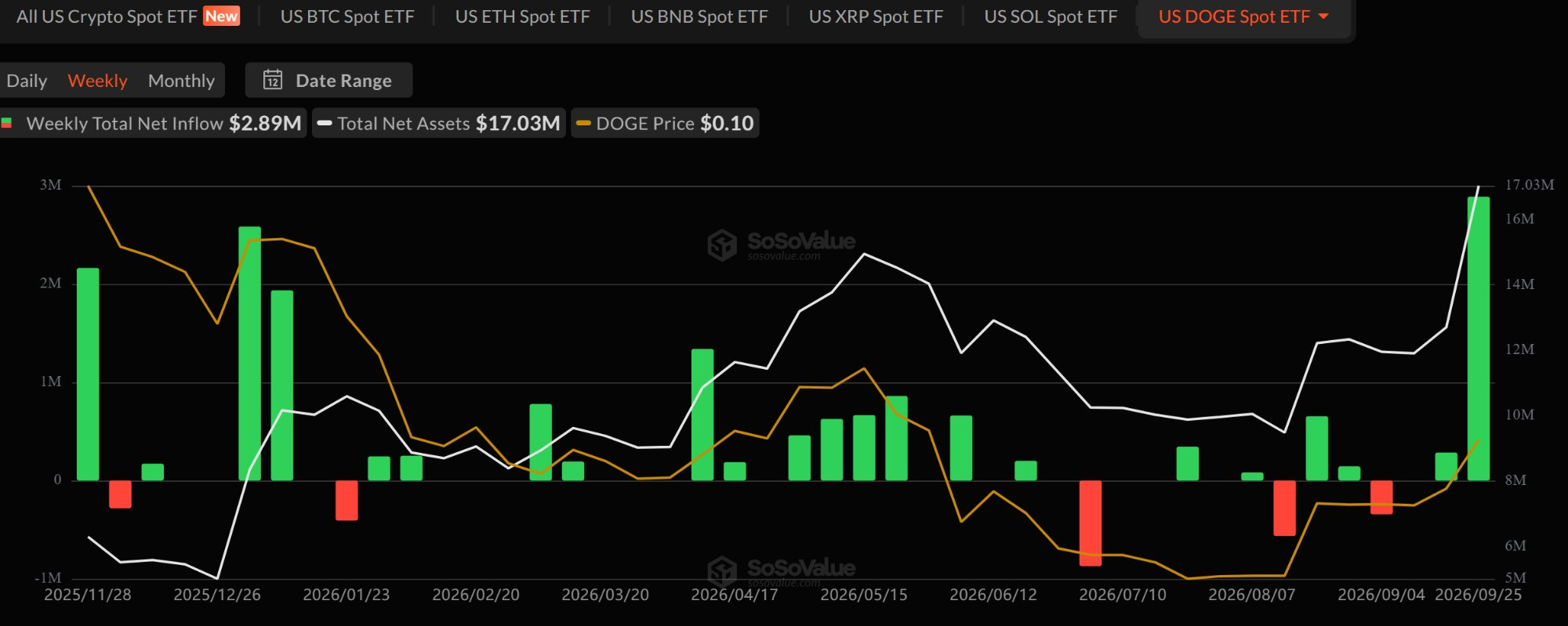
US spot Dogecoin (DOGE) exchange-traded funds (ETFs) drew $2.89 million in net inflows in the week ending September 25. That is their largest week since launch, according to SoSoValue data.
An ETF lets investors buy exposure to an asset through a normal brokerage account, much like buying a stock. The record came 11 days after Bitwise said it would shut its own Dogecoin fund.
Dogecoin ETF Inflows Beat the January Record
The previous weekly high was about $2.59 million, set in the week ending January 2, SoSoValue data shows. The week before this one brought in only $284,510.
All of the new money arrived in three sessions last week. Monday, Tuesday, and Friday.

Grayscale Takes Nearly All the Money as Bitwise Exits
BeInCrypto reported on September 10 that Bitwise will liquidate its Dogecoin ETF, BWOW. Its last trading day is October 14, barely three weeks away. The fund has lifetime net outflows of $1.23 million and holds $801,400.

“Bitwise has determined to liquidate the Fund as it continues to optimize its product range to meet evolving investor needs,” the issuer stated.
Since that announcement, cumulative inflows into Grayscale’s GDOG rose from $11.7 million to $15.46 million. Meanwhile, 21Shares’ TDOG fell from $1.63 million to $1.03 million.
GDOG took all of Friday’s $806,060. It now holds $13.87 million, or about 81% of the group’s assets.
How Big is Dogecoin ETF Demand?
The funds hold 0.11% of Dogecoin’s total market value, SoSoValue data shows. DOGE traded near $0.098, with a market cap of about $15.3 billion, according to BeInCrypto Markets data.

Quiet days are the norm. Between July 1 and September 18, the funds posted net flows on just nine trading days.
The Dogecoin record also landed in the same week US spot Bitcoin ETFs pulled in $2.39 billion. That total is more than 800 times the Dogecoin figure.
After October 14, two US spot Dogecoin funds will remain. Grayscale accounted for every dollar of Friday’s inflow.
The post Dogecoin ETFs Hit Record Week After Bitwise Exit Plans. Will Price React? appeared first on BeInCrypto.

Michael Saylor, executive chairman of Strategy and co-founder of the firm, argues that the next era of digital intelligence should be built around a “bill of digital rights” rather than expanding restrictions on how people and businesses use digital assets. In an essay posted on X on Saturday, Saylor positioned digital assets as essential infrastructure for productivity and capital formation—especially as automation reshapes industries.
Saylor’s framework outlines five core freedoms he says should apply to both individuals and companies: the ability to create new digital assets, to issue them to markets to finance productive activity, the right to hold them or choose custodians, the ability to transfer assets across users and service providers, and the freedom to use them—whether for spending, investing, earning income, or borrowing against collateral.
Key takeaways
- Saylor proposes a “bill of digital rights” centered on five freedoms: create, issue, hold/custody, transfer, and use digital assets.
- He argues that restricting what owners can do with assets undermines their economic value—because asset value depends on owner utility.
- Saylor links AI-driven productivity gains to the need for more flexible capital markets that can fund new businesses.
- He calls for “digital dollars” to be able to compete on yield and operate with minimal friction—where law allows it, and with legal updates where it doesn’t.
- Strategy’s recent Bitcoin buying resumed after a brief pause, reinforcing Saylor’s broader message about capital formation through digital assets.
From digital assets to a “rights” framework
In his essay, Saylor frames digital rights as a practical foundation for economic growth in an age where “digital intelligence” will automate tasks and make existing products obsolete. Rather than treating digital assets as a niche financial tool, he suggests they function as a general-purpose mechanism for raising capital and reallocating resources faster than traditional systems typically allow.
The five rights Saylor highlights start with creation and issuance. He argues that participants should be free to create new digital assets and to issue them to markets so businesses can finance productivity and expansion. From there, he emphasizes ownership and custody choice—owners should be able to hold assets themselves or select custodians that fit their needs.
Transferability is the next pillar. Saylor stresses that rights should include the ability to move digital assets among people, companies, wallets, and service providers. Finally, he argues that digital assets should be usable in real economic activity, including spending, investing, earning income, and borrowing against them.
“An asset’s value depends on what its owner can do with it,” Saylor wrote, adding that “restrict its usefulness, and you restrict its economic potential.” The argument is less about any single token category and more about what regulations and market design allow owners to do—particularly during periods of fast technological change.
Why AI-era capital markets may require fewer bottlenecks
Saylor connects his “rights” idea to the economics of AI adoption. He writes that an AI age can increase production, but he argues it will only reach its potential if capital markets and money systems are capable of supporting the businesses and innovations that emerge from automation.
He also criticizes what he describes as a mismatch between protecting today’s business models and financing their successors. According to Saylor, shielding existing models while making it difficult for new ventures to raise capital leaves the economy less prepared for technological change.
To underscore the scale of what he envisions, Saylor says the ambition should be to enable “10 million new companies” to raise capital. The core implication is that digital assets and modernized rails for money and funding could shorten the time between technological opportunity and real-world investment.
This is where his policy argument becomes more pointed. If future prosperity depends on rapid entrepreneurship, then the rules governing digital asset creation, issuance, custody, transfer, and use are not just technical questions—they determine whether new market entrants can fund their growth.
“Digital dollars” should compete—and move quickly
Saylor’s essay extends beyond general digital assets to the specific question of money. He argues that “digital dollars” should be allowed to compete on yield and operate at “the speed of light.” In his view, banks, fintech companies, and technology platforms should be able to provide digital dollars through the applications and devices people already use.
In other words, the differentiator shouldn’t be whether these systems are compatible with legacy processes, but whether they can deliver competitive returns and low-friction settlement. Saylor also calls for legal reform where necessary, writing that “where the law prevents it, the law should change.”
For investors and market participants, the practical question is what regulatory barriers might be slowing interoperability or limiting issuance and distribution. Saylor’s framework suggests that the more restrictive the rules on custody, transfers, or usage, the less capital the system can efficiently mobilize for new activity.
Strategy’s Bitcoin buys align with Saylor’s capital-formation thesis
While Saylor’s essay is a policy and philosophy statement, it lands alongside Strategy’s ongoing Bitcoin accumulation. Cointelegraph reported earlier this week that Strategy resumed buying Bitcoin after a two-week pause. The company acquired 950 BTC for $75.7 million, averaging $79,670 per coin.
Cointelegraph also reported that this brought Strategy’s holdings to 846,000 BTC, acquired for about $63.8 billion at an average cost of $75,416 per coin. At the time of publication in the source report, Bitcoin was trading at roughly $84,523.
Strategic Bitcoin purchasing has been a central part of Strategy’s public narrative for enabling capital exposure through a digital asset. Read alongside Saylor’s essay, the purchases reinforce his larger claim: that economic transformation requires funding mechanisms that can move quickly and function across modern financial rails, rather than being constrained by older frameworks.
At the same time, Saylor’s broader critique about “protecting existing business models” hints at a tension that investors may watch as AI accelerates. If regulations or market structures slow down funding channels for new companies—even while incumbents benefit from continuity—the economy could fail to realize the full productivity promised by automation.
Going forward, readers may want to watch how lawmakers and regulators respond to calls for more flexible digital-money systems and clearer rights for digital-asset usage—particularly around custody choices, transferability, and the ability to deploy digital assets for borrowing and investment. The direction of those rules will likely determine how quickly new ventures can access capital in an AI-driven economy.

During a relatively calm weekend trading session in which most larger-cap cryptocurrencies have remained sideways, Quant’s QNT has gone on a tear, skyrocketing by 75% in the past 24 hours alone to over $180.
A major US banking partnership appears to be the most evident catalyst, although on-chain data shows activity began heating up well before the announcement was made public.
Why Is QNT Soaring?
Interestingly, the biggest fundamental development didn’t come in the past 24 hours. It was announced on September 24 when The Clearing House selected Quant to power its On-Chain Money Initiative. The crypto project will provide the interoperability, orchestration, and transaction-management layer for the planned network, allowing financial institutions to clear and settle tokenized deposits while connecting with existing payment infrastructure, including the RTP and CHIPS networks.
Both parties expect to launch the system to participating institutions in the first half of 2027. The scale involved helps explain why this announcement attracted so much attention. The Clearing House says its US payment networks clear and settle more than $2 trillion every day, across wire, ACH, check-image, and real-time payments.
However, the activity around Quant and its native token started to pick up over a week before the partnership made the news. Santiment Intelligence said that active addresses exceeded 870 every day between September 16 and 23, whereas they had not topped 792 during the first half of the month.
New addresses were also running at approximately 1.8 times their earlier September weekday average. After the announcement, though, active addresses exploded to 2,064 on September 24, which marked the highest level in nearly a year. QNT’s price skyrocketed by 27% that day.
$QNT’s on-chain activity stepped up on Sep 16, eight days before its Clearing House headline.
Active addresses topped 870 every day from Sep 16 to 23. From Sep 1 to 15 they never passed 792.
New addresses ran about 1.8x their Sep 1 to 15 weekday average over the same… pic.twitter.com/VIyGPyIhyf
— Santiment Intelligence (@SantimentData) September 25, 2026
How High, QNT?
There’s no way to sugarcoat what happened to QNT’s price in the past day and week. The asset is up by 75% since this time yesterday and by a whopping 185% weekly. It currently trades at $180 after briefly topping $190 earlier today.
Crypto Patel, who outlined the significance of the $115 support recently, noted that QNT has reached a couple of his big targets. However, he warned that investors should not FOMO in and start buying now, trying to catch the next wave up. Instead, he noted that consolidation and retracement become important after such a parabolic move, and predicted that the price could settle somewhere between $50 and $100 before the next big move.
EGRAG CRYPTO shared a similar warning, indicating that investors should buy the retracements on such occasions, as going blindly into a token that has posted such a green candle could prove counterproductive.
The post Quant (QNT) Rockets 75% Today as Major Banking Catalyst Fuels 180% Weekly Rally appeared first on CryptoPotato.

When The Debugger Lies With Stale Cache Values

World’s first Minecraft themed-hotel is coming to London in 2027 – here’s everything we know

What Should You Consider First?





-

 Fashion2 days ago
Weekend Open Thread: J.McLaughlin – Corporette.com
-

 Crypto World5 days ago
Goldman Sachs and Deutsche Bank Agree: The S&P 500 Rally Isn't Over
-

 Tech7 days ago
Researchers escape OpenAI Codex sandbox to run commands on host
-

 Fashion3 days ago
8 iPhone Accessories That Add Personality
-

 Crypto World7 days ago
Who Needs CLARITY Anyway? ARB Could See 70X Increase: Hodler’s Digest
-

 Entertainment4 days ago
These 17 Fall Amazon Dresses Seriously Look Like Anthropologie
-

 Business7 days ago
Analog Devices (ADI) Bets $1.35 Billion on Chips that Let Machines Think for Themselves
-

 Crypto World6 days ago
Coinbase, Robinhood, Circle Seen as Tokenized-Stock Winners
-

 Crypto World4 days ago
This Bearish Netflix Stock Trade Can Cash In On Video Streaming Giant’s Woes
-

 Crypto World5 days ago
Trump-Xi Polymarket Odds for Handshake Hit 50%
-

 Tech4 days ago
Reolink’s solar 4K security camera falls to its lowest price in months
-

 Tech6 days ago
Google’s $899 Googlebook is a bet that you’ll buy a new laptop for Gemini
-

 Crypto World4 days ago
Crude Oil Prices Pressured by Diplomatic Hopes in the Middle East
-

 Crypto World4 days ago
Bitcoin price tests $83,600 Supertrend support after $87K rejection
-
 Business4 days ago
Oil Price Today (September 23): Crude oil below $100 on hopes of US-Iran talks. What did Trump say?
-

 Crypto World4 days ago
Bitcoin Threatens Sub-$84,000 Breakdown as Long Liquidations Spike
-

 Crypto World5 days ago
Meta Jumps 11% As Muse Shines and Investors Show an Appetite for Advancing AI
-

 Crypto World4 days ago
Did Jim Cramer Just Give GameStop Stock the Kiss of Death When He Said the Turnaround Is Working?
-

 Crypto World6 days ago
Bitcoin price holds above $81K as key catalysts line up
-

 Crypto World7 days ago
ARB Price Signals Spur Speculation of 70x Upside in Hodler Digest
You must be logged in to post a comment Login