
Crypto World
OKB Rockets 7% Daily, BTC Price Settles Below $64K: Market Watch

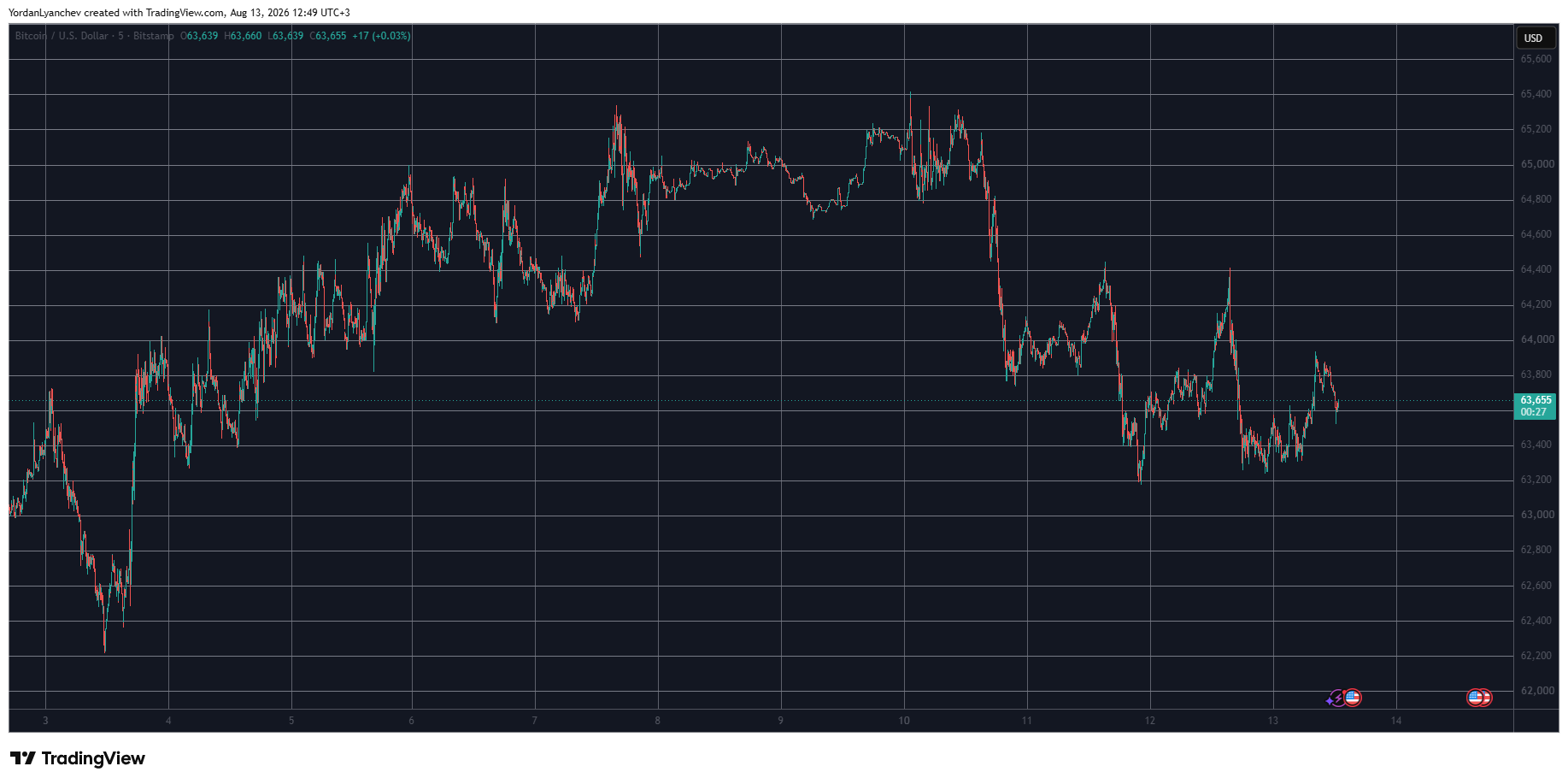
Bitcoin’s price recovery attempt to over $64,000 came to a quick halt, as the asset was pushed south by over a grand before it finally found some support.
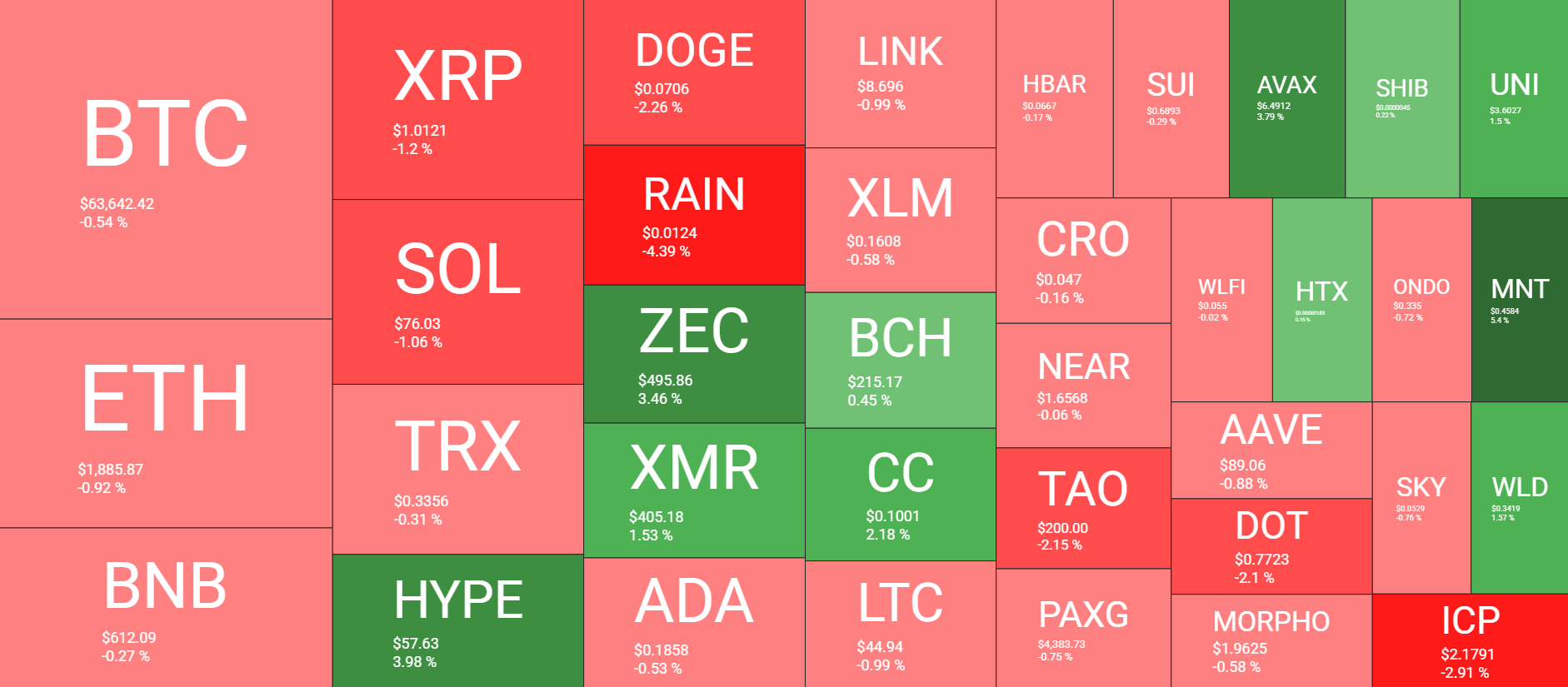
HYPE and ZEC have posted the most substantial gains from the larger-cap alts, while ETH has slid below $1,900 again, and XRP is close to dipping beneath $1.00 for the second time this week.
BTC Calms Below $64K
The primary cryptocurrency went on a minor run that began at the start of the previous business week when it pumped from $62,200 to over $65,000 at the end of it. The local peak came despite the CLARITY Act setback in the US Senate and following the weak US jobs report for July.
Although it couldn’t continue climbing past $65,400, it spent the subsequent weekend trading sideways around $65,000. It tried to break out once again on Monday, but it faced another rejection at $65,400. This time, though, it was more violent as it slumped by $1,500 to $63,800 within hours.
The rebound was stopped at $64,400 a day later, and the drop pushed it to $63,200. Even the US CPI data for July, which matched expectations, did not lead to a more profound recovery. BTC was stopped again at $64,400, and another dip to $63,200 followed.
It has since calmed between the two boundaries, currently trading at $63,600. Its market cap has dropped below $1.280 trillion on CG, while its dominance over the alts is beneath 57%.
HYPE, OKB on the Rise
Bitway’s BTW has solidified its position within the top 100 alts by market cap. Another 11% surge has made it the 83rd-largest crypto by that metric. OKB follows suit. It has surged by more than 7% daily (and 27% monthly) and now sits above $100. MNT, VVV, and STABLE are next from the mid-cap alts.
HYPE and ZEC have posted the most significant gains from the larger-cap alts. Both are up by around 3-4% to $58 and $495, respectively. In contrast, RAIN is down by over 4% to $0.0124. XRP, DOGE, SOL, BNB, TRX, and ADA are also in the red. ETH is below $1,900 after a 1% decline.
The total crypto market cap has shed around $30 billion daily and is down to $2.250 trillion on CG.
The post OKB Rockets 7% Daily, BTC Price Settles Below $64K: Market Watch appeared first on CryptoPotato.

Crypto World
AI cannot bear liability for losing trades, responsibility follows delegation: Brickken CEO


AI agents have started executing trades and moving funds without constant human approval, prompting Brickken CEO Edwin Mata to argue that liability must follow the authority granted to the software rather than attach to the AI itself.
Summary
- AI agents cannot assume legal duties because current law does not recognize them as legal persons.
- Mata said principals normally bear the outcome when agents act within an authorized mandate.
- ERC-8226 proposes time limits, financial caps, revocation controls, and verifiable records for AI agents.
- U.S. securities rules already require broker-dealers to control automated systems that access regulated markets.
Sandmark reported on Aug. 6 that existing laws provide no single answer for losses caused by autonomous financial agents, leaving courts to examine the user, developer, platform, and institution involved in each transaction.
The report said contract law, negligence rules, product liability, and fiduciary duties could all apply, depending on who controlled the agent and what caused the loss. A user may bear the result of an authorized trade, while a developer or platform could face claims if faulty design, weak safeguards, or corrupted information pushed the agent outside its intended role.
Commenting on the issue, Edwin Mata, a lawyer and the CEO and co-founder of tokenization platform Brickken, told crypto.news that responsibility should never be assigned directly to the software.
“Under current law, AI is not a legal person capable of assuming duties or bearing liability. It is a technical system acting on behalf of a natural or legal person.”
According to Mata, an investigation should instead establish who authorized the agent, whose interests it represented, and what powers it received. Such an inquiry would help distinguish a losing decision made within an approved strategy from a transaction that broke the agent’s limits.
AI agent liability follows the granted authority
Mata compared the legal relationship to a power of attorney, under which one party receives permission to act for another within a defined scope. When an issuer, bank, or investor authorizes an agent to transact, he said, the principal would ordinarily bear the consequences of actions that remain within that authority.
Under the same reasoning, an investor could not reject a trade simply because the software produced an unfavorable result. A price loss does not by itself show that the agent acted without permission or that another party failed in its duties.
“An issuer cannot disown an unfavourable but authorised transaction merely because the decision was generated by software,” Mata said.
Responsibility may change when an agent exceeds its mandate. Mata said a developer, platform, or financial institution could face exposure if its design or controls caused or allowed the failure, although the final assessment would depend on the facts and applicable law.
Sandmark cited similar legal distinctions in its report. Chanté Eliaszadeh, founder of Astraea Counsel, told the publication that liability would generally follow control. She said users are usually the starting point when agents act on their behalf, but developers could face risk if a system marketed for autonomous trading failed in a foreseeable way.
The question has gained urgency as agents obtain direct access to wallets and payment systems. In May, a Keyrock report found that AI agents had settled $73 million through 176 million transactions during the previous 12 months, with USDC accounting for 98.6% of the payments examined.
Coinbase has also connected agents to trading, portfolio management, and payments under user-set limits. By July, Chainalysis had counted more than 100 million x402-linked payments on Base, although the analytics firm said meme-coin farming and automated activity contributed to the early transaction totals. The figures therefore did not represent only independent agents buying goods or services.
Human approval needs clear and enforceable limits
While a person may formally approve an agent’s activity, Mata said consent alone does not provide meaningful control if the person cannot understand the authority being granted.
Effective delegation, in his view, requires a list of permitted actions and eligible assets, along with limits for individual transactions and total spending. A mandate should also specify its duration, the conditions requiring human review, the principal’s right to revoke access, and a record of every action taken.
Such controls are already appearing in commercial products. Anchorage Digital introduced agentic banking in May with verified identities, spending limits, and audit controls for autonomous systems accessing crypto and traditional payment rails.
Visa and Wirex have separately tested agent-led stablecoin payments for software subscriptions, marketing budgets, and procurement. According to Wirex, the trials were designed to examine security, reliability, transparency, and consumer control when software initiates payments for a user or business.
A June guide to agentic payments explained how x402 allows autonomous software to pay for data, computing services, and online resources using stablecoins. Because those payments can occur without a person approving each transaction, authorization systems must establish what the agent can buy, how much it can spend, and when its access ends.
ERC-8226 would record AI agent mandates onchain
Mata pointed to ERC-8226, the proposed Regulated Agent Mandate Standard, as one model for making delegated authority verifiable.
Filed as a draft Ethereum standard on April 12, ERC-8226 is designed for AI agents operating with tokenized regulated assets. The proposal was written by Brickken contributors Ludovico Rossi, Dario Lo Buglio, Thamer Dridi, and Nabil El Alami Khalifi.
Known as RAMS, the standard would let a verified principal give an onchain agent permission that is limited by asset, action, duration, and monetary value. A regulated token contract could check the mandate when the agent tries to execute a transaction.
The proposal separates three questions that may arise during an agent-led trade. An identity registry would confirm that the agent exists, a compliance provider would determine whether the principal is eligible to transact in the asset, and the RAMS registry would verify whether the planned action falls within the delegated mandate.
Under the draft specification, a mandate could set a maximum amount for one transaction and a cumulative amount across multiple transactions. It could also include activation and expiry times, allowed assets, approved actions, revocation functions, and records showing how much authority the agent has already used.
Mata said RAMS would not transfer liability to the agent or reimburse a principal for an authorized loss. Instead, the proposed standard would provide evidence showing who granted the authority, what the agent could do, and whether the transaction remained within those limits.
“Its purpose is to make attribution verifiable: who granted the authority, what the agent was permitted to do, whether it remained within those limits and which person or control failed when it did not.”
ERC-8226 remains a draft rather than an adopted Ethereum standard or legal requirement. Its discussion page also lists unresolved questions, including whether tokens purchased by an agent should remain in the agent’s wallet or settle directly into the principal’s wallet.
U.S. rules keep responsibility with regulated firms
For U.S. markets, existing securities rules already place duties on the firms that provide access to exchanges and alternative trading systems.
Under SEC Rule 15c3-5, a broker-dealer providing market access must maintain financial and regulatory risk controls under its direct and exclusive control, subject to limited exceptions. SEC guidance says the broker-dealer remains responsible for the effectiveness of those controls even when it uses technology supplied by an independent third party.
The rule requires automated pre-trade checks designed to stop orders that exceed preset credit or capital thresholds. It also requires controls that restrict trading systems to authorized people, block prohibited securities transactions, and deliver immediate execution reports to surveillance staff.
For consumer payments, Regulation E requires preauthorized electronic fund transfers to carry a written or similarly authenticated authorization from the account holder. CFPB guidance also says the authorization process should demonstrate the consumer’s identity and agreement, while allowing the consumer to stop or revoke future payments under specified procedures.
Current CFPB rules do not directly state how a standing instruction such as “manage my portfolio” should apply when an AI agent independently selects and executes individual transfers. Sandmark reported that lawyers remain divided over whether a manipulated agent payment would resemble an unauthorized transfer caused by stolen credentials or an authorized transaction carried out under previously granted access.
Outside the United States, Bank of England Deputy Governor Sarah Breeden said in June that financial oversight frameworks were not designed for autonomous agents and that requiring human approval for every action may be unrealistic. She said regulators were considering stronger safeguards, including circuit breakers or market-wide kill switches if faulty AI models threatened trading systems.


Lynq CEO Jerald David has said institutional finance needs interoperable settlement systems capable of moving cash and collateral 24/7 as firms adopt several forms of digital money.
Summary
- Institutions are likely to use stablecoins, tokenized deposits, CBDCs, and traditional bank money.
- Separate payment systems can leave capital unavailable where institutions need it.
- The Bank of England is testing stablecoins and simulated digital pounds in one payment flow.
- David said settlement infrastructure must keep pace with markets that trade around the clock.
In comments shared with crypto.news, David said the Bank of England’s latest digital pound experiment gives an early indication of how institutional markets may use several forms of digital money instead of choosing one option.
“I do not expect a single form of digital money to replace all others,” David said.
“Stablecoins, tokenized deposits, tokenized money market funds, potentially CBDCs, and traditional bank money are all likely to have different roles depending on the counterparty, jurisdiction, and type of transaction.”
His comments follow an Aug. 12 report detailing how NOBO Finance, Dun & Bradstreet, and Polygon Labs joined Phase 2 of the Bank of England’s Digital Pound Lab. The consortium is testing whether a stablecoin and simulated digital pounds can handle separate parts of the same cross-border trade-finance payment.
Under the test, an exporter receives an advance through a stablecoin payment system while a UK importer completes the final settlement in simulated digital pounds. Polygon Labs said both parts are coordinated within one transaction flow, allowing the experiment to study whether private and central bank money can operate together without one side waiting for the other.
Separate settlement rails can restrict institutional capital
Rather than treating the experiment as a contest between stablecoins and a central bank digital currency, David focused on the infrastructure connecting different forms of money. Institutions may have enough capital overall, he said, but the funds may not be available in the required form, market, or jurisdiction when a transaction must settle.
“The challenge arises when these different forms of money operate on separate rails. An institution may have sufficient capital available, but not necessarily in the right form or in the right place at the point it is needed.”
According to David, fragmented systems can create problems across funding, collateral management, and settlement. Firms may respond by placing funds in advance at several trading venues or with multiple counterparties, tying up capital that could otherwise remain available for other transactions.
The problem extends beyond converting one digital currency into another. A financial institution may hold bank deposits for regular business, stablecoins for blockchain transactions, and tokenized money market fund shares for managing short-term liquidity. Each instrument can serve a separate purpose, but David said institutions still need a way to move value between them when obligations arise.
Polygon described a similar problem when announcing its involvement in the Bank of England experiment. The company said bank money, stablecoins, tokenized deposits, and a possible digital pound currently operate through systems that do not communicate easily.
Polygon is supplying the stablecoin settlement component and related smart-contract infrastructure through its Open Money Stack. The simulated digital-pound portion remains on the Bank of England’s demonstration ledger rather than moving onto Polygon.
Why 24/7 trading requires continuous settlement
As digital asset markets trade without closing, David said the difference between trading hours and settlement hours has become more important for institutions. Crypto markets operate through nights, weekends, and public holidays, while bank transfers and parts of the traditional settlement system remain subject to operating schedules and daily cut-off times.
“If assets can trade around the clock but cash and collateral cannot move on the same basis, only part of the problem has been addressed,” David said.
An institution facing a margin call outside banking hours may own enough cash or liquid assets to meet its obligation. David’s argument, however, is that the capital offers limited help if the firm cannot transfer it to the required counterparty before traditional payment systems reopen.
Lynq encounters the mismatch in institutional digital asset markets, according to David. The company operates a broker-dealer-run settlement network intended for institutions that need to earn yield, transfer funds, and settle digital asset transactions.
“At Lynq, we encounter this mismatch directly in institutional digital asset markets,” he said. “The practical issue is not so much creating another form of digital money, but ensuring that capital can move to where it is required, at the time it is required.”
U.S. banks are also developing products intended to extend settlement beyond normal hours. An Aug. 4 report on Wells Fargo tokenized deposits said the bank plans to begin with selected corporate clients using a U.S. dollar-to-British pound corridor.
Wells Fargo said its planned service would allow participating clients to transfer, program, and settle funds around the clock on the bank’s blockchain platform. The initial release is expected to expand to additional clients, countries, and currencies during 2027.
Institutions are developing several forms of digital money
David’s expectation that different types of digital money will coexist is also visible in projects under development at major banks. Stablecoin issuers provide tokens backed by reserve assets, while tokenized deposits remain liabilities of the commercial banks that issue them.
During June, major U.S. banks backed plans for a shared tokenized-deposit network scheduled for 2027. The project involves JPMorgan Chase, Bank of America, Citigroup, and Wells Fargo as banks seek to provide blockchain-based payments without moving customer deposits outside the banking system.
According to the participating institutions, a shared network could allow bank-issued digital money to move among participating lenders instead of remaining confined to one bank’s internal system. Such arrangements still require common technical, legal, and compliance standards before deposits issued by separate banks can work together.
Stablecoins provide another route by allowing tokens to move across blockchain networks and jurisdictions. However, David said the form an institution chooses may depend on the counterparty, applicable rules, and transaction type rather than one instrument proving suitable for every use.
Tokenized money market funds add a third option by placing shares in cash-management funds on blockchain systems. Institutions can use the products to hold assets that may earn a return, although transferring a fund share does not always provide the same function as transferring bank money or a payment stablecoin.
Central bank money would carry a different risk structure because a digital pound would represent a direct liability of the Bank of England. Commercial bank deposits remain claims on banks, while stablecoin holders depend on a private issuer and its reserve arrangements.
Bank of England tests a multi-money payment system
The Digital Pound Lab gives private firms access to a simulated environment containing application programming interfaces, wallets, a demonstration ledger, and separate smart-contract functions. According to the Bank of England, the lab uses no real customers or money and is not a regulatory sandbox.
NOBO Finance leads the consortium’s trade-finance design and a second workstream involving a portable credit profile for small businesses. Dun & Bradstreet contributes verified company identity and credit information, while Polygon supplies blockchain infrastructure intended to let the profile travel with the payment.
The trade-finance test uses invoice factoring backed by an electronic bill of lading. Under the proposed process, an exporter can obtain a stablecoin advance rather than waiting for the importer’s final payment, while the UK importer later settles the transaction with simulated digital pounds.
The Bank has not decided to issue a digital pound, and the participants’ designs do not indicate its eventual policy or the final structure of any CBDC. The Bank and HM Treasury are due to decide on the project’s next steps later in 2026, while any introduction of a digital pound would require Parliament to approve primary legislation.
Similar work is taking place at the international level. The Bank for International Settlements said its Project Agorá prototype showed that tokenized commercial bank deposits could settle against tokenized central bank reserves across jurisdictions. The project involves seven central banks and more than 40 financial institutions, with later trials expected to process transactions using real value.
For the Bank of England consortium, Phase 2 remains a controlled test rather than a live payment service. The Bank said participants develop their use cases over three months and share the results to inform its work on digital-pound technology, payment services, and possible business models for intermediaries.

Cue the release of The End of Oak Street, now in theaters. Written and directed by David Robert Mitchell (It Follows, Under the Silver Lake) and produced by J.J. Abrams (Cloverfield, Super 8), Oak Street follows the Platt family—husband and wife Greg (Ewan McGregor) and Denise (Anne Hathaway), their two children Audrey (Maisy Stella) and Brian (Christian Convery), and their rambunctious dog Starbuck (played by two different pups named Brisket and Buzz)—after a mysterious cosmic event transports their 1980s suburban Michigan neighborhood back to a primitive era. What follows is a brutal fight for survival against aggressive, hungry, and carnivorous dinosaurs who quickly turn the community’s previously idyllic streets into their own personal feeding ground. There’s an absurd scientific explanation for these events, but the movie doesn’t spend too much time on it, which is mostly for the best within the bounds of its sub-100-minute run. Instead, The End of Oak Street is a thriller about suburban unease and domestic tension, with a primeval twist.
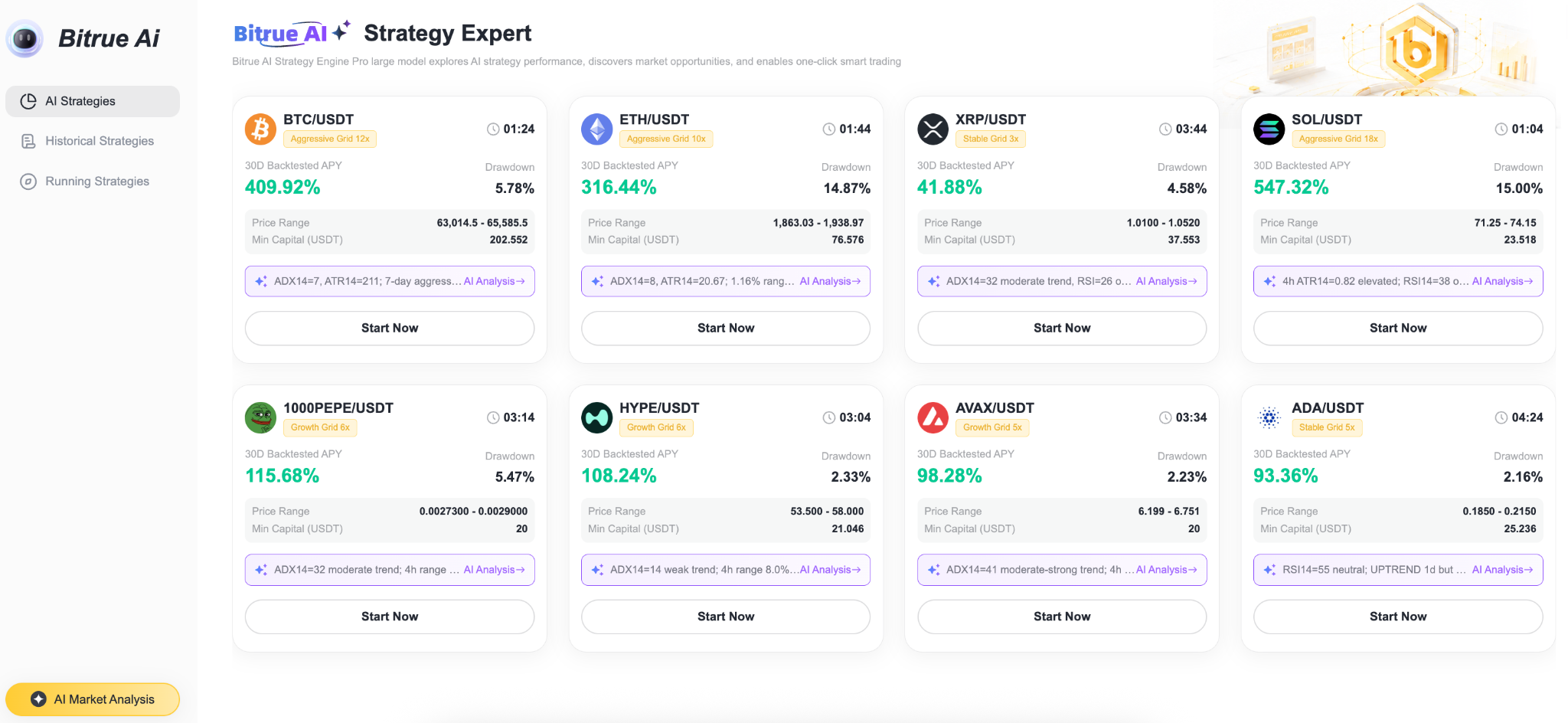
Bitrue has officially launched Bitrue AI, a new trading copilot designed to solve a major limitation in automated crypto trading by explaining not just what a strategy does, but why. Built for XRP traders and the broader crypto market, the platform delivers real-time market rationale alongside every trade signal to bring full clarity to automated strategies.
The debate around AI trading has focused for too long on whether a bot can execute faster than a human. Of course it can. The more important question is whether the human using it can still understand the decision being made on their behalf.
That distinction matters because most traders do not experience automated trading as a technical exercise. They experience it when the market moves against them. A strategy that looked straightforward at entry can quickly become hard to interpret: why is capital sitting idle, why is the bot not adjusting, and what exactly changed in the market? For XRP holders and crypto traders more broadly, that context can be as valuable as the execution itself.
As Bitrue launches Bitrue AI, its premise is clear: understanding a trade should matter as much as executing one. That is the philosophy behind its Explainable AI feature and it is a useful challenge to the “set it and forget it” model that has defined much of crypto automation so far.
Automation Made Trading Easier, But Not Always Clearer
Crypto trading bots earned their popularity by making automation accessible. Built-in grid bots, straightforward setup and no third-party software have lowered the barrier for users who want a systematic approach without building one from scratch. But accessibility and transparency are not the same thing.
Consider a conventional grid bot operating on XRP at around $1.08, with a preset range between $0.98 and $1.18. That range may place capital across a wide set of unfilled orders. The trader can see the parameters, but not necessarily the thinking behind them. If the market begins trending sharply in one direction, the strategy may require manual reassessment, a stop or a complete rebuild. The strategy is fixed; the market is not.
This is not an argument against grid trading. It is an argument for clearer decision support. A bot should not only place orders. It should help users understand what it is seeing and why a particular strategy still makes sense or no longer does.
Why Explainable AI Is the Relevant Next Step
Bitrue AI approaches this problem by continuously analysing market conditions, K-line data, technical indicators, volatility and trend signals before generating and refreshing strategies in real time. The aim is not simply to automate a range, but to keep the strategy connected to current market conditions.

A screenshot of Bitrue AI’s live strategy view.
More importantly, Bitrue AI is designed to provide an explanation with every recommendation. It tells the user what market conditions it detected, which signals informed the recommendation, what risk level is involved and why the grid parameters were selected. In a market where signals are abundant but context is often scarce, that is the part of AI trading worth paying attention to.
Getting a signal is easy. Understanding it is what matters.
The point is not to remove responsibility from the trader. No AI-generated explanation can make a volatile market risk-free or guarantee a profitable outcome. The point is to give the trader more information before they decide whether to act.
What Bitrue AI Offers at Launch
Bitrue AI launches with eight real-time AI strategies across three profiles: Aggressive, Growth and Stable. These strategies are refreshed every few minutes to respond to changing conditions. The platform is designed to identify entry points, set take-profit and stop-loss levels, and adjust strategy recommendations as conditions evolve.
The value of those categories is not that every trader should choose the same one. It is that a user can start from a stated trading profile while still seeing the market rationale behind the strategy. For beginners, this can make technical concepts more approachable. For busy professionals, it can provide a structured way to stay engaged without watching every price movement. For traders prone to FOMO, it can introduce a data-driven pause before an emotional decision.
The Difference Is Visible in the Workflow
Decision point
Typical fixed-grid workflow
Bitrue AI approach
Strategy generation
User defines a fixed range and parameters.
Generates a strategy from current market analysis.
Market response
May need manual adjustment or a restart.
Re-analyses conditions and refreshes strategies every few minutes.
Grid range adaptability
Wide fixed range, capital often wasted in unfilled orders
Recalculates upper and lower limits based on current price
Decision context
User interprets orders and price levels manually.
Shows market analysis, signals, strategy rationale and risk context.
Capital use
Capital may be committed across the selected grid range.
Bitrue says capital is committed to pending and filled orders as strategies evolve.
Strategy styles
Single fixed approach
Aggressive, Growth, and Stable, for different trading profiles
AI explainability
Shows order information only
Provides market analysis, trend judgment, strategy rationale and risk
Grid position display
User must judge based on current price manually
Clearly shows current running grid zone
Early Access
Limited
Free
Bitrue also presents the current grid position as a running zone such as the current and next target grid rather than leaving users to reconstruct it from separate buy and sell levels. This is a product-positioning comparison rather than a performance comparison. Any automated strategy remains exposed to market risk, fees, slippage and the limitations of the underlying model.
The Bigger Point: AI Should Make Traders Smarter
Retail traders today are not only competing with other retail traders. They are operating in a market shaped by algorithms, bots and institutions with speed and data access that individuals cannot replicate. The answer is not to pretend that automation can be avoided. It is to demand that automation is more intelligible.
For an asset like XRP, which has spent much of the past year in a sustained downtrend, that means a strategy that can recognise a changing trend matters more than one that simply holds its original parameters.
That is why the difference between a tool that merely executes and a tool that explains matters. The former can make trading easier. The latter can potentially make a trader more informed. When market conditions change, an explanation gives the user a better foundation for deciding whether to stay the course, reduce exposure or step back.
Bitrue AI will continue to add features, including broader asset coverage and deeper personalisation, after its Early Access rollout. But the more important contribution at launch is conceptual: AI trading should be judged not only by the speed of its execution, but also by the clarity of its reasoning.
Bitrue AI is currently available in Early Access and is free to try at bitrue.com/bitrue-ai. Users interested in applying any strategy to XRP or other assets should first confirm current asset availability, product terms and the relevant risks on the platform.
About Bitrue Bitrue is a global cryptocurrency exchange offering spot, futures, leveraged token, staking, and yield products to users across 100+ countries.
About Bitrue AI Bitrue AI is Bitrue’s beginner-friendly AI trading copilot, built to make AI trading as simple as possible through eight real-time AI strategies, continuous market adaptation, and Explainable AI that shows traders not just what to do, but why.
The post Bitrue Launches AI Copilot That Explains the ‘Why’ for XRP and Crypto Trades appeared first on BeInCrypto.

Binance will stop processing transfers to and from HTX and 10 other crypto platforms on August 23. Anything sent after that date can be held for a compliance review.
Binance did not draw up that list. It matches, name for name, the crypto firms in the European Union’s latest sanctions package.
The List Came From Brussels, Not Binance
The EU adopted Council Regulation 2026/1848 on July 23. It bans transactions with 14 crypto and payment platforms. Eleven of them become illegal to deal with on August 23.
Binance picked the same date in its announcement. It also copied the names exactly, down to odd spellings like “NoOnecrypto INC.” and “Exnode Pay (Arvix).”
Two earlier names came from Washington instead. The US Treasury sanctioned Shelbit and Aban Tether on August 7 over links to Iranian networks.
So this is not a delisting. No tokens leave Binance, and spot trading carries on as normal. What changes is where users can legally send money.
Why HTX Is on the List
Britain froze the assets of Huobi Global S.A., the Panama company behind HTX, on May 26. The stated reason was providing financial services to A7 LLC and Garantex Europe OU.
A7 is a Russian payment network. The US Treasury says it belongs to sanctioned Moldovan politician Ilan Shor and Russian state bank Promsvyazbank. British officials say the network claims to have moved more than $90 billion last year.
The UK Treasury confirmed on May 29 that the freeze covers the HTX exchange itself. HTX rejected the UK sanctions and told users their funds were safe.
A separate case is closer to a verdict. The Financial Conduct Authority (FCA) sued HTX in London’s High Court over illegal crypto ads. The settlement window closes on August 25.
“HTX’s conduct stands in stark contrast to the majority of firms working to comply with the FCA’s regime.”
That line belongs to Steve Smart, the FCA’s joint executive director of enforcement and market oversight.
Who Faces the Biggest Risk
HTX says it has 59.49 million registered users. Its own half-year report counts just over 420,000 who traded spot. Binance handles roughly 10 times HTX’s daily spot volume.
Traders who move funds between the two lose that route. So does anyone using the smaller listed platforms as a cheap on-ramp.
Ordinary wallets get caught too. On-chain investigator ZachXBT argued the UK order tainted innocent addresses and made risk scores meaningless.
Binance is not the last stop. The EU ban binds every firm in the bloc from the same morning, and Bybit tightened its checks months ago. Users have nine days to clear anything still in flight.
The post Binance Blacklists HTX and 10 Other Crypto Platforms: Are Your Funds at Risk? appeared first on BeInCrypto.


Bank Leumi, Israel’s largest bank, will offer cryptocurrency trading to customers from early 2027 becoming the first Israeli bank to announce such a service.
Customers of Leumi and its mobile banking unit, Pepper, will be able to buy, hold and sell bitcoin , ether and solana (SOL) through a section of the Leumi Trade app, according to a Friday announcement.
Galaxy Digital (GLXY) will provide trading and services through GalaxyOne Institutional, its platform for banks and asset managers. Leumi has also signed an agreement to use Galaxy’s custody infrastructure, formerly known as GK8, to support the offering.
The tie-up gives Galaxy a banking partner in Israel and places Leumi among a growing group of financial institutions bringing crypto access inside customer platforms. By embedding trading within its capital-markets app, the bank is betting that clients will favor a regulated banking interface over standalone crypto exchanges.
Maya Ravia, Leumi’s head of strategy, described digital assets as an increasingly integral part of the global financial system. Galaxy Israel CEO Lior Lamesh said early movers among banks would help define finance’s shift toward open, programmable infrastructure.
The companies did not disclose commercial terms, fees or customer eligibility requirements. CoinDesk has reached out to Bank Leumi for further comments.
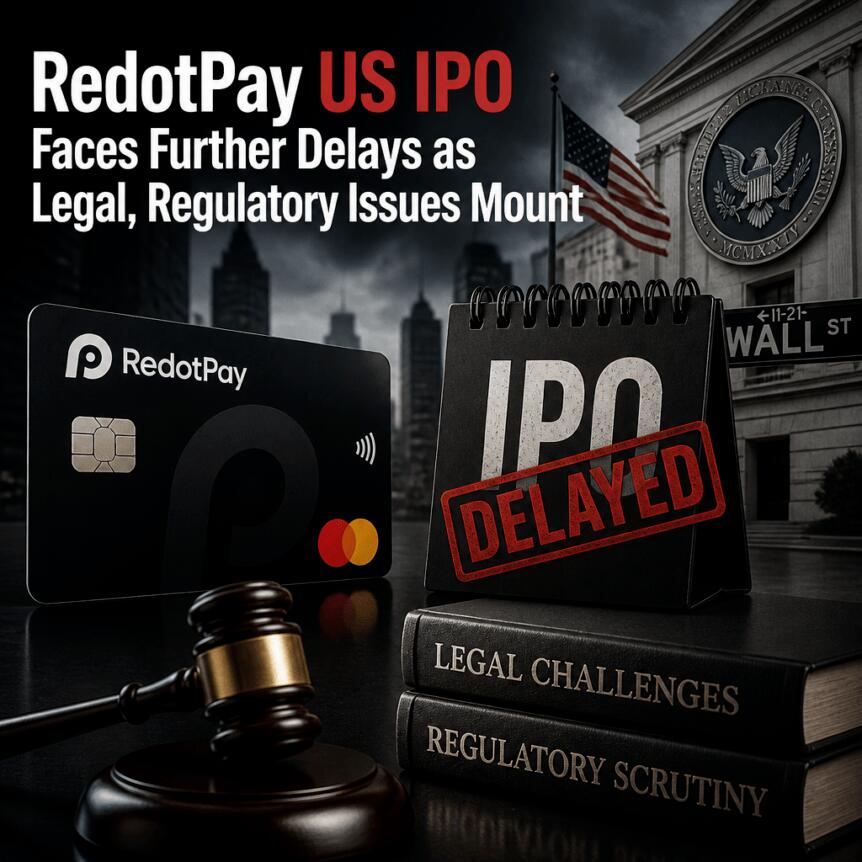
RedotPay’s ambition to list in the United States appears to be running into a slowdown, according to a report from Bloomberg. The stablecoin payments company is said to have delayed plans for a US initial public offering (IPO) as it navigates regulatory steps and ongoing legal disputes tied to Binance.
While Bloomberg reported the postponement, a RedotPay representative told Cointelegraph that the company is not discussing IPO timing. Instead, the spokesperson pointed to RedotPay’s recent progress in the US, stating the firm obtained a money transmitter license this week and is preparing to launch its product in the country.
Key takeaways
-
Bloomberg reports RedotPay has delayed its planned US IPO while it seeks regulatory approvals and deals with legal pressure involving Binance.
-
RedotPay did not comment on IPO timing to Cointelegraph, but said it recently secured a US money transmitter license.
-
Legal claims at the center of the delay include a lawsuit reportedly seeking nearly $473 million filed by Binance affiliates.
-
RedotPay’s IPO plans were previously flagged earlier this year, including reports of discussions with major investment banks.
IPO plans pushed back amid US expansion
According to Bloomberg, RedotPay has put its US IPO timeline on hold as it works through regulatory requirements. The report cites people familiar with the matter and frames the delay as part of broader preparations to expand into the US market.
RedotPay’s position, as conveyed to Cointelegraph, shifts the emphasis toward product rollout rather than capital markets timing. The company representative said RedotPay obtained a money transmitter license in the United States this week and is preparing to launch its stablecoin payments offering there.
For investors and market watchers, the sequencing matters. Stablecoin-focused payment businesses typically depend on licenses and regulator-by-regulator permissions to operate at scale, which can complicate an IPO process when litigation and approvals are both active.
From early-year IPO chatter to banking discussions
RedotPay’s US public-market ambitions first surfaced in February, when reports suggested the company was considering a listing in New York. At the time, RedotPay was described as working toward a potential IPO that could draw significant capital, with prior reporting indicating involvement from major firms including JPMorgan Chase, Goldman Sachs, and Jefferies Financial Group.
Those earlier reports also pointed to a target valuation above $4 billion and discussions that could have raised more than $1 billion, alongside other organizational changes. In March, Cointelegraph reported that RedotPay was seeking to raise up to $150 million amid internal restructuring and preparations for a potential IPO.
While IPO timing can change quickly in fast-moving sectors, the more recent US licensing step suggests the company is concentrating on operational readiness. That could be consistent with a broader trend in crypto-adjacent businesses: demonstrating licensed activity and compliance footing before pursuing the added scrutiny that comes with public listing.
Binance litigation adds legal and operational uncertainty
A major factor in the IPO delay narrative is the legal dispute involving Binance affiliates. Earlier in August, Binance affiliates reportedly sued RedotPay’s founders in Hong Kong seeking nearly $473 million in damages. The allegations claim the founders used confidential information obtained through their prior involvement with Binance to build a competing payments business and to redirect Binance users toward RedotPay.
RedotPay has denied the accusations. In correspondence with Cointelegraph, the company said it would “vigorously defend all claims.” That stance is important for assessing how persistent the dispute may be: even if the company believes it will win, the existence of a large claim can affect how comfortable underwriters and regulators feel about moving forward with an IPO during the dispute’s active stage.
The conflict has also extended beyond Hong Kong. Cointelegraph previously reported that the disagreement spilled into Singapore, where Binance and RedotPay differ on the status of a related case. RedotPay told Cointelegraph this week that it expected Binance to discontinue that matter, while Binance rejected RedotPay’s characterization and said its claims remain active.
Taken together, the litigation timeline and regional spread underline why RedotPay might prefer to focus on licensing milestones and product execution while legal outcomes remain uncertain.
What to watch next
As RedotPay pushes toward a US launch after receiving a money transmitter license, the next developments that may shape both operations and any future IPO timetable are regulatory milestones tied to its expansion and the trajectory of the Binance affiliate lawsuits. For now, the company’s public-market plans appear to be on pause, with attention shifting to compliance and execution in the US.

Solana is moving toward a significant shift in how it prices and allocates blockspace. A new Solana Improvement Document, SIMD-0553, would replace the network’s current approach—where transaction fees are not tightly linked to how many computing resources a transaction consumes—with a model that charges according to requested resources and burns the resulting fees in SOL.
The proposal entered Solana’s onchain governance process in early August and passed the initial support stage on August 4. It is now in the support-and-discussion phase, which typically runs for seven epochs (about two weeks). If it clears the process, it could reshape incentives for both developers and high-frequency users by making inefficient transaction behavior more expensive.
Key takeaways
- SIMD-0553 would tie fees more closely to requested compute, so transactions that use far more resources would pay more than lightweight ones.
- Instead of sending the resource fee to validators, the proposal directs it to a SOL burn, removing tokens from circulation.
- Core Solana devs and application teams would have stronger financial incentives to optimize performance and reduce resource waste.
- Some high-volume trading and bot activity is expected to face substantially higher costs under the terminal fee model.
- Higher burn projections could, in theory, move SOL toward deflation—but only if network activity grows enough to outweigh daily issuance.
Charging for compute, not just sending transactions
At the center of SIMD-0553 is a critique of Solana’s current fee structure: according to Cavey, a researcher at Solana infrastructure firm Temporal and author of the proposal, the cost users pay does not reflect the underlying compute differences between transactions. In his explanation, submitting a transaction that does minimal work can cost the same as one that consumes a large amount of CPU cycles.
Under the proposed model, resource fees would be set according to the resources a transaction requests rather than a flat baseline. Cavey argues this would give developers a clear reason to optimize, because wasteful behavior would no longer be subsidized by the network’s simpler fee mechanics.
“By installing this resource pricing right now, suddenly app developers have to optimize,” Cavey said, in the context of how poorly specified incentives can persist when inefficient and efficient transactions cost the same.
For end users, the change is intended to be beneficial indirectly: applications that reduce their compute consumption could pass on lower costs, improving user experience and potentially expanding what apps can afford to run.
Impact on arbitrage and high-frequency trading
A major focus of the proposal is computationally wasteful arbitrage. Cavey points to a pattern where searchers submit large volumes of transactions that largely fail—effectively consuming resources while capturing only limited successful outcomes—yet pay relatively low fees under current pricing.
He cites activity from the prior 30 days involving the traders with the highest failure rates: five accounts allegedly submitted 11.5 million transactions, consuming 929 million compute units across 2,477 trades that generated $16,091 in profit, while paying just 78 SOL in fees.
SIMD-0553 is designed to alter that equation. By increasing the cost of failed or inefficient attempts in proportion to requested resources, it would push arbitrage strategies toward more accurate and responsive behavior rather than brute-force submission.
Temporal’s modeling, as described alongside the proposal, suggests certain areas of onchain activity could become cheaper: stablecoin and token transfers could drop by about 20%, vote transactions by around 12.3%, and oracle updates by roughly 16.9% under the proposed fee model.
However, the same analysis implies a clear trade-off: some swaps—especially when routed through specific venues and prioritized differently—could become more expensive. Temporal estimates include a high-priority swap routed through DFlow costing 9.72% more, a mid-priority OKX swap costing 301% more, and a pump.fun swap with zero priority costing 3150% more. Cavey’s broader framing is that the base could remain low in absolute dollar terms for the most compute-intensive transactions, but the relative change for certain active strategies would be dramatic.
That is also why the proposal rejects a uniform increase to Solana’s existing 5,000-lamport fee, according to the article’s description: the uniform approach, Cavey argues, would likely penalize high-volume senders such as market makers while still failing to accurately price resource consumption.
Burn mechanics and the deflation debate
Beyond cost calculation, SIMD-0553 aims to change what happens to the fees. Rather than routing the resource fee to validators, the proposal would burn those fees—meaning SOL would be removed from circulation.
The article notes that the current daily burn is around 648 SOL, and that the terminal fee rate in SIMD-0553 could raise burn to roughly 7,500 to 9,000 SOL per day if resource demand stays roughly the same. That would represent an estimated 12 to 14 times increase in burn compared with current levels.
Cavey argues the effect could eventually make SOL deflationary, though he frames it as conditional on network success and continued growth in activity. As the article points out, Solana currently issues about 60,000 SOL per day, so even a 9,000 SOL daily burn would not, by itself, make the token deflationary. A separate improvement document, SIMD-0550, is described as targeting faster curbing of inflation already scheduled.
Importantly, the proposal’s burn incentive is also intended to reduce motivations to generate unnecessary resource-heavy transactions, aligning economic behavior with the network’s performance goals.
Still, not all contributors agree on the balance between validator revenue and token burn. One contributor, bji, reportedly argues against “more burn” as a goal and questions whether validator income should be reduced arbitrarily, reflecting a wider tension in fee-market design: funding network operations while maintaining supply dynamics.
Concerns about fairness, usability, and system complexity
Some of the debate around SIMD-0553 centers on a technical fairness question: should fees be based on how many resources a transaction requests or on how much it actually uses?
Contributor mschneider raises that it might feel more natural to charge based on units used. Cavey’s response, as presented in the article, is that charging based on requested resources provides upfront cost visibility for users and lets validators verify they can afford the fee before execution. At the same time, the model creates incentives for developers to estimate their resource needs accurately, reducing the risk of overpaying for unused compute.
The proposal would also introduce new operational and user-facing considerations. Some contributors worry that a new fee model could make Solana harder to use. Cavey argues that most users won’t need to calculate fees directly because exchanges and applications typically handle fee calculation and routing. He also suggests automated traders are sophisticated enough to adapt to fee-structure changes.
On validator economics, the article describes an estimated initial reduction to base-fee revenue of around 4%. Cavey says parameters could be adjusted to offset that impact if needed, but the disagreement remains unresolved for participants who prioritize validator income over additional burn.
As Solana moves deeper into the governance timeline, the key question for token holders and ecosystem participants is how those trade-offs resolve: whether the community converges on parameters that achieve stronger resource alignment without introducing unacceptable complexity or unintended pressure on critical market infrastructure.


Strategy has pushed back against MSCI’s proposed methodology for identifying “non-operating companies,” which could result in the largest bitcoin treasury company being removed from the index provider’s global equity indexes.
Strategy said on X, “Digital assets are assets. Index providers should measure markets, not decide which assets companies are allowed to own,” Strategy said. “MSCI’s proposal puts it out of step with regulators, markets, and its own customers. Bitcoin doesn’t need MSCI. Neither does Strategy.”
The latest consultation replaces an earlier proposal focused specifically on companies with significant digital asset holdings. Applying the new financial-ratio screen using May 2026 data would have resulted in the removal of Strategy, Metaplanet and uranium holder Yellow Cake from the MSCI ACWI IMI.
The response follows Strategy’s formal objection in December 2025 to MSCI’s previous proposal, which would have excluded companies whose digital assets represented at least 50% of total assets.
Strategy argued at the time that it is an operating company, not an investment fund or passive bitcoin vehicle, pointing to its software business, active treasury operations and bitcoin-backed credit instruments. It described the 50% threshold as arbitrary and urged MSCI to maintain neutral index standards.
MSTR is lower by 4.3% on Friday as bitcoin dips to $62,600.
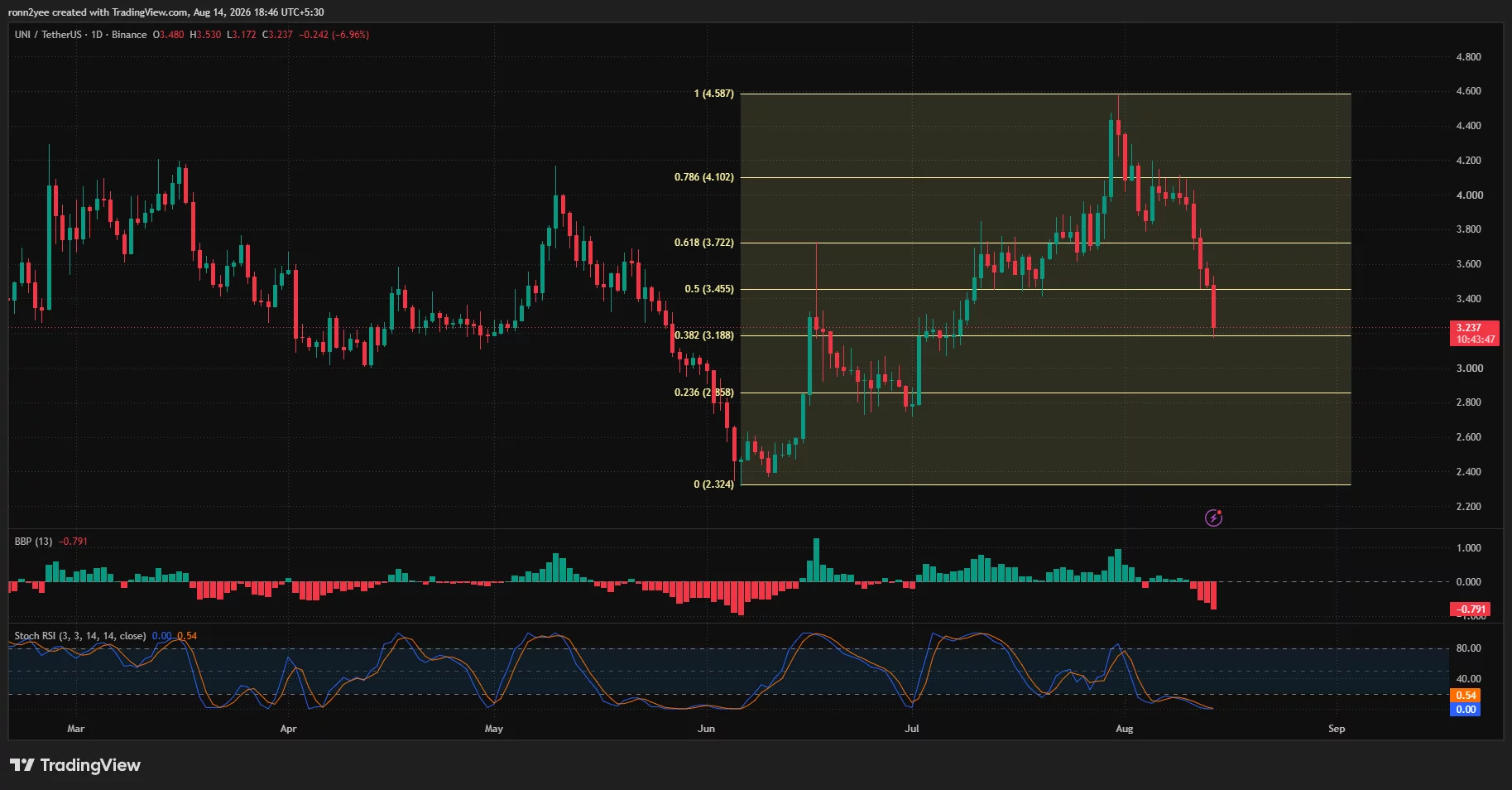
Uniswap price has fallen nearly 20% over the past seven days to $3.23 as a head-and-shoulders breakdown, weak capital flows, and cascading long liquidations intensified selling pressure.
Summary
- Uniswap price has dropped nearly 20% in seven days and traded around $3.23 on Aug. 14.
- The daily price has returned to the 38.2% Fibonacci retracement at $3.19.
- 4-hour Aroon and Chaikin Money Flow readings show sellers remain firmly in control.
- Liquidation clusters between $3.45 and $3.65 could limit any short-term recovery.
Uniswap price extends its breakdown toward $3.20
According to data from crypto.news, Uniswap (UNI) price fell as low as $3.17 on Aug. 14 before recovering slightly to $3.23. The token was down almost 7% on the daily candle and nearly 20% over seven days, extending a decline that began after its early-August peak near $4.59.
The daily chart shows UNI giving back most of the rally that started from the June 11 low of $2.32. Sellers pushed the token below the 78.6%, 61.8%, and 50% Fibonacci retracement levels at $4.10, $3.72, and $3.46, respectively.
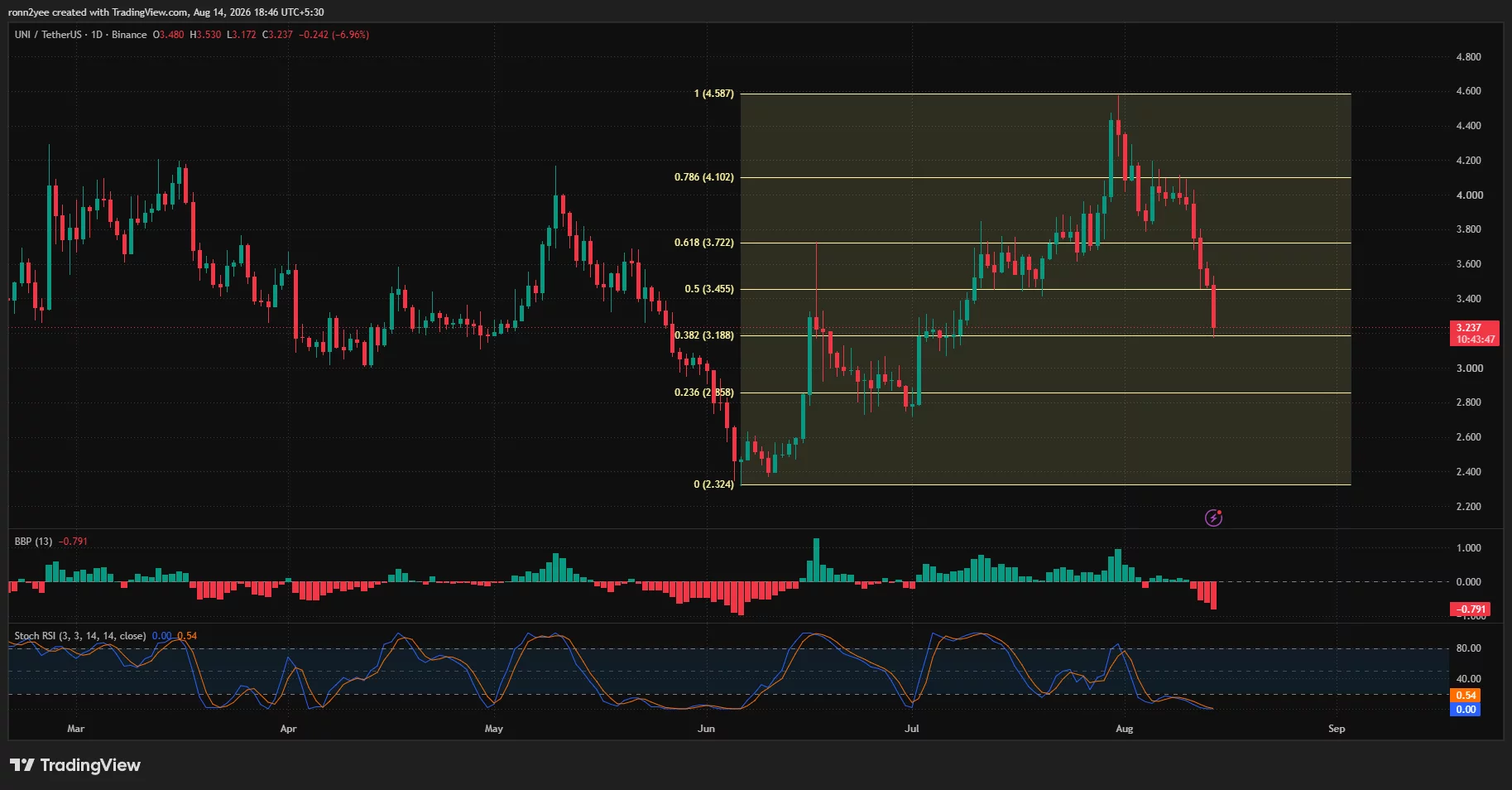
UNI is now testing the 38.2% retracement at $3.19. The level carries added importance because it sits near the lower end of the token’s March-to-May trading range, where buyers previously stepped in around $3.10–$3.20.
A daily close below $3.19 would weaken that support and expose the 23.6% Fibonacci level at $2.86. Continued selling could then send the token toward the psychological $3.00 mark or the June swing low at $2.32.
The latest daily candle also shows little evidence that buyers are absorbing the decline. UNI opened near $3.48, briefly reached $3.53, and then fell to $3.17, leaving the token close to its session low.
Bear-bull power stood at -0.791, its weakest reading on the displayed daily chart. A deeply negative reading indicates that sellers are forcing the price farther below its short-term average rather than merely responding to a temporary pullback.
Daily Stochastic RSI readings of 0.00 and 0.54 place UNI deep in oversold territory. Such a reading can precede a relief rebound, but oversold conditions alone do not confirm that the decline has ended while price continues to record lower highs and lower lows.
Head-and-shoulders pattern confirms a bearish reversal
Crypto analyst Crypto With Gopal identified a head-and-shoulders pattern on UNI’s 4-hour chart in an Aug. 12 post on X. According to the analyst, the right shoulder failed around $4.20 before the token broke below the pattern’s neckline near $3.90.
The formation began with a left shoulder below $4.00, followed by a head near $4.60 and a lower right shoulder around $4.20. Price subsequently lost the rising neckline that had supported the July advance.
Crypto With Gopal placed the pattern’s downside target near $3.00. UNI has since fallen from approximately $3.53 at the time of the post to around $3.23, bringing the projected level within 7% of the current price.
The 4-hour chart supports the bearish pattern. UNI formed a sequence of lower highs after the Aug. 1 peak, initially losing $4.00 before falling through $3.80, $3.60, and $3.45. A brief attempt to stabilize around $3.50 failed on Aug. 14 and was followed by another sharp leg lower.
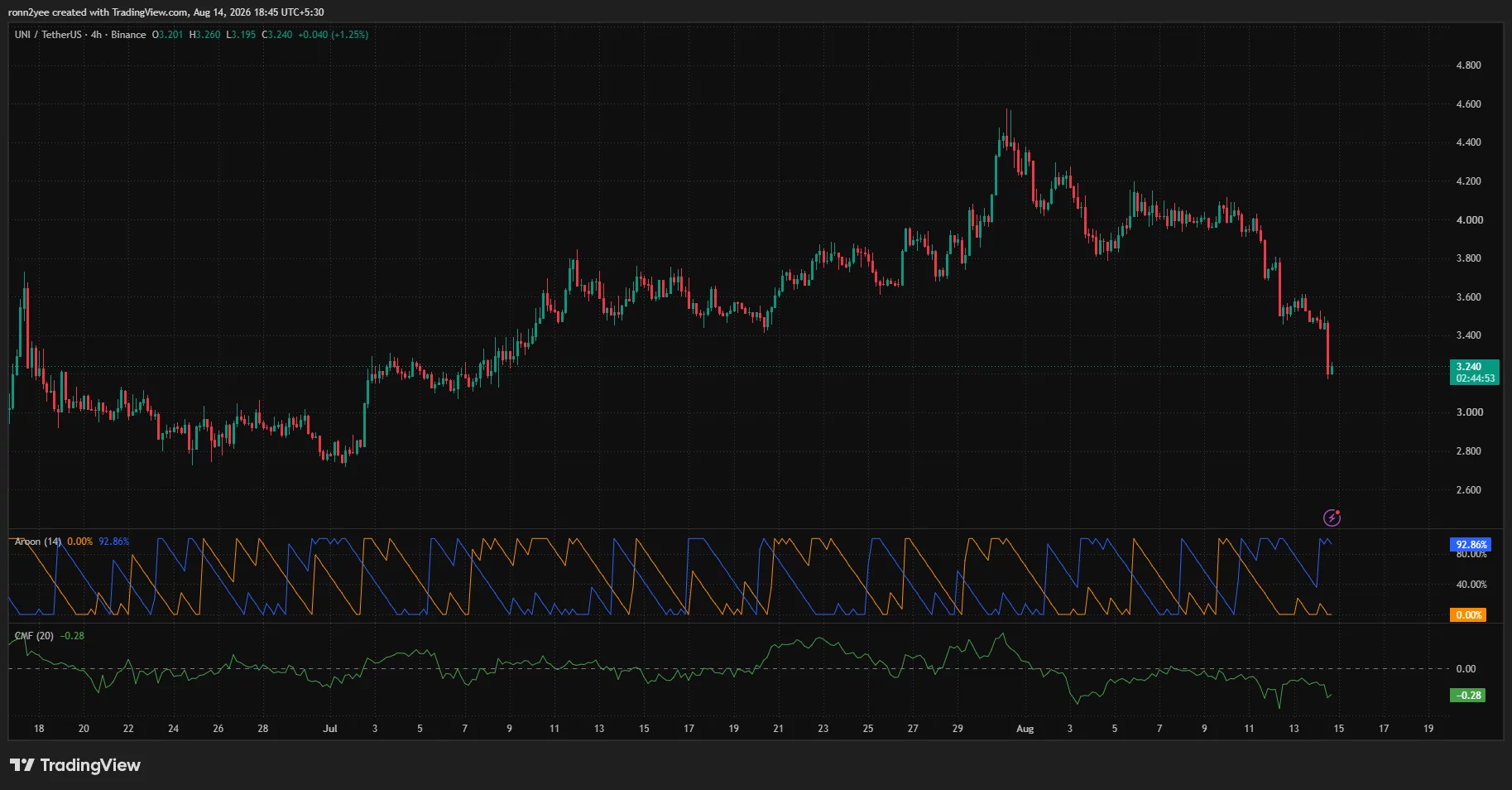
Aroon Down stood at 92.86% on the 4-hour timeframe, while Aroon Up registered 0%. The separation indicates that recent lows are forming much more frequently than recent highs, keeping the short-term trend pointed downward.
Chaikin Money Flow was also negative at -0.28. The reading shows that trading volume has been concentrated during periods when UNI closed near the lower end of its candles, a sign that capital continues to leave the market.
UNI liquidations could amplify volatility
CoinGlass’ three-day liquidation heatmap shows that UNI’s decline accelerated as the price moved through several areas containing leveraged positions. The token fell from above $3.80 on Aug. 11 to nearly $3.20 by Aug. 14, with sharp drops appearing around $3.60, $3.45, and $3.35.
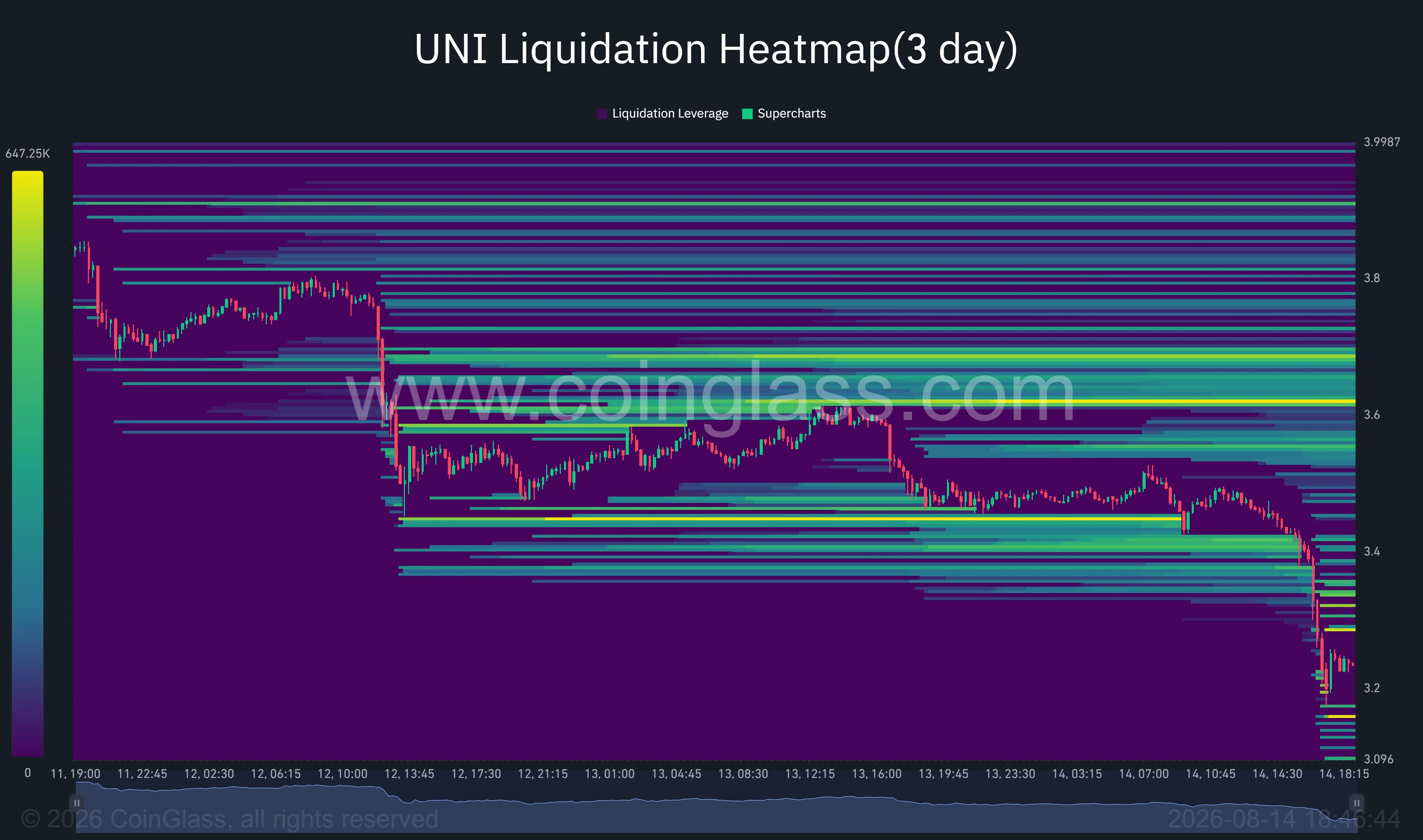
The heatmap suggests that liquidity previously concentrated near $3.45 was cleared during the latest sell-off. UNI briefly moved below $3.20 before stabilizing around $3.23, where nearby liquidation bands appear smaller than the clusters left above the market.
Larger concentrations remain between approximately $3.45 and $3.55, followed by brighter bands around $3.60–$3.65. Because price can move toward areas containing heavily leveraged positions, a recovery into these zones could trigger short liquidations and produce a faster rebound.
However, the same clusters may also act as resistance. Traders who bought before the breakdown could use a return toward $3.45 or $3.60 to reduce exposure, adding spot supply as leveraged shorts face pressure.
Another large liquidity band sits near $3.68, while additional concentrations extend toward $3.80. UNI would need to reclaim the $3.45 Fibonacci midpoint and then hold above $3.72 to begin repairing the damage visible on the daily chart.
Below the current price, liquidation liquidity is thinner, although smaller bands appear between $3.10 and $3.20. A clean breakthrough through that area could allow the price to travel more quickly toward the $3.00 target identified in the head-and-shoulders setup.
Key UNI price levels traders are watching
The immediate support range lies between the daily low of $3.17 and the 38.2% Fibonacci level at $3.19. Holding this area could allow UNI to attempt an oversold bounce toward $3.40–$3.45, where the first notable liquidation cluster and former support are located.
A move above $3.45 would put $3.60–$3.65 in focus. Reclaiming that range would clear a dense group of liquidation levels, although the 61.8% retracement at $3.72 would remain the stronger technical barrier.
For the bullish case to gain credibility, UNI would need to close above $3.72 and recover the broken neckline near $3.90. The $4.10 Fibonacci level and the failed right shoulder around $4.20 would then become the next resistance points.
The bearish case remains active while UNI trades below $3.45. A daily close under $3.17 would open the path toward $3.00 and $2.86, while a loss of $2.86 would expose the June recovery base between $2.32 and $2.40.
For U.S. investors, UNI remains available through crypto trading platforms rather than U.S.-listed spot exchange-traded funds, leaving the token more dependent on direct spot demand and offshore derivatives liquidity. The chart therefore offers no ETF flow buffer comparable to Bitcoin or Ethereum when leveraged selling accelerates.
Disclosure: This content is provided by a third party. Neither crypto.news nor the author of this article endorses any product mentioned on this page. Users should conduct their own research before taking any action related to the company.

Man shared ‘explicit’ images with ’14-year-old girl’

Aviva boss in warning to Chancellor ahead of October’s budget

AI cannot bear liability for losing trades, responsibility follows delegation: Brickken CEO


-

 Fashion7 days ago
Weekend Open Thread: Mattifying Sunscreen
-

 News Videos6 days ago
Can Astrology Help Find Gold and Silver Trends? A Financial Astrology Guide
-

 Tech7 days ago
Rinn Pharma & Biopharma to join NordicPharmaTrain network
-

 Business5 days ago
Datadog: Best Of Breed For Multiple Reasons
-

 Business6 days ago
How to Start a Cleaning Business: A Step-by-Step Guide
-

 Business6 days ago
BDC Weekly Review: Private BDC Q2 Numbers Are Strong
-
 NewsBeat3 days ago
Communication cards help banking customers access services or report scams
-
 Business4 days ago
Oil Price Today (August 11): Crude oil rises to $88 after Trump’s compensation demand dents Hormuz opening. Here’s why
-

 Fashion7 days ago
Weekly News Update, 8.6.26 – Corporette.com
-
 Entertainment6 days ago
10 R-Rated Drama Movies That Can Be Called Masterpieces
-

 Fashion5 days ago
Amazon Sundays: Closet Care Before Fall
-

 Business6 days ago
SharkNinja Keeps Eating
-

 Politics6 days ago
Be quiet, Miriam! – spiked
-

 Business6 days ago
Mutual Fund Manager Scoops Up Beaten-Down Stocks
-

 Politics5 days ago
Ben-Gvir’s crocodile project halted but abuses at Ketziot Prison continue
-

 Business5 days ago
5 Things You Must Know About Jorge Messi, the Father and Longtime Agent Who Shaped Lionel Messi’s Career
-

 Entertainment7 days ago
Warren Hudson’s Dad Releases Audio Of Threats
-

 Politics7 days ago
Welsh independence campaign group YesCymru sets 2032 referendum target
-

 Politics5 days ago
The Church of England’s ruinous reparations racket
-
 Crypto World4 days ago
Why Did Nvidia Stock Fall on Monday Despite a $500 Billion Wall Street AI Deal?
You must be logged in to post a comment Login