
Crypto World
OKX, BlackRock and Standard Chartered Launch Tokenized RWA Collateral

OKX, BlackRock and Standard Chartered announce a joint framework to integrate BlackRock’s BUIDL tokenized short-term Treasuries into collateral workflows, enabling off-exchange custody while trading on the same integrated venue. The arrangement marks a notable step in embedding tokenized real-world assets into traditional market infrastructure, pairing Standard Chartered’s custody capabilities with OKX’s institutional execution. By allowing BUIDL to serve as yield-bearing collateral without moving assets between venues, the framework aims to improve capital efficiency and broaden participation for qualified investors. The release outlines the collaboration, the custody model, and the path toward broader tokenization across markets.
Key points
- BUIDL can be posted as collateral off-exchange and held in regulated custody at Standard Chartered.
- BUIDL can be deposited and traded on-exchange, used as yield-bearing collateral for margin trading.
- The framework unites BlackRock’s BUIDL token, Standard Chartered custody, and OKX’s institutional execution and margining infrastructure into a single ecosystem.
- This marks the first time a globally systemically important bank (G-SIB) has acted as custodian in such an arrangement.
Why it matters
By combining BUIDL’s tokenization with regulated custody and integrated trading, the framework expands the utility of Real-World Assets and enables yield-bearing collateral within a single ecosystem. It links a major asset manager, a global bank, and a digital-asset exchange to demonstrate tokenization can operate within institutional workflows while preserving custody protections. This setup potentially broadens access to tokenized instruments and advances the integration of TradFi and digital markets.
What to watch
- Uptake by OKX VIP and institutional clients posting BUIDL as off-exchange collateral with Standard Chartered custody.
- Operational performance of on-exchange trading and off-exchange custody within the integrated venue (OKX Middle East).
- Plans to expand tokenization to additional assets, regions, or workflows.
Disclosure: The content below is a press release provided by the company or its PR representative. It is published for informational purposes.
OKX, BlackRock and Standard Chartered Launch Joint Framework to Establish New Utility for Tokenized Real-World Assets
- OKX to accept BlackRock’s tokenized short-term US treasury fund, BUIDL, as yield-bearing collateral for trading
- Standard Chartered to provide a comprehensive and reliable custody offering, the first-ever G-SIB-backed off-exchange tokenized collateral framework
- Initiative scales utility of tokenized real-world assets (RWA) and enables broader market participation
DUBAI, April 28, 2026 — OKX, a leading global fintech company and crypto trading platform, today announced the launch of a joint framework with BlackRock and Standard Chartered to integrate BlackRock’s BUIDL tokenized short-term treasury fund into collateral workflows, marking the first time a globally systemically important bank (G-SIB) has acted as custodian in such an arrangement. The framework enables OKX clients to hold collateral in regulated, off exchange custody while trading on the same integrated venue.
Through this joint framework OKX VIP and institutional clients can post BUIDL as collateral held off-exchange in regulated custody at Standard Chartered, while trading seamlessly on OKX Middle East, eliminating the need to move assets between venues. In addition, BUIDL can be deposited and traded on-exchange, and used as yield-bearing collateral for margin trading.
This framework unites BlackRock’s BUIDL – tokenized by Securitize (which has announced a proposed business combination with Cantor Equity Partners II, Inc. (Nasdaq: CEPT))- Standard Chartered’s regulated custody as a G-SIB, and OKX’s institutional execution and margining infrastructure. This framework delivers a uniquely integrated model where collateral custody and trading occur within a single, coordinated ecosystem, representing a key advancement toward embedding tokenization into global market infrastructure.
The framework also delivers:
- Capital at work: The ability to use BUIDL as collateral transforms idle margin into a yield-generating asset.
- Universal collateral: OKX is expanding the utility of Real-World Assets by establishing BUIDL as a platform-wide collateral.
- Superior protection: With BUIDL safeguarded by Standard Chartered, OKX clients obtain trading collateral segregated from OKX’s assets, while retaining the ability to trade on OKX without transferring custody, providing clients with exchange default protection.
This framework, which involves the participation of the world’s largest asset manager, a Tier 1 Global Bank, and a premier digital asset exchange, establishes a new utility framework for the cryptocurrency ecosystem. It integrates traditional financial (TradFi) security with the agility of digital markets, embedding RWA tokenization into the core of global market infrastructure.
“BUIDL was designed to bring the benefits of tokenization to short term treasury exposure, allowing qualified investors to earn US dollar yields on blockchain rails,” said Samara Cohen, Global Head of Market Development at BlackRock. “The framework with OKX and Standard Chartered allows qualified investors to unlock new opportunities in how they deploy collateral.”
“This collaboration highlights the potential of tokenizing real-world assets (RWA) at scale. By enabling institutions to deploy BUIDL as on-chain collateral on OKX’s global platform, we improve capital efficiency while demonstrating how traditional financial instruments can operate seamlessly in digital markets,” said Haider Rafique, Global Managing Partner at OKX. “Tokenization is about making existing markets faster, more transparent, and more accessible.”
“Our role as custodian in this initiative reflects our commitment to delivering trusted and innovative solutions for clients as the financial ecosystem evolves,” said Margaret Harwood-Jones, Global Head of Financing and Securities Services at Standard Chartered. “By providing secure custody of BUIDL for this collateral use case, we are helping to ensure clients can access digital asset opportunities with the high standards of protection and compliance. This framework demonstrates how traditional financial institutions and digital market infrastructure can work together to bring tokenized assets safely and efficiently to global investors.”
The launch follows extensive institutional testing and integration. BlackRock’s BUIDL is issued on a public blockchain and invests in cash, U.S. Treasury bills, and repurchase agreements, with yield distributed on-chain. Its integration into OKX’s collateral framework demonstrates that tokenized RWAs can operate at scale within existing institutional workflows for trading, margining, and liquidity management.
For further information, please contact:
About OKX
OKX is a fintech company on a mission to modernize money and markets. Today it is trusted by more than 100 million people around the world who use OKX services to invest, transact and trade digital assets across a number of financial instruments including spot, futures, and decentralised markets. As one of the world’s largest platforms, OKX is known for its exchange, wallet, and onchain ecosystem used by everyday people and large institutions.
OKX maintains regional offices in the United States, Europe, UAE and Singapore with a number of local offices across São Paulo, Hong Kong, the Republic of Türkiye, and Australia. Over the past several years, it has built one of the world’s most comprehensive regulatory compliant, licensed fintech companies.
OKX is steadfastly committed to transparency and security and publishes Proof of Reserves reports on a monthly basis to ensure customer funds are always protected and available to people. To learn more about OKX, download the app or visit: okx.com.
About OKX Institutional
OKX Institutional delivers secure digital asset market infrastructure for institutional market participants. We offer highly liquid spot and derivative markets through global offshore and regional onshore regulated exchange orderbooks and OTC RFQ, plus critical institutional services across the trade lifecycle.
From banks integrating crypto products to asset managers exploring allocation and trading firms scaling derivative strategies—we provide the compliant, flexible foundation institutions need to compete in digital asset markets.
BlackRock
BlackRock’s purpose is to help more and more people experience financial well-being. As a fiduciary to investors and a provider of financial technology, we help millions of people build savings that serve them throughout their lives by making investing easier and more affordable. For additional information on BlackRock, please visit www.blackrock.com/corporate.
Standard Chartered
We are a leading international banking group, with a presence in 54 of the world’s most dynamic markets. Our purpose is to drive commerce and prosperity through our unique diversity, and our heritage and values are expressed in our brand promise, here for good.
Standard Chartered PLC is listed on the London and Hong Kong stock exchanges.
For more stories and expert opinions please visit Insights at sc.com. Follow Standard Chartered on X, LinkedIn, Instagram and Facebook.



The CFTC filed suit against Wisconsin to establish its exclusive regulatory authority over prediction markets, a sector closely tied to crypto and blockchain-based derivatives.
The U.S. Commodity Futures Trading Commission (CFTC) sued Wisconsin on April 28, 2026, to reassert its exclusive jurisdiction over prediction markets. The action challenges state-level regulatory interference in a sector increasingly built on blockchain technology and crypto assets. The lawsuit underscores ongoing federal-state jurisdictional disputes over decentralized and tokenized derivatives platforms.
The CFTC’s enforcement action signals the regulator’s intent to maintain control over derivatives-adjacent products in the crypto space, potentially affecting platforms that tokenize prediction market shares or operate on decentralized protocols.
The CFTC said that its lawsuit is in response to Wisconsin filing civil suits against multiple CFTC-regulated prediction market companies — Kalshi, Polymarket, Crypto.com, Robinhood, and Coinbase — alleging violations of state law.
Sources: CFTC
This article was generated automatically by The Defiant’s AI news system from publicly available sources.
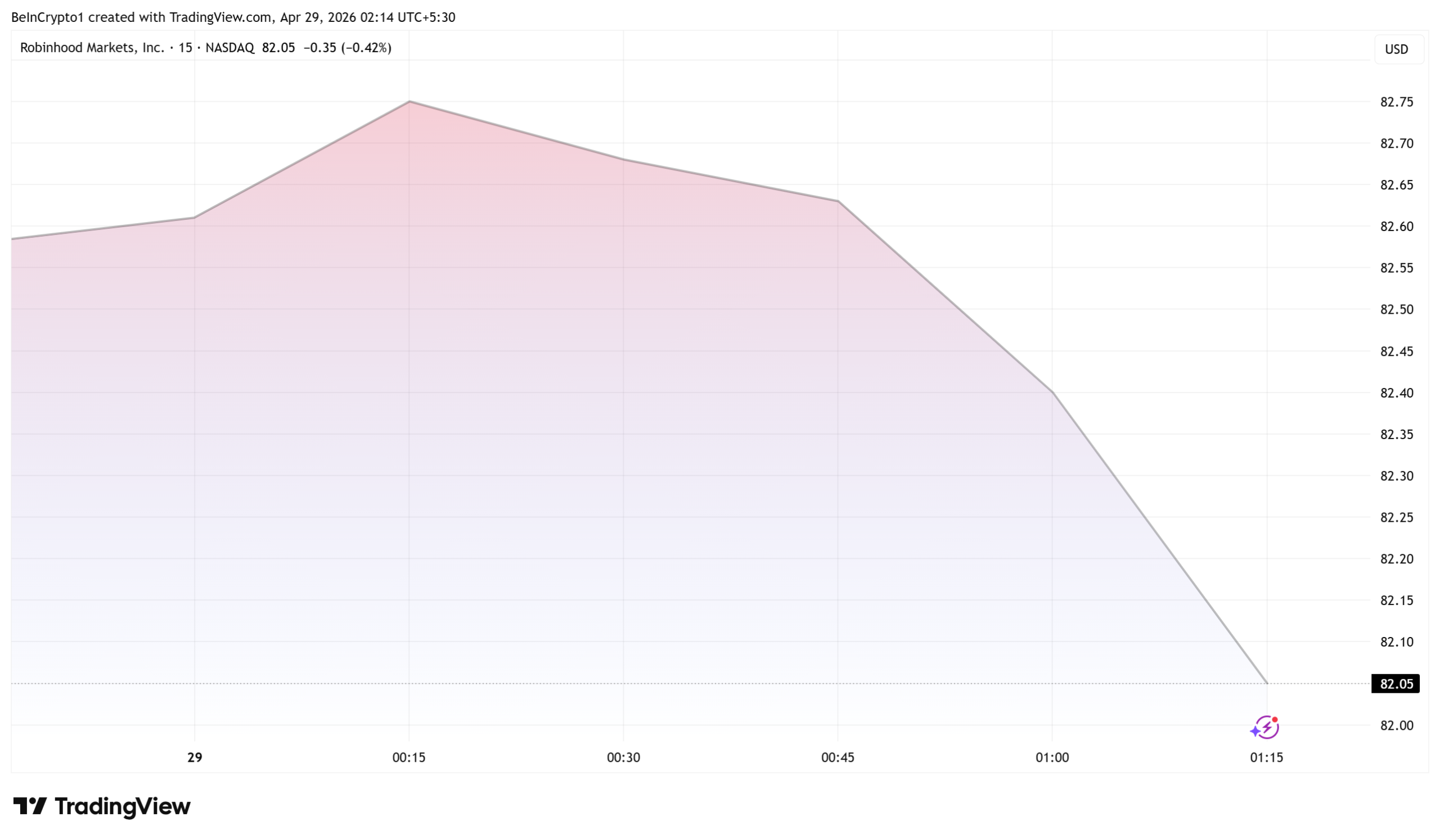
Robinhood Markets shares slipped about 6% in after-hours trading Tuesday after the retail brokerage reported a 47% year-over-year drop in cryptocurrency revenue, dragging overall first-quarter results below Wall Street expectations.
The Menlo Park firm posted $346 million in first-quarter profit, or $0.38 per diluted share, narrowly missing analyst estimates of $0.39 even as net income rose 3% from a year earlier.
Crypto Revenue Slides as Bitcoin Cools
Crypto transactions generated $134 million in revenue during the quarter, down 47% year-over-year as digital asset trading activity cooled across the platform.
Total revenue reached $1.07 billion, up 15% year-over-year but short of the $1.14 billion analysts had projected. The miss arrived even as equities, options, futures, and prediction markets posted double-digit growth or record volumes, the company said.
Trading fees drove much of the platform’s gains last year, when HOOD stock peaked at $153.86 in October alongside crypto’s broader run.
Robinhood stock dipped on this report, and was trading for $82.05 as of this writing.
Prediction Markets and Tokenization Cushion the Slide
Chairman and CEO Vlad Tenev pointed to the firm’s expanding role across customer finances in a statement.
“Robinhood is increasingly positioned at the center of our customers’ financial lives,” he stated in the broadcast.
Wagers routed through Kalshi-powered prediction markets logged record volumes, supported by a one-cent transaction fee.
Robinhood also launched the public testnet for Robinhood Chain, an Ethereum (ETH) layer-2 network built around tokenized assets.
Total platform assets stood at $307 billion, up 39% year-over-year on the back of net deposits and higher equity valuations.
The firm’s European tokenized stocks product continues to offer customers exposure to private companies including OpenAI and SpaceX.
The after-hours sell-off pushed HOOD to roughly $82, well off the October peak. The path forward depends on whether prediction markets and tokenization can offset the cooling in digital asset trading.
The post HOOD Stock Topples After Robinhood Earnings Reveals 47% Decrease in Crypto Revenue appeared first on BeInCrypto.
Crypto World
LayerZero Pledges 10,000 ETH to DeFi United as Industry Rallies Behind Kelp DAO Recovery

TLDR:
- LayerZero Labs is donating 5,000 ETH and depositing another 5,000 ETH into Aave to strengthen market liquidity.
- The $292M Kelp DAO exploit involved an RPC-poisoning attack that forged cross-chain messages via LayerZero’s DVN.
- DeFi United has raised over $300M in ETH and stablecoins, with major contributors including Consensys and Arbitrum DAO.
- Total value locked across DeFi fell from $95B to $80B following the Kelp DAO hack, reflecting broad market disruption.
LayerZero Labs has committed over 10,000 ETH to the DeFi United recovery initiative, led by Aave, following the $292 million Kelp DAO exploit.
The crypto infrastructure provider will donate 5,000 ETH directly and deposit another 5,000 ETH into Aave markets.
This contribution, valued at roughly $23 million, places LayerZero among the largest participants in the industry-wide effort to restore rsETH backing after the April 18 attack.
LayerZero’s Contribution to DeFi United
LayerZero’s pledge comes approximately five days after the company first announced its intent to join a recovery effort.
The firm will also work to deepen liquidity for GHO, the native stablecoin on Aave. This move signals a broader commitment beyond a simple financial donation.
LayerZero confirmed the details in an official post on X, stating it is “donating 5,000 ETH to DeFi United, depositing an additional 5,000 ETH to strengthen Aave markets liquidity, and strategically deepening GHO liquidity.”
LayerZero also confirmed plans to continue working with Aave and other DeFi participants. The focus will be on how Omnichain Fungible Tokens (OFTs) should be designed and configured for use in lending markets. This collaboration could shape future standards across the ecosystem.
The exploit on April 18 involved a sophisticated RPC-poisoning attack on LayerZero’s Decentralized Verifier Network.
Attackers forged a cross-chain message, releasing unbacked rsETH from Kelp’s LayerZero-powered bridge adapter on Ethereum. Around 107,000 rsETH then entered lending positions on Aave, creating substantial bad debt.
Industry Response and Recovery Progress
DeFi United has now raised over $300 million in ETH and stablecoins from dozens of protocols and individuals. Arbitrum DAO has a pending vote to release 30,765 ETH toward the effort.
Consensys and Joseph Lubin together are contributing 30,000 ETH, matched by a low-interest loan from Mantle.
Aave DAO also has a pending proposal to approve a 25,000 ETH contribution. This adds to Aave founder Stani Kulechov’s personal pledge of 5,000 ETH. Kelp DAO contributed 2,000 ETH, while Circle is buying AAVE tokens to support the protocol’s stability.
There remains a dispute over responsibility for the attack. LayerZero states it “recommended multi-DVN redundancy” to protect against single points of failure. Kelp, however, says it “used the default configuration” provided, which relied on a 1-of-1 DVN setup with only LayerZero Labs as the verifier.
Meanwhile, the total value locked across DeFi has dropped to $80 billion, down from roughly $95 billion just before the hack.
Aave has released a detailed technical recovery plan, and the broader effort to restore rsETH backing continues to move forward.



A federal judge rejected Sam Bankman-Fried’s request for a new trial on Tuesday, April 28, 2026, denying the former FTX chief’s attempt to reopen his criminal case based on claims of newly discovered evidence.
US District Judge Lewis Kaplan issued the ruling in New York, where he oversaw Bankman-Fried’s 2023 trial. Bankman-Fried was convicted over the collapse of FTX and later sentenced to 25 years in prison.
The motion was filed under Rule 33, a procedure that allows defendants to seek a new trial if new evidence emerges. Bankman-Fried argued that the jury did not hear the full picture of FTX’s finances, including claims that the exchange had assets that could repay customers.
He also argued that evidence about lawyers’ involvement in FTX decisions could have supported his claim that he acted in good faith rather than with criminal intent.
However, Kaplan denied the motion even after Bankman-Fried tried to withdraw it. Bankman-Fried had claimed the judge would not be fair in deciding the request.
The ruling leaves Bankman-Fried’s broader appeal before the Second Circuit as his main path to challenge the conviction.
The post Judge Rejects Sam Bankman-Fried’s Retrial Bid in FTX Case appeared first on BeInCrypto.
Crypto World
RailsX Goes Live: Amboss Brings Self-Custodial Bitcoin and Stablecoin Trading to the Lightning Network
TLDR:
- RailsX enables peer-to-peer bitcoin and stablecoin trading natively on the Lightning Network with no intermediary..
- The platform launches with two stablecoin pairs, USDT-L and USDC-L, both issued by Speed Wallet on Lightning.
- All trades settle atomically through Lightning channels in seconds, removing the need for centralized exchanges.
- RailsX combines Amboss’s Magma liquidity marketplace with Taproot Assets to power decentralized BTC trading.
RailsX, a new peer-to-peer exchange built on the Lightning Network, is now live for early users. Amboss Technologies developed the platform to allow self-custodial trading between bitcoin and stablecoins.
The launch introduces two stablecoin-bitcoin pairs: USDT-L and USDC-L, both issued by Speed Wallet. Users retain full control of their private keys throughout all transactions, removing the need for centralized custody.
Trading Bitcoin Against Stablecoins Without Giving Up Custody
RailsX routes all trades through existing Lightning payment channels. This means settlement happens in seconds, with minimal fees and no third-party intermediary holding assets.
There is no centralized order book managing trades on the platform. Instead, transactions execute atomically, giving users a fully decentralized trading experience.
The platform is accessible through open-source node manager Thunderhub, with no additional setup required. Amboss is also coordinating liquidity formation across BTC/stablecoin pairs to support growing trading volume.
RailsX combines Amboss’s liquidity marketplace, Magma, with Taproot Assets to enable this decentralized structure. The company says this approach aligns with its reading of U.S. draft Clarity Act legislation.
Speed Wallet handles the issuance and underlying custody for both USDT-L and USDC-L. All assets remain fully backed and transparent under Speed Wallet’s framework.
Before RailsX launched, Speed Wallet had already been operating wrapped stablecoins for its own users. Now, that infrastructure is available to the entire Lightning Network through RailsX.
Amboss CEO and co-founder Jesse Shrader addressed what the platform means for everyday users. “RailsX lets users trade, hold, and move value on Lightning without ever giving up control of their money,” Shrader said.
He added that the platform is designed to unlock Bitcoin’s potential as a medium of exchange. According to Shrader, RailsX serves global stablecoin demand without exposing users to cross-chain decentralized finance risks.
Stablecoins Return to Bitcoin via Taproot Assets
RailsX builds on Amboss’s existing Rails product, which lets users supply liquidity to Lightning channels and earn yield. The new platform extends that foundation into fully self-custodial stablecoin trading.
Industry leaders have recently discussed bringing stablecoins back to Bitcoin using Taproot Assets. These include Tether CEO Paolo Ardoino and Lightning Labs CEO Elizabeth Stark.
Speed Wallet CEO Raj Patel spoke directly about the platform’s role in expanding access. “Speed Wallet built this technology with one goal: to make stablecoins on Lightning accessible to everyone,” Patel said.
He described RailsX as the kind of distribution platform Speed Wallet had always envisioned. Patel also noted that the launch takes self-custody stablecoin trading into the mainstream for the broader Lightning Network.
The Lightning Network saw a sharp drop in capacity earlier this year amid bear market conditions. However, capacity has largely stabilized over the past two months.
According to The Block’s data dashboard, total U.S. dollar capacity on the network stands at roughly $380 million. Bitcoin capacity hovers at approximately 4,870 BTC. RailsX was first unveiled in January and is now entering its early-user phase.
The platform represents a growing push to make Bitcoin a practical medium of exchange at scale. As stablecoin demand rises globally, Lightning-native solutions like RailsX are drawing increasing attention from users seeking alternatives to centralized exchanges.
TLDR:
- TON Tech’s Agentic Wallets let AI agents execute on-chain transactions without needing per-action user approval.
- Users retain full ownership and can withdraw funds or revoke agent access at any point during operation.
- The framework needs no wallet upgrades and supports leading AI models, MCP, and CLI developer tools.
- Telegram bots using Agentic Wallets can now handle both autonomous communication and on-chain payments.
Agentic Wallets on TON represent a new standard for AI-driven blockchain activity. TON Tech has introduced a self-custodial framework that allows AI agents to manage funds and execute transactions independently.
Users retain full control over their assets at all times. The system requires no third-party involvement and works with existing TON wallets without requiring upgrades.
This development connects blockchain payments directly to the Telegram ecosystem, where autonomous bots are already active.
How Agentic Wallets Operate Within the TON Ecosystem
The setup process for Agentic Wallets is straightforward for any user. A user asks their AI agent to create a wallet, funds it, and confirms the setup.
After that, the agent can transact within clearly defined spending limits. No per-transaction approval from the user is needed during normal operation.
Control over funds stays with the user throughout the entire process. The agent operates a dedicated on-chain wallet funded directly by the user.
Ownership, however, remains tied to the user’s main wallet at all times. Funds can be withdrawn at any point, and agent access can be revoked on demand.
TON Tech shared details about the framework publicly, noting the open and self-custodial nature of the standard. The role separation between agent and user reduces the risk of unauthorized activity.
This separation is built directly into the architecture of each wallet setup. Users therefore do not need to rely on any intermediary to manage agent transactions.
The system is also designed to protect developers from vendor lock-in. No upgrades to existing wallets are required to implement the framework.
Developers can build and manage their own setups independently from the start. Compatibility with leading AI models and agent frameworks further adds to that flexibility.
Telegram Integration and the Developer Stack Behind Agentic Wallets
The developer tooling packaged with Agentic Wallets supports multiple integration paths. It includes MCP and CLI tools specifically built for managing agent workflows.
These tools allow developers to work inside their existing environments without major changes. The framework’s broad compatibility makes adoption practical for teams of various sizes.
Telegram adds an immediate use case for this release. Bot API and recent bot-to-bot communication already allow agents to interact autonomously on the platform.
Agentic Wallets extend that foundation to include on-chain payments within the same chat interface. As TON Tech noted in its post, agents on Telegram can now both communicate and make financial transactions in one environment.
That combination makes the framework immediately actionable within Telegram. The existing bot infrastructure provides a ready-built environment for agent-based payments.
Developers can therefore build financial workflows directly into their Telegram bots without external tools. This bridges the gap between AI communication and real on-chain transactions.
The framework is open and available for any developer to adopt without restrictions. TON Tech has published resources to help teams launch AI agents with Agentic Wallets.
The standard is built to grow alongside the broader AI agent and blockchain ecosystem.


President Trump told hundreds of top $TRUMP memecoin holders at a private April 25 event at Mar-a-Lago that the White House will not allow banks to block the CLARITY Act, pledging to sign the bill immediately and framing crypto market structure legislation as a national priority.
Summary
- Trump delivered a direct warning to bankers at a private Mar-a-Lago gala on April 25, telling attendees he would not allow traditional financial institutions to derail the CLARITY Act.
- The event drew Tether CEO Paolo Ardoino, ARK Invest’s Cathie Wood, Anchorage Digital CEO Nathan McCauley, billionaire Tim Draper, and boxer Mike Tyson, among the top 297 $TRUMP token holders.
- The Trump intervention comes as the CLARITY Act missed its April Senate Banking Committee markup deadline and faces a final end-of-May window with approximately four working weeks remaining before the Memorial Day recess.
CLARITY Act legislation received the most direct public presidential backing it has seen yet on April 25 when Trump addressed top $TRUMP memecoin holders at a private gala at his Mar-a-Lago estate in Florida. TheStreet reported that Trump told the gathering he would not allow banks to hinder the progress of the bill and said he would sign the bill immediately if Congress sent it to his desk. Trump described crypto as having “become mainstream” and backed the CLARITY Act as essential for keeping the industry onshore.
CLARITY Act Gets a Presidential Warning Directed at Banking Industry Resistance
The April 25 event was organized by Fight Fight Fight LLC, the issuer behind the $TRUMP token, and billed as the most exclusive conference in the world. The top 297 $TRUMP holders by time-weighted average received access to a conference and gala luncheon. The top 29 holders received a private reception with the president. As crypto.news reported, attendees included Tether CEO Paolo Ardoino, ARK Investment Management’s Cathie Wood, Anchorage Digital CEO Nathan McCauley, billionaire Tim Draper, and boxer Mike Tyson. Trump’s remarks directly targeted banking industry groups that have spent months lobbying senators to reopen the settled stablecoin yield provisions, warning that the White House would not allow those efforts to succeed. The event also carried a political subplot: Democratic senators Warren, Schiff, and Blumenthal sent a formal letter calling the gathering a direct sale of presidential access to crypto industry participants with financial interests in legislation Trump controls.
Why Trump’s Intervention Matters for the May Markup Window
The CLARITY Act missed its April Senate Banking Committee markup deadline after the Kevin Warsh confirmation hearing consumed most of the committee’s April calendar. As crypto.news documented, a coalition of 120-plus organizations including Coinbase, Ripple, Kraken, and Andreessen Horowitz had sent a joint letter on April 23 demanding an immediate markup, but no notice came from Chairman Tim Scott before the informal April cutoff. As crypto.news tracked, the committee’s most pressing competing obligation has now been removed following Tillis’s decision to end his Warsh block on April 27, potentially opening a direct path for a first-week-of-May markup. Trump’s April 25 statement now gives the Senate Banking Committee explicit White House pressure to move, with Senate Banking Committee Republicans aware that publicly resisting a Trump-backed bill carries its own political cost.
What Still Stands Between the CLARITY Act and Trump’s Signature
Presidential backing alone does not resolve the bill’s remaining structural obstacles. As crypto.news noted, the bill must still pass a Banking Committee markup, clear a 60-vote Senate floor threshold, be reconciled between the Banking and Agriculture Committee versions, reconciled with the July 2025 House text, and then signed by Trump. Congress breaks for Memorial Day recess on May 21, leaving fewer than four working weeks. Polymarket prices passage at approximately 46% and Galaxy Research puts odds at 50-50 or lower. The core dispute that banking groups are lobbying on, whether stablecoin activity rewards function as illegal yield, remains formally unresolved in the final bill text, and Democratic senators continue to insist on ethics language barring senior government officials from profiting from crypto holdings, language the White House has refused to accept.
Justin Sun, the Tron founder who emerged as the top $TRUMP holder at a previous May 2025 gala, held a notable position at the April 25 event, a development that drew renewed congressional scrutiny about the role of foreign investors in $TRUMP token purchases given Sun’s nationality.
TLDR:
- Peter Brandt publicly rejected $250,000 Bitcoin forecasts for 2026, calling them unrealistic based on current chart conditions.
- Bitcoin’s ascending channel allows gradual gains but does not confirm a bullish reversal or support a parabolic price advance.
- Brandt identified double bottoms and inverse head-and-shoulders as true reversal signals, none of which appear on Bitcoin’s chart.
- A legitimate breakout above the channel’s upper boundary with strong volume remains the only path toward extreme Bitcoin price targets.
Veteran trader Peter Brandt has publicly shut down projections of $250,000 Bitcoin in 2026. He pointed to a defined ascending channel on the chart as evidence against such forecasts.
Brandt argued that the current structure does not support a parabolic advance or a confirmed bullish reversal. His remarks came as Bitcoin traded between $76,000 and $78,000 in recent sessions. The response has drawn significant attention from traders and analysts across the market.
Brandt Calls Out Unrealistic Bitcoin Forecasts
Brandt took to X to confront what he sees as dangerous market optimism. He wrote directly, “Bitcoiners, those of you predicting $250,000 in 2026 need to stop with the mushrooms.”
He accompanied that remark with a chart showing a clear ascending channel pattern. His message was pointed and left little room for misinterpretation.
He identified the formation as a rising parallel channel, not a bullish reversal structure. Brandt stated plainly that the pattern “is NOT a bullish bottoming pattern.”
That distinction carries weight for traders who rely on technical analysis to guide decisions. An ascending channel and a bullish bottom are two very different market signals.
He then outlined what a genuine bullish reversal actually looks like. Double bottoms and inverse head-and-shoulders patterns are structures that historically confirm new uptrends.
These formations signal a definitive shift in market momentum from sellers to buyers. None of those signals is present on Bitcoin’s current chart, according to Brandt.
He also made clear that an ascending channel does allow for gradual price gains. However, he stressed it does not guarantee acceleration toward extreme price targets.
Without a confirmed breakout above the upper boundary, the channel simply defines a range. That range, in Brandt’s view, makes $250,000 an unsupported projection for 2026.
Chart Structure Tells a Different Story for Bitcoin
Bitcoin dropped sharply in late January 2026 and tested the $60,000 support zone in early February. Sellers dominated that move before buyers regained footing and pushed price higher.
The recovery established the current ascending channel that has contained price action since. That structure has held firm through multiple trading sessions without a confirmed break.
Within the channel, Bitcoin has posted higher highs and higher lows in an orderly fashion. The upper resistance boundary has continued to reject rally attempts near $77,000 to $78,000.
Meanwhile, the lower support boundary has absorbed each dip without a decisive breakdown. Price remains technically constructive but structurally capped.
Brandt stated that a move toward extreme price targets would require a clear breakout above channel resistance. He added that such a breakout must be accompanied by strong trading volume to carry validity.
That confirmation has not materialized as of the latest available market data. Until it does, the channel remains the dominant structure on the chart.
Bitcoin was near $77,000 at the time of reporting, with the channel still intact. Brandt offered no revised price target alongside his critique of the $250,000 forecasts.
His focus remained on chart interpretation and structural discipline rather than speculation. Traders continue to watch both channel boundaries closely for any sign of a directional shift.


Stablecoin transfer volume fell 19.18% to $831B in 30 days, yet market cap and holders rose as USDT, USDC, and DAI added billions while Ethena’s USDe saw $1.1B outflows.
Summary
- Stablecoin transfer volume dropped 19.18% to 831 billion dollars over the past 30 days, but total market cap rose 2.06% to 305.29 billion and holders increased 2.32% to 246.94 million.
- USDT, USDC, and DAI posted strong net inflows of 3.6 billion, 2 billion, and 1.2 billion dollars respectively, while Ethena’s USDe suffered 1.1 billion dollars in net outflows amid yield compression and sustainability concerns.
- The slowdown in transfer volume follows a period when monthly stablecoin turnover hit 1.78 trillion dollars and annual volumes topped 33 trillion, pointing to a consolidation phase as Bitcoin and Ethereum trade off recent highs.
Stablecoin transfer volume declined 19.18% to $831 billion over the past 30 days, signaling reduced on-chain activity even as the broader stablecoin market continues expanding. Despite the sharp drop in transaction throughput, total stablecoin market capitalization increased 2.06% to $305.29 billion, while the number of holders rose 2.32% to 246.94 million, reflecting sustained adoption and holding behavior across digital dollar ecosystems.
Stablecoins are cryptocurrencies designed to maintain a stable value by pegging their price to a specific real-world asset, typically the U.S. dollar. They achieve price stability through fiat-backed reserves, algorithmic supply adjustments, or crypto-collateralized mechanisms, making them critical infrastructure for payments, DeFi lending, and cross-border remittances.
Inflows and Outflows Reveal Divergent Trends
Net inflow data over the past 30 days reveals sharp divergence among major stablecoin issuers. Tether’s USDT led with $3.6 billion in net inflows, extending its dominance as the sector’s largest asset by market cap, currently sitting at $188 billion. Circle’s USDC followed with $2 billion in net inflows, while MakerDAO’s DAI recorded $1.2 billion in positive flows, demonstrating sustained demand for decentralized and centralized dollar-pegged instruments.
Meanwhile, Ethena’s USDe experienced the largest net outflow, shedding $1.1 billion as yield compression eroded its competitive advantage. USDe supply fell to November 2024 levels after approximately $1.6 billion in redemptions, driven by yields compressing to around 3.5%, well below the double-digit returns that initially attracted capital. The flight to quality following concerns around protocol sustainability pushed investors toward more established stablecoins with transparent reserve structures.
Market Activity Reflects Consolidation Phase
The 19% decline in transfer volume suggests a consolidation phase rather than capitulation, as stablecoin supply and holder counts continue growing despite reduced circulation velocity. Data from earlier in 2026 showed stablecoin transfer volume hitting $1.78 trillion in February alone, with velocity increasing from 2.6x to approximately 6x year-over-year, indicating coins were circulating more actively across payments and DeFi protocols. The recent pullback aligns with broader crypto market softness, as Bitcoin (BTC) trades near $76,190, down from recent highs.
Bitcoin is currently priced around $76,190, while Ethereum (ETH) sits near $2,329. The stablecoin market cap of $305.29 billion now represents roughly 1% of total U.S. dollar supply, a milestone reached as annual transaction volumes surpassed $33 trillion in 2025, rivaling Visa and Mastercard combined.
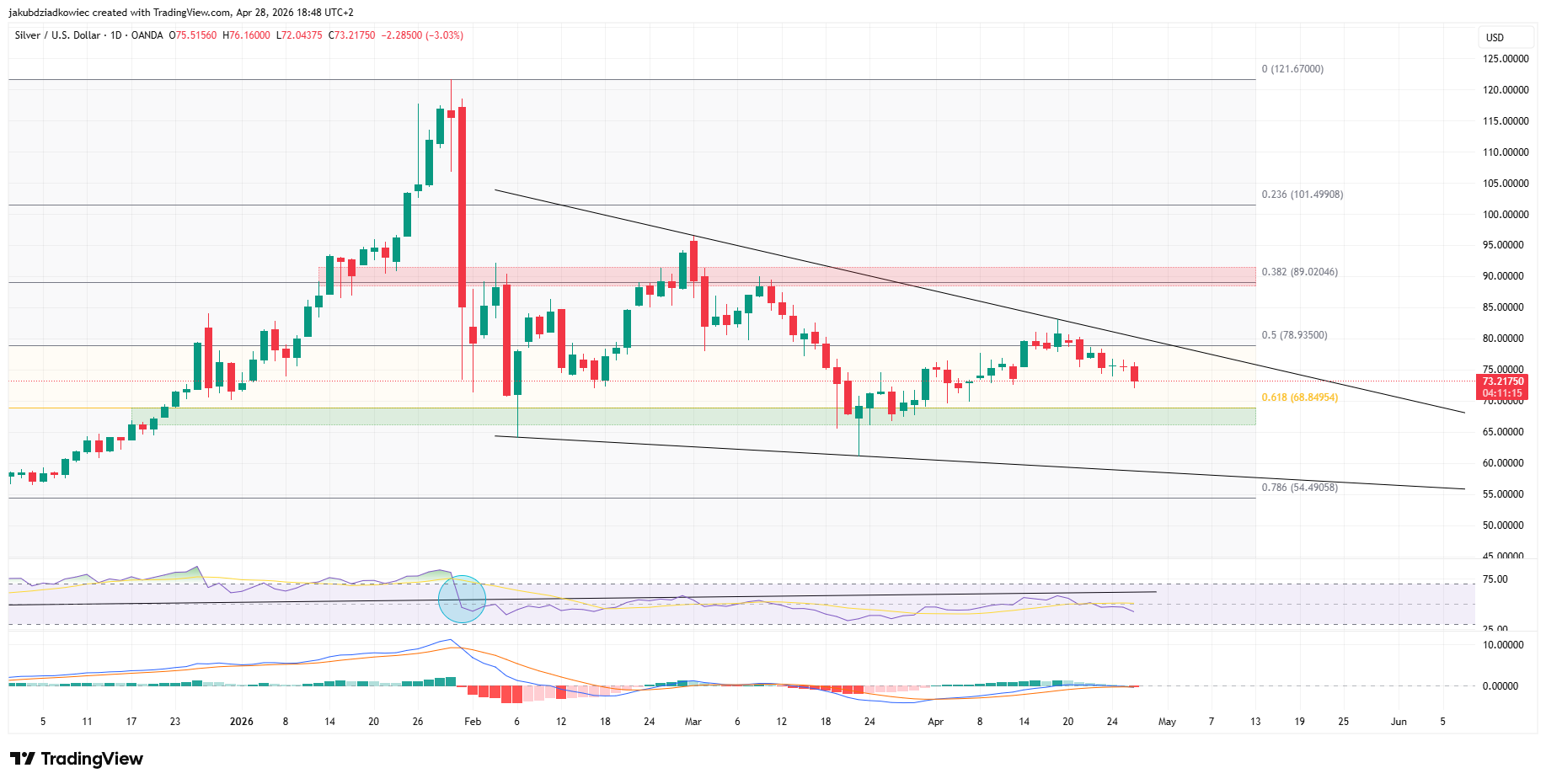
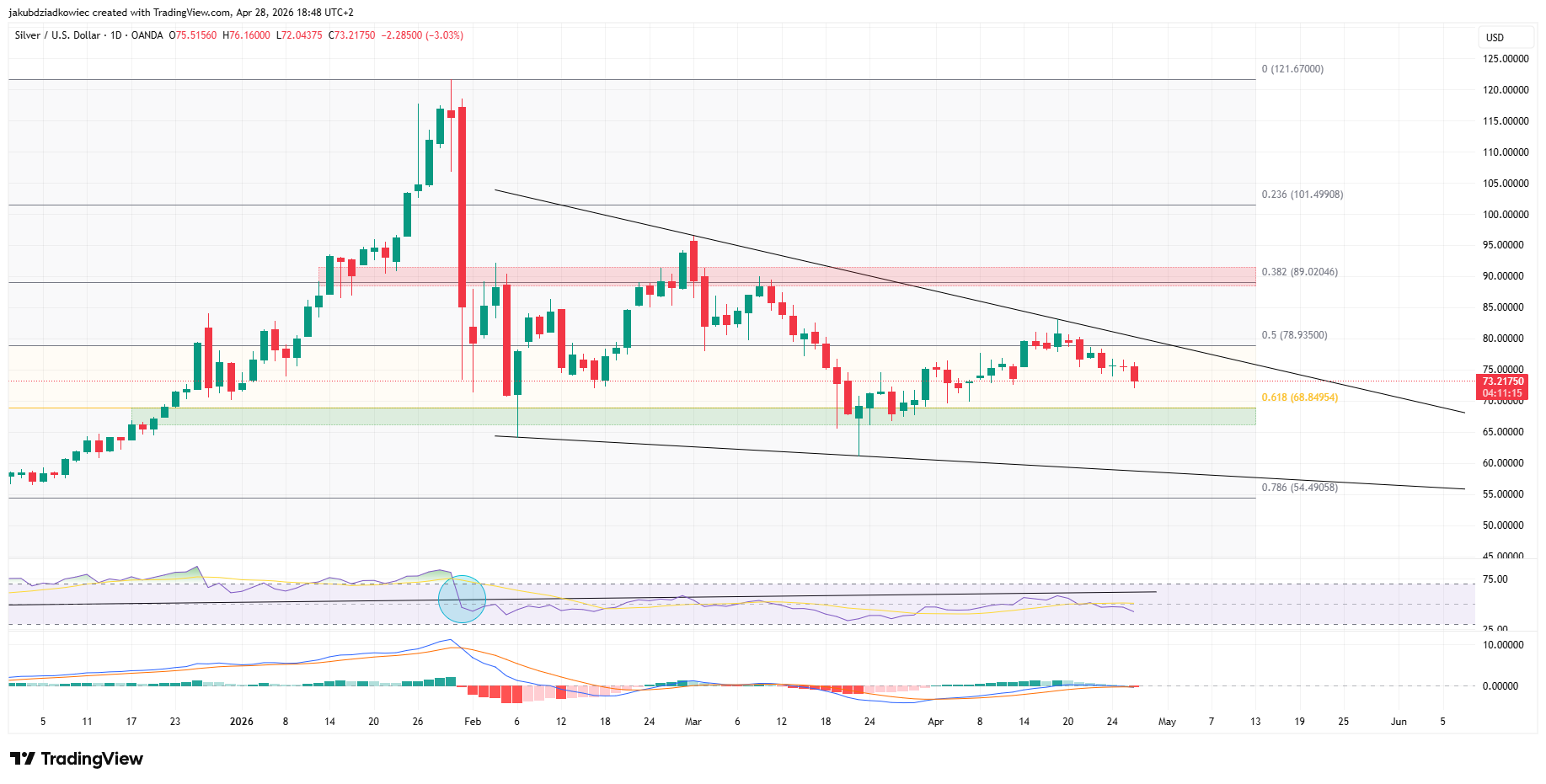
Silver (XAG/USD) price slipped to $73.42 on April 28, down 2.78%, as a descending triangle on the daily chart points toward a $68 downside target.
The setup follows a sharp rejection from the all-time high of $121.67 set on January 29. Falling volume and weakening momentum now reinforce the bearish bias across multiple timeframes.
Daily Chart Frames Silver Price Inside Descending Triangle
The daily chart shows silver locked inside a descending triangle that began forming after the January 29 peak. Price now sits near the upper boundary, suggesting another rejection toward the lower band.
Mapping the Fibonacci grid from the $121.67 high to the $54.49 low frames the trade clearly. Silver trades around $73.22, sitting between the 0.5 retracement at $78.93 and the 0.618 level at $68.85.
If the price closes below the upper band, the next bearish target sits at $68. That level aligns with the 0.618 retracement. A larger risk extends to $54.49 at the 0.786 level, which coincides with the triangle’s lower band.
Resistance sits at $89, capping rebounds at the 0.382 Fibonacci retracement. A close above that level would invalidate the bearish thesis. Such a move would reopen the path toward the $100 target watched earlier this year.
Volume tells a similar story to prior silver bearish signals from March. Two volume peaks lined up with the January and March 23 lows. The steady contraction since then points to an accumulation phase that often precedes a directional move.
MACD has recently crossed downward, keeping the bias tilted lower. RSI also broke its ascending trendline shortly after the all-time high, mirroring the price move.
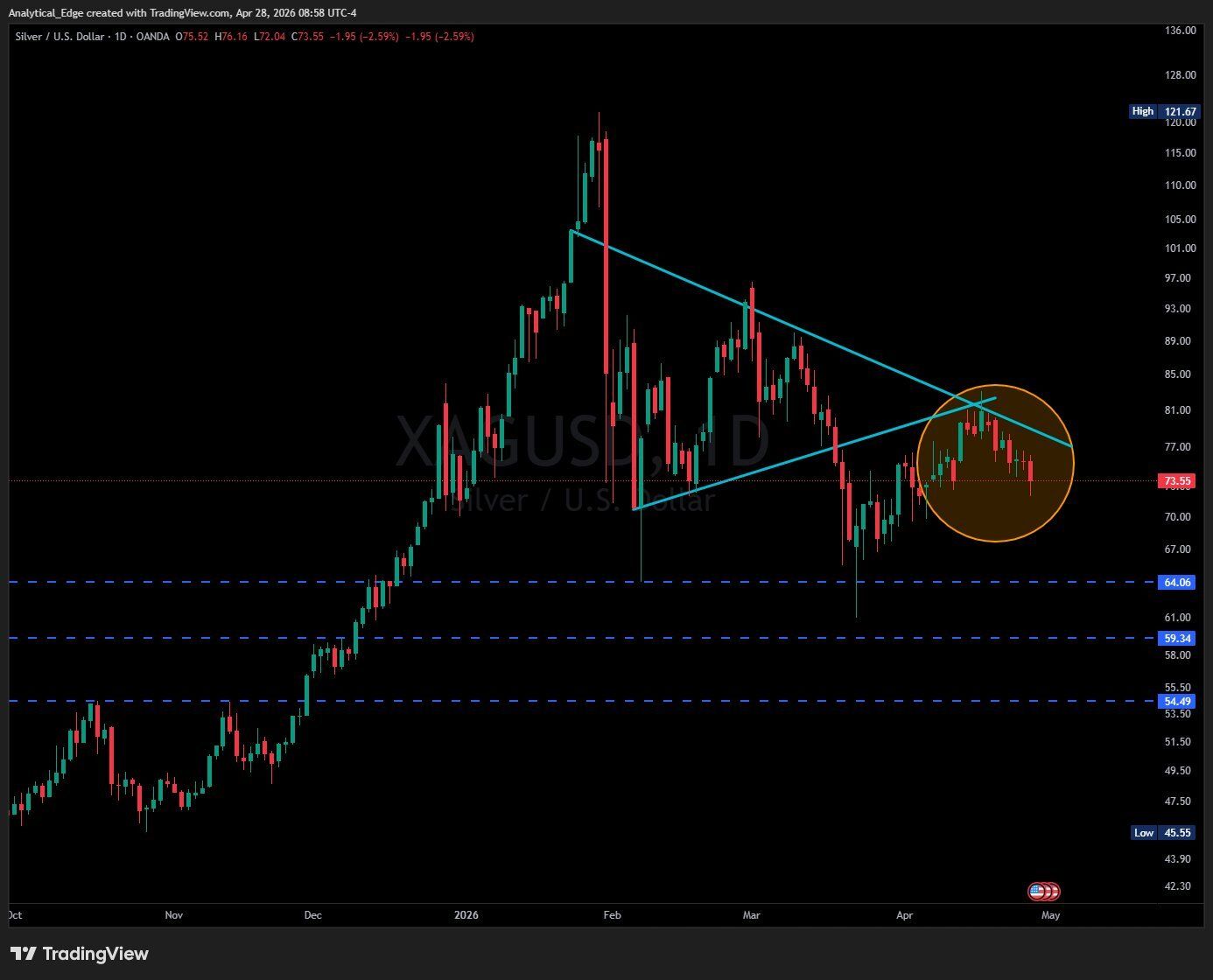
X user @EdgeStrategy67 flagged the same bearish structure on the daily timeframe. The post points to a bear flag formation that has continued to play out.
“As said for some time, bear flag formed and then it has continued in today. But it was expected according to chart!”
That independent read aligns with the descending triangle thesis and reinforces the case for further downside.
Four-Hour Chart Sets $68 as Silver Price Target
The four-hour chart confirms the bearish picture but adds a short-term wrinkle. Price broke down from an ascending parallel channel on April 23 after rejecting the $82 high printed on April 17.
That April 17 rally high lined up with the upper band of the daily descending triangle. The cluster of resistance triggered a swift reversal, pushing silver back below $74.
RSI on the four-hour timeframe has slipped to 32, approaching oversold territory. That reading hints at a possible short-term bounce before any deeper leg develops. MACD leans slightly bearish, keeping the broader structure intact.
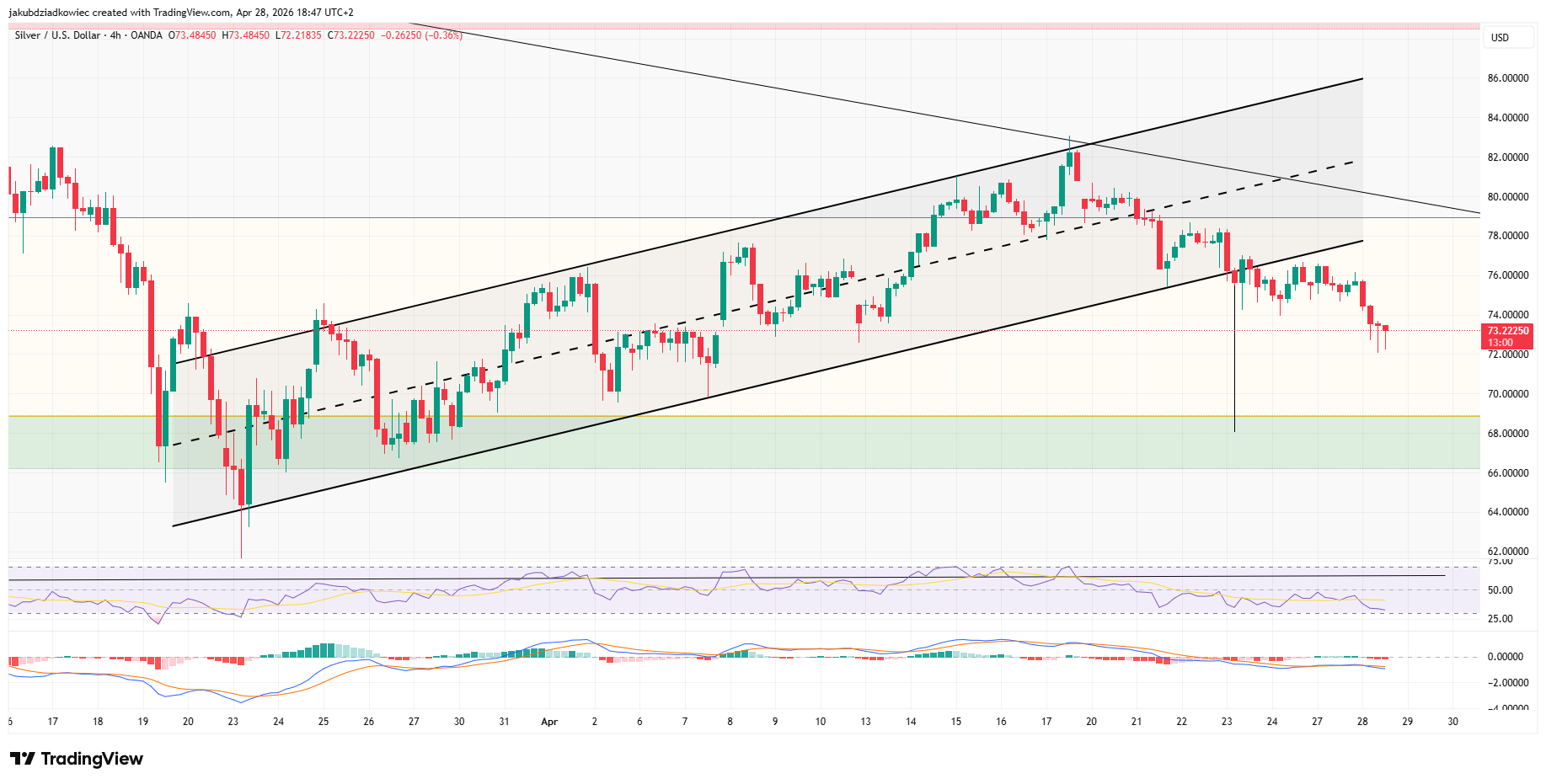
The measured move from the channel height projects toward $68. That level capped buyers in late March and aligns with the 0.618 Fibonacci retracement on the daily chart.
The fundamental backdrop reinforces the chart picture. Silver pulled back as US-Iran tensions drove oil-led inflation expectations higher. The shift has lifted the US Dollar and weighed on non-yielding metals.
The next few sessions will decide whether silver retests the $68 low directly. A relief bounce off oversold readings could arrive first before the larger move resolves.
The post Silver Eyes Lower Prices as Daily Chart Confirms Bearish Setup appeared first on BeInCrypto.

Carrie Underwood Details ‘Rewarding’ Life on Family Farm

Kylie Jenner’s KHY Enters a New Era with ‘Born in LA’

TWENTY SIX, Tayson Kryss – Buscando Money

Manchester United reach agreement with Casemiro over contract clause amid transfer speculation

US brings back mandatory military draft registration

Steven Gerrard disagrees with Gary Neville over ‘shock’ Chelsea and Arsenal claim | Football


-

 Tech1 day ago
Register Renaming | Hackaday
-

 Fashion4 days ago
Weekend Open Thread – Corporette.com
-
Crypto World3 days ago
Hyperliquid $HYPE Rally Builds Momentum as AI Sector Enters Prove-It Phase
-

 Politics6 days ago
Making troops accountable for war crimes threatens US alliance, ex-SAS colonel warns
-

 Politics6 days ago
Disabled people challenge government SEND proposals over segregation concerns
-

 Business5 days ago
Patterson-UTI Energy, Inc. (PTEN) Q1 2026 Earnings Call Transcript
-

 Business7 days ago
Rolls-Royce Voted UK’s Most Iconic Trade Mark as IPO Register Hits 150
-
 Sports2 days ago
IPL 2026: Ruturaj Gaikwad registers slowest fifty of the season, enters all-time unwanted list | Cricket News
-

 Politics1 day ago
Drax board avoid their own AGM, accused of greenwashing & environmental racism
-

 Politics6 days ago
Starmer handler McSweeney to be dragged from shadows by Foreign Affairs Committee
-

 Politics6 days ago
Zack Polanski responds to home secretary’s taser threat
-
Politics6 days ago
Wings Over Scotland | How To Get Away With Crimes
-

 Politics6 days ago
‘Iran is still a nuclear threat’
-
 Business7 days ago
HCL Tech share price tank over 9% after weak Q4. JPMorgan, HSBC & 3 others cut target price
-

 Crypto World7 days ago
Crypto’s great hope in Senate’s Clarity Act still has a path to survive tight calendar
-

 NewsBeat3 days ago
LK Bennett closes all stores after entering administration
-
 Sports6 days ago
Tim Bradley names the current best in the world: “Better than Inoue and Usyk”
-

 Crypto World5 days ago
Michael Saylor says BTC winter is over. Market analyst disagrees, says bitcoin was in a pullback
-
 Crypto World7 days ago
Ethereum Price News: ETH Flashes a Bullish Setup No Holder Should Miss While Pepeto Nears Its Binance Listing
-

 Business7 days ago
The Job Benefits Most Men Don’t Know to Negotiate
You must be logged in to post a comment Login