

Crypto World
OKX oil futures deal with ICE brings 24/7 crude to crypto

Intercontinental Exchange and OKX are teaming up to list perpetual oil futures that track ICE Brent and WTI benchmarks on the crypto exchanges derivatives platform.
Summary
- ICE will license its Brent and WTI futures prices to support new perpetual oil contracts on OKX in selected markets
- The move follows ICE’s investment that valued OKX at 25 billion dollars and gave the NYSE owner a board seat
- Oil perps mirror a fast growing niche pioneered by platforms like Hyperliquid, where WTI linked perpetuals have seen volumes jump to 7.3 billion dollars
- The initiative blurs lines between traditional commodities and crypto derivatives as CME and ICE push regulators to rein in offshore oil perps while testing their own 24/7 models
The owner of the New York Stock Exchange will provide its regulated futures prices for ICE Brent crude and West Texas Intermediate as the reference curve behind the new contracts, while OKX handles the perpetual structure, crypto margin and user distribution.
The contracts will reference the same benchmarks that underlie multi trillion dollar cleared futures on ICE, according to Bloomberg, but will be listed as non expiring swaps on OKX’s venue with funding payments to keep prices aligned with the underlying oil curves.
For now the trading will be limited to jurisdictions where OKX already has permission to offer perpetual futures, which means the products are likely to launch outside the United States even as ICE markets them to institutions used to regulated commodity exposure.
That split structure allows ICE to monetise its benchmark data and deepen a 25 billion dollar strategic tie up with OKX without immediately seeking US approval for 24 hour oil perps on its own exchanges.
The deal sits on top of a broader partnership under which ICE took a minority stake in OKX, secured a board seat and agreed to license its US futures and tokenised equities markets back into the crypto exchange, which serves more than 120 million accounts.
Under that March agreement ICE plans to launch US regulated crypto futures based on OKX spot prices while OKX in turn expects to offer access to ICE’s US futures suite and New York Stock Exchange linked tokenised stocks once regulators sign off.
Will OKX and ICE’s 24/7 oil perps redraw the line between Wall Street and crypto?
Market observers see the oil perpetuals as a logical extension of that blueprint, inserting real world commodities into a crypto native leverage and funding model that retail traders already use for Bitcoin (BTC) and Ethereum (ETH) exposure on OKX’s derivatives books.
For readers tracking large cap assets, Bitcoin and Ethereum prices, liquidity conditions and derivative flows are already covered in depth on dedicated pages at crypto news, which provide context for how new products like oil perps can bleed into broader digital asset volatility and funding markets.
What does this mean for crypto and commodity regulation
The move lands in the middle of a political and regulatory fight over whether perpetual futures on US linked commodities should be allowed for American users at all, and if they are, who should host them.
CME and ICE have pushed US officials to crack down on platforms like Hyperliquid that list WTI linked perps for global users with little classical oversight, framing the issue as a question of market integrity and surveillance rather than a pure turf war.
At the same time both exchanges are nudging regulators toward a world of 24 hour trading, with ICE’s NYSE working on a tokenised securities platform funded by stablecoins and designed for round the clock access that looks very similar in structure to the crypto venues they are publicly criticising.
In that context the OKX deal reads less like a sideline experiment and more like a live test case for hybrid market structure.
ICE supplies regulated benchmarks and governance while OKX contributes the perpetual engine, user interface and experience running high leverage derivatives with up to 125 times leverage in some markets.
If regulators tolerate oil perps tied to regulated benchmarks offshore, it strengthens the case for bringing similar products onshore in a controlled way; if they clamp down, the episode will underline how far commodity regulators are willing to go to keep price discovery anchored in listed futures rather than in offshore crypto contracts.
One person familiar with the thinking told Bloomberg that a large energy trading firm put it bluntly, saying that traders “want the same benchmarks and margin offsets they already use at ICE, but with the flexibility of crypto style funding and around the clock risk management,” a view that captures the logic behind the tie up even as the regulatory path remains uncertain.
For readers looking to understand how this clash between traditional derivatives and digital assets is evolving beyond oil, detailed coverage of Bitcoin markets, Ethereum staking and the rise of perpetual futures across major coins is available on crypto news, including explainers on how funding rates, open interest and cross margining can transmit stress between commodity perps and large cap crypto contracts.
Those dynamics matter because an oil shock expressed through leveraged perps can now move through balance sheets that also hold Bitcoin or Ethereum collateral, tightening the coupling between energy and crypto in ways that macro traders and regulators will have to model rather than ignore.
“We are seeing the convergence of two infrastructures that used to live in separate universes,” said a derivatives strategist at a European prop firm who asked not to be named because they are not authorised to speak publicly. “If you clear oil futures at ICE during the day and trade perpetuals on OKX at night, that is one risk system, not two.”


Strategy chairman Michael Saylor has not ruled out the company offloading some Bitcoin as early as this year, after recently softening his long-held “never sell” stance.
“I think it’s not unlikely that we’ll sell some Bitcoin between now and the end of the year,” Saylor said during an interview with Natalie Brunell published to YouTube on Friday.
Saylor said it is “also likely” that the company will sell a mix of equity and credit and manage its USD and cash holdings. “We do it in a very thoughtful programmatic fashion where we’re running our multivariate models, and we’re literally running them,” Saylor said, noting the company is focused on long-term outcomes out to 2033:
“Ultimately, the way to think of it is seven years out, we would like to have maximized our Bitcoin per share,” Saylor said.

Michael Saylor spoke to Natalie Brunell on the Coin Stories podcast. Source: Natalie Brunell
He added that an objective of the company is: “What is it that we should be doing now that’s going to maximize and optimize the company’s performance so that we’ve maxed out Bitcoin per share seven years from now.”
Strategy’s (MSTR) stock price closed the trading day on Friday at $159.89, down 10.86% over the past 30 days, according to Google Finance. It comes as the price of Bitcoin (BTC) is lower than the average price that Strategy has paid for its Bitcoin, since it began acquiring in 2020.
Bitcoin is trading lower than Strategy’s average purchase price
At the time of publication, Bitcoin is changing hands at $75,958, while Strategy has acquired its 843,768 Bitcoin at an average price of roughly $75,700 each, according to Strategy’s website and CoinMarketCap data.
Strategy’s buy announcements over the years have often been viewed by the Bitcoin community as bullish signals, but because the company has never announced a sale before, it’s unclear how the community would react.
Related: Saylor signals BTC buy as retail holders get push on STRC dividend vote
It comes just days after Saylor said he raised the possibility of selling Bitcoin during Strategy’s recent earnings call to protect the asset’s long-term interests.
“We own about $65 billion worth of Bitcoin. If the market thought we would never sell it, the credit rating agencies would say, Well then, I guess it’s not an asset,” Saylor told Scott Melker on The Wolf Of All Streets podcast published to YouTube on May 10.
Magazine: ETH bears growling, Tom Lee’s buying, XRP to ‘explode’: Market Moves


Galaxy Digital founder Mike Novogratz has appeared in court as the company fights BitGo’s $100 million claim tied to a failed $1.2 billion merger.
Summary
- Mike Novogratz testified in Delaware court over Galaxy’s failed $1.2 billion BitGo acquisition.
- BitGo is seeking a $100 million termination fee after Galaxy called off the merger in 2022.
- The dispute centers on financial statements, SEC accounting rules, and whether Galaxy validly ended the deal.
Novogratz appeared in Delaware Chancery Court this week in the long-running dispute between Galaxy Digital and BitGo. BitGo is asking the court to make Galaxy pay at least $100 million after the crypto investment firm walked away from the acquisition.
The companies agreed to the deal in 2021, when crypto valuations were still high. Galaxy later ended the merger in August 2022, after the Terra collapse and a wider market downturn. Galaxy said BitGo failed to deliver required audited financial statements on time. BitGo said Galaxy wrongly abandoned the deal.
SEC accounting rules sit at center of case
According to Bloomberg’s report, Novogratz testified that he was “pushing to get this deal done,” but said the SEC made approval difficult under then-Chair Gary Gensler. He also said Galaxy itself was not the subject of a government probe.
The accounting issue traces back to SEC Staff Accounting Bulletin 121. The Delaware Supreme Court said SAB 121 became effective shortly before BitGo’s financial statement deadline and gave guidance for public companies that safeguard digital assets.
The court also noted that if BitGo failed to submit compliant statements by July 31, 2022, Galaxy could terminate the agreement without paying the reverse fee.
BitGo says Galaxy damaged its reputation
BitGo CEO Mike Belshe testified that the failed deal hurt the company. He said “This was incredibly damaging,” according to the report, while arguing that BitGo had provided the needed information.
BitGo’s side says Galaxy’s public reason for ending the merger suggested that BitGo could not pass an audit. Galaxy disputes that view and says the contract allowed termination without the $100 million fee because the financial statements did not meet the required terms.
Court fight comes as both firms expand
The case returns at a busy time for both companies. BitGo became a public company in January and later reported $3.77 billion in first-quarter revenue, up 112.6% from a year earlier. However, its net loss widened to $60.7 million as Bitcoin treasury marks and IPO costs weighed on results.
Galaxy has also been expanding its regulated U.S. footprint. A recent market update said GalaxyOne Prime NY received both a BitLicense and Money Transmission License from New York regulators on May 18, allowing it to offer trading and custody services to institutions in the state.
The trial is expected to end this week. The judge will decide whether Galaxy must pay the $100 million fee or whether the company had the right to terminate the deal without payment.


Tokenized stocks could move trading activity away from traditional exchanges as regulators weigh new rules for onchain equities.
Summary
- Tiger Research says tokenized stocks could split exchange liquidity across competing blockchain venues and platforms.
- Revenue may move offshore if exchanges lose fee control over tokenized stock trading flows globally.
- Hyperliquid’s $2.6B RWA open interest shows demand for onchain market access is rising fast globally.
Tiger Research said tokenized stocks could create two main risks for traditional markets: liquidity fragmentation and revenue fragmentation. The report linked those risks to the SEC’s reported innovation exemption, which may allow third parties to tokenize listed stocks such as Apple and Tesla without issuer approval.
The research said traditional finance treats the break-up of centralized liquidity as a “serious structural threat.” In simple terms, trading that usually sits on exchanges such as the NYSE or Nasdaq could move across several blockchain networks and decentralized venues.
That shift could create different prices for the same stock-linked asset across venues. It could also make large trades harder if buyers and sellers spread across many platforms instead of one deep market.
Revenue could move away from domestic exchanges
Tiger Research also warned that exchange revenue could split if tokenized stocks trade on competing venues. Fees that normally flow to domestic exchanges, brokers, and clearing systems could instead move to offshore platforms or new blockchain-based markets.
The report said this issue also affects national financial competitiveness. If one country delays tokenized market rules while another moves faster, trading fees and market activity can shift across borders.
This is why the SEC’s reported exemption matters. Related coverage said the SEC may allow tokenized public stocks on blockchain platforms, but tokens may need to carry the same rights as traditional shares, including dividend and voting access.
SEC Commissioner Hester Peirce has also warned that blockchain does not change the legal nature of the asset. In a July 2025 statement, she said “Tokenized securities are still securities.” She added that market participants must follow federal securities laws when dealing with tokenized instruments.
Hyperliquid shows onchain RWA demand
The shift is already visible in crypto markets. Hyperliquid said RWA trading open interest reached $2.6 billion on May 18, setting a new all-time high and doubling from two months earlier.
Tiger Research used Hyperliquid’s growth to argue that capital is already moving toward 24/7 onchain access to real-world assets. That demand puts pressure on exchanges and regulators that still rely on older trading hours, settlement systems, and venue models.
RWA.xyz data also shows that tokenized stocks remain small but active. Its dashboard lists $1.53 billion in tokenized stock value, $3.40 billion in monthly transfer volume, and more than 272,000 holders.
Exchanges are already moving onchain
Traditional exchanges are not ignoring the shift. Reuters reported in March that the NYSE partnered with Securitize to develop tokenized versions of traditional financial securities for a future NYSE-affiliated digital platform.
NYSE planned to work with Securitize on digital transfer agent standards, trade processing, and tokenized security infrastructure. Reuters also noted that U.S. exchanges, including NYSE and Nasdaq, have been increasing efforts to put stocks, bonds, and funds on blockchain rails.
The core question is now control. If tokenized stocks develop inside regulated exchange systems, traditional venues may keep part of the flow. If third-party platforms grow faster, stock trading could become more fragmented.
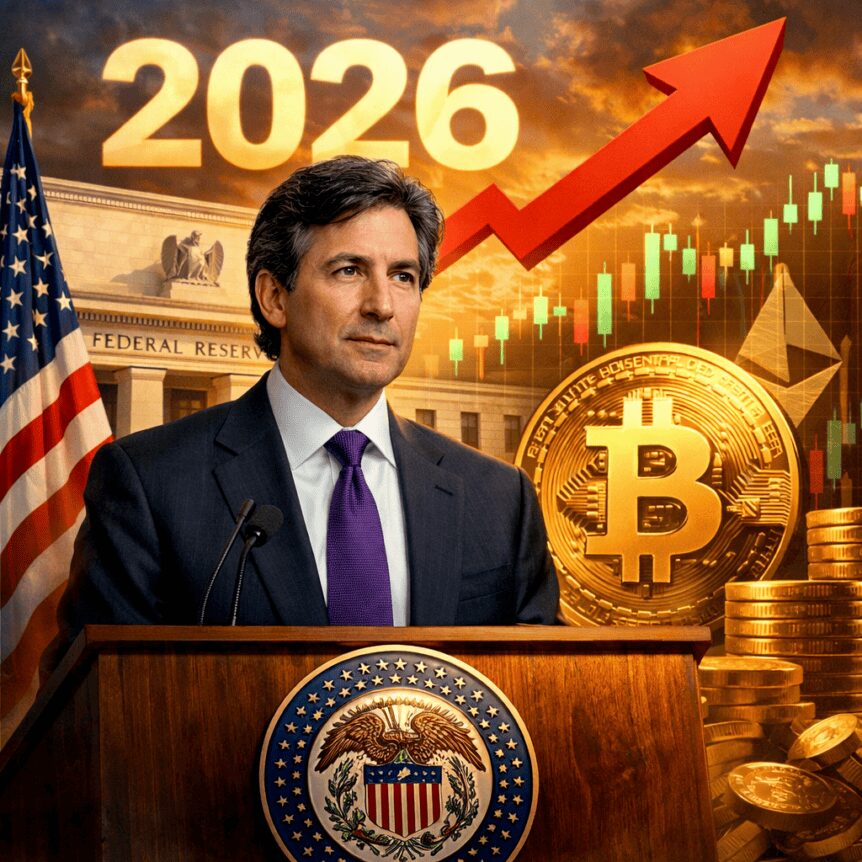
Kevin Warsh was sworn in as chair of the United States Federal Reserve, but the market’s focus quickly shifted to the policy path that will shape crypto markets and broader risk assets through 2026. The latest CME Group FedWatch data suggests investors are pricing in virtually no chance of rate cuts this year, signaling a higher-for-longer stance that could influence liquidity and risk appetite across crypto and equities.
During the swearing-in ceremony, President Donald Trump framed Warsh’s tenure as one defined by independence from the Executive Branch on monetary policy, while underscoring a belief that a booming economy should guide growth alongside inflation containment. “We want to stop inflation, but we don’t want to stop greatness,” Trump said, a line that captured the tension between price stability and growth the new administration seeks to navigate.
“We want to stop inflation, but we don’t want to stop greatness.”
Warsh inherits a policy backdrop where inflation, employment, and debt dynamics intersect with a market environment that had been pricing little relief in the near term. The Trump administration’s emphasis on growth as a lever to manage debt sits beside persistent macro uncertainty, complicating how traders read even the first signals from the new leadership at the Fed.
Key takeaways
- No rate cuts expected in 2026, based on CME FedWatch data, reinforcing a higher-for-longer policy trajectory.
- Near-term odds of a 25 basis point hike at the June meeting sit at about 3.5%, with the current federal funds target at 3.50%–3.75%.
- Probability of a rate hike at the July meeting rises to roughly 17%, and about 67% of traders expect a hike at the December meeting.
- The leadership change at the Fed comes amid inflation concerns and growth considerations, with markets parsing how the new chair’s approach will balance these forces.
- Crypto and other risk assets could face headwinds if the expected pause on rate cuts persists, as liquidity and risk sentiment remain sensitive to policy signals.
Fed leadership and policy signals
The swearing-in of Warsh as chair places the Fed at a critical inflection point. While details of his forthcoming policy communications remain to be seen, the market is already responding to the prevailing assumption that monetary easing via rate cuts is unlikely in the near term. In a regime where the Fed’s stance on inflation and growth will guide the tempo of liquidity, crypto traders are attuned to any shift in language or data that might alter the balance between price stability and economic expansion.
Trump’s remarks at the event underscored a deliberate narrative: Warsh’s independence should enable a policy path that prioritizes growth while attempting to keep inflation in check. The president’s framing, coupled with inflation and employment dynamics, creates a backdrop in which the Fed’s credibility will be tested as markets weigh the odds of future policy moves against evolving macro data releases.
Markets, rates and crypto implications
Market pricing through the CME FedWatch tool indicates a remarkably low likelihood of rate cuts in 2026. The immediate implication is a constrained environment for policy ease, which tends to support tighter financial conditions. In practice, this translates into higher real interest rates and a spotlight on the trajectory of inflation, growth signals, and debt sustainability as the Fed’s mandate remains in focus.
The June 17 FOMC meeting is seen as a potential touchpoint for a small policy adjustment, with a 3.5% probability of a 25 basis point rate hike. With the current target range at 3.50% to 3.75%, even a modest move would be read as a continuation of the higher-for-longer theme, rather than the start of a rapid easing cycle.
Beyond June, the odds shift toward a greater probability of action later in the year. A July hike carries roughly a 17% chance, while the December meeting is seen as the more likely period for a rate move, with about two-thirds of traders expecting a hike then. Taken together, the data imply a policy stance that remains tight through the year, creating a backdrop of higher borrowing costs and a slower easing pace than many crypto and equity markets had priced in during earlier cycles.
In the crypto ecosystem, this environment has a nuanced set of implications. Historically, lower interest rates have been supportive of risk-on assets, including Bitcoin and broader crypto markets, by boosting liquidity and search for yield in higher-risk corners of the market. Yet the flip side is that cheap credit can fuel inflationary pressures or misallocation if it leads to a wave of leveraged speculation. As the Fed maintains a careful watch on inflation and growth, crypto traders will be watching not only the headline rate moves but also any shifts in the Fed’s communications that could tilt expectations for the cost of capital and the availability of liquidity.
What this means for investors and builders
For investors, the current outlook reinforces the idea that capital will continue to be priced with an eye toward central bank policy and macro data. Portfolios with exposure to crypto and other risk assets may need to tolerate continued volatility as rate expectations swing with new data releases and statements from Fed leadership. The absence of imminent rate cuts suggests a period of consolidation for risk assets, even as the underlying fundamentals of blockchain networks, DeFi protocols, and institutional involvement in crypto continue to evolve.
For builders and developers in the crypto space, the environment underscores the importance of funding resilience and product-market fit independent of a passive liquidity tailwind. Projects that demonstrate real utility, robust security, and clear paths to revenue may fare better in a regime where liquidity remains tethered to policy signals, rather than a broad, rate-driven liquidity flood.
And for regulators and policymakers outside the Fed, the ongoing conversation around inflation control, debt management, and economic growth will intersect with how the crypto sector is treated within the broader financial system. As policy makers weigh the CLARITY Act and other regulatory contours, the market will assess whether legislative actions could alter the risk-and-reward dynamics that crypto projects navigate daily.
The immediate takeaway is clear: the Fed’s leadership transition arrives at a moment when policy clarity, inflation momentum, and growth trajectories will jointly shape the path of crypto and risk assets. Investors should stay attentive to the Fed’s communications, inflation prints, and any shifts in the rate-path narrative that could alter funding conditions for digital assets and their traditional counterparts.
Readers should monitor upcoming FOMC communications and macro data releases, as any hint of a policy pivot or a renewed emphasis on price stability could recalibrate sentiment across cryptocurrencies and the broader market.
South Korea’s planned cryptocurrency tax has come under renewed political scrutiny after a public petition seeking its repeal cleared the signature threshold required for legislative review.
Summary
- South Korea’s proposed crypto tax repeal petition has crossed 50,000 signatures and moved to a National Assembly committee for review.
- The petition argues that taxing crypto gains while exempting stock and bond investment income creates unfair treatment for digital asset investors.
- South Korea is set to launch the 22% crypto tax in January 2027, with the National Tax Service already coordinating compliance rules with local exchanges.
According to South Korea’s National Assembly petition system, the motion surpassed 50,000 signatures at around 11:23 a.m. local time on Thursday, eight days after submission, automatically sending the proposal to a parliamentary committee for examination.
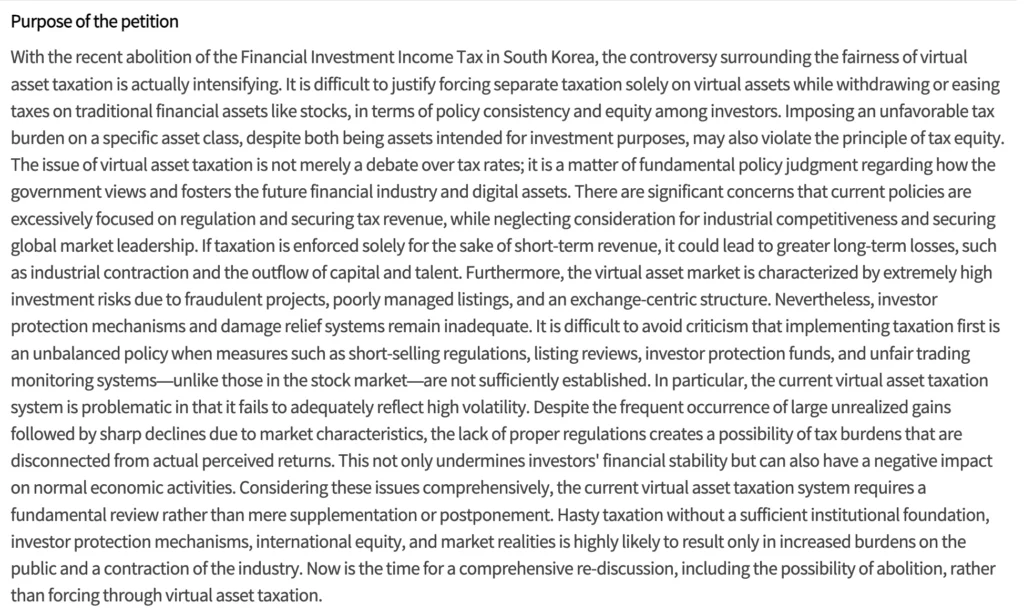
In the petition, an anonymous author argued that taxing crypto investors while exempting traditional financial investment income creates an unfair imbalance.
The motion pointed to South Korea’s decision to abolish taxes on gains from stocks and bonds, while virtual asset investors still face a planned 22% levy on annual gains above 2.5 million won, or roughly $1,650.
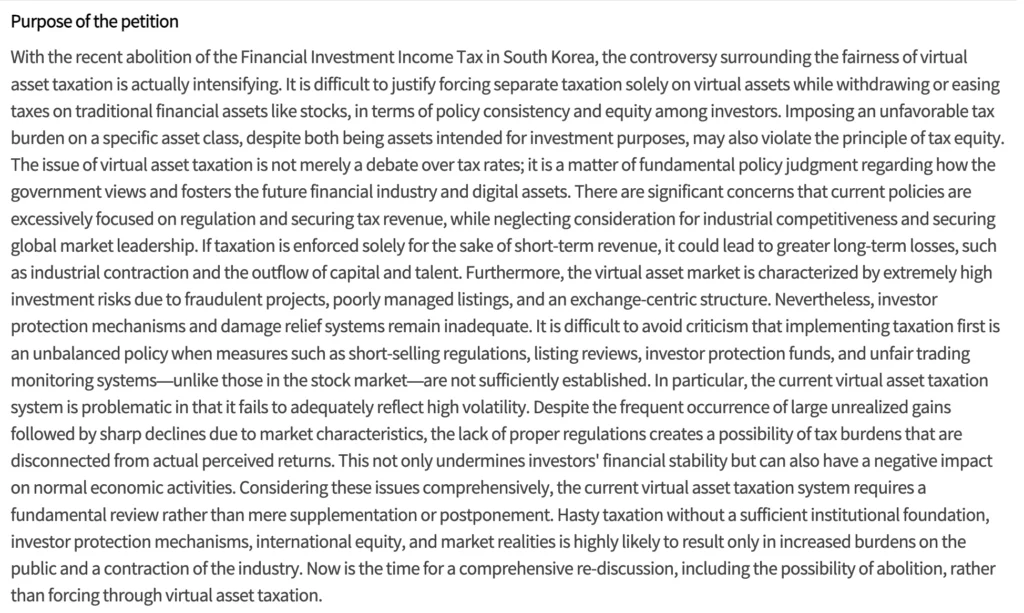
A translated excerpt of the petition. Source: South Korean National Assembly
Set to take effect from Jan. 1, 2027, the tax includes a 20% income tax and a 2% local income tax under South Korea’s Income Tax Act.
Earlier this month, Moon Kyung-ho, director of the Ministry of Economy and Finance’s income tax division, said during a National Assembly forum that the government intended to proceed with the tax as scheduled.
At the same time, South Korea’s National Tax Service has continued preparing implementation guidance with domestic exchanges including Upbit, Bithumb, Coinone, Korbit, and Gopax. Local reports previously said the agency plans to release detailed compliance guidelines later in 2026 before the first full filing period opens in May 2028 for income earned during 2027.
Petition raises investor protection concerns
Alongside criticism over tax fairness, the petition argued that South Korea’s crypto market still lacks sufficient investor safeguards. The motion cited fraudulent activity and poor-quality token listings as ongoing risks that authorities have not fully addressed before introducing taxation.
Translated text from the petition stated that the issue extends beyond tax rates and concerns how the government intends to treat digital assets and the future of the financial industry.
Additional criticism focused on market volatility. According to the motion, the current framework fails to properly account for large price swings that can rapidly alter investor positions.
Political disagreement over the crypto tax has delayed the measure three times already. Per earlier crypto.news reporting, lawmakers postponed implementation from 2025 to 2027 after debates over exchange infrastructure, reporting systems, and whether the 2.5 million won threshold was too low compared with other investment products.
More recently, South Korea’s People Power Party proposed legislation to abolish the tax before its scheduled rollout. However, the Finance Ministry’s latest public comments suggested authorities are still preparing for implementation unless lawmakers amend the law beforehand.
Elsewhere in South Korea’s digital asset sector, regulators have continued advancing new crypto oversight rules ahead of 2027. Earlier this month, the National Assembly passed amendments to the Foreign Exchange Transactions Act requiring firms involved in overseas crypto transfers to register with the finance minister.
Separately, the Financial Services Commission said on May 15 that it plans to release detailed tokenized securities rules in July ahead of amendments to the Capital Markets Act and Electronic Securities Act scheduled to take effect in February 2027. Samsung SDS is also building infrastructure for the Korea Securities Depository’s token securities platform as authorities prepare blockchain-based issuance and settlement systems.


THORChain node operators are voting on ADR028, a recovery plan that would restart the network after a $10.7 million exploit without minting new RUNE.
Summary
- THORChain’s ADR028 plan would use protocol-owned liquidity first before sharing remaining losses with synth holders.
- The proposal avoids new RUNE minting, token sales, or holder dilution while node operators vote on recovery.
- Recent DeFi exploits add pressure on THORChain to restart safely after patching its GG20 vulnerability.
THORChain said node operators are now voting on ADR028 after the May 15 incident. The proposal sets the direction for recovery, while exact figures remain open to later changes through Mimir governance.
The official exploit report said the attacker drained about $10.7 million from one of five vaults. THORChain said the attacker was a newly churned node operator who exploited a GG20 Threshold Signature Scheme vulnerability. The other four vaults were not affected.
Recovery plan avoids new RUNE
Under ADR028, protocol-owned liquidity would absorb the loss first. Any remaining shortfall would then be shared across synth holders. THORChain said the split is still being reviewed and will be adjusted later.
The proposal says no new RUNE will be minted, no RUNE will be sold, and holders will not be diluted. Protocol-owned liquidity would be reduced to zero, with part of future system income redirected to rebuild it over time.
Moreover, THORChain said GG20 will stay in place for now, but it must be patched and upgraded before trading resumes. The network will also need a successful churn before normal activity returns.
The exploit report said automatic solvency checks detected the vault imbalance within minutes. Node operators then used manual pauses and Mimir votes to halt trading, signing, chain observation, and churning within about two hours of the community alert.
Recent DeFi exploits add pressure
The THORChain vote comes after earlier reports said the protocol halted trading when ZachXBT warned that losses could top $10 million across Bitcoin, Ethereum, BSC, and Base. Related coverage noted that RUNE fell after the alert as users waited for clearer details from protocol operators.
The incident also follows a busy period for crypto exploits. Recent reports said the Verus Ethereum bridge lost more than $11.5 million after attackers used a forged cross-chain transfer message. Security firms linked that exploit to missing validation checks in the bridge process.
April also showed how heavy the pressure on DeFi security has become. Crypto protocols lost more than $606 million in the first 18 days of April, led by the $292 million KelpDAO breach and the $285 million Drift Protocol exploit.
TRM Labs also reported that North Korea-linked actors drove about 76% of global crypto hack losses in the first four months of 2026. The firm put those losses at about $577 million through April.
Attacker faces slashing and bounty offer
ADR028 proposes full slashing for the attacker’s node. THORChain said innocent nodes assigned to the same vault would be protected. Recovered RUNE would be paired with any assets recovered from the affected vault, while surplus RUNE would be burned.
The proposal also offers the attacker a bounty to return the funds. If funds are returned in part, the recovery plan would roll back by the same share. THORChain also said the protocol will remain neutral and permissionless, meaning the attacker’s swaps will not be censored once trading resumes.
The vote now gives node operators a path to approve the recovery direction. It does not finalize every number. The main test is whether THORChain can restart safely, absorb losses without new RUNE, and restore confidence after another high-profile DeFi exploit.
Pi Network is trying to link token design with real product use as PI continues to trade near the lower end of its recent range.
Summary
- Pi Network price holds near $0.153 after losing about 10% over the last seven days.
- Chengdiao Fan said token design should support user growth, engagement, feedback, and long-term utility.
- Pi’s utility push follows Protocol 23, but PI still faces weak momentum near key support.
Pi Network said founder Chengdiao Fan’s Consensus 2026 talk focused on a common problem in crypto: the gap between token design and real product innovation. The project said her session, “Aligning Web3, AI, and Blockchain for Utility,” framed tokens as tools for user growth, engagement, and long-term use.
Fan’s presentation also discussed Pi Launchpad, a proposed model for ecosystem tokens and launch mechanisms. The goal is to help products reach real users who can test, give feedback, and use tokens inside actual product experiences, rather than only trading them.
Pi Network’s own blog said Fan argued that AI has made it easier to create applications. That changes the main challenge for builders. In Pi’s view, distribution, verified users, and real usage now matter more than the ability to launch another app.
The Consensus event page used similar language. It said the session would show how Pi combines blockchain infrastructure, verified identity, and a large engaged network to support utility-driven products and AI-era business models.
PI price remains under pressure
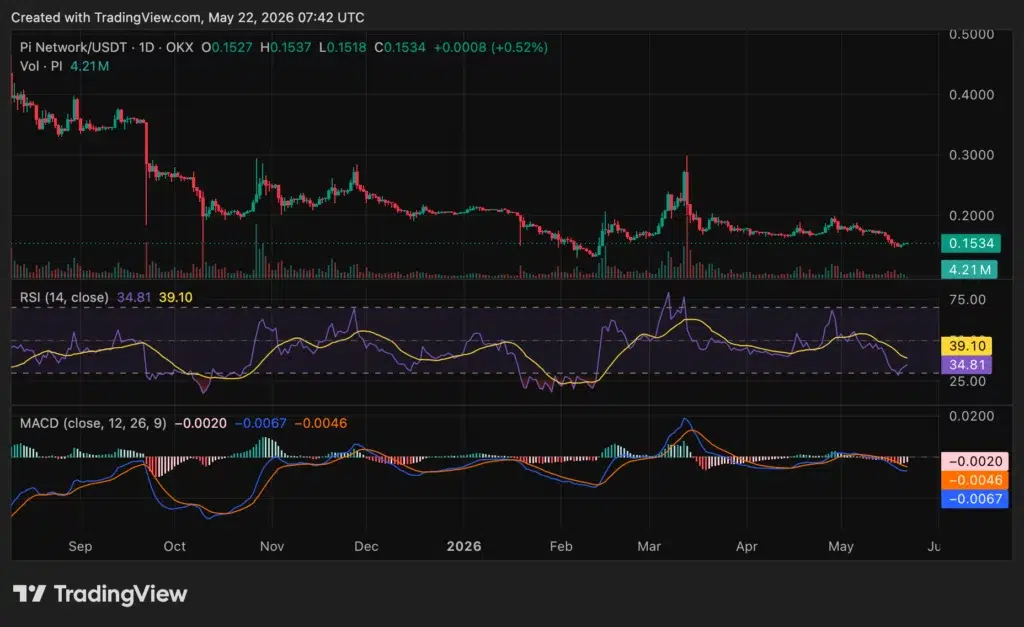
Pi Network’s market data still shows a weak price setup. PI traded near $0.152949 on May 22, with a 24-hour range between $0.150275 and $0.153973. The token was down 10.02% over seven days and 10.14% over 30 days, according to crypto.news price data.
The same data showed Pi Network with a market cap of about $1.62 billion and a fully diluted valuation of about $2.49 billion. PI ranked #54 by market cap, with 24-hour trading volume near $11.5 million.
Pi’s longer-term price picture remains weak. The token is down more than 81% over the past year and remains far below its all-time high of $2.99, reached on Feb. 26, 2025. It is still above its all-time low of $0.131244 from Feb. 11, 2026.
Chart signals also point to limited demand. PI/USDT is trading with muted volume, while the price is struggling to reclaim the $0.17 to $0.20 zone. RSI near 35 shows weak momentum, and the MACD remains negative, keeping sellers in control for now.
Protocol 23 keeps ecosystem hopes alive
Pi Network’s utility message follows a major technical phase for the project. Recent coverage said Protocol 23 activated on May 11, shortly after the project’s Consensus 2026 appearance. The upgrade introduced full smart contract functionality to the Pi blockchain for the first time.
Earlier reports also said Pi’s co-founders used Consensus 2026 to discuss AI, online identity, and Web3 use cases. Fan spoke about utility and token design, while Nicolas Kokkalis joined a panel on proving human identity online without exposing personal data.
That timing matters because Pi is trying to move beyond its long-running mobile mining identity. Protocol 23 gives the network a path toward more programmable applications, while Pi Launchpad would support ecosystem tokens and product launches.
Still, the market has not yet priced in a clear recovery. PI needs a stronger move above $0.17 to $0.18 to weaken the bearish setup. A break below $0.15 could expose another move toward lower support.
Token design becomes Pi’s main test
Fan’s message puts Pi Network inside a wider debate about what tokens should do. Many crypto projects have used tokens mainly for fundraising, speculation, or short-term incentives. Pi is arguing that tokens should help products find users and keep them active.
That pitch fits the project’s existing focus on identity. Pi says its verified user network can help businesses reach real people at a time when AI tools can create fake users, bots, and content at scale. The project says this creates value for apps that need trusted human participation.
The challenge is execution. Utility claims only matter if developers build products that users want and if PI becomes useful inside those products. Price action shows traders remain cautious while they wait for stronger signs of demand.
Polymarket has reportedly appointed a Japanese representative as the prediction market platform moves toward securing approval to operate legally in the country by 2030.
Summary
- Bloomberg reported that Polymarket has appointed a Japan representative as it works toward regulatory approval in the country by 2030.
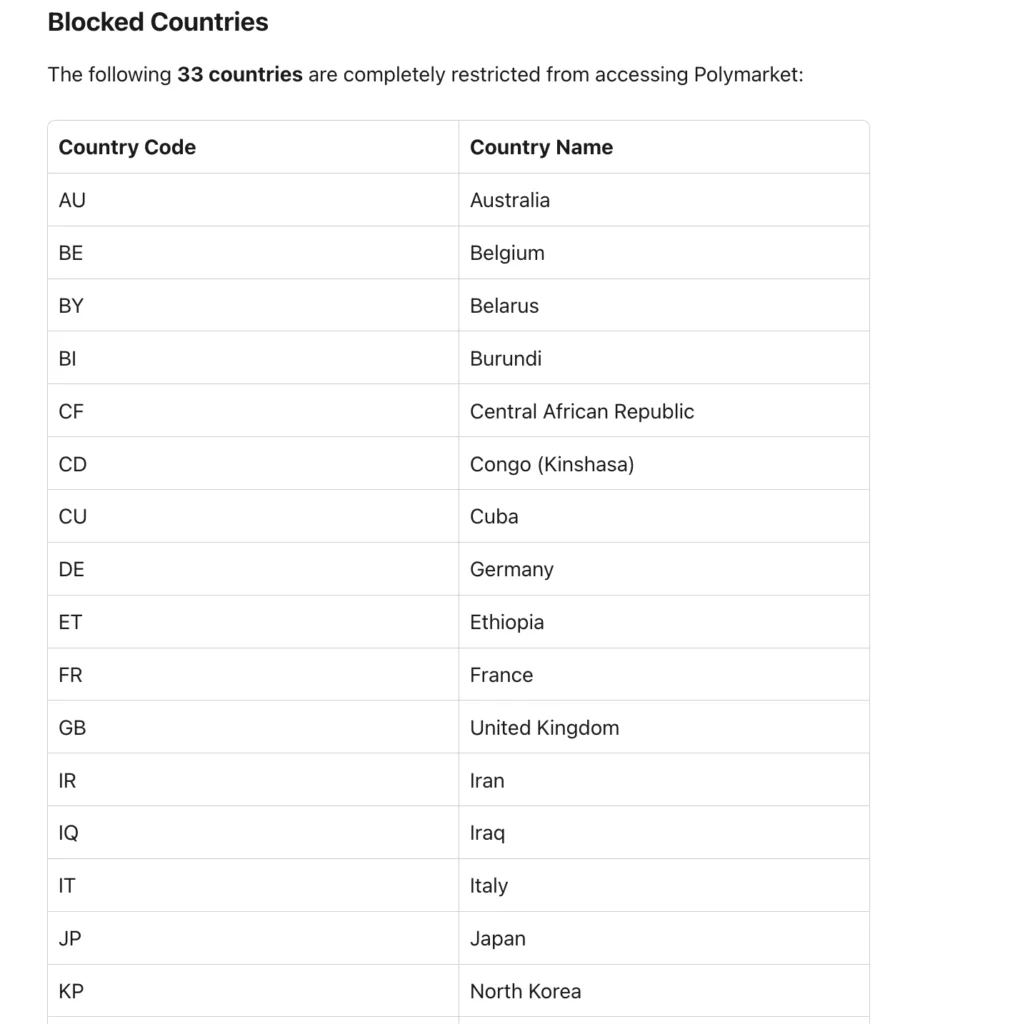
- Japan remains on Polymarket’s restricted access list while local gambling laws continue imposing strict penalties on unauthorized betting activity.
- Expansion efforts in Japan have surfaced as regulators in India, Argentina, and parts of the U.S. continue tightening oversight on prediction markets.
According to a Friday Bloomberg report citing people familiar with the matter, Polymarket sees Japan as a long-term expansion market even as the platform remains blocked or restricted across several jurisdictions over gambling and financial compliance concerns.
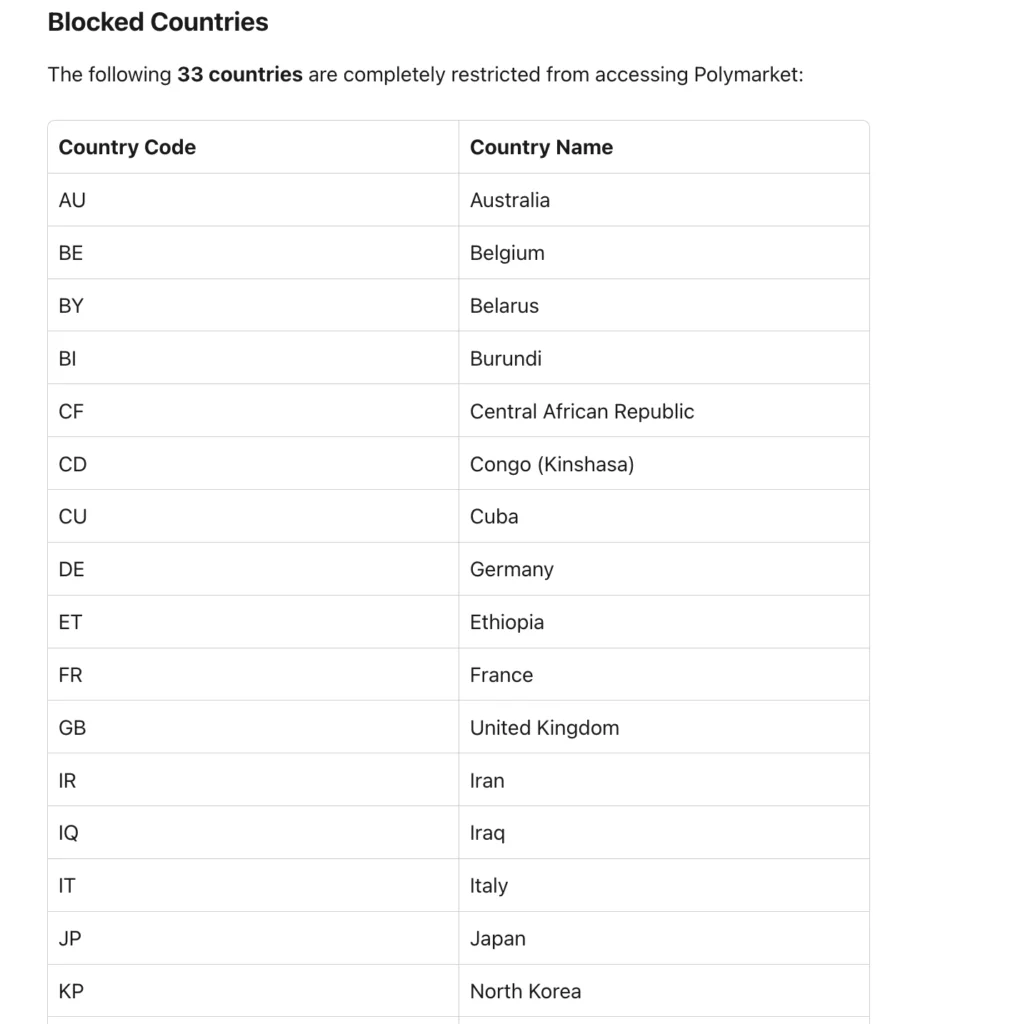
Polymarket’s list of restricted countries. Source: Polymarket website.
Leading the effort is Mike Eidlin, who Bloomberg identified as the current head of Japan at Jupiter. According to the report, Eidlin has been appointed to oversee Polymarket’s local strategy as the company begins discussions around regulatory access in the country.
At present, Japan remains on Polymarket’s restricted jurisdiction list. The platform’s website states that users from the country are blocked due to “regulatory requirements and compliance with international sanctions.”
Japanese law maintains strict restrictions on gambling activity. Under the country’s Penal Code, habitual gambling can carry prison terms of up to three years, while operating gambling businesses can result in imprisonment ranging from three months to five years.
Government-approved horse racing and public lotteries remain exempt under existing rules, while pachinko parlors continue operating through a long-standing legal gray area tied to token exchange systems.
Polymarket pushes expansion amid rising regulatory pressure
Outside Japan, regulators have continued increasing scrutiny of prediction market platforms, particularly those tied to crypto-based payments and speculative contracts.
Earlier on Friday, Indian authorities blocked access to Polymarket after the Ministry of Electronics and Information Technology instructed internet providers and VPN operators to restrict access to what officials classified as illegal online betting and prediction market services. Local outlet ThePrint reported that authorities are also preparing similar action against Kalshi, a U.S.-regulated prediction platform overseen by the Commodity Futures Trading Commission.
Regulatory documents tied to India’s Promotion and Regulation of Online Gaming Act 2025 have categorized platforms that allow users to place money on uncertain outcomes as prohibited betting services, regardless of whether operators describe them as forecasting tools or researching markets.
Pressure has surfaced in other regions as well. Earlier this year, authorities in Argentina ordered internet providers to block Polymarket after a Buenos Aires court found the platform operated outside the country’s gambling framework. Colombia and Romania imposed similar restrictions last year after classifying the service as unauthorized gambling activity.
At the same time, parts of the U.S. have also moved against prediction markets tied to sports contracts. Minnesota recently became the first U.S. state to ban prediction markets, while the CFTC and the Department of Justice filed a lawsuit earlier this week challenging the state’s legislation.
Even with growing regulatory pushback, Polymarket has continued expanding its institutional presence.
Earlier this month, the company partnered with Nasdaq Private Market to launch prediction markets linked to private-company valuations, IPO timelines, and secondary-market pricing. Under the agreement, Nasdaq Private Market serves as the resolution data provider for those contracts using verified transaction data tied to private companies.
Reuters previously reported that Polymarket has also been exploring a fresh funding round that could value the company at roughly $15 billion.
Back in the U.S., Polymarket has also returned through its acquisition of federally regulated derivatives exchange QCEX. Bloomberg and other outlets have reported that the company remains in talks with the CFTC as it seeks to restore broader access to its main exchange operations in the country.
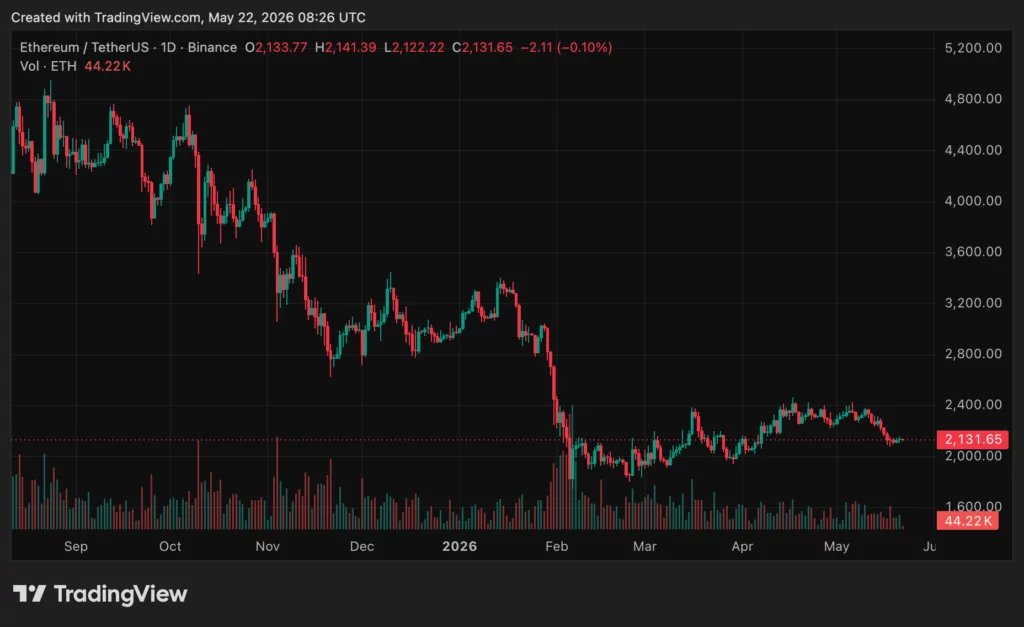
Ethereum sentiment has weakened sharply in May as traders react to price pressure, ETF outflows, Foundation exits, and slower network growth.
Summary
- Santiment says Ethereum’s market cap fell 11.6% in 15 days as trader sentiment weakened.
- ETF outflows, Foundation exits, and slower network growth have fueled fresh Ethereum doubts in May.
- JPMorgan says ETH needs stronger network activity and real-world use to close Bitcoin’s widening lead.
Santiment said Ethereum has seen a sharp shift in market mood, with its market cap down 11.6% over 15 days. The data platform said ETH is now at risk of falling below $2,000 for the first time since late March if selling pressure continues.
The report said Ethereum’s social dominance rose while price kept falling. That pattern can point to higher attention, but Santiment said the tone of discussion moved toward fear and frustration instead of optimism.
Santiment also said bullish and bearish comments about ETH moved closer to balance in May. In late April, bullish comments were still well above bearish ones. By May, the ratio had moved closer to 1.0, showing that traders had become far less confident.
ETF outflows weigh on ETH demand
ETF flows are one of the main pressure points. Santiment said several Ethereum ETF products saw outflows through May, including large exits from BlackRock-related funds. It also said no total Ethereum ETF inflow day above $50 million had been recorded in three weeks.
📉 Ethereum sentiment has flipped hard, and retail has jumped from crypto’s #2 market cap quickly. ETF outflows, Foundation exits, slowing network growth, and nonstop bearish narratives have traders questioning $ETH like never before. Here’s our take. 👇https://t.co/RDpVPbdIZs pic.twitter.com/y7JPlcZEPK
— Santiment Intelligence (@SantimentData) May 22, 2026
Related reports also show why traders are watching the $2,000 area. Earlier market coverage said Ethereum ETFs recorded more than $340 million in net outflows over six trading sessions, while ETH struggled to reclaim $2,150.
JPMorgan has also flagged weaker Ethereum demand compared with Bitcoin. The bank said Bitcoin ETFs recovered about two-thirds of recent outflows, while Ether ETFs recovered only about one-third. It also said ETH and altcoins may keep lagging without stronger DeFi activity and real-world use cases.
Foundation exits add to trader doubts
Ethereum Foundation changes have also fed the weaker mood. Recent coverage noted that Carl Beek and Julian Ma announced exits from the Ethereum Foundation, adding to broader Protocol Cluster changes.
Santiment said traders often react quickly to these narratives. It added that reports about Foundation exits and public claims about ETH supporters reducing exposure helped build the current bearish mood. Some of those claims lacked full context, but they still shaped trader behavior.
The report also noted that Ethereum remains strong in development activity. Santiment said Ethereum still leads in raw developer work, even as retail traders focus more on faster price moves from rival ecosystems.
Network growth remains the market test
Santiment said daily active addresses and network growth have cooled from stronger periods in 2024 and 2025. Fewer new wallets are interacting with Ethereum, which traders may read as a sign of weaker demand for ETH.
Ethereum was trading near $2,125 to $2,135 on May 22, based on market data crypto.news. That keeps ETH close to the support zone watched by traders after recent outflows and technical weakness.
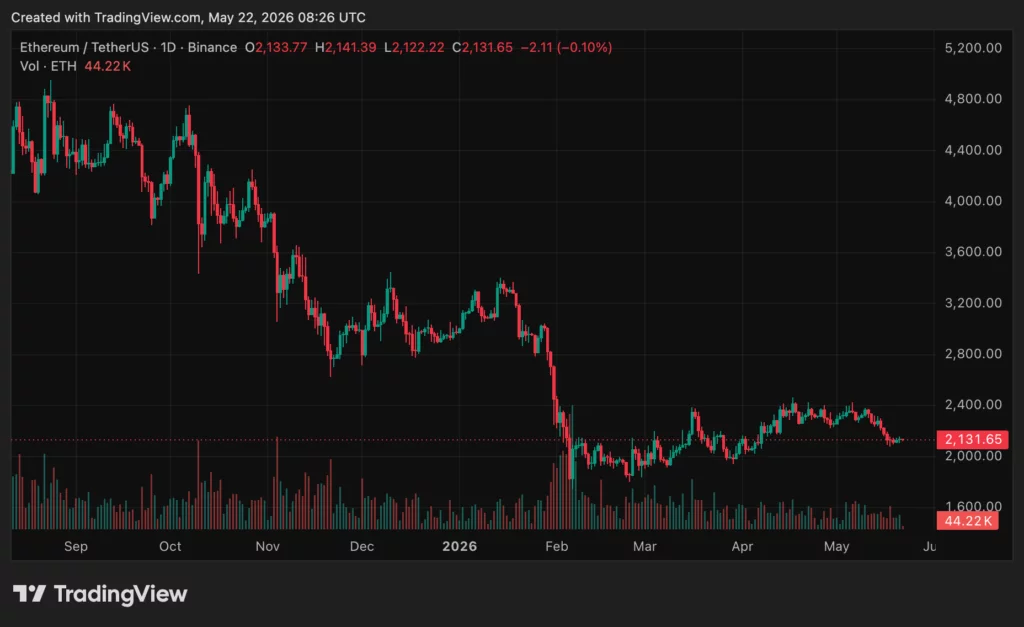
Santiment said “Whether ETH is actually approaching one of those moments remains uncertain,” referring to whether extreme bearish sentiment could turn into a contrarian setup. For now, the market is focused on whether Ethereum can restore demand, defend the $2,000 area, and prove that network use can recover faster than trader confidence is falling.
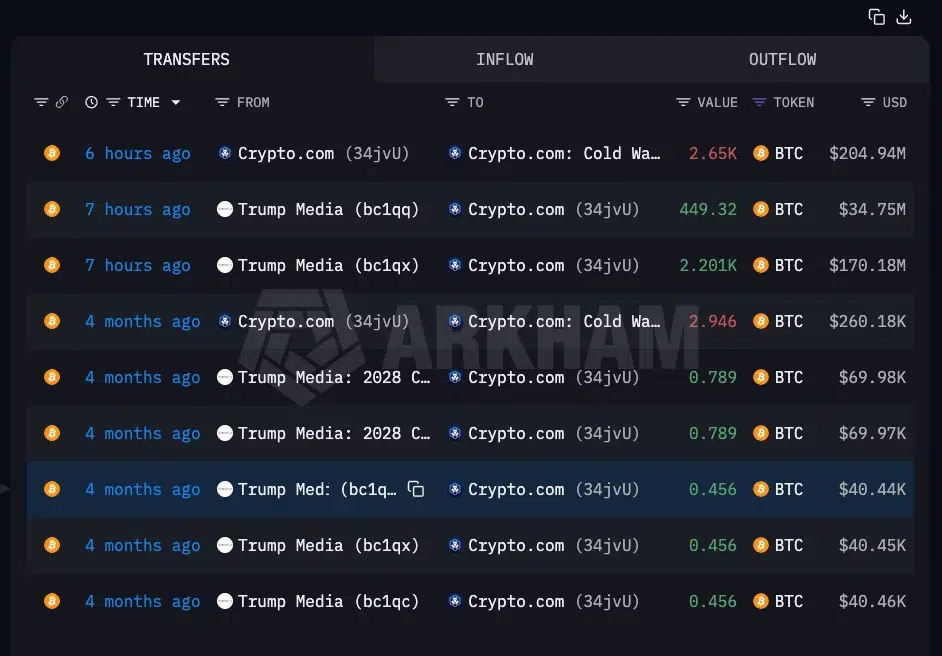
Trump Media & Technology Group has transferred another 2,650 Bitcoin worth about $205 million to Crypto.com, adding fresh scrutiny to the company’s crypto treasury strategy as its holdings remain deeply underwater.
Summary
- Trump Media moved 2,650 Bitcoin worth about $205 million to Crypto.com, according to Lookonchain data.
- The company’s Bitcoin treasury has fallen sharply below its reported average purchase price of about $118,522 per coin.
- Trump Media previously disclosed a $405.9 million quarterly loss, with most of the hit tied to unrealized crypto asset markdowns.
According to blockchain analytics platform Lookonchain, the transfer was detected from wallets linked to Trump Media, the company behind Truth Social and majority owned by the Donald J. Trump Revocable Trust.
Although deposits to exchanges do not automatically confirm a sale, traders often treat large inflows as a possible signal that liquidation could follow.
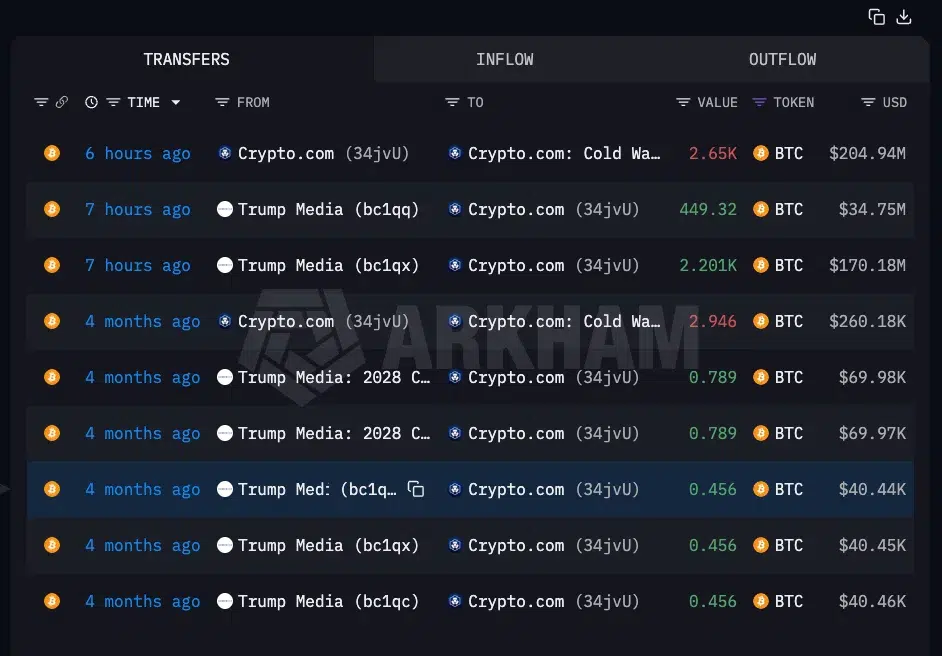
Transferred funds remain in the Crypto.com wallet. Source: Arkham.
Earlier this year, Trump Media moved 2,000 Bitcoin valued at roughly $175 million when Bitcoin (BTC) traded around $87,378. Since then, the market has weakened further, with Bitcoin hovering near $77,700 at the time of the latest transfer.
Corporate treasury losses deepen
Based on Trump Media’s previous disclosures, the company originally accumulated 11,542 BTC at an average purchase price of about $118,522 per coin, spending close to $1.37 billion on the position. At current market prices, the remaining treasury has fallen well below its entry level.
Quarterly filings released by the company showed that its Bitcoin holdings had already declined to 9,542 BTC after the first transfer. Following the latest 2,650 BTC movement flagged by Lookonchain, the stash now appears to stand near 6,889 BTC.
Recent financial results have already shown the impact of the downturn. Trump Media reported a $405.9 million net loss for Q1 2026, with $368.7 million tied to unrealized markdowns on digital assets, pledged crypto assets, and equity securities.
Within the filing, the company disclosed that its Bitcoin holdings carried a cost basis of roughly $1.13 billion while their fair value had dropped to about $647 million by the end of March. Trump Media also disclosed ownership of around 756 million Cronos tokens linked to its partnership with Crypto.com.
What does this mean for Bitcoin?
Large exchange inflows such as these can create temporary fear among traders because visible supply on an exchange order book may act as a potential resistance zone.
However, it must also be noted that the $205 million transfer remains relatively small compared with Bitcoin’s multi-billion dollar daily spot and derivatives trading volume. For now, the market impact would depend on whether the coins are sold directly on the exchange or moved through over-the-counter channels.
Separately, on-chain supply data has continued to show strong long-term holder activity despite weakness among some corporate treasury buyers.
Market analytics cited in recent reports estimated that more than 70% of Bitcoin’s circulating supply has remained unmoved for over a year, suggesting long-term investors have continued holding through the current downturn.
🚨 $BTC Long Term Holders Just Flashed The Signal That Preceded Every Major Expansion Phase Since 2012.#Bitcoin The 1Y+ Long Term Holder metric has now dropped back into the historical “oversold” accumulation zone, a region that previously appeared before explosive upside… pic.twitter.com/9ZHwKFJRm9
— CryptoZeno (@CrypZeno) May 20, 2026

WOW Ripple XRP $200M Wall Street Deal – Clarity Act This Week EVERYTHING CHANGES NOW

How to watch Hull vs Middlesbrough: TV channel and live stream for Championship play-off final

LRS outflows up over 10% in March led by travel demand

US brings back mandatory military draft registration

Steven Gerrard disagrees with Gary Neville over ‘shock’ Chelsea and Arsenal claim | Football

Register Renaming | Hackaday
WOW Ripple XRP $200M Wall Street Deal – Clarity Act This Week EVERYTHING CHANGES NOW

Vibe Coding for Finance: Best Use Cases for 2026

Istri jadi pencari Nafkah Utama, Wajarkah? #mencarinafkah #pekerjaan #suami #istri #financial
-

 Crypto World1 day ago
Blockchain.com files with SEC for U.S. IPO
-

 Fashion11 hours ago
Holiday Weekend Open Thread – Corporette.com
-
 Crypto World6 days ago
Intesa Sanpaolo’s crypto holdings jump to $235M as XRP enters
-

 Fashion6 days ago
On the Scene at Gucci’s Cruise Show in New York City: Mariah Carey, Kim Kardashian, Lindsay Lohan, Iman, and More!
-

 Politics7 days ago
Watch: far-right flag-fanatics run over victim, attack locals – Setup By the Left wing for your entertainment
-
 Crypto World15 hours ago
Space X IPO Is ‘Bad News’ for Tech Stocks: But What About Bitcoin?
-

 Fashion7 days ago
Trending Western Style Vests Perfect for Summer
-

 Fashion6 days ago
Amazon Sundays: Memorial Day Hosting
-

 Business15 hours ago
Dell Technologies DELL Stock Surges 15% on AI Server Momentum and Analyst Upgrades in 2026
-

 Entertainment6 days ago
Off Campus Easter Eggs Explained: Characters, Stories, More
-
 Crypto World4 days ago
Revolut Launches Dogecoin Debit Card Across UK and EU
-
 Tech16 hours ago
A 0.12% parameter add-on gives AI agents the working memory RAG can’t
-
Business6 days ago
Australia defends property tax changes designed to fix ‘broken’ housing
-
 NewsBeat2 days ago
Charity run by Reform leader Malcolm Offord accused of ‘law breaking’ over Scottish registration
-

 Sports1 day ago
2026 CJ Cup Byron Nelson leaderboard: Brooks Koepka finds putting stroke in Round 1
-
 Crypto World23 hours ago
Bitcoin Accumulation Weakens as BTC Realized Losses Hit $600M
-

 Politics7 days ago
Anti-Zionists attacked in Jerusalem as ethnofascists chant race-hate
-

 Tech1 day ago
WhatsApp ads could make Irish debut after discussions with DPC
-

 Crypto World23 hours ago
Trump Media’s Bitcoin Stash Shrinks Again as 2,650 BTC Lands on Crypto.com
-

 Politics11 hours ago
Makerfield: a tale of two social-media histories
You must be logged in to post a comment Login