

Crypto World
Onchain Gacha Surges to Record High as Crypto Drops


Crypto prices may have been in freefall in June 2026, but a niche corner of the tokenization boom is showing just how resilient consumer demand can be. Bitcoin dropped more than 20% and traded near a 21-month low, while spot Bitcoin exchange-traded funds recorded their worst stretch on record with $4.5 billion in outflows, according to Cointelegraph coverage.
At the same time, Blockworks Research reported that users spent a record $324 million on onchain gacha—an enormous jump from roughly $50 million in the same month a year earlier. The activity underscores how “randomized” collectibles mechanics, now tokenized and accelerated on blockchain rails, are drawing attention even during broader market stress.
Key takeaways
- Onchain gacha spending hit $324 million in June 2026, per Blockworks Research—up sharply from about $50 million a year earlier.
- Tokenized trading cards rely on physical custody and grading assumptions, shifting risk from buyers of cards to users of NFTs.
- Instant buyback and rapid trade cycles mimic gacha/loot-box behavior while compressing the time required to sell offchain.
- Collectors still participate in real-card redemption, including NFT burns that represent claims to physical assets on platforms like Courtyard, based on Dune.
From booster packs to blockchain packs
Gacha traces its roots to Japanese vending machines: pay a fixed amount and receive a randomized item. In traditional trading card games, this typically takes the form of sealed booster packs that contain an unpredictable assortment. The value of the cards inside can vary dramatically based on rarity, condition, print run, and the year of release—creating a market where prices can span from very small amounts to prices that reach the hundreds of thousands of dollars for pristine copies.
Because condition and authenticity matter so much at the high end, grading has become central to how these collectibles trade. Independent graders such as PSA, Beckett, or CGC evaluate attributes like centering, wear on corners and edges, and surface imperfections, then encapsulate the card in a sealed holder (“slab”). Two visually similar cards can command very different prices once graded.
That is the gap blockchain projects aim to bridge. According to the article, platforms such as Collector Crypt and Courtyard tokenize real collectibles by accepting physical cards (often already graded), storing them in vaults, and issuing NFTs tied to specific cards and stated grades. When a user opens a pack, the system delivers a token backed by a corresponding physical asset held in custody. Users can keep the NFT, trade it on marketplaces, sell it back to the platform, or redeem it for the physical card.
The core dependency is straightforward but important: the NFT value depends on whether the vault truly holds the exact card in the claimed condition. That places custodial and integrity risk on platform operators—risk that the article notes is not theoretical, as grading companies themselves report fraud and counterfeits.
What drove the June surge
Tokenized gacha’s rise is unlikely to be explained by one variable. The report points to several converging factors, including strong brand momentum in Pokémon and an onchain infrastructure that makes buying, trading, and verification feel immediate.
On the consumer side, the article cites Circana research saying Pokémon became the most popular toy brand in the U.S. in 2025, generating $2.5 billion in sales—up 87% year over year. It also points to interest from older collectors, not just children, alongside heightened demand for card grading.
That grading demand appears to have spilled into operations. In June, PSA reportedly suspended new submissions across four basic service levels while working through a backlog of nearly 10 million cards, according to the service-level update referenced in the article. Tokenization, in this framing, plugs into a market where collectors want liquidity and frictionless access, but where traditional channels can be slow and expensive.
The article also draws a direct line between tokenized packs and mainstream excitement around trading cards, noting that high-profile buyers such as Logan Paul have helped keep Pokémon in the public spotlight.
The mechanics: speed, buybacks, and speculation
While the collectibles are physical, the market behavior is increasingly shaped by how fast users can cycle positions. A major friction in the traditional offchain trading-card market is liquidity. Selling a card often requires finding a counterparty, confirming authenticity and grade, and arranging shipping.
Onchain tokenized trading cards can reduce that friction by offering built-in pathways for trading. The article specifically describes an “instant buyback” mechanism: many platforms allow users to sell packs/cards back shortly after opening—so if the outcome disappoints, users can cash out quickly (for example, at a discount such as 85% of value in the article’s description) and open another pack. If the card is desirable, users can list it or hold it.
This creates a “gacha loop” that compresses what can take weeks offchain into minutes or seconds onchain. The article compares the effect to loot boxes in video games—where users pay for randomized outcomes and the appeal often includes the dopamine and uncertainty around rare pulls.
There are regulatory implications in the background. The article notes that some jurisdictions have tried to bring loot boxes under gambling frameworks. Whether tokenized TCG mechanics fall into similar categories could depend on how large the sector becomes and how platforms structure odds, marketing, and redemption terms. For now, the key operational difference highlighted is tempo: the same gacha logic plays out faster in the onchain environment.
Collectors haven’t disappeared—redemption still exists
Despite the gambling-like loop, tokenized trading cards also serve a less flashy purpose: enabling real collectors to hold and redeem physical assets. According to Dune data cited in the article, users burn 5% to 8% of NFTs issued on Courtyard each week, with each burn representing a claim to a physical card.
Collector Crypt’s head of marketing, Dakota Campbell, is cited as saying that around 30% of its users eventually redeem a card. He also claims that many users choose to hold rather than constantly flip, often beyond the 72-hour buyback window described in the article.
Campbell further reports that, in the prior 30 days referenced in the piece, 5,400 assets were shipped to 634 unique users with a total insured value of $3.29 million. That detail matters because it anchors the story in actual custody and logistics, not only trading behavior.
Why this matters beyond one record month
Blockchain startups are essentially taking an established collectibles playbook—tokenizing and routing demand through faster rails. But the sustainability of onchain gacha is an open question. The article emphasizes that inflows can reverse quickly, since the gacha loop runs in both directions and user engagement can be sensitive to broader sentiment.
For readers and market participants, the key thing to watch next is whether platforms can maintain trust and real-world custody at scale—especially as counterfeit risk and consumer protection concerns remain persistent themes in graded-card markets—while also building durable collector communities that go beyond short-term speculation.

Ethereum has had a notable recovery from its June lows, reclaiming an important resistance zone while testing a major descending trendline on the higher timeframe. Although the latest rally has strengthened short-term sentiment, ETH is still approaching a cluster of technical barriers that could determine whether the recovery extends above $2K or transitions into another corrective phase.
Ethereum Price Analysis: The Daily Chart
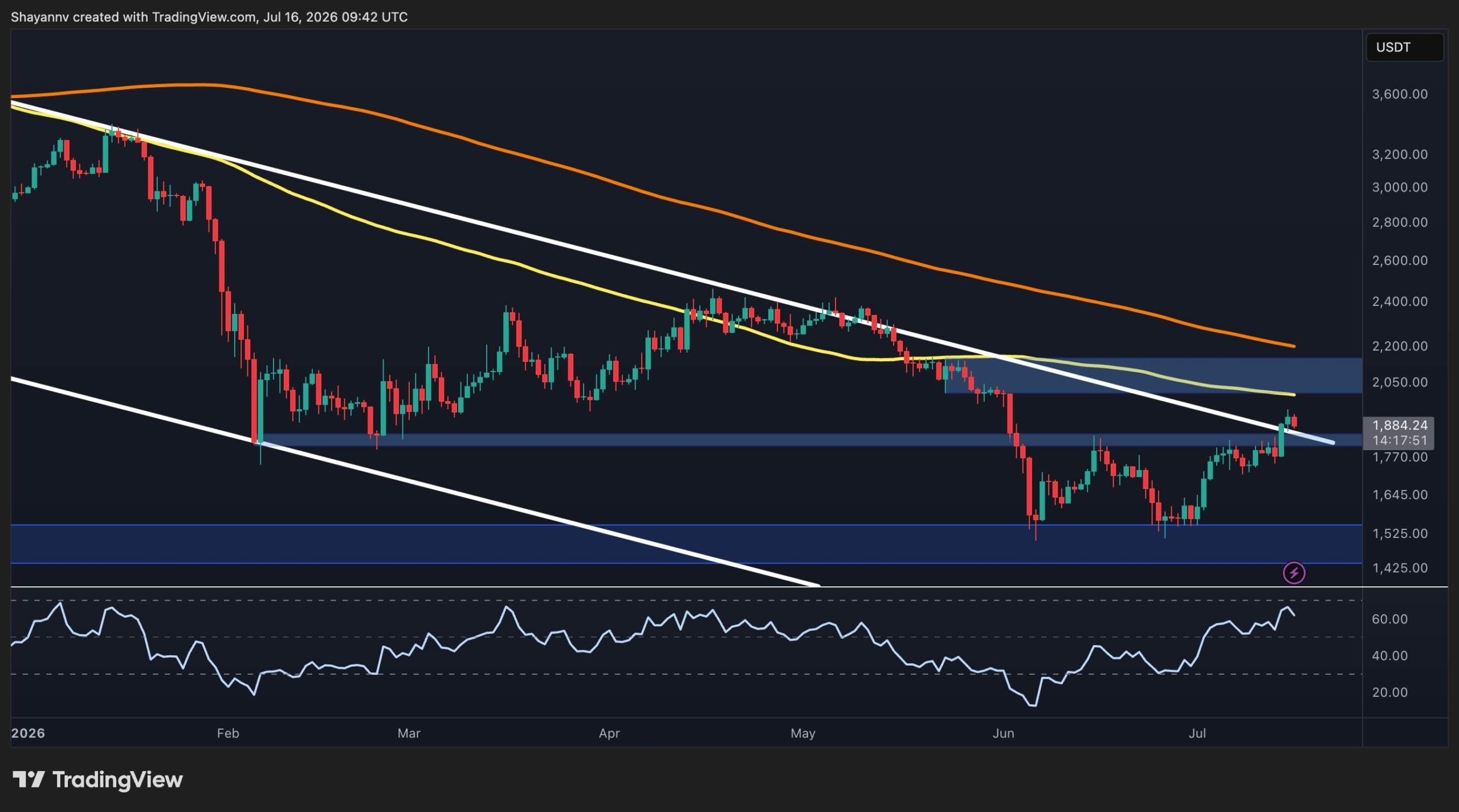
On the daily timeframe, ETH has been trading within a broad descending channel that has defined price action for several months. The recent rebound from the $1.5K demand zone allowed the asset to reclaim the $1.8K support region.
The price is also on the verge of breaking above the channel’s upper boundary, which is closely followed by the descending 100-day moving average near the $2K area. This confluence has already attracted selling pressure, suggesting that sellers remain active around this technical barrier.
The next major resistance sits between $2K and $2.2K, where the 200-day moving average also converges from above. A confirmed breakout above the channel and a sustained move beyond $2.2K would represent a meaningful structural shift and could open the door toward higher recovery targets.
On the downside, the recently reclaimed $1.8K zone now acts as the first key support. Losing this level would once again expose the broader demand region around $1.5K, which previously triggered the latest bullish reversal.
ETH/USDT 4-Hour Chart
The lower timeframe shows a much stronger bullish structure. ETH advanced inside a well-defined ascending channel after forming a clear double bottom near $1.5k and has been consistently printing higher highs and higher lows throughout the recovery.
The recent rally pushed the price above the $1.8K resistance zone before reaching the channel’s upper boundary around $1.95K. However, sellers defended this area, leading to a modest rejection from local highs.
As long as ETH holds above the $1.8K breakout zone, the current pullback appears more consistent with profit-taking than a confirmed trend reversal. Maintaining this support could allow buyers to attempt another move toward the major daily resistance cluster between $2K and $2.2K.
Conversely, a decisive breakdown below $1.8K would weaken the short-term structure and could trigger a deeper retracement toward the intermediate support around $1.72K, or even the order block located around $1.62K to $1.64K, where buyers previously stepped in.

On-Chain Analysis
The Exchange Reserve chart continues to paint a constructive longer-term picture. Ethereum reserves held across centralized exchanges have declined steadily, reaching approximately 15.3 million ETH, which is arguably the lowest reading over the past few years.
A persistent decline in exchange balances generally indicates that investors are withdrawing coins into self-custody or long-term storage rather than preparing to sell them immediately. This reduces the amount of readily available supply on exchanges and can provide a supportive backdrop if demand continues to recover.
While the falling exchange reserve does not guarantee immediate upside, the continued reduction in available supply complements the improving technical structure. If ETH successfully clears the overhead resistance between $2K and $2.2K while exchange balances remain on their current downtrend, the broader recovery could gain additional strength. Conversely, failure to overcome the higher-timeframe resistance may still result in a short-term correction despite the favorable on-chain backdrop.

The post Ethereum Price Analysis: Is $2K Next for ETH After Reclaiming Key Support? appeared first on CryptoPotato.
Crypto World
Why Stripe’s $53 billion PayPal bid is a high-stakes play to own the future of digital payments


If Stripe owns PayPal, Bridge becomes the shared infrastructure layer under PYUSD, OpenUSD and Tempo. That’s infrastructure consolidation, not token competition, and it’s a much bigger deal than the acquisition headline suggests.”
That sort of infrastructure scale could allow Stripe to introduce lower settlement fees and checkout incentives for PYUSD, while Tempo could gradually steer users toward OUSD.
“This potentially strengthens Tempo considerably,” said Niamh Byrne, chief commercial officer at blockchain developer platform Alchemy. “If OpenUSD gains meaningful traction, it could increase the strategic importance of Tempo and position it as more than another blockchain.”
However, even if Stripe does combine multiple prominent stablecoin projects under one roof, commentators do not foresee major disruption to the stablecoin sector in the immediate future.
“Circle’s cross-chain interoperability is operationally proven at institutional scale, whereas Tempo is an unproven layer-1 still in early development,” Citi said in its note. “It is our understanding that Bridge/Tempo relies on third parties for interoperability capabilities.”
Tether’s USDT, meanwhile, holds a 60% share of the stablecoin market, dwarfing even USDC, let alone PYUSD, which is in itself something of a “mic drop” to suggestions of a threat from distant competitors. Notwithstanding that, USDT derives its prominence from the retail sector and emerging markets rather than institutions and corporates.

US crypto market-structure legislation appears to be nearing a potential Senate vote, as lawmakers race to finalize the remaining sticking points before the August work break. Summer Mersinger, CEO of the Blockchain Association and a former commissioner at the US Commodity Futures Trading Commission (CFTC), told attendees at the Injective Summit in Washington, DC, that the Digital Asset Market Clarity (CLARITY) Act is “very close” on the main language and could reach the Senate floor as soon as next week—if an ethics agreement can be reached.
In a sign of how political and governance questions are driving the timeline, Mersinger said “ethics is the big elephant in the room,” pointing to ongoing discussions involving Republican senators and a White House meeting. She also emphasized that while the industry’s members support the broader bill, they do not want the ethics debate to derail the rest of the legislative package.
Key takeaways
- Summer Mersinger says the CLARITY Act is close on the bill’s core market-structure provisions and a Senate vote could come next week if lawmakers align on ethics language.
- Mersinger described ethics provisions as the primary unresolved issue, with talks involving Republican senators and the White House.
- Some Senate Democrats have indicated they will oppose a vote unless ethics provisions are clear, and the bill needs bipartisan support to pass.
- Prediction market Kalshi showed traders’ odds of a Senate floor vote before the August break rising to 75.1% (up from 47% on July 10).
Why the ethics fight could determine whether CLARITY advances
Mersinger’s remarks framed the current legislative hurdle less as a technical drafting problem and more as a political constraint. She said lawmakers have a few remaining “nits” to work out but are “very close” on the main language. According to her, progress now depends on reaching agreement on ethics provisions—language that Democrats have made central to whether they will support bringing the bill to the Senate floor.
At the Injective Summit, Mersinger tied the urgency to the legislative calendar, noting the window for action before August recess. She described the ethics question as a concern raised across “every office,” and referenced a White House meeting involving Republican senators as a potential path to compromise. Her hope, she said, is that any agreement reached there would either be acceptable to Democrats or could be adjusted so Democrats would have room to support the final text.
“Ethics is the big elephant in the room… Today there’s a meeting at the White House with some Republican senators,” Mersinger said, adding lawmakers are hopeful an agreement can be produced that Democrats can accept. “For my members and what we are advocating for on the Hill… please don’t let it kill all the hard work that we put in the rest of the bill.”
What lawmakers are trying to finalize before the August break
CLARITY, described by the Blockchain Association as a market-structure effort aimed at establishing clearer rules for digital-asset activity, has already advanced through key early stages in Congress. Mersinger said her organization has been engaged with legislators as the bill moved forward, including during the period when it passed through the Senate Banking and Agriculture committees.
Her comments suggest that the bill’s prospects now hinge on a final set of negotiations rather than on a broader lack of support for the underlying policy direction. Still, she acknowledged that the remaining debate is highly consequential: ethics language is not just a marginal edit, but the focal point for lawmakers deciding whether the bill can reach a final vote.
White House talks and Democratic opposition risks
Mersinger’s mention of ethics discussions followed earlier reporting that President Donald Trump was set to meet with Republican senators to discuss CLARITY. That coverage indicated the conversation could include Trump’s ties to the industry, after Senate Democrats had held their own meeting on the bill the prior day. The reports also pointed to Trump’s disclosure in June that he earned $1.4 billion from ventures related to digital assets, including his memecoin and his family business, World Liberty Financial.
The concern reflected in those disclosures appears to have translated into concrete legislative posture. Earlier, three Senate Democrats announced that they would not support a crypto market-structure vote unless ethics provisions were clear. Their stated rationale was that without stronger guardrails, lawmakers and the White House could face potential conflicts or corruption risks associated with the digital-asset sector. With Republicans holding a slim majority in the Senate, the bill would require support from several Democrats to clear the chamber.
How the odds shifted on Kalshi’s prediction market
While political negotiations continue behind closed doors, market-based indicators have also shown a change in expectations about timing. At the time of publication, Kalshi—using a contract centered on whether the Senate would vote on CLARITY before the August break—showed a 75.1% chance of a floor vote, according to the market listing referenced in the source report.
The same reference noted the odds were 47% on July 10, implying that traders have become more confident in near-term movement. However, prediction markets can react to headlines and perceived momentum even when the underlying political constraints—particularly on ethics—remain unresolved. That makes the next few days’ negotiations especially relevant for readers trying to assess whether the rising odds reflect a true path to passage or simply a temporary shift in expectations.
What investors and builders should watch next
For participants across the crypto industry, the immediate question is whether lawmakers can translate the “very close” drafting progress into a workable ethics agreement that both sides can accept. Mersinger’s comments suggest the Senate vote may depend on whether a compromise can survive Democratic scrutiny—so watch for details of any ethics language emerging from White House and senator discussions, and whether Democratic leadership signals a readiness to support a floor vote once the text is finalized.
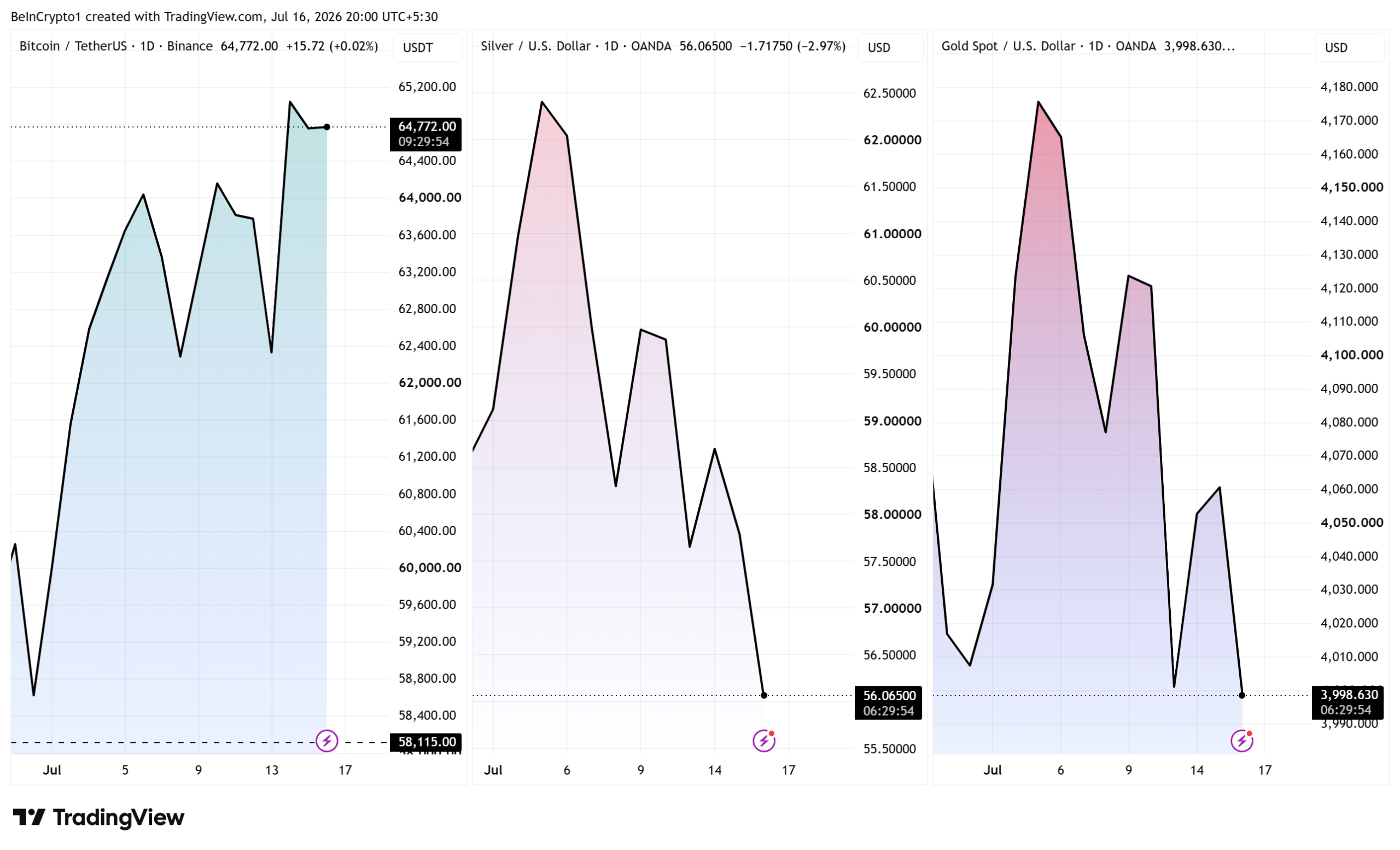
Gold and silver lost roughly $700 billion in market value in a single day. Bitcoin (BTC) barely moved, holding near $64,000 and claiming a rare safe-haven win over precious metals.
Gold broke below $4,000. Silver sank below $55.50, its lowest level in about 7 months. A stronger dollar and rising bets on Federal Reserve rate hikes are squeezing both metals.

Gold and Silver Selloff Deepens Despite Iran Threat
Iran threatened to shut the Bab el-Mandeb Strait, a key global shipping route. That kind of news usually sends investors rushing into gold. This time, they sold instead, with US stocks also bearing the brunt.
Gold fell 1.7% on Thursday, erasing about $485 billion. Silver dropped 3%, wiping out another $100 billion. By late trading, combined losses neared $700 billion.
“Gold and silver just lost around $700B in market value in a single day. A brutal reminder that even traditional safe-haven assets can get hit hard when liquidity disappears,” commented Garrett, a KOL and Binance affiliate.
The rout deepens a slide that began in late January, when gold set a record near $5,600, and silver peaked above $121. Gold has since lost roughly 28% of its value.
So where did the money go? Into dollars and short-term US Treasuries. Both now pay solid yields, while gold and silver pay nothing.

The Federal Reserve, under new Chair Kevin Warsh, held rates at 3.50% to 3.75% in June. Minutes then exposed a divided Fed rate outlook, with some officials leaning toward hikes.
Follow us on X to get the latest news as it happens
ETF Outflows Accelerate the Metals Rotation
Big money is leaving gold funds fast. SPDR Gold Shares (GLD) has bled $14.4 billion since March 1. That is 50% more than the $9.6 billion pulled from all spot Bitcoin ETFs since October.
The trend echoes March, when Wall Street pulled billions from gold and GLD lost a record $8.5 billion in one month. However, the exit is slowing. July outflows sit at just $46 million so far.
One corporate holder shows the damage in real time. Antalpha, a Nasdaq-listed lender tied to Bitcoin mining giant Bitmain, keeps its gold in Tether Gold (XAUt), a token backed by physical bars in Swiss vaults.
That makes its retreat visible on-chain. The firm has handed back over $50 million in gold profits, Arkham data shows, and its XAUt stack has shrunk to $138.8 million from a $329.9 million January peak.
Bitcoin Safe Haven Test Is Not Over
Bitcoin traded near $64,650 on Thursday, up about 4% this week. The Bitcoin price consolidation comes after BTC hit its most oversold level against gold on record.

Still, BTC is no pure haven. It fell alongside metals during the US-Iran war hedge test earlier this year, when US stocks beat every traditional refuge.
Daniela Hathorn, senior market analyst at Capital.com, says cooler inflation data helped steady Bitcoin. Still, she warns it trades like a macro asset, moved by rates and ETF flows. In a note shared with BeInCrypto, she named the levels to watch.
“Bitcoin has stabilised after the volatility seen earlier this month, with prices consolidating around the $64,000–65,000 area. … From a technical perspective, the $63,000–64,000 region has emerged as an important support zone, while the $65,500–66,000 area is acting as the first meaningful resistance.”
The next test is simple. Can Bitcoin hold $63,000 while gold and silver hunt for a floor? With GLD outflows drying up, the metals washout may be close to running out of sellers.
The post Gold and Silver Lost $700B as Iran Threatens Bab el-Mandeb. Will Bitcoin Follow? appeared first on BeInCrypto.


Coinbase and Ripple have secured EU-wide access through Luxembourg as MiCA’s July 1 deadline has pushed Binance and other unlicensed platforms to scale back services.
Summary
- Coinbase and Ripple have secured EU-wide access through separate Luxembourg MiCA authorizations.
- Binance’s retreat has created an opening for licensed exchanges to capture migrating customers.
- USDT restrictions give USDC and RLUSD room to compete for European stablecoin volume.
According to earlier reports, Binance withdrew its Greek license application and began suspending services in several European Union countries after the 18-month transitional period ended. The deadline requires crypto-asset service providers to obtain authorization before continuing to serve customers across the bloc.
Coinbase chose Luxembourg as its European MiCA base in June, securing passporting rights across all 27 EU member states as well as Iceland, Liechtenstein, and Norway. Its license from Luxembourg’s Commission de Surveillance du Secteur Financier allows the exchange to operate across those markets through one regulatory hub.
As users began leaving platforms that had not completed the licensing process, Coinbase offered a 5% bonus on eligible asset transfers. crypto.news reported that the campaign targeted European customers moving funds from non-compliant exchanges, giving Coinbase a direct route to capture users affected by the deadline.
Ripple followed with preliminary crypto-asset service provider approval on June 23 before receiving full authorization from the CSSF on July 6. Combined with its existing Electronic Money Institution license, the approval allows Ripple to provide regulated payment, custody and stablecoin services across the European Economic Area.
Cassie Craddock, Ripple’s managing director for the UK and Europe, described the authorization as a foundation for scaling the company’s services while remaining compliant in the post-transition market.
Luxembourg has emerged as the main MiCA entry point
Coinbase and Ripple have joined Bitstamp in placing their European operations in Luxembourg, concentrating three established crypto companies under the CSSF. Each licensed company can use MiCA passporting rules instead of seeking separate authorization in every member state.
Customer transfers, however, have created new compliance risks for both departing exchanges and licensed platforms receiving their users. As previously reported by crypto.news, Bruna Szego, chair of the EU Authority for Anti-Money Laundering and Countering the Financing of Terrorism, warned that firms leaving the market could face a surge in withdrawal requests.
During a briefing before the European Parliament’s Committee on Economic and Monetary Affairs, Szego also cautioned that licensed providers could struggle to process large numbers of new customers. She urged those firms to maintain effective anti-money laundering controls while handling the influx.
Compliance demand has also created opportunities for legal technology providers. Global law firm Reed Smith has launched Aquarius, a platform that automates MiCA tasks such as crypto-asset classification, regulatory white paper preparation, due diligence and environmental, social and governance disclosures.
Reed Smith designed Aquarius for firms entering Europe or adding crypto services under the new rules. The law firm plans to extend later versions to regulatory systems in the United Kingdom, the United Arab Emirates, Hong Kong and Singapore.
USDT restrictions have opened space for USDC and RLUSD
Stablecoin access has become another point of competition as regulated European exchanges restrict or delist USDT. crypto.news reported that Tether’s reduced presence leaves more than $100 billion in EU-linked volume open to compliant alternatives such as Coinbase-backed USDC and Ripple’s RLUSD.
Ripple’s CASP and EMI authorizations give the company a regulated structure for distributing and settling RLUSD with European institutions without depending entirely on outside licensed intermediaries. Coinbase can pursue a similar opportunity through USDC, including revenue from trading, custody and payment settlement.
For investors, Coinbase’s European customer inflows could affect the company’s regional revenue in coming quarters, while Ripple’s licensed payment expansion could increase XRP’s role in services offered to EU financial institutions. Both outcomes will depend on customer adoption and the companies’ ability to meet MiCA and anti-money laundering requirements as migration continues.


Three men who disguised themselves as police officers and created fake police websites to steal $5.4 million worth of crypto have been jailed in the UK this week.
According to a report from the UK’s Metropolitan Police, the gang called unsuspecting crypto holders and convinced them, while posing as police officers, that their funds were at risk.
Victims were instructed to deposit their crypto into wallet addresses they were told were secure police accounts, and were encouraged to give up the details of their own accounts.
Once handed over, the funds were laundered before being spent on luxury holidays, cars, clothes, and watches.
Adding to these offences, the men also misrepresented their annual incomes, with one of them declaring an annual income of just £444 ($600).
Read more: UK police officer caught lying about crypto bags banned from force
Among the luxury items purchased were a £60,000 ($81,000) car, holidays to Thailand, Japan, Paris, Mykonos, the Maldives, and the Seychelles, and various goods from the likes of Harrods, Hermès, Louis Vuitton, and Rolex.
Police also found £500,000 ($674,000) in cash in a safety deposit box and determined that much of the crypto stolen by the gang was being converted into payment cards.
The Met eventually tracked down the gang after a victim reported in January 2025 that they’d been swindled.
Hamza Bashir, 23, Kevin Nwamma, 25, and Anthony Ikenwe, 29 were handed prison sentences of six years and nine months, 11 years, and 11 years, respectively.
Got a tip? Send us an email securely via Protos Leaks. For more informed news and investigations, follow us on X, Bluesky, and Google News, or subscribe to our YouTube channel.
Ethereum’s native token rode the sub-CPI crypto rally like very few did, pumping toward a six-week peak of roughly $1,950. This means that it had recovered nearly 30% in value since its multi-year peak at $1,510 was reached weeks ago.
However, its run was halted at that level, and the asset now stands below $1,900. According to popular analyst Crypto Rover, this minor rejection might be just the beginning.
Another Major Leg Down?
While observing ETH’s more macro picture, the market commentator outlined a rather interesting pattern that the asset tends to follow – a very precise 1,369-day repeating occurrence that drives it up and down.
Rover speculated that “Ethereum may be heading for its biggest crash yet,” as this historical pattern maps out two “devastating sell-offs” incurred at approximately this time of each cycle. They both began after similar rallies like the 30% surge in the past couple of weeks, but the subsequent rejections pushed the altcoin south to new local lows.
If the analyst’s scenario plays out again, ETH could dump again to and even below $1,500, which would mark a new multi-year low. The other side of the coin of this pattern shows a spectacular long-term run would be in the making following this capitulation. Rover’s analysis outlined some massive targets of somewhere around five-digit territory at $10,000.
ETHEREUM MAY BE HEADING FOR ITS BIGGEST CRASH YET.
This chart shows the exact same 1,369-day pattern repeating for a third time.
The previous two cycles ended with devastating selloffs.
If this fractal holds…
The worst may still be ahead. pic.twitter.com/jMYhpiUgZ5
— Crypto Rover (@cryptorover) July 16, 2026
Maybe Bottom Is In, Though
Fellow analyst Michaël van de Poppe also weighed in on ETH’s impressive move above $1,900, calling it “phenomenal.” However, he doesn’t see such a doomsday scenario as Rover. Instead, he said he doubts there will be “a lot more new lows coming in on the markets,” as the on-chain data he reviews points in the opposite direction.
“There’s a lot more upside going to come on this one, and I think it’s simply in a ‘buy-the-dip’ regime,” he added.
His focus was more on ETH’s short-term performance, and the chart he listed envisions targets of around $2,500-$2,700 by the start of Q4.
The post ‘The Worst Is Still Ahead’ for ETH: Analyst Predicts Another Ethereum Crash appeared first on CryptoPotato.

Visa and investment thesis platform Artemis have released a report arguing that the rise of “agentic” AI—software that can discover services, negotiate terms, and execute transactions—may force a rethink of how the world processes payments. The core problem, they say, is that today’s card rails and similar incumbents were designed for human purchasing patterns: relatively infrequent, fee-sensitive transactions settled on timelines that don’t fit high-volume micropayments.
In their view, AI agents reached a practical capability threshold in mid-2025, enabling them to locate unfamiliar APIs, compare pricing, and initiate payments autonomously. That shift makes near-zero friction and fast settlement more important than ever—conditions the report says current infrastructure often cannot meet at scale. The report also frames stablecoins as a potential catalyst for machine-native micropayments while pointing to a convergence model where multiple rails coexist.
Key takeaways
- Visa and Artemis argue traditional card infrastructure struggles with the frequency and fee sensitivity required for AI agents’ micropayments.
- The report links AI agent adoption to a mid-2025 capability jump that lets agents evaluate services and trigger payments autonomously.
- It projects convergence rather than replacement: cards for proxy transactions inside merchant networks, stablecoins for machine-native micropayments, and hybrid workflows.
- Coinbase’s x402 protocol is cited as a developing real-world example, with volume and transaction counts accelerating after its May 2025 launch.
- The paper describes a shared machine-payment framework approach, including Visa work to extend Tempo’s Machine Payment Protocol (MPP) toward card-based agent commerce.
Why AI agents pressure payment rails
The joint report, released Wednesday, centers on the mismatch between human commerce and machine commerce. According to Visa and Artemis, card systems were built around lower-frequency transactions where fee structures and settlement timing are acceptable. AI agents, by contrast, can operate in rapid cycles—discovering new endpoints, running pricing checks, and paying in the background—creating what the report calls a demand for near-zero fees and faster settlement to make micropayments economically viable.
The authors argue this isn’t simply a theoretical upgrade request. They say AI agents crossed a key capability threshold in mid-2025, where they can both navigate unfamiliar APIs and make payment decisions without human intervention. In that context, even modest frictions—fees that scale poorly, settlement delays that reduce automation efficiency, or lack of operational flexibility—can become bottlenecks.
Evidence of adoption: Coinbase’s x402 protocol
The report also points to early market signals from agent-oriented payment standards. One example highlighted is x402, a payment protocol developed by Coinbase. Visa and Artemis say x402 processed $15 million in adjusted volume across more than 109 million adjusted transactions since its launch in May 2025.
More notably, the report describes a sharp acceleration after a period of relatively low activity. It says that in October 2025, the monthly transaction count jumped from 40,000 to 3.8 million, culminating in 38 million transactions processed in October alone. The data is used to suggest that agent-compatible micropayment pathways can see rapid throughput growth when the right operational conditions are met.
Stablecoins as part of a convergence, not a winner-takes-all
A central thesis in the report is convergence across payment types. Visa and Artemis write that the “trajectory points toward convergence rather than competition,” outlining three roles for different rails: cards for proxy purchases within existing merchant networks; stablecoins for machine-native micropayments; and hybrid flows where both types of payments operate within the same workflow.
That framing matters because it avoids a binary story of crypto displacing incumbents. Instead, it suggests that stablecoins may become especially useful where card economics and settlement cadence do not match machine micropayment needs, while card networks could still provide reach inside merchant ecosystems—particularly for transactions where proxy purchasing or familiar merchant integration is beneficial.
The report further argues that a single machine-payments framework could support both stablecoin and card transactions, creating a pathway for agentic flows to extend into card-based commerce networks rather than forcing a full migration.
Shared frameworks and the push to connect card networks to machine payments
To describe how convergence could be implemented, the report discusses Tempo’s Machine Payment Protocol (MPP). It says MPP now spans both onchain crypto payments and fiat payments through shared payment tokens. Visa, in turn, is described as working to extend the protocol into card-based agent commerce.
In practical terms, the report says Tempo’s approach is designed to make it easier for AI actors to send and receive money, while Visa’s tools aim to support agentic payments on card rails. Visa’s crypto division has also been referenced in relation to AI tooling, including functionality for same-day payments by AI agents. Separately, Tempo—which has backing associated with Stripe in the source material—has been described as launching AI-related capabilities alongside its machine payments work in March.
Beyond the product details, the investor-relevant takeaway is structural: instead of treating cards and crypto rails as separate stacks, the report highlights efforts to align them through shared tokenized payment concepts. That alignment is presented as a key step toward enabling agents to execute payments across different networks without the underlying automation logic having to be rebuilt for every rail.
How stablecoins may scale with AI-native microbusiness
The report’s convergence model also intersects with another recent claim in the broader ecosystem: Swyftx earlier this week said AI-enabled microbusinesses could add an estimated $262 billion in stablecoin volume by 2033, assuming roughly 33% adoption. The company’s argument, as presented in the source material, connects AI-native payments settled in stablecoins to growth in machine-driven commercial activity.
While that figure is based on Swyftx’s adoption assumptions rather than Visa/Artemis data, it aligns with the joint report’s emphasis on micropayment economics. The implication for readers is that the stablecoin narrative may increasingly hinge on transaction utility—especially volume at the micro scale—rather than on retail speculation alone.
For investors and builders, the next signal to watch is whether machine-payment standards such as x402 and the broader MPP framework keep showing step-function usage growth, and whether card-network extensions can reduce the friction that the report identifies. The unanswered question is not whether AI agents will create new payment demand, but whether payment rails can adapt fast enough to keep that demand commercially frictionless.

The US CPI data for June brought a much-needed relief rally in the cryptocurrency markets, pushing the largest of the bunch to a new three-week peak at $65,500.
However, after gaining about $4,000 in just a day, the asset was rejected and driven south by $1,500. According to popular crypto analysts, this was not an isolated or accidental rejection, as history might map out the path forward.
Why Was BTC Stopped?
Crypto Rover noted that BTC has faced the same scenario after every relief rally during this bear cycle. It surges to the Short-Term Holder Realized Price, and then the bears step up and halt its progress. He believes this is because it’s the average cost basis of recent buyers.
“As soon as they get back to break-even, many sell to exit their positions.”
This pattern first played out in November last year, after the notorious October crash, which wiped out over $19 billion in leveraged positions. BTC was stopped at $115,000 at the time, before similar occurrences took place during January’s rally to $95,000, and the mid-May surge to $83,000.
Merlijn The Trader shared a similar opinion, claiming he envisioned this bull-trap rally to $65,500. He believes another leg down is in the making and predicted a “flush toward the $58.5K-$60K order block.”
He outlined the significance of the $63,000 support. If held, BTC could still see some upward momentum, especially if it reclaims the aforementioned $65,500 resistance. However, a breakdown below $63,000 is likely to result in another sub-$60,000 dip.
On The Flip Side…
Another popular analyst, Jelle, outlined a rather contrasting scenario. He indicated that BTC’s recent move represented a “big win for the bulls,” as the asset has “reclaimed the previous range lows.” He warned that bitcoin tends to move slowly during the summer and investors should be cautious about becoming too bullish during such not-ideal market conditions.
Nevertheless, Jelle added that this is a “good start” for bitcoin, but a more profound move north would require breaking many key levels before “things really change for the better.”
Big win for the bulls, $BTC has reclaimed the previous range lows!
Good start, but still loads of levels to break before things really change for the better.
It’s still summer; tends to be slow – and I’ll treat the market accordingly. DCA, nothing more. pic.twitter.com/XrpNvb3uoE
— Jelle (@CryptoJelleNL) July 16, 2026
The post The $65.5K Rejection: What Top Analysts Are Saying About Bitcoin’s Next Move appeared first on CryptoPotato.

MoonPay has acquired crypto infrastructure startup Glide, aiming to fold Glide’s deposit and routing technology into MoonPay’s fiat-to-crypto offering. The companies announced the deal this week, positioning it as a step in MoonPay’s shift from payments toward broader digital asset infrastructure for other applications.
Glide, founded in 2023 by Tushar Soni and Qinyu Tong, is designed to help software applications accept deposits from a wide range of token and wallet sources without requiring users to manually coordinate cross-chain bridges, swaps, and other intermediate steps. Glide’s documentation states the platform supports more than 100 tokens across 30 blockchain networks.
Key takeaways
- MoonPay is integrating Glide’s deposit and routing capabilities into its MoonPay Deposits product.
- Glide’s core utility is simplifying wallet funding across chains, tokens, exchanges, and cards without manual bridge-and-swap workflows.
- The acquisition reinforces MoonPay’s strategy to expand beyond fiat-to-crypto payments into deeper infrastructure layers.
- MoonPay did not disclose financial terms of the acquisition.
Glide’s approach to cross-chain deposit friction
Soni said Glide was created after recurring issues surfaced while working with Web3 consumer startups: users struggled to add funds to their wallets smoothly. In those workflows, balances could end up on the wrong chain, in the wrong token, or sitting on the wrong venue—forcing users to complete multiple steps to get funds where they actually needed them.
“Funds sat on the wrong chain, in the wrong token, on an exchange, or on a card, and every deposit meant bridges, swaps, and drop-offs,” Soni told Cointelegraph.
According to Soni, the founders also met while working on Robinhood Wallet and later pursued Y Combinator with a plan to build wallet infrastructure for Web3 consumer startups. But their engagements with startups made the deposit problem more visible—prompting Glide to pivot from general wallet infrastructure toward a unified deposit flow.
From multiple sources to a single funding experience
Glide’s model centers on reducing the manual complexity that often accompanies deposits in multi-chain ecosystems. Instead of asking users to orchestrate the path from one asset or chain to another, Glide is intended to automate routing so applications can fund wallets from different sources—such as other chains, tokens, wallets, exchanges, or card-based funding.
As Glide evolved, the objective sharpened: enable users to top up without having to complete bridges and swaps themselves. That distinction matters for app developers because it shifts a portion of the user-experience burden away from end-users and into infrastructure logic that can be reused across products.
Glide was founded in 2023 by Soni and Tong, both formerly associated with the team behind Robinhood Wallet. Their focus on deposit flows reflects a broader trend in crypto—consumer-facing services increasingly depend on reliable onboarding and funding rails, not just token support or interfaces.
How MoonPay plans to use the technology
MoonPay said that after the acquisition, Glide’s technology will be integrated into MoonPay Deposits. MoonPay Deposits is already used by applications including Wallet in Telegram, Moonshot, and Paysafe, according to the announcement shared with Cointelegraph.
MoonPay CEO and co-founder Ivan Soto-Wright framed the purchase as part of a larger infrastructure strategy. He pointed to MoonPay’s recent deals expanding security, trading, and accounting capabilities, arguing that digital asset companies need more than checkout-style payments to help businesses and end users operate reliably with crypto.
“Every acquisition this year has added a layer of the infrastructure that businesses and their users need to operate with digital assets: moving money, securing it, trading it, accounting for it,” Soto-Wright said.
Soto-Wright also described the specific problem Glide targets: users can lose funds by sending the wrong token on the wrong chain. The implication is that future blockchain-based platforms will increasingly require infrastructure that removes these complexities from the user’s workflow, making the underlying transfers effectively invisible.
MoonPay’s expanding acquisition pipeline
The companies did not disclose the financial terms of the Glide acquisition.
For MoonPay, the deal adds to a busy stretch of dealmaking. The acquisition was described as MoonPay’s sixth acquisition announcement of 2026, with additional purchases previously reported by Cointelegraph including Sodot, Decent, DFlow, Entendre, and Dawn Labs. MoonPay’s investor roster includes Thrive Capital, Paradigm, Valhalla Ventures, Tiger Global Management, and Coatue, according to startup data platform Tracxn.
MoonPay also noted leadership changes in its compliance and administration function, with former acting chair of the US Commodity Futures Trading Commission Caroline Pham named chief legal officer and chief administrative officer late last year.
What to watch next for deposits and routing
With Glide’s deposit and routing technology slated for integration into MoonPay Deposits, the key open question for builders and users will be how quickly MoonPay can translate Glide’s cross-chain simplification into smoother funding experiences across supported apps—and whether that improvement reduces common user errors tied to token and network mismatches.

Apple will release updates to the whole iPad lineup by spring 2027

Rory McIlroy has commentators in awe as he drives 400-yard par four at the Open

Liverpool City Region to host The Open three more times by 2050


-

 Fashion6 days ago
Weekend Open Thread: Nutriplenish Leave-In Conditioner
-

 Sports6 days ago
Super Eagles star Moses Simon opens up on Liverpool transfer regret
-

 Politics1 day ago
Young campaigners urge incoming PM to act on outdoor junk food ads
-

 News Videos2 days ago
XRP BOMBSHELL… XRP OMBOARDED FOR TRANSACTIONS!!!
-

 Tech3 days ago
Get Your ESP32 Sunny Side Up With This Solar Dev Board
-

 Tech2 days ago
Dark Secrets Emerge When Jailbreaking LLMs
-

 Crypto World17 hours ago
CFTC blocks Kalshi from unwinding Michigan trades after court order
-
 Entertainment1 day ago
Disney’s Most Ambitious Failed Star Wars Attraction Is Coming to SDCC
-
 Sports20 hours ago
New Cornerback Enters Vikings Trade Rumor Mill
-
 NewsBeat2 hours ago
London Mayor Sadiq Khan handed a peerage by Keir Starmer alongside 15 other Labour figures… just days before the PM leaves No10
-

 Business15 hours ago
Nvidia Stock Slips After Big Tuesday Rally as Huang Confirms Vera Rubin Chip Is Now in Production Today
-

 News Videos3 days ago
how to make coin bank box with cardboard #scienceproject #money #diy #shorts
-
 Tech3 days ago
Cloudflare Precursor Watches Your Mouse and Keyboard To Decide If You Are Human
-
 Entertainment23 hours ago
Vicki Gunvalson Defends Discussing Heather Dubrow’s Money
-
Crypto World2 days ago
Ripple, Coinbase, Circle Join Linux x402 Foundation to Help Shape AI Payments
-

 NewsBeat20 hours ago
Watch: Is Donald Trump facing a popular backlash on immigration?
-

 Sports18 hours ago
Michigan officials not expected to discuss AD Warde Manuel at Thursday meeting
-

 Business2 days ago
ACCC warns AI could lift insurance costs in risk-prone areas
-
 NewsBeat20 hours ago
Firefighters issue update on Dovestone moorland blaze as fire enters fourth day
-

 Business2 days ago
Subaru recalls 541,000 vehicles over federal safety sticker mistake: NHTSA
You must be logged in to post a comment Login