
Crypto World
OneKey ‘hacked’ already-patched Ledger app



Crypto wallet maker OneKey and cybersecurity firm Anzen claim to have hacked version 1.22.1 of Ledger’s Ethereum app. Ledger outright disagrees, saying, “No Ledger user was hacked.”
Earlier today, OneKey founder Yishi Wang detailed how his security team reproduced a transaction replacement attack that takes place while a user is reviewing a legitimate transaction.
Wang declared, “We hacked ledger,” and warned users on Ledger’s older Ethereum app to update it, noting that Ledger has already fixed this in version 1.22.3.
Ledger says OneKey didn’t actually hack anything
Ledger’s Chief Technology Officer Charles Guillemet responded hours later, claiming that “reproducing an already-patched bug is not ‘hacking Ledger.’”
He added, “No user was hacked. No exploitation in the wild. Running an exploit against an old version after the fix has shipped is a lab exercise, not a finding.”
A Ledger spokesperson told Protos that OneKey “took the already disclosed findings and tried to replicate them in a lab environment.”
Read more: KuCoin criticized for helping ‘launder’ $9.5M from fake Ledger app
The Ledger Donjon team claimed this fix was shipped on August 13 in version 1.22.2, further contradicting OneKey’s claims.
Protos has reached out to OneKey for comment and will update this piece should we hear anything back.
Got a tip? Send us an email securely via Protos Leaks. For more informed news and investigations, follow us on X, Bluesky, and Google News, or subscribe to our YouTube channel.



US President Donald Trump’s family-linked crypto ventures have left investors at least an estimated $4.7 billion underwater while generating about $1.4 billion for the president in 2025, according to Public Citizen.
Summary
- Public Citizen estimated that TRUMP memecoin investors were down a combined $3.2 billion.
- WLFI holders and Trump Media investors accounted for at least $1.45 billion in additional losses.
- Trump reported about $1.4 billion in crypto-related income for 2025.
- The watchdog urged Congress to add presidential divestment rules to the CLARITY Act.
Trump crypto losses reached an estimated $4.7 billion
Public Citizen estimated investor losses across five Trump-linked products, including the Official Trump memecoin, World Liberty Financial’s WLFI governance token, USD1 stablecoin, Trump Digital Trading Cards and Trump Media’s digital-asset treasury.
Most of the total came from TRUMP, which the nonprofit estimated had put buyers $3.2 billion underwater. World Liberty Financial’s WLFI token accounted for at least $1 billion, while Trump Media’s digital-asset treasury produced an estimated $450 million loss for shareholders.
Trump’s NFT trading cards added at least $9.3 million to the calculation. Public Citizen assigned no major loss to USD1 because the World Liberty stablecoin is designed to retain a value of $1 and has not suffered a sustained break from its peg.
The organization said its $4.7 billion estimate included both realized and unrealized losses. Buyers who continue to hold depreciated tokens have not locked in those losses, meaning the final amount could change if prices recover or fall further.
Public Citizen also said TRUMP trading had mainly moved wealth from later buyers to a small group that entered early, rather than causing the entire amount to disappear. Citing an analysis by blockchain intelligence company Nansen, the report said about 1 million retail wallets, or 65% of those studied, were underwater by a combined $3.2 billion.
Only about $400 million of the TRUMP total represented losses realized through sales, according to the analysis. The top 1% of profitable wallets captured roughly $2.7 billion, equal to about 80% of all gains, while wallets that entered during the token’s first two days collected almost 90% of the profits.
TRUMP launched on Jan. 17, 2025, three days before the president returned to the White House. Its price climbed from less than $1 to an all-time high of $73.43 as buyers entered, but later surrendered most of that value.
In July, crypto.news reported Nansen’s findings that nearly 989,000 wallets had accumulated $3.81 billion in realized and paper losses through the end of June. Different wallet filters and measurement dates can produce different totals, which explains why that analysis does not match Public Citizen’s $3.2 billion estimate.
Trump earned hundreds of millions from TRUMP and WLFI
While buyers absorbed losses, Public Citizen calculated that Trump received $635 million in licensing fees linked to the TRUMP memecoin during 2025. CIC Digital LLC, a Trump-owned company, licensed its name and brand to the token venture rather than buying the coins as an ordinary investor.
Two companies linked to the project retained 80% of TRUMP’s one billion-token supply, with the holdings scheduled to enter circulation over three years. According to the watchdog, the businesses also receive revenue from trading activity, allowing them to earn fees even when the token’s market price falls.
World Liberty Financial provided another large source of income. Trump received $527 million from WLFI token sales in 2025 after earning about $30 million from sales during the project’s first three months in 2024, bringing his estimated proceeds from the governance token to $557 million.
An equity transaction added $65.6 million, the organization said. Trump owns 70% of an entity that holds a 38.25% equity interest in World Liberty and receives 75% of WLFI token-sale proceeds after certain deductions, according to company documents, court records, and his financial disclosure.
World Liberty’s public-market buyers have experienced a different result. WLFI reached a record price of $0.3313 on Sept. 1, 2025, but Public Citizen valued it at $0.05744 when preparing its report. Buyers who entered at the peak were therefore down as much as 83%.
AI Financial Corporation, formerly ALT5 Sigma, accounted for most of the estimated WLFI loss. The Nasdaq-listed company acquired 7.28 billion WLFI tokens for about $1.46 billion in August 2025 and valued the position at $421 million by the end of June 2026, leaving it with a paper loss of roughly $1.04 billion.
Among 31,000 likely retail wallets that purchased WLFI through decentralized exchanges on Ethereum, Nansen found that 25,000, or 82%, were underwater as of Aug. 3. Losing wallets were down $54 million, compared with $24 million in gains among profitable wallets.
Centralized exchange activity was not included because the necessary account-level data is not public. Public Citizen therefore described its $1 billion WLFI calculation as a minimum estimate.
Financial disclosure showed $1.4 billion in crypto income
Trump’s June 2026 annual disclosure placed his crypto-related income for 2025 at more than $1 billion, with some calculations putting the amount near $1.4 billion. The earnings came mainly from memecoin licensing, World Liberty token distributions, an equity sale, and revenue tied to USD1.
As the financial disclosure showed, income and current holdings are separate figures. Licensing payments and token-sale proceeds record money received during the reporting period, while holdings describe assets still owned when the filing was prepared.
Trump reported a cold-wallet Bitcoin position worth more than $50 million, a smaller Ethereum holding, and ether staking rewards of about $1.8 million. The disclosure also recorded continuing exposure to WLFI and USD1, though federal ethics forms often place asset values within ranges rather than giving exact balances.
Public Citizen estimated that Trump earned at least $7.2 million from licensing fees and secondary-market royalties tied to four series of digital trading cards. About 175,000 cards were issued, and three of the collections covered by its calculation originally generated $12.3 million in sales but carried an aggregate market value of about $3 million when assessed.
For Trump Media shareholders, the organization estimated a $450 million loss connected to the company’s digital-asset treasury. Public Citizen included the equity exposure because investors bought shares in a publicly traded US company that later placed corporate funds into cryptocurrencies.
White House spokesperson Anna Kelly has denied that the president’s business interests create an ethics problem. She has said that neither Trump nor his family has engaged in conflicts of interest, while the White House maintains that the president does not participate in the management of his companies.
CLARITY Act faces renewed ethics demands
Following its loss estimate, Public Citizen called for the CLARITY Act to require a sitting president and immediate family members to divest from crypto ventures. The organization argued that federal digital-asset policy and the president’s private financial interests “cannot be separated.”
The bill would establish federal categories for digital assets and divide oversight between the Securities and Exchange Commission and the Commodity Futures Trading Commission. It also contains registration, custody, disclosure, and customer-asset provisions for companies serving US investors.
Ethics restrictions remain one of the disputed parts of the Senate negotiations, alongside decentralized finance rules and rewards paid on stablecoin balances. Democratic lawmakers have pressed for limits on crypto holdings held by elected officials, while the White House has rejected claims that Trump’s ventures affect his policy decisions.
Sens. Elizabeth Warren and Richard Blumenthal separately asked the SEC in August to investigate whether the TRUMP token facilitated fraud or improper enrichment after its price fell about 98% from its peak. Their request did not establish that securities fraud occurred, and the agency would need to determine whether federal securities laws apply to the token before pursuing such a case.
Trump met crypto executives and federal regulators at the White House on Aug. 19, where he asked lawmakers to approve a “fair version” of the legislation. Attendees included executives from Coinbase, Robinhood, Kraken, Ripple, and other digital-asset companies.
The Senate’s scheduled procedural vote is set for Sept. 15 at 2:15 p.m. Eastern. Sixty senators must support cloture to begin considering the bill, and passage of the procedural motion would still leave amendments, a final Senate vote, and reconciliation with the House-approved text.



Since stepping into the role of U.N. Human Rights Office’s first chief of digital technology and human rights earlier this year, Wafa Ben-Hassine has been thinking about ways to better work with decisionmakers on AI. “Instead of just writing endless papers that collect dust, what can we actually do to talk to companies about how they build this technology and to pressure governments to hold them accountable?” asks Wafa Ben-Hassine. “The problem now is that there’s such a lack of accountability and a lack of transparency in how the companies operate, and it’s just getting worse.”
Thus she’s setting about to do “a lot of campaigning, a lot of pressure, a lot of meetings, building relationships and trust” to persuade U.N. member states “to use the tools that they have at hand to allow for greater accountability.” Specifically, she’s concerned with AI trampling on privacy, freedom of expression, and “the right to have a decent life.” She’s not new to these questions, coming to Geneva after over five years at the Omidyar Network, a social-change philanthropy, in Washington, D.C. In that role, she co-founded Humanity AI, a coalition of foundations that have pooled some $500 million to grant to projects that support humane deployments of the technology.
“I really want my section to be the authority on human rights online,” she says. “I want people to come to us to be able to ask really tough questions around child safety and privacy. I want different actors in this space to feel they can trust the expertise and guidance my section produces.”
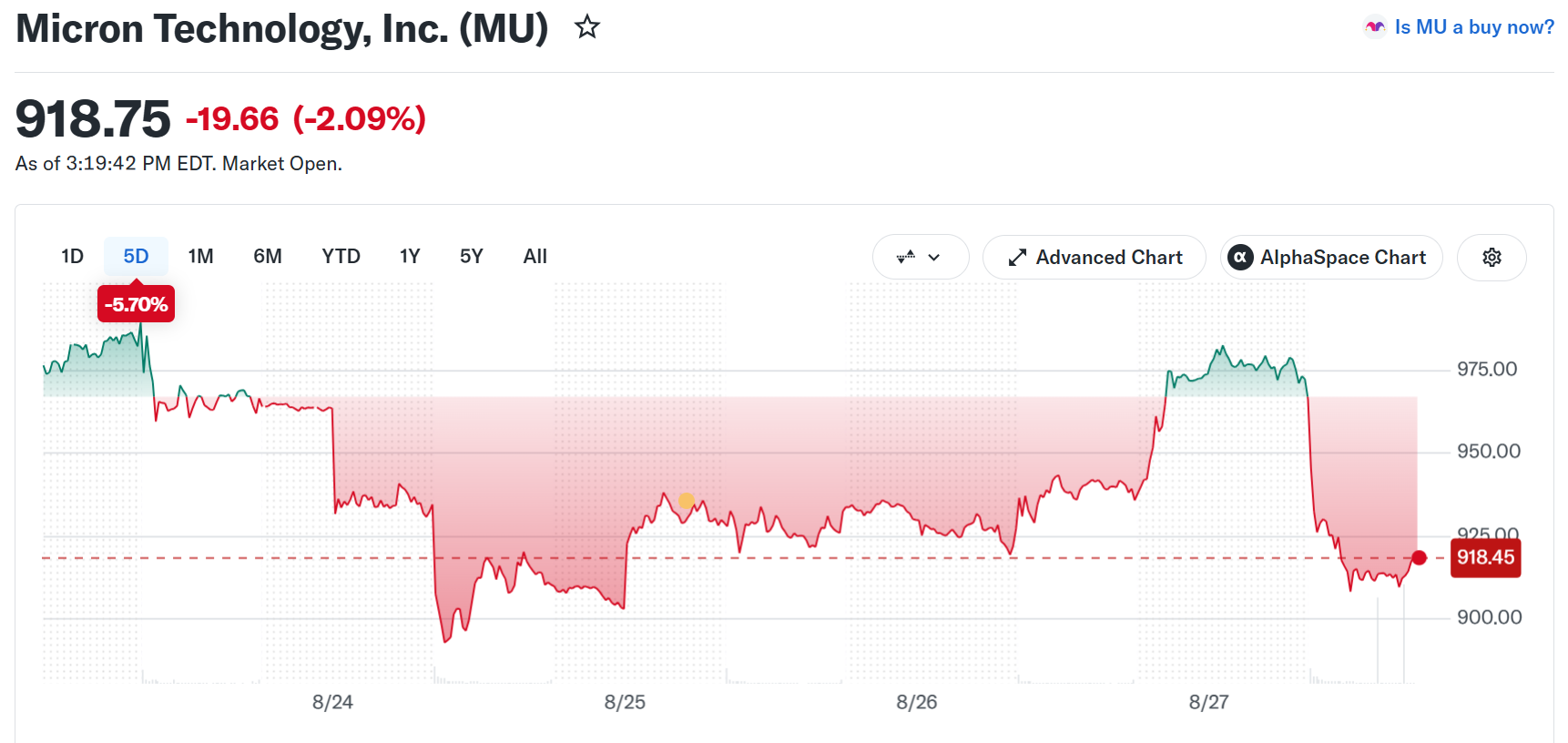
President Donald Trump praised Micron on Truth Social Thursday afternoon. He called it one of the “hottest” companies in the world. Micron Technology (MU) stock fell anyway.
The post cheered a $10 billion research lab. Micron had announced that lab a full week earlier. Traders had already moved on.
Micron Stock Was Falling Before Trump Posted
The market did like the news when it was fresh, as MU stock jumped 3.97% on August 20, the day the plan went public.
Every gain from that day is now gone. Here is how the stock has traded since, according to StockAnalysis data.
Shares traded at $918.75 as of this writing, approximately 5% below its weekly open. It also leaves Micron about 27% under its record high of $1,255.

The company is still worth about $1.04 trillion. Few stocks fall this hard while sitting on gains that large.
What the Truth Social Post Left Out
Trump described the $10 billion as additional to a previous $250 billion pledge. Micron’s own statement says otherwise. The lab sits inside that total, not beside it.
That pledge has its own history with this White House. Micron first put the number at $200 billion in June 2025, in a joint announcement with the administration. A company filing split it into $150 billion for factories and $50 billion for research.
The same filing claimed 90,000 direct and indirect jobs. It also confirmed up to $6.4 billion in federal CHIPS Act support. Micron has since raised the headline figure to more than $250 billion.
The new lab itself is slow money, as construction starts in 2027 and the $10 billion is spread over a decade.
“America’s AI future will be built on American-made memory,” said Sanjay Mehrotra, Micron chairman, president and chief executive officer.
Follow us on X to get the latest news as it happens
Analysts Stay Bullish While Memory Stocks Sell Off
The real damage came on August 24, three days before the post. MU dropped 5.83% that session. Rival SanDisk fell 6.45% on the same day, so the selling hit the whole memory group.
Nvidia’s Q2 earnings landed on August 26. Revenue hit $96.2 billion, up 106% from a year ago. Yet the company guided next-quarter gross margin down to 74% from 75%, per its results. Nvidia buys high-bandwidth memory from Micron, so rising memory prices cut both ways.
Meanwhile, Wall Street is not worried, as seen with a consensus of 31 analysts setting the 12-month target at $1,556.55, roughly 69% above Thursday’s price. Of that group, 30 back a buy and one says hold.

Trump’s posts keep landing on the wrong days. He praised Micron on July 1 as well. The stock ended that month 15.5% lower. Timing data pointed to rival catalysts when SpaceX stock moved after a similar post.
The post Trump Just Mentioned Micron Stock, But Its Down 5% This Week appeared first on BeInCrypto.
Crypto wallet maker OneKey and cybersecurity firm Anzen claim to have hacked version 1.22.1 of Ledger’s Ethereum app. Ledger outright disagrees, saying, “No Ledger user was hacked.”
Earlier today, OneKey founder Yishi Wang detailed how his security team reproduced a transaction replacement attack that takes place while a user is reviewing a legitimate transaction.
Wang declared, “We hacked ledger,” and warned users on Ledger’s older Ethereum app to update it, noting that Ledger has already fixed this in version 1.22.3.
Ledger says OneKey didn’t actually hack anything
Ledger’s Chief Technology Officer Charles Guillemet responded hours later, claiming that “reproducing an already-patched bug is not ‘hacking Ledger.’”
He added, “No user was hacked. No exploitation in the wild. Running an exploit against an old version after the fix has shipped is a lab exercise, not a finding.”
A Ledger spokesperson told Protos that OneKey “took the already disclosed findings and tried to replicate them in a lab environment.”
Read more: KuCoin criticized for helping ‘launder’ $9.5M from fake Ledger app
The Ledger Donjon team claimed this fix was shipped on August 13 in version 1.22.2, further contradicting OneKey’s claims.
Protos has reached out to OneKey for comment and will update this piece should we hear anything back.
Got a tip? Send us an email securely via Protos Leaks. For more informed news and investigations, follow us on X, Bluesky, and Google News, or subscribe to our YouTube channel.

Machi Big Brother proposed a $1 million buyout of Friends.Tech on August 27, offering to acquire the stalled project from Racer and Paradigm and relaunch its FRIEND token.
The proposal sent FRIEND sharply higher, but the move also revived questions about Machi’s own heavy losses on the token and whether his plan can bring the project back to life.
Machi Offers $1M as FRIEND Trading Activity Explodes
In a post on Wednesday, Machi Big Brother wrote that Friend.Tech was trading at less than $300,000 in market capitalization before making his offer.
“I’m offering a 1 mil usd buyout offer to Racer and @paradigm. We can CTO relaunch $FRIEND,” he wrote.
The proposal quickly changed the token’s trading activity, with CoinGecko data showing FRIEND up more than 1,600% over 24 hours at the time of writing, with the token trading near $0.06. It had traded as low as $0.0025 during the previous 24 hours and reached roughly $0.10 at its high. In addition, trading volume had climbed to about $5.3 million over 24 hours, a 94,831% increase from the previous day.
Moves across other timeframes were even bigger, with the asset jumping by more than 2,600% from where it had been a week ago and almost 3,400% in 14 days. Across one month, it had gained nearly 3,300%, although the numbers are bound to change given ongoing volatility.
Machi’s offer comes with a sizable personal history involving FRIEND. According to Lookonchain, he previously spent about 5,200 ETH, worth $16.7 million at the time, to acquire aroud 11 million FRIEND. Those tokens had been worth only $500,000 when Lookonchain posted, leaving Machi with a loss exceeding $16 million.
There was another detail. Lookonchain noted that Machi had transferred the 11 million coins to wallet 0x3205 five days before announcing his $1 million offer. However, the crypto trader rejected any suggestion that he had sold the tokens, and described the receiving address as his “new fomo wallet.”
Friend.Tech’s Collapse Left FRIEND Vulnerable
Friend.Tech launched on Base on August 2023 and initially drew users with a system that allowed people to trade access to influencers’ feeds. But activity weakened considerably after its early success.
As CryptoPotato reported in September 2024, the development team then transferred control of Friend.Tech’s smart contract to Ethereum’s null address, preventing future changes to fee or functionality. The decision came as platform revenues had fallen dramatically, with reported fees reaching as little as $71.
FRIEND also suffered heavily during that decline, and even reached a new all-time low. Wednesday’s rally therefore needs to be viewed against a much larger collapse, as even that move still leaves the token over 98% below its all-time high.
Machi’s proposal now puts the project in an unusual position: a token that had almost disappeared from traders’ attention suddenly has millions of dollars in daily turnover, while the person proposing its revival has already lost millions on a past investment. Whether the bid becomes an actual acqusition remains to be seen.
The post FRIEND Explodes Over 1,600% After Machi Big Brother Proposes $1M Takeover appeared first on CryptoPotato.
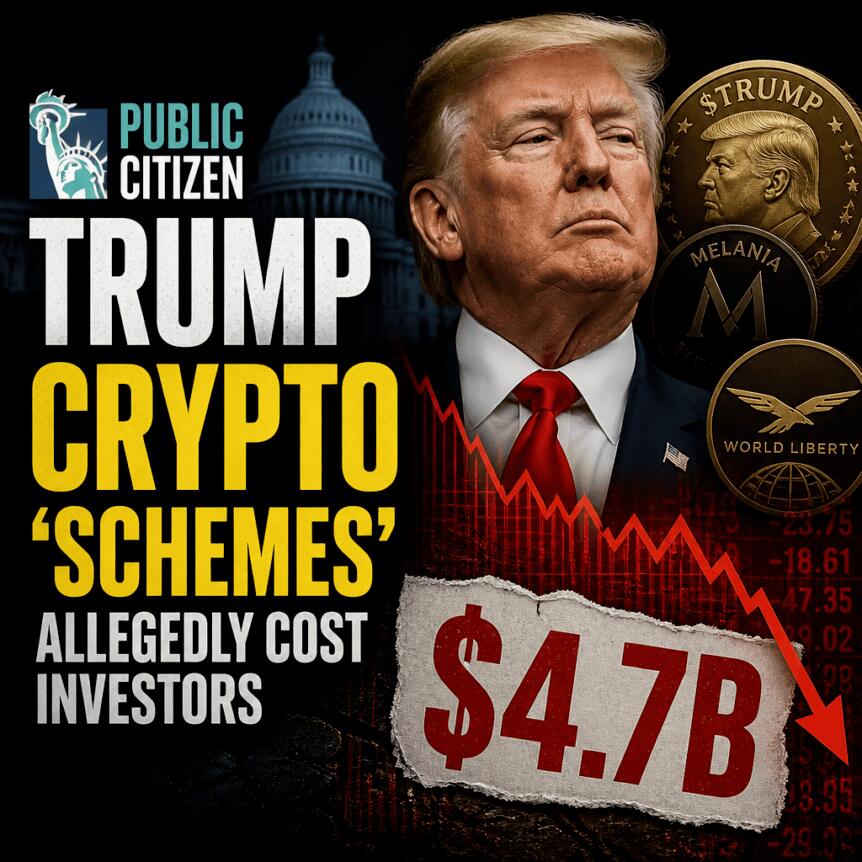
US consumer advocacy group Public Citizen says investors involved in Donald Trump’s digital asset activities since 2022 have collectively lost an estimated $4.7 billion. The figure, published in a report by the nonprofit, centers on the Trump family’s World Liberty Financial token initiatives, Trump’s 2022 NFT trading cards, and the president’s memecoin, Official Trump (TRUMP), alongside revenue tied to World Liberty’s USD1 stablecoin.
Public Citizen’s analysis claims that most of the losses fall on TRUMP memecoin buyers, while it also argues that purchases of World Liberty Financial’s USD1 stablecoin have not “suffered major losses.” The group further contends that the gains earned by Trump through licensing, royalties, and token-related sales did not fully reflect the ongoing risk borne by outside investors.
Key takeaways
- Public Citizen estimates investor losses of at least $4.7 billion tied to Trump family crypto ventures since 2022.
- The largest share of the losses—$3.2 billion—is attributed to investors in the TRUMP memecoin.
- Public Citizen says investors in World Liberty Financial’s USD1 stablecoin have not faced major losses.
- The advocacy group renews pressure for ethics provisions in the Digital Asset Market Clarity (CLARITY) Act.
- Cointelegraph reported earlier that Trump met with crypto executives and called for a “fair version” of the CLARITY Act to advance; a scheduled cloture vote is set for Sept. 15.
Where Public Citizen says investor losses came from
In its report, Public Citizen argues that a combination of Trump-linked digital asset products and related activity has left investors underwater by at least an estimated $4.7 billion since 2022. The group points to several components: the World Liberty Financial governance token, the president’s NFT trading cards launched in 2022, the TRUMP memecoin, and Trump Media’s digital asset treasury.
The report’s central breakdown is stark. Public Citizen says TRUMP memecoin investors account for $3.2 billion of the estimated losses, presenting it as a case where value was transferred to early buyers rather than disappearing entirely. In contrast, the group says buyers of World Liberty Financial’s USD1 stablecoin have not seen “major losses,” implying that price deterioration—rather than systemic failure—has been the dominant issue for the higher-risk products in the portfolio.
Public Citizen also highlights that its estimate concerns “left investors…underwater,” framing the problem as a mismatch between investor outcomes and the perceived benefits accruing to the Trump family through various mechanisms.
How the report ties losses to revenue and licensing
Alongside the loss estimate, Public Citizen describes revenue streams it says Trump earned during the same period. According to the nonprofit, the president collected $7.2 million from NFT licensing fees and royalties. It also cites more than $600 million from World Liberty token sales and the sale of an equity stake, $635 million in licensing fees for the memecoin, and $197 million in revenue from capital contributions to World Liberty.
The organization stresses that these totals do not incorporate the value or stakes tied to ventures that Trump continues to hold. Some figures, Public Citizen notes, were reflected in disclosures discussed in earlier coverage; Cointelegraph previously reported on 2025 filing disclosures that included earnings tied to crypto.
For investors, the implication is not simply that digital assets can be volatile, but that governance, incentives, and monetization structures may concentrate upside for promoters while leaving retail participants exposed to downside. Public Citizen’s framing underscores a familiar tension in crypto markets: whether token launches and monetization pathways generate benefits broadly—or primarily reward early participants and project insiders.
Why ethics provisions in the CLARITY Act matter now
Public Citizen’s renewed criticism extends beyond individual products and into proposed crypto regulation. The nonprofit says the US needs ethics provisions in the Digital Asset Market Clarity (CLARITY) Act, arguing that “the president’s policy choices and personal portfolio cannot be separated.” It calls for legislation that would require a US president and his family to divest from projects in the industry.
This push reflects a broader concern among critics of US policy conflicts: in fast-moving sectors like digital assets, the line between market participation and policymaking can shape outcomes. Public Citizen’s argument suggests that even if a bill is technically neutral, the political actor’s direct exposure could alter incentives for how rules are designed, timed, or implemented.
Supporters of engagement may argue that experience or involvement can inform policy. But Public Citizen’s position is that divestment requirements are an essential safeguard—particularly where a president’s policy choices could influence investor confidence, market structure, and enforcement priorities.
Legislation still moving—timing and political pressure
Public Citizen’s renewed call comes as it characterizes additional crypto-related activity as “potentially on the way.” The group also links its push to momentum around the CLARITY Act.
Cointelegraph reported that Trump met with crypto company executives last week and urged passage of a “fair version” of the CLARITY Act once the Senate returns to session next month. The bill is scheduled for a cloture vote on Sept. 15. Advancing would require at least 60 senators to vote in favor, meaning the measure’s next step depends on securing broad support rather than a simple party-line outcome.
The combination of Public Citizen’s critique and the legislative calendar is likely to keep the ethics debate in focus. If the CLARITY Act proceeds on the timetable described, lawmakers may face pressure—publicly and politically—to address conflict-of-interest concerns before the bill’s substance locks in.
Meanwhile, Public Citizen’s estimate is likely to remain a reference point in future discussions because it connects consumer-outcome claims with specific categories of products—memecoin versus stablecoin—and with monetization mechanisms such as royalties, licensing fees, and token sales.
Investors and builders should watch whether the CLARITY Act’s handling of conflicts of interest evolves as the Sept. 15 cloture vote approaches, and whether additional disclosures or market data clarify the extent to which losses were driven by general volatility versus design choices tied to early participation. The next phase will test whether ethics safeguards become part of crypto market structure—or remain optional in practice.


Stellar’s tokenized real-world asset market has climbed from about $785 million in January to more than $3 billion in July, while only just over $2 million has entered Blend pools that accept RWAs.
Summary
- Stellar’s RWA value increased almost fourfold during the first seven months of 2026.
- Four tokenized products account for hundreds of millions of dollars each on the network.
- Blend has $127 million in TVL, but its RWA-enabled pools hold only slightly more than $2 million.
- RedStone says round-the-clock pricing remains necessary before more RWAs can serve as DeFi collateral.
Stellar’s RWA market has crossed $3 billion
RedStone’s latest report has found that Stellar’s RWA market expanded almost fourfold between January and July, driven by tokenized money market funds, U.S. Treasury products and corporate credit.
Several individual products have reached values normally associated with established investment funds rather than early blockchain trials. The Amundi and Spiko Overnight Swap Fund, a French-regulated UCITS cash-management product, has grown to hundreds of millions of dollars in onchain value since going live on Stellar in March.
RedStone’s report identified Spiko’s tokenized U.S. Treasury bill fund as another major contributor. The product had reached about $536 million, while Ondo Finance’s USDY held more than $533 million on Stellar.
USDY is a yield-bearing asset supported by short-term U.S. Treasuries and bank demand deposits. Ondo expanded the product to Stellar in September 2025, after which its value on the network rose from slightly more than $1 million at the beginning of 2026 to over $533 million.
Corporate credit has added another large pool of tokenized value. VuMe Bond 2030, issued under Luxembourg securitization rules, launched on Stellar in February and has since reached approximately $500 million.
Franklin Templeton has maintained an earlier institutional presence through the Franklin OnChain U.S. Government Money Fund. Launched on Stellar in 2021, the fund uses the BENJI token and invests primarily in U.S. government securities, cash, and repurchase agreements. RedStone placed the value tokenized on Stellar at about $460 million.
The concentration of several large products shows that Stellar has already attracted issuers capable of placing hundreds of millions of dollars on a public network. Yet issuance records how much value has been tokenized, not how much of it is being traded, supplied to lending markets, or used as collateral.
RWA use in Stellar DeFi remains limited
Stellar’s decentralized finance market remains much smaller than its tokenized asset base. RedStone placed total DeFi value on the network at about $259 million when its report was prepared, compared with more than $3 billion in RWAs.
Blend, Stellar’s largest lending protocol, accounted for roughly $127 million of that DeFi total. Pools capable of accepting RWAs, however, held only slightly more than $2 million.
Templar Protocol provides another example of the limited use of tokenized assets in lending. Its Stellar application allows users to borrow against assets including deJAAA, deJTRSY, CETES, and USTRY, but the protocol had about $8.4 million in total value locked on the network, according to RedStone.
DeJAAA represents exposure to AAA-rated collateralized loan obligation tranches, while deJTRSY is tied to short-term U.S. Treasury securities. CETES tracks Mexican government Treasury certificates, and USTRY is backed by short-term U.S. Treasury bills.
Royal Fool, the pseudonymous co-founder and chief executive of Templar Protocol, said dependable pricing is required before a lending market can safely accept an RWA.
“Listing a real-world asset as collateral works best if we can price it reliably around the clock.”
According to the executive, SEP-40 feeds allow Templar to accept real-world collateral and support borrowing against it on Stellar. Lending protocols need current prices to calculate loan-to-value ratios and determine when a position no longer has enough collateral.
A tokenized security does not automatically become usable in DeFi simply because it exists on a blockchain. Trading venues need a defensible price before listing it, while lending protocols must keep valuing collateral even when the market for its underlying asset is closed.
Continuous pricing could bring more RWAs into DeFi
Price discovery becomes harder when an onchain token represents an asset that does not trade continuously. Bitcoin, Ether, and other liquid cryptocurrencies change hands around the clock, allowing oracle providers to combine quotes from several active exchanges.
Traditional assets follow different schedules. U.S. stocks trade mainly during set market hours, while government debt products may only have reliable spot prices when their domestic markets are open.
Money market funds add another complication because their value depends on the securities held in their portfolios rather than on constant secondary-market trading. Fund administrators may also distribute net asset value data through systems that cannot send information directly to a smart contract.
Corporate debt requires additional inputs, including credit quality, maturity, settlement terms, and the structure of the security. According to RedStone, an oracle must account for such differences rather than applying the same method used to price a liquid crypto token.
Stellar’s SEP-40 Oracle Consumer Interface provides a common format through which Soroban smart contracts can request price information. Before the standard was introduced, each provider could use a separate interface, requiring developers to build a new adapter whenever they added another data source.
Under SEP-40, compatible providers follow the same set of functions for identifying supported assets, price precision, update intervals, and timestamps. Applications can retrieve the latest value, request historical records, and check whether a price has become stale.
RedStone joined Stellar in March and later adopted SEP-40. Materials provided with the report said the oracle provider now supports 55 price feeds covering U.S. Treasuries, sovereign debt, corporate credit, tokenized gold, and money market products.
Among the covered assets are Ondo’s USDY, Franklin Templeton’s BENJI and Matrixdock’s XAUm gold token. RedStone also supplies data for Centrifuge-linked Treasury and credit products, along with tokenized Mexican and Brazilian government debt issued by Etherfuse.
Martin Quensel, founder of Anemoy and co-founder of Centrifuge, said tokenization places regulated funds within reach of decentralized finance, while standardized pricing allows protocols to use them as collateral.
“Reliable, standardized pricing on Stellar by RedStone is what lets protocols actually use them as collateral.”
Stellar had previously added another data layer when it integrated Chainlink services in October 2025. The arrangement covered Data Feeds, Data Streams, and the Cross-Chain Interoperability Protocol for applications working with DeFi and tokenized assets.
DTCC brings a U.S. market catalyst for 2027
The Depository Trust & Clearing Corporation plans to add tokenized versions of DTC-custodied assets to Stellar in the first half of 2027, extending the network’s RWA pipeline into U.S. market infrastructure.
As reported in May, the initial eligible assets are expected to include Russell 1000 shares, major index exchange-traded funds, U.S. Treasuries, and several classes of corporate and other bonds.
DTCC received a no-action letter from the U.S. Securities and Exchange Commission in December 2025. The relief allows it to test tokenized securities under specified conditions while maintaining existing investor protections, disclosures and control over ownership records.
The $114 trillion figure attached to the agreement represents assets held in custody by DTC, not the value that will move to Stellar. DTCC has not said that its entire custody base will be tokenized or transferred onto the network.
For U.S. investors, tokenization under DTCC’s system would keep the securities within established custody and regulatory structures. Eligible assets could receive blockchain-based representations while ownership records remain tied to the securities held at DTC.
DTCC has already begun testing tokenized public-market assets with major financial firms. In July, BlackRock, JPMorgan, Goldman Sachs, Vanguard, the New York Stock Exchange, and almost 40 other institutions participated in a tokenization pilot involving stocks, ETFs, and U.S. Treasuries.
Microsoft and Circle shares, the Invesco QQQ Trust, the SPDR S&P 500 ETF and BlackRock’s iShares 0–3 Month Treasury Bond ETF were among the first assets included. JPMorgan also completed a conversion of QQQ shares into a tokenized representation during the pilot.
The active trial uses permissioned infrastructure, including Hyperledger Besu and Canton, while the separate Stellar deployment remains scheduled for 2027. DTCC said participants would test collateral transfers, repurchase agreements, and equity transactions before the current program enters its planned operational phase.
The company behind XRP has made another move geared toward Wall Street and beyond its cryptocurrency roots by launching a new institutional trading business with Ripple Prime.
The new initiative, announced earlier on Thursday, will allow hedge funds, asset managers, and other institutional clients to execute Total Return Swaps (TRS) across US-listed equities, indices, and digital assets.
Deeper Into Wall Street
The announcement shared by the company informed that the service is already live, and it aims to expand the firm’s presence in traditional financial markets less than a year after completing its $1.25 billion acquisition of prime broker Hidden Road.
Products within Delta One are derivatives designed to closely track the performance of an underlying asset or index. A TRS, for instance, allows an investor to receive the gains and income generated by an asset without necessarily owning it directly, in exchange for paying financing costs and absorbing losses.
Ripple Prime has expanded the scope of assets available on its platform as clients can now access equities alongside foreign exchange, fixed income, derivatives, and cryptocurrencies through a single counterparty relationship. The company said customers can also cross-margin exposures across those different assets around the clock, potentially reducing the amount of collateral institutions need to maintain separately.
Ripple Prime’s President, Noel Kimmel, said that these sorts of services are what institutional market participants are “asking for today, and we are proud to be the ones delivering it.”
Beyond Crypto
Ripple’s acquisition of Hidden Road (later renamed Ripple Prime) was initially announced in April 2025 and completed by the end of the year. It became the first crypto company to own and operate a global multi-asset prime broker, clearing over $3 trillion annually and serving more than 300 institutional customers.
As reported a few months back, Ripple Prime also received an investment-grade BBB rating from KBRA, with the agency pointing to its growth in clearing and intermediation across exchange-traded derivatives and fixed-income repo markets.
Earlier in August, Ripple Prime announced an upsized $275 million private placement of senior unsecured notes, following a $200 million debt facility secured from Neuberger Specialty Finance in May. The entity said it would use the fresh capital to support its continued expansion.
The post Ripple (XRP) Makes Major Wall Street Push With New Institutional Trading Business appeared first on CryptoPotato.


The changes aim to cut investor selling pressure and channel protocol revenue to ENA as Ethena looks to revive USDe growth.

Nigeria Defender Ekerette Udom Joins Finnish Topflight Side SJK

AI turns up a promising finding in cancer data that researchers hadn’t noticed for years

Luton airport hit by lightning strike – flights cancelled and diverted





-

 Fashion6 days ago
Weekend Open Thread: Madewell – Corporette.com
-

 Crypto World2 days ago
SpaceX stock could rise 75% to $240, JPMorgan says
-

 Business5 days ago
Musk’s Tesla, SpaceX Confirm $16.8 Billion ‘Terafab’ Chip Plant as World’s Largest Building in Texas
-

 Crypto World6 days ago
anatomy of crypto’s biggest liquidation event since 2021
-

 Crypto World3 days ago
A $30 Billion AI Fund Implodes, Now the SEC Is Investigating Wall Street’s Role
-

 Politics5 days ago
6 months on, Irish renters crushed by effects of government housing bill
-

 Crypto World2 days ago
Did Trump Just Move SpaceX Stock With One Truth Social Post?
-

 Business4 days ago
Mystery AI Model ‘Ox Alpha’ Draws Developers With Free Access as Chinese Lab Origins Remain Debated
-
 NewsBeat6 days ago
The ‘Lucky Dip Gang’ causing carnage for clicks: After five thugs were killed speeding in the wrong direction on a motorway, GUY ADAMS investigates a sick new trend… and why police aren’t even allowed to pursue them
-

 Business3 days ago
Moderna CEO warns China is pouring state money into mRNA technology
-

 Business3 days ago
NVIDIA Stock Drops Nearly 2 Percent to $210 on Seventh Losing Day Ahead of Critical AI Earnings
-

 Tech6 days ago
Unitree’s New Superman Robot Claims to Outjump and Outrun Every Human, Usain Bolt Included
-
 Crypto World6 days ago
Nvidia Stock Suffers Longest Losing Streak Since 2022: Will Q2 Earnings End It?
-

 Business6 days ago
UK firms in critical financial distress rise 9% to 53,756
-

 Sports5 days ago
Deshaun Watson fires back at Browns fans after being booed: ‘It’s a disrespectful thing’
-
 Crypto World4 days ago
Google Gemini AI Predicts Ethereum Could Become the Trade Retail Misses in 2026
-

 Tech6 days ago
Faster chip in a familiar form factor
-

 Business6 days ago
Will Tesla Stock Be Higher or Lower a Year From Now? Here’s What Wall Street Analysts Are Saying
-

 Crypto World7 days ago
SEC Regulation Crypto vs CLARITY Act: which framework wins
-

 Business4 days ago
Tesla Recalls Nearly 3 Million Cars in China Over Hidden Door Handles Linked to Multiple Deaths Amid New Ban
You must be logged in to post a comment Login