

Crypto World
Open USD Raises Competition in the Global Stablecoin Payments Market



With stablecoin supply above $300 billion and payment use reaching an estimated $390 billion in 2025, more than twice the previous year, competition increasingly centres on distribution, liquidity, reserve income, and access to payment networks.
Open USD has brought these commercial forces together through a consortium of more than 140 participants, including Visa, Mastercard, Stripe, Coinbase, and BlackRock. Participating companies will be able to distribute the asset through exchanges, wallets, merchant products, and payment services while receiving a share of reserve earnings.
The model places Open USD against established issuers and smaller competitors seeking partnerships with the same financial companies.
BeInCrypto spoke with Louisa Bai, Head of Stablecoins at Mysten Labs, Marc Boiron, CEO of Polygon Labs, and Kevin Cui, Executive Director and Chief Executive Officer of OSL Group, about stablecoin competition, regional use cases, currency demand, and blockchain settlement.
Open USD Links Distribution With Reserve Income
Open USD gives participating companies a financial incentive to support adoption through their own products. Reserve earnings can be returned to consortium members, linking token distribution to commercial revenue.
“OUSD is primarily built to share stablecoin reserves across its partners, including Visa, Stripe, Coinbase, Mastercard, and leading blockchains such as Sui,” said Louisa Bai, Head of Stablecoins at Mysten Labs. “Its partner network and revenue-sharing model could increase competition in a market with deeply entrenched incumbents.”
USDT and USDC retain an advantage built through liquidity, trading pairs, exchange listings, and widespread use across crypto markets.
“Their moat comes from liquidity depth and years of exchange listings,” Bai said. “Mid-sized issuers face the greatest pressure because they lack the liquidity of USDT and USDC and the partner economics offered by OUSD.”
Open USD also depends on cooperation between companies with different commercial priorities. Decisions covering reserves, governance, supported networks, and distribution will require agreement across banks, payment companies, exchanges, and crypto firms.
Its progress will depend on whether shared reserve income produces sustained adoption across participating products.
Different Stablecoins Will Serve Different Products
Stablecoin control will remain divided between issuers, payment companies, exchanges, applications, and blockchains.
Issuers manage reserves and redemption, while payment companies control merchant access and customer distribution. Exchanges provide liquidity, and blockchains determine transaction speed, fees, and settlement capacity.
“Different stablecoin assets aimed at different use cases will coexist, together with different forms of control,” Bai said.
PYUSD remains closely connected to PayPal and its consumer products, while Open USD may develop around business payments and merchant settlement. Exchange-backed coins can focus on trading, while bank-supported assets can serve treasury management and institutional transfers.
This division allows stablecoins to develop around specific commercial environments rather than a single dominant operating model.
Regional Demand Splits Between Dollar Access and Local Settlement
Stablecoin adoption follows currency stability, remittance costs, regulation, and access to banking. Latin America currently provides some of the strongest examples of stablecoins functioning as everyday money across savings and cross-border payments, according to Marc Boiron, CEO of Polygon Labs.
“Latin America, and it’s not close,” Boiron said. “When a currency loses value overnight and sending money home costs 6% and takes three days, a digital dollar is a household decision.”
Boiron pointed to the Mexico-US and Brazil-US corridors as major sources of current volume. He described the Gulf as an early regulatory leader, Japan as a careful builder of bank-connected products, and the US as a market gaining more room for regulated issuance and payments.
Emerging markets such as Argentina, Brazil, and Pakistan use dollar stablecoins as protection from inflation and currency depreciation.
In Nigeria, Paga plans to use Sui-based stablecoin payments to support international transfers for freelancers and businesses paying overseas suppliers.
Local-currency coins serve a different economic need. Markets with trusted currencies and regulators seeking domestic settlement onchain have stronger incentives to develop assets denominated in yen, dirhams, euros, or other local units.
“A stablecoin inherits the reputation of the currency behind it,” Boiron said.
He expects dollar coins to lead in markets where people seek protection from inflation, while local-currency stablecoins can develop in places such as Japan and the Gulf, where domestic currencies retain public trust.
Business adoption depends on liquidity and reliable fiat conversion, while distribution and licensing determine how easily merchants and exchanges can support a new asset. Boiron said businesses need coins already present in the wallets and payment services they use, backed by issuers acceptable to banks and auditors.
“It comes down to liquidity, distribution, and whether there is a licensed issuer standing behind it,” he said.
Europe follows MiCA rules covering issuance, authorization, reserves, and distribution. Exchanges have restricted several assets, including USDT, while providers adjusted their offerings to European requirements.
The resulting market divides between dollar access in weaker-currency economies and local settlement in regions where domestic units retain trust.
Dollar Stablecoins Will Retain Their Lead
Dollar coins still dominate supply and liquidity, while local-currency assets are developing around domestic settlement and regional trade.
“Non-dollar stablecoins remain concentrated in foreign-exchange trading within DeFi,” Bai said. “Locally denominated assets such as JPYC will continue to develop, while USD is likely to remain dominant in the near term.”
Meanwhile, Cui expects local-currency stablecoins to grow alongside dollar coins as companies adopt them for domestic payments and regional trade.
“Local-currency stablecoins are developing a durable role alongside dollar coins by reducing FX exposure and allowing businesses operating in euros, reais, or yen to retain their own unit of account,” said Kevin Cui, Executive Director and Chief Executive Officer of OSL Group.
Local coins may gain adoption where companies earn and spend in the same currency, while dollar coins continue serving international settlement and savings demand.
Blockchains Provide the Settlement Base
Blockchains determine how efficiently stablecoins move between users, companies, and financial applications.
Boiron offered a complementary view of the chain’s role, arguing blockchains create more value by supporting widely used assets across many products than by issuing coins tied to one ecosystem.
“The most valuable stablecoin is the one everyone else already accepts,” Boiron said.
Chains therefore compete through transaction performance, developer tools, and support for several major stablecoins.
“Sui’s role in stablecoin growth is settlement, with fast execution built for the transaction volumes mass adoption requires,” Bai said. “Stablecoins need fast finality, capacity for large user numbers, stable fees, and strong user experience.”
Sui introduced gasless stablecoin transfers in May 2026, allowing users to send supported assets without holding SUI separately for transaction fees. Confidential transfers entered public beta in June, allowing issuers to conceal balances and transaction values while preserving access for compliance and auditing.
Sui also recorded more than six million transactions per second during a July public experiment using programmable tunnels. These offchain payment and state channels process activity away from the main network before settling final results on Sui.
Such features can support payroll, merchant payments, treasury transfers, and institutional settlement.
Open USD shows how stablecoin competition is expanding beyond issuance. Reserve income, distribution partnerships, payment access, and blockchain performance will influence which assets gain adoption.
Dollar coins will retain their advantage in global markets, while local assets develop around domestic payments and regional commerce. The strongest providers will combine reliable reserves with liquidity, distribution, and efficient settlement.
The post Open USD Raises Competition in the Global Stablecoin Payments Market appeared first on BeInCrypto.

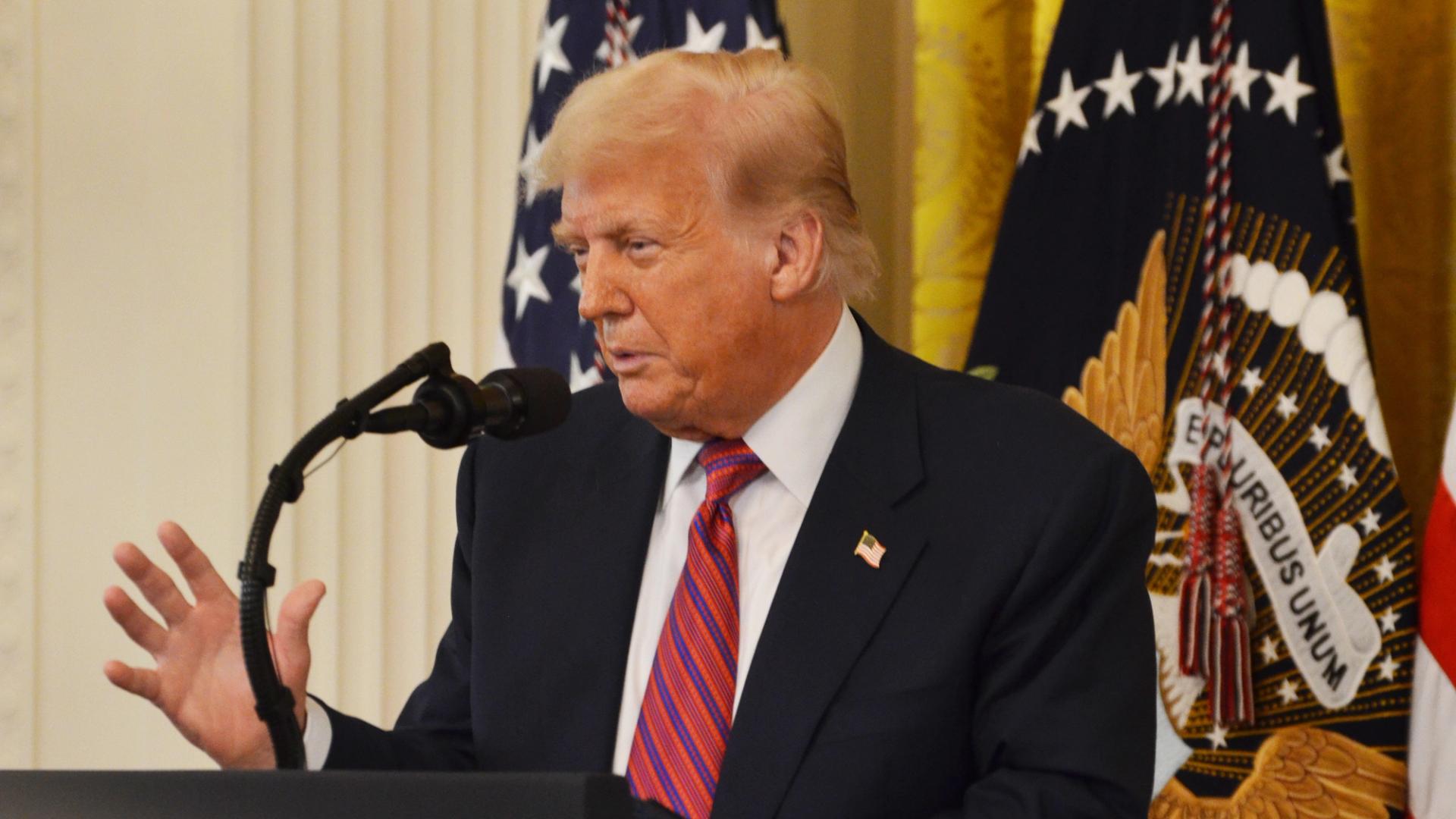
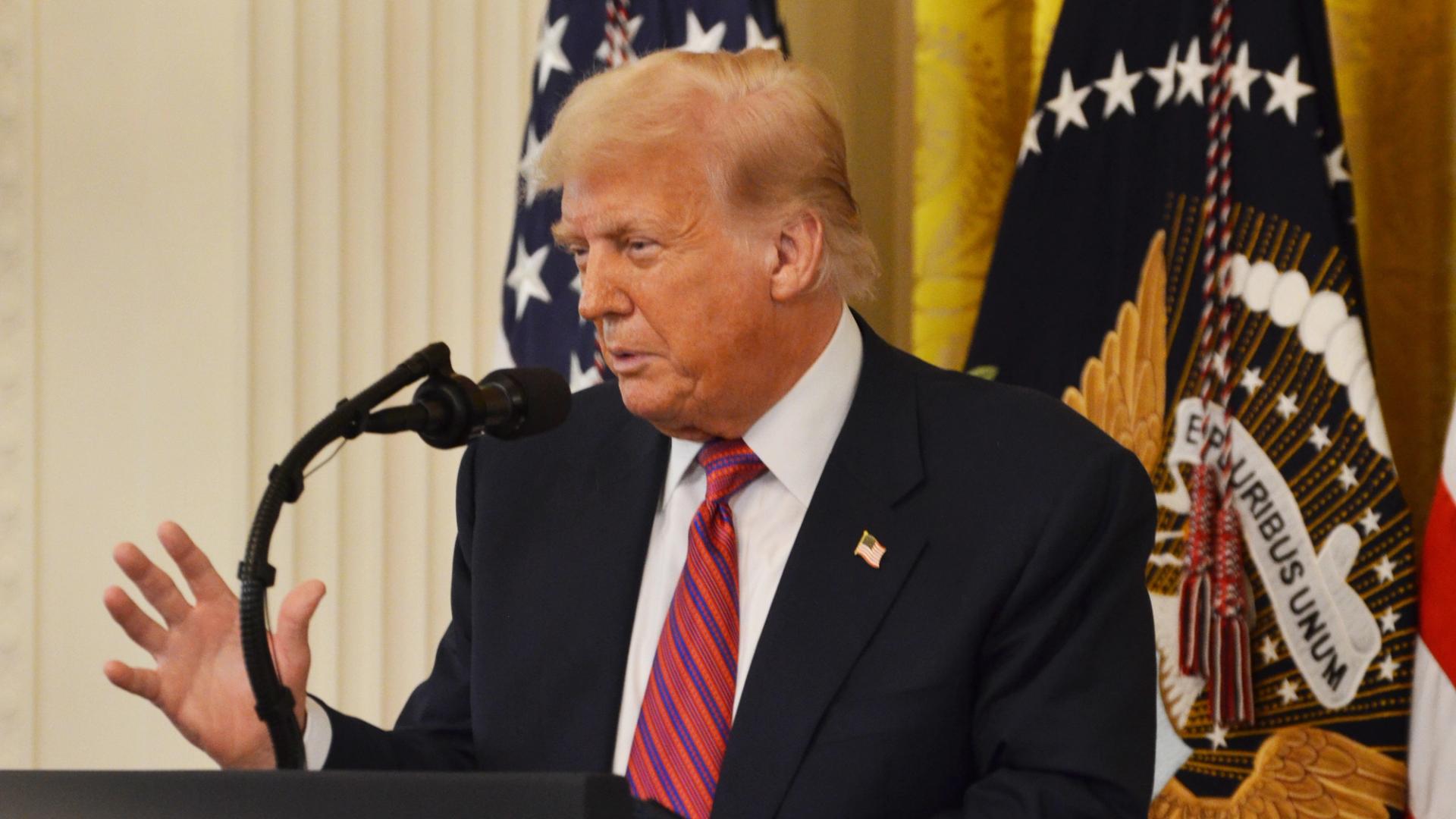
“If Senate Democrats block this historic legislation after the administration has bent over backward to accommodate their concerns, stakeholders should make no mistake: It is the Democrats who are blocking this legislation because they were never serious about a legislative outcome,” the White House official said.
Democratic negotiators such as Senators Kirsten Gillibrand, Ruben Gallego and Angela Alsobrooks reportedly haven’t received details of the agreement with Trump, who’d met personally with Republican senators last week. But many of the Democrats have drawn a line in the sand that the ethics provision — driven primarily by Trump’s own deep crypto connections — needs to be strong.
The dispute was heightened recently by the president’s disclosures that he’d pocketed more than $1 billion last year from his crypto interests.
The White House, Republicans and their crypto industry allies are already building their case against any Democrats who don’t accept the new answer to their ethics demands. It’s unclear when they’ll get to see it.
The industry is expecting full circulation of the Clarity Act legislative language as soon as Tuesday night or Wednesday, though that expectation has been repeatedly delayed since last week.
The Senate has fewer than three weeks to finish the bill, including the ethics piece, and get it through the political gauntlet of a floor vote before lawmakers leave town for their reelection campaigns. There’s technically enough time, but even without significant further debate, it would be tight.

Bitcoin is displaying the same technical conditions that have historically marked major market bottoms, even as some on-chain indicators continue to point to the possibility of further downside.
In his latest analysis, crypto analyst Ali Martinez said that metrics such as MVRV and Cumulative Value-Days Destroyed (CVDD) still place BTC’s potential cycle bottom in the $40,000 to $50,000 range. However, the crypto asset’s monthly chart is now showing a technical setup that has consistently appeared near the end of previous bear markets.
Rare Technical Trifecta Returns
According to Martinez, this pattern consists of three important signals occurring together: the monthly Relative Strength Index (RSI) falling to around 43.65, the Chande Momentum Oscillator (CMO) dropping to roughly -71, and Bitcoin testing its 50-month moving average.
In the three previous market cycles, this combination coincided with major long-term bottoms. For example, back in March 2015, the setup appeared when BTC traded at $235. Although the price later briefly declined to $162, Martinez said the signal preceded an 8,300% macro expansion.
A similar pattern emerged in January 2019, when the crypto asset was near $3,333, slightly above the cycle low of $3,124 recorded a month earlier, before beginning a rally of 1,911%. The same technical cluster also appeared in December 2022, when it stood at $16,270, just above the $15,473 cycle bottom while hovering near the 50-month moving average. The analyst said that move was followed by a 675% rally.
Interestingly, Bitcoin’s correction to $58,000 last month triggered the same historical setup once again.
According to the analysis, the monthly RSI has now fallen below 43.65, the Chande Momentum Oscillator has cooled to -71, and Bitcoin is trading around its 50-month moving average. While Martinez acknowledged that on-chain indicators still leave room for the crypto asset to revisit the $40,000 to $50,000 range in what he described as a “sweep of the CVDD floor,” he said the current technical alignment has represented a dominant accumulation zone.
Based on that combination of signals, Martinez stated,
“Shifting focus away from short positions and toward spot BTC accumulation offers a highly favorable risk-to-reward ratio at these levels.”
Buying Opportunity
Martinez is not alone in seeing the current market as a buying opportunity. Crypto analyst Doctor Profit also recently noted that investors waiting for a traditional four-year cycle bottom in September or October could miss the opportunity. While he acknowledged that a large liquidity zone remains around $54,000 and said Bitcoin could still decline about 15% from current levels, he does not expect the crypto asset to fall below $50,000.
Instead of waiting for lower prices, Doctor Profit suggested accumulating Bitcoin gradually rather than investing all at once. He also said the next major rally is unlikely to begin immediately. The analyst said several upcoming events could strengthen market sentiment before the asset reaches its expected cycle low.
These include the planned rollout of tokenized stocks involving BlackRock, the New York Stock Exchange, the S&P, Nasdaq, and the DTCC. He also mentioned speculation surrounding the CLARITY Act’s possible passage in August.
The post Bitcoin Just Triggered Three Rare Signals That Previously Marked Market Bottoms appeared first on CryptoPotato.
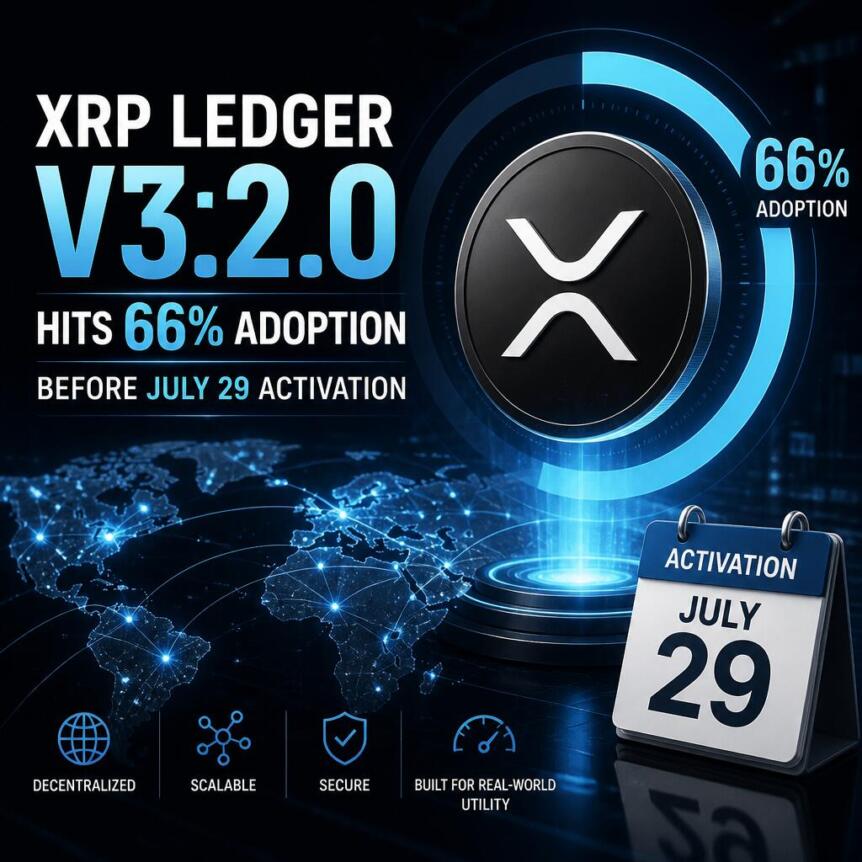
XRP Ledger’s v3.2.0 now runs on 66% of tracked validators as the network approaches a scheduled amendment activation. XRP Ledger’s v3.2.0 has reached 99 validators and 481 nodes across the monitored network. The July 29 activation remains on schedule because validator support continues above the required threshold.
Validator Adoption Expands Across The Network
XRP Ledger’s v3.2.0 currently operates on 57.33% of tracked nodes, according to recent XRPL Explorer data. The tracker recorded 481 updated nodes among 825 observed systems. Adoption has increased since the software became available in June.
However, many operators still use the earlier release across both validator and node infrastructure. Version 3.1.3 remains active on 42 validators, representing 28% of the monitored validator group. Another 323 nodes continue running that version, equal to 38.41% of tracked nodes.
XRP Ledger’s v3.2.0 gives operators access to maintenance fixes before the amendment changes ledger rules. Software installation and amendment approval remain separate processes under XRP Ledger governance. Updated servers receive the code, while validator votes determine whether consensus changes become binding.
Amendment Support Clears The Required Threshold
The fixCleanup3_2_0 amendment currently holds 85.71% validator support ahead of its planned activation. Thirty validators support the proposal, while five validators oppose it. The approval level exceeds the network’s required 80% threshold.
XRP Ledger’s v3.2.0 supports the amendment, but approval must remain above 80% during the full waiting period. XRP Ledger rules require that level for two consecutive weeks. A decline below the threshold would restart the countdown.
The network has scheduled activation for July 29, 2026, at 09:57 UTC. XRP Ledger’s v3.2.0 must remain available across participating infrastructure when the new rules take effect. Unsupported servers may become amendment-blocked and lose the ability to confirm the ledger’s valid state.
Update Addresses Existing Protocol Issues
XRP Ledger’s v3.2.0 fixes problems affecting vaults, lending functions, permissioned trading, and related domain features. The release addresses calculations involving Single Asset Vault deposits and issued shares. It also corrects accounting behavior within the Lending Protocol.
The update includes repairs for the Permissioned DEX, Multi-Purpose Tokens, and Permissioned Domains. XRP Ledger’s v3.2.0 applies maintenance changes to features already introduced through earlier amendments. The package does not center on new consumer-facing products.
The development team also renamed the main server software from rippled to xrpld. XRP Ledger’s v3.2.0 retires amendments that have remained active for more than two years. Developers also continued dividing libxrpl into smaller modules for simpler maintenance and future development.
XRP Ledger’s v3.2.0 remains on course for the July 29 amendment activation after reaching 66% validator adoption. Validator support remains above the required level, while operators using older software still face an update deadline.
![CryptoRank chart showing only 8 of 113 altcoins launched since 2024 above TGE price, Source: CryptoRank via Wu Blockchain]](https://wordupnews.com/wp-content/uploads/2026/07/f8210db076c04d16a03a4eab4900bda1.webp)
Almost every big altcoin launched since 2024 has lost money for launch-day buyers. CryptoRank data from July 21 shows just 8 of 113 still trade above their token generation event (TGE) price.
The count covers only tokens with market caps above $100 million today. Even in that select group, the median return since launch stands at -95.7%.
![CryptoRank chart showing only 8 of 113 altcoins launched since 2024 above TGE price, Source: CryptoRank via Wu Blockchain]](https://assets.beincrypto.com/img/vAtl29sM_j2fJFOiieUQWcJa45Q=/smart/f8210db076c04d16a03a4eab4900bda1)
Why Most Altcoins Launched Since 2024 Fell Below TGE Price
The report builds on a warning from December. Back then, research firm Memento Research found 84.7% of 2025 launches, 100 of 118 tokens, below their listing price. Median project valuations in that analysis had collapsed 71% from launch.
The market has not helped since. CryptoRank’s second-quarter recap shows 82.1% of the top 100 assets fell in June. Every major token category it tracks also posted median losses.
The numbers hide an even darker picture. The list counts only tokens still worth over $100 million. Thousands of smaller launches failed and never made the cut.
So why do new tokens keep sinking? Two reasons stand out. Many launched at inflated prices, and scheduled token unlocks then kept adding supply that buyers did not want.
Worldcoin (WLD) shows how far the fall can go. One of 2024’s most hyped launches now sits down 97% from peak, even with a Grayscale ETF filing pending.

Hyperliquid Leads the Few Survivors Still in Profit
Hyperliquid (HYPE) tops the winners with a 1,519% gain since its November 2024 airdrop. The token now trades near $61.52 with a $13.7 billion market cap. That makes it the tenth-largest cryptocurrency.
HYPE’s edge is simple. Its perpetuals exchange earns real fees, and that revenue funds token buybacks. Spot HYPE ETFs also began trading in May. Still, the token sits about 20% below its June record of $76.70.
Ondo (ONDO) comes second at 101.4% above its launch price, lifted by demand for tokenized US Treasuries. Yet ONDO remains 81% below its December 2024 peak of $2.14. Being in profit can still hide a deep crash.

EverValue Coin (EVA), an Arbitrum token with growing Bitcoin backing, gained 20.3%. Midnight Network (NIGHT), a privacy chain tied to Cardano, added 16.5%. CryptoRank did not name the other four winners.
The lesson is blunt. Hype fades, but unlock schedules do not. The few survivors earn fees, solve real problems, or hold hard assets. The next wave of launches will show whether anyone was paying attention.
The post Only 8 Altcoins Launched Since 2024 are Profitable appeared first on BeInCrypto.


The controversy centered on Rentech, a little-known intermediary that appeared in contracts connected to Chinese market maker Web3Port. According to documents obtained by CoinDesk, Movement executives later questioned whether the foundation believed Rentech was affiliated with Web3Port when it was not. Rentech has denied any wrongdoing or misrepresentation.
The fallout extended beyond Movement. Binance banned the market-making account involved in the token launch for what it described as misconduct, while Movement launched a token buyback program and hired outside firm Groom Lake to review the events surrounding the deal.
Movement Labs and co-founder Rushi Manche separated in May 2025.
More recently, the company attempted to chart a new course.
In June, Movement announced it would pivot away from competing with other Ethereum scaling networks and instead focus on cross-border payments, remittances and stablecoin settlement. The company said it had secured access to licensed payment infrastructure in the U.S., Canada and the European Union as it sought to build services aimed at emerging markets.
The strategy reflected a wider trend across the crowded layer-2 sector, where blockchain projects have increasingly shifted toward real-world financial applications as competition among scaling networks has intensified.
It remains unclear how the Chapter 11 filing will affect Movement’s blockchain network, its partnerships or plans to expand its payments business. Chapter 11 bankruptcy allows companies to continue operating while restructuring their debts under court supervision.
Bitcoin is attempting to extend its recovery after rebounding sharply from the June lows. The asset is now pressing into an important confluence of resistance, where a descending trendline aligns with a major supply zone.
While buyers have regained short-term momentum, the coming sessions will determine whether this move develops into a broader trend reversal or another lower high within the prevailing structure.
Bitcoin Price Analysis: The Daily Chart
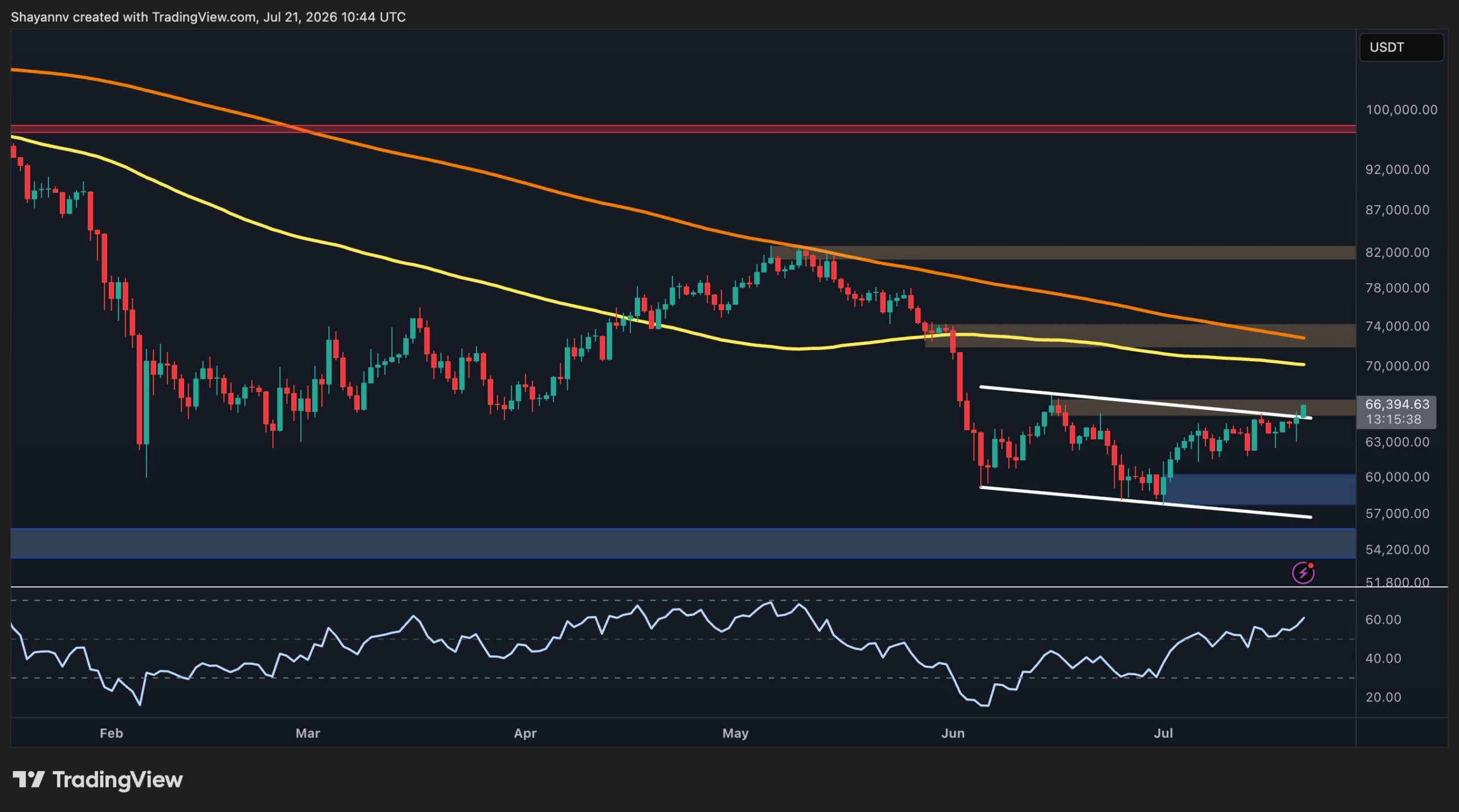
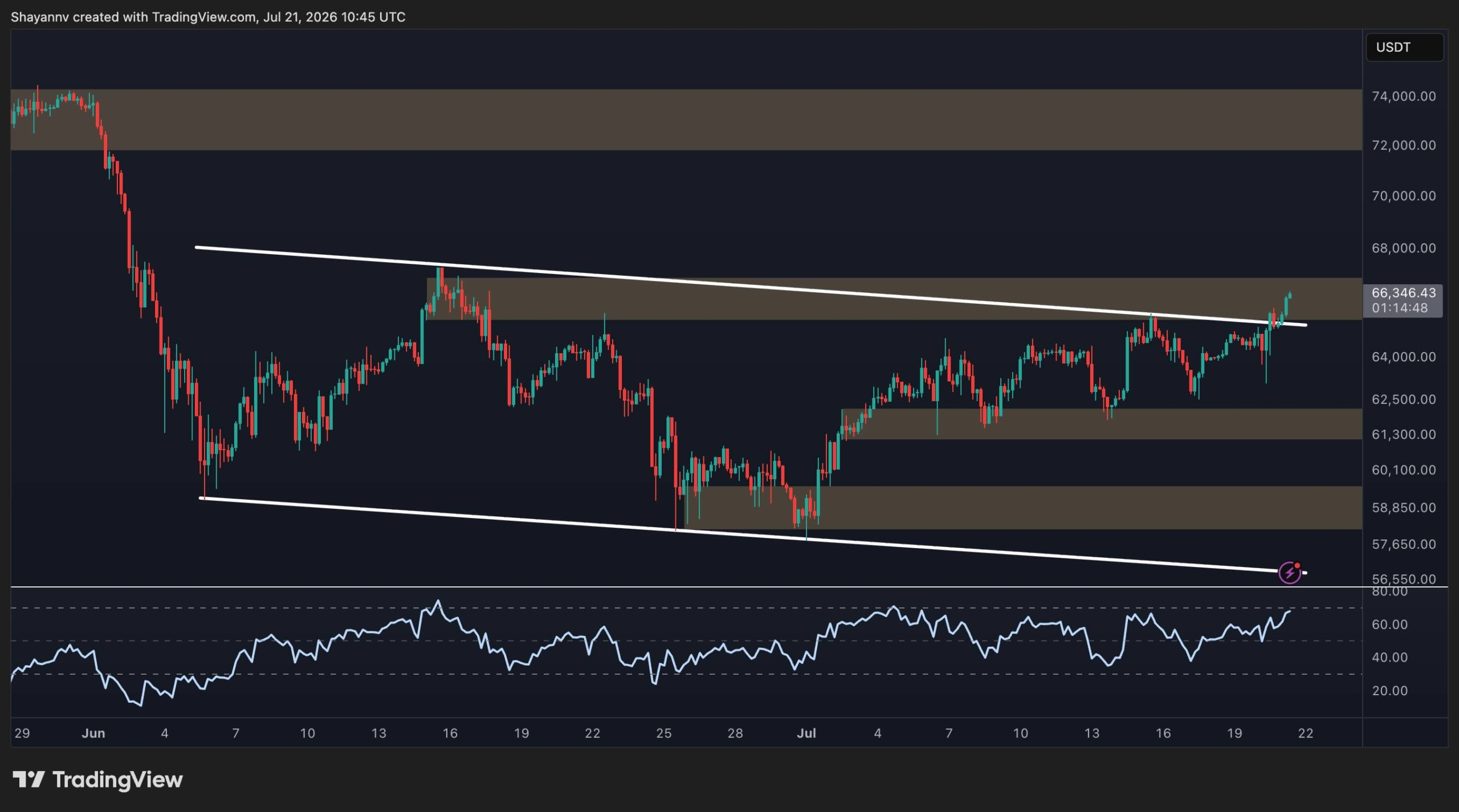
On the daily timeframe, BTC continues to trade below its long-term moving averages, with the 100-day MA positioned around the $70K region and the 200-day MA closer to $73K. Both averages remain downward sloping, indicating that the broader market structure still favors sellers despite the recent recovery.
Following the sharp decline toward the $57K to $60K support area, Bitcoin established a sequence of higher lows inside a narrowing descending channel. The recent rally has carried the price toward the upper boundary of this formation, which coincides with the $66K to $67K resistance zone.
A decisive breakout above both the descending trendline and the $66K to $67K supply area would represent the first meaningful structural improvement since the correction began. Such a move could expose the next resistance level around $74K, where the 200-day moving average and another major supply zone converge.
However, rejection from current levels would reinforce the descending structure and could trigger another pullback toward the $60K support region. Below that, the major demand zone around $55K remains the most important higher timeframe support visible on the chart.
BTC/USDT 4-Hour Chart
The 4-hour chart presents a more constructive picture. Bitcoin has been respecting a well-defined descending channel since early June, but recent price action shows buyers steadily reclaiming higher support levels after defending the channel’s lower boundary around $58K.
The market has already broken above several intermediate resistance zones at roughly $58K and $61K before advancing toward the current resistance cluster around $66K. This area also aligns with the channel’s upper trendline, making it the key short-term battleground.
Unlike previous tests, the latest advance has been accompanied by stronger momentum, with RSI pushing toward the overbought territory near 70. This reflects increasing buying pressure but also raises the possibility of a short-term pause or local pullback if profit-taking emerges at resistance.
If the breakout above the channel holds, it could invalidate the current bearish corrective structure and pave the way for an advance toward the next higher timeframe resistance around $72K to $74K.
Conversely, failure to overcome this ceiling would likely keep Bitcoin oscillating inside the channel, with initial support located near $61K followed by the stronger demand region around $58K.
On-Chain Analysis
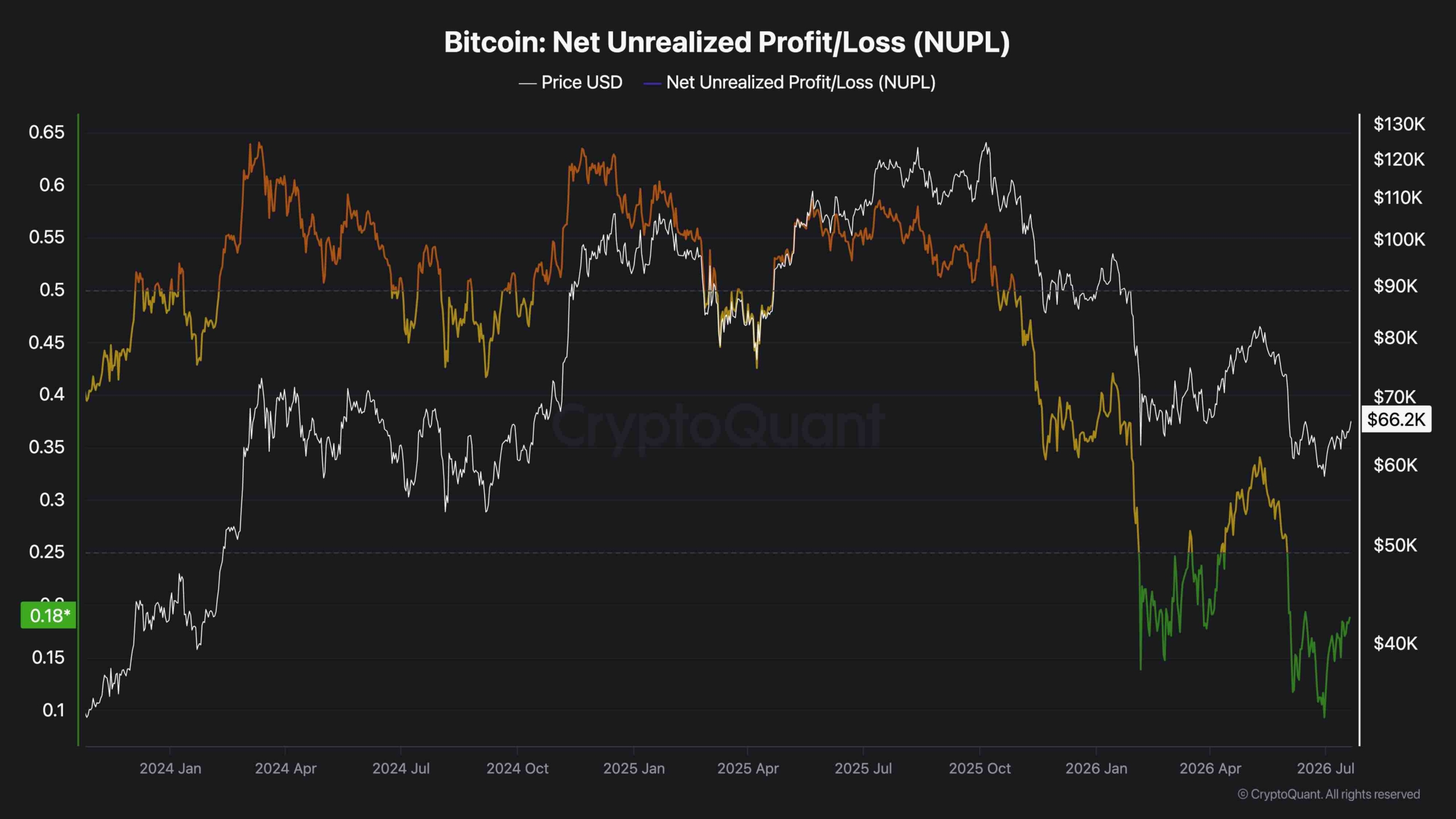
The Bitcoin Net Unrealized Profit/Loss (NUPL) metric currently sits around 0.18, well below the euphoric levels observed during previous market peaks.
NUPL measures the aggregate unrealized profits and losses across the network. Elevated readings generally indicate widespread investor optimism and increasing profit-taking risk, while lower values suggest that market participants are holding significantly smaller unrealized gains.
The recent recovery in NUPL from deeply depressed levels indicates that profitability across the network is gradually improving alongside price. However, the indicator remains firmly within the lower sentiment bands and is still far from the overheated conditions that historically accompanied cycle tops.
This suggests that, from an on-chain perspective, the market has not yet entered an excessive profit-taking phase. If Bitcoin manages to break above its current technical resistance, continued improvement in NUPL would likely support a healthier and more sustainable recovery. On the other hand, a rejection at current levels could temporarily stall the metric’s recovery without necessarily invalidating the broader rebuilding process.
The post Bitcoin Price Analysis: Is $70K Next After BTC Broke Above $66K? appeared first on CryptoPotato.
The White House agreed to provisions in a crypto market structure bill that could ensure support from some Democratic lawmakers in the US Senate.
According to a Tuesday Punchbowl report, White House officials met with Republican Senators Cynthia Lummis and Bernie Moreno to reach an agreement on ethics language in the Digital Asset Market Clarity (CLARITY) Act under consideration in the Senate.
Neither Lummis nor Moreno have publicly announced the details of the deal, which could facilitate Democratic support in what is expected to be a tight Senate vote, but the report suggested that it could affect US President Donald Trump’s crypto investments.
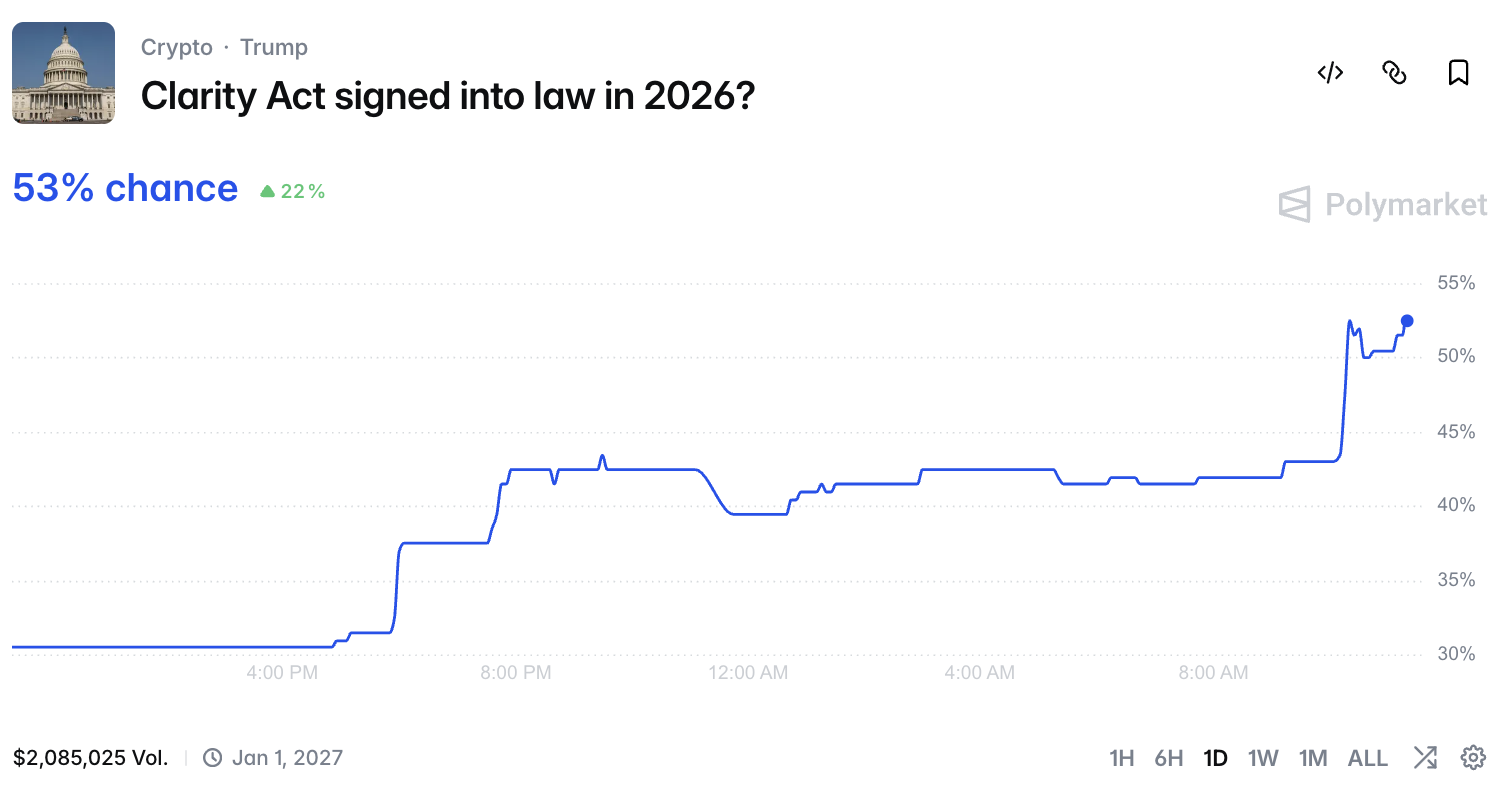
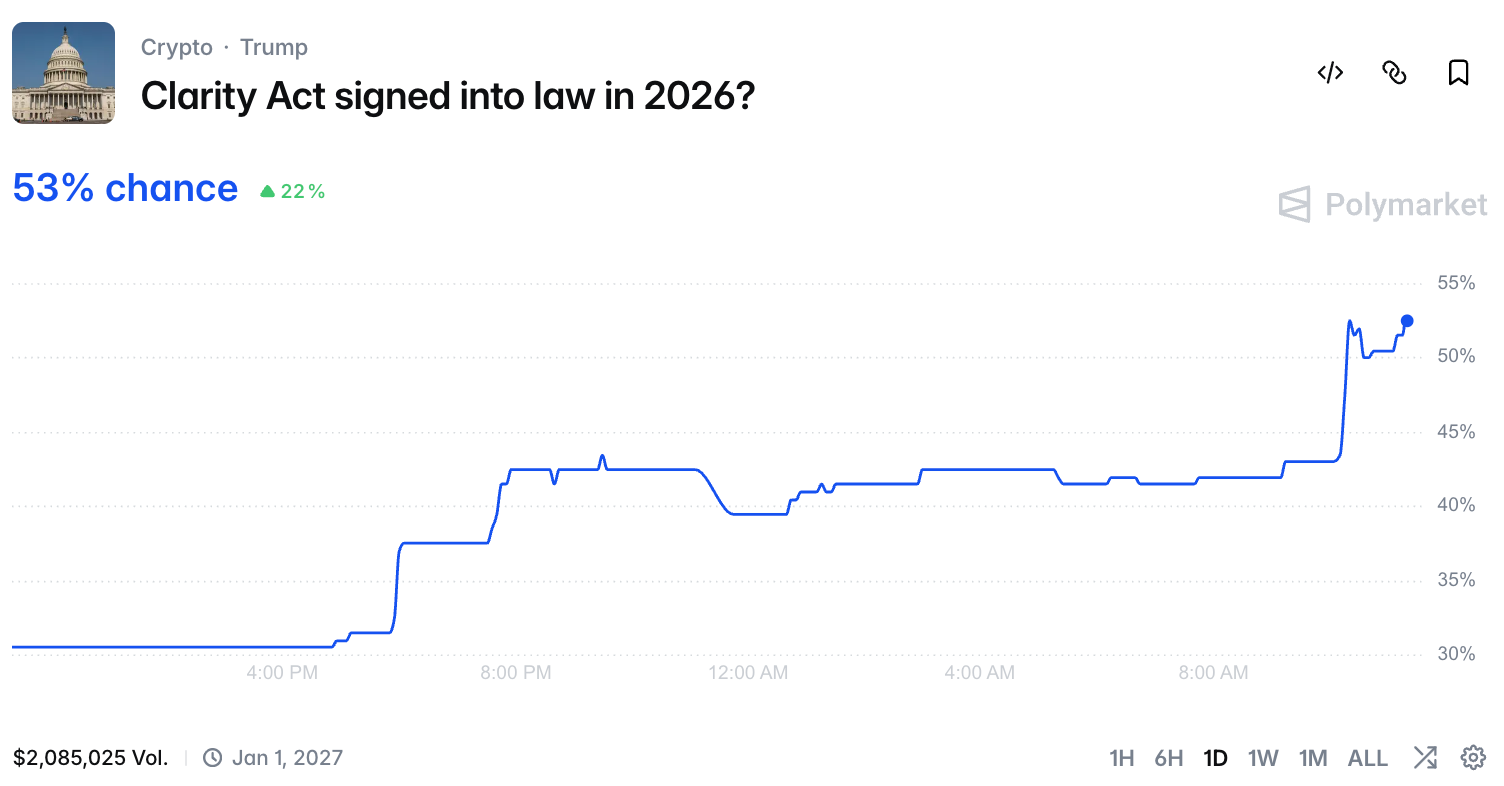
Event contract on chances of CLARITY Act being signed into law in 2026.
Source: Polymarket
The CLARITY Act, passed by the House of Representatives in July 2025 as part of Republicans’ “Crypto Week” agenda, has faced several delays in Congress due to government shutdowns, concerns from lawmakers over ethics, tokenization and stablecoin rewards and provisions for protecting developers from enforcement actions. Many lawmakers and industry advocates expect the Senate to consider the bill before the chamber breaks for August state work periods, but as of Tuesday, no vote appeared on the congressional calendar and the text of the bill had not been made public.
No certainty for 60-vote threshold
Last week, Trump urged the Senate to pass CLARITY “in honor of” the late Senator Lindsey Graham, whom the president said was “a big supporter” of the bill. Many crypto industry executives and lawmakers have publicly come out in support of the bill, but it’s unclear whether the legislation will pass the 60-vote threshold in the Senate, due to many Democrats’ concerns about potential conflicts of interest with the Trump administration.
Related: Ethics remain sticking point as crypto market structure bill goes to markup
Several Senate Democrats, including Elizabeth Warren, Chris Murphy, Jeff Merkley and Chris Van Hollen said that any CLARITY bill would be “worthless” without ethics provisions to address Trump’s ties to the crypto industry, including his memecoin and his family’s World Liberty Financial business. Cointelegraph requested details on the agreement from Lummis’ office but did not receive an immediate response.
A White House official told Cointelegraph that the administration was “committed to working with Congress to see the CLARITY Act advance and has agreed to the most comprehensive and wide-ranging ethics provision in history,“ adding that it had “bent over backward to accommodate [Democrats’] concerns.“
According to Coinbase vice chair Ryan VanGrack, Democrats have already been able to negotiate to include provisions on customer protection in the Senate bill. However, many lawmakers are calling for hearings to explore Trump’s investments and links to the industry before any potential vote.
Bitcoin price climbs amid CLARITY talks
The price of Bitcoin (BTC) rose above $66,000 early on Tuesday, reaching a seven-week high amid reports of an ethics deal and Trump’s plans to introduce additional 10% international trade tariffs.
“The reason that prices are running upwards are entirely dedicated towards the potential approval of the Clarity Act,“ said Michaël van de Poppe, founder and chief investment officer of MN Fund and MN Capital, in a Tuesday X post. “Things are brighter and brighter, and as the charts technically look incredible from here, it looks likely that we’ll see the Clarity Act being approved shortly.“
Magazine: Will the crypto lobby’s $189M campaign get CLARITY over the line?


AI shopping agent developer ORO has revealed that it lost $630,000 worth of crypto when a suspected North Korean state hacker, posing as a conference contact, tricked a staff member into installing a malicious Microsoft Teams extension.
According to a post-mortem released by ORO, one of its team members met a contact at an industry conference in February 2025 and formed a “legitimate relationship” that involved communicating on Telegram.
Almost a year later in May 2026, the Telegram account belonging to this genuine contact reached out to schedule a catch-up call.
However, when the ORO staff member joined the call via a link that mimicked Microsoft Teams, there was no working audio, and so the pair rescheduled for another day.
Almost immediately, the team member’s computer prompted them to update Microsoft Teams, and, thinking nothing of it, they okayed the procedure.
Read more: MetaMask hired suspected North Korean dev flagged months earlier
However, the seemingly innocent update allowed a malicious extension to be installed onto their computer. This extension tracked their keyboard inputs, clipboard history, took screenshots of the computer’s page and browser history, and could swap out crypto addresses.
The attacker spent almost a month quietly collecting data before, on July 13, they drained ORO’s crypto wallets of 147,000 Alpha tokens.
ORO believes attack came from North Korea
ORO maintains that the contact at the conference was “legitimate,” and that their Telegram account had become compromised.
As for who the attacker is, ORO claims with “high confidence,” based on its macOS intrusion, that it’s a North Korean hacker from the state-backed group Sapphire Sleet.
It said, “The IP address that our compromised machine was beaconing to, the matching payload and some overlapping infrastructure outlined in the above post from Microsoft makes us confident that the attack came from this group.”
Indeed, Microsoft’s Threat Intelligence department highlights how Sapphire Sleet uses Teams-themed cover, social engineering, and focuses on macOS.
“By impersonating a legitimate software update, threat actors tricked users into manually running malicious files, allowing them to steal passwords, cryptocurrency assets, and personal data while avoiding built‑in macOS security checks,” it said.
ORO claims it’s partly responsible for $600K hack
Despite the hacker’s actions, ORO also partly admitted responsibility for causing the hack.
It claims that a lack of widespread support for hardware wallets in decentralised protocol Bittensor meant that the firm, going against its preference for hardware wallets, “temporarily” established the owner key as a software wallet.
It said, “This is what allowed it to be exfiltrated from a compromised machine. That was inexcusable, and it was our mistake. We are sorry for the impact this has had on our community and our supporters.”
ORO claims it’s actively pursuing the recovery of the stolen assets with the help of cryptocurrency exchanges and law enforcement, as well as Bittsensor agent firm Opentensor, Bittsensor wallet firm Curciible Labs, and Bittsensor AI infrastructure firm Connito AI.
The company also stressed that its subnet is “fully operational,” no other wallets, user, or subnet data was affected, and that validator signing keys on hardware wallets “were never exposed.”
Read more: Solana DEX Stabble urges liquidity exit after alleged DPRK mole revealed
A number of North Korea-related crypto attacks have been uncovered in recent months.
In April, a North Korean mole known as “Moo” was exposed by crypto sleuth ZachXBT and subsequently fired from Solana-based DEX Stabble.
This month, the crypto wallet firm MetaMask was revealed to have employed a North Korean mole as a developer for at least a month.
According to a DeFi security analyst, the developer’s links to Lazarus Group, another North Korea-based hacking group, were publicly available for almost a year.
Got a tip? Send us an email securely via Protos Leaks. For more informed news and investigations, follow us on X, Bluesky, and Google News, or subscribe to our YouTube channel.
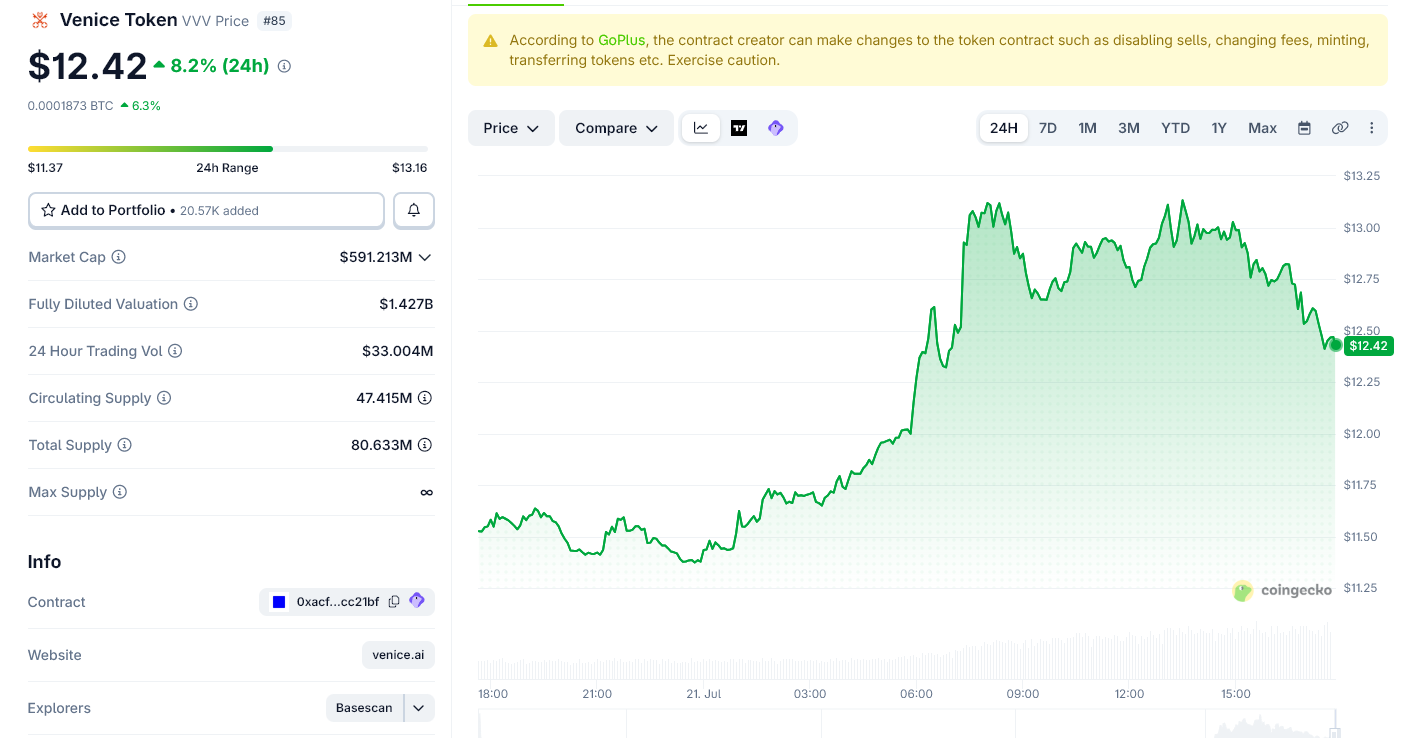
Venice Token (VVV) price rallied 11% on Tuesday to $12.84, breaking above the descending resistance line that had capped every recovery attempt since the June 3 peak at $21.47.
The move ends a six-week correction that bottomed just below $10. Momentum, volume, and Fibonacci structure now make $14 the next battleground.

Daily RSI Broke Its Downtrend Before the Price Did
Momentum turned before price action did. The daily Relative Strength Index (RSI) broke above its descending trendline several sessions ahead of the price chart. Analysts often read such leads as early confirmation of a trend change.
The indicator bottomed near 32 in early July, when the Venice Token price tested the $10 area. It has since reclaimed the 50 midline and its moving average, and it currently sits near 55.

A reading of 55 leaves room before the overbought zone above 70. However, the signal would weaken if RSI slips back below 50 during a pullback.
A previous analysis flagged bearish divergences in VVV just before the June top, and momentum has since completed a full reset.
Hourly Volume Delivers Critical Confirmation
Daily volume tells a more cautious story. It has declined steadily since May, which means the breakout still lacks confirmation on higher timeframes.
The hourly chart fills that gap. VVV traded inside a parallel channel between roughly $11.35 and $12.05 from July 18 until Tuesday morning. The break above the channel’s upper band occurred during the strongest hourly-volume spike of the entire recovery.

Hourly RSI reached 83 during the impulse and has since cooled to 70. Therefore, a retest of the $12.00 to $12.05 area would be a natural next step.
Holding that zone would confirm it as new support and echo the bullish setups that preceded the May rally.
Venice Token Price Prediction Makes $14 the Gate to $16.80
The correction from $21.47 stopped almost exactly where the Fibonacci theory said it should. The low formed just below $10, slightly above the 0.618 retracement at $9.33, and near a prior resistance area.
The current target sits at the 0.382 retracement near $13.97. That level overlaps a horizontal supply zone around $14, where VVV stalled repeatedly in May and June. A move there would add roughly 9% from current prices.
A clean break above $14 would expose the 0.236 level at $16.83, about 31% higher.
Beyond that, the record high of $22.58 from January 2025 remains the final barrier. In contrast, a rejection at $14, combined with a $12 loss, would invalidate the bullish structure and reopen the $10 support.

Fundamentals could accelerate the move. Venice AI announced on July 17 that $5 of every $100 in API credit purchases now automatically buys and burns VVV. The token also led a broader altcoin rally in May, and rising burns tighten supply while most circulating VVV remains staked.
The setup now reduces to a single question. Either buyers convert $14 into a launchpad, or the breakout stalls at the same wall that stopped them twice before.
The post Venice Token Breaks Out with 10% Rally. How Far Will This Altcoin Jump? appeared first on BeInCrypto.
Ondo Finance said it has deployed its tokenized stocks as collateral on OndoPerps, a perpetual futures venue, starting with SPYon and QQQon, in a post published Monday on X. The OndoPerps account said tokenized stock collateral is "live" and "now available for all users," letting Ondo Stocks back… Read the full story at The Defiant

Big K.R.I.T. – Money On The Floor (Explicit) ft. 8Ball & MJG, 2 Chainz

These stylish gloves are on sale for only $20!

Topgolf founders target cue sports


-
 NewsBeat5 days ago
London Mayor Sadiq Khan handed a peerage by Keir Starmer alongside 15 other Labour figures… just days before the PM leaves No10
-

 Fashion4 days ago
Weekend Open Thread – Corporette.com
-

 Politics3 days ago
The House | The City of London can help the new chancellor deliver growth in every postcode
-

 Politics6 days ago
Young campaigners urge incoming PM to act on outdoor junk food ads
-

 Crypto World6 days ago
CFTC blocks Kalshi from unwinding Michigan trades after court order
-
 Crypto World4 days ago
Two July Windows Left: The CLARITY Act’s Senate Fight and What Failure Means
-

 Crypto World3 days ago
Ripple Payments Joins MiCA With 14 Firms, Does It Mean Anything For XRP?
-

 Business6 days ago
Nvidia Stock Slips After Big Tuesday Rally as Huang Confirms Vera Rubin Chip Is Now in Production Today
-

 Politics2 days ago
Democrats look to World Cup watch parties to register thousands of voters
-
 Entertainment6 days ago
Disney’s Most Ambitious Failed Star Wars Attraction Is Coming to SDCC
-

 Crypto World4 days ago
Ripple wins EU-wide access as ESMA adds it to MiCA register
-

 Crypto World10 hours ago
Grayscale Files For Worldcoin ETF, WLD Registers Sharp Rise
-

 Crypto World5 days ago
Injective Submits SEC Transfer-Agent Registration to Onchain Ownership Records
-

 Business6 days ago
Palantir Shares Rise After Expanded Nvidia Partnership and Fresh Analyst Upgrades Ahead of Earnings Day
-

 Tech18 hours ago
Sail Virtually Aboard The “Itanic” With IA-64 Emulator
-
 Tech15 hours ago
Turtle Beach Command Series KB7 review: a nifty screen-equipped gaming keyboard
-

 Tech7 days ago
Dark Secrets Emerge When Jailbreaking LLMs
-

 NewsBeat4 days ago
Registration is now open for March for Men with Kev 2026
-

 News Videos7 days ago
XRP BOMBSHELL… XRP OMBOARDED FOR TRANSACTIONS!!!
-

 NewsBeat1 day ago
Unregistered fitter used Gas Safe logo on business flyers
You must be logged in to post a comment Login