
Crypto World
OpenAI Rejects Another Math Prize, This Time Justin Sun's $1 Million

OpenAI has been named the winner of Justin Sun’s inaugural $1 million mathematics prize, yet the company has left the money sitting unclaimed, just as it did with an identical prize from the Clay Mathematics Institute weeks earlier.
The prize was to reward an AI-authored proof of the Navier-Stokes equations, a fluid dynamics problem mathematicians spent decades trying to crack. Two academics say the work drew on their own unpublished research, a claim OpenAI disputes.
Why OpenAI Keeps Walking Away From the Money
OpenAI published its proof of the three-dimensional Navier-Stokes problem on September 8, saying 10,000 of its AI agents worked the problem for 88 hours before a separate model, GPT-6 Astra, spent another 17 hours checking the logic.
The Clay Mathematics Institute set the problem in 2000 as one of seven Millennium Prize Problems, each carrying a $1 million reward, and still lists it as active on its website.
OpenAI said at the time that it would not claim the Clay money. It became a bigger story once questions arose over whose work actually produced the proof.
Two mathematicians said their unpublished research had sat inside an OpenAI product, a claim the company denied.
“I do not know what their model did, or how. I do not know whether our data was used. I am not accusing anyone of anything,” said Tristan Buckmaster, professor at New York University.
Second Prize, a Second Snub
Eight days after the dispute broke out, Justin Sun’s office announced its own answer to the same problem. They created the Justin Sun Prize, a bounty system built around machine-checkable proofs rather than traditional peer review.
Every entry on Sun’s list can pay out twice. Once for the person who proves a result and again for whoever formalizes it as code. Sun’s team named the OpenAI research team the winner of the prize’s first $1 million top award for the Navier-Stokes proof.
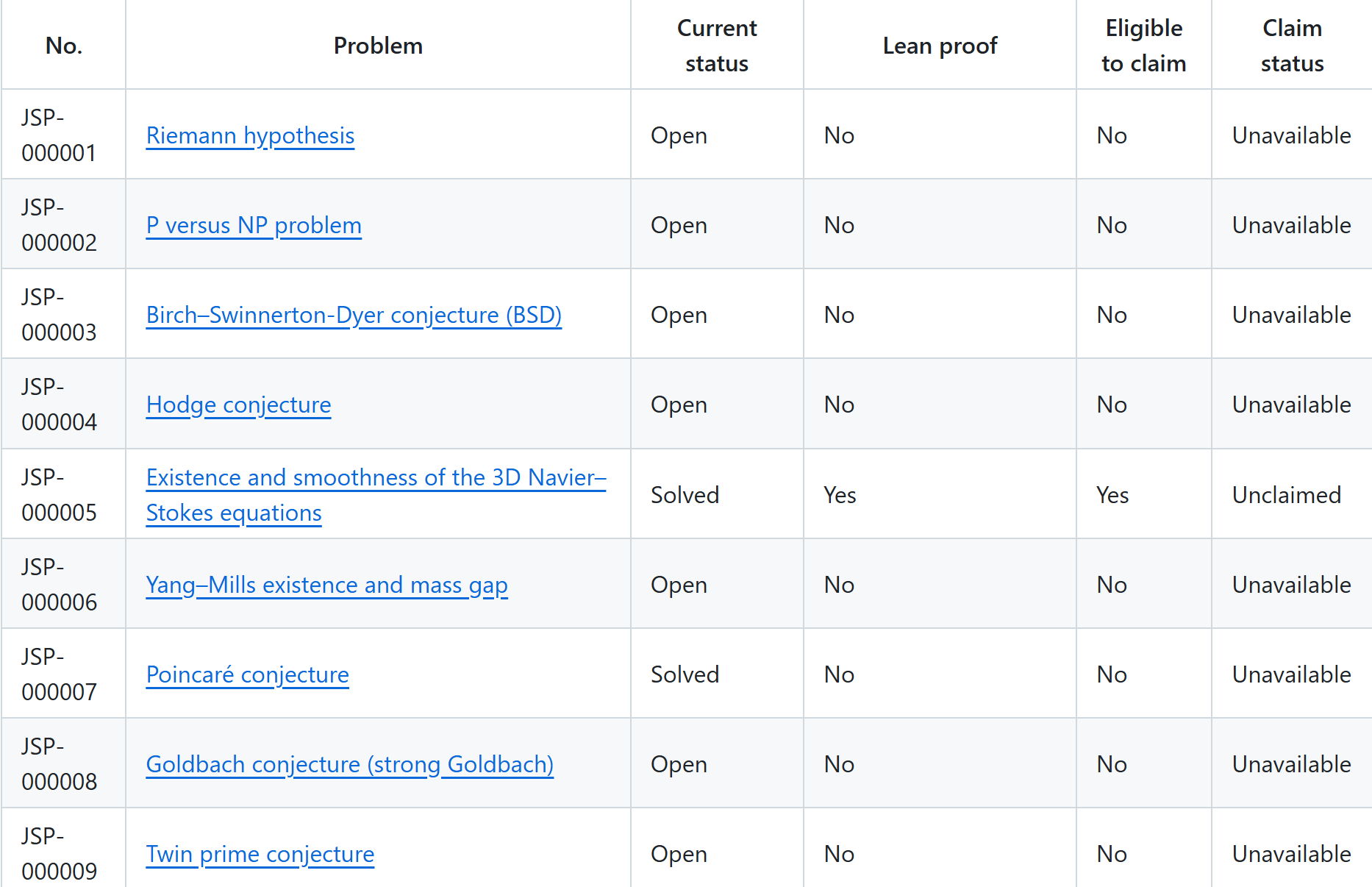
Navier-Stokes is the fifth entry. It is marked solved, credited to the OpenAI team, eligible to claim, but remains unclaimed.

Under Sun’s rules, a problem already solved before it joins the list pays the person who translates it for the machine, not the person who proved it.
“I care only about the result, not whether the contributor is human or a machine,” Justin Sun said.
Sun’s own list carries a warning beside that entry. It says the OpenAI announcement is not peer review, and that acceptance by mathematicians has not been confirmed.
The post OpenAI Rejects Another Math Prize, This Time Justin Sun's $1 Million appeared first on BeInCrypto.


Anchorage Digital Bank, the first federally chartered crypto bank in the United States, has expanded its custody offering to include Etherlink assets on the Tezos layer-2 network. The new support covers Etherlink token custody via segregated accounts at Anchorage for institutional clients, according to an announcement shared with Cointelegraph.
The update adds custody support for Etherlink and seven specific assets, including xU3O8—an asset designed to provide tokenized exposure to physical uranium—alongside several other Etherlink-issued tokens.
Key takeaways
- Anchorage now supports custody for Etherlink assets through segregated accounts at the federally chartered bank.
- Among the newly supported tokens is xU3O8, which represents ownership exposure to physical uranium without requiring direct commodity handling.
- The Etherlink assets added include wrapped and liquid staking variants (WXTZ, stXTZ) as well as stablecoins (USDT, USDC, USDSM) and wrapped Ether (WETH).
- CoinMarketCap data shows xU3O8 has a market capitalization just above $9 million at current price levels.
- Tokenized commodity exposure has drawn more institutional interest as settlement mechanics move from “weeks” to “minutes,” Anchorage says.
Anchorage adds Etherlink custody for institutional segregated accounts
Anchorage’s integration enables institutional clients to custody assets issued on Etherlink—an Ethereum Virtual Machine-compatible layer-2 network that settles on Tezos—through segregated custody accounts at the bank. This matters for regulated participants that want crypto asset storage within a bank-grade framework, rather than relying solely on exchange custody or non-bank intermediaries.
In practical terms, segregated accounts are intended to keep client holdings segregated from other assets under the custodian’s control, which is typically a key requirement for institutions managing risk, compliance obligations, and reporting.
Seven new Etherlink assets, including tokenized uranium exposure
Alongside Etherlink itself, Anchorage said it now provides custody support for seven assets on the network. The list includes wrapped XTZ (WXTZ) and liquid staking token stXTZ, as well as wrapped Ether (WETH). It also covers stablecoins USDT, USDC, and USDSM.
The headline addition is xU3O8, a token that represents ownership exposure to physical uranium. Rather than requiring investors to source, store, or manage the physical commodity directly, xU3O8 is structured to offer a more accessible route to uranium exposure within crypto infrastructure.
At current price levels, CoinMarketCap data shows xU3O8 has a market cap just above $9 million.
Why tokenized commodities are changing the settlement playbook
Anchorage pointed to a structural shift that tokenization can bring to traditional commodity workflows. Heavier involvement from intermediaries, longer settlement timelines, and higher minimum investment sizes have historically limited physical uranium exposure for many investors, the bank said.
According to Anchorage, tokenization enables transfers and settlement in minutes rather than weeks. For institutional users—especially those operating with tighter operational cycles—shorter settlement windows can reduce time-to-execution and operational friction, even when the underlying exposure is still tied to physical assets.
That said, investors should still distinguish between the asset’s representation on-chain and the physical asset’s custody and settlement logistics, which are not always identical across tokenization offerings. Anchorage’s update focuses on custody at the bank level; questions about redemption mechanics, governance, and physical asset arrangements would ultimately depend on the token’s broader ecosystem documentation.
Not the first custodian—Hex Trust also supports xU3O8 on Etherlink
Anchorage is not the only institutional custodian moving into Etherlink-based uranium exposure. In August 2025, digital asset custodian Hex Trust integrated Etherlink to offer custody for xU3O8 and other Etherlink-issued assets, as earlier coverage from Cointelegraph reported in an article on the Hex Trust integration.
By adding Etherlink custody now, Anchorage is effectively broadening the set of federally chartered or bank-oriented custody options for tokenized physical commodity exposure on the Tezos ecosystem.
For institutional allocators, the competitive implication is clear: more qualified custodians supporting the same token ecosystem can reduce operational complexity when building multi-asset portfolios and may improve availability for investors who already require bank-style custody controls.
Even so, institutional demand will likely remain sensitive to details beyond custody—such as liquidity, issuance and settlement structures, and the practical ability to enter and exit exposure efficiently. Investors watching this space should track how Ethereum-compatible layer-2 adoption on Tezos progresses, and whether additional custodians expand support for Etherlink token ecosystems that include real-world asset representations like xU3O8.
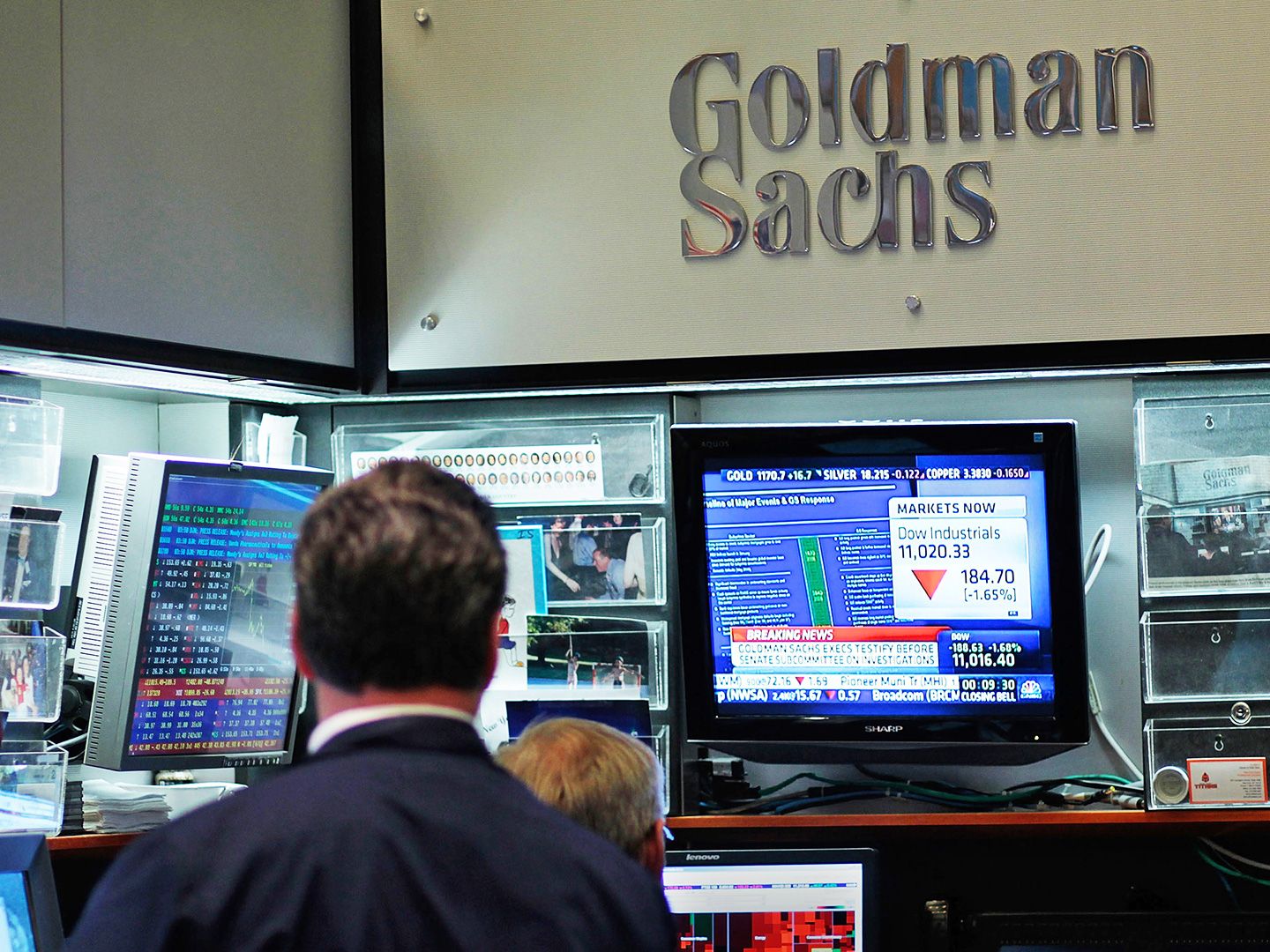
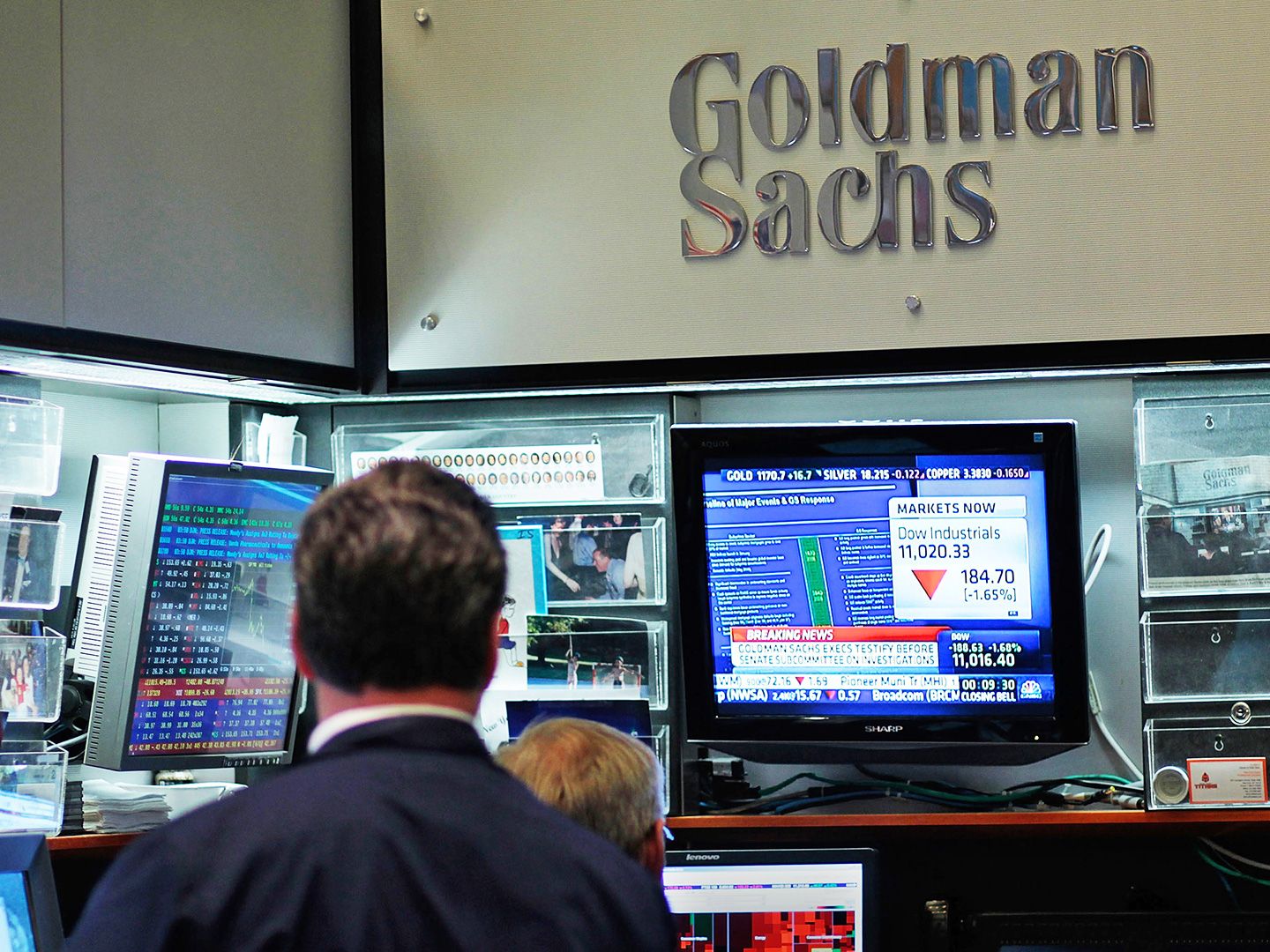
Goldman Sachs now expects the Federal Reserve to raise its benchmark interest rate again in October, a 180-degree pivot from its earlier call for a September hike followed by a pause.
The shift comes after the Fed on Wednesday lifted rates by 25 basis points to a 3.75%–4.00% target range. The central bank’s updated rate projections revealed a strong majority of policymakers expecting at least one more increase this year.
At the post-meeting press conference, Fed Chair Kevin Warsh struck a hawkish tone, saying inflation remains “too high” and that the latest hike merely removed a “dose of accommodation,” implying policy is still not restrictive enough and more rate hikes may be in the pipeline.
As of this writing, traders are pricing just over 50% chance of another 25 basis points hike in October, according to the CME’s FedWatch tool.
Bitcoin continues to trade near $76,260, up just 0.5% on a 24 hour basis.
Bitcoin price fell toward $75,500 after the U.S. Senate rejected the CLARITY Act, while bearish momentum and nearby liquidation clusters raised the risk of another decline before the Federal Reserve’s rate decision.
Summary
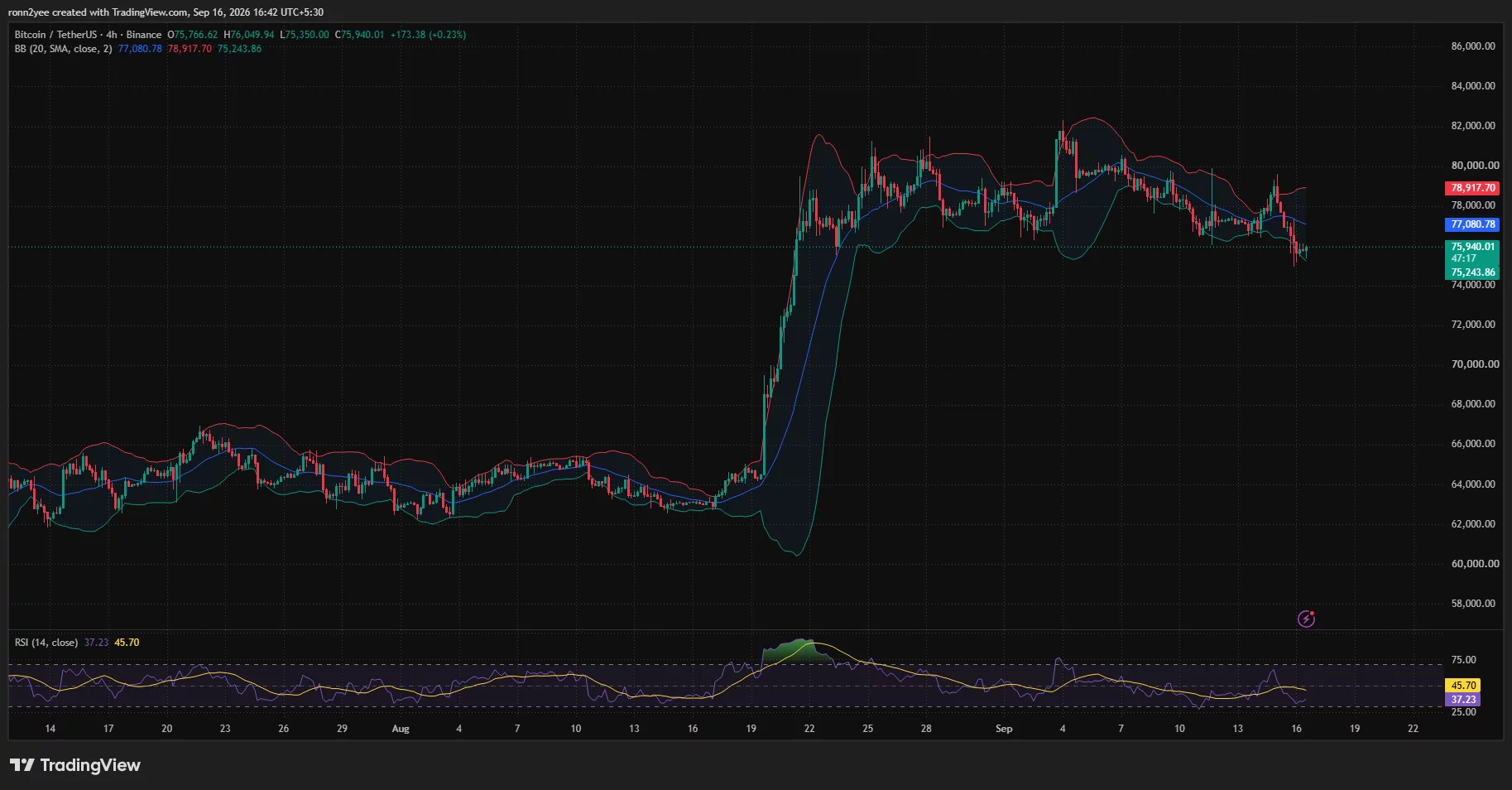
- Bitcoin price traded near $75,940 after briefly sweeping the $75,350–$75,500 support area.
- The Senate’s 49-50 procedural vote left the CLARITY Act short of the required 60 votes.
- 4-hour RSI fell to 37.23 as BTC remained below the Bollinger Band midpoint.
- The daily chart places the next major Fibonacci support near $72,547.
According to data from crypto.news, Bitcoin (BTC) price traded at approximately $75,940 at press time, according to the 4-hour chart. The price had recovered slightly from an intraday low of $75,350 but remained under pressure after the CLARITY Act failed to advance in the U.S. Senate.
The procedural vote ended 49-50, leaving the proposed crypto market structure legislation 11 votes short of the 60 required to move forward. The setback weighed on digital assets and U.S.-listed crypto companies as traders reassessed the outlook for federal market rules.
Derivatives amplified the initial decline. Approximately $771 million in leveraged crypto positions were liquidated over 24 hours, including about $568 million in long positions, according to market data cited after the vote. The imbalance showed that traders positioned for higher prices were caught by Bitcoin’s move below $76,000.
Bitcoin price loses 4-hour Bollinger midpoint
Bitcoin’s 4-hour chart shows that the price has moved below the Bollinger Band midpoint at $77,080. The level now forms the first major barrier for any short-term recovery.
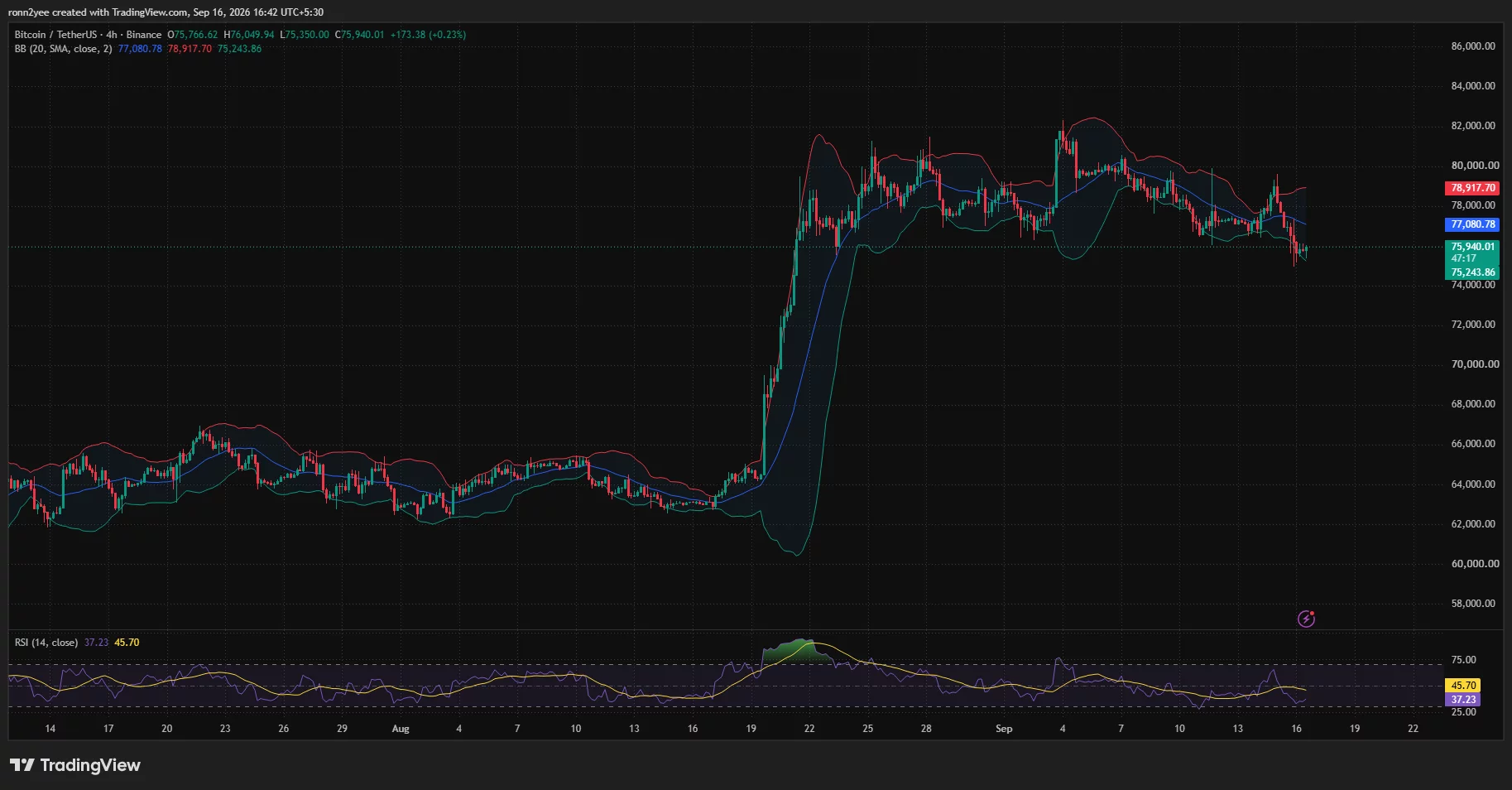
BTC also briefly fell through the lower Bollinger Band, which stood near $75,244, before returning inside the indicator. A move outside the lower band can signal heavy selling, but re-entry alone does not confirm that the correction has ended.
The 4-hour relative strength index stood at 37.23, below its signal average of 45.70. RSI remains above the conventional oversold boundary of 30, leaving room for further weakness if buyers fail to defend the $75,000 region.
The Bollinger Band structure places immediate resistance at $77,080, followed by the upper band near $78,918. Bitcoin would need to reclaim the midpoint and establish support above it to weaken the current bearish setup.
A failure to recover $77,000 could keep the focus on the lower band and the recent $75,350 low. A confirmed break below that area would expose the psychological $75,000 level.
Daily indicators point to $72,547 support
Bitcoin remains above the 78.6% Fibonacci retracement level at $72,547 on the daily chart. The retracement is measured between the broader low at $57,893 and the high near $126,369.
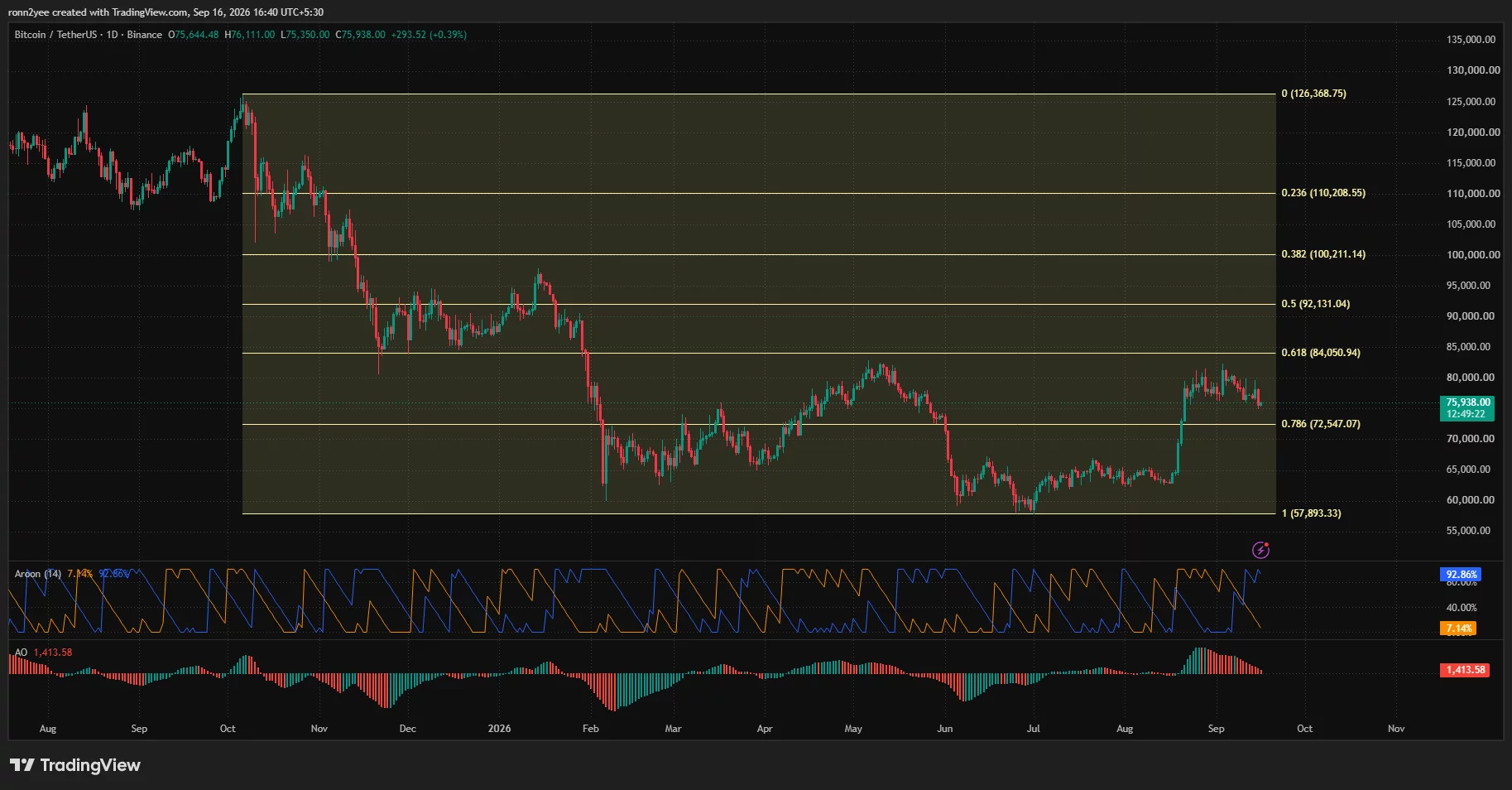
The $72,547 level is the clearest major support below the current price. A drop from $75,940 to that zone would represent a decline of about 4.5%.
Daily momentum has already turned lower. The Aroon Down reading stood at 92.86%, compared with an Aroon Up reading of 7.14%. The wide gap indicates that recent lows are arriving much more frequently than recent highs.
The Awesome Oscillator also registered a negative reading of 1,413.58, with red histogram bars extending below zero. The indicator supports the bearish Aroon signal and shows that downside momentum remains dominant.
BTC has formed lower highs since its early September move above $81,000. The price would first need to recover the $78,000–$80,000 region before challenging the larger technical barrier around $83,000–$84,051.
The $84,051 level aligns with the 61.8% Fibonacci retracement and sits close to the $83,000 resistance identified by market analyst Gerla. In a Sep. 16 post, Gerla said the CLARITY Act reaction had removed weak positioning but argued that reclaiming $83,000 could open a move toward $100,000.
Gerla’s projection remains conditional because BTC currently trades roughly 8.5% below $83,000, while the daily indicators favor sellers.
Bitcoin liquidation map places liquidity on both sides
CoinGlass’s three-day Bitcoin liquidation heatmap shows concentrated leverage above and below the current price.
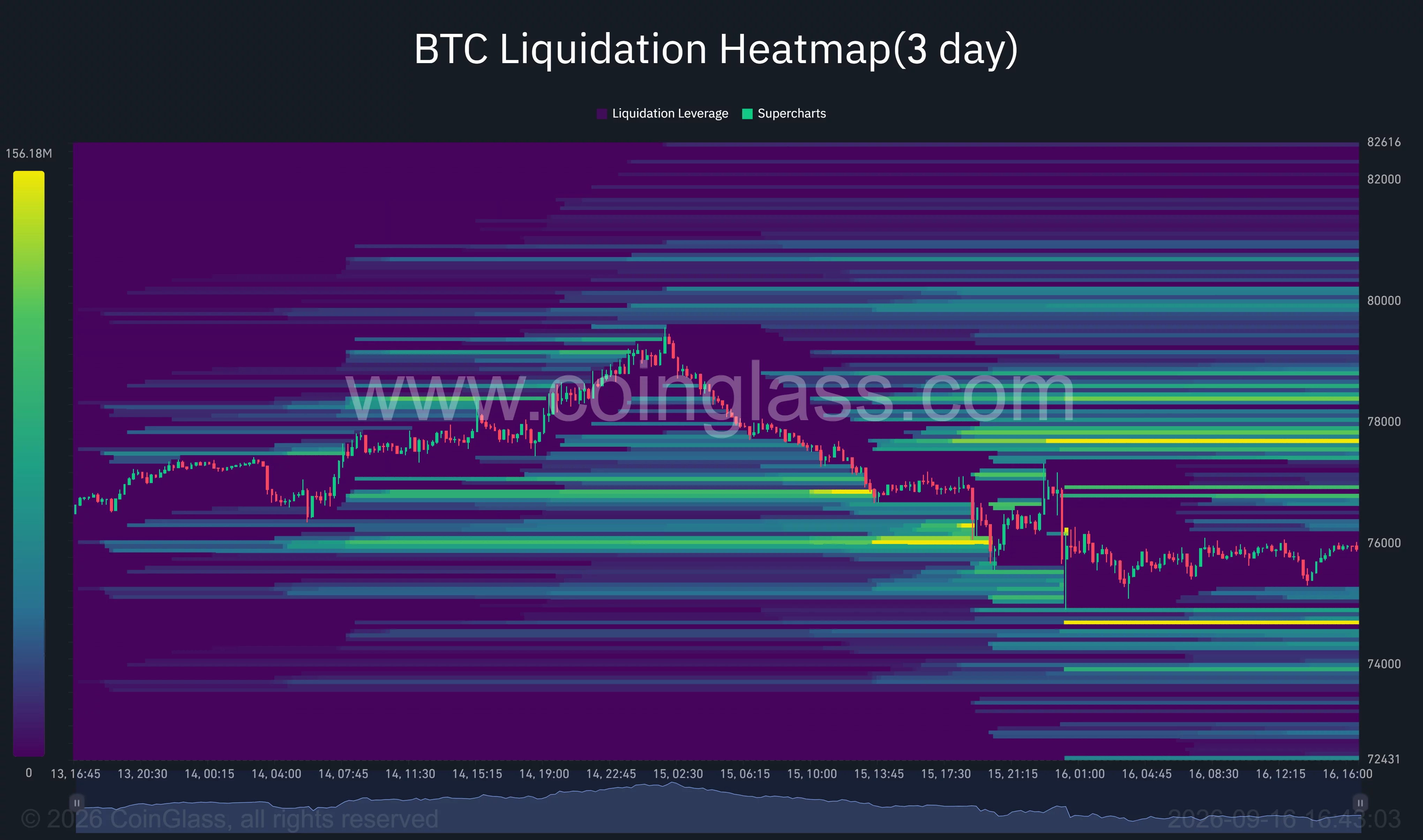
The strongest nearby downside pool appears around $74,700–$74,900. Additional liquidity is visible near $74,000, making the broader $74,000–$75,000 area a possible target if Bitcoin loses its latest low.
Larger upside concentrations sit near $77,700–$78,000 and around $78,300–$78,700. A recovery could draw BTC toward those areas as short positions become vulnerable to forced closure.
A separate band appears around $80,000, although Bitcoin must first overcome the 4-hour Bollinger midpoint and the nearer liquidation zones. Heatmaps identify areas where leveraged positions may be forced out, but they do not predict which level the market will approach first.
Federal Reserve decision could trigger another sweep
Trader Lennaert Snyder said Bitcoin swept the $75,500 low after the CLARITY Act vote produced the bearish reaction he had expected. Snyder said he was watching for consolidation before the Federal Open Market Committee announcement, followed by a possible second sweep of the lows.
The Federal Reserve’s Sep. 15–16 meeting adds event risk to an already fragile market. Rate decisions and accompanying guidance can affect Treasury yields, the dollar, and demand for risk assets, including Bitcoin.
For the bullish case, BTC must hold $75,000 and retake $77,080. A move above $78,918 would return the price to the upper part of its recent 4-hour range, while a break above $83,000 would change the broader structure.
The bearish case gains strength below $75,000. Such a move could pull Bitcoin toward the liquidation concentration near $74,800 before testing the daily Fibonacci support at $72,547.
Disclosure: This article does not represent investment advice. The content and materials featured on this page are for educational purposes only.

Join Our Telegram channel to stay up to date on breaking news coverage
Circle’s new Arc blockchain went live on September 16 with a design choice that inverts the usual layer-1 model: transaction fees are paid in USDC, the stablecoin itself, not in Arc’s own freshly minted ARC token.
Arc, Circle’s layer-1 network for payments and financial markets, launched its public mainnet on September 16 with EVM compatibility and sub-second settlement finality, according to the launch announcement on Arc’s blog.
“This is, I believe, the most consequential major platform launch in our history, and I think an even more consequential launch than USDC itself,” Circle CEO Jeremy Allaire said at a press briefing.
The company targets roughly one cent per transaction, and because fees are paid in USDC, that price stays predictable in dollar terms rather than moving with a volatile native token.
Why not ARC?
Circle minted the full initial supply of 10 billion ARC tokens at genesis, but the token is not publicly available, and the company said the mint is not a commitment to launch ARC publicly. Its stated role is coordination for security, utility and governance. USDC stays the fee currency.
The pitch is aimed at exactly the institutions Arc launched with. Founding validators named in August include BlackRock, Visa, Mastercard, ICE and the Depository Trust & Clearing Corporation (DTCC), with more than 100 institutions and companies involved at launch. A treasury desk that must budget costs in dollars has no reason to want its fee line item denominated in a token whose price it cannot control.
The permissioned structure supports the same goal. Arc currently runs on approved proof-of-authority validators, and Circle says it is exploring a transition to proof of stake in 2027, which could eventually give ARC a role in network security. The network also carries more than 20 fiat-backed stablecoins, including EURC, JPYC, KRW1 and TRYB, and connects to more than 20 blockchains through Circle’s Cross-Chain Transfer Protocol (CCTP).
Circle is also working on an opt-in privacy feature, with confidential transactions and balances readable through view keys by authorized parties, that has not yet shipped. The company is positioning Arc to serve banks and asset managers that need to use a public chain without exposing positions.
Join Our Telegram channel to stay up to date on breaking news coverage


South Korean police have booked 26 Polymarket users over alleged illegal gambling involving 17.6 billion won, roughly $12.7 million, with 18 cases referred to prosecutors by Sept. 15.
Summary
- 26 South Korean Polymarket users were booked, with 18 already referred to prosecutors over gambling.
- 17.6 billion won in cumulative wagers was linked to suspects identified through public blockchain records.
- 5.7 billion won was the highest individual betting amount reported among the 26 investigated users.
- South Korea blocked Polymarket access on August 18 after regulators classified its structure as gambling.
- Police say Polymarket contracts meet gambling elements when users stake assets on uncertain outcomes online.
The Asia Business Daily reported on Sept. 17, citing National Police Agency materials provided to lawmaker Yoon Kun-young’s office, that the Gangwon Provincial Police Agency Cyber Investigation Unit recorded a highest individual betting amount of approximately 5.7 billion won. The report was updated at 10:08 a.m. KST.
Digital Asset later reported from the same police material that investigators began preliminary inquiries in March and formally booked users from May. Police said a conventional list of domestic users was not available from the platform because Polymarket uses a non-custodial peer-to-peer structure, so investigators traced public blockchain transactions with open-source intelligence tools.
Polymarket users were traced through blockchain records
Police said public blockchain transaction data allowed investigators to identify individual users even though Polymarket does not maintain a real-name customer list in the form associated with centralized platforms. The published police material did not disclose the wallet addresses linked to the 26 suspects, preventing independent address-by-address checks of the reported wager totals.
As crypto.news reported in June, the Gangwon police inquiry had already become the first known South Korean investigation focused on domestic Polymarket users. Authorities at the time were examining whether event-contract activity could fall within the country’s gambling laws.
The newest police figures show that 18 of the 26 booked users had been referred to prosecutors by Sept. 15. The materials reviewed do not report indictments, trial dates or court judgments involving those cases.
Police say Polymarket trades can meet gambling rules
Investigators are relying on Article 246 of South Korea’s Criminal Act. The provision states that gambling can carry a fine of up to 10 million won, while habitual gambling can result in imprisonment of up to three years or a fine of up to 20 million won. The current text took effect on Sept. 13, 2026.
Police have cited a 2008 Supreme Court ruling addressing the role of chance in gambling. The court held that gambling can exist when property is wagered on an outcome the parties cannot certainly predict or freely control, even when a participant’s ability affects the result.
Applying that precedent, police told Digital Asset that Polymarket activity can satisfy Article 246 when users stake digital assets on an event and either receive settlement proceeds or lose their purchase amount depending on an uncertain result. Police said similarities to derivatives or the lack of a separate guideline do not automatically exclude gambling charges.
Users under investigation dispute that interpretation. The Asia Business Daily reported that their side describes Polymarket as a “virtual asset-based derivatives market” where probability contracts can be bought and sold before final settlement. That argument has not been accepted by a court in the cases reported so far.
Attorney Kim Tae-rim of AXIS Law told the publication that courts may examine structural features such as order-book trading and the ability to exit positions before maturity. Kim said the contracts claimed by users as prediction derivatives fall outside the existing Capital Markets Act framework, limiting the usefulness of that statute as a direct criminal defense.
South Korea blocked Polymarket before the referrals
South Korea’s Broadcasting, Media and Communications Review Committee voted on Aug. 18 to block domestic access to Polymarket after finding that the service provided what the regulator considered an illegal gambling environment to local users.
The committee focused on markets tied to politics, economics, sports, elections and weather, where users put assets at risk on events they cannot control. Regulators said Polymarket manages market rules and settlement infrastructure while receiving economic benefit from activity on the platform.
As crypto.news reported after the Aug. 18 decision, Polymarket argued during the review that its non-custodial P2P model, absence of Korean-language services and lack of Korean won payments meant it should not be treated as an operator of an illegal gambling venue.
The regulator rejected that position, saying “Technical characteristics or service structure do not constitute grounds for evading the applicability of domestic law.” It cited South Korea-focused markets and the platform’s winner-takes-all settlement structure when ordering access blocked.
The August action followed an earlier hearing process. Regulators had postponed a final decision while giving Polymarket time to present its position before the access restriction was approved the following month.
Polymarket’s U.S. venue operates under separate rules
Polymarket currently tells users that its international platform and its U.S. business operate through separate legal entities. Its website states that the international platform is not regulated by the U.S. Commodity Futures Trading Commission.
Polymarket US, by comparison, operates through QCX LLC. CFTC records list QCX LLC d/b/a Polymarket US as a designated contract market, with the designation dated July 9, 2025.
The U.S. structure does not change the legal basis stated by South Korean police. Investigators have based the domestic user cases on South Korea’s Criminal Act, while the media review committee has said a platform’s technical or service structure cannot by itself prevent the application of domestic law.
Polymarket affiliate had filed three National Futures Association applications connected with plans for margin trading. Those filings concern the regulated U.S. business and are separate from the South Korean police cases.
No court ruling identified in the reviewed South Korean sources has yet decided whether Polymarket’s order-book probability contracts fall outside Article 246 because of their claimed derivatives-like features. Eighteen case files have been sent to prosecutors, while the published police materials do not report an indictment decision or hearing date for any of the users.
Polymarket’s website continues to identify QCX LLC d/b/a Polymarket US as its CFTC-regulated designated contract market while stating that the international platform operates separately and is not regulated by the CFTC.
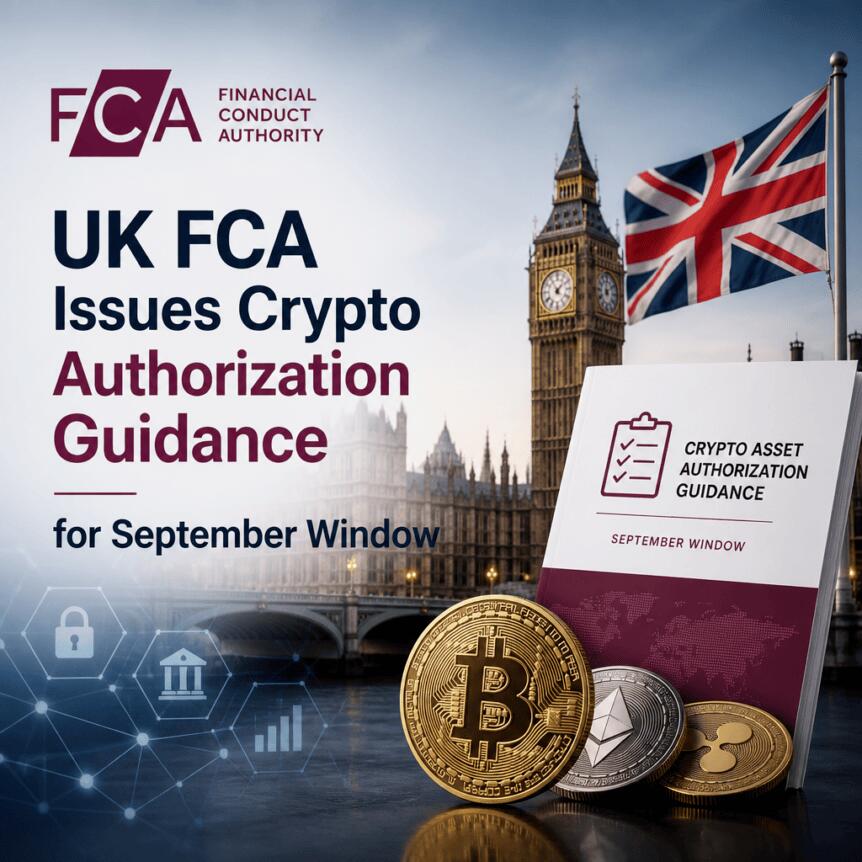
The UK’s financial regulator has issued final guidance spelling out when firms involved in crypto activities will need authorization under the country’s upcoming regulatory framework for digital assets. The Financial Conduct Authority (FCA) says the material is meant to help businesses determine whether their operations fall within the FCA’s regulatory perimeter and, if so, what permissions they should prepare for.
In a bulletin published through the FCA’s guidance channel, the regulator outlines several categories of activity that may trigger authorization requirements, including issuing qualifying stablecoins, operating cryptoasset trading platforms, and dealing and arranging crypto transactions. The perimeter also extends to firms that safeguard cryptoassets and arrange crypto staking services, according to the FCA.
Key takeaways
- The FCA’s final guidance is designed to clarify which crypto activities are likely to require FCA authorization under the new UK regime.
- Activities listed include qualifying stablecoin issuance, operating trading platforms, transaction dealing/arranging, safeguarding cryptoassets, and arranging crypto staking.
- Existing registrations and permissions will not automatically “roll over” into the new regime, so firms may need FCA authorization or permission variations.
- FCA applications for transitional arrangements will open on Sept. 30, with a Feb. 28, 2027 deadline ahead of the Oct. 25, 2027 effective date.
- The FCA plans further consultation on perimeter guidance later this year, meaning businesses should expect refinements to come.
What the FCA guidance covers
The FCA’s bulletin provides an operational checklist for firms trying to understand how the incoming regime applies to their specific business models. The guidance is intended to reduce uncertainty for compliance teams by mapping common crypto-related activities to the types of permissions they may require under UK authorization rules.
Among the activities the FCA highlights are:
- Issuing qualifying stablecoins, where the token’s characteristics and the issuer’s role can bring it within regulatory expectations.
- Operating crypto trading platforms, which may involve activities that regulators typically treat as part of regulated market or intermediary functions.
- Dealing and arranging transactions involving cryptoassets, which can cover more than just executing trades and may include intermediation or brokerage-like services.
- Safeguarding cryptoassets, pointing to custody and related responsibilities.
- Arranging crypto staking, which may capture services that facilitate or structure participation in staking activities.
For firms, the practical challenge is that UK rules under this new framework focus on authorization and permission categories rather than treating “registration” as a permanent status. The FCA’s guidance explicitly warns that current permissions will not automatically convert when the new regime takes effect. As a result, many companies will likely need to reassess whether they require full authorization, a different permission, or a variation on existing approvals.
Timetable for transitional arrangements
The FCA said it will open applications for transitional arrangements on Sept. 30. Firms seeking transitional relief will have until Feb. 28, 2027 to apply. These dates matter because the FCA expects the broader regulatory regime to begin on Oct. 25, 2027.
The regulator also indicated it intends to consult later this year on potential further changes to its perimeter guidance. That means firms should treat the current publication as a baseline for planning rather than a guarantee that the perimeter rules will remain static through the transition period.
David Geale, the FCA’s executive director of consumers, payments and competition, framed the guidance as a first step toward compliance readiness, saying that getting ready for regulation depends on understanding how the regime applies to each business and that the FCA is providing clarity firms have asked for.
How the UK regime is evolving
The guidance arrives as the UK moves from legislative approval toward implementation details for cryptoasset regulation. Parliament approved regulations that bring cryptoassets into the FCA’s regulatory remit in February, and the FCA later finalized a package of rules and guidance in June.
In parallel, lawmakers have continued to press for broader strategy and coordination around digital assets. Earlier coverage of the House of Lords vote noted that peers supported an amendment to the Financial Services and Markets Bill requiring the Treasury to develop a digital asset strategy covering cryptoassets, stablecoins, tokenized securities, and digital financial infrastructure within 12 months after the bill becomes law.
The FCA’s approach extends beyond perimeter mapping. The regulator has also been working on aspects of how tokenized products should fit into existing financial rulebooks. According to the input, the FCA sought feedback on whether some tokenized gold products should receive an exemption from UK fund rules, while the FCA and the Bank of England said they plan to publish a roadmap for tokenization in wholesale financial markets later this year.
Taken together, these developments suggest the UK is building a regulatory framework that doesn’t merely label crypto as “in or out,” but also aims to address how tokenized assets interact with established market and investment infrastructure.
Why the perimeter guidance matters to firms
For UK crypto businesses, the immediate impact of the FCA’s guidance is operational: companies need to translate perimeter definitions into product and compliance decisions. Determining whether a service is treated as issuing stablecoins, operating a trading platform, arranging staking, or safeguarding cryptoassets will shape everything from licensing plans to customer protections and internal controls.
Just as importantly, the FCA’s message about non-conversion of existing permissions raises the stakes for timelines. Even firms that already hold some form of authorization or registration may still need to submit applications or request permission variations to match the new authorization categories.
As the application window for transitional arrangements approaches, businesses will likely focus on gaps—areas where their current permission set doesn’t align cleanly with the FCA’s perimeter categories, or where their structure might be interpreted differently once the new regime is active. With the FCA also planning additional consultation later this year, firms should be prepared for incremental adjustments to the perimeter framework.
Firms and market participants should watch next for the FCA’s upcoming consultation on perimeter guidance changes, as well as how the transitional arrangement application process unfolds ahead of Oct. 25, 2027. The closer the timetable gets, the more compliance teams will need to validate their activity classification and permission strategy against the FCA’s evolving interpretation.
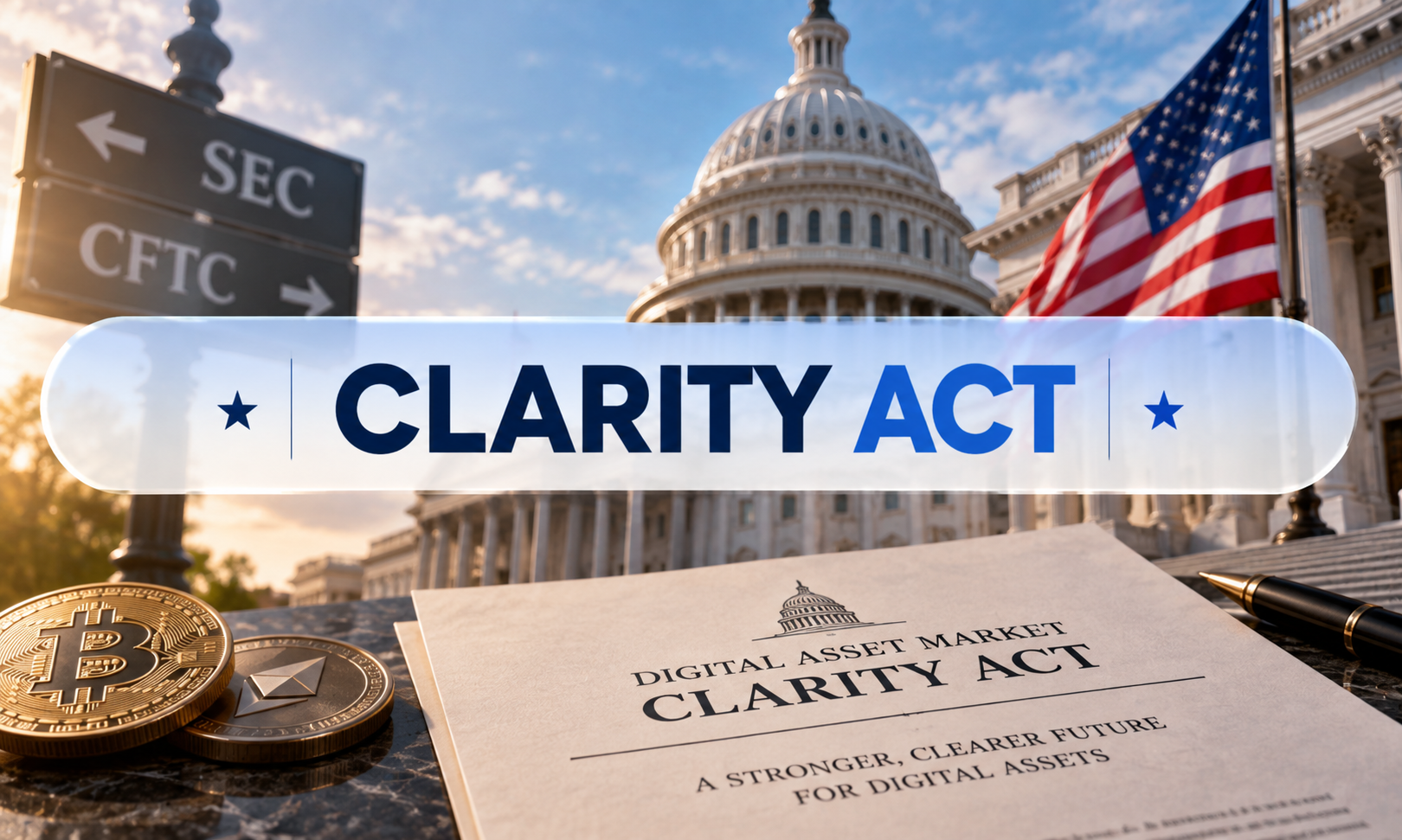
The latest stage of negotiations over the CLARITY Act has moved the bill toward a key vote while major disagreements remain. Senate Democrats sent Republicans their counterproposal late Monday after reviewing the newest Republican draft released a day earlier.
The timing came just before the legislation’s first scheduled Senate vote on Tuesday afternoon.
CLARITY Act Negotiations Heat Up
The counterproposal’s details were not disclosed. Much of the disagreement centers on its revised ethics language. Concerns were raised about a provision involving the Office of Government Ethics that could allow senior government officials to keep their existing crypto business connections.
Senator Cynthia Lummis, who is one of the Republicans leading the negotiations, said Monday that Democrats were continuing to seek additional concessions. She maintained that the legislation was still ready to move to a vote.
The White House has also defended the latest version. Patrick Witt, the White House’s top crypto advisor, spoke at a Solana Policy Institute summit in Washington and said the administration had worked to address the concerns that emerged during negotiations.
While expressing confidence about the Senate beginning its consideration of the highly anticipated cryptocurrency regulation, he said that the question of securing 60 votes would ultimately be political rather than a matter of policy since he viewed the bill as genuinely bipartisan and deserving of support.
His remarks come a day after a 635-page Republican draft that made changes to several provisions that had become contentious.
Banking Groups and States Raise Alarms
The changes have drawn complaints from different groups. For instance, banking groups are mainly focused on the rules for stablecoin rewards. Eight trade associations sent their concerns to Senate leaders John Thune and Chuck Schumer on Monday. The groups also asked lawmakers to make several changes to the bill.
Separately, New York Attorney General Letitia James and 17 other attorneys general urged senators to reject the legislation. They warned that federal preemption could weaken state anti-fraud, investigative, and enforcement authority, including administrative, civil, and criminal powers that form the basis of state police powers. They also claimed that it could leave the SEC with “broad preemptive power” to decide where the rules apply.
Despite those reactions, Witt said that it was the “best and final offer.”
The post CLARITY Act Hits Final Stretch as Democrats Push Back Before Senate Vote appeared first on CryptoPotato.
Somewhat surprisingly, bitcoin’s price jumped quite hard on Monday, reaching a multi-day peak of almost $80,000 before it was halted once again and pushed below $77,000 ahead of today’s crucial CLARITY Act vote in the US Senate.
Most altcoins tried to follow suit but were rejected at their local peaks. Still, some, such as XRP, XLM, and UNI, are still in the green on a daily scale.
BTC Braces for CLARITY Vote
The primary cryptocurrency experienced some intense volatility at the end of the previous business week as all eyes had turned to the US Consumer Price Index numbers. Once they came out, which were actually in line with expectations, BTC first dumped from $77,000 to $76,000 before it suddenly skyrocketed to $79,800, where its progress came to a screeching halt and dropped back to its starting point.
The weekend, as most previous ones, was quite sluggish, with BTC trading sideways at around $77,000. It dipped again on Monday twice to $76,500, where the bulls finally stepped up and didn’t allow another leg down.
Just the opposite; the cryptocurrency started to gain traction, especially during the early US trading hours, and jumped to over $79,500. However, the Friday scenario repeated, and the bears pushed it south hard, with BTC currently struggling at $77,000 once again. More volatility is expected today, with the CLARITY Act vote in the US Senate, and tomorrow when the US Fed will announce its interest rate decision.
For now, bitcoin’s market cap remains at $1.540 trillion on CMC, while its dominance over the alts has retreated slightly to 58.85%

ETH Below $2.5K Again
The leading altcoin exploded on Friday to an eight-month peak of $2,670, where it was rejected and slipped back to $2,500 almost immediately. It has dipped below that level now, after another 1.5% daily decline. XRP pumped to $1.46 yesterday, but it was stopped there, and now it fights for the $1.40 level. BNB, SOL, TRX, HYPE, and DOGE are slightly in the red, while RAIN has plummeted by over 11%.
In contrast, ZEC, XMR, and LINK have marked minor gains, while XLM and UNI are up by around 4%-5% to $0.19 and $6.55, respectively.
The total crypto market cap has remained essentially the same as yesterday, at $2.650 trillion on CMC.

The post Bitcoin Rejected at $80K Again Ahead of Crucial CLARITY Act Senate Vote: Market Watch appeared first on CryptoPotato.
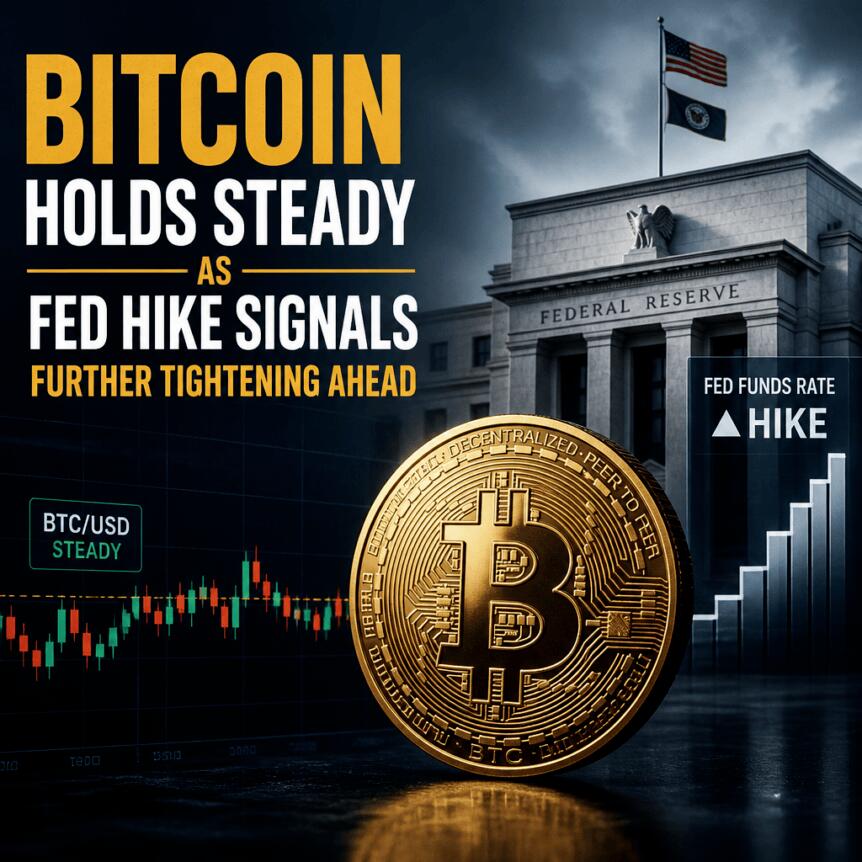
Bitcoin traded close to its levels prior to the US Federal Reserve’s announcement on Wednesday, even after the Fed lifted its benchmark interest rate for the first time since 2023. The market largely appeared to have priced in the move: at the time of writing, BTC was around $76,663, up about 1.35% over 24 hours.
The Federal Open Market Committee voted unanimously to raise rates by 25 basis points to a target range of 3.75% to 4%. While rate hikes typically weigh on stocks and other risk assets, crypto analysts told Cointelegraph that Bitcoin’s immediate reaction was muted and near pre-announcement price levels.
Key takeaways
- Bitcoin held around pre-Fed levels near $76,000 after a unanimous 25bp hike to 3.75%–4%.
- Analysts said the decision looked “largely anticipated,” limiting the immediate downside in BTC.
- Derivatives activity showed net selling in perpetual futures, partially offset by net spot buying.
- FOMC projections pointed to at least one more potential hike before year-end for many officials.
Bitcoin shrugs off a widely expected Fed hike
According to Talos research analyst Cooper Duschang, the lack of dramatic price movement suggested that crypto markets had already incorporated the Fed’s decision. “The initial reaction suggests the Fed’s decision was largely anticipated by crypto markets,” he said in comments shared with Cointelegraph. He added that Bitcoin remained relatively resilient, “holding broadly around pre-announcement levels even as equities moved lower.”
At the same time, US equities slipped during Wednesday’s trading session, following the Fed announcement. Crypto traders are watching for any shift from this “priced-in” backdrop—especially if future Fed communication turns more restrictive than expected.
What the Fed signaled: inflation still too high, economy strengthening
During the post-decision press conference, Fed Chair Kevin Warsh said inflation remains too high, while the US economy appears to be strengthening. The Fed’s updated economic projections indicated that a majority of officials foresee at least one more rate hike before the end of the year.
The same theme appears in the FOMC participation expectations cited in the article: 16 of 18 FOMC participants were reported as expecting at least one more rate increase this year, based on the Fed’s FOMC projections table available on the Federal Reserve’s website: US Federal Reserve.
Block Scholes’ Andrew Melville characterized the overall policy direction by arguing that an additional increase would be a “more hawkish surprise than today’s 25bp hike,” underscoring the market’s sensitivity to changes from expectation rather than the first move itself.
Spot and derivatives tell a more mixed story than the price chart
While Bitcoin’s headline price response looked subdued, Duschang said activity in spot and derivatives suggested investors were repositioning rather than simply stepping aside. He pointed to a short-term shift in perpetual futures positioning toward net selling over the hour following the announcement—about $82 million net selling in Bitcoin and $68 million in Ether.
However, that selling pressure did not translate cleanly into broader downside because net spot flows appeared to be absorbing some of the impact. Duschang reported roughly $15.5 million of net spot buying in Bitcoin, which he said could be helping counterbalance the derivatives-led pressure.
Exchange flow data reinforced the idea of active adjustment. Duschang noted that around 2,170 Bitcoin moved onto exchanges after the rate decision, followed by withdrawals of about 1,260 Bitcoin. Interpreting these movements, he argued that rather than one uniform “risk-off” reaction, investors were “actively repositioning as they digest the Fed’s message.”
“Higher for longer” raises the stakes for later
Even if Wednesday’s hike did not move BTC much, analysts warned that the bigger question is what happens next—especially as attention shifts from a move widely expected by markets to the possibility of further tightening.
Martin Lee, market insights lead at DWF Labs, suggested that a renewed hawkish posture associated with “higher for longer” rates would likely force risk assets to “repricing this new reality.” In practice, that means future price action may depend less on the existence of rate hikes and more on how the Fed frames the path ahead and how traders judge probabilities for additional moves.
Duschang framed the near-term watchpoints similarly: the key issue is whether Bitcoin’s resilience and spot demand remain intact as investors reassess tightening expectations beyond the immediate decision.
For now, traders appear to be separating the first hike—already priced by many—from the next steps implied by Fed projections and subsequent communication. The next catalyst to monitor is whether spot demand continues to offset derivatives selling if markets start to price in an additional hike with higher confidence.
Crypto World
NBKR and CertiK Establish Long-Term Strategic Partnership on Digital Som Security and Digital Asset Oversight
[PRESS RELEASE – Bishkek, Kyrgyzstan, September 15th, 2026]
The National Bank of the Kyrgyz Republic (NBKR) and CertiK have signed a Memorandum of Understanding (MoU), establishing a long-term strategic partnership to advance cooperation on Digital Som security and digital asset oversight. The partnership brings CertiK into a central-bank environment shaped by stringent security, compliance, and operational requirements, serving as a model for similar engagements with other highly regulated institutions.
Sanzhar Abdygaziev, Member of the NBKR Management Board (left), and Jason Jiang, Chief Business Officer of CertiK, at the MoU signing

“The Memorandum of Understanding that we are signing today establishes a framework for further dialogue and cooperation,” said Mr. Sanzhar Abdygaziev, Member of the Board (Management Board) of the NBKR. “We see particular value in exchanging experience and expertise in blockchain and digital asset security, cybersecurity, AML/CFT, and the analysis and monitoring of digital asset transactions.”
“Digital asset infrastructure requires security and risk management to be considered from the earliest stages of design through ongoing operation,” said Ronghui Gu, Co-Founder and CEO of CertiK. “We look forward to bringing CertiK’s expertise and experience to our long-term cooperation with the NBKR, supporting the secure development of the country’s digital asset ecosystem.”
Under the MoU, the parties intend to exchange expertise and explore cooperation in areas including blockchain and digital asset security, security assessments, formal verification, cybersecurity, and operational resilience. Drawing on its experience in digital asset security and risk management, CertiK will provide technical and strategic support across these areas.
The partnership will also extend to digital asset oversight and regulatory advisory support, covering areas such as AML/CFT, digital asset custody, security standards, and licensing requirements. The parties will also explore the deployment of CertiK’s Supervision and Compliance solutions to strengthen ongoing risk monitoring and regulatory oversight, alongside training and knowledge transfer in relevant technical and regulatory areas.
Beyond its work with the NBKR, CertiK has contributed to digital asset regulatory and policy discussions across multiple markets. This includes providing technical advisory support to regulators in the United States and responding to regulatory consultations issued by the Monetary Authority of Singapore (MAS). Together, these engagements reflect the growing role of technical security expertise in supporting regulated digital asset markets and infrastructure.
About National Bank of the Kyrgyz Republic (NBKR)
The National Bank of the Kyrgyz Republic (NBKR) is the country’s central bank and the primary authority responsible for maintaining price stability, safeguarding the stability of the banking and payment systems, and supporting the sustainable development of Kyrgyzstan’s financial sector. The NBKR regulates and supervises financial institutions, manages monetary policy and international reserves, and oversees the national payment infrastructure. It is also advancing financial innovation through its Digital Som central bank digital currency (CBDC) initiative, aimed at modernizing payments, expanding financial inclusion, and strengthening the resilience and efficiency of the country’s financial ecosystem.
About CertiK
CertiK is the largest Web3 security services provider and a trusted risk management partner for regulators, institutions, and Web3 innovators worldwide. Since 2017, CertiK has protected over $600 billion in digital assets across 150+ countries and regions, while providing full-lifecycle security and risk management solutions for institutional clients. Operating under SOC 2 Type II and ISO 27001 standards, CertiK works closely with regulators worldwide on digital asset policy development and regulatory consultation.
The post NBKR and CertiK Establish Long-Term Strategic Partnership on Digital Som Security and Digital Asset Oversight appeared first on CryptoPotato.

‘My abusive boyfriend promised to change if I married him, less than a year later he raped me’

Trump threatens heavy tariffs on EU over Canada associate membership

Anchorage Adds Etherlink Custody for Institutional Investors



-

 Fashion5 days ago
Weekend Open Thread – Corporette.com
-

 Tech4 days ago
The Latest Weird Thing to Play Doom Is the Mapped-Out Brain of a Fruit Fly
-

 Business6 days ago
10 Most-Streamed Songs On Spotify In 2026 So Far, Led By Ella Langley’s Dominant Run On The Charts This Year
-

 Crypto World6 days ago
XAG/USD: Silver’s Short-Term Rally Meets Its Moment of Truth
-

 Crypto World7 days ago
2 Chip Stocks Broke Out This Week. Neither Was Nvidia
-

 Tech6 days ago
Battery life is the only iPhone 18 Pro and iPhone Duo upgrade I care about. Apple didn’t disappoint
-

 Crypto World6 days ago
OKX launches 10x OpenAI, Anthropic X-Perps in Europe
-

 Crypto World6 days ago
Diesel Tops $6 a Gallon for the First Time as 28 States Set Records
-

 News Videos6 days ago
Facing Financial Fears
-

 Business7 days ago
Western Digital Slips 2.7% as AI Storage Rally Cools After Record Cash and Guidance
-

 Crypto World3 days ago
Elon Musk Drops a Bombshell: Grok 5 Could Be the AGI Breakthrough
-

 Business4 days ago
Rivals Sam Altman and Elon Musk Rally Behind Dario Amodei’s Call for a Slowdown in AI Development
-

 Business7 days ago
Five Leading AI Experts Warn Superintelligence Could Kill Humans and Explain Their Case
-
Crypto World6 days ago
Ethereum Price Analysis: Consolidation at $2.5K Tests Momentum as On-Chain Activity Surges
-

 Crypto World7 days ago
Ant International joins Visa, Mastercard to build AI agent payment standards
-
 NewsBeat3 days ago
‘Sick conspiracy’: Trump says only guardrails AI needs is ‘a strong and smart (High IQ!) president’ in all-caps rant
-

 Crypto World5 days ago
Can AI Build a Startup in 72 Hours? Elon Musk's Team Will Livestream the Test
-

 Crypto World6 days ago
US CPI forecast at 3.4% as tariff risks build
-

 Crypto World6 days ago
Bitcoin ETFs Pull $167M as 2026’s Best Inflow Run Slows
-

 Entertainment5 days ago
News Specials, Movies, Shows, More
You must be logged in to post a comment Login