
Crypto World
Paradigm-backed Succinct launches ZCAM iPhone app to verify real media



Succinct Labs has launched ZCAM, an iPhone camera app built to verify photos and videos at the moment of capture.
Summary
- Succinct Labs launched ZCAM to verify iPhone photos and videos at the moment of capture.
- The app creates cryptographic fingerprints that help prove media came from a real device.
- ZCAM targets rising AI fake risks as fraud losses tied to generative AI continue growing.
The app uses cryptography to create a record linked to the device that captured the media.
The company said ZCAM “signs photos and videos at the moment of capture, producing a tamper-proof record that links content to the device that captured it.” The record allows users to check whether a file came from a real device and whether it was later changed or generated by AI.
ZCAM targets AI fake photo and video risks
The launch comes as AI-generated images and videos continue to raise concerns around online fraud, identity abuse, and false media. Succinct said commercial AI detection tools can fail, so its system focuses on proving origin rather than only detecting fakes.
According to the company, ZCAM creates a cryptographic hash from the pixels captured by an iPhone camera. This hash works as a digital fingerprint for the photo or video and can support independent verification.
Succinct also cited Deloitte Center for Financial Services research that estimated generative AI could help push fraud losses in the United States to $40 billion by 2027. The figure compares with $12.3 billion in 2023.
Adoption remains key for media verification
The app could serve businesses, journalists, and users who need proof that photos and videos are real. Media verification has become more important as AI tools make it easier to create realistic fake content.
However, broad use may depend on whether people choose to capture content inside ZCAM instead of their default phone camera. The product works best when users sign media at the original capture point.
Other projects have also used blockchain and cryptography to address AI-related trust issues. World, backed by OpenAI CEO Sam Altman, uses a human verification model to help separate real people from AI-driven online accounts.
Paradigm-backed Succinct expands crypto tools
Succinct Labs raised $55 million in a 2024 financing round led by Paradigm. The round also included support from founders linked to Polygon and EigenLayer.
The company said its SP1 zero-knowledge virtual machine secures more than $4 billion in digital assets. In August, Succinct launched the mainnet for its Succinct Prover Network and activated the PROVE token.
The Succinct Prover Network runs as a decentralized marketplace on Ethereum. It lets applications submit zero-knowledge proof requests, while independent provers compete to verify them.



Japanese bitcoin treasury firm Metaplanet is back in the market with another round of balance-sheet leverage, issuing 8 billion yen, worth roughly $50 million, in zero-interest ordinary bonds to finance future bitcoin purchases.
In a Friday filing, the company said the latest issuance was fully taken up by EVO Fund, a Cayman Islands-based investor that has repeatedly anchored Metaplanet’s previous offerings. It also marks the firm’s 20th bond issuance, underscoring its long favored strategy of tapping debt markets to fund bitcoin accumulation.
Metaplanet, now Japan’s largest corporate bitcoin holder, has maintained a steady buying spree since April 2024, adding 5,075 BTC in the first quarter alone. As of writing, it held 40,177 BTC, which makes it the third-largest listed bitcoin treasury globally, according to BitcoinTreasuries.
The aggressive accumulation continues even as the firm faces deep paper losses. Metaplanet reported a $619 million net loss for fiscal 2025, largely driven by unrealized markdowns on its bitcoin stack.
The broader backdrop, however, has been volatile rather than outright bearish. Bitcoin, which briefly surged to an all-time high near $126,000 in October 2025, has since pulled back amid geopolitical shocks in the Middle East. It is currently trading around $77,800, still up roughly 10% over the past month as risk sentiment stabilizes.
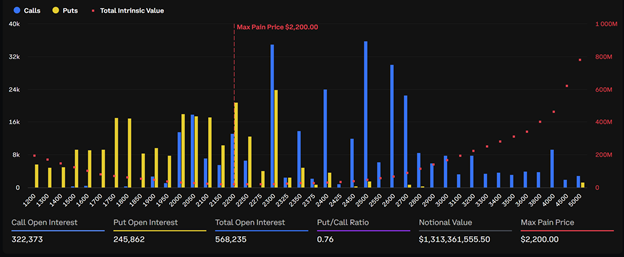
Bitcoin (BTC) and Ethereum (ETH) will see a combined $9.87 billion in options contracts expire today at 08:00 UTC on Deribit, marking April’s largest monthly settlement.
The expiry covers 109,000 BTC contracts with a notional value of $8.55 billion and 563,000 ETH contracts worth $1.32 billion. Both assets traded well above their respective max pain levels heading into settlement, with the Web3 conference in Hong Kong this week adding a bullish backdrop as attendees reflected broad optimism across crypto markets.
BTC and ETH Settle Above Max Pain
Bitcoin’s max pain sat at $72,000, yet spot price hovered near $77,900 at the time of expiry. The put-to-call ratio of 0.93 pointed to a roughly balanced split between bearish and bullish positioning.
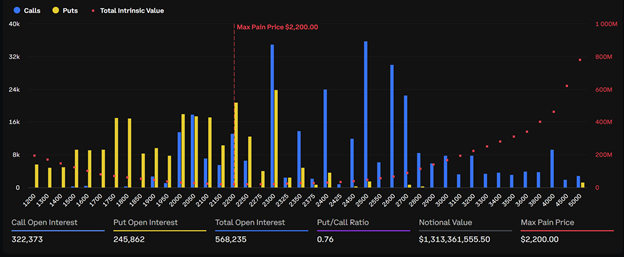
Ethereum showed a stronger call bias. ETH traded around $2,315 against a $2,200 max pain, with a put-to-call ratio of 0.72.
The skew toward calls suggests traders had been betting on further upside. Altcoin prices have also been recovering alongside the broader rally.
According to Deribit, call open interest led on both assets, reinforcing the bullish tilt across the derivatives market.
BTC call open interest totaled 52,607 contracts versus 52,844 puts, while ETH calls dominated at 322,373 against 245,862 puts.
Implied Volatility Drops Despite Price Rally
Analysts at Greeks.live noted that Bitcoin’s implied volatility for major maturities continued to fall this month, with most terms dropping 1% to 2% to below 40%. Ethereum’s IV declined even more sharply, sitting around 60%.
“The market continued to rebound this week, with Bitcoin breaking strongly above $78,000… Despite the price rally, Skew metrics have pulled back, indicating that the market is not driven by FOMO,” they wrote.
The declining volatility and retreating skew suggest the current rally reflects steady capital inflows rather than speculative momentum.
Bitcoin’s second-quarter performance has already outpaced the first quarter in both price and sentiment.
What Comes Next for Options Markets
This monthly settlement clears roughly 25% of total open interest on Deribit. Looking ahead, 12% of remaining positions mature at the end of May and another 24% at the end of June, according to Greeks.live. That June expiry will be the next major quarterly event.
Greeks.live noted that Bitcoin performed significantly better in the second quarter than the first, both in price and overall market sentiment.
If macroeconomic pressures ease by mid-year, the current price floor around $78,000 could solidify as confirmed support.
However, the concentration of June-dated contracts suggests that the next quarterly expiry will carry even greater weight for market direction.
Traders will likely watch whether the declining IV trend holds or reverses as those larger maturities approach.
In the meantime, the options data paints a picture of measured optimism rather than euphoria, with steady institutional flows continuing to support prices without triggering excessive leverage in either direction.
The post Nearly $10 Billion April Options Expiry Puts Bitcoin and Ethereum Direction in Focus appeared first on BeInCrypto.

TLDR:
- US consumer sentiment fell to 47.6, marking its lowest level amid rising cost pressures
- The S&P 500 remains near highs, showing a sharp disconnect from household expectations
- Retail outlook weakens as discount chains report softer demand and cautious guidance
- Strong premium travel demand contrasts with declining confidence among lower-income groups
A widening gap between financial markets and household outlook is drawing attention across the United States. Equity benchmarks remain elevated, yet US consumer sentiment has dropped sharply, raising concerns about how long this divergence can persist without affecting broader economic stability.
Record Gap Between Markets and Households
Recent commentary shared by Global Markets Investor described an unusual disconnect between Wall Street performance and everyday financial expectations. The post noted that US consumer sentiment fell to 47.6 in April, marking a record low reading.
At the same time, the S&P 500 continues to trade near peak levels. This contrast places US consumer sentiment at levels seen during past recessions, while equities reflect continued optimism. The gap between the two indicators now stands at its widest point on record.
The update pointed to rising living costs as a key factor weighing on US consumer sentiment. Higher gas prices and persistent inflation continue to pressure lower-income households. These pressures have intensified following disruptions linked to the Strait of Hormuz closure.
Meanwhile, asset price growth has supported wealthier households. This trend has helped sustain equity valuations despite weakening US consumer sentiment. As a result, financial conditions vary sharply across income groups.
The same post indicated that more than a quarter of households expect their finances to worsen. This marks the highest level since May 2024. Such expectations further reflect declining US consumer sentiment across the country.
Diverging Spending Patterns and Economic Signals
Retail data shows early signs of strain among cost-conscious consumers. Discount chains have reported cautious outlooks, aligning with the drop in US consumer sentiment. Walmart issued measured guidance, while Dollar General noted softer expectations.
At the same time, spending patterns remain uneven. Premium travel and cruise bookings continue to perform well. This divergence suggests that higher-income consumers remain less affected by declining US consumer sentiment.
The contrast between retail segments reflects a broader economic divide. While some households maintain discretionary spending, others are scaling back. These shifts are closely tied to ongoing weakness in US consumer sentiment.
The US economy depends heavily on consumer activity. As US consumer sentiment weakens, questions arise about future demand. Market participants are watching whether reduced confidence will translate into lower spending levels.
Equity markets continue to price in a stable outcome. However, declining US consumer sentiment presents a different narrative. If household confidence continues to fall, corporate earnings could face pressure in the coming months.
This divergence leaves uncertainty about which trend will adjust. Either markets may reprice risk, or consumer conditions may stabilize. Until then, US consumer sentiment remains a key measure shaping expectations across sectors.



The President Trump administration has announced plans to fight what it called “industrial-scale campaigns” aimed at copying artificial intelligence technology from American companies.
Summary
- The White House said foreign entities used proxy accounts to target major American AI companies.
- US officials said unauthorized distillation could help foreign firms build cheaper AI models.
- The plan includes information sharing with US AI companies and stronger private-sector defenses.
The White House Office of Science and Technology Policy said foreign entities are targeting major US AI firms through unauthorized model distillation.
Michael J. Kratsios, assistant to the president for the White House science office, said the government has “information” that foreign entities, mainly based in China, are trying to extract capabilities from US AI models. The statement said these groups use proxy accounts and jailbreaking methods to avoid detection.
Kratsios said, “Models developed from surreptitious, unauthorized distillation campaigns like this do not replicate the full performance of the original.” He added that such models can still allow foreign actors to release products that appear close to US systems on some benchmarks at a much lower cost.
US says proxy accounts helped hide activity
The White House said some foreign companies used “tens of thousands of proxy accounts” to mask their activity while probing American AI models. It also said the groups used jailbreaking techniques to expose private or protected model information.
According to the science office, these campaigns aim to extract useful features from American models without permission. The statement said, “These coordinated campaigns systematically extract capabilities from American AI models, exploiting American expertise and innovation.”
The White House also said models built through these methods may lack security controls. It warned that copied systems could move away from being “neutral and truth-seeking” if safety protections are removed or weakened.
Moreover, the statement follows claims made by Anthropic in late February. The Claude developer accused three Chinese AI firms, DeepSeek, Moonshot, and MiniMax, of carrying out distillation attacks against its models.
Anthropic said the firms created more than 16 million exchanges with its AI models through about 24,000 “fraudulent accounts.” The company said the activity targeted capabilities such as coding, agentic reasoning, data analysis, grading tasks, and computer vision.
The case has added focus to how frontier AI companies protect model access. AI firms charge users through token-based pricing, and lower-cost competitors can gain market attention by offering similar performance on selected tasks.
US plans closer work with private AI firms
The White House science office said the administration will work with US companies to share information about large attacks. It also plans to help the private sector coordinate stronger defenses against foreign actors.
The administration said it will explore measures to “hold foreign actors accountable.” It did not provide a detailed list of possible penalties or enforcement steps in the statement.
The move comes as AI competition between the United States and China continues to grow. US officials have framed advanced AI systems as a core technology for national security, business productivity, and future economic power.
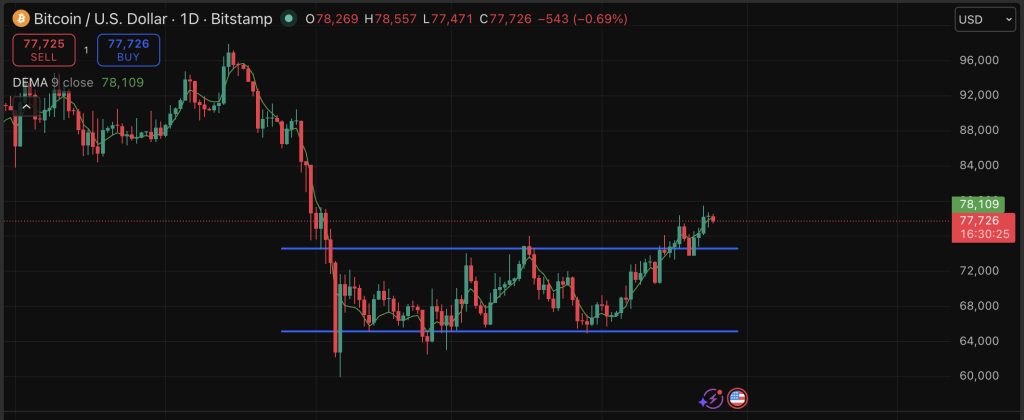
Bitcoin is trading near $78,000, doing well, but pinned just under the $79,000 resistance. Few analysts give a $50,000 price prediction, but our Bitcoin data shows an $80,000 breakout. A few so-called expert traders issued a sharp bearish warning this week, projecting a 36% crash from current levels toward $50,000 if Bitcoin’s range-bound structure resolves to the downside.
In an analysis shared on X, a trader mapped three historical consolidation periods in which Bitcoin traded sideways for 64 to 114 days before a violent breakout, two of which ended in 27% and 33% crashes, respectively.
This split-market setup is producing unusually binary sentiment. Bitcoin has now been breaking the two-and-a-half-month range, with the bottom in sight, or being left behind.
Discover: The best pre-launch token sales
Bitcoin Price Prediction: Rocketing to $80K, Or Is $50K the Real Target?
Bitcoin’s current price is running a mini-rally, with support clustered at $72,000-$73,000 and deeper Fibonacci support at $70,000-$68,000, which is well above the projected $50,000. Resistance sits at $79,000, a zone that has rejected the price twice in the last 10 days.
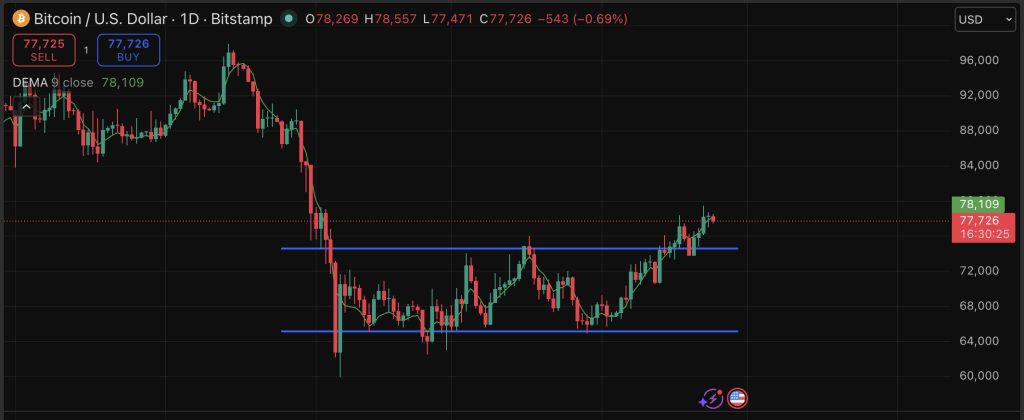
Our prediction model believes that $72,000 is the pivotal “line to hold,” as a foundation for a $80,000-$90,000 run. However, a clean break below risks a cascade of panic selling toward sub-$50,000.
Another analyst has an even more brutal prediction, placing the bear-case floor at $30,000-$40,000 following the failed $79K breakout.
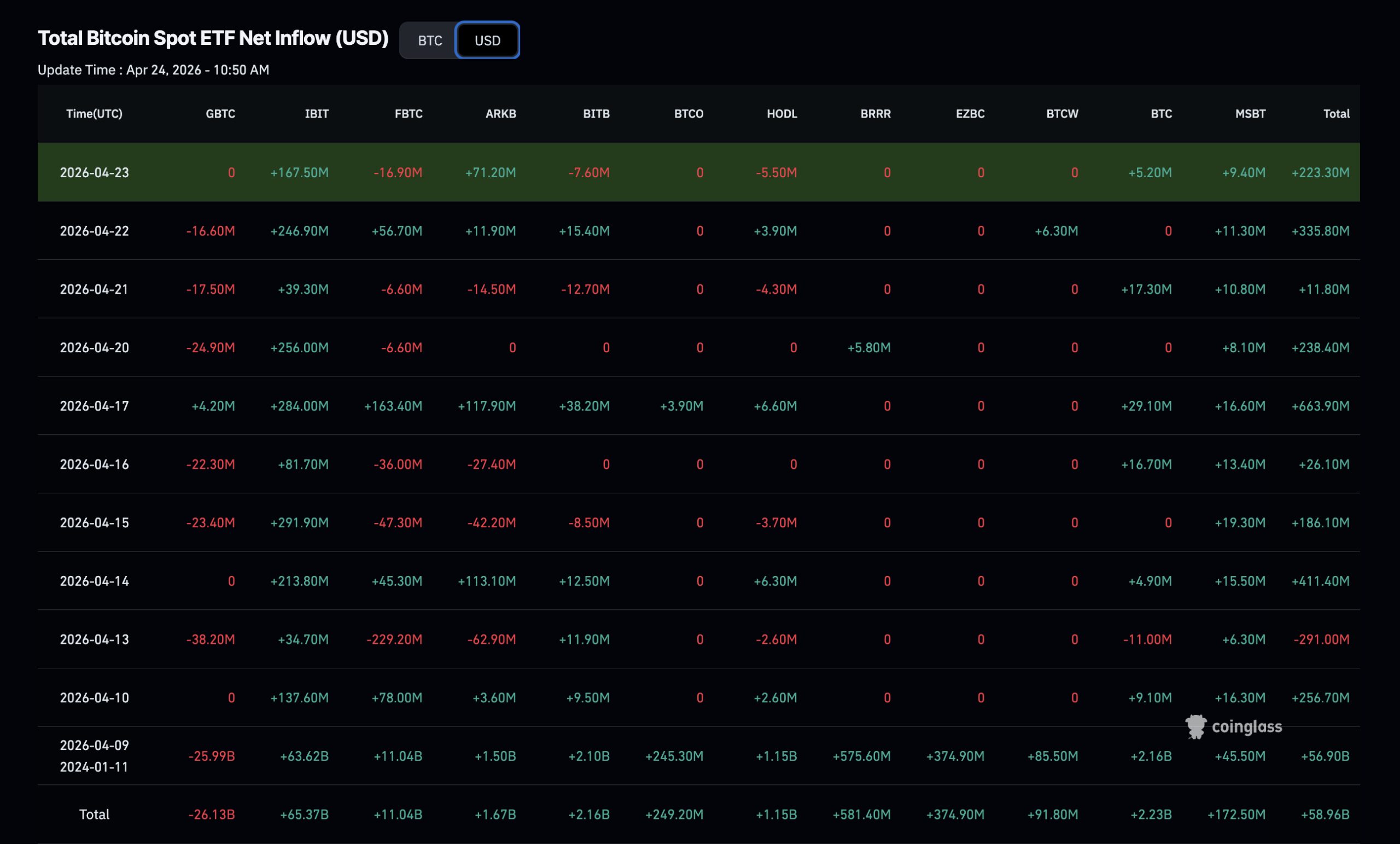
ETF inflows are the one to watch, especially with massive inflows coming in for more than 2 weeks now. See our BlackRock and Strategy accumulation analysis for context on institutional positioning at these levels.
Discover: The best crypto to diversify your portfolio with
Bitcoin Hyper Targets Early-Mover Upside as BTC Tests Critical Support
Traders sitting in BTC face asymmetric risk, a 36% downside to $50,000 versus less than 5% upside to $80,000, with macro headwinds still unresolved. That math is pushing some capital into earlier-stage Bitcoin ecosystem plays where the upside calculus looks different.
Bitcoin Hyper ($HYPER) is positioning as a direct infrastructure bet on Bitcoin’s scalability problem, the same slow transactions and high fees that have limited BTC’s programmability for years. The project will be the first Bitcoin Layer 2 with Solana Virtual Machine (SVM) integration, promising sub-Solana latency and low-cost smart contract execution while inheriting Bitcoin’s security model.
The presale has raised $32,5 million at a current price of $0.0136, with 30% APY staking available to early participants. As covered in recent reporting on the presale milestone, momentum has been building alongside Bitcoin’s price volatility.
Research Bitcoin Hyper before the next price adjustment.
The post Bitcoin Price Prediction: $50K Warns Analyst, Data Points $80K appeared first on Cryptonews.


Kelp DAO’s $292 million exploit has raised new questions about risk across liquid restaking and DeFi lending markets.
Summary
- Kelp DAO’s $292M exploit raised concerns over hidden risks across liquid restaking and lending markets.
- Aave, SparkLend, Fluid, and Lido took risk-control steps after rsETH markets came under pressure.
- The incident renewed debate over whether yield stacking hides risk across connected DeFi protocols.
The attack reportedly affected the protocol’s rsETH bridge and involved 116,500 rsETH, equal to about 18% of circulating supply.
The incident did not remain limited to Kelp DAO. Aave saw large withdrawals, while SparkLend and Fluid paused rsETH markets. Lido also paused earnETH, which had exposure to rsETH, even though its core stETH product was not affected.
A post by a DeFi-focused account, known as @whatexchange on X, compared the event to the 2008 financial crisis. The account wrote, “Stacking asset layers does not remove risk. It compresses and hides it.”
Layered yield products face scrutiny
The post argued that rsETH moved through several layers before the exploit. Users first staked ETH through Lido and received stETH. That stETH could then move into Kelp DAO and EigenLayer, where rsETH was minted.
The rsETH token was then used as collateral on lending platforms such as Aave, SparkLend, and Fluid. It was also bridged through LayerZero to other chains, creating wrapped versions that depended on the same underlying asset.
The analysis compared this structure to mortgage products before the 2008 crisis. It said both systems repackaged one base asset through several financial layers, while each layer relied on the previous one working as expected.
Market response shows hidden exposure
After the Kelp DAO exploit, several DeFi platforms moved to reduce risk. Aave froze rsETH markets for several hours, while SparkLend and Fluid paused similar markets. Ethena also paused LayerZero OFT bridges as a precaution, despite having no direct rsETH exposure.
According to the post, over $6.2 billion exited Aave within less than 36 hours. The account said the main issue was not only the exploit size but the difficulty of mapping indirect exposure across protocols.
The post stated, “No participant, including protocols themselves, can fully map their exposure network.” It added that when users cannot verify exposure in real time, they often react by withdrawing funds.
DeFi risk debate shifts to system design
The post also focused on bridge security. It claimed Kelp used a 1-of-1 verifier setup, meaning one node verified cross-chain messages before funds moved. The post argued that this design created a single point of failure inside a product marketed as decentralized.
The analysis also questioned yield stacking. It said each layer adds new risks, including validator slashing, restaking risks, bridge bugs, contract failures, and lending liquidations.
The post said users should not judge DeFi products only by APY. It argued that higher returns often reflect hidden risk across several connected systems, not simple passive income.
The Kelp DAO exploit has now become part of a wider debate on DeFi security, leverage, and transparency. The incident showed how one failure can affect users across several platforms, including users who did not directly interact with Kelp DAO.


Morgan Stanley has introduced a new portfolio designed to hold stablecoin reserves within its money market fund structure.
Summary
- Morgan Stanley has launched a stablecoin reserve portfolio that allows issuers to place backing assets into its money market fund while earning yield.
- The fund invests in cash, short-term US Treasuries, and repo agreements, with a $10 million minimum and a 0.15% fee.
According to Morgan Stanley, the “Stablecoin Reserves Portfolio” allows issuers to place backing assets into its Institutional Liquidity Funds trust while earning yield without compromising liquidity or capital stability. The fund, listed as MSNXX, is structured to maintain a $1 net asset value alongside daily access to funds and regular income distribution.
Positioning the offering within ongoing regulatory developments, the bank said the portfolio has been built with compliance in mind under the Guiding and Establishing National Innovation for U.S. Stablecoins Act. The GENIUS Act, signed into law in July, has already drawn interest from traditional payment firms such as Western Union and Zelle, both of which have moved to explore stablecoin integrations.
“Developing innovative ways to work with stablecoin issuers is another step towards modernizing the financial infrastructure,” said Amy Oldenburg, head of digital asset strategy at Morgan Stanley.
Details shared by the bank show the fund invests in cash, short-dated U.S. Treasury securities with maturities of 93 days or less, and overnight repurchase agreements backed by Treasuries. Entry into the fund requires a minimum investment of $10 million, alongside a 0.15% management fee. While the structure is designed with stablecoin issuers in mind, access is not limited to them, with the bank confirming that other investors may also participate.
Momentum in Morgan Stanley’s digital asset push has picked up pace in recent months. Early April saw the launch of the Morgan Stanley Bitcoin Trust, an exchange-traded fund that has continued to gather inflows since its debut. Farside Investors’ data from mid April showed the fund crossing $103 million in net inflows within days of launch, overtaking the WisdomTree Bitcoin Fund, which has accumulated $86 million since early 2024.
The early traction came after a $19.3 million daily inflow pushed the product ahead of its rival. Competitive pricing has also played a role, with the fund’s 0.14% fee sitting just below the Grayscale Bitcoin Mini Trust.
Standing among a growing field of spot Bitcoin ETFs, the Morgan Stanley product still trails larger funds such as BlackRock’s iShares Bitcoin Trust and Fidelity’s Wise Origin Bitcoin Fund, which hold $64.3 billion and $10.9 billion in inflows, respectively. Mid-tier competitors, including Franklin, Valkyrie, and Invesco Galaxy, continue to hold higher cumulative inflows for now.
Alongside ETF activity, the bank has taken further steps to deepen its crypto capabilities. A filing with the Office of the Comptroller of the Currency in February outlined plans to secure a national trust banking charter, a move that would allow it to offer custody services and execute crypto transactions directly for clients. Additional filings with the U.S. securities regulator also point to plans for Ether and staked Solana exchange-traded funds.
Looking at the structure of the new stablecoin reserve product, the design aligns closely with traditional money market fund mechanics while adapting to blockchain-based liabilities, which places Morgan Stanley among a small but growing group of Wall Street firms seeking to bridge conventional finance and tokenized assets, especially as institutional demand continues to build.


U.S. authorities have frozen more than $701 million in cryptocurrency tied to investment scams targeting Americans as part of an ongoing crackdown.
Summary
- U.S. authorities have frozen over $701 million in cryptocurrency tied to investment scams targeting American victims.
- Law enforcement has dismantled key parts of the network, including a recruitment channel and more than 500 fake investment websites used to lure deposits.
The U.S. Department of Justice said Thursday that the funds were restrained through coordination with crypto exchanges and legal action, as part of efforts led by its Scam Center Strike Force. Law enforcement agencies working alongside the unit focused on networks operating scam centers aimed at U.S. victims.
“The Scam Center Strike Force continues its work to identify, seize, and forfeit funds involved in money laundering related to scams, so that funds can be returned to victims whenever possible,” the agency said.
A significant portion of the restrained assets comes as authorities expand the use of confiscated crypto. In March last year, U.S. President Donald Trump signed an executive order to establish a Strategic Bitcoin Reserve and a Digital Asset Stockpile, funded in part through seized digital assets.
Scam networks, recruitment channels dismantled
Across Southeast Asia, enforcement actions have begun to disrupt the infrastructure behind these schemes. Authorities confirmed the seizure of a Telegram channel used to recruit individuals into a scam center based in Cambodia, where job seekers were often lured under false pretenses.
Investigators also took down at least 503 fake investment websites. Those domains, which previously displayed fabricated dashboards and false returns to convince users to deposit funds, now show seizure notices informing visitors that law enforcement has taken control.
Earlier enforcement activity had already pointed to how these operations function. In December 2025, U.S. authorities seized domains tied to the Tai Chang compound in Burma, where platforms mimicked legitimate trading services and directed victims to download malicious apps before extracting funds.
Court filings unsealed alongside the latest action name two Chinese nationals, Huang Xingshan and Jiang Wen Jie, accused of running a crypto fraud operation from the Shunda compound in Burma. That site had been seized in November 2025 by the Karen National Liberation Army, exposing links between armed groups and scam networks.
Pressure has also extended to intelligence gathering. The U.S. Department of State has offered a $10 million reward for information that could disrupt the Tai Chang scam centers, which investigators have linked to organized crime activity in the region.
Global operations step up coordination
Outside the U.S., similar efforts have been underway to curb crypto-related fraud. Recently, the Singapore Police Force disclosed that a one-month operation between March 16 and April 15 prevented more than $2.86 million in potential losses.
Working with exchanges such as Coinbase, Gemini, Independent Reserve, and regional platform Coinhako, authorities were able to identify victims early and intervene. Blockchain analytics firms TRM Labs and Chainalysis supported the effort by tracing suspicious transactions.
“The operation’s success stemmed from the rapid exchange of information between the police and participating cryptocurrency exchanges, which enabled swift victim identification and immediate intervention,” Singapore police said.
“Officers conducted over 90 direct interventions, contacting scam victims both by telephone and in-person to prevent further financial losses,” they added.
Rising complaints continue to underline the scale of the issue. The Federal Bureau of Investigation reported in April that it received more than one million cybercrime complaints in 2025, with total losses reaching about $21 billion.
Southeast Asia remains central to many of these operations. Scam compounds across countries such as Myanmar, Cambodia, and Laos often rely on trafficked or coerced workers, with crypto investment fraud emerging as one of their most profitable activities.
TLDR:
- BitMine acquired 100,000 ETH, worth about $233.7M, signaling continued large-scale accumulation activity.
- Ethereum trades near its realized price of $2,340, a key level often acting as resistance or support.
- Price remains below the $2,360 resistance, with repeated rejections confirming short-term bearish pressure.
- RSI below 50 and bearish MACD crossover suggest weakening momentum and possible further downside.
Ethereum traded near a key on-chain level as fresh institutional activity entered the market. A large acquisition tied to BitMine added to ongoing price pressure, while technical indicators pointed to weakening short-term momentum around the $2,300 range.
BitMine Accumulates Ethereum Amid Market Weakness
Recent data pointed to a large Ethereum transfer involving BitMine, drawing attention across the market. The transaction was valued at roughly $233.7 million based on prevailing prices.
A post shared by Coin Bureau on X reported that BitMine acquired another 100,000 ETH. The update added that three newly created wallets received the funds from BitGo, with tracking data from LookOnChain linking the activity.
The move adds to a growing list of large Ethereum transactions tied to institutional players. Market participants often monitor such transfers to assess accumulation trends and liquidity shifts.
The involvement of Tom Lee further drew attention to the transaction. His association with BitMine has previously aligned with strategic digital asset allocations.
At the same time, Ethereum continued trading close to its realized price near $2,340. This level represents the average acquisition cost for all on-chain holders.
Historically, Ethereum tends to face resistance around this zone during recovery phases. Traders often sell near this level to exit at breakeven.
Still, sustained trading above the realized price has previously marked the start of broader expansion cycles. That context keeps attention fixed on current price behavior.
Ethereum Price Struggles Below Resistance Levels
At the time of observation, Ethereum traded near $2,313, reflecting a modest daily decline. Price action showed a series of lower highs and lower lows after peaking near $2,420.
A separate post by Ali Charts on X stated that Ethereum is testing its realized price near $2,340. The analyst described this level as a historical boundary between bearish phases and broader expansion cycles.
The $2,360 to $2,400 range acted as a clear resistance zone. Multiple attempts to reclaim this level faced rejection, reinforcing short-term selling pressure.
On the downside, support formed near $2,280, with a deeper level around $2,250. A break below this range could expose lower price areas.
Momentum indicators supported the cautious outlook. The Relative Strength Index remained below 50, signaling reduced buying strength.
At the same time, the MACD indicator showed a bearish crossover. The histogram continued printing negative values, reflecting growing downside momentum.
Earlier bullish momentum from April 21 to April 22 faded as sellers regained control. Price now hovered within a mid-range zone rather than near extremes.
This structure suggested either continued downward movement or a period of sideways trading. A recovery would require a firm move above $2,360.
For now, Ethereum remained in a consolidation phase with a slight bearish tilt. Market participants continued watching both price levels and on-chain activity for direction.
The combination of technical weakness and large-scale accumulation created a mixed backdrop. Traders remained attentive to how Ethereum reacts around its realized price level.
Trading firm Jane Street has asked a US court to toss a lawsuit brought by the administrator of the bankrupt Terraform Labs, accusing the company of insider trading that worsened the collapse of the Terra ecosystem.
In a motion to dismiss filed in a Manhattan federal court on Thursday, Jane Street argued Terraform’s suit was an attempt “to extract cash from Jane Street to foot the bill for a fraud that Terraform itself perpetrated on the market.”
“Terraform now claims it was victimized by Jane Street’s trading,” it added. “The problem with this theory is that Terraform’s fraud scheme — in which Jane Street had no involvement — has already been prosecuted, adjudicated, and punished.”
Terraform’s court-appointed administrator, Todd Snyder, sued Jane Street, co-founder Robert Granieri, and employees Bryce Pratt and Michael Huang in February, accusing them of trading Terra tokens after receiving nonpublic information from “Terraform insiders.”
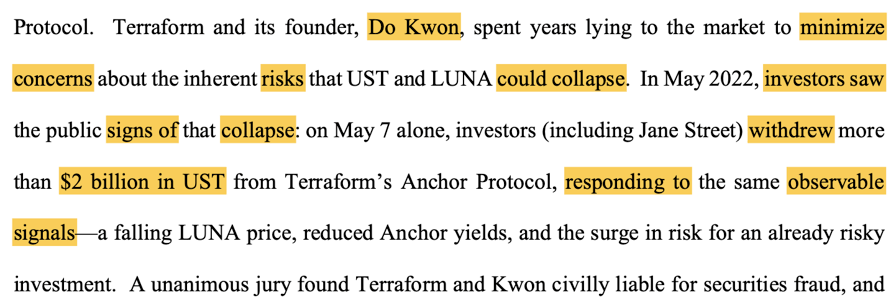
A highlighted excerpt of Jane Street’s motion argues it traded Terra-linked tokens based on market signals, not insider information. Source: CourtListener
Terraform collapsed in May 2022 after its algorithmic stablecoin, TerraUSD, rapidly lost its peg to the US dollar, sending the price of the highly interconnected LUNA token tumbling and wiping out $40 billion in value.
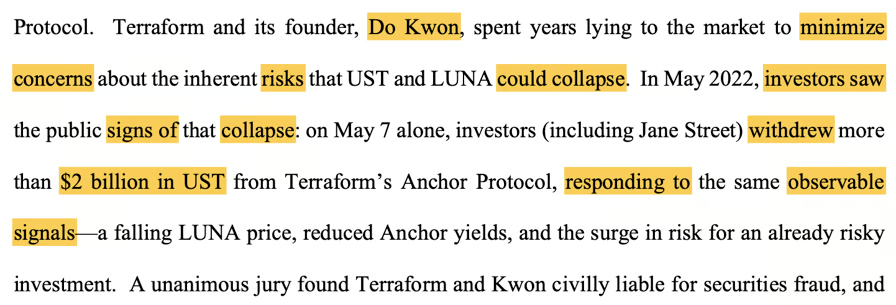
Jane Street argued in its motion that investors “saw the public signs of that collapse,” and it moved to “sell a deteriorating investment as the market was visibly collapsing.”
The firm claimed that the reasons for Terraform’s collapse had already been decided by a court, noting that its founder, Do Kwon, pleaded guilty to conspiracy and wire fraud charges, for which he was sentenced to 15 years in prison.
Jane Street claimed that Terraform’s complaint was also “self-defeating,” as it had stated that Jane Street’s largest TerraUSD sale took place 10 minutes after “supposed material nonpublic information was visible to the market.”
Related: Sam Bankman-Fried withdraws motion for a new trial, asks for new judge
It said Terraform also didn’t identify any material, nonpublic information Jane Street received when it alleged the trading firm sold more tokens in early May 2022 as Terraform transitioned to a new liquidity pool.
“Plaintiff pleads ‘on information and belief’ that Jane Street learned the timing of Terraform’s transition to a new liquidity pool through ‘back-channel communications,’ yet cannot identify a single communication disclosing that timing — despite extensive pre-suit discovery,” the motion said.
Jane Street asked the court to dismiss the suit with prejudice, meaning Terraform cannot bring the same lawsuit against it again.
Magazine: How to fix suspected insider trading on Polymarket and Kalshi

Guy Ritchie’s 10-Part Crime Drama Is Still a Late-Night Sleeper Hit on Streaming 1 Year Later

BREAKING: Passenger dies on UK Cathay Pacific flight to Hong Kong after collapsing ahead of landing

Minneapolis campaigners press Swiss National Bank to dump Palantir investment

Manchester United reach agreement with Casemiro over contract clause amid transfer speculation

US brings back mandatory military draft registration

Steven Gerrard disagrees with Gary Neville over ‘shock’ Chelsea and Arsenal claim | Football

![LISA - 'MONEY' 2023 WORLD TOUR [BORN PINK] KYOCERA DOME OSAKA](https://wordupnews.com/wp-content/uploads/2026/02/1770253317_hqdefault-80x80.jpg)

-

 Sports7 days ago
NWFL Suspends Two Players Over Post-Match Clash in Ado-Ekiti
-

 Fashion7 days ago
Weekend Open Thread: Theodora Dress
-

 Politics6 days ago
Palestine barred from entering Canada for FIFA Congress
-
Entertainment4 days ago
NBA Analyst Charles Barkley Chimes in on Ice Spice McDonald’s Fiasco
-

 Tech5 days ago
Auto Enthusiast Scores Running Tesla Model 3 for Two Grand and Turns It Into Bare-Bones Go-Kart
-

 Business5 days ago
Powerball Result April 18, 2026: No Jackpot Winner in Powerball Draw: $75 Million Rolls Over
-

 Politics5 days ago
Zack Polanski demands ‘council homes not luxury flats for foreign investors’
-

 Crypto World6 days ago
Russia Pushes Bill to Criminalize Unregistered Crypto Services
-

 Politics3 days ago
Gary Stevenson delivers timely reminder to register to vote as deadline TODAY
-

 Business2 days ago
Rolls-Royce Voted UK’s Most Iconic Trade Mark as IPO Register Hits 150
-

 Politics2 days ago
Disabled people challenge government SEND proposals over segregation concerns
-

 Politics2 days ago
Making troops accountable for war crimes threatens US alliance, ex-SAS colonel warns
-

 Crypto World6 days ago
Russia Introduces Bill To Criminalize Unregistered Crypto Services
-

 Politics2 days ago
Starmer handler McSweeney to be dragged from shadows by Foreign Affairs Committee
-
Politics2 days ago
Wings Over Scotland | How To Get Away With Crimes
-

 Politics2 days ago
Zack Polanski responds to home secretary’s taser threat
-
Crypto World5 days ago
Kelp DAO rsETH Bridge Hack Drains $292M as DeFi Losses Top $600M in Two Weeks
-

 Politics2 days ago
‘Iran is still a nuclear threat’
-

 Crypto World2 days ago
New York sues Coinbase, Gemini over prediction market offerings
-
 Sports7 days ago
Kevin Kisner apologizes for Masters criticism: ‘I crossed the line’
You must be logged in to post a comment Login