

Crypto World
Pepe Coin Price Prediction: Whale Wallets Stack $7.5M PEPE During 17% Rebound While Pepeto Lines Up 150x Listing

The Pepe Coin price prediction is heating up. PEPE whales added $7.5 million during a 17% rebound off the June 6 low, pushing whale supply from 181 trillion to 183.6 trillion tokens, and meme coin ETF flows are pulling capital back per CoinMarketCap.
Whenever big-money flows show that kind of conviction, meme tokens move first, and the hunt for the next Pepe-style winner gets noisy.
The same builder who scaled the original Pepe Coin from internet joke to $11 billion on 420 trillion tokens now leads Pepeto, with identical supply, the same bottom-up community heat, and a full exchange the first version never delivered.
Anyone who picked up Pepe Coin in April 2023 turned tiny deposits into life-rewriting paydays as the token printed 7,000% in four weeks, riding pure hype with no audit and no real product.
Pepeto ships both plus an approaching Binance listing, and the same crowd that drove the original Pepe Coin into mainstream headlines is already gathering. The big-cap picture lays the table, but the real prize is the presale still on offer. With whale wallets stacking, this is the moment.
The Next Pepe Coin: Same Builder, Real Products, and a Binance Listing Ready
The original Pepe Coin proved a meme token without products could ride pure crowd belief to $11 billion. Buyers who entered early and held past listing day walked away with returns that rewrote their lives. But PEPE never launched an exchange or any cross-chain product, leaving nothing to support demand once the hype faded.
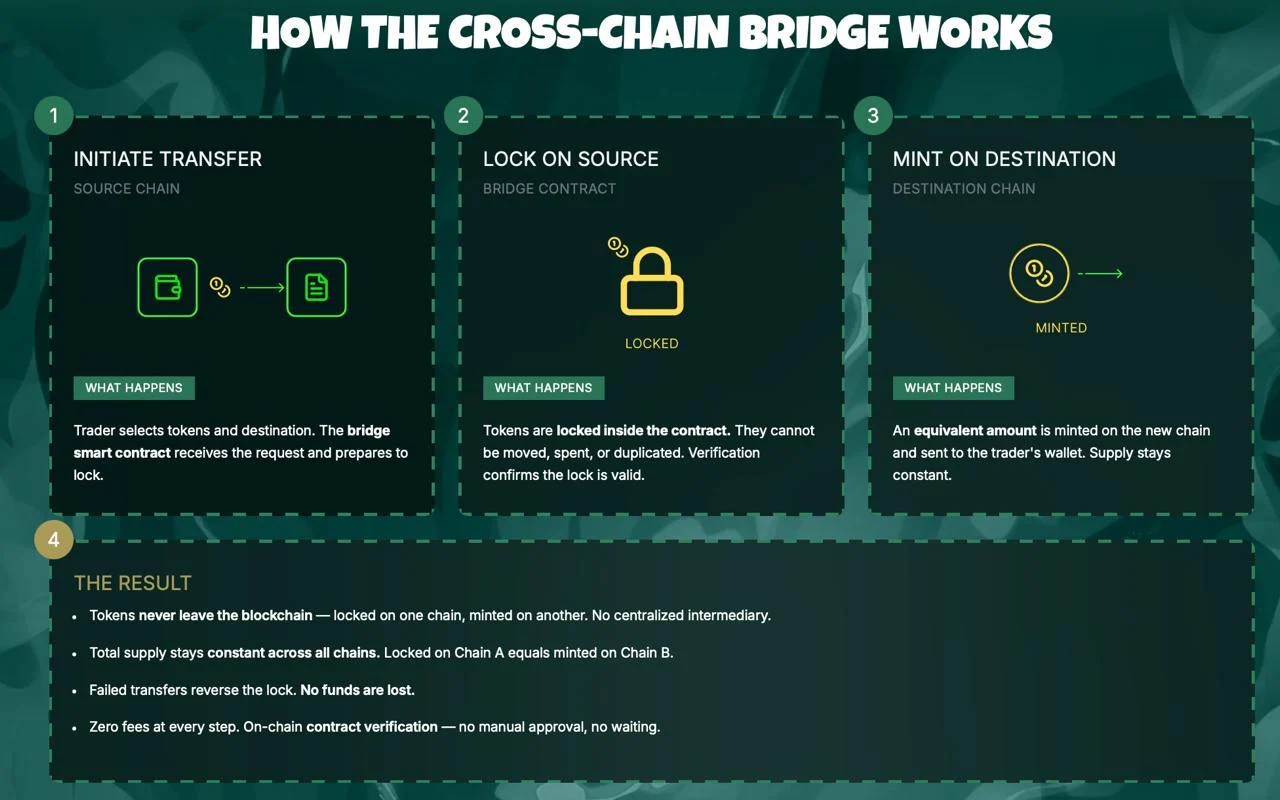
That is why PEPE today sits 90% below its peak. Pepeto fills every void the first version left empty, with the same cofounder shipping zero-fee trading, a bridge across ETH, BNB, and SOL, a token scanner that flags threats before capital arrives, and a signed SolidProof audit on file. The Binance listing arrives at launch, and the organic build behind Pepeto walks the same path that took the original from nothing to billions.
Pepe Coin Price Prediction 2026 and the Presale Where the Same Builder Goes Bigger
Pepeto: The Exchange Presale From the Builder Who Already Hit $11 Billion
Pepeto is the strongest presale on the market, carrying more working tools than any meme coin has ever shipped at this stage.
Pepeto runs a live exchange on Ethereum where the risk engine scores every contract before your wallet goes near it, catching dangerous permissions and liquidity holes most buyers learn about only after losing money.
Against the original Pepe Coin which peaked at $11 billion on hype alone, Pepeto delivers a live exchange, a signed SolidProof audit, and a former Binance lead running the listing roadmap. Over $10.307 million committed while new wallets join every round shows where serious capital is heading.
Staking at 169% APY grows inside the presale while the market tracks PEPE price charts. At $0.0000001878 on 420 trillion tokens, reaching the same cap Pepe hit while shipping nothing means 150x, and the exchange gives that target a real base. That entry slams shut the moment the Binance listing goes live, and each round closes faster than the one before.
PEPE Price Outlook: Recovery Has a Ceiling and the Upside Is Capped
Pepe (PEPE) trades near $0.000002722 per CoinMarketCap, down 90% from its all-time high, with a $1.12 billion cap.
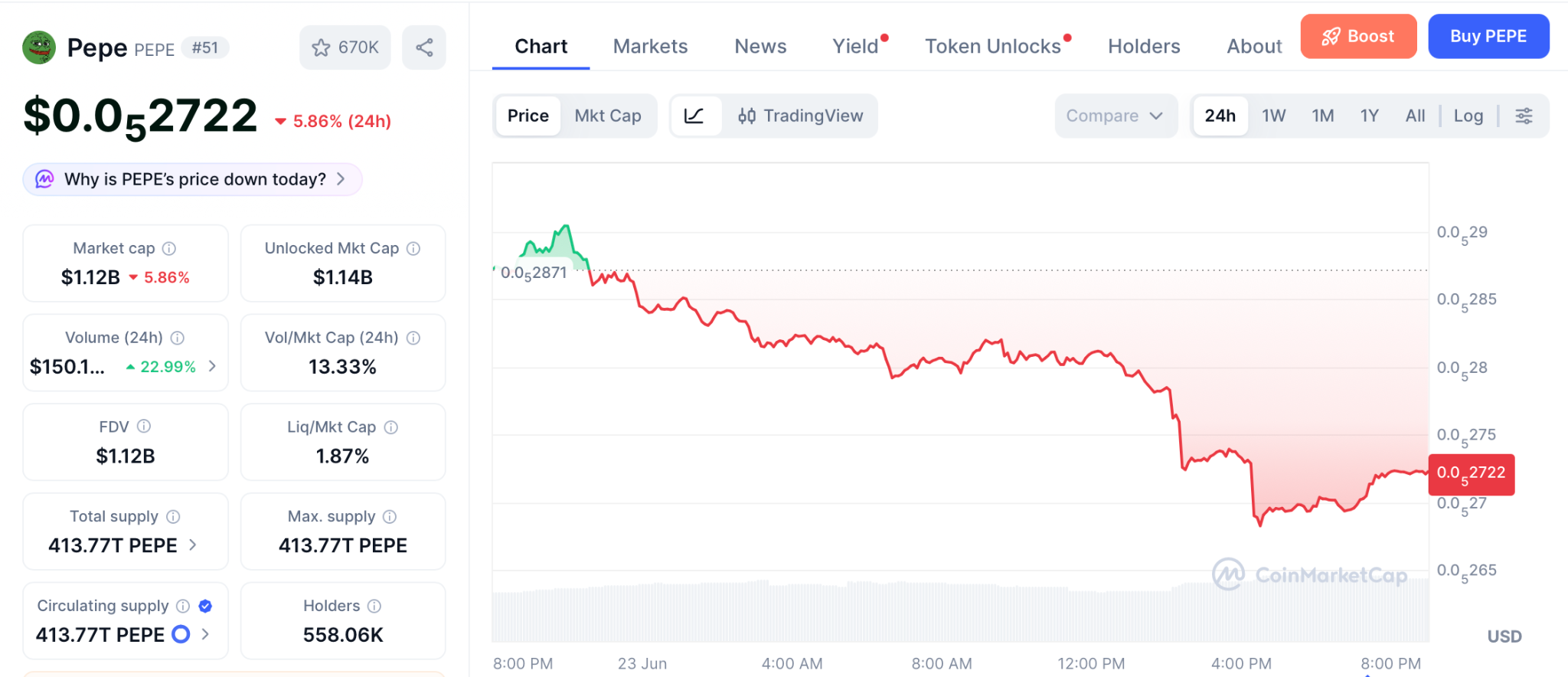
The 50-day EMA hovers around $0.0000035 per FXStreet, with a run back to the $0.000028 peak giving roughly 10x. For a Pepe Coin that already proved meme power, 10x is a recovery play not a wealth builder, while the builder behind Pepeto targeting 150x to that same peak tells you exactly where the better math lives.
Conclusion
The $7.5 million in whale accumulation and the 17% rebound off June lows tell you smart money is already back, and that blend of meme power with real exchange tools is why wallets entering each round trace to addresses that held winners across past cycles.
They commit with size, verify everything, and move the second they spot what the rest of the market hasn’t priced in. The Pepe Coin price prediction hands you a 10x at best, but the next Pepe Coin is the one shipping real products and a presale spot that vanishes the moment trading opens, and the Pepeto official website is the gateway holding those entries right now.
Every wallet stacking before the Binance listing opens is writing the part of this cycle late arrivals will spend the rest of 2026 trying to undo, because once the rounds close the entry price disappears and the chance to be early is gone for good.
Click To Visit Pepeto Website To Enter The Presale

FAQs
What makes the Pepe Coin price prediction for 2026 different from Pepeto’s upside?
PEPE at $0.000002722 targets recovery toward $0.0000050 short term, but even reaching its ATH only delivers 10x. Pepeto at presale pricing carries 150x to that same cap with a working exchange and approaching Binance listing behind it.
Why do crypto investors keep calling Pepeto the next Pepe Coin heading into 2026?
Pepeto shares the same cofounder and 420 trillion token supply as the original, but ships zero-fee trading, a cross-chain bridge, and a signed SolidProof audit. Over $10.307 million raised confirms serious conviction.
Disclaimer: This is a Press Release provided by a third party who is responsible for the content. Please conduct your own research before taking any action based on the content.


Crypto World
INFINIOS and Circle Partner to Expand Digital Finance Infrastructure Across the Middle East

TLDR:
- INFINIOS will integrate USDC, EURC, and Circle’s API-enabled payment rails into its platform.
- The deal targets cross-border payments, treasury management, and embedded finance use cases.
- Both firms align on KYC, AML/CFT, and data protection standards for regional compliance needs.
- Circle’s Middle East expansion accelerates as demand for internet-native financial infrastructure grows.
INFINIOS Circle’s new strategic agreement marks a significant move in the region’s financial technology landscape.
Announced on June 24, 2026, in Manama, Bahrain, the deal links INFINIOS, a Bahraini fintech company, with Circle Internet Financial.
Together, they plan to expand digital payment and treasury infrastructure across the Middle East and beyond, targeting businesses and financial institutions seeking faster, more connected financial solutions.
Stablecoin Integration at the Core of the Agreement
Under the agreement, INFINIOS will integrate Circle’s financial infrastructure into its platform. This includes USDC, EURC, and API-enabled onchain payment capabilities for payouts and treasury operations. The integration gives INFINIOS access to globally recognized stablecoin rails designed for institutional use.
The arrangement covers a broad range of enterprise and institutional use cases. These include cross-border payments, treasury and liquidity management, merchant settlement, and platform payouts. Tokenized financial services and embedded finance solutions are also part of the scope.
Both companies have emphasized a shared commitment to regulatory compliance throughout the collaboration. The agreement aligns with KYC, AML/CFT, and data protection standards relevant to financial operations in the region. This focus on compliance positions the partnership as a trust-based infrastructure initiative.
INFINIOS CEO Sherif Abdelsalam framed the deal as a turning point for regional digital finance. He said the partnership combines INFINIOS’s market expertise with Circle’s technology to unlock real-time, global financial connectivity.
He added that the goal is to build infrastructure that enables seamless, compliant, and scalable financial innovation globally.
INFINIOS Eyes Broader Regional and Global Connectivity
Circle’s Managing Director for the Middle East and Africa, Dr. Saeeda Jaffar, pointed to accelerating demand for modern financial infrastructure across the region.
She noted that businesses and financial institutions are actively seeking faster, more connected ways to move value globally.
The collaboration with INFINIOS, she said, is designed to expand access to Circle’s stablecoin infrastructure across key markets.
Dr. Jaffar also stated that the partnership aims to enable new payment, treasury, and embedded finance use cases across the region.
She described the joint effort as advancing trusted, internet-native financial infrastructure built for greater interoperability, efficiency, and global connectivity. Her remarks reflect Circle’s broader strategy of deepening its footprint in emerging fintech markets.
Circle Internet Group trades on the NYSE under the ticker CRCL and operates as a leading global financial platform company.
Its subsidiary, Circle Internet Financial, brings established stablecoin infrastructure to the partnership. This gives INFINIOS a globally recognized technology backbone for its regional expansion plans.
The collaboration between INFINIOS and Circle reflects a broader trend of traditional and digital finance converging in the Middle East.
As the region’s fintech ecosystem matures, partnerships of this kind are becoming increasingly common. The agreement sets a framework for interoperable, efficient digital finance infrastructure built to scale globally.

Despite a handful of short-lived rebounds, Bitcoin has remained locked in a steep multi-month downtrend, and many analysts believe it hasn’t reached its true cycle bottom.
There is a growing debate over whether BTC (which now trades just south of $63,000) is poised to break under the psychological $50,000 level, with some warning that an even deeper crash might be on the horizon.
Bulls, Get Ready
A few hours ago, Ali Martinez paid close attention to the $60,000-$63,000 range, noting it is the largest volume cluster, with more than 1.3 million BTC transacted.
In his view, “immediate support” at $60,587 must hold to maintain the current trend, but a break below could open the door to a collapse to $46,702, where 150,000 coins moved. Moreover, a subsequent drop beneath that zone could trigger a devastating crash to $37,867, something last observed towards the end of 2023.
X user Chiefy also thinks the worst is ahead, predicting a “final trap” that could take the price to as low as $44,000. “That’s where the crowd finally gives up. Just like they did in 2022,” the analyst added.
Whales Don’t Agree
Despite the prevailing bearish sentiment and a wave of pessimistic forecasts, large investors seem remarkably unshaken. Not long ago, these market participants purchased 30,000 BTC (worth over $1.8 billion) in the span of a single week.
Such accumulation signals that whales are positioning for the next price pump and shows their strong conviction in the asset’s long-term price potential. It is worth noting that smaller players monitor these actions and could get encouraged to hop on the bandwagon, thus distributing fresh capital into the ecosystem.
Meanwhile, the analytics platform Lookonchain revealed that one anonymous whale opened a 40x long position on Bitcoin, worth nearly $70.5 million. This is a highly risky bet, and a plunge to $61,724 would liquidate the trader (should they not provide additional collateral to keep the position open).
Some might see this as a sign of an incoming resurgence. After all, whales are known for being experienced investors who rarely wager substantial sums, relying simply on their sixth sense.
The post Bitcoin Warning: Here’s Why BTC’s Price Could Crash Below $38K (Analyst) appeared first on CryptoPotato.

A set of U.S. law enforcement groups and a coalition of Catholic organizations have urged caution as the CLARITY Act (the Blockchain Regulatory Certainty Act, part of the broader legislation) advances toward a key House hearing scheduled for July 17. In separate letters sent this week to senior White House officials, the organizations argued that certain provisions—particularly Section 604—could unintentionally create oversight gaps affecting investigations into illicit financial activity.
The letters arrive as the bill continues its legislative path. The CLARITY Act cleared the Senate Banking Committee in May, reportedly with most Democrats voting against it, and the measure has faced pushback from parts of the banking sector that say it may enable crypto firms to offer stablecoin-related yields without the same regulatory treatment applied to traditional financial institutions. For compliance stakeholders, the central question is whether the legislation clarifies responsibilities—or narrows enforcement reach in ways that complicate AML and sanctions compliance.
Key takeaways
- Law enforcement groups warn that Section 604 could create “oversight gaps” that hinder probes into crimes including money laundering and other illicit activity.
- Human trafficking advocates contend that provisions in Section 604 may increase regulatory ambiguity, potentially making monitoring of abuse-related illicit finance more difficult.
- Crypto industry policy officials argue Section 604 narrowly prevents non-custodial software developers from being misclassified as money transmitters.
- The bill’s hearing on July 17 is expected to focus on whether the statute best balances regulatory certainty with accountability, AML/KYC alignment, and investigative authority.
Law enforcement letters to White House officials
According to the letters, four law enforcement organizations—including the National District Attorneys Association, the National Association of Assistant United States Attorneys, the International Association of Chiefs of Police, and the National Sheriffs’ Association—contacted acting Attorney General Todd Blanche and White House digital assets adviser Patrick Witt regarding the CLARITY Act’s likely operational impact on enforcement.
The groups stated that regulatory certainty for digital assets should not come at the expense of accountability, transparency, victim protection, or public safety. In their view, the specific design of Section 604 risks weakening longstanding compliance and investigative frameworks, including requirements connected to KYC and anti-money laundering (AML).
The law enforcement organizations’ concern focuses on how Section 604 treats certain categories of participants and activities. The provision addresses the regulatory framework for digital asset service providers and seeks to protect non-controlling developers, open-source contributors, self-custody tools, and certain decentralized finance (DeFi) infrastructure from being automatically classified as money transmitters.
The letters distinguish between writing or publishing software code—described as not the target of their criticism—and the scope of exemptions related to transactions they believe could interfere with criminal investigations. They argued that broad exemptions may shield individuals or entities whose activity facilitates digital-asset movement, creating obstacles to oversight and weakening investigative authorities used by law enforcement.
“Our concern is with broad exemptions that may shield individuals or entities whose activities facilitate the movement of digital assets, create obstacles to legitimate oversight, or weaken longstanding investigative and enforcement authorities relied upon by law enforcement.”
Section 604’s scope contested: enforcement risk vs. misclassification prevention
In response to the law enforcement objections, Lindsay Fraser, chief policy officer at the Blockchain Association, said the letters reflect a misunderstanding of what Section 604 accomplishes. She characterized the provision as doing a limited, technical job: ensuring that non-custodial software developers are not misclassified as money transmitters when they do not custody assets or control transactions.
“It does not immunize criminals. It does not limit sanctions enforcement. It does not stop prosecutions for money laundering, fraud, or terrorist financing.”
For compliance and legal teams, the dispute underscores a practical policy challenge: how lawmakers should calibrate liability and regulatory status for participants across the digital-asset stack. Section 604 is designed to provide clearer boundaries for developers and infrastructure contributors, but critics worry that real-world illicit finance frequently relies on networks where the line between “developer,” “infrastructure,” and “facilitator” can be difficult to operationalize.
This is especially salient for institutions that must perform AML/KYC controls and evaluate counterparties under evolving U.S. expectations. If exemptions are interpreted too broadly, regulators and supervised entities may struggle to determine which actors remain subject to the same compliance obligations, potentially affecting monitoring coverage, suspicious activity reporting workflows, and sanctions-risk management.
Human trafficking coalition raises a rights-and-abuse lens
A separate letter from the Alliance to End Human Trafficking—founded by U.S. Catholic Sisters—told senators that Section 604 may create “broad carveouts and regulatory ambiguities” that could make it harder to responsibly monitor illicit financial activity tied to trafficking, organized crime, child exploitation, and other forms of abuse, including sanctions evasion.
The coalition’s framing places the bill within a broader compliance and human-rights context, asserting that financial-system design should be measured by its effectiveness in safeguarding human life and dignity, not only by innovation outcomes. That emphasis aligns with the perspective of victim-centered enforcement priorities, where investigators depend on clear obligations and predictable compliance duties to trace illicit proceeds.
“The test of any financial system is not simply whether it generates wealth or innovation, but whether it safeguards human life and dignity.”
In contrast, a key proponent of the CLARITY Act, Senator Cynthia Lummis, took an opposing view. She argued publicly that regulatory ambiguity harms builders and benefits criminals, and that the measure draws an important line: writing code is not money transmission. Her statements suggest the bill is intended to reduce legal uncertainty for legitimate developers while closing gaps she believes bad actors exploit.
Why the July hearing could matter for regulated entities
The House hearing scheduled for July 17 will likely focus on the same central tension raised in both letters: whether Section 604 appropriately narrows the definition of money transmission liability for non-custodial participants, or whether its exemptions expand in practice to the point that they complicate AML/KYC enforcement and related investigative authority.
While the debate is framed as a question of regulatory certainty, institutional impact will depend on how supervised firms and enforcement agencies interpret and operationalize the statutory language. The concerns raised by law enforcement organizations point to potential friction in illicit-activity probes, including the ability to pursue certain investigative pathways or obtain cooperation that relies on regulated status. Meanwhile, industry policy arguments emphasize that the bill is meant to prevent misclassification and reduce overreach toward software development and decentralized infrastructure.
Because digital-asset compliance regimes in the U.S. are also shaped by enforcement practice and interagency expectations—alongside parallel international approaches such as the EU’s MiCA framework—U.S. legislation that clarifies who counts as a covered “money transmitter” or analogous regulated actor can have cross-border ramifications. For example, the way exemptions are structured may affect how firms design compliance programs for U.S. users, assess jurisdictional risk, and document governance responsibilities for technology providers.
Unresolved issues remain: the exact boundaries of “non-controlling” developers, how “self-custody tools” and DeFi infrastructure are treated under real enforcement scenarios, and whether the legal certainty promised by the bill will translate into consistent compliance obligations for institutions that must detect, prevent, and report financial crime.
Closing perspective
As the CLARITY Act approaches its July 17 House hearing, the most consequential question for compliance and legal stakeholders is how Section 604 will be interpreted in practice—especially regarding the line between non-custodial technical contribution and activity that can be viewed as facilitating transactions. The outcome could influence how firms operationalize AML/KYC controls and how regulators assess responsibility across the digital-asset ecosystem.
Crypto World
House Sets July CLARITY Act Field Hearing as Lummis Presses for a Senate Floor Vote Before the Recess
The House Financial Services Committee has scheduled a July field hearing dedicated to the CLARITY Act, the digital-asset market-structure bill, hours before Senator Cynthia Lummis renewed her push for a Senate floor vote before the August recess. The two moves narrow the legislative calendar to a… Read the full story at The Defiant


SBI Group, the Japanese financial conglomerate with $252 billion in total assets, plans to issue JPYSC, its yen-linked stablecoin, as early as this week. Cointelegraph reported Monday morning, citing Nikkei, that SBI has received FSA approval and will proceed with issuance within days. The launch… Read the full story at The Defiant

OpenPayd, a London-based financial infrastructure provider focused on stablecoin rails, says it has obtained authorization under the European Union’s Markets in Crypto-Assets Regulation (MiCA). The approval enables the firm to provide crypto services across the European Economic Area (EEA) through passporting, expanding its ability to operate under a unified EU framework.
In announcing the authorization, OpenPayd said its status as a crypto asset service provider (CASP) allows it to support fiat-to-stablecoin on-ramping and off-ramping. The company framed MiCA as a milestone that should increase confidence for businesses looking to use digital asset technology for payments, treasury workflows, and growth initiatives.
Key takeaways
- OpenPayd received MiCA authorization from the Malta Financial Services Authority (MFSA), allowing EEA-wide service delivery via passporting.
- The CASP authorization covers use cases such as fiat-to-stablecoin on- and off-ramping.
- OpenPayd said it serves more than 1,100 businesses globally and processes annualized transaction volume exceeding $240 billion.
- The news arrives shortly before the July 1 MiCA transitional deadline, when firms increasingly need formal authorization to continue operating.
- OpenPayd is also pursuing a potential US public listing tied to a proposed Nasdaq merger deal.
MiCA authorization and what it allows OpenPayd to do
OpenPayd’s new authorization positions it as a CASP under MiCA. According to the company’s statement seen by Cointelegraph, the license supports services aimed at connecting traditional fiat payments with stablecoin settlement—specifically fiat-to-stablecoin on-ramping and off-ramping.
OpenPayd’s leadership linked the approval to broader adoption of stablecoins within financial infrastructure. CEO Iana Dimitrova said stablecoins are becoming part of mainstream financial plumbing, and that MiCA provides businesses with more confidence to integrate digital asset technology into payments and treasury operations.
The authorization was issued by the Malta Financial Services Authority (MFSA), an OpenPayd spokesperson told Cointelegraph.
Why the timing matters: MiCA’s July 1 transitional deadline
OpenPayd’s license comes just days ahead of July 1, a transitional deadline under MiCA that has accelerated efforts by crypto firms across Europe to secure formal authorization. The closer the deadline approaches, the more business continuity planning depends on receiving regulatory clearance rather than relying solely on transitional arrangements.
Cointelegraph reports that activity is already ramping up across jurisdictions. For instance, Bitcoin Suisse secured a MiCAR (MiCA-adjacent) license in Liechtenstein on Tuesday, while Ripple announced preliminary CASP approval in Luxembourg. OpenPayd’s MFSA authorization fits into this wider push for EU compliance as companies prepare for what becomes increasingly a “real license” environment across the bloc.
OpenPayd’s operating footprint and customer base
This new MiCA status follows about a year after OpenPayd launched stablecoin infrastructure designed to help businesses manage both fiat currencies and digital assets from a single platform. The company says it processes more than $240 billion in annualized transaction volume and supports over 1,100 businesses worldwide.
OpenPayd also highlighted existing relationships, listing clients including Kraken, eToro, OKX, and B2C2. For investors and counterparties, these details matter because MiCA authorization is not only a compliance milestone—it can also reduce operational friction for regulated providers that want stablecoin rails that meet EU standards.
OpenPayd’s broader MiCA positioning also places it in the growing set of firms already moving through EU licensing routes. The authorization follows examples of other market participants that have publicly described receiving MiCA approvals, including OKX and Gemini (information referenced in the original reporting), signaling that the compliance landscape is becoming more crowded—and more competitive—across Europe.
Link to OpenPayd’s Nasdaq listing plan
Regulatory progress is arriving while OpenPayd pursues a potential public listing in the United States. Earlier in June, the company announced a proposed merger with a special purpose acquisition company, Titan Acquisition Corp, which OpenPayd said would target a Nasdaq listing. Under the plan, the shares would trade under the ticker “OP,” subject to approval.
OpenPayd has said the transaction values the firm at about $1.1 billion and is expected to close in the fourth quarter of 2026, with completion dependent on shareholder and regulatory approvals. While MiCA licensing mainly affects OpenPayd’s European operating permissions, the company’s listing strategy points to how compliance traction may be used to support fundraising and broader market access.
What to watch next
With July 1 approaching, the next key signals will be whether more providers secure MiCA authorizations before the deadline and how quickly firms convert those approvals into expanded product rollouts. For market participants relying on stablecoin on- and off-ramping, OpenPayd’s MFSA clearance underscores the direction of travel: regulation is becoming a gating factor for cross-border crypto services inside the EEA.
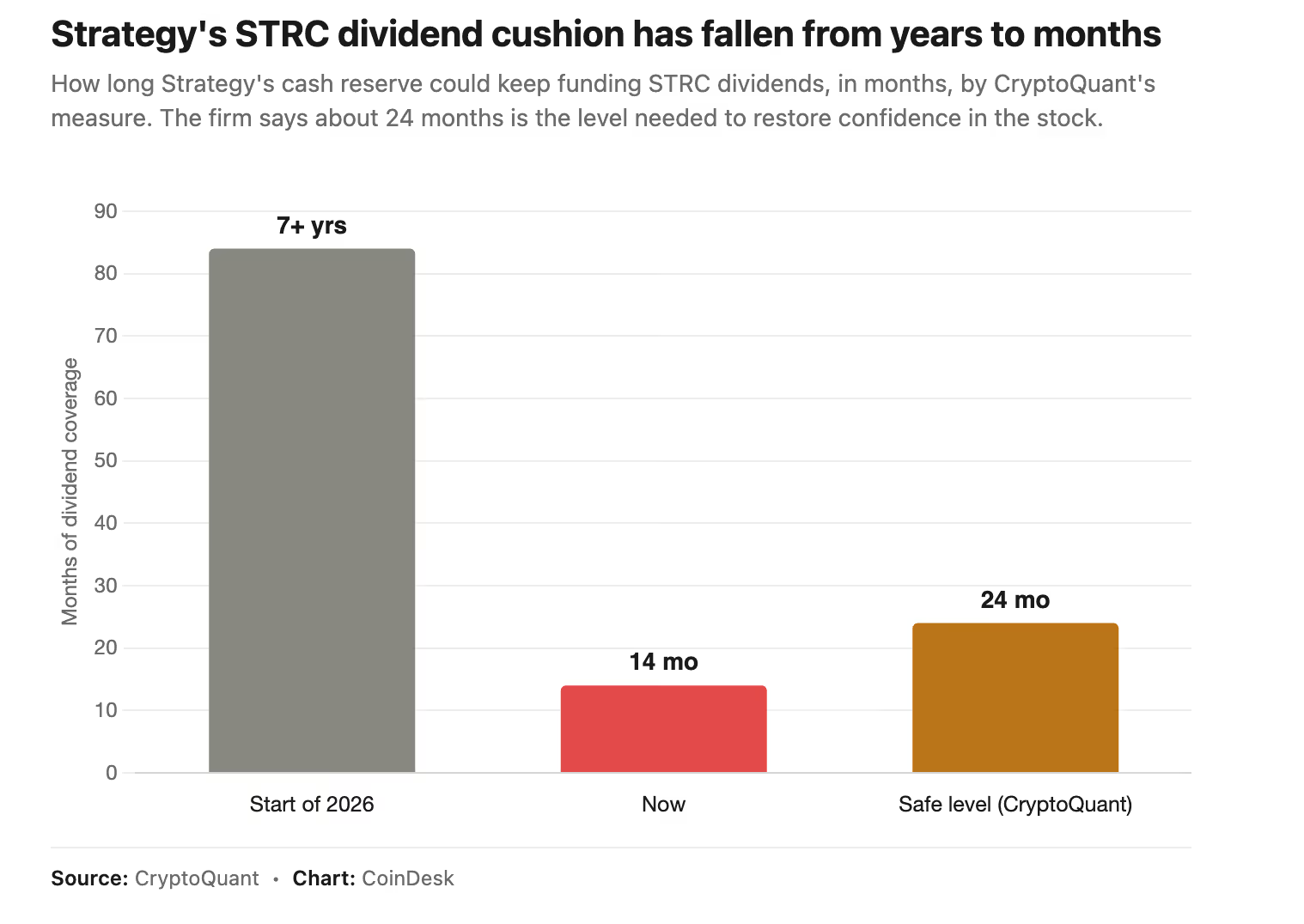
The squeeze comes from both directions. As Strategy issued more STRC to fund bitcoin purchases, its annual dividend obligations ballooned from about $300 million at the start of 2026 to $1.2 billion now, a near fourfold jump in under six months.

CryptoQuant noted the reserve needed to reach about $2.8 billion, or 24 months of coverage, for STRC to recover. As such, Strategy reported a $1.1 billion reserve in mid-June.
So its bitcoin offers less of a backstop than its size suggests.
“The company sits on a $10.6 billion unrealized loss, with all Bitcoin purchased in 2024, 2025, and 2026 underwater,” CryptoQuant said. “Any forced BTC sale at current prices would crystallize large losses and destroy shareholder value.”
A forced sale is unlikely soon, though. Strategy is not required to sell bitcoin to defend STRC and can instead raise the dividend or sell new shares to signal it can keep paying, tools it is already using.
CryptoQuant’s prescription is for Strategy to pause its bitcoin buying and rebuild the reserve first, then adopt a systematic approach to timing purchases rather than buying whenever it raises capital.
Strategy cannot simply switch the payments off to save cash. STRC’s dividends are cumulative, meaning any skipped payment still has to be made up later, and CryptoQuant said the company is unlikely to suspend them anyway because doing so would damage its credibility with the preferred holders it needs.
The report is a sharper read than the one Benchmark-StoneX offered on Tuesday.
A wave of selling in the technology sector that emerged earlier this week has weighed on European equities. The trigger was investor concern over the profitability of large-scale debt-funded investments by major US tech companies in AI infrastructure. The Nasdaq and S&P 500 fell to their lowest levels in more than a week, with semiconductor manufacturers bearing the brunt of the decline.
In Germany, Infineon Technologies (-5.86%), Siemens Energy (-3.93%) and Vonovia (-3.21%) were among the worst performers, while SAP and Airbus ended the session in positive territory, gaining around 2% each. Geopolitical factors also remain in the background: a memorandum signed in June between the United States and Iran has yet to remove uncertainty, with implementation of the agreement still subject to ongoing negotiations.
Technical picture
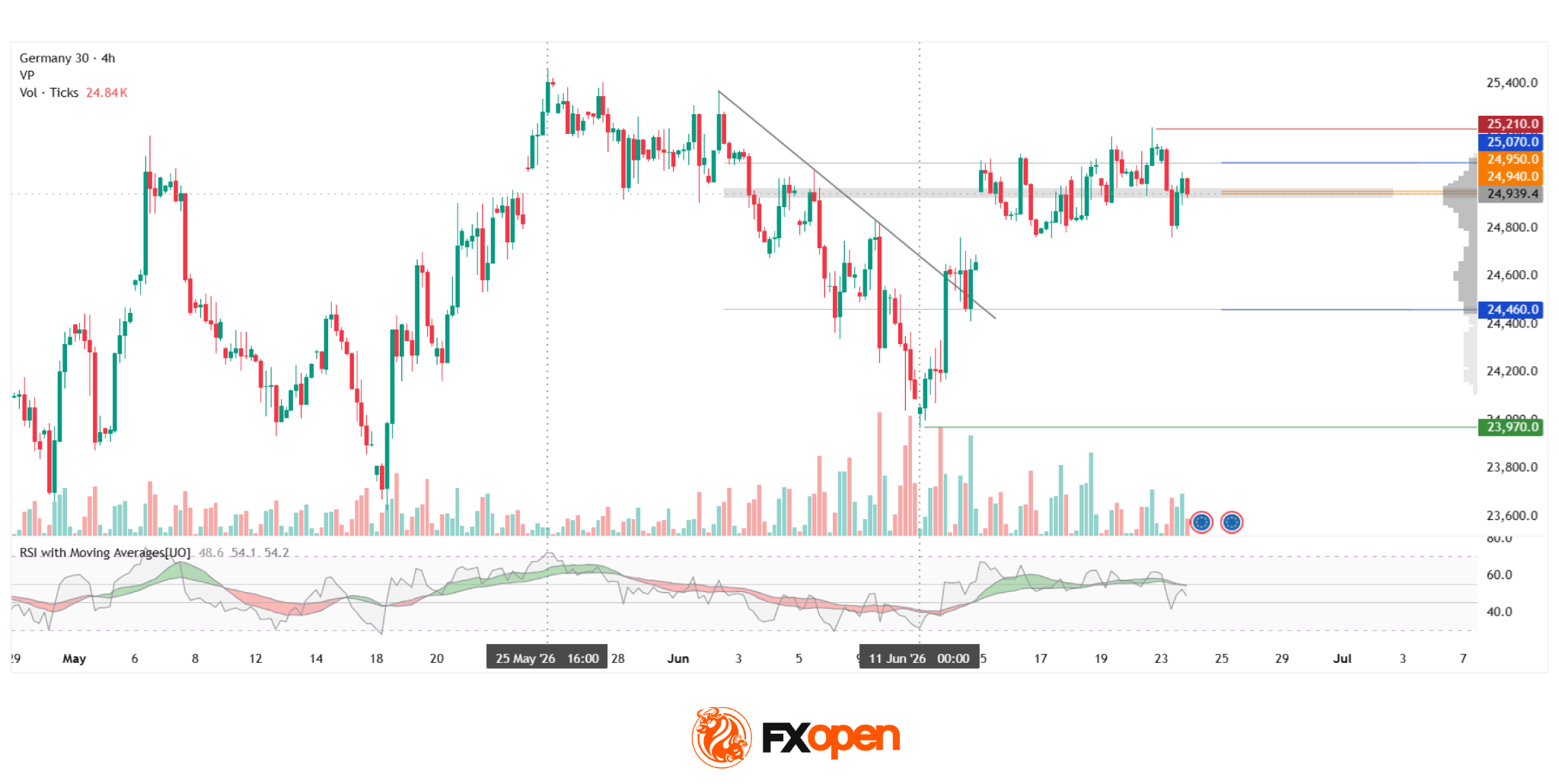
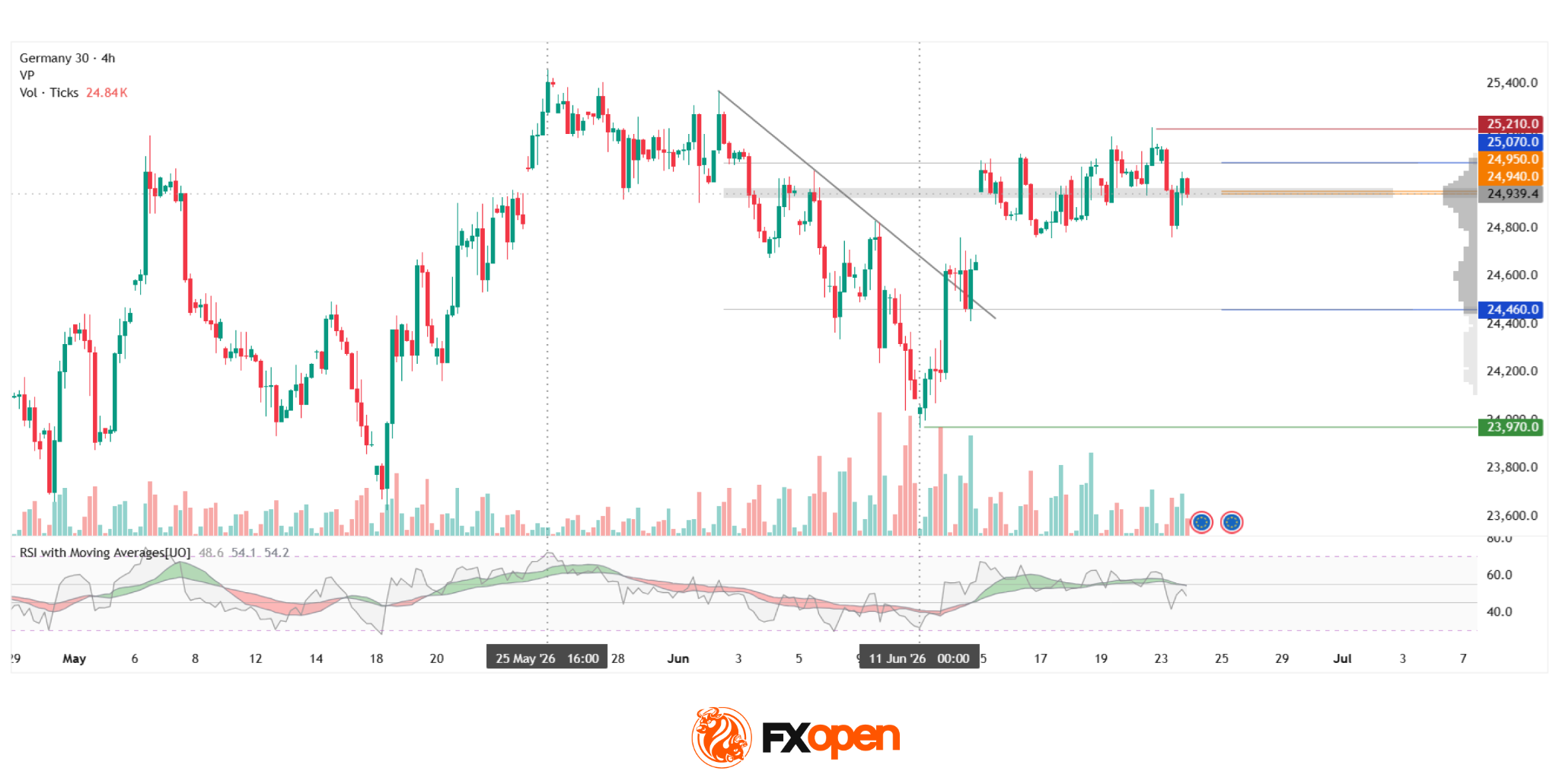
On the H4 chart of the DAX 40 index (GDAXIm on FXOpen), after peaking around 25,450 at the end of May, price declined towards the 23,970 area, forming a downward trend structure. Following an attempted breakout of the downtrend and a gap on 15 June, the index moved into a sideways range, forming a POC zone at 24,940–24,950 and an upper boundary of the current profile at 25,070, with price now trading between these levels.
The nearest resistance is located around 25,210, which could cap the market if the upper boundary of the profile is breached. Support is seen in the 23,970 area, which could be reached if the lower boundary at 24,460 is broken. Volume remains moderate, confirming the consolidation phase. The RSI and moving averages are at 48, 54 and 54 respectively; the oscillator is below its moving averages, while the averages are converging towards neutral levels, indicating a lack of clear momentum within the current range.
Summary
Pressure on the DAX 40 is driven by a global reassessment of AI infrastructure valuations, which has triggered a sell-off in the semiconductor sector worldwide, including German equities. Price has returned to a balance area after the rebound, while the RSI remaining below its moving averages signals a lack of directional momentum on either side.
Trade global index CFDs with zero commission and tight spreads (additional fees may apply). Open your FXOpen account now or learn more about trading index CFDs with FXOpen.
This article represents the opinion of the Companies operating under the FXOpen brand only. It is not to be construed as an offer, solicitation, or recommendation with respect to products and services provided by the Companies operating under the FXOpen brand, nor is it to be considered financial advice.


The US Senate passed sweeping bipartisan housing legislation Monday by a vote of 85-5, sending a package that includes a statutory ban on a Federal Reserve central bank digital currency through December 31, 2030 toward the president's desk. The 21st Century ROAD to Housing Act (H.R. 6644), led by… Read the full story at The Defiant

Strategy’s perpetual preferred stock Stretch (STRC) is under serious financial stress due to two simultaneous pressures, reported onchain analytics firm CryptoQuant on Tuesday.
The Bitcoin bear market means that all BTC purchased between 2024 and 2026 is underwater, with $10.6 billion in unrealized losses, and cash reserves are depleted, down 38% since early 2026 after a $1.5 billion convertible senior note repurchase in May.
Strategy pays dividends on its Stretch product, which offers an 11.5% yield and is designed to trade at $100. However, it fell to a record low of $82.5 last week, a record 17.5% below par.
At current prices of $87.4, the current effective yield is 13.2%, according to the STRC tracker.
Stop Buying Bitcoin
The core problem is that Strategy’s dividend obligations have nearly quadrupled to $1.2 billion per year, while the cash to cover them has shrunk, collapsing dividend coverage from more than seven years to just 14 months.
Last week, Strategy claimed that it had 32 years of dividend coverage using its $55 billion Bitcoin stash, but the argument was flawed.
At current dividend obligations, restoring just 24 months of coverage would require a cash reserve of approximately $2.8 billion, roughly twice what Strategy holds today, said CryptoQuant.
STRC issuance has been an effective capital-raising mechanism for Bitcoin purchases, but the rapid growth of dividend obligations has become a structural liability that could weigh on its sustainability.
“The market appears to be pricing this risk; the STRC price decline reflects not only near-term cash reserve weakness but also long-term concerns about the company’s ability to service its growing dividend burden.”
They added that any forced Bitcoin sale at current prices would crystallize its unrealized losses scale, destroy shareholder value, and potentially catalyze another leg down for BTC spot markets.
CryptoQuant recommended that the company “pause Bitcoin purchases until cash reserves and dividend coverage are restored.”
Strategy’s annualized dividend obligations have nearly quadrupled to $1.2B, while its cash reserve has fallen 38% in 2026.
Dividend coverage collapsed from 7+ years to just 14 months.
The company needs to stop buying Bitcoin and rebuild cash. pic.twitter.com/TR0oaAnT5k
— CryptoQuant.com (@cryptoquant_com) June 23, 2026
Saylor seems adamant, however, with the firm’s latest purchase of 520 BTC for $35 million while increasing its USD reserve by $300 million to $1.4 billion on Monday.
STRC, MSTR, and BTC Declining
The move gave some brief respite to STRC, which returned to $88 on Tuesday, but it remains in trouble, trading below par.
Company stock (MSTR) has also taken a beating, tanking a further 5% on Tuesday to end the day trading at $103.84, its lowest level since early 2024, according to Google Finance.
The move coincided with another Bitcoin dip as the asset failed to hold $64,000 and fell to $62,000 on Tuesday. BTC reclaimed $63,000 during the Asian trading session on Wednesday, but had already started to fall back from that level at the time of writing.
The post Saylor Should Stop Buying Bitcoin, Says CryptoQuant appeared first on CryptoPotato.
INFINIOS and Circle Partner to Expand Digital Finance Infrastructure Across the Middle East

Ryan Lochte Escapes Foreclosure Days After Engagement

Shop banned from selling tobacco fined after getting caught again


-

 Fashion5 days ago
Weekend Open Thread: Miami – Corporette.com
-

 Entertainment3 days ago
Renter of Home in Anne Heche Crash Denies Settlement With Son
-

 Tech2 days ago
Microsoft accidentally kills epic Outlook email threads
-

 Business3 days ago
Soccer-U.S. defends Iran World Cup travel restrictions, says discussions ongoing
-
 Sports14 hours ago
Two goals and an assist by sheer aura: Cristiano Ronaldo just entered the World Cup chat
-
Crypto World5 hours ago
Bitcoin (BTC) Dips Below $62K, Ethereum (ETH) Plunges 6% Daily: Market Watch
-

 Politics6 days ago
BBC Reporter Discusses Cross Party Criticism Of Trumps Iran Deal
-
Business8 hours ago
Entergy settles forward sale agreements, raises $672 million in cash proceeds
-
 Business4 days ago
Wall Street Week Ahead: Investors see Micron earnings as pulse check of AI rally momentum
-

 Politics4 days ago
Andy Burnham and the meaning of Makerfield
-

 Tech6 days ago
AWS enters the context layer race with a graph that learns from agents, not manual curation
-
 Crypto World4 days ago
Can Charles Hoskinson Really Rescue Cardano?
-

 Crypto World4 days ago
HIVE shares jump as $220M AI deal speeds Bitcoin mining pivot
-

 Crypto World2 hours ago
Securitize Wraps Roubini's SEC-Registered ETF as Dubai VARA Digital Security
-

 Crypto World4 days ago
Jake Chervinsky accuses CME of protecting derivatives monopoly
-

 NewsBeat5 days ago
Keir Starmer Allies Question His Chances For No 10
-

 Tech2 days ago
Nearly 7,000 fake Amazon domains registered ahead of Prime Day 2026, researchers warn
-

 Business5 days ago
Brexit cost 6% of UK economy, Bank of England company data suggests
-

 Sports5 days ago
FIFA World Cup 2026: Canada beat 9-men Qatar 6-0 to register first ever win | FIFA World Cup 2026
-
 Tech3 days ago
Signal’s Meredith Whittaker says AI chatbots ‘are not your friends’ and calls Copilot agents a backdoor
You must be logged in to post a comment Login