
Crypto World
PIPPIN Jumps 23% as AI and Meme Tokens Gain Momentum

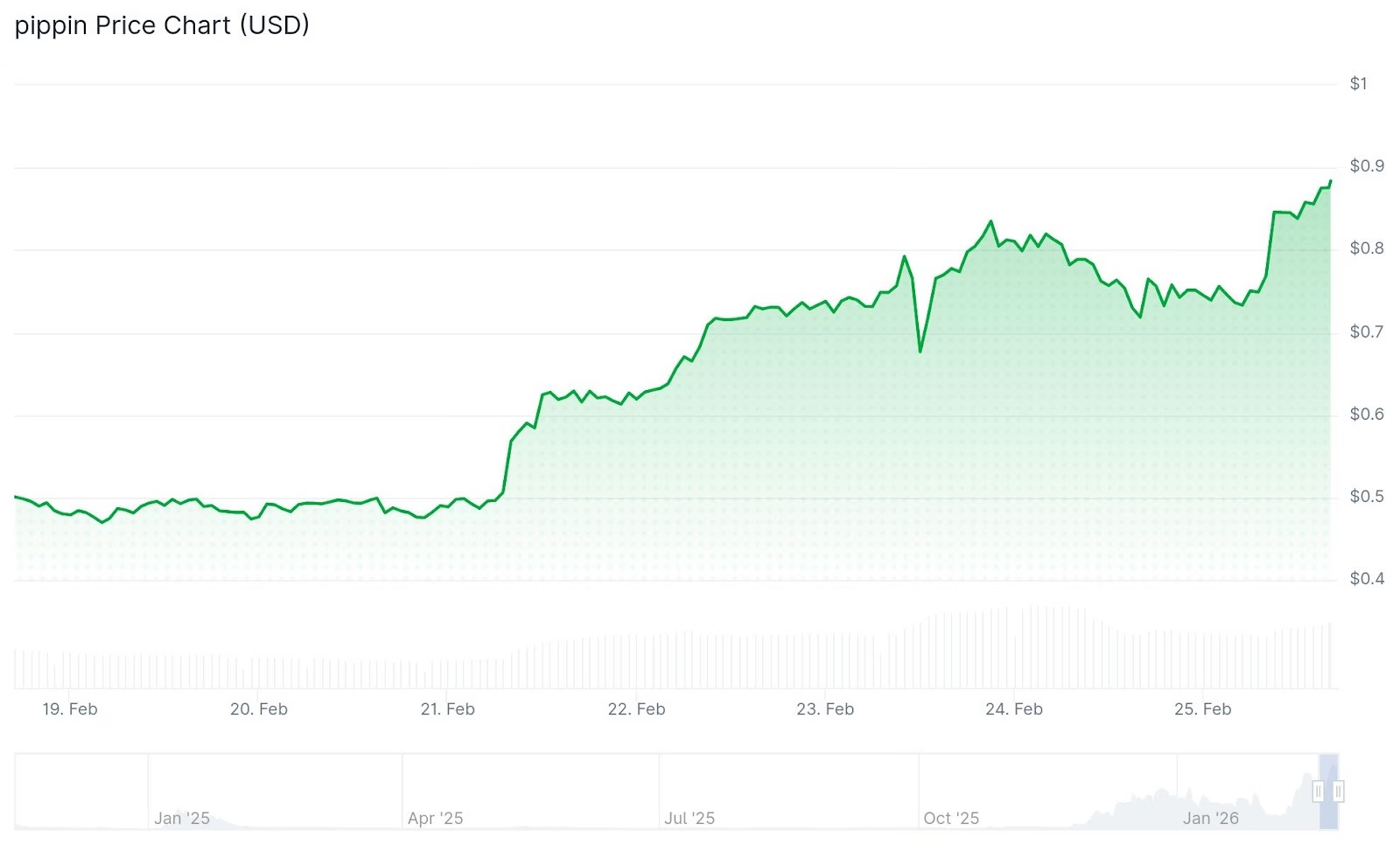
The Solana-based AI memecoin is up 170% over the past month.
PIPPIN, an AI-driven memecoin on the Solana blockchain, surged 23% over the past 24 hours, outperforming large-cap cryptocurrencies as traders rotated into narrative-focused tokens.
The coin is currently hovering around $0.87, up 70% over the past week and 169% over the past month. It boasts a market capitalization of around $870 million, with daily trading volume above $70 million, according to CoinGecko.

The rally comes as AI-linked tokens have regained attention across crypto markets in recent days. The AI token sector’s market cap today is $13.8 billion, up 5.6% over 24 hours. The meme-coin market is also higher at $34.6 billion, up 4.7%, with PIPPIN leading the surge. Meanwhile, the global cryptocurrency market cap stands at $2.38 trillion, down 2.2% on the day.
PIPPIN’s move also reflects a broader trend of markets reacting to AI narratives, where even hypothetical scenarios have recently moved stocks and crypto. However, some experts say the rally has no clear driver.
“The PIPPIN AI-meme token has been going up since early December 2025. There isn’t too much known about why,” Nicolai Sondergaard, research analyst at Nansen, told The Defiant. “In addition, much of the supply is on exchanges (GATE), which further reduces the likelihood of understanding what is going on.”
Sondergaard explained that there also aren’t many smart money or public figures in it anymore, and that a majority of the top holders are labeled on-chain as “investment recipients.”
“This could insinuate somewhat centralized control,” Sondergaard added. “Alas, this cannot be proven or disproven at this point, even if accusations such as these have been flying around on CT.”
CoinGecko also cautioned traders to do their research before trading PIPPIN, as Bubblemap data found that 80% of its supply is controlled by interconnected insider wallets.



Anthropic revenue surpassed $30 billion on an annualized basis as of early April 2026, the company disclosed alongside a major new compute deal with Google and Broadcom, marking a more than threefold increase from the approximately $9 billion run rate it reported at the end of 2025.
Summary
- The $30 billion figure puts Anthropic ahead of OpenAI’s reported run rate of approximately $24 to $25 billion, with the gap driven by Anthropic’s enterprise-heavy revenue mix: 80 percent of its revenue comes from business customers rather than consumers, producing higher retention and lower churn than a consumer-first product strategy
- Over 1,000 business customers are now each spending more than $1 million annually on Claude services, doubling from 500 when Anthropic raised its Series G at a $380 billion valuation in February 2026; the company says that number doubled in less than two months
- Alongside the revenue disclosure, Anthropic confirmed a new long-term agreement with Google and Broadcom for multiple gigawatts of next-generation TPU computing capacity beginning in 2027, described by CFO Krishna Rao as “our most significant compute commitment to date”
Anthropic’s official announcement states plainly: “Our run-rate revenue has now surpassed $30 billion, up from approximately $9 billion at the end of 2025.” The trajectory behind that figure is striking. The company had a run rate of roughly $1 billion at the start of 2025, $4.5 billion by mid-year, $9 billion by year-end, $14 billion in February when it announced its Series G, and $30 billion in April. Each milestone came faster than the prior one. CEO Dario Amodei has noted repeatedly that he has consistently underestimated his own company’s growth, saying he is “always very conservative” on the business side and has been wrong every time.
Claude Code, the company’s agentic coding platform, has been a particular standout, generating over $2.5 billion in run-rate revenue as of February 2026, with weekly active users doubling since January 1.
The enterprise customer expansion tells the most important part of the story. When Anthropic announced its Series G in February, it noted that over 500 business customers were each spending more than $1 million annually. That number now exceeds 1,000 and doubled in less than two months. This is not organic drift from marketing. It reflects a fundamental shift in how large organizations are deploying AI: not as a search replacement or productivity experiment, but as core infrastructure for legal, finance, consulting, and communications workflows where knowledge worker productivity carries a measurable premium. Claude’s API market share expanded from 12 percent in 2023 to 32 percent by mid-2025, overtaking OpenAI to become the enterprise language model leader by that measure.
What the Google and Broadcom Compute Deal Signals
The timing of the compute announcement alongside the revenue disclosure is deliberate. Anthropic is signaling to the market that it has the demand to justify infrastructure at a scale few companies can access. The deal gives Anthropic access to approximately 3.5 gigawatts of TPU-based computing capacity beginning in 2027, an extension of the $50 billion US AI infrastructure commitment announced in November 2025. Anthropic already runs workloads on AWS Trainium, Google TPUs, and Nvidia GPUs, matching each workload to the chips best suited for it.
What a $30 Billion Run Rate Means for the AI Market
As crypto.news has reported, the revenue signals coming from frontier AI companies are now primary inputs for institutional investors assessing whether the AI buildout justifies current infrastructure spending levels. As crypto.news has noted, the competitive dynamics between Anthropic and OpenAI have direct market effects on AI-adjacent crypto assets and the broader perception of the AI sector’s capital efficiency. Anthropic projects positive free cash flow by 2027 while OpenAI has pushed its breakeven target to 2030, a structural gap that is now visible in revenue terms.

Securitize has appointed Brett Redfearn as its president and as a member of the tokenization platform’s board of directors, underscoring the crypto industry’s growing pull for former regulators and established market veterans. Redfearn, who previously led the U.S. Securities and Exchange Commission’s Division of Trading and Markets, spent over a decade at JPMorgan and later served as Coinbase’s head of capital markets. He has also been a member of Securitize’s advisory board, and the company’s Thursday notice confirmed the leadership change as it continues to push real-world asset tokenization into the crypto mainstream.
The move arrives as tokenization of real-world assets (RWA) gains momentum across crypto markets. Securitize’s boardroom shake-up comes amid a broader surge in on-chain assetization activity, with data from analytics platform RWA.xyz showing $3.85 billion in distributed asset value across platforms in March and tokenized stocks on-chain surpassing $1 billion in total value. The numbers highlight a material shift toward regulated, tokenized exposure to traditional assets within the crypto ecosystem.
Key takeaways
- Brett Redfearn is named president and board member of Securitize, bringing SEC leadership experience, Coinbase capital markets background, and JPMorgan tenure to the tokenization platform.
- Market momentum for tokenized assets remains robust, with March data placing distributed asset value at about $3.85 billion on RWA platforms and tokenized stocks crossing $1 billion in on-chain value.
- The SEC is recalibrating its enforcement leadership, naming David Woodcock as director of the Division of Enforcement, a role that will shape crypto oversight as the space expands.
- Lawmakers are scrutinizing regulator departures, including the exit of former enforcement head Margaret Ryan, amid ongoing questions about crypto enforcement actions and dropped cases.
- The broader trend of ex-government officials entering crypto continues, signaling a convergence of traditional financial governance experience with digital asset markets.
Strategic pivot at Securitize
In its official announcement, Securitize confirmed Brett Redfearn’s elevation to president and a seat on the company’s board. The former SEC official led the agency’s Division of Trading and Markets, a portfolio overseeing market structure and regulatory compliance, before moving to Coinbase as head of capital markets. He also accumulated frontline experience at JPMorgan spanning various roles across a decade. By bringing Redfearn onto the executive team, Securitize signals a continued emphasis on robust compliance, market governance, and scalable tokenization of real-world assets—areas where regulatory familiarity and traditional market discipline can be advantageous for accelerating institutional-grade adoption.
Redfearn’s growing role at Securitize also reflects a broader industry trend: attracting senior figures with public-sector credibility to help bridge crypto innovation with established financial norms. The executive’s transition from public service to private sector leadership dovetails with ongoing investor appetite for regulated pathways to tokenized exposure, especially in tokenized securities, asset-backed tokens, and other RWAs that promise enhanced liquidity and efficiency for traditional instruments.
RWAs and tokenization momentum
The market context for Redfearn’s appointment is favorable to Securitize’s business model. Data from RWA.xyz indicate a sustained surge in tokenized assets, with March totaling roughly $3.85 billion in distributed asset value across platforms. In parallel, tokenized stocks have crossed a notable threshold, with on-chain value exceeding $1 billion. These figures illustrate not only growing demand for tokenized access to mainstream assets but also the viability of regulated tokenization rails that can support larger, more diverse pools of capital.
For investors, the implication is twofold: first, tokenized RWAs offer a potential pathway to diversification and liquidity in traditional asset classes; second, the involvement of experienced financial-services executives in tokenization ventures could help drive scalable governance, risk controls, and compliance frameworks that appeal to institutions wary of regulatory uncertainty. Securitize’s leadership move aligns with a market that increasingly prioritizes both innovation and credible oversight as use cases expand beyond crypto-native tokens.
Regulatory backdrop and leadership reshuffle
Beyond Securitize’s leadership update, the regulatory environment is experiencing a notable transition. The SEC announced that David Woodcock would become director of the Division of Enforcement, with the appointment set to take effect on May 4. The change comes as the agency continues to navigate a contentious policy landscape for crypto-related enforcement, and as lawmakers press for clarity on how the SEC will approach recent crypto cases and policy shifts.
Interest among lawmakers centers on the departure of former enforcement head Margaret Ryan and questions about the SEC’s crypto crackdown strategy, including whether certain cases have been dropped or recalibrated. While authorities have pursued various actions against crypto firms and projects in recent years, the timing and rationale behind high-profile moves have drawn scrutiny from Capitol Hill. The broader takeaway for market participants is a heightened focus on how enforcement direction and regulatory priorities will shape project roadmaps, exchange behavior, and the permitting environment for tokenized assets.
In parallel, industry observers note how the movement of former regulators into crypto companies—such as Caroline Pham’s shift from the Commodity Futures Trading Commission to MoonPay—illustrates a broader willingness among policy veterans to contribute to, and influence, the sector’s development. This trend does not guarantee favorable policy outcomes, but it does signal a convergence of traditional financial governance with crypto innovation, potentially accelerating the adoption of clearer compliance standards and governance practices.
What this means for investors, builders and users
The confluence of leadership experience and tangible market momentum in RWAs points to a maturing segment of the crypto economy. For investors, the combination of seasoned governance acumen and regulatory-aware product design could translate into more credible access points to real-world assets, with improved risk management and reporting. For builders, Redfearn’s appointment may encourage the creation of more transparent issuance and custody solutions, along with stronger tokenization infrastructure that stands up to regulatory scrutiny. For users, the trend could translate into broader ranges of tokenized securities and asset-backed tokens that operate on trusted rails, delivering greater liquidity and on-chain settlement efficiencies.
That said, uncertainties remain. The regulatory posture toward crypto enforcement and the specifics of how RWAs will be treated under securities or commodities regimes will continue to influence product design, listing standards, and cross-border considerations. Market watchers should monitor how Woodcock’s leadership style translates into enforcement priorities and whether the SEC’s approach to complex asset-backed tokens evolves in a direction that reduces friction for compliant projects while preserving investor protections.
As the sector evolves, the next few quarters will reveal how these leadership movements translate into tangible policy signals, partnerships, and capital flows. Expect further commentary from industry participants on how tokenization platforms align with evolving regulatory expectations, and watch for any new data points that illuminate the pace of adoption among institutional participants seeking regulated exposure to tokenized real-world assets.
Readers should keep an eye on Securitize’s strategic execution under Redfearn’s presidency—especially initiatives around onboarding institutions, expanding the RWA toolkit, and advancing governance standards. Concurrently, any developments from the SEC’s enforcement division and congressional inquiries into crypto cases will help frame the risk and opportunity landscape for tokenized assets in the near term.

TLDR:
- Bitcoin continues trading below $72K after repeated rejection, keeping the market inside a tight consolidation range.
- On-chain data shows only 59% of the Bitcoin supply remains in profit, nearing levels seen during past bear markets.
- Traders watch $69,100 support and $72,000 resistance as key zones that could determine Bitcoin’s next move.
- Analysts note that extreme loss levels historically create accumulation opportunities before broader market sentiment improves.
Bitcoin continues to trade within a tight range below $72,000 as analysts track liquidity levels and momentum signals.
At the same time, on-chain data shows the share of BTC supply in profit falling toward levels last seen during previous bear cycles.
Bitcoin Faces Resistance Near $72K as Traders Watch Liquidity Zones
Bitcoin has struggled to maintain momentum above the $72,000 region during recent sessions. The market rejected this level again, keeping price action inside a narrow trading range.
Crypto analyst Lennaert Snyder discussed the setup in a post on X, noting that Bitcoin faced rejection near $72,000 again. As a result, he opened a small hedge short after the failed breakout attempt.
According to Snyder, liquidity around $66,590 remains a potential downside target this week. He also noted that the present zone offers poor risk-reward conditions for long positions.
The analyst explained that long setups may become attractive under two scenarios. One option involves Bitcoin reclaiming the $72,000 resistance zone. The other scenario involves a pullback toward the $69,100 level.
That area contains a four-hour imbalance and marks the lower edge of the recent trading range. If buyers regain control, Snyder expects liquidity around $74,800 to become the next weekly target.
Meanwhile, technical indicators still show moderate bullish momentum. The Relative Strength Index currently stands near 65, which signals steady buying pressure.
However, the indicator remains below the overbought threshold of 70. This suggests room for further upside if demand continues.
The Moving Average Convergence Divergence indicator also remains positive. The MACD line stays above the signal line, while the histogram shows weakening but positive momentum.
These signals suggest consolidation may continue before the next directional move develops.
On-Chain Data Shows Bitcoin Profit Supply Near Bear Market Levels
While price remains near recent highs, on-chain data presents a different picture of investor positioning.
CryptoQuant contributor Darkfost shared new data showing a drop in Bitcoin’s profit supply. The analysis estimates that around 59% of the circulating Bitcoin supply currently sits in profit.
This means nearly one Bitcoin out of every two remains held at a loss. The figure sits close to levels observed during previous bear market conditions.
Historically, the market tends to operate with a higher share of profitable supply. Data shows the long-term average sits closer to 75%.
The gap between current levels and the historical average shows that many investors entered positions at higher prices.
The data also identifies a key threshold around the 50% level. Previous bear markets often reached a bottom near that point. Although the current market has not reached that level, the trend suggests widespread unrealized losses across the network.
Darkfost explained that profitable supply plays an important role in sustaining market momentum. When investors hold gains, they are more likely to continue participating in the market. However, when losses dominate the supply distribution, sentiment often weakens.
For this reason, the analyst described the current environment as more suitable for accumulation strategies. Market participants often increase exposure during periods when losses reach extreme levels.
The strategy aims to position investors before broader market sentiment turns positive again. At the same time, exposure typically decreases when the share of supply in profit approaches 100%.
For now, Bitcoin remains within a defined price range while traders monitor resistance near $72,000 and support levels below $70,000.



The US inflation reading the market has been dreading arrives Friday morning when the Bureau of Labor Statistics releases the March Consumer Price Index at 8:30 AM ET, with economists widely forecasting it will be the hottest monthly inflation print since May 2022, driven almost entirely by the energy shock from the Iran war.
Summary
- Barclays Senior US Economist Pooja Sriram forecasts March headline CPI at 0.9 percent month over month and 3.3 percent year over year, “led by a surge in gasoline prices”; BofA Securities economists project a 10.6 percent monthly jump in energy prices driving a 0.9 percent headline increase; Oxford Economics projects headline CPI above 3 percent in March and above 4 percent in April
- The expected reading would mark a sharp reversal from the 2.4 percent annual inflation rate recorded in the first two months of 2026, and would be the first major inflation data to reflect the impact of the Iran war on consumer energy prices; Pantheon Economics says the US experienced the largest one-month jump in fuel costs since at least 1957
- Core CPI, which strips out volatile food and energy, is forecast to rise 0.3 percent monthly and 2.7 percent year over year, with the Federal Reserve expected to hold interest rates at 3.50 to 3.75 percent at its April 29 meeting; CME FedWatch shows 98.4 percent of respondents pricing in no change
As Kiplinger reported, “How much and how severely depends on just how long the conflict continues to crimp key energy exports. Some degree of inflation is now inevitable.” That framing captures the central tension in Friday’s release: whether the data confirms a one-month spike that fades as oil stabilizes, or signals the opening print of a new inflation regime where the Iran war has durably repriced transportation, manufacturing, and utility costs across the economy.
Consumers have already paid approximately $8.4 billion in additional fuel costs in the month after the Iran war started, according to an estimate from the Joint Economic Committee’s Democratic minority. Gasoline prices have averaged over $4 per gallon nationally, with oil remaining close to $110 per barrel even after the temporary ceasefire announcement caused a brief drop.
Since the post-2009 recovery, only five months have produced a monthly CPI reading of 0.9 percent or higher. Every one of them fell between October 2021 and June 2022, at the peak of the post-pandemic inflation surge. March 2026 is expected to join that short and painful list. The mechanism is straightforward: the Iran war disrupted oil flows through the Strait of Hormuz, the world’s most critical petroleum corridor, causing a supply shock that fed immediately into gasoline, diesel, and jet fuel prices. Energy costs then ripple into transportation, food distribution, and manufacturing, which is why Oxford Economics expects the headline rate to climb above 4 percent in April even after the temporary ceasefire.
What the Report Means for the Federal Reserve
The Fed had penciled in one interest rate cut for 2026 before the Iran war began. The war repricing of energy has caused many economists to remove that cut from their forecasts entirely. Austan Goolsbee, president of the Federal Reserve Bank of Chicago, warned that rising prices could pressure household budgets and derail spending. Some Fed policymakers signaled in March meeting minutes that future rate hikes may need to be considered if inflation accelerates further. Mark Zandi, chief economist at Moody’s Analytics, told CBS News: “We’re going to be paying the price for this through much of the year.”
What to Watch in the Numbers When the Report Drops Friday
As crypto.news has reported, bitcoin and crypto markets have been closely tracking every inflation signal in 2026, with the war-driven energy shock adding a new layer of uncertainty on top of existing tariff and monetary policy pressures. As crypto.news has noted, the March CPI release is one of the most anticipated economic events of the quarter for crypto investors because a number above 3.5 percent would likely extend the Fed pause and suppress the rate-cut narrative that has historically supported risk asset rallies. The report drops at 8:30 AM ET Friday, April 10.
Morgan Stanley Bitcoin Trust (MSBT) launched on April 8 with a 0.14% expense ratio, making it the cheapest US spot Bitcoin ETF and undercutting BlackRock’s iShares Bitcoin Trust (IBIT) by 11 basis points.
Senior ETF analyst Eric Balchunas, however, does not expect BlackRock to respond with a fee reduction. His reasoning centers on IBIT’s liquidity advantage and dominant market position.
This ETF Expert Thinks Otherwise
MSBT pulled in approximately $30.6 million in net inflows on its first day and processed more than 1.6 million shares.
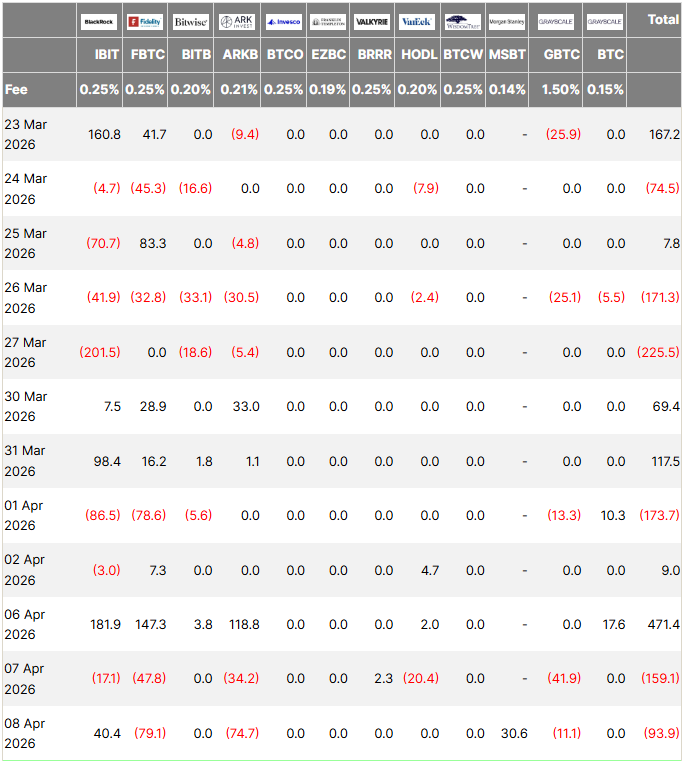
Balchunas placed the debut among the top 1% of all ETF launches. He has also projected $5 billion in AUM for MSBT within its first year.
Still, he made clear that IBIT’s position remains secure for now. IBIT holds roughly $55 billion in assets, making it by far the most liquid spot BTC ETF.
“Prob won’t see any cut from $IBIT. When you are King of the Hill with tons of liquidity, you have pricing power,” wrote Balchunas.
That liquidity moat gives IBIT tighter trading spreads and deeper options market activity, two factors that institutional traders weigh heavily when choosing a fund.
Fellow Bloomberg analyst James Seyffart echoed that view, noting it is unlikely MSBT will compete with IBIT on liquidity anytime soon.
Where the Pressure Falls
Balchunas warned that MSBT’s aggressive pricing could still trigger fee cuts elsewhere. Smaller issuers with less scale may be forced to lower their expense ratios to retain market share.
Because all spot BTC ETFs hold the same underlying asset, fees become one of the few differentiators. MSBT now sits one basis point below Grayscale’s Bitcoin Mini Trust at 0.15% and well below Fidelity’s Wise Origin Bitcoin Fund (FBTC) at 0.25%.
Morgan Stanley also brings a structural advantage most competitors lack. The bank’s wealth management arm employs roughly 16,000 financial advisors overseeing $9.3 trillion in client assets.
Those advisors can now recommend an in-house product rather than directing clients to third-party funds.
Balchunas identified only two scenarios that could force BlackRock to reconsider its pricing.
- The first would be sustained outflows from IBIT toward cheaper rivals.
- The second would be an entry from Vanguard at approximately 0.10%, though he assigned that outcome a 0.01% probability.
The US spot BTC ETF market has grown past $100 billion in cumulative assets since launching in January 2024.
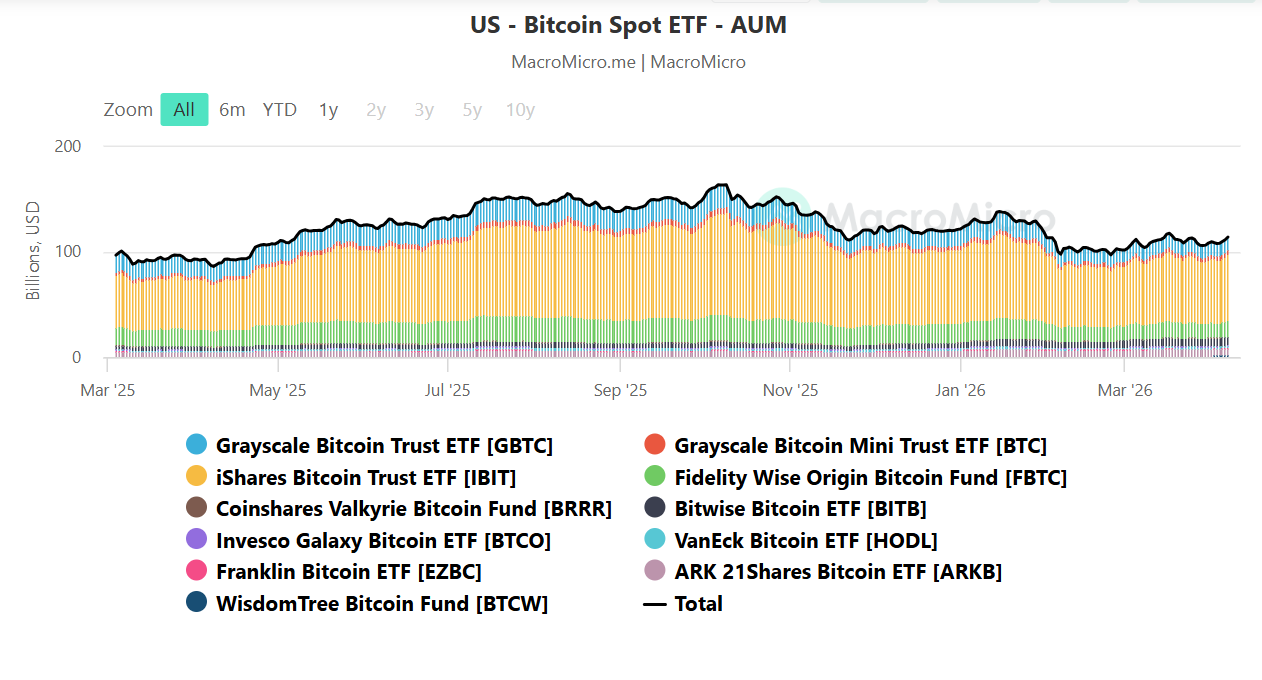
However, 2026 started slowly, with four consecutive months of net outflows between November 2025 and February 2026.
March reversed that trend with $1.32 billion in inflows. Whether MSBT can sustain its opening momentum and capture a meaningful share of new flows will likely determine how seriously competing issuers treat its pricing signal.
The post 2 Conditions That Could Force BlackRock to Cut IBIT Fees After MSBT’s Undercut appeared first on BeInCrypto.


Binance Wallet has integrated predict.fun prediction markets and is sponsoring all gas fees for users on BNB Smart Chain.
Binance Wallet has integrated BNB Smart Chain-based predictfun as its official prediction market provider. Predictfun is backed by YZi Labs, formerly Binance Labs, the centralized exchange’s venture capital arm.
The integration allows Binance Wallet users to access prediction market functionality directly within the wallet interface without bearing transaction costs on the BNB network.
The move comes amid broader regulatory scrutiny of prediction markets in the U.S., including recent CFTC action seeking to enjoin Arizona from enforcing criminal and civil penalties against prediction market operators. Predictfun operates as a decentralized prediction market platform, and the Binance Wallet integration represents a major distribution channel for the protocol.
Sources: Binance Wallet
This article was generated automatically by The Defiant’s AI news system from publicly available sources.
MSBT saw a strong first day of trading on Wednesday, but the broader U.S. Bitcoin ETF sector was in the red yesterday.
Morgan Stanley’s spot Bitcoin (BTC) ETF, MSBT, kicked off trading as expected on Wednesday, April 8, on NYSE Arca. The fund saw a relatively strong debut, with $30.6 million in net inflows yesterday, per Farside data.
Morgan Stanley’s fund page shows that the fund held 444.4 BTC valued at $31,654,653.90 as of April 8. Meanwhile, CoinDesk reported the fund generated $34 million in day-one trading volume.
Bloomberg senior ETF analyst Eric Balchunas commented on the day-one performance midday on yesterday, when MSBT had already recorded $27 million in trading volume. Balchunas pushed his original $30 million day-one volume prediction to $50 million in the X post. For context, Balchunas reference two recent crypto ETF launches, for Solana and XRP funds, which both saw nearly $60 million traded on their first day.
The launch makes Morgan Stanley the first major U.S. commercial bank to issue its own spot Bitcoin ETF. A key competitive advantage, as The Defiant previously reported, is that MSBT carries a 0.14% expense ratio — the lowest in the U.S. spot Bitcoin ETF market, undercutting BlackRock’s IBIT (0.25%), Fidelity’s FBTC (0.25%), and Grayscale’s Bitcoin Mini Trust (0.15%).
The same day as MSBT’s positive debut, total U.S. spot BTC ETF products, excluding MSBT, saw $124.55M in net outflows, per SoSoValue data. However ,BlackRock’s IBIT — by far the leading product in terms of cumulative net inflows — bucked the trend with $43.38 million in net inflows on the day Wednesday.
As of midday ET today, April 9, MSBT had seen 610,525 shares traded at a current price of $20.67, putting intraday volume at approximately $12.6 million, per Yahoo Finance data.
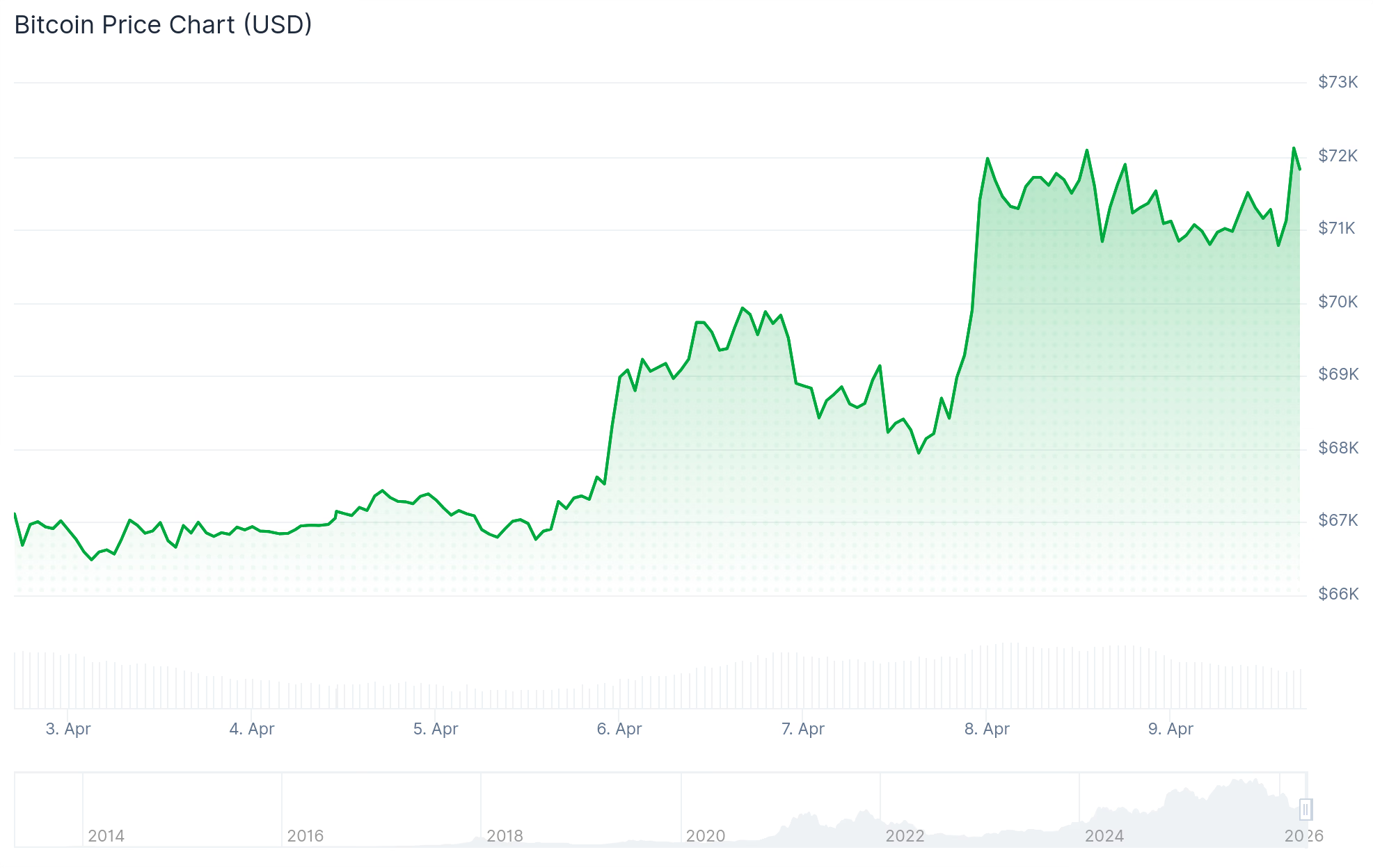
Bitcoin was trading just below $72,000 at press time, per The Defiant’s price tracker. The prior day had seen a sharp ceasefire-driven short squeeze push crypto markets higher.

MSBT’s launch is the latest milestone in a deepening institutional embrace of Bitcoin. The Defiant has tracked how advisor-driven capital has become the largest category of institutional Bitcoin ETF buyers, surpassing hedge funds and brokerages — precisely the channel Morgan Stanley is now positioned to dominate.
When the bank first filed for MSBT in January, Balchunas called it a “shocker” and noted the firm’s existing advisor approvals for crypto allocations made issuing their own branded fund a natural next step.
The question now is whether day-one momentum translates into sustained flows, and whether other banks follow Morgan Stanley through the door it has opened.
This article was written with the assistance of AI workflows. All our stories are curated, edited and fact-checked by a human.
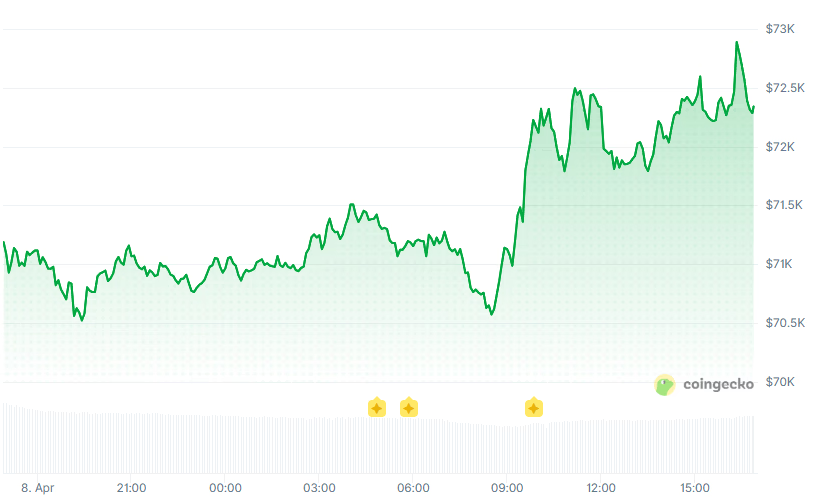
BTC clung to a three-week high as the Iran truce lifted risk assets, but doubts about the deal’s durability capped upside.
Bitcoin held above $72,000 on Thursday, consolidating near its highest levels in three weeks as crypto markets digested a fragile ceasefire between the United States and Iran.
BTC was changing hands at $72,285, up 1.5% over the past 24 hours and 8% on the week, according to CoinGecko. Ethereum rose 0.6% to $2,210, also up 7.2% over the past seven days. XRP gained 0.6% to $1.36, BNB edged up 0.2% to $607.25, and Solana climbed 2% to $84, bringing its weekly gains to 6.6%.

The gains followed a sharp ceasefire-driven short squeeze that sent BTC to its highest level since mid-March.
President Donald Trump said on Truth Social Thursday that all U.S. military assets would remain in place around Iran until the ceasefire is “fully complied with,” warning that failure could lead to renewed conflict. Meanwhile, Iran continued to restrict traffic in the Strait of Hormuz and proposed a $1-per-barrel fee on transiting oil, drawing criticism from the EU and the United States.
Total crypto market capitalization stood at approximately $2.53 trillion, per CoinGecko, up from $2.43 trillion at the start of the week.
Morgan Stanley’s MSBT Debuts
Morgan Stanley’s spot Bitcoin ETF, MSBT, kicked off trading as expected on Wednesday on NYSE Arca. The fund saw $30.6 million in net inflows on its first day.
The fund carries a 0.14% expense ratio, the lowest in the U.S. spot Bitcoin ETF market, undercutting BlackRock’s IBIT at 0.25% and Grayscale’s Bitcoin Mini Trust at 0.15%. Bloomberg
Despite MSBT’s strong debut, the broader U.S. spot BTC ETF complex saw $124 million in net outflows on Wednesday, excluding MSBT, per SoSoValue. Total AUM across U.S. spot Bitcoin ETFs stood at $91.9 billion, or about 6.43% of Bitcoin’s overall market cap.
The outflows followed a $471 million single-day inflow on April 6, when spot Bitcoin ETFs recorded their strongest daily inflows since February, despite ongoing geopolitical tensions
ZEC Leads Altcoins
Zcash was the standout performer this week. ZEC surged another 15% to $371 on Thursday, leading the broader market. The token has gained over 65% in the past 30 days, fueled by a risk-on rotation, a pending decision on the Grayscale spot ZEC ETF, and Foundry’s institutional mining pool launch.

On the downside, World Liberty Financial’s WLFI token fell roughly 10% to an all-time low of $0.0885. On-chain data showed WLFI deposited 5 billion of its own tokens as collateral to borrow stablecoins.
Looking Ahead
The two-week ceasefire window is set to expire around April 21, with peace negotiations expected to begin Friday in Islamabad. Whether the rally extends depends on the truce’s durability.
Fed minutes released Wednesday showed officials believe inflation may fall slowly toward 2%, while oil risks add pressure. Policymakers signaled room for either hikes or cuts depending on conditions, a hawkish undertone that adds another headwind for risk assets already contending with geopolitical uncertainty.

The US Treasury’s Office of Cybersecurity and Critical Infrastructure Protection (OCCIP) launched a program to share real-time cyber threat intelligence with eligible digital asset firms at no cost.
The initiative gives qualifying crypto companies access to the same security briefings that traditional banks and financial institutions have received for years.
Why This Matters Now
The announcement arrives after a devastating 2025 for digital asset security. Crypto platforms lost approximately $3.4 billion to hacks last year, according to Chainalysis data.
North Korean state-backed actors alone accounted for $2.02 billion of that total.
Treasury officials cited the growing frequency and sophistication of attacks as the primary driver behind the program.
Cyber threats targeting digital asset platforms are growing in frequency and sophistication. This initiative expands access to actionable threat information that helps firms strengthen defenses, reduce risk, and respond more effectively to incidents,” read an excerpt in the announcement, citing Cory Wilson, Deputy Assistant Secretary for Cybersecurity.
Ties to the GENIUS Act
The effort also advances a recommendation from the President’s Working Group on Digital Asset Markets.
Tyler Williams, Counselor to the Secretary for Digital Assets, linked the program to the Guiding and Establishing National Innovation for US Stablecoins (GENIUS) Act, signed into law in July 2025.
The FDIC approved a separate GENIUS Act implementation framework on April 7, covering cybersecurity standards for stablecoin issuers.
Together, both actions signal an accelerating push to fold crypto firms into the federal financial security apparatus.
The post US Treasury’s Secret Weapon Against Crypto Hackers Is Now Available For Free appeared first on BeInCrypto.

Melania Trump stepped into the spotlight on Wednesday with a rare and direct statement addressing Jeffrey Epstein. This surprising statement raises a key question inside Washington: Why now?
Speaking at the White House, the First Lady denied any personal connection to Epstein or Ghislaine Maxwell.
“I never had any relationship with Jeffrey Epstein,” she said. “He did not introduce me to my husband.” She also dismissed a reported 2002 email to Maxwell as “casual correspondence” and called ongoing claims “false and damaging.”
However, the timing of the appearance stands out. Melania Trump has largely avoided political controversy during her time in public life.
Epstein Files Continue to Cause Political Chaos in the US
Her decision to speak now comes as scrutiny around the Epstein files intensifies and internal tensions inside the administration spill into public view.
Earlier this week, the Justice Department confirmed that former Attorney General Pam Bondi would not comply with a congressional subpoena tied to the Epstein document release.
Days before that, President Donald Trump removed Bondi from her role following criticism over how the files were handled.
At the same time, lawmakers continue to question whether key materials were withheld. Allegations tied to previously undisclosed FBI interviews have added pressure, even as officials warn that some claims in the files remain unverified.
Against this backdrop, Melania Trump’s statement appears less like a routine denial and more like a response to mounting political risk.
She also urged Congress to focus on victims, stating that “innocent people should not be harmed by lies.”Yet shortly after her remarks, Donald Trump told reporters he did not “know anything about” her statement. That response adds another layer of uncertainty.
The post Melania Breaks Silence as Epstein Pressure Hits Trump, But Why Now? appeared first on BeInCrypto.

Eden Project Morecambe ‘takes major leap forward’ with VINCI appointed

Anthropic revenue just hit a $30 billion run rate

Richard Riakporhe prays for Jeamie TKV ahead of British title fight


-

 Fashion6 days ago
Weekend Open Thread: Spanx – Corporette.com
-

 Business4 days ago
Three Gulf funds agree to back Paramount’s $81 billion takeover of Warner, WSJ reports
-

 Business6 days ago
Expert Picks for Every Need
-

 Sports5 days ago
India men’s 4x400m and mixed 4x100m relay teams register big progress | Other Sports News
-

 Tech2 days ago
How Long Can You Drive With Expired Registration? What Florida Law Says
-

 Business5 days ago
No Jackpot Winner, Prize to Climb to $231 Million
-

 Fashion4 days ago
Massimo Dutti Offers Inspiration for Your Summer Mood Board
-
Politics7 days ago
Wings Over Scotland | The quality of mercy
-

 Fashion2 days ago
Let’s Discuss: DEI in 2026
-

 Business5 days ago
Akebia Therapeutics, Inc. (AKBA) Discusses Pipeline Progress and Strategic Focus on Kidney Disease Treatments at R&D Day – Slideshow
-

 Crypto World1 day ago
Bitcoin recovers as US and Iran Agree a Ceasefire Deal
-

 Politics7 days ago
East Jerusalem Palestinian families eviction orders
-

 Politics7 days ago
Why so many children are now classified as ‘disabled’
-

 Crypto World12 hours ago
Canary Capital Files SEC Registration for PEPE ETF
-

 Politics6 days ago
The UK should not pay a penny in slavery reparations
-

 Politics7 days ago
Nuclear rockets, moon bases and NASA’s Mars plan
-

 Tech7 days ago
The Threadless Ball Screw Never Took Off, But Don’t Write It Off
-
 Business7 days ago
HPS FY 2025 slides: SaaS inflection drives 22% revenue growth
-

 Fashion7 days ago
Tory Burch’s Spring 2026 Campaign Goes on a Getaway
-

 Fashion6 days ago
Frugal Friday’s Workwear Report: Hammered Metallic Button Sweater Vest
You must be logged in to post a comment Login